The Metals Company: Metals From the Seafloor, No Revenue — and Everything Waits on One Agency in Washington
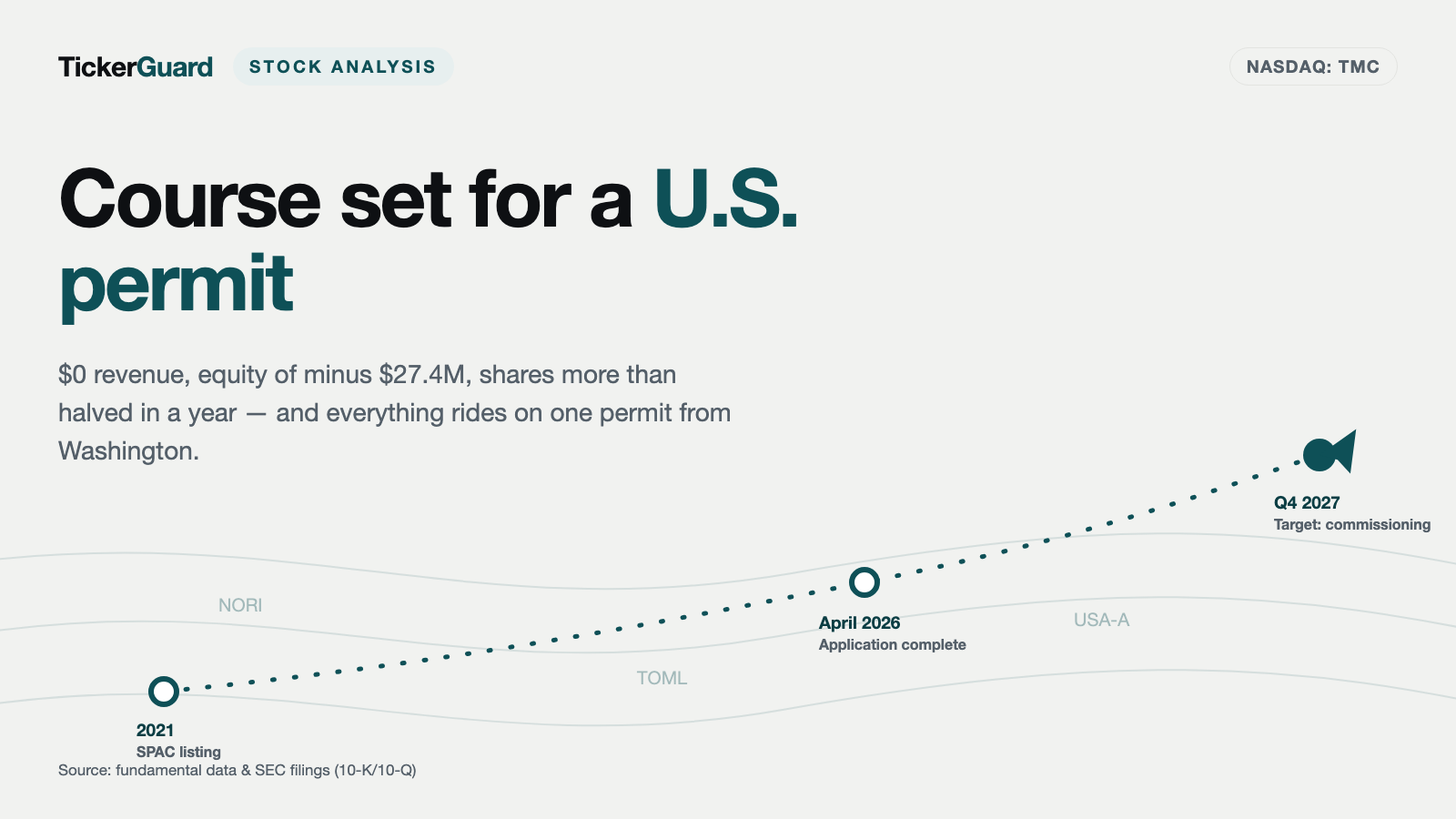
The good news kept coming, and yet shares of TMC the metals company (Nasdaq: TMC) more than halved within a year. The company wants to lift nodules rich in nickel, copper, cobalt and manganese from the floor of the Pacific. In April 2026 the U.S. agency NOAA found its application complete, and in May partner Allseas signed the contract for the production vessel. At the same time, shareholders’ equity stood at minus $27.4 million on June 30, 2026, the U.S. review is running a few months late, and the United Nations seabed authority is scrutinizing both of its licenses. Through a dive mask, everything looks closer than it is.
 Thomas Mücke
Founder & Publisher
Thomas Mücke
Founder & Publisher
As of Today
As of: October 14, 2026
- Closing price
- 2.60 $ -6.60%
- Market Capitalisation
- 1.4 $B
- Growth Score
- 3/10
- AAQS
- 0/10
Price change since October 14, 2026: -1.1%
This analysis has a cut-off date. The Stock Guard tells you when something material changes in the numbers. Reserve your free spot
Chart
Interactive price chart (TradingView).
52-week range: 2.80 $ to 10.70 $ · Last price: 2.60 $ (As of: October 14, 2026)
Note: pure fact-based analysis, not investment advice and not a solicitation to buy or sell. All figures without guarantee.
Anyone who has snorkeled with a dive mask knows the effect: the fish down there looks bigger and closer than it really is. Water bends the light, and the eye falls for it every time, even when you know better. Investors have their own version of this. Call it the dive-mask trap: a big prize below the surface, a few pieces of good news, and payday suddenly seems within arm’s reach.
TMC the metals company is a textbook case. The Vancouver-based company wants to lift nodules containing nickel, copper, cobalt and manganese from the floor of the Pacific, with a permit from the U.S. government rather than from the United Nations. In 2026 the good news kept coming: the U.S. agency NOAA found its application complete, and partner Allseas signed the contract for the production vessel. And yet the share price has fallen by more than half within a year. Today we look at what lies behind the mask, using the reports TMC itself files with the U.S. securities regulator, the SEC. At the end, you decide.
What TMC actually does
On the floor of the Clarion-Clipperton Zone, an abyssal plain in the eastern Pacific between Hawaii and Mexico, billions of rock nodules sit loose on and just below the sediment. These polymetallic nodules contain nickel, copper, cobalt and manganese in a single piece, plus rare earth elements. TMC’s best-known project area, NORI-D, lies about 1,500 miles southwest of San Diego, according to the annual report.
TMC does not collect a single nodule today and has no revenue. The business model is a three-step plan: a converted vessel called Hidden Gem is to pick up the nodules with a collector vehicle on the seafloor and lift them on board through a riser pipe. Onshore, they would be processed into nickel-copper-cobalt intermediates and a manganese ore substitute — first at partners in Japan, later perhaps at a plant of its own in Brownsville, Texas. The vessel technology comes from offshore contractor Allseas, which ran a pilot test in 2022 and has owned about 14.4 percent of TMC’s shares since the July 2026 issuance.
The twist is the legal route. Deep-sea mining in international waters is supposed to be overseen by the United Nations’ International Seabed Authority (ISA), which, per the 10-Q, has to this day not completed its rules for commercial mining. The United States never ratified the UN Convention on the Law of the Sea and has its own 1980 statute, the Deep Seabed Hard Mineral Resources Act. Since April 2025 TMC has pursued this route through a U.S. subsidiary, backed by an executive order from President Trump to speed up permitting.
Formally, TMC is a Canadian company incorporated in British Columbia, but it reports like a U.S. company, with an annual report on Form 10-K and quarterly reports on Form 10-Q. Its fiscal year is the calendar year. TMC went public in September 2021 by merging with a blank-check company, or SPAC, then called Sustainable Opportunities Acquisition Corp.
Company history for investors
-
2021
Listing via a SPAC
On Sept. 9, 2021, DeepGreen merged with Sustainable Opportunities Acquisition Corp. Shareholders began a bet on a business with no revenue and no mining rules.
-
2022
Pilot test in NORI-D
In November 2022 TMC and Allseas successfully completed the pilot test in NORI-D. It showed technically that nodules can be lifted on board.
-
2024
Cash almost gone
At Dec. 31, 2024, only $3.5M was left in cash. Credit lines from CEO Barron, a family fund and Allseas bridged operations.
-
2025
U.S. filing, Korea Zinc, first reserves
NOAA applications in April 2025, $85.2M from Korea Zinc in June, first reserves in August. Partly because of that, the book loss rose to $319.8M.
-
2026
Application complete, Allseas deal, ISA inquiry
NOAA found the USA-A application complete on Apr. 28, the Allseas contract followed on May 11. Meanwhile the ISA is examining both licenses, and a review stage is running a few months late.
How the stock landed on our desk
TMC is not a hit from our value or momentum filters, and it cannot be: with no revenue and no earnings the usual ratios cannot even be computed. It reached the research list through the Reddit mention component of our in-house stock scanner, which ranks names by how often they are discussed in investor forums (as of October 15, 2026). That is an attention signal, not a quality signal. Deep-sea mining, critical minerals and Washington — that is exactly the material forum enthusiasm is made of.
On timeliness: the most recent periodic report is the 10-Q for the quarter ended June 30, 2026, filed on August 13, 2026, the same day as the earnings release. After that came two releases on NOAA procedural steps (August 17 and 19), a Nasdaq notice on the expiry of the listed warrants (September 9), ownership reports (Schedule 13G/A of August 13 and Gerard Barron’s Schedule 13D/A of September 11) and a board change reported on September 29, 2026. All of it is reflected here. Through October 15, 2026, the only further filings were insider reports on equity awards to directors (Forms 3 and 4 of September 16 and October 9, 2026) and the annual conflict minerals report (Form SD of September 29, 2026) — neither changes the picture.
The numbers over the years — given their due
Let’s start with what is genuinely impressive. TMC has turned an exploration project into something that did not exist before: in August 2025 a prefeasibility study for NORI-D declared what the company calls the world’s first mineral reserves for seafloor nodules. Reserves are the most demanding classification — the part of a deposit that can be mined economically under the current plan. Per the 10-Q, the U.S. application areas hold about 1.64 billion tonnes of nodules in measured, indicated and inferred resources, with an estimated 15.5 million tonnes of nickel, 12.8 million tonnes of copper, 2.0 million tonnes of cobalt and 345 million tonnes of manganese.
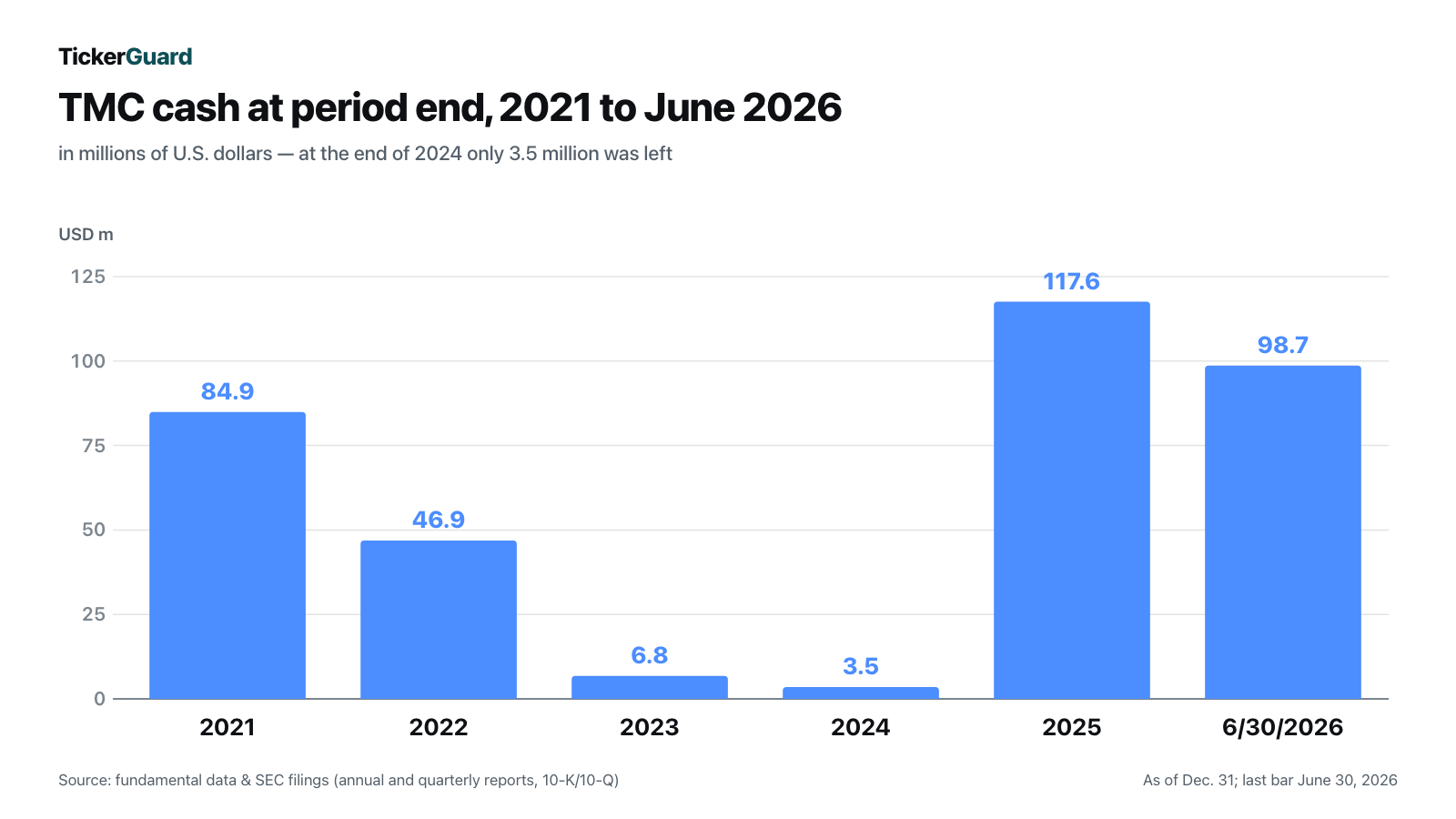
The cash position has turned around, too. At the end of 2024 only $3.5 million was left. In the first half of 2025, financing brought in a net $132.1 million, including $85.2 million from South Korean metals group Korea Zinc. On June 30, 2026, TMC still had $98.7 million, plus an undrawn $44 million credit facility. It had no financial debt at June 30, 2026.
Now the other half. TMC posted a loss every year, and 2025 was the largest yet at $319.8 million. The accumulated deficit since inception reached about $1.03 billion at June 30, 2026. That sounds like a company burning cash like a blast furnace. The actual cash flow tells a different story: operations used only $42.9 million in 2025, less than in any year since 2021.
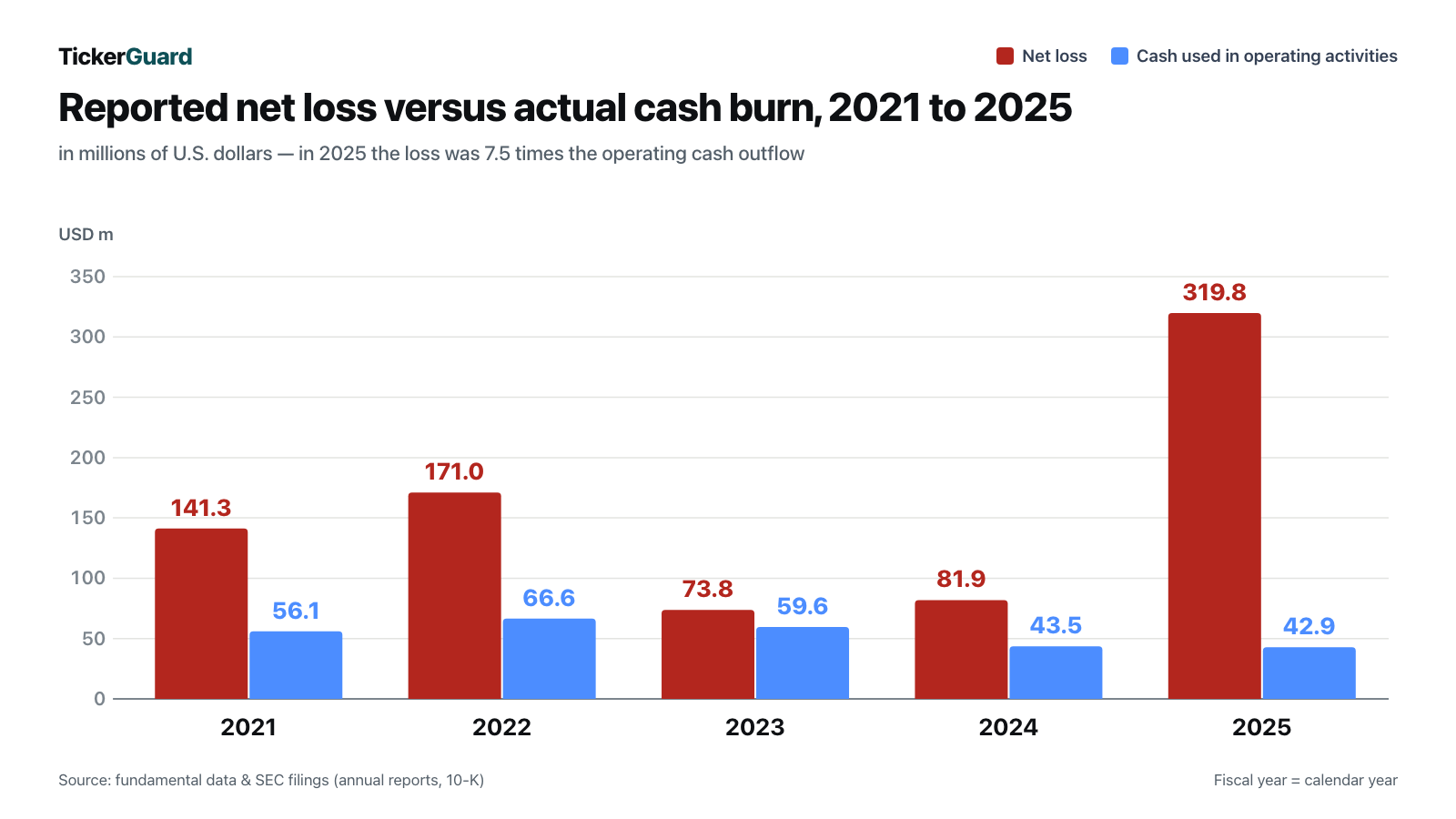
The 2025 gap comes from three large items that cost no cash: $131 million for remeasuring a royalty liability (more on that shortly), a $63.7 million increase in stock-based compensation in general and administrative expenses, and $38.1 million for warrants TMC granted to its sponsoring states, Nauru and Tonga. Rule of thumb: at TMC, the income statement says little about how long the money lasts — that is what the cash flow statement is for.
The pattern continued in 2026. The first-half net loss was $80.7 million, cash used in operations $20.7 million. The second-quarter loss included $37.2 million of charges owed to Allseas — $32.8 million to record deferred costs incurred before March 30, 2026, and $4.4 million of other negotiated costs — plus, separately, a $7.9 million charge from remeasuring the share settlement.
What the filings say — the uncomfortable truths
Here are the passages you won’t find on page one of a press release. All of them come from TMC’s own filings.
Uncomfortable truth No. 1: “Complete” does not mean “approved” — and a review stage is slipping
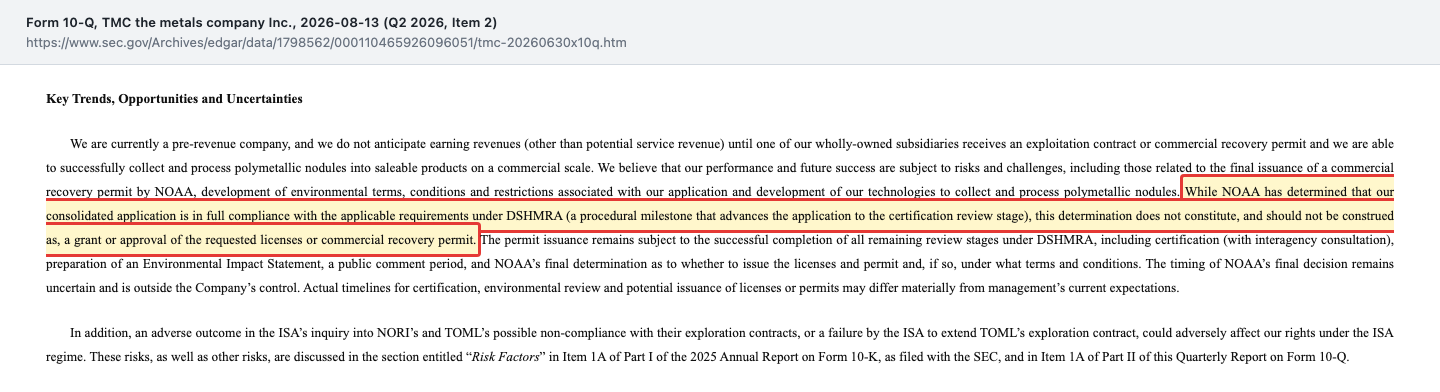
The U.S. process has three stages. First, NOAA, the federal ocean and weather agency, checks whether the application is complete and compliant. Then comes certification, including consultation among several departments. After that come an environmental impact statement, public hearings and, only at the very end, the decision. For the consolidated application covering the USA-A area, TMC cleared the first stage on April 28, 2026. The quarterly report puts that in context itself:
“While NOAA has determined that our consolidated application is in full compliance with the applicable requirements under DSHMRA (a procedural milestone that advances the application to the certification review stage), this determination does not constitute, and should not be construed as, a grant or approval of the requested licenses or commercial recovery permit.”
— TMC the metals company, SEC quarterly report 10-Q for the period ended June 30, 2026, Item 2
There is no statutory deadline for the decision, and the next stage is taking longer than planned. On the day of the quarterly results, CEO Gerard Barron said:
“There has been a delay of a few months in the USA-A consolidated application certification process, but we remain confident that the permit will arrive well in advance of offshore vessel commissioning by the end of 2027, which we believe remains the critical path for production start.”
— Gerard Barron, earnings release of August 13, 2026, Form 8-K, Exhibit 99.1
TMC is further along in its second area, USA-B: NOAA certified that exploration-only application in late May 2026 and announced on August 17, 2026, that it will prepare an environmental impact statement. For a mining permit, though, USA-A is what counts. Rule of thumb: each of these releases is a real step — but a step on a road whose length nobody knows in advance.
Uncomfortable truth No. 2: The better the project, the deeper the equity hole
This is the strangest number in the filings. On June 30, 2026, shareholders’ equity was minus $27.4 million. Put simply: if everything on the balance sheet were sold at book value and every obligation paid, nothing would be left. Yet the largest single liability is not a loan but a royalty liability of $145 million. In 2023 TMC sold a 2 percent royalty on revenue from the NORI area, and that commitment is remeasured at fair value every quarter. When the prefeasibility study declared reserves in August 2025, its value jumped:
“The resulting royalty liability fair value of NORI Areas A to D totaled $145 million, an increase of $131 million in 2025.”
— TMC the metals company, SEC annual report 10-K for 2025, Item 7

Good news about the project thus became bad news on the balance sheet. This is accounting, not cash going out the door: the royalty is only paid once nodules are sold. Today it is held by the listed The Metals Royalty Co. (Nasdaq: TMCR), in which TMC itself owned 22.4 percent at June 30, 2026, and TMC may buy back up to 75 percent of the royalty at a capped return. Still, the number deserves to be taken seriously. Negative equity is a hard criterion for our quality rating, whatever its source. And the mechanism can repeat: if a permit brings production closer, the royalty’s fair value can rise again.
Uncomfortable truth No. 3: Allseas is partner, major shareholder and creditor at once
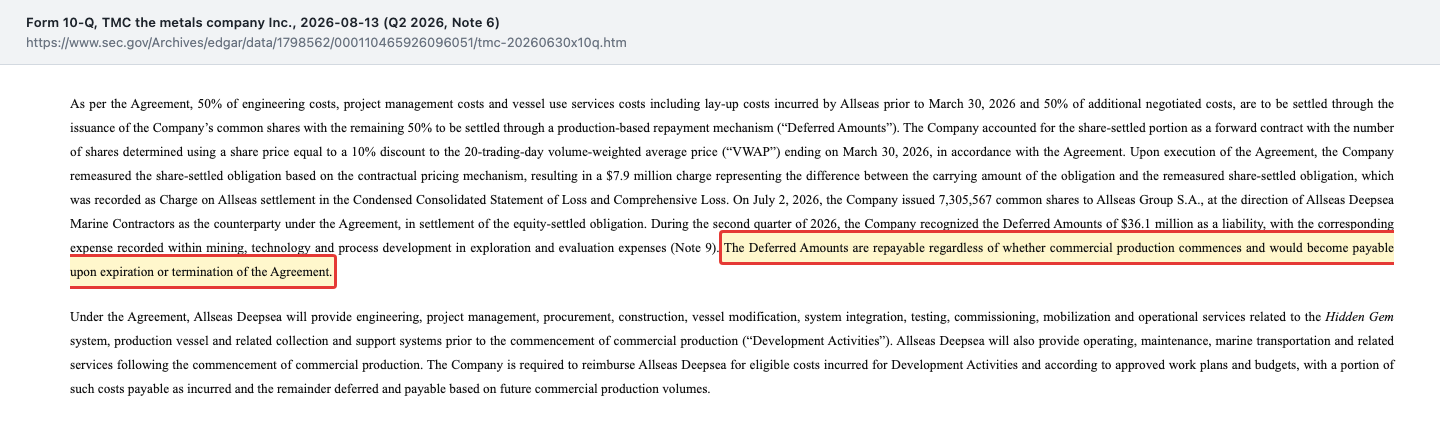
Without Allseas there is no production vessel. On May 11, 2026, the two companies signed the contract to develop and operate the first commercial system, designed for 3.0 million wet tonnes of nodules a year, with commissioning targeted to begin in the fourth quarter of 2027. Costs accrued through March 2026 were split: 50 percent is settled in TMC stock, and 50 percent is deferred and repaid out of future production volumes. For the stock portion, TMC issued 7,305,567 new shares on July 2, 2026, carried at $43.2 million. Per the 10-Q, that amount consists of $32.8 million of accrued costs, $7.9 million from remeasuring the share settlement (issue price at a 10 percent discount to the 20-trading-day volume-weighted average price through March 30, 2026) and $2.5 million of further negotiated costs. The deferred portion comes to $36.1 million. The catch is in Note 6:
“The Deferred Amounts are repayable regardless of whether commercial production commences and would become payable upon expiration or termination of the Agreement.”
— TMC the metals company, SEC quarterly report 10-Q for the period ended June 30, 2026, Note 6
Going forward, TMC pays 50 percent of approved development costs in cash within ten business days of an invoice, with the rest deferred to production. The contract expressly lets TMC postpone work packages if money is short. On June 30, 2026, TMC owed Allseas and its affiliates a total of $83.7 million, of which $43.2 million was settled with the July shares. After that issuance Allseas holds 63.4 million shares, or 14.4 percent. A company that is supplier, major shareholder and creditor all at once carries a lot of weight — and the filings name no second partner for the production vessel.
Uncomfortable truth No. 4: The UN seabed authority is scrutinizing both licenses
Alongside the U.S. route, TMC holds two older ISA exploration contracts through its subsidiaries NORI (sponsored by Nauru, which now calls itself Naoero) and TOML (sponsored by Tonga). These contracts underpin its resource estimates to date. Alongside the U.S. route, the ISA, based in Kingston, Jamaica, is examining both contracts:
“In March 2026, the ISA identified our subsidiaries NORI and TOML as contractors requiring specific attention for possible non-compliance with their exploration contracts.”
— TMC the metals company, SEC quarterly report 10-Q for the period ended June 30, 2026, Part II, Item 1A

TMC disputes the allegations and has taken the matter to the International Tribunal for the Law of the Sea. On July 18, 2026, the tribunal’s Seabed Disputes Chamber prescribed provisional measures, unanimously finding prima facie jurisdiction; jurisdiction over the merits is not prejudged: the ISA must respect due process but may continue its inquiry. Nothing has been decided on the merits; per the 10-Q, a hearing on the merits could come in the second half of 2027 at the earliest. On July 20, 2026, the ISA extended the NORI contract to July 2031 — “without prejudice” to the inquiry. The TOML contract expires on January 11, 2027, before the ISA is scheduled to consider the requested extension in February and March 2027; TMC expects it to be deemed extended from January 12, 2027, under the ISA’s extension procedures until the Council has decided.
Uncomfortable truth No. 5: Twice as many shares as in 2021 — and large equity awards at the top
The road so far has mostly been paid for with shareholders’ ownership. Dilution means your slice of the pie gets smaller because more people are eating from the same pie. At the end of 2021 TMC had 224.4 million shares; on August 11, 2026, it had 441.1 million — almost twice as many. On June 30, 2026, another 28.3 million employee options and 46.2 million restricted stock units (RSUs) were outstanding, plus warrants, of which about 31.4 million remain after the public and private SPAC warrants (24.5 million combined) expired on September 9, 2026. Together that is roughly 105 million potential shares, close to a quarter of today’s count. Another 136 million so-called Special Shares (including options on them) convert into common shares only at prices of $12 and up.
Some of the awards went to directors and consultants. In 2025, stock-based compensation in general and administrative expenses rose by $63.7 million, mainly from RSUs and options granted to directors and consultants in the third quarter of 2025. According to his Schedule 13D/A filed on September 11, 2026, Gerard Barron owns 6.9 percent of the shares, including exercisable options. On top of that he holds 13.3 million RSUs that vest by April 2029 if the share price reaches certain thresholds. Awards tied to share-price thresholds like these show how much weight the share price carries at TMC.
And the capital need is not covered. The 10-Q says so plainly:
“We will, however, need and are seeking additional financing to fund our continued operations over time.”
— TMC the metals company, SEC quarterly report 10-Q for the period ended June 30, 2026, Item 2 (Liquidity and Capital Resources)
TMC considers its funds sufficient for the next twelve months and does not express going-concern doubt. At the first-half 2026 rate of operating cash outflow, the cash would last a little over two years on paper; on top of that come cash payments to Allseas for the production vessel, which the filings do not yet quantify. TMC itself does not expect the money to last until production without fresh funding. For U.S. processing, the August 13, 2026, earnings release says most of the money is to come from the government; until those processes are complete, TMC does not currently intend to pursue other capital market transactions. How a resource project actually gets into construction with a government loan is shown in our analysis of Lithium Americas — a step TMC still has ahead of it.
Valuation: What the market pays for nodules on the seafloor
With 441,135,482 shares (August 11, 2026) and a closing price of $2.63 on October 14, 2026, TMC’s market value is about $1.16 billion. Subtracting $98.7 million in cash leaves an enterprise value of roughly $1.06 billion — before counting the deferred Allseas costs or the royalty liability. There is no price-to-earnings or price-to-sales ratio, and price-to-book is meaningless with negative equity.
So what are you buying? An option. The market pays a little over a billion dollars for the prospect that a U.S. agency grants a mining permit, that a converted vessel collects reliably in the deep sea, that processing plants are found and that metal prices cooperate. Each of these steps is plausible. What they have in common is that none of them is complete yet.
How much sentiment swings shows in the closing prices: $9.61 on October 15, 2025, $6.17 at year-end 2025, $4.43 on June 30, 2026, and $2.63 on October 14, 2026 — the lowest close of the past twelve months. The number of shares for Allseas was set by contract at a 10 percent discount to the volume-weighted average price over the 20 trading days through March 30, 2026 — weeks in which the stock closed between $4.10 and $6.42, well above its October price. According to fundamental data, the average analyst price target is about $10.90 and about 10.6 percent of the float is sold short (retrieved October 15, 2026); per the data source, six analyst ratings stand behind it. An average here means all targets added up and spread evenly — with only six ratings, a single very bullish analyst can pull it up sharply. A gap that wide between target and price mainly shows how far apart opinions are.
Opportunities and risks at a glance
What speaks for the company:
- A huge, studied deposit. About 1.64 billion tonnes of nodules in the U.S. application areas; in August 2025, what the company calls the world’s first reserves for seafloor nodules.
- Political tailwind. A presidential executive order of April 2025 to speed up permitting; nickel is on the U.S. government’s critical minerals list.
- Progress in the U.S. process. USA-A in full compliance since April 28, 2026, USA-B certified in late May 2026, an environmental review for USA-B announced on August 17, 2026.
- Strong partners. Allseas for the vessel, Korea Zinc as an investor, Glencore with offtake rights to half of NORI’s nickel and copper if processed at a TMC-owned facility, Pacific Metals in Japan for processing.
- Manageable cash burn. $98.7 million in cash and a $44 million undrawn credit facility at June 30, 2026, against $20.7 million of operating cash outflow in the first half; no financial debt.
What speaks against it:
- No revenue, no permit. NOAA’s commercial recovery permit is missing, certification for USA-A is running a few months late, and there is no statutory deadline.
- Negative equity. Minus $27.4 million at June 30, 2026, driven by a $145 million royalty liability.
- Dependence on Allseas. One partner for the entire production vessel; $36.1 million of deferred costs are repayable even without production, at the latest when the agreement ends.
- ISA inquiry. Inquiry into both ISA contracts since March 2026, merits still open, TOML contract expires January 11, 2027.
- Dilution. Share count almost doubled since the end of 2021; roughly 105 million more shares possible from options, RSUs and warrants, plus further capital needs.
- Environmental opposition. Deep-sea mining is controversial; per the annual report, groups such as the UN Environment Programme Finance Initiative warn against investing, which can make financing harder.
A human conclusion
Remember the dive mask from the beginning? At TMC the fish is really there: an enormous deposit, a U.S. government that wants to clear the way, a partner building the vessel. Through the mask, though, it looks closer than it is. Between you and payday lie a permit that has not been granted, a review stage already running a few months late, negative equity, an ongoing inquiry by the UN authority and a cash balance that will not last until production without fresh money.
None of that has to go wrong. Pioneers carry an especially high risk — whether it pays off is an open question. The next markers are easy to see: the report for the quarter ended September 30, 2026, certification for USA-A, January 11, 2027, for the TOML contract, and the government funding TMC holds out.
What you make of it is your decision. And that is how it should be.
Sources and data
- Quarterly report (10-Q) for the period ended June 30, 2026, filed August 13, 2026
- Quarterly report (10-Q) for the period ended March 31, 2026, filed May 14, 2026
- Annual report (10-K) for 2025, filed March 31, 2026, auditor Ernst & Young LLP
- Second-quarter 2026 earnings release (Form 8-K of August 13, 2026, Exhibit 99.1)
- Forms 8-K of August 17, 2026 (environmental review USA-B) and August 19, 2026 (publication of the USA-A application)
- Schedule 13D/A of Gerard Barron, September 11, 2026
- All TMC filings with the SEC (CIK 0001798562), last checked October 15, 2026
- Price, analyst and short-interest data: source fundamental data, as of October 14 and 15, 2026
Data as of: company figures as of June 30, 2026, or the date stated; share count as of August 11, 2026; filings through October 9, 2026; prices as of October 14, 2026. Calculated values (market value, enterprise value, cash runway, potential dilution) are our own estimates from the filings cited.
Note: This article is journalistic commentary, not investment advice and not a solicitation to buy or sell securities. Shares of pre-revenue resource developers are especially volatile; a total loss of the capital invested is possible. Positions held by the operator are disclosed daily; where one exists, it appears as a notice at the top of this deep dive.
Key figures at a glance
All monetary figures in millions of $; earnings per share as reported.
| Metric | 2021 | 2022 | 2023 | 2024 | 2025 |
|---|---|---|---|---|---|
| Revenue | 94.4 | 141.8 | 72.0 | 0.0 | 0.0 |
| Operating Income (EBIT) | 149.6 | -174.1 | -72.4 | -81.3 | -140.1 |
| Net Income | -141.3 | -171.0 | -73.8 | -81.9 | -319.8 |
| Net Margin | -149.7% | -120.5% | -102.4% | – | – |
| Earnings Per Share | -0.69 $ | -0.71 $ | -0.26 $ | -0.25 $ | -0.83 $ |
Source: fundamental data & SEC filings (annual and quarterly reports, 10-K/10-Q)
Our Bottom Line at a Glance
- Deposit positive
- About 1.64 billion tonnes of nodules in the U.S. application areas with an estimated 15.5 million tonnes of nickel; in August 2025 the NORI-D prefeasibility study declared what the company calls the first reserves for seafloor nodules.
- Permit negative
- The USA-A application has been in full compliance since April 28, 2026, but per the 10-Q it is not approved; the company said on August 13, 2026, that certification is running a few months late, and there is no statutory deadline.
- Balance sheet negative
- Shareholders’ equity of minus $27.4 million at June 30, 2026, mainly due to a $145 million royalty liability; no financial debt.
- Liquidity neutral
- $98.7 million in cash and a $44 million undrawn credit facility at June 30, 2026, against $20.7 million of operating cash outflow in the first half; per the 10-Q that covers twelve months, but fresh money is needed over time.
- Partners and dependence neutral
- Allseas builds the production vessel and owns 14.4 percent; $36.1 million of deferred costs are repayable even without production, at the latest when the agreement ends. Korea Zinc, Glencore and Pacific Metals support financing, offtake and processing.
- Dilution and pay negative
- Share count up from 224.4 million (end of 2021) to 441.1 million (August 11, 2026); in 2025 stock-based compensation in general and administrative expenses rose by $63.7 million.
TMC the metals company controls, by its own account, the world’s largest undeveloped resource of several critical metals, enjoys political tailwind in the U.S. and has an experienced partner in Allseas for its production vessel. Against that stand a company with no revenue and no mining permit, negative shareholders’ equity of $27.4 million at June 30, 2026, a delay in the U.S. process, an ongoing inquiry by the UN seabed authority and a share count that has almost doubled. At the October 14, 2026, close of $2.63, TMC is valued at about $1.16 billion. Not investment advice.
What Our Rating Means
Substance risk
We found at least one documented issue that threatens the company itself — regardless of how the stock is currently valued.
Red here is not about the deposit and not about the share price. It reflects documented risks to the substance of the business: shareholders’ equity was negative at $27.4 million on June 30, 2026, the business depends mainly on a U.S. permit that has not been granted and on a single partner for the production vessel, and the UN seabed authority is examining both exploration contracts. In fairness, the negative equity stems mainly from a book valuation, and at the first-half 2026 rate of operating outflow the $98.7 million cash balance lasts a little over two years on paper — excluding the not yet quantified cash payments to Allseas. A permit could change the picture quickly; until then TMC remains a bet on regulators and capital markets. The decision is yours.
A journalistic assessment by our editorial team at the time of the deep dive, based on public sources — not investment advice and not a solicitation to buy or sell. Your personal circumstances (investment goals, risk capacity, taxes) cannot be taken into account. What our levels mean, how verdicts are formed, and what conflicts of interest exist →
Worth Noting
- This analysis was triggered by the Reddit mention component of our in-house stock scanner (as of October 15, 2026). There is no hit from the value or momentum filters, and there cannot be one: TMC has neither revenue nor earnings.
- Identity checked against EDGAR: CIK 0001798562, formerly Sustainable Opportunities Acquisition Corp. (until Sept. 9, 2021), Nasdaq. The fundamental-data feed lists a different CIK; the SEC filings govern. The Form 25 of Sept. 9, 2026, covers only the expired warrants, not the common shares.
- Reviewed: 2025 annual report on Form 10-K (Mar. 31, 2026), 10-Qs for the periods ended Mar. 31 and June 30, 2026, Forms 8-K of Aug. 13, Aug. 17, Aug. 19 and Sept. 29, 2026, Schedule 13D/A of Sept. 11, 2026, Forms 3 and 4 of Sept. 16 and Oct. 9, 2026. Earnings call transcripts were not reviewed.
- Calculated values are our own estimates: market value from 441,135,482 shares times the Oct. 14, 2026, close (cross-checked against the fundamental-data market value at the prior day’s price: consistent); cash runway from $98.7 million divided by the first-half 2026 operating cash outflow; potential dilution excluding Special Shares and expired warrants.
Stock Watch
This analysis is as of October 15, 2026. Stock Watch will tell you what's changed at TMC since then.
Later $1 a month per stock — signing up is free, and you'll be the first to know when it launches.
The full analysis as a PDF for later
We will send you this analysis as a PDF — to print, file away, and read at your own pace. And we will add you to the free Stock Watch list for TMC the metals company Inc (TMC), so you hear about it when something material in this analysis changes.
Frequently Asked Questions
TMC plans to collect polymetallic nodules from the seafloor of the Clarion-Clipperton Zone in the Pacific and recover nickel, copper, cobalt and manganese from them. Partner Allseas is converting the production vessel, with commissioning targeted from the fourth quarter of 2027. TMC has no revenue yet.
No. On April 28, 2026, NOAA found the consolidated application for the USA-A area to be in full compliance. Per the 10-Q, that is expressly not a permit. Certification, an environmental impact statement and a public comment period still follow; the company says certification is running a few months late.
It was minus $27.4 million on June 30, 2026. The main reason is a $145 million royalty liability: in 2023 TMC sold a royalty on the NORI area. Its fair value rose by $131 million in 2025 after the prefeasibility study and was booked as a loss without any cash changing hands.
On June 30, 2026, TMC had $98.7 million in cash and an undrawn $44 million credit facility. Operations used $20.7 million in the first half of 2026. TMC considers its funds sufficient for twelve months but, per the 10-Q, will need additional financing over time.
Allseas develops and will operate the Hidden Gem production vessel and owns about 14.4 percent of TMC after the July 2, 2026, share issuance. TMC pays half of development costs in cash and defers the rest. Per the 10-Q, $36.1 million of deferred costs must be repaid even if production never starts.
The United Nations’ International Seabed Authority granted exploration contracts to TMC subsidiaries NORI and TOML. Since March 2026 it has been examining possible non-compliance, and TMC is contesting the process before the International Tribunal for the Law of the Sea. NORI’s contract runs to July 2031; TOML’s expires on January 11, 2027.
The share count rose from 224.4 million at the end of 2021 to 441.1 million on August 11, 2026. Options, RSUs and remaining warrants could add roughly 105 million more shares. On top of that come Special Shares, which convert into common shares only at prices of $12 and up.
Found an error?
Did you spot a factual error, an outdated number, or a typo in this deep dive? Let us know briefly — your report goes straight to the editorial team.