Medios: €2 Billion in Revenue, €15 Million in Profit — and a Book Value Made Almost Entirely of Acquisition Assets
Medios supplies specialty pharmacies with expensive specialty drugs and compounds cancer infusions: just over €2 billion in revenue in 2025, while the stock trades below half its book value. We read the 2025 annual report, the 2026 half-year report and every mandatory disclosure through October. On the stock market, Medios is worth about €252 million — less than the €360.6 million of goodwill on its own balance sheet.
 Thomas Mücke
Founder & Publisher
Thomas Mücke
Founder & Publisher
Chart
Interactive price chart (TradingView).
Note: pure fact-based analysis, not investment advice and not a solicitation to buy or sell. All figures without guarantee.
Do you know that tingle when something is available “below value”? A stock trading at half its book value promises exactly that: one euro of equity for 50 cents. Psychologists call the mechanism behind it the anchoring effect. The first number we see sets the yardstick — and anything below it feels like a bargain. Here, the anchor is called “book value.”
At Medios AG of Berlin, that anchor looks particularly tempting. The company booked just over €2 billion in revenue in 2025, has grown for ten years, sits in Germany’s SDAX small-cap index — and at the October 14, 2026 close of €10.26, the market values it at only about €252 million. The balance sheet shows a little over €520 million of equity. A pricing error by the market? Let’s make a deal: before we talk about “cheap,” let’s look together at what that book value is made of and how much of the €2 billion in revenue actually reaches shareholders.
The tension at the heart of this analysis: Medios grows revenue reliably, is soundly financed and makes money. At the same time, margins are wafer-thin, 2025 guidance was missed and 2026 guidance cut, cash flow is weakening, and the book value that makes the stock look so cheap consists almost entirely of acquisition premiums already paid. In the end, you decide.
What Medios actually does
Medios operates in a corner of healthcare most people never see: the supply of very expensive specialty drugs, for example against cancer, multiple sclerosis or hemophilia. The company calls itself a specialty pharma provider. In everyday terms, it is supplier, lab and logistics partner for around 900 specialized pharmacies in Germany. In 2025 the business had three parts:
- Pharmaceutical Supply (2025 revenue: €1,688.8 million) — wholesale. Medios buys high-priced specialty drugs from manufacturers and delivers them to pharmacies from three central warehouses in Berlin, Hamburg and Mannheim. Lots of revenue, little margin: according to the annual report, the gross margin was 3.8 percent in 2025.
- Patient-Specific Therapies (€220.1 million) — manufacturing. In cleanroom labs, Medios compounds infusions for individual patients on behalf of pharmacies, such as chemotherapies dosed by body weight and body surface area. According to the company, it made 426,000 such preparations in Germany in 2025.
- International Business (€169.2 million) — the Ceban group, acquired in June 2024, with manufacturing and pharmacy supply in the Netherlands, Belgium and Spain. In the Netherlands, Medios says it is the market leader in pharmaceutical compounding, the preparation of medicines to prescription.
Medios was founded in 2015 and went public in 2016. Since then, according to the letter from the executive board, revenue has grown from around €100 million to more than €2 billion, largely through acquisitions. At the end of 2025 the group had 982 employees.
At its Capital Markets Day on September 29, 2026, management announced the next overhaul: three segments become two — Specialty Pharma Supply (wholesale) and Compounding (manufacturing in Germany and Europe). According to the presentation, compounding contributed 19 percent of group revenue in 2025 but about half of the operating segments’ EBITDA pre (before head-office costs); future investment is to go there. On October 1, 2026, Medios closed the purchase of 74 percent of Caesar & Loretz (Caelo) of Hilden, a supplier of active ingredients and excipients for pharmacies with expected annual revenue of around €40 million.
Company history for investors
-
2016
IPO
A year after its founding, Medios goes public. For shareholders, an entry into a then-small specialist with revenue of around €100 million.
-
2021
Cranach Pharma and capital increase
With the acquisition of Cranach Pharma (€104m of goodwill) and a cash capital increase with gross proceeds of about €72m (December), revenue jumps past €1 billion.
-
2024
Acquisition of the Ceban group
Purchase price about €259m in cash and new shares, financed from existing cash and a credit line. Medios becomes European; the balance sheet has since carried about €156m of goodwill from Ceban alone.
-
2025
Buyback and board changes
Buyback of 1 million shares at €12.50; the CEO and COO announce their departures. EBITDA pre of €93.1m falls short of guidance.
-
2026
Guidance cut, new strategy
Earnings guidance cut on 07/28, first-half cash flow halved, Ambition 2031 at the Capital Markets Day, Caelo deal closed on 10/01. Close on 10/14: €10.26.
How the stock landed on our desk
Medios made our research list via the forum hot list of wallstreet-online, the ranking of the most-discussed stocks among German retail investors (as of October 14, 2026). That is a signal of attention, not of quality. It was not prompted by a hit from our in-house stock scanner.
The key metrics on our German sister site (as of October 14, 2026) paint a mixed picture. The Piotroski score, a health check of nine yes-or-no questions on profit, cash flow, debt and efficiency, stands at 5 out of 9. That is okay, not good; a truly healthy company scores 7 to 9. The Altman Z″, an early-warning gauge for insolvency risk, sits in the safe zone at 3.26. And a price-to-book ratio of about 0.5 is the anchor this article is about.
Medios is a German issuer and does not report to the U.S. securities regulator, the SEC. This analysis is based on its mandatory reports under German law: the 2025 annual report, the first-quarter statement and the 2026 half-year financial report of August 12, 2026 (the latest periodic report), plus every ad hoc announcement, voting rights notification and managers’ transaction disclosure through October 14, 2026, and the Capital Markets Day presentation. We did not review earnings call transcripts for this analysis. The next quarterly statement is scheduled for November 10, 2026.
The numbers over the years — given their due
First, what genuinely impresses. Group revenue rose from €517 million (2019) to €1,357 million (2021) and €2,078.7 million (2025). EBITDA pre — operating profit before depreciation and amortization, interest, taxes and certain special items — grew from €17.7 million to €93.1 million over the same period, and the margin from 3.4 to 4.5 percent. In 2025, organic growth, i.e. excluding acquisitions, was 7.0 percent for revenue and 2.7 percent for EBITDA pre. In the first half of 2026, revenue of €1,074.9 million topped €1 billion in a half-year for the first time; all three segments grew organically.
The balance sheet is solid, too. The equity ratio stood at 57.0 percent on June 30, 2026. Of a €125 million term loan taken out in 2024, €87.5 million was outstanding, and €70 million of a €100 million revolving credit facility was drawn, against €83.2 million in cash. At its Capital Markets Day, Medios put net debt at 1.32 times EBITDA as calculated under its loan agreements (the half-year press release and presentation give 1.4 under their own definition); its banks allow 3.0 times. In 2025, Medios spent €12.6 million to buy back one million of its own shares at €12.50. And on August 12, 2026, the day of the half-year report, CFO Stefan Bauerreis bought shares worth €38,948 at an average of €11.13.
So much for the good news. Now for what lies behind it.
What the reports say — the uncomfortable truths
What follows is in the annual report, the half-year report and the mandatory disclosures — you just have to read further back.
Uncomfortable truth No. 1: Most of the billions are pass-through revenue — and depend on one supplier
€2 billion in revenue sounds like a big company. But 81 percent of it, €1,688.8 million, comes from wholesale. There, Medios buys an expensive drug and sells it on with a small markup. The segment’s gross profit was €70.3 million in 2025, with a gross margin of 3.8 percent according to the annual report; EBITDA pre was €52.5 million, a margin of 3.1 percent on revenue from external customers. In the first half of 2026 that margin fell to 2.7 percent. A rule of thumb: revenue that merely passes through your books is size, not profit.
How vulnerable this business is appears in the risk report:
“In the Pharmaceutical Supply segment, there is currently a high degree of dependence on one supplier in terms of earnings. Should the purchasing conditions with this supplier change in the future, this would have a significant impact on the earnings situation of the segment and thus of the Group.”
— Medios AG, Annual Report 2025, risk report, section “Dependence on suppliers,” page 145
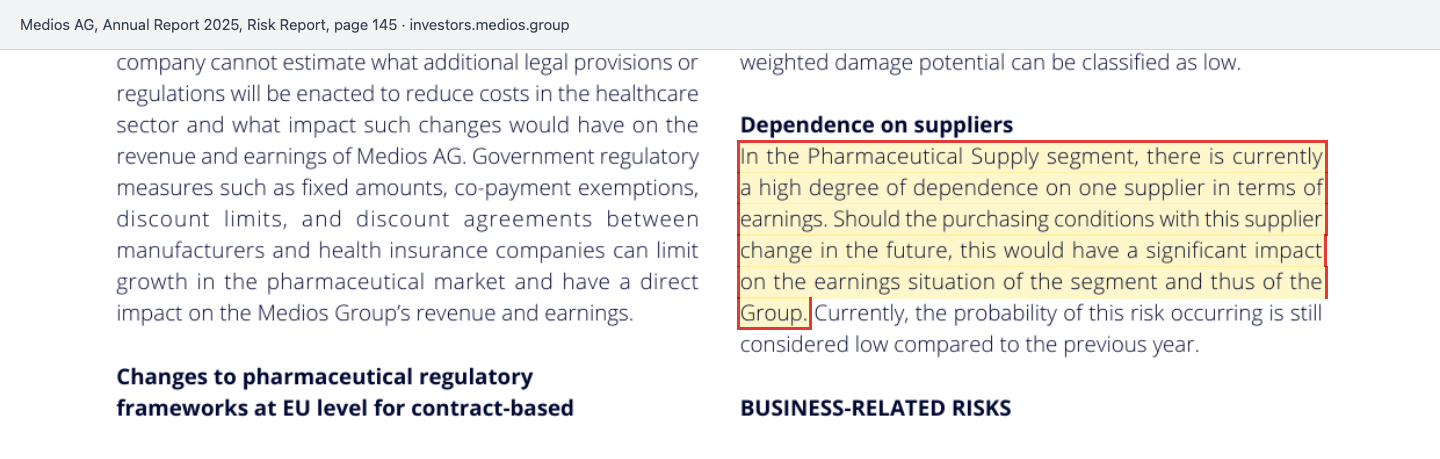
Imagine your neighbor telling you his store is doing great — and mentioning in passing that his profit mostly depends on the discounts of a single wholesaler. That is what this says. To be fair: Medios considers the risk unlikely. Still, it is notable that the section was not yet in the 2024 annual report. But the segment with this dependence delivered about half of the operating segments’ EBITDA pre in 2025 (€52.5 million of €103.9 million before head-office costs).
Uncomfortable truth No. 2: “Pre” is a stretchy word
Medios steers and communicates with EBITDA pre: earnings before interest, taxes, depreciation and amortization, additionally adjusted for “special items.” The company decides which items those are — and the list grew. According to the Capital Markets Day presentation of September 29, 2026, adjustments totaled €2.0 million (2020), €3.8 million (2021), €3.7 million (2022), €8.1 million (2023), €16.0 million (2024), €9.0 million (2025) and €5.4 million in the first half of 2026. They include costs of introducing a new ERP software system (2025: €5.1 million), one-time costs of executive board changes (€1.5 million) and payments for acquired manufacturing volumes (2024: €6.2 million). For 2026, according to the press release of March 26, 2026, another category was added: one-time expenses for efficiency measures.
How far it is from adjusted to actual profit shows in the 2025 math:
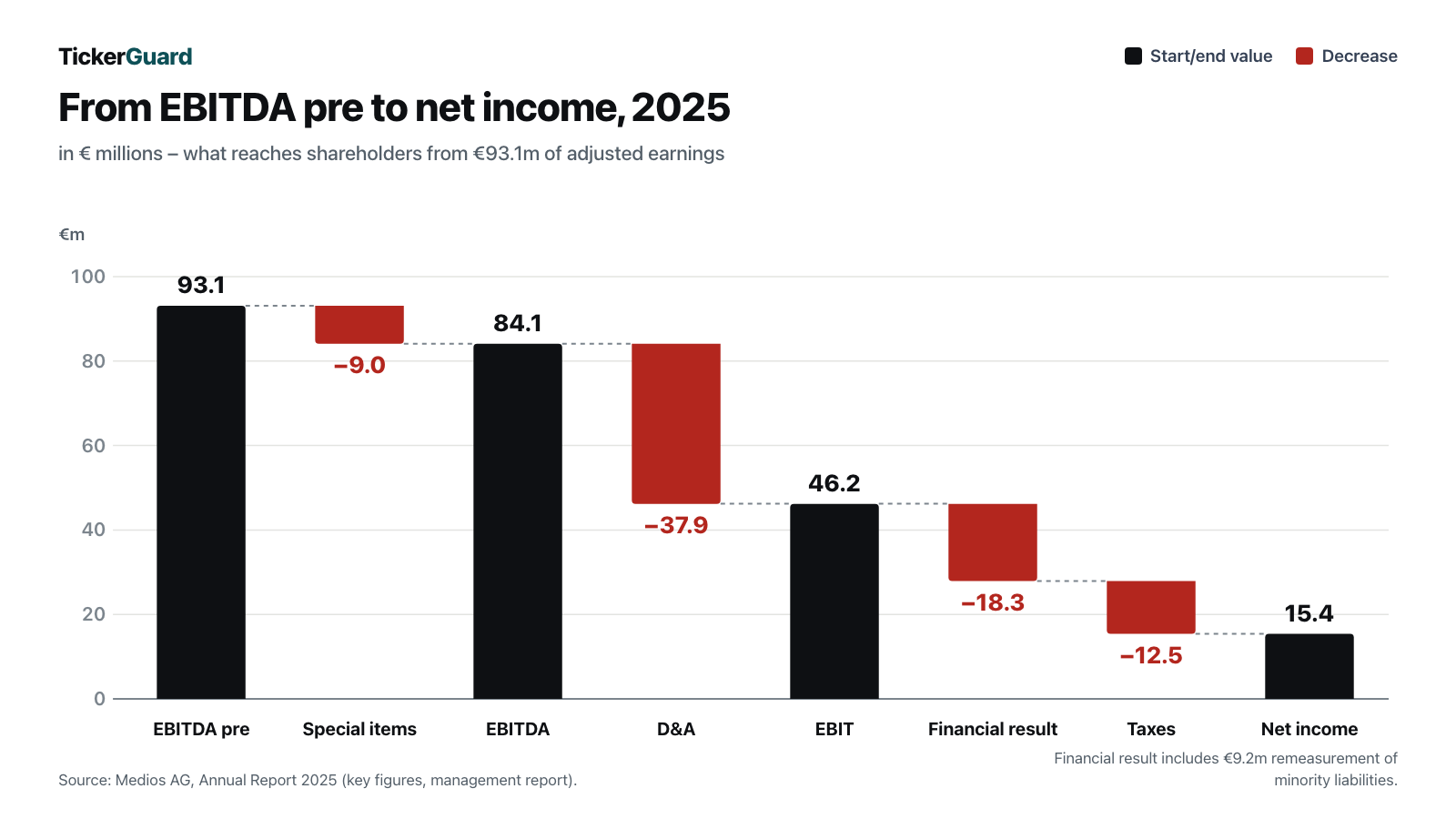
Three items eat most of it. Depreciation and amortization of €37.9 million include €24.3 million of scheduled amortization on customer relationships from acquisitions. The financial result contains €9.2 million from remeasuring liabilities to minority shareholders from the Ceban deal. And the tax rate was 44.9 percent, rising to 45.3 percent in the first half of 2026. The “adjusted earnings per share” Medios also reports adds back the special items, the purchase-price-allocation amortization and that remeasurement (net of the related taxes), arriving at €1.94 for 2025 — reported earnings per share were €0.61.
Notably, management is now correcting course itself:
“Regarding transparency of earnings, Medios is moving from ‘EBITDA pre’ to a newly defined ‘EBITDA adjusted’. Going forward, adjustments will be limited to two clearly defined categories – M&A expenses and restructuring costs. […] On the new definition, the 2025 EBITDA adjusted amounted to €87 million (4.2% margin)”
— Medios AG, press release of September 29, 2026 on the Capital Markets Day
Under the narrower definition, 2025 earnings shrink from €93.1 million to €87 million. That is honest and welcome — but it also shows how much used to sit “before” the bottom line.
Uncomfortable truth No. 3: Guidance missed, then cut
For 2025, Medios had guided to EBITDA pre of around €96 million and delivered €93.1 million; the annual report calls that “slightly below” the forecast and points to the international business. For 2026, the company held out €94 million to €102 million on March 26, 2026. That day, the stock fell from €13.60 to €11.74. On July 28, 2026, an ad hoc announcement cut the range to €88–92 million while raising the revenue target to €2.10–2.16 billion. The half-year report gives the reasons:
“The adjustment to the earnings forecast is primarily attributable to the ongoing decline in prices for high-margin products in the Pharmaceutical Supply segment, as well as to a less favorable business outlook in the medical cannabis sector as a result of the Statutory Health Insurance Contribution Rate Stabilization Act.”
— Medios AG, Half-Year Financial Report 2026, risk, opportunity and forecast report, page 12
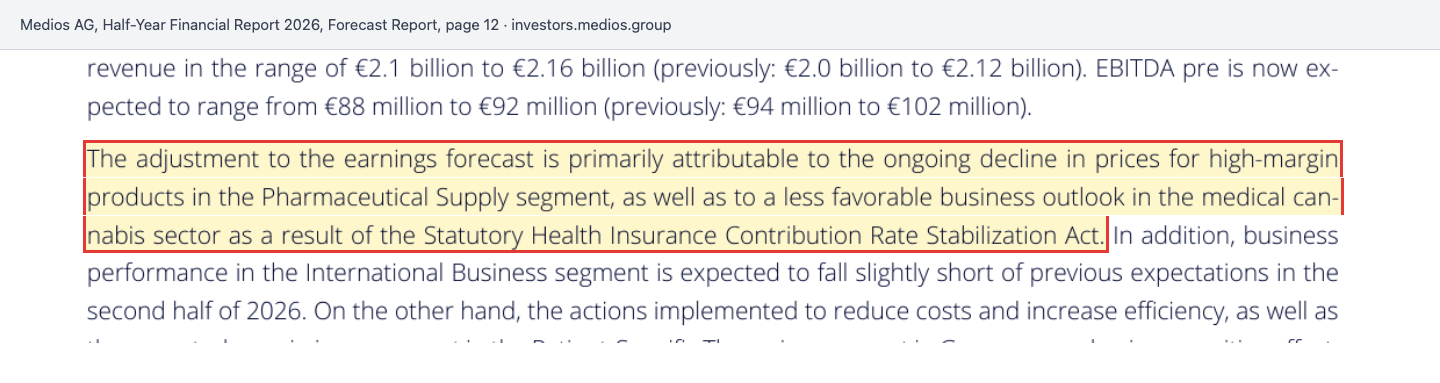
The cannabis episode shows how quickly rules can change. In early 2026, Medios entered the medical cannabis market, with exclusive distribution rights for products of the Dutch producer Bedrocan in Germany, Spain, Belgium, Italy and Austria. A few months later, the German parliament passed the Statutory Health Insurance Contribution Rate Stabilization Act, which, according to the press release of July 28, 2026, excludes cannabis flowers from reimbursement by statutory health insurers going forward. Price regulation also bites in infusions: measures to control prices have applied since November 2025 and pushed the gross margin of manufacturing down to 23.2 percent in the first half of 2026 (prior year: 23.7 percent). Medios lives in a market where the state co-determines prices — that is protection and risk at the same time.
The company is aware of the trust problem. Under “Rebuilding Trust,” the Capital Markets Day presentation of September 29, 2026 lists as a goal, verbatim: “Improve reliability (‘Deliver what we promise’).”
Uncomfortable truth No. 4: Cash flow is not keeping pace with growth
Profit on paper is one thing, money in the bank another. Cash flow from operating activities fell from €73.7 million (2024) to €52.3 million (2025), mainly because more money was tied up in receivables: they rose by €22.1 million to €142.7 million in 2025. The first half of 2026 brought another decline:
“Cash flow from operating activities amounted to €11.2 million in the first half of 2026 (H1 2025: €23.4 million), representing a decrease of €12.2 million, or 52.1%, compared with the prior-year figure.”
— Medios AG, Half-Year Financial Report 2026, financial position, page 10
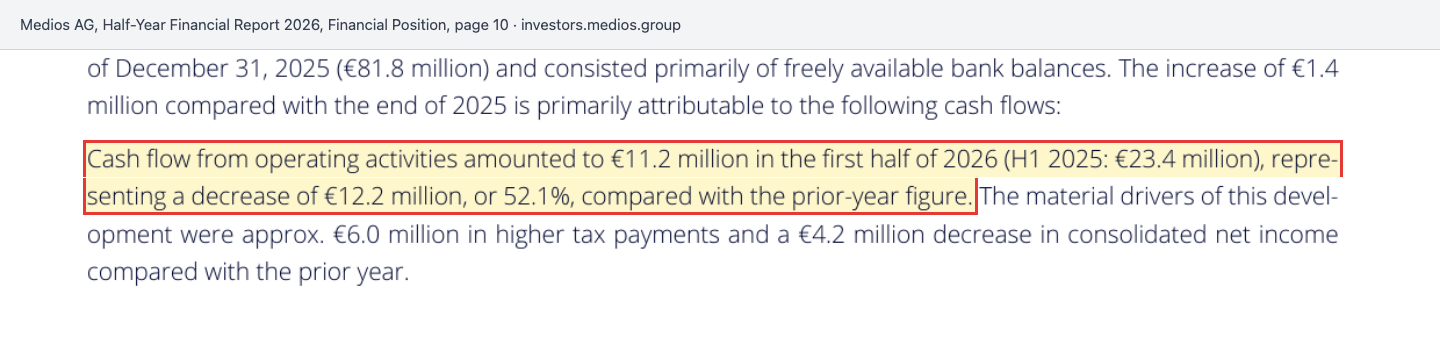
After €8.1 million of capital expenditure, free cash flow before acquisitions in the first half of 2026 was €3.1 million, down from €20.5 million a year earlier. Receivables rose again since year-end, by €31.7 million. For full-year 2025, free cash flow before acquisitions was €44.0 million; €10.0 million of interest and €5.1 million of lease repayments still had to come out of that. A wholesaler that grows faster has to pre-finance more inventory and receivables. Here, growth costs money first.
Uncomfortable truth No. 5: Book value is mostly goodwill
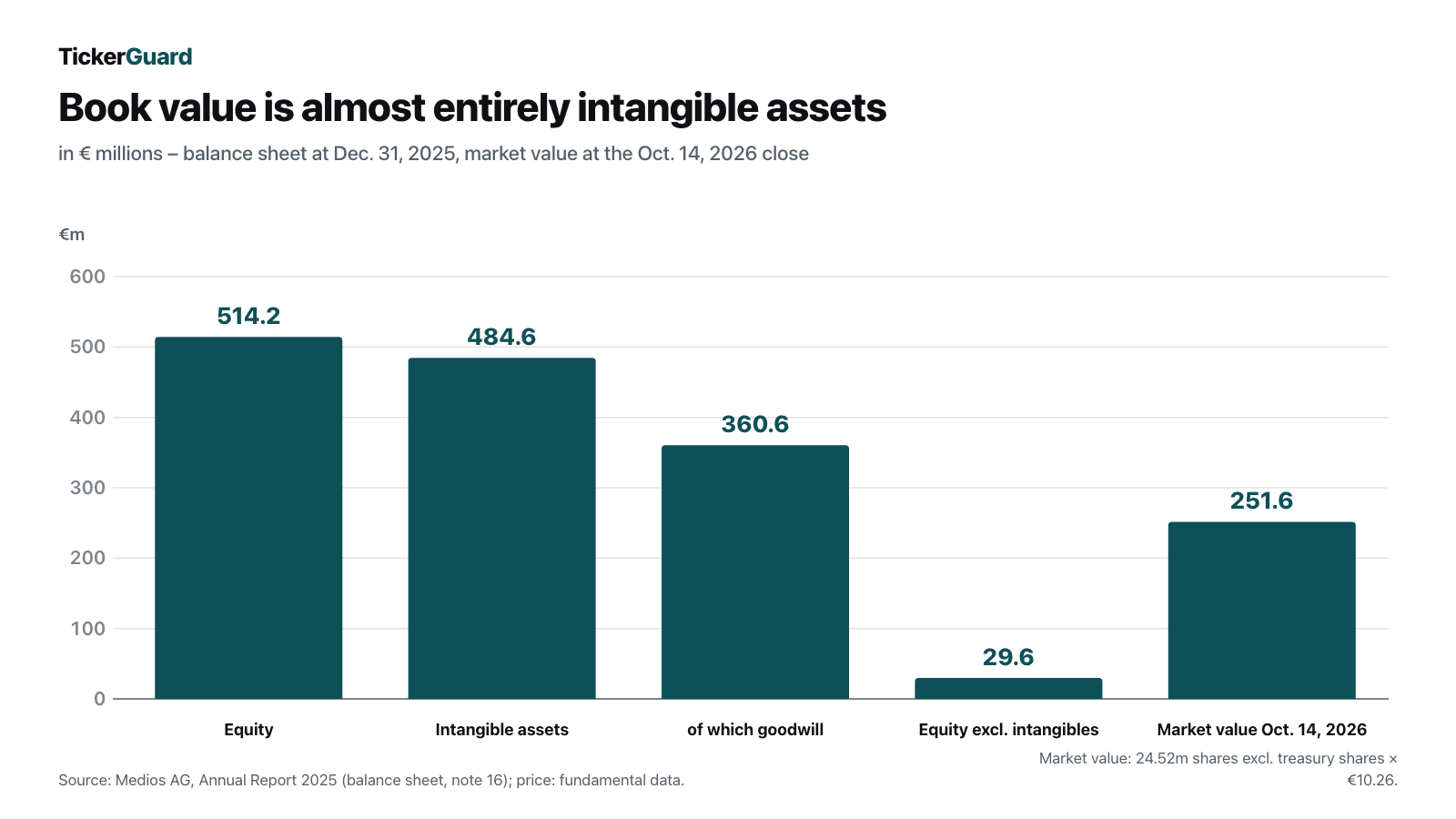
Now to the anchor from the start. At the end of 2025, the balance sheet showed €514.2 million of equity. On the asset side sit €484.6 million of intangible assets: €360.6 million of goodwill and €117.7 million of customer relationships, both the result of acquisitions. Goodwill is the part of a purchase price that exceeds the tangible assets an acquired company brings along — paid for expected future profits. Strip out the intangibles and €29.6 million of equity remains.
The largest single item stems from the most recent big acquisition:
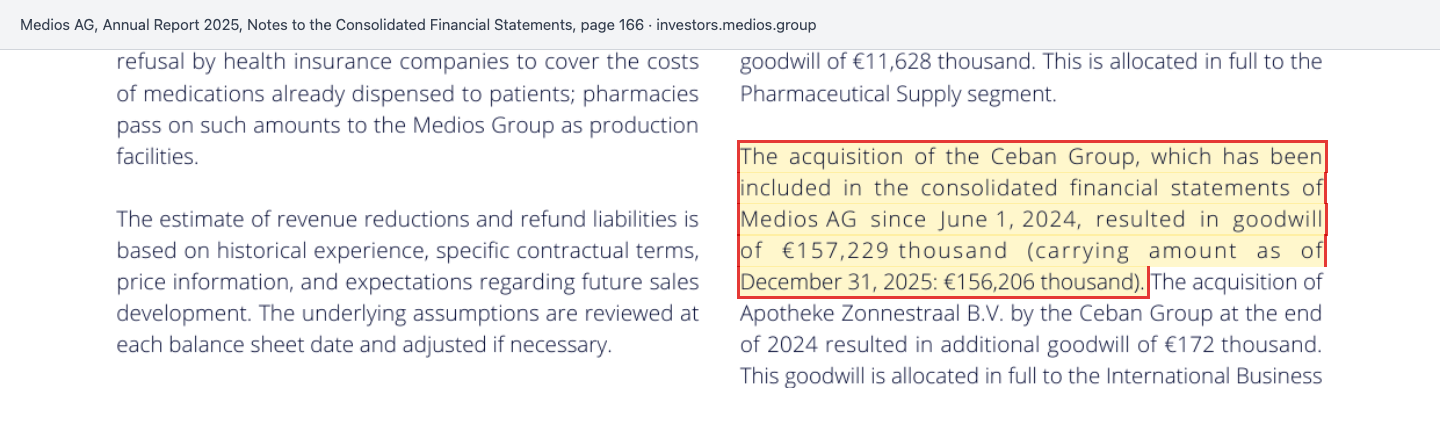
“The acquisition of the Ceban Group, which has been included in the consolidated financial statements of Medios AG since June 1, 2024, resulted in goodwill of €157,229 thousand (carrying amount as of December 31, 2025: €156,206 thousand).”
— Medios AG, Annual Report 2025, notes to the consolidated financial statements, page 166
According to the ad hoc announcement of March 18, 2024, Medios paid about €259 million for Ceban: €235.3 million in cash and 1.7 million new shares worth about €23.9 million. At the time, Medios expected Ceban to post revenue of about €160 million and adjusted EBITDA of about €29 million for 2023. The International Business segment, which houses Ceban, generated €169.2 million of revenue and €29.1 million of EBITDA pre in 2025; so a year and a half after the deal, the segment earns about what Medios had already expected Ceban to earn for 2023. For the second half of 2026, Medios expects business there to fall “slightly short of previous expectations.” The 2025 impairment test showed no need for a write-down; management assumed medium-term revenue growth of about 4 percent a year for this unit and an after-tax discount rate of 5.835 percent.
What does that mean for the anchor? A price-to-book ratio of about 0.5 compares the market value with a book value that consists of more than 90 percent paid-for expectations about the future. The market values Medios at less than the goodwill alone on its books. That may be an overreaction — or a verdict on what those acquisitions are worth today.
Uncomfortable truth No. 6: An executive board in flux
Between May 2025 and September 2026, four of the five members who sat on the executive board in early 2025 announced their departure; three have already left. On May 12, 2025, Medios announced via ad hoc release that CEO Matthias Gärtner would step down at his own request and that COO Mi-Young Miehler would leave on June 30, 2025. Thomas Meier has led the group since February 1, 2026. CFO Falk Neukirch left at his own request in March 2026, succeeded by Stefan Bauerreis on April 15, 2026. On September 14, 2026, Medios announced that Christoph Prusseit, responsible for the German business, would not renew his contract running to July 2027 and would hand over his duties at year-end. One-time costs of the board changes came to €1.5 million in 2025.
A new board can bring fresh air, and the switch to two segments clearly bears its signature. But new strategies from new executives are not yet results. Whether “Medios Next Level” works will show in the numbers for 2027 at the earliest.
Valuation: what the market pays for Medios
At the Xetra close of €10.26 on October 14, 2026 and 24.52 million shares outstanding (25.51 million issued minus 986,362 treasury shares), Medios is worth about €252 million. Based on the 2025 figures, that implies:
- a price-to-sales ratio of about 0.12 — not very meaningful for a thin-margin wholesaler;
- a price-to-earnings ratio of just under 17 on reported earnings per share of €0.61, but only about 5 on adjusted earnings of €1.94 — which of the two is closer to the truth is exactly the question from truth No. 2;
- a price-to-book ratio of about 0.48 (equity on June 30, 2026: €523.5 million), while equity excluding intangible assets was only about €51 million on that date;
- a free cash flow yield of about 17.5 percent based on 2025 (€44.0 million), or about 11.5 percent after interest and lease payments (about €29 million). In the first half of 2026, however, free cash flow was only €3.1 million.
Management is looking at these numbers too: at the Capital Markets Day it called share buybacks a preferred option given the “current valuation” of the group on the stock market, and the annual general meeting approved a new authorization on June 10, 2026. No buyback under that authorization had been announced as of October 14, 2026. Medios pays no dividend. By 2031, Medios wants to lift revenue to about €3.1 billion, about €700 million organically and about €300 million through compounding acquisitions, and double EBITDA adjusted to about €170 million. It budgets about €325 million of financial headroom for acquisitions through 2031 — more than today’s market value.
The view of the pros: according to the investor relations site, five firms cover the stock (Berenberg, Deutsche Bank, Metzler, Montega, Warburg). According to fundamental data, the average price target stood at €20.25 on October 14, 2026. Average here means all price targets added up and divided by their number; a single very high or very low target moves it noticeably. Price targets are opinions, not evidence.
What it looks like when a healthcare distributor fights thin margins and heavy debt is shown in our Accendra Health analysis. And how risky a cannabis business becomes when the rules change, in our Canopy Growth analysis.
Opportunities and risks at a glance
What speaks for Medios:
- Reliable revenue growth. From €517 million (2019) to €2,078.7 million (2025), up 8.4 percent in the first half of 2026, organically in every segment.
- Solid balance sheet. Equity ratio of 57.0 percent and net debt at 1.32 times EBITDA (June 30, 2026), term loan being repaid in scheduled installments.
- Structural growth market. According to IQVIA, specialty drugs accounted for 51 percent of drug spending in leading industrialized countries in 2024 (cited in the 2026 half-year report); an aging population needs more individualized therapies.
- Higher-margin compounding. About 19 percent of revenue but roughly half of the operating segments’ EBITDA pre; the Caelo deal strengthens this part.
- Low valuation, insider purchase. Market value below goodwill, share buyback authorization in place, CFO purchase on August 12, 2026.
What speaks against it:
- Thin margins. 0.7 percent net margin in 2025; wholesale earns 3.1 cents of EBITDA pre per euro of revenue.
- Dependence. High earnings dependence of wholesale on one supplier; health policy co-determines prices and reimbursement.
- Reliability. 2025 guidance missed, 2026 guidance cut; the list of adjustments grew over the years.
- Cash flow. Operating cash flow halved in the first half of 2026, free cash flow €3.1 million.
- Soft book value. €484.6 million of intangible assets against €514.2 million of equity (end of 2025).
- Turnover at the top. New CEO, new CFO, head of the German business leaving.
A human conclusion
Remember the anchor from the beginning — one euro of book value for 50 cents? After reading the annual report, that euro looks different. More than nine tenths of it is goodwill and customer relationships from acquisitions, expectations Medios has paid for and that still have to pay off. A price-to-book ratio of 0.5 here is not a discount on plants and inventory but a markdown on hopes.
To be fair, though: Medios is not a turnaround case. The company grows, makes money, has a solid equity ratio and moderate debt, and the new board addresses the weaknesses openly — down to a more honest earnings metric. Whether the stock is cheap depends on whether margins in the new compounding segment really rise and cash flow catches up with revenue again. The next milestones are the quarterly statement on November 10, 2026 and the 2026 annual report with a new auditor and a new segment structure. The next time a price-to-book ratio below 1 looks like a gift, ask first what the book value is made of.
What you make of it is your decision. And that is how it should be.
Sources and data
- Annual Report 2025 (IFRS consolidated financial statements, audited by Baker Tilly; published March 26, 2026), for comparison the 2024 annual report (German), and press release on fiscal 2025 of March 26, 2026
- Quarterly statement as of March 31, 2026 (May 12, 2026)
- Half-Year Financial Report 2026 (August 12, 2026), press release and half-year presentation
- Ad hoc announcements (German originals): guidance revision (July 28, 2026), acquisition of 74 percent of Caelo (August 11, 2026), share buyback offer (June 18, 2025), executive board changes (May 12, 2025), acquisition of Ceban (March 18, 2024)
- Press releases: 2026 earnings guidance reduced (July 28, 2026), closure of the Aschaffenburg site (June 29, 2026), Christoph Prusseit will not renew (September 14, 2026), Ambition 2031 (September 29, 2026), closing of the Caelo acquisition (October 1, 2026)
- Earlier ad hoc announcement (German): completion of the cash capital increase with gross proceeds of about €72 million (December 3, 2021)
- Capital Markets Day presentation of September 29, 2026 (adjustments 2020 to H1 2026, segment structure, financing)
- Managers’ transaction by Stefan Bauerreis (notification of August 13, 2026), voting rights notifications and shareholder structure per the investor relations site
- Voting results of the June 10, 2026 annual general meeting and invitation (election of the 2026 auditor; German)
- Price and key-metric data: fundamental data, as of October 14, 2026
Data as of: company figures as of December 31, 2025 and June 30, 2026 (latest periodic report of August 12, 2026); mandatory disclosures, press releases and managers’ transactions reviewed through October 14, 2026, with the last ad hoc announcement dated August 11, 2026. Price: Xetra close of October 14, 2026. Medios does not report to the SEC; the basis is its reporting under German law and IFRS, quoted from the company’s official English versions (the German versions are legally binding). Computed values (market value, valuation ratios, equity excluding intangibles, free cash flow yield) are our own estimates and labeled as such. The key-metric tiles on this page show the current database values and may differ from the figures used here.
Disclaimer: This article is journalistic commentary and not investment advice. It is not a recommendation or a solicitation to buy or sell securities. Stocks can fluctuate sharply; losses up to the total loss of the capital invested are possible. Positions held by the operator are disclosed daily; where one exists, it appears as a notice at the top of this deep dive.
Our Bottom Line at a Glance
- Growth positive
- Revenue from €517 million (2019) to €2,078.7 million (2025), up 8.4% to €1,074.9 million in the first half of 2026, organically in every segment.
- Margins and earnings quality negative
- Net margin 0.7% in 2025; wholesale at a 3.1% EBITDA pre margin (H1 2026: 2.7%); €9.0 million of adjustments in 2025, €87 million instead of €93.1 million under the new definition.
- Guidance reliability negative
- 2025 EBITDA pre of €93.1 million below guidance of about €96 million; 2026 guidance cut on 07/28/2026 from €94–102 million to €88–92 million.
- Cash flow negative
- Operating cash flow from €73.7 million (2024) to €52.3 million (2025); €11.2 million in the first half of 2026 after €23.4 million, free cash flow €3.1 million.
- Balance sheet neutral
- Equity ratio 57.0% and net debt at 1.32 times EBITDA (06/30/2026); but €484.6 million of intangible assets against €514.2 million of equity (12/31/2025).
- Dependence negative
- Per the 2025 risk report, high earnings dependence of wholesale on one supplier; prices and reimbursement are shaped by policy (cannabis reimbursement, price regulation since November 2025).
Medios is a growing, soundly financed specialty pharma provider with more than €2 billion in revenue that keeps very little of it as profit. It missed its 2025 guidance and cut its 2026 guidance, operating cash flow more than halved in the first half of 2026, and the book value against which its low valuation is measured consists almost entirely of goodwill and customer relationships. The new executive board aims to steer against this with a focus on compounding and a narrower earnings metric. Not investment advice.
What Our Rating Means
Open questions
The business works in principle, but one material question is open. As long as it stays open, our findings do not carry a quality verdict.
Yellow because the business works but a material operating question is open: Medios grows and is soundly financed, yet margins are structurally thin and fell recently (EBITDA pre margin of 4.1 percent in the first half of 2026 after 4.7 percent, wholesale 2.7 after 3.3 percent), 2025 guidance was missed and 2026 guidance cut, cash flow halved in the first half of 2026, and per the risk report the wholesale segment depends heavily on one supplier for its earnings. A substantive risk such as going-concern doubts or over-indebtedness is not in evidence. The low valuation is a price argument and does not change this rating — whether the discount to book value is an opportunity or deserved depends on the earning power of the acquisitions, not on the traffic light. The decision is yours.
A journalistic assessment by our editorial team at the time of the deep dive, based on public sources — not investment advice and not a solicitation to buy or sell. Your personal circumstances (investment goals, risk capacity, taxes) cannot be taken into account. What our levels mean, how verdicts are formed, and what conflicts of interest exist →
Worth Noting
- This analysis was prompted by the forum hot list of wallstreet-online (as of October 14, 2026), not by a hit from our in-house stock scanner.
- Medios does not report to the SEC. The basis is the 2025 annual report, the Q1 2026 quarterly statement, the 2026 half-year financial report (08/12/2026), all mandatory disclosures reviewed through 10/14/2026 (last ad hoc announcement 08/11/2026, last press release 10/01/2026, last voting rights notification and managers’ transaction 08/13/2026) and the Capital Markets Day presentation of 09/29/2026. Quotes use the company’s official English versions; the German versions are legally binding. Earnings call transcripts were not reviewed.
- Computed values are our own estimates: market value from 24,519,361 shares outstanding (25,505,723 issued minus 986,362 treasury shares per the investor relations site as of 03/31/2026) times the Xetra close of 10/14/2026; equity excluding intangibles at 12/31/2025 (€514.2m − €484.6m) and 06/30/2026 (€523.5m minus about €472.7m); 2025 free cash flow after interest and leases: €44.0m − €10.0m − €5.1m.
- The quarterly statement as of 09/30/2026 is scheduled for 11/10/2026; from fiscal 2026, PricewaterhouseCoopers audits the accounts and Medios will report two instead of three operating segments.
The full analysis as a PDF for later
We will send you this analysis as a PDF — to print, file away, and read at your own pace.
Frequently Asked Questions
Berlin-based Medios supplies around 900 specialized pharmacies in Germany with high-priced specialty drugs, for example against cancer, multiple sclerosis or hemophilia, and compounds patient-specific infusions in its own labs. Since June 2024 it has also owned the Ceban group, with manufacturing in the Netherlands, Belgium and Spain. Revenue was €2,078.7 million in 2025.
About 81 percent of revenue comes from wholesale, where Medios buys expensive drugs and passes them on with a small markup. The EBITDA pre margin there was 3.1 percent in 2025. After amortization from acquisitions, interest and a 44.9 percent tax rate, €15.4 million of net income remained, a net margin of 0.7 percent.
On July 28, 2026, Medios lowered its 2026 EBITDA pre target from €94–102 million to €88–92 million. According to the half-year report, the reasons were continued price declines for high-margin products in wholesale, a weaker outlook for medical cannabis after a new German health insurance law and a slightly softer international business. Revenue guidance rose to €2.10–2.16 billion.
With EBITDA pre, Medios adjusts operating earnings for several self-defined special items, such as stock options, software rollout or board changes; in 2025 they totaled €9.0 million. The new, narrower EBITDA adjusted only strips out M&A and restructuring costs. For 2025 it comes to €87 million instead of €93.1 million.
At the October 14, 2026 close of €10.26, the price-to-book ratio was about 0.5. But of €514.2 million of equity at the end of 2025, €484.6 million consisted of intangible assets, mainly €360.6 million of goodwill from acquisitions. Without them, €29.6 million remained. Whether the discount is justified depends on the future earnings of those acquisitions.
No. The 2025 retained profit was carried forward in full. Instead, Medios bought back one million of its own shares at €12.50 in 2025. At its Capital Markets Day on September 29, 2026, the company said share buybacks remain a preferred option given the current stock market valuation. The annual general meeting approved a new authorization on June 10, 2026.
Found an error?
Did you spot a factual error, an outdated number, or a typo in this deep dive? Let us know briefly — your report goes straight to the editorial team.