Canopy Growth: The Quarterly Loss Fell 68 Percent — and the Share Count More Than Doubled in a Year
Canopy Growth is the best-known cannabis stock in the world, and one of the most expensive lessons: the accumulated deficit stood at C$11.15 billion on June 30, 2026. The business is genuinely turning. In the quarter ended June 30, 2026, net revenue rose 13 percent to C$81.2 million and the net loss fell 68 percent to C$14.6 million. But 422.3 million shares now split that result instead of 188.3 million. And the books it is written in had to be rewritten: on May 15, 2026 the audit committee declared two audited fiscal years and eight quarterly reports no longer reliable, and on August 7, 2026 the auditor resigned. We read what a one-dollar share price really means when a share consolidation is on the ballot.
 Thomas Mücke
Founder & Publisher
Thomas Mücke
Founder & Publisher
As of Today
As of: October 7, 2026
- Closing price
- 0.8765 $ -1.60%
- Market Capitalisation
- 0.4 $B
- Growth Score
- 1/10
- AAQS
- 4/10
Price change since August 21, 2026: -16.5%
This analysis has a cut-off date. The Stock Guard tells you when something material changes in the numbers. Reserve your free spot
Chart
Interactive price chart (TradingView).
52-week range: 0.857 $ to 1.90 $ · Last price: 0.8765 $ (As of: October 7, 2026)
Note: pure fact-based analysis, not investment advice and not a solicitation to buy or sell. All figures without guarantee.
There is an investing trap that requires no weakness in arithmetic, only a tired glance: the one-dollar trap. It works like this. You see a share price of about a dollar, and your mind quietly adds a word that is not printed anywhere — “cheap.” A dollar is a small number, small numbers feel like small risk, and before you know it you are estimating what happens if the thing goes back to five. The catch is that the price of one share tells you nothing whatsoever about the price of a company. It only tells you how many slices the cake was cut into. At Canopy Growth (Nasdaq: CGC, also TSX: WEED) the answer as of August 5, 2026 is 423,037,675 common shares plus 26.3 million exchangeable shares — and shareholders are about to vote on gluing those slices back together. So let us make a deal. Before you look at the small price, we read together what the company itself told the U.S. securities regulator, the SEC: the annual report on Form 10-K for fiscal 2026, the quarterly report on Form 10-Q as of June 30, 2026, and three current reports on Form 8-K that are worth every minute. An SEC filing is honest under threat of prosecution. And this set of filings describes a business that is recovering, a share count growing faster than revenue, and two fiscal years that the company’s own audit committee declared invalid. What you make of it is up to you.
What Canopy Growth Actually Does — and When Its Fiscal Year Ends
Canopy Growth is at heart a Canadian cannabis producer, headquartered in a former chocolate factory in Smiths Falls, Ontario. The business stands on two legs. The first is simply called Cannabis and splits three ways: the Canadian adult-use market (brands such as Tweed, 7ACRES, DOJA, Claybourne and Deep Space), the Canadian medical market — the company is Canada’s leading provider of medical cannabis services through Spectrum Therapeutics and the Apollo, Abba Medix and Canada House clinics — and exports, mainly to Europe, with Poland and Germany as the focus. The second leg is a German engineering business: Storz & Bickel of Tuttlingen, maker of the Volcano and Mighty vaporizers. Then there is a third structure you have to understand before you can read the balance sheet: Canopy USA, LLC. Because neither Nasdaq nor the New York Stock Exchange currently permits the listing of companies that consolidate entities cultivating or distributing marijuana in the United States, Canopy Growth holds an expressly unconsolidated, non-controlling interest in that vehicle, carried as an equity method investment at fair value. The U.S. business therefore does not appear in revenue at all; it sits in the balance sheet as an investment.
One detail has to travel with every number in this piece: Canopy Growth’s fiscal year ends March 31, not December 31. When this analysis says “fiscal 2026,” it means April 1, 2025 through March 31, 2026; “first quarter of fiscal 2027” means April 1 through June 30, 2026. And a second quirk: the books are kept in Canadian dollars while the stock trades on Nasdaq in U.S. dollars. All operating figures below are therefore in Canadian dollars (C$) and all price figures in U.S. dollars — mixing the two inside a single ratio produces a number that belongs to nobody. With that, the central tension of this analysis is on the table, and it runs through every chapter: the business is improving for the first time in years, but the number of shares splitting that result is growing faster than the result itself — and the books it is all recorded in had to be restated.
Company history for investors
-
2019
Constellation Brands invests C$5.1 billion
In the third quarter of fiscal 2019 the drinks group takes a large stake for C$5.1 billion. For shareholders that was peak expectation — today Constellation holds 26.3 million non-voting exchangeable shares from it.
-
2024
Canopy USA acquires Acreage outright
On December 9, 2024 Acreage Holdings becomes wholly owned by the U.S. structure, with Canopy Growth issuing 5,888,291 of its own shares. U.S. access becomes real — paid for out of existing holders’ stakes.
-
2026
Refinancing: a $150 million secured term loan
On January 8, 2026 a secured loan replaces the old facility and a convertible debenture is exchanged. The price: 18.7 million new warrants, 9.5 million new shares and a coupon of SOFR plus 6.25 percentage points.
-
2026
MTL Cannabis costs 41.2 million new shares
The March 16, 2026 acquisition adds cultivation capacity and revenue — and costs 41,232,337 new shares plus C$18.5 million in cash. Existing holders are diluted by roughly a tenth in a single step.
-
2026
Two fiscal years and eight quarters withdrawn
On May 15, 2026 the audit committee declares the fiscal 2024 and 2025 statements and eight quarterly reports no longer reliable. Anyone who bought on that basis was using numbers the company itself took back.
-
2026
Auditor leaves, consolidation goes to a vote
On August 7, 2026 PKF O’Connor Davies resigns and MNP LLP takes over. The same day the company calls its September 25, 2026 annual meeting — with a proposal to consolidate the shares by up to one-for-fifteen.
How the Stock Landed on Our Desk
Canopy Growth did not reach our research list through a price or momentum filter in our in-house stock scanner. It arrived through the SEC filing feed, and specifically through a filing you rarely see: a current report on Form 8-K under Item 4.02, filed on May 15, 2026. The item has a clumsy name and a simple meaning — “Non-Reliance on Previously Issued Financial Statements.” When a company files one, it is telling its shareholders in an official document that the numbers they bought or sold on were wrong. That is a harder signal than any price move, and it is why we looked closer.
Two further filings turned a single finding into a pattern. On August 7, 2026 Canopy Growth reported the resignation of its auditor under Item 4.01, and on the same day it filed its proxy statement for the annual meeting — carrying a proposal to consolidate the shares at a ratio of up to one-for-fifteen. Three documents, one day: quarterly numbers, an auditor change, and an invitation to vote on a reverse split. Remember where this starts: not at a price, but at a filing saying that earlier numbers no longer hold.
The Numbers Over the Years — Given Their Due
First the part that genuinely speaks for Canopy Growth, and it is more than the stock’s reputation suggests. The operating trend has pointed the right way for three years, and at this company that is not a given. In the first quarter of fiscal 2027 (April 1 to June 30, 2026) net revenue rose 13 percent to C$81.2 million from C$72.1 million — and it rose in every business: Canadian medical cannabis up 22 percent to C$25.8 million, Canadian adult-use up 10 percent to C$29.7 million, international markets up 10 percent to C$9.6 million, Storz & Bickel up 6 percent to C$16.1 million. Gross margin — the share of revenue left after direct production costs — improved from 25 to 27 percent. The net loss fell 68 percent to C$14.6 million from C$44.9 million. And the company’s preferred operating gauge, adjusted EBITDA, improved from negative C$7.9 million to negative C$3.2 million. In plain terms: the business is not profitable yet, but the gap is a fraction of what it once was.
The same picture across full fiscal years — and here you see how deep the hole was:
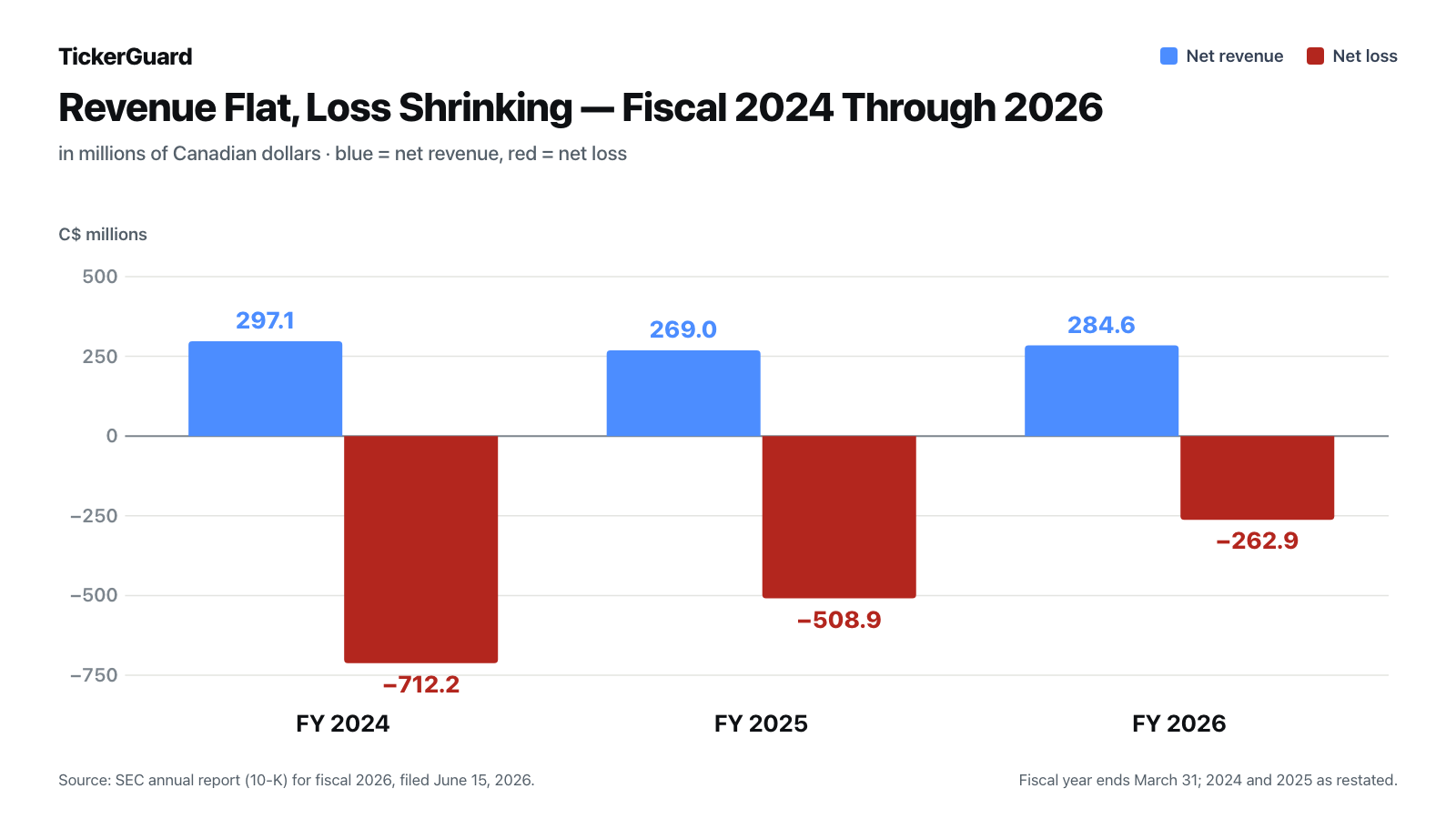
That curve tells a turnaround story, not a growth story. Net revenue in fiscal 2026 was C$284.6 million, 6 percent above the prior year’s C$269.0 million but still below fiscal 2024’s C$297.1 million. Inside that total a lot moved: Canadian adult-use grew to C$94.5 million (up 20 percent) and Canadian medical to C$90.8 million (up 18 percent), while exports fell to C$28.7 million (down 7 percent) and Storz & Bickel to C$70.7 million (down 14 percent). The net loss narrowed to C$262.9 million from C$508.9 million and C$712.2 million. And the figure nobody quotes because it sounds so dull: cash used in operating activities — the money the business actually burns, regardless of depreciation and accounting entries — shrank from C$228.4 million in fiscal 2024 to C$165.8 million and then to C$63.8 million in fiscal 2026. That is the most honest piece of good news in this analysis.
And the balance sheet is stocked: C$336.6 million of cash and cash equivalents on June 30, 2026, after C$364.7 million at the March 31, 2026 year-end and only C$113.8 million a year earlier. Total assets were C$1,103.9 million, total liabilities C$415.3 million, and shareholders’ equity C$688.6 million. Against a free cash outflow of C$25.7 million in the quarter, that cash lasts well over three years on the arithmetic — survival is not today’s question here. Remember the shape of it: Canopy Growth still burns cash, but only about a quarter of what it burned two years ago. Which brings us to the uncomfortable truths.
What the Filings Say — the Uncomfortable Truths
Uncomfortable Truth No. 1: Two Audited Fiscal Years and Eight Quarterly Reports Were Declared Invalid
On May 15, 2026 the audit committee of the board reached a conclusion no company enjoys filing. The wording is as dry as it is severe:
“… should no longer be relied upon because of non-cash technical errors in the Company’s accounting relating to certain share-settled warrants of the Company with exercise prices denominated in U.S. dollars … In addition, the reports of the Company’s independent registered public accounting firms included in the 2024 10-K and the 2025 10-K should no longer be relied upon.”
— Canopy Growth Corporation, Form 8-K, Item 4.02, filed May 15, 2026 (SEC EDGAR)

The affected filings are the audited statements for fiscal 2024 and fiscal 2025 plus eight quarterly reports — the periods ended September 30, 2023, December 31, 2023, June 30, 2024, September 30, 2024, December 31, 2024, June 30, 2025, September 30, 2025 and December 31, 2025. The cause sounds technical but is easy to follow. Canopy Growth had issued warrants whose exercise price is set in U.S. dollars while the company’s functional currency is the Canadian dollar. Under the accounting rules that turns an equity instrument into a liability that has to be remeasured at fair value at every reporting date. Think of it this way: you promise to deliver goods later at a fixed dollar price while you keep your own books in euros. Whether that promise costs you a little or a lot depends on the exchange rate — which is exactly why it is a debt and not an ownership stake. In fairness, the correction is non-cash. The same filing lists what does not change: revenue, gross margin, operating income or loss, cash flows from operations, adjusted EBITDA, total assets, cash balances, liquidity, and compliance with every debt covenant and borrowing arrangement. No money went missing. But anyone who invested in 2024 or 2025 on the basis of those statements was working with numbers the company itself has since withdrawn. That is the point of this truth.
Uncomfortable Truth No. 2: The Controls Are Not Effective by the Company’s Own Account — and the Auditor Walked
Errors happen. What matters more is what the pattern of error says about the controls. The fiscal 2026 annual report carries an adverse opinion on internal control over financial reporting: the auditors expressly did not certify that those controls were effective as of March 31, 2026, because of a material weakness in exactly the place where equity-linked instruments are classified as equity or as liabilities. And the quarterly report as of June 30, 2026 carries that finding into the present:
“Based upon this evaluation, our Chief Executive Officer and Chief Financial Officer have concluded that, as of June 30, 2026, our disclosure controls and procedures were not effective as of such date due to a material weakness in our internal control over financial reporting that was disclosed in Item 9A of the Annual Report.”
— Canopy Growth Corporation, Form 10-Q as of June 30, 2026, Item 4 “Controls and Procedures” (SEC EDGAR)

The second filing landed the same day, August 7, 2026. Auditor PKF O’Connor Davies resigned — and the stated reason reads as if nobody had smoothed it over:
“… resigned as the Company’s independent registered public accounting firm, effective August 7, 2026 (the “Resignation Date”) due to strategic changes in the desire of the firm to provide services to the cannabis sector.”
— Canopy Growth Corporation, Form 8-K, Item 4.01, filed August 7, 2026 (SEC EDGAR)

Fairness matters here too, and the counterpoint is real: the filing expressly states that there were no disagreements on accounting principles, financial statement disclosure or auditing scope. The auditor is not walking out over a fight; its firm no longer wants to serve the cannabis sector at all. The audit committee has engaged Canadian firm MNP LLP for the fiscal year ending March 31, 2027, and that appointment is Proposal 2 at the annual meeting. Management is also remediating: the quarterly report lists enhanced technical review controls for complex equity-linked instruments, a formal requirement to engage outside experts on new issuances, and training. Even so, one sentence survives for you as an investor: until the weakness has been tested as remediated, every number this company publishes comes out of a system it has itself declared ineffective.
Uncomfortable Truth No. 3: Revenue Grew 13 Percent — the Share Count Grew 124
Here is where the one-dollar trap snaps shut. Net loss per share in the quarter ended June 30, 2026 fell to C$0.03 from C$0.24 a year earlier. That looks like an 88 percent improvement — but the loss itself only fell 68 percent. The difference is in the denominator: the loss is spread over 422.3 million shares instead of 188.3 million. Put differently, a good part of the prettier per-share figure comes not from earning more but from more people sharing. How far this has gone shows up across fiscal years:
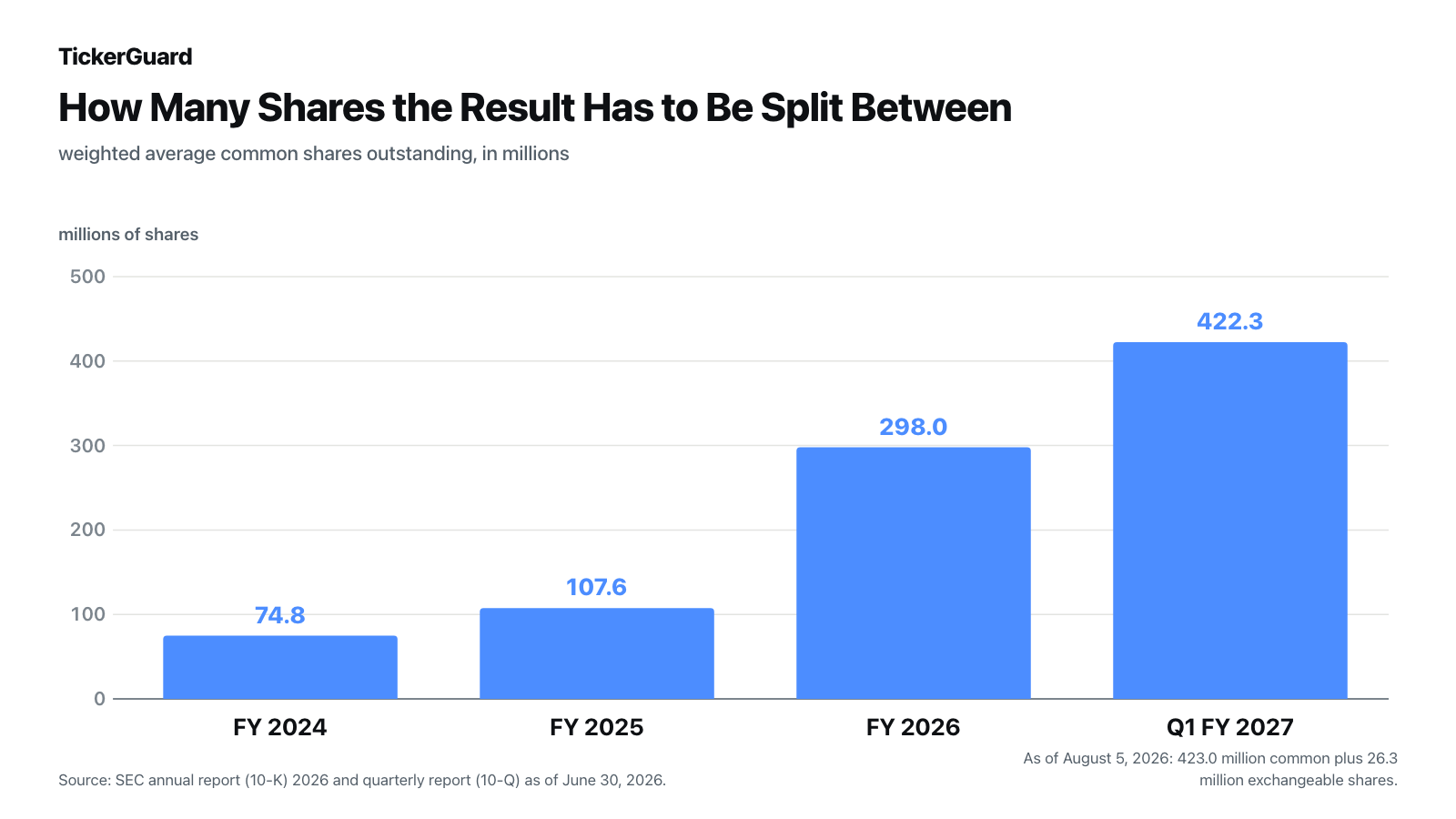
What does dilution mean in practice? Picture a pizza cut into eight slices, one of them yours. Then guests arrive, the pizza is cut into 45 slices, and you still get one. The pizza did not shrink; your share of it did. Where the new slices came from is documented cleanly. On March 16, 2026 Canopy Growth acquired Canadian producer MTL Cannabis Corp. and paid with 41,232,337 new shares plus C$18.5 million in cash, together with 2,956,391 further shares to former holders of a subsidiary and 7,446,919 replacement warrants. On January 8, 2026 an institutional holder exchanged a convertible debenture with a C$96.4 million principal amount for a new one of C$55.0 million (7.50 percent coupon, convertible at C$1.83 per share) — plus 9,493,670 shares, 12,731,481 warrants and C$10.5 million in cash. And for the new senior secured term loan of $150.0 million in cash proceeds (principal of roughly $162.1 million, priced at the U.S. reference rate SOFR with a 3.25 percent floor plus 6.25 percentage points, maturing January 2031, secured by substantially all assets) the lenders also received 18,705,578 warrants struck at $1.30.
The overhang is correspondingly large. As of June 30, 2026 there were 54,367,558 warrants outstanding — 30,838,728 carried as liabilities at a weighted average exercise price of C$4.58, and 23,528,830 carried in equity at C$4.08 — plus 5,410,436 employee options at an average of C$2.77. Most of those rights sit far above today’s price and are worthless for now, but they exist. Remember the pattern: at Canopy Growth the turnaround was not paid for out of the business, but with pieces of the business. A glance at the accumulated deficit shows how much capital has gone through here: C$11,152.8 million — a little over C$11.15 billion — sat on the June 30, 2026 balance sheet. How a hole like that forms and what it means for later shareholders is something we worked through on a far smaller scale in our FreeCast analysis.
Uncomfortable Truth No. 4: The U.S. Dream Rests on a Borrower That Is in Default
Canopy Growth describes its U.S. exposure as “unparalleled” access to the world’s largest cannabis market. In practice that access runs through Canopy USA, LLC and its subsidiaries — above all Acreage Holdings, which Canopy USA acquired outright in December 2024, with Canopy Growth issuing 5,888,291 of its own shares as consideration. The quarterly report as of June 30, 2026 sizes the loans extended to Acreage and to affiliate Wana: roughly C$185.9 million ($130.8 million) is owed to the Canopy side, and roughly C$112.3 million ($79.0 million) to a third-party lender. Then comes the sentence: “Acreage is currently in default under the Third ARCA.”
The state of play, with dates. On May 12, 2026 an initial forbearance agreement was signed — the lenders agreed to hold off on enforcing their rights. In return, Acreage had to appoint a chief restructuring officer and a financial advisor. On July 31, 2026 a second forbearance agreement followed, with an outside date of January 31, 2027 that the lenders may extend at their sole discretion. What matters for ranking: the third-party lender’s portion ranks ahead of Canopy’s portion, so if that lender enforces its security, it gets paid first. Canopy Growth names the consequence in its own risk section: it could lose “the entirety of its investment” in that debt. Picture it this way — you lent your neighbor money for his house, but the bank holds the first mortgage. As long as everyone stands still, nothing happens; the day the bank moves, you see nothing. For valuation that means one thing: the “other investments” line — C$125.5 million as of June 30, 2026 — is not a safe asset but an open question with a date on it.
Valuation: What the Market Pays for a Turnaround
A price-to-earnings ratio cannot be formed here; there are no earnings. So let us approach it through orders of magnitude, keeping the currencies apart. On August 21, 2026 the stock closed at $1.05 (52-week range $0.844 to $2.38, data as of August 22, 2026). Applied to 423.0 million common shares plus 26.3 million exchangeable shares, that is a market value of roughly $472 million; independently, fundamental data show about $499 million as of August 22, 2026 — close enough to call it “roughly half a billion dollars.” At an exchange rate of C$1.3764 per U.S. dollar (data as of August 22, 2026) that equals roughly C$650 million.
Two honest comparisons follow. First, book equity as of June 30, 2026 was C$688.6 million, so the stock trades below book value — fundamental data put the price-to-book ratio at about 0.97 as of August 22, 2026. Second, measured against fiscal 2026 net revenue of C$284.6 million, the market is paying roughly two and a half times one year of sales. For a company still reporting a C$22.1 million operating loss in the quarter, that is no bargain — but it is not a growth premium either. A third anchor makes it concrete: cash alone, at C$336.6 million, covers a good half of the market value.
What the market is pricing here is plainly not the current business but a bet on two events, both outside the company’s control: the opening of the U.S. market to listed cannabis companies (only then may Canopy Growth consolidate its U.S. interest at all), and further legalization in Europe, where the company booked just C$9.6 million in the quarter ended June 30, 2026. Until then, one sober sentence governs the price: the low per-share figure is not a valuation argument, it is the result of 423 million shares issued. Skip that arithmetic and you are paying for a feeling. How badly valuation anchors mislead when the denominator moves is also on display in our Zymeworks analysis.
The per-share figure has a second, very practical side. Nasdaq requires a minimum closing bid price of $1.00 for continued listing. The proxy statement records where things stood on the day it was filed:
“As of the date hereof, the closing price for the Shares on the Nasdaq Global Select Market was $0.97 per Share, and the closing price of our Shares has been below $1.00 for 25 consecutive business days as of the date hereof.”
— Canopy Growth Corporation, Proxy statement DEF 14A filed August 7, 2026, Proposal 3 “Share Consolidation Proposal” (SEC EDGAR)
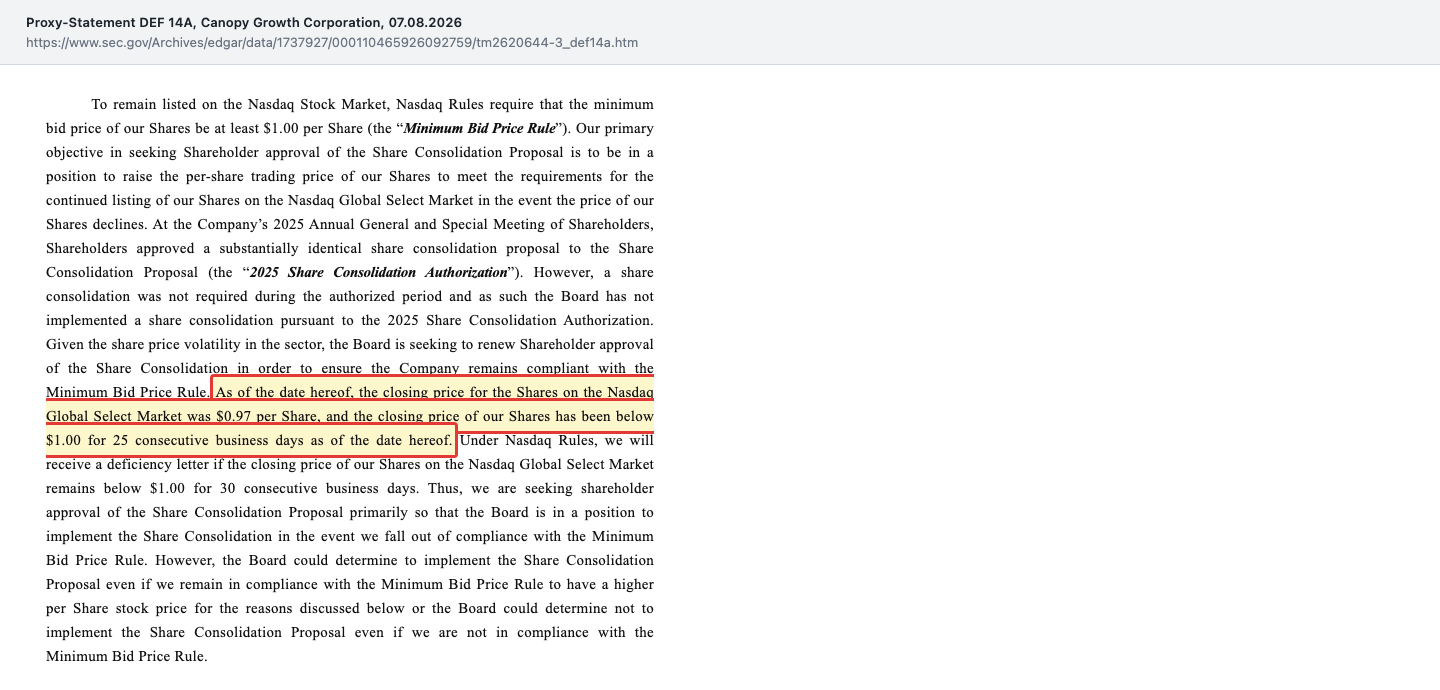
Since the date of that filing the price has climbed back above the threshold — the stock closed at $1.05 on August 21, 2026 (data as of August 22, 2026), and a single close at or above $1.00 resets the Nasdaq counter. On today’s facts no deficiency letter has been triggered. That is exactly why the authorization is a reserve and not a schedule: the board may consolidate, it does not have to, and if it does, not a single decimal of the company’s value changes.
Upside and Risks at a Glance
What speaks for Canopy Growth:
- The business is measurably turning: net revenue in the quarter ended June 30, 2026 up 13 percent to C$81.2 million, and up in all four businesses; gross margin from 25 to 27 percent, and on an adjusted basis from 25 to 31 percent.
- The loss is shrinking fast: net loss down 68 percent to C$14.6 million in the quarter, and across fiscal years from C$712.2 million (2024) to C$508.9 million to C$262.9 million (2026).
- Cash burn is under control: cash used in operating activities cut from C$228.4 million in fiscal 2024 to C$63.8 million in fiscal 2026, against C$336.6 million of cash on June 30, 2026.
- The balance sheet is not underwater: C$1,103.9 million of assets against C$415.3 million of liabilities, equity of C$688.6 million, and no going-concern qualification in the fiscal 2026 annual report.
- Two real franchises: Canada’s leading medical cannabis service provider, up 22 percent in the quarter, and Storz & Bickel, whose gross margin jumped from 29 to 48 percent in the quarter.
What speaks against it:
- A documented accounting and control failure: two audited fiscal years and eight quarterly reports withdrawn on May 15, 2026, an adverse opinion on internal control in the fiscal 2026 annual report, disclosure controls expressly not effective as of June 30, 2026, and the auditor’s resignation on August 7, 2026.
- Heavy dilution: weighted average shares from 74.8 million in fiscal 2024 to 422.3 million in the quarter ended June 30, 2026, plus 54.4 million warrants outstanding and a C$55.0 million debenture convertible at C$1.83.
- The business still burns cash: a C$22.1 million operating loss and a C$25.7 million free cash outflow in the quarter ended June 30, 2026 alone — worse than the C$11.6 million a year earlier.
- The U.S. leg rests on a borrower in default: Acreage is in default, the forbearance runs to January 31, 2027, and a senior lender ranks ahead of Canopy; the company names total loss of that position as a risk itself.
- Listing risk and consolidation: as of August 7, 2026 the closing price had been below the Nasdaq $1.00 mark for 25 consecutive business days, and the September 25, 2026 annual meeting votes on a consolidation of up to one-for-fifteen — the second such authorization in a row.
A Human Conclusion
Back to the one-dollar trap. Its core is not that a one-dollar stock is bad — Canopy Growth is unarguably a better company than it was two years ago: revenue is growing in every business, the loss has been cut to a third, cash burn to a quarter, and there is C$336.6 million in the bank. Its core is that the small per-share figure spares you a piece of arithmetic that hurts particularly here. Because this same company once raised C$5.1 billion from Constellation Brands in fiscal 2019 — today the drinks group holds 26.3 million non-voting exchangeable shares from that investment, about 5.9 percent. And the balance sheet carries an accumulated deficit of C$11.15 billion. None of that is an argument against the future. It is simply the full bill.
So the honest question is not “is a dollar cheap?” It is this: do you want to hand money to a company whose operations are finally steadying — while its own financial statements for two years have been withdrawn, its auditor has left the industry, and in September shareholders vote on turning fifteen of your shares into one? If you can answer yes, because you believe the U.S. market will open and you have years of patience, you have a thesis. If you hesitate, because “cheap” was until now only a feeling, you have just learned something that will protect you in a great many other stocks. What you make of it is your decision. And that is exactly as it should be.
Sources
Every original document used in this analysis — read it yourself:
- Canopy Growth Corporation — Form 10-K annual report for fiscal 2026, period ended March 31, 2026 (filed June 15, 2026)
- Canopy Growth Corporation — Form 10-Q quarterly report as of June 30, 2026 (filed August 7, 2026)
- Canopy Growth Corporation — Form 8-K, Item 4.02 “Non-Reliance” (filed May 15, 2026)
- Canopy Growth Corporation — Form 8-K, Item 4.01 “Changes in Registrant’s Certifying Accountant” (filed August 7, 2026)
- Canopy Growth Corporation — Form 8-K, Item 2.02, Exhibit 99.1: first quarter fiscal 2027 results (filed August 7, 2026)
- Canopy Growth Corporation — Proxy statement DEF 14A for the annual meeting on September 25, 2026 (filed August 7, 2026)
- Canopy Growth Corporation — Form 8-K, Item 5.03 “Advance Notice By-Law” (filed May 27, 2026)
- Full SEC filing history for Canopy Growth Corporation: EDGAR overview (sec.gov)
- Fundamental data (metrics, price series, price-to-book ratio, exchange rate; data as of August 22, 2026), reconciled with the SEC filings.
Transparency & disclaimer: this analysis is journalistic commentary on publicly available information. It is not investment advice, not a regulated financial analysis, and not a solicitation to buy or sell securities. Equity investments carry substantial risk up to and including total loss. All information is provided without warranty; the as-of date of each figure is stated in the text. Positions held by the operator are disclosed daily; where one exists, it appears as a notice at the top of this deep dive.
Key figures at a glance
All monetary figures in millions of C$; earnings per share as reported.
| Metric | 2022 | 2023 | 2024 | 2025 | 2026 |
|---|---|---|---|---|---|
| Revenue | 475.7 | 333.3 | 297.1 | 269.0 | 284.6 |
| Operating Income (EBIT) | -1,018.8 | -2,630.5 | -228.7 | -117.1 | -73.1 |
| Net Income | -310.0 | -3,278.2 | -657.3 | -598.1 | -262.9 |
| Net Margin | -65.2% | -983.7% | -221.2% | -222.4% | -92.4% |
| Earnings Per Share | -7.92 C$ | -70.69 C$ | -8.79 C$ | -5.56 C$ | -0.09 C$ |
Source: fundamental data & SEC filings (annual and quarterly reports, 10-K/10-Q)
Our Bottom Line at a Glance
- Operating trend positive
- The business is measurably turning: in the quarter ended June 30, 2026 net revenue rose 13 percent to C$81.2 million — in all four businesses — gross margin improved from 25 to 27 percent, and adjusted EBITDA went from negative C$7.9 million to negative C$3.2 million. Across fiscal years the net loss fell from C$712.2 million (2024) to C$508.9 million to C$262.9 million (2026).
- Accounting & controls negative
- On May 15, 2026 the audit committee declared two audited fiscal years (2024, 2025) and eight quarterly reports no longer reliable; the fiscal 2026 annual report carries an adverse opinion on internal control, and disclosure controls were not effective as of June 30, 2026 per management. On August 7, 2026 the auditor resigned — with no disagreements, but with remediation still open.
- Dilution negative
- Weighted average shares rose from 74.8 million in fiscal 2024 to 422.3 million in the quarter ended June 30, 2026. The MTL acquisition of March 16, 2026 alone cost 41.2 million new shares; on top of that sit 54.4 million warrants outstanding, 5.4 million employee options and a C$55.0 million debenture convertible at C$1.83.
- Financial position neutral
- Cash of C$336.6 million as of June 30, 2026 covers well beyond four quarters at a free cash outflow of C$25.7 million per quarter, and the fiscal 2026 annual report carries no going-concern qualification. Against that stand debt of C$240.2 million with a $90.0 million minimum unrestricted cash covenant and a rising quarterly outflow (prior-year quarter: C$11.6 million).
- U.S. strategy negative
- Access to the U.S. market runs through the unconsolidated interest in Canopy USA. Its subsidiary Acreage is in default per the Form 10-Q as of June 30, 2026; a forbearance agreement runs to January 31, 2027 and a senior lender ranks ahead of Canopy. The company names total loss of the extended loans (about C$185.9 million) as a risk itself.
- Listing & structure negative
- As of August 7, 2026 the closing price was $0.97 and had been below the Nasdaq $1.00 minimum for 25 consecutive business days; a deficiency letter follows after 30. The September 25, 2026 annual meeting votes on a share consolidation of one-for-five to one-for-fifteen — after a substantially identical 2025 authorization that was never used.
Canopy Growth is posting improving operating numbers for the first time in years: net revenue in the quarter ended June 30, 2026 up 13 percent to C$81.2 million, net loss down 68 percent to C$14.6 million, and cash burn in fiscal 2026 cut to C$63.8 million. That recovery was paid for in ownership: weighted average shares have gone from 74.8 million in fiscal 2024 to 422.3 million. On top sits a documented accounting failure — two audited fiscal years and eight quarterly reports withdrawn, an adverse opinion on internal control, and the auditor’s resignation on August 7, 2026 — plus a U.S. investment whose borrower is in default. Not investment advice.
What Our Rating Means
Substance risk
We found at least one documented issue that threatens the company itself — regardless of how the stock is currently valued.
The red rating here is not about the price or the valuation but about a documented accounting failure: on May 15, 2026 the audit committee withdrew two audited fiscal years and eight quarterly reports, the fiscal 2026 annual report carries an adverse opinion on internal control, the Form 10-Q as of June 30, 2026 states that disclosure controls were not effective, and on August 7, 2026 the auditor resigned. Until the weakness has been tested as remediated, every figure comes out of a system the company itself calls ineffective. Plenty argues against the rating and deserves saying: the correction was non-cash, equity is clearly positive at C$688.6 million, cash of C$336.6 million lasts well beyond four quarters, and the fiscal 2026 annual report carries no going-concern qualification. Where the evidence sits between two levels the more cautious one applies — and alongside the accounting failure sit dilution from 74.8 million to 422.3 million shares and a U.S. investment whose borrower, Acreage, is in default. The decision is yours.
A journalistic assessment by our editorial team at the time of the deep dive, based on public sources — not investment advice and not a solicitation to buy or sell. Your personal circumstances (investment goals, risk capacity, taxes) cannot be taken into account. What our levels mean, how verdicts are formed, and what conflicts of interest exist →
Worth Noting
- Canopy Growth reached our research list through the SEC filing feed, specifically the rare Form 8-K under Item 4.02 (“Non-Reliance”) of May 15, 2026 — a company stating that its own published financial statements may no longer be relied upon.
- Non-calendar fiscal year: it ends March 31. “Fiscal 2026” means April 1, 2025 to March 31, 2026, and “Q1 fiscal 2027” means April 1 to June 30, 2026. Comparing these figures with other companies’ calendar years compares periods shifted by three months.
- Currencies are deliberately kept apart: all operating figures are in Canadian dollars (the reporting currency) and all price figures in U.S. dollars (the Nasdaq quotation currency). Conversions in the text use C$1.3764 per U.S. dollar, data as of August 22, 2026. This analysis is evergreen; a daily price is never a reason to buy.
Stock Watch
This analysis is as of August 26, 2026. Stock Watch will tell you what's changed at CGC since then.
Later $1 a month per stock — signing up is free, and you'll be the first to know when it launches.
The full analysis as a PDF for later
We will send you this analysis as a PDF — to print, file away, and read at your own pace. And we will add you to the free Stock Watch list for Canopy Growth Corp (CGC), so you hear about it when something material in this analysis changes.
Frequently Asked Questions
Canopy Growth Corporation (Nasdaq: CGC, also TSX: WEED), headquartered in Smiths Falls, Ontario, produces and sells cannabis. It reports two segments: Cannabis (Canadian adult-use, Canadian medical, and exports to Europe) and Storz & Bickel, the German vaporizer maker based in Tuttlingen. In fiscal 2026, C$213.9 million of net revenue came from Cannabis and C$70.7 million from Storz & Bickel. The U.S. business runs through Canopy USA, LLC, an unconsolidated interest.
On March 31. Fiscal 2026 therefore covers April 1, 2025 through March 31, 2026, and the annual report on Form 10-K for it was filed on June 15, 2026. The first quarter of fiscal 2027 covers April 1 to June 30, 2026, with the Form 10-Q filed on August 7, 2026. Comparing Canopy figures with calendar years means comparing periods that are shifted by three months.
Because warrants exercisable in U.S. dollars had been misclassified. Canopy Growth’s functional currency is the Canadian dollar, which under the accounting rules makes such instruments liabilities rather than equity, remeasured at fair value each reporting date. On May 15, 2026 the audit committee declared the audited statements for fiscal 2024 and 2025 and eight quarterly reports no longer reliable. The correction is non-cash: revenue, gross margin, operating results, cash balances and debt covenant compliance are unchanged.
PKF O’Connor Davies stepped down effective August 7, 2026 — per the Form 8-K, “due to strategic changes in the desire of the firm to provide services to the cannabis sector.” The filing expressly states there were no disagreements on accounting principles, financial statement disclosure or auditing scope. The audit committee engaged Canadian firm MNP LLP for the fiscal year ending March 31, 2027; that appointment is on the ballot at the September 25, 2026 annual meeting.
Severely. Weighted average shares outstanding rose from 74.8 million in fiscal 2024 to 107.6 million in fiscal 2025, 298.0 million in fiscal 2026, and 422.3 million in the quarter ended June 30, 2026 — 5.6 times as many in a little over two years. As of August 5, 2026 there were 423,037,675 common shares and 26,261,474 exchangeable shares outstanding, plus 54.4 million warrants, 5.4 million employee options and a C$55.0 million debenture convertible at C$1.83.
Shareholders vote on it on September 25, 2026. Proposal 3 would authorize the board to consolidate the shares at a ratio between one-for-five and one-for-fifteen, with the ratio at the board’s discretion and the authority expiring September 25, 2027; fractional shares are cancelled for no consideration. The driver is the Nasdaq rule requiring a $1.00 minimum closing bid price: as of August 7, 2026 the price was $0.97, the 25th consecutive business day below it. A substantially identical 2025 authorization was never used.
C$336.6 million as of June 30, 2026, after C$364.7 million on March 31, 2026 and C$113.8 million a year earlier. In the quarter ended June 30, 2026, C$25.0 million was used in operating activities and free cash outflow was C$25.7 million. On that arithmetic the balance lasts well beyond four quarters. Debt stood at C$240.2 million (principal amount C$285.4 million) and shareholders’ equity at C$688.6 million.
Canopy USA, LLC holds the group’s U.S. interests, including Acreage Holdings, Wana and Jetty. Because neither Nasdaq nor the New York Stock Exchange currently permits listing companies that consolidate U.S. marijuana operations, Canopy Growth holds an expressly unconsolidated, non-controlling interest accounted for under the equity method at fair value. The Form 10-Q as of June 30, 2026 also reports Acreage as in default; a forbearance agreement runs to January 31, 2027.
Found an error?
Did you spot a factual error, an outdated number, or a typo in this deep dive? Let us know briefly — your report goes straight to the editorial team.