FreeCast: A Streaming Guide With $628,149 in Revenue — and a $205 Million Accumulated Deficit
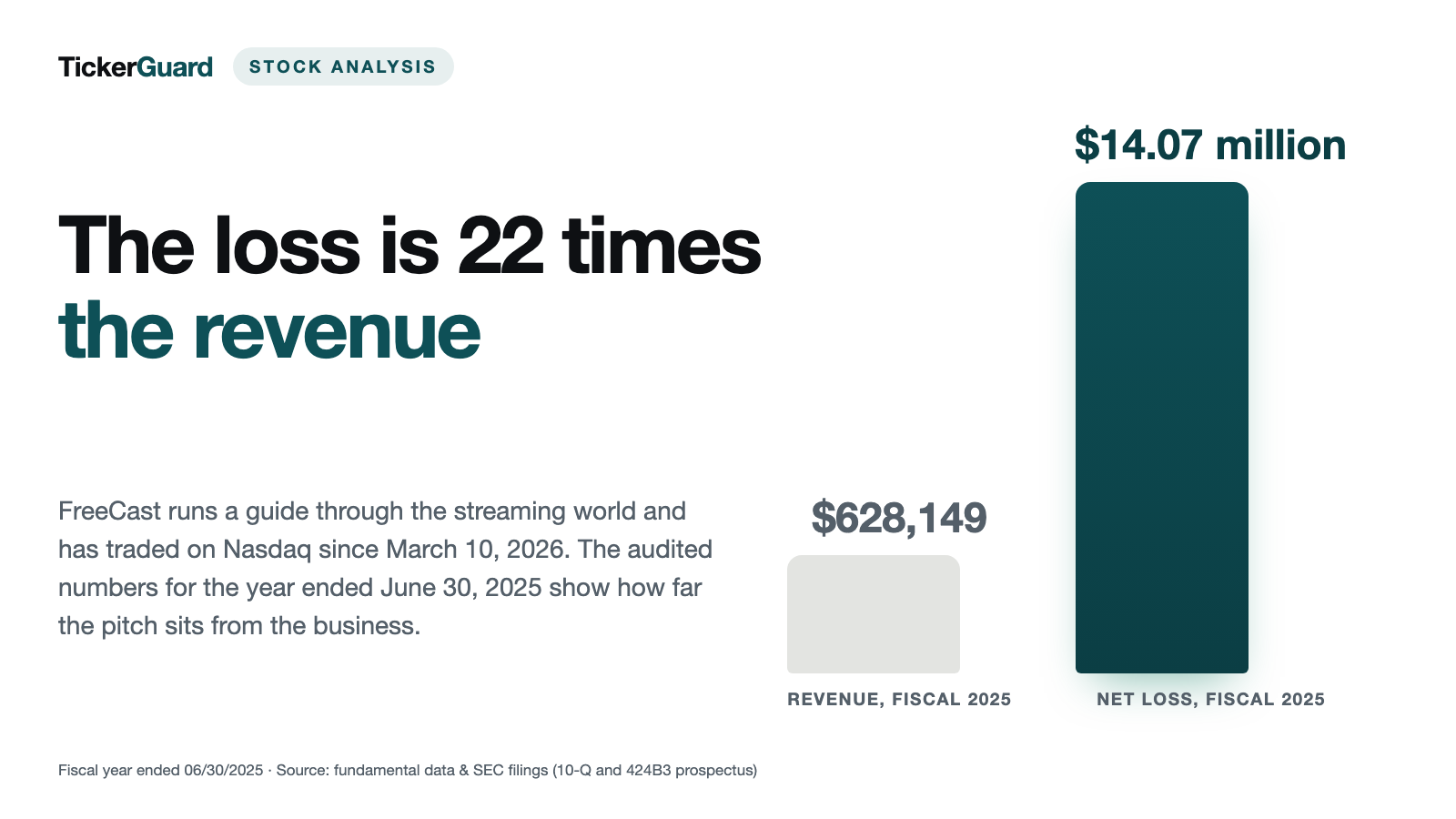
FreeCast, Inc. (Nasdaq: CAST) wants to fold the fragmented streaming world into a single TV guide. The audited fiscal year ended June 30, 2025 brought in $628,149 of revenue — and produced a $14.07 million net loss. Roughly half of that revenue comes from two companies whose president is the CEO himself. On March 31, 2026 the cash box held $119,302 against a monthly burn of about $898,000. This piece does the math on the revenue line, not on the share price.
 Thomas Mücke
Founder & Publisher
Thomas Mücke
Founder & Publisher
As of Today
As of: October 7, 2026
- Closing price
- 1.20 $ +5.30%
- Market Capitalisation
- 56.0 $M
- Growth Score
- 5/10
- AAQS
- 4/10
Price change since August 21, 2026: -24.1%
This analysis has a cut-off date. The Stock Guard tells you when something material changes in the numbers. Reserve your free spot
Chart
Interactive price chart (TradingView).
52-week range: 0.59 $ to 9.80 $ · Last price: 1.20 $ (As of: October 7, 2026)
Note: pure fact-based analysis, not investment advice and not a solicitation to buy or sell. All figures without guarantee.
There is one number your brain keeps without being asked: the first one it sees. For FreeCast that number arrived on March 10, 2026. That day the Class A stock opened on Nasdaq at $33.00 and closed at $9.13. Ever since, that anchor has sat in the head of every investor who discovered the stock later. On June 11, 2026 it traded as low as $0.50 intraday; on August 21, 2026 it closed at $1.58. And something inside us whispers: down 95 percent, surely that is cheap.
That is the anchoring trap. The first price becomes the yardstick even though it says nothing whatsoever about what a business is worth. So we will do it the other way around here: first what the company takes in, what it spends and who owns it — and only at the very end what the market is charging for it.
The deal for this piece: no recommendation, no price targets. Only the figures from the filings with the U.S. securities regulator, the SEC, each with its own as-of date. The central tension that runs through every chapter is reach versus revenue. FreeCast talks about a distribution network with more than 52 million reachable consumers. The audited fiscal year ended June 30, 2025 brought in $628,149.
What FreeCast actually does — the TV guide for the streaming age
Picture the old printed TV listings magazine. It showed what was on tonight, across three dozen channels, in a grid. That is precisely what FreeCast attempts for the streaming world. The product is called SmartGuide and lays a single program guide over subscription services, free ad-supported channels, catch-up libraries and over-the-air broadcast. The user sees a grid, clicks a show and lands wherever it is playing.
The company sits in Orlando, Florida, was founded in 2011 and employed 57 full-time and 60 contract staff as of March 31, 2026 (figure stated in the prospectus of July 23, 2026). The SEC classifies it under industry code 7374, "Services-Computer Processing & Data Preparation." Money comes in through four buckets, and the 10-Q for the quarter ended March 31, 2026 describes each one:
- Subscriptions. Once the core business under the SelectTV name, discontinued in October 2022 and replaced by free, ad-supported registration. In the year ended June 30, 2025 the line was worth $132,950, down from $233,453 — a decline of 43 percent.
- FAST channel builds. FAST stands for free ad-supported television. FreeCast assembles such channels for customers — editing, motion graphics, channel assembly, content acquisition — and then hosts them on its own platform for a monthly fee. Billing is cost plus a 15 or 30 percent markup.
- Ad platform. A marketplace where advertisers bid in real time for inventory. FreeCast describes itself as an agent in those transactions and therefore books only the margin as revenue, while receivables and payables appear gross and look large relative to the top line.
- Agency work. Individual marketing and campaign mandates, illustrated in the filings by the Launch That contract.
The growth story attached to this sits in the prospectus of July 23, 2026 and sounds big: a distribution network of 26 partners representing "a potential customer universe of more than 52 million consumers worldwide," plus a pipeline of 22 further partners at 23.1 million and a backlog of 14 partners at 14.7 million potential users. Those are not customers. They are other companies' user bases that FreeCast might reach if the contracts land. Keep the distinction as an anchor: a reachable user is a map; a paying customer is an invoice.
Company history for investors
-
2022
The paid subscription is dropped
In October 2022 the SelectTV.com paid service and streaming kits were discontinued. For shareholders that meant the only revenue paid directly by an end customer went away.
-
2023
Verbal contracts with two of the CEO's companies
Since June 2023 FreeCast has built channels for Test Drive Live and Celebrity Cigars, both tied to the chief executive. From then on a large share of revenue has come from inside the house.
-
2026
Direct listing on Nasdaq
Trading under the ticker CAST began on 03/10/2026. The company raised nothing in the process — only existing shares were admitted to trading.
-
2026
Conversion price starts tracking the market
On 04/20/2026 the note held by the CEO's company was renewed and the fixed $8 price replaced by the prevailing close. For shareholders that means dilution with no floor.
-
2026
Warrants expire almost entirely
After the price was cut from $4.25 to $1.33, only 250,000 of 6,743,587 shares were taken up by 05/22/2026. A clear signal of how hard fresh money was to find.
-
2026
Private placement of roughly $23.7 million
Fresh money arrived on 07/02/2026 at $3.00 a share. It funds operations for a good two years on paper — and the new investors were well below that level on 08/21/2026.
-
2026
Approval without a shareholder meeting
On 07/17/2026 the controlling votes approved the issuance of 3,243,807 further shares by written consent. Remaining shareholders were informed on 07/27/2026, not asked.
How this stock landed on our desk
Not through a valuation screen — at $628,149 of annual revenue, no valuation screen fires. FreeCast came to us through our in-house Reddit hype scanner, which flags micro caps that suddenly attract unusual chatter in investor forums. That run is dated August 23, 2026.
What makes the alert tangible is the trading data. On August 18, 2026, 154,052,800 shares changed hands in a single session. Fundamental data puts the free float at roughly 21.4 million shares (as of August 23, 2026). The entire float therefore turned over more than seven times that day. The stock opened at $0.86, reached $2.30 and closed at $2.10. By August 21, 2026 it was back at $1.58.
Days like that have nothing to do with the business. They have everything to do with a small number of freely tradable shares meeting a sudden burst of attention. We have described that pattern in its purest form before, in our GameStop analysis. The difference: GameStop booked roughly $835 million of revenue in the quarter ended May 2, 2026. FreeCast booked $92,909 in the quarter ended March 31, 2026.
Our in-house stock scanner adds a few markers as of August 23, 2026: insiders hold roughly 26.9 percent, institutions roughly 12.5 percent. There is no price-to-earnings ratio because there are no earnings. The price-to-sales ratio sits around 133. Our balance-sheet quality score, which places a company on a scale from 0 to 9, cannot be computed cleanly here at all — there is no annual report to build it from. That is not a footnote; it is the first finding.
The numbers over the years — credit where it is due
Start with what genuinely works in FreeCast's favor. The company has existed since 2011, it ships a finished, working product you can download and use, it holds registered service marks on FreeCast and SelectTV, and it made it onto a regulated U.S. exchange in an unusually difficult market. Gross profit is positive and growing: $281,568 in the year ended June 30, 2025 against $170,924 the year before. Every dollar of revenue covers its direct costs and leaves something over. For a great many micro caps, even that is not true.
The ad platform has genuinely started up as well: advertising revenue rose from $1,151 to $271,638 in fiscal 2025 as the first demand partners came onto the platform from October 2024. That is the first new revenue bucket in years.
Now the scale on which all of this happens.
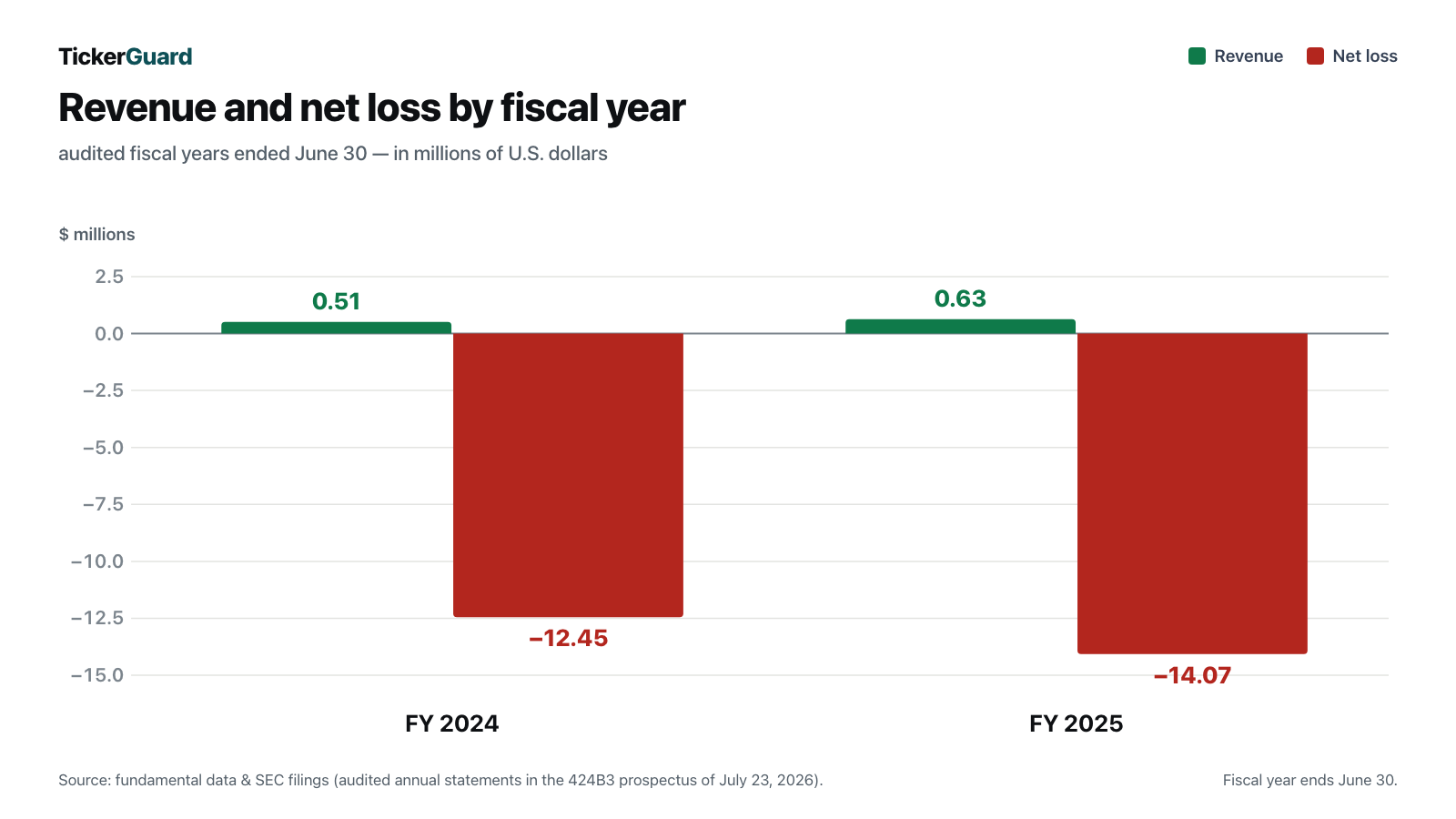
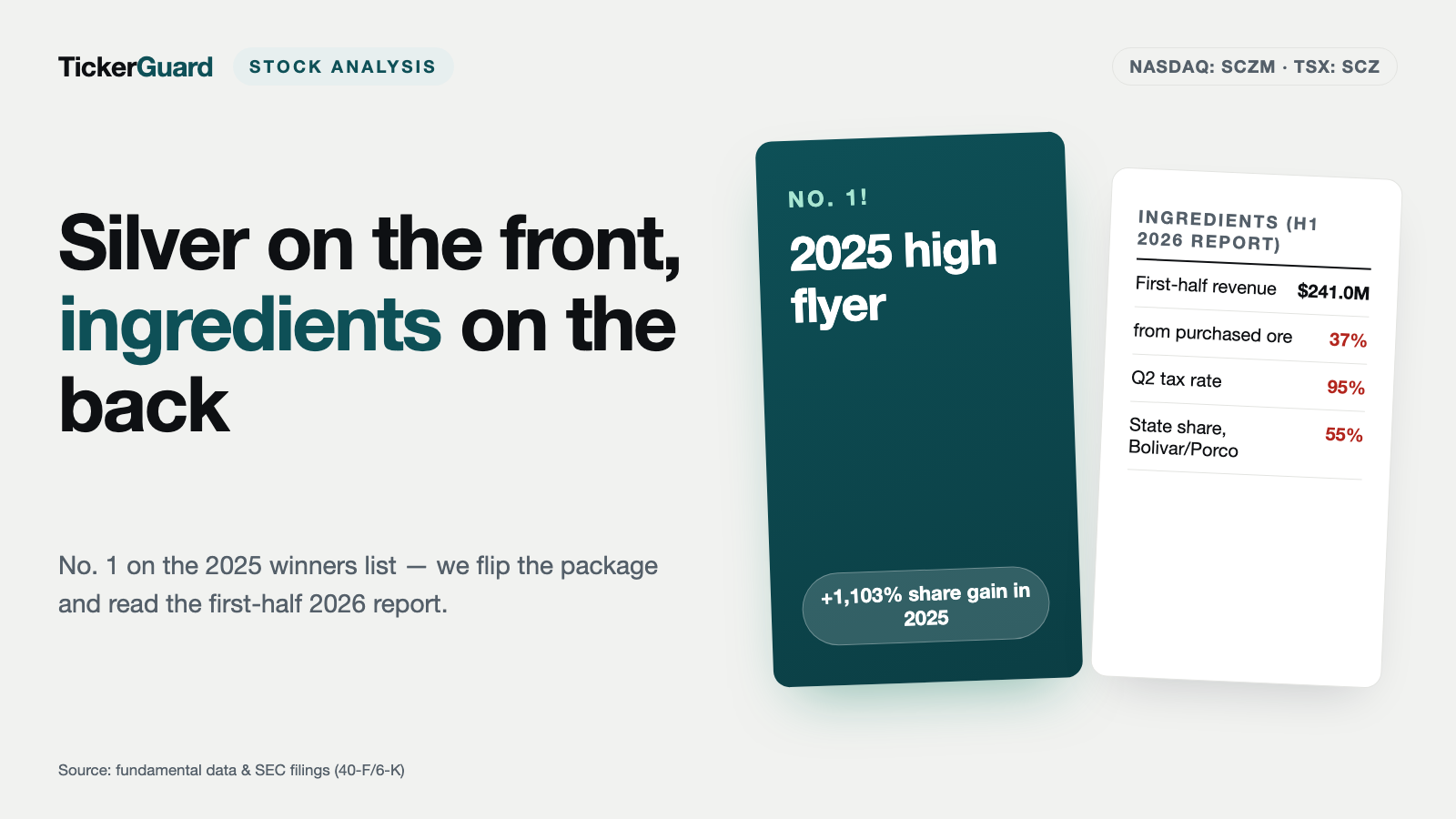
Operating expenses for the year ended June 30, 2025 came to $14,037,006, of which $8,029,108 was general and administrative and $5,482,968 compensation. Revenue covered 4.5 percent of that. The year before, operating expenses were $10,899,711 — costs rose 29 percent, revenue rose 24 percent, but from $507,920 to $628,149, an absolute gain of $120,229.
And the current trend points down. In the nine months ended March 31, 2026 revenue fell to $350,859 from $413,837, down 15 percent. In the quarter alone it was $92,909 against $143,885, down 35 percent. The nine-month net loss came in at $10,180,305 against $10,869,850 — so it shrank slightly, but only because less was spent, not because more came in.
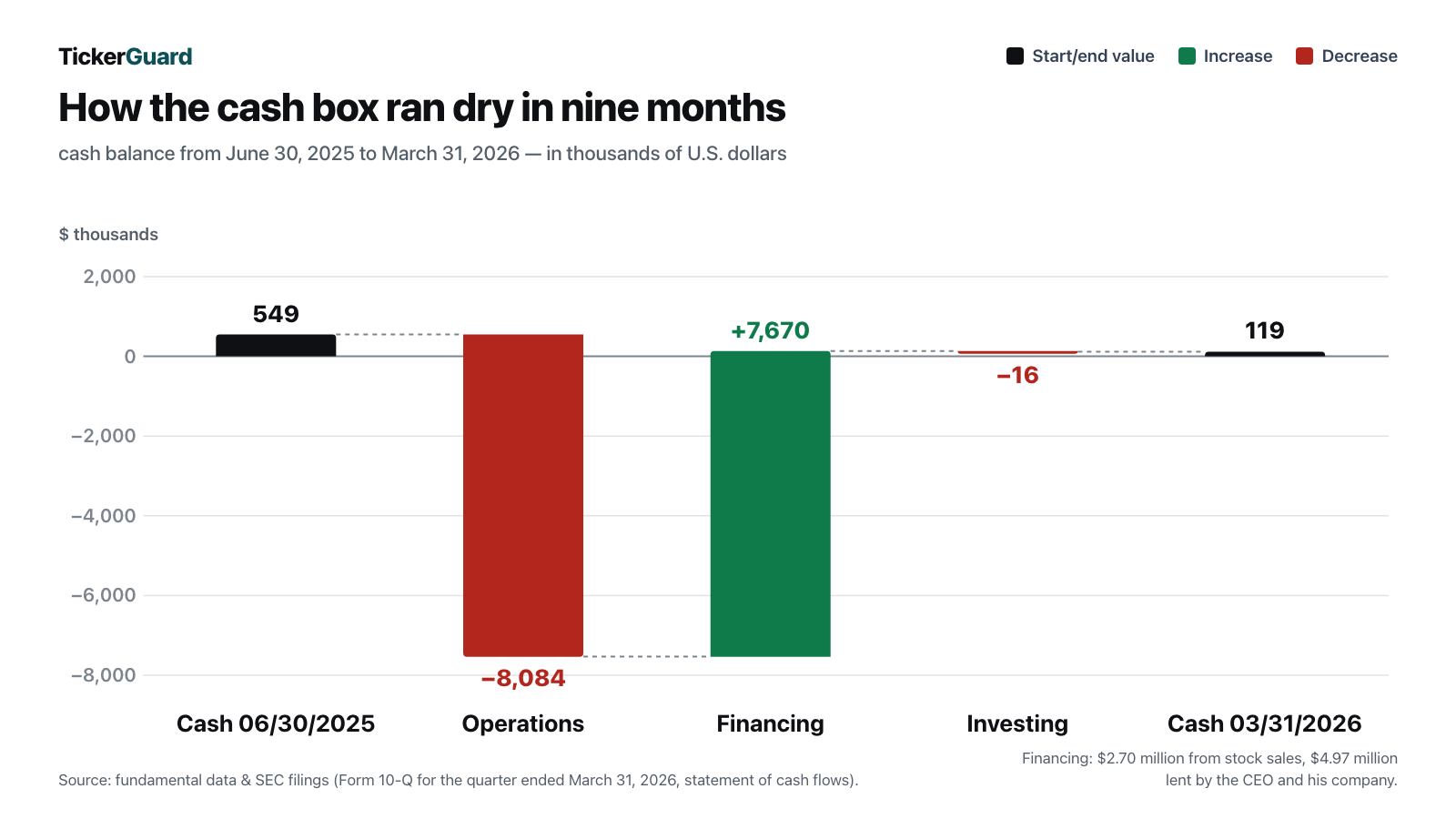
One note on diligence, because it sits in the filings themselves: the MD&A section of the quarterly report states operating cash outflow of $8,002,935 for the nine months, while the statement of cash flows in the same report says $8,083,926. This article uses the statement of cash flows throughout.
What the filings say — the uncomfortable truths
Uncomfortable truth no. 1: The auditor doubts the company can continue — and the cash box was nearly empty
There is one sentence in a set of financial statements that outshines everything else. It reads "substantial doubt about our ability to continue as a going concern," and it means the auditor has serious doubts that the business survives the next twelve months. The statements for the year ended June 30, 2025 carry that paragraph, and the 10-Q for the quarter ended March 31, 2026 repeats it:
"These factors, among others, raise substantial doubt about our ability to continue as a going concern for the next twelve months from the date these financial statements were issued."
— FreeCast, Inc., Form 10-Q for the quarter ended March 31, 2026, MD&A (liquidity)

How close it got shows in the cash box. On June 30, 2025 it held $549,249; on March 31, 2026 it held $119,302. In the nine months between, $8,083,926 flowed out of operations — roughly $898,000 a month. Set that against the balance: on March 31, 2026 the money on hand covered about four days.
Fairness requires the postscript, and it matters: on July 2, 2026 the picture changed. That day FreeCast closed a private placement and took in roughly $23.7 million gross — 4,666,667 shares plus pre-funded warrants for a further 3,243,807 shares, both priced at $3.00. In the prospectus of July 23, 2026 the company says management believes those funds are sufficient to run the business for "at least the next 12 months." At the burn rate of the preceding nine months, the sum arithmetically lasts a good two years. The audit report still carries the going-concern paragraph — it relates to the statements for the year ended June 30, 2025.
Two items sit alongside in the fine print. First, the purchase agreement expressly bars the company from using the proceeds to satisfy existing debt, other than ordinary trade payables. Second, those investors paid $3.00 a share; on August 21, 2026 the stock closed at $1.58.
Uncomfortable truth no. 2: Roughly half the revenue comes from the CEO's own companies
This one bears reading twice. In June 2023 FreeCast entered into verbal arrangements with two entities: Test Drive Live Inc. and Celebrity Cigars, Inc. For both, FreeCast builds FAST channels and operates the platform. The president of both entities is William A. Mobley, Jr. — the same man who founded and runs FreeCast. At Celebrity Cigars he is additionally the sole director, and his son Sean Mobley is part of the management team.
"For the nine months ended March 31, 2026, and 2025, more than 50.1% and 42.1%, respectively, of our total revenue was derived from two related party customers."
— FreeCast, Inc., Prospectus 424B3 of July 23, 2026, risk factors

For anyone doing the arithmetic: in the income statement for those same nine months, the separately disclosed line "Sales – related parties" reads $169,110 out of $350,859, or 48 percent. The risk factor says more than 50.1 percent. Either way you slice it, roughly half the revenue comes from companies whose president is the company's own chief executive. In the nine months ended March 31, 2026, Celebrity Cigars alone accounted for 37.8 percent of revenue, agency client Launch That for 33.9 percent and Ignite for 12.3 percent.
Why this is more than a formality: revenue is a stranger's confirmation that your work is worth paying for. Sell to yourself and that confirmation is missing. The pricing of these services is described in the prospectus as a 15 or 30 percent markup on the company's own costs — so it is not set by a market. And for completeness: between October 9 and November 21, 2025, another Mobley entity, Nextelligence, Inc., wired $191,023 on behalf of Celebrity Cigars and Test Drive Live to FreeCast in order to fully clear their outstanding bills.
Fairness also requires this: FreeCast discloses all of it, at length and in several places. And there is now a process — the prospectus describes mandatory audit committee approval for all related-party transactions. Until July 17, 2026, however, that committee had exactly one member; a second joined only on that date. Nasdaq requires three and grants newly listed companies phase-in periods.
Uncomfortable truth no. 3: The subscriber counter has been running since 2011 — dead accounts included
Every platform story lives on a user number. FreeCast states in its own risk factors what its number is worth, and the passage is remarkably candid:
"As a result, our reported subscriber figures may significantly overstate the number of users who actively use the platform, generate advertising impressions, or contribute to revenue in any given period."
— FreeCast, Inc., Prospectus 424B3 of July 23, 2026, risk factors

In everyday terms: this is the newsletter list nobody has been removed from in fifteen years. It is impressively long and says nothing about today's readership. Which is exactly why this analysis deliberately quotes no FreeCast subscriber figure: the company itself writes that the figure is no yardstick for usage, reach or revenue. We saw the same gap between a large story and a very small revenue line recently at Nasdaq newcomer Bitzero Holdings.
The reliable cross-check is the revenue line. The $628,149 of the year ended June 30, 2025 is spread across a "customer universe" the prospectus puts at more than 52 million consumers. Even if just one in a thousand of them paid, that would be 52,000 customers, each contributing about $12 a year. The arithmetic is deliberately crude; it only shows how far the map sits from the invoice.
Uncomfortable truth no. 4: 89.75 percent of the votes sit with one person
FreeCast has two classes of stock. Class A, the one traded on Nasdaq, carries one vote per share. Class B carries 15 votes per share and may, per the prospectus, be held only by founder Mobley and entities he controls; on sale it converts automatically into an ordinary Class A share.
The arithmetic sits in the information statement of July 27, 2026. As of the July 16, 2026 record date there were 33,655,422 Class A shares at one vote each and 13,925,640 Class B shares at 15 votes each — 242,540,022 votes in total. Of those, 89.75 percent were attributable to Mobley, and 90.03 percent to officers and directors together. FreeCast is therefore a "controlled company" under Nasdaq rules and may forgo a majority-independent board as well as independent compensation and nominating committees. It uses that exemption.
How that plays out in practice shows in the same transaction. Nasdaq requires shareholder approval for a capital raise of that size. FreeCast obtained it on July 17, 2026 by written consent without a meeting: 121,270,012 of the 242,540,022 votes sufficed. The information statement that followed on July 27, 2026 states plainly that no vote is requested. All of that is entirely lawful and common in the United States. It simply means that as a Class A holder you are a supplier of capital, not a co-decider.
Layered on top is the leverage over the share count. On April 20, 2026 FreeCast renewed the convertible note with Nextelligence — the chief executive's company — to June 30, 2027 and changed the conversion price:
"This renewal note extended the maturity date to June 30, 2027, and changed the conversion price from $8 a share to the closing price of a share of Class A common stock on the Nasdaq Global Market on the most recent trading day prior to the date Nextelligence gives us written notice of conversion."
— FreeCast, Inc., Prospectus 424B3 of July 23, 2026, related party transactions

Dilution, in everyday terms, means your slice of the cake gets smaller without you doing anything wrong — the cake is simply cut into more pieces. With a fixed conversion price you know in advance how many extra pieces can appear. With a conversion price that tracks the market you do not: the lower the stock, the more shares the same debt produces — and the lender picks the moment. As of July 15, 2026, $3,679,451 was outstanding. At the August 21, 2026 close of $1.58, that would arithmetically be about 2.33 million additional shares, a good 4.9 percent of the 47,581,062 outstanding.
Valuation: what the market charges for $628,149 of annual revenue
There is no price-to-earnings ratio because there are no earnings. That leaves revenue and substance, and both are short.
At the valuation anchor of $1.58 per share (closing price August 21, 2026) and 47,581,062 shares across both classes (as of July 15, 2026), the market capitalization is roughly $75 million. Count the 3,243,807 pre-funded warrants, exercisable at $0.0001 and never expiring, and it is about $80 million. Against that sits trailing twelve-month revenue of $565,171. The price-to-sales ratio therefore lands at roughly 133.
That number needs a yardstick or it is merely large. A growing software business with high margins is often valued at eight to fifteen times revenue; a media company at one to three times. FreeCast trades at roughly 133 times — on revenue that has fallen over the last nine months. Put differently: for every dollar of annual revenue, the market is currently paying about $133.
The substance side does not help. As of March 31, 2026, total assets of $1,121,579 faced liabilities of $8,117,813; equity was negative at minus $6,996,234. The accumulated deficit was $205,415,506 against paid-in capital of $198,414,784 — over the years slightly more has been consumed than was ever contributed. A large share of that sum never moved in cash; it arose from shares and warrants issued for services. It is history and no verdict on the future. But it describes how this company has been financed since 2011.
After the July 2, 2026 private placement, equity turns positive arithmetically — roughly $23.7 million gross against a negative balance of about $7 million. An audited or reviewed interim statement showing that is not yet available as of this analysis; it will first appear in the annual report for the fiscal year ended June 30, 2026.
As for the professionals' view: it consists of a single voice. As of August 23, 2026, fundamental data carries estimates from exactly one analyst — a price target of $6.00, expected earnings per share of minus $0.30 for the fiscal year ended June 30, 2026 and expected revenue of roughly $3.01 million for the fiscal year ending June 30, 2027. No analyst rating is on file. That is not a consensus but an opinion — and it implies more than a fivefold increase over the $565,171 of trailing twelve-month revenue last reported. The trading range since the direct listing runs from $0.50 (June 11, 2026) to $33.00 (March 10, 2026, first day of trading). Anyone buying here should treat swings of that magnitude as the norm.
Upside and risks at a glance
What speaks for FreeCast:
- The funding question is answered for now: the private placement of July 2, 2026 brought in roughly $23.7 million gross — at the cash burn of the nine months to March 31, 2026 (about $898,000 a month), that arithmetically lasts a good two years. The company itself considers the funds sufficient for "at least the next 12 months."
- The product exists and ships: SmartGuide runs on mainstream televisions, streaming sticks and smartphones; FreeCast and SelectTV are registered service marks. Gross profit is positive and rose to $281,568 in the year ended June 30, 2025 from $170,924.
- The ad platform has started: advertising revenue rose from $1,151 to $271,638 in the year ended June 30, 2025 as the first demand partners came aboard from October 2024 — the first new revenue bucket in years.
- Disclosure is unusually blunt: the company states in its own risk factors that its subscriber count may "significantly overstate" active usage, and it discloses the dealings with the chief executive's companies by name, amount and family relationship.
- Oversight is being built out: on July 17, 2026 the board went from three to four members and the audit committee from one to two; approval of all related-party transactions by that committee is now mandatory.
What speaks against it:
- The scale of the business: $628,149 of revenue and a $14,065,948 net loss in the audited year ended June 30, 2025 — the loss is 22 times the top line. In the nine months to March 31, 2026 revenue fell to $350,859 from $413,837, and in the quarter alone by 35 percent.
- The going-concern flag: the audit report on the statements to June 30, 2025 carries it, and the 10-Q for the quarter ended March 31, 2026 repeats it. At that date the company held $119,302 in cash and equity was negative at $6,996,234.
- The customer base is half homemade: more than 50.1 percent of revenue in the nine months to March 31, 2026 came, per the prospectus, from two related party customers whose president is the company's own chief executive; the arrangements have been verbal since June 2023 and pricing is a 15 or 30 percent markup on the company's own costs.
- Control and dilution in one hand: 89.75 percent of voting power sits with the chief executive (as of July 15, 2026); the convertible note held by his company, most recently $3,679,451, has converted at the prior day's closing price since April 20, 2026 — the lower the stock, the more new shares. Add 3,243,807 pre-funded warrants at $0.0001 that never expire.
- The evidence base is thinner than for an established stock: FreeCast has never filed an annual report (10-K); the first fiscal year as a public company ended June 30, 2026. Audited annual figures so far exist only inside registration prospectuses.
A human bottom line
Back to the anchor in your head. $33 on the first day of trading, $0.50 in June, $1.58 in August — that is the sequence everyone sees first, and it tells a story about bargains. The sequence that counts is a different one: $507,920 of revenue, $628,149 of revenue, $350,859 in nine months. Between those two sequences lies the entire difference between a share price and a company.
Staying fair here means saying this: FreeCast is attempting something that solves a real problem. The streaming world genuinely is fragmented, a shared guide genuinely would be useful, and the company has not given up since 2011. It has even just done the most urgent thing available to it: it raised money. Roughly $23.7 million buys a business with this cost base two quiet years.
Money changes nothing about the question that has been open for fifteen years, though: why do so few strangers pay for this product? More than half the revenue comes from companies belonging to the chief executive. The user number, by the company's own account, is not a yardstick. And the voting rights are distributed so decisively that as a Class A holder you will not be asked about anything.
So the honest question is not "is this cheap?" but: would you bid $75 million for a company that takes in $628,149 a year, half of it from itself — and where a single person decides when and at what price new shares come into existence? If your answer is yes, you have a thesis, and you know exactly what to watch in the first annual report: the "Sales – related parties" line, the share count, and whether the going-concern paragraph disappears. If your answer is no, what you had was an anchor. What you do with that is your decision. And that is exactly as it should be.
Sources
Every original document used in this analysis — read it yourself:
- FreeCast, Inc. — Form 10-Q for the quarter ended March 31, 2026 (filed May 15, 2026)
- FreeCast, Inc. — Prospectus 424B3 of July 23, 2026 (audited fiscal 2025/2024 statements, risk factors, related party transactions)
- FreeCast, Inc. — Prospectus 424B4 of March 4, 2026 (Nasdaq direct listing, voting rights, controlled company status)
- FreeCast, Inc. — Form 8-K of July 6, 2026 (private placement of roughly $23.7 million)
- FreeCast, Inc. — Form 8-K of May 28, 2026 (warrant exercise price cut from $4.25 to $1.33)
- FreeCast, Inc. — Form 8-K of April 22, 2026 (renewed Nextelligence convertible note, conversion into 484,354 shares)
- FreeCast, Inc. — Form 8-K of July 23, 2026 (board expanded from three to four, second audit committee member)
- FreeCast, Inc. — Information statement DEF 14C of July 27, 2026 (written consent, voting power, beneficial ownership)
- Full SEC filing history of FreeCast, Inc.: EDGAR overview (sec.gov)
- Fundamental data (price, trading volume, free float, market capitalization, price-to-sales ratio, ownership; as of August 23, 2026), reconciled against the SEC filings.
- Origin of the idea: our in-house Reddit hype scanner, run of August 23, 2026; metrics from our in-house stock scanner.
Transparency & disclaimer: This analysis is journalistic commentary on publicly available information. It is not investment advice, not a regulated financial analysis and not a solicitation to buy or sell securities. Equity investments carry substantial risk up to total loss; with a company carrying a going-concern flag that applies with particular force. Forward-looking statements are inherently uncertain. All information is provided without warranty; the as-of date of each figure is noted in the text. Positions held by the operator are disclosed daily; where one exists, it appears as a notice at the top of this deep dive.
Key figures at a glance
All monetary figures in millions of $; earnings per share as reported.
| Metric | 2022 | 2023 | 2024 | 2025 | 2026 |
|---|---|---|---|---|---|
| Revenue | 0.3 | 0.5 | 0.5 | – | 0.7 |
| Operating Income (EBIT) | -10.5 | -14.9 | -10.7 | – | -12.7 |
| Net Income | -11.6 | -13.6 | -12.4 | -14.1 | -24.5 |
| Net Margin | -3,826.9% | -2,674.7% | -2,450.4% | – | -3,440.3% |
| Earnings Per Share | -0.28 $ | -0.33 $ | -0.30 $ | -0.34 $ | -0.62 $ |
Source: fundamental data & SEC filings (annual and quarterly reports, 10-K/10-Q)
Our Bottom Line at a Glance
- Scale of the business negative
- In the audited fiscal year ended June 30, 2025, revenue of $628,149 met a net loss of $14,065,948 — the loss was 22 times the top line. In the nine months to March 31, 2026 revenue fell to $350,859 from $413,837, and in the quarter alone by 35 percent to $92,909.
- Substance and going concern negative
- The audit report on the statements to June 30, 2025 carries a going-concern explanatory paragraph, and the 10-Q for the quarter ended March 31, 2026 repeats it. At the same date: $119,302 of cash against roughly $898,000 of monthly outflow, equity of minus $6,996,234 and an accumulated deficit of $205,415,506.
- Funding after the private placement neutral
- On July 2, 2026 roughly $23.7 million gross came in at $3.00 a share; the company considers the funds sufficient for "at least the next 12 months," and on the prior burn rate they last a good two years. They may not, however, be used contractually to repay existing debt, and no audited statement showing the new position exists yet.
- Origin of revenue negative
- Per the prospectus of July 23, 2026, more than 50.1 percent of revenue in the nine months to March 31, 2026 came from two related party customers whose president is the company's own chief executive (fiscal 2025: more than 35 percent; fiscal 2024: more than 52 percent). The arrangements have been verbal since June 2023 and pricing is a 15 or 30 percent markup on the company's own costs.
- Control and dilution negative
- As of July 15, 2026, 89.75 percent of voting power sat with the chief executive, because Class B shares carry 15 votes and are reserved for him. The convertible note held by his company, most recently $3,679,451, has converted at the prior day's close since April 20, 2026; on top sit 3,243,807 pre-funded warrants at $0.0001 that never expire.
- Disclosure and product positive
- The product exists and ships, gross profit is positive and rose to $281,568 in the year ended June 30, 2025 from $170,924, and advertising revenue went from $1,151 to $271,638. The company also names its own weak spots — down to the statement that its subscriber count may "significantly overstate" active usage.
FreeCast folds the fragmented streaming world into a single program guide and is valued on Nasdaq at roughly $75 million. The audited fiscal year ended June 30, 2025 produced $628,149 of revenue and a $14,065,948 loss; roughly half of that revenue comes from two companies whose president is the chief executive himself. The auditor issued a going-concern explanatory paragraph, and on March 31, 2026 the cash box held $119,302. The private placement of July 2, 2026 for roughly $23.7 million buys time but changes neither the size of the revenue line nor the 89.75 percent of voting power sitting in one hand. Not investment advice.
What Our Rating Means
Substance risk
We found at least one documented issue that threatens the company itself — regardless of how the stock is currently valued.
Red, because several documented findings go to the substance of the company itself and not merely to the price of the stock: a going-concern explanatory paragraph from the auditor for the year ended June 30, 2025, repeated verbatim in the 10-Q for the quarter ended March 31, 2026; negative equity of $6,996,234 at that date; a persistently negative operating cash flow of $8,083,926 over nine months against $350,859 of revenue; and a revenue base that is roughly half made up of companies belonging to the chief executive. The private placement of July 2, 2026 for roughly $23.7 million is real progress and buys a good two years on paper — it is reflected in this rating, but it does not undo the findings while no audited statement free of the going-concern paragraph exists. This rating says nothing about the right moment to buy, nor about whether $75 million of market capitalization is appropriate. The decision is yours.
A journalistic assessment by our editorial team at the time of the deep dive, based on public sources — not investment advice and not a solicitation to buy or sell. Your personal circumstances (investment goals, risk capacity, taxes) cannot be taken into account. What our levels mean, how verdicts are formed, and what conflicts of interest exist →
Worth Noting
- FreeCast reached our research list through our in-house Reddit hype scanner, run of August 23, 2026; no mention count is recorded for that run, so none is quoted. The trading day itself is documented: on August 18, 2026, 154,052,800 shares changed hands against a free float of roughly 21.4 million shares (as of August 23, 2026).
- Evidence chain and its limit: as of this analysis FreeCast had never filed an annual report (10-K) — the Class A stock has only been listed since March 10, 2026 and the first fiscal year as a public company ended June 30, 2026. Audited annual figures for fiscal 2024 and 2025 therefore come from registration prospectuses 424B4 (March 4, 2026) and 424B3 (July 23, 2026), which carry an audit report with a going-concern explanatory paragraph. The attribution line in this analysis deliberately names 10-Q and 424B3/424B4 rather than the usual 10-K/10-Q wording.
- Recency note: the most recent periodic report is the 10-Q for the quarter ended March 31, 2026, filed May 15, 2026, and it has been fully evaluated. Every filing from that date onwards was reviewed and, where it changes the picture, incorporated: the Form 8-K of May 28, 2026 on the warrants, the Form 8-K of July 6, 2026 on the private placement, the Schedule 13G of July 8, 2026, the registration statements of July 16 and 20, 2026, the prospectus 424B3 of July 23, 2026, the Form 8-K of July 23, 2026 on the board, the information statement of July 27, 2026, and insider filings of July 29 and August 14, 2026. Neither a Form 15 nor a Form 25 has been filed; the Nasdaq listing continues.
- Numbers diligence: the MD&A section of the 10-Q for the quarter ended March 31, 2026 states $8,002,935 of operating cash outflow for the nine months, while the statement of cash flows in the same report says $8,083,926. This analysis uses the statement of cash flows throughout. The market capitalization is cross-checked: 47,581,062 shares across both classes (prospectus 424B3 and information statement DEF 14C, as of July 15, 2026) times $1.58 (closing price August 21, 2026) gives $75.18 million; fundamental data shows $75.18 million as of the same date. The share count of 33,655,422 carried there covers only the listed Class A.
- Risk of confusion: on Nasdaq, the ticker CAST stands for FreeCast, Inc. Inside the company's own product descriptions the same letters also appear as an acronym for a planned tuner technology ("Collaborative ATSC Service Tech") — it has nothing to do with the ticker. Similarly named companies such as Castellum, Inc. (CTM) are not meant either.
Stock Watch
This analysis is as of August 26, 2026. Stock Watch will tell you what's changed at CAST since then.
Later $1 a month per stock — signing up is free, and you'll be the first to know when it launches.
The full analysis as a PDF for later
We will send you this analysis as a PDF — to print, file away, and read at your own pace. And we will add you to the free Stock Watch list for FreeCast, Inc. (CAST), so you hear about it when something material in this analysis changes.
Frequently Asked Questions
FreeCast, Inc. (Nasdaq: CAST) of Orlando, Florida, runs SmartGuide, a shared program guide for the streaming world: a kind of TV listings magazine that folds subscription services, free ad-supported channels, catch-up libraries and over-the-air broadcast into one grid. Alongside it the company builds ad-supported channels for customers, operates a marketplace for streaming advertising and takes on agency mandates. It was founded in 2011 and had about 57 full-time and 60 contract employees as of March 31, 2026.
$628,149 in the audited fiscal year ended June 30, 2025, and $507,920 the year before. In the nine months ended March 31, 2026 revenue fell to $350,859 from $413,837 a year earlier; in the quarter ended March 31, 2026 it was $92,909 against $143,885. Against that stood a net loss of $14,065,948 in the year ended June 30, 2025 — 22 times the top line.
Because the company has only been listed on Nasdaq since March 10, 2026 and its fiscal year ends June 30. The first fiscal year as a public company therefore ran to June 30, 2026, and the first annual report was still outstanding as of this analysis. Audited annual figures for fiscal 2024 and 2025 sit instead inside the registration prospectuses (424B4 of March 4, 2026 and 424B3 of July 23, 2026), each carrying an audit report with a going-concern explanatory paragraph.
It means the auditor has substantial doubt that the company can survive the next twelve months. The statements for the year ended June 30, 2025 carry that paragraph, and the 10-Q for the quarter ended March 31, 2026 repeats it. At that date the company held $119,302 in cash, equity was negative at $6,996,234 and the accumulated deficit was $205,415,506. On July 2, 2026 FreeCast raised roughly $23.7 million gross in a private placement.
Founder and chief executive William A. Mobley, Jr. held 89.75 percent of all voting power as of July 15, 2026, with officers and directors together at 90.03 percent. The reason is the second share class: Class B shares carry 15 votes each and may only be held by Mobley and entities he controls, while Class A shares carry one vote. FreeCast therefore counts as a "controlled company" on Nasdaq and uses the associated exemptions from board independence requirements.
Since June 2023 FreeCast has built and hosted channels for Test Drive Live Inc. and Celebrity Cigars, Inc. — both companies whose president is chief executive Mobley; at Celebrity Cigars he is also sole director and his son sits on the management team. Per the prospectus of July 23, 2026, more than 50.1 percent of revenue in the nine months ended March 31, 2026 came from those two customers. The arrangements are verbal and pricing is a 15 or 30 percent markup on the company's own costs.
In a direct listing the company issues no new shares and raises no money; existing shares are simply admitted to trading. FreeCast registered 19,782,084 Class A shares held by existing shareholders that way, and trading began on March 10, 2026. There was no fixed price range and no bank underwriting the offering on a firm-commitment basis. The first print was $33.00; the same day closed at $9.13.
No price-to-earnings ratio can be formed because there are no earnings. At the valuation anchor of $1.58 (closing price August 21, 2026) and 47,581,062 shares across both classes (as of July 15, 2026), market capitalization is roughly $75 million, or about $80 million including the 3,243,807 pre-funded warrants. Measured against trailing twelve-month revenue of $565,171 that is a price-to-sales ratio of roughly 133. Exactly one analyst followed the stock as of August 23, 2026, with a $6.00 price target; no analyst rating is on file.
Found an error?
Did you spot a factual error, an outdated number, or a typo in this deep dive? Let us know briefly — your report goes straight to the editorial team.