Bitzero: $2.6 Billion on Paper, $2.5 Million in the Bank
Bitzero Holdings Inc. has traded on Nasdaq since June 9, 2026 and describes itself in its news releases as a provider of AI and HPC data center infrastructure. The revenue note in its interim report to June 30, 2026 knows only one source: bitcoin mining in Norway, $10,650,851 for the quarter. Direct costs for that same quarter came to $12,411,797 — every coin mined cost more than it brought in. The same filing carries a material uncertainty about the company's ability to continue as a going concern, a working capital deficit of $24.0 million, and a letter agreement and, from the news release of June 15, 2026, a letter agreement worth roughly $2.6 billion of lease income over 15 years. Not investment advice — just the question of which of those numbers comes due first.
 Thomas Mücke
Founder & Publisher
Thomas Mücke
Founder & Publisher
As of Today
As of: October 5, 2026
- Closing price
- 4.00 $ -0.30%
- Market Capitalisation
- 0.2 $B
- AAQS
- 0/10
Price change since August 21, 2026: -35.9%
This analysis has a cut-off date. The Stock Guard tells you when something material changes in the numbers. Reserve your free spot
Chart
Interactive price chart (TradingView).
52-week range: 4.00 $ to 9.50 $ · Last price: 4.00 $ (As of: October 5, 2026)
Note: pure fact-based analysis, not investment advice and not a solicitation to buy or sell. All figures without guarantee.
There is an investor weakness that has nothing to do with greed and still gets expensive: the label trap. It works like this. You read a name, a ticker, a self-description, and your head immediately supplies the matching story. "Provider of AI and HPC data center infrastructure," plus a ticker that opens with the letters A and I, and the picture of server halls full of graphics cards assembles itself. The label has done the work the balance sheet was supposed to do. Bitzero Holdings Inc. (Nasdaq: AIBZ) is a good place to study that trap at leisure — not because the company is doing anything improper, but because its own mandatory filings tell a far more sober story than its news releases do. So let us make a deal: we read the interim report to June 30, 2026, the audited annual statements to September 30, 2025 and every release filed in the weeks since, and we look at which number sits under which label. You decide at the end.
What Bitzero actually does — mining bitcoin in a Norwegian valley
Bitzero Holdings is a Canadian corporation based in Vancouver. It earns its money in exactly one place: Namsskogan, a municipality in central Norway, where its wholly owned subsidiary Exanorth AS operates a data center. At June 30, 2026 the site held 39 containers with 16,130 miners, together roughly 1.85 EH/s of installed hashrate. "EH/s" stands for exahash per second and, in plain language, is simply how many tickets the company draws per second in the bitcoin lottery: whoever guesses the right number first takes the block and the transaction fees. The power comes from hydroelectric generation in Norway's NO4 price zone, the climate is cool and the costs are low — that is the real locational advantage.
Alongside that, Bitzero owns development land that produces nothing yet. In North Dakota it holds just over 184 acres for which the annual information form dated February 2, 2026 states a total capacity of 200 to 300 megawatts — but only 2.5 megawatts are immediately available, and those are not in use. The rest is listed in the same document as "Inactive Capacity," reachable only after studies, construction and grid investment. On the site sits the Nekoma Pyramid, a Cold War radar bunker built in the late 1960s and first commissioned in 1975, described in the same document as "currently non-operational." The property was to be marketed for sale or lease through an agency agreement with Cushman & Wakefield; by that document's own account, however, that agreement expired on January 31, 2025, a year before the report date. In Kokemäki, Finland, the June 15, 2026 release says pre-design work covers up to 520 megawatts with an initial phase of up to 80 megawatts targeted for 2027; on June 23, 2026 a six-month land reservation covering roughly 33 hectares for a further Finnish site was added.
And then there is the number that outshines everything else. On May 5, 2026 Bitzero announced a binding letter agreement with OneQode Networks Pte. Ltd. for a 15-year lease of the full 110 megawatts at the Norwegian site. In its release marking its first week of Nasdaq trading on June 15, 2026, the company put total revenue over the life of the lease at approximately $2.6 billion and, assuming a site net operating income margin of about 85 percent, derived roughly $151 million of annual net operating income at full capacity. In the same paragraph sits the sentence you have to read alongside it:
"A definitive lease agreement has not been executed as of the date of this news release. Completion of any definitive lease agreement remains subject to customary conditions, including due diligence, technical specifications and credit support arrangements."
— Bitzero Holdings Inc., news release dated June 15, 2026, filed as exhibit 99.1 to a report on Form 6-K (sec.gov)
That establishes the central tension of this analysis, and it runs through every chapter: tomorrow's revenue sits in a letter agreement, today's costs sit in the income statement — and the bank balance sits between them.
Anyone weighing that $2.6 billion has to look at the other side of the table too, and there the record is thin. OneQode Networks Pte. Ltd. is described in the same release as a global high-performance cloud and network infrastructure provider; the suffix "Pte. Ltd." marks a Singapore private limited company. Nothing in Bitzero's mandatory filings says anything about the size, revenue or creditworthiness of this prospective tenant — and the release itself lists "credit support arrangements" among the conditions still outstanding.
Company history for investors
-
2022
North Dakota property acquired
On July 18, 2022 the U.S. subsidiary bought the 184-acre site including the Nekoma Pyramid. By early 2026 only 2.5 MW was available there — and not in use.
-
2024
Last year with hosting revenue
In the fiscal year to September 30, 2024 renting out data center space contributed $7,004,281. A year later the same line read zero.
-
2025
Reverse takeover of a listed shell
On November 19, 2025 Bitzero Blockchain went public through a reverse takeover of WBM Capital Corp. Holders of Bitzero Blockchain shares received one new share for every 10 they held.
-
2026
OneQode letter agreement for 110 megawatts
Announced May 5, 2026: a 15-year lease worth roughly $2.6 billion in total. As of June 15, 2026 the definitive agreement had not been executed.
-
2026
First day of Nasdaq trading
On June 9, 2026 the shares began trading as AIBZ and left the OTCQB market. For shareholders that meant more liquidity — and a range of $4.83 to $10.25 in the weeks that followed.
-
2026
A $24.8 million placement, and the loan repaid
On July 30, 2026 four investors put up $24,770,454 at $4.25 per special warrant; on August 6, 2026 the 14 percent loan was retired with $22,375,000.
How the stock reached our desk
Honestly: not through one of our valuation or momentum scanners — the stock is simply too young and has no ratio history yet. As of August 22, 2026 Bitzero sat high in the rankings of the most-discussed stocks on the German investor forum wallstreet-online, which is where private investors in Germany are talking loudest about a share right now. That is an attention signal and explicitly not a reason to buy: a stock appears on those lists when a lot gets written about it, whether out of enthusiasm, irritation or simple curiosity about a fresh ticker starting with the letters A and I. For us the list is a topic radar. When many people talk about one company at once, the sober look into the original filings is worth all the more, because detail is what gets lost in noise.
And the original filings are a small hurdle in themselves here. Bitzero registered on Form 40-F on May 15, 2026 — the form used by Canadian issuers under the multijurisdictional disclosure system — and its shares began trading on Nasdaq on June 9, 2026.
That difference in paperwork matters more than it sounds. A Canadian filer of this kind files no 10-K and no 10-Q. Its annual statements and quarterly figures appear as exhibits to a report on Form 6-K, or as exhibits to the registration statement. Anyone searching EDGAR for "Bitzero 10-K" finds nothing and may conclude there are no filings. There are — they simply have different names, are prepared under IFRS, are presented in U.S. dollars, and the fiscal year ends on September 30. The report we take apart here therefore covers the third quarter of fiscal 2026, which corresponds to the April-to-June 2026 calendar quarter.
The numbers over the years — credit where credit is due
Start with what genuinely impresses. Revenue for the quarter to June 30, 2026 rose 65.5 percent to $10,650,851, up from $6,433,870 a year earlier. For the nine months to the same date it was $23,467,163, up 34.5 percent. This is real volume growth: over those nine months the site mined 291.53 bitcoin, roughly 149.89 of them in the quarter alone, so capacity has visibly increased. The balance sheet has moved too: construction in progress rose from $3,377,689 at September 30, 2025 to $9,205,124; the filing attributes the quarter's $1,427,773 increase principally to the Finnish project. And the company rebuilt its funding in short order: gross proceeds of $24,770,454 arrived on July 30, 2026, and by August 6, 2026 its largest loan — the JGB facility, carrying at least 14 percent interest and secured on substantially all of the company's assets — was fully repaid.
Now the figure standing next to it. Direct costs — utilities and grid services, depreciation on owned and hosted equipment, site payroll — rose 79.2 percent in that same quarter to $12,411,797. That left a gross loss of $1,760,946. In plain terms: the shop is selling more, but the goods sold cost more to make than they bring in. And this quarter is not an isolated case — at the gross level it looks similar in every period the filings report:
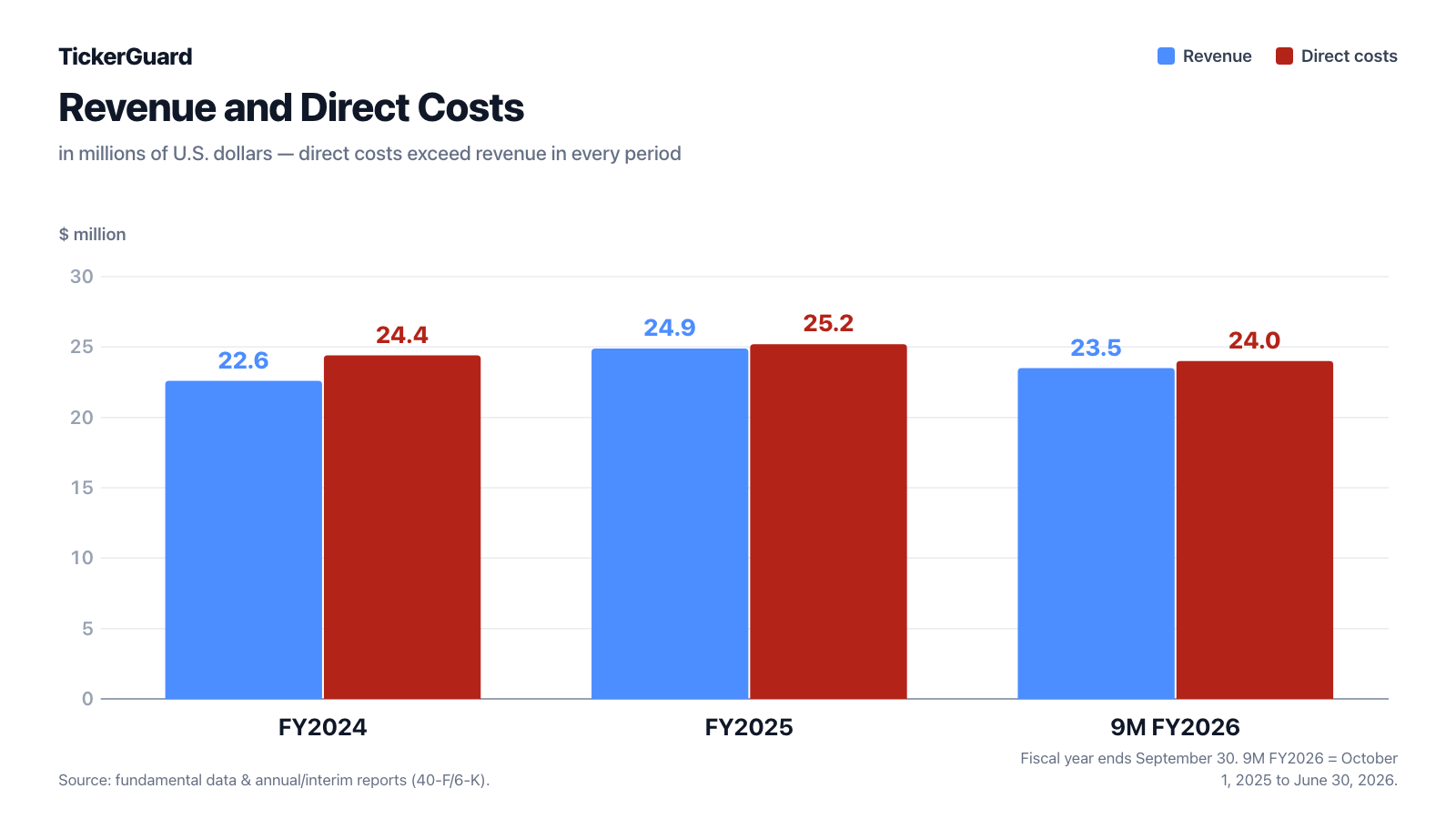
Before you put too much weight on those bars, the explanation belongs with them — and, to the filing's credit, it sits in plain sight in the MD&A itself:
"Direct costs increased 79.2% to $12.4 million in Q3 FY2026 from $6.9 million. The increase primarily reflects $5.8 million of depreciation of right-of-use assets in the current quarter, compared with nil in the comparative quarter. Utilities and grid services were $3.9 million in both quarters, and depreciation of property, plant and equipment decreased to $2.5 million from $2.8 million."
— Bitzero Holdings Inc., MD&A to June 30, 2026, section 7(b) "Direct costs and gross margin," exhibit 99.2 to a report on Form 6-K filed August 17, 2026 (sec.gov)
That finding cuts both ways. In the company's favor: the running costs of its own data center did not explode. Utilities and grid services cost practically the same in both quarters ($3,907,278 against $3,916,279), and depreciation on owned equipment actually fell. Strip out the $5,820,618 of right-of-use depreciation and direct costs for the quarter were $6,591,179 — below the $6,926,572 of the year-earlier quarter, on 65.5 percent more revenue. On that basis the quarter would have shown a gross profit of roughly $4.1 million. Against the company: that depreciation is not a bookkeeping trick. It is the single largest item within direct costs, and it was paid in bitcoin. Note 17 sets it out with unusual clarity: right-of-use assets of $5,820,618 were added during the quarter and fully depreciated within that same quarter, and lease liabilities of $5,916,434 were settled using digital currency. At June 30, 2026 both the right-of-use asset and the lease liability stand at nil.
Put plainly: Bitzero rented extra capacity for one quarter, consumed it immediately and paid for it with mined bitcoin — and that single rental is what pushed the quarter's gross result into the red. Whether it repeats is the real question for the annual statements to September 30, 2026. Rule of thumb: a cost jump that lives in one line and was paid in bitcoin is not a trend — but it is not a technicality either.
One detail belongs in that series for honesty's sake. In the fiscal year to September 30, 2024, revenue still included $7,004,281 from hosting services — renting data center space to third parties. In fiscal 2025 that line was zero. The very business the company now wants to rebuild at scale disappeared entirely in the meantime. The MD&A to June 30, 2026 is blunt about it: "The Company remains focused on self-mining and does not currently report hosting revenue." Where the revenue does come from sits one note further on:
"For the three- and nine-month periods ended June 30, 2026 and June 30, 2025, substantially all revenue was generated from Bitcoin mining conducted in Norway through Exanorth AS."
— Bitzero Holdings Inc., interim financial statements to June 30, 2026, note 5 "Operating Segments" (Form 6-K filed August 17, 2026, sec.gov)

Just how clear-cut that is shows in the revenue note itself: note 6 lists exactly two lines for the nine months — $23,476,975 from digital assets mined and a refund adjustment of $9,812, together the reported $23,467,163. There is no third revenue type. Bitcoin mining therefore accounts for 100 percent of revenue.
Hold on to that finding, because it carries the rest of this piece: the data centers the news releases are about exist as land, permits and a letter agreement — in the revenue note they do not exist at all. For a picture of a company that has already made the transition, see our analysis of HIVE Digital, whose annual report shows high-performance computing as a separate, quantified revenue stream alongside mining.
What the filings say — the uncomfortable truths
Uncomfortable truth no. 1: the statements carry a going concern warning
When a company needs as much capital as Bitzero's plans would require, the first question is not "how big could this get?" but "how long does the money last?" The interim statements answer it in note 2(d), and the answer is a standard sentence with a very concrete meaning:
"These events and conditions indicate that a material uncertainty exists that may cast significant doubt on the Company's ability to continue as a going concern."
— Bitzero Holdings Inc., interim financial statements to June 30, 2026, note 2(d) "Going concern" (Form 6-K filed August 17, 2026, sec.gov)

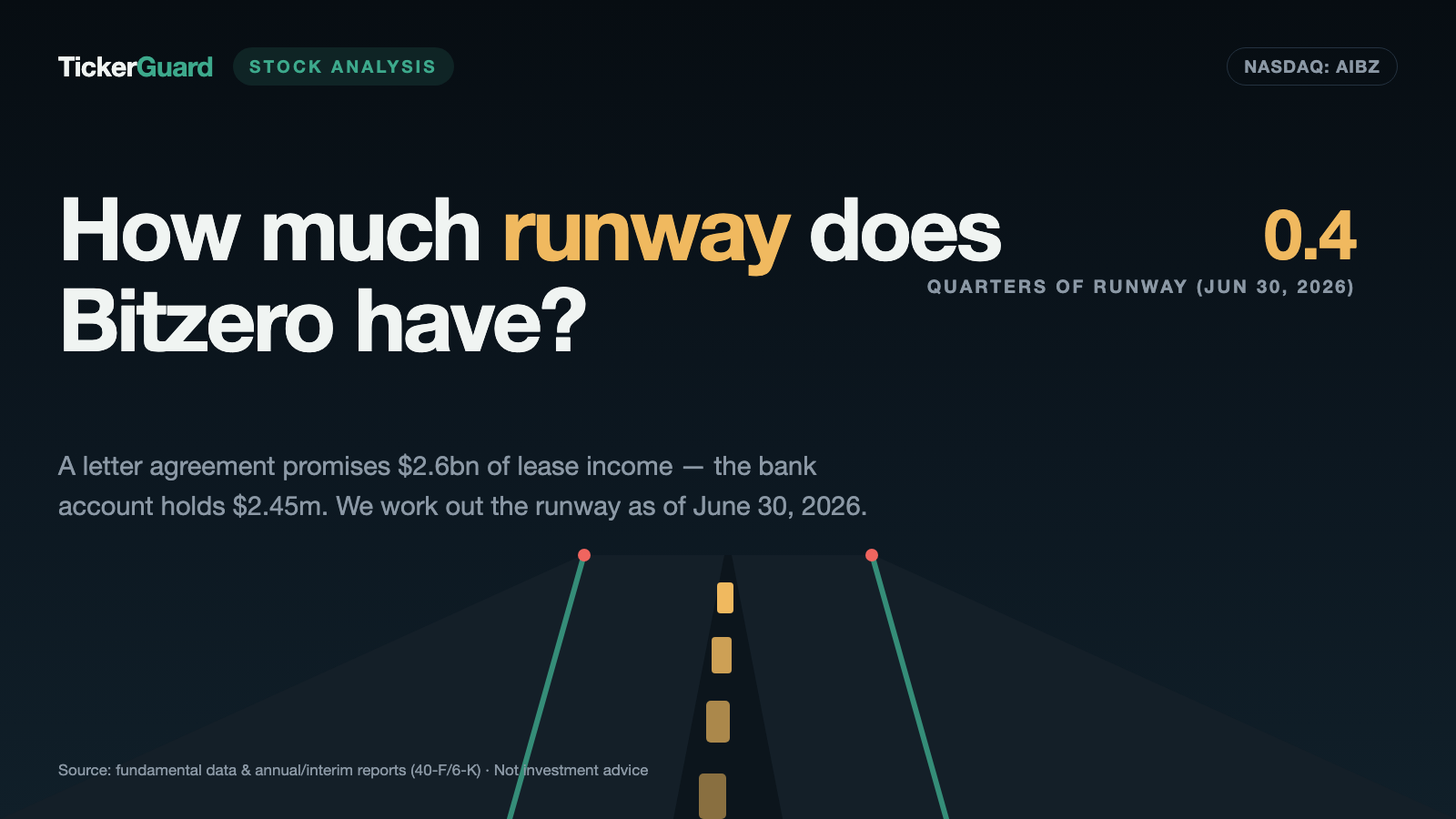
In plain language: the accountant writes a note next to the balance sheet saying, in effect, "whether this company gets through the next twelve months depends on things that have not been settled yet." That is not a bankruptcy forecast, but it is not a formality either — the same wording already appeared as an emphasis of matter paragraph in the report of auditor SRCO Professional Corporation on the fiscal year ended September 30, 2025. The numbers behind it at June 30, 2026: $2,453,673 in cash, $493,384 held in trust, $2,000,000 restricted and 41.03 bitcoin worth $2,462,683 — against current liabilities of $37,040,583. That produces a working capital deficit of $24.0 million, up from $6.4 million at September 30, 2025. Cash used in operating activities over the nine months was $22,637,772. Put that against the bank account: $22,637,772 over nine months is about $7.55 million a quarter, so the $2,453,673 of cash plus $493,384 held in trust covers roughly 0.4 of a quarter — about five weeks if no fresh money arrives. That is the number the going concern warning hangs on.
Fairness requires the sequel: the July 30, 2026 placement brought roughly $23.3 million net, and repaying that largest loan on August 6, 2026 released the $2.0 million of restricted cash and ended the covenants. The MD&A puts the effect carefully: those transactions improved near-term liquidity but do not eliminate the company's dependence on achieving its operating plans and obtaining financing when required.
Uncomfortable truth no. 2: the quarterly loss is four times the operating loss
The net loss for the quarter to June 30, 2026 was $26,464,717 — on revenue of $10.7 million. Anyone concluding that the business burns $26 million of cash per quarter is wrong; anyone dismissing the loss as "just accounting" is wrong too. The bridge from operating loss to reported loss shows where the difference comes from:
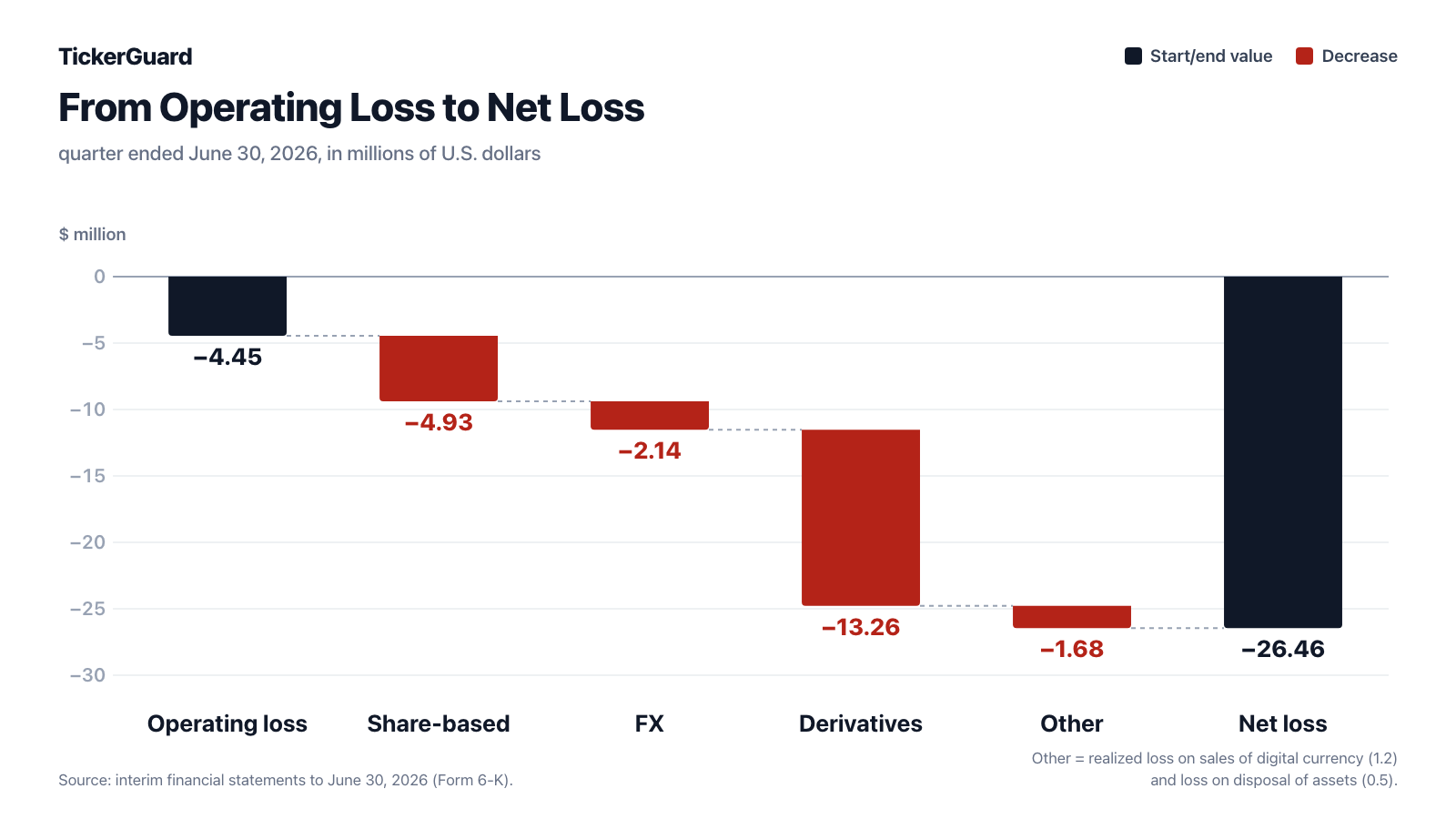
The biggest item, the $13,262,586 fair-value loss on derivatives, needs explaining because it turns intuition upside down. Bitzero issued warrants to its lenders — exercisable at $0.10 per share. Because their terms do not guarantee a fixed number of shares for a fixed amount of cash, IFRS classifies them not as equity but as a liability that is remeasured at every reporting date. The workings are in note 20(d): with a share price of $6.76 at June 30, 2026, an exercise price of $0.10 and expected volatility of roughly 119 percent, each warrant was valued at about $6.69. The consequence is paradoxical: the higher the share price climbs, the larger the reported loss. At June 30, 2026 derivative liabilities stood at $15,552,778 — more than twice total equity. Across the nine months, incidentally, the same line adds up to a loss of only $5,900,982: remeasurement produced gains in the earlier quarters that partly absorbed the third-quarter hit.
The remaining items in the bridge are smaller but real: a foreign-exchange loss of $2,140,136, a realized loss of $1,189,073 on sales of digital currency and a $494,922 loss on disposal of assets — the last two together making up the $1.68 million shown as "other" in the chart. What is not a valuation effect: share-based expense of $4,931,500 in the quarter and $20,014,769 over nine months. It costs no cash, but it costs ownership — more on that shortly.
Uncomfortable truth no. 3: adjusted EBITDA is positive because the loss is adjusted out
The same MD&A contains a figure that cheerfully contradicts the picture: adjusted EBITDA of $3,136,431 for the quarter, a margin of 29.4 percent, and $6,580,615 over nine months. EBITDA is earnings before interest, taxes, depreciation and amortization; "adjusted" means the company additionally strips out items it considers unrepresentative. What is remarkable is how openly the report says which ones:
"The current-quarter measure reflects add-backs for share-based expense, the foreign-exchange loss and the derivative fair-value loss, which more than offset the operating loss embedded in EBITDA."
— Bitzero Holdings Inc., MD&A to June 30, 2026, section 10 "Reconciliation of EBITDA" (Form 6-K filed August 17, 2026, sec.gov)

This is not sleight of hand — the full reconciliation is in the report, and stripping out valuation swings can be sensible for volatile positions. But the measure answers a different question than many readers assume. It does not say "the business makes money." It says: "before depreciation, before interest, before share-based expense and before valuation effects, something would be left over." For a data center, though, that depreciation is not a rounding item: it came to $8,315,888 in the quarter, and note 16 puts the useful life of mining equipment at three years. Rule of thumb: adjust depreciation out of a data center and you have adjusted out the main event.
Uncomfortable truth no. 4: the loan that was repaid cost more than the balance sheet said
Repaying the senior secured loan early on August 6, 2026 is unambiguously good news: it carried a rate of at least 14 percent — precisely, the greater of Term SOFR plus 11 percentage points and 14 percent — and was secured on substantially all of the group's assets. Repayment released the security and ended the covenants. Only: what sat on the balance sheet and what was paid are two different numbers.
"At June 30, 2026, the carrying amount of the Company's JGB senior secured loan was $13.0 million and the contractual principal outstanding was $22.890 million."
— Bitzero Holdings Inc., MD&A to June 30, 2026, section 3(d) (Form 6-K filed August 17, 2026, sec.gov)

The gap of roughly $9.4 million between carrying amount and actual payment is the discount created when the attached warrants were split out at the time the loan was drawn. The accounting is correct; for a reader it means that a loan that looked like $13 million on the balance sheet cost $22.4 million in cash on its way out — against equity of $6.6 million at the reporting date. (Between June 30 and the payoff five weeks later, contractual principal came down from the reported $22.890 million to the $22,375,000 actually paid.) What that does to fourth-quarter fiscal 2026 earnings appears in no published report so far. The annual statements to September 30, 2026 are where it will show up. One more clause from the same MD&A belongs here: the compliance certificate required for June 30, 2026 "had not been delivered as at the date of these financial statements and is being finalized" — the covenants themselves fell away with the repayment.
Uncomfortable truth no. 5: 57 million shares can become 73 million
Dilution is one of those terms best explained with a cake: your slice gets smaller when new slices keep being cut, even though the cake stays the same size. At Bitzero the arithmetic is worth doing because it all sits in a single table — section 18 of the MD&A, as of August 13, 2026. Outstanding are 55,122,366 voting and 2,312,243 non-voting shares, together 57,434,609. Alongside them:
- 5,828,342 special warrants from the July 30, 2026 placement — each exchanges automatically, for no further consideration, into one share and one warrant, at the latest four months and one day after closing. The company's own table carries 11,656,684 potential shares for them: 5,828,342 from the exchange and a further 5,828,342 from exercising the resulting warrants. That second half, however, requires $5.00 per share in cash, exercisable for five years.
- 1,947,229 further warrants, most of them exercisable at $0.10.
- 727,273 options at a weighted average exercise price of $4.48, plus 350,000 restricted share units.
- 759,435 shares under the conversion right attached to the 26-bitcoin financing from FAR Holdings.
Add it up and you get roughly 15.4 million additional shares, or about 27 percent on top of today's count — and that total does not include the disputed conversion right held by the former chief executive. Behind it sits an unsecured convertible loan with contractual principal of $1,000,000 that, including accrued interest, was carried at $1,752,590 (note 18). Note 23 records that the loan and the related conversion right are part of live legal proceedings between Bitzero and its former chief executive over employment matters and equity instruments; while those run, section 18 of the MD&A says the number of shares potentially issuable cannot be determined — the outstanding securities table leaves that cell empty. The price of the July 30, 2026 placement is a dated valuation anchor in its own right: $4.25 per special warrant, while the same share was marked at $6.76 on June 30, 2026 in the valuation note. Those who put up money did so at a clear discount — spread, per the Form D filed August 14, 2026, across four investors. Rule of thumb: growth paid for with fresh shares and warrants is never quite free.
Valuation: what the market pays for a letter agreement
A price-to-earnings ratio cannot be formed here — there are no earnings. That leaves revenue. Adding the last twelve reported months ($7,402,272 in the quarter to September 30, 2025 plus $23,467,163 in the nine months to June 30, 2026) gives roughly $30.9 million. Market capitalization was in the order of $360 million — worked out from the 57,434,609 shares reported on August 13, 2026 and the closing price of $6.24 on August 21, 2026, it comes to about $358 million. That is a price-to-sales ratio of about 11.6. For context: that is a multiple usually seen at software companies with high gross margins, not at a business whose direct costs exceed its revenue.
The valuation can be defended, but only on one ground: that the OneQode letter agreement becomes a definitive contract. On the company's own assumptions — roughly $151 million of annual net operating income at full utilization of 110 megawatts — today's market capitalization would be earned back in a little over two annual results. Except that figure rests on a margin of about 85 percent the company itself describes as an internal assumption, on utilization that does not yet exist, on a 110-megawatt build-out that has only just begun, and on a contract that has not been signed. A second note on the reliability of forecasts comes from the report itself: the comparison against the forecast in the November 19, 2025 listing statement shows mining revenue for the same fiscal year revised to $32.75 million from a planned $39.27 million (down 16.6 percent) and general and administrative expenses at $8.14 million against $4.36 million (up 86.7 percent).
One last item belongs in the valuation discussion because it rarely surfaces anywhere: in its release of June 23, 2026, Bitzero disclosed that it had engaged a service provider for a two-week investor awareness campaign in June and July 2026 for $246,500. That is roughly a tenth of the entire cash balance at June 30, 2026. It is disclosed and is not unusual in Canada, but it belongs in the picture when judging how much of the share price move since the Nasdaq listing is business and how much is attention. For a comparison with a company the market is already paying for an operating AI data center business, see our analysis of Riot Platforms.
Opportunities and risks at a glance
What speaks for Bitzero:
- A real, growing operation: 16,130 miners and roughly 1.85 EH/s at June 30, 2026, 291.53 bitcoin mined over nine months, quarterly revenue up 65.5 percent to $10,650,851.
- A locational advantage with substance: hydroelectric power in Norway's NO4 price zone, a cool climate, plus owned land in North Dakota (184 acres) and Finland — sites and grid connections are currently the industry's scarcest raw material.
- Funding rebuilt in five weeks: gross proceeds of $24,770,454 on July 30, 2026, full repayment of the at-least-14-percent loan on August 6, 2026, covenants removed and $2.0 million of restricted cash released.
- A 15-year letter agreement worth roughly $2.6 billion with a cloud provider, plus partnerships with Vertiv (August 4, 2026) and Red Engineering Design, give the build-out plan an industrial footing.
- The owner is in the boat: founder and chief executive Mohammed Bakhashwain held 4,332,717 shares, or 8.0 percent, at June 30, 2026 per his ownership filing.
What speaks against it:
- A going concern warning in the interim statements to June 30, 2026 and in the auditor's report on fiscal 2025, plus a working capital deficit of $24.0 million and $22,637,772 of cash used in operations over nine months.
- A gross loss in every reported period: $1,776,389 (fiscal 2024), $293,485 (fiscal 2025), $1,543,061 (nine months to June 30, 2025) and $527,325 (nine months to June 30, 2026) — in none of the reported periods has the core business produced a gross profit, even though the shortfall has narrowed on a nine-month basis.
- One segment, one site, one product: revenue depends entirely on the bitcoin price, network difficulty and Norwegian power prices. Hosting revenue in fiscal 2025 was zero.
- Dilution of roughly 27 percent from instruments already issued, plus an unquantified amount from the disputed conversion right held by the former chief executive; the July 30, 2026 placement priced at $4.25, well below the $6.76 marked at June 30, 2026.
- Earnings swing violently on valuation effects: a $13,262,586 derivative loss in a single quarter and $15,552,778 of derivative liabilities against $6,615,513 of equity — and the loss grows arithmetically as the share price rises.
- A short reporting history: this is the first interim period as a non-venture issuer, with certificates filed under the simplified Form 52-109F2, which expressly makes no representations about the effectiveness of disclosure controls or internal control over financial reporting — the form itself warns this "may result in additional risks to the quality, reliability, transparency and timeliness" of the filings; the annual information form of February 2, 2026 lists eight employees.
- Both hats on one head: since the resignation of Gilles Seguin, announced on June 4, 2026, Mohammed Bakhashwain has run the company as chief executive and chaired the board — he leads the body meant to supervise him.
A human conclusion
Back to the label trap. Its core is not that labels lie — Bitzero really does own land, grid connections, permits and a signed letter agreement, and the plans for Norway and Finland are not fabrications. Its core is that a label takes the ordering of your questions away from you. It lets you ask "how big could this get?" first, when the first question at a company with a going concern warning, a $24 million working capital deficit and a business with no gross profit has to be: "how does it get from here to there?"
Both numbers in the headline sit in the same filings: the $2.6 billion from a letter agreement, spread over 15 years and conditional on a contract that as of June 15, 2026 had expressly not been executed — and the $2.45 million of cash at June 30, 2026, due from tomorrow onwards. So the honest question is not "is Bitzero an AI stock?" but: do you trust this company to fund the next two years before the big number can even start flowing — and are you willing to carry roughly a quarter of dilution while it does? If yes, you have a thesis. If no, you had a label. What you make of it is your decision. And that is exactly as it should be.
Sources
Every original document used in this analysis, for you to read yourself:
- Bitzero Holdings Inc. — unaudited interim condensed consolidated financial statements for the three and nine months ended June 30, 2026 (exhibit 99.1 to Form 6-K, filed August 17, 2026)
- Bitzero Holdings Inc. — management's discussion and analysis for the three-month period ended June 30, 2026 (exhibit 99.2 to Form 6-K, filed August 17, 2026)
- Bitzero Holdings Inc. — audited consolidated financial statements for the years ended September 30, 2025 and September 30, 2024 (exhibit 99.76 to the registration statement on Form 40-F)
- Bitzero Holdings Inc. — management's discussion and analysis for the year ended September 30, 2025 (exhibit 99.77)
- Bitzero Holdings Inc. — annual information form dated February 2, 2026 (exhibit 99.80)
- Bitzero Holdings Inc. — registration statement on Form 40-F, amendment no. 2 dated August 12, 2026 (with the complete exhibit index)
- Bitzero Holdings Inc. — news release dated June 15, 2026 on the first week of Nasdaq trading and the OneQode letter agreement (exhibit 99.1 to Form 6-K)
- Bitzero Holdings Inc. — news release dated June 23, 2026 on the Finnish land reservation and the investor awareness campaign (exhibit 99.1 to Form 6-K)
- Bitzero Holdings Inc. — material change report dated August 10, 2026 on the placement of 5,828,342 special warrants (exhibit 99.1 to Form 6-K)
- Bitzero Holdings Inc. — news release dated June 4, 2026 on the Nasdaq listing approval and board changes (exhibit 99.1 to Form 6-K)
- Bitzero Holdings Inc. — news release dated August 4, 2026 on the collaboration with Vertiv (exhibit 99.1 to Form 6-K)
- Complete SEC filing history for Bitzero Holdings Inc. (CIK 0002100457, including the Schedule 13G of July 14, 2026 and the Form D of August 14, 2026): EDGAR overview (sec.gov)
- Fundamental data (price, market capitalization, 52-week range; data as of August 21, 2026), reconciled against the filings listed above.
Transparency & disclaimer: this analysis is journalistic commentary on publicly available information. It is not investment advice, not a regulated financial analysis and not a solicitation to buy or sell securities. Equity investments carry substantial risk up to and including total loss. All figures without warranty; the as-of date of the data is stated in the text. Positions held by the operator are disclosed daily; where one exists, it appears as a notice at the top of this deep dive.
Key figures at a glance
All monetary figures in millions of $; earnings per share as reported.
| Metric | 2024 | 2025 |
|---|---|---|
| Revenue | 22.9 | 26.5 |
| Operating Income (EBIT) | -12.0 | -19.4 |
| Net Income | -11.4 | -17.6 |
| Net Margin | -49.9% | -66.5% |
| Earnings Per Share | -0.22 $ | -0.34 $ |
Source: fundamental data & SEC filings (annual and quarterly reports, 10-K/10-Q)
Our Bottom Line at a Glance
- Revenue growth and operations positive
- Revenue rose 65.5 percent to $10,650,851 in the quarter to June 30, 2026 and 34.5 percent to $23,467,163 over nine months. Real volume sits behind it: 291.53 bitcoin mined in nine months, 16,130 miners and roughly 1.85 EH/s of installed hashrate at the reporting date.
- Gross profit negative
- Direct costs exceeded revenue in every reported period: negative $1,776,389 in the fiscal year to September 30, 2024, negative $293,485 in fiscal 2025 and negative $527,325 in the nine months to June 30, 2026 (prior-year period negative $1,543,061), with negative $1,760,946 in the quarter alone. The quarterly figure is almost entirely down to $5,820,618 of depreciation on right-of-use assets, nil in the year-earlier quarter — without it the quarter would have shown a gross profit. A business that has reported no gross profit in any period still cannot fund scale out of itself.
- Liquidity and going concern negative
- The interim statements to June 30, 2026 disclose a material uncertainty about the ability to continue as a going concern; the auditor said the same about fiscal 2025. Cash of $2,453,673 against current liabilities of $37,040,583, a working capital deficit of $24.0 million, and $22,637,772 of cash used in operations over nine months.
- Capital structure and dilution negative
- From 57,434,609 shares (August 13, 2026), special warrants, 1,947,229 warrants, 727,273 options, 350,000 restricted share units and a conversion right could add roughly 15.4 million more — about 27 percent. The July 30, 2026 placement priced at $4.25, well below the $6.76 documented in the filings for June 30, 2026.
- Earnings quality negative
- Between the $4,446,500 operating loss and the $26,464,717 net loss for the quarter sit $4,931,500 of share-based expense, a $2,140,136 foreign-exchange loss and a $13,262,586 fair-value loss on derivatives. Those derivatives carry $15,552,778 on the balance sheet and become more expensive as the share price rises; the $3,136,431 of adjusted EBITDA set against them exists only because those very items are added back.
- Future projects neutral
- The 15-year OneQode letter agreement worth roughly $2.6 billion, the 110-megawatt build-out in Norway, pre-design work for up to 520 megawatts in Finland and the partnerships with Vertiv and Red Engineering Design are all genuinely documented — but without a signed lease, without utilization and without revenue. The upside and the disappointment risk sit equally close here.
Bitzero Holdings describes itself as a provider of AI and HPC data center infrastructure, yet the segment note to June 30, 2026 attributes substantially all revenue to bitcoin mining at a single Norwegian site. Revenue is growing fast (up 65.5 percent to $10,650,851 in the quarter), direct costs are growing faster (up 79.2 percent to $12,411,797), and the statements carry a material uncertainty about the ability to continue as a going concern. Against that sit a working capital deficit of $24.0 million, equity of $6,615,513 and potential dilution of roughly 27 percent. A valuation of about eleven times trailing revenue can only be justified by a lease that has not been signed. Not investment advice.
What Our Rating Means
Substance risk
We found at least one documented issue that threatens the company itself — regardless of how the stock is currently valued.
Red, and not because of the share price. One documented finding would be enough for this level; here several coincide. Note 2(d) of the interim statements to June 30, 2026 expressly discloses a material uncertainty about the ability to continue as a going concern, and the auditor had already included the same point in its report on the year ended September 30, 2025. Then the cash position: $2,453,673 of cash and $493,384 held in trust against $22,637,772 of cash used in operations over nine months — arithmetically less than half a quarter of runway without new money. The working capital deficit of $24.0 million has grown almost fourfold from $6.4 million since September 30, 2025, and equity fell over the same nine months from $12,850,711 to $6,615,513. The core business has produced no gross profit in any reported period — even though the shortfall narrowed on a nine-month basis from $1,543,061 to $527,325. The July 30, 2026 placement and the August 6, 2026 loan repayment visibly eased the situation, and with land, grid connections and a 15-year letter agreement the company holds a genuine lever — but the dependence on further financing remains, and the company describes it in its own report. Whether the stock is cheap or expensive at this price plays no part in this rating. The decision is yours.
A journalistic assessment by our editorial team at the time of the deep dive, based on public sources — not investment advice and not a solicitation to buy or sell. Your personal circumstances (investment goals, risk capacity, taxes) cannot be taken into account. What our levels mean, how verdicts are formed, and what conflicts of interest exist →
Worth Noting
- Bitzero is a Canadian issuer under the multijurisdictional disclosure system and therefore files no 10-K and no 10-Q. This analysis is based on the interim financial statements and MD&A to June 30, 2026 (exhibits 99.1 and 99.2 to the Form 6-K filed August 17, 2026), the audited annual statements to September 30, 2025 (exhibit 99.76 to the registration statement on Form 40-F) and the annual information form dated February 2, 2026. Reporting is under IFRS in U.S. dollars and the fiscal year ends September 30.
- Easy to confuse: Bitzero Holdings Inc. was named WBM Capital Corp. until November 19, 2025; the comparative figures are those of Bitzero Blockchain Inc., the accounting acquirer. The Canadian ticker is AIBZ.U (BITZ.U until June 9, 2026) and the Nasdaq ticker is AIBZ. The 10-for-1 ratio in the reverse takeover was the exchange ratio for Bitzero Blockchain shares, not a consolidation of the listed shares. That consolidation affected the WBM shares and ran 6,000,000-for-1 on October 4, 2024, followed by a 1-for-250,000 split on July 24, 2025.
- Valuation figures are dated and evergreen: the price anchor of $6.24 is the closing price of August 21, 2026, while the price documented in the filings for June 30, 2026 was $6.76 (a valuation input for the warrants, note 20(d)). Market capitalization was cross-checked against the 57,434,609 shares in section 18 of the MD&A; the deviation from the fundamental data is under 7 percent.
- Data caveat: Bitzero has only been listed on Nasdaq since June 2026. The fundamental data set holds neither a quarterly series nor reliable derived ratios for this company; individual automatically calculated values on the stock page (such as the Altman Z-score or the equity ratio) are not meaningful for this security at present. Every figure in this analysis therefore comes from the SEC filings themselves — only price, market capitalization and trading range come from fundamental data.
Stock Watch
This analysis is as of August 26, 2026. Stock Watch will tell you what's changed at AIBZ since then.
Later $1 a month per stock — signing up is free, and you'll be the first to know when it launches.
The full analysis as a PDF for later
We will send you this analysis as a PDF — to print, file away, and read at your own pace. And we will add you to the free Stock Watch list for Bitzero Holdings Inc. (AIBZ), so you hear about it when something material in this analysis changes.
Frequently Asked Questions
Bitzero Holdings Inc. (Nasdaq: AIBZ) is a Canadian corporation based in Vancouver. It mines bitcoin in Namsskogan, Norway — with 39 containers, 16,130 miners and roughly 1.85 EH/s of hashrate at June 30, 2026. It also holds development land in North Dakota and Finland where it plans data centers for high-performance computing.
Not according to its own filings. The segment note in the interim statements to June 30, 2026 attributes substantially all revenue for the three and nine months to that date to bitcoin mining in Norway. The revenue note lists exactly one item: digital assets mined. The MD&A states that the company does not currently report hosting revenue.
Because, per note 2(d), the company depends on generating operating cash flow, staying within financing covenants and raising further capital. At June 30, 2026 cash of $2,453,673 stood against current liabilities of $37,040,583, and cash used in operations over nine months was $22,637,772. The auditor made the same point in its report on fiscal 2025.
Bitzero puts total revenue from the 15-year lease of 110 megawatts in Norway at roughly $2.6 billion and, assuming a site net operating income margin of about 85 percent, derives roughly $151 million of annual net operating income at full capacity. The June 15, 2026 release also states that a definitive lease agreement has not been executed.
Because the measure strips out precisely the items that make up the loss. Unadjusted EBITDA for the quarter to June 30, 2026 was negative $17,197,791. Only adding back share-based expense, the foreign-exchange loss and the derivative fair-value loss produces the positive $3,136,431. Depreciation of $8,315,888 for the quarter is likewise excluded.
At August 13, 2026 there were 57,434,609 shares outstanding. Special warrants (11,656,684 potential shares), 1,947,229 further warrants, 727,273 options, 350,000 restricted share units and 759,435 shares under a conversion right could add roughly 15.4 million — about 27 percent. The disputed conversion right held by the former chief executive is not included.
Because Bitzero is a Canadian issuer under the multijurisdictional disclosure system. It registered on Form 40-F on May 15, 2026 and files interim reports on Form 6-K. The audited annual statements sit as an exhibit to the registration statement. Reporting is under IFRS in U.S. dollars and the fiscal year ends September 30.
No. The annual information form dated February 2, 2026 states that no cash dividends have been declared or paid to date and that there is no intention to pay any in the foreseeable future. With accumulated losses of $121,001,609 at June 30, 2026 and a going concern warning, a distribution would be hard to justify anyway.
Found an error?
Did you spot a factual error, an outdated number, or a typo in this deep dive? Let us know briefly — your report goes straight to the editorial team.