Santacruz Silver: A Winner With a Silver Name — and a Report That Comes With Zinc, Purchased Ore and the Bolivian State
Up 1,103 percent in 2025, No. 1 on the TSX Venture 50, almost halved since its January 2026 peak: Santacruz Silver (Nasdaq: SCZM, TSX: SCZ) still makes the hot list of a major German investor forum. Read the first-half report and you find zinc, ore bought from other miners, a state partner and a tax bill that swallowed almost all of the second quarter.
 Thomas Mücke
Founder & Publisher
Thomas Mücke
Founder & Publisher
Chart
Interactive price chart (TradingView).
Note: pure fact-based analysis, not investment advice and not a solicitation to buy or sell. All figures without guarantee.
You know the feeling: a name sits at the top of a ranking, and your brain immediately concludes there must be something to it. Call it the leaderboard reflex. A ranking measures what has already happened. Our minds read it as a tip about what comes next.
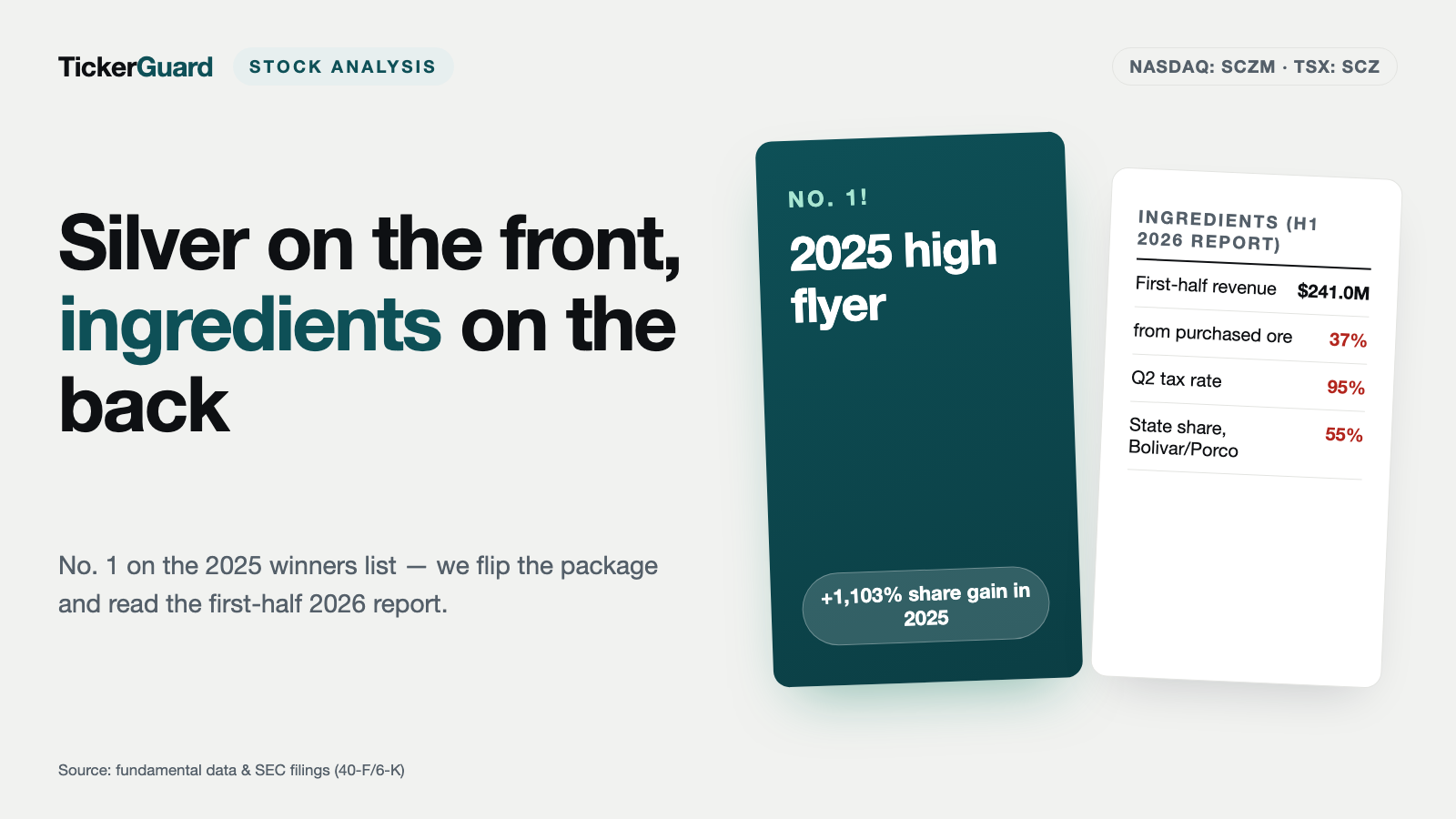
On February 18, 2026, Santacruz Silver announced it had ranked No. 1 on the TSX Venture 50, the annual leaderboard of Canada’s junior exchange: a 1,103 percent share price gain in 2025. By then, the peak was already behind it — the highest close of the following months came on January 27, 2026, at C$22.45. On October 7, 2026, the stock closed at C$11.98 in Toronto, almost 47 percent lower. The tension running through this analysis: a name that sounds like pure silver, and a report in which zinc, purchased ore, a Bolivian state miner and a tax bill all play a part. Let’s read the filings together. The decision is yours at the end.
What Santacruz Silver Actually Does
Santacruz is a producer, not an explorer: it mines ore, mills it, separates the metals into concentrates and sells those to smelters. Headquarters are in Vancouver; the operations are in Bolivia and Mexico. According to its annual information form dated April 30, 2026, it employs 1,463 people plus 810 contractors in Bolivia and 774 people plus 112 contractors in Mexico; in Canada it has three employees.
The core is the Bolivian business Santacruz bought from Glencore on March 18, 2022:
- Bolivar and Porco — two mines with their own mills, run under an association agreement with state miner COMIBOL. Santacruz operates them; COMIBOL is entitled to 55 percent of the net cash flow.
- Caballo Blanco — the Tres Amigos and Colquechaquita mines plus the Don Diego plant, 100 percent owned.
- San Lucas — an ore-sourcing business: Santacruz buys ore from third-party miners, pays based on metal content and market prices, and processes it in its own plants.
- Soracaya — an exploration project with an inferred resource of 4.1 million tons; an enhanced permit to extract 3,000 tons a month has been applied for.
In Mexico, Santacruz runs the Zimapan mine in Hidalgo state, the largest single operation by tons milled (222,259 tons in the second quarter of 2026). The MD&A spells out what the concentrates contain: silver and zinc each generate more than 30 percent of revenue; lead and copper together less than 10 percent. Santacruz is a silver and zinc producer — the name tells half the story.
Company history for investors
-
2022
Bolivian mines bought from Glencore
On 2022-03-18, Santacruz took over Bolivar, Porco, Caballo Blanco and San Lucas. A small producer became a silver-zinc group — with purchase-price debt.
-
2023
Trading halt over missing statements
Trading was halted from May 8 to June 9, 2023, because the 2022 annual statements were missing. The 2023 statements were later restated: from +$16.1M to −$11.0M.
-
2024
Glencore renegotiation
Term sheet in March, agreement on October 3, 2024: the outstanding payments were restructured, Santacruz booked a $133.3M one-time gain, and Glencore received a zinc-price CVR.
-
2025
Two management orders, Glencore settled
Management orders in May and June, Glencore purchase price settled with $40M in September, 4:1 consolidation on December 10. The stock topped the TSX Venture 50.
-
2026
Nasdaq, currency reform, Toronto
Nasdaq debut on January 21, peak close on January 27, Bolivian currency float in June with $36.1M of tax in the quarter, move to the Toronto Stock Exchange on September 21.
How the Stock Landed on Our Desk
The trigger was not a hit from our in-house stock scanner. The stock made our research list through the forum hot list of wallstreet-online, the ranking of the stocks most discussed by German retail investors (as of October 8, 2026), under its Nasdaq ticker SCZM. That is an attention signal, not a quality signal — which brings us right back to the leaderboard reflex.
SCZM is the same share as SCZ in Toronto. It has traded on Nasdaq since January 21, 2026, and on the Toronto Stock Exchange since September 21, 2026 (before that on the smaller TSX Venture Exchange). Ahead of the Nasdaq debut, Santacruz consolidated its shares one-for-four on December 10, 2025, to meet Nasdaq’s initial listing requirements.
Since the Nasdaq listing, Santacruz also reports to the U.S. securities regulator, the SEC — as a Canadian issuer with an annual report on Form 40-F (first for 2025, filed May 1, 2026) and interim reports on Form 6-K. It reports under IFRS in US dollars. The latest periodic report is the interim filing for the period ended June 30, 2026 (Form 6-K filed August 17, 2026). Only three releases followed: conditional approval to list on the Toronto Stock Exchange (September 8), the trading date there (September 17) and the purchase of a processing plant (September 18, 2026). We last checked the company’s news page on October 8, 2026.
The Numbers Over the Years — Credit Where It Is Due
Let’s start with what genuinely impresses. Santacruz is leverage on the silver price, and that leverage paid off. In the second quarter of 2025, its own mines realized $33.13 per ounce of silver; in the second quarter of 2026, they realized $72.17. All-in sustaining costs (AISC), which include ongoing capital spending, rose only to $21.87. That left a margin of $50.30 per ounce sold — more than three times the prior year.
It shows in revenue, which rose from $251.3 million in 2023 to $283.0 million in 2024 and $326.4 million in 2025; the first half of 2026 alone brought $241.0 million, up from $143.6 million a year earlier. Operating cash flow grew from $29.6 million in 2023 to $54.4 million in 2024 and $79.1 million in 2025.
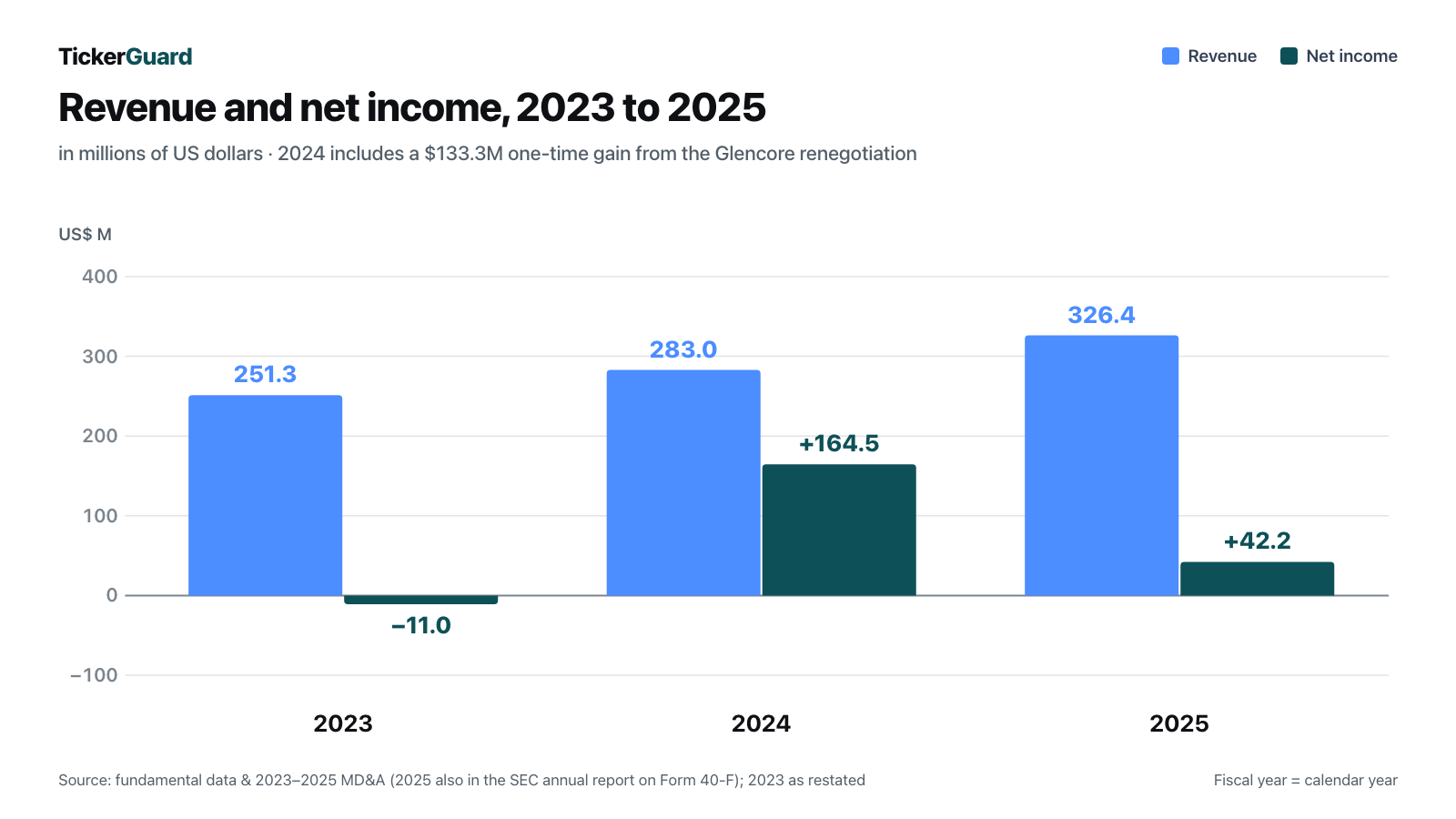
Earnings tell a bumpier story. In 2024, Santacruz reported $164.5 million of net income, but $133.3 million of it was a book gain: the outstanding payments to Glencore for the Bolivian mines had been renegotiated. In the end, Santacruz paid $40 million by September 4, 2025, instead of up to $80 million. Net income was $42.2 million in 2025 and $30.5 million in the first half of 2026. And one drop of bitterness on volume: Santacruz produced 5.60 million ounces of silver in 2025, 17 percent less than in 2024 (6.72 million). One reason was a flooding event at the Bolivar mine in May 2025. The first half of 2026 brought 2.91 million ounces, 3 percent less than a year earlier. The revenue jump comes mainly from price, not volume.
What the Filings Say — the Uncomfortable Truths
Now let’s flip the package over. What follows isn’t on the leaderboard; it’s in the fine print of the filings.
Uncomfortable Truth No. 1: The 100 Percent Figures Don’t Belong 100 Percent to Santacruz
In its production tables, Santacruz reports the Bolivar and Porco mines in full, at 100 percent. In the financial statements they appear at only 45 percent. The reason is in the MD&A for the period ended June 30, 2026:
“COMIBOL’s entitlement under the Agreement is not a direct share of production, but rather a 55% participation in net cash flow.”
— Santacruz Silver Mining Ltd., Form 6-K filed August 17, 2026, MD&A for the period ended June 30, 2026, Company Overview
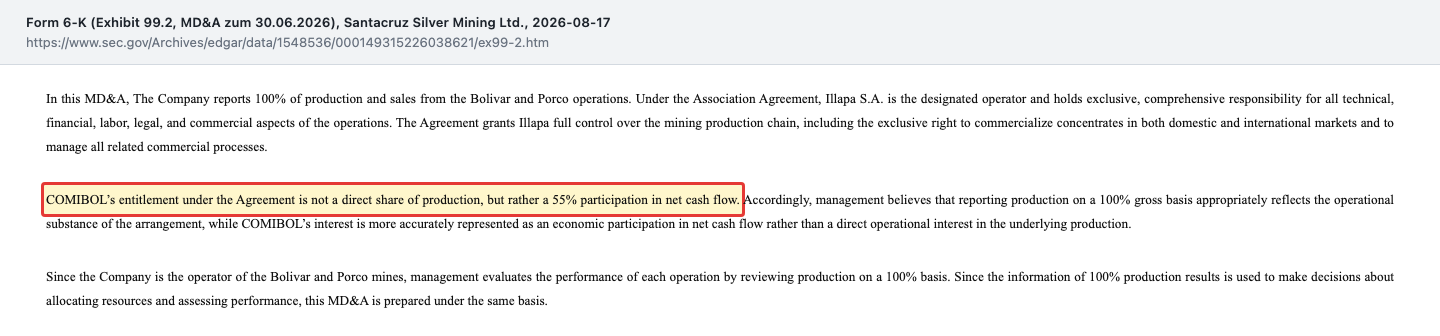
Management argues for the 100 percent presentation because Santacruz runs the mines on its own. That is understandable, but what matters to you is what actually reaches shareholders. In the first half of 2026, 774,740 of the 2.91 million reported ounces of silver came from Bolivar and Porco — 26.6 percent. Counting those two mines at 45 percent leaves roughly 2.49 million ounces. That is our simplification, because COMIBOL shares in net cash flow, not in production. The direction holds, though: part of the silver in the headlines economically belongs to the Bolivian state.
Uncomfortable Truth No. 2: More Than a Third of Revenue Is Purchased Ore
In the first half of 2026, Santacruz’s own mines generated $152.0 million of revenue and the San Lucas ore-sourcing business $89.0 million — 37 percent. San Lucas buys ore from third-party miners, pays based on metal content and market prices, and processes it. That keeps the plants full, but it is a different business from owning a mine. The MD&A says so itself: “Ore processing generates significantly lower margins because the ore is purchased from third-party miners.”
Part of the price advantage there passes through to the sellers: when silver rises, so does the purchase price of the ore. Santacruz is expanding the business anyway. On September 18, 2026, it announced the purchase of a 500-ton-per-day processing plant dedicated solely to San Lucas ore. The purchase price is $9.2 million, with $4.6 million due on November 8, 2026; total investment is about $14 million, with commissioning expected in the fourth quarter of 2026.
Uncomfortable Truth No. 3: The Largest Mine Runs Without a Feasibility Study
In mining, a feasibility study is the proof that a mine works technically and economically on its demonstrated deposits — the basis for declaring mineral reserves. For Zimapan, the mine with the largest milled tonnage, no such study exists:
“Production at the Zimapan Mine is not supported by a feasibility study on mineral reserves demonstrating economic or technical viability or any other independent economic study under NI 43-101.”
— Santacruz Silver Mining Ltd., Form 6-K filed August 17, 2026, MD&A for the period ended June 30, 2026, Qualified Person and Technical Disclosures
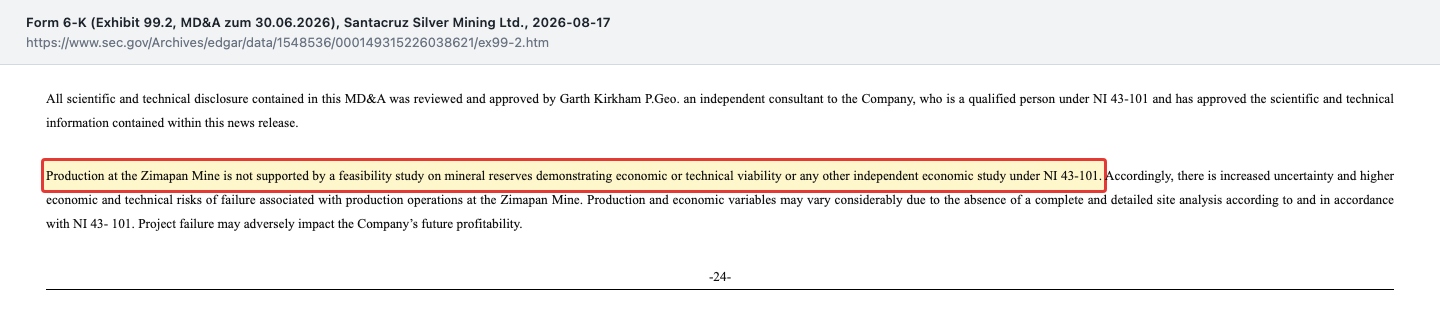
The very next sentence speaks of “increased uncertainty and higher economic and technical risks of failure.” That does not mean Zimapan is doing badly — the mine is producing. It means no outsider can put a number on how long it will last. The declared reserves at the Bolivian mines are small, too: the tables in the 2025 annual information form, dated January 1, 2023, show 319,172 tons for Porco, while 197,231 tons were milled there in 2025 alone. Bolivar shows 1.24 million tons against 232,448 tons milled in 2025. Neither the annual report nor the interim report as of June 30, 2026, contains a newer reserve estimate. A mine with a short reserve can run for a long time if new material keeps being proven up — but that is not guaranteed.
Uncomfortable Truth No. 4: Bolivia Shares in the Profits — and Net Income Shrank to $2.0 Million
The second quarter of 2026 shows how much the country matters. First, road blockades disrupted parts of Bolivia for about 53 days; production continued, but concentrate could not be exported and inventories rose by about $17 million. Then, in June, Bolivia floated its currency: from 6.96 to 9.77 bolivianos per dollar by quarter-end. For Santacruz, that turned into a tax bill, because under Bolivian law the paper gain on dollar assets is taxable even without any cash coming in.
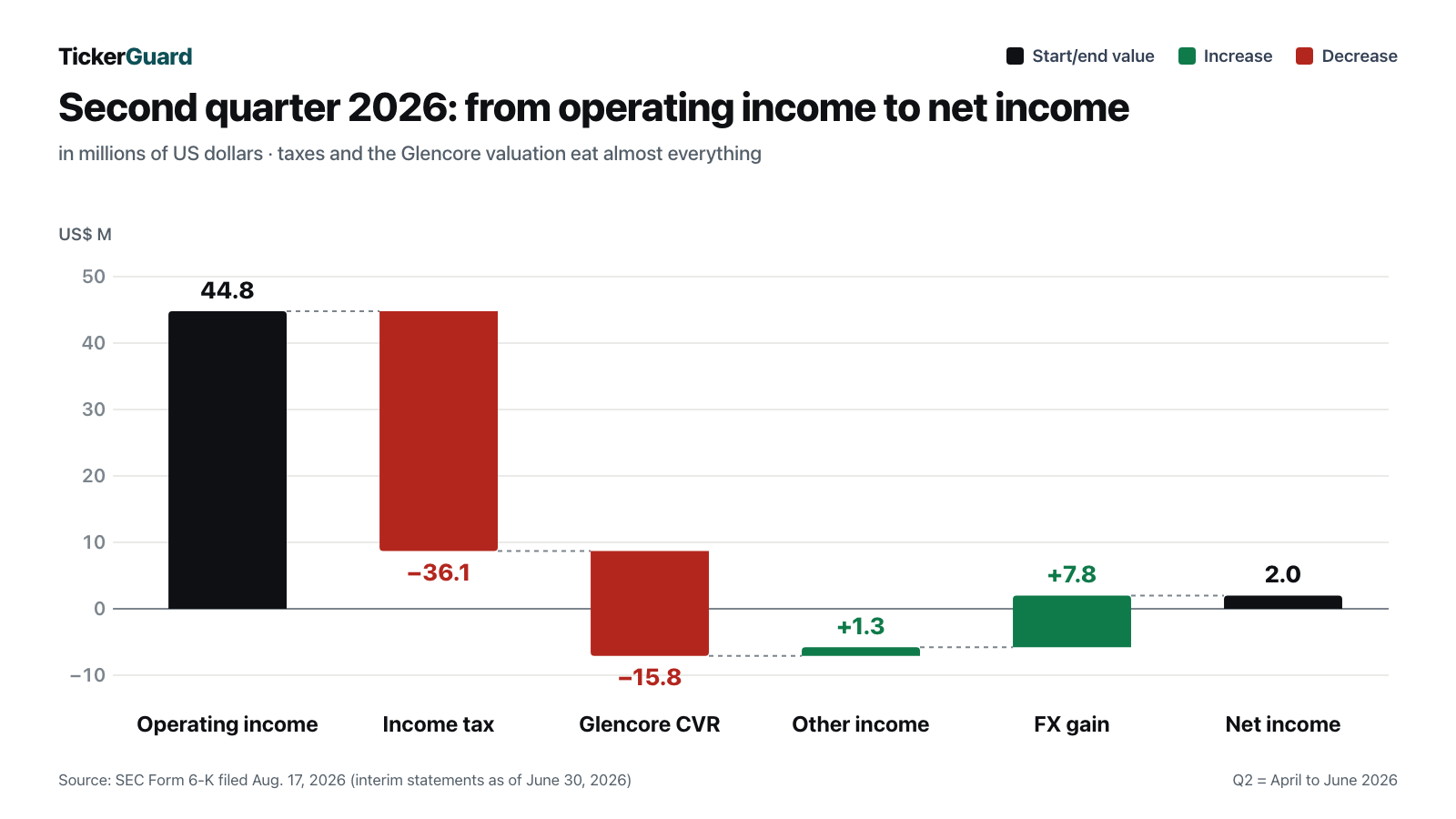
Of $38.1 million in pre-tax income, $36.1 million went to income tax — a rate of 95 percent. The company calls both triggers one-time, but also writes:
“The two one-time items represented a significant portion of the increase in Q2 2026 income tax expense and are non-recurring in nature but will affect the tax liability payable to the Bolivian government during fiscal 2026.”
— Santacruz Silver Mining Ltd., Form 6-K filed August 17, 2026, MD&A for the period ended June 30, 2026, Overview of Financial Results
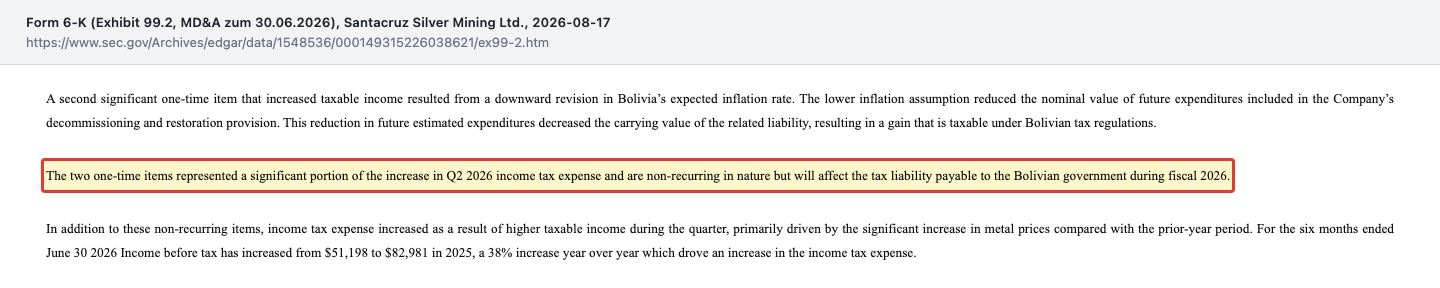
One-time in the income statement does not mean free. At June 30, 2026, the balance sheet carried $64.3 million of current income taxes payable, more than the $50.4 million of cash. Add $22.4 million of US Treasuries, of which $15.8 million serve as collateral for borrowings according to the results release, and $45.2 million of bank loans and promissory notes in bolivianos at roughly 10 to 11.5 percent interest. Management expects the concentrate held back to be sold in the following quarter and the unusually high receivables to come down and lift cash. Whether that is enough, the next interim report will show. And the Glencore deal still echoes: a contingent value right from the 2024 restructuring obliges Santacruz to make payments once zinc averages at least $3,850 per ton in a month. Nothing has come due yet, but its fair value rose by $15.8 million in the quarter to $35.1 million.
Bolivia also brings this: on June 24, 2026, an employee died at the Reserva mine; Santacruz suspended work in the affected area and launched an investigation.
Uncomfortable Truth No. 5: Three Regulatory Orders in Three Years
Canadian securities regulators can halt trading in a stock, or bar management from trading it, when required filings are late. At Santacruz this has happened three times, all of it documented in the annual information form:
“The Company was subject to a management cease trade order issued by the British Columbia Securities Commission and Ontario Securities Commission on May 1, 2025 for failure to file annual audited financial statements, annual management’s discussion and analysis and certification of annual filings for the year ended December 31, 2024.”
— Santacruz Silver Mining Ltd., Form 40-F filed May 1, 2026, 2025 Annual Information Form, Cease Trade Orders, Bankruptcies, Penalties or Sanctions
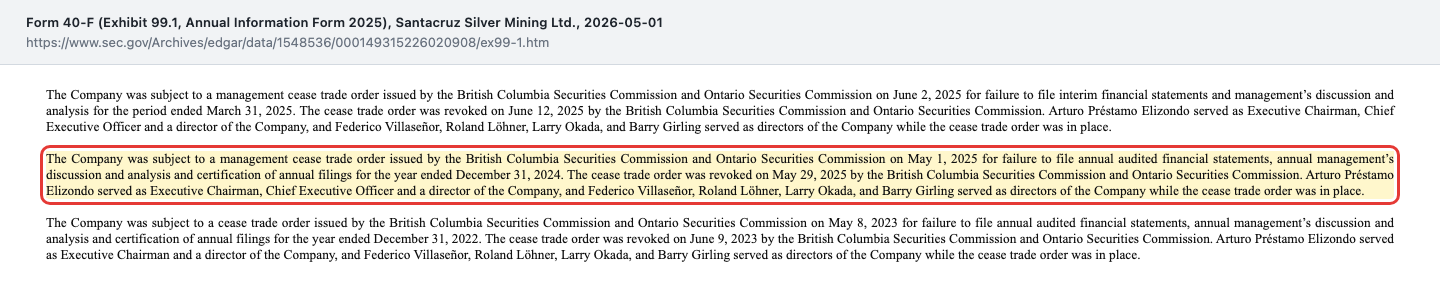
There is more. In its 2024 statements, Santacruz corrected “several errors” in the 2023 statements. Net income for 2023, originally reported as a profit of $16.1 million, now stands at a loss of $11.0 million. Deloitte resigned as auditor effective August 21, 2025; Davidson & Company has audited the company since September 1, 2025. The annual information form lists no further order after June 2025, and Nasdaq admitted the shares. As an emerging growth company, however, Santacruz does not yet need an auditor to attest to its internal controls. Power is concentrated, too: Arturo Préstamo Elizondo is both CEO and executive chairman and held 18,155,683 shares as of March 31, 2026, according to the annual information form — almost 20 percent; directors and officers together held about 24 percent. Skin in the game is good — it is not a substitute for strong outside oversight.
Valuation: What the Silver Leverage Costs
With 92,990,284 shares (as of August 14, 2026) and a closing price of C$11.98 on October 7, 2026, Santacruz is valued at about C$1.11 billion in Toronto. On Nasdaq, the stock closed at $8.45 the same day, or roughly $786 million. Over the twelve months through early October 2026, the closing price ranged from C$7.00 (November 4, 2025, adjusted for the consolidation) to C$22.45 (January 27, 2026).
Because Santacruz reports in US dollars, we use the Nasdaq value. The last four quarters (third quarter of 2025 through second quarter of 2026) brought $423.8 million of revenue and $42.3 million of net income. That works out to a price-to-earnings ratio (P/E) of about 19 and a price-to-sales ratio of just under 2; the market pays about 3.7 times the $213.1 million of shareholders’ equity. The P/E is distorted, though: excluding the one-time tax items and the Glencore valuation, earnings would be higher — the company itself cites $17.8 million for the second quarter excluding the CVR effect. Annualizing only the first half of 2026, with $30.5 million of net income, gives a P/E of about 13 — a back-of-the-envelope figure that assumes silver prices like those of the first half of 2026 (the company’s own mines realized an average of $76.33 per ounce).
That is the crux: for a producer, the valuation isn’t high as long as silver stays expensive. It rests on a price Santacruz does not control, on mines with only short declared reserves, and on a country that put its currency, its roads and its taxes on the agenda in a single quarter. For a silver producer with a different country risk, see our Silvercorp Metals stock analysis; for how a silver explorer without production is valued, see the Highlander Silver stock analysis.
Opportunities and Risks at a Glance
What speaks for the company:
- Strong silver leverage. A $50.30 margin per ounce sold from its own mines in the second quarter of 2026, up from $15.63 a year earlier.
- Growing revenue and cash flow. 2025 revenue of $326.4 million and operating cash flow of $79.1 million; $241.0 million of revenue in the first half of 2026 alone.
- Glencore purchase price settled. $40 million instead of up to $80 million, with the final payment in September 2025.
- Recovery at Bolivar. Silver output there was up 32 percent quarter over quarter in the second quarter of 2026; management targets full production in the fourth quarter of 2026.
- Better listings. Nasdaq since January and the Toronto Stock Exchange since September 2026.
What speaks against it:
- State partner. COMIBOL is entitled to 55 percent of Bolivar and Porco’s net cash flow, yet the production figures show both mines at 100 percent.
- Bolivia as a cost factor. 53 days of road blockades, a currency float and $36.1 million of income tax in the second quarter of 2026; taxes payable above cash.
- Short reserves, no study for Zimapan. Reserves dated January 1, 2023, in the annual information form; no feasibility study for the largest mine.
- Purchased ore. 37 percent of first-half 2026 revenue at significantly lower margins.
- Reporting history. A cease trade order on the stock in 2023 and two management cease trade orders in 2025 over late filings, restated 2023 statements, change of auditor in 2025.
- Glencore CVR. Payments of $1.333 million a month once zinc reaches $3,850 per ton.
A Human Conclusion
Remember that No. 1 ranking from the start? It was earned. Santacruz earned more in 2025, settled its Glencore debt for $40 million instead of up to $80 million and made the jump to Nasdaq and the Toronto Stock Exchange. But the leaderboard reflex kicks in exactly where the ranking ends: it measures yesterday’s share price, not what is inside the package. And on the back of the package are zinc, purchased ore, a state partner with 55 percent, a mine without a feasibility study, a tax bill from Bolivia’s currency reform and a reporting history with three regulatory orders.
All of this can work out as long as silver stays expensive. The next milestones are easy to see: the production report and interim statements for the third quarter of 2026, commissioning of the new plant, Bolivar’s return to full production and the zinc price relative to the $3,850 threshold. Feel free to read the next leaderboard with interest — but read the filing afterward.
What you make of it is your decision. And that is how it should be.
Sources and Data Cut-Off
- MD&A for the period ended June 30, 2026 and interim financial statements as of June 30, 2026 (SEC Form 6-K filed August 17, 2026, approved by the board on August 14, 2026); second-quarter results release
- SEC annual report on Form 40-F for 2025 filed May 1, 2026, with the 2025 annual information form (dated April 30, 2026), 2025 MD&A and 2025 consolidated financial statements
- 2024 MD&A (with restated 2023 comparatives) and 2023 MD&A (original version) from the investor website
- Releases after the interim report: conditional approval to list on the Toronto Stock Exchange (September 8, 2026), September 21 trading date in Toronto (September 17, 2026), purchase of a processing plant (September 18, 2026)
- Other releases: Nasdaq debut (January 21, 2026), No. 1 on the TSX Venture 50 (February 18, 2026), fatality at the Reserva mine (June 29, 2026)
- SEC filer index for CIK 0001548536
- Price and market value data: source fundamental data, as of October 7, 2026
Data cut-off: Company figures as of June 30, 2026, or the date stated; share count as of August 14, 2026; releases through September 18, 2026; prices as of October 7, 2026. We last checked the company’s news page on October 8, 2026. The reporting currency is the US dollar; the home exchange quotes in Canadian dollars. Production figures for Bolivar and Porco are on a 100 percent basis. Prices before December 10, 2025, are adjusted for the one-for-four consolidation. Calculated values (market value, valuation ratios, Bolivar and Porco’s silver share, tax rate) are our own estimates and labeled as such. The key-figure tiles on this page show the current database values with their own rounding and may differ from the October 7, 2026, closing price of C$11.98 used here.
Disclaimer: This article is journalistic commentary, not investment advice. It is not a solicitation to buy or sell securities. Mining stocks depend heavily on metal prices and country risk and are particularly volatile; you could lose your entire investment. Positions held by the operator are disclosed daily; where one exists, it appears as a notice at the top of this deep dive.
Our Bottom Line at a Glance
- Silver leverage positive
- In the second quarter of 2026, Santacruz’s own mines realized $72.17 per ounce of silver (prior year: $33.13) at all-in sustaining costs of $21.87 — a margin of $50.30 per ounce.
- Revenue and cash flow positive
- 2025 revenue of $326.4 million (up 15 percent) and operating cash flow of $79.1 million; first-half 2026 revenue of $241.0 million versus $143.6 million.
- Bolivian structure negative
- COMIBOL is entitled to 55 percent of Bolivar and Porco’s net cash flow. In the second quarter of 2026, road blockades, the currency float and $36.1 million of income tax cost almost all of the profit.
- Balance sheet neutral
- At June 30, 2026, $50.4 million of cash and $22.4 million of Treasuries against $45.2 million of loans, but $64.3 million of current taxes payable and a $35.1 million Glencore CVR.
- Reserves negative
- No feasibility study for Zimapan; the Bolivian reserve tables are dated January 1, 2023, and short relative to throughput (Porco 319,172 tons versus 197,231 tons milled in 2025).
- Reporting and leadership negative
- A cease trade order on the stock in 2023 and two management cease trade orders in 2025 over late filings, restated 2023 statements, change of auditor in 2025. CEO and executive chairman in one person, holding almost 20 percent of the shares.
Santacruz Silver is a profitable silver and zinc producer focused on Bolivia that benefits strongly from high silver prices: $241.0 million of revenue in the first half of 2026. Behind the production figures, however, stand a state partner with 55 percent of two mines, 37 percent purchased ore, a mine without a feasibility study and a tax bill that swallowed almost all of the second quarter. At the October 7, 2026, close of C$11.98, the company is valued at about C$1.11 billion. Not investment advice.
What Our Rating Means
Open questions
The business works in principle, but one material question is open. As long as it stays open, our findings do not carry a quality verdict.
Yellow here is not about the share price. The business works: Santacruz makes money, operating cash flow and equity are positive, and the Glencore debt is settled. Material operating questions remain open: how much of the silver price reaches shareholders after COMIBOL, Bolivian taxes and ore purchases; how long the thinly declared reserves and the Zimapan mine without a feasibility study will carry the business; and whether reporting stays on time after three regulatory orders. For red, an acute threat to the company is missing: all orders have been revoked, and there is no going-concern doubt. The decision is yours.
A journalistic assessment by our editorial team at the time of the deep dive, based on public sources — not investment advice and not a solicitation to buy or sell. Your personal circumstances (investment goals, risk capacity, taxes) cannot be taken into account. What our levels mean, how verdicts are formed, and what conflicts of interest exist →
Worth Noting
- This analysis was prompted by the Nasdaq ticker SCZM on the wallstreet-online forum hot list (as of October 8, 2026); we list the company under its home listing SCZ (Toronto Stock Exchange) as SCZ.TO. The trigger was not a hit from our in-house stock scanner.
- Since its Nasdaq listing, Santacruz reports to the SEC as a Canadian issuer (CIK 0001548536): annual report on Form 40-F for 2025 filed May 1, 2026, interim reports and releases on Form 6-K. Earlier years (2023, 2024) come from the MD&A on the investor website; 2023 as restated in the 2024 MD&A.
- Calculated values are our own estimates: market value from 92,990,284 shares times the October 7, 2026, close; P/E and price-to-sales from the Nasdaq market value and the four quarters through June 30, 2026; Bolivar and Porco’s silver share from the first-half 2026 production tables (774,740 of 2,914,599 ounces); second-quarter 2026 tax rate from $36.1 million of $38.1 million.
- Production figures for Bolivar and Porco are on a 100 percent basis; financially, Santacruz records 45 percent. Prices before December 10, 2025, are adjusted for the one-for-four consolidation. The 1,103 percent gain for 2025 is the TSX Venture 50 figure cited in the company’s release of February 18, 2026.
The full analysis as a PDF for later
We will send you this analysis as a PDF — to print, file away, and read at your own pace.
Frequently Asked Questions
Santacruz Silver is a Vancouver-based mining company that operates the Bolivar, Porco and Caballo Blanco mines and the San Lucas ore-sourcing business in Bolivia, plus the Zimapan mine in Mexico. It sells concentrates containing mainly silver and zinc; each of the two metals generates more than 30 percent of revenue.
They are the same share. SCZM is the ticker on Nasdaq, where the stock has traded in US dollars since January 21, 2026. SCZ is the ticker on the Toronto Stock Exchange (since September 21, 2026; previously the TSX Venture Exchange). In Frankfurt the stock trades as 1SZ. TickerGuard lists it as SCZ.TO.
Bolivar and Porco operate under an association agreement with Bolivian state miner COMIBOL. Santacruz runs the mines, while COMIBOL is entitled to 55 percent of the net cash flow, so the financial statements carry only 45 percent. In its production figures, however, Santacruz reports both mines at 100 percent.
Of $38.1 million in pre-tax income, $2.0 million remained. Bolivia floated its currency in June 2026; the paper gain on dollar assets became taxable, and income tax rose to $36.1 million. On top of that came a $15.8 million charge because the obligation under the Glencore contingent value right was valued higher.
When the payments for the Bolivian mines were restructured in October 2024, Santacruz granted Glencore a contingent value right. If zinc averages at least $3,850 per ton in a month, Santacruz pays $1.333 million for that month, capped at $77.7 million through the end of 2032. Nothing has come due so far; the fair value was $35.1 million at June 30, 2026.
The securities regulators of British Columbia and Ontario halted trading in May 2023 because the 2022 annual statements were missing, and barred management from trading in May and June 2025 because the 2024 annual statements and the report for the quarter ended March 31, 2025, were missing. All three orders were revoked once the reports were filed.
Found an error?
Did you spot a factual error, an outdated number, or a typo in this deep dive? Let us know briefly — your report goes straight to the editorial team.