ARMOUR Residential: A Big Monthly Dividend, Zero Employees — Who Really Gets Paid
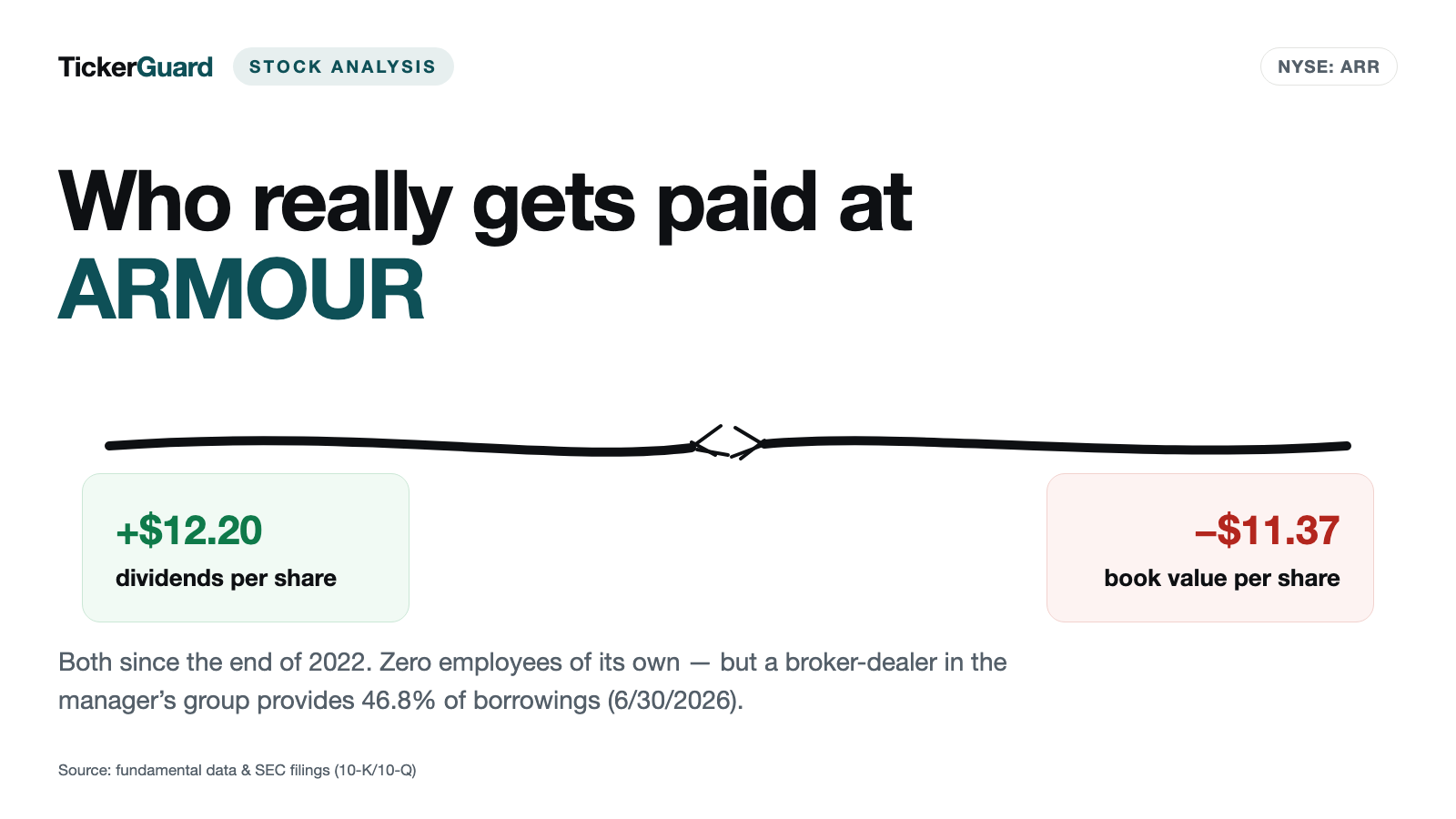
Since the end of 2022, ARMOUR Residential has declared $12.20 in dividends per share — and lost $11.37 in book value per share. The $0.24 monthly dividend works out to roughly 21.7 percent a year at the October 7, 2026 close, yet the net result since 2022 is just under 3 percent. Using the SEC filings, we show why the external manager earns on every new share and a broker-dealer in its group earns on selling new shares, even when value per share falls.
 Thomas Mücke
Founder & Publisher
Thomas Mücke
Founder & Publisher
As of Today
As of: October 7, 2026
- Closing price
- 13.30 $ -1.50%
- Market Capitalisation
- 1.6 $B
- P/E
- 5.4
- Growth Score
- 6/10
- AAQS
- 2/10
Price change since October 7, 2026: +0.1%
This analysis has a cut-off date. The Stock Guard tells you when something material changes in the numbers. Reserve your free spot
Chart
Interactive price chart (TradingView).
52-week range: 13.50 $ to 19.10 $ · Last price: 13.30 $ (As of: October 7, 2026)
Note: pure fact-based analysis, not investment advice and not a solicitation to buy or sell. All figures without guarantee.
There is an investor trap that works with a single number: yield hypnosis. It goes like this. You see a dividend yield three or four times higher than anything a bank pays, and your mind starts doing the math — this much money a year, on time every month, without lifting a finger. The question of where that money comes from barely gets asked. With ARMOUR Residential REIT (NYSE: ARR), the number is right there on the table: a $0.24 dividend every month, $2.88 a year. At the $13.29 close on October 7, 2026, that is roughly 21.7 percent. Right next to it, the same filings carry a second number the hypnosis blanks out: since the end of 2022, ARMOUR has declared $12.20 in dividends per share — and lost $11.37 in book value per share over the same span. $12.20 in, $11.37 out.
So let’s make a deal. Before you pencil that number into your portfolio, let’s read what ARMOUR itself has reported to the U.S. securities regulator, the SEC — the annual report (10-K) for 2025, the quarterly reports (10-Q) through June 30, 2026, the earnings release of July 22, 2026 and the current reports (8-K) through early October 2026. These filings carry legal liability for false statements, which makes them the most reliable source we have. And they answer exactly the question the hypnosis pushes aside: who actually pays this dividend — and who earns from it?
What ARMOUR Residential actually does — an interest spread with leverage
ARMOUR is a mortgage REIT. A REIT (real estate investment trust) is a U.S. real estate company that pays almost no corporate tax as long as it distributes nearly all of its taxable income. ARMOUR does not own houses, though; it owns mortgage-backed securities — bundles of thousands of U.S. home loans whose interest and principal payments flow to whoever holds the security. Almost all of them are Agency MBS, securities whose repayment is guaranteed by the government-sponsored mortgage giants Fannie Mae and Freddie Mac or by the government’s Ginnie Mae. ARMOUR therefore carries very little homeowner default risk. It carries all of the price risk.
Here is the business in everyday terms: picture someone who borrows money every week at a short-term rate and lends it out long-term at a slightly higher one. The difference is the income. In the second quarter of 2026, ARMOUR’s securities yielded 4.93 percent on average, while the borrowed money cost 3.83 percent. Including interest rate swaps, the earnings release shows an economic net interest spread of 1.82 percentage points. That sounds thin — and it would be, if ARMOUR invested only its own money. That is where leverage comes in: as of June 30, 2026, $2.58 billion of equity supported $19.4 billion of repo debt, a ratio of 7.54 to 1. A repo (repurchase agreement) is a very short-term loan in which the mortgage securities sit with the lender as collateral. The portfolio totaled $21.8 billion: 94.5 percent Agency MBS, 2.7 percent U.S. Treasuries and 2.8 percent forward purchases of Agency securities (TBA).
Then there is a risk only mortgage securities carry: prepayment. Any U.S. homeowner can pay off a mortgage at any time, for example after moving or refinancing at a lower rate. For ARMOUR, it is like lending a friend money at a good rate, only to have him pay it all back exactly when you could earn less anywhere else. It is measured as CPR, the annualized prepayment rate. In the second quarter of 2026 it was 10.7 percent across all Agency securities and 28.2 percent on the high-coupon 6.5 percent pools. Because ARMOUR bought many securities above face value, every fast prepayment eats part of the premium it paid. The quarterly report puts it plainly: higher prepayment rates decrease the yield and earnings.
And who does all of this? Not ARMOUR. The 10-K contains one of the shortest sentences you will find in an annual report: “We do not have any employees.” Everything is run by ARMOUR Capital Management (ACM), an external investment adviser that, per the annual report, had 20 employees providing services to ARMOUR as of February 17, 2026. ACM also controls BUCKLER Securities, a broker-dealer that supplies a large share of ARMOUR’s borrowing. That defines the central tension of this analysis: the dividend arrives on time every month — but the capital it flows from grows mainly through new shares, and the firms around ARMOUR earn from size, not from value per share.
Company history for investors
-
2020
New shares sold continuously on the market
Through February 2019, ARMOUR issued new shares mainly in block offerings placed through underwriting syndicates; since 2020, it has sold new common shares continuously through at-the-market programs, supplemented by large offerings such as 18.5 million shares in August 2025. For shareholders, dilution arrives steadily and sometimes in big bursts.
-
2023
1-for-5 reverse stock split
On September 29, 2023, five shares become one. Book value per share still falls from $28.90 to $22.54 that year.
-
2024
Dividend drops to $0.24 a month
From 2024, holders receive $2.88 a year after $5.00 in 2023 — about 42 percent less. Book value falls to $19.07 by year-end.
-
2025
A strong year with many new shares
Total economic return of 12.79 percent, net income of $322.7 million. Shares outstanding rise from 62.4 to 111.9 million; book value per share slips to $18.63.
-
2026
Manager deal to 2033, more authorized shares
In March the management agreement is extended to 2033; in July authorized shares rise to 250 million. Book value on June 30: $17.53.
How the stock landed on our desk
ARMOUR jumps out of any list sorted by dividend yield. $2.88 in annual dividends divided by the $13.29 close on October 7, 2026 gives the 21.7 percent mentioned above. There was also a notable price move: according to ARMOUR’s monthly update, the stock stood at $16.22 at the end of August 2026; on October 7, 2026 it closed at $13.29 — a decline of about 18 percent in just over five weeks. No current report (8-K) explains the drop, and none of the other documents reviewed give a reason — whether rates, spreads or sentiment cannot be established from them; the October dividend was confirmed unchanged at $0.24 on October 1, 2026. Whether book value fell along with it in the third quarter will only show in the next quarterly report.
Filter our in-house stock scanner for high payouts and you will find plenty of names like this. With mortgage REITs, though, one rule makes classic metrics look dated: the price-to-earnings ratio says almost nothing, because earnings under U.S. accounting rules (GAAP) swing with the market value of securities and hedges. The yardstick is book value per share — the equity that belongs to each shareholder on paper. And total economic return: the change in book value plus dividends paid. Keep this in mind: with a mortgage REIT, the dividend is only half the math — the other half sits in book value.
The numbers over the years — given their due
First, what speaks for ARMOUR, and in 2025 that is quite a bit. After two loss years (net loss of $67.9 million in 2023 and $14.4 million in 2024), ARMOUR posted net income of $322.7 million in 2025. Total economic return for 2025 was 12.79 percent according to the earnings release, with 10.63 percent in the fourth quarter alone. CEO Scott Ulm said the portfolio grew by about 60 percent in 2025, funded with $878 million of newly raised capital. The second quarter of 2026 was solid too: total economic return of 4.8 percent, net income to common stockholders of $111.5 million or $0.86 per share, and book value of $17.53 after $17.42 at the end of March. So-called Distributable Earnings (a company-defined measure that strips out market-value swings) came to $0.72 per share — exactly matching the quarter’s three monthly dividends. In the first quarter of 2026, the figure was $0.76. Liquidity (cash plus unencumbered securities) stood at about $1.2 billion as of June 30, 2026.
Now the curve that completes the picture — book value per common share over three and a half years, adjusted for the 1-for-5 reverse stock split of September 2023:
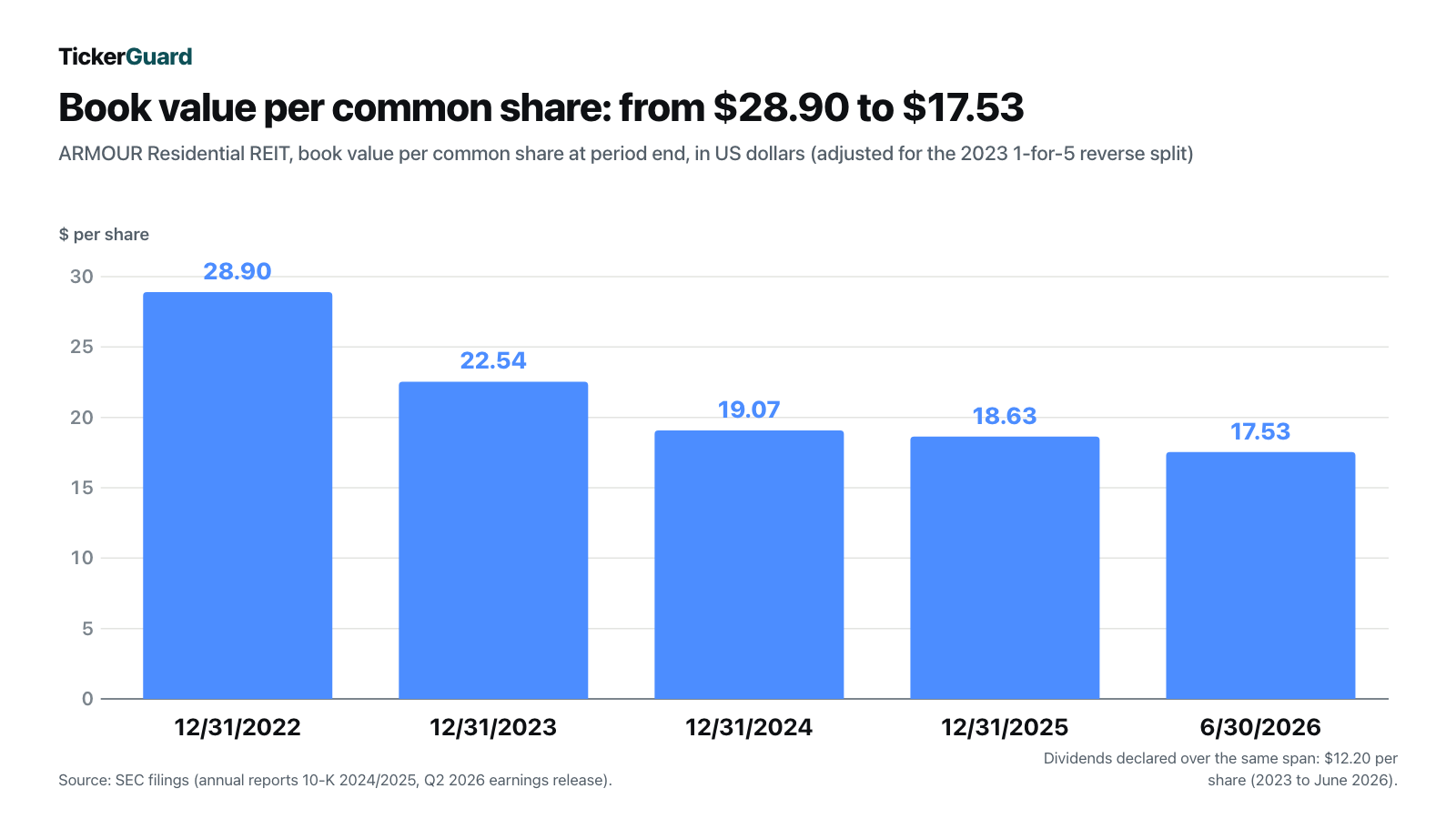
Next to it, the second curve that explains how ARMOUR still managed to grow: the number of shares outstanding.
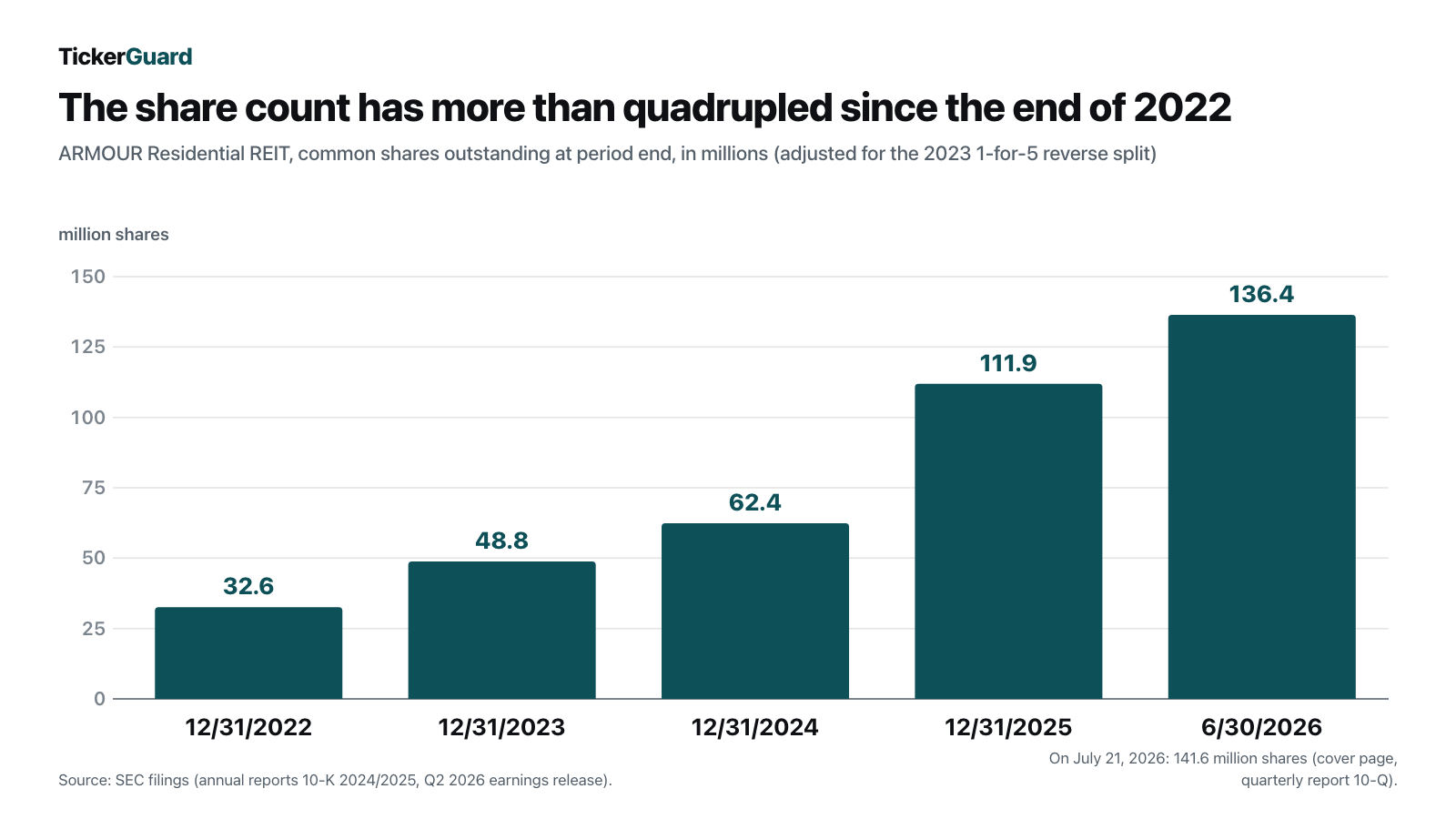
Put the two curves together and you get the real picture: measured in dollars, ARMOUR has grown strongly — equity rose from $1.11 billion at the end of 2022 to $2.58 billion by mid-2026 — but the growth came from new shareholders, not from earnings. Per share, the assets have shrunk. Which brings us to the uncomfortable truths.
What the filings say — the uncomfortable truths
Uncomfortable truth No. 1: Part of the dividend is your own money
Let’s run the numbers from the chart. Anyone holding an ARMOUR share at its $28.90 book value at the end of 2022 would have been declared $12.20 in dividends through June 2026 ($5.00 in 2023, $2.88 each in 2024 and 2025, $1.44 in the first half of 2026). Over the same stretch, book value fell by $11.37. That leaves $0.83 — just under 3 percent over three and a half years, without reinvestment and before taxes. Year by year, by our math: minus 4.7 percent (2023), minus 2.6 percent (2024), plus 12.8 percent (2025). In everyday terms: a well you draw a bucket from every month while the water level slowly drops. You do get water — but some of it is water that was already in the well.
The annual report says as much in tax language:
“The portion of the dividends on our common stock which represented non-taxable return of capital was 19.6% in 2025, 14.8% in 2024 and 47.5% in 2023.”
— ARMOUR Residential REIT, Inc., SEC annual report 10-K for 2025, Note 13 “Income Taxes”
To be fair, “return of capital” in the tax sense is not the same as “paid out of substance” in the economic sense — taxable and book income diverge sharply at mortgage REITs. And 2025 was a genuinely good year. But the direction over several years is clear: the dividend exceeded what book value per share could support. For how another high-yield mortgage REIT is doing, see our analysis of Dynex Capital. Remember: a stable dividend is no proof of stable value.
Uncomfortable truth No. 2: Leverage of 7.5 — small moves, big effects
With $7.54 of debt for every dollar of equity (June 30, 2026), a small move in the securities is enough for a big one in book value. ARMOUR does the math itself in its quarterly report. If the yield premium of mortgage securities over Treasuries (the spread) widens by just 0.25 percentage points, the portfolio loses an estimated 1.21 percent of its value — but equity drops 10.22 percent. For a parallel shift of all rates by one percentage point, ARMOUR estimates a 4.69 percent hit to equity if rates rise and 7.59 percent if they fall. Both directions hurt — falling rates because prepayments speed up.
Leverage turns dangerous when lenders ask for more collateral. The quarterly report describes the mechanism:
“When the value of the securities pledged to secure a repurchase agreement decreases to the point where the positive difference between the collateral value and the loan amount is less than the haircut, our lenders may issue a margin call, which requires us to pay the difference in cash or pledge additional collateral to meet the obligations under our repurchase agreements.”
— ARMOUR Residential REIT, Inc., SEC quarterly report 10-Q for the period ended June 30, 2026, Item 2 “Liquidity and Capital Resources”
The average haircut was 2.51 percent as of June 30, 2026. Put simply: for every $100 of borrowing, ARMOUR pledges securities worth a little over $102.50. If their price falls, cash has to be posted — precisely when the securities are cheapest. The $1.2 billion of liquidity is the buffer for that. This is not a risk unique to ARMOUR; it is the basic law of the industry. But it explains why book value falls so fast in bad years.
Uncomfortable truth No. 3: The fee grows with every new share — value per share does not necessarily
Now to the question of who earns from ARMOUR. The external manager, ACM, receives 1.5 percent a year on the first $1.0 billion of “gross equity raised” and 0.75 percent on everything above that. What matters is what this base leaves out:
“Realized and unrealized gains and losses do not affect the amount of gross equity raised.”
— ARMOUR Residential REIT, Inc., SEC quarterly report 10-Q for the period ended June 30, 2026, Note 8 “Commitments and Contingencies”

In plain terms, the fee is based on the money shareholders ever paid in — $5.81 billion as of June 30, 2026 — not on what is left of it. Equity on the same date was $2.58 billion. Contractual fees run about $51.1 million a year, roughly 2.0 percent of equity, or about $0.36 per share a year (based on 141.6 million shares on July 21, 2026). On March 30, 2026, the agreement was extended through March 31, 2033; through then, contractual fee commitments add up to $383.2 million, according to the quarterly report. ARMOUR cannot terminate early without cause, and if the agreement ends in connection with a liquidation or certain business combinations, a termination fee of four years’ worth of fees comes due. ACM had voluntarily waived part of its fee in 2025 (about $3.3 million in the first half of 2025); it ended that waiver in December 2025, effective with the fee for January 2026. As a result, ARMOUR paid $12.5 million in management fees in the second quarter of 2026, versus $9.4 million a year earlier.
And this closes the loop with the share count. Every new share increases gross equity raised and therefore the fee. When new shares may be sold is set by the board:
“ARMOUR’s board of directors has authorized our CEO and CFO to issue new common shares where the net proceeds to the Company, after fees and expenses, represents at least 93.50% of our most recent estimate of ARMOUR’s book value per common share.”
— ARMOUR Residential REIT, Inc., SEC annual report 10-K for 2025, Item 1A “Risk Factors”

In everyday terms: you are sharing a cake with friends. Every newcomer brings a slice along — but one that may be up to 6.5 percent smaller than your share. And the baker gets a commission on every new slice. In 2025, net proceeds averaged about 98.0 percent of book value according to the annual report; ARMOUR put the dilution to existing shareholders at $11.5 million — about 0.5 percent of its $2.26 billion in equity at year-end 2025. In the second quarter of 2026, ARMOUR sold 12,714,990 new shares for $218.7 million, about $17.20 apiece — against book value of $17.42 at the end of March and $17.53 at the end of June. On July 24, 2026, another 25 million shares were added to the at-the-market program; the day before, authorized common shares were raised from 175 million to 250 million. In fairness, ARMOUR argues that fixed costs get spread over more shares and that the fee rate drops to 0.75 percent above $1 billion. But the incentives point one way: for the manager, size is always good. For you, only if value per share grows with it.
Uncomfortable truth No. 4: The most important lender is controlled by the manager
That leaves the question of where the $19.4 billion of borrowing comes from. ARMOUR had open repurchase agreements with 25 counterparties as of June 30, 2026. One of them, however, is far larger than all the others:
“At June 30, 2026 and December 31, 2025, BUCKLER accounted for 46.8% and 47.0% of our aggregate borrowings and had an amount at risk of 6.8% and 7.1%, respectively, of our total stockholders' equity with a weighted average maturity of 27 days and 13 days, respectively, on repurchase agreements, net (see Note 13 - Related Party Transactions).”
— ARMOUR Residential REIT, Inc., SEC quarterly report 10-Q for the period ended June 30, 2026, Note 6 “Repurchase Agreements, net”

BUCKLER Securities is a broker-dealer controlled by ACM; according to the quarterly report, ARMOUR owns 10.8 percent of it, carried at $752,000. The stated purpose: give ARMOUR access to cheaper repo financing through BUCKLER. ARMOUR’s profit allocation for that in the first half of 2026 was $20,000. BUCKLER earns from ARMOUR in other ways, too: as sales agent, it placed about 23.1 million new ARMOUR shares in the first half of 2026, with issuance costs and commissions of about $3.1 million going to BUCKLER per the quarterly report; over the life of the at-the-market program since July 2023, the July 24, 2026 prospectus supplement cites $8.8 million in compensation to BUCKLER. And since February 2026, ARMOUR has extended a credit commitment to BUCKLER:

This new $275 million commitment comes on top of an older one for $50 million (dated February 28, 2025, valid until February 28, 2028). Together that is up to $325 million, or about 12.6 percent of equity. In everyday terms: your money manager also controls the broker where he takes out nearly half of your loans, sells new shares through that same broker for a commission — and you also commit capital to that broker in case of need. None of this is prohibited, all of it is disclosed, and the independent directors hold protective rights under BUCKLER’s operating agreement. The prospectus supplement itself lists the conflicts of interest with ACM and BUCKLER as a risk. Remember: when manager, lender and sales agent belong to the same group, a lot depends on how strictly the independent directors review the terms.
Valuation: below book — a discount or a warning?
For a mortgage REIT, price is measured against book value. On July 22, 2026, the last reported price per the prospectus supplement was $16.38, about 93 percent of the $17.53 book value as of June 30, 2026. At the $13.29 close on October 7, 2026, it would be about 76 percent of that book value — although book value as of September 30, 2026 had not yet been published. With 141.6 million shares, the October price implies a market value of about $1.9 billion; the July price, about $2.3 billion.
How should a discount to book be read? Optimistically as a bargain: buying below book gets you each dollar of equity for less, and the $2.88 dividend looks even larger against a lower price. Cautiously as a warning: the market is pricing in further book value erosion, fees and dilution skimming part of the return, and 7.5 times leverage striking again in the next spread shock. The dividend equals 16.4 percent of June 30, 2026 book value — to pay it permanently without eroding capital, ARMOUR would need to earn a little over 16 percent on its equity every year. In 2025, total economic return was 12.79 percent, and that was a good year; in 2023 and 2024 the return on book value was negative — not a single year since the end of 2022 has cleared that bar. For a buyer at roughly 76 percent of book value, the personal dividend yield looks higher, but the capital the dividend has to come from is the same.
The view from Wall Street: according to fundamental data (as of October 8, 2026), the average analyst price target is about $18.40 (ratings are available from six analysts). Average means all price targets added up and spread evenly — with so few votes, a single outlier moves it a lot; price targets are opinions, though, not evidence. A P/E ratio says little here, because GAAP earnings swing with the market value of the securities.
Upside and risks at a glance
What speaks for ARMOUR Residential:
- Little credit risk: as of June 30, 2026, the portfolio was 94.5 percent government-guaranteed Agency MBS and 2.7 percent U.S. Treasuries.
- Current earnings cover the dividend for now: Distributable Earnings of $0.72 per share in the second quarter of 2026 (first quarter: $0.76) against $0.72 in dividends.
- Strong recovery in 2025: net income of $322.7 million and a 12.79 percent total economic return, after losses in 2023 and 2024.
- A liquidity buffer of about $1.2 billion and interest rate swaps with $15.9 billion of notional amount (June 30, 2026).
- On October 7, 2026, the stock traded well below its last published book value.
What speaks against it:
- Book value per share down 39 percent since the end of 2022 ($28.90 to $17.53); by our math, just under 3 percent total return in three and a half years despite $12.20 in dividends.
- High leverage (7.54 to 1): a 0.25 percentage point wider spread costs an estimated 10.22 percent of equity; margin calls bite in stress periods.
- Fee based on gross equity raised ($5.81 billion), not book value; agreement through 2033 with $383.2 million in contractual fees and a termination fee of four years’ worth of fees.
- Ongoing dilution: share count more than quadrupled, issuance allowed down to 93.50 percent of book value, 250 million shares authorized.
- Dependence on BUCKLER: 46.8 percent of borrowing from a broker-dealer controlled by the manager, plus committed subordinated capital of up to $325 million in total ($275 million new since February 2026, $50 million since February 2025).
A human conclusion
Back to the yield hypnosis from the beginning. Its trick is to make one number shine so brightly that everything else disappears into the shadows. At ARMOUR, the number is real: the 24 cents have arrived every month since 2024. But the filings show what sits in the shadows — book value per share down by more than a third since the end of 2022, a share count that has more than quadrupled, a manager whose fee grows with every new share, and a key lender controlled by that same manager. Whoever holds this stock is not holding a savings-account substitute but a bet on rates and spreads with 7.5 times leverage, run by a manager whose fee, under the contract, does not fall even when there are losses.
That can still be a deliberate choice — for someone who checks book value every quarter, treats the dividend as part of total return, and knows that some of it is their own money coming back. So the honest question is not “What percentage do I get?” but: What will my share be worth in three years once I subtract the dividends? Whoever knows the answer is no longer hypnotized. What you make of it is your decision. And that is how it should be.
Sources
All original documents used in this analysis — so you can read them yourself:
- ARMOUR Residential REIT, Inc. — SEC quarterly report 10-Q for the period ended June 30, 2026 (filed July 22, 2026)
- ARMOUR Residential REIT, Inc. — Q2 2026 earnings release, Exhibit 99.1 to current report 8-K (Item 2.02, July 22, 2026)
- ARMOUR Residential REIT, Inc. — Prospectus supplement 424B5 for the at-the-market program (July 24, 2026)
- ARMOUR Residential REIT, Inc. — Current report 8-K of July 24, 2026 (Items 1.01, 5.03, 8.01: sales program, authorized shares)
- ARMOUR Residential REIT, Inc. — September 2026 company update, Exhibit 99.1 to current report 8-K (September 11, 2026)
- ARMOUR Residential REIT, Inc. — October dividend confirmation, Exhibit 99.1 to current report 8-K (October 1, 2026)
- ARMOUR Residential REIT, Inc. — Current report 8-K of April 1, 2026 (Item 1.01: management agreement extended to 2033)
- ARMOUR Residential REIT, Inc. — SEC quarterly report 10-Q for the period ended March 31, 2026 (filed April 22, 2026)
- ARMOUR Residential REIT, Inc. — SEC annual report 10-K for 2025 (filed February 18, 2026)
- ARMOUR Residential REIT, Inc. — Q4 2025 earnings release, Exhibit 99.1 to current report 8-K (February 18, 2026)
- ARMOUR Residential REIT, Inc. — SEC annual report 10-K for 2024 (filed February 12, 2025)
- Complete SEC filing history of ARMOUR Residential REIT, Inc.: EDGAR overview (sec.gov)
- Fundamental data (closing prices, market value, analyst estimates; as of October 8, 2026), cross-checked against the SEC filings.
Transparency & disclaimer: This analysis is a journalistic assessment of publicly available information. It is not investment advice, not a financial analysis in the regulatory sense, and not a solicitation to buy or sell securities. Investing in stocks involves substantial risk, up to and including the total loss of capital. All information without guarantee; the data date is noted in the text. Positions held by the operator are disclosed daily; where one exists, it appears as a notice at the top of this deep dive.
Key figures at a glance
All monetary figures in millions of $; earnings per share as reported.
| Metric | 2021 | 2022 | 2023 | 2024 | 2025 |
|---|---|---|---|---|---|
| Revenue | 19.2 | -878.0 | 449.7 | 239.9 | 1,305.3 |
| Operating Income (EBIT) | 15.4 | -105.0 | 457.9 | 509.8 | 964.8 |
| Net Income | 3.9 | -229.9 | -67.9 | -14.4 | 322.7 |
| Net Margin | 20.3% | 26.2% | -15.1% | -6.0% | 24.7% |
| Earnings Per Share | 0.24 $ | -9.75 $ | -1.58 $ | -0.28 $ | 3.42 $ |
Source: fundamental data & SEC filings (annual and quarterly reports, 10-K/10-Q)
Our Bottom Line at a Glance
- Earnings power & dividend neutral
- Distributable Earnings exactly covered the dividend in the second quarter of 2026 ($0.72 per share), and total economic return was 12.79 percent in 2025. But from 2023 through June 2026, $12.20 of dividends was offset by an $11.37 loss in book value.
- Book value per share negative
- From $28.90 (12/31/2022) to $17.53 (6/30/2026), down 39 percent; per the annual report, 47.5 percent (2023), 14.8 percent (2024) and 19.6 percent (2025) of dividends counted as return of capital for tax purposes.
- Leverage & rate risk negative
- Debt-to-equity of 7.54 to 1 (6/30/2026). By the company’s estimate, a 0.25 percentage point wider spread costs 10.22 percent of equity; a one-point rate move in either direction costs 4.69 to 7.59 percent.
- Credit quality & liquidity positive
- 94.5 percent of the portfolio is government-guaranteed Agency MBS and 2.7 percent U.S. Treasuries; liquidity of about $1.2 billion and 25 repo counterparties as of June 30, 2026.
- Governance & conflicts of interest negative
- Fee based on gross equity raised ($5.81 billion), agreement through 2033 with $383.2 million in contractual fees; 46.8 percent of borrowing and commissions on share sales go to BUCKLER, a broker-dealer controlled by the manager; subordinated capital commitments to BUCKLER totaling up to $325 million (of which $275 million new since February 2026).
ARMOUR Residential is a textbook case of yield hypnosis: the $0.24 monthly dividend has arrived on time since 2024, yet book value per common share fell from $28.90 (end of 2022) to $17.53 (6/30/2026) while the share count more than quadrupled. The business runs at 7.5 times leverage on government-guaranteed mortgage securities; the external manager is paid on capital raised, and nearly half of the borrowing comes from a broker-dealer in the same group. Holders of this stock hold a leveraged rate bet with a high payout, not a savings-account substitute. Not investment advice.
What Our Rating Means
Open questions
The business works in principle, but one material question is open. As long as it stays open, our findings do not carry a quality verdict.
Not a bankruptcy candidate, but a model whose size pays the manager and its in-house broker-dealer while value per share has fallen 39 percent since the end of 2022.
A journalistic assessment by our editorial team at the time of the deep dive, based on public sources — not investment advice and not a solicitation to buy or sell. Your personal circumstances (investment goals, risk capacity, taxes) cannot be taken into account. What our levels mean, how verdicts are formed, and what conflicts of interest exist →
Worth Noting
- Mortgage REITs are measured by book value per share and total economic return (change in book value plus dividends), not by P/E: GAAP earnings swing with the market value of securities and hedges. All book values are adjusted for the 1-for-5 reverse stock split of September 29, 2023.
- Data date: the latest periodic report is the 10-Q for the period ended 6/30/2026 (filed 7/22/2026); all current reports through the dividend confirmation of 10/1/2026 were reviewed. Book value as of 9/30/2026 was not yet available at publication; no current report explains the September 2026 price decline.
- Total returns for 2023 and 2024 and the cumulative return since the end of 2022 are our own calculations from book value and declared dividends (no reinvestment, before taxes). Not to be confused: common stock ARR and the 7.00 percent Series C preferred ARR-PRC.
Stock Watch
This analysis is as of October 8, 2026. Stock Watch will tell you what's changed at ARR since then.
Later $1 a month per stock — signing up is free, and you'll be the first to know when it launches.
The full analysis as a PDF for later
We will send you this analysis as a PDF — to print, file away, and read at your own pace. And we will add you to the free Stock Watch list for ARMOUR Residential REIT Inc (ARR), so you hear about it when something material in this analysis changes.
Frequently Asked Questions
ARMOUR Residential REIT, Inc. (NYSE: ARR) of Vero Beach, Florida, is a mortgage REIT. It borrows short-term through repurchase agreements (repo) and buys U.S. mortgage-backed securities whose repayment is guaranteed by Fannie Mae, Freddie Mac or Ginnie Mae. As of June 30, 2026, the portfolio totaled $21.8 billion against $19.4 billion of repo debt. ARMOUR is externally managed by ARMOUR Capital Management.
Since 2024, ARMOUR has paid $0.24 per common share every month, or $2.88 a year; in 2023 it was $5.00. The October 2026 dividend was confirmed unchanged on October 1, 2026. At the $13.29 close on October 7, 2026, that is roughly 21.7 percent. According to the annual report, 19.6 percent of 2025 dividends counted as return of capital for tax purposes.
Book value per common share fell from $28.90 at the end of 2022 to $17.53 on June 30, 2026. The drivers are price losses on mortgage securities as rates and spreads rose, amplified by leverage of about 7.5 to 1; dividends that exceeded earnings in several years; and new shares, some sold slightly below book value.
ARMOUR Capital Management receives 1.5 percent on the first $1.0 billion of gross equity raised and 0.75 percent above that. Gains and losses do not change this base. As of June 30, 2026, it stood at $5.81 billion, for an effective fee of 0.88 percent, or about $51.1 million a year. The management agreement runs through March 31, 2033.
BUCKLER Securities is a broker-dealer controlled by ARMOUR’s external manager, ARMOUR Capital Management; ARMOUR owns 10.8 percent. As of June 30, 2026, 46.8 percent of all repo borrowing came from BUCKLER. BUCKLER also sells new ARMOUR shares as an agent for a commission, and ARMOUR has committed subordinated capital of up to $325 million in total to it ($275 million new since February 2026, $50 million since February 2025).
U.S. homeowners can pay off their mortgages at any time. Because ARMOUR bought many mortgage securities above face value, fast prepayments wipe out part of that premium and lower interest income. In the second quarter of 2026, the annualized prepayment rate (CPR) was 10.7 percent across all Agency securities and 28.2 percent on 6.5 percent coupon pools.
Measured against book value, the stock traded at $16.38 on July 22, 2026, about 93 percent of the $17.53 book value as of June 30, 2026; at the $13.29 close on October 7, 2026, it would be about 76 percent. Whether that is a bargain depends on whether book value keeps falling — the September 30, 2026 figure had not been published at the time of writing.
Found an error?
Did you spot a factual error, an outdated number, or a typo in this deep dive? Let us know briefly — your report goes straight to the editorial team.