NGEx Minerals: A C$5.4 Billion Market Value — and Not One Estimated Ton at Its Flagship Project
2 meters at 1,740 grams of gold per ton: NGEx Minerals (TSX: NGEX, OTCQX: NGXXF) reports the highest drill grades in Argentina’s Vicuña District, and the market values the company at about C$5.4 billion. Yet its flagship Lunahuasi project still has no resource estimate – not a single officially estimated ton.
 Thomas Mücke
Founder & Publisher
Thomas Mücke
Founder & Publisher
Chart
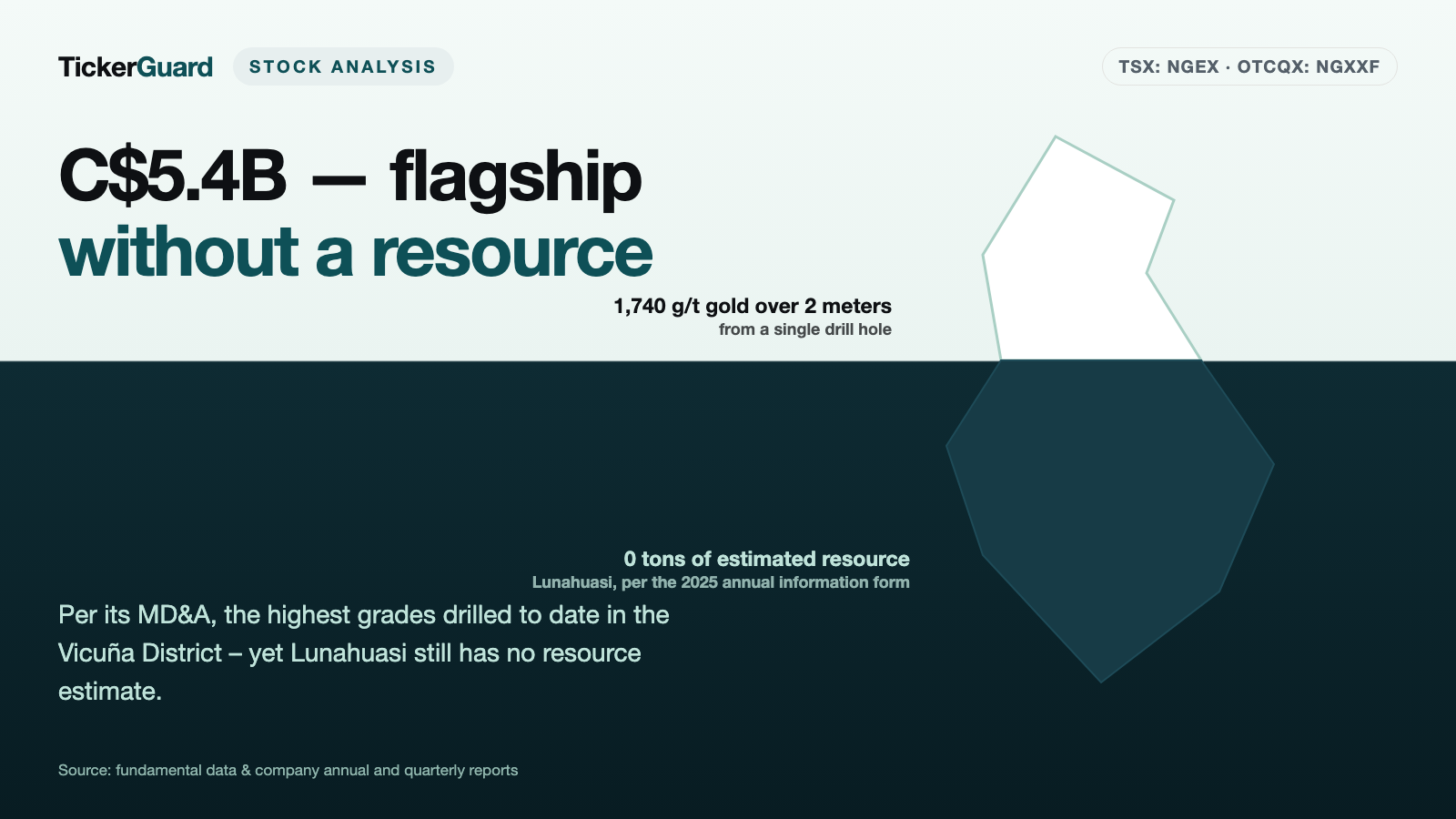
Interactive price chart (TradingView).
Note: pure fact-based analysis, not investment advice and not a solicitation to buy or sell. All figures without guarantee.
Do you know the feeling when a single number sticks? “2 meters at 1,740 grams of gold per ton.” It sounds like a treasure chest, and it is meant to. Let’s call it drill-core hypnosis: one spectacular interval from one hole lodges itself in your head, and soon the whole company feels as rich as that one meter of rock.
NGEx Minerals has been delivering numbers like that for three years, and the market has rewarded it: on October 5, 2026, the company was worth about C$5.4 billion. The tension at the heart of this analysis is easy to name — a multibillion-dollar valuation on one side, and on the other a deposit for which not a single resource estimate exists yet. Let’s read the financial statements, management’s discussion and the news releases together. The decision at the end is yours.
What NGEx Minerals actually does
NGEx Minerals explores for copper, gold and silver in the Andes. The company is based in Vancouver, was spun out of Josemaria Resources in 2019 and belongs to the Lundin Group, the network of companies built by the Swedish-Canadian Lundin mining family. NGEx has no revenue. Its MD&A for the period ended June 30, 2026, says so plainly: it does not expect operating profits until it identifies and develops a commercially viable deposit.
The centerpiece is Lunahuasi in San Juan Province, Argentina, 100 percent owned by NGEx. The deposit was discovered in early 2023 with eight drill holes. It sits in the Vicuña District, where Lundin Mining and BHP jointly advance the large Josemaria and Filo del Sol projects. According to the MD&A, NGEx has found four types of mineralization there: very high-grade copper-gold-silver veins, a large porphyry system (widespread, lower-grade copper-gold mineralization), quartz veins with extremely high gold grades, and disseminated mineralization in between. The high-grade veins form named zones: Mars, Saturn and Jupiter.
The second leg is Los Helados in Chile, about nine kilometers away. NGEx holds about 69 percent and operates the project; since April 2026, Lundin Mining has been the partner with the remaining 31 percent. Los Helados is the opposite of Lunahuasi: huge but low-grade. The resource estimate dates from 2023 (as of October 31, 2023) and has not been updated since; the technical report of August 22, 2025, carried it over unchanged, which is why the MD&A for the period ended June 30, 2026, cites that report’s effective date, July 29, 2025. It comprises 2.08 billion tons of indicated resources at 0.51 percent copper equivalent (copper, gold and silver combined; copper alone 0.40 percent) and another 1.08 billion tons of inferred resources. A third project, Valle Ancho, is to be spun out into its own company in 2026.
One term runs through every release: copper equivalent. Gold and silver are converted at copper prices so that one number describes an interval. For Lunahuasi, NGEx uses $3.00 per pound of copper, $1,500 per ounce of gold and $18 per ounce of silver, with 80 percent recovery for all metals. It is a handy yardstick, but a calculated figure, not a measured quantity.
Company history for investors
-
2019
Spun out of Josemaria Resources
NGEx started as a spin-out with Los Helados as its core project (end of 2020: 124.8M shares). For shareholders, it marked the start of a pure explorer without revenue.
-
2023
Lunahuasi discovered
Eight holes found the high-grade veins in early 2023. In August came a C$85.7M placement at C$6.50 — more money, more shares.
-
2024
Placement at C$11.00
In October 2024 NGEx raised C$176.9M gross. The price per new share was about 70% above 2023, so fewer new shares were needed per dollar.
-
2025
Placement at C$25.00 and LunR spin-out
In October 2025 C$175.0M came in, and shareholders received LunR shares. NGEx kept 19.9% of LunR — more than half of its equity at June 30, 2026.
-
2026
Adit permit, metallurgy, Valiente
Environmental approval for the adit in March, first metallurgy with an arsenic issue in September, a vote on the Valle Ancho spin-out on Oct. 29. Lunahuasi still has no resource.
Why there is no 10-K with the SEC
NGEx Minerals does not file an annual report (10-K) or a quarterly report (10-Q). With the U.S. securities regulator, the SEC, it has only two notices of private placements on file under CIK 0002044153 (Form D, dated November 13, 2024, and October 23, 2025). That is not a red flag; it is typical for Canadian explorers whose shares trade over the counter in the United States.
NGEx reports under Canadian rules and IFRS accounting standards, in Canadian dollars, on the SEDAR+ platform and identically on its investor website. The fiscal year is the calendar year; the auditor is PricewaterhouseCoopers. Because its Argentine subsidiaries operate in a hyperinflationary economy, NGEx applies the special hyperinflation accounting rules there; that nudges a few line items but does not change the picture. Every figure in this analysis therefore carries “Source: fundamental data & the company’s annual and quarterly reports”.
How the stock landed on our desk
To be clear: NGEx is not a hit from our in-house stock scanner, and it can’t be. The scanner works with revenue, earnings, margins and balance-sheet ratios, and an explorer without revenue fails every one of those filters. The name made our research list through the forum hot list of the German site wallstreet-online, a ranking of the stocks German retail investors discuss most (as of October 6, 2026), under its U.S. symbol NGXXF. That is a signal of attention, not of quality.
NGXXF is the same stock as NGEX on the Toronto Stock Exchange. OTCQX is an over-the-counter U.S. market; price discovery happens in Toronto in Canadian dollars. On timeliness: the latest report is the interim statement as of June 30, 2026, with the MD&A dated August 6, 2026. Since then came the Valle Ancho spin-out announcement, an investor day on September 15 with initial metallurgical results, a change of board chair on September 17 and, on October 2, 2026, the notice of a special meeting.
The numbers over the years — given their due
Let’s start with what is genuinely impressive. The fourth drill program ran from October 2025 to late April 2026 with up to eight rigs and totaled 27,318 meters in 32 holes, more than the 25,000 meters planned. Together with the 43,251 meters of the first three programs, that is about 70,600 meters of core (our sum). Some intervals from the MD&A and the releases for the second quarter of 2026:
- DPDH064: 1,540 meters at 1.17 percent copper equivalent, including 88 meters at 8.65 percent in the Saturn zone
- DPDH077: 57.75 meters at 9.41 percent copper equivalent in the Jupiter zone, including 19 meters at 25.84 percent
- DPDH070: 17.30 meters at 207.79 grams of gold per ton, including 2 meters at 1,740 grams
For comparison: the indicated resource at neighboring Los Helados averages 0.40 percent copper. According to the MD&A, these are the highest copper, gold and silver grades drilled to date in the Vicuña District. The company sees plenty of room to grow:
“The Lunahuasi deposit, including the high-grade zones and the porphyry zone, remain open in all directions”
— Wojtek Wodzicki, President and CEO, Q2 2026 results release, August 6, 2026
“Open” in mining means the drilling has not yet found the edges of the mineralization. That is good news. It also means nobody knows how big the whole thing will turn out to be.
Now the other half of the picture. An explorer earns nothing; it spends. The annual net loss grew from C$5.5 million in 2021 to C$123.3 million in 2025. Shareholders paid for it: private placements raised gross proceeds of C$25.0 million in 2021, C$30.0 million in 2022, C$85.7 million in 2023, C$176.9 million in 2024 and another C$175.0 million in 2025.
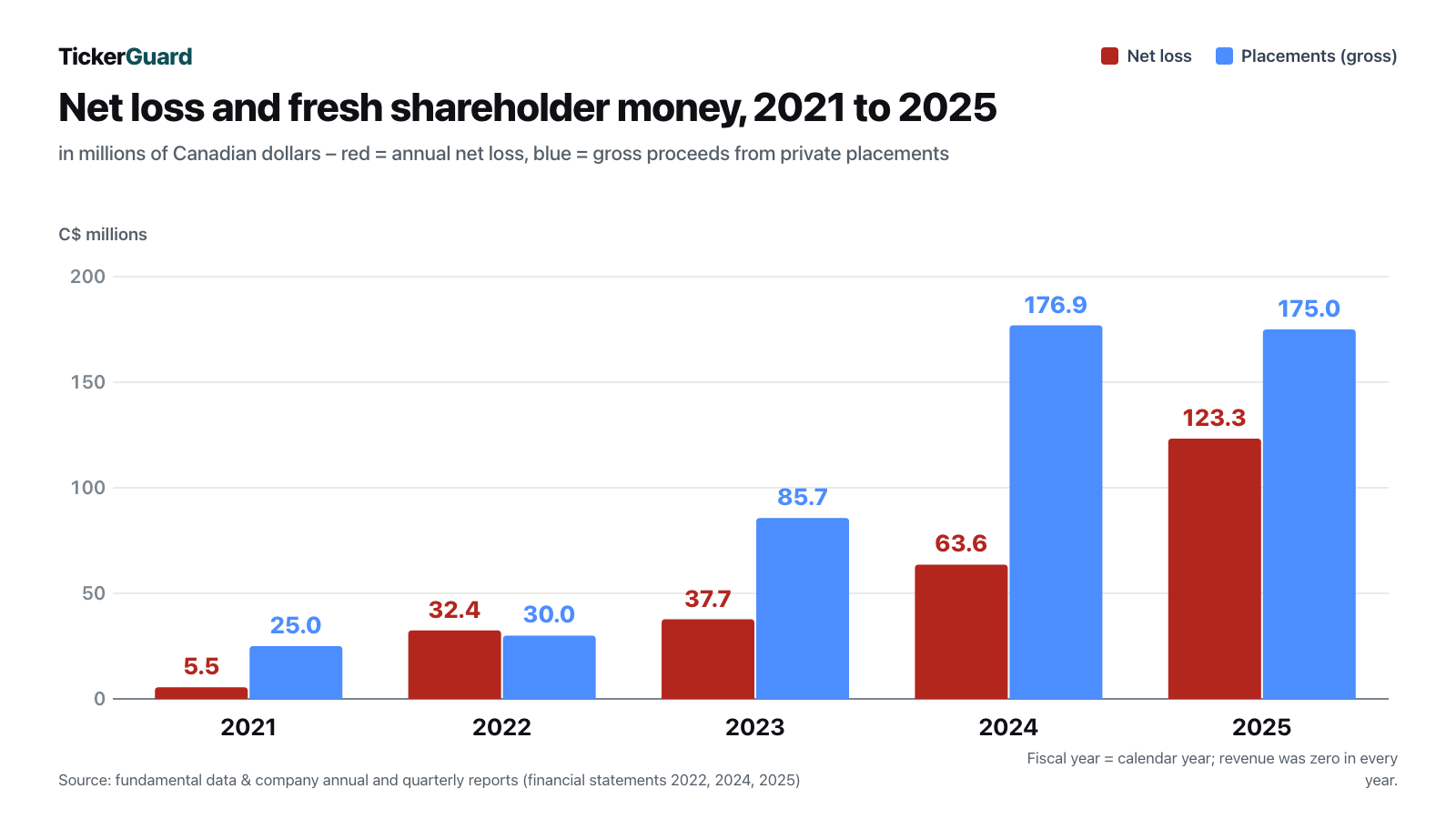
Exploration is the biggest cost: C$100.0 million in 2025, about 77 percent of the operating loss. In the first half of 2026, NGEx lost C$64.1 million, and operating cash outflow was C$65.9 million. Spending follows the seasons: drilling happens in the South American summer, so the fourth and first quarters are expensive and the second and third cheaper (net loss in the first quarter of 2026: C$44.1 million; in the second: C$20.0 million).
The balance sheet is unusually strong for an explorer. At June 30, 2026, NGEx held C$81.2 million in cash and C$133.5 million in short-term investments, C$214.7 million combined. It has no bank debt. At the 2025 operating cash outflow of C$93.5 million, that covers a little more than two years — a back-of-the-envelope figure that excludes the planned exploration adit and the roughly C$2.0 million of working capital slated to go, net, to the new company Valiente.
What the filings say — the uncomfortable truths
Now for the parts that no drill result mentions — what sits behind the drill-core hypnosis.
Uncomfortable truth No. 1: Lunahuasi has no resource estimate yet
A resource estimate is a deposit’s first official statement of quantity: how many tons of rock at what grade are in the ground under Canada’s NI 43-101 standard? Economic studies, mine plans and bank loans all build on it. For Lunahuasi, the annual information form contains one sober sentence:
“No Mineral Resources have been estimated for the Lunahuasi deposit.”
— NGEx Minerals Ltd., 2025 Annual Information Form dated March 19, 2026, summary of the Lunahuasi technical report
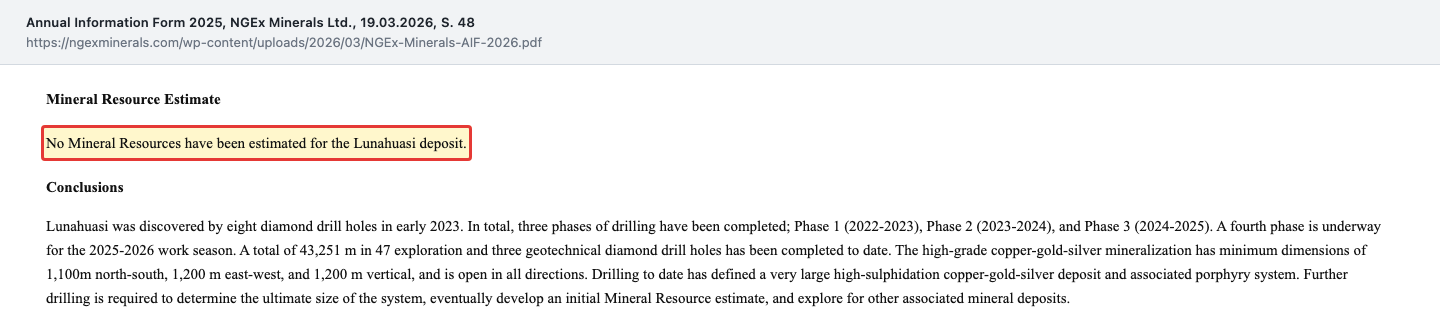
The MD&A for the period ended June 30, 2026, confirms the status indirectly: its forward-looking statements still list whether future drilling can convert the exploration potential into a resource estimate at all. At the September 15, 2026, investor day, NGEx said the proposed fifth drill program of about 25,000 meters is building toward an initial estimate. It gives no date. The presentation also explains why it takes time: Lunahuasi consists of several deposit types, each needing its own drill spacing and estimation model.
A drill interval is a line through a mountain. A resource is a body. Anyone who builds a body in their head out of spectacular lines is doing the geologists’ work in advance — and that is exactly the drill-core hypnosis.
Uncomfortable truth No. 2: The concentrate contains arsenic
On September 15, 2026, NGEx reported its first metallurgical tests. The results are good: a simple flotation process recovered 92.0 to 94.2 percent of the copper from samples of the Mars, Saturn and Jupiter zones. The same release, however, contains this sentence:
“As expected from mineralization in which enargite is the principal copper mineral, the initial copper concentrates contained arsenic at levels above typical penalty thresholds for sale to conventional copper smelters.”
— NGEx Minerals Ltd., release “Positive Preliminary Metallurgical Results from Lunahuasi,” September 15, 2026

What does that mean in practice? Smelters pay for copper concentrate but deduct penalties for impurities such as arsenic — above a certain level, many will not take the material at all. That is well known for enargite deposits and solvable, but it costs money. NGEx therefore tested solutions right away: a process called GlassLock removed more than 95 percent of the arsenic without losing copper, gold or silver; producing copper cathode and gold-silver doré on site was examined as well. The company itself stresses that more variability, optimization and scale-up work is needed. What this would cost in a mine, nobody knows today — that requires an economic study, and that requires a resource.
Uncomfortable truth No. 3: More than half of equity is one block of shares
In October 2025, NGEx spun out LunR Royalties. Among other things, LunR owns royalties on NGEx projects: 1 percent of the net smelter return (revenue after smelting and transport costs) from Lunahuasi and 1.38 percent from Los Helados. Shareholders received 80.1 percent of LunR; NGEx kept 19.9 percent, or 13,370,107 shares. At June 30, 2026, that stake was carried at C$252.7 million — 58 percent of shareholders’ equity of C$433.4 million. The MD&A shows how much it moves:
“Also in other comprehensive income, the Company has reported an unrealized loss on its investment in LunR common shares in the amount of $153.9 million and an unrealized gain of $78.2 million, respectively, for the three and six months ended June 30, 2026 (2025: $nil for each respective period).”
— NGEx Minerals Ltd., MD&A for the period ended June 30, 2026, dated August 6, 2026, Results from Operations

The quarterly net loss was C$20.0 million. The swing in the stake was almost eight times as large — it simply bypasses the income statement and goes straight to equity. And there is a loop worth knowing about. Our reading: because LunR is meant to earn from the revenue of Lunahuasi and Los Helados, its market value depends heavily on what the market expects from those projects. Part of NGEx’s balance sheet therefore reflects expectations for its own projects. That also means: beyond the LunR royalty, Lunahuasi carries a 1 percent royalty to Vicuña Corp. (Lundin Mining and BHP) and, for the first ten years of production, 0.5 percent to a third party — 2.5 percent of the net smelter return in total (revenue after smelting, refining and transport costs), payable before any mining or operating costs.
Uncomfortable truth No. 4: More shares, a powerful family, many spin-outs
Without revenue, an explorer has one way to raise money: new shares. Dilution means your slice of the pie gets smaller because more people share it. At NGEx, the share count rose from 124.8 million at the end of 2020 to 216.9 million in September 2026, an increase of 74 percent. To be fair, placement prices climbed sharply, from C$6.50 in 2023 to C$11.00 in 2024 and C$25.00 in October 2025. Anyone who bought at C$25.00 then is roughly flat on the NGEx share itself at the October 5, 2026, close of C$24.98 — not counting the LunR shares distributed shortly afterward. There are also 11.2 million stock options outstanding; share-based compensation cost about C$24.5 million in 2025.
Who calls the shots at NGEx is spelled out in the annual information form:
“Nemesia currently holds 73,671,714 Common Shares of the Corporation, which represents approximately 34.02% of the Corporation’s issued and outstanding Common Shares.”
— NGEx Minerals Ltd., 2025 Annual Information Form dated March 19, 2026, Significant Shareholders

The Lundin Group includes Lundin Mining, the partner at Los Helados, and a major shareholder with its own money at stake is not a drawback. The annual information form itself names the flip side, though: fewer freely tradable shares and influence over shareholder votes. Since September 17, 2026, Adam Lundin has chaired the board. And the group regularly spins out projects: NGEx itself came out of Josemaria Resources in 2019, LunR followed in 2025, and Valle Ancho is to follow in 2026 as Valiente Resources. NGEx pays Valiente about C$16.6 million, of which about C$14.6 million flows back to NGEx as the purchase price for the project; net, Valiente keeps about C$2.0 million of working capital. NGEx CEO Wojtek Wodzicki is slated to also serve as Valiente’s CEO and chair. The special meeting is on October 29, 2026. For your account, that would mean: 1,000 NGEx shares become 1,000 new NGEx shares plus 200 Valiente shares.
Valuation: five billion for drill core
With 216,858,780 shares (record date September 22, 2026) and a close of C$24.98 on October 5, 2026, NGEx is valued at about C$5.42 billion; at the OTCQX close of $17.64 the same day, that is about $3.8 billion. In early January 2021, the stock traded at C$0.53 (excluding the LunR shares distributed in 2025). Over the twelve months to early October 2026, it ranged between C$21.24 (November 4, 2025) and C$31.84 (February 25, 2026), based on closing prices.
There is no price-to-earnings or price-to-sales ratio. The market pays about 12.5 times book value. A simple calculation is more revealing: what is left of the market value once you subtract the cash and securities NGEx owns?
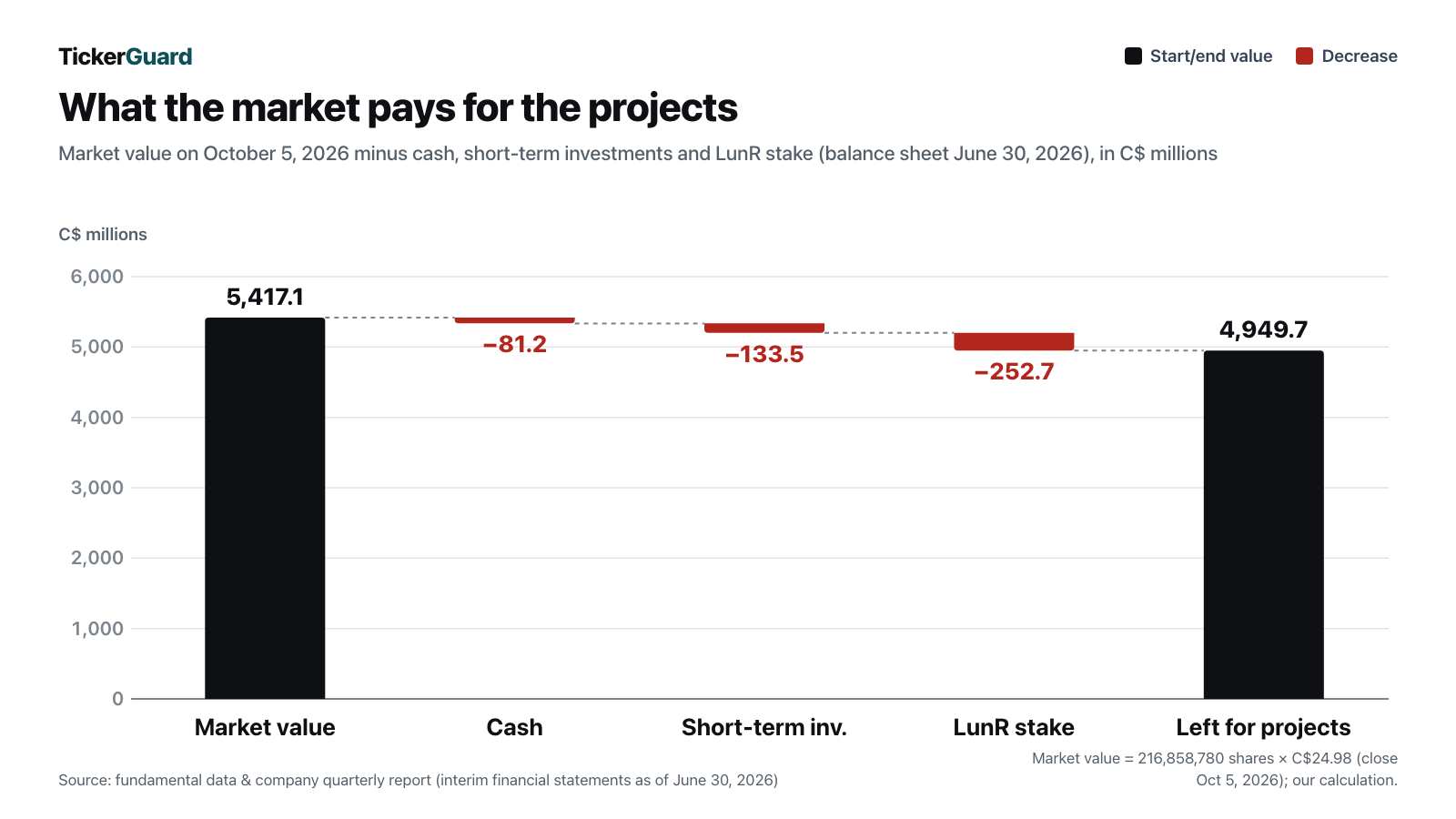
So the market pays about C$4.9 billion for projects of which only one — Los Helados, where NGEx holds 69 percent — has a resource estimate, and a low-grade one at that, calculated for large-scale underground mining. We did not also subtract liabilities of C$44.4 million (including C$34.0 million of deferred tax); they move the result by less than 1 percent. The rest of the price is a bet that Lunahuasi turns out as large and as rich as the drill core suggests. That can work out. Our view: the price already assumes success. For a similar story with lots of drill core and no resource yet, see our analysis of Collective Mining; for how an Andean copper explorer without a mine can look financially, see our analysis of Solaris Resources.
Upside and risks at a glance
What speaks for the company:
- Exceptional grades. According to the MD&A, the highest copper, gold and silver grades drilled to date in the Vicuña District, with the deposit open in all directions.
- Full treasury, no debt. C$214.7 million in cash and short-term investments at June 30, 2026, plus the LunR stake.
- Permit for the adit. Environmental approval came on March 9, 2026; construction is targeted for the fourth quarter of 2026 once the remaining permits are in hand.
- Solid first metallurgy. 92.0 to 94.2 percent copper recovery in testing; more than 95 percent of the arsenic could be removed.
- Powerful neighbors. Lundin Mining and BHP are advancing Josemaria and Filo del Sol next door, and Lundin Mining has been the partner at Los Helados since April 2026.
What speaks against it:
- No resource for Lunahuasi. No resource estimate per the March 2026 annual information form, and no date for a first one.
- Arsenic in the concentrate. Above typical smelter penalty thresholds; the extra treatment costs money nobody has quantified yet.
- Volatile equity. 58 percent of it sat in the LunR stake at June 30, 2026, which lost C$153.9 million in the second quarter.
- Dilution and pay. Share count up 74 percent since the end of 2020, 11.2 million options outstanding.
- Concentrated control. The Lundin family holds about 34 percent, and the group regularly spins out projects.
- Country and permitting risk in Argentina. Hyperinflation, currency rules and a glacier-protection law whose reform remains open, according to the annual information form.
A human conclusion
Remember the 2 meters at 1,740 grams of gold from the start? They are real, and by everything the reports show, Lunahuasi is an exceptional discovery. NGEx has money, experienced people and powerful neighbors. But drill-core hypnosis kicks in exactly where the reports stop: there is no resource estimate yet, the metallurgy has an arsenic issue, and the market pays about C$4.9 billion for projects whose size nobody knows.
That need not be a mistake. The next milestones are easy to see: the special meeting on October 29, 2026, the interim statements as of September 30, 2026, the start of the adit, the fifth drill program and, at some point, the first resource estimate. Enjoy the drill releases — but read them as lines through a mountain, not as a mine.
What you make of it is your decision. And that’s how it should be.
Sources and data cut-off
- Interim financial statements and MD&A as of June 30, 2026, dated August 6, 2026
- Interim financial statements and MD&A as of March 31, 2026
- Consolidated financial statements and MD&A as of December 31, 2025 with the auditor’s report of PricewaterhouseCoopers LLP; 2024 financial statements; 2022 financial statements
- 2025 Annual Information Form, dated March 19, 2026
- NI 43-101 technical report on Los Helados, August 22, 2025 (effective date July 29, 2025; section 14.1: resource estimate as of October 31, 2023, not updated since)
- Investor Day presentation, September 15, 2026
- Management information circular for the October 29, 2026, special meeting (Valle Ancho/Valiente spin-out)
- News releases: environmental approval for the adit (March 9, 2026), Lundin Mining as partner at Los Helados (March 11, 2026), Q2 results (August 6, 2026), Valle Ancho spin-out (August 6, 2026), metallurgy (September 15, 2026), chair succession (September 17, 2026), notice of special meeting (October 2, 2026)
- SEC directory for CIK 0002044153 (Form D only)
- Price and market value data: source fundamental data, as of October 5, 2026
Data cut-off: company figures as of June 30, 2026, or the date stated; share count as of September 22, 2026; news releases through October 2, 2026; prices as of October 5, 2026. The company’s news page was last checked on October 8, 2026. The reporting currency is the Canadian dollar; drilling and resource figures apply to each project as a whole. Calculated values (market value, the subtraction, cash runway, total meters) are our own estimates and labeled as such. The key-figure tiles on this page show the current database values with their own rounding and may differ from the October 5, 2026, close of C$24.98 used here.
Note: This article is journalistic commentary and not investment advice. It contains no recommendation to buy or sell and is not a solicitation to buy or sell securities. Shares of explorers without revenue are especially volatile; a total loss of the capital invested is possible. Positions held by the operator are disclosed daily; where one exists, it appears as a notice at the top of this deep dive.
Our Bottom Line at a Glance
- Lunahuasi deposit positive
- According to the MD&A for the period ended June 30, 2026, the highest copper, gold and silver grades drilled to date in the Vicuña District; the fourth program added 27,318 meters, and the deposit is open in all directions.
- Resource estimate negative
- Lunahuasi has no resource estimate according to the annual information form dated March 19, 2026. NGEx gives no date for a first one; the fifth drill program is meant to work toward it.
- Metallurgy neutral
- Initial tests (September 15, 2026): 92.0 to 94.2 percent copper recovery, but arsenic above typical penalty thresholds; an added process removed more than 95 percent. Costs in a mine remain open.
- Financial position positive
- C$214.7 million in cash and short-term investments at June 30, 2026, no bank debt; at the 2025 operating cash outflow of C$93.5 million, a runway of a little more than two years by our calculation.
- LunR stake neutral
- C$252.7 million at June 30, 2026, 58 percent of equity; its value fell by C$153.9 million in the second quarter of 2026. A non-dilutive funding cushion, but a volatile one.
- Dilution and control negative
- Share count up 74 percent since the end of 2020 to 216.9 million, with 11.2 million options outstanding. The Lundin family holds about 34 percent through Nemesia.
With Lunahuasi in Argentina, NGEx Minerals is exploring a copper-gold-silver deposit with exceptional drill grades, but according to its March 2026 annual information form it has no resource estimate yet. The balance sheet is strong, with C$214.7 million in cash and short-term investments plus the LunR stake; there is no revenue. At the October 5, 2026, close of C$24.98, NGEx is valued at about C$5.4 billion, roughly C$4.9 billion of which is, by our calculation, attributed to the projects. Not investment advice.
What Our Rating Means
Open questions
The business works in principle, but one material question is open. As long as it stays open, our findings do not carry a quality verdict.
Yellow here is not about the share price and not about the balance sheet, which is unusually strong for an explorer at C$214.7 million in cash and short-term investments with no bank debt. Yellow stands for the open operating question at the core: Lunahuasi has no resource estimate, no economic study and only a first round of metallurgy with an arsenic issue. Whether the drill core becomes a mine is unproven. There is no substance risk that would warrant red; the cash covers a little more than two years by our calculation. The decision is yours.
A journalistic assessment by our editorial team at the time of the deep dive, based on public sources — not investment advice and not a solicitation to buy or sell. Your personal circumstances (investment goals, risk capacity, taxes) cannot be taken into account. What our levels mean, how verdicts are formed, and what conflicts of interest exist →
Worth Noting
- This analysis was prompted by the U.S. OTCQX symbol NGXXF on the forum hot list of the German site wallstreet-online (as of October 6, 2026); we list the company under its home listing NGEX (Toronto Stock Exchange) as NGEX.TO. There is no hit from our in-house stock scanner, and there cannot be: the company has neither revenue nor earnings.
- NGEx is not an SEC periodic filer (CIK 0002044153, Form D only). All company figures come from its Canadian filings: financial statements for 2022, 2024 and 2025 (auditor PricewaterhouseCoopers LLP), the 2025 Annual Information Form, interim statements and MD&A as of March 31 and June 30, 2026, the September 15, 2026, investor day deck, the special meeting circular and news releases through October 2, 2026.
- Calculated values are our own estimates: market value from 216,858,780 shares times the October 5, 2026, close; the subtraction uses cash, short-term investments and the LunR stake as of June 30, 2026, without liabilities; cash runway from the 2025 operating cash outflow, excluding the adit and Valiente’s roughly C$2.0 million of working capital (net of the roughly C$14.6 million purchase price that flows back to NGEx); total meters as the sum of the technical report and the fourth program.
- Drill results in copper equivalent use the company’s formula ($3.00/lb copper, $1,500/oz gold, $18/oz silver, 80% recovery). They describe individual drill intervals and are not a resource.
The full analysis as a PDF for later
We will send you this analysis as a PDF — to print, file away, and read at your own pace.
Frequently Asked Questions
NGEx Minerals is a Canadian explorer in the Lundin Group. It explores the Lunahuasi copper-gold-silver deposit in San Juan Province, Argentina (100 percent), and holds about 69 percent of the Los Helados project in Chile. It has no revenue; funding comes from share placements.
No. The annual information form dated March 19, 2026, states that no mineral resources have been estimated for Lunahuasi. At its September 15, 2026, investor day, NGEx said the fifth drill program of about 25,000 meters is building toward an initial estimate, but it gave no date.
Copper equivalent converts gold and silver at copper prices so that one number can describe a drill interval. For Lunahuasi, NGEx uses $3.00 per pound of copper, $1,500 per ounce of gold, $18 per ounce of silver and 80 percent recovery. It is a calculated figure, not a resource.
The main copper mineral at Lunahuasi is enargite, which contains arsenic. According to the September 15, 2026, release, the first concentrates exceeded typical smelter penalty thresholds. An added treatment removed more than 95 percent of the arsenic; the cost in a future mine has not been quantified.
LunR Royalties is a royalty company NGEx spun out in October 2025. Among other things, it receives 1 percent of the net smelter return from Lunahuasi and 1.38 percent from Los Helados. NGEx kept 19.9 percent; the stake was worth about C$252.7 million at June 30, 2026.
It is the same stock. NGEX is the symbol on the home exchange, the Toronto Stock Exchange, where prices are set in Canadian dollars. NGXXF is the symbol on the U.S. over-the-counter market OTCQX. TickerGuard lists the stock as NGEX.TO.
NGEx plans to spin out the Valle Ancho project into a new company, Valiente Resources. For each NGEx share, holders receive one new NGEx share and one fifth of a Valiente share. NGEx pays Valiente about C$16.6 million; about C$14.6 million of that flows back to NGEx as the purchase price for the project, and about C$2.0 million stays as working capital. The vote is on October 29, 2026, and needs two thirds of the votes cast.
Found an error?
Did you spot a factual error, an outdated number, or a typo in this deep dive? Let us know briefly — your report goes straight to the editorial team.