Accendra Health: two bond series cost $117 million in interest a year — the entire company costs $108 million on the stock market
Owens & Minor, founded in 1882, became Accendra Health in December 2025. The distribution business was sold for $375 million; what stayed is the home-care operation built on Apria and Byram — and the debt. As of June 30, 2026, $1.72 billion of borrowings stands against $7.7 million of cash, and equity is negative at $550.9 million. In June 2026 the company swapped notes carrying 4.500 percent and 6.625 percent coupons for secured paper at 9.000 percent and 9.750 percent; the bond market still marks the new second lien tranche at about 69 percent of its carrying value. Not investment advice — just the question of what is left of a 143-year-old company once you take away its business and its name and leave the debt behind.
 Thomas Mücke
Founder & Publisher
Thomas Mücke
Founder & Publisher
As of Today
As of: September 24, 2026
- Closing price
- 0.7332 $ -2.30%
- Market Capitalisation
- 0.1 $B
- Growth Score
- 3/10
- AAQS
- 0/10
This analysis has a cut-off date. The Stock Guard tells you when something material changes in the numbers. Reserve your free spot
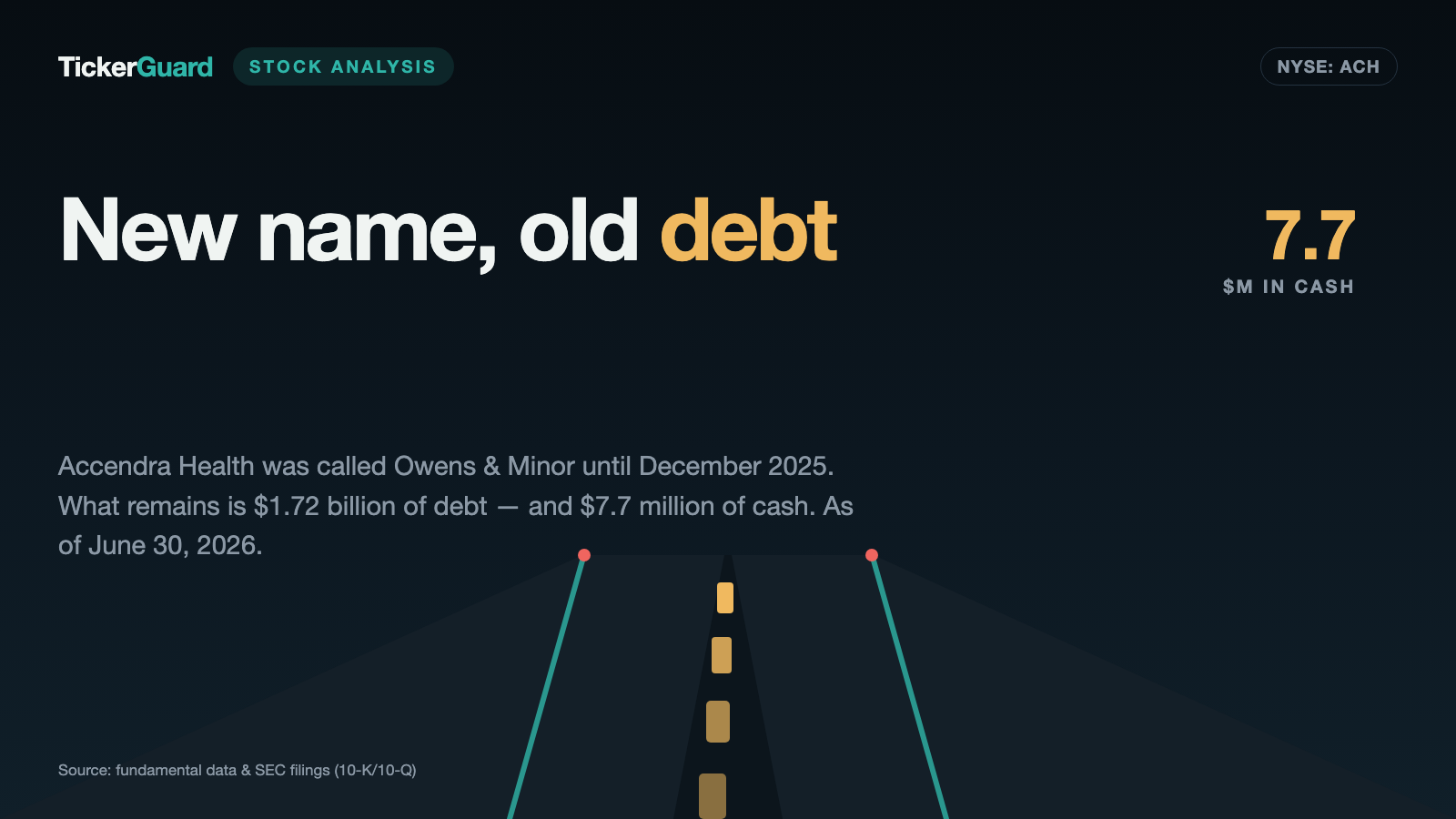
Chart
Interactive price chart (TradingView).
52-week range: 0.7501 $ to 5.50 $ · Last price: 0.7332 $ (As of: September 24, 2026)
Note: pure fact-based analysis, not investment advice and not a solicitation to buy or sell. All figures without guarantee.
There is an investor trap so pleasant that you barely notice it: the rebranding trap. It works like this. A company is stuck — old business, thin margins, too much debt. So it sells the hardest part, gives itself a new name, gets a new ticker, and suddenly everything reads like a fresh start. Our minds turn that into a story within seconds: "New name, new company, new chance." It is the same reflex that lets us credit a person with a new character after a new haircut. Accendra Health (NYSE: ACH) is the perfect test case: founded in 1882 as Owens & Minor in Virginia, the company sold its distribution business effective December 31, 2025, renamed itself in December 2025 and has traded under a new ticker since January 2, 2026. So let us make a deal. Before we believe the new name, we read together what the company itself reported to the U.S. securities regulator, the SEC — the quarterly report (10-Q) for the period ended June 30, 2026, filed on August 10, 2026, the annual report (10-K) for 2025, and the current reports (8-K) filed that same August 10. An SEC filing is honest under penalty of law. And this one describes a balance sheet that did not join the rebranding. In the end, the decision is yours.
What Accendra Health actually does — health care delivered to your living room
Forget the word "healthcare" for a moment. At its core, Accendra Health runs a rental and delivery operation for medical equipment inside private homes. In plain terms: when a physician prescribes a breathing device for a patient with sleep apnea, that device has to reach the patient's home, be set up, explained, serviced and resupplied with consumables month after month. That is precisely what the group's two large brands do: Apria (respiratory therapy, oxygen, non-invasive ventilation, sleep apnea devices) and Byram Healthcare (consumables for diabetes, ostomy, wound care, urology, incontinence), alongside the smaller Lofta brand. The 2025 annual report (10-K) describes this as supporting "health beyond the hospital" and puts the combined experience of both brands at "nearly 90 years." As of December 31, 2025, more than 6,500 people worked there full and part time.
Patients almost never pay for any of it directly; payors do. And that is the first key to understanding this business. In the first half of 2026, $971.4 million came from commercial payors (including Medicare Advantage plans), $253.9 million from Medicare and $15.7 million from Medicaid. Roughly 78 percent of revenue therefore depends on private insurance groups — on negotiations, reimbursement rates and contracts that can be cancelled. Remember this sentence, it returns in a moment: in this business, a customer who declines to renew is not a lost order but a lost revenue stream.
Until the end of 2025 that was only half the company. The other half was the classic Owens & Minor operation: supplying hospitals with medical consumables, known internally as Products & Healthcare Services (P&HS). That segment is gone. The quarterly report describes the sequence plainly: the purchase agreement with Dominion Healthcare Acquisition Corporation was signed on October 7, 2025 and closed on December 31, 2025 at a price of $375 million in cash, subject to customary adjustments. Accendra Health retained a 5 percent interest in the divested business. That frames the central tension of this analysis, and it runs through every chapter that follows: half the company was sold — the debt was not.
How the stock reached our desk — through a day when it halved
Accendra Health did not arrive on our research list through a valuation or momentum filter. It came through our Reddit hype scanner, and the trigger was a single trading day. On August 10, 2026 — the day the quarterly report, the rights plan and the chief executive's retirement notice were all published — the closing price fell from $2.80 (August 7, 2026) to $1.40. Exactly half, in one session, on roughly 8.07 million shares. For context, a year earlier, on August 1, 2025, the stock stood at $6.57. Over the twelve months to August 10, 2026 the closing price ranged between $1.40 and $5.68 (our own review of daily closing prices, data as of August 11, 2026).
Days like that are classic fuel for forum attention — and for the second trap after the rebranding trap: the reflex of reading a halving as a bargain. That one has a name too: anchoring on the old price. The mind calculates "$2.80 before, $1.40 now, so 50 percent off." The market calculates differently: it prices the new information, not the old price. What that new information contains is the rest of this article. Worth noting alongside: roughly 8.98 percent of the free float was recently sold short (5.57 million shares, data as of August 11, 2026), so an entire group of participants is positioned for further declines. Institutions hold about 85.4 percent and insiders about 7.7 percent.
The numbers over the years — given honest credit
Start with what genuinely speaks for this company, because there is something. The remaining home-care business is large, growing and real. Continuing-operations revenue rose in each of three years: $2,552.6 million in 2023, $2,680.1 million in 2024 and $2,762.0 million in 2025. That is 8.2 percent of growth over two years, in a market with demographic tailwinds — diabetes, sleep apnea and chronic respiratory conditions are rising in the United States, and care keeps migrating out of the hospital and into the home. Operating income reached $133.2 million in 2023. In 2025 it stood at $27.5 million, which looks thin next to 2023 — but that figure absorbs a one-time $80.0 million payment for a collapsed acquisition, which we come to shortly.
The adjusted earnings measure the company itself emphasizes is not zero either. Adjusted EBITDA — roughly, earnings before interest, taxes, depreciation, amortization and special items, so a crude look at the operation before financing — came to $118.5 million in the first half of 2026. This is not an empty shell; it ships equipment every day and issues invoices for it.
The revenue trend turned in 2026, though. First-half revenue fell to $1,241.0 million from $1,355.8 million a year earlier, a decline of 8.5 percent. In the second quarter alone the drop was 10.1 percent ($613.2 million against $681.9 million). Adjusted EBITDA fell 38.5 percent over the same period, from $192.7 million to $118.5 million. The product-level view shows where the decline came from:
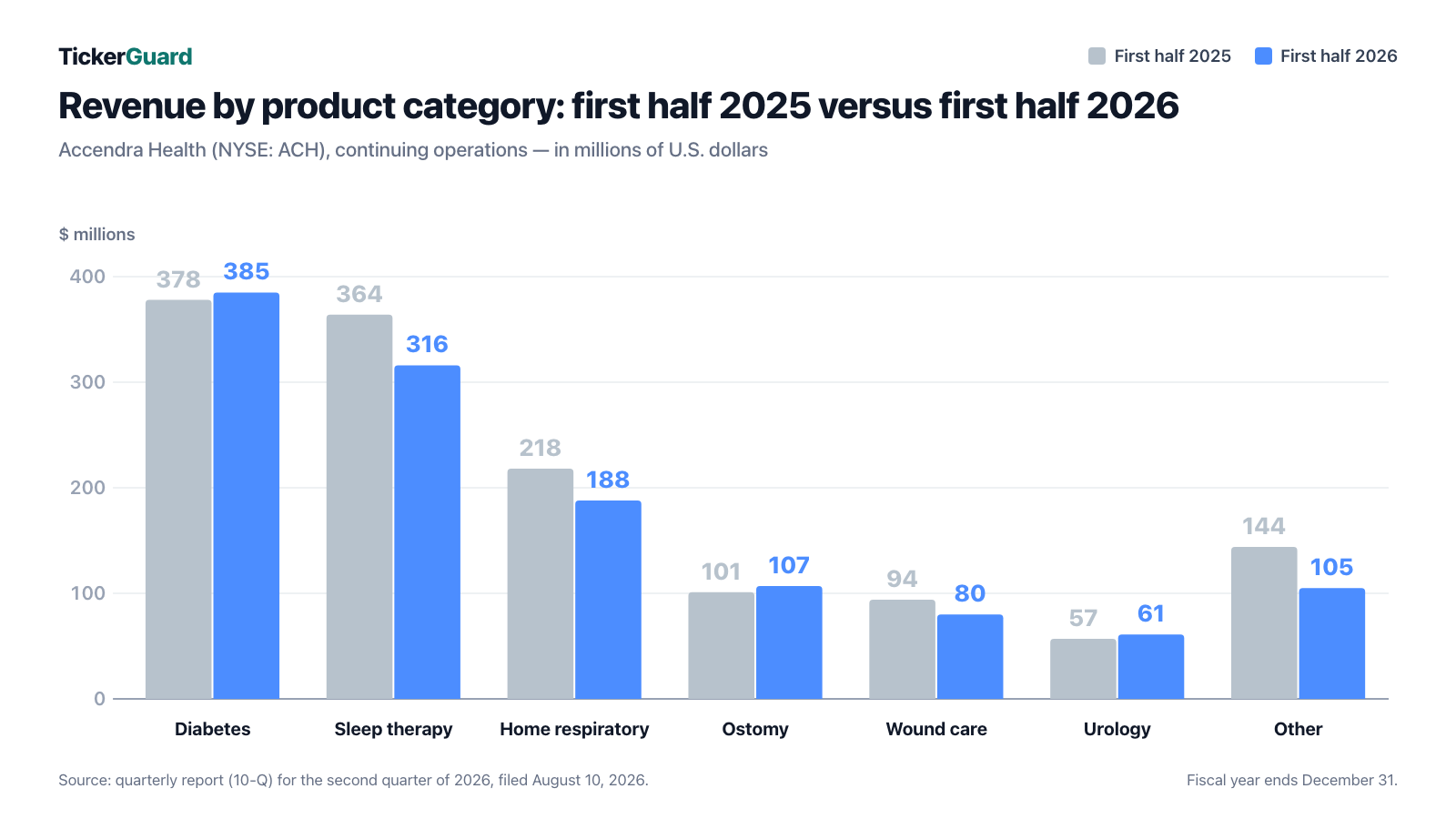
The pattern is unmistakable. The two equipment businesses — sleep therapy and home respiratory therapy — lost roughly $78 million of half-year revenue between them. Those are the categories with the most expensive devices and the longest rental terms. The reason sits in the first uncomfortable truth.
What the filings say: uncomfortable truth No. 1 — the largest customer walked away
The quarterly report devotes a dedicated section to it, headed "Contract Termination with a Commercial Payor and Equipment Sales." A large commercial payor, with which Accendra Health held several separately managed contracts, terminated part of them. The company writes:
"The terminated portion of this relationship reflected $37 million, or 3%, of our net revenue, including nearly all of our capitation revenue, for the six months ended June 30, 2026. There was no related revenue for the three months ended June 30, 2026."
— Accendra Health, Form 10-Q for the second quarter of 2026, management discussion, filed August 10, 2026

Two terms need translating. Capitation means the insurer pays a fixed amount per covered life per month, regardless of how much is actually delivered. For the provider that is predictable revenue — a subscription, in effect. That subscription is now almost entirely gone. And the $37 million figure badly understates the total effect, because it only describes the residual revenue still recognized in the first half of 2026. The actual decline appears elsewhere in the management discussion: $81 million in the second quarter and $123 million in the first half. Strip that out and revenue would have grown slightly — except it is not stripped out, it is gone.
One side observation shows how early the company knew. Amortization of intangible assets jumped to $29 million in the second quarter of 2026 from $7.6 million a year earlier. The reason, per the filing, is that the remaining useful life of a customer relationship intangible was shortened as of June 30, 2025, following notice of the termination. By June 30, 2026 that asset was fully amortized and removed from the balance sheet.
Uncomfortable truth No. 2 — the exchange doubled the coupons
In June 2026 Accendra Health rebuilt its debt, in a transaction it calls the "Balance Sheet Optimization Transaction." It offered holders of two unsecured bonds — the 4.500 percent notes due 2029 and the 6.625 percent notes due 2030 — a swap into new, secured paper. Take-up was near total:
"At the expiration of the Exchange Offers, $478 million in aggregate principal amount of 2029 Notes were tendered and $548 million in aggregate principal amount of 2030 Notes were tendered and cancelled representing approximately 99.9% and 99.2% of the principal outstanding."
— Accendra Health, Form 10-Q for the second quarter of 2026, Note 5, filed August 10, 2026

What emerged: $539.25 million of first lien secured notes at a 9.000 percent coupon maturing in June 2032, and $698.1 million of second lien secured notes at 9.750 percent maturing in June 2033. On top of that, $326.25 million of new money was raised and used to retire the Term Loan A. In plain language, the company bought itself time — the next meaningful maturity is not until 2029 — and paid for it twice over. First with a much higher rate: the new coupons run at 9.000 and 9.750 percent instead of 4.500 and 6.625 percent. Those two series alone cost roughly $116.6 million of coupon a year ($539.25 million at 9.000 percent plus $698.065 million at 9.750 percent). Second, it pledged collateral: those creditors now have a claim on assets they did not have before. Anyone who did not exchange sits at the very back — the filing puts it bluntly, saying the remaining unsecured notes are "effectively subordinated to any of our secured indebtedness."
More interesting than the exchange itself is what the bond market makes of it. A quarterly report must disclose not only the carrying amount of debt but also its estimated fair value. The two diverge sharply:
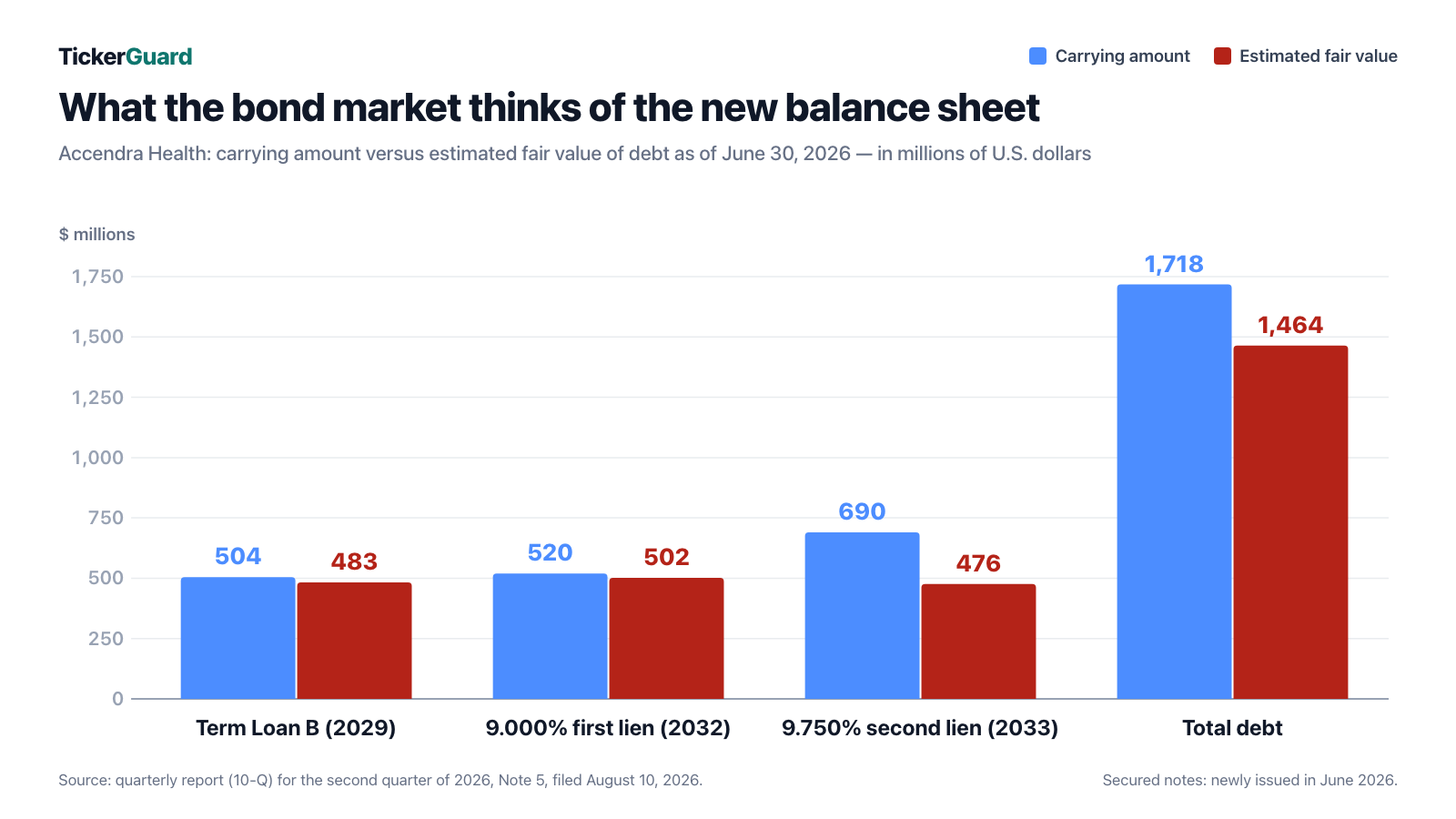
This chart is the single most important finding in the analysis. The second lien note was issued in June 2026 — and as of June 30, 2026, days later, it is marked at $475.8 million against a carrying amount of $690.2 million. That is roughly 69 cents on the dollar. The first lien tranche is marked near 97 cents and the Term Loan B near 96. Translated: professional bond investors, who sit at the front of the queue and hold collateral, consider it likely that they will not get a meaningful part of their money back. Anyone buying the stock sits behind those investors. That is not an opinion, it is a ranking.
Uncomfortable truth No. 3 — negative equity and $7.7 million of cash
Now the balance sheet as of June 30, 2026, in simple terms. On the asset side sit $2,107.4 million. Of that, $1,228.1 million is pure goodwill — the amount past acquisitions cost above the value of the assets acquired. It is an accounting item, not something you can sell. On the liability side sit $2,658.4 million. The difference is equity, and it is negative: minus $550.9 million, after minus $461.0 million six months earlier. The accumulated deficit stands at $1,175.3 million.
Negative equity alone is not a death sentence; profitable companies carry it, often after large buyback programs. What matters is whether enough money comes in. Here it gets tight. Cash fell from $281.99 million on December 31, 2025 to $7.7 million on June 30, 2026. Operating activities consumed $76.1 million in the first half of 2026, after providing $2.5 million a year earlier. Even the company's preferred measure, free cash flow, came in at minus $27.1 million, against plus $50.7 million a year before.
There are buffers, and fairness requires naming them. The revolving credit facility was undrawn at June 30, 2026; of a $300 million commitment, $271 million remained available after $29 million of letters of credit. There is also a receivables sale program, under which the company sells invoices to a bank before customers pay. But both buffers have shrunk: the revolver was cut from $450 million to $300 million on June 15, 2026, and the receivables program from $450 million to $150 million effective December 31, 2025. Debt covenants were in compliance at June 30, 2026, per the filing.
For context: negative equity combined with heavy leverage is a pattern we also examined in our Branicks analysis, there in German commercial real estate. The mechanism is identical. As long as interest is serviced, nothing happens; the moment operating inflows fall below the interest bill, management stops deciding and creditors start.
Uncomfortable truth No. 4 — the buyer's invoice has not arrived yet
A detail from Note 2 of the quarterly report is easy to skim past: when it sold the distribution business, Accendra Health committed to reimbursing the buyer.

Of that, $35 million was already incurred in the first half of 2026, $17 million of it in the second quarter. Only $15 million had actually been paid during the half. The staggering — nothing before April 2026, no more than $15 million before October 2026, no more than $55 million before January 2027 — pushes the bulk into the fourth quarter of 2026 and the first quarter of 2027. Into a cash balance that stood at $7.7 million on June 30, 2026. There is a second commitment in the same agreements: under the transition services agreement, the company may be obligated to provide the divested business with up to $115 million in credit support. Neither number appears as debt on the balance sheet.
Uncomfortable truth No. 5 — a poison pill for the tax assets, and a departing chief executive
On August 10, 2026 Accendra Health announced three things at once. The first was the quarterly report. The second was a Section 382 rights plan — formally a "Tax Asset Preservation Plan," colloquially a variety of poison pill. Its purpose is stated verbatim in the filing:
"The purpose of the Tax Asset Preservation Plan is to facilitate the Company's ability to preserve its NOLs and its other tax attributes in order to be able to offset potential future taxable income for U.S. federal income tax purposes."
— Accendra Health, Form 8-K dated August 10, 2026, Item 1.01

The mechanism in everyday terms: loss carryforwards are a tax credit. A company that has run losses for years may offset future profits against them and pay no tax for a while. U.S. tax law curtails that credit if ownership shifts too far — broadly, if 5-percent shareholders collectively add more than 50 percentage points over a rolling three-year period. To prevent that, the board issues every shareholder a purchase right that triggers automatically once anyone acquires 4.9 percent or more, which makes the purchase prohibitively expensive. The plan runs to August 10, 2029, or until the board decides it is no longer needed.
How large is the protected asset? The 2025 annual report quantifies it:

And the third announcement that day? Chief executive Edward A. Pesicka informed the board that he intends to retire and step down from the board by the end of 2026, or earlier once a successor is appointed. The filing expressly states that this is not the result of any disagreement over the company's operations, policies or practices, and that a search is under way. None of that needs dramatizing. It is worth noting when it comes: the man who ran the sale, the rebranding and the debt exchange is leaving before their effect can be measured.
A fourth item from the same period belongs here for completeness. On July 15, 2026 Accendra Health filed a shelf registration statement (Form S-3), effective since July 24, 2026. It allows the company to issue common stock, preferred stock, debt securities, warrants and other instruments at any time without a fresh approval process. That is routine for a listed group — but a company with negative equity securing that option shortly after a debt exchange is also saying something about its expectations. For shareholders an equity raise means dilution: your slice of the cake gets smaller because new slices are added.
For completeness: $80 million for an acquisition that never happened
In 2025 the group — then still Owens & Minor — planned to acquire the competitor Rotech Healthcare. The deal collapsed. The bill appears in the annual report: an $80.0 million transaction breakage fee, plus $22 million of transaction costs and $18.3 million of financing fees. Without those charges, 2025 operating income would have been roughly $107 million instead of $27.5 million. That matters when comparing 2025 with 2026 — and it matters just as much that $120 million of cash went out for a purchase that never closed.
One more legacy item: in 2024 the group wrote off $307 million of goodwill in the Apria reporting unit, triggered, per the filing, in part by its own falling share price, rising interest rates and anticipated pricing changes on a capitated contract. That very capitated contract has since been terminated. Even after the write-off, $1,228.1 million of goodwill remains on the balance sheet — against a market capitalization of roughly $108 million.
Valuation — what the market pays for the equity, and what for the debt
Let us work through the orders of magnitude with clear as-of dates. At June 30, 2026 there were 76,904,704 shares outstanding. At the August 10, 2026 close of $1.40, that gives a market capitalization of roughly $108 million. As a cross-check, the company's own shelf prospectus reports a closing price of $3.61 on July 14, 2026 — about $278 million at the time. Both are dated anchors, not price targets.
The enterprise value — market capitalization plus net debt, meaning what a buyer would have to fund to own the whole company including its liabilities — sits at roughly $1.82 billion ($108 million of equity value plus $1,718.1 million of debt less $7.7 million of cash). Against annualized first-half 2026 revenue (2 × $1,241.0 million, or about $2.48 billion) that is an enterprise value of roughly 0.7 times annual revenue. Against annualized adjusted EBITDA (2 × $118.5 million, about $237 million) it is roughly 7.7 times adjusted EBITDA. Neither multiple is conspicuously expensive for a healthcare services provider.
The decisive view is a different one. Of that $1.82 billion of enterprise value, roughly 94 percent belongs to creditors and roughly 6 percent to shareholders. In this structure the equity is an option: if the company services and eventually reduces its debt, every dollar of improvement accrues to shareholders and the stock can multiply. If it does not, the business passes to creditors and the stock is worth close to nothing. There is not much middle ground between those outcomes. A price-to-earnings ratio cannot be formed for lack of earnings; book value per share stands at minus $7.16 as of June 30, 2026.
And the single figure that sums it up: the two new bond series alone cost roughly $116.6 million of coupon a year. The company's entire market capitalization on August 10, 2026 was about $108 million. Shareholders collectively own less than the company wires to its bondholders in a single year.
For a look at how a financially steadier competitor in the same business is built, our AdaptHealth analysis offers the direct comparison: the same home-care model, the same payor dependence — but a different balance sheet.
Opportunities and risks at a glance
Opportunities
- A focused business with no near-term maturities: after the exchange there is no meaningful maturity before 2029, and no current portion of long-term debt was reported at June 30, 2026. Three years is not a bad runway for a turnaround.
- Structural tailwinds: diabetes revenue grew to $384.6 million in the first half of 2026, ostomy to $107.0 million and urology to $61.1 million — three consumables businesses with recurring orders are advancing while only equipment rental suffers.
- $362 million of tax assets: the unlimited-life loss carryforwards keep future profits tax-free for years, a real asset the board is deliberately protecting with the rights plan.
- The equity is an option: at roughly $108 million of market capitalization against $1.82 billion of enterprise value, any operational improvement leverages disproportionately into the share price.
- Undrawn reserves: $271 million of available revolving credit and a $150 million receivables sale program remain in place, and covenants were in compliance at June 30, 2026.
Risks
- Negative equity and an empty till: minus $550.9 million of equity, $7.7 million of cash and $76.1 million of operating cash outflow in the first half of 2026 — the substance has been used up.
- The bond market prices in a default: the second lien note issued in June 2026 is marked at roughly 69 percent of carrying value as of June 30, 2026. Shareholders rank behind those creditors.
- Customer concentration: roughly 78 percent of revenue comes from commercial payors. One of them just took $123 million of half-year revenue with it; nothing stops the next one.
- $1.23 billion of goodwill against a $108 million market capitalization: after the $307 million write-off in 2024, another impairment is plausible — the company itself cites a falling market capitalization as a trigger for the last test.
- Up to $180 million of off-balance-sheet commitments: a $65 million reimbursement cap plus up to $115 million of credit support for the divested business, with payment steps at October 1, 2026 and January 1, 2027.
- Leadership change and dilution risk: the chief executive leaves by the end of 2026 with no successor named, while the shelf registration effective July 24, 2026 permits new shares at any time.
A human conclusion
Back to the rebranding trap. It works so well because it does not lie: Accendra Health is genuinely a different company from Owens & Minor. The distribution business is sold, the ticker is new, the capital structure is rebuilt, the chief executive is leaving. All of it is change. Just not the kind of change the word "fresh start" conjures up. What actually happened is this: a 143-year-old company sold half its business, used the proceeds not to retire its debt but to postpone it — and paid for the postponement with roughly doubled coupons and collateral handed to its creditors. At the end of that half year, $7.7 million sat in the till.
None of that makes the stock a mistake by default. It makes it something other than the name suggests: not a stake in a newly focused healthcare provider, but a bet on the residual value of an over-indebted balance sheet. Bets like that have worked spectacularly, and they have ended in total loss just as often. The difference between those outcomes here has nothing to do with the brand, the market or the product. It comes down to one question: can the company generate more cash from operations, durably, than its interest costs? In the first half of 2026 the answer was no.
So when you catch yourself thinking "fresh start" at a name change, pause and ask what was not renamed. At this company, that is $1.72 billion. What you do with that is your decision. And that is exactly as it should be.
Sources
- Form 10-Q for the second quarter of 2026, Accendra Health, Inc., filed August 10, 2026 — revenue, earnings and balance sheet data, Note 2 (divested business, reimbursement obligation), Note 3 (goodwill), Note 5 (debt and its fair value), management discussion (contract termination, liquidity, adjusted EBITDA)
- Form 10-Q for the period ended March 31, 2026, filed May 11, 2026
- Form 10-K for 2025, filed February 20, 2026 — business description, headcount, multi-year figures, income tax note (loss carryforwards), 2024 goodwill impairment, the Apria settlement and corporate integrity agreement
- Form 8-K dated August 10, 2026, Items 1.01 and 5.03 — Section 382 Tax Asset Preservation Plan, 4.9 percent threshold, final expiration August 10, 2029
- Form 8-K dated August 10, 2026, Item 5.02 — announced retirement of chief executive Edward A. Pesicka by the end of 2026
- Form 8-K dated August 10, 2026, Item 2.02 — second quarter 2026 earnings release
- Form 8-A12B dated August 10, 2026 — registration of the preferred share purchase rights on the New York Stock Exchange
- Form S-3 shelf registration statement dated July 15, 2026 — closing price of $3.61 on July 14, 2026, framework for future securities issuance
- Form 8-K dated June 25, 2026 — final results of the exchange offers, size of the new first and second lien notes
- Form 8-K dated December 31, 2025 — closing of the sale of the Products & Healthcare Services segment
- SEC EDGAR filing history, CIK 0000075252 — former names (Owens & Minor, Inc. through December 31, 2025), listing venue, filing history
- Source: fundamental data & SEC filings (annual and quarterly reports, 10-K/10-Q) — share count, free float, short interest, ownership percentages, daily closing prices; data as of August 11, 2026
Disclosure: this article is journalistic analysis and expressly not investment advice, not a recommendation to buy or sell, and not a solicitation to buy or sell securities. Shares of individual companies can suffer severe losses up to a total loss, and that applies with particular force to a company with negative shareholders' equity. All figures come from the original sources linked above and carry the as-of dates stated; they may have changed since. Positions held by the operator are disclosed daily; where one exists, it appears as a notice at the top of this deep dive.
Key figures at a glance
All monetary figures in millions of $; earnings per share as reported.
| Metric | 2021 | 2022 | 2023 | 2024 | 2025 |
|---|---|---|---|---|---|
| Revenue | 9,785.3 | 9,955.5 | 10,334.0 | 10,700.9 | 2,762.0 |
| Operating Income (EBIT) | 368.5 | 142.9 | 104.5 | -207.8 | 221.7 |
| Net Income | 221.6 | 22.4 | -41.3 | -362.7 | -1,100.6 |
| Net Margin | 2.3% | 0.2% | -0.4% | -3.4% | -39.8% |
| Earnings Per Share | 2.94 $ | 0.29 $ | -0.54 $ | -4.73 $ | -14.31 $ |
Source: fundamental data & SEC filings (annual and quarterly reports, 10-K/10-Q)
Our Bottom Line at a Glance
- Business model and market position positive
- The home-care operation built on Apria and Byram is a real, large business with demographic tailwinds: continuing-operations revenue rose from $2,552.6 million in 2023 to $2,762.0 million in 2025, and more than 6,500 employees serve patients nationwide. Diabetes, ostomy and urology also grew in the first half of 2026, to $384.6 million, $107.0 million and $61.1 million.
- Balance sheet substance negative
- As of June 30, 2026 equity is negative at minus $550.9 million (December 31, 2025: minus $461.0 million), cash has fallen to $7.7 million from $281.99 million, and the accumulated deficit has reached $1,175.3 million. Of $2,107.4 million of assets, $1,228.1 million is pure goodwill — after a $307 million write-off already taken in 2024.
- Financing and interest burden negative
- The June 2026 exchange pushed maturities out to 2029 through 2033 but doubled the coupons to 9.000 and 9.750 percent: those two series alone cost roughly $116.6 million a year. The bond market marks the second lien tranche at $475.8 million rather than $690.2 million as of June 30, 2026 — roughly 69 cents on the dollar.
- Cash generation negative
- Operating activities consumed $76.1 million in the first half of 2026, after providing $2.5 million a year earlier, and free cash flow as the company defines it was minus $27.1 million against plus $50.7 million. Adjusted EBITDA fell 38.5 percent to $118.5 million, while $79.3 million of interest was paid over the same period.
- Customer concentration negative
- Roughly 78 percent of first-half 2026 revenue came from commercial payors ($971.4 million). One of them terminated contracts and took $123 million of half-year revenue plus "nearly all" of capitation revenue with it; the sleep therapy and home respiratory businesses lost roughly $78 million between them.
- Leadership and capital measures neutral
- Chief executive Edward A. Pesicka announced on August 10, 2026 that he will retire by the end of 2026, with no disagreement stated and a search under way. The shelf registration effective July 24, 2026 permits new securities at any time; the Section 382 rights plan protects $362 million of loss carryforwards but also makes a takeover harder.
Accendra Health changed its name, sold its distribution business for $375 million and, in June 2026, swapped almost all of its unsecured notes for secured paper at 9.000 and 9.750 percent coupons. What remains is a real home-care business with $2.76 billion of annual revenue in 2025 — and a balance sheet that did not join the restructuring: minus $550.9 million of equity, $7.7 million of cash, $1,718.1 million of debt and $76.1 million of operating cash outflow in the first half of 2026. That professional bond investors mark the second lien tranche, issued only days earlier, at roughly 69 percent of carrying value is the most honest verdict on this company currently available. Buying the stock does not buy the fresh start; it buys the junior claim behind it. Not investment advice.
What Our Rating Means
Substance risk
We found at least one documented issue that threatens the company itself — regardless of how the stock is currently valued.
The red light here is not about the share price but about documented substance findings: negative equity of $550.9 million, a cash balance shrunk to $7.7 million, $76.1 million of operating cash outflow in the first half of 2026, and a bond market marking the freshly issued second lien note at roughly 69 percent of carrying value as of June 30, 2026. Set against that are genuine strengths — a grown home-care business, no maturity before 2029, $271 million of available revolving credit and $362 million of usable loss carryforwards. But a substance risk does not become an open operating question because of them: the company must durably generate more cash from operations than its interest costs, and in the first half of 2026 it did not. The decision is yours.
A journalistic assessment by our editorial team at the time of the deep dive, based on public sources — not investment advice and not a solicitation to buy or sell. Your personal circumstances (investment goals, risk capacity, taxes) cannot be taken into account. What our levels mean, how verdicts are formed, and what conflicts of interest exist →
Worth Noting
- Accendra Health reached our research list through the Reddit hype scanner. The trigger was August 10, 2026: the quarterly report, the Section 382 rights plan and the chief executive's retirement notice all appeared that day, and the closing price fell from $2.80 to $1.40 on roughly 8.07 million shares.
- Risk of confusion: the ticker ACH previously belonged to a different company. The authoritative identifier is SEC CIK number 0000075252, under which Owens & Minor, Inc. filed through December 31, 2025. All prior-year figures in this article are continuing operations; the divested Products & Healthcare Services segment is reported separately as discontinued operations.
- Data basis and evergreen note: balance sheet and earnings figures as of June 30, 2026 from the quarterly report filed August 10, 2026; multi-year figures from the 2025 annual report; prices, share count and ownership percentages as of August 11, 2026. Prices cited are dated valuation anchors, not price targets. Adjusted EBITDA and free cash flow are non-GAAP measures defined by the company.
Stock Watch
This analysis is as of August 26, 2026. Stock Watch will tell you what's changed at ACH since then.
Later $1 a month per stock — signing up is free, and you'll be the first to know when it launches.
The full analysis as a PDF for later
We will send you this analysis as a PDF — to print, file away, and read at your own pace. And we will add you to the free Stock Watch list for Accendra Health Inc (ACH), so you hear about it when something material in this analysis changes.
Frequently Asked Questions
Accendra Health, Inc. is the same legal entity as Owens & Minor, Inc., founded in 1882 — the same CIK number 0000075252 at the U.S. securities regulator, the SEC. The company renamed itself in December 2025 after selling its hospital distribution business. Its stock has traded on the New York Stock Exchange under the ticker ACH instead of OMI since January 2, 2026.
Effective December 31, 2025 it sold the Products & Healthcare Services segment, which supplied hospitals with medical consumables. The buyer was Dominion Healthcare Acquisition Corporation and the price was $375 million in cash, subject to customary adjustments. Accendra Health retained a 5 percent interest in the divested business.
As of June 30, 2026 the company reported $1,718.1 million of debt: a Term Loan B with $511 million of principal (due March 2029), first lien secured notes of $539.25 million at a 9.000 percent coupon (June 2032), second lien secured notes of $698.1 million at 9.750 percent (June 2033) and $4.5 million of residual old unsecured notes. There were no current maturities.
At June 30, 2026, $2,107.4 million of assets stood against $2,658.4 million of liabilities — the difference of minus $550.9 million is negative equity. It stems from an accumulated deficit of $1,175.3 million, including the $1,100.6 million group net loss in 2025 tied to the sale of the distribution business and the $307 million goodwill impairment in 2024.
Accendra Health exchanged $478 million of its 4.500 percent notes due 2029 (99.9 percent of the outstanding amount) and $548 million of its 6.625 percent notes due 2030 (99.2 percent) into new secured notes at 9.000 percent and 9.750 percent, maturing in 2032 and 2033. It also raised $326.25 million of new money to retire the Term Loan A. For accounting purposes the exchange was treated as a modification under ASC 470.
The quarterly report puts the second lien 9.750 percent note issued in June 2026 at a carrying amount of $690.2 million and an estimated fair value of $475.8 million as of June 30, 2026 — roughly 69 cents on the dollar. Across all debt, $1,718.1 million of carrying value faces $1,463.6 million of fair value. Bond investors are pricing in default risk.
The plan adopted on August 10, 2026 gives every shareholder a purchase right that triggers once an investor acquires 4.9 percent or more of the shares. It is designed to stop an ownership shift from devaluing the $362 million of loss carryforwards. In practice it also makes a takeover harder. The plan runs to August 10, 2029, or until the board decides it is no longer needed.
With 76,904,704 shares outstanding and the August 10, 2026 close of $1.40, market capitalization was roughly $108 million; at $3.61 on July 14, 2026, per the company's own shelf prospectus, it was about $278 million. Enterprise value including net debt sits at roughly $1.82 billion — of which about 94 percent belongs to creditors.
Found an error?
Did you spot a factual error, an outdated number, or a typo in this deep dive? Let us know briefly — your report goes straight to the editorial team.