AdaptHealth Stock: 15.9 Percent Organic Growth in the Quarter — and a $144 Million Write-Down the Company's Own Annual Report Flagged Five Months Earlier
AdaptHealth delivers sleep therapy devices, oxygen and home medical supplies to roughly 4.8 million people across the United States. In the second quarter of 2026 the business ran at record volume: $740.3 million in revenue, up 15.9 percent organically. In the same quarter adjusted EBITDA fell 3.2 percent to $132.0 million, $144.2 million of goodwill was written off, and the full-year outlook came down by roughly $100 million on an operating basis. The 2025 annual report had flagged the write-down five months earlier in a subordinate clause — headroom in two reporting units stood below 10 percent and below 20 percent. Not investment advice, but a question: what is growth worth when it ties up more capital than it earns?
 Thomas Mücke
Founder & Publisher
Thomas Mücke
Founder & Publisher
As of Today
As of: September 18, 2026
- Closing price
- 5.70 $ -0.90%
- Market Capitalisation
- 1.3 $B
- Growth Score
- 5/10
- AAQS
- 3/10
This analysis has a cut-off date. The Stock Guard tells you when something material changes in the numbers. Reserve your free spot
Chart
Interactive price chart (TradingView).
52-week range: 5.20 $ to 13.40 $ · Last price: 5.70 $ (As of: September 18, 2026)
Note: pure fact-based analysis, not investment advice and not a solicitation to buy or sell. All figures without guarantee.
There is an investor trap that feels like plain common sense — which is exactly why it works so well: the growth reflex. It goes like this. You read "record volume," "15.9 percent organic growth," "new contracts signed," and your mind completes the sentence: "… so the company must be earning more." Growth feels like progress, because in almost every other part of life it is progress. On a balance sheet it is not automatically anything. Growth can cost money — more money than it brings in. AdaptHealth Corp. (NASDAQ: AHCO) of Conshohocken, Pennsylvania is the textbook case right now: the company delivers oxygen concentrators, ventilators and sleep apnea masks into the homes of roughly 4.8 million people, it grew 15.9 percent organically in the second quarter of 2026 — and in that same quarter reported adjusted EBITDA down 3.2 percent, a $144.2 million goodwill impairment and a reduced full-year outlook. So let us make a deal. Before you decide whether that growth is worth anything, we read together what AdaptHealth told the U.S. securities regulator, the SEC: the quarterly report (Form 10-Q) as of June 30, 2026, the annual report (Form 10-K) for 2025 and five current reports (Form 8-K) from the past four months. These filings are honest under penalty of law. And one of them flagged the write-down five months in advance, without anyone noticing.
What AdaptHealth actually does — the clinic that comes to you
AdaptHealth does not manufacture medical devices; it is a distributor and service provider — think of a mix between a home medical supply store, a delivery service and a billing office. When a physician prescribes a positive airway pressure machine for a patient with sleep apnea, AdaptHealth brings the device to the home, sets it up, ships masks and tubing every month — and bills the insurer. The business runs through three reportable segments. Sleep Health is the largest: equipment and supplies for obstructive sleep apnea, $386.5 million of revenue in the second quarter of 2026. Respiratory Health supplies oxygen and home ventilation to people with chronic lung disease, $194.4 million. Wellness at Home delivers beds, wheelchairs and consumables to patients discharged from acute care, $159.4 million. On top of that sits the diabetes business — continuous glucose monitors and insulin pumps — which is being sold and has therefore been reported as discontinued operations since the second quarter of 2026.
The scale: roughly 4.8 million patients a year in all 50 states through about 670 locations in 48 states, with roughly 10,900 employees (as of December 31, 2025). In the second quarter of 2026, 61.3 percent of revenue came from private insurers, 23.3 percent from government programs such as Medicare and Medicaid and 15.4 percent directly from patients. One point matters more than any other for understanding this company: AdaptHealth does not set its own prices. Anyone billing durable medical equipment in the United States takes what the payor pays — and the Centers for Medicare and Medicaid Services set the rates through fee schedules and a competitive bidding program. That names the central tension of this analysis, and it runs through every chapter: AdaptHealth can win patients but not prices — every new patient first costs a device, and whether anything is left at the end is decided by somebody else.
How this stock reached our desk
Not through a price move, but through a filing type companies use only when they have to. On July 2, 2026 AdaptHealth filed a current report (Form 8-K) under Item 1.05 — the category, mandatory since late 2023, for "material cybersecurity incidents." Our event radar reads the SEC filing stream, and Item 1.05 is rare enough to stand out. We went deeper after the quarterly report of August 4, 2026, which arrived the same day as a reduced full-year outlook. The cut-off for this analysis is August 5, 2026; every SEC filing up to that date has been reviewed.
Ratio-based scanners could have surfaced AdaptHealth from two directions at that moment — and both would have misled. A growth filter sees double-digit organic growth and record volume. A value filter sees a stock below book value. What neither sees: that the growth comes from a contract that costs margin, and that book value consists of goodwill to the tune of 172 percent. Fix the finding early: at AdaptHealth the decisive number is not the revenue line but the line below it — and the very last line of the cash flow statement.
The numbers over the years — given their due
First what genuinely speaks for AdaptHealth, and there is more of it than the red headlines suggest. The business is large, broad and recurring: $3,244.9 million of revenue in fiscal 2025, roughly a third of it from fixed monthly equipment reimbursements that keep running month after month. It has demographics behind it: sleep apnea and chronic lung disease are not becoming rarer, and care at home is cheaper for payors than any hospital bed. And it is operationally cash-generative: $601.8 million of cash from operations in 2025, $541.8 million in 2024, $480.7 million in 2023 — a series that has climbed for years. It is still climbing in 2026: $239.0 million in the first half.
Plenty went right operationally in the second quarter of 2026 as well. The exclusive capitated agreement with a large national integrated delivery network on the West Coast reached full run-rate, a new capitated agreement with Humana OneHome in South Florida and Texas brought roughly 478,000 members into the network, and the company's patient app passed 512,000 registered users, 56 percent more than at year-end 2025. A capitated contract works like this: the payor pays a fixed fee per member per month, and the provider must cover everything those members need out of that fee. Run it efficiently and you earn; misjudge it and you pay. Hold on to that sentence — it comes back shortly.
And now the chart that tells the other half of the story — net result and goodwill impairments across the three full fiscal years 2023 to 2025:
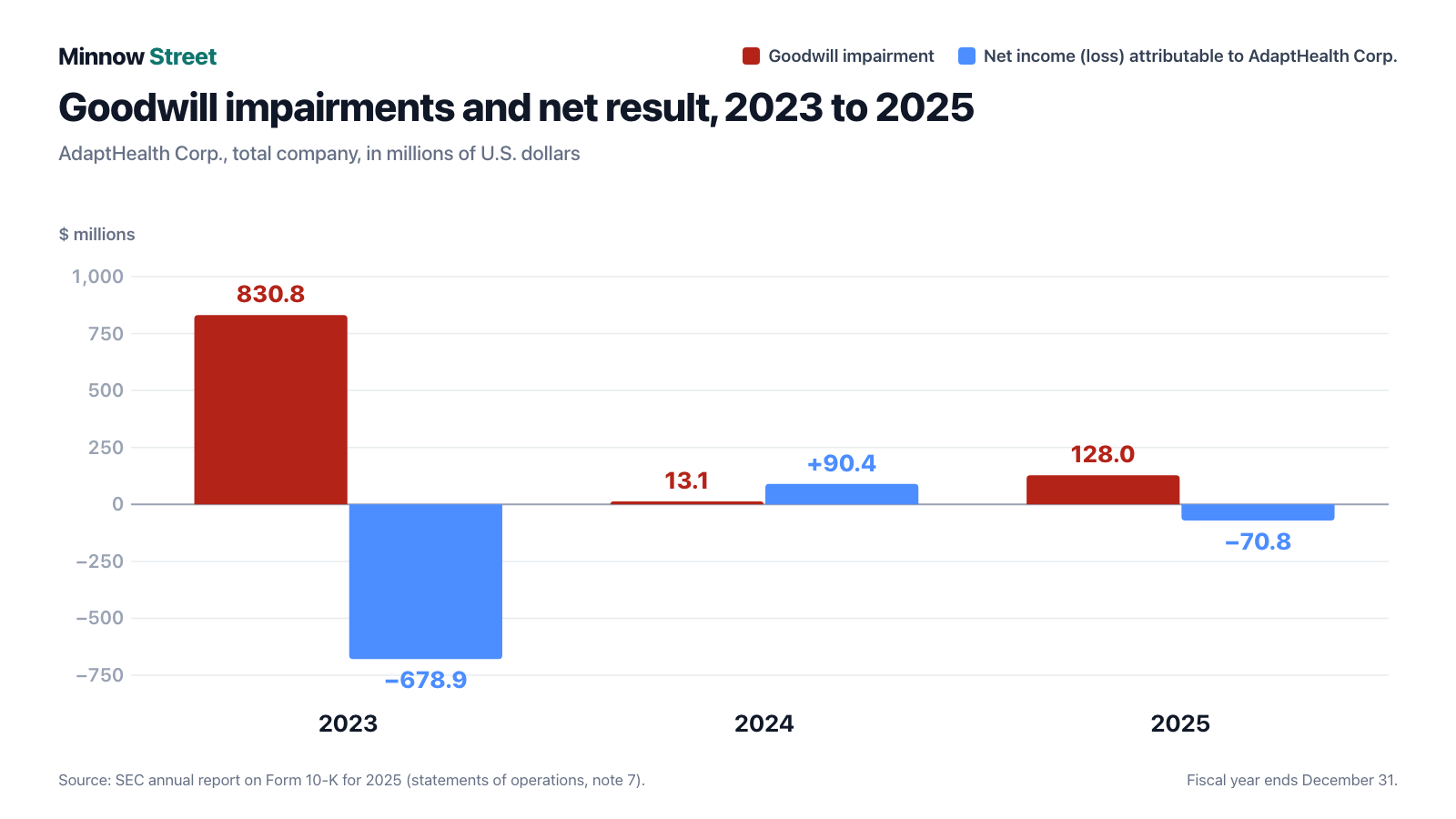
Goodwill is the amount a buyer paid above the identifiable net assets of an acquired business. It sits on the balance sheet as an asset, but it is not a truck and not a building: it is quantified optimism. AdaptHealth collected a great deal of it, because between 2019 and 2022 the company bought regional home medical suppliers by the dozen. When the expectations behind those purchases do not materialize, the optimism has to be written down. The 2025 annual report states the tally in a footnote: gross goodwill stood at $3.5 billion, net at $2.5 billion — accumulated impairment charges as of December 31, 2025 came to $1.0 billion. Add the $144.2 million from the second quarter of 2026 and it is roughly $1.15 billion. Hold on to that: AdaptHealth has written off more goodwill in three and a half years than the entire company was worth on the market in early August 2026. Which brings us to the uncomfortable truths.
What the filings say — the uncomfortable truths
Uncomfortable truth no. 1: the company's own annual report flagged the write-down five months earlier
On February 24, 2026 AdaptHealth published its annual report (Form 10-K) for 2025. It disclosed that the diabetes business had been written down by $128.0 million. And then comes a sentence that is easy to skim past — because in form it is reassurance:
"While the Company's quantitative goodwill impairment test did not result in an impairment charge of the Company's Wellness at Home or Respiratory Health reporting units, based on the results of such test, the excess of the estimated fair value of the Wellness at Home reporting unit over its carrying value was less than 10%, and the excess of the estimated fair value of the Respiratory Health reporting unit over its carrying value was less than 20%."
— AdaptHealth Corp., Form 10-K for 2025, "Critical Accounting Policies and Estimates" (goodwill), filed February 24, 2026

Put it in everyday terms: your bank tells you the house is still worth roughly what you owe on it — but only just, less than ten percent of daylight. If anything then goes worse than planned, the daylight is gone. That is precisely what happened. In connection with the diabetes divestiture AdaptHealth had to revise its projections and reallocate the corporate support costs previously carried by that business across the remaining units. The result is in the quarterly report:
"The impairment test indicated that the estimated fair values of the Company's Respiratory Health and Wellness at Home reporting units were less than their respective carrying values, and as such, the Company recognized non-cash goodwill impairment charges totaling $144.2 million during the three and six months ended June 30, 2026."
— AdaptHealth Corp., Form 10-Q as of June 30, 2026, note 8 "Goodwill and Identifiable Intangible Assets"
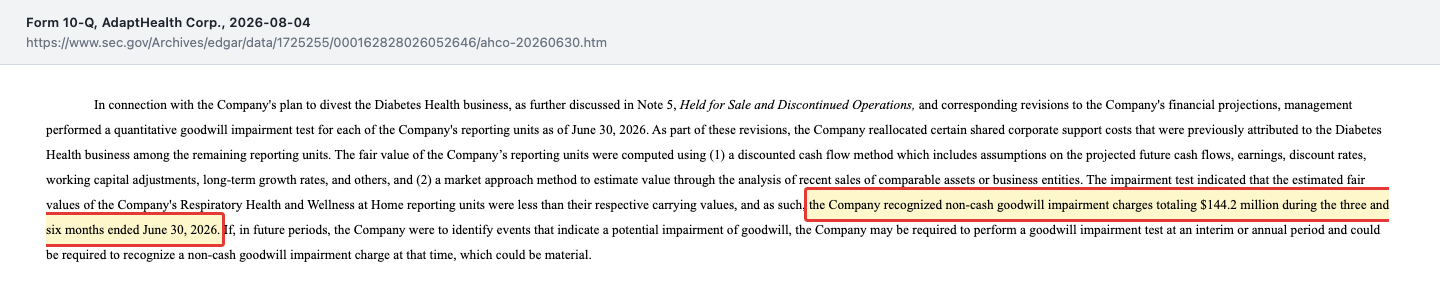
To be fair: a goodwill impairment is non-cash. No money leaves the building, no device breaks, no patient is served worse. What it does do is correct an earlier purchase decision. And when $830.8 million (2023), $13.1 million (2024) and $128.0 million (2025) are followed by another $144.2 million (first half of 2026), that is no longer an isolated event but a pattern: the company systematically overpaid for what it bought. What remains as of June 30, 2026 is $2,370.4 million of goodwill — against equity attributable to AdaptHealth Corp. of $1,378.5 million. Strip out goodwill and intangibles and tangible book value is negative by roughly $1,023.7 million.
Uncomfortable truth no. 2: the growth eats more cash than the business produces
Here is the line no headline generator reads. In the first half of 2026 operating activities provided AdaptHealth $239.0 million — a solid figure, if slightly below the prior-year period ($257.5 million). In the same half, purchases of equipment and other fixed assets rose from $184.3 million to $287.5 million, up 56.0 percent. The reason is not extravagance but the business model itself: every new rental patient receives a device, and that device has to be bought first. The revenue arrives afterwards, in small monthly installments, over years.
The company names the result of that arithmetic itself. Free cash flow — what is left after capital spending — swung from positive $73.3 million in the first half of 2025 to negative $48.4 million in the first half of 2026. Together with $127.4 million for acquisitions and $26.8 million for a legacy obligation from the company's route to the public market (more on that shortly), cash fell from $106.1 million at year-end 2025 to $43.3 million as of June 30, 2026. The gap was closed with borrowings: net $150.0 million of additional debt in the half.
In everyday terms: a contractor wins so many new customers that he keeps having to buy new machines — faster than the old customers' invoices come in. That is not weakness, as long as the machines eventually pay for themselves. It is not a reason to cheer either, and it has a hard limit: the bank account. Remember the sentence: growth paid for out of the till is healthy only for as long as the till holds out.
Uncomfortable truth no. 3: the contract that produced the growth costs $55 million of earnings
Remember the fixed fee per member per month? This is where the circle closes. The West Coast capitated contract was the engine of the record growth — and it is simultaneously the single largest reason for the reduced outlook. The chief executive's commentary in the August 4, 2026 earnings release is remarkably direct:
"Our West Coast capitated partnership reached full scale in the quarter, and the complexity of that transition has impacted our margins. Together with an unexpected price increase from one of our manufacturers, this has led us to lower our full-year outlook."
— Suzanne Foster, Chief Executive Officer, AdaptHealth Corp., Form 8-K of August 4, 2026, Exhibit 99.1 (second-quarter 2026 earnings release, Item 2.02)
The company lays out the bridge itself. The previous 2026 adjusted EBITDA guidance was $680 million to $730 million; the new range is $490 million to $520 million. Of that, $100 million is pure accounting: the diabetes business moves into discontinued operations, while $60 million of previously allocated corporate overhead stays in continuing operations — roughly half of which the company expects to eliminate within twelve months of closing. The other roughly $100 million is real: $55 million from the West Coast contract, $30 million from a manufacturer price increase and $15 million from other portfolio actions.
How that lands across the segments is shown in the second chart. It compares adjusted EBITDA by segment in the second quarter of 2026 with the year-earlier quarter — both series recast for continuing operations, so they are genuinely comparable:
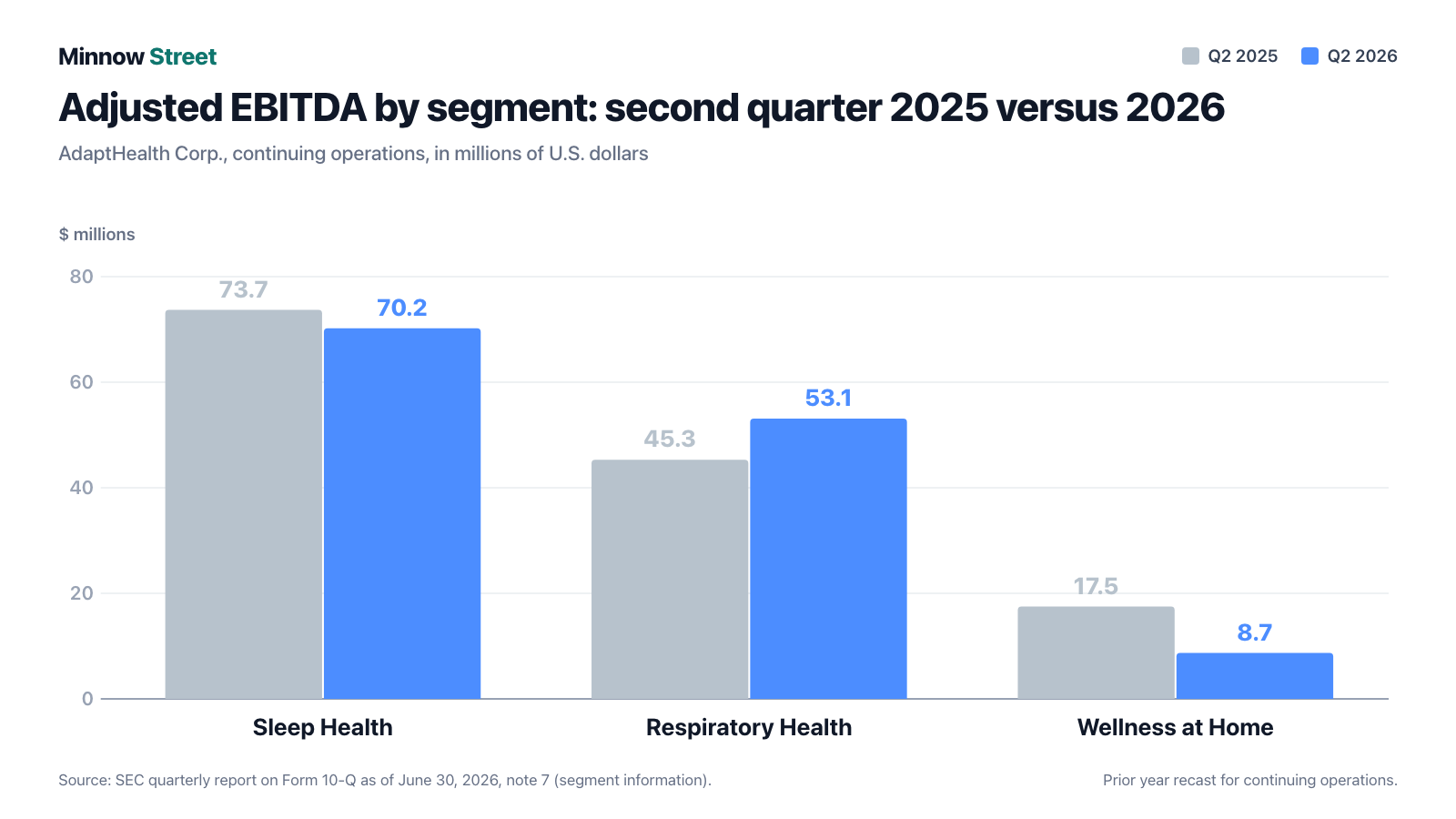
Wellness at Home is the sore point: $159.4 million of revenue in the second quarter of 2026 against $152.0 million a year earlier — more revenue — on adjusted EBITDA that fell from $17.5 million to $8.7 million. Across the full first half it is $11.9 million against $30.3 million. That is exactly where the new capitated contracts land. And that is exactly where $65.1 million of goodwill was written off. The growth reflex in a single column: more revenue, less profit, less goodwill.
Uncomfortable truth no. 4: patient data left the building — and the scope is still unknown
On June 15, 2026 someone contacted AdaptHealth claiming to hold data taken from the company's systems. On June 27 the company determined the incident was material; on July 2 it filed the current report (Form 8-K) under Item 1.05. The attack ran through social engineering — someone was persuaded, not outsmarted — and compromised a user session associated with a third-party contractor, according to the filing. Cloud-based applications were affected, including internal patient management systems and document storage platforms. What was taken is stated verbatim:
"The data affected includes passwords associated with insurance billing and certain personally identifiable information and protected health information of patients."
— AdaptHealth Corp., Form 8-K of July 2, 2026, Item 1.05 "Material Cybersecurity Incidents"

Fairness cuts the other way too. According to the company, the affected systems hold no Social Security numbers, no bank account details and no payment card information. Access was terminated, credentials were reset, the incident is contained, and there is cybersecurity insurance. The quarterly report of August 4, 2026 records that the incident had not had a material impact on operations and had not affected the company's ability to serve patients. It also records that the full financial impact — remediation, legal and regulatory matters, notifications, reputational effects — is not yet determinable. With health data in the United States that is not a small loose end: the federal HIPAA framework carries notification duties and penalties, and class actions in such cases are the rule rather than the exception.
Uncomfortable truth no. 5: the credit line is bigger than what AdaptHealth is allowed to draw
In April 2026 AdaptHealth put its financing on a new footing: a credit agreement with Bank of America providing $450.0 million of revolving commitments, a $325.0 million term loan and a $325.0 million delayed draw term loan, maturing in April 2031. That let the company redeem its last expensive bond in August 2026 — $325.0 million at 6.125 percent. It is clean work, and it lowered interest expense: $51.8 million in the first half of 2026 against $55.9 million in the prior-year period. The agreement carries two financial maintenance covenants, however: consolidated total leverage must not exceed 3.50 to 1.00 at the end of any fiscal quarter, and consolidated interest coverage must not fall below 3.00 to 1.00. Both were met as of June 30, 2026. What that means in practice is in the quarterly report:
"At June 30, 2026, based on the financial debt covenants under the 2026 Credit Agreement, the maximum amount the Company could borrow under the 2026 Revolver and remain in compliance with the financial debt covenants under the agreement was $265.7 million."
— AdaptHealth Corp., Form 10-Q as of June 30, 2026, "Liquidity and Capital Resources"
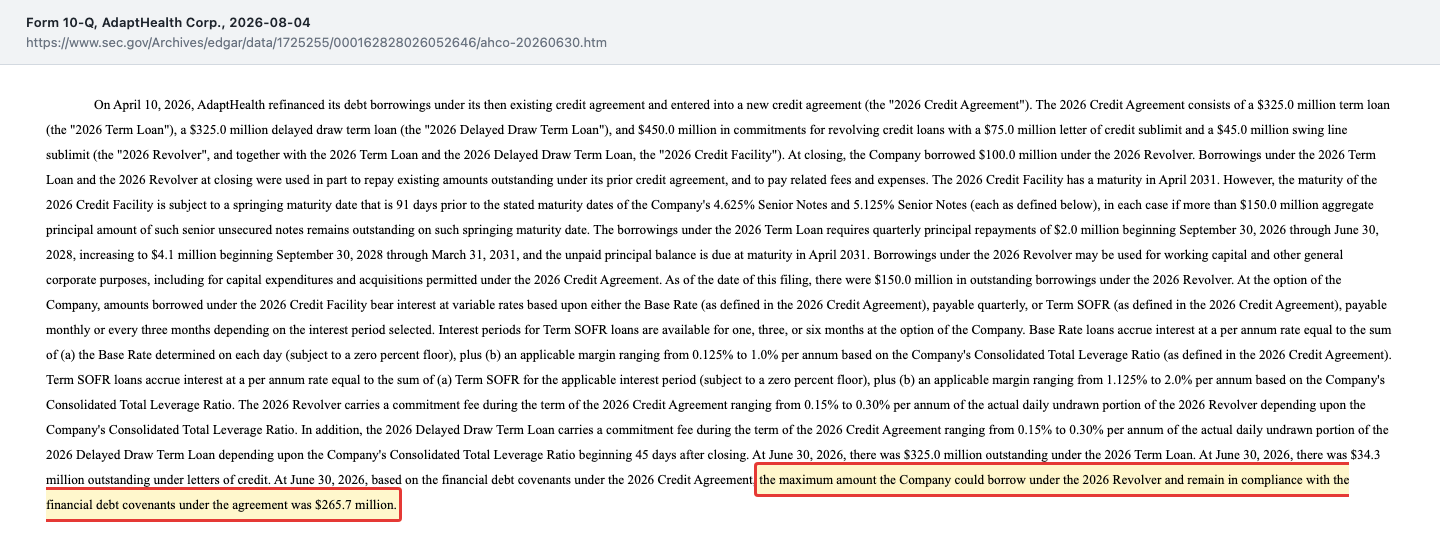
Do the arithmetic: $450.0 million of commitments less $150.0 million drawn less $34.3 million of letters of credit also comes to $265.7 million — here the contractual limit and the covenant limit happen to coincide. But the covenants are anchored to adjusted EBITDA, and adjusted EBITDA has just been guided down by roughly $100 million. The credit line is therefore not a fixed amount but a function of the company's own earning power: if earnings fall further, the line shrinks with them. Against that sat $1,900.0 million of debt principal as of June 30, 2026 — $325.0 million term loan, $150.0 million drawn revolver, $1,425.0 million of notes — with $43.3 million of cash. Net debt of roughly $1,856.7 million is about 3.7 times the adjusted EBITDA guided for 2026. Help is on the way: the sale of the diabetes business brings $235.0 million in cash — though not until the first quarter of 2027 and subject to antitrust clearance.
One more line belongs to the debt picture even though it is not called debt. Other long-term liabilities include $238.9 million under a Tax Receivable Agreement with legacy holders from before the company went public. AdaptHealth pays them 85 percent of certain of its own tax savings; in the first half of 2026 that was $26.8 million in cash. Against a $43.3 million cash balance, that is no longer a footnote.
Valuation — what the market priced in on August 4, 2026
Evergreen means no daily prices as a buy argument. An order of magnitude still needs a dated anchor, and August 4, 2026 supplies an unusually clear one. According to the cover page of the quarterly report, 136,344,196 shares were outstanding as of July 31, 2026. On August 3, 2026, the day before the results, the stock closed at $10.83 — roughly $1.48 billion of market value. On August 4, 2026, the day of the results and the guidance cut, it closed at $6.71, or roughly $0.92 billion. A third of the market value in one session: that is how much confidence had been attached to the old outlook.
On that basis the valuation looks like this. Against revenue guidance of $2.85 billion to $2.89 billion the price-to-sales ratio is roughly 0.32 — every dollar of revenue costs 32 cents on the market. Because the debt comes with the purchase, though, the more meaningful figure is enterprise value: market value plus net debt of roughly $1,856.7 million comes to about $2.8 billion. Measured against guided adjusted EBITDA of $490 million to $520 million, that is roughly 5.5 times. Book value per share is around $10.11, so the stock trades near two-thirds of book — except that this book value, as shown above, is more than entirely goodwill.
And the professional view? As of August 5, 2026 the analyst consensus stood at a price target of $14.14 from eight ratings (five strong buy, one buy, two hold). Read that properly: a price target is an opinion with decimal places, not a fact. After a guidance cut of this size, consensus estimates typically take weeks to catch up — so the gap between price and target says more about when the estimates were last updated than about what the company is worth. If you want to see what a business looks like when somebody else sets its prices too, our analysis of Encompass Health is the inpatient-rehab counterpart, where government programs pay 82 percent of the bills.
Opportunities and risks at a glance
What speaks for it:
- A large, recurring care business with demographics behind it: $3,244.9 million of revenue in 2025, roughly 4.8 million patients a year, about a third of revenue from fixed monthly equipment reimbursements.
- The operating business still throws off cash: $601.8 million from operations in 2025 after $541.8 million (2024) and $480.7 million (2023), and $239.0 million in the first half of 2026.
- The restructuring is concrete and under way: sale of the low-margin diabetes business for $235.0 million in cash (agreement dated July 19, 2026), refinancing in April 2026, redemption of the 6.125 percent notes in August 2026, and a workforce reduction with expected annual savings of roughly $26.8 million.
- Respiratory Health, the second-largest segment, is growing profitably: adjusted EBITDA up from $45.3 million to $53.1 million in the second quarter of 2026 on $194.4 million of revenue.
- The valuation is low: roughly 0.32 times sales and about 5.5 times guided adjusted EBITDA on an enterprise value basis (anchor price August 4, 2026).
What speaks against it:
- A pattern rather than an incident: $830.8 million of goodwill impairment in 2023, $13.1 million in 2024, $128.0 million in 2025 and $144.2 million in the first half of 2026 — roughly $1.15 billion in total, more than the market value on August 4, 2026. What remains is $2,370.4 million of goodwill against $1,378.5 million of attributable equity; tangible book value is negative.
- The growth costs earnings: adjusted EBITDA down 3.2 percent in the second quarter of 2026 despite 15.9 percent organic revenue growth, with Wellness at Home halving from $17.5 million to $8.7 million.
- Negative free cash flow of $48.4 million in the first half of 2026 after positive $73.3 million a year earlier, capital spending up 56.0 percent, cash down from $106.1 million to $43.3 million.
- Leverage and covenants: $1,900.0 million of debt principal, roughly 3.7 times guided adjusted EBITDA, plus a $238.9 million Tax Receivable Agreement liability; the available credit line is a function of that same earnings figure.
- No structural pricing power: rates are set by payors and by the Centers for Medicare and Medicaid Services, whose competitive bidding program resumes in 2026. On top of that, a cybersecurity incident with exfiltrated patient data whose financial consequences the company says are not yet determinable.
A human bottom line
Back to the growth reflex from the opening. Its core is not that growth is bad — AdaptHealth supplies millions of people with equipment they need, the business is real and the demand is rising. Its core is that growth answers a question nobody asked. "Is the company growing?" is the easy question. The hard one is: is it growing at a price it can afford? For the second quarter of 2026 the documented answer is: not yet. More patients, more revenue, more devices bought on credit — and less profit, less free cash flow, less goodwill. That the company's own annual report flagged the write-down five months earlier in a subordinate clause is the real lesson of this analysis: the uncomfortable numbers are almost always already there. They are just not in the headline.
So the honest question is not "is AdaptHealth cheap?" — at 0.32 times sales it obviously is. The question is: do you trust a business built on capitated fees and administratively set reimbursement rates to make money durably, when it has failed to do so four times in the past three and a half years? If your answer is yes, you are buying a turnaround at a price that already contains a setback. If your answer is no, you have good reasons and owe nobody a justification. What you do with it is your decision. And that is exactly as it should be.
Sources
Every original document used in this analysis — read them yourself:
- AdaptHealth Corp. — Form 10-Q as of June 30, 2026 (filed August 4, 2026)
- AdaptHealth Corp. — Form 8-K of August 4, 2026, Exhibit 99.1 (second-quarter 2026 earnings release, Item 2.02)
- AdaptHealth Corp. — Form 8-K of July 20, 2026, Item 1.01 (asset purchase agreement for the diabetes business)
- AdaptHealth Corp. — Form 8-K of July 7, 2026, Item 7.01 (notice of redemption, 6.125 percent senior notes)
- AdaptHealth Corp. — Form 8-K of July 2, 2026, Item 1.05 (material cybersecurity incident)
- AdaptHealth Corp. — Form 8-K of April 13, 2026, Items 1.01/1.02/2.03 (2026 credit agreement)
- AdaptHealth Corp. — Form 10-K for 2025 (filed February 24, 2026)
- Complete SEC filing history for AdaptHealth Corp.: EDGAR overview (sec.gov)
- Fundamental data (metrics, share count, price history, analyst consensus; as of August 5, 2026), reconciled against the SEC filings.
Transparency & disclaimer: This analysis is journalistic commentary on publicly available information. It is not investment advice, not a regulated financial analysis and not a solicitation to buy or sell securities. Equity investments carry substantial risk up to and including total loss. All information without warranty; the as-of date of each figure is noted in the text. Positions held by the operator are disclosed daily; where one exists, it appears as a notice at the top of this deep dive.
Key figures at a glance
All monetary figures in millions of $; earnings per share as reported.
| Metric | 2021 | 2022 | 2023 | 2024 | 2025 |
|---|---|---|---|---|---|
| Revenue | 2,454.5 | 2,970.6 | 3,200.2 | 3,261.0 | 3,244.9 |
| Operating Income (EBIT) | 225.6 | 190.4 | -598.4 | 263.7 | 186.3 |
| Net Income | 156.2 | 69.3 | -678.9 | 90.4 | -70.8 |
| Net Margin | 6.4% | 2.3% | -21.2% | 2.8% | -2.2% |
| Earnings Per Share | 1.17 $ | 0.50 $ | -5.05 $ | 0.67 $ | -0.52 $ |
Source: fundamental data & SEC filings (annual and quarterly reports, 10-K/10-Q)
Our Bottom Line at a Glance
- Business model & demand positive
- A large, recurring care business with demographics behind it: $3,244.9 million of revenue in 2025, roughly 4.8 million patients a year across all 50 states, about a third of revenue from fixed monthly equipment reimbursements. In the second quarter of 2026 revenue grew 15.9 percent organically to $740.3 million — demand is not the problem.
- Earning power & pricing negative
- Adjusted EBITDA fell 3.2 percent to $132.0 million in the second quarter of 2026 despite record growth, and the Wellness at Home segment halved from $17.5 million to $8.7 million. On August 4, 2026 the full-year outlook came down by roughly $100 million on an operating basis ($55 million from the West Coast capitated contract, $30 million from a manufacturer price increase, $15 million from portfolio actions). Rates are set by payors and by the Centers for Medicare and Medicaid Services, not by AdaptHealth.
- Capital intensity & cash flow negative
- Growth ties up capital here: in the first half of 2026, $239.0 million of operating cash flow met $287.5 million of capital spending (up 56.0 percent), free cash flow swung from positive $73.3 million to negative $48.4 million, and cash fell from $106.1 million to $43.3 million. The company guides to $80 million to $120 million of free cash flow for full-year 2026 — that remains unproven.
- Balance sheet quality negative
- After $830.8 million (2023), $13.1 million (2024), $128.0 million (2025) and $144.2 million in the first half of 2026, goodwill impairments total roughly $1.15 billion — more than the market value on August 4, 2026. What remains is $2,370.4 million of goodwill against $1,378.5 million of attributable equity, leaving tangible book value negative by roughly $1,023.7 million. The 2025 annual report had signalled the write-down five months earlier (headroom below 10 percent and below 20 percent).
- Financing & covenants neutral
- The April 2026 refinancing holds: a new credit agreement to 2031, redemption of the 6.125 percent notes in August 2026, first-half interest expense down from $55.9 million to $51.8 million, and financial covenants met as of June 30, 2026. Against that stand $1,900.0 million of debt principal (roughly 3.7 times guided adjusted EBITDA), a $238.9 million Tax Receivable Agreement liability and $265.7 million of remaining revolver capacity that is itself a function of that same earnings figure. The diabetes sale brings $235.0 million — but not before the first quarter of 2027.
- Restructuring & special risks neutral
- The company is cleaning up in earnest: sale of the low-margin diabetes business (4.4 percent adjusted margin in 2025) for $235.0 million, a workforce reduction with expected annual savings of roughly $26.8 million, and a focus on three segments. Open items remain: antitrust clearance, the competitive bidding program resuming in 2026, and the June 2026 cybersecurity incident in which patient data and billing passwords were exfiltrated and whose financial consequences the company says are not yet determinable.
AdaptHealth is the growth reflex in its purest form: revenue rose 15.9 percent organically to $740.3 million in the second quarter of 2026 — and adjusted EBITDA fell 3.2 percent to $132.0 million, because the capitated contract driving that growth costs margin. Add a $144.2 million goodwill impairment in exactly the two units whose headroom the 2025 annual report had put below 10 percent and below 20 percent five months earlier, negative free cash flow of $48.4 million for the half, and a full-year outlook cut by roughly $100 million on an operating basis. The business is real and the need is growing; the question is whether this growth will ever bring in more than it costs in devices, capital and goodwill. Not investment advice.
What Our Rating Means
Open questions
The business works in principle, but one material question is open. As long as it stays open, our findings do not carry a quality verdict.
Red is not supported by the evidence: there is no going-concern warning, equity attributable to AdaptHealth Corp. stood at $1,378.5 million as of June 30, 2026, operating cash flow was clearly positive at $239.0 million for the first half of 2026, interest coverage runs at roughly 4.6 times ($236.6 million of adjusted EBITDA against $51.8 million of interest expense), and the credit agreement covenants were met at quarter end. Green is not supported either, because two material operating questions are open. First, earning power: revenue grows double digits while adjusted EBITDA falls, the Wellness at Home segment halved in the quarter, and the full-year outlook was cut by roughly $100 million on an operating basis — AdaptHealth is structurally not a price setter, since payors and the Centers for Medicare and Medicaid Services fix the rates. Second, capital intensity: capital spending rose 56.0 percent to $287.5 million in the half, free cash flow turned to minus $48.4 million, and cash fell to $43.3 million while the Tax Receivable Agreement alone drew $26.8 million. That roughly $1.15 billion of goodwill has been written off in three and a half years, leaving tangible book value negative, does not make the balance sheet a solvency risk, but it does document a run of overpriced acquisitions. The restructuring has begun and the stock is visibly cheap after August 4, 2026 — neither changes the rating: price is not a quality attribute, and proof of durable margins in the new perimeter is still outstanding. The decision is yours.
A journalistic assessment by our editorial team at the time of the deep dive, based on public sources — not investment advice and not a solicitation to buy or sell. Your personal circumstances (investment goals, risk capacity, taxes) cannot be taken into account. What our levels mean, how verdicts are formed, and what conflicts of interest exist →
Worth Noting
- AdaptHealth reached our research list through the event radar on SEC filings: the current report on Form 8-K of July 2, 2026 under Item 1.05 (material cybersecurity incident). The research was deepened after the quarterly report of August 4, 2026 and the accompanying guidance cut. The cut-off for this analysis is August 5, 2026; every SEC filing up to that date has been reviewed.
- Mind the comparability: since the second quarter of 2026 the diabetes business has been reported as discontinued operations, and all prior-year figures were recast accordingly. Figures for 2023 to 2025 come from the Form 10-K for 2025 and cover the total company including diabetes — annual and quarterly series must not be mixed without that caveat.
- Valuation figures are dated and deliberately kept as orders of magnitude: the anchor price is the August 4, 2026 close ($6.71; prior day $10.83) applied to 136,344,196 shares per the cover page of the quarterly report. The analyst consensus (price target $14.14, eight ratings, as of August 5, 2026) partly predates the guidance cut and should be read with that in mind.
Stock Watch
This analysis is as of August 26, 2026. Stock Watch will tell you what's changed at AHCO since then.
Later $1 a month per stock — signing up is free, and you'll be the first to know when it launches.
The full analysis as a PDF for later
We will send you this analysis as a PDF — to print, file away, and read at your own pace. And we will add you to the free Stock Watch list for AdaptHealth Corp. (AHCO), so you hear about it when something material in this analysis changes.
Frequently Asked Questions
AdaptHealth Corp. (NASDAQ: AHCO) of Conshohocken, Pennsylvania delivers medical equipment and supplies directly into patients' homes and bills the payors. Three segments: Sleep Health (devices for obstructive sleep apnea), Respiratory Health (oxygen and home ventilation) and Wellness at Home (beds, wheelchairs and consumables after a hospital stay). The company serves roughly 4.8 million patients a year in all 50 states through about 670 locations in 48 states (as of June 30, 2026).
On August 4, 2026 AdaptHealth lowered its 2026 adjusted EBITDA guidance from $680 million to $730 million down to $490 million to $520 million. Roughly $100 million of the change is pure reclassification, because the diabetes business is now reported as discontinued operations. The other roughly $100 million is operating: $55 million from a West Coast capitated contract whose transition weighed on margins, $30 million from an unexpected manufacturer price increase and $15 million from other portfolio actions.
Goodwill is the premium AdaptHealth paid above the identifiable net assets of the companies it acquired. As of June 30, 2026 the estimated fair values of the Respiratory Health and Wellness at Home reporting units fell below their carrying values, so $79.1 million and $65.1 million respectively were written off. No cash leaves the business, but the charge corrects earlier purchase prices. With $830.8 million (2023), $13.1 million (2024) and $128.0 million (2025), the impairments now total roughly $1.15 billion.
Yes, in a subordinate clause. The Form 10-K for 2025, filed February 24, 2026, recorded that the excess of estimated fair value over carrying value was below 10 percent for Wellness at Home and below 20 percent for Respiratory Health. Those are precisely the two units written down five months later as of June 30, 2026. In form the sentence was reassurance; in substance it was advance notice.
As of June 30, 2026 debt principal stood at $1,900.0 million: a $325.0 million term loan, $150.0 million drawn under the revolver and $1,425.0 million of senior notes. Against $43.3 million of cash, net debt was roughly $1,856.7 million — about 3.7 times the adjusted EBITDA guided for 2026. On top of that sits a $238.9 million Tax Receivable Agreement liability owed to legacy holders. The financial covenants of the credit agreement were met as of June 30, 2026.
On June 15, 2026 AdaptHealth received a communication from a threat actor claiming to hold data from its systems; on June 27 the company determined the incident was material. A social engineering attack compromised a user session, affecting cloud-based applications including patient management systems. According to the filing, the exfiltrated data includes passwords tied to insurance billing plus personally identifiable and protected health information of patients; Social Security numbers, bank account and card data were not held in those systems. The full financial impact is not yet determinable, the company says.
On July 19, 2026 AdaptHealth agreed to sell the diabetes business for $235.0 million in cash to RGH Enterprises, a subsidiary of Cardinal Health. The reason is in the numbers: on $592.4 million of revenue in 2025 the segment produced only $26.1 million of adjusted EBITDA, down from $60.5 million a year earlier — a margin of 4.4 percent against 9.9 percent — and it was written down by $128.0 million at the end of 2025. Closing is expected in the first quarter of 2027, subject to antitrust clearance.
By the usual multiples, yes. On 136,344,196 shares outstanding (as of July 31, 2026) and the August 4, 2026 closing price, market value came to roughly $0.92 billion — about 0.32 times guided annual revenue and around two-thirds of book value. Enterprise value of roughly $2.8 billion is about 5.5 times guided adjusted EBITDA. Against that: book value consists entirely of goodwill, and free cash flow was negative in the first half of 2026.
Found an error?
Did you spot a factual error, an outdated number, or a typo in this deep dive? Let us know briefly — your report goes straight to the editorial team.