B2Gold: Buy It for the Gold and You Get Half Mali
Between February and July 2026, gold fell 23 percent — shares of B2Gold (TSX: BTO, NYSE American: BTG) fell 41 percent. Its filings with the SEC show why only part of the high gold price reaches shareholders: 55 percent of the gold comes from a single mine in Mali, where the state has already raised its take. Add a fire at the new Arctic mine, a price cap until January 2027 and 145 million potential new shares. Buy B2Gold and you are not buying the gold price — you are buying what Mali, Nunavut and old contracts leave of it.
 Thomas Mücke
Founder & Publisher
Thomas Mücke
Founder & Publisher
Chart
Interactive price chart (TradingView).
Note: pure fact-based analysis, not investment advice and not a solicitation to buy or sell. All figures without guarantee.
There is an investor weakness that catches almost everyone with gold stocks. The gold price goes up, so we buy a gold producer, because surely it must be making money too. Let us call it the gold-goggles trap: through gold-tinted goggles every mine looks the same — a gold bar with a ticker symbol. Everything that sits between the gold price and your portfolio — countries, taxes, construction sites, old contracts — drops out of view.
B2Gold Corp. is a textbook case. Gold hit about $5,513 an ounce on January 28, 2026, the highest price ever. B2Gold booked its highest revenue ever in 2025. Then the wind turned: from February 26 to July 20, 2026, gold fell 23 percent, from about $5,185 to $4,010. Over the same period the stock fell 41 percent on the NYSE American, from $6.21 to $3.65, before climbing back to $5.20 by October 2, 2026. The gold goggles promise leverage on the way up — they keep quiet about the fact that it works on the way down too. Here is the deal: we take off the gold goggles for a moment and read what B2Gold itself reports to the U.S. securities regulator, the SEC. At the end, you decide.

What B2Gold actually does
B2Gold is a gold producer headquartered in Vancouver, founded in 2007 by its own account. It digs up gold, pours it into bars and sells it. It runs four mines on three continents:
- Fekola in Mali — the crown jewel, a large open pit with an underground section in the west of the country. B2Gold owns 80 percent, the State of Mali 20 percent. Next door sits Fekola Regional, where the state will hold 35 percent.
- Masbate in the Philippines — a low-grade open pit, but the lowest-cost operation in the group.
- Otjikoto in Namibia — 90 percent owned by B2Gold, mining underground and processing stockpiles since open-pit mining ended in the fourth quarter of 2025.
- Goose in Nunavut, Canada — the new mine in the Canadian Arctic, 100 percent owned and in commercial production since October 2, 2025.
On top of that come the Gramalote development project in Colombia and a stake of about 28 percent in the royalty company Versamet. At the end of 2025, B2Gold employed 6,327 people. In 2025 the group produced 979,604 ounces of gold — a bit over 30 metric tons, about the weight of 25 small cars.
The business model is simple: costs per ounce are largely fixed, the selling price is the gold price. When gold rises, margins expand disproportionately. That is exactly what the gold goggles show. So keep in mind the tension that runs through this article: the gold price is the tailwind — how much of it reaches you is decided by Mali, a construction site in the Arctic and 2024 contracts that keep braking the gold price until January 2027.
Company history for investors
-
2023
Sabina acquisition brings in Goose
For about 216 million new shares, B2Gold buys the Goose mine in Nunavut. For shareholders: more Canada, less Africa — but also more shares.
-
2024
Mali agreement and $876 million in write-downs
Fekola is written down in the second quarter, an MOU settles the terms in September, and Goose follows in the third quarter. The bottom line: a $630 million loss.
-
2025
Convertible bond and Goose start-up
In January $460 million through a convertible bond, in October commercial production at Goose. Revenue rises to $3.06 billion.
-
2026
Goose fire, Finland sale, new CEO
A fire in the crushing circuit on April 16, $325 million from the Finland sale to Agnico Eagle, and Mike Cinnamond takes over as CEO on June 4.
-
2026
Permit for Fekola Regional
On August 7 Mali grants the Menankoto exploitation permit. That clears the way for more than 150,000 extra ounces a year from 2028 — with a 35 percent state stake.
How the stock landed on our desk
Not through our in-house stock scanner. B2Gold showed up under the ticker BTG in the most-searched and most-discussed stock rankings of a major German stock portal. BTG is the listing on the NYSE American in New York. The home market is the Toronto Stock Exchange under the ticker BTO, plus the stock exchange in Namibia under B2G. We file the company under its home listing BTO; the international securities identification number (ISIN) is CA11777Q2099.
As a Canadian company, B2Gold reports to the SEC under the joint Canada-U.S. system (MJDS): once a year with an annual report on Form 40-F (business description, risk factors, audited financial statements) and in between with quarterly financial statements and news releases on Form 6-K. It reports under international accounting standards (IFRS) in U.S. dollars, and its fiscal year is the calendar year. The latest periodic report covers the quarter ended June 30, 2026, filed on August 7, 2026. Through October 5, 2026, three more releases followed: the long-awaited exploitation permit for Fekola Regional (August 7), a fatal workplace accident at the Masbate mine on August 28 (mining and processing continued uninterrupted, according to the release), and an operations update for the Goose mine (September 28). None of them involved new financing.
The numbers over the years — honestly appraised
Let us start with what is genuinely impressive. B2Gold is not a developer living on hope but a producer with a track record. Gold revenue held steady between $1.73 billion and $1.93 billion from 2021 through 2024 and jumped to $3.06 billion in 2025. The reason: 39 percent more money per ounce and 16 percent more ounces sold. Cash flow from operating activities reached $896 million in 2025.
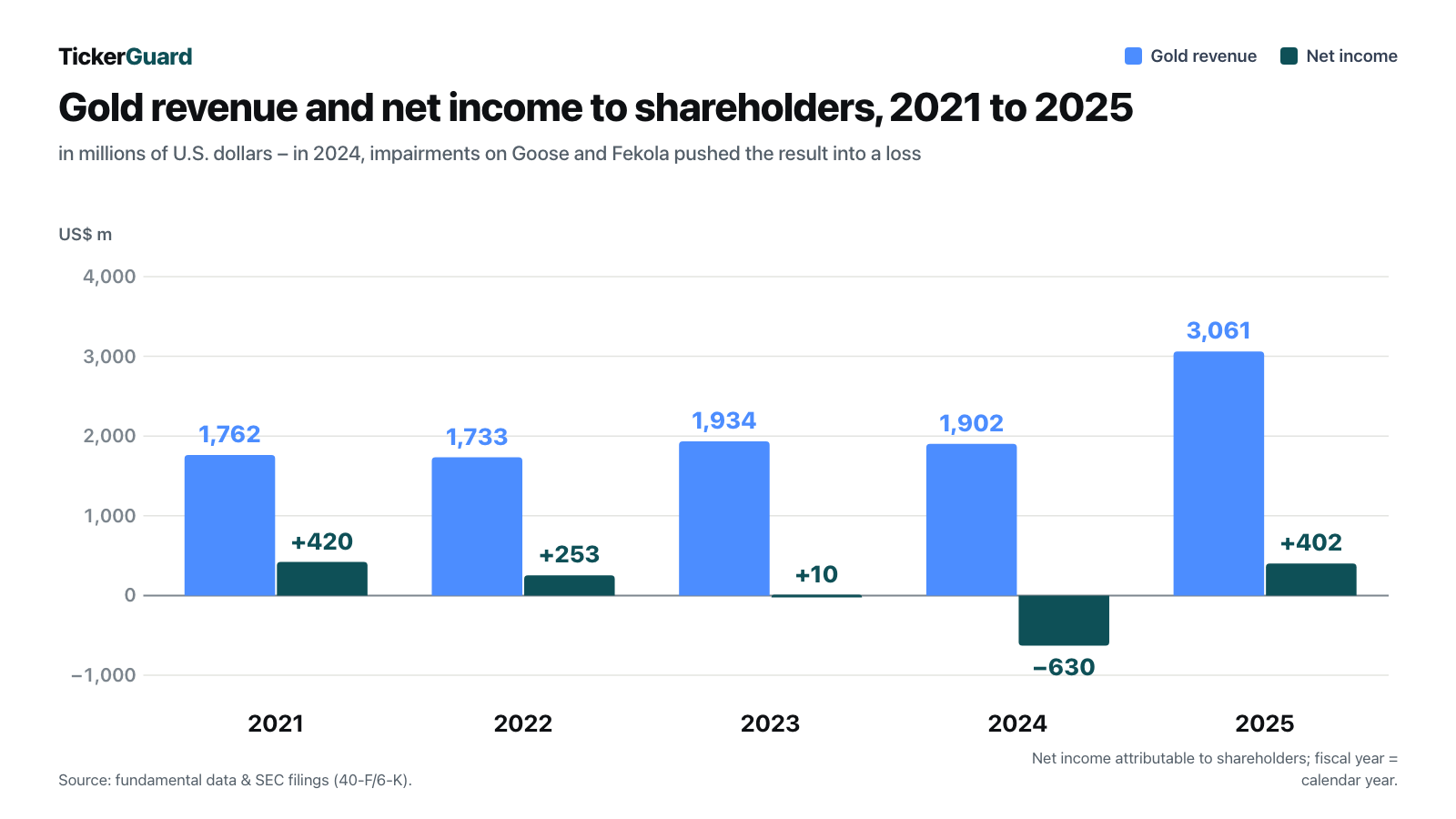
The chart also shows the first crack in the gold goggles: revenue is calm, profit is not. In 2024 B2Gold posted a $630 million loss despite a rising gold price, because it had to write down the Goose mine by $661 million and the Fekola complex by $215 million — $876 million in total, or $194 million after tax at Fekola. Impairments like these do not cost cash, but they are an admission that a project is worth less than hoped.
How much of the gold price actually turns into margin becomes clear when you look at every single ounce sold:
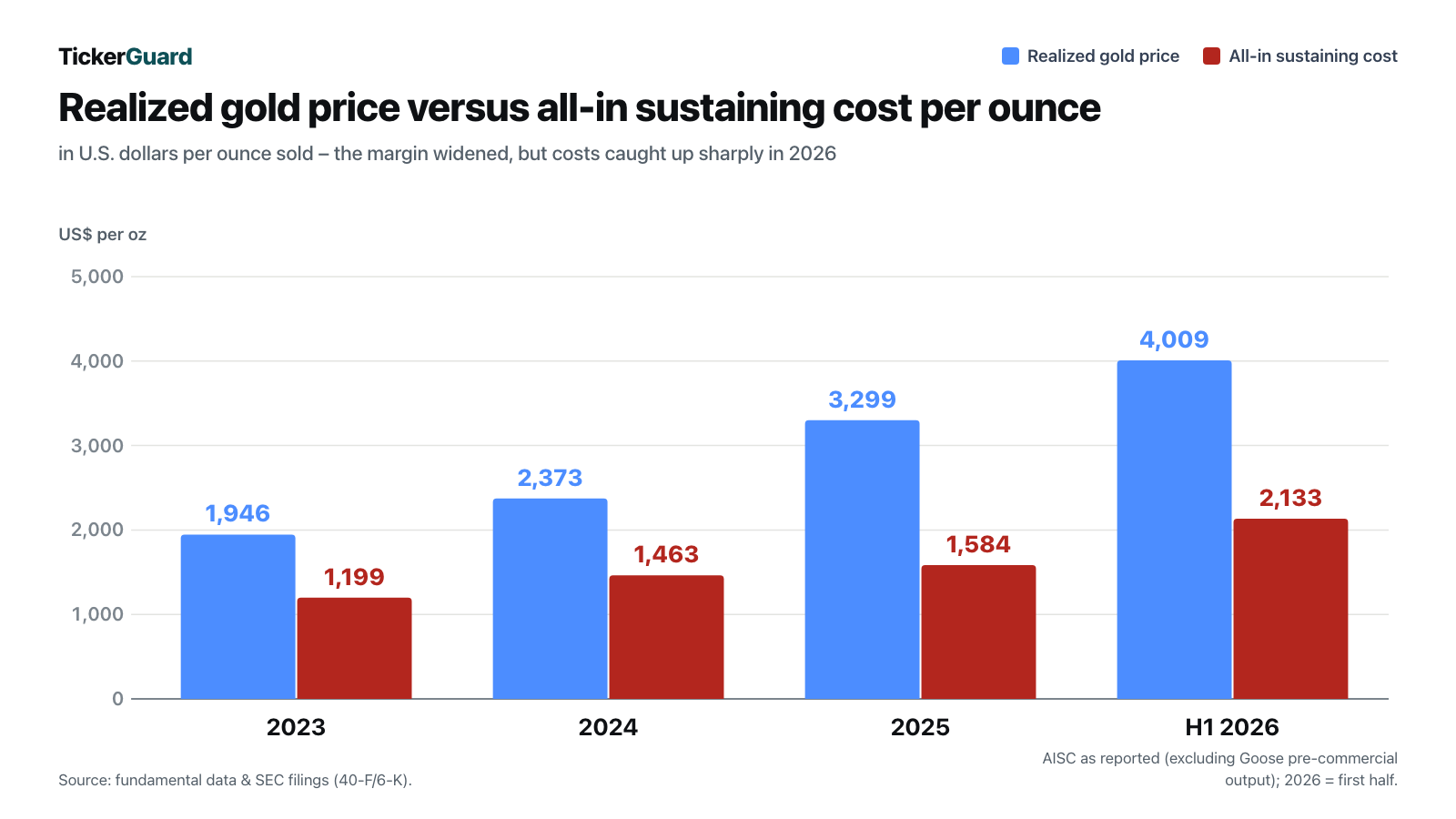
AISC (all-in sustaining cost) is the industry standard for the full cost of an ounce: mining, royalties, sustaining capital and overhead. Think of it as a baker's full cost per loaf, oven repairs included. The gap to the realized price is the gross profit per ounce. It grew from $747 (2023) to $1,876 in the first half of 2026 — impressive. But costs are catching up: for full-year 2026 B2Gold expects $2,370 to $2,550 per ounce, assuming $5,000 gold. Part of that is the gold price itself, because royalties rise with it. The other part is called Goose.
The first half of 2026 looks brilliant on the income statement: $1.95 billion in revenue and $617 million in net income for shareholders. That includes a one-time gain of $292 million from selling the Finnish projects to Agnico Eagle for $325 million in cash. B2Gold reports $301 million on an adjusted basis.
What the filings say — the uncomfortable truths
Now come the passages the gold goggles hide. All of them are taken from the mandatory reports B2Gold filed with the SEC.
Uncomfortable truth No. 1: More than half of the gold comes from Mali — and Mali has already raised its take
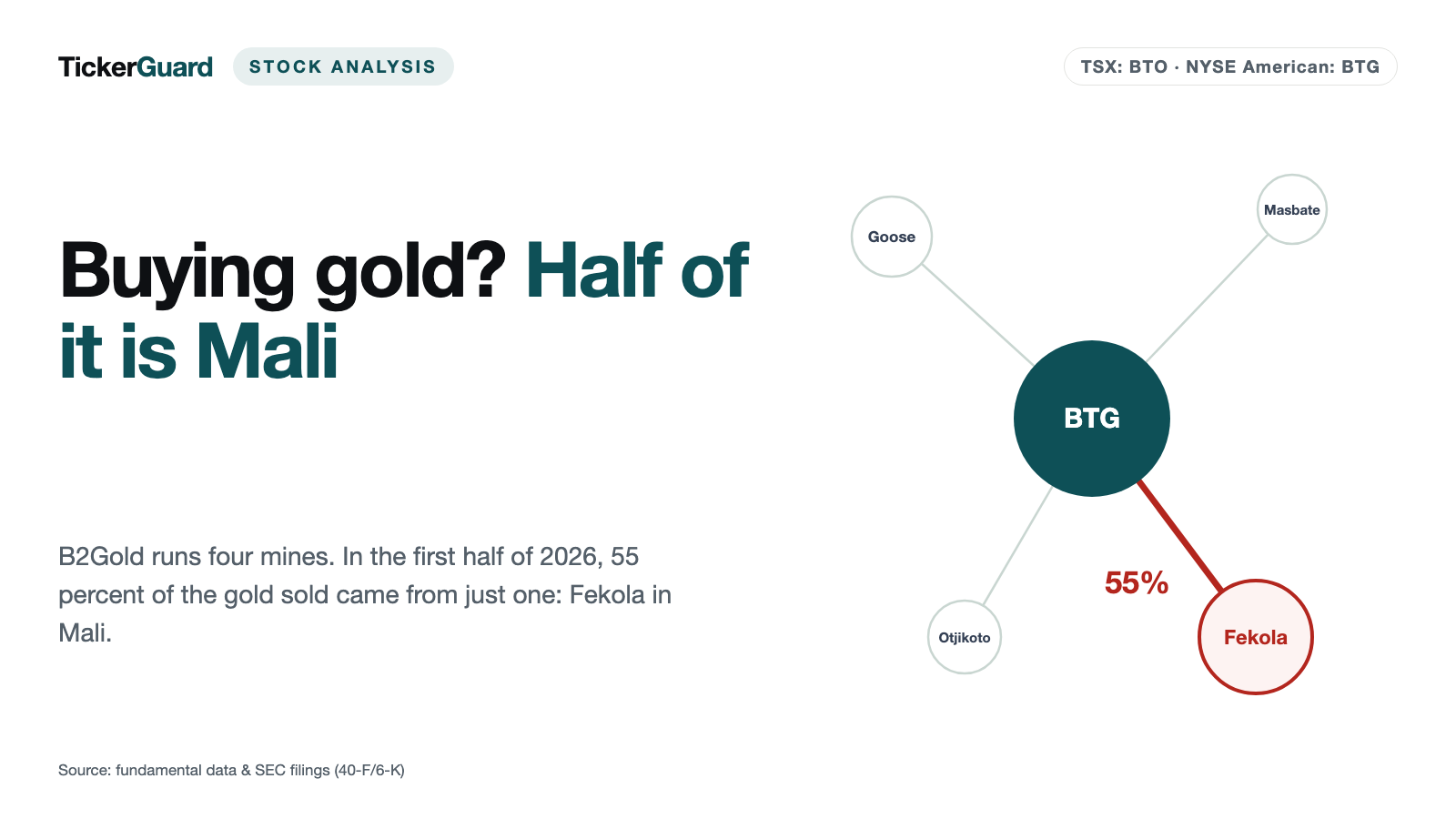
In the first half of 2026, B2Gold sold 485,883 ounces of gold. 266,740 of them, or 55 percent, came from the Fekola complex in Mali. Mali is run by a transitional government whose president, according to the annual report, has been granted a five-year mandate — renewable as many times as necessary until the country's stability is restored. In 2025 the country left the West African economic bloc ECOWAS together with Burkina Faso and Niger. The annual report describes attacks by the armed group JNIM and a fuel crisis that temporarily paralyzed the country's economy.
In 2023 Mali tightened its mining code: higher levies, new mandatory funds, a larger state stake in new mines. After an audit of all mining companies, B2Gold signed a memorandum of understanding (MOU) with the state in September 2024. Under it, the existing Fekola mine stays under the 2012 mining code until 2040; since 2024 the state has received a priority dividend of 20 percent of the mine's annual net income (previously 10 percent), and old tax disputes were settled. How firm that agreement is, the annual report answers itself:
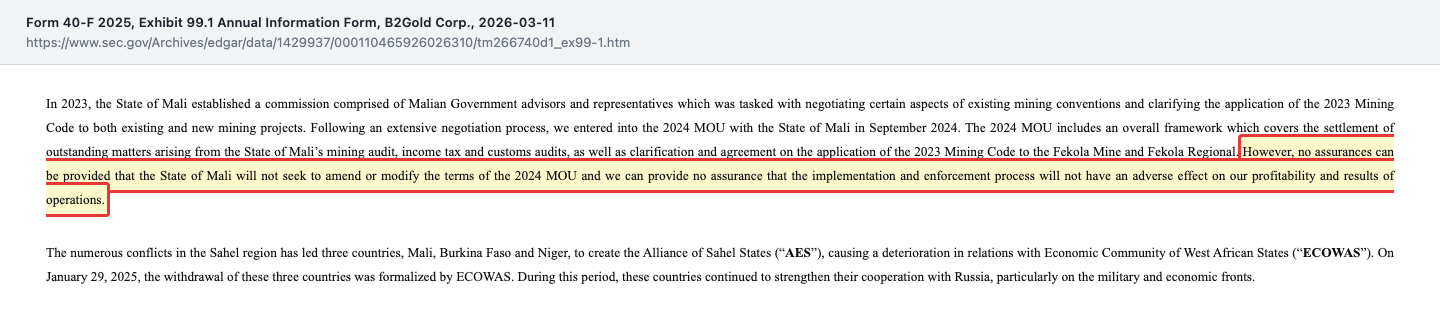
“However, no assurances can be provided that the State of Mali will not seek to amend or modify the terms of the 2024 MOU and we can provide no assurance that the implementation and enforcement process will not have an adverse effect on our profitability and results of operations.”
— B2Gold Corp., 40-F 2025, Exhibit 99.1 (Annual Information Form), Risk Factors – Mali
What Mali already costs shows up in the numbers. In the first half of 2026, Fekola paid $221.6 million in royalties and production taxes, 17.7 percent of its gold revenue. At Masbate the figure was 5.1 percent. On top of that came a $30 million priority dividend to the state in the second quarter. For full-year 2026, B2Gold expects tax payments of about $620 million according to its MD&A for the quarter ended June 30, 2026, including about $150 million of withholding taxes — assuming $4,000 gold in the second half. And that the fight over mining revenue in Mali is real, others have learned the hard way: what it looks like when the state places a mine under provisional administration is described in our Barrick Mining analysis.
The second Mali factor is the wait. Fekola Regional, an adjacent area about 20 kilometers from the mine, is supposed to deliver more than 150,000 ounces a year from 2028 through the mid-2030s. The annual report from March 2026 spells out what that depended on:
“Production from Fekola Regional depends on the Government issuing a new exploitation permit for this area.”
— B2Gold Corp., 40-F 2025, Exhibit 99.1 (Annual Information Form), Risk Factors – Mali
The good news: on August 7, 2026, Mali granted the permit for the Menankoto area, which together with Dandoko makes up Fekola Regional. The less good news: it came about a year after talks began in July 2025, and because of the delay B2Gold cut its 2026 guidance for the Fekola complex from 410,000–460,000 to 390,000–420,000 ounces. In Fekola Regional the state will hold 35 percent instead of the previous 10; in the Fekola mine itself it holds 20 percent. How other gold miners live with Mali risk is also covered in our Allied Gold analysis, whose largest mine, Sadiola, is in Mali as well.
Uncomfortable truth No. 2: The mine meant to offset Mali is still a construction site
B2Gold's answer to Mali risk is called Goose. To get it, B2Gold acquired Canada's Sabina Gold & Silver in April 2023 and issued about 216 million new shares. Goose sits in the Back River district of Nunavut, so remote that a full year's fuel supply travels in over a winter ice road. Over the medium term the mine is supposed to produce more than 300,000 ounces a year.
The road there has been bumpy. In 2024 B2Gold wrote Goose down by $661 million. After commercial production began on October 2, 2025, the mine delivered 38,616 ounces in the fourth quarter, 32 percent below plan. Then came the fire:
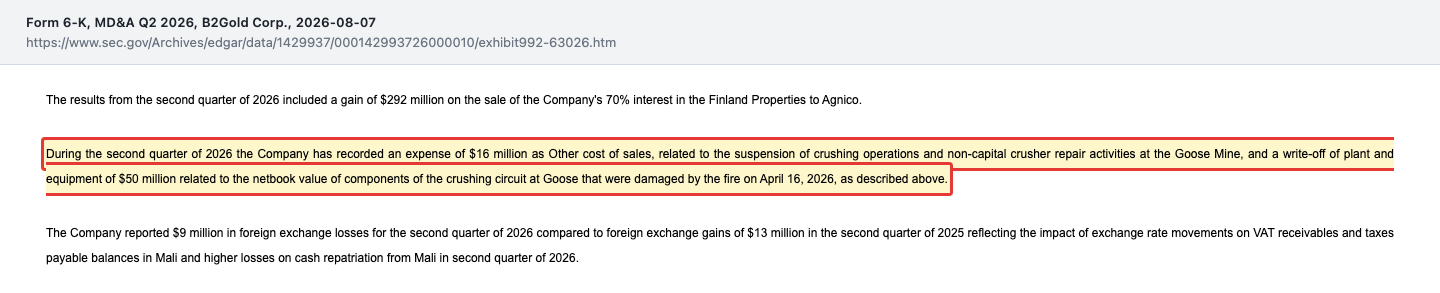
“During the second quarter of 2026 the Company has recorded an expense of $16 million as Other cost of sales, related to the suspension of crushing operations and non-capital crusher repair activities at the Goose Mine, and a write-off of plant and equipment of $50 million related to the netbook value of components of the crushing circuit at Goose that were damaged by the fire on April 16, 2026, as described above.”
— B2Gold Corp., MD&A for the quarter ended June 30, 2026, section Other
The consequences in the second quarter of 2026: Goose produced just 12,890 ounces, and each ounce sold carried an all-in sustaining cost of $6,390 — more than gold was worth on the market. For comparison, Masbate came in at $1,236. Guidance for Goose in 2026 dropped from 170,000–230,000 to 170,000–200,000 ounces. According to the September 28, 2026 operations update, mobile crushers have been processing more than 3,000 metric tons of ore a day since mid-August; from October the repaired fixed plant is supposed to handle 3,200 tons, and after a second upgrade costing about $25 million according to the MD&A for the quarter ended June 30, 2026, an average of 4,000 tons by mid-2027. The path to more than 300,000 ounces a year is plausibly described, but it has not been walked yet.
Uncomfortable truth No. 3: B2Gold does not get the gold price — not yet
This is where the gold goggles deceive the most. In 2024, B2Gold signed two contracts that are expensive today.
First, in January 2024, a gold prepay: banks paid $500 million up front, and in return B2Gold delivered a total of 264,768 ounces from July 2025 through June 2026 — priced at about $2,191 per ounce. Like a farmer who sold his harvest two years ahead at the old price. Those deliveries were completed as of June 30, 2026.
Second, price collars, which the banks required as a condition of the credit facility:

“During the year ended December 31, 2024, as a requirement of the RCF, the Company entered into a series of 1:1 zero-cost put/call collar contracts for gold with settlement between February 2025 and January 2027.”
— B2Gold Corp., MD&A for the quarter ended June 30, 2026, section Derivative financial instruments – Gold collars
A collar is a price corridor: if gold falls below $2,450, B2Gold receives the difference; if it rises above $3,294, B2Gold pays the difference. In the first half of 2026 that cost $141 million in cash, almost half of adjusted net income. As of June 30, 2026, 116,458 ounces were still capped, the last of them through January 2027. With gold at about $4,140 (October 2, 2026), each of them costs about $845.
How big the gap is shows up in a calculation from the second quarter of 2026: at the four mines, B2Gold realized on average about $4,470 per ounce by our math. At the group level, $3,767 remained, because roughly 66,000 ounces went into the prepay — and the $71 million collar loss runs separately through the non-operating line on top of that. The good news is in the same report: from July 2026 all gold is sold at spot prices, and from February 2027 without a cap. We have also logged the collars as a side find.
Uncomfortable truth No. 4: The hefty $417 million quarterly profit is not cash in the bank
B2Gold reported $417 million in net income for shareholders for the second quarter of 2026, $0.31 per share. Sounds like a gold mine, literally. Adjusted for the Finland sale ($292 million), unrealized derivative gains ($135 million) and other one-off items, $41 million, or 3 cents per share, remained. And the cash? Operating activities used $79 million, and after capital spending free cash outflow came to $258 million. The earnings release explains why:
“Free cash outflow during the second quarter was mainly the result of higher cash tax payments (including a higher priority dividend paid to the State of Mali), the impact of the prepaid gold sales (the “Gold Prepay”), and higher production costs, which more than offset higher gold revenues.”
— B2Gold Corp., Q2 2026 earnings release (6-K, release dated August 6, 2026)
In the second quarter alone, B2Gold paid $262 million in taxes, mainly the final 2025 payments for Masbate and Fekola. As of June 30, 2026 it held $287 million in cash; it had repaid a net $150 million on its $800 million credit facility during the first half and drew $95 million again after quarter-end, mainly for the annual fuel supply for Goose. This is not an alarm signal — the balance sheet holds, and the company expects significantly more free cash flow in the second half. But it shows how far reported earnings and cash can drift apart at a gold producer.
Uncomfortable truth No. 5: A convertible bond is waiting to become 145 million new shares
In January 2025, B2Gold borrowed $460 million through a convertible bond: 2.75 percent interest, due February 1, 2030. Instead of repayment, bondholders may take shares at about $3.17 apiece. On October 2, 2026 the stock closed at $5.20. What that means for the share count is spelled out in the MD&A:

“The Notes, if converted, would result in the issuance of approximately 145 million shares.”
— B2Gold Corp., MD&A for the quarter ended June 30, 2026, section Outstanding Share Data
Dilution simply means your slice of the pie gets smaller when new slices are cut for new shareholders. 145 million shares would be 11 percent more. Look at it from the bondholders' side: at the October 2, 2026 price, 145 million shares would be worth about $754 million — for a $460 million bond. To be fair: $460 million of debt would disappear in exchange, and diluted earnings per share already account for the conversion today ($0.29 instead of $0.31 in the second quarter). What stands out is the ratio to the buyback: through August 6, 2026, B2Gold repurchased 35 million shares for $172 million. That offsets roughly a quarter of the built-in dilution. We have logged this as a side find too.
Valuation: what the market pays per ounce
On October 2, 2026 the stock closed at $5.20 on the NYSE American and at C$7.41 in Toronto. With 1,321,386,966 shares (as of August 6, 2026), that is a market value of about $6.9 billion (about C$9.8 billion in Toronto). Add $456 million of debt including leases (June 30, 2026) and the $95 million drawn after quarter-end, subtract $287 million of cash, and enterprise value comes to about $7.1 billion.
- Price-to-earnings ratio: on reported net income for the twelve months through June 2026 ($807 million), the P/E is about 8.5. Excluding the Finland sale and other one-off items (adjusted $628 million), it is about 11. The “As of Today” box above shows the P/E from continuously updated fundamental data in Canadian dollars; it can differ because of a different earnings base and currency conversion.
- Price-to-sales ratio: about 1.8 on $3.78 billion of trailing twelve-month revenue.
- Enterprise value per annual ounce: about $8,200 — $7.1 billion divided by the 870,000-ounce midpoint of 2026 production guidance (our calculation).
- Dividend: $0.02 per quarter, or $0.08 a year — about 1.5 percent on the October 2, 2026 price.
- The view from the pros: according to fundamental data (as of October 5, 2026), seven of twelve covering analysts rate the stock buy, four hold and one sell; the average price target is $6.45. Analyst targets are opinions, not guaranteed forecasts.
One more calculation belongs here, and it goes straight to the gold goggles. The 2026 guidance assumes $5,000 an ounce. On October 2, 2026, gold traded at about $4,140, a quarter below its January high. Lower gold does reduce royalties (at Fekola by about $23 per ounce for every $100 move in the gold price), but above all it reduces revenue. The low P/E is therefore also the discount for Mali, Goose and a gold price that has already been higher. Over the twelve months to early October 2026, the stock traded between $3.65 and $6.21 on the NYSE American, based on closing prices.
Opportunities and risks at a glance
What speaks for the company:
- A real producer. Close to a million ounces in 2025, $3.06 billion in revenue, $896 million in operating cash flow.
- A wide margin per ounce. In the first half of 2026, $1,876 separated the realized price from all-in sustaining cost.
- The brakes are coming off. The prepay has been fully delivered since June 2026, and the collars expire in January 2027.
- Growth is lined up. Fekola Regional has had its permit since August 7, 2026 (more than 150,000 ounces a year from 2028), and Goose targets more than 300,000 ounces.
- A solid balance sheet. $4.0 billion of equity as of June 30, 2026, an $800 million credit facility, a dividend and a buyback.
What speaks against it:
- Concentration risk in Mali. 55 percent of the gold sold, a transitional government, a tougher mining code and an agreement without a guarantee that it will last.
- Goose is unproven. A $661 million write-down in 2024, a fire in April 2026, all-in sustaining cost of $6,390 per ounce in the second quarter.
- Rising costs. 2026 guidance for all-in sustaining cost of $2,370 to $2,550 per ounce is far above the $1,584 of 2025.
- Dilution. The convertible would add about 145 million new shares, 11 percent more.
- Gold-price dependence in both directions. The 2026 guidance assumes $5,000; on October 2, 2026 gold stood at about $4,140.
A human conclusion
Remember the gold-goggles trap from the start? With B2Gold it would be too easy to say: gold is expensive, so the mine makes money. But it would be just as wrong to conclude the opposite. The filings show a real producer with a margin of $1,876 per ounce in the first half of 2026, a healthy balance sheet and brakes that are just now coming off.
What the gold goggles hide is the question of where the gold comes from and who ends up owning it. More than half of it comes from a country whose government has already changed the rules once. The mine meant to balance that still has to prove it works. And until January 2027, B2Gold still sells part of its gold at prices from another era.
The next hard tests are the report for the quarter ending September 30, 2026 — is Goose running at 3,200 tons a day, and how large are the last collar losses? — and the start of mining at Fekola Regional.
What you make of it is your decision. And that is how it should be.
Sources and data cut-off
- Financial statements for the quarter ended June 30, 2026 (IFRS, unaudited) and MD&A for the quarter ended June 30, 2026, both filed on Form 6-K on August 7, 2026
- Q2 2026 earnings release (6-K, release dated August 6, 2026)
- MD&A for the quarter ended March 31, 2026 (6-K of May 7, 2026)
- Annual report on Form 40-F for 2025 (March 11, 2026) with the Annual Information Form, audited 2025 financial statements and 2025 MD&A
- News releases on Form 6-K: Menankoto exploitation permit (Fekola Regional) (August 7, 2026), fatality at Masbate (release dated August 28, 2026), Goose operations update and drill results (September 28, 2026)
- Registration statement on Form S-8 of August 5, 2026 (10 million shares for the restricted share unit plan)
- Annual figures 2021 to 2025: XBRL data from the 40-F annual reports at the SEC
- All filings at the SEC under CIK 0001429937; in Canada on SEDAR+
- Stock and gold price data: source fundamental data, closing prices on the NYSE American and the Toronto Stock Exchange on October 2, 2026
Data cut-off: company figures as of June 30, 2026 or the date stated; share count as of August 6, 2026; stock price, gold price and market value as of October 2, 2026. The company's news releases were last checked on October 5, 2026; the latest one remains September 28, 2026. Reporting currency is the U.S. dollar. The mines' average realized price in the second quarter of 2026 and the trailing twelve-month figures are our own calculations from reported numbers.
Note: This article is journalistic commentary and not investment advice. It contains no recommendation to buy or sell and is not a solicitation to buy or sell securities. Gold mining stocks swing hard with the gold price; losses up to a total loss of the capital invested are possible. Positions held by the operator are disclosed daily; where one exists, it appears as a notice at the top of this deep dive.
Our Bottom Line at a Glance
- Production and margin positive
- 979,604 ounces of gold and $3.06 billion in revenue in 2025. In the first half of 2026, $1,876 per ounce separated the realized price ($4,009) from all-in sustaining cost ($2,133).
- Country risk Mali negative
- 55 percent of the gold sold in the first half of 2026 came from Mali. The state owns 20 percent of Fekola, the mining code was tightened in 2023, and the September 2024 agreement carries no guarantee of permanence, according to the annual report.
- Goose ramp-up negative
- A $661 million write-down in 2024, 32 percent below plan in the fourth quarter of 2025, a fire on April 16, 2026 with a $50 million write-off and all-in sustaining cost of $6,390 per ounce in the second quarter of 2026.
- Price brakes neutral
- The prepay at about $2,191 per ounce has been fully delivered since June 2026; collars with a $3,294 ceiling cost $141 million in the first half of 2026 and run off by January 2027.
- Balance sheet and cash flow positive
- $4.0 billion of equity, $287 million in cash and $456 million of debt as of June 30, 2026, plus an $800 million credit facility. Even so, cash flowed out in the second quarter of 2026 because of $262 million in tax payments.
- Dilution neutral
- The $460 million convertible bond (conversion price about $3.17) would create about 145 million shares, 11 percent more. Buybacks of 35 million shares in 2026 offset about a quarter of that.
B2Gold is an established gold producer with close to a million ounces a year, a wide margin per ounce and a solid balance sheet. Its SEC filings show, however, why the gold price only partly reaches shareholders: 55 percent of the gold comes from Mali, the new Goose mine is still ramping up after a write-down and a fire, collars cap part of the price until January 2027, and a convertible bond equals 145 million new shares. Not investment advice.
What Our Rating Means
Open questions
The business works in principle, but one material question is open. As long as it stays open, our findings do not carry a quality verdict.
Yellow, because the business works but a material operational question is open. B2Gold is profitable, the balance sheet holds ($4.0 billion of equity, an $800 million credit facility), and the margin per ounce is wide. What remains open is whether Goose can become the second pillar: after a $661 million write-down, a ramp-up below plan and the April 2026 fire, the path to more than 300,000 ounces a year is described but not proven. Until then, more than half of the gold depends on Mali, where the state changed the rules in 2023. No substance risk, but no proven quality without a question mark either. The low P/E is a price argument and does not change this rating. The decision is yours.
A journalistic assessment by our editorial team at the time of the deep dive, based on public sources — not investment advice and not a solicitation to buy or sell. Your personal circumstances (investment goals, risk capacity, taxes) cannot be taken into account. What our levels mean, how verdicts are formed, and what conflicts of interest exist →
Worth Noting
- This analysis was triggered by the ticker BTG in the rankings of a major German stock portal; BTG is B2Gold's NYSE American listing. We file the company under its home listing BTO on the Toronto Stock Exchange. There is no hit from our in-house stock scanner.
- As a Canadian company, B2Gold reports to the SEC under the MJDS: annual report on Form 40-F, interim reports and news releases on Form 6-K. We reviewed the mandatory filings through the release of Sept. 28, 2026.
- All company figures in U.S. dollars. The mines' average realized price in the second quarter of 2026 (about $4,470 per ounce), the trailing twelve-month earnings and revenue, and market and enterprise value are our own calculations from reported numbers.
- Mali's share is measured on gold sold (ounces). Measured on consolidated revenue it would be higher, because consolidated revenue includes the lower-priced prepay ounces; we deliberately do not use that ratio.
- Gold prices come from fundamental data (closing values); the high on Jan. 28, 2026 was about $5,513 per ounce, the value on Oct. 2, 2026 about $4,138.
The full analysis as a PDF for later
We will send you this analysis as a PDF — to print, file away, and read at your own pace.
Frequently Asked Questions
B2Gold is a Canadian gold producer headquartered in Vancouver. It runs four mines: Fekola in Mali, Masbate in the Philippines, Otjikoto in Namibia and Goose in Nunavut, Canada. In 2025 B2Gold produced 979,604 ounces of gold and generated $3.06 billion in revenue. It also owns the Gramalote project in Colombia and about 28 percent of Versamet.
They are the same stock on three exchanges. BTO is the ticker on the Toronto Stock Exchange, the home market. BTG is the listing on the NYSE American in New York, and B2G the one on the stock exchange in Namibia. The ISIN is CA11777Q2099. As a Canadian company, B2Gold reports to the SEC on Forms 40-F and 6-K.
Very. In the first half of 2026, 266,740 of the 485,883 ounces sold, or 55 percent, came from the Fekola complex in Mali. The state owns 20 percent of the mine, receives priority dividends and tightened its mining code in 2023. According to the annual report, there is no assurance that Mali will not seek to change the September 2024 agreement.
Goose in Nunavut has been in commercial production since October 2, 2025, but is struggling with the ramp-up. The mine was written down by $661 million in 2024, and the crushing circuit caught fire on April 16, 2026. In the second quarter of 2026, all-in sustaining cost was $6,390 per ounce. 2026 guidance is 170,000 to 200,000 ounces.
Because of two contracts from 2024. Through June 2026, B2Gold delivered 264,768 ounces into prepaid gold sales at about $2,191 per ounce. On top of that, collars with a $3,294 ceiling cost $141 million in the first half of 2026. As of June 30, 2026, 116,458 ounces were still capped, the last of them through January 2027.
Yes. B2Gold pays $0.02 per share each quarter, or $0.08 a year. At the October 2, 2026 NYSE American closing price of $5.20, that is about 1.5 percent. In addition, B2Gold bought back 35 million of its own shares for $172 million in 2026 through August 6. Investors outside Canada are subject to Canadian withholding tax.
Yes, through the convertible bond issued in January 2025. It totals $460 million, pays 2.75 percent interest, matures on February 1, 2030 and converts at about $3.17 per share. According to the MD&A, conversion would create about 145 million new shares, 11 percent of the 1.32 billion shares outstanding on August 6, 2026.
Found an error?
Did you spot a factual error, an outdated number, or a typo in this deep dive? Let us know briefly — your report goes straight to the editorial team.