HydrogenPro: New Shares at About 5 U.S. Cents — Share Count Nearly Doubled Since 2025
Norwegian electrolyzer maker HydrogenPro is valued on the exchange at roughly the cash it held at the end of June 2026, and its board names a voluntary liquidation as the worst case. The June shares went for NOK 0.50, 76 percent below the last market price; the contracts worth close to NOK 300 million announced for the third quarter had not been reported by October 5, 2026.
 Thomas Mücke
Founder & Publisher
Thomas Mücke
Founder & Publisher
In June 2026, HydrogenPro's own board wrote that without new money, a voluntary liquidation might in a worst-case scenario have to be considered. In January 2021, a HydrogenPro share had cost NOK 75.60 in Oslo. On October 5, 2026, it closed at NOK 0.483 — more than 99 percent lower. And the whole company is now valued on the exchange at roughly the amount of cash it held at the end of June 2026. Both sound like a bargain, like the coat on the clearance rack: the old tag says $400, crossed out, and underneath it says $80. You grab it — not because you know the coat is worth $80, but because the $400 is stuck in your head. Psychologists call this the anchoring effect: the first number we see becomes the yardstick for everything that follows, even when it has nothing to do with today's value.
In the stock market, the old price tags are past share prices; investors in HydrogenPro's September 2020 private placement, shortly before the October listing, paid NOK 22.30 a share. The comparison with the cash is the second, even more tempting anchor. So let's make a deal: we'll leave the old price tags on the rack and read what the reports say about today's value. The tension running through this analysis: HydrogenPro has proven it can supply electrolyzers for big plants — but by its own numbers, the cash on hand lasts only a few more quarters, and shareholders pay for every rescue with a smaller slice of the pie.
What HydrogenPro actually does — hydrogen under pressure
HydrogenPro ASA, based in Porsgrunn (Herøya), Norway, builds electrolyzers. Think of one as a kettle that doesn't heat water but uses electricity to split it into hydrogen and oxygen. If the power comes from wind or solar, the hydrogen is produced without CO₂ — for steel mills, refineries, fertilizer plants or synthetic fuels. HydrogenPro specializes in pressurized alkaline technology: the hydrogen leaves the unit already compressed, which saves the customer compressors. The company was founded in 2013 by engineers whose know-how traces back to Norsk Hydro's electrolysis tradition in Norway's Telemark region.
HydrogenPro supplies the heart of a hydrogen plant — the cell stacks and gas separators. Partners such as the Austrian plant builder ANDRITZ or India's Thermax build the rest. The coated electrodes the company highlights as its technical core are made in Aarhus, Denmark. The closure of its own factory in Tianjin, China, was decided in 2026; production is to be outsourced to LONGi Hydrogen's plant in Wuxi, a partner that is also a shareholder. Two reference projects carry the story: ACES Delta in Utah, with 220 megawatts and 40 electrolyzers, developed by Chevron New Energies and Mitsubishi Power, and SALCOS, with 100 megawatts for Salzgitter AG's steel mill in Germany.
At the end of 2025, HydrogenPro had just 87 employees, down from 151 at the end of 2024 and 231 at the end of 2023. It reports in Norwegian kroner (NOK), and the fiscal year matches the calendar year. For scale: at the European Central Bank reference rates of October 5, 2026, one euro was worth NOK 10.76 and $1.1204, which puts one dollar at roughly NOK 9.6. One point matters for the evidence trail: HydrogenPro does not report to the U.S. securities regulator, the SEC. The ticker HYPRF is merely a secondary over-the-counter quote in the U.S. with no reporting obligation of its own; the stock's home is Euronext Oslo Børs under the ticker HYPRO. All evidence therefore comes from the audited 2025 annual report, the 2026 half-year report and the stock exchange notices on the Oslo Børs Newsweb system.
Company history for investors
-
2020
Placement at NOK 22.30 per share ahead of the listing
Private placement of about NOK 600 million (NOK 550 million in new shares) in September, listing on Merkur Market from October 2020; Mitsubishi Heavy Industries subscribes. For shareholders, this price remains the most important anchor.
-
2023
Capital raise at NOK 24
In June 2023, HydrogenPro places 5 million new shares for NOK 120 million. The year brings record revenue of NOK 568 million — carried by the big projects.
-
2025
Industrial partners subscribe at NOK 5.50
ANDRITZ and Mitsubishi Heavy Industries jointly (agreed December 2024, registered January 2025) and LONGi Hydrogen (price agreed December 2024, resolved May, registered July 2025) each bring in about NOK 70 million. Shares rise to 95.5 million; market value falls to about NOK 187 million by year-end (our calculation: closing price of NOK 1.96 times 95.5 million shares).
-
2026
March: auditor flags doubt about survival
PwC adds a going-concern warning to the 2025 annual report. The board still considers liquidity sufficient, provided measures take effect in time.
-
2026
May: strategic review
With the Q1 report, the board launches a review of options and hires Clarksons Securities as adviser. Cash has fallen to NOK 56 million.
-
2026
June/July: rescue at NOK 0.50
Private placement and subsequent offering bring in about NOK 21 million combined, 76% below the last price before the announcement. Shares rise to 138.3 million.
-
2026
September: largest June-placement holder below 5 percent
The stake of Espen Westeren and Titan Ventures, the largest reported individual holder after the June placement, fell to 4.48% on September 18, 2026 (notice of September 21, 2026), down from 18.91% in June.
How the stock landed on our desk
Through the forum ranking of the German finance portal wallstreet-online — the list of stocks German retail investors discuss most — as of October 5, 2026, where it appeared under its U.S. symbol HYPRF. A list like that measures attention, not quality. Hydrogen stocks are a permanent fixture on German message boards, and a stock that has fallen from NOK 75 to under half a krone draws bargain hunters the way a red clearance tag draws shoppers.
A bigger neighbor whose alkaline plant also sits in Herøya makes a useful comparison: in September 2026, we ran the numbers on electrolyzer maker Nel. As of June 30, 2026, Nel held about NOK 1,328 million in cash and had no bank debt. HydrogenPro, on the same date, had NOK 58.6 million. Both are waiting for the same market — but with very different amounts of breath.
The numbers over the years — given their due
First, what genuinely speaks for HydrogenPro. The company has delivered: in the first quarter of 2026, the first stage of ACES in Utah went into operation with all 40 electrolyzers (the company expects final completion of the start-up in the second half of 2026), backed by a ten-year service agreement. For SALCOS in Salzgitter, the electrolyzers are installed. The technology keeps improving: according to the June 22, 2026 notice, the new electrode generation showed in lab-scale tests that power consumption of 4.2 kilowatt-hours per normal cubic meter of hydrogen is obtainable at beginning of life, after 4.4 in May. And costs are falling noticeably: personnel and other operating expenses dropped to NOK 82 million in the first half of 2026 from NOK 108 million a year earlier. HydrogenPro has no bank loans.
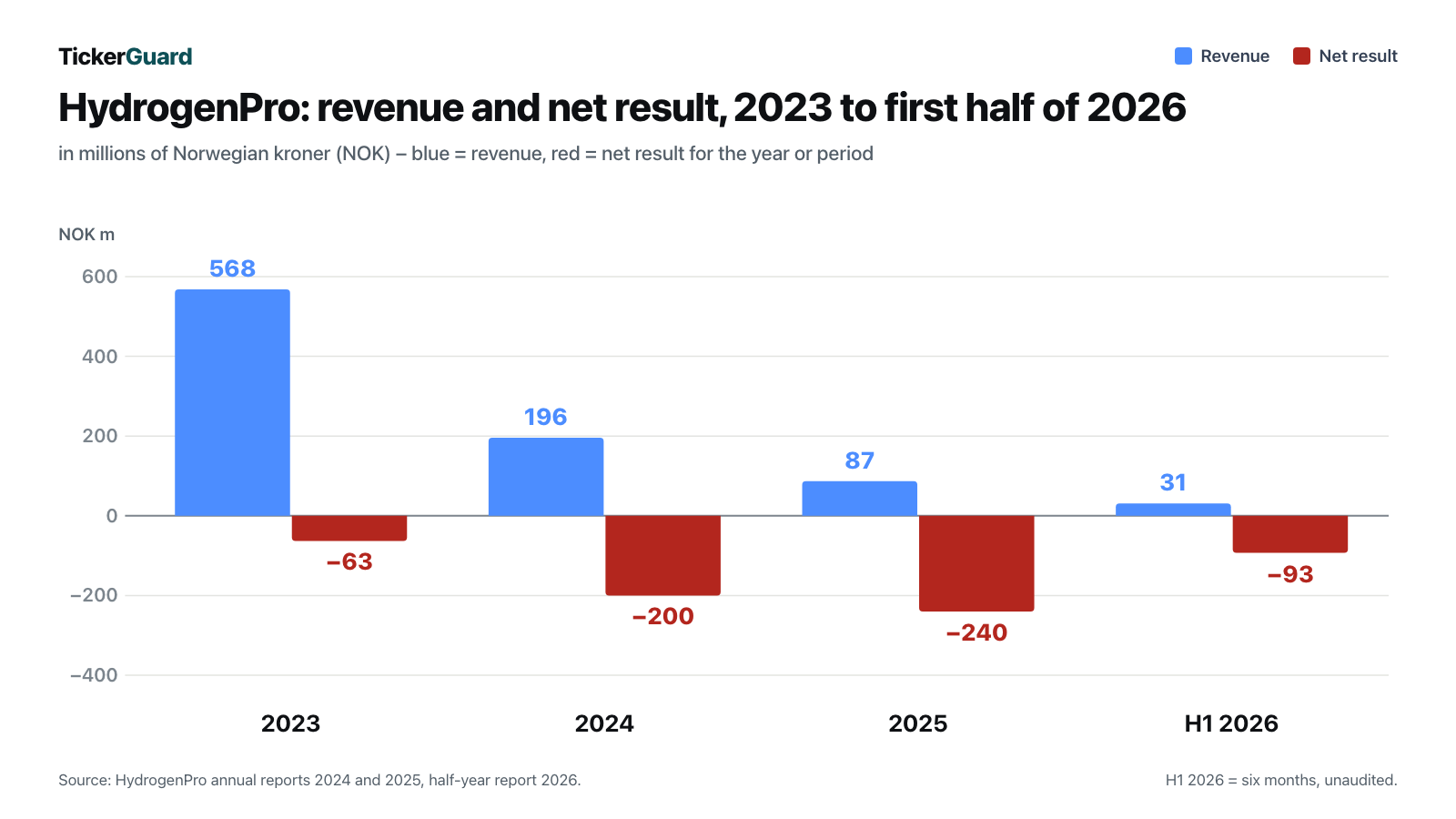
Now the multi-year view. Revenue lived off exactly those two big projects and shrank once they were delivered: from NOK 568 million (2023) to NOK 196 million (2024) and NOK 87 million (2025). The first half of 2026 brought in NOK 31 million. HydrogenPro did not turn a profit in any of those years; the loss grew from NOK 63 million (2023) to NOK 200 million (2024) and NOK 240 million (2025).
The order backlog stood at NOK 262 million as of June 30, 2026; of the NOK 275 million at the end of 2025, the annual report attributes NOK 195 million to long-term service agreements and NOK 80 million to electrolyzer deliveries. New orders in the first half of 2026 came to NOK 25 million, and to NOK 57 million for all of 2025. And the customer base is narrow: in 2025, according to the annual report, 95 percent of revenue came from two customers, ANDRITZ and Mitsubishi Power America; in 2024, ANDRITZ alone accounted for 99 percent.
Uncomfortable truth No. 1: From sufficient to limited in six months
In the 2025 annual report, which reflects the situation as of February 2026, the board still sounded confident. It based the going-concern assumption on a rolling five-quarter forecast:
“The updated five quarter rolling forecast indicates that the Group has sufficient liquidity beyond the forecast period, provided that planned operational and financial measures are executed in a timely manner.”
— HydrogenPro ASA, Integrated Report 2025, Board of Directors' report, section Going Concern
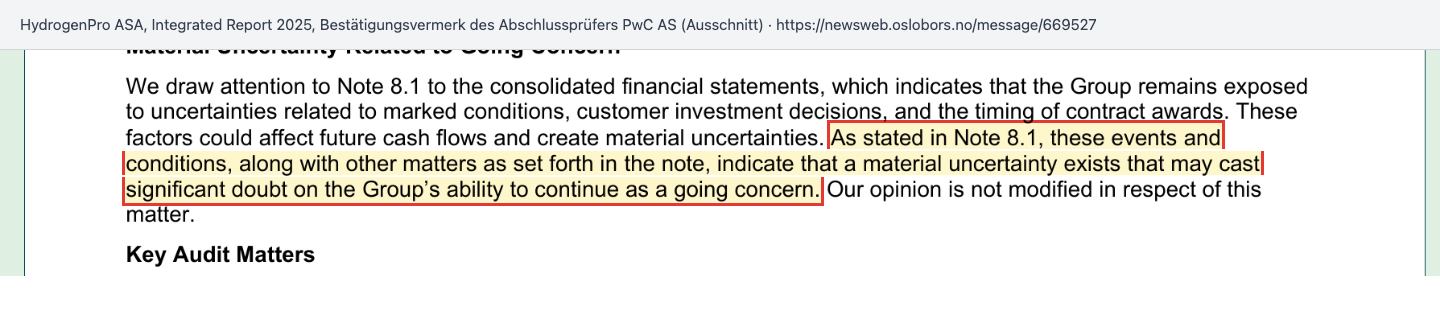
The key part of that sentence is the condition: “provided that … executed in a timely manner.” The auditor, PwC, read it the same way and added a separate paragraph to its audit opinion — a warning auditors include when a material uncertainty may cast significant doubt on the company's survival. In everyday terms: the auditor signs off that the books are right but sticks a yellow note next to them saying the money could run short.
“As stated in Note 8.1, these events and conditions, along with other matters as set forth in the note, indicate that a material uncertainty exists that may cast significant doubt on the Group’s ability to continue as a going concern.”
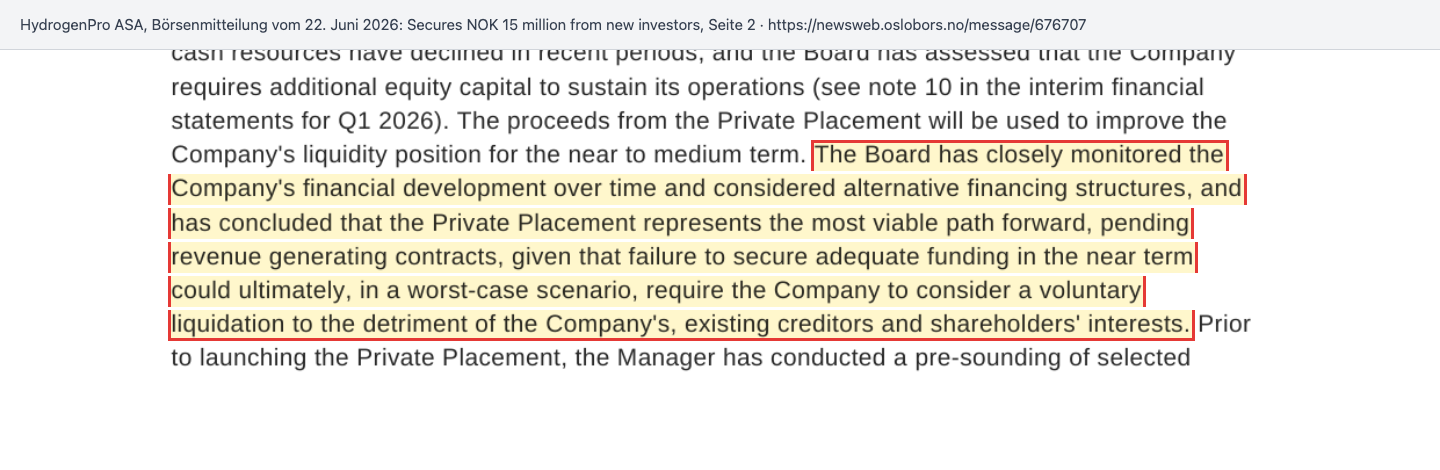
The cash balance soon proved the yellow note right. It fell from NOK 102 million at the end of 2025 to NOK 56 million at the end of March 2026. On May 13, 2026, the board announced a “strategic review” and brought in investment bank Clarksons Securities as adviser. On June 22, 2026, an emergency raise followed, and its justification contains a sentence that describes the situation without varnish:
“The Board has closely monitored the Company’s financial development over time and considered alternative financing structures, and has concluded that the Private Placement represents the most viable path forward, pending revenue generating contracts, given that failure to secure adequate funding in the near term could ultimately, in a worst-case scenario, require the Company to consider a voluntary liquidation to the detriment of the Company’s, existing creditors and shareholders’ interests.”
— HydrogenPro ASA, stock exchange notice of June 22, 2026, Secures NOK 15 million from new investors
The money from this rescue is modest: NOK 15 million in June and another NOK 6.4 million from a subsequent offering in July. As of June 30, 2026, the company held NOK 58.6 million in cash — roughly $6.1 million or €5.5 million. How long that lasts, the half-year report says itself in Note 11:
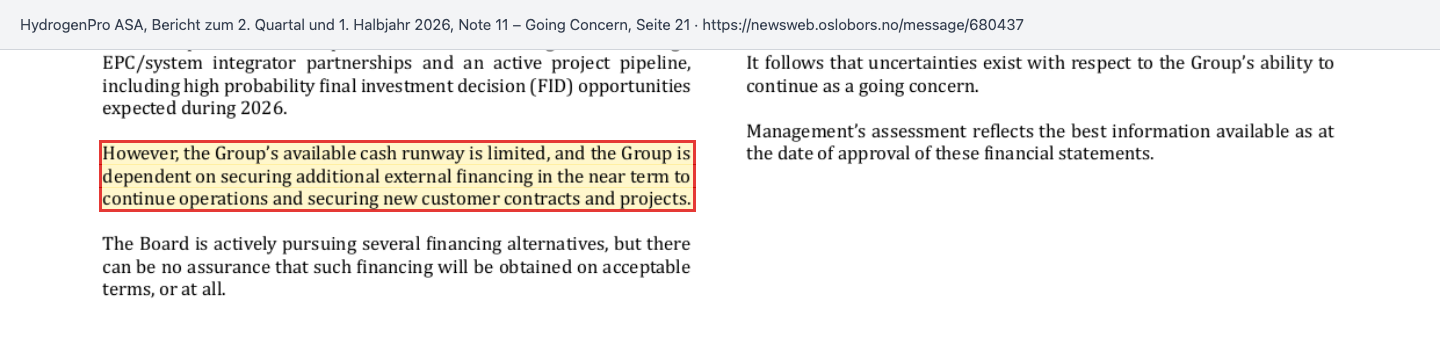
“However, the Group’s available cash runway is limited, and the Group is dependent on securing additional external financing in the near term to continue operations and securing new customer contracts and projects.”
— HydrogenPro ASA, Second quarter and half-year report 2026, Note 11 Going Concern
Let's run the numbers as simply as possible (our own calculation). In the first half of 2026, operations consumed NOK 49.7 million in cash, investments NOK 6.0 million and lease payments NOK 2.9 million — about NOK 59 million in six months, or just under NOK 30 million a quarter. Against the NOK 58.6 million in cash plus NOK 6.4 million from July, that's a little over two quarters. Without new orders with down payments or fresh money, that takes the company to roughly the turn of the year 2026/27. The second quarter on its own looked friendlier: operations, investments and leases consumed only about NOK 12 million, a pace at which the money would last a little over five quarters. But that quarter relied on receivables (NOK 6.9 million) and inventories (NOK 5.4 million) turning into cash — an effect that can't be repeated at will, because those balances are already small. The honest range is therefore two to five quarters, depending on which pace you assume. Note 11 itself speaks of additional financing “in the near term” — which fits the tighter case better (our reading).
Rule of thumb: a going-concern warning is not a verdict but a clock. At HydrogenPro, the company itself has told you what time it is.
Uncomfortable truth No. 2: Existing shareholders pay for the rescue
Every capital raise is a life ring — but it comes at a price, and existing shareholders pay it. The everyday picture of dilution: the pie gets cut into more slices, and your slice shrinks even if you sell nothing. At HydrogenPro, the price of the rescues can be read off a single number: the issue price per new share.
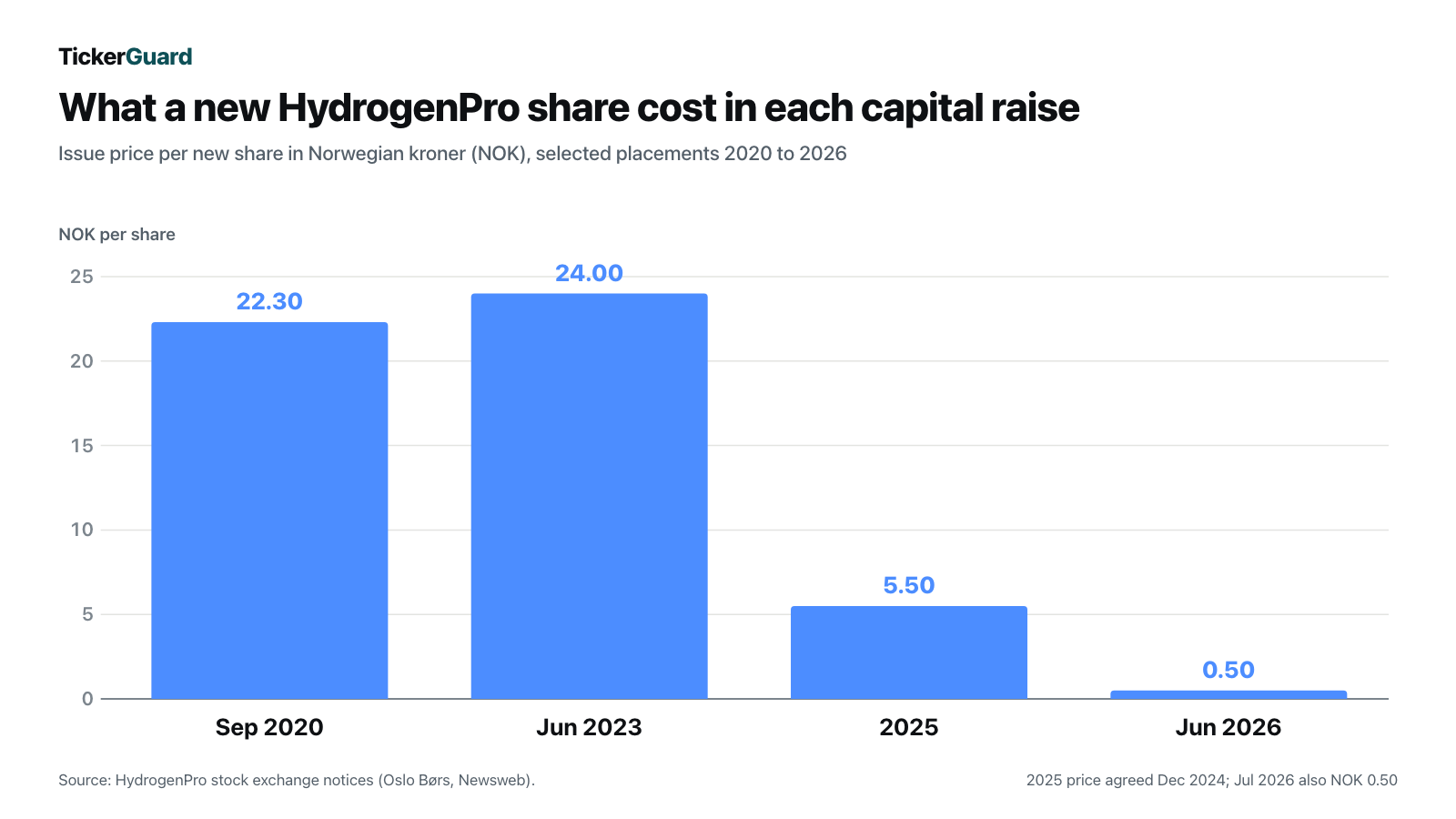
The June 22, 2026 placement was priced at NOK 0.50, while the stock had closed at NOK 2.11 on the last trading day before — a 76 percent discount. On the day of the announcement, the share price fell to NOK 0.85. Thirty million new shares went solely to new investors (according to a correction notice issued the same day). The largest reported individual holder afterward was Espen Westeren, who together with his company Titan Ventures reported a stake of 18.91 percent (23.7 million shares). So the new shares could be delivered immediately, major shareholder ANDRITZ temporarily lent out its roughly 16 million shares. In July came a subsequent offering for the remaining shareholders of 12.8 million shares at the same price. Jardis Invest, a company closely associated with CEO Jarle Dragvik, received 33,756 shares in it for about NOK 17,000, according to a managers' transaction notice of July 21, 2026 — together with the 41,033 shares attributed to the CEO in the annual report at the end of 2025, his stake remains small.
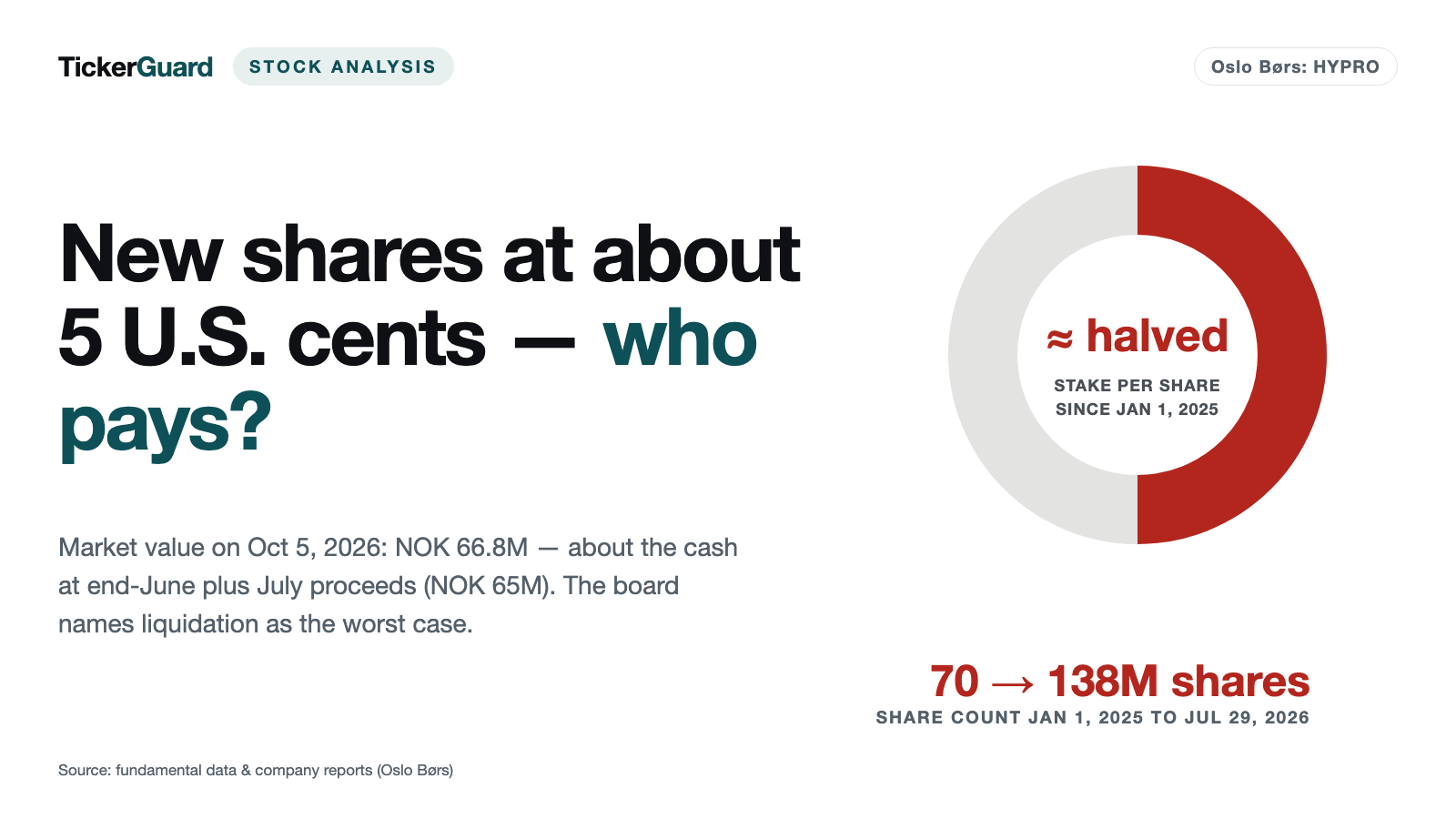
The result over a year and a half: at the start of 2025, HydrogenPro had 70.1 million shares outstanding; since July 29, 2026, it has 138.3 million — almost twice as many. Anyone who owned 1 percent of the company at the start of 2025 now holds about half a percent, provided the number of shares held is unchanged. The June placement was open only to new investors; the remaining shareholders could only take part in the July subsequent offering. The three industrial partners, which held about 42 percent combined at the end of 2025 (our attribution via the share counts in the shareholder register, where ANDRITZ and LONGi appear behind custodian banks), have shrunk considerably: ANDRITZ holds 11.6 percent, LONGi Hydrogen about 9.2 percent and Mitsubishi Heavy Industries, based on the year-end 2025 register, about 8.5 percent (our calculation on today's share count).
And the life ring is nearly used up. The general meeting of June 3, 2026 authorized the board to issue up to 47,762,442 new shares. The placement and the subsequent offering used 42,762,444 of them, leaving about 5 million shares. A larger capital raise would therefore need a new general meeting. The major-shareholding notices show how quickly the new large shareholder's stake shrank afterward: Titan Ventures and Espen Westeren stood at 14.87 percent on July 17, 2026, at 9.66 percent on August 17 and at 4.48 percent on September 18, 2026. According to the major-holding notifications, the reported holding fell by more than 17.5 million shares within three months (our calculation). The notifications do not say whether the shares were sold, transferred or lent, or why.
Rule of thumb: someone who buys at NOK 0.50 does the math differently from someone who got in at NOK 22.30. For one, today's price is an entry point; for the other, it's an anchor.
Uncomfortable truth No. 3: The prettiest numbers come with an asterisk
If you only read the headlines of the half-year report, you see progress: EBITDA, roughly what the day-to-day business throws off before depreciation, interest and taxes, improved from minus NOK 32 million in the first quarter to minus NOK 16 million in the second quarter of 2026, and the gross margin was 158 percent. A gross margin above 100 percent means material costs were negative — and that's exactly what happened. HydrogenPro reversed NOK 12 million of material costs it had booked the year before for customer back charges on the ACES project; the customer now runs the plant with the original solution. That's good news about the technology, but it isn't recurring business. Without that reversal, EBITDA would have been about minus NOK 28 million (our calculation). The bottom line for the second quarter was a loss of NOK 51 million, including a NOK 32 million write-down on the closed factory in China.
The second asterisk is on growth. On June 22, 2026, HydrogenPro held out the prospect of concrete order intake in the following, third quarter:
“Two contracts, representing combined close to 30% of the NOK 1 billion sales pipeline, are expected to conclude during the third quarter of 2026.”
— HydrogenPro ASA, stock exchange notice of June 22, 2026, Business update
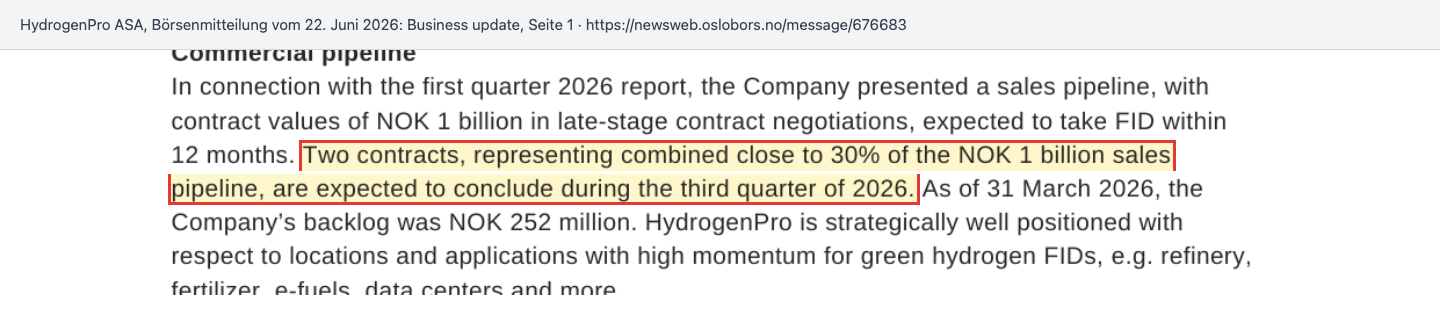
Two months later, in the release and presentation accompanying the half-year report of August 21, 2026, the same topic sounded more cautious: HydrogenPro said it had been selected as supplier for two major projects worth close to NOK 300 million, but the awards were still awaiting final regulatory clearance and a technical review. The third quarter ended on September 30, 2026. As of October 5, 2026, HydrogenPro had not reported either contract as signed on the exchange's announcement system. For perspective: NOK 300 million would be more than three times all of 2025 revenue and four and a half times the market value. That's exactly why this order is the number everything hinges on — and why it pays not to count it as won before it is.
What the stock costs
At the closing price of NOK 0.483 on October 5, 2026, HydrogenPro's 138.3 million shares are worth about NOK 66.8 million — roughly $7.0 million or €6.2 million. At the end of 2025, the figure was still about NOK 187 million (our calculation: closing price of NOK 1.96 times 95.5 million shares; the annual report states NOK 140 million, which matches the share count before the 2025 capital increases), and at the end of 2024 NOK 356 million according to the annual report. The company held NOK 58.6 million in cash on June 30, 2026, with another NOK 6.4 million gross added in July. That works out to roughly NOK 0.47 of cash behind each share (end-of-June cash plus July's gross proceeds, before costs) — almost exactly the share price. That's the second anchor from the opening: the market value roughly equals the cash of June 30 — on paper, almost nothing would be left for the business itself. But that cash isn't standing still — it has likely kept shrinking since the end of June, and at just under NOK 30 million a quarter, about half would be left after one quarter — roughly the end of September 2026 — and almost nothing after two; at the more favorable second-quarter pace of about NOK 12 million, a little over NOK 50 million would remain at the end of September (our calculation).
It looks cheap against the balance sheet, too: equity of NOK 158 million as of June 30, 2026 implies a price-to-book ratio of about 0.42, and the market value equals 0.8 times 2025 revenue. There is no price-to-earnings ratio because there are no earnings. But both comparisons have a catch. At the first-half pace, the cash burns at just under NOK 30 million a quarter, and much of the equity is tied up in property, plant and equipment totaling NOK 95 million, including the expanded electrode production in Aarhus, with a total investment of about NOK 56 million, and in a $3 million convertible note receivable from U.S. project developer DG Fuels, whose value HydrogenPro itself can only estimate with unobservable inputs. When cash is tight, a factory is worth only what someone will pay for it.
In fairness: a NOK 300 million contract with customary down payments would push the cash question out. Until then, though, the order the board itself spelled out in June still applies: financing first, contracts second.
Upside and risks at a glance
What speaks for HydrogenPro:
- Electrolyzers delivered for two large reference plants: ACES Delta in Utah (220 megawatts, in operation since the first quarter of 2026, ten-year service agreement) and SALCOS in Salzgitter (100 megawatts).
- According to the half-year release and presentation, selected as supplier for two projects worth close to NOK 300 million — more than three times 2025 revenue; the awards are still pending.
- Costs are falling sharply: operating expenses of NOK 82 million in the first half of 2026 versus NOK 108 million, outsourcing of production to LONGi decided, no bank loans.
- Large industrial groups among the shareholders: ANDRITZ, LONGi Hydrogen and Mitsubishi Heavy Industries.
What speaks against HydrogenPro:
- Going-concern warning from auditor PwC in the 2025 annual report; the 2026 half-year report itself calls the cash runway “limited.”
- NOK 58.6 million in cash as of June 30, 2026, against an outflow of about NOK 59 million in the first half; on paper, that lasts a little over two quarters, or a little over five at the more favorable second-quarter pace.
- The share count has nearly doubled since early 2025, the latest rescue was priced 76 percent below market, and the authorization for new shares is down to about 5 million.
- Revenue fell from NOK 568 million (2023) to NOK 87 million (2025), and 95 percent of 2025 revenue came from two customers.
- The contracts announced for the third quarter of 2026 had not been reported as signed as of October 5, 2026.
A human conclusion
Remember the coat with the crossed-out price tag? HydrogenPro is covered in such tags: NOK 75.60 in January 2021, NOK 22.30 in the placement ahead of the listing, NOK 5.50 for LONGi in 2025. None of those numbers tells you what the stock is worth today. That will be decided by two questions the reports leave open: will the announced contracts come through, and where will the money come from until then?
To be fair: this company delivered, in Utah and in Salzgitter. It would be unfair to readers, though, to leave out what the board itself wrote: that without funding, liquidation could loom in the worst case. The next test comes on November 13, 2026, with the third-quarter report: how much cash is left, are the contracts signed, and will another general meeting be needed for new shares? Anyone buying HydrogenPro because the old price was so high is buying the price tag — not the coat. What you do with that is your call. And that's how it should be.
Sources
- HydrogenPro ASA — Second quarter and half-year report 2026 with presentation (published August 21, 2026; most recent periodic report, IAS 34, unaudited)
- HydrogenPro ASA — Integrated Report 2025 (IFRS consolidated financial statements, auditor PwC AS; published March 27, 2026)
- HydrogenPro ASA — Integrated Report 2024 (comparative figures for 2023 and 2024)
- First quarter 2026 report (May 13, 2026; launch of the strategic review) and fourth quarter 2025 report (February 27, 2026)
- Stock exchange notices of June 22, 2026: Business update and private placement at NOK 0.50 and the correction to it (company website); redelivery of borrowed shares to ANDRITZ (June 25, 2026); final results of the subsequent offering (July 21, 2026); insider allocations (July 21, 2026); new share capital, 138,287,333 shares (July 29, 2026)
- Minutes of the general meeting of June 3, 2026 (authorization for 47,762,442 new shares) and financial calendar 2026 (Q3 2026 report on November 13, 2026)
- Major-shareholding notices by Espen Westeren and Titan Ventures AS (publication dates; the record dates cited in the text are up to three days earlier): June 22, 2026, July 20, 2026, August 18, 2026, September 21, 2026
- Earlier capital raises: private placement at NOK 22.30 (September 30, 2020), private placement at NOK 24 (June 13, 2023), share issue to LONGi Hydrogen at NOK 5.50 (May 27, 2025)
- Euronext Oslo Børs — HydrogenPro quote page (ISIN NO0010892359); closing prices of June 19, 2026, June 22, 2026 and October 5, 2026 and the record close of January 2021 from the fundamental-data price history
- European Central Bank — euro reference exchange rates of October 5, 2026 (conversion of NOK into dollars and euros)
- Source: fundamental data & company reports (annual and quarterly reports, Oslo Børs)
This analysis is a journalistic assessment based on publicly available company reports. It is not investment advice and not a solicitation to buy or sell securities. Stocks can lose value, up to and including a total loss. All figures carry the date of their source; prices are dated snapshots. Positions held by the operator are disclosed daily; where one exists, it appears as a notice at the top of this deep dive.
Our Bottom Line at a Glance
- Liquidity and survival negative
- As of June 30, 2026, cash stood at NOK 58.6 million, with about NOK 59 million flowing out in the first half. PwC added a going-concern warning to the 2025 annual report; the half-year report itself calls the runway limited.
- Dilution negative
- The June 22, 2026 emergency raise was priced at NOK 0.50, 76 percent below the prior close. Since early 2025, the share count has risen from 70.1 million to 138.3 million; the authorization is down to about 5 million shares.
- Revenue and customers negative
- Revenue fell from NOK 568 million (2023) to NOK 87 million (2025); 95 percent came from two customers in 2025. Order intake in the first half of 2026 was NOK 25 million.
- Technology and references positive
- HydrogenPro has delivered ACES Delta in Utah (220 megawatts, in operation since Q1 2026) and SALCOS in Salzgitter (100 megawatts); according to the company, its new electrode generation cuts power consumption further.
- Order prospects neutral
- According to the half-year presentation, HydrogenPro has been selected as supplier for two projects worth close to NOK 300 million, but the awards are still pending; the closings announced for Q3 2026 had not been reported by October 5, 2026.
- Costs positive
- Operating expenses fell to NOK 82 million in the first half of 2026 from NOK 108 million a year earlier; production in China is being outsourced to LONGi (decided in 2026), and there are no bank loans.
HydrogenPro has supplied the electrolyzers for two large hydrogen plants but burned about NOK 30 million a quarter in the first half of 2026 and held only NOK 58.6 million in cash as of June 30, 2026. The auditor flags doubt about the company's survival, the last rescue was priced at NOK 0.50, and the share count has nearly doubled since early 2025. At NOK 0.483 (October 5, 2026), the market value roughly equals the cash. Not investment advice.
What Our Rating Means
Substance risk
We found at least one documented issue that threatens the company itself — regardless of how the stock is currently valued.
Red here stands for a documented threat to the company itself, not for weak technology: auditor PwC added a going-concern warning, the board named a voluntary liquidation as the worst case in June 2026, and on paper the cash lasts only a little over two to a little over five quarters (worked out in Uncomfortable truth No. 1). On the other side are the electrolyzers delivered for two large plants, falling costs and two projects worth close to NOK 300 million for which HydrogenPro has been selected as supplier — until those contracts are signed, survival depends on fresh money.
A journalistic assessment by our editorial team at the time of the deep dive, based on public sources — not investment advice and not a solicitation to buy or sell. Your personal circumstances (investment goals, risk capacity, taxes) cannot be taken into account. What our levels mean, how verdicts are formed, and what conflicts of interest exist →
Worth Noting
- This analysis was prompted by the forum ranking of the German finance portal wallstreet-online (most-discussed stocks among German retail investors) as of October 5, 2026, where the stock appeared under its U.S. symbol HYPRF. The thread running through it is the anchoring effect: old share prices and the “market value equals cash” comparison act like a crossed-out price tag — they say little about today's value.
- On the evidence: HydrogenPro is not an SEC filer; HYPRF is an over-the-counter secondary symbol without a reporting obligation (no CIK, checked October 5, 2026). All company figures come from the audited Integrated Report 2025 (auditor PwC AS), the Integrated Report 2024, the reports for the fourth quarter of 2025 and the first and second quarters of 2026, and stock exchange notices on Newsweb through October 5, 2026. The reporting currency is the Norwegian krone (NOK).
- Our own calculations: first-half 2026 cash outflow (operating cash flow −49.7, investments −6.0, lease payments −2.9 million NOK) and second-quarter 2026 alone (−8.2, −2.7 and −1.3 million NOK, about −12.2 million combined), runway on paper (NOK 58.6 million of cash on June 30, 2026 plus NOK 6.4 million of July gross proceeds, NOK 65.0 million in total, divided by the quarterly outflow), second-quarter EBITDA excluding the NOK 12 million reversal of material costs, the placement discount (NOK 0.50 vs. 2.11), the increase in share count, the stakes of ANDRITZ, LONGi and Mitsubishi on today's share count, market value, cash per share and price-to-book. Euro and dollar values at the ECB reference rates of October 5, 2026 (NOK 10.7575 and $1.1204 per euro).
- Price and market value: closing price of NOK 0.483 on Euronext Oslo Børs on October 5, 2026 (fundamental-data price history). Market-value cross-check: 138,287,333 shares times NOK 0.483 equals NOK 66.8 million; the fundamental data showed about NOK 68 million at NOK 0.495 on October 2, 2026. The price documented in a filing is the NOK 0.50 placement price of June 22, 2026.
- The FTE counts (74 in Q2 2026, 93 in Q3 2025) come from the Q2 2026 presentation; year-end headcounts from the Integrated Reports. The record close of NOK 75.60 (January 20, 2021) comes from the fundamental-data price history.
The full analysis as a PDF for later
We will send you this analysis as a PDF — to print, file away, and read at your own pace.
Frequently Asked Questions
HydrogenPro ASA of Porsgrunn, Norway, builds pressurized alkaline electrolyzers — units that use electricity to make hydrogen from water. It supplies cell stacks and gas separators, while partners such as ANDRITZ build the rest of the plant. Its reference projects are ACES Delta in Utah (220 megawatts) and SALCOS in Salzgitter, Germany (100 megawatts). Revenue in 2025 was NOK 87 million.
HYPRF is a secondary over-the-counter symbol for HydrogenPro shares in the U.S., with no reporting obligation of its own. The home exchange is Euronext Oslo Børs under the ticker HYPRO. HydrogenPro reports under IFRS and Norwegian law through annual and quarterly reports on the Newsweb system, not to the SEC, where it has no CIK.
As of June 30, 2026, HydrogenPro had NOK 58.6 million in cash, plus NOK 6.4 million gross from a subsequent offering in July. About NOK 59 million flowed out in the first half of 2026. At that pace, the cash lasts a little over two quarters on paper, or a little over five at the more favorable second-quarter pace. The half-year report itself calls the cash runway limited.
Cash had fallen from NOK 102 million at the end of 2025 to NOK 56 million at the end of March 2026. On June 22, 2026, the board placed 30 million new shares at NOK 0.50, 76 percent below the previous close, explaining that without funding, a voluntary liquidation could be required in a worst-case scenario.
Auditor PwC did not modify its audit opinion but pointed to a material uncertainty that may cast significant doubt on the company's ability to continue as a going concern. According to the report, the reasons are market conditions, customer investment decisions and the timing of new orders. It is not a bankruptcy verdict, but it is a serious warning sign.
According to the financial calendar of April 8, 2026, the third-quarter 2026 report is due on November 13, 2026. The key items will be the cash balance, order intake and whether the two announced contracts worth close to NOK 300 million combined have been signed.
No. The board did not recommend a dividend for 2025, citing the company's stage of development. HydrogenPro has posted losses for years — NOK 240 million in 2025 and another NOK 93 million in the first half of 2026.
Found an error?
Did you spot a factual error, an outdated number, or a typo in this deep dive? Let us know briefly — your report goes straight to the editorial team.