Deutsche Rohstoff: Half of the Record Year Comes From Selling Shares
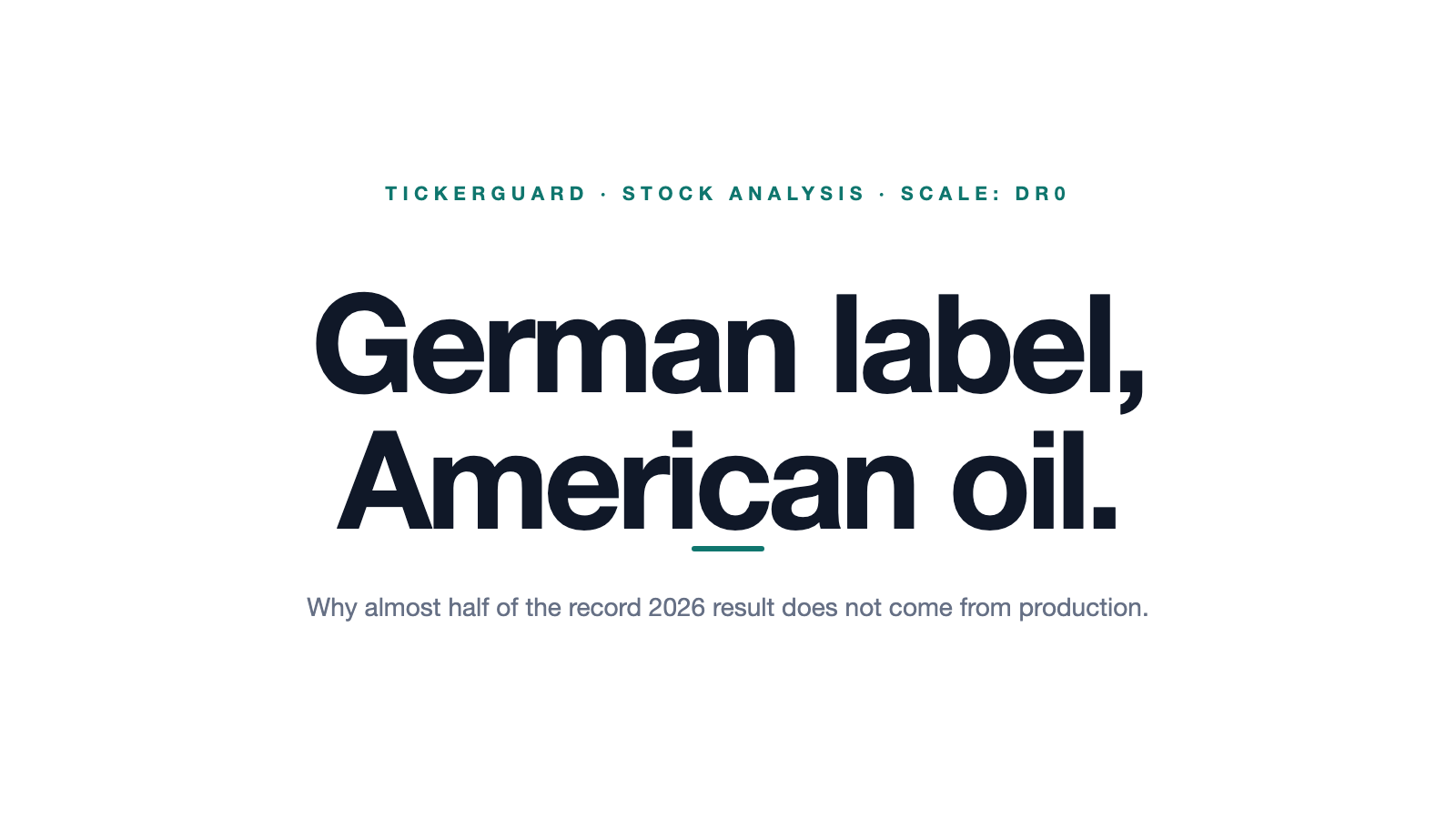
Deutsche Rohstoff AG of Mannheim, Germany, produces oil in Wyoming and Colorado and has raised its 2026 EBITDA guidance to EUR 355 to 375 million, after EUR 132.0 million in 2025. Around EUR 162 million of that comes from selling shares in tungsten miner Almonty Industries, not from its own production. Meanwhile the oil business shrank: revenue down 17 percent in 2025, down 26 percent in the first quarter of 2026, operating costs per barrel up 19 percent. Not a buy or sell recommendation — just the question of what survives the record once the Almonty shares are all sold.
 Thomas Mücke
Founder & Publisher
Thomas Mücke
Founder & Publisher
Chart
Interactive price chart (TradingView).
Note: pure fact-based analysis, not investment advice and not a solicitation to buy or sell. All figures without guarantee.
There is an investor trap waiting on every bank statement. Call it the bank-statement trap: on a bank statement, every incoming payment looks the same. Your monthly salary and the proceeds from selling your car sit in the same column, in the same font, with the same plus sign. Only one of them comes back next month. In the summer of 2026, Deutsche Rohstoff AG of Mannheim, Germany, set that trap without meaning any harm at all — quite the opposite: the company discloses every figure cleanly. The headlines do not. "Record quarter with earnings per share of EUR 21.59" (May 12, 2026), "Increase in 2026 guidance: EBITDA of approximately EUR 365 million expected" (July 22, 2026) — both are true. And in both cases the larger part of the money came not from oil, but from selling shares in a Canadian tungsten miner. So let us make a deal: we read the 2025 annual report (published April 22, 2026), the quarterly report as of March 31, 2026 (published May 12, 2026) and every release since. And we sort the incoming payments by where they came from.
What Deutsche Rohstoff actually does — three misunderstandings in one company name
Start with the name, because it misleads in three ways at once. "Deutsche" (German): the registered office is in Mannheim, Germany — every barrel is produced in the United States. "Rohstoff" (commodity): the money comes almost entirely from oil and natural gas, not from metals. "AG" (a German stock corporation): the company does not operate a single well itself; it is a holding company that owns stakes in operating businesses.
As of March 31, 2026 the structure looks like this. Below the wholly owned Deutsche Rohstoff USA Inc. in Wilmington sit five operating U.S. companies — 1876 Resources LLC (97.6 percent, Denver), Salt Creek Oil & Gas LLC (100 percent), Elster Oil & Gas LLC (93.0 percent), Bright Rock Energy LLC (95.0 percent) and the infrastructure company Coyote Hill Midstream LLC (100 percent). They produce in the Powder River Basin in Wyoming and the Denver-Julesburg Basin in Colorado; Bright Rock has been assembling an acreage position in the Utica formation in Ohio since 2025, with first wells planned for 2027. In Germany there are also Ceritech AG (72.5 percent) and Tin International GmbH (100 percent), plus the metals portfolio, whose by far largest item is Canada-based Almonty Industries Inc. — a tungsten producer with mines in Portugal (Panasqueira) and South Korea (Sangdong), listed on Nasdaq since 2025.
What stands out is how lean the whole thing runs: in fiscal 2025 the entire group employed an average of 60 people (prior year: 66). At the end of 2025 the group held interests in 121 operated and 106 non-operated horizontal wells — around 112 net wells. Put in everyday terms: this is not an industrial conglomerate with factory gates, it is a very small team allocating capital to wells and equity stakes and contracting out the execution.
Why there is no SEC filing here — and where the numbers come from instead
One point up front, because it shapes the entire evidence base: there is no 10-K and no 10-Q for Deutsche Rohstoff. The shares trade in Scale, the small and mid-cap segment of the open market at the Frankfurt Stock Exchange, and change hands on Xetra, Tradegate, Frankfurt, Berlin, Duesseldorf, Stuttgart, Munich and Hamburg. Reporting follows German law: audited consolidated accounts, a half-year report, quarterly reports and ad-hoc releases under Article 17 of the EU Market Abuse Regulation. Every figure in this analysis therefore carries the line "Source: fundamental data & company reports (annual/quarterly report, Frankfurt Stock Exchange)", never "SEC filings".
A second peculiarity matters more than it sounds. Deutsche Rohstoff reports under HGB, the German Commercial Code — not under IFRS, the international rules most large listed companies use. That has three concrete consequences we will need shortly. First, gains and losses from oil price hedging are netted directly against revenue instead of shown separately; under IFRS, according to the reconciliation in the annual report, 2025 revenue would have been EUR 15.9 million higher. Second, investments may be carried at no more than their purchase cost; increases in value only reach the income statement when they are sold. Third, the prudence principle applies: losses are shown early, gains late. Our analysis of PFISTERER, another German-listed company without an SEC registration, ran its entire evidence chain through the company's own annual reports rather than through sec.gov.
How this stock reached our desk
Honesty first: the hook is a pure attention signal, not a metric. On August 4, 2026 we pulled the ranking of most-discussed stocks in the forum of wallstreet-online.de, Germany's largest retail investor community. Deutsche Rohstoff sits in 44th place with seven posts in 24 hours — respectable midfield, hardly a storm.
The list only becomes interesting one level up. In third place of that same ranking, with 60 posts in 24 hours, stands Almonty Industries. That is precisely the holding from which Deutsche Rohstoff is currently drawing the bulk of its record result. The crowd argues passionately about the tungsten miner — and largely walks past the Mannheim co-owner quietly cashing in on the same rally. If the hype is what brought you here, this analysis offers the soberer question: what is left once the shares are sold?
The numbers over the years — given their due
First, what genuinely impresses. Deutsche Rohstoff has been profitable for years, it pays a dividend, it buys back its own shares, and in 2025 it reported the largest organic reserve increase in its history. Operating cash flow came to EUR 130.0 million in 2025 (prior year: EUR 143.6 million), cash rose from EUR 19.7 million to EUR 69.3 million, and net debt fell from EUR 157 million to around EUR 146 million. The track record on guidance is notably good: in April 2025 the company had promised revenue of EUR 170 to 190 million and EBITDA of EUR 115 to 135 million for 2025 — it delivered EUR 195.1 million and EUR 132.0 million.
And yet the multi-year picture shows two movements in opposite directions. Revenue fell 17 percent in 2025, from EUR 235.4 million to EUR 195.1 million, and EBITDA fell 21 percent, from EUR 167.6 million to EUR 132.0 million. For 2026 the company expects revenue of EUR 260 to 280 million (midpoint: EUR 270 million) — and EBITDA of EUR 355 to 375 million, a midpoint of EUR 365 million. EBITDA above revenue: at a producer that is not an arithmetic error, it is a warning light, and we will follow it in a moment.
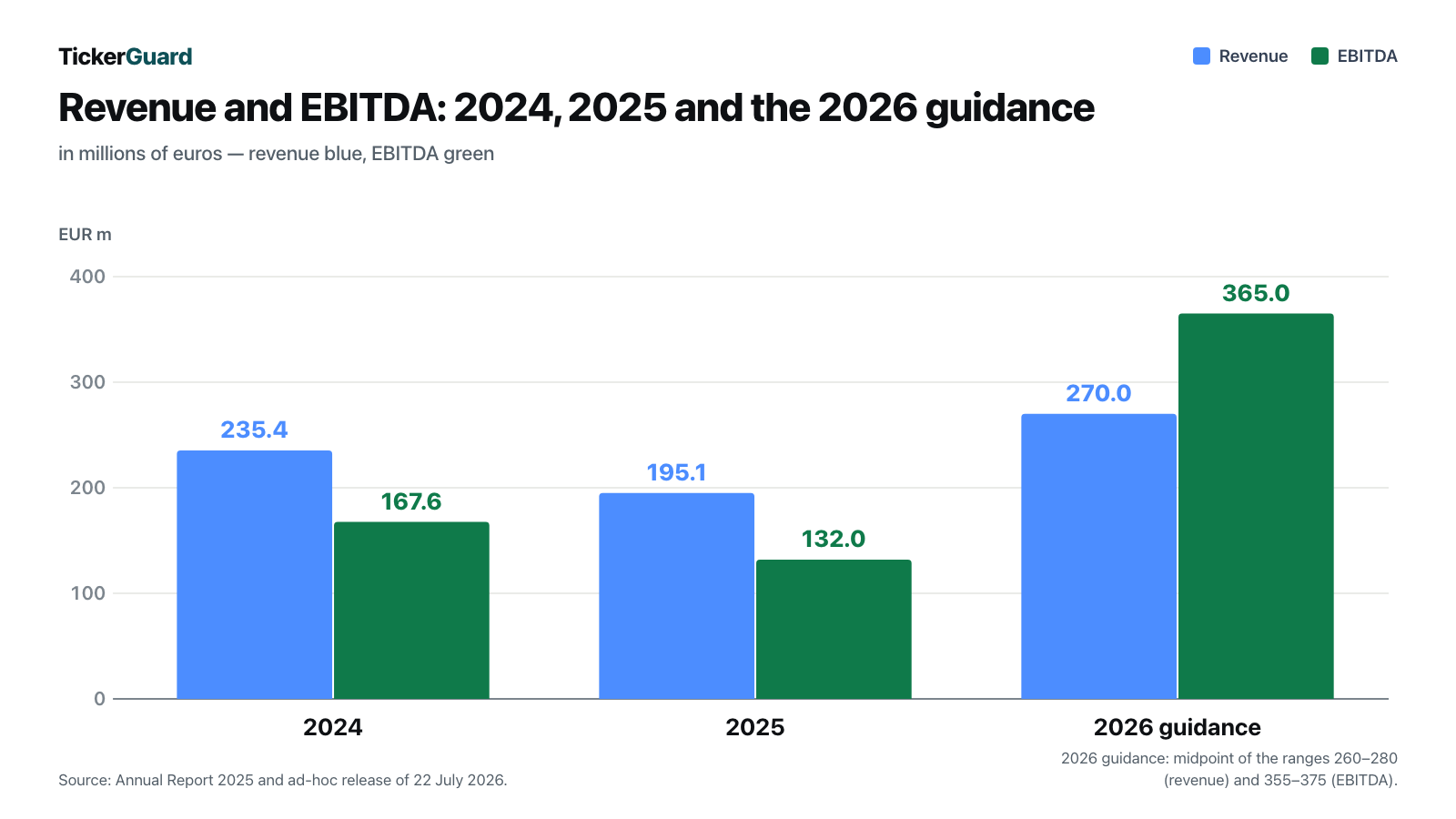
The first quarter of 2026 continued the operating trend — downwards. Revenue fell 26 percent, from EUR 59.1 million to EUR 43.9 million, output from 14,549 to 12,322 barrels of oil equivalent per day (down 15 percent), and operating cash flow from EUR 44.7 million to EUR 28.3 million (down 37 percent). Reported consolidated net profit after minorities nonetheless jumped from EUR 12.5 million to EUR 103.4 million, and earnings per share from EUR 2.55 to EUR 21.59. The difference sits in a single line of the income statement, and that line is where we go next.
What the reports say — the uncomfortable truths
Uncomfortable truth no. 1: Around EUR 162 million of the EUR 365 million EBITDA comes from selling shares
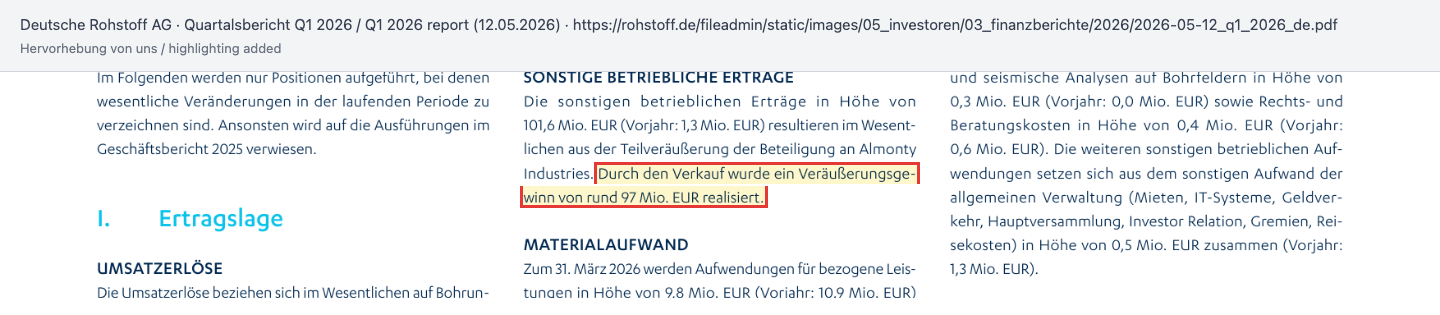
The line is called "other operating income". In the first quarter of 2026 it stood at EUR 101.6 million — against EUR 1.3 million in the prior-year quarter. The notes to the quarterly report explain why:
"Other operating income of EUR 101.6 million (previous year: EUR 1.3 million) resulted primarily from the partial sale of our stake in Almonty Industries. The sale of approximately 9 million shares generated a capital gain of approximately EUR 97 million."
— Deutsche Rohstoff AG, Q1 2026 quarterly report (May 12, 2026), notes, page 15; the German original is the authoritative version
On July 22, 2026 the second tranche followed. The ad-hoc release is exemplary in its clarity — and uncomfortable in its consequence:
"Deutsche Rohstoff AG is again raising its guidance for the 2026 financial year. The adjustment is driven by a further partial sale of its shareholding in Almonty Industries, which generated a pre-tax earnings contribution of approximately EUR 65 million. The earnings contribution represents the sales proceeds less the book value of the shares sold and therefore increases EBITDA, the key earnings metric underlying the Company's guidance, by the corresponding amount."
— Deutsche Rohstoff AG, ad-hoc release of July 22, 2026
Let us do the bridge ourselves. EBITDA in 2025 was EUR 132 million. Add roughly EUR 97 million from the first Almonty tranche and roughly EUR 65 million from the second — around EUR 162 million in total. That leaves EUR 71 million up to the guidance midpoint of EUR 365 million, to be contributed by the operating business and everything else.
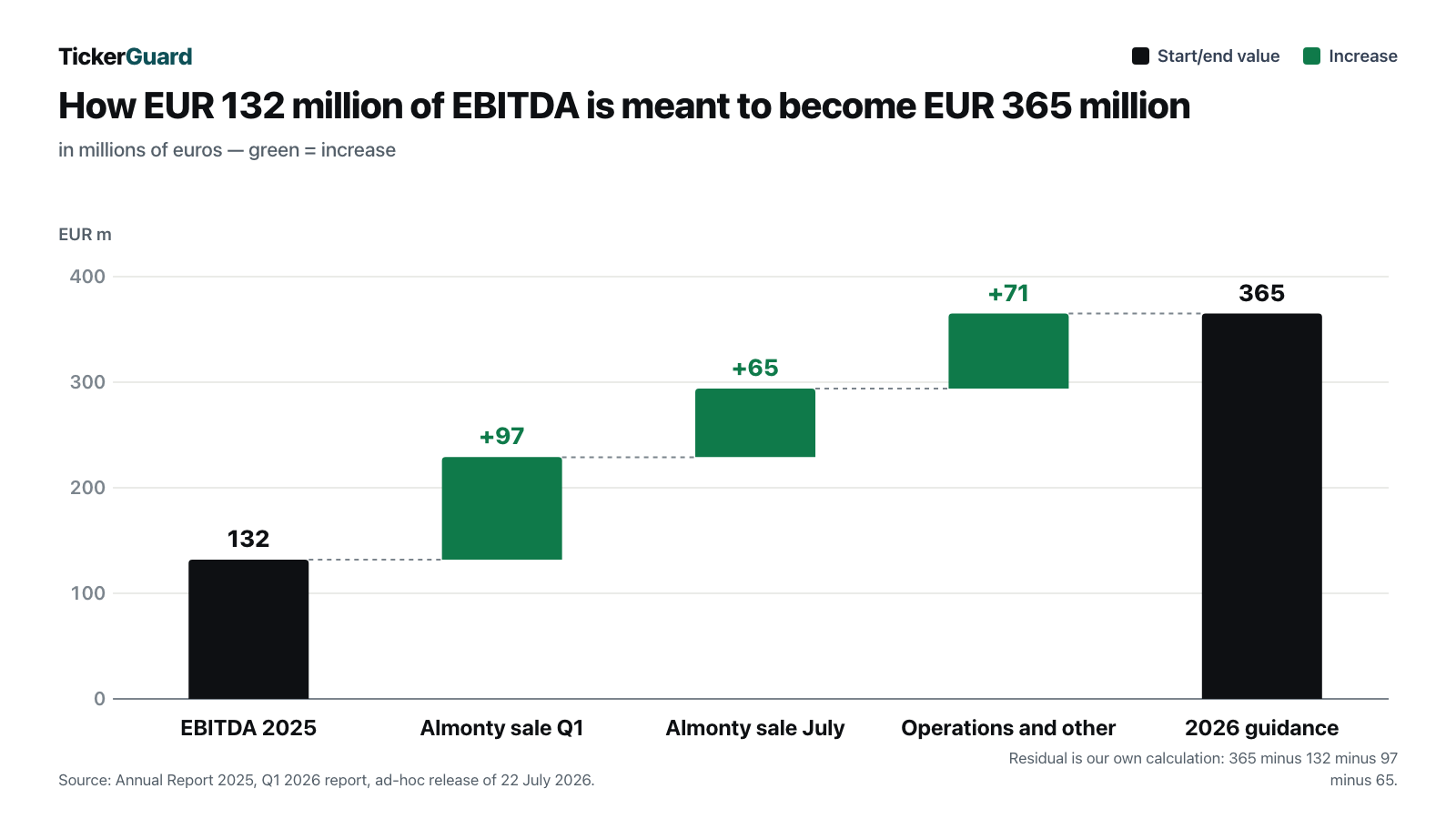
None of this is a criticism of management — quite the opposite. Buying into a tungsten miner, backing it for years with loans and convertibles, and then selling into a rally is a craft well practised. The average selling price of the July tranche was just under $16 per Almonty share, according to the ad-hoc release. It is a warning about valuation: a gain from selling shares is a car sale, not a salary. After the July tranche Deutsche Rohstoff still holds around 5.5 million Almonty shares plus convertible bond and loan receivables — a supply that is finite.
Uncomfortable truth no. 2: The oil business itself has been shrinking, not growing
While consolidated earnings exploded, the core business moved the other way. The 2025 annual report names the reasons without embellishment:
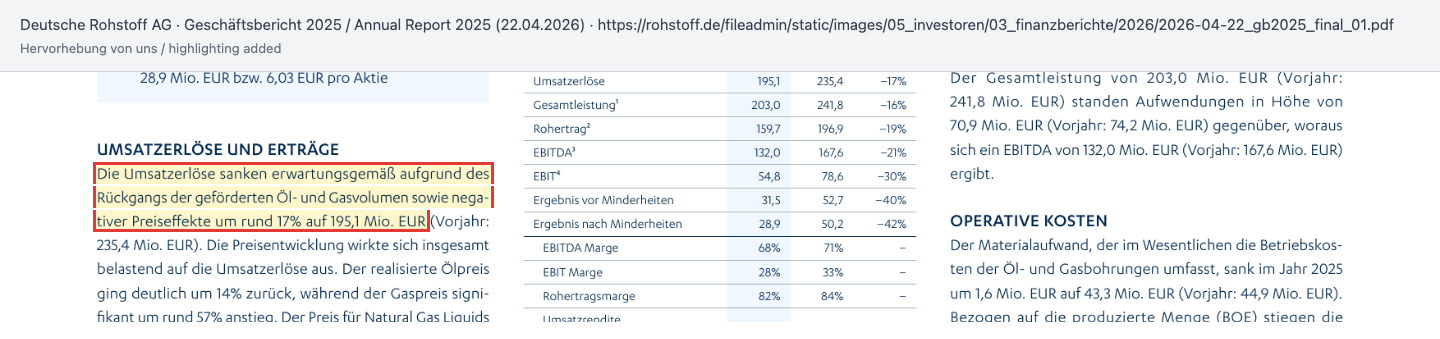
"Revenues declined as expected by around 17% to EUR 195.1 million (previous year: EUR 235.4 million) due to the decline in oil and gas volumes produced and negative price effects."
— Deutsche Rohstoff AG, Annual Report 2025 (April 22, 2026), group management report, page 34; the German original is the authoritative version
At the same time every barrel produced got more expensive. Operating costs rose from $9.00 to $9.90 per barrel of oil equivalent in 2025 — and then jumped again in the first quarter of 2026:
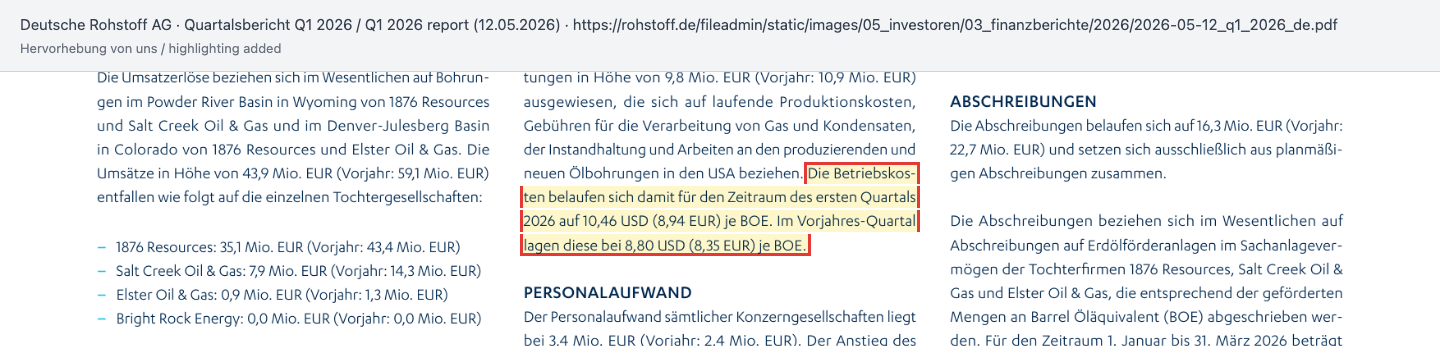
Costs per barrel up 19 percent while barrels are down 15 percent — that is the pair of scissors every producer fears. Deutsche Rohstoff reacted: from one rig at the end of February 2026 it went to two within 13 working days and to three by the end of March; the 2026 drilling programme was expanded from ten to 26 operated gross wells and capital expenditure raised to EUR 215 to 235 million. On June 3, 2026 the company reported that the first four new wells on the Dillon/Billings pad were producing a combined 6,000 barrels of oil per day three weeks after start-up, and that output would rise above 20,000 barrels of oil equivalent per day from July. For the full year 2026 the annual report projects 17,000 to 18,000 barrels of oil equivalent per day. That would be a genuine turnaround — but so far it appears in no published quarterly figure. The first mandatory report that could show it is the half-year report on August 19, 2026.
Uncomfortable truth no. 3: The hedge protects on the way down — and costs on the way up
A producer that plans its capital spending hedges part of its future output. That is sensible and standard in the industry. It also cuts both ways. A swap fixes the price in both directions: if oil falls below the agreed level, the counterparty pays the difference; if it rises above it, the company pays. A collar installs a floor and a ceiling; a put is pure downside insurance.
As of March 31, 2026, Deutsche Rohstoff's hedge book covered 1.594 million barrels of oil out to the first quarter of 2028. Of that, 1.049 million barrels were swaps at an average price of $72.60, 275,000 barrels were collars (average ceiling $78.20, floor $62.70) and 270,000 barrels were puts with a floor of $50.00; add 1.844 million MMBtu of natural gas. For the remaining three quarters of 2026, 983,000 barrels are hedged — against guidance of 17,000 to 18,000 barrels of oil equivalent per day and an expected oil share of around 70 percent, that is roughly a third of the expected oil volume.
In the first quarter of 2026 the hedge cost money for the first time in a while: the average WTI price of $72.74 sat just above the swap level, so hedging came in at minus $1.08 per barrel, or EUR 0.4 million — after a gain of $2.37 per barrel in full-year 2025. Because German accounting rules require the item to be netted against revenue, you cannot see it in the income statement; it hides inside the top line. Remember the picture: a hedge is insurance — and insurance costs money in good years.
Uncomfortable truth no. 4: "Present value of reserves" is an estimate with a price assumption baked in
The largest number in the company's communication is the present value of its oil and gas reserves. The 2025 annual report puts it like this:
"The present value of these reserves increased by 38% to USD 542 million – based on a conservative assumption of USD 60 per barrel of WTI. At an oil price of USD 80, this present value already amounts to USD 1.1 billion."
— Deutsche Rohstoff AG, Annual Report 2025 (April 22, 2026), letter to shareholders, page 6; the German original is the authoritative version
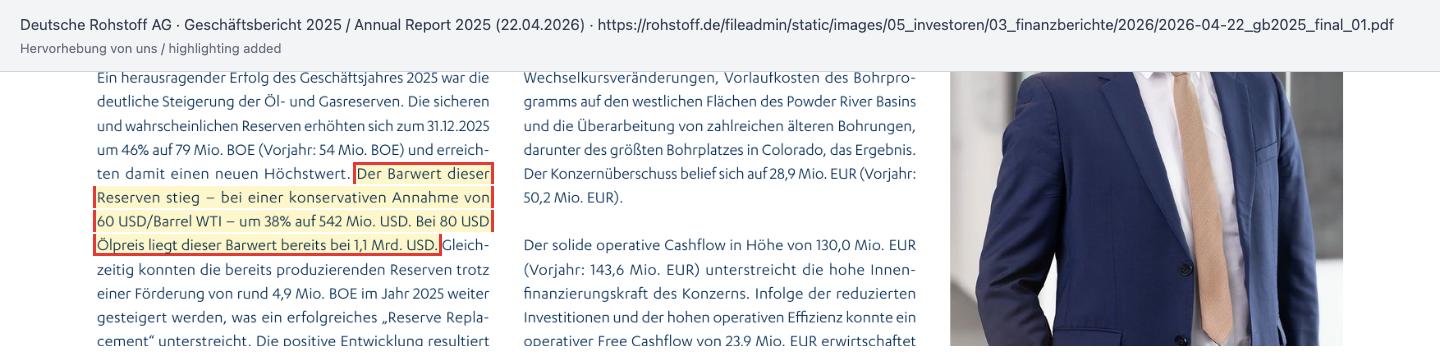
The figure is properly derived, but it needs its definition or it will be misread. According to the ad-hoc release of February 2, 2026: independent evaluators assess more than 99 percent of the reserves under standards accepted by the U.S. securities regulator, the SEC. Net cash flow is derived from oil and gas revenue less production taxes, operating costs and capital expenditure, then discounted at 10 percent — the metric is called PV10. Partner interests and royalties are already deducted. Proved and probable reserves rose 46 percent to 79 million barrels of oil equivalent as of December 31, 2025, of which 29 million come from wells already producing (present value $393 million).
Three caveats belong with that number. First, hedging transactions are not included in the calculation. Second, the Ohio acreage acquired in 2025 is not included either. Third — and this is the big one — the value hangs on a price assumption nobody knows: between $60 and $80 per barrel the present value roughly doubles. Put in everyday terms: this is like valuing an orchard using the apple price of the next fifteen years. The trees really are there. Nobody knows the price.
Uncomfortable truth no. 5: The money is earned in dollars and reported in euros
Every barrel is produced in the United States and sold in U.S. dollars; every figure in the consolidated accounts is in euros. In between sits the exchange rate — and in 2025 and 2026 it was no side show. In fiscal 2025 the weaker dollar cost the group EUR 7.7 million of revenue, according to the revenue bridge in the management report, which is three percentage points of the total 17 percent decline. In the first quarter of 2026, another EUR 4.3 million of currency losses landed in other operating expenses (prior-year quarter: EUR 1.3 million). And equity carries its own line, "equity differences from currency translation", which stood at minus EUR 10.0 million as of March 31, 2026 (December 31, 2025: minus EUR 17.2 million).
There is a second structural trap: not every consolidated euro belongs to the shareholders of Deutsche Rohstoff. The group holds 97.6 percent of 1876 Resources, 93.0 percent of Elster Oil & Gas, 95.0 percent of Bright Rock Energy and 72.5 percent of Germany's Ceritech AG. The minority interests' share of earnings was EUR 2.6 million in 2025 and EUR 0.7 million in the first quarter of 2026. That is manageable — but it explains why the consolidated accounts always carry two earnings lines: EUR 31.5 million before and EUR 28.9 million after minorities in 2025. For the stock, the second one is what counts.
One more participation model deserves a mention because it is unusual for a German company: managers of the U.S. subsidiaries are given so-called "profits interests" — non-voting profit participations under U.S. law that typically pay out only when a subsidiary is sold or distributes profits over the long run. The 2025 annual report names thirteen employees and board members holding such units. The advantage from the group's point of view: no say in decisions, and no need to hand out parent-company stock options. The price: part of the value created when a subsidiary is sold does not belong to the listed parent.
Valuation: cheap against a year that does not repeat
To the prices. The stock closed at EUR 80.60 on Xetra on August 4, 2026 (previous day: EUR 81.10). For context, the documented anchors from the reports: an opening price of EUR 32.20 at the start of 2025, an all-time high of EUR 55.30 in October 2025, a year-end 2025 close of EUR 49.00 — and in March 2026 the shares traded above EUR 100.00 at times, according to the annual report.
The share count matters more than one might think. On August 3, 2026 the company announced the early completion of its 2026 buyback programme — 83,306 shares at an average of EUR 90.03, roughly EUR 7.5 million in total. The number of dividend-bearing shares fell 1.7 percent to 4,706,735; together with the 2024 and 2025 programmes, around 6.1 percent of the share capital has been bought back and cancelled. That gives a market capitalisation of roughly EUR 379 million. Beware of quote portals: some still use the old count of 5,005,438 shares and therefore arrive at more than EUR 400 million.
Now the orders of magnitude. On 2025 earnings per share of EUR 6.03, the price-to-earnings ratio is around 13. Enterprise value — market capitalisation plus bonds (EUR 193.0 million) plus bank debt (EUR 36.1 million) minus cash and marketable securities (EUR 148.7 million, all as of March 31, 2026) — comes to roughly EUR 459 million. Against 2025 EBITDA of EUR 132.0 million that is about 3.5 times; against the 2026 guidance midpoint of EUR 365 million it is only 1.3 times. And this is exactly where the bank-statement trap springs shut: strip out the roughly EUR 162 million from the Almonty sales and you are left with operating EBITDA of around EUR 203 million — and a multiple of about 2.3. Still low for a producer, but a very different number.
A second anchor to read just as carefully: the PV10 of proved and probable reserves of $542 million converts, at the rate of $1.15 per euro that the company assumes in its base case, to roughly EUR 471 million — more than the market capitalisation of around EUR 379 million. That sounds like a cushion, but it is not one: PV10 is a value before group debt of EUR 229.1 million, before holding company costs and before taxes. Turning it into an "intrinsic value" counts the same money twice.
On distributions: for 2025 the annual general meeting on June 23, 2026 approved a dividend of EUR 2.25 per share (prior year: EUR 2.00) with 99.80 percent of votes in favour. At the August 4, 2026 close that is a yield of around 2.8 percent. For a comparison with a pure U.S. producer without an equity portfolio, see our analysis of SandRidge Energy — there the entire enterprise value sits in the oil business, without the extra layer of a holding company.
Opportunities and risks at a glance
What speaks for Deutsche Rohstoff:
- Solid balance sheet: equity ratio of 47.8 percent as of March 31, 2026 (after 38.1 percent at year-end 2025), cash and marketable securities of EUR 148.7 million, EBITDA interest coverage of 8.5 as of December 31, 2025 and net debt to EBITDA of 1.1.
- The largest organic reserve increase in company history: proved and probable reserves up 46 percent to 79 million barrels of oil equivalent as of December 31, 2025, evaluated by independent experts under SEC-accepted standards.
- Proven operational speed: from one rig to three in under a month (February to March 2026), drilling programme expanded from ten to 26 operated gross wells, and per the June 3, 2026 release slightly ahead of plan and within budget.
- Consistent capital returns: 2025 dividend raised to EUR 2.25 per share (annual general meeting June 23, 2026, 99.80 percent approval), three consecutive buyback programmes completed early, around 6.1 percent of share capital cancelled in total.
- The remaining Almonty position of around 5.5 million shares plus convertibles and loans as a hidden reserve that German accounting keeps off the balance sheet.
What speaks against it:
- Around EUR 162 million of the EUR 365 million 2026 EBITDA guidance comes from two Almonty sale tranches — a one-off gain that will not repeat once the stake is run down.
- The operating business has been shrinking: revenue down 17 percent in 2025 and 26 percent in the first quarter of 2026, output down 15 percent, operating cash flow down 37 percent, operating costs per barrel of oil equivalent up from $8.80 to $10.46.
- The promised production ramp above 20,000 barrels of oil equivalent per day from July 2026 is not yet evidenced by any published mandatory report — the half-year report on August 19, 2026 is the first test.
- Earnings depend on the oil price and the exchange rate: the base case assumes $75 per barrel, $3.50 per mcf of gas and $1.15 per euro; currency effects alone cost EUR 7.7 million of revenue in 2025 and a further EUR 4.3 million of expense in the first quarter of 2026.
- Funding is almost entirely via bonds: EUR 193.0 million nominal with coupons of 7.50 percent (due September 26, 2028) and 6.00 percent (due November 13, 2030) — in an environment where refinancing terms move with the oil price.
- A narrow market: 4,706,735 dividend-bearing shares at last count, a listing in the Scale open-market segment, and management and supervisory board holding around 10 percent at the end of 2025.
A human conclusion
Back to the bank statement. Deutsche Rohstoff's will show the finest balance in company history for 2026 — EUR 355 to 375 million of EBITDA after EUR 132.0 million the year before. None of it is dressed up; the company discloses every source, and the ad-hoc release of July 22, 2026 names the reason in its second sentence. But the statement itself does not sort. It shows one number, and our heads turn that into a story about a booming oil business, when in truth two very different stories sit side by side: a core business that shrank in 2025 and in the first quarter of 2026 and whose turnaround still has to be proved — and an equity sale that worked brilliantly and, for exactly that reason, only works once.
So the honest question is not "is the record year real?" — it is real. It is: which lines of this bank statement come back in 2027? The annual report itself gives a surprisingly sober answer: for 2027 the company projects EBITDA of EUR 210 to 230 million — well below 2026 and well above 2025. Somewhere in between, without share sales, lies the actual bet. On August 19, 2026 the half-year report arrives and shows the first half of the answer. What you make of it is your decision. And that is exactly how it should be.
Sources
Every primary document used in this analysis — to read for yourself:
- Deutsche Rohstoff AG — Annual Report 2025 (published April 22, 2026, HGB consolidated accounts, English translation) · authoritative German version
- Deutsche Rohstoff AG — Q1 2026 quarterly report (published May 12, 2026, unaudited, English translation) · authoritative German version — the most recent published periodic report
- Deutsche Rohstoff AG — ad-hoc release on the 2026 reserve report (February 2, 2026)
- Deutsche Rohstoff AG — corporate news on the 2026 U.S. drilling programme (June 3, 2026)
- Deutsche Rohstoff AG — ad-hoc release raising 2026 guidance (July 22, 2026)
- Deutsche Rohstoff AG — corporate news on completing the share buyback (August 3, 2026)
- Deutsche Rohstoff AG — financial calendar 2026 (retrieved August 4, 2026): half-year report 2026 due August 19, 2026
- Hook: ranking of most-discussed stocks on wallstreet-online.de (retrieved August 4, 2026, 24-hour window): Deutsche Rohstoff 44th, Almonty Industries 3rd
- Share prices: Xetra closing prices via ariva.de (retrieved August 4, 2026), cross-checked against the price data in the annual reports.
- Fundamental data (key figures, valuation; data as of August 4, 2026), reconciled with the annual and quarterly reports.
Transparency & disclaimer: this analysis is journalistic commentary on publicly available information. It is not investment advice, not a regulated financial analysis and not a solicitation to buy or sell securities. Equity investments carry substantial risk up to and including total loss. All information without warranty; the data cut-off is stated in the text. The most recent published periodic report is the quarterly report as of March 31, 2026, published May 12, 2026; the 2026 half-year report is due on August 19, 2026 and may supersede individual statements in this analysis. Positions held by the operator are disclosed daily; where one exists, it appears as a notice at the top of this deep dive.
Our Bottom Line at a Glance
- Earnings quality negative
- Of the 2026 EBITDA guidance of EUR 355 to 375 million, around EUR 162 million comes from two sale tranches of the Almonty Industries stake (roughly EUR 97 million in the first quarter, roughly EUR 65 million per the ad-hoc release of July 22, 2026). That is a one-off gain, not a recurring one.
- Operating trend negative
- Revenue fell 17 percent to EUR 195.1 million in 2025 and a further 26 percent to EUR 43.9 million in the first quarter of 2026. Output dropped from 14,549 to 12,322 barrels of oil equivalent per day year over year (full-year 2025 average: 13,537), operating costs rose from $8.80 to $10.46 per barrel of oil equivalent, and operating cash flow fell 37 percent.
- Balance sheet and funding positive
- Equity ratio of 47.8 percent as of March 31, 2026 after 38.1 percent at year-end 2025, with EUR 148.7 million of cash and marketable securities against EUR 193.0 million of bonds and EUR 36.1 million of bank debt. EBITDA interest coverage was 8.5 as of December 31, 2025 and net debt to EBITDA 1.1.
- Reserves and growth plan positive
- Proved and probable reserves rose 46 percent to 79 million barrels of oil equivalent as of December 31, 2025, with a PV10 of $542 million at $60 per barrel of WTI. The 2026 drilling programme was expanded from ten to 26 operated gross wells and capital expenditure raised to EUR 215 to 235 million.
- Guidance uncertainty neutral
- The announced output of more than 20,000 barrels of oil equivalent per day from July 2026 is so far evidenced only by the corporate news release of June 3, 2026, not by a periodic report. The 2026 half-year report on August 19, 2026 is the first mandatory filing that can show it.
- Capital returns and ownership positive
- The 2025 dividend was raised to EUR 2.25 per share and approved on June 23, 2026 with 99.80 percent of votes in favour; the third consecutive buyback programme was completed early (83,306 shares at an average of EUR 90.03, announced August 3, 2026), with around 6.1 percent of share capital cancelled in total. Management and supervisory board held around 10 percent at the end of 2025.
Deutsche Rohstoff AG will post the best result in its history in 2026 — but around EUR 162 million of the projected EUR 365 million of EBITDA comes from selling Almonty shares, not from production. The oil business itself shrank in 2025 and in the first quarter of 2026, costs per barrel rose, and the announced production ramp from July 2026 still has to be proved by the half-year report on August 19, 2026. The balance sheet is stable throughout: a 47.8 percent equity ratio and EUR 148.7 million of cash and marketable securities. Not investment advice.
What Our Rating Means
Open questions
The business works in principle, but one material question is open. As long as it stays open, our findings do not carry a quality verdict.
Yellow here is explicitly not about a threat to the substance of the business. As of March 31, 2026 the balance sheet is in good shape: a 47.8 percent equity ratio, EUR 148.7 million of cash and marketable securities against EUR 229.1 million of financial debt, EBITDA interest coverage of 8.5 at year-end 2025, and no going-concern flag. Yellow is there because two material operating questions are open. First, around EUR 162 million of the EUR 365 million 2026 EBITDA guidance comes from two Almonty sale tranches — earnings that will not repeat once the stake is run down; on our calculation, operating EBITDA is around EUR 203 million. Second, the core business has been shrinking — revenue down 17 percent in 2025 and 26 percent in the first quarter of 2026, output down 15 percent year over year, operating costs per barrel of oil equivalent up 19 percent — and the promised ramp above 20,000 barrels of oil equivalent per day from July 2026 is documented in no periodic report so far. The business model itself clearly works: reserves of 79 million barrels of oil equivalent with a present value of $542 million at a conservatively assumed oil price of $60, guidance met for years running, and a very lean cost base with 60 employees group-wide. Whether the operating questions resolve will not be visible before the half-year report on August 19, 2026. The decision is yours.
A journalistic assessment by our editorial team at the time of the deep dive, based on public sources — not investment advice and not a solicitation to buy or sell. Your personal circumstances (investment goals, risk capacity, taxes) cannot be taken into account. What our levels mean, how verdicts are formed, and what conflicts of interest exist →
Worth Noting
- The hook for this analysis is the ranking of most-discussed stocks on wallstreet-online.de (retrieved August 4, 2026, 24-hour window): Deutsche Rohstoff in 44th place with seven posts, its own holding Almonty Industries in 3rd place with 60 posts. That is an attention signal, not a metric and not a recommendation.
- The most recent published periodic report is the quarterly report as of March 31, 2026 (published May 12, 2026). The 2026 half-year report is due on August 19, 2026 per the financial calendar and may supersede statements on output, the hedge book, the remaining Almonty stake and debt. All price and valuation figures are as of August 4, 2026.
- The company reports under the German Commercial Code (HGB), not IFRS: hedging results are netted against revenue, investments may be carried at no more than cost, and increases in value only reach the income statement on sale. Comparisons with IFRS reporters are therefore limited; the 2025 annual report contains its own reconciliation.
- Possible confusion: the symbol DR0.DE is shorthand for "Deutsche Rohstoff, listed in Germany" — not an official exchange code. Not to be confused with the German Mineral Resources Agency (DERA) at the Federal Institute for Geosciences and Natural Resources, a government body with no connection to the listed company.
- The 2026 revenue corridor of EUR 260 to 310 million quoted in the Q1 2026 report was deliberately not used: the ad-hoc release of July 22, 2026 gives current revenue guidance as EUR 260 to 280 million, as does the key-figure table in the 2025 annual report.
The full analysis as a PDF for later
We will send you this analysis as a PDF — to print, file away, and read at your own pace.
Frequently Asked Questions
Deutsche Rohstoff AG, based in Mannheim, Germany, is a holding company. Its money is earned by U.S. subsidiaries producing oil and natural gas in the Powder River Basin (Wyoming) and the Denver-Julesburg Basin (Colorado). It also holds a portfolio of listed mining stakes, the largest being tungsten producer Almonty Industries. The group employed an average of 60 people in 2025.
The shares trade in the Scale segment of the open market at the Frankfurt Stock Exchange, not in the United States — there is no 10-K, no 10-Q and no SEC registration. Reporting follows German law: audited consolidated accounts, a half-year report, quarterly reports and ad-hoc releases. This analysis relies on the 2025 annual report and the quarterly report as of March 31, 2026.
Because a large part of the result comes not from selling oil but from selling shares in Almonty Industries. Those gains flow into EBITDA as other operating income without generating any revenue. Around EUR 97 million arrived in the first quarter of 2026 and a further EUR 65 million in July 2026 — together, roughly EUR 162 million of the EUR 365 million projected.
Almonty Industries is a Canadian tungsten producer with mines in Portugal and South Korea, listed on Nasdaq since 2025. Deutsche Rohstoff held around 8 percent at the end of 2025 and sold roughly 14 million shares in two 2026 tranches for a combined earnings contribution of around EUR 162 million. After the July sale, around 5.5 million shares plus loans and convertible bonds remain.
As of March 31, 2026 the balance sheet showed bonds of EUR 193.0 million (coupons of 7.50 percent to September 2028 and 6.00 percent to November 2030) and bank debt of EUR 36.1 million, against EUR 148.7 million of cash and marketable securities. The equity ratio stood at 47.8 percent and EBITDA interest coverage at 8.5 as of year-end 2025.
It is the discounted net cash flow of proved and probable oil and gas reserves — revenue less production taxes, operating costs and capital expenditure, discounted at 10 percent (PV10), with partner interests and royalties already deducted. The figure assumes an oil price of $60 per barrel of WTI; at $80 per barrel it would be $1.1 billion.
Yes. For fiscal 2025 the annual general meeting on June 23, 2026 approved a dividend of EUR 2.25 per share (prior year: EUR 2.00) with 99.80 percent of votes in favour. At the Xetra close of EUR 80.60 on August 4, 2026 that is around 2.8 percent. The company has also bought back and cancelled its own shares every year since 2024.
The 2026 half-year report is due on August 19, 2026 according to the financial calendar, and the third quarter report on November 17, 2026. The half-year report is the first mandatory filing that must show whether the announced production ramp above 20,000 barrels of oil equivalent per day from July 2026 actually materialised.
Found an error?
Did you spot a factual error, an outdated number, or a typo in this deep dive? Let us know briefly — your report goes straight to the editorial team.