Avino Silver & Gold: No. 5 on Toronto's Leaderboard – but 82 Percent of the New Money Came From Shareholders
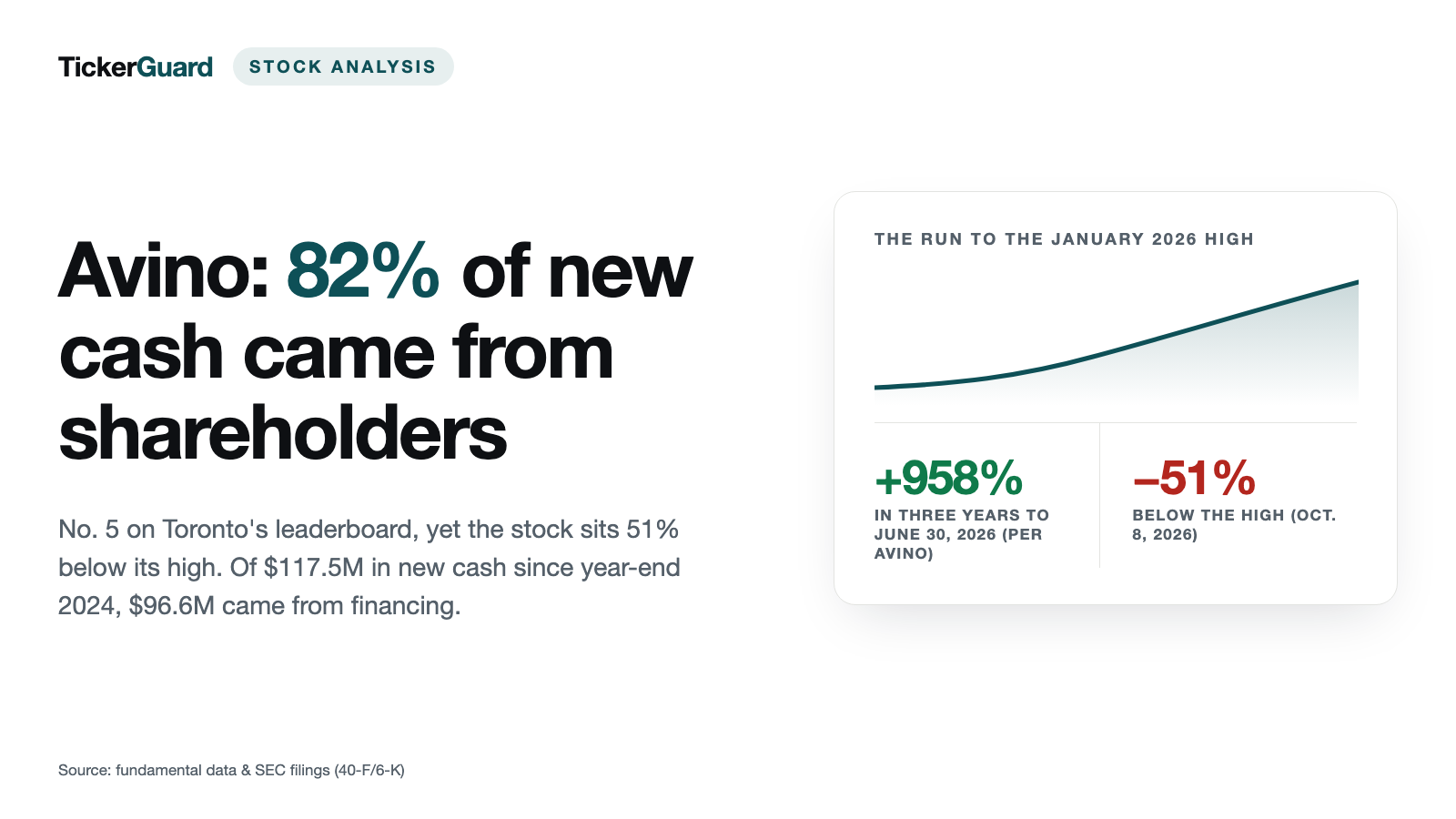
Avino (TSX and NYSE American: ASM) ranks fifth on Toronto's TSX30 leaderboard, yet sat 51 percent below its high on October 8, 2026. Of the $117.5 million in new money in its record cash pile since year-end 2024, $96.6 million came from financing, mostly new shares — the award tells you about the last race, not the next one.
 Thomas Mücke
Founder & Publisher
Thomas Mücke
Founder & Publisher
As of Today
As of: October 9, 2026
- Closing price
- 5.46 $ +2.63%
- Market Capitalisation
- 0.9 $B
- P/E
- 21.0
This analysis has a cut-off date. The Stock Guard tells you when something material changes in the numbers. Reserve your free spot
Chart
Interactive price chart (TradingView).
Last price: 5.46 $ (As of: October 9, 2026)
Note: pure fact-based analysis, not investment advice and not a solicitation to buy or sell. All figures without guarantee.
Up 958 percent in three years, No. 5 on Toronto's leaderboard — and still 51 percent below its high on October 8, 2026. If a trophy like that makes you think “winner,” you are already inside the investor weakness this piece is about: the trophy trap. A trophy tells you who won the last race, not who will win the next one.
On September 9, 2026, Avino Silver & Gold Mines announced that it had been named to the TSX30 for the second year in a row — the list of the 30 stocks with the strongest gains on the Toronto Stock Exchange over three years, measured by dividend-adjusted share price appreciation. The 958 percent for the three years to June 30, 2026 is the company's figure; measured in U.S. dollars on the NYSE American, our price data show roughly 860 percent, from $0.66 to $6.34. By the day of the announcement, the high was more than seven months old: on January 28, 2026 the stock closed at $11.24; on October 8, 2026 it closed at $5.46. And the record cash pile? Of the $117.5 million it grew by since year-end 2024, $96.6 million — 82 percent — came from financing, mostly from selling new shares. So here is the deal: we put the trophy aside for a moment and read what Avino itself files with the U.S. securities regulator, the SEC. At the end, you decide.

What Avino actually does
Avino is a small silver producer based in Vancouver, incorporated in 1968. It mines ore in Mexico, grinds it in its own mill and sells a concentrate of silver, gold and copper to metal traders and smelters. At the end of 2025, it had 294 employees in Mexico and 11 in Canada. Two sites matter:
- The Avino Mine near Durango — a historic mine in which Avino holds 99.67 percent. It supplies most of the metal today; in the second quarter of 2026 it accounted for 155,650 of the 184,293 tonnes milled.
- La Preciosa — a large, long-undeveloped silver deposit about 20 kilometers southwest, which Avino bought from U.S. miner Coeur Mining in March 2022. Since April 1, 2025 it has been accounted for as a development project; in August 2025, Avino paid $13.25 million in cash plus a deferred payment to buy back all royalties and contingent payments still attached to the deposit. The ore travels by truck to the Avino Mine's mill.
The business model is the same as every miner's: costs per tonne are largely fixed, the selling price is the metal price. When silver rises, the margin grows disproportionately. Avino says it does not hedge its metal production — so the lever works unhindered, in both directions. Keep in mind the tension that runs through this piece: the trophy and the record cash pile shine — but most of the money came from shareholders, the mine is delivering less metal despite a high silver price, and the future depends on a deposit that is not yet in regular production.
Company history for investors
-
2022
La Preciosa bought from Coeur Mining
In March, Avino acquires the large silver deposit next to its own mine. For shareholders: a growth project — paid for in part with new shares issued to Coeur.
-
2025
Royalties bought back, $77 million from share sales
In August, Avino buys back all royalties on La Preciosa. Over the year, the company sells 16.5 million new shares into the market for $77.0 million.
-
2026
Share price high and silver record on January 28
The stock closes at $11.24 and silver stands at about $114.59 — the peak of the run for which Avino receives the award in September.
-
2026
First mineral reserves and a buyback program
In April, Avino reports first reserves for La Preciosa and the Avino Mine, 127 million silver-equivalent ounces combined with the oxide tailings, and launches a buyback of up to 8.4 million shares.
-
2026
A second quarter with less metal
Silver down 6 percent, copper down 50 percent, revenue 32 percent below the prior quarter. In September, the second TSX30 trophy in a row follows anyway.
How the stock landed on our desk
Through our in-house Reddit hype scanner: on October 9, 2026, ASM ranked 148th with three mentions in 24 hours — a thin trigger and not a buy signal, but reason enough to hold the story up against the filings.
The numbers over the years — given their due
Let's start with what is genuinely impressive. Avino is not an explorer living on hope; it is a mine that makes money. Revenue was about $44 million in both 2022 and 2023, rose to $66.2 million in 2024 and to $92.2 million in 2025. Net income climbed from $0.5 million (2023) to $8.1 million and then $26.6 million (2025). The first half of 2026 added another $26.8 million, slightly more than in the whole prior year ($26.6 million). The main driver is the silver price: in 2023 Avino realized an average of $23.46 per ounce, in 2025 $44.70 and in the first half of 2026 $74.62.
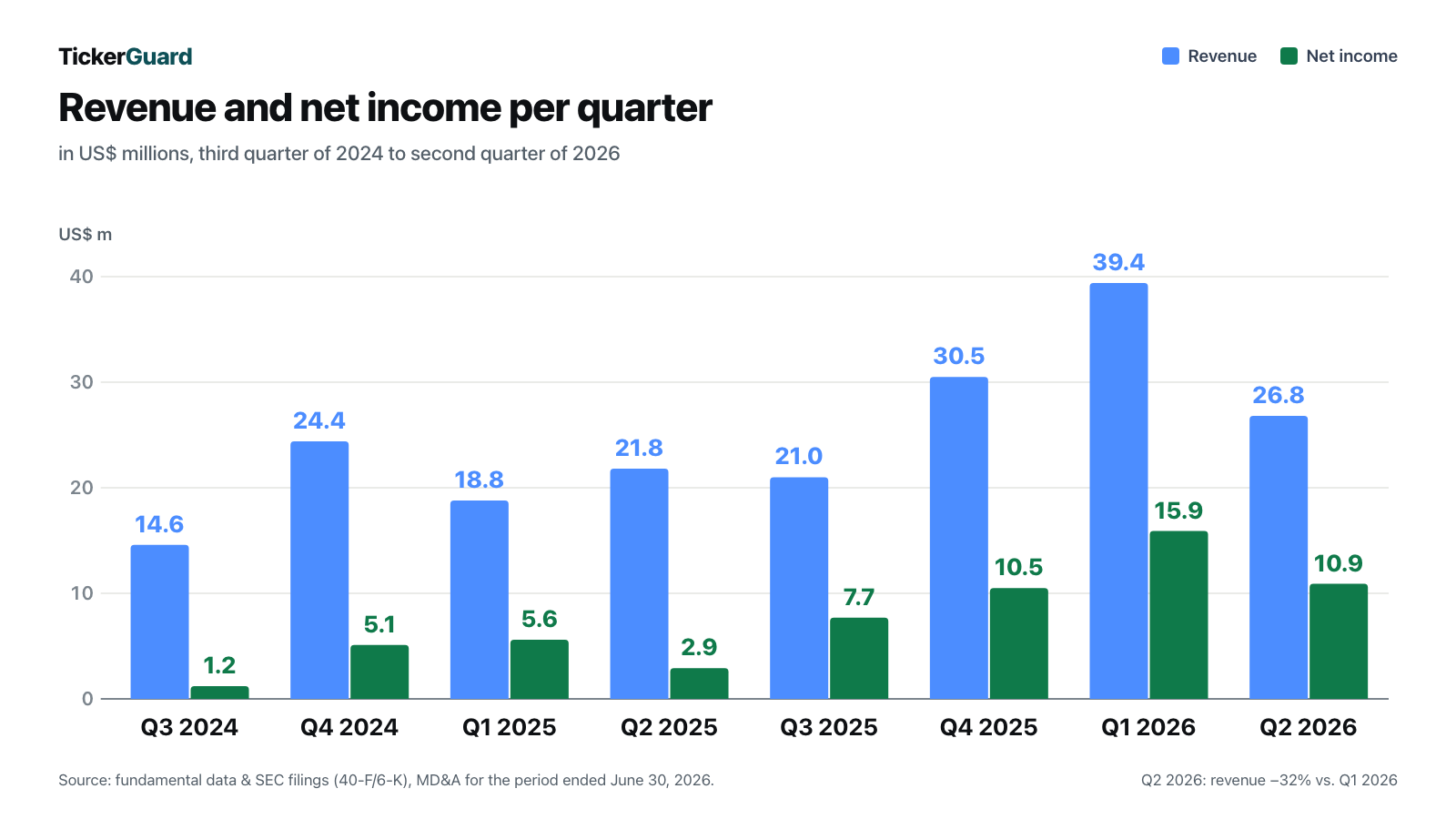
The margin is remarkable. In the first half of 2026, $36.4 million of the $66.2 million in revenue remained after direct mine costs — 55 percent. Operations brought in $26.9 million in cash; capital spending was $6.5 million. Avino has no bank debt, only leases and equipment loans totaling $8.6 million plus a deferred payment of $8.7 million from the royalty buyback (June 30, 2026). Equity stood at $282.6 million and cash at $144.8 million — a record.
But the chart also shows the first dent in the trophy. The second quarter of 2026 brought in far less revenue than the first, even though silver still fetched $68.90 on average. The MD&A points to fewer silver equivalent ounces sold than in previous periods. On top of that comes an item it lists under mine operating income: because concentrate is first invoiced at provisional prices and settled later, adjustments for changes in metal prices and metal contents cost $5.2 million in the quarter. How the metal volumes look is the second uncomfortable truth. The first concerns the cash.
What the filings say — the uncomfortable truths
Now come the passages you cannot see next to the trophy. All of them come from the mandatory filings Avino has made with the SEC.
Uncomfortable truth No. 1: The full cash pile comes mostly from shareholders
At the end of 2024, Avino had $27.3 million in cash; on June 30, 2026, it had $144.8 million. An increase of $117.5 million — and the cash flow statement shows where it came from. So that the 82 percent does not sound sharper than it is: without the one-time buyback of the La Preciosa royalties ($13.25 million in 2025), the business would have contributed about $34 million after investments instead of $20.9 million. Even then, by far the larger part of the new money came from financing.
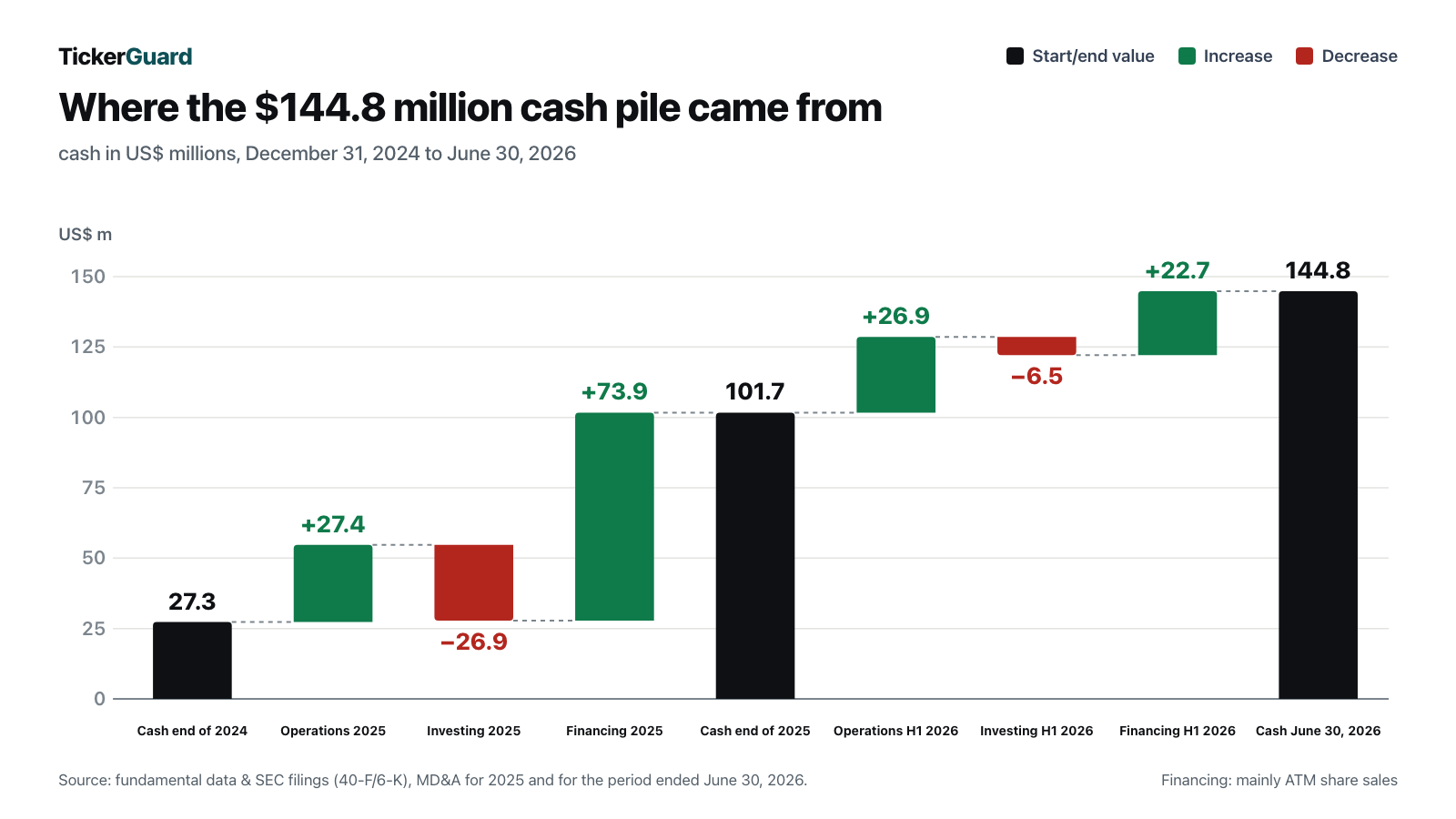
In 2025, operating cash flow of $27.4 million barely covered capital spending of $26.9 million — although that included the one-time $13.25 million La Preciosa royalty buyback. The rest of the cash increase came from share sales under a so-called at-the-market (ATM) program: Avino continuously sells new shares directly into the market at the prevailing price. The MD&A for the period ended June 30, 2026 describes the second program:

“In November 2025, the Company announced a new at-the-market (the ‘2025 ATM #2’) sales agreement for gross proceeds of up to $60 million. At March 31, 2026, the Company had received gross proceeds of approximately $59 million in connection with the 2025 ATM #2.”
— Avino Silver & Gold Mines, MD&A for the period ended June 30, 2026, Liquidity and Capital Resources
In shares: according to the interim financial statements, Avino issued 16,504,560 new shares into the market in 2025 for $77.0 million gross, and another 3,099,435 in the first half of 2026 for $25.7 million — together 19.6 million shares for $102.7 million, plus a 2.75 percent commission to the banks. Dilution means your slice of the pie gets smaller when new slices are cut for new shareholders. In the second quarter of 2026, Avino's weighted average share count was 170.0 million, against 144.1 million a year earlier — 18 percent more. On August 12, 2026, 169,855,271 shares were outstanding, just under 175 million including options and share units.
In fairness: Avino sold the new shares while the price was high. In the first half of 2026, Avino realized about $8.28 per new share on average. Since April 2026, the company has been buying back its own stock under a normal course issuer bid (NCIB) — up to 8,428,566 shares through April 7, 2027. By August 12, 2026, however, it had repurchased only 548,039, at prices from $5.65; by our calculation the average was about $5.97 per share including costs. Measured against the 19.6 million shares sold, that is just under 3 percent. The trophy says “record cash”; the cash flow statement says who filled the till.
Uncomfortable truth No. 2: Silver 104 percent pricier than a year ago, but less metal
This is where the trophy misleads most. In the second quarter of 2026, Avino received $68.90 for every ounce of silver, 104 percent more than in the second quarter of 2025 — even though silver has fallen sharply again since its January 2026 high. Revenue nevertheless rose only 23 percent. The July 22, 2026 production release explains why:
- Silver: 267,305 ounces, 6 percent less than in the second quarter of 2025. Recovery — the share of silver in the ore that ends up in the concentrate — fell from 85 to 69 percent.
- Copper: 729,929 pounds, 50 percent less. The copper grade of the ore dropped from 0.42 to 0.30 percent.
- Gold: 2,178 ounces, 23 percent more — the one bright spot.
Avino converts all three metals into a conversion unit, the silver equivalent (AgEq): gold and copper are translated into “silver ounces” using their price ratio to silver. Think of a baker who converts rolls and cakes into “loaves.” When silver rises faster than gold and copper, the same copper suddenly counts as fewer “silver ounces.” Part of the 43 percent drop in equivalent ounces sold is therefore a conversion effect, as the MD&A itself acknowledges. The physical figures above are not.
The awkward part is the comparison with the company's own outlook. On February 19, 2026, Avino guided to 1.0 to 1.2 million ounces of silver, 5,000 to 7,000 ounces of gold and 6.0 to 7.5 million pounds of copper for 2026 — and wrote about copper:
“… even though production for silver and gold remains constant, and copper production is expected to increase.”
— Avino Silver & Gold Mines, 2026 outlook (6-K, release of February 19, 2026)
After the first half, Avino had produced 530,362 ounces of silver and 4,029 ounces of gold — both on track. Copper stood at 2,073,583 pounds, 32 percent less than a year earlier and only 28 to 35 percent of full-year guidance. Avino explains the decline with planned mine sequencing into lower-copper areas and with near-surface material outside the reserves that it chose to process: good silver and gold grades, but lower and partly oxidized copper that recovers worse. The February outlook, by contrast, still spoke of rising copper production; the MD&A offers no reconciliation with that guidance. To reach the low end of 6.0 million pounds, Avino would have to produce about 3.9 million pounds in the second half, almost twice as much as in the first. Costs ran above plan too: all-in sustaining costs per equivalent ounce sold (AISC — the full cost of an ounce including sustaining capital and overhead) were $38.75 in the second quarter. Even using the price ratios from its own guidance, the figure was $31.81; Avino had promised $25 to $27 for the full year. We have also logged the copper gap as a side find.
Uncomfortable truth No. 3: La Preciosa is being ramped up without a feasibility study
Avino's future is called La Preciosa. On April 16, 2026, the company reported mineral reserves for La Preciosa and the Avino Mine for the first time — tonnages that qualify as economically mineable under a recognized standard. Together with the old oxide tailings, which have carried a reserve since 2024, they total 27 million tonnes containing 127 million silver-equivalent ounces, including 95 million ounces of silver; La Preciosa alone accounts for 11 million tonnes with 72 million ounces of silver at 206 grams per tonne. That is a real milestone, because a resource is merely “there,” while a reserve is “worth mining.” Yet the same MD&A contains a sentence that Canadian miners must include under the NI 43-101 rule when they produce without such a study:
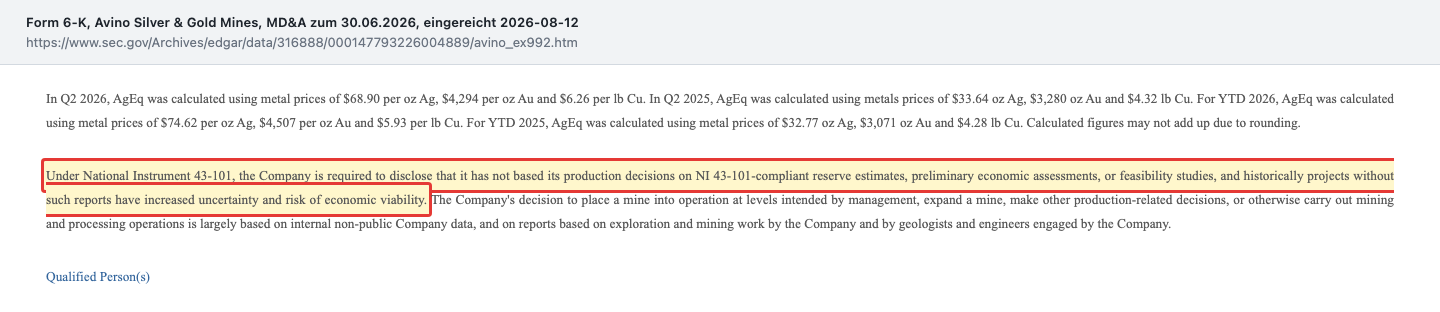
“Under National Instrument 43-101, the Company is required to disclose that it has not based its production decisions on NI 43-101-compliant reserve estimates, preliminary economic assessments, or feasibility studies, and historically projects without such reports have increased uncertainty and risk of economic viability.”
— Avino Silver & Gold Mines, MD&A for the period ended June 30, 2026, Production Results by Operation
The La Preciosa figures show what that means in practice. In the second quarter of 2026, 28,643 tonnes of development ore went to the mill, roughly twice as much as in the first quarter (14,098 tonnes) — about 315 tonnes a day. The target for the second half of 2026 is 500 tonnes a day. The ore contained 153 grams of silver per tonne, three times the Avino Mine's grade, but only 60 percent of it reached the concentrate. The reason: it is development ore from the access drifts, diluted with waste rock. According to the MD&A, actual production mining with wider stopes is due to begin soon on Level 3 of the Abundancia and Gloria veins; preparation is said to be nearly complete, but Avino gives no exact date. Until then, the ore also runs below the reserve average of 206 grams. Whether the ore keeps traveling 20 kilometers by truck to the old mill or a stand-alone plant gets built is still under study. For a look at a silver producer that runs several mines side by side, see our Silvercorp Metals analysis; for the company that owned La Preciosa until 2022, see our Coeur Mining analysis.
Uncomfortable truth No. 4: One dominant customer and a service company owned by the CEO
Avino sells its concentrate to very few buyers. The annual report is clear about it:
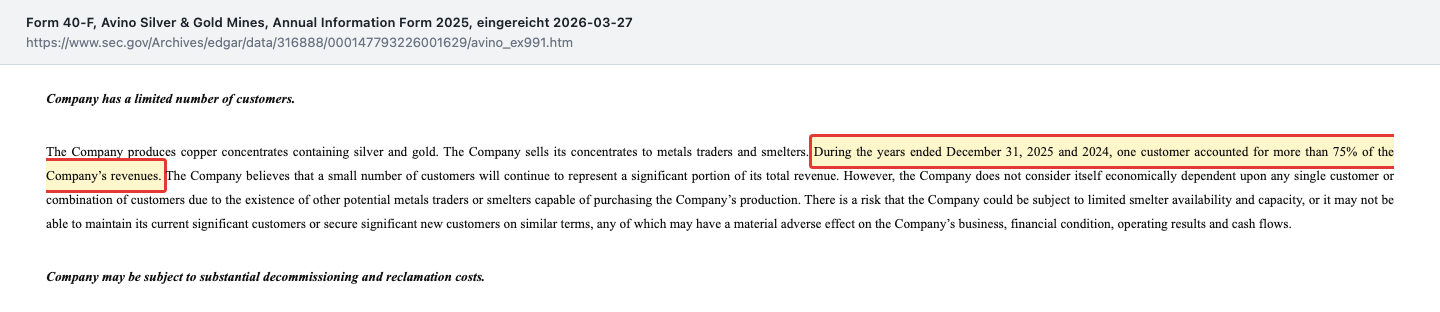
“During the years ended December 31, 2025 and 2024, one customer accounted for more than 75% of the Company’s revenues.”
— Avino Silver & Gold Mines, 40-F 2025, Exhibit 99.1 (Annual Information Form), Risk Factors
Avino says it does not consider itself economically dependent, because other traders and smelters could also buy the concentrate; according to the same Annual Information Form, the Avino Mine's concentrate is sold under a long-term agreement with Samsung C&T U.K. Limited. That is plausible; concentrate is a tradable commodity. But if that one buyer drops out or tightens terms, three quarters of revenue are hit at once.
The second point concerns administration. Avino obtains office space, staff and administrative services in Vancouver through a cost-sharing agreement with Oniva International Services — at a 2.5 percent markup. The interim financial statements name the owner:
“The President & CEO, and director of the Company, is the sole owner of Oniva.”
— Avino Silver & Gold Mines, Interim financial statements for the period ended June 30, 2026, Note 10 (Related Party Transactions)
The CEO is David Wolfin, a director since 1995. In the first half of 2026, Avino paid Oniva $1.31 million and another $181,000 to his consulting firm Intermark Capital. Against first-half net income of $26.8 million that is small, and it is fully disclosed. But it is a setup in which the CEO sits on both sides of the table. According to the 2026 meeting circular, Wolfin held about 5.17 million shares directly and indirectly, roughly 3 percent.
Uncomfortable truth No. 5: The figures in the filings do not always agree
That sounds pedantic, but it is not. Contradictions between the press release and the MD&A are a nuisance for investors, because they have to check every number twice. In the MD&A for the period ended June 30, 2026, this sentence sits right below the quarterly table:
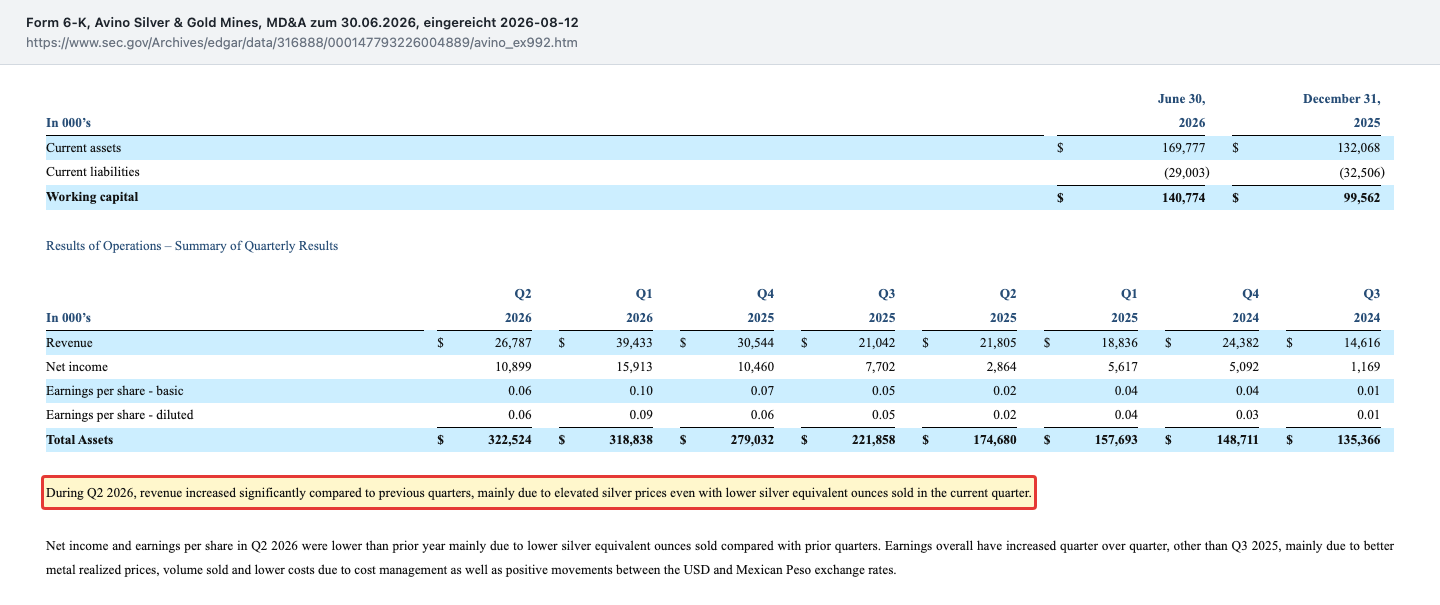
“During Q2 2026, revenue increased significantly compared to previous quarters, mainly due to elevated silver prices even with lower silver equivalent ounces sold in the current quarter.”
— Avino Silver & Gold Mines, MD&A for the period ended June 30, 2026, Summary of Quarterly Results
Against the prior-year quarter that is true; against the immediately preceding quarter it is not: revenue fell 32 percent. And it is not the only instance. Adjusted earnings per share for the second quarter of 2026 are $0.06 in the results release and $0.14 in the highlights of the MD&A, while its own table shows $0.06 — $11.1 million divided by roughly 175 million shares gives $0.06. The buyback cap appears in three documents with three numbers: 8,428,566 shares in the April 6, 2026 release and in the interim statements, 8,423,566 in the results release, 8,248,566 in the MD&A. First-half silver output is 530,632 ounces in the results release and in the MD&A’s key figures table, but 530,362 in the production release and in the production tables of the same MD&A. Even cash at June 30, 2026 appears as $144,183,000 in the results release and in the MD&A liquidity table, but as $144,783,000 on the balance sheet of the interim financial statements — we use the balance sheet figure. None of these errors changes the picture of the company, and the financial statement tables are consistent as far as we have recalculated them. But for a company with a market value of almost $1 billion, that is a conspicuous number of discrepancies — and a good reason to check every number in a press release against the table.
Valuation: what the market pays for Avino
On October 8, 2026, the stock closed at $5.46 on the NYSE American. With 169,855,271 shares (as of August 12, 2026), that gives a market capitalization of about $927 million. Subtracting cash of $144.8 million and adding leases, equipment loans and the deferred royalty payment ($17.2 million combined, June 30, 2026) puts enterprise value at about $800 million.
- Price-to-earnings: on net income for the twelve months to June 2026 ($45.0 million), the P/E is about 21. You are paying a little over 20 years of earnings — earnings that in this period owe a great deal to the silver price.
- Price-to-sales: about 7.9 on $117.8 million of trailing twelve-month revenue. You are paying almost eight years of revenue — for a company whose revenue tracks the silver price directly and fell 32 percent from the prior quarter in the second quarter of 2026.
- Price-to-book: about 3.3 on $282.6 million of equity. For every dollar on the balance sheet, the market pays $3.30; the premium is essentially a bet that La Preciosa delivers.
- Dividend: none. According to the annual report, Avino has never paid a dividend since its incorporation and does not plan one.
- The professionals' view: according to fundamental data (as of October 9, 2026), four analysts cover the stock, two rating it “strong buy” and two “buy”; the average price target is $10.76. With so few voices, that is more of a sample than a consensus — and these are third-party views, not a recommendation from us.
One more calculation belongs here, and it goes straight to the trophy. Trailing earnings were earned at silver prices that brought Avino between $44.70 (full year 2025) and $74.62 (first half of 2026) on average. On January 28, 2026, silver stood at about $114.59 according to fundamental data; on October 8, 2026, at about $59.59. The stock has followed silver in both directions: over the twelve months to early October 2026, it ranged on a closing basis between $4.14 (November 6, 2025) and $11.24 (January 28, 2026). A P/E of 21 is no bargain for a small producer with one mine and one project — it assumes that La Preciosa lifts output substantially.
Upside and risks at a glance
What speaks for the company:
- A mine that makes money. $26.6 million of net income in 2025, $26.8 million in the first half of 2026, a 55 percent mine margin in the half-year.
- A very strong balance sheet. $144.8 million of cash, no bank debt, $282.6 million of equity (June 30, 2026).
- First reserves for both mines. Since April 2026, together with the oxide tailings, 27 million tonnes containing 127 million silver-equivalent ounces, plus measured and indicated resources of 301 million ounces.
- Avino owns La Preciosa outright. No third-party royalties since August 2025, and the ore can run through the existing mill.
- Unhedged silver leverage. No price hedging: when silver rises, almost every extra dollar lands in the margin.
What speaks against it:
- Less metal. Silver down 6 percent, copper down 50 percent in the second quarter of 2026; the 2026 copper target is far off after six months.
- Cash from share sales. 19.6 million new shares for $102.7 million since the start of 2025; the average share count rose 18 percent within a year.
- La Preciosa is unproven. No feasibility study, development ore at 60 percent recovery, 315 tonnes a day in the second quarter of 2026 — the 500-tonne target only applies from the second half.
- Concentration risks. One customer with more than 75 percent of revenue, all mines in one Mexican state, higher mining royalties since 2025 and a strong peso that pushes up costs.
- Silver cuts both ways. From the January 2026 high to early October, silver fell 48 percent and the stock 51 percent.
A human conclusion
Remember the trophy trap from the start? With Avino, it would be too easy to say: two TSX30 awards, record cash, so things are going well. But it would be just as wrong to conclude the opposite. The filings show a mine that earns decent money at high silver prices, and a balance sheet with no bank debt and $144.8 million in cash.
What the trophy does not show is the next race. The record cash pile was filled mainly by new shareholders, the old mine is delivering less metal than a year ago, and the deposit that is supposed to change everything is being ramped up without a feasibility study. Add filings in which you would rather check the numbers twice.
The next hard tests are the production release and the interim filing for the period ending September 30, 2026. Does La Preciosa make the leap toward 500 tonnes a day? Does copper come back — to reach the low end of its own full-year guidance, Avino needs about 3.9 million pounds in the second half, almost twice as much as in the first? And will the build-out be funded by the business rather than by new shares?
What you make of it is your decision. And that is how it should be.
Sources and data cut-off
Avino is incorporated under the laws of British Columbia. Its home exchange is the Toronto Stock Exchange; in the U.S. the stock trades on the NYSE American, under the ticker ASM in both places (ISIN CA0539061030). As a Canadian company, Avino reports to the SEC under the joint Canada-U.S. system (MJDS): once a year with an annual report on Form 40-F, and in between with interim financial statements and news on Form 6-K. There is no U.S. quarterly report (10-Q). The accounts follow international standards (IFRS) and are presented in U.S. dollars; the parent company's functional currency is the Canadian dollar, and most costs are incurred in Mexican pesos. The fiscal year is the calendar year.
The most recent periodic report is the interim filing for the period ended June 30, 2026, submitted on August 12, 2026 together with the results release. Through October 9, 2026, it was followed only by a mandatory report on 2025 payments to governments (Form SD, September 3) and the TSX30 release (September 9). Neither involved a capital raise.
- Interim financial statements for the period ended June 30, 2026 (IFRS, unaudited) and MD&A for the period ended June 30, 2026, both filed on Form 6-K on August 12, 2026
- Q2 2026 results release (6-K of August 12, 2026) and Q2 2026 production release (6-K of July 22, 2026)
- MD&A for the period ended March 31, 2026 (6-K of May 13, 2026)
- Annual report on Form 40-F for 2025 (March 27, 2026) with the Annual Information Form; MD&A for fiscal 2025 (6-K of March 10, 2026)
- 2024 Annual Information Form (40-F of March 12, 2025) for 2022 to 2024
- News on Form 6-K: 2026 outlook (February 19, 2026), normal course issuer bid (April 6, 2026), inaugural mineral reserves (April 16, 2026), annual meeting voting results (May 27, 2026), TSX30 recognition (September 9, 2026)
- 2026 notice of meeting and information circular (6-K of May 12, 2026)
- All filings with the SEC under CIK 0000316888; in Canada on SEDAR+
- Share price and silver price data: source fundamental data, NYSE American closing prices as of October 8, 2026
Data cut-off: company figures as of June 30, 2026 or the date stated; share count as of August 12, 2026; share price, silver price and market value as of October 8, 2026. Company filings were last checked on October 9, 2026; the most recent release remains the one of September 9, 2026. The presentation currency is the U.S. dollar. Twelve-month figures, enterprise value, the financing share of the cash increase and the copper gap are our own calculations from reported figures.
Note: This article is journalistic commentary and not investment advice. It contains no recommendation to buy or sell and is not a solicitation to buy or sell securities. Shares of small silver producers swing hard with the silver price; losses up to a total loss of the capital invested are possible. Positions held by the operator are disclosed daily; where one exists, it appears as a notice at the top of this deep dive.
Our Bottom Line at a Glance
- Profitability positive
- $26.6 million of net income in 2025 and $26.8 million in the first half of 2026 at a 55 percent mine margin. Driven mainly by the silver price: $68.90 per ounce in the second quarter of 2026 after $33.85 a year earlier.
- Balance sheet positive
- $144.8 million of cash, no bank debt and $282.6 million of equity as of June 30, 2026. Leases, equipment loans and the deferred royalty payment add up to $17.2 million.
- Output and costs negative
- In the second quarter of 2026, silver down 6 percent and copper down 50 percent; after six months only 28 to 35 percent of copper guidance. All-in sustaining costs per equivalent ounce of $31.81 on a guidance basis instead of $25 to $27.
- Source of the cash negative
- Of the $117.5 million increase in cash since the end of 2024, $96.6 million came from financing. 19.6 million new shares for $102.7 million; the average share count rose 18 percent within a year.
- La Preciosa neutral
- First reserves since April 2026: 72 million ounces of silver in La Preciosa alone, 127 million silver-equivalent ounces across all three deposits. But no feasibility study, and about 315 tonnes of development ore a day in the second quarter of 2026 at 60 percent recovery, against a target of 500.
- Customers, related parties, reporting quality negative
- One customer with more than 75 percent of revenue in 2024 and 2025, administrative services through the CEO's company Oniva at a 2.5 percent markup, and several contradictory figures in the results release and MD&A for the period ended June 30, 2026.
Avino is a small, profitable silver producer with a very strong balance sheet. Its SEC filings show, however, that the high silver price is masking weaknesses: the mine is delivering less metal, the cash pile comes mainly from selling new shares, and the La Preciosa growth project is being ramped up without a feasibility study. Add a dominant customer and filings with contradictory figures. Not investment advice.
What Our Rating Means
Open questions
The business works in principle, but one material question is open. As long as it stays open, our findings do not carry a quality verdict.
Yellow, because the business works but a material operating question is open. Avino makes money, has no bank debt and $144.8 million in cash — we see no substance risk. The open question is whether La Preciosa will offset the old mine's shrinking output: without a feasibility study, with development ore at 60 percent recovery and 315 tonnes a day in the second quarter of 2026 (target of 500 tonnes only from the second half), the ramp-up is described but not proven. Until then, earnings depend almost entirely on the silver price, more than three quarters of revenue on one customer, and the record cash pile was filled mostly by new shareholders. The P/E of about 21 is a price argument and does not change this rating. The decision is yours.
A journalistic assessment by our editorial team at the time of the deep dive, based on public sources — not investment advice and not a solicitation to buy or sell. Your personal circumstances (investment goals, risk capacity, taxes) cannot be taken into account. What our levels mean, how verdicts are formed, and what conflicts of interest exist →
Worth Noting
- This analysis was triggered by our in-house Reddit hype scanner: in the October 9, 2026 reading, ASM ranked 148th with three mentions in 24 hours. There is no hit from a fundamentals scanner.
- Avino reports to the SEC as a Canadian company under MJDS: annual report on Form 40-F, interim reports and news on Form 6-K. We reviewed the mandatory filings through the release of September 9, 2026.
- All company figures in U.S. dollars (presentation currency); the parent's functional currency is the Canadian dollar, and most costs are incurred in Mexican pesos. The stock trades in U.S. dollars on the NYSE American and in Canadian dollars in Toronto.
- Silver equivalent (AgEq) is a company conversion unit that depends on the assumed price ratios. Where possible, we therefore give the physical volumes per metal.
- Twelve-month figures, enterprise value, the financing share of the cash increase ($96.6 million of $117.5 million, 82 percent) and the copper gap are our own calculations from reported figures. The three-year share price gain (about 860 percent) is based on NYSE American closing prices in U.S. dollars; the 958 percent figure is the company's.
Stock Watch
This analysis is as of October 9, 2026. Stock Watch will tell you what's changed at ASM since then.
Later $1 a month per stock — signing up is free, and you'll be the first to know when it launches.
The full analysis as a PDF for later
We will send you this analysis as a PDF — to print, file away, and read at your own pace. And we will add you to the free Stock Watch list for Avino Silver & Gold Mines Ltd (ASM), so you hear about it when something material in this analysis changes.
Frequently Asked Questions
Avino is a Canadian silver producer based in Vancouver. It operates the Avino Mine near Durango, Mexico, and is developing the La Preciosa silver deposit about 20 kilometers away. It sells a concentrate of silver, gold and copper. In 2025, Avino reported revenue of $92.2 million and net income of $26.6 million.
La Preciosa is a large silver deposit in Durango that Avino bought from Coeur Mining in March 2022. It has been in development since April 2025 and free of third-party royalties since August 2025. In the second quarter of 2026 it delivered about 315 tonnes of ore a day; the target from the second half of 2026 is 500 tonnes.
In the second quarter of 2026, Avino produced 6 percent less silver and 50 percent less copper than a year earlier. The company cites lower-copper mining areas and development ore from La Preciosa with low recovery. Silver recovery fell from 85 to 69 percent, and the copper grade from 0.42 to 0.30 percent.
On June 30, 2026, Avino held $144.8 million in cash, up from $27.3 million at the end of 2024. Of the increase, $96.6 million came from financing, mainly at-the-market share sales: 19.6 million new shares for $102.7 million since the start of 2025. Operations contributed $20.9 million after capital spending.
Yes. Since April 8, 2026, a normal course issuer bid allows Avino to repurchase up to 8,428,566 shares through April 7, 2027. By August 12, 2026, Avino had bought back 548,039 shares. That is just under 3 percent of the 19.6 million shares the company has issued since the start of 2025.
No. According to its 2025 annual report, Avino has never paid a dividend since its incorporation in 1968 and does not expect to declare one in the foreseeable future. Shareholder returns come only through the buyback program launched in 2026. Earnings are reinvested in La Preciosa and the Avino Mine.
The stock trades on the Toronto Stock Exchange and the NYSE American, under the ticker ASM in both places; the ISIN is CA0539061030. As a Canadian company, Avino reports to the SEC with an annual report on Form 40-F and interim filings on Form 6-K, prepares its accounts under IFRS and presents them in U.S. dollars.
Found an error?
Did you spot a factual error, an outdated number, or a typo in this deep dive? Let us know briefly — your report goes straight to the editorial team.