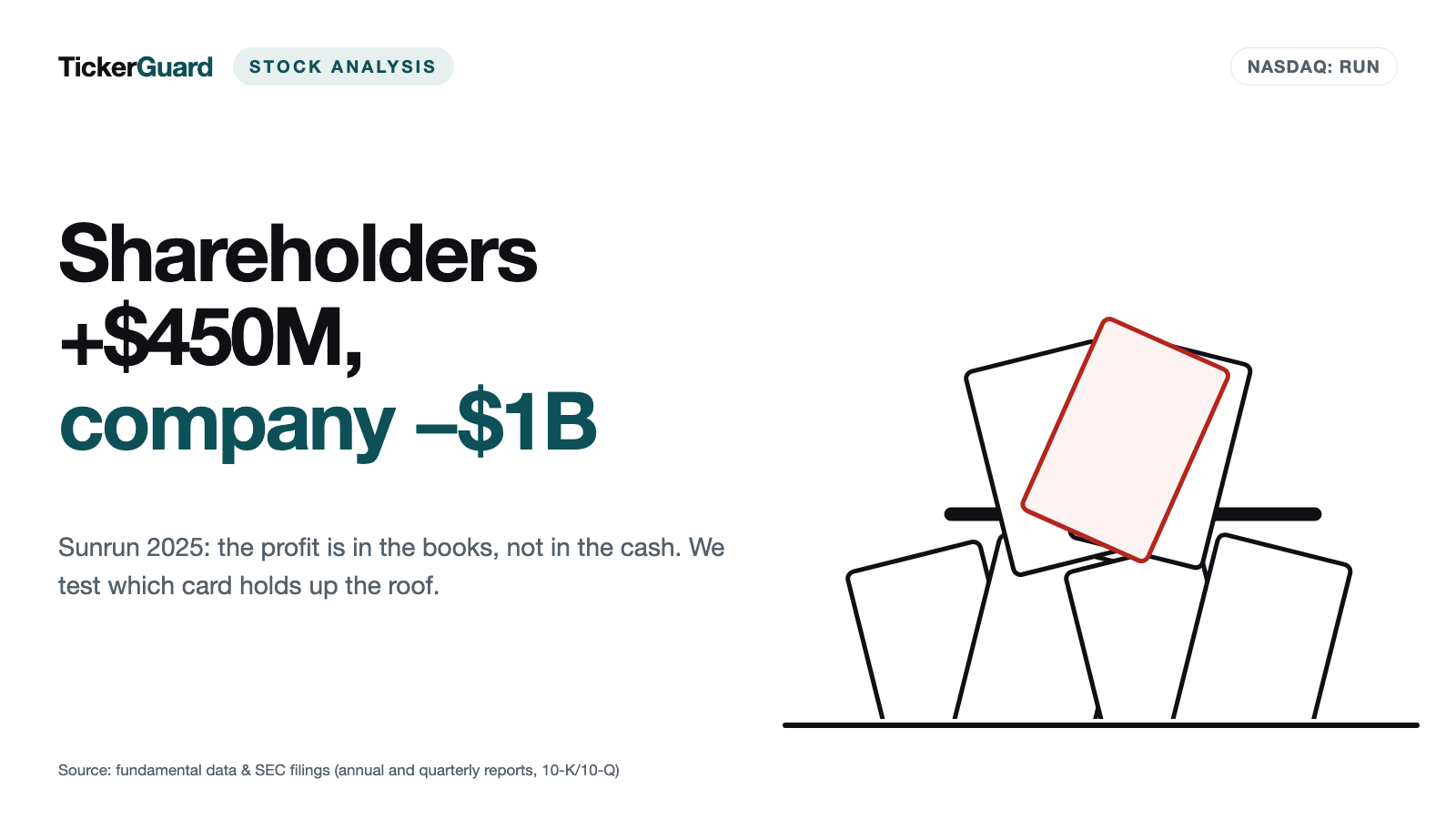
Sunrun: $450M profit for shareholders, $1B loss for the company
Sunrun stock has lost about two-thirds of its value since January 2026, and a price-to-earnings ratio of about 5 looks like a fire sale. But this P/E is not a discount — it is a formula: the profit for shareholders is created in the accounting for its investment funds, while the company as a whole loses money, owes about $15.2 billion and has cut its outlook. Our basis is Sunrun’s filings with the SEC through the quarterly report of August 5, 2026.
 Thomas Mücke
Founder & Publisher
Thomas Mücke
Founder & Publisher
As of Today
As of: October 8, 2026
- Closing price
- 7.60 $ -0.26%
- Market Capitalisation
- 1.8 $B
- P/E
- 5.2
- Growth Score
- 1/10
- AAQS
- 1/10
Price change since October 8, 2026: +0.1%
This analysis has a cut-off date. The Stock Guard tells you when something material changes in the numbers. Reserve your free spot
Chart
Interactive price chart (TradingView).
52-week range: 7.60 $ to 21.40 $ · Last price: 7.60 $ (As of: October 8, 2026)
Note: pure fact-based analysis, not investment advice and not a solicitation to buy or sell. All figures without guarantee.
You know the feeling in front of a sign that says “65% off.” Your brain stops calculating and starts reaching. In the stock market, that reflex is the sale-sign trap: a stock that has lost two-thirds of its value and trades at a price-to-earnings ratio of 5 has to be a bargain, right? The shares of Sunrun (Nasdaq: RUN) of San Francisco carry exactly that sign. They closed at $21.41 on January 28, 2026, and at $7.59 on October 8, 2026, a drop of about 65 percent. And for 2025, Sunrun reports $449.9 million of net income for its shareholders. So here is the deal: before you decide, let’s read together what Sunrun itself reported to the U.S. securities regulator, the SEC — the annual report (10-K) for 2025, the quarterly reports (10-Q) through June 30, 2026, and the earnings release of August 5, 2026. False statements in an SEC filing carry penalties, which is why it pays to look inside. And these filings describe a profit the company never actually earned. In the end, you decide.
What Sunrun actually does — solar and storage on subscription
Sunrun installs solar panels and batteries on single-family homes but usually does not sell them. The customer signs a lease or power purchase agreement, typically for 20 or 25 years, and pays monthly with nothing down. Think of Sunrun as a car rental company that buys every car on credit and then leases it out for a quarter of a century. As of June 30, 2026, Sunrun had 1,034,738 subscribers, 10 percent more than a year earlier, and a network of home batteries with 4,647 megawatt-hours of capacity. Three out of four new customers (74 percent in the second quarter of 2026) now add a battery. The company was founded in 2007, acquired its rival Vivint Solar on October 8, 2020, and had about 9,059 full-time employees as of December 31, 2025.
The systems cost a lot of money before the first monthly payment arrives. Sunrun pays for them from three sources: federal tax credits, which it sells to or shares with investors; investment funds with outside partners; and loans secured only by the systems themselves. That defines the central tension of this analysis: on the roof sits a solid, growing subscription business — but it is financed through a web of funds, tax credits and debt that reports a profit for shareholders the company’s cash does not show. The stock story is big, too: on August 5, 2026, Sunrun pointed to a non-binding letter of intent with Renew Home and Tesla, announced in June, to deliver more than 16 gigawatts of flexible capacity to data centers and utilities. Sounds like AI hype? Partly, yes — a letter of intent is not a contract.
Company history for investors
-
2007
Founded in San Francisco
Sunrun starts selling solar power to homeowners without them having to buy the system. The subscription model is built on outside capital from day one.
-
2015
IPO on Nasdaq
Since August 2015, the stock has traded under the ticker RUN. Shareholders have stood behind fund partners and project lenders in line ever since.
-
2020
Acquisition of Vivint Solar
Closed on October 8, 2020. The goodwill it created was fully written off in 2023 and 2024, a combined $4.28 billion.
-
2025
“One Big Beautiful Bill” tax law
From July 4, 2025: solar credit only with construction start by July 4, 2026, or service by the end of 2027; storage through 2033. The business model gets an expiration date.
-
2026
August: outlook cut
Cash Generation 2026 now $200M–$375M instead of $250M–$450M, −$36M after the first half (+$14M excluding safe harbor). The stock fell from $10.49 to $9.38 the next day.
How the stock landed on our desk
Sunrun reached our list through a quiet signal from the Reddit hype scanner (3 mentions in 24 hours, rank 145 instead of 331; ApeWisdom, as of October 9, 2026), typical after a sell-off, when investors go looking for the bottom. The numbers that circulate invite you to buy. According to fundamental data, the P/E ratio stood at about 5.2 (data as of October 9, 2026) and the market value at about $1.83 billion; by our own calculation the price-to-book ratio is about 0.5. For a company with more than a million paying customers, that looks like a pricing error. Keep the finding in mind from the start: at Sunrun, the P/E is not a valuation but the output of an accounting method. The next chapter shows how. If you want to meet another storage name with a similarly big story, read our analysis of Eos Energy.
The numbers over the years — given their due
First, what genuinely impresses. Revenue rose 45 percent in 2025 to $2,957.0 million (2024: $2,037.7 million), and another 48 percent in the first half of 2026 to $1,592.2 million. In the second quarter of 2026, Sunrun posted operating income of $34.8 million (prior-year quarter: −$112.2 million). The operating cash outflow, the money the day-to-day business consumes, shrank from $848.8 million (2022) to $421.4 million (2025). The subscriber network is growing, the battery share is rising and customers stay for decades. One caveat belongs here: a large part of the revenue jump comes from an arrangement Sunrun started in the third quarter of 2025, selling new customers’ systems to an investor instead of keeping them. That lifted energy systems and product sales in the second quarter of 2026 by 193 percent to $326.3 million. Now the chart that explains this whole chapter:
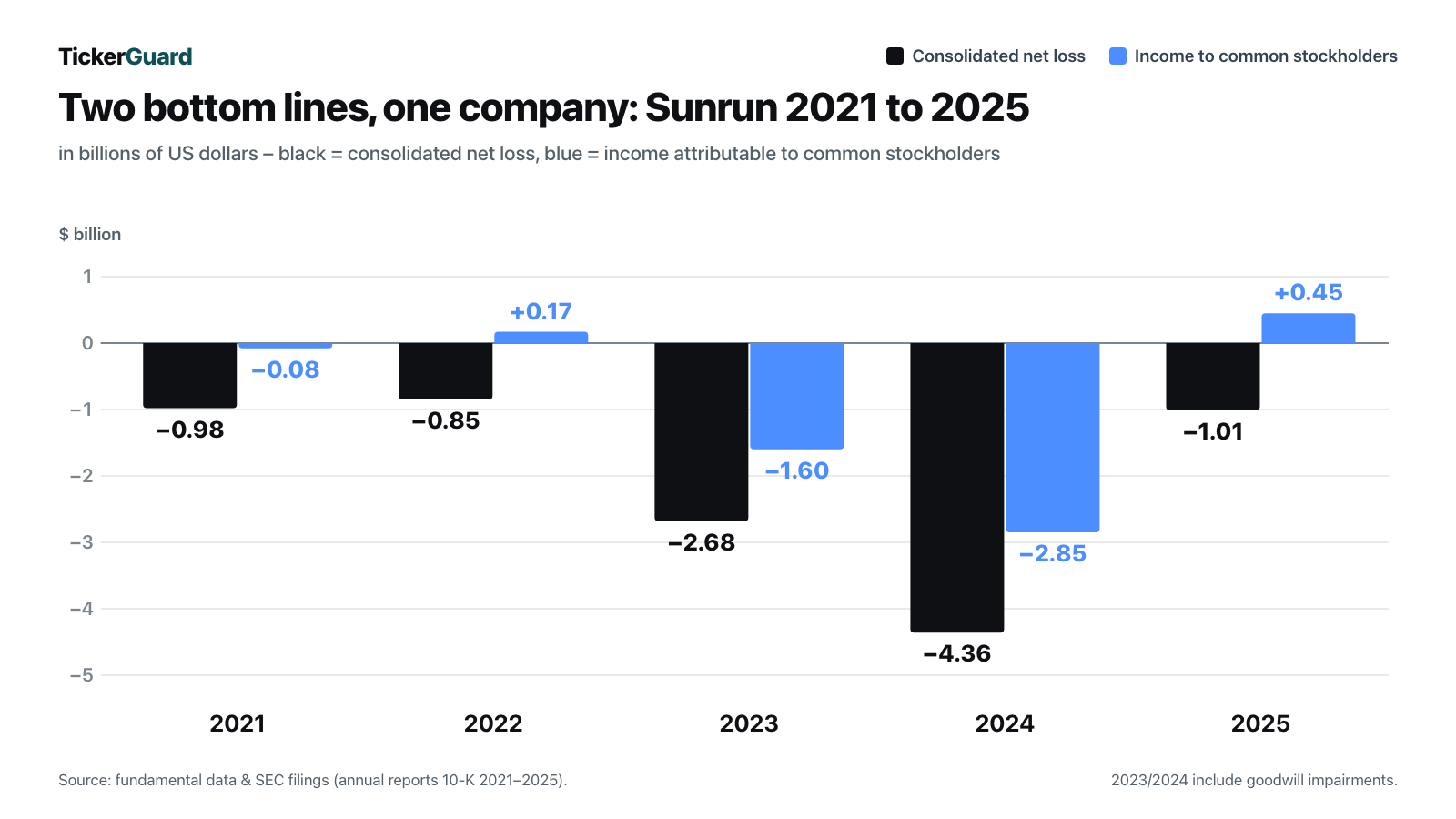
The black bars are what the company as a whole earns or loses. They are below zero in every single year: −$980.5 million (2021), −$849.6 million (2022), −$2,682.8 million (2023), −$4,355.2 million (2024) and −$1,009.1 million (2025). 2023 and 2024 include goodwill impairments of $1.16 billion and $3.12 billion from the Vivint deal; since the end of 2024, that goodwill has been carried at zero. Even without those charges, 2023 and 2024 would still show losses. The blue bars are your share as a common stockholder. They are higher every year, at +$449.9 million in 2025. The first half of 2026 repeats the pattern: company −$505.5 million, shareholders +$282.8 million. Remember this picture: the company loses, the shareholders win — and someone else carries the difference, at least on paper.
Uncomfortable truth No. 1: The profit belongs to an accounting method
Who carries the difference? The partners in Sunrun’s investment funds. They come in for the tax benefits and, in return, are allocated an outsized share of the losses in the early years. Sunrun splits fund results using a method called HLBV, “hypothetical liquidation at book value”: at every balance sheet date, you imagine the fund being liquidated at book value and calculate who would get what. The change in that hypothetical claim is booked as the partners’ income or loss. In 2025, that came to −$1,459.1 million for the partners, which is exactly why common stockholders were left with a profit. The quarterly report states the logic in one sentence:
“Investment funds generally allocate more loss to the noncontrolling interest in the first several years after fund formation.”
— Sunrun Inc., SEC quarterly report 10-Q as of June 30, 2026, Item 2 MD&A

An everyday picture: two friends buy a vacation home together. One mainly wants to save taxes and therefore has almost all the costs allocated to him in the early years. The other suddenly sees a profit in his household budget — even though the house costs exactly as much as before. This is not illegal; it is an accounting method permitted under U.S. GAAP and common in the industry for such fund agreements, and Sunrun discloses it in full. But it means: the P/E of about 5 does not measure what Sunrun earns, it measures how losses are split between partners. And because the effect works mainly in young funds, it takes a steady stream of new funds to keep the picture this way. Sunrun’s own risk factors say the fund accounting is complex enough to raise the risk of errors.
Uncomfortable truth No. 2: One-third of revenue goes to interest
A subscription model built on credit has a price, and it sits on one line of the income statement: interest expense. In 2025, Sunrun paid $996.8 million in net interest, 33.7 percent of revenue. In 2022, it was $445.8 million, or 19.2 percent. The first half of 2026 added another $528.4 million (prior year: $474.6 million).
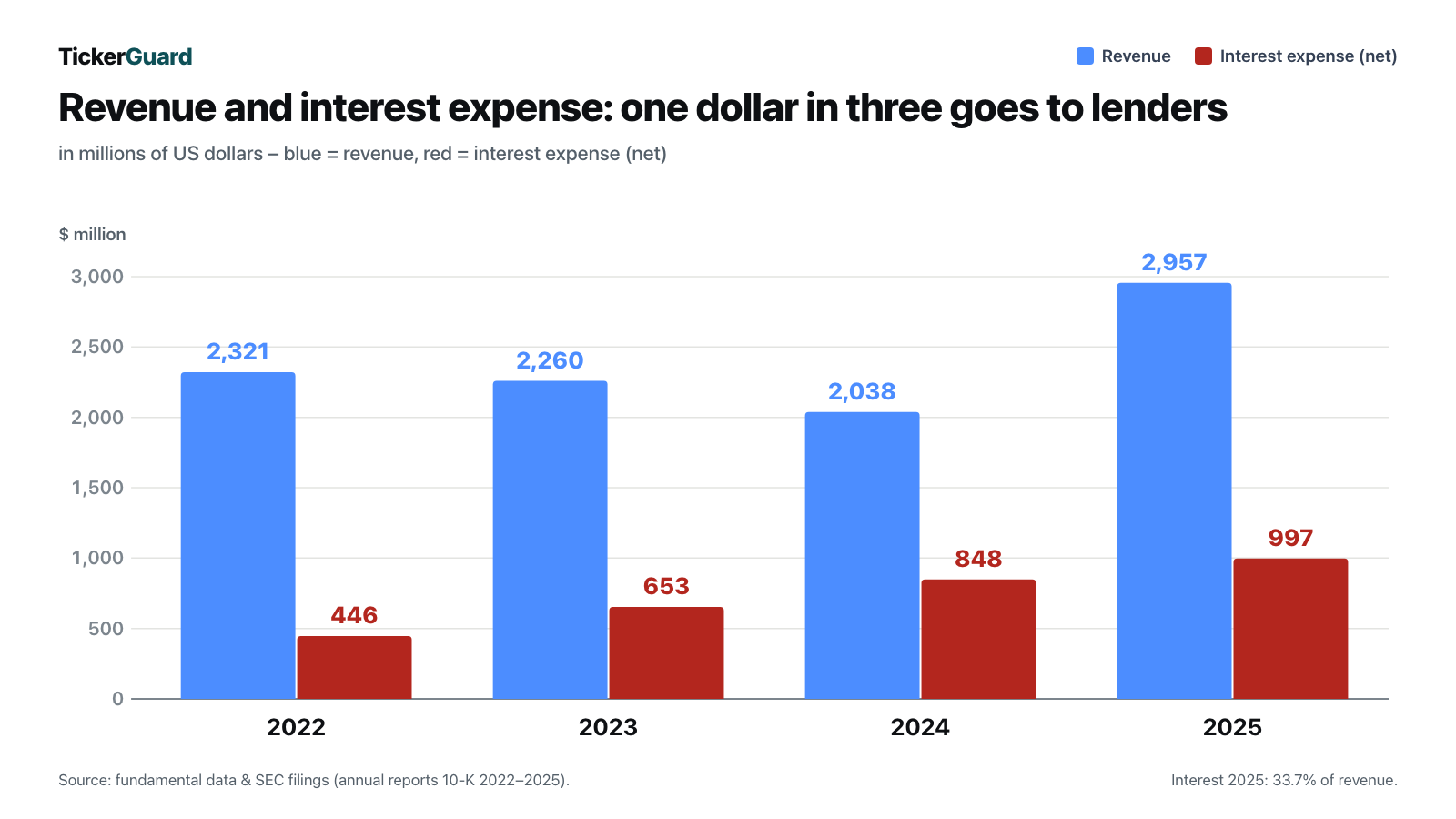
The reason is the mountain of debt. Total debt rose from $6.50 billion at the end of 2021 to $14.70 billion at the end of 2025 and to $15.16 billion as of June 30, 2026. Of that, $14.53 billion is non-recourse: secured only by the systems and their cash flows, so lenders cannot reach through to the parent company. That is real protection, and it should not be played down. The parent itself is on the hook for $636.9 million gross ($628.5 million on the balance sheet, net of the unamortized discount): $153.7 million drawn on a credit facility of up to $321.4 million (maturing March 2028) and convertible notes of $483.2 million at 4 percent, due March 2030. Still, the overall math is simple. In 2025, operating income was −$126.1 million and interest expense was $996.8 million. Interest coverage — how many times operating profit could pay the interest — was negative. Even in the best quarter, the second of 2026, $34.8 million of operating income covered just over one-eighth of $264.4 million in interest. Remember: a business that does not earn its interest from operations pays it with new money.
Uncomfortable truth No. 3: The business only runs as long as capital markets play along
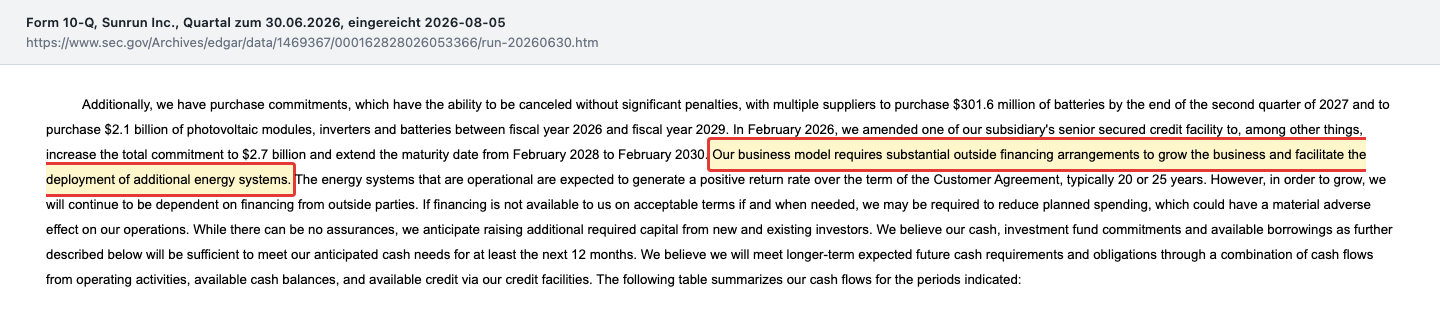
Where does the new money come from? From capital markets, quarter after quarter. In the first half of 2026, Sunrun raised $2,259.2 million in new non-recourse debt, repaid $1,839.3 million and received $821.6 million from fund partners. Over the same period, operations consumed $175.6 million, and it has been that way for years: operating cash flow was negative in every year from 2019 to 2025, a combined −$3.67 billion from 2021 to 2025. The quarterly report puts it plainly:
“Our business model requires substantial outside financing arrangements to grow the business and facilitate the deployment of additional energy systems.”
— Sunrun Inc., SEC quarterly report 10-Q as of June 30, 2026, Item 2 “Liquidity and Capital Resources”
In fairness: so far, Sunrun has reliably gotten that money. By early August 2026, it said it had raised about $1.5 billion of non-recourse debt year to date, and the Class A notes of a $267 million securitization were priced in August at a 6.33 percent yield, with a spread 0.2 percentage points tighter than in April. Management expects cash, fund commitments and credit lines to cover at least the next 12 months, and all debt covenants were met as of June 30, 2026. But this money is not cheap: Sunrun puts its observed project-level capital costs at 7.3 percent for the second quarter of 2026, after 6.3 percent in the first quarter (prior-year quarter: 7.4 percent), and the CFO cited “modestly higher capital costs than previously forecasted” as one reason for the outlook cut. Put simply: Sunrun is a bicycle that only stays up while it moves — and the lenders are doing the pedaling.
What shareholders in this industry face in the worst case is shown by competitor Sunnova Energy, an energy services company for homeowners and businesses with more than 441,000 customers according to its annual report for 2024. Sunnova filed for Chapter 11 on June 8, 2025, and stated in its current report that holders of its common stock “could experience a significant or complete loss.” Sunrun is in a different position: the parent company itself is liable for only about 4 percent of the debt, the convertible notes do not mature until March 2030, and all covenants are met. But the case shows who gets paid last in this business model: the shareholders.
Uncomfortable truth No. 4: The solar tax credit is running out
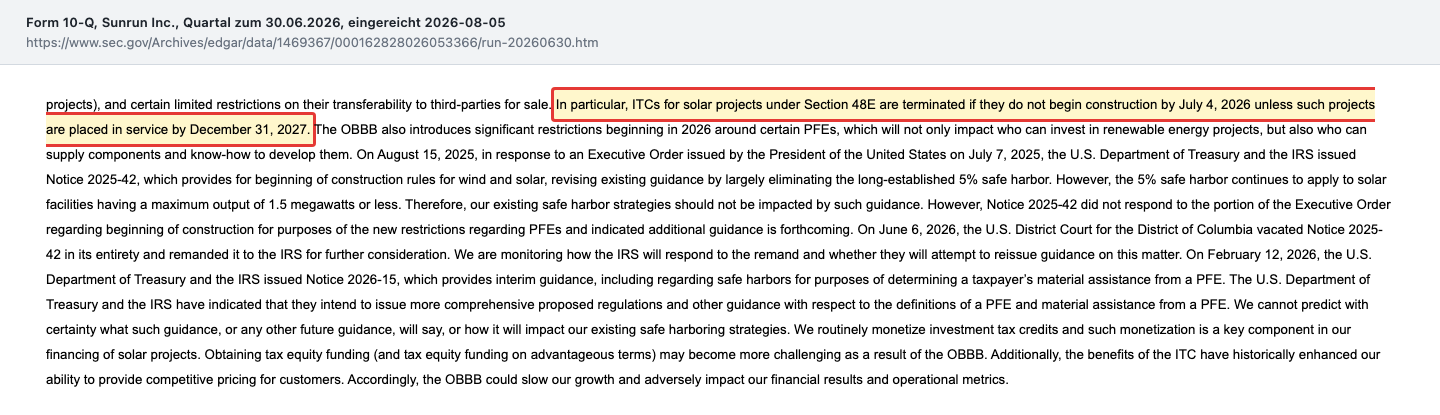
The most important funding source is a federal tax credit. According to Sunrun, its average rate in the second quarter of 2026 was 44.0 percent of eligible system costs, and it is sold to or shared with investors. The “One Big Beautiful Bill” tax law of July 4, 2025, put an expiration date on that lever for solar:
“In particular, ITCs for solar projects under Section 48E are terminated if they do not begin construction by July 4, 2026 unless such projects are placed in service by December 31, 2027.”
— Sunrun Inc., SEC quarterly report 10-Q as of June 30, 2026, Part II, Item 1A Risk Factors
The other side belongs here too: for battery storage, the full credit remains available through 2033 according to the quarterly report, and Sunrun has bought equipment in advance to lock in earlier deadlines (“safe harbor”). The storage-first strategy is therefore also an answer to the law. Two more screws are turning: the credit homeowners could claim themselves (Section 25D) ended on January 1, 2026, and new rules against components from certain foreign sources can cost credits. Add a concentration on top: according to the quarterly report, California represents “over 45% of our customer base, as of June 30, 2026” — and that is exactly where the new net billing tariff has made solar-only systems less attractive since April 2023. A business model that is largely paid for by the tax code largely belongs to the lawmakers.
Uncomfortable truth No. 5: The outlook was cut — and the second half has to carry it
Sunrun measures itself on a metric of its own called “Cash Generation”: the money left over after operations, investment, project loans, fund money and tax credits — loans the parent company is liable for and equity raises do not count. On August 5, 2026, the same day as the quarterly report, the company lowered its full-year target:
“We are revising our full-year Cash Generation outlook to $200 million to $375 million, excluding equipment safe harbor investments, reflecting reduced affiliate channel volumes, a delayed ramp in direct sales activities, and modestly higher capital costs than previously forecasted.”
— Danny Abajian, Chief Financial Officer, earnings release, 8-K Item 2.02, Exhibit 99.1 of August 5, 2026

The previous target was $250 million to $450 million. After the first half, Sunrun stands at −$36 million (first quarter −$59 million, second +$23 million). The outlook, however, excludes equipment purchased in advance to secure the tax credit (“safe harbor”), $28 million in the first quarter and $22 million in the second. On the same basis, the first half stood at +$14 million (first quarter −$31 million, second +$45 million). To reach the low end, the second half therefore has to deliver at least $186 million, and about $274 million for the midpoint. That is not impossible — the fourth quarter of 2025 brought $187 million — but the full-year target now rests on the second half. Volumes are falling at the same time: Sunrun added 19,793 subscribers in the second quarter of 2026, 31 percent fewer than a year earlier, and the contracted value left per new customer after acquisition costs fell 61 percent year over year to $5,100. The target for the total value of new customers also came down to $4.6 billion to $4.9 billion (previously $4.8 billion to $5.2 billion).
Valuation: cheap on paper, expensive on the balance sheet
What does Sunrun cost? At the October 8, 2026, price ($7.59) and with the 240,846,982 shares outstanding as of July 31, 2026, about $1.83 billion on the stock market. A buyer of the whole company would, however, also take on the debt: about $15.2 billion, more than eight times the market value. The stock is a thin lid on a big pot of borrowed money — when the value of the systems moves by a few percent, the lid moves by a multiple of that. And the lid is being sliced thinner: the share count rose from 226.2 million (February 21, 2025) to 240.8 million (July 31, 2026), about 6.5 percent in a year and a half. The P/E of about 5 does not help here, for the reasons above, and the price-to-book ratio of about 0.5 (stockholders’ equity of $3.49 billion as of June 30, 2026) only helps somewhat, because that equity is also an HLBV result.
Sunrun runs its own math. Its “Net Earning Assets” metric puts the present value of all future payments from existing customers, minus debt, at $9.0 billion, and the contracted part at $3.7 billion (June 30, 2026). That would be about $37 and $15 per share. But this calculation discounts at 6 percent. As of June 30, 2026, Sunrun’s project loans cost between 5.56 percent (securitizations, the largest block at $6.25 billion) and 11.02 percent (subordinated revolving loans) depending on type, with the $3.20 billion of subordinated loans at 9.30 percent on average; weighted across all project loans, that is about 6.6 percent by our own calculation (contractual rates before hedging). The discount rate is therefore below what Sunrun itself pays for its money; for new customers, Sunrun even applies its observed capital costs of 7.3 percent (second quarter of 2026). The calculation also assumes that customers renew or buy their systems at the end of the contract at 90 percent of the last contract rate. The number is a promise in today’s dollars, not a bank balance. The professionals’ view: according to fundamental data, 12 of 21 analysts rate the stock a buy, 9 a hold and none a sell; the average price target is about $15.86 (data as of October 9, 2026). Notably, the price target sits close to the contracted present value of about $15 per share, that is, to Sunrun’s own calculation at 6 percent; how the analysts arrive at their targets, however, is not visible from the consensus. And the insiders? On October 6, 2026, five executives, including CEO Mary Powell (24,335 shares) and CFO Danny Abajian (16,734), sold a combined 68,719 shares at about $7.76. According to their filings (Form 4), they did so solely to cover taxes on vested stock awards, so this was no voluntary exit.
Upside and risks at a glance
What speaks for Sunrun:
- A large, growing customer base with 20- to 25-year contracts.
- Storage as strategy: three of four new customers add a battery, and the storage credit remains through 2033.
- Strong revenue growth and an operating profit in the second quarter of 2026.
- Creditor protection through structure: almost all debt is secured only by the systems, and all covenants are met.
- New revenue streams in sight: grid services from the networked home batteries and the letter of intent with Renew Home and Tesla.
What speaks against it:
- The company loses money every year; the profit for shareholders is created in the fund accounting.
- Interest eats a third of revenue, and operating income does not cover it.
- Operations have consumed cash for years; growth and interest depend on new loans and fund partners.
- Political dependence: the solar tax credit is expiring, and over 45 percent of customers are in California.
- Outlook cut, fewer new customers, and the contracted value per new customer fell 61 percent year over year to $5,100 in the second quarter of 2026.
A human conclusion
Back to the sale sign. The sale-sign trap works because we take the old price as the right one and the new one as a gift. At Sunrun, neither is quite true. $21.41 in January 2026 was no proof of fair value, and a P/E of about 5 is no proof of a bargain, because it comes from an accounting method. What the filings actually show is a real, growing subscription business with more than a million customers. It is carried by $15 billion of debt, a tax credit with an expiration date and a capital market that has to play along again every quarter. Whoever buys here is not buying a discount but a bet that the lenders keep pedaling and the customers keep paying for a long time. So the honest question for you is not “How far has it fallen?” but: Do you trust the business to carry its interest, a third of its revenue, for the long haul — knowing that shareholders stand behind all of its creditors? What you make of it is your decision. And that is how it should be.
Sources
All original documents used in this analysis — read them yourself:
- Sunrun Inc. — SEC quarterly report 10-Q as of 06/30/2026 (filed August 5, 2026)
- Sunrun Inc. — Second-quarter 2026 earnings release, 8-K Item 2.02 with Exhibit 99.1 (filed August 5, 2026)
- Sunrun Inc. — SEC quarterly report 10-Q as of 03/31/2026 (filed May 6, 2026)
- Sunrun Inc. — SEC annual report 10-K for 2025 (filed February 26, 2026)
- Sunrun Inc. — SEC annual report 10-K for 2024 (filed February 27, 2025)
- Full SEC filing history of Sunrun Inc.: EDGAR overview (sec.gov) — reviewed after the quarterly report through October 9, 2026: ownership filing SC 13G (August 14, 2026), Form D (September 11, 2026), insider filings Form 144 and Form 4 (October 6 and 7, 2026)
- Sunnova Energy International Inc. — SEC current report 8-K on its Chapter 11 filing (June 8, 2025) and SEC annual report 10-K for 2024
- Insider filings (Form 4) by Mary Powell, Danny Abajian, Paul S. Dickson, Jeanna Steele and Maria Barak for October 6, 2026 (EDGAR, sec.gov)
- Fundamental data (prices, P/E ratio, analyst consensus; data as of October 9, 2026), cross-checked against the SEC filings and the SEC’s XBRL data series.
- Reddit mentions: ApeWisdom (as of October 9, 2026); accessed via our in-house Reddit hype scanner.
Transparency & disclaimer: This analysis is a journalistic contextualization of publicly available information and is not investment advice, not a financial analysis in the regulatory sense and not a solicitation to buy or sell securities. Investing in stocks involves substantial risk, up to and including total loss. All information without guarantee; the data date is noted in the text. Positions held by the operator are disclosed daily; where one exists, it appears as a notice at the top of this deep dive.
Key figures at a glance
All monetary figures in millions of $; earnings per share as reported.
| Metric | 2021 | 2022 | 2023 | 2024 | 2025 |
|---|---|---|---|---|---|
| Revenue | 1,610.0 | 2,321.4 | 2,259.8 | 2,037.7 | 2,957.0 |
| Operating Income (EBIT) | -666.2 | -662.2 | -1,978.6 | -3,695.2 | -126.1 |
| Net Income | -79.4 | 173.4 | -1,604.5 | -2,846.2 | 449.9 |
| Net Margin | -4.9% | 7.5% | -71.0% | -139.7% | 15.2% |
| Earnings Per Share | -0.39 $ | 0.79 $ | -7.41 $ | -12.81 $ | 1.66 $ |
Source: fundamental data & SEC filings (annual and quarterly reports, 10-K/10-Q)
Our Bottom Line at a Glance
- Customer base and growth positive
- 1,034,738 subscribers as of 06/30/2026 (+10%), 20- to 25-year contracts, 74% battery attachment in Q2 2026; 2025 revenue up 45% to $2.96 billion.
- Earnings quality negative
- Company 2025 −$1,009.1M, common stockholders +$449.9M — the difference is created in the fund accounting (HLBV). The P/E of about 5 measures how losses are split, not earning power.
- Debt and interest negative
- $15.16 billion of debt (06/30/2026), 2025 interest expense of $996.8M or 33.7% of revenue against negative operating income (−$126.1M); interest coverage below 1.
- Financing dependence negative
- Operating cash flow negative in every year 2019–2025, a combined −$3.67 billion 2021–2025; per the 10-Q, the model requires substantial outside financing. So far it keeps flowing: about $1.5 billion of new debt through August 2026.
- Policy and outlook negative
- Solar tax credit for construction starts after 07/04/2026 only if placed in service by the end of 2027; outlook cut on 08/05/2026, H1 2026 Cash Generation −$36M (excluding safe harbor +$14M); storage credit remains through 2033.
Sunrun has a real, growing subscription business with more than a million customers and a clear storage strategy. It is financed with $15.2 billion of debt, fund partners and a tax credit that is expiring for solar. The company loses money every year, interest eats a third of revenue, and the profit for shareholders is created in the fund accounting. Not investment advice.
What Our Rating Means
Substance risk
We found at least one documented issue that threatens the company itself — regardless of how the stock is currently valued.
Red signals a documented threat to the company’s substance, not to the share price: operating income did not cover interest in 2025 (−$126.1 million against $996.8 million), and operations have consumed cash every year since 2019, even though $449.9 million of net income was reported for shareholders in 2025. The decision is yours.
A journalistic assessment by our editorial team at the time of the deep dive, based on public sources — not investment advice and not a solicitation to buy or sell. Your personal circumstances (investment goals, risk capacity, taxes) cannot be taken into account. What our levels mean, how verdicts are formed, and what conflicts of interest exist →
Worth Noting
- Edition of October 9, 2026, based on the quarterly report 10-Q as of June 30, 2026, and the 8-K earnings release of August 5, 2026; the filings submitted afterward through October 9, 2026 (SC 13G, Form D, Form 144/Form 4) do not change the picture. The hook is the Reddit hype scanner (ApeWisdom: 3 mentions in 24 hours, rank 145, as of October 9, 2026) — an attention signal, not a data source.
- Income attributable to common stockholders, stockholders’ equity and therefore the P/E and price-to-book ratios rest on the HLBV method, which Sunrun uses to split the income and losses of its investment funds between itself and its fund partners. More meaningful for earning power are consolidated net income, operating income, interest expense and operating cash flow.
- Cash Generation, Net Earning Assets and Subscriber Value are Sunrun’s own metrics and are not audited under U.S. GAAP. Market value (shares as of 07/31/2026 × price on 10/08/2026), the interest ratio, interest coverage and the sum of operating cash flows are our own calculations from the sources named.
Stock Watch
This analysis is as of October 9, 2026. Stock Watch will tell you what's changed at RUN since then.
Later $1 a month per stock — signing up is free, and you'll be the first to know when it launches.
The full analysis as a PDF for later
We will send you this analysis as a PDF — to print, file away, and read at your own pace. And we will add you to the free Stock Watch list for Sunrun Inc (RUN), so you hear about it when something material in this analysis changes.
Frequently Asked Questions
Sunrun Inc. (Nasdaq: RUN) installs solar panels and batteries on U.S. homes and mostly leases them through lease or power purchase agreements with 20- to 25-year terms. As of June 30, 2026, Sunrun had 1,034,738 subscribers. In 2025, $1,819.0 million of revenue came from customer agreements and incentives and $1,138.0 million from energy systems and product sales.
Sunrun splits the results of its investment funds using the HLBV method, which allocates a large share of losses to fund partners in the early years. In 2025, that was −$1,459.1 million. As a result, common stockholders were credited with $449.9 million of net income, even though the company as a whole lost $1,009.1 million.
As of June 30, 2026, Sunrun carried $15.16 billion of debt. $14.53 billion of it is non-recourse debt secured only by the systems. The parent company itself is liable for $636.9 million gross ($628.5 million on the balance sheet): $153.7 million drawn on a credit facility of up to $321.4 million (through March 2028) and $483.2 million of 4 percent convertible notes due March 2030.
According to the quarterly report as of June 30, 2026, the Section 48E investment tax credit ends for solar projects that begin construction after July 4, 2026, unless they are placed in service by December 31, 2027. For battery storage, the full credit remains through 2033. The average credit rate in the second quarter of 2026 was 44.0 percent of eligible system costs.
On August 5, 2026, Sunrun cut its full-year outlook for its own Cash Generation metric from $250 million to $450 million to $200 million to $375 million. CFO Danny Abajian cited lower affiliate channel volumes, a delayed ramp in direct sales and modestly higher capital costs. After the first half of 2026, the metric stood at −$36 million; excluding the safe-harbor equipment purchases that the outlook also leaves out, at +$14 million.
Not necessarily. The P/E of about 5 (data as of October 9, 2026) is based on the income attributable to common stockholders, which is created in the fund accounting. The company lost $1.01 billion in 2025. Against a market value of about $1.83 billion (October 8, 2026) stands $15.16 billion of debt, more than eight times as much.
Found an error?
Did you spot a factual error, an outdated number, or a typo in this deep dive? Let us know briefly — your report goes straight to the editorial team.