Kaspi.kz: Revenue Up 60 Percent, Profit Up 1 Percent – What Is Slowing Kazakhstan's Super App
Kaspi.kz (Nasdaq: KSPI) is the app for almost everything in Kazakhstan. In 2025 revenue grew 60 percent and net income 1 percent; in the first half of 2026 profit slipped slightly. Turkish subsidiary Hepsiburada lost money in 2025, problem loans are rising, and co-founder Vyacheslav Kim has sold shares worth about $276 million since March.
 Thomas Mücke
Founder & Publisher
Thomas Mücke
Founder & Publisher
As of Today
As of: October 9, 2026
- Closing price
- 93.00 $ +0.20%
- Market Capitalisation
- 17.7 $B
- P/E
- 8.0
- Growth Score
- 8/10
- AAQS
- 10/10
Price change since October 8, 2026: +0.2%
This analysis has a cut-off date. The Stock Guard tells you when something material changes in the numbers. Reserve your free spot
Chart
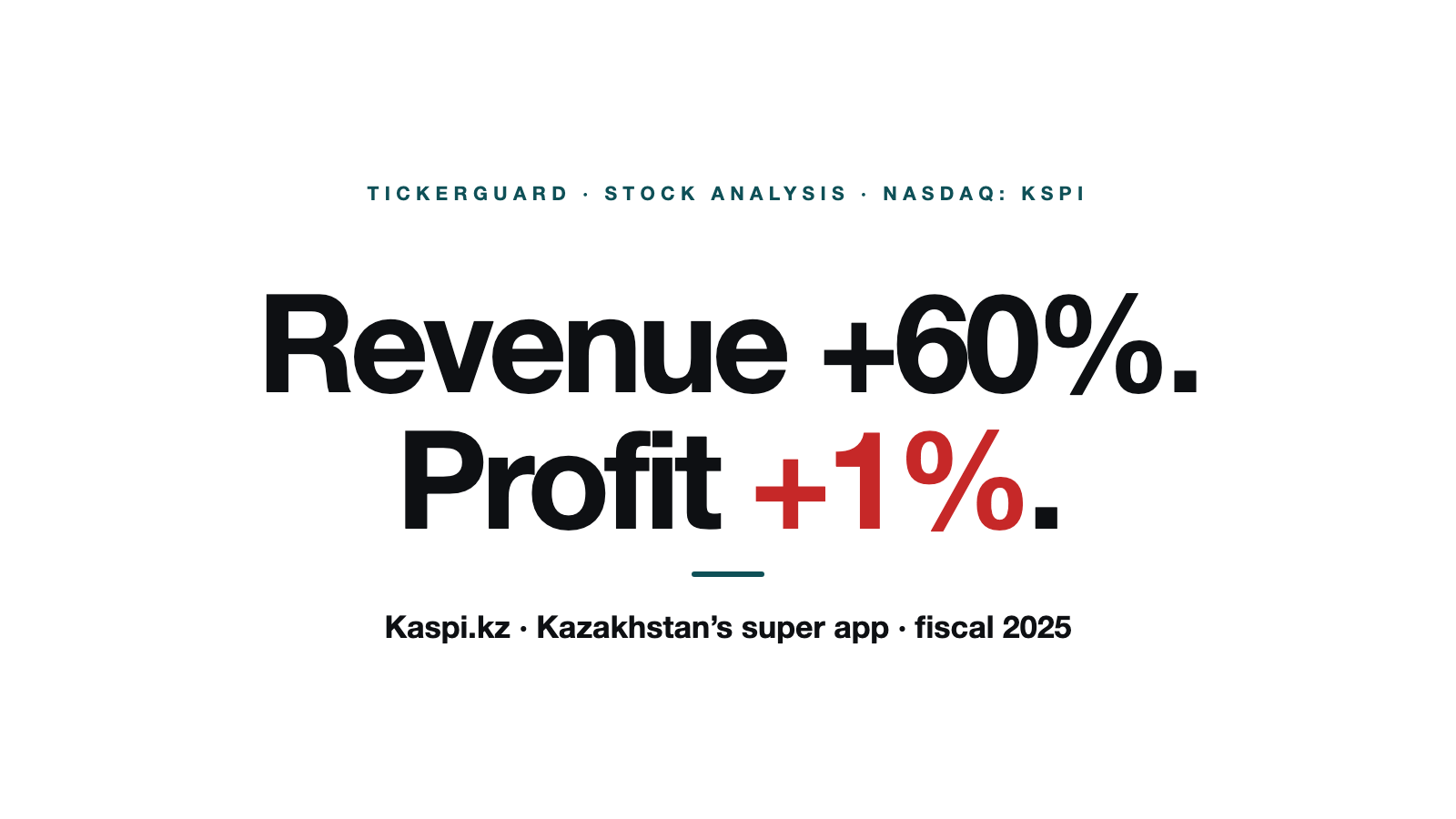
Interactive price chart (TradingView).
52-week range: 68.80 $ to 108.80 $ · Last price: 93.00 $ (As of: October 9, 2026)
Note: pure fact-based analysis, not investment advice and not a solicitation to buy or sell. All figures without guarantee.
Revenue up 60 percent, net income up 1 percent. That is how 2025 reads in Kaspi.kz's annual report — and anyone who has followed the stock for years tends to skim past the second number. That is what this piece is about: the habit trap. When you get reliably good news for long enough, you stop really reading each new figure. At Kaspi, net income grew 24 to 44 percent every year from 2022 through 2024. Next to that, a year at plus 1 percent looks like a blip you don't need to take seriously.
Habit, of all things, is Kaspi's greatest asset. An active customer in Kazakhstan completes 77 transactions a month in the app — paying, shopping, borrowing, saving, dealing with government services. Customer habit is the business model. Investor habit is the risk. So let's make a deal: we read the filings Kaspi submits to the U.S. securities regulator, the SEC, as if for the first time. In the end, you decide.

What Kaspi actually does
Kaspi.kz is a joint stock company from Almaty, incorporated in 2008, that runs a so-called super app in Kazakhstan: a single app in which people pay, shop online, order groceries, book flights, handle government services, save money and take out loans. Merchants get a second app, Kaspi Pay. According to the results release of August 10, 2026, more than 26 million consumers and 900,000 merchants in Kazakhstan and Türkiye use its services. The business is split into three platforms:
- Payments: in-store and online payments, bills, person-to-person transfers. For Kaspi, this is the main tool for winning new customers.
- Marketplace: online retail with third-party merchants, in-store shopping through the app, grocery delivery, travel — and since January 2025 the Turkish e-commerce platform Hepsiburada.
- Fintech: buy now, pay later, consumer loans, merchant loans and savings accounts through its own Kaspi Bank. Kaspi lends only in tenge and funds its loans mainly with customer deposits — KZT 8,132 billion as of June 30, 2026.
So don't be fooled: Kaspi is a tech company, but at its core it is also a bank. In the first half of 2026, KZT 935.1 billion of KZT 2,192.8 billion in revenue came from interest income, or 43 percent. At the end of 2025, Kaspi employed 14,008 people, 3,611 of them in Türkiye. Keep in mind the tension that runs through this piece: the app is growing, revenue is growing — but less and less of that growth reaches the bottom line, and the reasons are in the fine print.
Company history for investors
-
2024
Nasdaq IPO at $92
In January the shares list on Nasdaq as ADSs. In July the stock closes at $138.72 — its highest close to date. Dividend of KZT 3,400 per share.
-
2025
Hepsiburada acquisition, no dividend
Kaspi pays $1.127 billion for 65.41 percent of the Turkish platform. Hepsiburada loses KZT 93.0 billion, group net income rises 1 percent, and no dividend is paid.
-
2026
Lowest close, co-founder starts selling
On March 13 the stock closes at $68.84. From March 25, co-founder Kim sells shares week after week under a plan — about 3.0 million by October 8.
-
2026
Hepsi Bank and AI assistant Kasper
In July Kaspi takes over a Turkish bank with no customers and launches the shopping assistant Kasper. The second-quarter dividend rises to KZT 1,000 per share.
-
2026
Hepsiburada stake at 93.51 percent
In September Kaspi subscribes to a capital increase and buys more shares at $2.95 — about 44 percent below the 2025 price, which, however, included a control premium. More Türkiye, more capital, the same open profit question.
How the stock landed on our desk
Through the forum leaderboard of the German investor portal wallstreet-online, the list of stocks most discussed by German retail investors (as of October 9, 2026). That is an attention signal, not a quality signal. The share price gives people something to talk about: Kaspi listed on Nasdaq in January 2024 at $92 per share (prospectus dated January 18, 2024, filed January 19). On July 18, 2024 the stock closed at $138.72, on March 13, 2026 at $68.84, and on October 8, 2026 at $92.83 — almost three years later, right back at the offering price, even though net income has risen by a good quarter since 2023 and dividends were paid along the way.
Why a stock doesn't budge despite rising profits can have many reasons, and which of them drive the market can't be proven. So we look at what can be documented: the passages in the filings that are missing from the success story. How another emerging-market payments company grows by lending to its customers, and what that means for margins, is something we worked through in our analysis of StoneCo from Brazil.
The numbers over the years — given their due
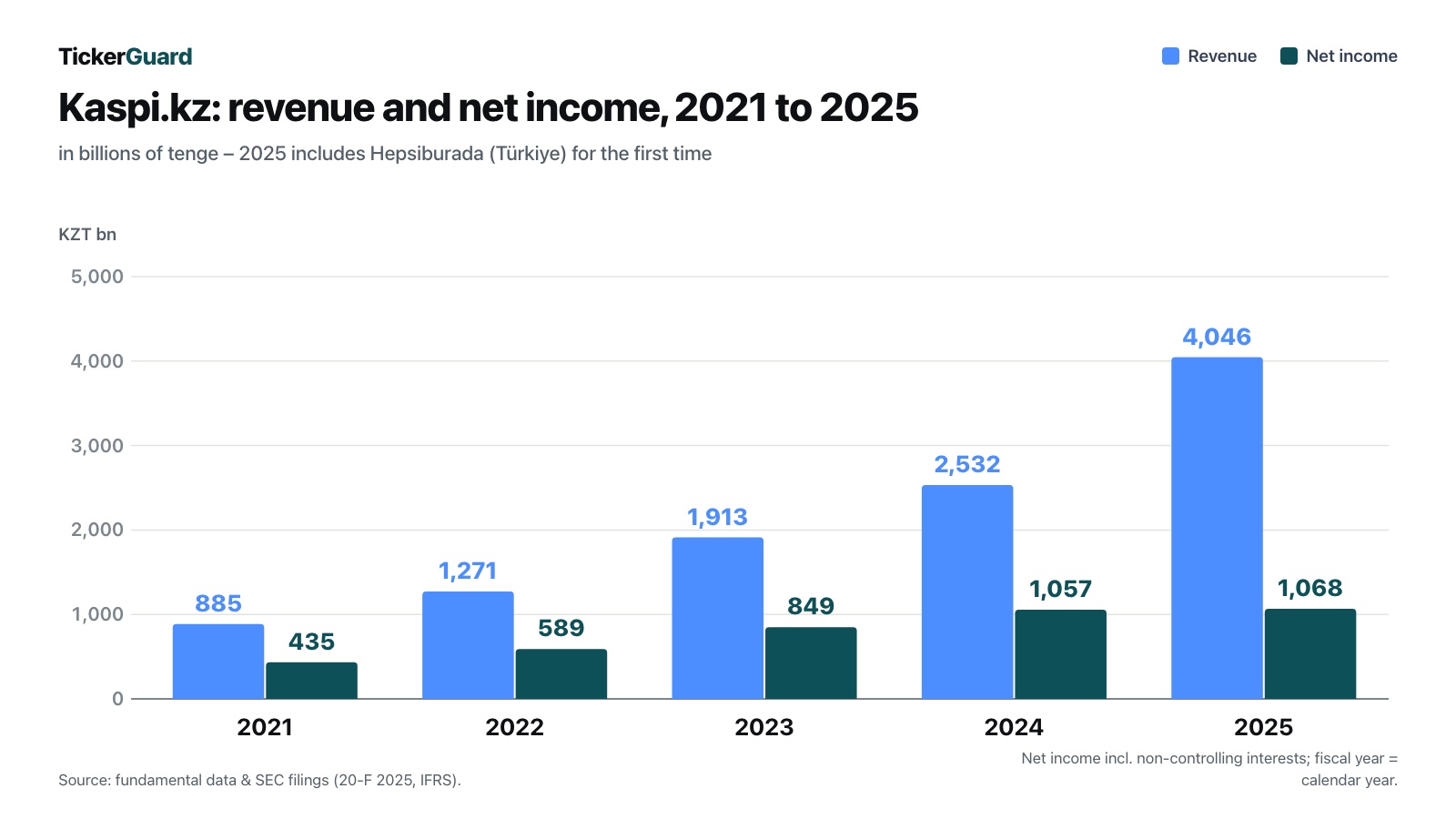
Let's start with what is genuinely impressive. Kaspi makes a lot of money, and has for years. Revenue rose from KZT 885 billion (2021) to KZT 2,532 billion (2024), net income over the same period from KZT 435 billion to KZT 1,057 billion. For 2025 the annual report shows KZT 4,046 billion in revenue — about $8.0 billion — and KZT 1,068 billion in net income, about $2.1 billion; as in the annual report, these two dollar figures are converted at the year-end rate of KZT 505.53 per dollar. A large part of the jump in revenue comes from Türkiye: Hepsiburada has been consolidated since late January 2025. As a result, much less of each tenge of revenue was left as profit: net margin, i.e. profit per KZT 100 of revenue, fell from about 42 percent in 2024 to about 26 percent in 2025 (our calculation).
Returns are exceptional, too: in the twelve months through June 2026, Kaspi earned more than 40 percent on its equity — about KZT 1,070 billion of net income on KZT 2,639.1 billion of shareholders' equity at June 30, 2026 works out to about 41 percent (our calculation; fundamental data show about 45 percent on a different basis). For every 100 tenge of shareholders' equity on the balance sheet, that is a little over 40 tenge of profit in a year. Under the international Basel III standard, Kaspi Bank's capital ratio stood at 20.8 percent on June 30, 2026; what counts for supervision, however, is the Kazakh calculation, where it stood at 14.1 percent. As the floor, the interim report (Note 18) cites 8 percent plus a 3 percent capital conservation buffer and a 1 percent systemic buffer, 12.0 percent in total. The annual report also announced a sector buffer on retail loans from April 1, 2026; with it, the threshold would be about 13.7 percent by our rough calculation (more on this below). And the business keeps growing: in the second quarter of 2026, e-commerce gross merchandise value rose 28 percent at constant currency, and the average customer shopped online 15.8 times on an annualized basis, up from 11.6 a year earlier. In July 2026 Kaspi launched “Kasper”, a shopping assistant built on artificial intelligence; according to the company, about one in five customers with access had used it within less than a month.
The chart, however, also shows that the net income bar has stopped growing. In the first half of 2026, revenue reached KZT 2,192.8 billion (up 23 percent) and net income KZT 510.8 billion — after KZT 512.7 billion a year earlier. The filings explain why.
What the filings say — the uncomfortable truths
Now come the passages that are missing from the success story. All of them are taken from mandatory filings Kaspi has submitted to the SEC.
Uncomfortable truth No. 1: Revenue is growing, profit no longer is
Kaspi puts it plainly in its own annual report:

“For the year ended December 31, 2025, our consolidated revenue and consolidated net income was ₸4,046 billion ($8,004 million) and ₸1,068 billion ($2,112 million), respectively, which represented an increase of 60% and 1%, respectively, compared to the year ended December 31, 2024.”
— Kaspi.kz, annual report on Form 20-F for 2025, Item 4 (Information on the Company)
The filings point to three brakes. First, Türkiye — more on that in a moment. Second, the price Kaspi pays for its deposits: in the first half of 2026, interest revenue rose 32 percent, but interest expenses and fees rose 38 percent, from KZT 401.4 billion to KZT 553.5 billion. The effective rate Kaspi pays on term deposits was 14.5 percent in the second quarter of 2026, 1.5 percentage points higher than a year earlier. In August 2026 Kaspi cut the rate on its three-month savings product by one percentage point — the first cut in more than two years; the company expects the benefit to show only toward year-end. Third, the central bank: in 2025 it raised banks' minimum reserve requirements. As a result, Kaspi had to park an additional KZT 247.8 billion with it that earns no interest.
How broadly the brake works shows up in the second quarter of 2026 by segment:
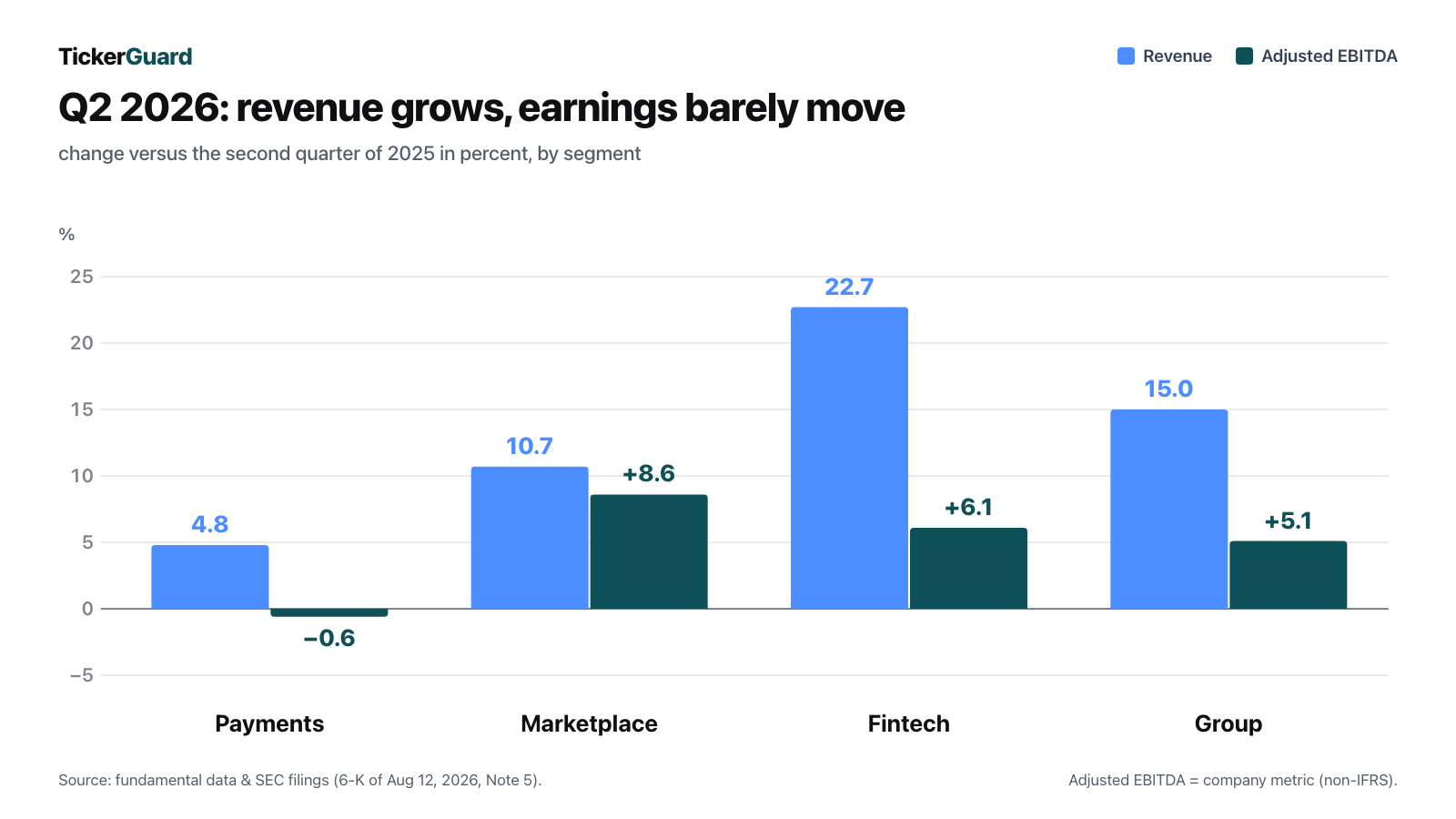
Adjusted EBITDA is a metric Kaspi defines itself — roughly, operating profit before interest from other operations, taxes, depreciation and amortization. It leaves some costs out. That makes the picture all the clearer: in Payments it even dipped slightly, because Kaspi is investing in “Kaspi Alaqan”, pay-by-palm.
Uncomfortable truth No. 2: Türkiye costs money — and Kaspi is buying more at a lower price
In January 2025, Kaspi bought 65.41 percent of Hepsiburada, one of Türkiye's large e-commerce platforms, from the Doğan family for $1.127 billion; by mid-2026 it had raised its stake to 86.74 percent in several steps for a combined $179 million or so, including about $66 million for 10.55 percent in December 2025. The annual report shows what that cost in the first year:

“Net income of Marketplace decreased by 20% to ₸279,773 million for the year ended December 31, 2025 from ₸348,400 million for the year ended December 31, 2024, driven primarily by ₸93,018 million net losses of Hepsiburada, partially offset by growth in Marketplace fee revenue, offset by faster growth in the number of e-Commerce Purchases than e-Commerce GMV (83% compared to 16%), which resulted in growth of delivery expenses outperforming growth of revenue.”
— Kaspi.kz, annual report on Form 20-F for 2025, Item 5 (Operating and Financial Review), Marketplace section
Without the Turkish losses, group net income would have grown about 10 instead of 1 percent in 2025 (our calculation) — still well below the 24 to 44 percent of 2022 through 2024. Türkiye has become big: in the second quarter of 2026, KZT 263.5 billion of KZT 1,122.1 billion in segment revenue came from there, a little over 23 percent. And Kaspi keeps doubling down. In July 2026 it closed the purchase of Rabobank A.Ş., a Turkish bank with no customers, and renamed it Hepsi Bank; according to the results release, it is to be capitalized with about $300 million, and expanding lending and deposits there is a priority from 2027. In September 2026 Kaspi subscribed for 71.4 million new Hepsiburada shares in a capital increase for TRY 9.32 billion and bought another 19.5 million shares from a fund — at $2.95 apiece. For the first block in January 2025, Kaspi had paid about $5.28 per share by our math, although that price included a premium for control. Since September 14, 2026, Kaspi has held 93.51 percent.
The balance sheet carries goodwill for Hepsiburada — the premium paid over book value — of KZT 429.7 billion (year-end 2025). Total goodwill stood at KZT 459.1 billion as of June 30, 2026, or 17 percent of equity attributable to shareholders. Kaspi tests whether it is recoverable once a year based on expected cash flows. We have also logged this point as a side find.
Uncomfortable truth No. 3: Problem loans are growing faster than the loan book
Kaspi lends mainly to individuals, and mostly without collateral. The annual report says so clearly:
“In addition, the vast majority of our loan portfolio is unsecured.”
— Kaspi.kz, annual report on Form 20-F for 2025, Item 3.D (Risk Factors), Credit risk
So far Kaspi has kept this remarkably well under control: cost of risk — roughly the share of the loan book Kaspi sets aside in the period for expected defaults — was 0.7 percent in the second quarter of 2026 after 0.6 percent a year earlier. But the direction has turned. The ratio of non-performing loans, meaning more than 90 days past due, rose from 6.1 percent at year-end 2025 to 7.0 percent at mid-2026. In absolute terms these loans grew from KZT 466.8 billion to KZT 547.9 billion in six months, up 17 percent, while total gross loans rose only 4.1 percent (our calculation). Total loan-loss allowances now equal only 76 instead of 80 percent of non-performing loans (interim report, Note 11). Kaspi explains this with a growing share of lower-risk car and merchant loans, fewer buy-now-pay-later loans and better collections. And one figure in the interim report deserves particular attention:

“During the six months ended 30 June 2025 and 2026, the Group has restructured loans to customers, which were classified as NPLs, in the amount of KZT 88,224 million and KZT 135,566 million, respectively, by providing an interest free extended repayment schedule.”
— Kaspi.kz, interim financial information as of June 30, 2026, Note 11 (Loans to customers)
Restructuring means: borrowers who can no longer pay get more time and stop paying interest. It gives debtors relief, and money does flow back — KZT 71.0 billion flowed back from restructured loans during the half-year. But these loans no longer earn interest, and the volume of restructurings is up 54 percent year over year. Next to cost of risk of 0.7 percent, the results release says underlying credit trends “remain strong and consistent”; Kaspi names the rise in the non-performing loan ratio in the same section itself. Both can be true. Anyone who has grown used to Kaspi's low credit losses so far should still read the next few quarters closely. We have logged this point as a side find as well.
Uncomfortable truth No. 4: The dividend depends on the bank — and in 2025 it disappeared entirely
Many investors know Kaspi as a reliable dividend payer. The annual report puts that into perspective in a single sentence:

“We paid ₸Nil, ₸3,400 and ₸2,950 per common share in the years ended December 31, 2025, 2024 and 2023, respectively.”
— Kaspi.kz, annual report on Form 20-F for 2025, Item 8.A (Dividend Policy)
The annual report gives no specific reason for the 2025 pause. In the same paragraph it names 2025 as an exception to its historical policy, announces a quarterly dividend of KZT 850 subject to shareholder approval, and then only says in general terms: “Our decision may be due to a number of factors, including the need to finance new business initiatives, pursue additional market opportunities and make capital expenditures.” In the same year, Kaspi paid about $1.2 billion for Hepsiburada ($1.127 billion for 65.41 percent in January, about $66 million for another 10.55 percent in December), and the central bank demanded higher reserves — whether that was decisive cannot be established from the filings. Payments resumed in April 2026: KZT 850 per share for 2025, KZT 850 for the first quarter and KZT 1,000 for the second quarter of 2026. The latest payment equals about 74 percent of second-quarter earnings per share of KZT 1,352 (our calculation).
Where the money comes from is the point. Listed Kaspi.kz is a holding company. According to the annual report, its ability to pay dividends depends significantly on how much its subsidiaries distribute to it, including Kaspi Bank — and for the bank there is a clear rule:
“Under Kazakhstan law, if a bank has an insufficient capital conservation buffer, it will be partially or fully prohibited from declaring or paying dividends.”
— Kaspi.kz, annual report on Form 20-F for 2025, Item 8.A (Dividend Policy)
The numbers: for Kaspi Bank's total capital ratio, the annual report cites a floor of 12.0 percent including the buffers for systemically important banks (Item 3.D, risk factors). At year-end 2025 the bank stood at 12.7 percent — a margin of 0.7 percentage points. As of June 30, 2026 it was 14.1 percent; the interim report still cites 8 percent plus a 3 percent capital conservation buffer and a 1 percent systemic buffer as the floor and states that the bank complies with the central bank's capital requirements (Note 18). It does not mention a new buffer. The annual report, however, had announced that from April 1, 2026 the central bank would introduce an additional 2 percent sector buffer on risk-weighted loans to individuals, which make up 83 percent of the bank's risk-weighted assets. If it applies as announced, it raises the threshold by about 1.7 percentage points by our rough math (2 percent on 83 percent of risk-weighted assets) to about 13.7 percent. Against the 14.1 percent of June 30, 2026, the margin would then be about 0.4 percentage points. How quickly that can change is described in the annual report itself: the bank's capital adequacy may decrease with the growth of the business, as a result of deterioration of the loan portfolio and profitability, or through the payment of dividends (Item 8.A). How Kaspi would decide on the dividend in such a case is not stated in any filing.
Uncomfortable truth No. 5: The co-founder sold week after week
Since March 18, 2026, insider filings for Kaspi have appeared at the SEC for the first time (Form 3, then Form 4). They show a clear pattern: co-founder Vyacheslav Kim, chairman of the board, sold shares in every calendar week from late March to early October 2026. Between March 25 and October 8, 2026 he reported sales totaling 3,009,154 shares for about $276 million, each under a pre-arranged trading plan (Rule 10b5-1). His holding fell from 39,457,265 shares according to his initial filing (Form 3) to 36,447,684 shares, a decline of 7.6 percent. From late March to late June alone he sold 1.36 million shares — almost twice as many as Kaspi itself bought back in the entire first half of 2026 (737,578 shares).
Kim is not the only seller: Yuri Didenko, the management board member responsible for capital markets, sold 50,000 shares in August 2026. The ownership structure is shifting, too. Funds of the private equity investor Baring held a combined 23.22 percent of the shares at year-end 2025 according to the interim report, and 19.00 percent at mid-2026; how and to whom the stakes were reduced is not disclosed in the filings. The free float rose from 29.59 to 33.87 percent over the same half-year. Co-founder and CEO Mikheil Lomtadze, by contrast, did not sell; his stake rose from 22.58 to 23.04 percent.
Sales under a plan are not automatically a bad sign. Founders diversify their wealth; private equity funds typically have a limited life. But context matters: the four largest shareholders — Kim, Lomtadze and two Baring entities — held a combined 66.5 percent according to the annual report and, if they act jointly, can decide on the board, dividends and major transactions (20-F, risk factors). Part of the shares changing hands on the market comes from co-founder Kim's sales; the Baring funds held about four percentage points less at mid-2026 than at year-end 2025, and the free float rose by roughly the same amount over that half-year.
Valuation: what the market pays for Kaspi
On October 8, 2026 the stock closed at $92.83 on Nasdaq. With 190,027,266 shares outstanding (June 30, 2026), that gives a market value of about $17.6 billion. The key figures box above may show a later daily price; we calculate throughout with the October 8, 2026 close. Because Kaspi reports in tenge, we convert at the June 30, 2026 rate (KZT 480.72 per dollar).
- Price-to-earnings: Shareholders were entitled to about KZT 1,070 billion of net income in the twelve months through June 2026, about $2.2 billion. That gives a P/E of about 8 — you are paying roughly eight years of earnings. For a company with a return on equity above 40 percent, that is low. Why the market pays so little is not stated in any filing; in our assessment, the obvious candidates are the stalled profit, the emerging market and tenge risk. The key-figures box above shows a P/E of 8.5 because the fundamental data use a different earnings and exchange-rate basis; the order of magnitude is the same.
- Price-to-book: about 3.2 on KZT 2,639.1 billion of equity attributable to shareholders (June 30, 2026), roughly $5.5 billion.
- Dividend: KZT 1,000 per share for the second quarter of 2026, about $2.08 at the June 30, 2026 rate. Four such quarters would come to a little over $8, or about 9 percent of the October 8, 2026 price — a calculation, not a promise: a payout of about 74 percent of quarterly earnings meets a capital cushion at the bank that is thin by our calculation, and in 2025 the dividend was skipped entirely. The dividend is paid in tenge, so the dollar amount moves with the exchange rate.
- The pros' view: According to fundamental data (as of October 9, 2026), seven covering analysts rate the stock, four at “strong buy” and three at “hold.” The average price target is $107.21. Average here means all price targets added up and divided by their number — a single very high or very low target pulls it noticeably. These are third-party opinions, not a recommendation from us.
One more calculation belongs here, and it concerns the currency. Kaspi earns in tenge; the stock trades in dollars. From year-end 2025 to mid-2026 the tenge strengthened from 505.53 to 480.72 per dollar, which helped the dollar value. In earlier crises, such as 2014, it went the other way — according to the annual report, rumors and temporary instability in the financial sector after that year's sharp devaluation of the tenge led to deposit withdrawals at Kaspi Bank. A low P/E at Kaspi is therefore no proof of a bargain; it may also reflect risks that don't appear in any income statement.
Upside and risks at a glance
What speaks for the company:
- A habit product. 77 transactions per month per active customer in Kazakhstan, more than 26 million consumers and 900,000 merchants in total.
- Very high returns. KZT 1,068 billion of net income in 2025, a return on equity above 40 percent in the twelve months through June 2026.
- Strong e-commerce growth. Gross merchandise value up 28 percent, purchases per customer at 15.8 instead of 11.6 (second quarter of 2026).
- Cheaper deposit funding in sight. First rate cut in more than two years in August 2026; Kaspi expects the effect toward year-end.
- Low valuation. A P/E of about 8 and a dividend that is high again — though it depends on distributions from Kaspi Bank and on what is, by our calculation, a thin capital margin.
What speaks against it:
- Profit has stalled. Up 1 percent in 2025, down 0.4 percent in the first half of 2026 — on revenue growth of 60 and 23 percent.
- The Türkiye bet. KZT 93.0 billion of losses at Hepsiburada in 2025, additional shares bought 44 percent below the entry price, about $300 million for a new bank, KZT 429.7 billion of goodwill for Hepsiburada on the balance sheet (year-end 2025).
- Credit quality is crumbling. Non-performing loans at 7.0 instead of 6.1 percent, coverage at 76 instead of 80 percent, 54 percent more restructured problem loans.
- A dividend on a capital leash. No payout in 2025; with the announced sector buffer, the bank's margin over its capital requirements would be about 0.4 percentage points by our calculation (June 30, 2026).
- One country, one currency, few owners. Dependence on Kazakhstan and the tenge, 66.5 percent held by four large shareholders, sales by the co-founder since March 2026.
A human conclusion
Remember the habit trap from the beginning? With Kaspi it is especially tempting, because much in the numbers is strong. With 77 transactions a month per active customer, the app is deeply embedded in daily life in Kazakhstan, and it earned more than 40 percent on equity in the twelve months through June 2026. But anyone who reads only these numbers sees just one half of the filings.
The other half begins with plus 1 percent. Hepsiburada in Türkiye lost money in 2025, deposits have become more expensive, problem loans grew faster than loans in the first half of 2026, the dividend depends on distributions from a bank whose capital margin is thin by our calculation, and the co-founder sold week after week from late March to early October 2026. We found no indication in the filings of a threat to the company's existence: according to the interim report, Kaspi Bank met the central bank's capital requirements as of June 30, 2026 with a total capital ratio of 14.1 percent, and the group earned KZT 510.8 billion in the first half. Whether these points are why the market values the stock at the offering price almost three years after the IPO can't be proven — but they are the points you should know before forming your own view.
The next tests are the third-quarter 2026 numbers: Does the rate cut reach the bottom line? Does the rise in non-performing loans stop? Does Türkiye lose less? If you read the answers instead of skimming them out of habit, you have already taken the most important step. The decision is yours.
Sources and data cut-off
Kaspi.kz is a joint stock company under Kazakh law based in Almaty. Since January 2024, American Depositary Shares (ADSs) have traded on Nasdaq under the ticker KSPI; one ADS represents one share, and the ADS's international securities identification number (ISIN) is US48581R2058. As a foreign private issuer, Kaspi reports to the SEC once a year with an annual report on Form 20-F and in between with interim financial information and announcements on Form 6-K. There is no U.S. quarterly report (10-Q). Accounts are prepared under international standards (IFRS) in tenge; the fiscal year is the calendar year.
The latest periodic report is the interim financial information as of June 30, 2026, filed on August 12, 2026, two days after the results release. Through October 10, 2026, it was followed by the dividend resolution of the extraordinary general meeting (6-K of September 10), two ownership filings by major shareholders (Schedule 13G/A by Baring/Asia Equity Partners on August 13 and by Vyacheslav Kim on August 14), two filings on the increased Hepsiburada stake (Schedule 13D/A of September 10 and 15), and insider filings (Form 4) and notices of proposed sale (Form 144). None of them was a capital measure by Kaspi.kz itself (new shares or bonds of the listed company); the September capital increase concerned its subsidiary Hepsiburada.
- Interim financial information as of June 30, 2026 (IFRS, unaudited; 6-K of August 12, 2026)
- Second-quarter and first-half 2026 results release and notice of extraordinary general meeting (6-K of August 10, 2026)
- Annual report on Form 20-F for 2025 (March 16, 2026)
- First-quarter 2026 results release (6-K of May 11, 2026)
- Announcements on 6-K: annual general meeting (April 16, 2026), first-quarter dividend (June 12, 2026), second-quarter dividend (September 10, 2026)
- Hepsiburada: Schedule 13D of February 5, 2025 (acquisition of 65.41 percent), 13D/A No. 9 of September 10, 2026, 13D/A No. 10 of September 15, 2026
- Ownership filings by major shareholders: Schedule 13G/A by Baring/Asia Equity Partners of August 13, 2026, Schedule 13G/A by Vyacheslav Kim of August 14, 2026
- Insider filings (Form 3 and Form 4) from March 18 through October 8, 2026, most recently of October 8, 2026; IPO prospectus (424B4) dated January 18, 2024, filed January 19, 2024
- All mandatory filings at the SEC under identification number (CIK) 0001985487
- Price data and analyst figures: source fundamental data, Nasdaq close of October 8, 2026
Data cut-off: Company figures as of June 30, 2026 or the respective date stated; share count as of June 30, 2026; insider sales through October 8, 2026; price and market value as of October 8, 2026. The company's filings were last checked on October 10, 2026. The reporting currency is the tenge; unless stated otherwise, we converted dollar figures at the June 30, 2026 rate (KZT 480.72 per dollar). Twelve-month earnings, P/E, price-to-book, payout ratio, profit excluding Türkiye, the capital buffer and the growth rates of problem loans are our own calculations from reported figures. Kim's sales volume is the sum of all sale lines in his Form 4 filings; the holding last reported there is 427 shares below the opening holding minus sales, because the filing of April 10, 2026 shows a holding 427 shares lower after a sale of 99 shares.
Note: This article is journalistic analysis and not investment advice. It contains no recommendation to buy or sell and is not a solicitation to buy or sell securities. Emerging-market stocks are volatile, among other things with exchange rates and politics; losses up to a total loss of the capital invested are possible. Positions held by the operator are disclosed daily; where one exists, it appears as a notice at the top of this deep dive.
Key figures at a glance
All monetary figures in millions of KZT; earnings per share as reported.
| Metric | 2021 | 2022 | 2023 | 2024 | 2025 |
|---|---|---|---|---|---|
| Revenue | 885,478.0 | 1,269,215.0 | 1,890,290.0 | 2,520,927.0 | 3,935,017.0 |
| Operating Income (EBIT) | 735,332.0 | 1,050,525.0 | 998,804.0 | 1,271,060.0 | 1,295,359.4 |
| Net Income | 431,914.0 | 585,026.0 | 841,351.0 | 1,039,739.0 | 1,038,400.5 |
| Net Margin | 48.8% | 46.1% | 44.5% | 41.2% | 26.4% |
| Earnings Per Share | 2,222.00 KZT | 3,015.73 KZT | 4,380.61 KZT | 5,430.78 KZT | 5,464.81 KZT |
Source: fundamental data & SEC filings (annual and quarterly reports, 10-K/10-Q)
Our Bottom Line at a Glance
- Business model positive
- A super app with 77 transactions per month per active customer in Kazakhstan, more than 26 million consumers and 900,000 merchants (results release of 8/10/2026). E-commerce up 28 percent at constant currency in the second quarter of 2026.
- Profitability neutral
- Very high returns (more than 40 percent on equity in the twelve months through 6/30/2026, our calculation), but net income up only 1 percent in 2025 on 60 percent revenue growth, and slightly below the prior year in the first half of 2026.
- Türkiye negative
- Hepsiburada lost KZT 93.0 billion in 2025 according to the 20-F. Additional shares bought in September 2026 at $2.95, about 44 percent below the January 2025 entry price; plus a new bank with about $300 million of capital needs.
- Credit quality negative
- Non-performing loans at 7.0 percent as of 6/30/2026 after 6.1 percent at year-end 2025, coverage at 76 instead of 80 percent, restructured problem loans up 54 percent in the first half of 2026. Cost of risk still low at 0.7 percent.
- Capital and dividend neutral
- No dividend in 2025, KZT 850, 850 and 1,000 per share again in 2026. Kaspi Bank's capital ratio at 14.1 percent as of 6/30/2026 against a 12.0 percent floor per the interim report; with the sector buffer announced in the 20-F for April 2026, about 13.7 percent by our calculation.
- Owners negative
- Four large shareholders with 66.5 percent according to the 20-F; co-founder Kim sold 3,009,154 shares for about $276 million from 3/25 to 10/8/2026, and the Baring funds cut their stake from 23.22 to 19.00 percent in the first half of 2026.
Kaspi.kz is a highly profitable platform company, but the profit engine has stalled: revenue up 60 percent and net income up 1 percent in 2025, slightly negative in the first half of 2026. As brakes, the filings show losses in Türkiye, more expensive deposits and higher reserves, along with rising problem loans, a dividend that depends on the bank's distributions, and sales by the co-founder since March 2026. Not investment advice.
What Our Rating Means
Open questions
The business works in principle, but one material question is open. As long as it stays open, our findings do not carry a quality verdict.
Yellow, because the business is highly profitable, but a material operating question is open. Kaspi earned KZT 1,068 billion in 2025, has a habit product, and according to the interim report Kaspi Bank met the central bank's capital requirements as of 6/30/2026 — we see no substance risk in the filings. The open question is whether profit will grow again: it has been flat since 2024, the Turkish subsidiary is loss-making and ties up more capital, problem loans are rising faster than the loan book, and Kaspi Bank's margin over its capital requirements is, by our calculation, thin. The low P/E of about 8 is a price argument and does not change this rating. The decision is yours.
A journalistic assessment by our editorial team at the time of the deep dive, based on public sources — not investment advice and not a solicitation to buy or sell. Your personal circumstances (investment goals, risk capacity, taxes) cannot be taken into account. What our levels mean, how verdicts are formed, and what conflicts of interest exist →
Worth Noting
- The hook for this analysis is the forum leaderboard of the German investor portal wallstreet-online (stocks most discussed by German retail investors) as of October 9, 2026. A hit from a metrics scanner was not the trigger.
- Kaspi.kz reports to the SEC as a foreign private issuer: annual report on Form 20-F, interim financial information and announcements on Form 6-K. We evaluated the mandatory filings through the announcement of 9/10/2026, the ownership filings (Schedule 13G/A of 8/13 and 8/14/2026, Schedule 13D/A through 9/15/2026) and insider filings through 10/8/2026.
- All company figures in tenge (IFRS). Dollar figures without their own reference were converted at the 6/30/2026 rate (KZT 480.72 per US dollar); the stock trades on Nasdaq in US dollars.
- Year-over-year net income includes non-controlling interests (2025: KZT 1,067.7 bn); net income attributable to shareholders was KZT 1,073.2 bn in 2025. Twelve-month earnings, P/E, P/B, payout ratio, profit excluding Türkiye and the roughly calculated capital buffer are our own calculations from reported figures.
- Adjusted EBITDA is a company metric, not an IFRS measure; we calculated the segment growth rates from Note 5 of the interim financial information.
Stock Watch
This analysis is as of October 10, 2026. Stock Watch will tell you what's changed at KSPI since then.
Later $1 a month per stock — signing up is free, and you'll be the first to know when it launches.
The full analysis as a PDF for later
We will send you this analysis as a PDF — to print, file away, and read at your own pace. And we will add you to the free Stock Watch list for Joint Stock Company Kaspi.kz (KSPI), so you hear about it when something material in this analysis changes.
Frequently Asked Questions
Kaspi.kz runs a super app in Kazakhstan in which customers pay, shop online, order groceries, book travel, use government services, save and borrow. Behind it are three segments: Payments, Marketplace and Fintech through its own Kaspi Bank. Since 2025 it has also held a majority stake in the Turkish e-commerce platform Hepsiburada.
According to the annual report on Form 20-F, net income rose only 1 percent in 2025, even though revenue grew 60 percent. The reasons include KZT 93.0 billion of losses at the Turkish subsidiary Hepsiburada, higher rates on customer deposits and higher minimum reserves at the central bank. In the first half of 2026, net income of KZT 510.8 billion was slightly below the prior year.
Hepsiburada is one of Türkiye's large e-commerce platforms. Kaspi bought 65.41 percent in January 2025 for about $1.127 billion and then increased its stake. In September 2026 Kaspi bought more shares at $2.95 and subscribed to a capital increase; since September 14, 2026 it has held 93.51 percent.
Yes, but not without interruption. According to the annual report, Kaspi paid KZT 2,950 per share in 2023 and KZT 3,400 in 2024, but nothing in 2025. In 2026 shareholders have so far approved KZT 850 for 2025, KZT 850 for the first quarter and KZT 1,000 for the second quarter of 2026. According to the annual report, the dividend depends significantly on distributions from the subsidiaries, above all Kaspi Bank; if the bank's capital conservation buffer is insufficient, Kazakh law partially or fully prohibits it from paying dividends.
As of June 30, 2026, 7.0 percent of loans were more than 90 days past due, up from 6.1 percent at year-end 2025. In tenge, these loans rose from KZT 466.8 billion to KZT 547.9 billion in six months. Loan-loss allowances cover 76 percent of them. Cost of risk was 0.7 percent in the second quarter of 2026.
Yes. Co-founder and board chairman Vyacheslav Kim sold 3,009,154 shares for about $276 million between March 25 and October 8, 2026 under a pre-arranged plan; his holding fell to 36,447,684 shares. Funds of the private equity investor Baring reduced their stake from 23.22 to 19.00 percent in the first half of 2026.
Kaspi.kz has been listed on Nasdaq since January 2024 under the ticker KSPI; what trades are American Depositary Shares (one ADS represents one share). As a foreign private issuer, Kaspi reports to the SEC with an annual report on Form 20-F and interim reports on Form 6-K, under IFRS and in tenge.
Found an error?
Did you spot a factual error, an outdated number, or a typo in this deep dive? Let us know briefly — your report goes straight to the editorial team.