CEWE: One Quarter Carries the Whole Year — and Now Kodak Moments Joins the Album
CEWE earned 98 percent of its 2025 operating profit in the Christmas quarter, calls itself Europe's market leader in photobooks and has raised its dividend 17 times in a row. At the same time, the German photo printer is rebuilding itself: commercial online printing is sold, the international instant-photo business of Kodak Moments is bought. We went through the annual and half-year reports to see what really lies beneath the feeling of a safe dividend stock.
 Thomas Mücke
Founder & Publisher
Thomas Mücke
Founder & Publisher
Chart
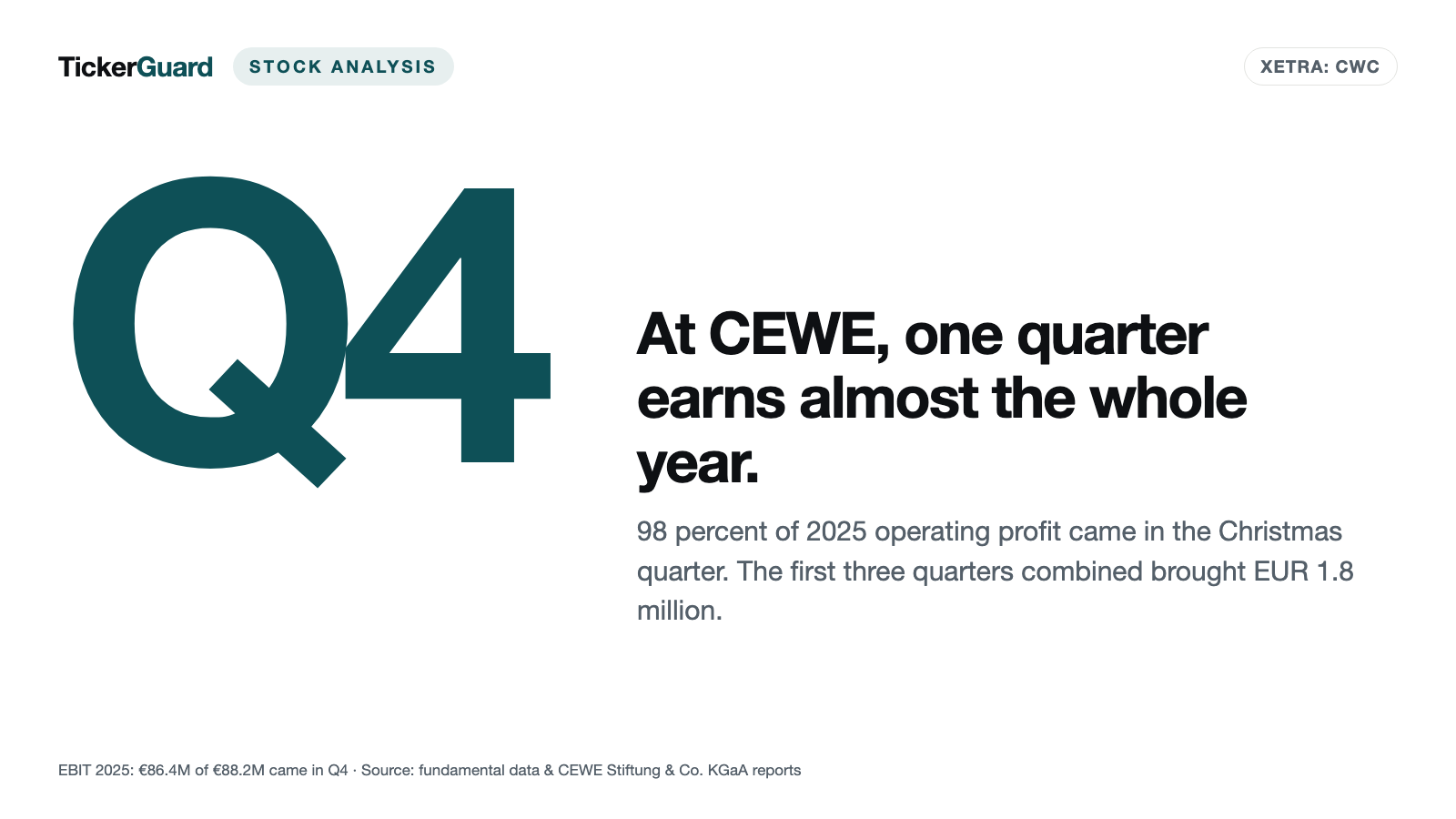
Interactive price chart (TradingView).
Note: pure fact-based analysis, not investment advice and not a solicitation to buy or sell. All figures without guarantee.
Some stocks feel like a comfort blanket. You know the brand, your parents made photobooks with it, and the dividend has gone up as reliably as the Christmas tree in December. That feeling is the trap this analysis is about. Let us call it the comfort-blanket trap: whatever has gone well for a long time starts to feel guaranteed — and we stop looking closely when something underneath begins to change.
At CEWE Stiftung & Co. KGaA (XETRA: CWC) of Oldenburg, Germany, a lot is changing in 2026. In July the group handed its commercial online printing business to Cimpress, agreed in the same month to buy the global instant-photo business of Kodak Moments, and in September it launched a share buyback. On top of that comes a quirk that repeats every year but is rarely seen in its full force: in 2025, EUR 86.4 million of EUR 88.2 million in operating profit was earned in the fourth quarter. So here is the deal: we pull the blanket back once and look at what lies beneath. Our only sources are the company's own reports — the Annual Report 2025 of March 26, 2026 and the Half-yearly report 2026 of August 13, 2026.
One point up front, because it shapes the evidence base: CEWE files nothing with the U.S. securities regulator, the SEC. The stock is listed in the Prime Standard of the Frankfurt Stock Exchange and belongs to the SDAX small-cap index; CEWE reports under European capital-markets law and IFRS. Every number here is therefore sourced to “fundamental data & reports of CEWE Stiftung & Co. KGaA.” The fiscal year is the calendar year. Quotes come from the official English versions of the reports.
What CEWE Actually Does — Photobooks, Prints and Kiosks in Retail Stores
CEWE describes itself as Europe's market leader in photofinishing. The word sounds like a darkroom, but today it mostly means this: you upload pictures from your phone, design a photobook, a calendar or a wall print, and CEWE prints, binds and ships it. In 2025 the group sold 6.32 million CEWE PHOTOBOOKS and produced 2.60 billion photos. Orders come in through apps, browsers, desktop software and more than 25,000 CEWE photo kiosks; the company supplies more than 16,000 stores run by retail partners. Besides the flagship brand, the group owns Cheerz, DeinDesign, Pixum and WhiteWall.
CEWE also runs its own photo stores and online shops in Poland, Czechia, Slovakia, Norway and Sweden that sell cameras and accessories — EUR 13.3 million of revenue in the first half of 2026. The third business, online printing for corporate customers under the SAXOPRINT, viaprinto and LASERLINE brands, has belonged to the U.S. group Cimpress since July 2, 2026. Without it, CEWE's 2025 revenue would have been EUR 777.0 million pro forma instead of the reported EUR 864.5 million. The company was founded in 1912, has been listed since March 24, 1993, and had 3,972 employees on June 30, 2026, of whom 521 worked in the divested printing unit.
An everyday picture of the model: CEWE is the photographer who never takes a picture but turns your memories into an album. It gets paid per product, and the more premium the product, the more sticks. In the second quarter of 2026, photofinishing revenue averaged 26.61 cents per photo, up from 24.68 cents in the second quarter of 2022 (quarterly figures; for full-year 2025 the figure was 28.68 cents per photo, so the two are not directly comparable).
Company history for investors
-
1993
Stock market listing
First listed on March 24, 1993. CEWE has been public ever since — today in the SDAX, with the Neumüller CEWE COLOR Stiftung as its managing general partner.
-
2025
Record year with EUR 88.2M of EBIT
Revenue EUR 864.5 million, dividend EUR 3.00 as the 17th straight increase. EUR 86.4 million of EBIT came in the fourth quarter — the year hinged on Christmas, as always.
-
2026
July: online printing sold to Cimpress
Closed on July 2, 2026 at a confidential price. CEWE expects a gain in the mid double-digit millions of euros, booked in the third quarter.
-
2026
July: Kodak Moments deal signed
About EUR 200 million of revenue in 54 countries, enterprise value about EUR 88 million. For shareholders, a step into North America — with integration risk and closing only in 2027.
-
2026
September: share buyback approved
Up to 150,000 shares for up to EUR 18 million between 09/15/2026 and 04/16/2027, about 2.0% of share capital.
How the Stock Landed on Our Desk
Not through a metric, but through other investors' curiosity: since August 11, 2026, CEWE has appeared on the hot-discussion list of the German investor portal wallstreet-online. That is an attention signal and explicitly not a reason to buy. The trigger is easy to find: July brought the printing sale and the Kodak Moments deal, September the buyback. CEWE itself notes in the half-year report that trading in its shares more than doubled in the second quarter of 2026 — to an average of 16,424 shares a day, from 6,391 a year earlier.
This is where the comfort-blanket trap bites for the first time: if your mental file says “safe dividend stock,” you read an acquisition and a buyback as confirmation. We read them as a reason to check whether the old picture still holds.
The Numbers Over the Years — Given Their Due
First, what genuinely impresses. Revenue rose from EUR 653.3 million (2018) to EUR 864.5 million (2025), operating profit (EBIT, earnings before interest and taxes) from EUR 53.7 million to EUR 88.2 million, and net income from EUR 36.3 million to EUR 58.0 million. Diluted earnings per share climbed from EUR 5.01 to EUR 8.45. For 2025, CEWE paid a dividend of EUR 3.00 per share, its 17th consecutive increase; in 2008 it was EUR 1.00.
The balance sheet matches. At December 31, 2025, the equity ratio was 61.2 percent, and cash exceeded financial debt by enough to leave a net cash position of EUR 108.3 million. Return on capital employed (ROCE) — operating profit relative to the capital tied up in the business — was 17.6 percent. Put simply: every euro tied up in the business earned about 18 cents of operating profit that year. That is good, but not a peak — in 2020 it was 20.6 percent.
For 2026, excluding the divested printing unit, CEWE guides to EUR 780 million to EUR 810 million of revenue, EUR 85 million to EUR 91 million of EBIT and earnings per share of EUR 8.43 to EUR 9.16; management says it aims for the upper half of those ranges. In the first half, photofinishing grew 4.4 percent to EUR 284.1 million. So far, this is the story that makes the blanket so warm. Now let us look underneath.
Uncomfortable Truth No. 1: One Quarter Carries the Whole Year
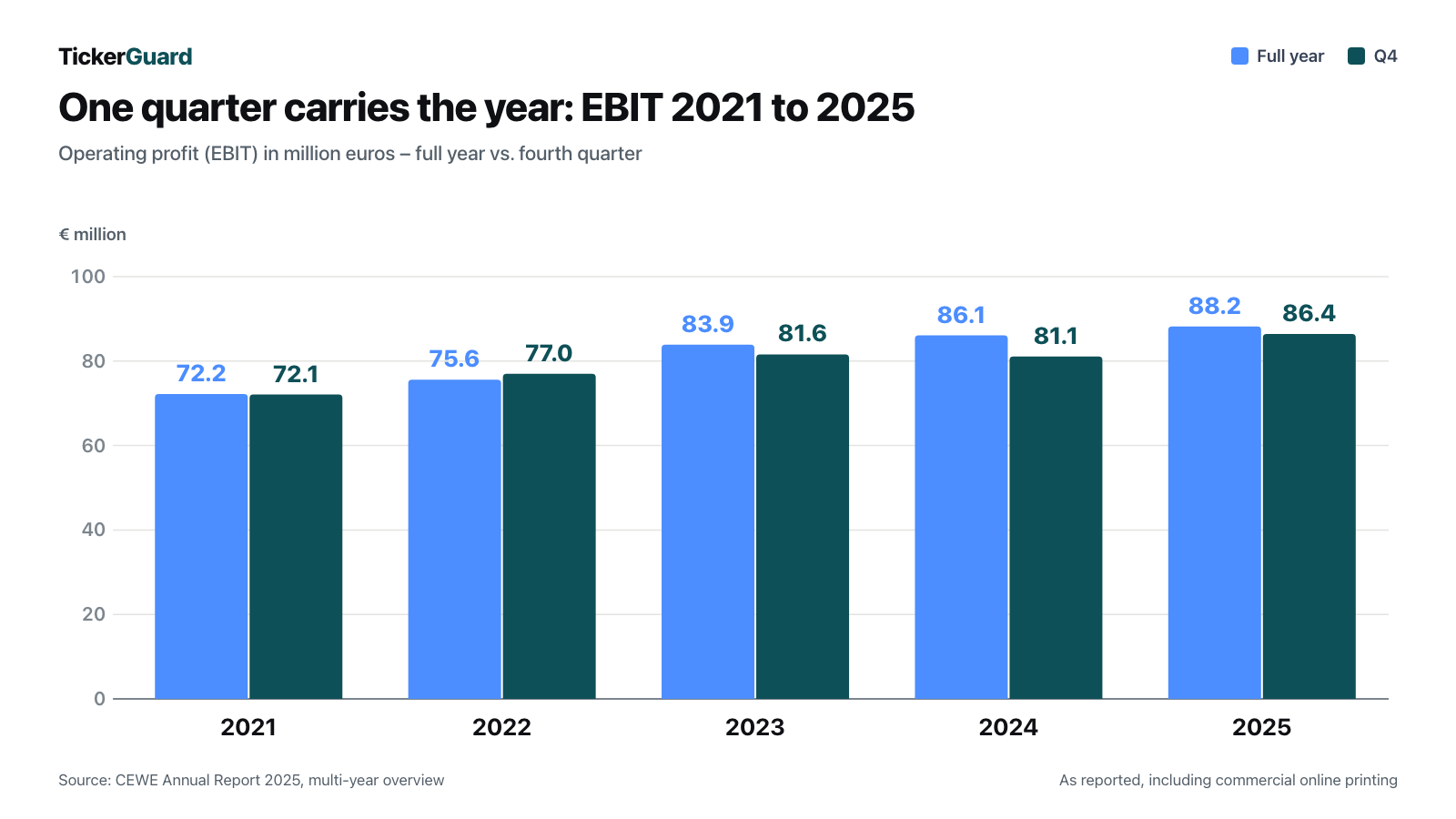
The most important number in this analysis is not in a press release but in the multi-year overview at the back of the annual report, which shows the fourth quarter separately. In 2025, CEWE earned EUR 86.4 million of EBIT there — out of EUR 88.2 million for the full year. That is 98 percent — while the fourth quarter accounted for 41.7 percent of revenue (EUR 360.8 million of EUR 864.5 million). The first three quarters combined contributed EUR 1.8 million. The gap between 42 percent of revenue and 98 percent of profit is fixed-cost leverage: wages, machines and buildings cost money all year, but they are fully used mainly before Christmas. And this is not a one-off; it is the pattern: in 2021, the fourth quarter brought EUR 72.1 million against EUR 72.2 million for the year; in 2022 it was EUR 77.0 million against EUR 75.6 million — meaning the first three quarters combined were in the red; in 2023 EUR 81.6 million against EUR 83.9 million; and in 2024 EUR 81.1 million against EUR 86.1 million. The fourth quarter's share of annual EBIT thus ranged between 94 and 102 percent in each of these five years.
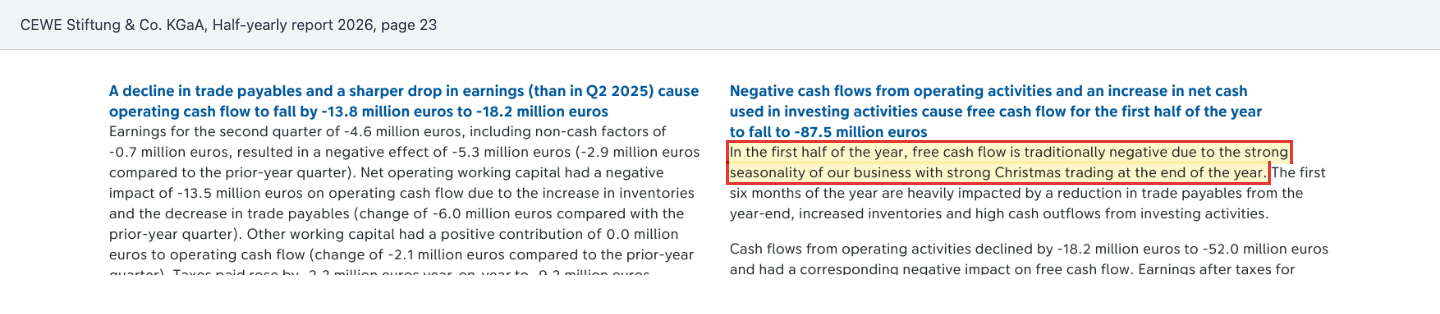
The reason is simple: photobooks, calendars and photo gifts are Christmas presents. For nine months, wages, rent, depreciation and marketing keep running, but most orders arrive in November and December. The same shows up in cash. CEWE describes it itself in the half-year report:
“In the first half of the year, free cash flow is traditionally negative due to the strong seasonality of our business with strong Christmas trading at the end of the year.”
— CEWE Stiftung & Co. KGaA, Half-yearly report 2026, Cash flows, page 23
How strong that rhythm is shows in the June 30, 2026 figures. In the first half, continuing operations posted a net free-cash-flow outflow of EUR 87.5 million (after minus EUR 48.0 million a year earlier) — including purchases of office and production buildings. Cash fell from EUR 149.4 million at year-end to EUR 23.6 million, and the net cash position of EUR 108.3 million turned into net financial debt of EUR 15.1 million. Earnings per share for the second quarter were minus EUR 0.63. None of this is an alarm signal; it is how this business breathes.
The uncomfortable part is something else: a company that earns its year in one quarter has nowhere to hide if that quarter stumbles. A parcel-service strike, a press outage or weak Christmas demand in December would hit not a quarter of the profit but almost all of it. CEWE's 2025 risk report rates “irregularities, disruptive events and operational downtime” as a high-impact risk. Rule of thumb: at CEWE, the first half says almost nothing about the year. The truth arrives in February or March, with the Christmas numbers.
Uncomfortable Truth No. 2: The Photobook Is Treading Water, and Price Increases Mainly Offset Costs
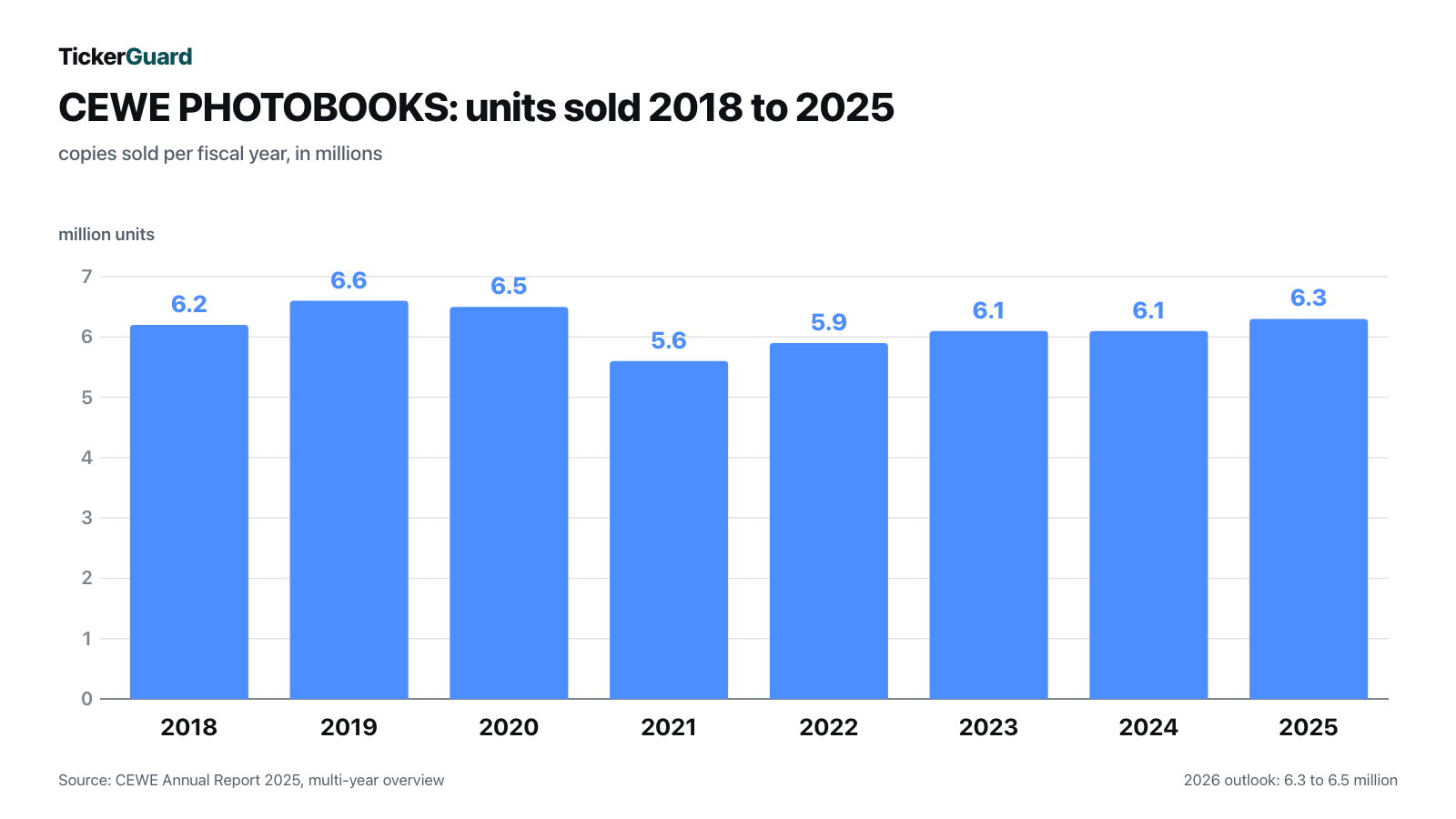
The second number beneath the blanket: CEWE sells hardly more photobooks, its most important product, today than seven years ago. It sold 6.2 million in 2018, 6.6 million in 2019, 6.5 million in 2020, only 5.6 million in 2021, then 5.9, 6.1 and 6.1 million, and 6.3 million in 2025. For 2026 the company plans 6.3 million to 6.5 million. The total number of photos produced rose from 2.23 billion to 2.60 billion between 2018 and 2025 — about 17 percent in seven years, or a little over 2 percent a year; in 2025 alone, photo volume rose 4.1 percent. So volume is growing — just not in the flagship product.
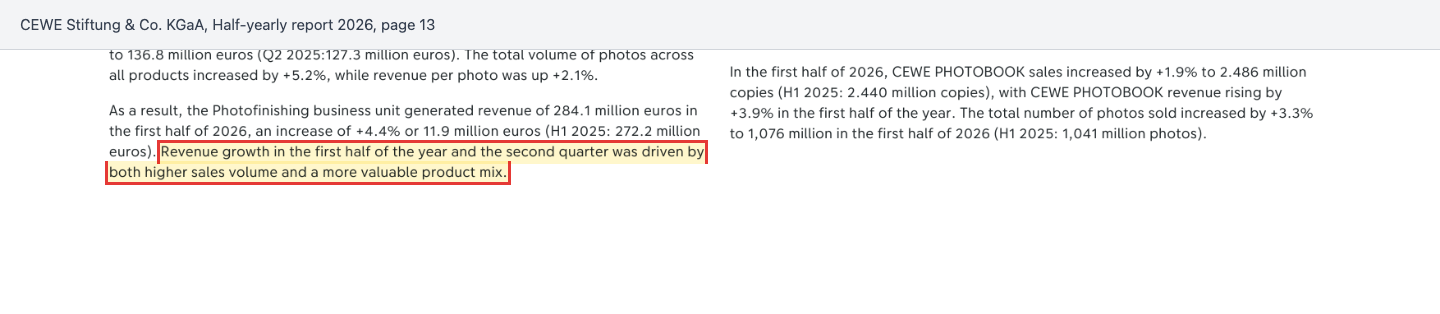
Photofinishing revenue growth comes from more photos and from higher-value products. CEWE names both:
“Revenue growth in the first half of the year and the second quarter was driven by both higher sales volume and a more valuable product mix.”
— CEWE Stiftung & Co. KGaA, Half-yearly report 2026, Photofinishing business unit, page 13
In the first half of 2026, the number of photos rose 3.3 percent and revenue per photo 1.0 percent. From 2021 to 2025, revenue per photo grew from 27.04 cents to 28.68 cents, about 6 percent — and customers' taste for thicker books and wall prints was not the only reason. In its Annual Report 2025, CEWE writes that “price rises also became necessary in 2025 mainly to counteract inflation-driven cost increases in almost every P&L item” (page 17). That is the uncomfortable part. Costs have grown faster than revenue: personnel expenses rose 29 percent between 2020 and 2025 to EUR 252.9 million, while revenue grew 19 percent over the same period. The EBITDA margin — profit before interest, taxes, depreciation and amortization relative to revenue — slipped from 18.6 percent to 16.3 percent, the EBIT margin from 11.0 percent to 10.2 percent.
Free cash flow — the money left after investment — has also weakened: EUR 82.8 million in 2023, EUR 73.8 million in 2024 and EUR 43.7 million in 2025. For 2025 CEWE presents an adjusted figure of EUR 70.8 million, because one-offs depressed the reported number — mainly early repayment of trade payables (EUR 15.9 million), a larger inventory build-up (EUR 7.4 million) and special real-estate investments (EUR 8.1 million). Both figures belong on the table. Rule of thumb: when price increases mainly offset rising costs, revenue grows but the margin does not — at CEWE it has slipped slightly since 2020.
Uncomfortable Truth No. 3: With Kodak Moments, CEWE Buys a Different Business — With a Licensed Brand
On July 16, 2026, CEWE signed to buy KODAK MOMENTS Retail Photo Solutions. The business runs about 37,000 connected photo kiosks in 16,000 stores, employs around 500 people in 54 countries and generates about EUR 200 million in annual revenue, with its core markets in the United States, Canada, Mexico and Australia. It includes a plant in Windsor, Colorado, that makes consumables for instant prints. The agreed enterprise value is about EUR 88 million. The actual price, however, is not fixed yet:
“The purchase price is calculated based on the net debt and net working capital to be assumed at the time of closing.”
— CEWE Stiftung & Co. KGaA, Half-yearly report 2026, page 14
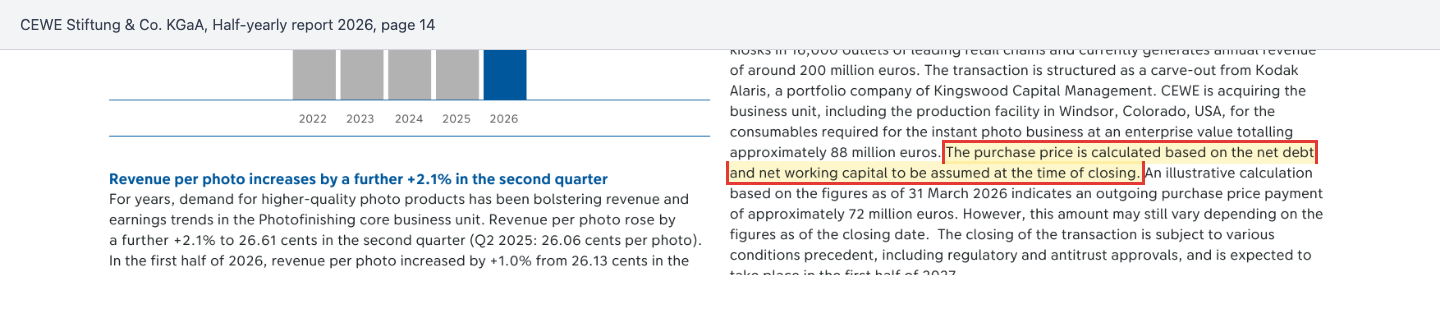
An illustrative calculation based on figures as of March 31, 2026 points to a payment of about EUR 72 million. Closing still needs regulatory and antitrust approvals and is expected in the first half of 2027. For the first full fiscal year after that, the board expects Kodak Moments to earn an EBIT margin in the mid single digits. For comparison: CEWE itself reached 10.2 percent in 2025, or about 11.2 percent pro forma without online printing. A rough back-of-the-envelope calculation of our own: a mid-single-digit margin of about 4 to 6 percent on about EUR 200 million of revenue would mean roughly EUR 8 million to EUR 12 million of EBIT; the agreed enterprise value of about EUR 88 million would then equal roughly 7 to 11 times that profit. At its Capital Market Day on October 6, 2026, CEWE showed — in a chart explicitly labeled illustrative — a small dilution of the group margin (below one percentage point, according to the slide) in the first year, and a group EBIT margin of around 12 percent or more after five years. That is a target, not a result.
And then there is an inconspicuous line in the imprint of the half-year report: “The Kodak trademark and Kodak trade dress are used under license from Eastman Kodak Company.” The trademark rights therefore sit with Eastman Kodak Company, not with the seller, Kodak Alaris. In other words, CEWE is buying a business whose brand name belongs to someone else. The reports disclose neither the term nor the cost of that license.
The Annual Report 2025, published on March 26, 2026, still listed profitable growth in commercial online printing as the second of three strategic priorities. On May 11, 2026, CEWE signed the sale to Cimpress. According to the Q1 statement, the parties agreed to keep the price confidential; CEWE expects a gain on disposal in the mid double-digit millions of euros, booked in the third quarter of 2026. For comparison: online printing generated EUR 89.6 million of revenue in 2025 and contributed EUR 1.7 million of EBIT, a margin of about 1.9 percent (Annual Report 2025, pages 21 f.). For you, this means 2026 group earnings will be lifted by a one-off, and you will only see how much cash actually came in with the quarterly statement on November 12, 2026. Rule of thumb: in 2026, CEWE swaps a low-margin business in Europe for a low-margin business overseas — with the stated, explicitly illustrative goal of lifting the group margin over the medium term. Whether that works will only show from 2027.
Uncomfortable Truth No. 4: Shareholders Provide the Capital, a Foundation Steers
The “Stiftung & Co. KGaA” in the name is not decoration. A German partnership limited by shares (KGaA) has two kinds of partners: shareholders, who provide the capital, and a general partner with unlimited liability, who runs the business. At CEWE that general partner is the Neumüller CEWE COLOR Stiftung, a foundation set up in the spirit of founder Heinz Neumüller. Who appoints its executive board — the people who actually run CEWE — is spelled out in the corporate governance statement:
“Those tasks are performed by the Board of Trustees of Neumüller CEWE COLOR Stiftung and regulated in the foundation's statutes.”
— CEWE Stiftung & Co. KGaA, Annual Report 2025, corporate governance statement, page 87
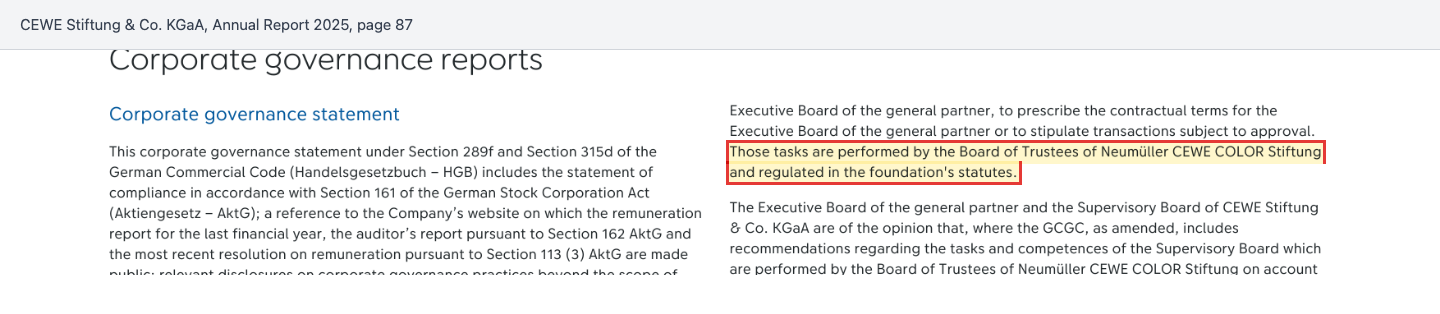
According to the same paragraph, “those tasks” are appointing the general partner's executive board, setting its contract terms and specifying transactions that require approval. Consistently, CEWE states that the German Corporate Governance Code's recommendations on executive board composition and pay do not apply to it. The foundation itself receives fixed annual compensation of EUR 50,000 plus VAT for management and liability, regardless of profit or loss, and is reimbursed for its expenses.
For you as a shareholder, this means you vote at the annual meeting on the dividend, discharge and the supervisory board — but not on who runs CEWE. The founder's family holds 27.1 percent of the shares through two holding companies, and CEWE itself held 702,711 treasury shares on June 30, 2026, about 9 percent of share capital. Under the articles of association, the foundation holds its role irrespective of any capital contribution; buying shares, even a great many, does not hand you the management. That shields the company from short-term pressure — and makes a takeover against the foundation's will difficult. We examined a similar structure with a different power center in our analysis of naval shipbuilder TKMS. Rule of thumb: at CEWE you co-own a family tradition. The foundation sets the course.
What the Stock Costs
First, a note: the automatically displayed key-figures box on this page uses its own earnings base and date, so its values may differ from our calculations, which refer explicitly to the reported figures named here. On October 9, 2026, CEWE closed at EUR 112.20 on XETRA (fundamental data). With 6,739,292 shares outstanding — 7,442,003 in total minus 702,711 treasury shares as of June 30, 2026, i.e. before the buyback that began on September 15, 2026 — that gives a market value of about EUR 756 million. Subtract the net cash of EUR 108.3 million from December 31, 2025, and the enterprise value comes to about EUR 648 million.
- Against earnings: On 2025 diluted earnings per share of EUR 8.45, the price equals a price-to-earnings ratio of about 13. On the 2026 guidance (EUR 8.43 to EUR 9.16) it is about 12 to 13.
- Against operating profit: The enterprise value of about EUR 648 million is roughly 7.3 times 2025 EBIT of EUR 88.2 million. This is a snapshot with mixed reporting dates: at June 30, 2026, seasonal net financial debt stood at EUR 15.1 million; on that basis the enterprise value would be about EUR 771 million, or roughly 8.7 times 2025 EBIT. In addition, the proceeds from the printing sale are undisclosed, and the roughly EUR 72 million Kodak Moments payment is still to come.
- Against the dividend: EUR 3.00 for 2025 equals a yield of about 2.7 percent at the October 9, 2026 price.
Then there is the buyback: between September 15, 2026 and April 16, 2027, CEWE plans to buy back up to 150,000 of its shares for up to EUR 18 million on the market, about 2.0 percent of share capital. The budget of up to EUR 18 million is a ceiling for the program; CEWE does not thereby state a target price or a valuation of the stock. CEWE's half-year report includes an overview of selected analyst views; we deliberately do not reproduce ratings or price targets, because they are third-party recommendations.
Upside and Risks at a Glance
What speaks for CEWE:
- Self-described European market leader. Revenue per photo in the second quarter rose from 24.68 cents (2022) to 26.61 cents (2026) without volumes collapsing.
- Solid balance sheet. Equity ratio of 61.2 percent and EUR 108.3 million of net cash at December 31, 2025; the risk report sees no threat to the company as a going concern.
- Long dividend record. 17 consecutive dividend increases up to EUR 3.00 for 2025, plus ongoing buybacks.
- Focus on the core. Without online printing, the 2025 EBIT margin would have been about 11.2 percent pro forma instead of the reported 10.2 percent, and ROCE 19.6 percent instead of 17.6 percent.
- New market. After closing (expected in the first half of 2027), Kodak Moments would bring about EUR 200 million in revenue and access to retail chains in North America and Australia.
What speaks against it:
- One quarter decides. 98 percent of 2025 EBIT came in the fourth quarter; weak Christmas trading would hit almost the entire annual profit.
- Flat photobook volumes, slightly lower margins. 6.3 million photobooks in 2025 after 6.2 million in 2018; EBITDA margin 16.3 percent in 2025 after 18.6 percent in 2020, with 2025 price increases mainly offsetting costs.
- Kodak Moments integration risk. Carve-out from Kodak Alaris, a new continent, an initially mid-single-digit margin, a brand licensed from a third party; the price is only fixed at closing.
- One-offs in 2026 not yet quantified. Confidential sale price for online printing, a gain on disposal in the third quarter, EUR 3.8 million of transaction costs in the first half, of which, according to the half-year report, the seller will bear EUR 2.0 million at closing.
- Limited say. The foundation's Board of Trustees, not the annual meeting, decides who runs the company.
An Honest Conclusion
Let us pull the comfort blanket back into place and see whether it still fits. It does — in many ways. CEWE is profitable, has a strong balance sheet, a brand people know and a dividend that has risen 17 times in a row. That explains why the share feels so familiar to many investors.
But beneath the blanket lie things that familiarity tends to overlook: a year decided almost entirely in December; photobook volumes that have barely grown since 2018; a makeover that changes the company in 2026 and 2027 — out of online printing, into an overseas instant-photo business with a licensed brand —; and a legal form in which a foundation, not you, sets the direction. The comfort-blanket trap is concluding from 17 consecutive dividend increases that the 18th, and everything else, will follow automatically.
The next solid data points are the third-quarter statement on November 12, 2026 with the gain from the printing sale, the Christmas numbers in the 2026 annual report and the closing of the Kodak deal in the first half of 2027. What you make of it is your decision. And that is how it should be.
Sources and Notes
- CEWE Stiftung & Co. KGaA, Half-yearly report 2026 — published August 13, 2026, reviewed by the auditor: segments, income statement, balance sheet, cash flow statement, discontinued operations, events after the reporting date, treasury shares, 2026 guidance, multi-year overview
- CEWE Stiftung & Co. KGaA, Annual Report 2025 — published March 26, 2026: multi-year overview 2018 to 2025 including fourth-quarter figures, legal form and foundation, takeover-related disclosures, corporate governance statement, risk report, strategic priorities
- CEWE Stiftung & Co. KGaA, Q1 2026 quarterly statement (German) of May 12, 2026 — sale of online printing to Cimpress, confidential purchase price
- CEWE releases at ir.cewe.de: closing of the online-printing sale (July 2, 2026), inside information on the Kodak Moments acquisition (July 16, 2026), inside information on the share buyback (September 14, 2026)
- CEWE Capital Market Day 2026: Equity Story and Kodak Moments presentation of October 6, 2026 — illustrative margin and return targets
- Price and market-value data: fundamental data, XETRA close of October 9, 2026 (EUR 112.20). Hook: hot-discussion list of the German investor portal wallstreet-online, first on August 11, 2026 (not a source of company figures)
Note: This article is journalistic commentary and expressly not investment advice, not a solicitation to buy or sell securities and not a recommendation. Stocks can lose their entire value. All figures come from the original reports linked above and are given with their respective reporting dates. Positions held by the operator are disclosed daily; where one exists, it appears as a notice at the top of this deep dive.
Our Bottom Line at a Glance
- Business model and market position positive
- Self-described European photofinishing leader with 6.32 million photobooks and 2.60 billion photos in 2025; revenue per photo in the second quarter up from 24.68 cents (2022) to 26.61 cents (2026).
- Balance sheet and payouts positive
- Equity ratio 61.2% and net cash of EUR 108.3 million at 12/31/2025; dividend of EUR 3.00 for 2025, the 17th consecutive increase; buyback of up to 150,000 shares through 04/16/2027.
- Dependence on the Christmas quarter negative
- EUR 86.4 million of EUR 88.2 million in 2025 EBIT came in the fourth quarter; in the first half of 2026 cash fell to EUR 23.6 million and the net position turned to EUR 15.1 million of debt (06/30/2026).
- Quality of growth neutral
- Photobooks 6.2 million (2018) vs. 6.3 million (2025); photos 2018–2025 +17%, revenue per photo 2021–2025 +6% (27.04 → 28.68 cents), supported partly by inflation-driven price increases. EBITDA margin down from 18.6% (2020) to 16.3% (2025), EBIT margin from 11.0% to 10.2%.
- 2026/27 makeover neutral
- Sale of online printing (confidential price, gain in the mid double-digit millions of euros in Q3 2026) and purchase of Kodak Moments (about EUR 200 million of revenue, mid-single-digit margin expected, licensed brand, closing H1 2027).
- Governance negative
- The executive board is appointed by the Board of Trustees of Neumüller CEWE COLOR Stiftung; per the Annual Report 2025, governance-code recommendations on board composition and pay do not apply because of the legal form.
CEWE is profitable, financially strong and has raised its dividend 17 times in a row. The reports also show how heavily the year depends on the Christmas quarter, that photobook volumes barely grow, that 2026 brings a makeover with a confidential sale price and an overseas acquisition, and that shareholders have no say over management. Not investment advice.
What Our Rating Means
Quality confirmed
Business model, numbers and balance sheet hold up to our review. Whether the current price supports an entry is a separate question — it hangs on the price, not on the company.
Quality is documented: profitable in every year since 2018, EBIT up from EUR 53.7 million to EUR 88.2 million, an equity ratio above 60 percent, net cash at year-end and no going-concern flag in the risk report. Dependence on the Christmas quarter is a concentration risk — an outage or weak Christmas trading would hit almost the entire annual profit — but it is a pattern that has held for years, not a threat to the substance of the company. Open questions are the Kodak Moments integration, which only closes in 2027, how long growth through product mix can last, and a legal form in which the foundation picks the executive board. These are points to watch, not fault lines. Whether the stock is attractive at EUR 112.20 (October 9, 2026) is a question of price. The decision is yours.
A journalistic assessment by our editorial team at the time of the deep dive, based on public sources — not investment advice and not a solicitation to buy or sell. Your personal circumstances (investment goals, risk capacity, taxes) cannot be taken into account. What our levels mean, how verdicts are formed, and what conflicts of interest exist →
Worth Noting
- The hook is the hot-discussion list of the German investor portal wallstreet-online, where CEWE has appeared since August 11, 2026 — an attention signal, not a data source.
- Data as of October 10, 2026. Company figures from the Half-yearly report 2026 (08/13/2026) and the Annual Report 2025 (03/26/2026). From 2026, CEWE reports online printing as a discontinued operation; first-half figures for 2025 and 2026 are therefore continuing operations, while annual figures through 2025 are as reported including online printing.
- Reviewed after 08/13/2026: a director-dealing notice by a Board of Trustees member (08/14/2026), ad-hoc release on the share buyback (09/14/2026), Capital Market Day (10/06/2026, no guidance change). No voting-rights notification and no capital measure other than the buyback. The Q3 2026 statement is due on 11/12/2026.
- CEWE is not an SEC filer and does not appear in the EDGAR database. The listing in the Prime Standard of the Frankfurt Stock Exchange under CWC governs.
The full analysis as a PDF for later
We will send you this analysis as a PDF — to print, file away, and read at your own pace.
Frequently Asked Questions
CEWE of Oldenburg, Germany, describes itself as Europe's market leader in photofinishing: photobooks, prints, calendars, wall art and photo gifts under brands such as CEWE, Cheerz, Pixum and WhiteWall. In 2025 it sold 6.32 million photobooks. It also runs photo stores in Poland, Czechia, Slovakia, Norway and Sweden. Its online printing business for corporate customers was sold to Cimpress in July 2026.
Photobooks and calendars are mostly Christmas gifts. In 2025, EUR 86.4 million of EUR 88.2 million in EBIT came in the fourth quarter. In the first half of 2026, reported EBIT was minus EUR 1.7 million and operating EBIT plus EUR 2.1 million. CEWE itself calls negative first-half cash flow traditional.
CEWE is acquiring KODAK MOMENTS Retail Photo Solutions, Kodak Alaris's instant-photo business with about 37,000 photo kiosks in 16,000 stores, around 500 employees and about EUR 200 million in annual revenue. The enterprise value is about EUR 88 million; an illustrative calculation puts the payment at about EUR 72 million. Closing is expected in the first half of 2027, and the Kodak brand is used under license.
For fiscal 2025, CEWE paid EUR 3.00 per share, up from EUR 2.85 the year before. It was the 17th consecutive increase; in 2008 the dividend was EUR 1.00. CEWE says it aims to keep the dividend at least stable each year and ideally raise it. At the October 9, 2026 price, that is a yield of about 2.7 percent.
The general partner is the Neumüller CEWE COLOR Stiftung, a foundation. Its executive board runs CEWE and is appointed by the foundation's Board of Trustees, not by the annual meeting. The foundation receives EUR 50,000 a year plus VAT and reimbursement of expenses. Shareholders share in the profits but do not decide who manages the company.
On a regulated market, CEWE is listed only in the Prime Standard of the Frankfurt Stock Exchange; according to its regulatory announcements it also trades on the open market of several German exchanges, is not listed on any U.S. exchange and reports under European capital-markets law and IFRS. The U.S. securities regulator's EDGAR database does not list the company. The relevant documents are the annual report, the half-yearly report and the quarterly statements, which CEWE publishes in German and English.
Found an error?
Did you spot a factual error, an outdated number, or a typo in this deep dive? Let us know briefly — your report goes straight to the editorial team.