Standard Lithium: Nine Stamps Collected — and the Tenth Is the One Missing
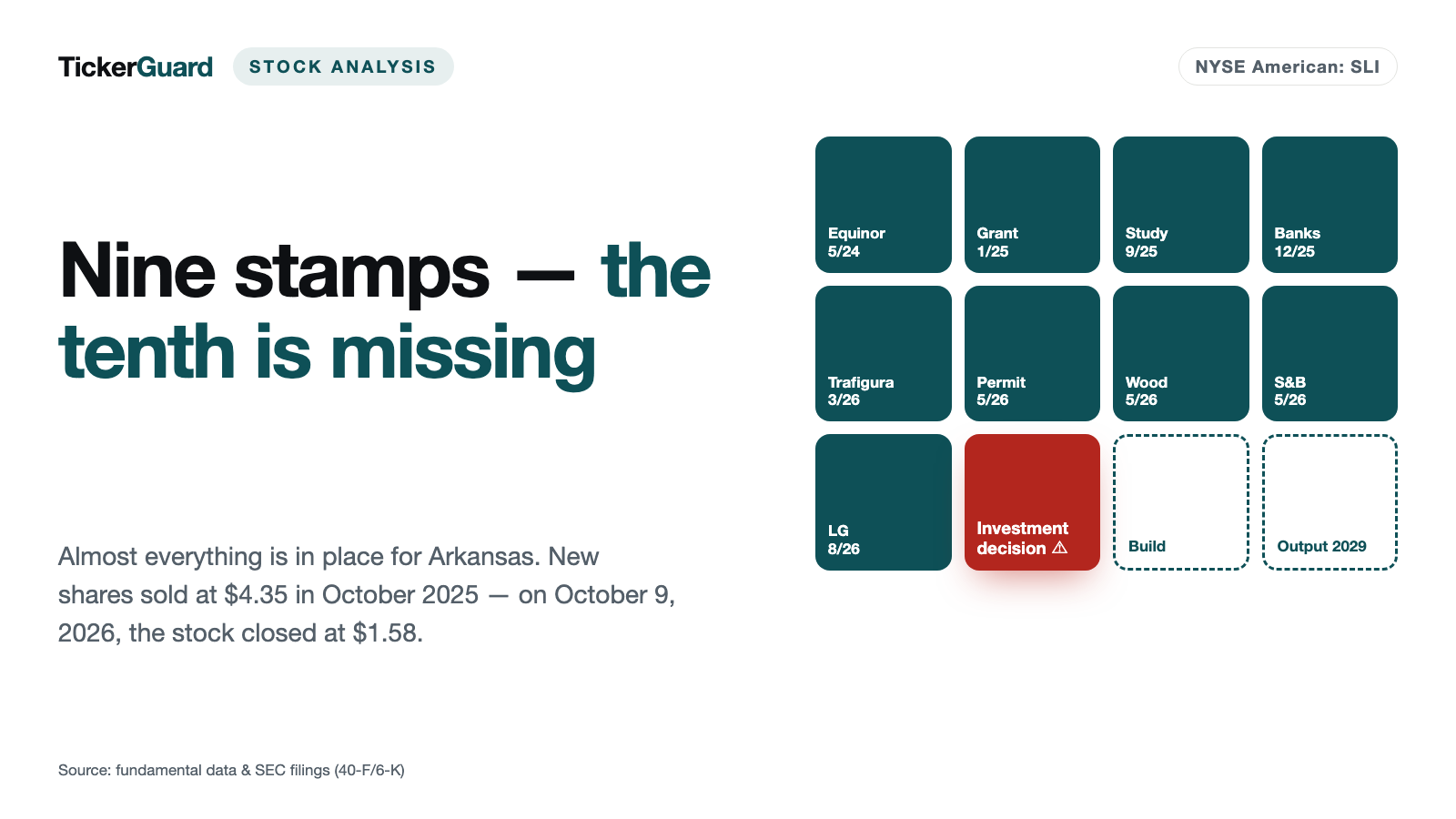
Standard Lithium wants to pull lithium out of underground brine in southern Arkansas together with Norway's Equinor, and in just over two years it has collected nine stamps: partner, grant, study, lender interest, buyers, environmental review, contractors. The tenth, the final investment decision, was promised for the end of 2025 and is still missing. The stock went from $4.35 in the October 2025 offering to $1.58 on October 9, 2026. And a clock is running in the notes: if the decision does not come by January 1, 2027, $40 million from Equinor may lapse. We read the annual report, the quarterly report and every filing since. A timeline in a filing is a plan, not a promise.
 Thomas Mücke
Founder & Publisher
Thomas Mücke
Founder & Publisher
As of Today
As of: October 11, 2026
- Closing price
- 1.60 $ -1.86%
- Market Capitalisation
- 0.4 $B
Price change since October 9, 2026: +1.3%
This analysis has a cut-off date. The Stock Guard tells you when something material changes in the numbers. Reserve your free spot
Chart
Interactive price chart (TradingView).
Last price: 1.60 $ (As of: October 11, 2026)
Note: pure fact-based analysis, not investment advice and not a solicitation to buy or sell. All figures without guarantee.
In October 2025, Standard Lithium sold new shares at $4.35. On October 9, 2026, the stock closed at $1.58 on the NYSE American — even though the company sent out almost nothing but good news in between: two major buyers, two construction contracts, a completed environmental review. How does that fit together? The answer lies in a coffee-shop loyalty card.
Buy nine, the tenth is free. In 2006, behavioral researchers led by Ran Kivetz showed that the closer customers got to the free coffee, the faster they bought — the goal-gradient effect. Something similar happens in the stock market: every box a project developer ticks makes the goal feel closer. Yet only the last stamp counts. For its Arkansas lithium project, Standard Lithium has collected nine stamps in just over two years; the tenth, the final investment decision, was once promised for the end of 2025. So let's make a deal: instead of counting the stamps, we read together what the company has told the U.S. securities regulator, the SEC. The tension running through this analysis: almost everything needed to build in Arkansas has been signed — except the final investment decision, and that is exactly what the schedule, the funding gap and your share of the project depend on.
What Standard Lithium Actually Does — Lithium From Arkansas Brine
Standard Lithium is a Canadian company headquartered in Vancouver whose projects are all in the United States. Deep beneath southern Arkansas and northeastern Texas lies a brine-bearing rock layer, the Smackover Formation; in the Arkansas project area, its top sits roughly 2.3 to 2.8 kilometers below sea level, according to the annual report. Brine has been pumped from it commercially in Arkansas for about 60 years, and for decades it has also fed bromine production. That brine contains lithium, too. Standard Lithium wants to recover it with what is called direct lithium extraction. Think of a filter that fishes the lithium out of a stream of salt water and sends the rest back underground. The end product is battery-quality lithium carbonate, the raw material for batteries in electric vehicles and energy storage systems.
The flagship is called South West Arkansas. According to the definitive feasibility study published in September 2025, the first phase is designed for 22,500 metric tons of lithium carbonate a year, averaging 22,156 tons over 20 years, at a capital cost of $1,449 million. The company targets first commercial production in 2029. Behind it sits the Franklin project in East Texas, which received a preliminary economic assessment in September 2026. Neither project belongs to Standard Lithium alone; both are held by the joint venture Smackover Lithium: 55 percent Standard Lithium, 45 percent Equinor. Standard Lithium runs the projects as operator. There is no revenue yet; a demonstration plant has been operating for about six years at chemical maker Lanxess's site near El Dorado. According to its annual information form, the company had 53 employees in March 2026.
A note on the evidence trail: as a Canadian issuer, Standard Lithium reports under the U.S.-Canadian multijurisdictional disclosure system. Instead of a 10-K annual report, it files an annual report on Form 40-F; quarterly reports and press releases arrive as Form 6-K. It reports under IFRS in U.S. dollars. Until mid-2024, the fiscal year ended June 30; after a transition period from July to December 2024, it has matched the calendar year since 2025. The stock trades on the NYSE American and on Canada's TSX Venture Exchange, both under the symbol SLI.
Company history for investors
-
2023
Pre-feasibility study for South West Arkansas
The study arrives in August. On June 30, 2023, 172.8m shares are outstanding — the starting point for the dilution that follows.
-
2024
Equinor takes a 45 percent stake
Equinor pays $30m and funds the first $60m of development costs ($40m Arkansas, $20m Texas). The accounting gain produces a profit for the fiscal year to June 2024 — without revenue.
-
2025
Grant, feasibility study, equity offering
The $225m grant is finalized in January, the feasibility study arrives in September. In October, 29.9m new shares at $4.35 raise $130m gross.
-
2026
Buyers, environmental review, contracts
Trafigura (March), environmental review and contracts (May), LG Energy Solution (August). The investment decision is pending — deadline for the Equinor payment: January 1, 2027.
How the Stock Landed on Our Desk
Not through our in-house stock scanner. It screens for revenue, profit, margin and balance-sheet quality, and a company with no revenue fails every one of those filters. Standard Lithium made our research list through the forum ranking of wallstreet-online, the list of stocks most discussed by German retail investors (as of October 11, 2026). That is a signal of attention, not of quality.
The attention has a reason, and it does not match the stamps. After the October 2025 offering at $4.35, the company's at-the-market sales still fetched an average of $3.59 a share in the second quarter of 2026, and only $2.78 in the third. The October 9, 2026, close of $1.58 was a little over 64 percent below the 2025 year-end close of $4.47. We found a very similar picture — construction progress in the press releases, a falling share price on the exchange — at Vulcan Energy and its lithium project in Germany's Upper Rhine Valley; how partners can share in a project at the project level is shown in our analysis of Lithium Americas.
The Numbers Over the Years — Credit Where It Is Due
First, what genuinely impresses, without qualification. In two years, Standard Lithium has checked off almost every precondition for construction. In May 2024, Equinor came in, paid $30 million and funded the first $40 million of development costs in Arkansas and the first $20 million in Texas on its own. In January 2025, the Department of Energy grant of $225 million was finalized. In December 2025, three government export credit agencies, including the Export-Import Bank of the United States, expressed interest in more than $1 billion of project debt. In May 2026, the Department of Energy concluded the federal environmental review without additional conditions, and in the same month the engineering and construction contracts with Wood (well field) and S&B (processing facility) were signed.
Sales are lined up, too. In March 2026, Trafigura signed an offtake agreement for 8,000 metric tons a year; in August 2026, LG Energy Solution signed for another 8,000 tons, both for ten years on a take-or-pay basis. In September 2026, Trafigura added an option for up to 4,000 more tons a year. The target was 18,000 tons, roughly 80 percent of capacity; with the option, commitments reach up to 20,000 tons a year. According to the quarterly report, the demonstration plant has processed more than one million barrels of real brine and completed more than 15,000 extraction cycles. Count them up and you have the nine stamps from the introduction: Equinor (May 2024), the grant (January 2025), the feasibility study (September 2025), lender interest from the export credit agencies (December 2025), Trafigura (March 2026), the environmental review, Wood and S&B (all May 2026), and LG Energy Solution (August 2026).
And the cash position is solid. In October 2025, Standard Lithium raised $130 million in gross proceeds. As of June 30, 2026, it held $137.3 million in cash and had no term or revolving debt. Shareholders' equity stood at $369.2 million.
Now the sober part. There has never been a profit in the usual sense. The fiscal year ended June 2024 did show net income of $105.8 million, but only because of a $164.1 million accounting gain on the deconsolidation of its project subsidiaries when Equinor took 45 percent. After that came a loss of $29.5 million in the six-month transition period to December 2024, $48.4 million in 2025 — including a $26.5 million impairment on a project at the Lanxess site that the company is no longer advancing — and $5.8 million in the first half of 2026. In the first half of 2026, $9.0 million went into operations and $27.2 million into capital contributions to the joint venture.
Uncomfortable Truth No. 1: The Finish Line Keeps Moving
This is where the loyalty card comes in. The most important stamp is the final investment decision, or FID in industry shorthand. Only then do the loans flow, and only then does construction begin. A year and a half ago, the annual report carried a clear date:
“A Final Investment Decision (“FID”) is planned by year-end 2025, with construction targeted to begin thereafter, if a positive FID is reached. Construction would take approximately two years, with first production expected in 2028.”
— Standard Lithium, annual report on Form 40-F for 2024, Exhibit 99.2 (MD&A), filed March 24, 2025

In the August 2026 quarterly report, the same plan reads: “We expect to take FID in 2026, with construction commencing shortly thereafter, and anticipate a two to three year construction timeline.” The company now names 2029 for first production. So “by year-end 2025” became “2026,” two years of construction became two to three, and 2028 became 2029. As of the cutoff for this analysis, October 11, 2026, the decision had not been made; fewer than three months of the year remain.
A one-year delay in first production is nothing unusual for a project of this size, and there are understandable reasons for it: the offtake agreements that, according to the company, underpin the size and structure of the project debt were only signed in 2026. But one side effect is right there in the Q2 2026 MD&A. For the Texas project, Standard Lithium cut the value of the milestone payments promised by Equinor by $0.7 million in the first half of 2026 because the expected dates moved — in the company's words, “updated assumptions regarding expected timelines of milestone achievement and FID.” And Standard Lithium does not decide alone: according to the annual information form, certain significant decisions in the joint venture require the approval of both partners.
For Arkansas, there is also a hard deadline, and it sits in the notes to the interim financial statements. When Equinor came in, Standard Lithium was promised milestone payments of $40 million for Arkansas and $30 million for Texas — but only if the decisions come in time:
“If FID is not determined at SWA Lithium by January 1, 2027, or at Texas Lithium by January 1, 2029, such contingent Financial assets will be subject to termination, pending potential negotiations between the Company and its joint venture partner, Equinor.”
— Standard Lithium, interim financial statements for the period ended June 30, 2026 (Form 6-K, Exhibit 99.1, Note 9 Financial Instruments)
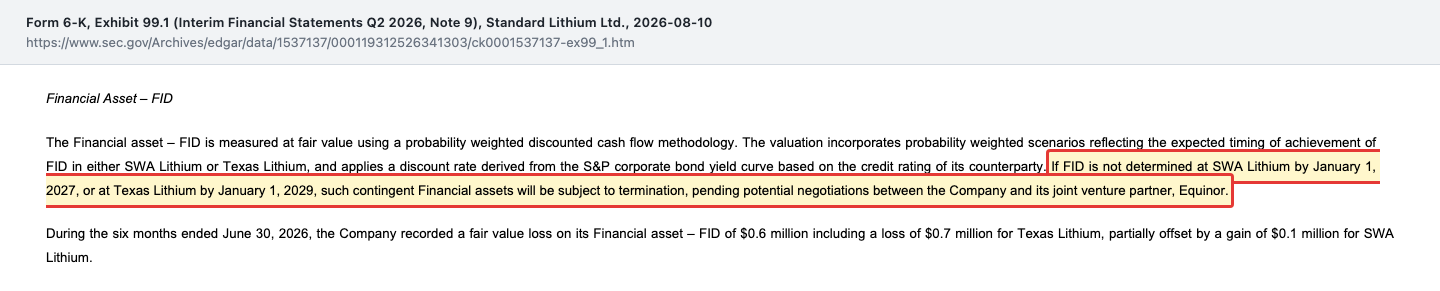
As of this analysis's cutoff, October 11, 2026, January 1, 2027, was less than three months away. If Arkansas misses the deadline, the payment is in question — it may lapse unless Standard Lithium and Equinor negotiate otherwise. On the balance sheet, the Arkansas portion stood at $31.4 million at the end of 2025. So the moving finish line comes with a dated price tag. Takeaway: a schedule in an MD&A is a statement of intent. It only becomes binding once both partners and the banks have signed — and sometimes a clock is running alongside it.
Uncomfortable Truth No. 2: The Cash Covers the Wait, Not the Build
$137 million sounds like a lot. Management spells out what it covers — and the second sentence is the one that matters:
“Management expects to have sufficient access to capital to continue advancing toward FID for the initial phase of our South West Arkansas Project and for currently budgeted operations through June 30, 2027 via cash held on our balance sheet and alternative forms of financing. However, we expect that additional sources of capital will be required in order to take FID and begin construction at the initial phase of the South West Arkansas Project, and to continue expanding our leasehold position and de-risking the East Texas Properties.”
— Standard Lithium, quarterly report for the period ended June 30, 2026 (Form 6-K, Exhibit 99.2, Liquidity and Capital Resources)
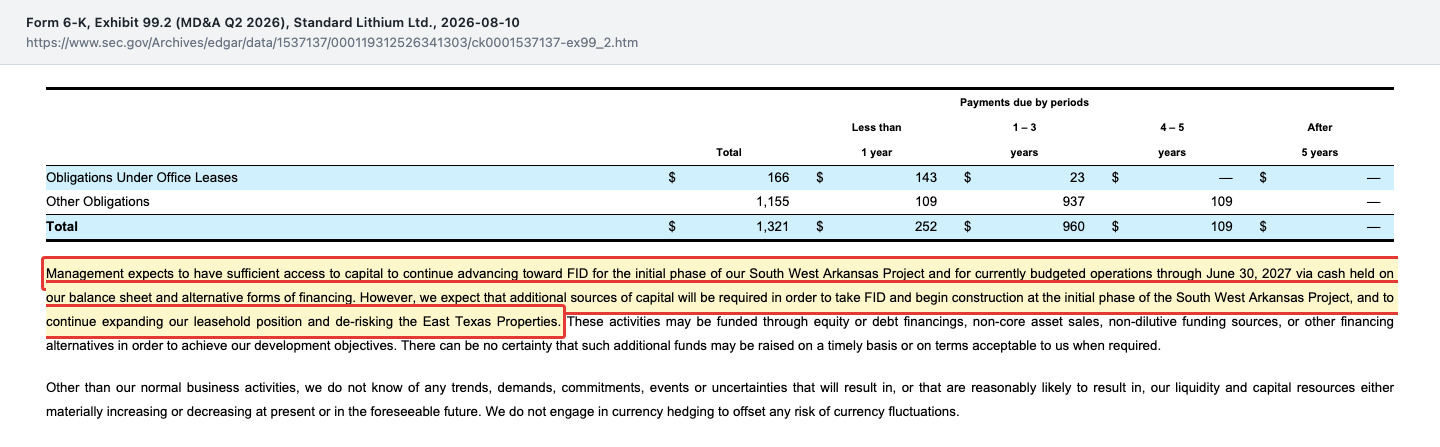
The size of the gap can be roughly read from the financing update of December 9, 2025. The joint venture is seeking up to $1.1 billion in project debt, on top of the $225 million grant. And further:
“Remaining CAPEX is expected to be financed by Project Debt of up to $1.1 billion and pro rata equity contributions from Standard Lithium and Equinor.”
— Smackover Lithium, financing update of December 9, 2025 (Form 6-K, Exhibit 99.1)
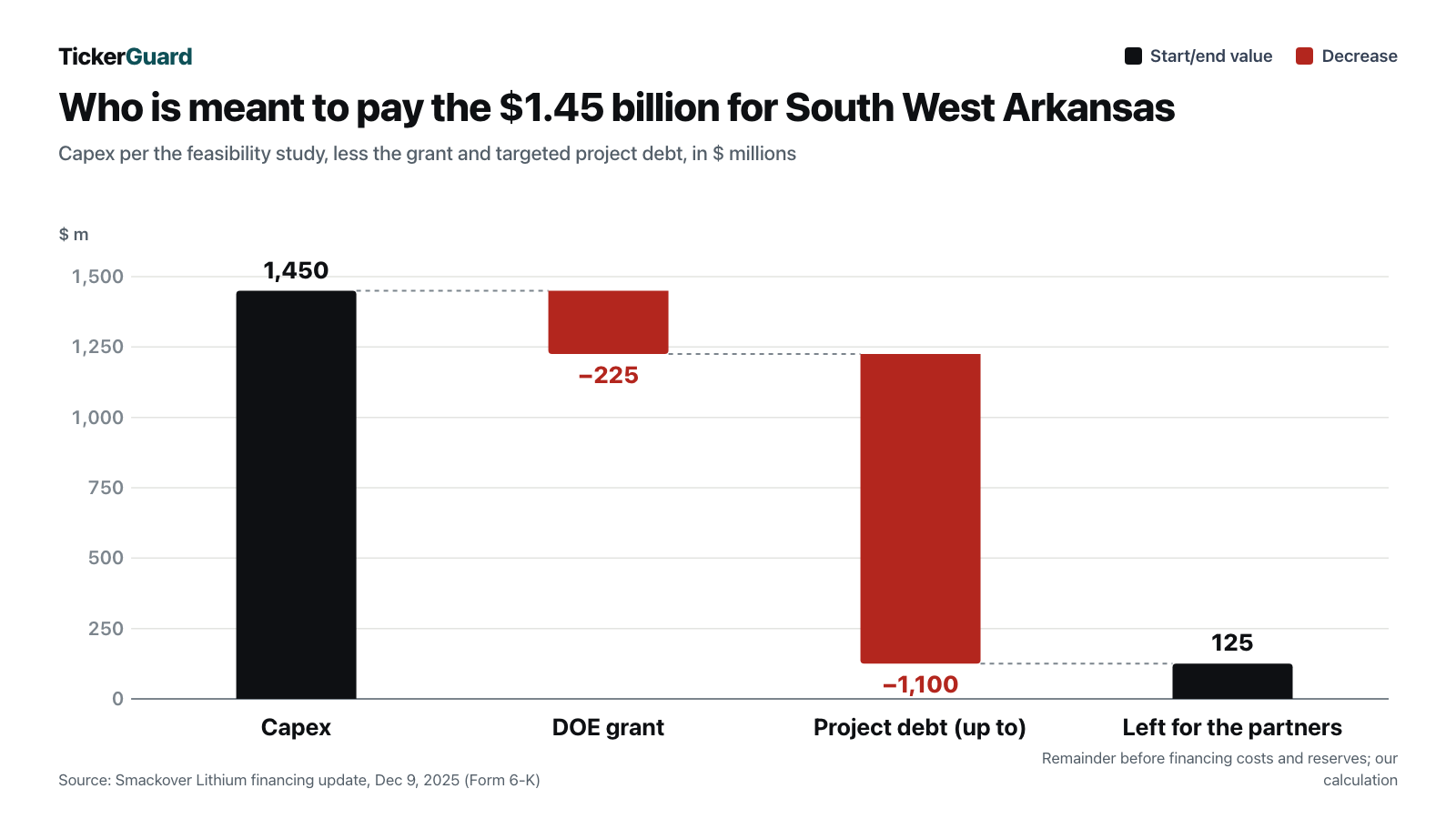
A rough calculation, with every caveat: 55 percent of $125 million, about $69 million, would fall to Standard Lithium. That would be manageable from today's cash — except the cash keeps shrinking until then: in the first half of 2026, it fell by $15.1 million despite share sales. And the $69 million is the floor. According to the same update, the debt is also meant to cover financing costs, and cost overrun facilities and reserve accounts “remain subject to negotiation with the lenders.” Nor is the debt committed: “None of the expressions of interest received to date from the ECAs or the commercial banks are commitments to finance the SWA Project.” Until the decision, Standard Lithium also keeps paying its share of development costs: $27.2 million in the first half of 2026 alone.
Uncomfortable Truth No. 3: Every Milestone Costs You a Slice of the Cake
Dilution is what happens when a cake is cut into more and more slices: the cake may grow, but your slice still gets smaller. Standard Lithium has largely paid for its progress with new shares. On June 30, 2023, it had 172.8 million shares outstanding; by August 10, 2026, it had 246.8 million — 43 percent more. The biggest jump came with the October 2025 offering of 29.9 million new shares at $4.35; on top of that, at-the-market sales added 18.1 million shares in 2025 alone.
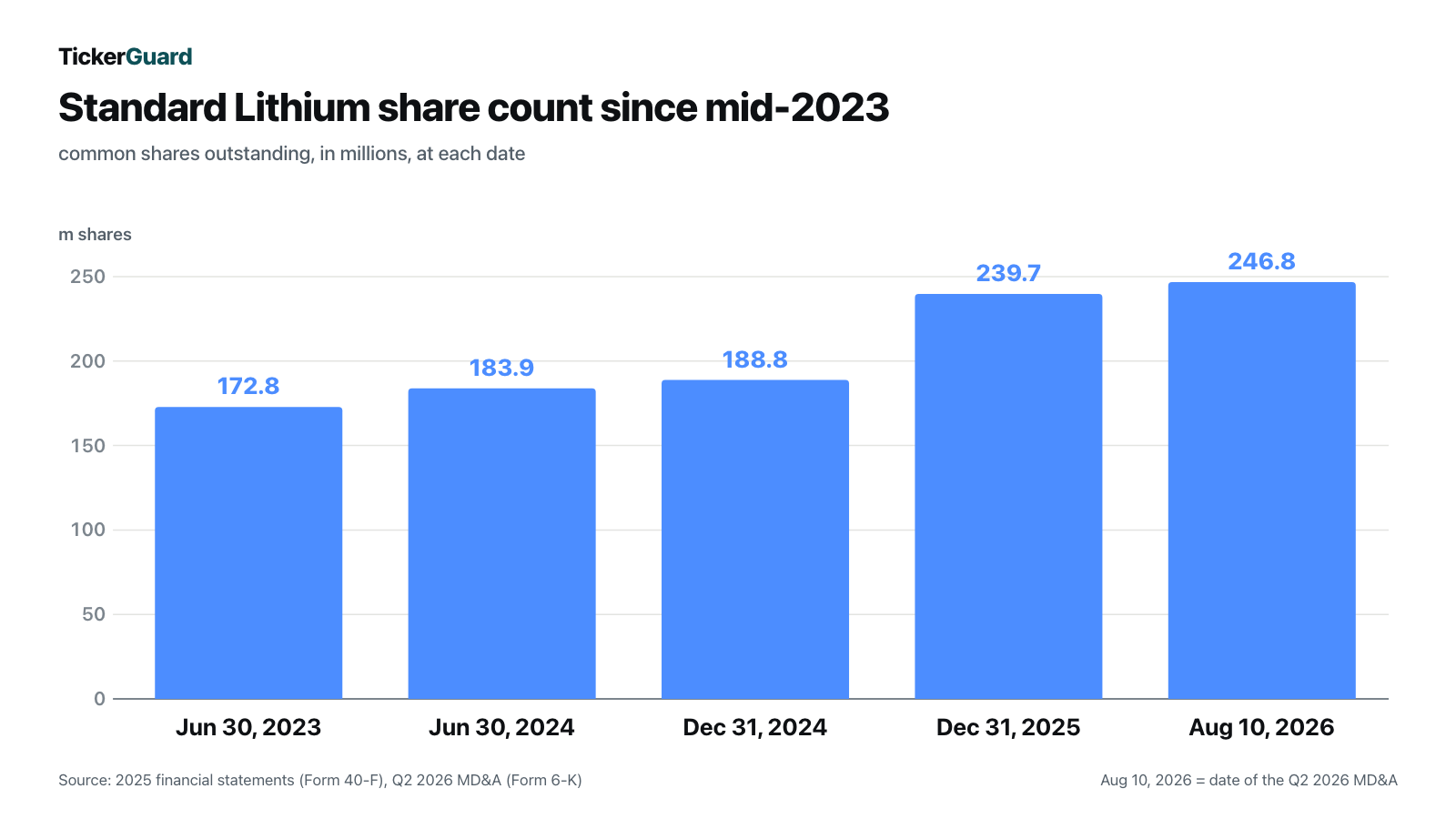
And that is not the end of it. As of the quarterly report, employee and director awards were also outstanding:
“As of the date of this MD&A, there were 246,784,162 common shares issued and outstanding, and 12,161,679 Options, 2,154,683 DSUs and 2,425,248 RSUs outstanding.”
— Standard Lithium, quarterly report for the period ended June 30, 2026 (Form 6-K, Exhibit 99.2, Outstanding Share Data)

That adds up to 16.7 million potential new shares, about 6.8 percent more. Then there is a new at-the-market program: on August 10, 2026, Standard Lithium announced a further program of up to $50 million that takes over once the current one is used up. As of August 7, 2026, just under $14 million remained under the current program. At the October 9, 2026, share price, about $64 million would translate into roughly 40 million new shares, just under one-sixth of today's count (our calculation). Whether and when the company uses them is open. In the third quarter of 2026, with the share price falling, it sold only 107,631 shares for just under $0.3 million. Takeaway: the lower the share price, the more shares every dollar the company still needs will cost.
What the Stock Costs
At the close of $1.58 on October 9, 2026, and 246.8 million shares, Standard Lithium is worth about $390 million. A price-to-earnings or price-to-sales ratio makes no sense for a company with no revenue. That leaves book value: shareholders' equity was $369.2 million as of June 30, 2026, so the market values Standard Lithium at about 1.06 times book. On the asset side, the main items are $137.3 million in cash, the $193.1 million carrying value of the stake in Smackover Lithium and $51.7 million in expected milestone payments from Equinor; liabilities come to just $28.2 million.
The milestone receivable is carried at $51.7 million, below the contractual $70 million, because of how it is valued: the company weights it by the probability of the decisions and discounts it. The commitment itself is in the annual report:
“Standard Lithium is to receive $40 million in milestone payments associated with SWA Lithium and $30 million in milestone payments associated with Texas Lithium subject to FIDs being made by certain dates ("Financial asset – FID").”
— Standard Lithium, annual report on Form 40-F for 2025, Exhibit 99.1 (Annual Information Form), Equinor transaction
If the decision for Arkansas comes before January 1, 2027, $40 million comes in — more than half of the notional equity share from the previous section. Raising the same amount by selling stock would take roughly 25 million new shares at the October 9, 2026, price, a little over one-tenth of today's count (our calculation). The company supplies one more figure itself: the feasibility study puts the after-tax net present value of South West Arkansas at $1,275 million, on a 100 percent project basis, at a lithium carbonate price of $22,400 a ton and before financing costs. Fifty-five percent of that would be about $700 million (our calculation). That figure only holds if the project gets built, costs hold and the lithium price is right; it reflects neither financing costs nor further new shares and is therefore not comparable with the market value. We deliberately leave the Franklin project in Texas aside; its September 2026 assessment relies in part on inferred resources only and sees first production in the early 2030s.
Upside and Risks at a Glance
What speaks for Standard Lithium:
- Almost every precondition for building in Arkansas is in place: a $225 million grant (January 2025), an environmental review without additional conditions (May 2026), engineering and construction contracts with Wood and S&B (May 2026).
- Buyers are under contract: Trafigura and LG Energy Solution with a firm 8,000 tons a year each over ten years, and with an option for up to 4,000 tons, up to 20,000 tons in total.
- Equinor is a 45 percent partner; if the Arkansas investment decision comes before January 1, 2027, Standard Lithium is due a $40 million milestone payment.
- The balance sheet carries no term or revolving debt; cash stood at $137.3 million on June 30, 2026, and according to management covers the path to the decision through mid-2027.
What speaks against Standard Lithium:
- The investment decision, announced in March 2025 for year-end 2025, was still pending on October 11, 2026; first production slipped from 2028 to 2029. If it does not come by January 1, 2027, the $40 million milestone payment may lapse, pending negotiations with Equinor.
- By its own account, Standard Lithium needs additional capital to take the decision and start construction; the project debt is not yet committed.
- The share count is up 43 percent since mid-2023, with 16.7 million options and share units outstanding and a new at-the-market program of up to $50 million.
- With no revenue, everything hinges on a single project, on Equinor as a partner whose approval significant decisions require, and on the lithium price, which the feasibility study puts at $22,400 a ton.
- A shareholder class action filed in 2022 was dismissed in September 2025; the appeal has been fully briefed since May 2026 and is undecided.
A Human Conclusion
Remember the loyalty card? Standard Lithium's is almost full, and that is real work: partner, grant, permit, contractors, buyers. It deserves respect. But the goal-gradient effect quickly turns a nearly full card into a conclusion the filings do not support — that the last stamp is a formality. At Standard Lithium, the last stamp is the most expensive one: it needs Equinor pulling in the same direction, commitments from the banks and additional capital that costs more shares at $1.58 than it did at $4.35.
The next test has a fixed date: the Arkansas decision has to come by January 1, 2027, or Equinor's payment is in question. Before that comes the report for the quarter ended September 30, 2026, likely in November: how much cash is left, what does it say about the timing of the decision, and has the company tapped the new at-the-market program? If you see a nearly full loyalty card at Standard Lithium, put the date from the 2025 annual report right next to it — and the one in the notes from 2026. What you make of it is your decision. And that is how it should be.
Sources
- Standard Lithium — Q2 2026 MD&A and interim financial statements (Form 6-K, filed August 10, 2026; most recent periodic report) and the results release of the same day
- Annual report on Form 40-F for 2025 (filed March 30, 2026): Annual Information Form, MD&A, consolidated financial statements
- Annual report on Form 40-F for 2024, MD&A (filed March 24, 2025; the original schedule)
- Smackover Lithium: financing update (December 9, 2025), Trafigura offtake (March 9, 2026), conclusion of the environmental review (May 14, 2026), LG Energy Solution offtake (August 31, 2026), Franklin preliminary economic assessment (September 8, 2026), amended Trafigura agreement (September 28, 2026) (all Form 6-K)
- Standard Lithium: new at-the-market program (August 10, 2026), board resignation of Karen Narwold (September 11, 2026), Q3 2026 at-the-market sales update (October 9, 2026) (all Form 6-K)
- Schedule 13G/A filed by Van Eck Associates (filed August 14, 2026; 6.5 percent as of June 30, 2026)
- Source: fundamental data & SEC filings (40-F/6-K) (closing prices December 31, 2025, and October 9, 2026)
This analysis is a journalistic assessment based on publicly available company filings. It is not investment advice and not a solicitation to buy or sell securities. Stocks can lose value, up to a total loss. All figures carry the date of their source; prices are dated snapshots. Positions held by the operator are disclosed daily; where one exists, it appears as a notice at the top of this deep dive.
Our Bottom Line at a Glance
- Project readiness positive
- A $225 million grant (January 2025), the definitive feasibility study (September 2025), an environmental review without additional conditions (May 2026) and contracts with Wood and S&B (May 2026) are in place.
- Offtake positive
- Trafigura and LG Energy Solution have each committed to 8,000 tons a year for ten years on a take-or-pay basis, 16,000 tons in total; with an option for up to 4,000 tons, that is up to 20,000 tons, more than the 18,000-ton target.
- Schedule negative
- The investment decision was planned in March 2025 for year-end 2025 and was still pending on October 11, 2026; first production slipped from 2028 to 2029. If it does not come by January 1, 2027, the $40 million milestone payment may lapse.
- Funding needs negative
- Cash of $137.3 million (June 30, 2026) lasts through mid-2027 according to management; additional capital will be required to take the decision and start construction. The project debt of up to $1.1 billion is not yet committed.
- Dilution negative
- The share count rose 43 percent from mid-2023 to August 2026, to 246.8 million; 16.7 million options and share units and a new at-the-market program of up to $50 million are in place.
- Balance sheet neutral
- No term or revolving debt, shareholders' equity of $369.2 million as of June 30, 2026. A large part of it is the stake in Smackover Lithium and the milestone payments tied to the investment decision.
Standard Lithium has met almost every precondition for its Arkansas lithium project: Equinor as a partner, a $225 million grant, the environmental review, construction contracts and buyers. The investment decision, once planned for year-end 2025, was still pending in October 2026, and the company needs additional capital to take it and build. The share count is up 43 percent since mid-2023. At $1.58 (October 9, 2026), Standard Lithium was worth about $390 million. Not investment advice.
What Our Rating Means
Open questions
The business works in principle, but one material question is open. As long as it stays open, our findings do not carry a quality verdict.
Yellow: almost everything needed to build in Arkansas has been signed, except the investment decision — and the loans, additional capital and $40 million from Equinor all hinge on it. Not red, because no threat to the company's substance is documented: no term or revolving debt, positive equity, and according to management the $137.3 million in cash lasts through mid-2027. As a partner, Equinor does not threaten the company's survival, but significant project decisions require its approval. Not green, because with no revenue, everything hinges on a delayed decision that is still pending (first production 2028 → 2029). The decision is yours.
A journalistic assessment by our editorial team at the time of the deep dive, based on public sources — not investment advice and not a solicitation to buy or sell. Your personal circumstances (investment goals, risk capacity, taxes) cannot be taken into account. What our levels mean, how verdicts are formed, and what conflicts of interest exist →
Worth Noting
- This analysis was prompted by the wallstreet-online forum ranking (stocks most discussed by German retail investors), as of October 11, 2026. There is no hit from our in-house stock scanner: the company has no revenue. The analysis uses the image of a loyalty card (the goal-gradient effect): the more milestones are met, the surer the last one feels.
- Evidence base: Standard Lithium is a Canadian MJDS filer (Form 40-F/6-K) with SEC CIK 0001537137. We reviewed the Form 40-F for 2025 (03/30/2026) and 2024 (03/24/2025), the quarterly report for the period ended 06/30/2026 (Form 6-K filed 08/10/2026) with the results release of the same day, and all Form 6-K releases and the Schedule 13G/A through October 9, 2026. The report for the quarter ended September 30, 2026, was not yet available on October 11, 2026.
- Our calculations: growth in the share count (246,784,162 vs. 172,752,197 = up 43 percent), options and share units relative to shares (16,741,610 vs. 246,784,162 = about 6.8 percent), the partners' notional equity share of South West Arkansas ($1,450m minus $225m minus $1,100m = $125m, 55 percent of which is about $69m, before financing costs and reserves), the notional share count from the at-the-market programs (just under $14m plus $50m divided by $1.58 = about 40 million shares), the milestone payment expressed in shares ($40m divided by $1.58 = about 25 million shares, about 10 percent), market value (246,784,162 times $1.58 = $389.9m), price-to-book ($389.9m vs. $369.2m) and the 55 percent share of the $1,275m net present value (about $700m).
- Prices: closes of $4.47 on December 31, 2025, and $1.58 on October 9, 2026, on the NYSE American (fundamental data). Offering price of $4.35 (October 2025) and average at-the-market prices of $3.59 (Q2 2026) and $2.78 (Q3 2026) per the MD&A and the sales update.
- Name confusion: the symbol SLI denotes the same stock on the NYSE American and the TSX Venture Exchange. The project companies are SWA Lithium (Arkansas) and Texas Lithium; both belong to Smackover Lithium.
Stock Watch
This analysis is as of October 11, 2026. Stock Watch will tell you what's changed at SLI since then.
Later $1 a month per stock — signing up is free, and you'll be the first to know when it launches.
The full analysis as a PDF for later
We will send you this analysis as a PDF — to print, file away, and read at your own pace. And we will add you to the free Stock Watch list for Standard Lithium Ltd (SLI), so you hear about it when something material in this analysis changes.
Frequently Asked Questions
Standard Lithium wants to recover lithium from Smackover Formation brine in Arkansas and Texas using direct lithium extraction, a filtering process. Its main project, South West Arkansas, is designed for 22,500 metric tons of lithium carbonate a year, with first production targeted for 2029. The company has no revenue yet.
According to the August 2026 quarterly report, the decision is expected in 2026; in March 2025, the plan was “by year-end 2025.” As of October 11, 2026, it had not been made. Project debt of up to $1.1 billion is meant to be in place first, and according to the annual information form, significant joint venture decisions require both partners' approval.
Since May 2024, Equinor has held 45 percent of the project companies in Arkansas and Texas; Standard Lithium holds 55 percent and operates them. Equinor paid $30 million and funded the first $60 million of development costs on its own ($40 million in Arkansas, $20 million in Texas). If the investment decisions come in time, Standard Lithium is due another $70 million: $40 million for Arkansas with a decision by January 1, 2027, and $30 million for Texas by January 1, 2029.
The share count rose from 172.8 million on June 30, 2023, to 246.8 million on August 10, 2026, an increase of 43 percent. The biggest step was the October 2025 offering at $4.35 a share. On top of that come 16.7 million options and share units and a new at-the-market program of up to $50 million.
No. As of June 30, 2026, Standard Lithium had no term or revolving debt and $137.3 million in cash. That changes with construction: the Smackover Lithium joint venture is seeking up to $1.1 billion in project debt, mainly through export credit agencies, none of which has been committed so far.
Standard Lithium is a Canadian issuer and uses the U.S.-Canadian multijurisdictional disclosure system. Its annual report is filed on Form 40-F; quarterly reports and press releases arrive as Form 6-K. It reports under IFRS in U.S. dollars, and its fiscal year has matched the calendar year since 2025.
Found an error?
Did you spot a factual error, an outdated number, or a typo in this deep dive? Let us know briefly — your report goes straight to the editorial team.