Community Healthcare Trust: Ten Years of Quarterly Dividend Raises — Then a 31 Percent Cut in August 2026
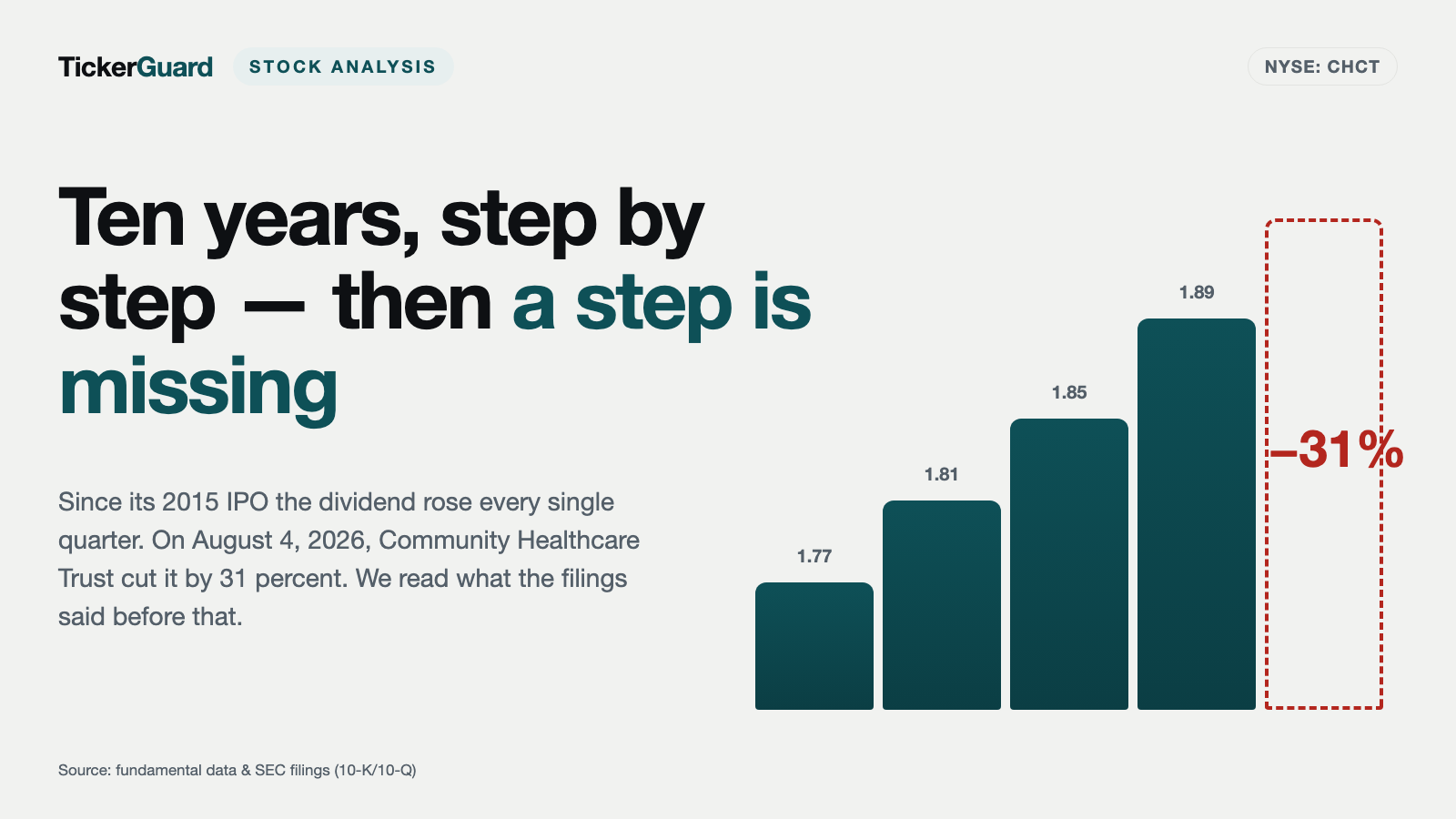
For ten years, Community Healthcare Trust (NYSE: CHCT) raised its quarterly dividend every single quarter — a promise many income investors treated as untouchable. On August 4, 2026, that streak ended: the board cut the payout from $0.48 to $0.33 per share, a 31 percent reduction. We read the quarterly report (10-Q), the annual report (10-K) and the mandatory SEC filings: one clinic tenant has barely paid rent for two years, interest expense grew faster than revenue, and the dividend had already stopped being covered by current earnings before the cut arrived. The portfolio itself — 197 medical offices and clinics spread across 36 states — keeps holding up. What's left is the question of whether the cut was an overdue correction or the first symptom of something bigger. Not investment advice — just the numbers behind a ten-year streak that broke in a single afternoon.
 Thomas Mücke
Founder & Publisher
Thomas Mücke
Founder & Publisher
As of Today
As of: October 9, 2026
- Closing price
- 13.60 $ -0.50%
- Market Capitalisation
- 0.4 $B
- P/E
- 111.8
- Growth Score
- 4/10
- AAQS
- 5/10
Price change since August 26, 2026: -8.7%
This analysis has a cut-off date. The Stock Guard tells you when something material changes in the numbers. Reserve your free spot
Chart
Interactive price chart (TradingView).
52-week range: 13.30 $ to 19.00 $ · Last price: 13.60 $ (As of: October 9, 2026)
Note: pure fact-based analysis, not investment advice and not a solicitation to buy or sell. All figures without guarantee.
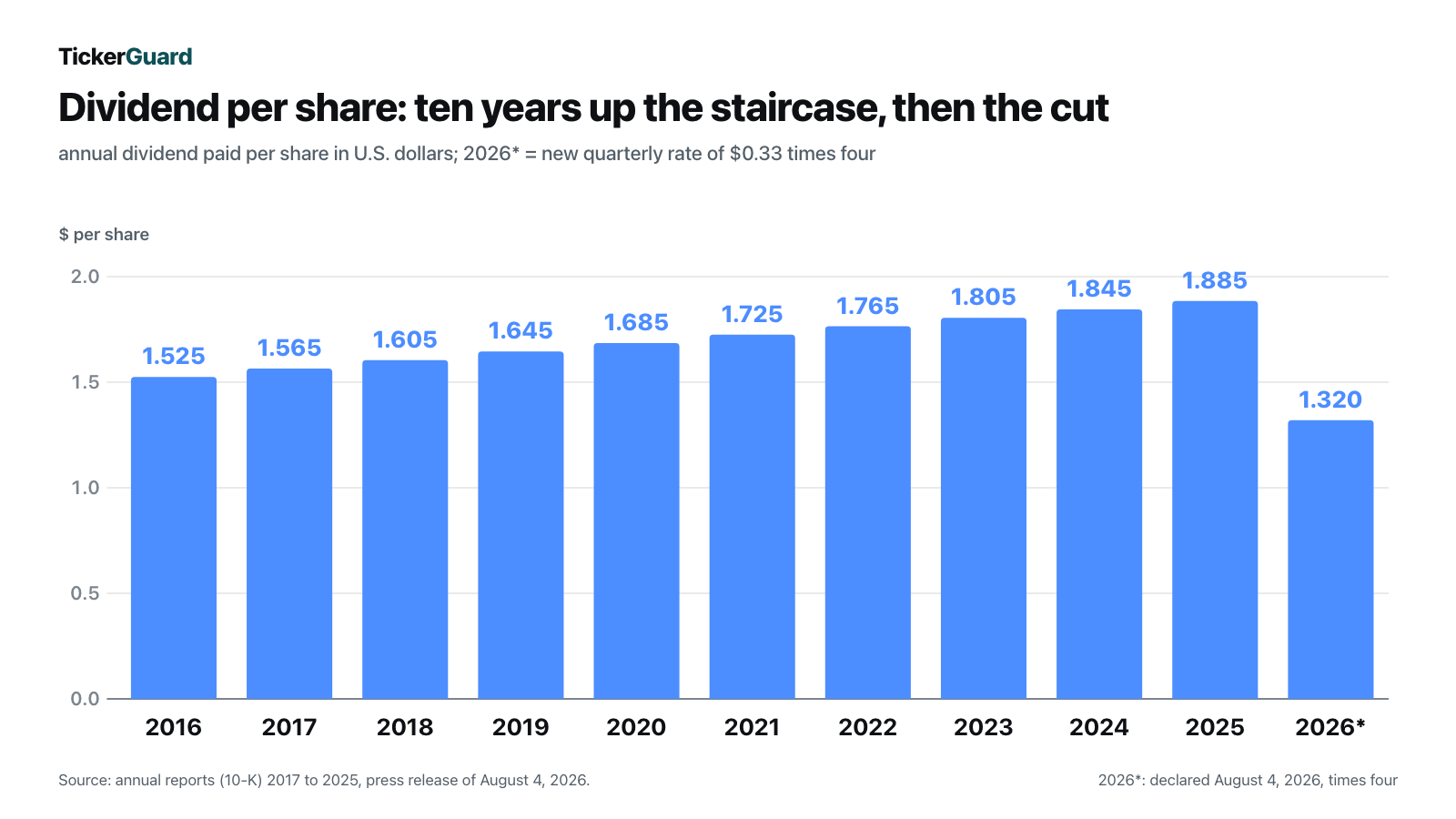
There's an investor reflex that feels like climbing a staircase in the dark: you know the height of every step because you've climbed it so many times, and eventually your foot stops testing and just trusts. Call it the streak trap — assuming, from a long unbroken run, that the next step will be there too. At Community Healthcare Trust Incorporated (NYSE: CHCT), that run lasted ten years: since its IPO in May 2015, the company says it raised its quarterly dividend in every single quarter. On August 4, 2026, the step wasn't there. The board cut the dividend by 31 percent — the first step back since the IPO. So let's make a deal before you test the stairs yourself: we'll read the quarterly report (10-Q), the annual report (10-K) and the mandatory filings to the U.S. securities regulator, the SEC, exactly as they stand — not as the streak told the story. A filing to the SEC is honest under penalty of law. At the end, you decide whether the missing step was a stumble, or proof the staircase was built too steep from the start.
What Community Healthcare Trust Actually Does
Start with the most important word: REIT, short for Real Estate Investment Trust. Picture a landlord legally required to hand almost everything he collects straight back out — at least 90 percent of taxable income — and who, in exchange, pays almost no corporate income tax himself. That's Community Healthcare Trust Incorporated (incorporated March 28, 2014 in Maryland, IPO in May 2015, headquartered in Franklin, Tennessee, with just 35 employees as of December 31, 2025): a landlord, but not an ordinary one. Instead of apartments or office towers, it owns and leases medical offices, specialty clinics, rehabilitation hospitals and behavioral health facilities — as of June 30, 2026, 197 properties across 36 U.S. states, roughly 4.5 million square feet, a gross investment of about $1.25 billion. Because a REIT pays out nearly all its profit, a different metric matters more than net income: FFO (Funds From Operations), adding back building depreciation, since well-leased clinics rarely lose value. AFFO further strips out straight-line rent effects — rent increases accountants book on average across the lease term before the cash arrives — and adds back stock compensation, since it costs no cash. Occupancy stood at 89.8 percent as of June 30, 2026. No tenant tops 10 percent of annual rent; the largest are US HealthVest at 7.3 percent and Lifepoint Health at 6.4 percent (December 31, 2025), alongside HCA, Fresenius Medical Care, DaVita and Tenet. The property mix: medical office buildings 36.0 percent of rent, inpatient rehabilitation 21.2 percent, acute behavioral hospitals 12.6 percent, the rest in specialty and surgical centers. For scale, one of the largest inpatient-rehab operators in the U.S. is Encompass Health — CHCT sits in the same segment, as landlord rather than operator. CHCT isn't the only REIT on our desk either: Millrose Properties is a very different kind, built on land banking for homebuilders rather than healthcare. A central tension runs through every chapter here: a landlord whose tenants mostly pay on time — but whose owners were most recently paid more than was actually left over after upkeep and reinvestment.
Company history for investors
-
2015
IPO on the NYSE
Community Healthcare Trust went public in May 2015. From then on, the company says it raised its quarterly dividend every single quarter.
-
2023
Founding CEO Dies, Dupuy Takes Over
After founding CEO Timothy Wallace died in March 2023, David Dupuy took over. Accelerated stock compensation of $11.8 million hit earnings without changing operations.
-
2024
The Troubled Tenant Stops Paying
An operator of six behavioral hospitals stopped paying in 2024. The company booked an $11.0 million reserve and raised its credit line to $400 million — an early warning sign.
-
2025
Second Reserve, EVP Exit, Sale Process Begins
Another $8.7 million loan-loss reserve, a $5.9 million leadership transition cost, and a July sale process for the troubled tenant — the legacy issue stayed unresolved.
-
2026
Last Raises Before the Cut
In February and May 2026 the dividend rose again, to $0.4775 and $0.48. Low-cost swaps expired in late March. The streak still held, but costs were already climbing.
-
2026
Dividend Cut 31 Percent
On August 4, 2026, the streak ended: a cut to $0.33 plus a strategy plan for more leasing and acquisitions — less current income, but a sturdier base.
How the Stock Landed on Our Desk
Let's be upfront: CHCT did not land on our desk through one of our growth or momentum scanners. The trigger was a mandatory filing — the kind of disclosure an SEC reporting company must publish the moment something material happens. On August 4, 2026, Community Healthcare Trust reported second-quarter earnings and, in the same release, a cut to the quarterly dividend from $0.48 to $0.33 per share — a 31 percent reduction, the first step back since the 2015 IPO. That interests us more than any scanner hit, because it ends a decade-long narrative in one announcement. It also has a concrete, checkable side effect worth a direct warning: many stock and metrics screeners don't update the dividend rate instantly. Anyone still dividing the old annualized rate of $1.885 by today's price lands on a yield of 11 to 12 percent — a number that no longer exists. That's a classic yield trap: a high displayed yield feels like a bargain but says nothing about the future once the underlying figure is history. The actual yield on the new, reduced rate is meaningfully lower — how much lower, we work out in the valuation chapter.
The Numbers Over the Years — Honestly Appraised
Start with what's genuinely true: revenue has grown steadily, if not spectacularly — $90.6 million in 2021, $112.8 million in 2023, $121.2 million in 2025, up roughly 34 percent in four years. Annualized net operating income (NOI, rent minus ongoing operating costs, before interest and depreciation) reached $101.4 million in the second quarter of 2026, up from $94.0 million a year earlier. That sounds like a solid, unremarkable leasing machine — and for a long time, it was exactly that. But two other lines move the wrong way. Occupancy slipped from 90.9 percent in the first quarter of 2025 to 89.8 percent in the first and second quarters of 2026 — no collapse, but no recovery; in the first half of 2026, 388,000 square feet of leases expired or were terminated against just 342,000 square feet newly leased or renewed. And interest expense rose from $17.8 million (2023) to $23.7 million (2024) to $27.0 million (2025) — faster than revenue. Nowhere is the imbalance clearer than in the dividend itself:
The second chart shows why this streak had to break: dividend paid per share against AFFO per share — what was operationally left for shareholders after every ongoing cost.
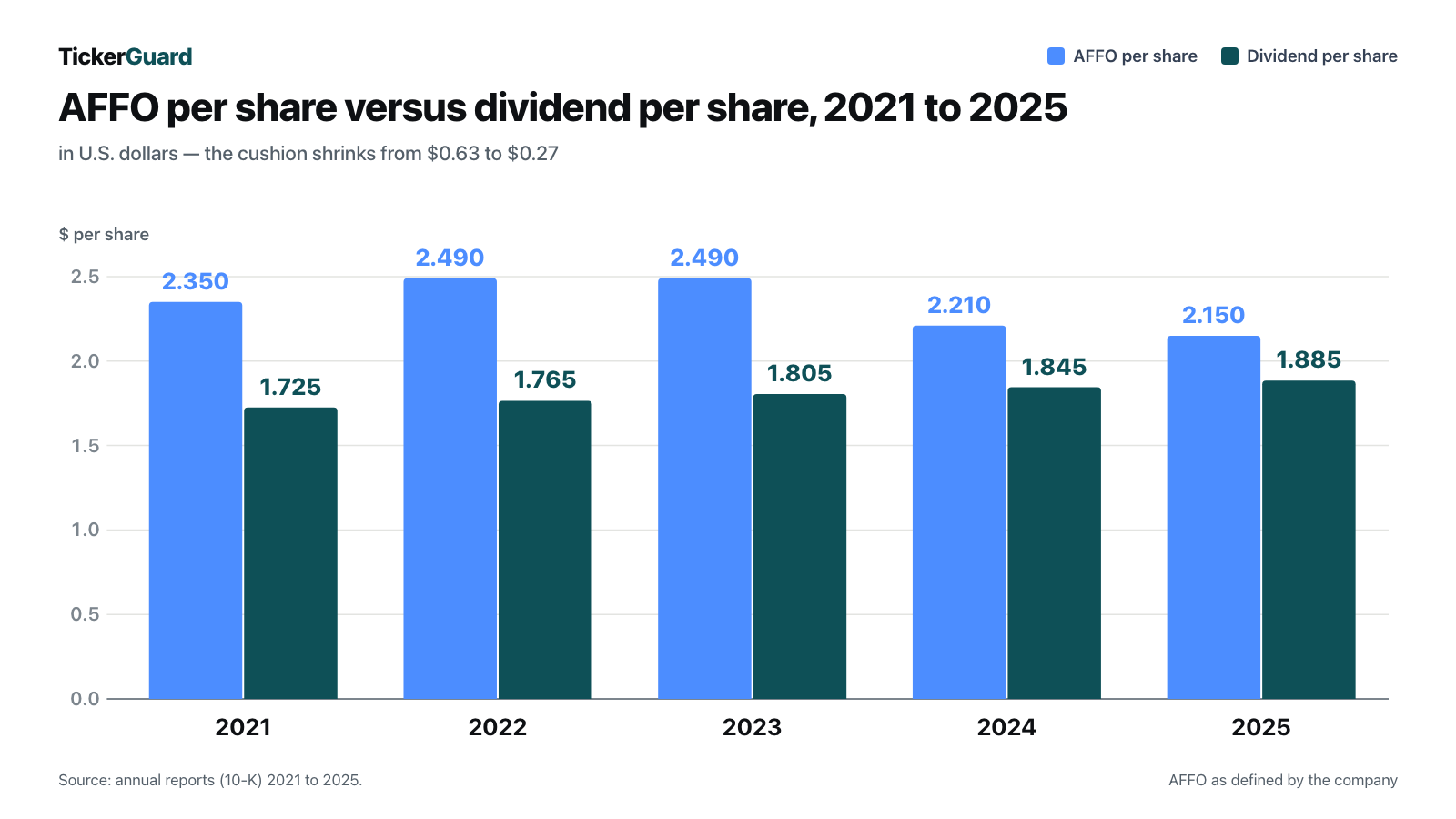
The dividend line climbs; the AFFO line falls — from $2.49 per share in 2023 to $2.15 in 2025. Remember this image: when a metric has known only one direction for years while the metric it's supposed to be paid from moves the other way, that isn't a law of nature — eventually the lines cross, and that is exactly what happened on August 4, 2026.
What the Filings Say — the Uncomfortable Truths
Now for the required reading: the original filings with the U.S. securities regulator, the SEC. We read the annual report (10-K) for 2025, the quarterly report (10-Q) for the second quarter of 2026, and the mandatory current reports, and pulled four findings that each put the streak in a different light.
Uncomfortable truth no. 1: in the four quarters before the cut, the dividend was no longer earned out of free cash flow
Run the numbers the company itself discloses. The AFFO payout ratio — dividend relative to AFFO per share — climbed from 72 percent in 2023 ($1.805 of $2.49) to 88 percent in 2025 ($1.885 of $2.15), 86 percent in the second quarter of 2026 ($0.48 of $0.56). But that same release introduced a stricter metric for the first time: FAD (Funds Available for Distribution), which subtracts leasing commissions, tenant improvements and recurring maintenance capital spending from AFFO — what's left after every real cost of running the portfolio. Here the picture flips: FAD per share in the second quarter of 2026 was $0.468 ($12.994 million on 27.752 million diluted shares) — the old $0.48 dividend sat above FAD, at roughly 103 percent, and roughly 110 percent summed over the trailing four quarters. Part of the reason: stock compensation of $10.3 million (2025) — 17.7 percent of reported AFFO — gets added back because it costs no cash; strip it out and 2025 AFFO would be roughly $48.1 million, or $1.77 per share, which the $1.885 dividend would have exceeded too. On August 4, 2026, the company drew the consequence:
"The Board unanimously declared a quarterly common stock dividend of $0.33 per share, payable on August 31, 2026, to stockholders of record as of August 19, 2026. This represents a 31% reduction from the prior dividend payment and lowers the Company's AFFO payout ratio to approximately 60%, enabling the dividend to grow with earnings going forward. Reallocating this capital is expected to provide an additional $25 million to $30 million of retained capital over the next two years to fund accretive acquisitions, portfolio reinvestments, and occupancy improvements."
— Community Healthcare Trust Incorporated, SEC current report (8-K) dated August 4, 2026, Exhibit 99.1, Q2 2026 press release
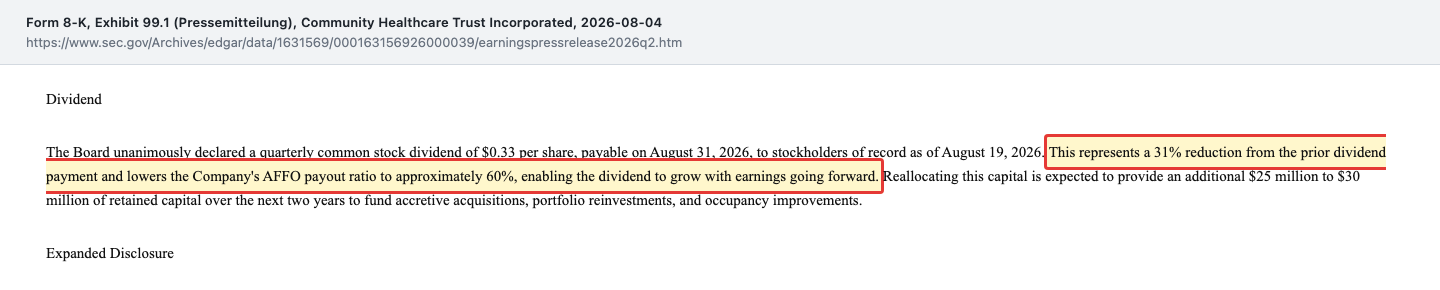
Remember the core of this section: a dividend that pays out more than is left over after maintenance and reinvestment isn't earnings — it's a slow return of your own capital. That was CHCT's recent reality, and the new $0.33 dividend equals roughly 60 percent of AFFO per the company — noticeably more conservative.
Uncomfortable truth no. 2: six hospitals, $19.7 million written off, thirteen months of waiting
The second finding carries a name the company never says out loud, only describes: the operator of six geriatric behavioral hospitals (roughly 79,000 square feet), who owes CHCT on two fronts — rent (contractually about $3.2 million a year) and payments on two loans ($17.0 million term loan plus $2.7 million revolving facility, contractually another roughly $2.5 million a year). The history reads like slow-motion deterioration: on the watch list 2020–2022, off in 2023, back on in early 2024 after a management change at the tenant, then no payment at all in the fourth quarter of 2024. Community Healthcare Trust responded the way any creditor must: loan-loss reserves of $11.0 million (2024) and $8.7 million (second quarter of 2025) — both loans now fully reserved — plus $1.7 million in accrued interest written off. The quarterly report puts it plainly:
"At June 30, 2026 and December 31, 2025, notes receivable included a $17.0 million term loan and a $2.7 million revolving credit facility secured by assets and ownership interests of six geriatric behavioral hospitals and affiliated companies all of which are co-borrowers on the loans. The notes and interest receivables on these notes are fully reserved."
— Community Healthcare Trust Incorporated, SEC quarterly report (10-Q) as of June 30, 2026, Note 10 "Other Assets, net"

Since July 17, 2025 — more than a year ago — a letter of intent has been in place to sell the operation to another behavioral-health provider. Rent recovers only at a crawl: roughly $0.2 million in the fourth quarter of 2025, $0.3 million in the first, $0.4 million in the second quarter of 2026. CEO David Dupuy tempered expectations back in summer 2025: "we don't believe there's going to be a meaningful pickup" and "we shouldn't expect a $5 million or $10 million recovery here." On the fourth-quarter-2025 call (February 18, 2026) CFO William Monroe explained why the deal drags on: "the buyer is still very interested in all 6 hospitals and the goal is for this transaction to happen all at one time … there would be no plans to have any sort of a staged closing." A single buyer for six properties is legally and financially more complex than six separate sales — which explains why, from the July 2025 letter of intent to this analysis's data cutoff (August 28, 2026), no close has happened; on the second-quarter-2026 call, Dupuy named a close "by year-end" 2026 as the goal, without guarantee. The company carries "15 to 20 names" on its general watch list among more than 300 tenants, but no other of its ten largest — this remains, by its own account, an isolated case.
Uncomfortable truth no. 3: interest is growing faster than rent
Community Healthcare Trust funds growth through a revolving credit facility — a corporate overdraft, drawn and repaid as needed — of $400 million (maturing October 2029), plus two term loans totaling $275 million. As of June 30, 2026, $285.0 million of the revolver was drawn (end of 2025: $258.0 million), bringing total debt to $560 million, up from $277.6 million in 2021. Net debt of $559.3 million equaled 43.9 percent of total capitalization, up from 41.6 percent a year earlier. Part of this debt was hedged with interest-rate swaps — trading a floating rate for a fixed one so rising market rates don't hit the bill directly. That hedge expired on March 29, 2026:
"On March 29, 2026, the Company's interest rate swaps that had fixed the interest rate at a weighted average rate of approximately 3.8% on $75.0 million of its Revolving Credit Facility balance matured. The Company has not replaced these interest rate swaps, so interest on the $75.0 million is now under the Revolving Credit Facility floating rate. The floating rate for the Revolving Credit Facility at June 30, 2026 was approximately 5.3%."
— Community Healthcare Trust Incorporated, SEC quarterly report (10-Q) as of June 30, 2026, Item 2 MD&A

In plain terms: $75 million of the credit line moved from a fixed 3.8 percent to a floating rate of roughly 5.3 percent. Together with the higher drawn credit line ($285 million versus $258 million at year-end 2025), that pushed interest expense up 12.7 percent in the second quarter of 2026, to $7.4 million. Adjusted EBITDAre for the quarter covered that quarter's interest roughly 3.1 times — solid, but the line is already drawn to more than two-thirds of its $400 million capacity, and CFO William Monroe promised: "the goal is to keep that leverage in sort of the ZIP code that it is today and certainly not add leverage over time" — worth watching once the $99 million of contracted acquisitions need financing, without new shares.
Uncomfortable truth no. 4: ten years up the stairs — who paid for it
The fourth, perhaps clearest finding sits in the quarterly report's statement of equity: since inception, Community Healthcare Trust has cumulatively paid out $413.235 million in dividends — against cumulative net income of just $95.689 million (as of June 30, 2026). That's the sum of more than ten years, and it shows in black and white: the dividend was never paid solely from profit, but substantially from the company's own capital base — bearing in mind that a REIT's net income is depressed by building depreciation; the comparison therefore shows the direction, not the exact size, and the magnitude of the gap remains remarkable. The annual report states the yearly streak as flatly as only a required document can:
"During 2025, 2024 and 2023, the Company paid cash dividends in the amounts of $1.885 per share, $1.845 per share and $1.805 per share, respectively."
— Community Healthcare Trust Incorporated, SEC annual report (10-K) for 2025, dividend disclosures
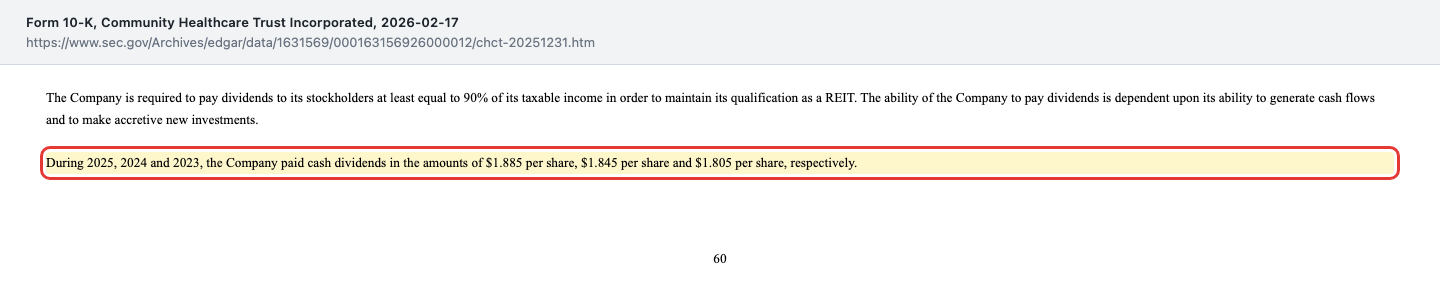
In parallel the share count rose — hardly through equity raises, but above all through stock-based pay: it rose from 25.981 million (end of 2023) to 28,653,842 (July 28, 2026) — roughly 10 percent in two and a half years, even though the ongoing share offering program (ATM) went unused in 2025 and the first half of 2026 (2023 netted $44.0 million, 2024 just $7.3 million). The driver instead was pay policy: under the "Alignment of Interest Program," employees, executives and directors take much of their pay in restricted stock — directors around 96 percent of their retainer, top executives half of both salary and bonus in 2025 (in 2024 still half the salary plus the full bonus); in January 2026 the stock pool for this program grew by 500,000 shares to 1.5 million. Equity shrank anyway: from $462.1 million (end of 2021) to $414.242 million (June 30, 2026). Remember the image: a company that most recently paid out more than it earned always has someone pay for that streak eventually — here with new debt, while the share count grew by roughly 10 percent in parallel through stock-based compensation.
What Management Said on the Earnings Calls
Read the last two years of earnings-call transcripts (ten calls, first quarter 2024 through second quarter 2026) and you find a company that, right up until shortly before the cut, talked about the streak as if it were never in question. On the first-quarter-2026 call (May 6, 2026) — three months before the cut — CEO David Dupuy said: "we declared our first quarter dividend and raised it to $0.48 per common share. This equates to an annualized dividend of $1.92 per share, and we are proud to have raised our dividend every quarter since our IPO." Coverage was described with the same reassuring line for years: "our dividend remains well covered with a current payout ratio of only 85%" (CFO William Monroe, third-quarter-2024 call). Three months after the May 2026 call came the 31 percent cut — not a lie, since the streak held true to announcement day, but proof of how fast a years-long story can turn. Going forward the formula is different: "Historically, we updated our dividend each quarter, but going forward, we expect to update our dividend on an annual basis while maintaining an AFFO payout ratio of approximately 60% to 65%" (Monroe, second-quarter-2026 call, August 5, 2026).
Asked why the cut is happening now, Dupuy answered analyst Alexander Goldfarb (Piper Sandler) with candor: "I'm reminded of kind of a funny quote, which is the definition of insanity is doing the same thing over and over again and expecting a different result. We have done a lot of great work. The portfolio continues to perform. For whatever reason, the market is not cooperating as far as where our share price is" — and later: "boy, it would be great if we had some currency in our share price to do some ATM as well," meaning the company's share offering program. As early as the first-quarter-2025 call, Dupuy said the company was "not excited raising equity at these prices." On the fourth-quarter-2025 call, asked whether the earlier target of $120 million to $150 million in annual acquisitions still held, Monroe's answer was an open admission about the share price: "if our stock was in a different spot, and we were doing what we have done prior to the last 1.5 years, we would be looking to make those acquisitions" — instead the company had focused "more on supporting our clients." The pattern is consistent: a low share price makes growth through new equity expensive, so management pulled the other lever — the dividend. On leasing, Dupuy sounded cautiously optimistic: the targeted 92 percent occupancy is achievable "as early as at the end of 2027," with 90.5 percent targeted by the end of 2026.
Valuation: What the Market Pays After the Cut
At the closing price of $14.90 on August 26, 2026, Community Healthcare Trust carries a market value of roughly $427 million. That's an order of magnitude, not a price target — and it shows how much the market has already reacted: as of June 30, 2026, weeks before the cut, the stock was valued at roughly $523.8 million (about $18.28 per share). Since the end of June 2026 — the cut was announced on August 4, 2026 — the stock has dropped by nearly a fifth (the current 52-week range is shown in the price box at the top of this page). Add net debt of $559 million to market value and you get an enterprise value of roughly $986 million. Set that against annualized NOI of $101.4 million and you get an implied cap rate of roughly 10.3 percent — simplified, the yield a buyer would get by purchasing the whole company today and running the portfolio unchanged. On an AFFO basis the stock trades at roughly 6.7 times annualized earnings; on the stricter FAD basis, roughly 8.3 times; the price is close to book value per share of $14.46 (price-to-book roughly 1.0). The new annualized dividend of $1.32 works out to a yield of roughly 8.9 percent at the $14.90 anchor — well below the outdated 11-to-12-percent figure from the earlier chapter, but still generous for a landlord with solid, if not growing, tenants. Five analysts covering the company as of August 28, 2026 (including Piper Sandler, Evercore ISI and Truist Securities) offer their "professionals' view": two rate CHCT "Strong Buy," one "Buy," two "Hold," none recommend selling — the average price target is $18.25. That's an estimate, not a guarantee, and analyst targets drift with the price. What matters more is the order of magnitude: after the cut, the market prices CHCT roughly at the substance value of its portfolio — no more, but not markedly less either.
Opportunities and Risks at a Glance
What speaks for Community Healthcare Trust:
- A broadly diversified portfolio without a real tenant concentration: 197 properties across 36 U.S. states, no tenant above 10 percent of rent (largest: US HealthVest 7.3 percent, Lifepoint Health 6.4 percent, as of December 31, 2025).
- The new dividend is set more conservatively: per the company, the August 4, 2026 cut lowers the AFFO payout ratio to roughly 60 percent — well below the recent 86 to 88 percent.
- A solid leasing base despite the decline: 89.8 percent occupancy as of June 30, 2026, with a weighted average remaining lease term of roughly 7.2 years.
- A concrete, already-contracted growth pipeline: four properties for roughly $99.0 million with expected initial yields of 9.1 to 9.75 percent, closing across 2026 and 2027.
- Extra capital room from the cut itself: $25 million to $30 million more in retained capital over two years, per the company's own announcement, without needing to issue new shares.
What speaks against it:
- The dividend was only barely covered by AFFO most recently (2025: 88 percent) and, measured against the stricter FAD, ran at roughly 110 percent over the trailing four quarters — the cut came late, not early.
- The troubled tenant with six behavioral hospitals remains unresolved after more than two years: $19.7 million in loans are fully written off, and the sale process begun in July 2025 still hadn't closed thirteen months later.
- Rising interest costs without full hedging: interest expense grew from $17.8 million to $27.0 million between 2023 and 2025; since interest-rate swaps expired in March 2026, $75 million of the credit line sits unhedged at a floating rate of roughly 5.3 percent.
- Occupancy has been declining since the first quarter of 2025 (90.9 to 89.8 percent), and management itself doesn't expect its own 92 percent target to be reachable before "the end of 2027" at the earliest.
- Growth funded by new shares is effectively frozen — by management's own account, because the share price would need to sit "in a different spot"; the historical acquisition target of $120 million to $150 million a year has been badly missed since 2025.
A Human Conclusion
Back to the staircase from the opening. The streak trap was justified at Community Healthcare Trust for ten years — every step held, every quarter brought the next raise, exactly as promised. The problem was never a lie; it was assuming a long streak is a law of nature rather than a decision remade every quarter. The numbers above show that decision was recently made against the company's own substance: paying out more than was left over, funded with new debt — while the share count rose by roughly 10 percent in parallel through stock-based compensation. The August 4, 2026 cut is therefore hard to read as a pure alarm signal — it reads more like the overdue moment when the numbers caught up with the story. What remains is a landlord with a broad, mostly healthy portfolio, a troubled tenant unresolved for more than two years, and a now more cautious payout policy. Whether that's a fresh start or just a breather before the next missing step is something only you can decide — with the numbers now on the table, rather than the streak that used to exist. What you make of it is your decision. And that is exactly as it should be.
Sources
All original documents used in this analysis — to read for yourself:
- Community Healthcare Trust Incorporated — SEC quarterly report (10-Q) as of June 30, 2026 (filed August 4, 2026)
- Community Healthcare Trust Incorporated — SEC current report (8-K) dated August 4, 2026, including Exhibit 99.1 (press release), Exhibit 99.2 (supplemental information) and Exhibit 99.3 (investor presentation)
- Community Healthcare Trust Incorporated — SEC quarterly report (10-Q) as of March 31, 2026 (filed May 5, 2026)
- Community Healthcare Trust Incorporated — SEC annual report (10-K) for 2025 (filed February 17, 2026)
- Community Healthcare Trust Incorporated — SEC annual report (10-K) for 2024 (filed February 18, 2025)
- Community Healthcare Trust Incorporated — SEC annual report (10-K) for 2023 (filed February 13, 2024)
- Community Healthcare Trust Incorporated — SEC proxy statement (DEF 14A) 2026 (filed March 12, 2026)
- Community Healthcare Trust Incorporated — SEC current report (8-K) dated January 9, 2026 (stock-compensation pool increase)
- Community Healthcare Trust Incorporated — SEC current report (8-K) dated May 6, 2025 (departure of EVP Timothy Meyer)
- Full SEC filing history: EDGAR overview (sec.gov)
- Earnings-call transcripts (ten calls, first quarter 2024 through second quarter 2026; quotes verified verbatim against the full transcripts). Publicly available at, among others: first quarter 2026 (May 6, 2026), fourth quarter 2025 (February 18, 2026), second quarter 2025 (July 30, 2025)
- Fundamental data (metrics, valuation, analyst consensus; data as of August 28, 2026), reconciled with the SEC filings.
Transparency & disclaimer: This analysis is a journalistic contextualization of publicly available information and is not investment advice, not a financial analysis in the regulatory sense, and not a solicitation to buy or sell securities. Stock investments carry substantial risks up to total loss. All information without warranty; the data cutoff is noted in the text. Positions held by the operator are disclosed daily; where one exists, it appears as a notice at the top of this deep dive.
Key figures at a glance
All monetary figures in millions of $; earnings per share as reported.
| Metric | 2021 | 2022 | 2023 | 2024 | 2025 |
|---|---|---|---|---|---|
| Revenue | 90.6 | 97.7 | 112.8 | 115.8 | 121.2 |
| Operating Income (EBIT) | 32.9 | 33.9 | 25.1 | 20.1 | 20.3 |
| Net Income | 22.5 | 22.0 | 7.7 | -3.2 | 5.1 |
| Net Margin | 24.8% | 22.5% | 6.8% | -2.7% | 4.2% |
| Earnings Per Share | 0.97 $ | 0.93 $ | 0.31 $ | -0.12 $ | 0.19 $ |
Source: fundamental data & SEC filings (annual and quarterly reports, 10-K/10-Q)
Our Bottom Line at a Glance
- Portfolio & Business Model positive
- A broadly diversified portfolio with no real tenant concentration: 197 properties across 36 U.S. states, no tenant above 10 percent of annualized rent (largest: US HealthVest 7.3 percent, Lifepoint Health 6.4 percent, as of December 31, 2025). Annualized net operating income rose to $101.4 million in the second quarter of 2026 (Q2 2025: $94.0 million).
- Dividend Coverage negative
- Coverage kept getting thinner before the cut: the AFFO payout ratio rose from 72 percent (2023) to 88 percent (2025), and measured against the stricter FAD metric it ran at roughly 110 percent over the trailing four quarters. The August 4, 2026 cut to $0.33 lowers that ratio to about 60 percent of AFFO, per the company.
- Troubled Tenant negative
- An operator of six geriatric behavioral hospitals has paid almost no rent since 2024; $19.7 million in loans are fully reserved. The sale process underway since July 17, 2025 still had not closed as of the August 28, 2026 data cutoff.
- Debt & Interest negative
- Interest expense rose from $17.8 million to $27.0 million between 2023 and 2025; since interest-rate swaps expired on March 29, 2026, $75 million of the credit line sits unhedged at a floating rate of about 5.3 percent. Net debt of $559.3 million equals 43.9 percent of total capitalization (June 30, 2026).
- Valuation neutral
- At $14.90 (August 26, 2026), the stock trades at about 6.7 times annualized AFFO and roughly at book value per share ($14.46). Five analysts see an average price target of $18.25 (as of August 28, 2026) — an estimate, not a promise.
Community Healthcare Trust is a solid landlord of healthcare real estate with a broadly diversified portfolio whose payout policy recently lived beyond its means: the dividend consumed 88 percent of AFFO in 2025 and, measured against FAD, ran as high as roughly 110 percent. The 31 percent cut on August 4, 2026 makes the payout more sustainable but resolves neither the two-year-old troubled tenant nor the rising interest burden. Not investment advice.
What Our Rating Means
Open questions
The business works in principle, but one material question is open. As long as it stays open, our findings do not carry a quality verdict.
The business holds up: rent mostly arrives on time, no single tenant dominates the portfolio, and the balance sheet is not overleveraged (net debt of roughly 6.0 times annualized Adjusted EBITDAre as of June 30, 2026). But several operating questions remain open — occupancy has recently fallen instead of risen (89.8 percent as of June 30, 2026), the six-hospital troubled tenant has gone unresolved for more than two years, and growth funded by new shares is effectively frozen by management's own account. That is not a substance risk in the sense of an existential threat, but it is also not a company whose stock has settled down. The decision is yours.
A journalistic assessment by our editorial team at the time of the deep dive, based on public sources — not investment advice and not a solicitation to buy or sell. Your personal circumstances (investment goals, risk capacity, taxes) cannot be taken into account. What our levels mean, how verdicts are formed, and what conflicts of interest exist →
Worth Noting
- This analysis was prompted by the mandatory filing (8-K) on August 4, 2026: a 31 percent dividend cut after more than ten years of uninterrupted increases — not a scanner hit.
- Data as of August 28, 2026; the price anchor ($14.90) is the closing price on August 26, 2026.
- Risk of confusion: some price and metrics screeners still show the old dividend rate ($1.885 a year, roughly 11 to 12 percent yield) instead of the new rate in effect since August 4, 2026.
Stock Watch
This analysis is as of August 28, 2026. Stock Watch will tell you what's changed at CHCT since then.
Later $1 a month per stock — signing up is free, and you'll be the first to know when it launches.
The full analysis as a PDF for later
We will send you this analysis as a PDF — to print, file away, and read at your own pace. And we will add you to the free Stock Watch list for Community Healthcare Trust Inc (CHCT), so you hear about it when something material in this analysis changes.
Frequently Asked Questions
Community Healthcare Trust Incorporated (NYSE: CHCT) is a real estate investment trust (REIT) — a company that leases out real estate and is legally required to distribute at least 90 percent of its taxable income. As of June 30, 2026, CHCT leased 197 medical offices, clinics and similar healthcare properties across 36 U.S. states, 89.8 percent occupied, with 35 employees at its headquarters in Franklin, Tennessee.
On August 4, 2026, the board cut the quarterly dividend from $0.48 to $0.33 per share, a 31 percent reduction — after more than ten years of uninterrupted increases since the 2015 IPO. According to the company, the cut lowers the AFFO payout ratio to about 60 percent and frees up $25 million to $30 million for acquisitions and portfolio reinvestment.
The new quarterly dividend of $0.33 annualizes to $1.32 per share. At a share price of $14.90 (closing price August 26, 2026), that is a yield of roughly 8.9 percent. Caution: many stock screeners still show the old, outdated rate of $1.885, implying a misleading 11 to 12 percent yield.
Measured against AFFO (Adjusted Funds From Operations, a REIT's operating earnings adjusted for one-time items), yes: the new dividend equals roughly 60 percent of AFFO per the company. The old $0.48 dividend, by contrast, exceeded FAD (Funds Available for Distribution, cash earnings after maintenance capital spending) of $0.468 per share in the second quarter of 2026 — over the trailing four quarters the payout ratio against FAD ran at roughly 110 percent.
An operator of six behavioral hospitals has paid almost no rent since 2024; Community Healthcare Trust has fully reserved the related $19.7 million in loans. A letter of intent to sell the operation to a new operator has been in place since July 2025; the company expects a close by year-end 2026, without any guarantee.
As of June 30, 2026, the company had $560 million in debt on its books, $285 million of it on a floating-rate credit line. Net debt equaled 43.9 percent of total capitalization, and the ratio to annualized Adjusted EBITDAre was about 6.0 times. After low-cost swaps expired in March 2026, interest expense rose 12.7 percent in the second quarter.
Found an error?
Did you spot a factual error, an outdated number, or a typo in this deep dive? Let us know briefly — your report goes straight to the editorial team.