Quantum Computing Inc.: $1.32 Billion in the Bank — and Revenue That Was Bought and Is Shrinking
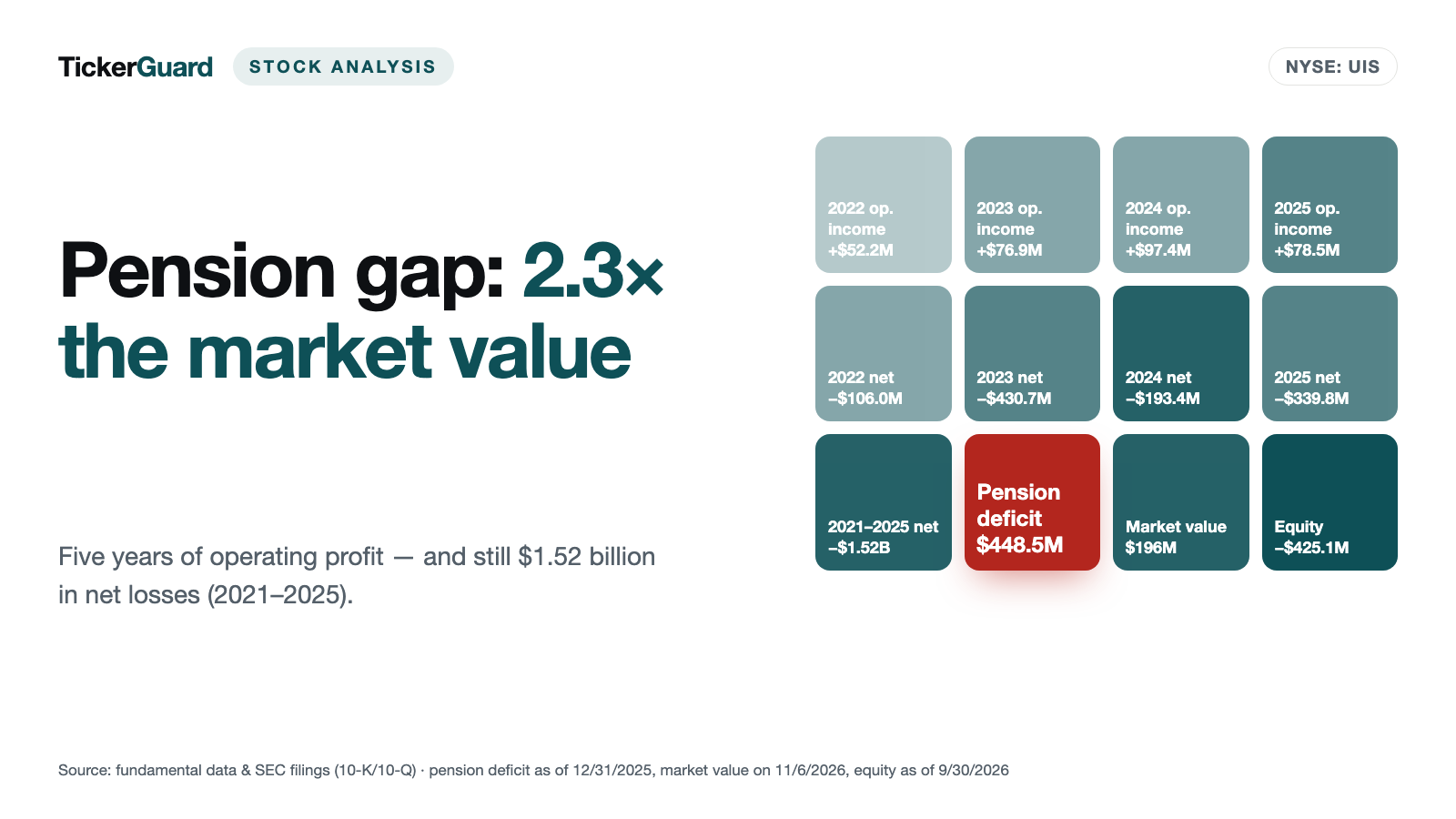
Quantum Computing Inc. raised about $1.55 billion from investors in 2025 and held $1.32 billion in cash and bonds as of June 30, 2026. Interest on it brought in $26.4 million in the first half of 2026 — almost three times revenue of $9.2 million. That revenue came almost entirely from three acquisitions; all four companies combined sold 38 percent less than a year earlier. The label says quantum computer; we read the list of ingredients.
 Thomas Mücke
Founder & Publisher
As of Today
As of: November 6, 2026
- Closing price
- 6.30 $ +12.40%
- Market Capitalisation
- 1.4 $B
- Growth Score
- 5/10
- AAQS
- 4/10
Price change since November 6, 2026: -0.5%
This analysis has a cut-off date. The Stock Guard tells you when something material changes in the numbers. Reserve your free spot
Chart
Interactive price chart (TradingView).
52-week range: 5.60 $ to 13.60 $ · Last price: 6.30 $ (As of: November 6, 2026)
Note: pure fact-based analysis, not investment advice and not a solicitation to buy or sell. All figures without guarantee.
There is an investor weakness that strikes with particular reliability around future technologies: the label trap. We judge the can by what is printed on the outside and never read the list of ingredients. With Quantum Computing Inc. (Nasdaq: QUBT, QCi for short), the future technology is right there in the company name. Read “Quantum Computing” and you picture the machines that are supposed to make today’s supercomputers look old one day — and stocks that could be worth a multiple on that day. That label has made QUBT a fixture on internet forums for years.
So let’s make a deal: we read the ingredients together. That means what QCi itself has filed with the U.S. securities regulator, the SEC — the annual report (10-K) for 2025, the quarterly report (10-Q) as of June 30, 2026, and the current reports (8-K) up to the investor presentation of October 2026. The central tension of this analysis runs through every chapter: QCi is unusually well funded for a company with so little revenue — but the money came from shareholders, not from the business. And most of the business it now has was bought.
What QCi actually does
QCi develops devices that compute, measure and encrypt with light instead of electricity — what specialists call photonics. The company stresses that its systems run at room temperature, unlike many quantum computers that have to be cooled to nearly absolute zero. The quarterly report names as its leading products the “Entropy Quantum Computer” (the Dirac line) for optimization problems, a photonic reservoir computer for AI applications (latest version since November 2025: NeuraWave), a photonic vibrometer and systems for secure communication. In June 2026, QCi says it sold and delivered a Dirac-3 system to a leading global consulting firm.
The core of the long-term strategy is a material: thin-film lithium niobate (TFLN), a crystal that allows especially capable light chips. QCi runs its own chip foundry for it in Tempe, Arizona, and plans a second one (“Fab 2”). In 2026, QCi bought three companies: Luminar Semiconductor (lasers and detectors, $110 million in cash, closed Feb. 2), NuCrypt (quantum communications, $4.5 million, March 4) and NHanced Semiconductors (chip packaging, a preliminary $73.8 million plus possible earnout payments, June 22). As of Dec. 31, 2025, QCi had 72 full-time employees; the October 2026 investor presentation puts the count at more than 300 in eleven locations after the deals. Keep this in mind: Today QCi is largely a maker of photonic components and chip packaging — the quantum computer is the goal, not the revenue.
Company history for investors
-
2022
Merger with QPhoton
In June 2022, QCi acquires QPhoton, the photonics start-up of today’s CEO Yuping Huang. The warrants issued in that deal still swing through the income statement as accounting gains or losses.
-
2025
Class action filed
On Feb. 25, 2025, shareholders sue over allegedly misleading statements about customers and contracts. The case is pending; QCi has moved to dismiss.
-
2025
$1.55 billion raised
Four private placements between January and October 2025, the last two at an implied $18.61 and $20.17 per share. The share count rises to 224.17 million by year-end.
-
2026
Three acquisitions in five months
Luminar Semiconductor (February), NuCrypt (March) and NHanced (June). Reported revenue jumps, while the combined revenue of the four companies falls 38 percent in the first half.
-
2026
Authorized shares nearly doubled
On June 29, 2026, authorized common stock rises from 250 million to 450 million shares. For shareholders, that means room for further dilution without a new vote.
How the stock landed on our desk
No metrics screen flagged QCi first; other investors’ attention did. Our in-house Reddit Hot Stocks scanner, which counts how often stocks are mentioned on Reddit forums, flagged QUBT on Nov. 8, 2026. On Nov. 5, 2026, the stock had closed at $5.63, its lowest close since March 2025, before rising to $6.33 on Nov. 6. For comparison: on Oct. 3, 2025, the stock closed at $24.62. According to our fundamental data (retrieved Nov. 8, 2026), about 70.0 million QUBT shares were also sold short — short sellers bet on falling prices. That is about 35 percent of the freely tradable shares.
On the same day, QUBT showed up in several other screens, including “parabolic reversal” (a stock that has fallen hard again after a steep run-up) and the Beneish M-Score. The latter is a formula that uses sudden jumps in receivables, assets and costs to flag numbers that might be dressed up. For QCi, much of the signal is explained by the acquisitions: receivables rose from $0.5 million to $6.9 million between Dec. 31, 2025, and June 30, 2026, and goodwill from $55.6 million to $181.5 million. That is not evidence of manipulation — but it is a reason to look more closely. Which is what we will do now.
The numbers over the years: little revenue, lots of cash
First, what genuinely impresses: the balance sheet. As of June 30, 2026, QCi held $189.2 million in cash and $1,134.3 million in interest-bearing securities — mainly U.S. Treasuries ($544.4 million) and corporate bonds ($576.2 million). Together that is $1.32 billion. Against it stood only $47.2 million in liabilities, and there was no debt. Shareholders’ equity was $1,592.0 million. The company puts it this way:
“As a result, the Company has adequate liquid assets on hand to meet its obligations over the next 12 months.”
— Quantum Computing Inc., SEC quarterly report 10-Q as of June 30, 2026, Note 1
Where the money came from is just as clear: shareholders. In 2025, QCi sold new shares in four private placements for gross proceeds of about $1.55 billion — $100 million in January ($12.25 per share), $200 million in June ($14.25), $500 million in September and $750 million in October 2025 (10-K 2025, Note 12). In the last two rounds, buyers paid an implied $18.61 and $20.17 per share. Now the chart that shows the central tension in one picture:
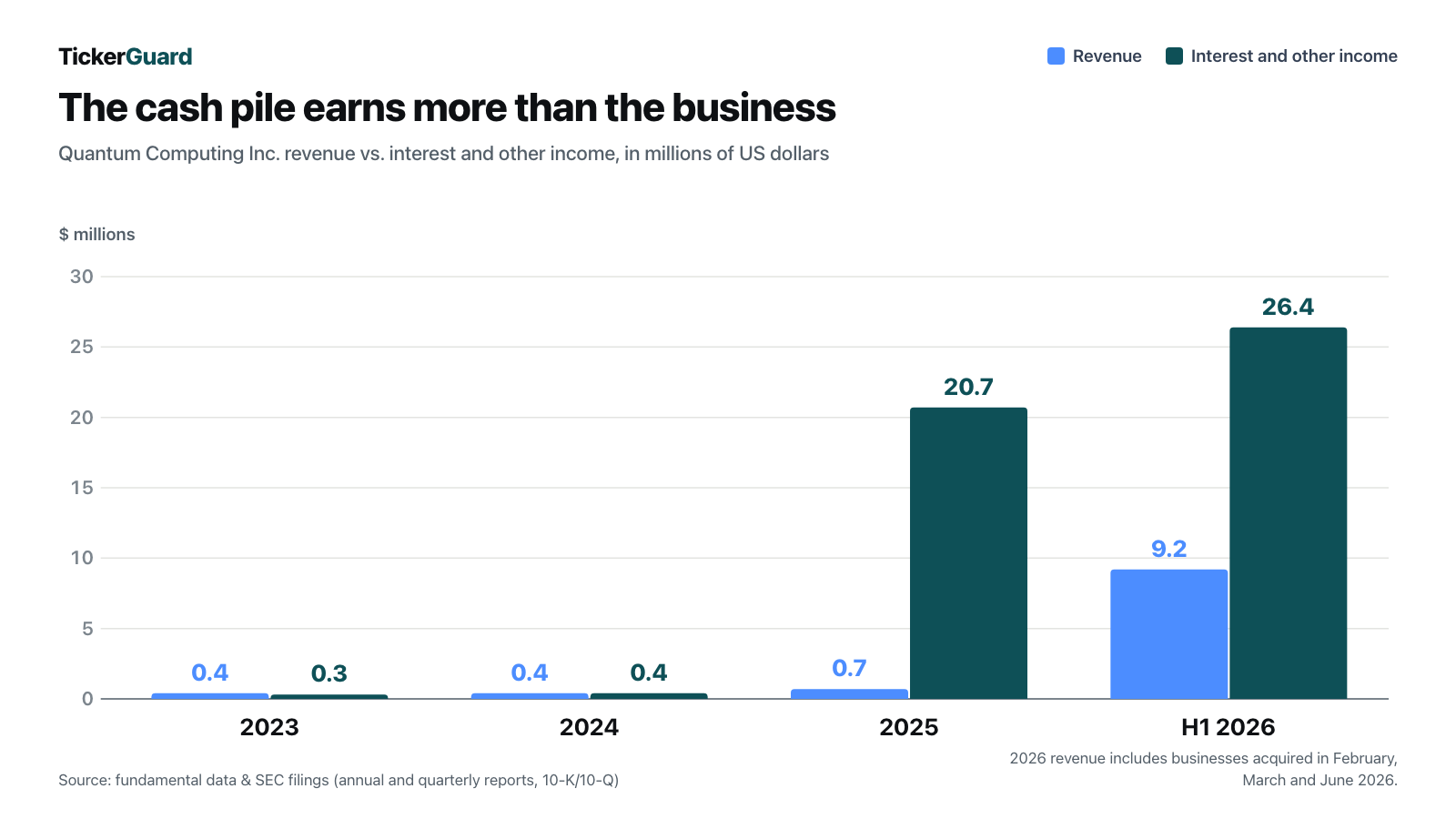
Revenue was $0.36 million in 2023, $0.37 million in 2024 and $0.68 million in 2025. Only in 2026 did it jump: $3.7 million in the first quarter and $5.6 million in the second, $9.2 million combined. The second-quarter earnings release describes where the earnings support actually came from:
“Interest and other income totaled $13 million compared to $1.8 million in the second quarter of 2025. The increase was due to interest income generated from the Company’s larger cash and investment positions.”
— Quantum Computing Inc., Q2 2026 earnings release, Exhibit 99.1 to the 8-K of Aug. 10, 2026
In everyday terms: right now QCi is more like a well-stocked savings account with a research lab and a few workshops attached. In the first half of 2026, the cost of the products sold was $11.1 million — more than the $9.2 million of revenue. QCi sold at a gross loss (−$1.9 million). Add $41.7 million of operating expenses, and the operating loss came to $43.6 million. The net loss was much smaller at $15.8 million because of $26.4 million in interest and other income and a $1.5 million accounting gain on old warrants. Operating cash outflow was $23.3 million. Keep this in mind: Without the interest on shareholders’ money, the loss would have been almost three times as large. And bond interest falls when policy rates fall.
What the filings say — the uncomfortable truths
Uncomfortable truth No. 1: The growth was bought — and what was bought is shrinking
The earnings release headlines a jump in second-quarter revenue from $61,000 to $5.6 million. True, but not very telling: in the second quarter of 2025, Luminar Semiconductor, NuCrypt and NHanced did not belong to QCi yet. How the four companies look together is shown in a table QCi itself publishes in the quarterly report — pro forma figures, calculated as if all four had been combined since Jan. 1, 2025:
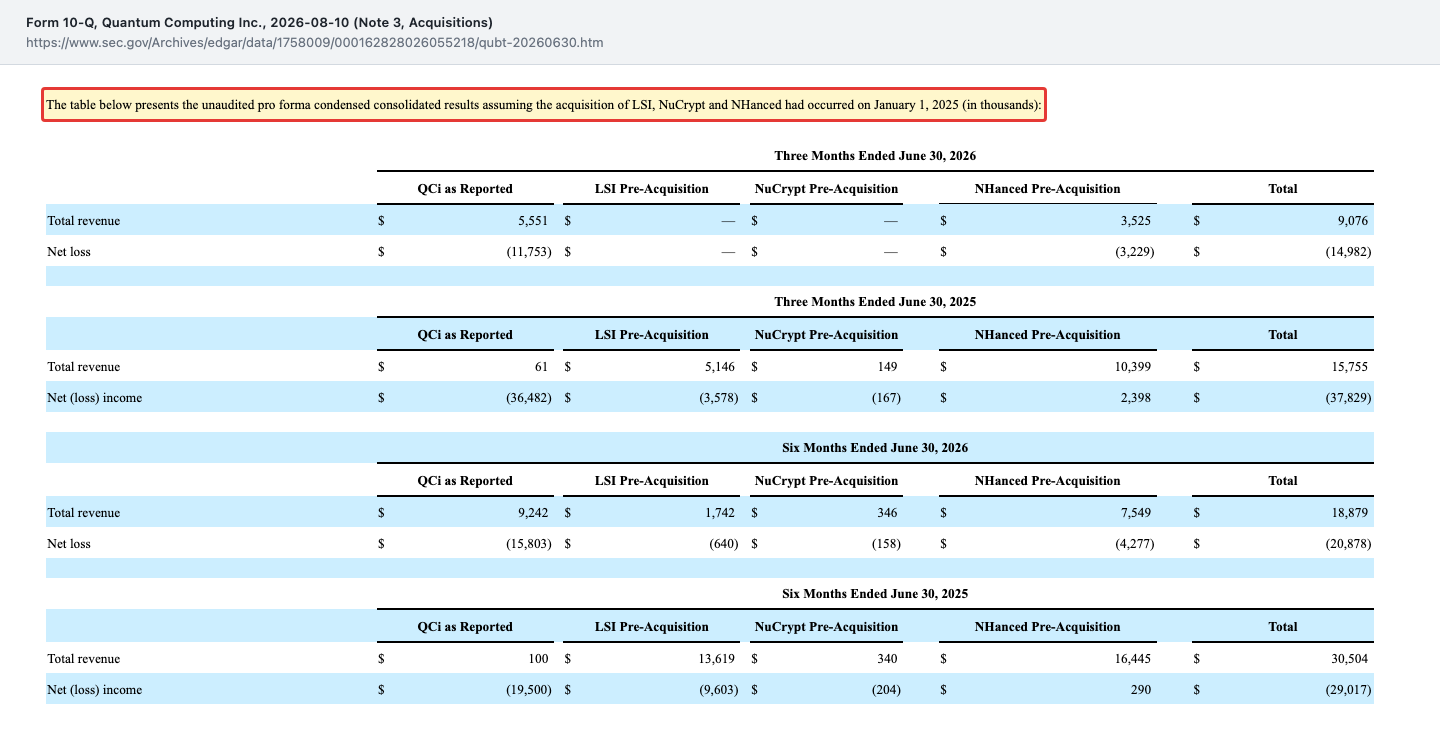
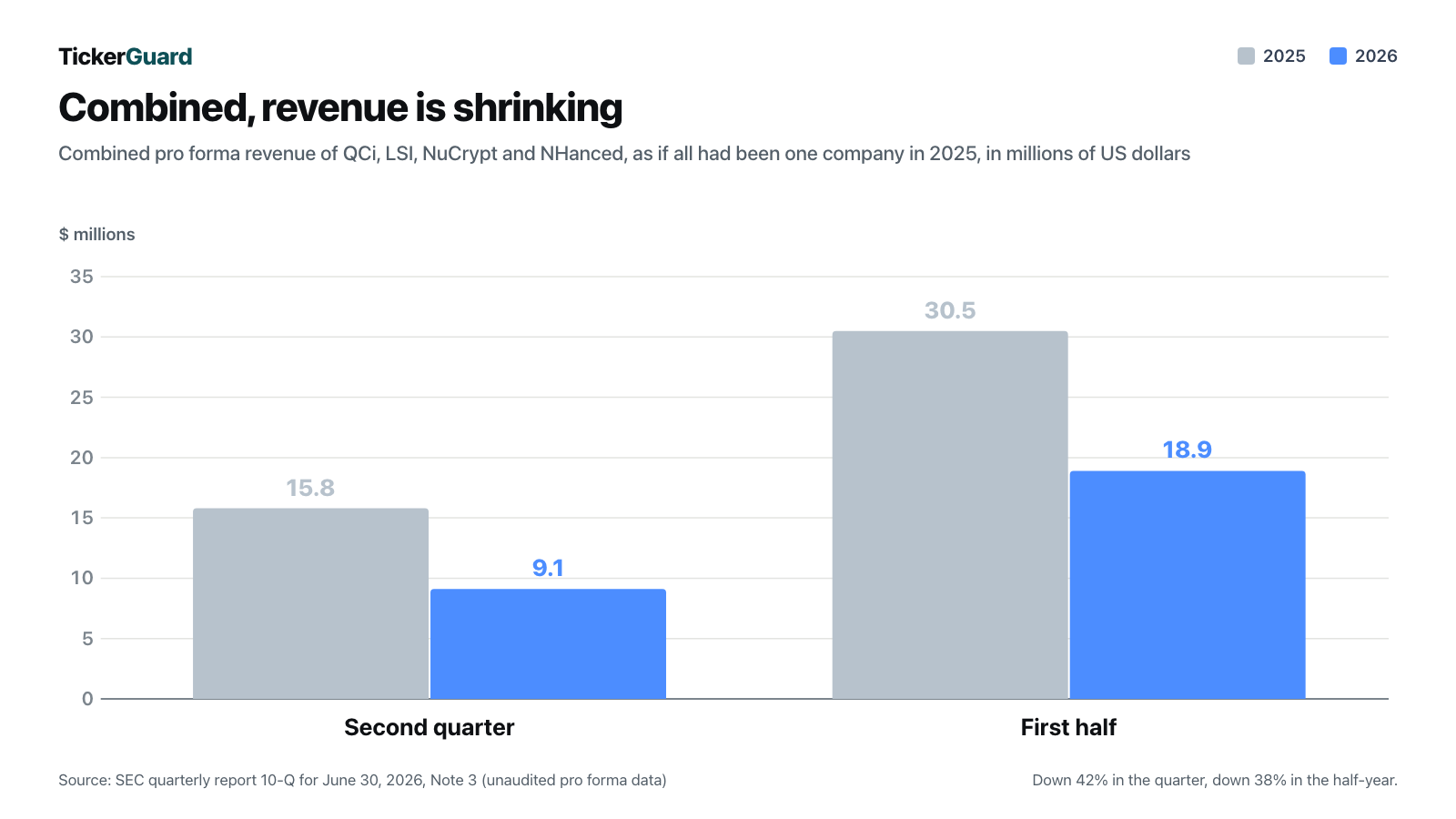
NHanced shows it most clearly: the packaging fab had revenue of $10.4 million in the second quarter of 2025, but only $3.5 million in the second quarter of 2026 up to the June 22 acquisition. Luminar Semiconductor posted $13.6 million in the first half of 2025; in 2026 it was $1.7 million in January before the deal plus $8.1 million afterward. And Luminar Semiconductor is losing money under QCi:
“From the acquisition date through June 30, 2026, LSI contributed revenue of $8.1 million and operating loss of $5.7 million.”
— Quantum Computing Inc., SEC quarterly report 10-Q as of June 30, 2026, Note 3 “Acquisitions”
The origin matters here: Luminar Semiconductor was a subsidiary of the lidar maker Luminar Technologies, which filed for Chapter 11 bankruptcy protection in December 2025; QCi bought the subsidiary in a court-supervised bidding process (10-K 2025). For a buyer with a full bank account that can be a cheap entry — but it also helps explain why part of the old customer base may have fallen away. The company reports a backlog of $42.5 million as of June 30, 2026, but no revenue guidance. Keep this in mind: A revenue jump from an acquisition is a purchase, not growth. Growth is when what you bought sells more than before.
Uncomfortable truth No. 2: A quadrupled share count — and room for 224 million more
The money in the bank has a price, and every shareholder pays it with his or her stake. At the end of 2022, there were 55.96 million QCi shares; at the end of 2023, 77.45 million; at the end of 2024, 129.01 million; at the end of 2025, 224.17 million; and according to the cover of the quarterly report, 226.35 million on Aug. 7, 2026. That is roughly four times as many in three and a half years — in plain terms, your slice of the cake has shrunk to a quarter, even if the cake itself got bigger. And the room for more was widened considerably in the summer of 2026:
“The Certificate of Amendment amends Section 4.1 of Article IV of the Company’s Certificate of Incorporation to increase the total number of authorized shares of capital stock from 260,000,000 to 460,000,000, consisting of (a) 450,000,000 shares of Common Stock, par value $0.0001 per share (increased from 250,000,000), and (b) 10,000,000 shares of Preferred Stock, par value $0.0001 per share (unchanged).”
— Quantum Computing Inc., current report 8-K of June 30, 2026, Item 5.03
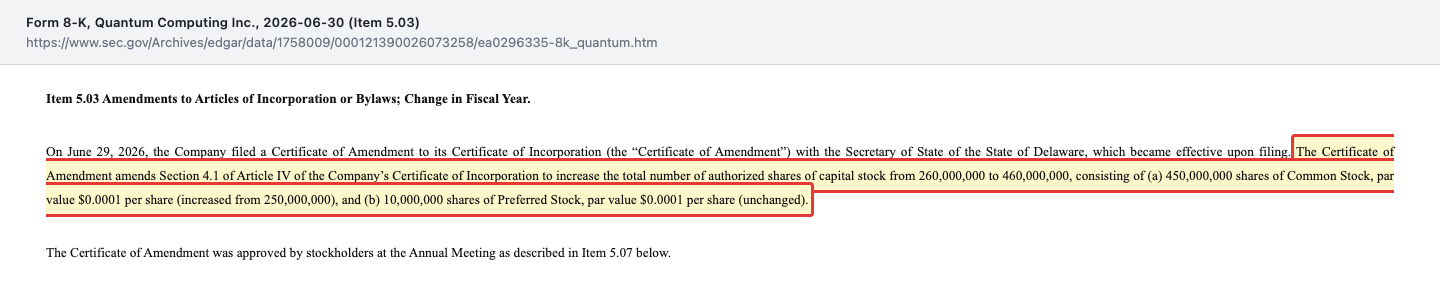
Do the math: 450 million authorized, 226.35 million issued — that leaves about 224 million shares the board could issue without another shareholder vote. Without the increase, the headroom would have been nearly used up at about 24 million. At the same annual meeting on June 24, 2026, the share pool for employee and executive pay was raised from 20 million to 30 million shares; from now on it grows automatically each year by 2 percent of shares outstanding. To be fair: through June 30, 2026, QCi sold no shares under its at-the-market program in 2026, and with $1.32 billion in the bank there is no pressing need for cash. Keep this in mind: A company that raised half a billion and then three quarters of a billion in a single fall has created room for further share sales; whether it uses that room is open.
Uncomfortable truth No. 3: The class action over customers and contracts is still open
Since February 2025, a securities class action has been pending in federal court in New Jersey on behalf of shareholders who bought QCi securities between March 30, 2020, and Jan. 15, 2025. The allegation, per the quarterly report: QCi made false or misleading statements about its customers, contracts and business operations. QCi disputes this and has moved to dismiss; it filed its latest brief on May 22, 2026. There are also four shareholder derivative suits against current and former officers and directors (March, May, June and September 2025), all stayed until the court rules on the motion to dismiss the class action. Here is how QCi describes the possible cost:
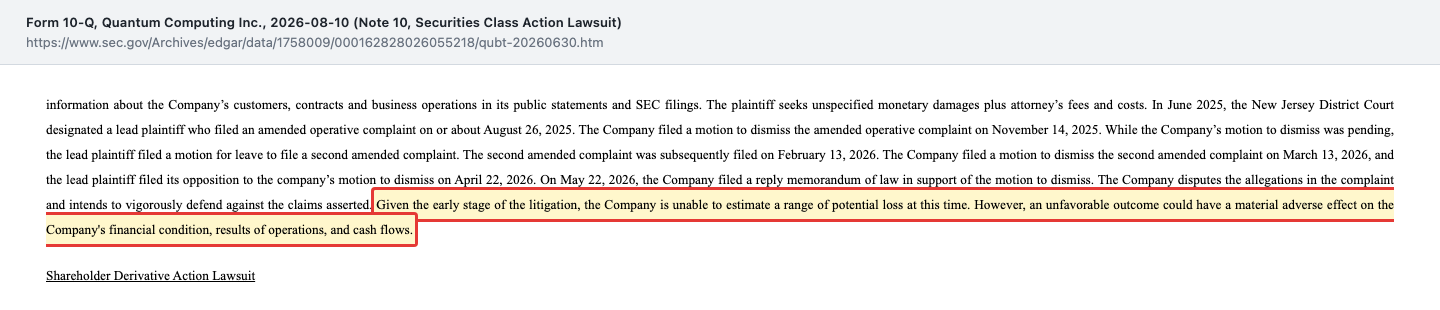
“Given the early stage of the litigation, the Company is unable to estimate a range of potential loss at this time. However, an unfavorable outcome could have a material adverse effect on the Company's financial condition, results of operations, and cash flows.”
— Quantum Computing Inc., SEC quarterly report 10-Q as of June 30, 2026, Note 10 “Securities Class Action Lawsuit”
A lawsuit is not a verdict, and class actions against companies with very volatile stocks are common in the U.S. So far the case is hard to see in the numbers: the line “professional services and legal fees” did rise to $13.8 million in the first half of 2026 from $2.5 million a year earlier, but in the same half-year QCi incurred about $12.9 million of acquisition transaction costs ($5.6 million in the first quarter, $7.3 million in the second). If those costs sit entirely in this line — QCi does not allocate them explicitly — the arithmetic leaves $13.8 million − $12.9 million = $0.9 million, less than the prior year’s $2.5 million. QCi does not report litigation costs separately. And the allegation goes to the very point of this analysis: whether real customers and contracts stand behind the story. Keep this in mind: Until the court rules, there is an open question mark over the customer claims QCi made between March 2020 and January 2025.
Uncomfortable truth No. 4: In the NHanced deal, QCi’s own orders count toward the sellers’ earnout
For NHanced, QCi paid a preliminary $73.8 million according to the quarterly report: $48.1 million in cash, $20 million into escrow, a $0.7 million adjustment and 447,000 shares worth $5.0 million. The escrow goes to the sellers only if NHanced hits certain revenue targets for 2027 and 2028. On top of that, an earnout of up to $72.0 million was agreed. The first step is $10 million if the relevant revenue reaches at least $50 million in 2027; NHanced had revenue of $35.1 million in 2025. Per the quarterly report, QCi also assumed two leases with NHanced in which a prior owner, now a QCi employee, is the lessor — about $48,700 a month with 3 percent annual increases. The purchase agreement defines what counts as revenue:
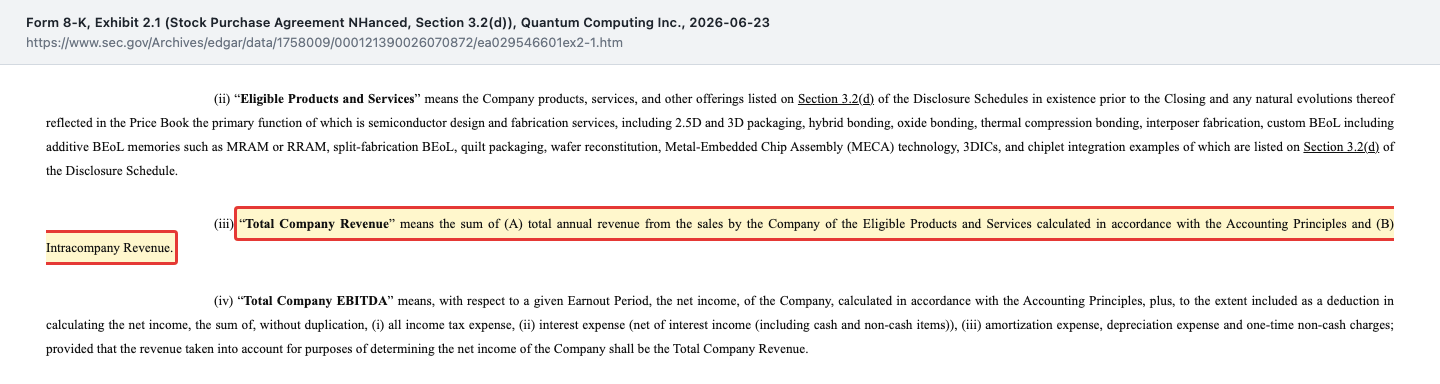
“‘Total Company Revenue’ means the sum of (A) total annual revenue from the sales by the Company of the Eligible Products and Services calculated in accordance with the Accounting Principles and (B) Intracompany Revenue.”
— Quantum Computing Inc., NHanced purchase agreement, Exhibit 2.1 to the 8-K of June 23, 2026, Section 3.2(d)
“Intracompany Revenue” means work NHanced performs for QCi itself, valued at the fab’s published list prices. The sellers are trusts of Robert Patti and Gretchen Trinklein Patti; according to the October 2026 investor presentation, Robert Patti is part of QCi’s leadership team as Chief Manufacturing Officer. At the same time, QCi’s investor presentation estimates $70 million to $90 million of capital spending for “Fab 2 & Other.” QCi does not say how much of that could go to NHanced — that some of it might is our own inference. The list-price rule is a safeguard, and none of this is prohibited. But for you it means: If QCi reports in 2027 that NHanced grew strongly, check how much of that QCi ordered from itself.
How another quantum company with very little revenue and big expectations looks in its filings is shown in our analysis of Quantum eMotion. QCi differs from it mainly in one respect: here money is not scarce but abundant.
Valuation: what the market pays for the business
There is no price-to-earnings ratio; QCi is losing money. A price-to-sales ratio on $9.8 million of revenue over the last four reported quarters would be absurdly high and therefore says nothing. The cash is more revealing. At $6.33 (close on Nov. 6, 2026) and 226.35 million shares, the market value on Nov. 6, 2026, was about $1.43 billion. Of that, about $1.32 billion was covered by cash and bonds as of June 30, 2026 — about $5.85 per share. Arithmetically, on Nov. 6, 2026, the market paid about $109 million for everything else: the lab, the fabs, three acquisitions and the quantum idea. The price-to-book ratio that day was about 0.9; excluding goodwill and intangible assets ($210.6 million combined), about 1.0.
Two caveats belong here. First, the price and the cash are from different dates: operating losses and capital spending have continued since June 30, 2026, and the updated figure will only come with the quarterly report as of Sept. 30, 2026, which had not been filed as of Nov. 8, 2026. Second, cash is only worth what management makes of it — and in 2026 a large share went into acquisitions whose revenue is shrinking. Keep this in mind: Anyone holding the stock at this price arithmetically owns mostly cash — the question is how much of it will still be there in five years and what it will earn by then.
Upside and risks at a glance
What speaks for Quantum Computing Inc.:
- Very strong balance sheet: $1.32 billion in cash and bonds, no debt, $47.2 million in liabilities (June 30, 2026).
- Market value close to the cash pile: about $1.43 billion on Nov. 6, 2026, price-to-book ratio that day about 0.9.
- In-house manufacturing from chip foundry to packaging, systems that the company says run at room temperature; backlog of $42.5 million (June 30, 2026).
- First sales: a Dirac-3 system for a leading consulting firm (June 2026) and a framework agreement with Planck Dynamics for NeuraWave with a potential value above $10 million, subject to milestones.
- The CEO has skin in the game: Yuping Huang held 21.53 million shares, about 9.5 percent, after his filing of Aug. 21, 2026.
What speaks against it:
- Hardly any revenue of its own: $0.68 million in 2025; the 2026 jump comes from acquisitions; pro forma, all four companies combined sold 38 percent less (first half of 2026).
- Gross loss: cost of revenue of $11.1 million against $9.2 million of revenue (first half of 2026), operating loss of $43.6 million.
- Heavy dilution: share count from 55.96 million (end of 2022) to 226.35 million (August 2026), with 450 million now authorized.
- Pending class action over allegedly misleading statements about customers and contracts, plus four derivative suits stayed until the court rules on the motion to dismiss.
- Earnout of up to $72 million to the Patti family trusts that sold NHanced; Robert Patti is Chief Manufacturing Officer per the October 2026 investor presentation, and intracompany orders count toward the revenue target.
A human conclusion
Back to the label trap from the beginning. The label says “Quantum Computing.” The list of ingredients reads: $1.32 billion in bonds and cash, a laser and detector business out of the bankruptcy estate of a lidar maker, a packaging fab with a possible additional payment of up to $72 million to its sellers, a small quantum communications team and a research lab with its first systems sold. Plus an open lawsuit over whether past statements about customers were true. Whether the allegations are true is for the court to decide; none has been proven so far. Nor is it a breakthrough — it is a very well-funded experiment.
Arithmetically, cash as of June 30, 2026, covered most of the market value of Nov. 6, 2026; losses and capital spending have continued since then. What remains open is whether a management team that so far has mainly raised money and bought companies will turn it into a business that earns more than the interest. So the honest question for you is not “Will quantum computing be big?” but: Do you trust this particular team to earn more with $1.32 billion than Treasuries would? If yes, you have a thesis. If you only bought the label, you had none. What you make of it is your decision. And that is how it should be.
Sources
All original documents used in this analysis — so you can check them yourself:
- Quantum Computing Inc. — Quarterly report 10-Q as of June 30, 2026 (filed Aug. 10, 2026)
- Quantum Computing Inc. — Current report 8-K of Aug. 10, 2026 (Item 2.02) with Exhibit 99.1, Q2 2026 earnings release
- Quantum Computing Inc. — October 2026 investor presentation, Exhibit 99.1 to the 8-K of Oct. 2, 2026
- Quantum Computing Inc. — Current report 8-K/A of Sept. 8, 2026: NHanced financial statements and pro forma data
- Quantum Computing Inc. — Current report 8-K of July 22, 2026: new Chief Revenue Officer
- Quantum Computing Inc. — Current report 8-K of June 30, 2026: annual meeting, authorized shares
- Quantum Computing Inc. — Current report 8-K of June 23, 2026: acquisition of NHanced Semiconductors with Exhibit 2.1, purchase agreement
- Quantum Computing Inc. — Quarterly report 10-Q as of March 31, 2026 (filed May 11, 2026)
- Quantum Computing Inc. — Current report 8-K of Feb. 3, 2026: completion of the Luminar Semiconductor acquisition
- Quantum Computing Inc. — Annual report 10-K for 2025 (filed Mar. 2, 2026)
- Quantum Computing Inc. — Annual report 10-K for 2024 (filed Mar. 20, 2025)
- Insider filings (Form 4, most recently Aug. 24, 2026, as a Form 4/A that only corrects the exercise price to $0.0001; Yuping Huang holds 21,531,173 shares) and the full filing history: EDGAR, CIK 0001758009
- Fundamental data (prices through Nov. 6, 2026, short interest, retrieved Nov. 8, 2026), with market value checked against the share count in the quarterly report.
- Earnings call transcripts were not analyzed; the basis is exclusively the mandatory filings with the SEC.
Transparency & disclaimer: This analysis is a journalistic assessment of publicly available information and does not constitute investment advice, a regulated financial analysis, or a solicitation to buy or sell securities. Equity investments carry substantial risk, including total loss. All information is provided without guarantee; the data date is noted throughout the text. Positions held by the operator are disclosed daily; where one exists, it appears as a notice at the top of this deep dive.
Key figures at a glance
All monetary figures in millions of $; earnings per share as reported.
| Metric | 2021 | 2022 | 2023 | 2024 | 2025 |
|---|---|---|---|---|---|
| Revenue | 0.0 | 0.1 | 0.4 | 0.4 | 0.7 |
| Operating Income (EBIT) | -17.1 | -36.6 | -26.2 | -25.9 | -51.1 |
| Net Income | -27.9 | -38.6 | -27.0 | -68.5 | -18.7 |
| Net Margin | -89,304.9% | -28,451.4% | -7,548.0% | -18,375.9% | -2,738.1% |
| Earnings Per Share | -0.96 $ | -0.69 $ | -0.41 $ | -0.73 $ | -0.11 $ |
Source: fundamental data & SEC filings (annual and quarterly reports, 10-K/10-Q)
Our Bottom Line at a Glance
- Balance sheet & liquidity positive
- $1.32 billion in cash and bonds, no debt, $47.2 million in liabilities (June 30, 2026). Operating cash outflow was $23.3 million in the first half of 2026.
- Revenue & growth negative
- $9.2 million of revenue in the first half of 2026, almost entirely from three acquisitions. Pro forma, combined revenue fell 38 percent to $18.9 million (10-Q as of June 30, 2026).
- Earnings power negative
- Gross loss of $1.9 million and operating loss of $43.6 million in the first half of 2026; the smaller net loss ($15.8 million) rests on $26.4 million of interest and other income.
- Dilution negative
- Share count from 55.96 million (end of 2022) to 226.35 million (Aug. 7, 2026); authorized common stock raised from 250 million to 450 million shares on June 29, 2026.
- Legal & governance negative
- Pending class action over customer and contract statements (since Feb. 25, 2025), four derivative suits stayed until the ruling on the motion to dismiss; earnout of up to $72 million to the Patti family trusts that sold NHanced (Robert Patti is Chief Manufacturing Officer per the October 2026 investor presentation).
- Valuation neutral
- Market value about $1.43 billion (Nov. 6, 2026), of which about $1.32 billion is covered by cash and bonds (as of June 30, 2026); price-to-book about 0.9.
Quantum Computing Inc. is above all well funded: $1.32 billion in cash and bonds with no debt. The operating business, by contrast, is small, runs at a gross loss and was mostly bought; combined, the four companies had 38 percent less revenue in the first half of 2026 than a year earlier. The share count has quadrupled since 2022, and a class action over customer and contract statements is pending. Not investment advice.
What Our Rating Means
Open questions
The business works in principle, but one material question is open. As long as it stays open, our findings do not carry a quality verdict.
Yellow, because the balance sheet is not the risk and the business does operate — QCi sells components, manufacturing services and its first systems to customers — but one material question is open: $1.32 billion in cash with no debt lasts a very long time at $23.3 million of operating cash outflow per half-year, so there is no existential risk. Open is the operating question — whether the lab and the acquisitions become a business with a gross profit. So far the acquired revenue is shrinking, and losses are softened only by interest on shareholders’ money. The pending class action and the earnout to the Patti family trusts are governance questions, not a proven breach. That the market value sat close to the cash pile on Nov. 6, 2026, is a price argument and does not change the color. The decision is yours.
A journalistic assessment by our editorial team at the time of the deep dive, based on public sources — not investment advice and not a solicitation to buy or sell. Your personal circumstances (investment goals, risk capacity, taxes) cannot be taken into account. What our levels mean, how verdicts are formed, and what conflicts of interest exist →
Worth Noting
- Data date: balance sheet, earnings and cash flow figures as of June 30, 2026 (10-Q filed Aug. 10, 2026) or Dec. 31, 2025 (10-K filed Mar. 2, 2026); share count per the 10-Q cover as of Aug. 7, 2026; prices and short interest per fundamental data (close Nov. 6, 2026, retrieved Nov. 8, 2026). All SEC filings through Nov. 8, 2026, were reviewed; the quarterly report as of Sept. 30, 2026, had not yet been filed.
- Risk of confusion: Quantum Computing Inc. (QUBT) is not Quantum Corporation (QMCO, storage hardware).
- Pro forma revenue figures are unaudited company data (10-Q, Note 3) calculated as if Luminar Semiconductor, NuCrypt and NHanced had belonged to QCi since Jan. 1, 2025.
Stock Watch
This analysis is as of November 8, 2026. Stock Watch will tell you what's changed at QUBT since then.
Later $1 a month per stock — signing up is free, and you'll be the first to know when it launches.
The full analysis as a PDF for later
We will send you this analysis as a PDF — to print, file away, and read at your own pace. And we will add you to the free Stock Watch list for Quantum Computing Inc (QUBT), so you hear about it when something material in this analysis changes.
Frequently Asked Questions
Quantum Computing Inc. (Nasdaq: QUBT, Hoboken, New Jersey) develops photonic systems that compute, measure and encrypt with light — including the Dirac-3 optimization machine and the NeuraWave AI accelerator. Since 2026, acquisitions have added lasers, detectors and chip packaging, which now generate most of its revenue.
As of June 30, 2026, QCi held $189.2 million in cash and $1,134.3 million in securities, mainly U.S. Treasuries and corporate bonds — $1.32 billion in total. It had no debt. The money came from four private placements in 2025 with gross proceeds of about $1.55 billion.
QCi reported $9.2 million of revenue in the first half of 2026, up from $0.1 million a year earlier; for 2025 it was $0.68 million. The increase comes from three acquisitions. Combined, the four companies had $18.9 million of revenue in the first half of 2026, 38 percent less than a year earlier (pro forma data in the 10-Q).
No. In the first half of 2026, the operating loss was $43.6 million, and cost of revenue alone exceeded revenue. The net loss was smaller at $15.8 million because the cash pile generated $26.4 million in interest and other income.
The class action filed in New Jersey on Feb. 25, 2025, accuses QCi of false or misleading statements about customers, contracts and business operations, on behalf of buyers between March 30, 2020, and Jan. 15, 2025. QCi disputes the claims and has moved to dismiss; per its 10-Q, it cannot yet estimate a possible loss.
No. Quantum Computing Inc. (ticker QUBT) is the photonics and quantum technology company in Hoboken. Quantum Corporation (ticker QMCO) sells storage hardware and has nothing to do with quantum computers. Because the names are similar, the two are often confused on forums and in news feeds.
Found an error?
Did you spot a factual error, an outdated number, or a typo in this deep dive? Let us know briefly — your report goes straight to the editorial team.