Quantum eMotion: $11,171 of Revenue for the Whole Year — and $6.8 Million for Stock Options
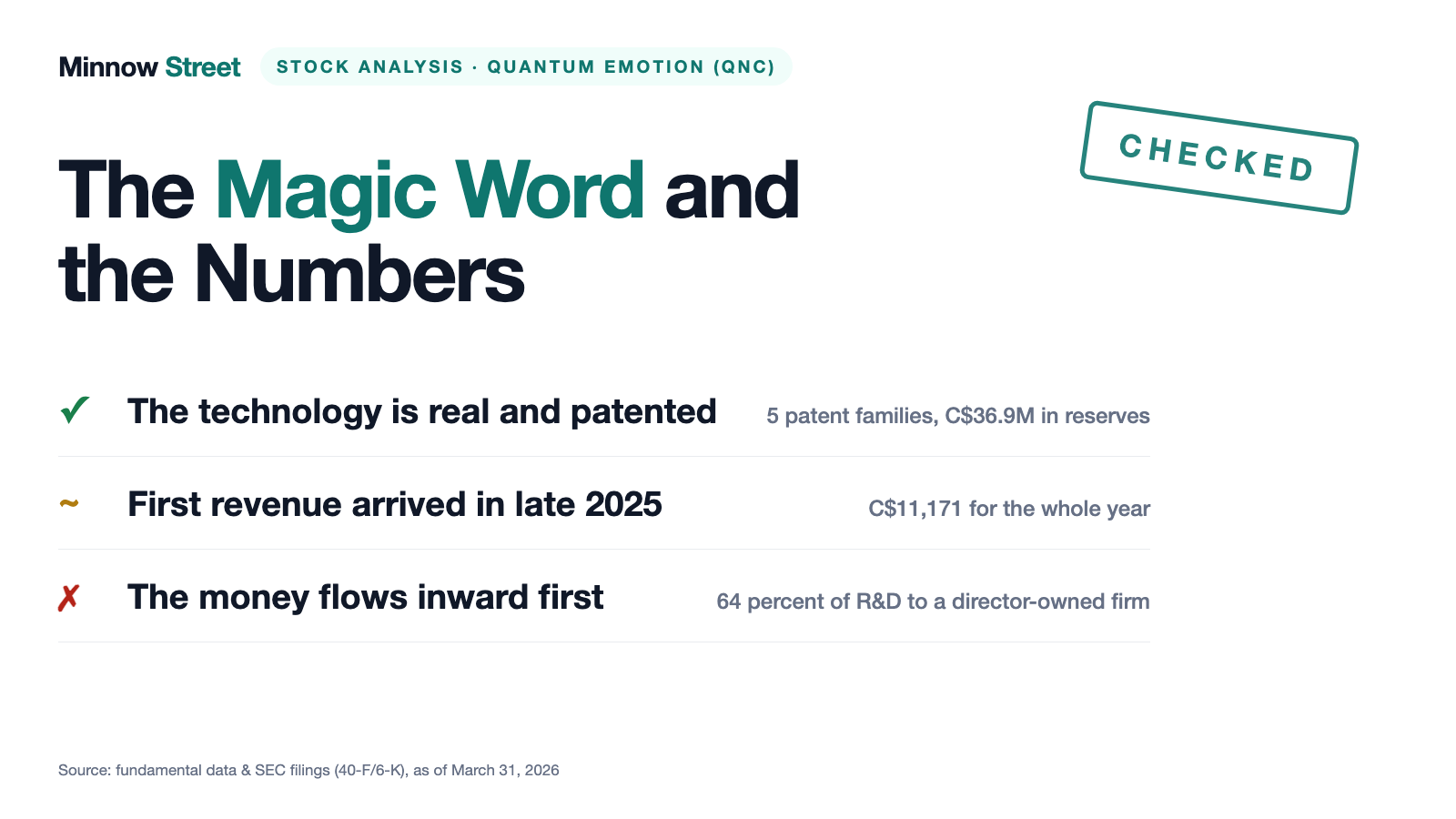
Quantum eMotion builds random number generators that draw their randomness from actual quantum noise — a serious technology with five patent families and granted patents in roughly a dozen countries. In the fourth quarter of 2025 the Montreal company booked the first revenue in its history: C$11,171. In that same year it recorded C$10,983,407 of expenses, including C$6,833,609 of share-based payments, by far the largest single line. Of a C$1,073,747 research budget, C$684,397 went to a company owned by a director. And at the annual meeting on June 18, 2026, 47.05 percent of votes cast opposed re-electing the chief executive. The interim report as of June 30, 2026, filed on August 14, has not eased any of it: C$1,479 of quarterly revenue, the largest quarterly loss in company history and, for the first time, an eight-figure liability on the balance sheet. Not investment advice — just the question of who a company serves first while it still has almost no customers.
 Thomas Mücke
Founder & Publisher
Thomas Mücke
Founder & Publisher
As of Today
As of: September 28, 2026
- Closing price
- 2.20 $ +17.00%
- Market Capitalisation
- 0.5 $B
- Growth Score
- 3/10
- AAQS
- 4/10
This analysis has a cut-off date. The Stock Guard tells you when something material changes in the numbers. Reserve your free spot
Chart
Interactive price chart (TradingView).
52-week range: 1.70 $ to 4.40 $ · Last price: 2.20 $ (As of: September 28, 2026)
Note: pure fact-based analysis, not investment advice and not a solicitation to buy or sell. All figures without guarantee.
Some words switch off the arithmetic part of the brain. “Quantum” is one of them. The moment it lands, attention shifts from “what does this company earn?” to “do I even understand this?” — and what you do not understand, you also do not check. Call it the magic word trap: a term sounds so large that asking a plain question feels rude. Quantum eMotion Corp. of Montreal (NYSE American: QNC, also TSX Venture and Frankfurt) carries the magic word in its name and in its product. So let us switch the arithmetic back on and read what the company itself has told the U.S. securities regulator, the SEC — the annual report on Form 40-F for 2025, filed March 31, 2026, the interim reports on Form 6-K as of March 31 and June 30, 2026 — the latter filed August 14, 2026 — and everything in between. A filing with the securities regulator is honest under penalty of law. This one describes a real technology, a balance sheet that was surprisingly clean for a long time — and has carried an eight-figure liability since June 30, 2026 — and revenue that fits in a wallet. What you make of it is your call.
What Quantum eMotion actually does — dice nobody can predict
Every encryption scheme stands or falls on randomness. A key is only as safe as the random number it came from. The problem: computers cannot roll dice. They compute an imitation of randomness using formulas that always produce the same result once you know the starting value. Specialists call it pseudo-randomness. For everyday purposes it is usually enough. Against an adversary with enormous computing power, not always.
Quantum eMotion therefore taps a different source: the noise inside a semiconductor that arises from quantum mechanical effects. On current physical understanding, that noise is not predictable — not even with unlimited computing power. The device that turns it into numbers is called a quantum random number generator, or QRNG. Think of a dice cup where not even the manufacturer knows what will come up.
Around that core the company has built a product family: a developer kit (SDK) for programmers, a cloud service that supplies randomness on demand (“entropy as a service”), post-quantum cryptography building blocks, and — acquired on April 2, 2026 — the SecureKey platform, which protects cryptographic keys while they are in use in memory. Hardware is part of it too: a first 65-nanometer QRNG chip design went to fabrication in May 2025, and with Taiwanese partner JMEM Tek the company is developing a system-on-chip that combines the entropy source, a hardware fingerprint function and quantum-resistant encryption on one die.
The intellectual property is substantial. The annual report lists five patent families. The two oldest carry granted patents — two each in the United States, plus grants in Australia, Brazil, China, Germany, France, the United Kingdom, India, Italy, Japan, Canada, Korea, the Netherlands, Sweden and Spain among others. The three newer families, including the cryptocurrency wallet technology, are still only pending. The company has existed since 2007. What it did not have until the end of 2025: a single dollar of revenue.
How the stock reached our desk
Quantum eMotion is not a hit from our in-house stock scanner — the company simply lacks the metrics a scanner works with. It reached our desk by two other routes. First: on February 24, 2026 the shares began trading on NYSE American under the same QNC symbol used in Canada, and trading on the U.S. over-the-counter venue OTCQB ceased in exchange. An uplisting like that is what first makes a stock investable for American funds — and visible on our watchlist.
Second: on June 26, 2026 Capital Ventures International and two Susquehanna entities jointly reported 24,234,055 shares — 11.0 percent of the company. The filing cites June 18, 2026 as the event date. When a professional trading group holds better than a tenth of a company that still has almost no revenue, the books are worth opening. What distinguishes Quantum eMotion from its neighbor SEALSQ — also quantum-resistant chips, also plenty of narrative — is the balance sheet: there is no mountain of borrowed money here, there is a bank account — since June 30, 2026, admittedly, with a C$9.01 million contingent consideration liability beside it.
The numbers over the years — given their due
Start with what impressed for a long time: the financial position. As of June 30, 2026, Quantum eMotion reported equity of C$38,155,529. Cash and short-term investments stood at C$34,004,955 — C$21,665,000 of it in Canadian guaranteed investment certificates yielding 3.05 to 3.30 percent, roughly C$9.6 million in an on-demand account at 2.75 percent, plus a US$1,008,261 term deposit. There is still no bank debt. Those interest payments are, incidentally, the only line the company earns reliably: in the second quarter of 2026 they produced C$373,686 of financial income — 253 times the quarter’s revenue.
One sentence from the original version of this analysis has been overtaken by events, however. Back then C$903,312 of total liabilities stood against C$40.96 million of equity, a ratio of roughly 45 to 1. It is now C$10,159,356, and therefore only 3.8 to 1. The reason is not borrowed money but an accounting entry: SKV Technology, the SecureKey owner acquired in April 2026, was recognized for the first time at the half-year mark, with intellectual property of C$10,085,274 on one side of the balance sheet and a contingent consideration liability of the same size on the other. Why that is more than a bookkeeping matter is covered in the second-quarter chapter below.
Where the money came from is no secret: two 2025 equity raises (C$10.0 million on February 24 and C$12.0 million on June 2) and warrant exercises that added another C$23,431,033 during 2025. In this model a rising share price funds itself — as long as it keeps rising.
The operating side looks different. The loss has grown sharply over the past two years:
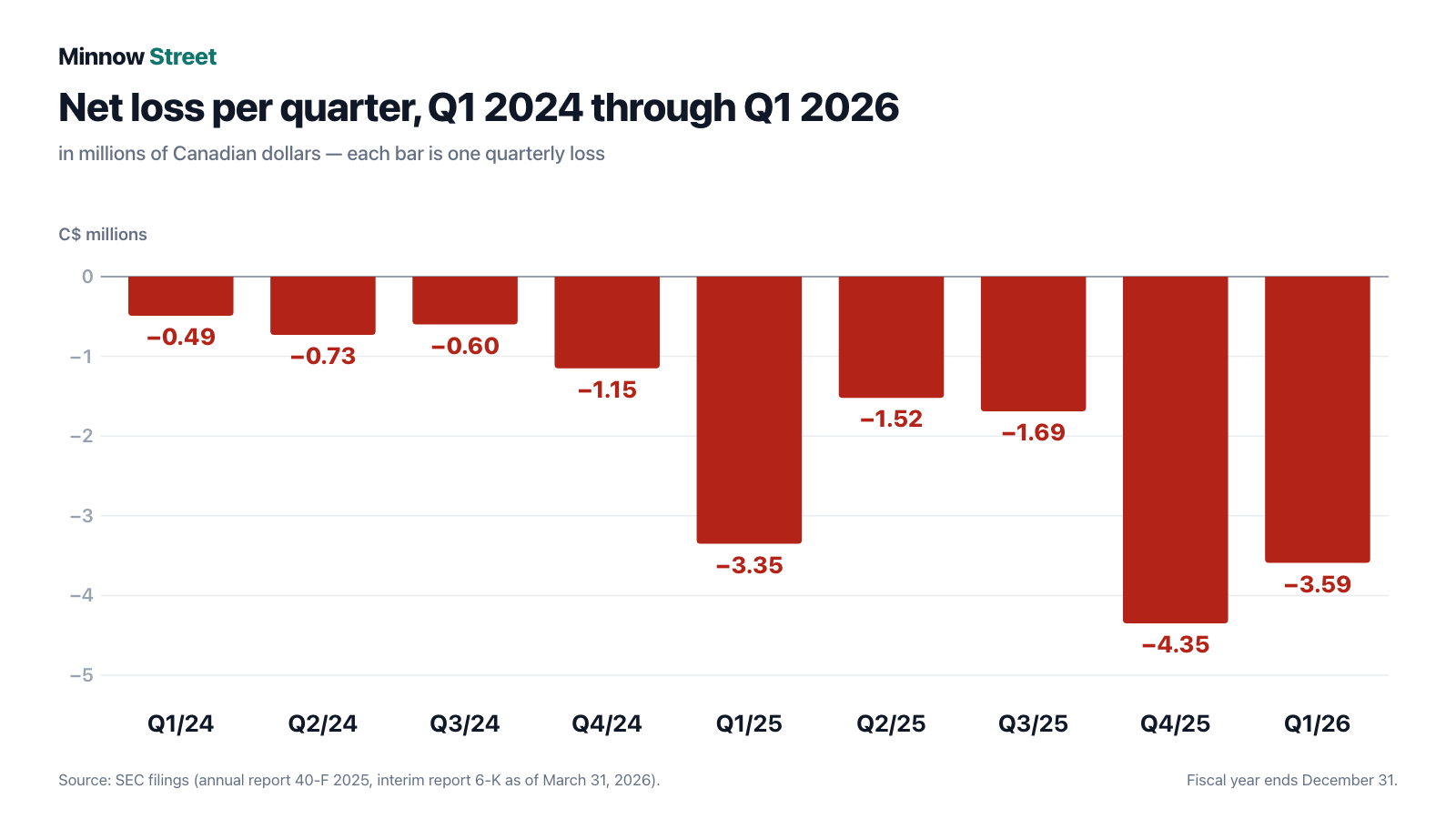
The 2024 full-year loss was C$2,968,738. In 2025 it was C$10,548,287 — more than three times as much. The first half of 2026 added a further C$8,324,643, C$4,736,314 of it in the second quarter alone. The accumulated deficit stood at C$35,001,353 on June 30, 2026. That the company nonetheless looks solid is not down to the business; it is down to having raised more money than it has managed to burn so far.
Headcount grew too, and quickly: from 9 employees on June 30, 2025 to 17 on June 30, 2026 — 9 in research, 7 in administration and 1 in sales. Three months earlier the total was 13, with only 5 researchers against 7 administrators. The second quarter of 2026 flipped that ratio; all four new hires went into development. At a company that still owes proof that its technology can be sold, that is the right direction.
What the filings say — the uncomfortable truths
Uncomfortable truth no. 1: an entire year of revenue fits on a shop receipt
Note 17 to the audited 2025 consolidated statements runs two sentences and is the single most important line in the report:
“The Company achieved its first revenue of $11,171 in the final quarter of 2025. The revenues were based on royalty rates of 10 % and 5 % on partners’ sales, respectively from two partners.”
— Quantum eMotion Corp., annual report 40-F for 2025, consolidated financial statements (Exhibit 99.2), note 17 “Revenues”

The first quarter of 2026 was barely better: C$10,582, split into C$8,343 from Greybox Solutions (5 percent of that partner’s C$166,860 of sales) and C$2,239 from Krown Technologies (5 percent of C$42,534). The second quarter of 2026 was worse still: C$1,479. The half-year breakdown in the management commentary shows why — of the C$12,061 booked in the first half, C$8,342 came from Greybox and C$3,718 from Krown. Subtract the first quarter and Greybox contributed nothing in the second. The only revenue of the quarter came from Krown. The report promises higher rates ahead: 10 to 20 percent for Greybox going forward, and 10 percent instead of 5 for Krown from November 2026. A higher percentage of nothing is still nothing.
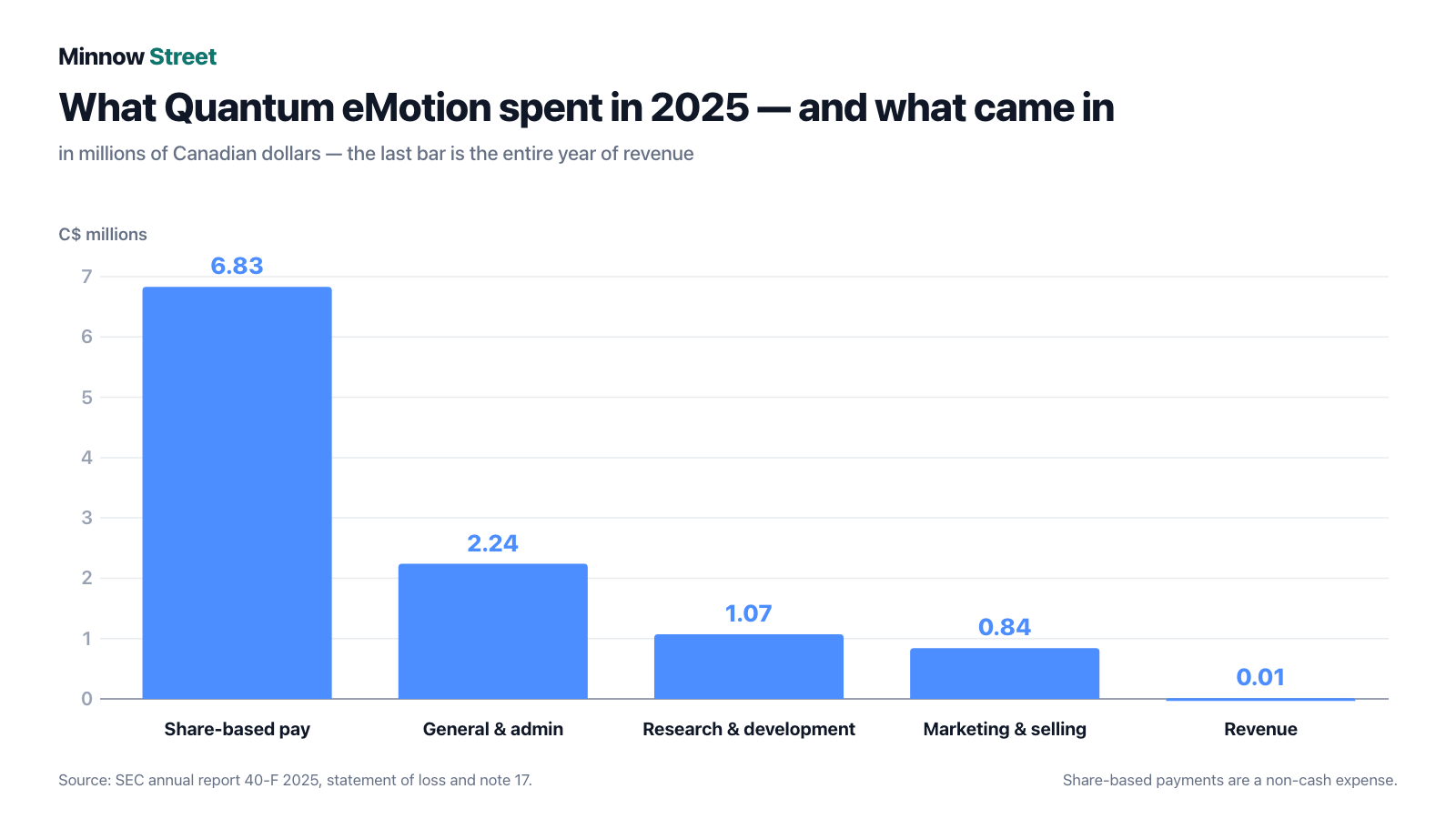
To make the scale tangible: over the twelve months to June 30, 2026, Quantum eMotion took in C$23,232. That is less than a quarter of one administrative salary. And it sits against this expense base:
Uncomfortable truth no. 2: two thirds of the research budget goes to a director’s company
The 2025 statements list eight items under related party transactions. One stands out:
“Research and development costs of $684,397 (2024: $434,609) to Fileglobal, a company owned by a Director.”
— Quantum eMotion Corp., annual report 40-F for 2025, consolidated financial statements (Exhibit 99.2), note 13 “Related party transactions”

Total 2025 research and development expense was C$1,073,747. So roughly 64 percent of it went to a single entity owned by a member of the company’s own board. The first half of 2026 continued the pattern: C$482,392 of C$931,482, or 52 percent. In fairness: Larry Moore did not stand for re-election on June 18, 2026, the half-year ended twelve days later, so the half-year total overwhelmingly covers the period in which he was still a director. Adding all payments to key management — salaries, fees, director compensation, IT services and share-based pay — gives C$5,066,313 for 2025, roughly 453 times the year’s revenue, and C$1,401,857 for the first half of 2026, roughly 116 times the half-year revenue.
Context matters here: these payments are fully disclosed, audited, and not unusual in small Canadian companies, where founders often work through their own entities. The question every shareholder is entitled to ask remains, though: who tests whether the price is right when the buyer and the seller sit at the same table? At the June 2026 annual meeting the person concerned, Larry Moore, was not put forward again as a director; the June 22, 2026 filing describes him as a consultant and former director and notes accelerated vesting of 125,000 options for him. That has not changed the flow of money through the half-year: the interim report as of June 30, 2026 still lists Fileglobal among related party transactions, and through his second company, Baystream Corporation, Larry Moore received a further C$75,723 for IT services and C$15,000 in director fees in the same period.
Uncomfortable truth no. 3: the biggest cost item is paper — and the option pool now refills itself
Share-based pay is not a cash outflow. The company compensates employees, consultants and directors partly with the right to buy shares later. For accounting purposes it is still an expense — and at Quantum eMotion it was the single largest one in 2025 at C$6,833,609, bigger than administration, research and marketing combined (C$4,149,798). In the first quarter of 2026 it was C$2,066,390 of C$3,598,911 in total expenses — even though not a single new option was granted in that quarter. The charge stems from the 10,245,000 options granted during 2025 alone. The second quarter of 2026 added C$1,924,763; for the first half the figure is C$3,991,153 out of C$8,336,705 of total expenses.
The price of that is dilution — your slice of the cake shrinks because new slices keep being cut. The numbers: 135,502,838 shares at the end of 2023, 164,652,838 at the end of 2024, 218,588,670 at the end of 2025 and 219,419,670 on June 30, 2026. That is roughly 62 percent more shares in a little over two years. On top sit 19,764,355 options outstanding (weighted average exercise price C$1.48) and 7,250,000 warrants — 27.0 million potential new shares, a good 12 percent of the current count.
Then came June 18, 2026. At the annual meeting, 97.52 percent voted to rebuild the option plan from the ground up:

At first glance the room even shrinks: 10 percent of 219,419,670 shares is roughly 21.9 million rather than 24.75 million. The difference is mechanical. A fixed cap eventually runs out; a rolling one refills itself with every new share issued. Whoever raises capital automatically enlarges the option pool as well.
How quickly that new room becomes practice is visible in the interim report as of June 30, 2026. In the first half of 2026 the company granted 2,980,618 new options at a weighted average exercise price of C$4.23. Since not a single option was issued in the first quarter, by the company’s own account, all of them fall into the second quarter — the same quarter in which the annual meeting approved the rolling plan. Options outstanding therefore rose from 17,184,737 at the turn of the year to 19,764,355, and the weighted average exercise price climbed from C$0.97 to C$1.48. For comparison, only 11,552,487 of them were exercisable as of June 30, 2026, and at an average of C$0.49.
Uncomfortable truth no. 4: almost half the votes cast went against the company’s own chief
That same annual meeting on June 18, 2026 elected all five nominees to the board. The voting report, however, is a story of two halves. Catherine Loubier received 99.74 percent support, David Teeple 97.20 percent, Tullio Panarello 96.54 percent. And then:
“Francis Bellido 25,173,943 · 52.95% · 22,366,076 · 47.05%” — “John Young 24,506,954 · 51.55% · 23,033,065 · 48.45%”
— Quantum eMotion Corp., report 6-K of June 22, 2026, “Report of Voting Results” for the June 18, 2026 annual meeting (votes for, percent for, votes against, percent against)
Francis Bellido is the chief executive; John Young is a director and also chief operating officer of the U.S. subsidiary. Legally both were elected — a simple majority suffices. As a signal it is something else entirely: more than 22 million votes against the company’s own chief executive equal roughly 10 percent of all shares outstanding. At a company that has only just reported its first revenue, that is not a procedural squabble.
No filing identifies who cast those votes. Eight days later, Capital Ventures International and the Susquehanna entities reported their 11.0 percent stake — citing June 18, 2026, the day of the meeting, as the event date. That does not establish a link. The order of magnitude is striking all the same.
And it did not last. On August 14, 2026 — the same day the interim report was filed — the same group submitted an amendment (Schedule 13G/A, amendment no. 1). As of the new event date of June 30, 2026, it reports only 5,297,606 shares, or 2.4 percent. Between June 18 and June 30, 2026, therefore, roughly 18.9 million shares left that block — better than three quarters of the position, in twelve days. What that means has to be phrased carefully: Capital Ventures International belongs to the Susquehanna trading house, whose positions can arise from market making and hedging and need not express a view on the company. But anyone who read the June filing as a vote of confidence should also note the 2.4 percent of August.
Uncomfortable truth no. 5: the risk warning the auditor did not sign
The risk section of the annual report contains a sentence that would trigger alarms at almost any other company:
“If QeM fails to achieve profitability in future periods, the value of its Common Shares may decline. […] This risk is a factor which indicates a material uncertainty that may cast significant doubt on the Company’s ability to continue as a going concern.”
— Quantum eMotion Corp., annual report 40-F for 2025, Annual Information Form (Exhibit 99.1), Risk Factors, “Ability to Generate Profits”

And here is the part that fairness demands be said: the auditor disagrees. Richter LLP of Montreal signed the 2025 consolidated statements on March 30, 2026 without qualification and included no going-concern paragraph. The statements themselves say explicitly that they were prepared “on a going-concern basis”. That fitted the balance sheet then, and it fits the one today: C$34.0 million of cash and short-term investments against C$1.06 million of current liabilities (June 30, 2026) is not a case for doubt. The C$9.01 million contingent consideration liability sits among non-current items and only falls due if the agreed milestones and sales materialize.
The contradiction is still worth noting — and it runs both ways. In the interim report as of March 31, 2026, filed six weeks after the annual report, the company describes seven development projects and states seven times that there are “currently no material threats” to those projects continuing — five of those citing its “strong balance sheet” explicitly. The interim report as of June 30, 2026 repeats the same seven statements and the same five references unchanged. Two documents, filed six weeks apart with the same regulator, say two different things about the same company. One is legal caution, the other is confidence in the management commentary. Shareholders may pick which tone to believe — or simply look at the balance sheet, which in this case sides with management.
Update of August 14, 2026: what the second quarter changes about this analysis
This analysis originally stood on the state of August 13, 2026 — the interim report as of March 31, 2026. One day later, on August 14, 2026, Quantum eMotion filed the interim report as of June 30, 2026: management’s discussion and analysis and interim financial statements as exhibits 99.1 and 99.2 to a 6-K filing, plus the two certifications from the chief executive and the chief financial officer. There was no separate earnings release and no conference call — normal for a company this size; everything management has to say about the numbers is in the management commentary. The same day also brought an amendment to the ownership filing by Capital Ventures International and Susquehanna. Together those two documents change more about this analysis than a single quarterly report usually does.
What was surprising
First: the free acquisition now has a price tag. In April 2026 Quantum eMotion had acquired California-based SKV Technology along with the SecureKey key-protection platform — with no payment whatsoever at closing, neither cash nor shares. At the half-year mark the company had to recognize that transaction for the first time, and on both sides of the balance sheet:
“At the acquisition date, the Corporation recognized an intangible asset representing the acquired intellectual property and a corresponding contingent consideration liability of $10,085,274 representing the fair value of the potential future milestone and royalty payments.”
— Quantum eMotion Corp., interim report 6-K as of June 30, 2026 (Exhibit 99.2), note 4 “Intangible assets and property and equipment”
That explains the most conspicuous change in the balance sheet. Total liabilities jumped from C$903,312 (March 31, 2026) to C$10,159,356. The first two milestones were already achieved during the second quarter and paid in cash at C$1,500,000; on top of that the company booked a C$423,798 fair value adjustment as a financial expense. What remains as of June 30, 2026 is C$9,009,072. The acquired intellectual property is amortized over five years — C$504,264 in the second quarter alone, which pushed half-year amortization from C$11,766 a year earlier to C$521,485. How much business would be required for the full purchase price to fall due is stated with remarkable candor: “Achieving the maximum royalty amount of C$15,000,000 would require cumulative sales of approximately C$195,000,000 over the five-year royalty period.” Against trailing twelve-month revenue of C$23,232, that is a number worth letting sink in — it describes an aspiration more than a liability.
Second: revenue did not grow, it shrank. After C$11,171 for all of 2025 and C$10,582 in the first quarter of 2026, Quantum eMotion booked C$1,479 in the second quarter. Comparing the half-year figures with the quarterly ones shows where the drop came from: of C$12,061 of half-year revenue, C$8,342 came from Greybox Solutions — essentially the entire first-quarter amount. In the second quarter Greybox paid nothing. And that same partner received money from Montreal in the same period: a new line in short-term investments reads “Short-term advance, interest bearing at 12% and due on demand” at C$474,750, which the cash flow statement labels explicitly as “Advance to Greybox”. In other words, the company lent its paying partner roughly twenty times what it took in as revenue over twelve months.
Third: the quiet promissory note from the last report has gone into default. The original version of this analysis left an open question: what happened to the secured convertible promissory notes of US$1,100,000 issued by Vertical Growth Equity Inc., which matured in May 2026? The new report answers it in a single sentence:
“As of June 30, 2026, the Company has yet to receive payment, and as a result, has sent a notice of default to the holder and extended the maturity date to August 2026.”
— Quantum eMotion Corp., interim report 6-K as of June 30, 2026 (Exhibit 99.2), note 3 “Investments”
The carrying value of that receivable rose with accrued interest to C$1,649,868 and remains on the books in full — nothing was written down. It is the third stake in a small, privately held partner whose valuation rests entirely on estimates: Greybox at C$645,240, Krown at C$567,900, VGE at C$1,649,868. Together C$2.86 million for which no market price exists.
What the earlier findings confirm
All five uncomfortable truths survived the quarter. Share-based pay remains the largest expense line: C$1,924,763 in the quarter and C$3,991,153 in the half-year — almost half of all expenses. The rolling option plan was used in the very quarter it was approved: 2,980,618 new options at a weighted average of C$4.23. And the research budget continued to flow mostly to a single company owned by Larry Moore — C$482,392 of C$931,482 in the half-year, even though he left the board on June 18, 2026.
The pattern behind the jump in losses also held. The quarterly loss of C$4,736,314 is the largest in company history — but it does not come from operations in the narrow sense. Strip out share-based pay (C$1,924,763), the SKV amortization (C$504,264) and the fair value adjustment (C$423,798) and C$1,883,489 of genuine cash outflow remains; that is almost exactly what the cash flow statement reports as cash used in operations for the quarter — C$1,859,513, some C$24,000 less. Anyone judging Quantum eMotion should therefore look less at the loss and more at that line.
What changes in the assessment
The strongest argument for this company used to be its balance sheet — and that argument is weaker today than it was in the original version of August 13. Not dramatically: cash and short-term investments of C$34.00 million still stand against C$1.06 million of current liabilities, there is no bank debt, and at C$1.86 million of quarterly burn the money lasts more than four years — but only if you count operations alone and leave out the SKV milestones, of which C$1.5 million already left the bank account in the second quarter and up to C$5.5 million remains open. And the “45 to 1” framing from the original version no longer applies; the C$9.01 million contingent consideration liability is not an accounting trick.
The commercialization side has weakened too. Quarterly revenue of C$1,479 after C$10,582 is statistically meaningless at this scale — which is precisely the point. After nearly two decades, revenue ought to be large enough that a single absent partner dampens it rather than halving it. That Greybox received a C$474,750 loan in the same half-year does not make that question smaller.
On the other side there are two improvements that should not be suppressed. The company grew its development team from 5 to 9 researchers and now employs more people in development than in administration for the first time. And interest income on its own capital, at C$373,686 in the quarter, covers a fifth of the operating cash burn. On balance, the assessment is the same as in August: the substance holds, the business is unproven — except that the gap between the two did not narrow in the second quarter of 2026, it widened.
Valuation: what is the market actually paying for?
At a company with negligible revenue and no profit, the usual tools break down. There is no price-to-earnings ratio. A price-to-sales ratio can be computed, but it would run into five figures and stop being a metric and start being a joke. That leaves two anchors.
First, book value. So you can check the arithmetic, here is every input: the stock closed at $2.23 on August 17, 2026; the interim report shows 219,419,670 shares outstanding as of June 30, 2026. That gives a market capitalization of roughly $489 million. Balance sheet equity was C$38,155,529 as of June 30, 2026; converted at $1 = C$1.3869, the market capitalization equals roughly C$679 million. So the market pays roughly eighteen times what the balance sheet holds. Put differently: about one eighteenth of every invested dollar is backed by assets; the rest is expectation.
A note on care: the balance sheet is in Canadian dollars, the listing in U.S. dollars. That is why the exchange rate is stated explicitly above — every metric combining the two hangs on it. Metrics where the conversion would require additional assumptions about as-of dates — the Altman Z-score, say, or net current asset value per share — are deliberately omitted here. That is a gap in the data worth knowing about rather than papering over.
Second, the market being addressed. The annual report itself supplies a figure: the global QRNG chip market was worth roughly $150 million in 2024 and is projected to reach $2 billion by 2033. Even if that comes true and Quantum eMotion captures a very large share, the expectation would still need discounting — and the documented share so far is C$23,232 over twelve months. Analyst estimates for revenue or earnings barely exist; no credible “professional view” can be cited here.
Comparisons with other quantum names only help so much. D-Wave Quantum, for instance, at least sells computing time and has reported quarterly revenue in the millions — its valuation is ambitious too, but there is a revenue base to compute against. At Quantum eMotion the base is so small that any percentage calculation on it becomes arbitrary.
Opportunities and risks at a glance
What speaks for Quantum eMotion:
- The technology is documented, not a slide deck: five patent families, two of them with granted patents in the United States and roughly a dozen other countries, and a 65-nanometer QRNG chip sent to fabrication in May 2025.
- A still solid balance sheet for a company this size: C$38,155,529 of equity and C$34,004,955 of cash and short-term investments against C$1,061,420 of current liabilities, with no bank debt as of June 30, 2026. The dilution pressure of the coming years comes from options, not from distress.
- The tailwind is real: post-quantum cryptography is on the agenda at regulators and banks, FIPS 140-3 validation is under way, and Canada’s NRC IRAP program committed up to C$600,000 in March 2026 — C$101,084 had been received by June 30, 2026 and another C$64,621 claimed.
- The move to NYSE American on February 24, 2026 widens the pool of possible investors.
- The acquired SecureKey platform (April 2026) brings a finished software product rather than another letter of intent, has been integrated into the product line, and required no payment at closing — the purchase price only comes due if something can actually be sold with it.
- The development team grew from 5 to 9 people in the second quarter of 2026, so more staff now work in research than in administration for the first time. On May 19, 2026 the company also signed a consortium agreement with Taiwanese chip partner JMEM Tek for a joint security chip platform.
What speaks against it:
- After nearly two decades, trailing twelve-month revenue is C$23,232 — and in the second quarter of 2026 it fell to C$1,479 because one of the two paying partners dropped out. The many announced partnerships have so far produced two paying partners.
- The largest expense line is the company’s own share-based pay: C$6,833,609 in 2025 and C$3,991,153 in the first half of 2026 — almost half of all half-year expenses.
- 64 percent of the 2025 research budget and 52 percent of the first half of 2026 went to an entity owned by Larry Moore; total key management remuneration in 2025 was C$5,066,313 against C$11,171 of revenue.
- 47.05 percent of votes cast on June 18, 2026 opposed re-electing the chief executive and 48.45 percent opposed director John Young — a confidence problem that has not gone away. The trading group that reported 11.0 percent eight days later showed only 2.4 percent as of June 30, 2026.
- The share count rose roughly 62 percent in a little over two years, and the new rolling option plan was used immediately — 2,980,618 grants in the second quarter of 2026 — and now grows automatically with every share issued.
- Both paying partners are themselves young, privately held companies. The auditor classified the valuation of those stakes as a key audit matter — for Krown a 35 percent valuation discount was applied, “considering recent financial performance and the absence of recent rounds of financing”. A third partner, Vertical Growth Equity Inc., failed to repay a US$1.1 million promissory note that matured in May 2026; Quantum eMotion issued a notice of default and extended maturity to August 2026.
- Since June 30, 2026 the SKV acquisition sits on the balance sheet as a C$9,009,072 contingent consideration liability; C$1.5 million already left the bank account in the second quarter, and amortization of the acquired intellectual property will charge earnings with a good C$2 million a year for five years.
A human conclusion
Back to the magic word trap. It works so well because it feels like modesty: “This is quantum physics, I know nothing about it, so I had better not ask.” The trick is noticing that you do not need any quantum physics to judge this company. The decisive numbers are grade-school arithmetic: 11,171 against 10,983,407. 684,397 out of 1,073,747. 22,366,076 against 25,173,943. And, since August 14, 2026: 1,479 against 4,736,314.
And then both sides deserve an honest look. Quantum eMotion is not a castle in the air. The patents are granted, the chip is in fabrication, the treasury is full, there is no bank debt, and the auditor signed the 2025 accounts without qualification. A company holding C$34.0 million in cash and short-term investments and spending just under two of them a quarter has time — more time than most small listed companies ever get.
What the company does not have is proof that anyone will pay for its technology. Two partners, a few thousand dollars of royalties, and a license agreement promising a million-dollar annual fee that starts only once the partner actually sells something. That could turn — in either direction. And while everyone waits for the proof, shareholder money flows toward the company’s own leadership circle on a scale worth seeing before you buy.
The most honest sentence about this stock therefore is not in our analysis but in its own balance sheet: today it is essentially a well-funded bank account with a very good idea sitting next to it. Whether the idea becomes a business will be settled by the next quarterly reports, not by the next press release. The report of August 14, 2026 certainly did not settle it; it merely kept the question open for another three months. What you make of that is your call. And that is exactly as it should be.
Sources
- Quantum eMotion Corp., annual report on Form 40-F for fiscal 2025 (filed March 31, 2026, CIK 0002106613)
- Annual Information Form 2025 (Exhibit 99.1 to the 40-F) — business description, patents, risk factors, trading data, directors
- Audited 2025 consolidated financial statements under IFRS (Exhibit 99.2 to the 40-F) — auditor’s report by Richter LLP dated March 30, 2026, note 4 (investments), note 13 (related party transactions), note 17 (revenues), note 18 (subsequent events)
- Interim report 6-K as of March 31, 2026, management’s discussion and analysis (filed May 15, 2026)
- Interim financial statements as of March 31, 2026 (Exhibit 99.2)
- Interim report 6-K as of June 30, 2026, management’s discussion and analysis (filed August 14, 2026) — revenue breakdown, expense structure, headcount, liquidity, options outstanding
- Interim financial statements as of June 30, 2026 (Exhibit 99.2) — note 3 (investments, notice of default to Vertical Growth Equity), note 4 (SKV acquisition and contingent consideration), note 9 (share capital and options), note 10 (related party transactions)
- Schedule 13G/A of August 14, 2026 — Capital Ventures International, Susquehanna Advisors Group, G1 Execution Services, Susquehanna Securities: 5,297,606 shares, or 2.4 percent, as of June 30, 2026
- Filing 6-K of February 24, 2026: start of trading on NYSE American
- Filing 6-K of April 17, 2026: completion of the SKV Technology acquisition (April 2, 2026)
- Filing 6-K of June 22, 2026: voting results of the June 18, 2026 annual meeting
- Schedule 13G of June 26, 2026 — Capital Ventures International, Susquehanna Advisors Group, Susquehanna Securities: 24,234,055 shares, or 11.0 percent
- Fundamental data (share price, listing venue, free float, USD/CAD exchange rate; price as of August 17, 2026)
Disclaimer: This article is a journalistic assessment of publicly available company information. It is expressly not investment advice and not a solicitation to buy or sell securities. Shares of small companies without meaningful revenue can be highly volatile; a total loss of invested capital is possible. Positions held by the operator are disclosed daily; where one exists, it appears as a notice at the top of this deep dive. at the time of publication. All figures come from the primary documents named above and carry the as-of dates stated.
Key figures at a glance
All monetary figures in millions of C$; earnings per share as reported.
| Metric | 2021 | 2022 | 2023 | 2024 | 2025 |
|---|---|---|---|---|---|
| Revenue | 0.0 | 0.0 | 0.0 | 0.0 | 0.0 |
| Operating Income (EBIT) | -1.6 | -2.2 | -2.1 | -3.0 | -11.0 |
| Net Income | -1.6 | -2.8 | -2.4 | -3.0 | -10.5 |
| Net Margin | – | – | – | – | -94,425.6% |
| Earnings Per Share | -0.02 C$ | -0.02 C$ | -0.02 C$ | -0.02 C$ | -0.06 C$ |
Source: fundamental data & SEC filings (annual and quarterly reports, 10-K/10-Q)
Our Bottom Line at a Glance
- Technology and intellectual property positive
- Five patent families; two of them carry two granted U.S. patents each plus protection in roughly a dozen other countries, while three newer families are only pending (annual report 40-F 2025). The first 65-nanometer QRNG chip design went to fabrication in May 2025 and FIPS 140-3 validation is under way. The technology is documented, not merely asserted.
- Balance sheet and funding positive
- C$38,155,529 of equity, still no bank debt, and C$34,004,955 in cash and short-term investments as of June 30, 2026. With C$1,859,513 of cash used in operations in the second quarter of 2026, that covers more than four years. New and limiting: total liabilities rose to C$10,159,356 because the SKV acquisition now sits on the balance sheet with a C$9,009,072 contingent consideration liability.
- Commercialization negative
- The first revenue in company history arrived in the fourth quarter of 2025: C$11,171 for the year, plus C$10,582 in the first quarter of 2026 — and only C$1,479 in the second quarter of 2026, not a single dollar of it from Greybox Solutions. After nearly two decades of development, that is a beginning that most recently got smaller rather than larger.
- Expense structure negative
- The largest 2025 expense was share-based payments at C$6,833,609 — more than general and administrative, research and marketing combined (C$4,149,798). In the first half of 2026 it was C$3,991,153 of C$8,336,705. Two new lines arrived with the second quarter of 2026, both from the SKV acquisition: C$504,264 of amortization on the acquired intellectual property and a C$423,798 fair value adjustment on the purchase liability.
- Governance and related parties negative
- C$684,397 of C$1,073,747 in 2025 research expense went to Fileglobal, a director-owned company; in the first half of 2026 it was C$482,392 of C$931,482 — even though Larry Moore has not been a director since June 18, 2026. At that same annual meeting, 47.05 percent of votes cast opposed re-electing the CEO, 48.45 percent opposed director John Young, and the option plan was converted to a rolling 10 percent of shares outstanding.
- Dilution negative
- The share count rose from 135,502,838 (December 31, 2023) to 219,419,670 (June 30, 2026) — roughly 62 percent in a little over two years. The new rolling option plan was used immediately: 2,980,618 grants at a weighted average of C$4.23 in the second quarter of 2026, taking the total to 19,764,355 options plus 7,250,000 warrants. SKV milestones of up to C$7,000,000 may be settled in stock.
Quantum eMotion has a documented technology, a balance sheet that was unusually clean until recently — and almost no revenue. C$23,232 over the twelve months to June 30, 2026 stands against C$8,336,705 of expenses in the first half of 2026 alone, of which C$3,991,153 was share-based payments. The interim report of August 14, 2026 changed three things: quarterly revenue fell to C$1,479, the quarterly loss hit a record C$4,736,314, and the SKV acquisition now sits on the books with a C$9,009,072 contingent consideration liability. Buying the stock means betting that partnerships eventually turn into invoices. The governance findings are part of that bet. Not investment advice.
What Our Rating Means
Open questions
The business works in principle, but one material question is open. As long as it stays open, our findings do not carry a quality verdict.
The balance sheet still holds: C$38.16 million of equity, C$34.00 million in cash and short-term investments, no bank debt and a cash runway beyond four years — no substance risk is documented, and the auditor signed the 2025 accounts without qualification and without a going-concern paragraph. What remains open is the decisive operating question, and the interim report as of June 30, 2026 did not answer it but sharpened it: after nearly two decades of development, there is still no proof that this technology can be sold — C$23,232 over twelve months is not a business model, and second-quarter revenue fell back to C$1,479. Three further findings cannot be argued away: the largest expense line is the company’s own share-based pay, a substantial part of the research budget flows to an entity owned by a former director, and the newly recognized C$9.01 million purchase liability can cost real money if the technology succeeds. That is not a balance sheet or governance breach, but it is a reason to read every quarterly figure carefully. The decision is yours.
A journalistic assessment by our editorial team at the time of the deep dive, based on public sources — not investment advice and not a solicitation to buy or sell. Your personal circumstances (investment goals, risk capacity, taxes) cannot be taken into account. What our levels mean, how verdicts are formed, and what conflicts of interest exist →
Worth Noting
- Hook: Quantum eMotion has traded on NYSE American since February 24, 2026; on June 26, 2026 Capital Ventures International and the Susquehanna entities reported 11.0 percent — their amended filing of August 14, 2026 shows only 2.4 percent as of June 30, 2026.
- Data basis: annual report 40-F for 2025 (filed March 31, 2026), interim report 6-K as of March 31, 2026 (filed May 15, 2026) and interim report 6-K as of June 30, 2026 (filed August 14, 2026); all filings through August 14, 2026 reviewed. Price as of August 17, 2026. This analysis was published on August 13, 2026 and updated on August 18, 2026 for the second quarter of 2026.
- Currency note: all balance sheet and income figures are Canadian dollars under IFRS, while market capitalization is in U.S. dollars. Metrics that mix the two — such as the Altman Z-score or net current asset value per share — are deliberately not shown.
- Not to be confused: Quantum eMotion (QNC) is unrelated to Quantum Corporation (QMCO) or QuantumScape (QS); the company was named Quantum Numbers Corp. until June 2021.
Stock Watch
This analysis is as of August 26, 2026. Stock Watch will tell you what's changed at QNC since then.
Later $1 a month per stock — signing up is free, and you'll be the first to know when it launches.
The full analysis as a PDF for later
We will send you this analysis as a PDF — to print, file away, and read at your own pace. And we will add you to the free Stock Watch list for Quantum eMotion Corp. (QNC), so you hear about it when something material in this analysis changes.
Frequently Asked Questions
Quantum eMotion builds quantum random number generators. Encryption depends on genuine randomness, and computers cannot produce it — they only compute an imitation. The company taps physical quantum noise instead. Around that sit software products: a developer kit, a cloud service that delivers randomness on demand, and, since April 2026, the acquired SecureKey key-protection platform.
Very little — and less in the second quarter of 2026 than before. The first revenue in company history arrived in the fourth quarter of 2025 and totaled C$11,171 for all of 2025. The first quarter of 2026 added C$10,582, the second quarter only C$1,479. These are royalties from two partners — Greybox Solutions and Krown Technologies — calculated as a percentage of their sales; in the second quarter of 2026 only Krown paid. Over the twelve months to June 30, 2026 the total was C$23,232.
Quantum eMotion is a Canadian issuer and files with the U.S. securities regulator, the SEC, under the simplified MJDS regime: an annual report on Form 40-F, interim reports on Form 6-K, and accounts prepared under IFRS. No Form 10-Q exists. All balance sheet and income figures are stated in Canadian dollars while the NYSE American listing trades in U.S. dollars. Comparing balance sheet items to market capitalization therefore mixes two currencies.
No, and not remotely. The 2025 net loss was C$10,548,287, after C$2,968,738 in 2024. The first half of 2026 added C$8,324,643 — including C$4,736,314 in the second quarter alone, the largest quarterly loss in company history. The largest expense line remains share-based payments: C$6,833,609 in 2025 and C$3,991,153 in the first half of 2026 — a non-cash charge that nonetheless increases the share count. Cash used in operations was C$4,072,332 in 2025 and C$3,945,160 in the first half of 2026.
As of June 30, 2026 the company held C$34,004,955 in cash and short-term investments, with net working capital of C$34,318,761 and still no bank debt. Cash used in operations was about C$1.86 million in the second quarter of 2026 and C$3.95 million in the first half. At that rate the balance sheet covers more than four years. What is new is an obligation that can cost real money: the contingent consideration liability from the SKV acquisition, carried at C$9,009,072 as of June 30, 2026 after C$1.5 million of milestone payments were already made in cash during the second quarter.
At the annual meeting on June 18, 2026 all five nominees were elected, but by very different margins: three received between 96.54 and 99.74 percent support, while CEO Francis Bellido received only 52.95 percent and director John Young 51.55 percent. A total of 22,366,076 votes went against the chief executive. Legally he was elected; as a signal it shows that a large block of shareholders does not back the leadership. No filing identifies who cast those votes. What stands out is only this: the trading group around Capital Ventures International and Susquehanna, which reported 11.0 percent eight days after the meeting, showed just 2.4 percent as of June 30, 2026 in its amended filing of August 14, 2026.
Substantially. The share count rose from 135,502,838 at the end of 2023 to 164,652,838 at the end of 2024 and 218,588,670 at the end of 2025; by June 30, 2026 it stood at 219,419,670. That is an increase of roughly 62 percent in a little over two years. On top of that sit 19,764,355 options (weighted average exercise price C$1.48) and 7,250,000 warrants — 27,014,355 potential new shares, or a further 12 percent if exercised. In the second quarter of 2026 alone, 2,980,618 new options were granted at a weighted average of C$4.23.
Conventional measures barely apply, because there is almost no revenue and no profit. The stock closed at $2.23 on August 17, 2026; across 219,419,670 shares that is a market capitalization of roughly $489 million, or about C$679 million at the prevailing exchange rate. Against that sit C$23,232 of trailing twelve-month revenue and C$38,155,529 of equity as of June 30, 2026. That is about eighteen times book value; no meaningful revenue or earnings multiple exists.
Found an error?
Did you spot a factual error, an outdated number, or a typo in this deep dive? Let us know briefly — your report goes straight to the editorial team.