D-Wave Quantum: 100,000 Qubits by 2031 — and $4.5 Million in Quarterly Revenue
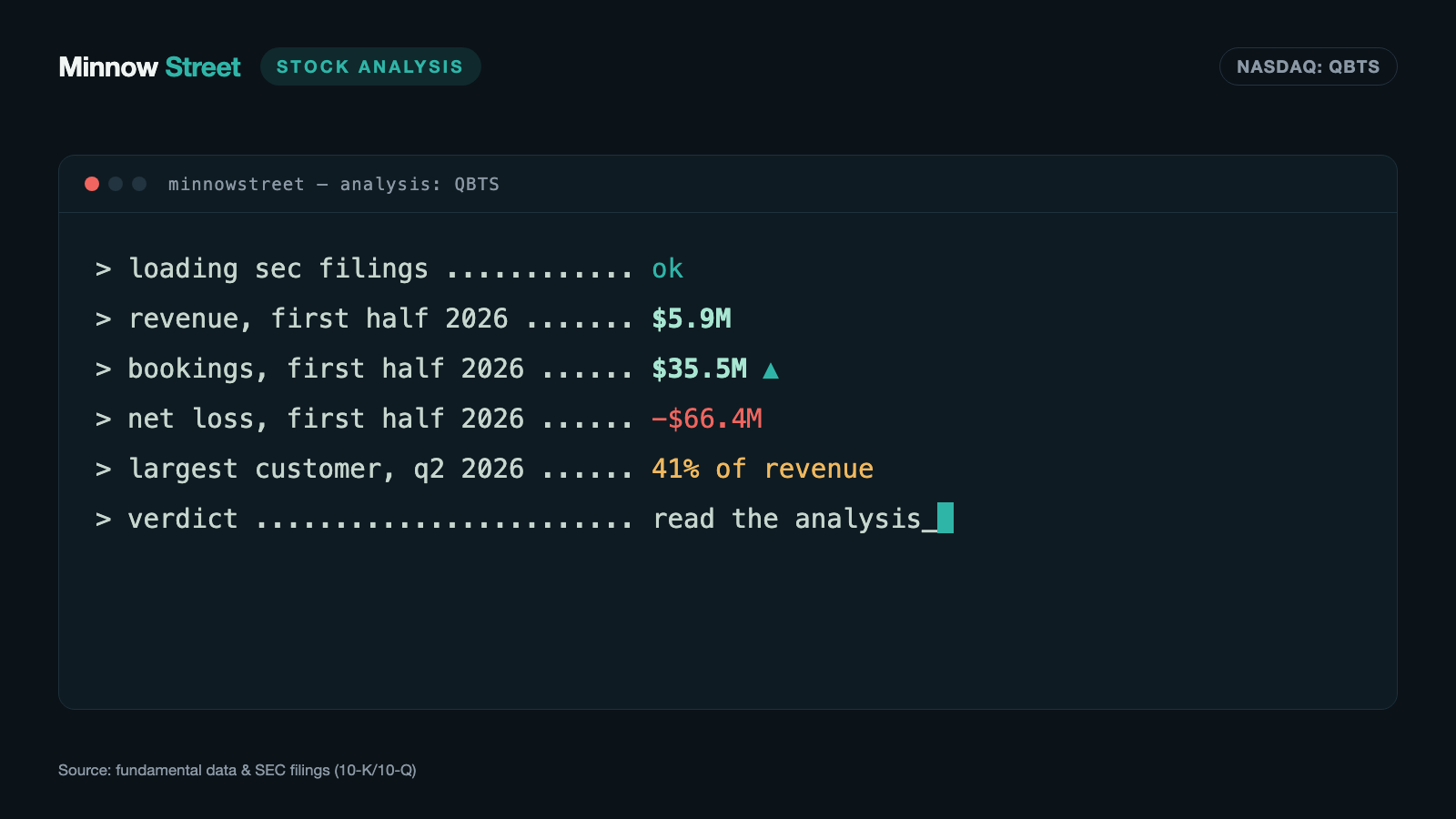
The earnings release for D-Wave Quantum's third quarter of 2026 highlights revenue up 21 percent and an order backlog up 1,221 percent. The comparison with the quarterly report as of June 30 shows: since then the backlog shrank from $40.7 million to $38.3 million, and only $1.9 million of new orders came in. And the government is now a shareholder: for up to $100 million of grant funding, the U.S. Department of Commerce received new shares at a 15 percent discount. We read the filings with the U.S. securities regulator, the SEC, line by line and show where the headline and the numbers part ways.
 Thomas Mücke
Founder & Publisher
As of Today
As of: November 12, 2026
- Closing price
- 9.80 $ -7.60%
- Market Capitalisation
- 3.6 $B
- Growth Score
- 4/10
- AAQS
- 5/10
Price change since August 11, 2026: -51.6%
This analysis has a cut-off date. The Stock Guard tells you when something material changes in the numbers. Reserve your free spot
Chart
Interactive price chart (TradingView).
52-week range: 9.10 $ to 32.20 $ · Last price: 9.80 $ (As of: November 12, 2026)
Note: pure fact-based analysis, not investment advice and not a solicitation to buy or sell. All figures without guarantee.
There is an investor trap that catches the curious in particular — the people who care about technology and therefore look harder than everyone else. Call it the milestone trap. It works like this: a company delivers one piece of news after another, and every single one is genuine. A paper in Nature. Leader status from the research firm IDC. A grant from the U.S. National Science Foundation. A roadmap to 100,000 qubits by 2031. Your mind keeps score and silently converts milestones into progress — and progress into revenue. It just never checks whether the revenue line moved with them. At D-Wave Quantum (NASDAQ: QBTS) it has moved only in tiny steps. The quarterly report (Form 10-Q) for the period ended June 30, 2026 showed second-quarter revenue of $3.076 million — practically as much as a year earlier ($3.095 million). The earnings release for the third quarter, dated November 10, 2026, reports $4.5 million, 21 percent more than in the year-earlier quarter, against operating expenses of $55.9 million. The same release highlights an order backlog up 1,221 percent — the comparison with the end of June shows that it has shrunk since. So let us make a deal: we take the milestones seriously, and alongside them we read what the company itself told the U.S. securities regulator, the SEC. The company is liable for false statements in its SEC filings. What you make of it is up to you.
What D-Wave Quantum actually does — the first merchant of a machine that is still looking for its market
D-Wave builds quantum computers. Not as a research project but as a product: the Palo Alto, California company describes itself as the world's first commercial supplier of such machines and the only one offering two fundamentally different architectures at the same time. What a quantum computer is fits into a plain image: an ordinary computer tries solutions one after another, like someone walking every corridor of a maze in turn. A quantum computer exploits the physics of very cold, very small components to examine many paths at once. The smallest unit of computation is a qubit; the more of them that work together cleanly, the larger the problems you can attack.
The first architecture, annealing, is D-Wave's specialty and behaves like a ball dropped into a hilly landscape that rolls into the deepest valley on its own — well suited to optimization questions: the cheapest delivery route, the best shift schedule, the most stable material mix. The current system is called Advantage2 and runs more than 4,400 qubits; according to the November 10, 2026 earnings release, D-Wave has delivered one such system to Como, Italy; whether it belongs to the $20 million system order from the first half and when the revenue will be booked, the release leaves open. The second architecture, the gate model, is the more universal approach also pursued by IBM and Google; here D-Wave is at the beginning and strengthened itself in January 2026 by acquiring Quantum Circuits.
Money comes in three ways: cloud access to the machines (the company calls it QCaaS, quantum computing as a service — you rent compute time instead of buying a machine), professional services helping customers build applications, and outright sales of complete systems. The annual report (Form 10-K) for 2025 describes the fields of use:
"Customers apply our technology to address use cases spanning optimization, artificial intelligence, research and more."
— D-Wave Quantum Inc., Form 10-K for 2025, Item 1 "Business" (Overview)
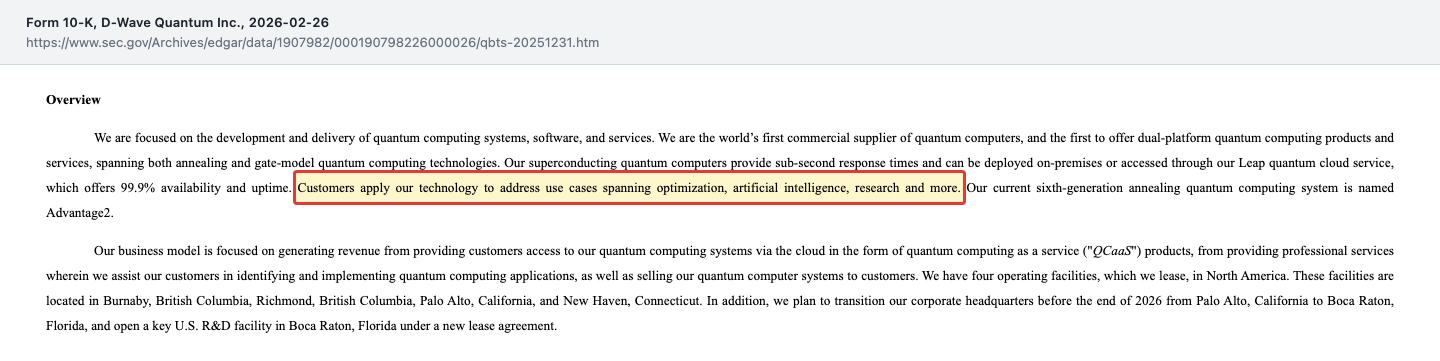
That frames the central tension of this analysis, and it runs through every chapter: the technology is real and recognized by peers and government agencies — but to this day it has not produced a business that pays for itself. What funds the operation is the shareholder, not the customer.
Company history for investors
-
2025
First sale of a complete machine
An annealing system for $13.7 million makes up 56 percent of 2025 revenue of $24.6 million — a one-off, not a new baseline.
-
2025
$536.7 million from at-the-market sales
In the first half of 2025 D-Wave sells 50.9 million new shares straight into the market. The cash pile grows, every existing shareholder's stake shrinks.
-
2026
Acquisition of Quantum Circuits
Purchase price $538.5 million, of which $256.0 million in cash and 10.4 million shares. Since then about half of equity consists of goodwill and intangibles.
-
2026
Voluntary move to Nasdaq
Since July 27, 2026 QBTS has traded on Nasdaq instead of the NYSE. For shareholders only the venue changes; there was no listing problem.
-
2026
U.S. Department of Commerce becomes a shareholder
For up to $100 million of grant funding the government receives 7,095,721 shares at a 15 percent discount. The money flows in installments after milestones — the dilution came at once.
How the stock reached our desk
D-Wave did not arrive through a momentum or value scanner but through a plain observation. On August 6, 2026 the company filed its quarterly report for the period ended June 30, 2026, and the figures in it stood in a conspicuous relationship to the company's size on the exchange. As of August 10, 2026, D-Wave was worth roughly $7.5 billion. Revenue over the trailing twelve months was $12.4 million. That works out to a price-to-sales ratio of about 605 — a number that breaks conventional yardsticks.
Which brings the honest warning up front: at D-Wave, the usual measuring sticks mislead. There is no price-to-earnings ratio because there are no earnings. A price-to-sales ratio of 605 says only that the market is not pricing a single dollar earned today; it is pricing an expectation. Note the finding at the outset: whoever buys D-Wave is not buying a business but a bet that one will emerge. Whether the bet pays depends on physics — and on the calendar. We will look at both, starting with what genuinely impresses.
The numbers over the years — given their due
The positives first, and there are more of them than the revenue line suggests. The balance sheet is remarkably solid: as of September 30, 2026 the company held, according to the earnings release, $279.4 million in cash and a further $224.0 million in marketable securities — $503.4 million combined. Against that stand total liabilities of only $86.0 million, including $42.0 million of loans. Shareholders' equity was $1,037.3 million. A company in that position has no near-term funding question; with $109.0 million of cash used in operations in the first nine months of 2026 — on average about $36 million per quarter — the liquidity on hand lasts roughly three and a half years.
Second, the technical progress is real. In the second quarter of 2026 D-Wave published a peer-reviewed paper in Nature on a fast, high-fidelity two-qubit entangling gate; the research firm IDC, according to D-Wave, named it one of only two Leaders in its quantum computing assessment; the National Science Foundation awarded a grant of $1,566,240. Bookings rose as well — more on that shortly, because the figure carries a footnote. And customer quality improved measurably in the second quarter of 2026: commercial customers supplied 62.4 percent of revenue, up from 45.1 percent a year earlier, and Forbes Global 2000 companies 47.7 percent, up from 20.4 percent. Since the original edition, new evidence of practical use has been added: the Japanese mobile carrier NTT DOCOMO moved a second application running on D-Wave technology into regular operation in August 2026; according to the November 10, 2026 release, the IT consultancy CGI also plans to add the machines to its offering.
Now the chart that puts the rest in context — revenue and operating expenses side by side:
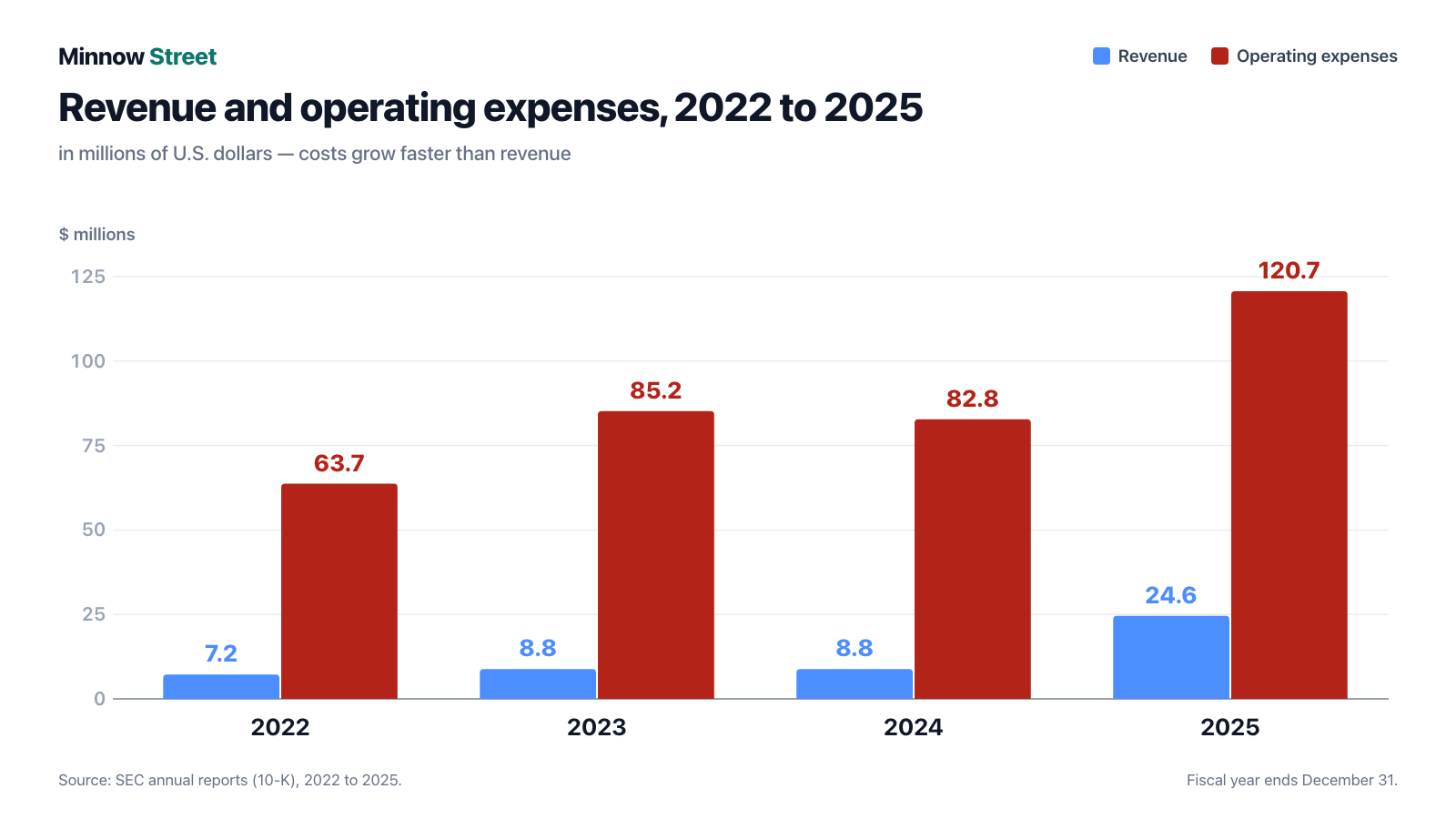
The revenue series read on its own: $7.2 million (2022), $8.8 million (2023), $8.8 million (2024), $24.6 million (2025). The 2025 jump looks like the long-awaited breakthrough but has a simple explanation: more than half of it came from the first sale of a complete annealing machine for $13.7 million in the first quarter of 2025. The geography table in the quarterly report shows where it went: in the first half of 2025, $13.99 million of revenue came from Germany — in the first half of 2026, $0.30 million.
That is precisely why revenue in the first half of 2026 fell to $5.9 million, 67 percent below the $18.1 million of the year-earlier period. Read that percentage alone and you assume a collapse; strip out the one-off and something plainer appears: the underlying business excluding large machine sales ran at roughly $1.4 to $2.9 million per quarter from 2022 through 2024 and has run at $2.8 to $4.5 million since the second quarter of 2025 — it moves, but only in small steps. Second-quarter 2026 at $3.076 million against $3.095 million a year earlier is the sharpest evidence available. The third quarter at $4.5 million is the highest quarterly revenue since early 2025 — but it, too, sits within the same narrow band, as the next chapter shows. Note the image: revenue breathes, but it hardly grows.
Update November 2026: the third quarter — more revenue, fewer new orders
On November 10, 2026 D-Wave published its earnings release for the third quarter (SEC Form 8-K, Item 2.02, with the press release as Exhibit 99.1 and the investor presentation as Exhibit 99.2). The full quarterly report (Form 10-Q) was not yet on file with the SEC when this update was written on November 11, 2026; every figure in this chapter therefore comes from the earnings release and still has to be confirmed by the quarterly report. A transcript of the earnings call that we could have checked against the original was not yet available — we quote nothing from it. The company gives no revenue guidance.
The release's headline reads: "Third Quarter Revenue Up 21% Year Over Year". That is correct: $4.513 million, up from $3.739 million. The composition, however, puts the gain in perspective. Professional services rose by $1.5 million and cloud access (QCaaS) by $0.8 million to $2.2 million — system sales, by contrast, fell by $1.5 million. What grew, then, is mainly the project business with consultants, and that earns less: gross margin fell from 71.4 to 52.9 percent, and gross profit in dollars even from $2.7 million to $2.4 million, down 11 percent. More revenue, less gross profit — that is the first line worth reading beneath the headline.
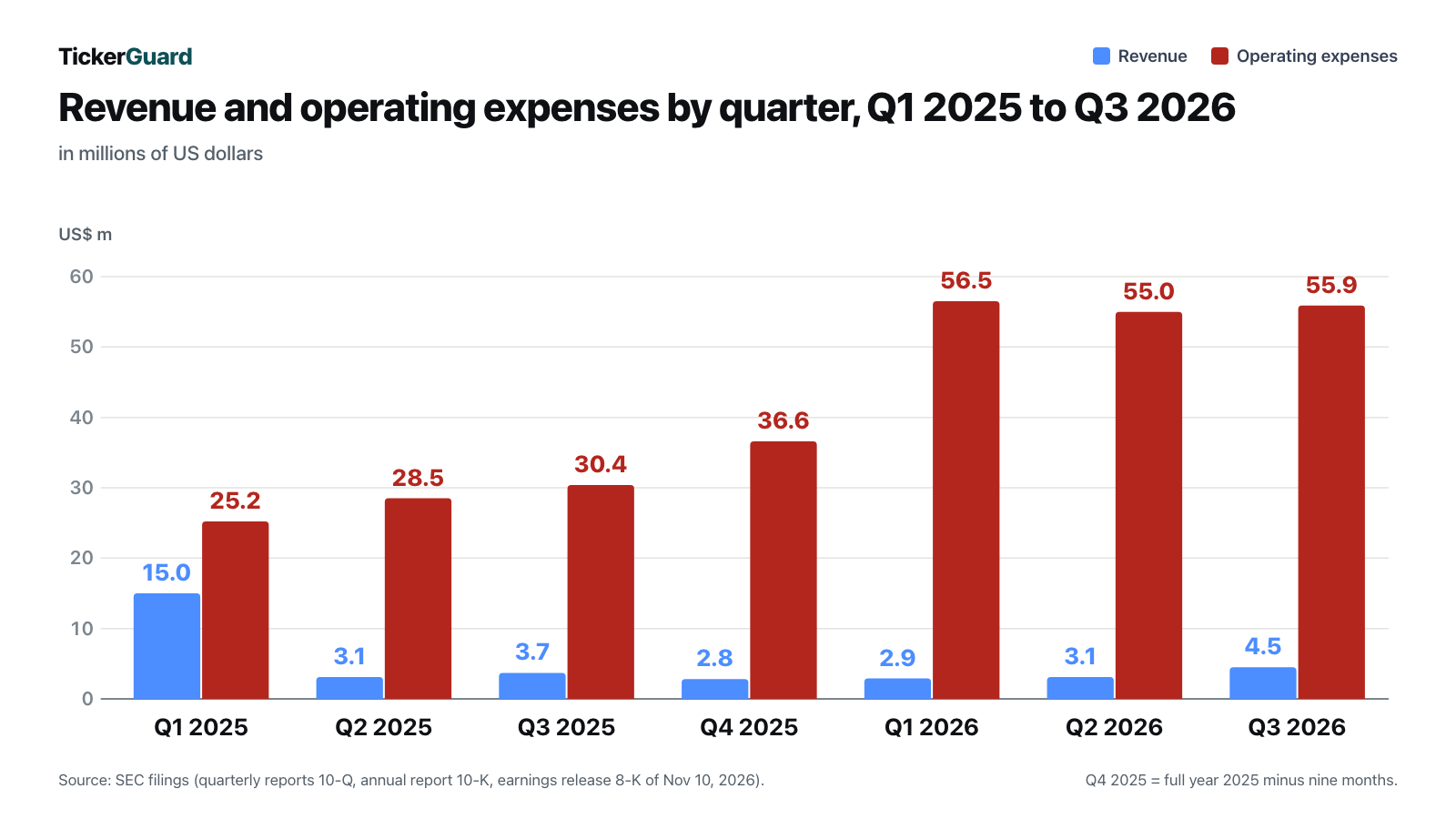
The cost side stays where it has stood since the start of the year: $55.9 million of operating expenses in the third quarter, against $30.4 million a year earlier, up 84 percent. According to the release, the biggest driver was $12.3 million more in personnel costs, plus $4.1 million more in stock-based compensation and $4.6 million more in depreciation and amortization. The operating loss for the quarter was $53.5 million, against $27.7 million. That the net loss of $48.2 million ($0.13 per share) is nonetheless well below the $140.0 million of the year-earlier quarter has a single cause: a year earlier, the remeasurement of the since-redeemed warrants weighed on earnings with $121.9 million. The operating business has not improved; it has worsened.
The more important finding sits in the order figures. The release reports $38.3 million of firmly ordered, not yet delivered work (in jargon, "remaining performance obligations") — up 1,221 percent from a year earlier. The comparison with the prior quarter is missing from the release: as of June 30, 2026 the figure was still $40.7 million. The backlog has therefore shrunk. The reason sits one line above: in the third quarter, new orders of only $1.9 million came in, 19 percent fewer than in the year-earlier quarter and less than half of quarterly revenue. A company that sells less new business than it works off is living off its cushion. For the overall picture after nine months, bookings stand at $37.4 million (prior year $5.3 million) — still containing the single $20 million system sale from the first half and the $2.3 million that Quantum Circuits closed immediately before the acquisition. Roughly 59 percent of the $38.3 million backlog is due to arrive as revenue within twelve months.
Two further pieces of news from the quarter change the picture. First: chief financial officer John Markovich retired effective September 2, 2026 — according to the SEC filing of August 25, 2026, not because of any disagreement on business, operations, accounting policies, financial statements or controls. Since then Greg Golkov, previously head of the finance department with the rank of senior vice president, has run the function on an acting basis — according to the amended filing of September 22, 2026, until a new chief financial officer is hired. Second, and this weighs more: since September 8, 2026 the U.S. government has been a shareholder of D-Wave — more on that in the second uncomfortable truth. Cash fell during the quarter from $546.2 million to $503.4 million; arithmetically, roughly $35.5 million flowed out of the operating business (nine months $109.0 million less $73.5 million in the first half).
What the filings say — the uncomfortable truths
Uncomfortable truth no. 1: after nine months, double the costs on half the revenue
In the first nine months of 2026 D-Wave spent $167.4 million running the business — twice the $84.1 million of the year-earlier period, and more than six times what the company took in across 2022, 2023 and 2024 combined. Broken out according to the earnings release of November 10, 2026: research and development $85.6 million (from $37.1 million), general and administrative $48.8 million (from $26.5 million), sales and marketing $33.1 million (from $20.5 million). The operating loss for the nine months was therefore $161.5 million, against $65.5 million — a deterioration of 146 percent while revenue fell 52 percent to $10.4 million. The company states the direction plainly itself, in the quarterly report for the period ended June 30, 2026:
"We expect to continue to incur significant losses for the foreseeable future as we continue to invest in a number of research and development programs as well as a variety of go-to-market initiatives."
— D-Wave Quantum Inc., Form 10-Q for the quarter ended June 30, 2026, Item 2 (MD&A)

The accumulated deficit — the sum of every loss since inception — stood at $1,096.6 million as of September 30, 2026. For scale, that is roughly forty-five times the best annual revenue D-Wave has ever produced. An honest counterweight belongs here: part of the costs does not leave as cash or arises only once. The company itself calculates what remains when stock-based compensation ($28.9 million), depreciation and amortization ($13.4 million) and one-time items ($10.7 million, mainly acquisition costs for Quantum Circuits plus capital-markets and advisory costs) are taken out: adjusted operating expenses of $114.4 million in nine months, a measure outside U.S. accounting standards. Against $10.4 million of revenue, even that gives a clear picture: even on the company's own, friendlier calculation, roughly eleven dollars go out for every dollar taken in — on the reported figures, roughly sixteen.
Uncomfortable truth no. 2: 113 million shares became almost 380 million — and now the government is in
This part concerns every existing shareholder. Dilution means the company issues new shares to raise money — and your slice of the pie gets smaller even though you sold nothing. The pie itself may well grow; the question is only whether it grows faster than the number of people eating it. At D-Wave, the number of eaters looks like this:
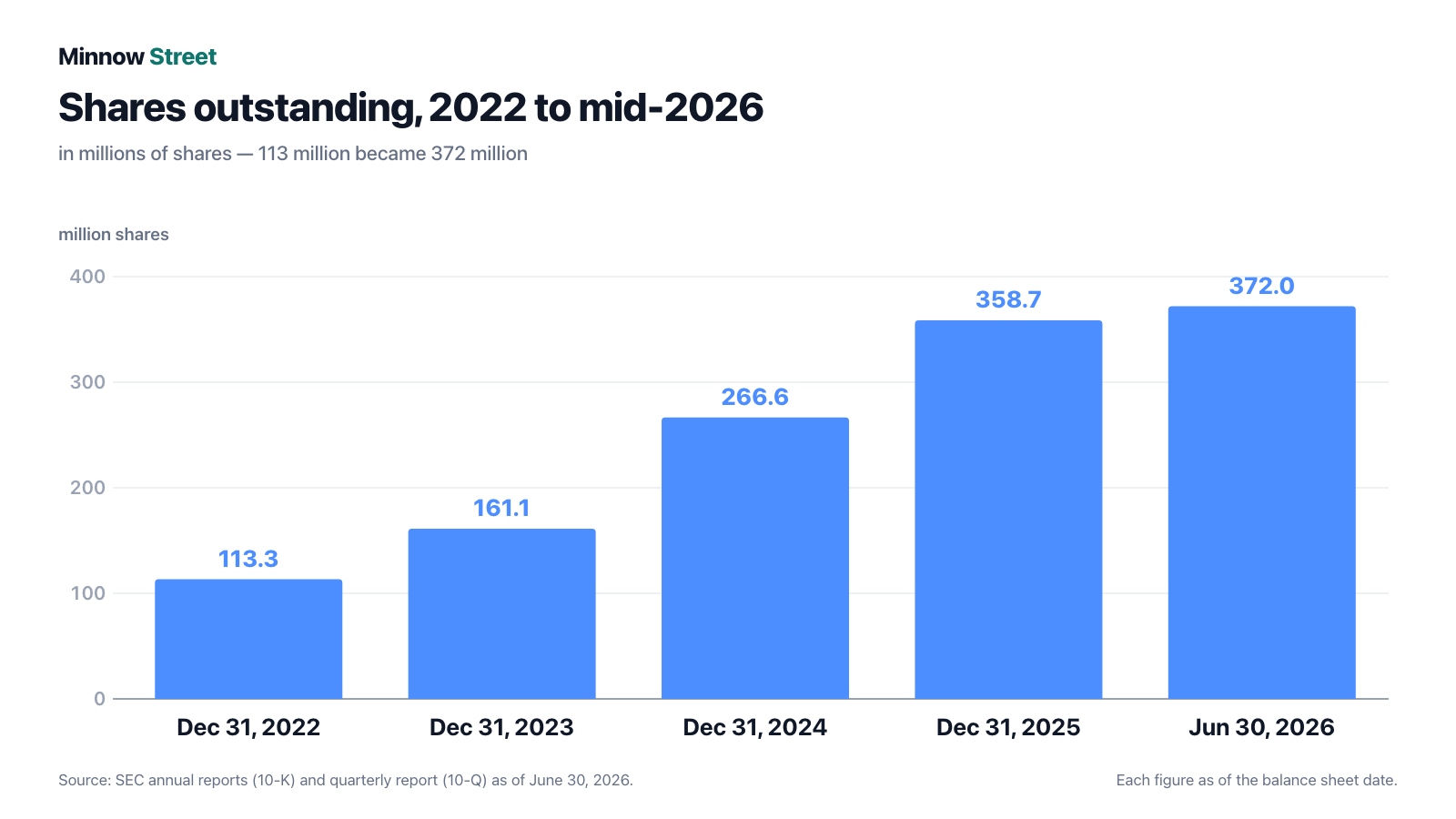
The biggest push came in 2025. In the first half alone, D-Wave issued 50,948,852 new shares through at-the-market programs — arrangements under which a company drip-feeds its own shares directly into the market — raising $536.7 million net. Another 3.87 million shares came from an equity line of credit ($37.8 million) and 12.56 million from warrant exercises. The good news for 2026: that carousel has stopped. In the first nine months of 2026 financing activities actually used $5.2 million of cash, and the quarterly report for the period ended June 30, 2026 records:
"As of December 31, 2025, the Company had completed all issuances under its prior equity programs, including the ELOC and its ATM sales agreements."
— D-Wave Quantum Inc., Form 10-Q for the quarter ended June 30, 2026, "Liquidity and Capital Resources"

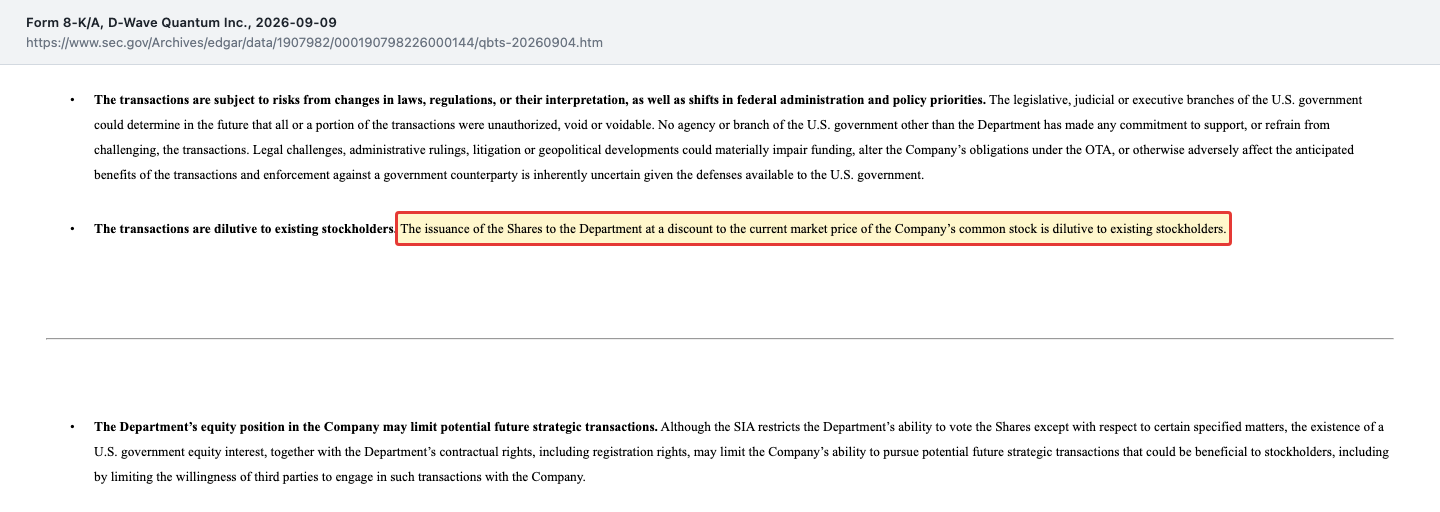
Idle, however, is not dismantled. On January 20, 2026 D-Wave filed an automatic shelf registration with the SEC (Form S-3ASR) — a document that becomes effective immediately, with no further clearance process, and permits the sale of stock, debt and other securities, expressly in an indeterminate number and with no dollar cap. And there is a second route for whose issuance the shelf registration was not even needed. On September 4, 2026 D-Wave signed a funding agreement under the CHIPS and Science Act with the U.S. Department of Commerce for up to $100 million to develop its next generations of computers. What is given in return is set out in the amendment filing of September 9, 2026: on September 8 the Department received 7,095,721 new shares at $14.093 each — about $100 million in total, issued without a prospectus. For the resale of those shares the shelf did come into play after all: in a prospectus supplement (Form 424B7) dated September 10, 2026, D-Wave registered them under the Form S-3ASR of January 20, 2026 for resale by the Department. The price equals the lowest closing price on three reference dates during the negotiation, less 15 percent. D-Wave itself describes the consequence for the other shareholders:
"The issuance of the Shares to the Department at a discount to the current market price of the Company’s common stock is dilutive to existing stockholders."
— D-Wave Quantum Inc., Form 8-K/A dated September 9, 2026, Item 8.01 (Risk Factors)
The money, however, is not there yet. In the balance sheet at September 30, 2026, a new deduction of minus $100.0 million appears under shareholders' equity for proceeds from share issuances not yet received ("Uncollected equity issuance proceeds"). It is to arrive in installments: a first tranche of $53.6 million shortly after signing, the remaining $46.4 million only once development milestones are reached. If the Department terminates the agreement early — it may do so on 60 days' notice even without cause — D-Wave can buy back the unpaid shares pro rata for $1 in total. The Department's shares carry no voting rights while the government holds them — with exceptions, for example in mergers — and may, without the company’s consent, only be sold to the extent that grant funds have been paid out; a prospectus supplement dated September 10, 2026 has already registered the resale. According to that supplement, 379,626,628 shares were outstanding as of September 9, 2026; the Department holds 1.9 percent of them.
The room for further issuance remains ample: of the 675.0 million authorized shares, roughly 379.6 million were thus issued. Roughly 295 million shares — 44 percent of authorized capital — remain free. What that can look like in practice is something the chipmaker SEALSQ demonstrated, where 100 million shares became 223 million in short order. Note the image: the press has not been scrapped — it has been reloaded and is waiting for the next funding need.
Uncomfortable truth no. 3: one customer supplies 41 percent — and it is a different one every year
On revenue of $3 million a quarter, every larger order weighs heavily. The quarterly report sets out that concentration in a small table, and it is revealing in two ways. First, the size: "Customer A" accounted for 41 percent of second-quarter 2026 revenue and 35 percent of the first half. Second, the turnover: in the second quarter of 2025 the biggest customer was "Customer B" at 35 percent — and in the first half of 2025 at 76 percent. In the current year it appears as a dash, meaning below the ten percent threshold.
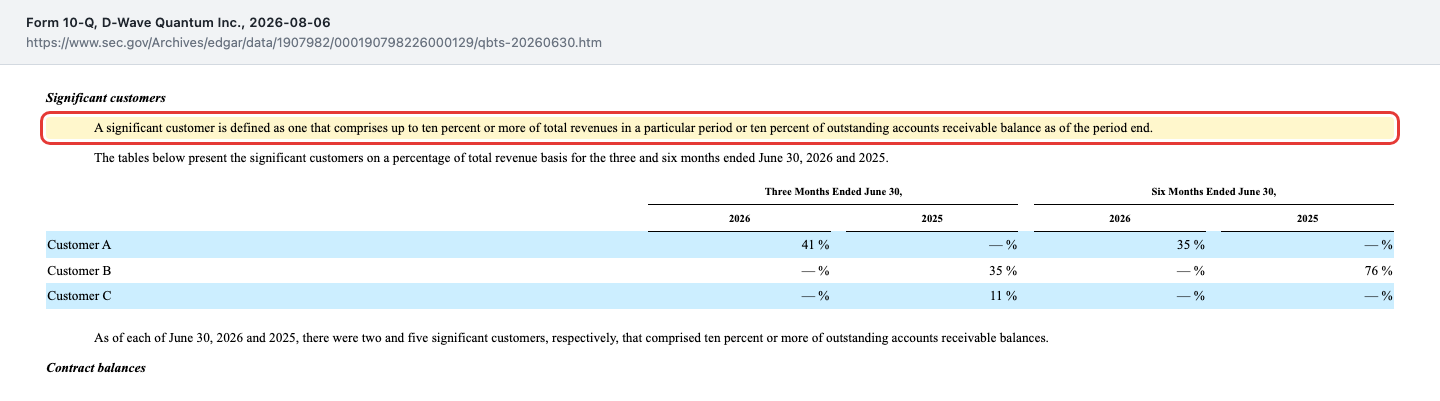
For a company that describes recurring cloud revenue as the core of its model, that is the more awkward of the two observations. Large customers who vanish after a year were not subscribers but one-time buyers. The receivables picture shows the same narrowing: as of June 30, 2026 only two customers exceeded ten percent of outstanding invoices, down from five a year earlier. To be fair: the company counted more than 100 paying customers in the first half of 2026, over half of them commercial enterprises — the breadth exists, it simply does not carry the revenue. For the third quarter, the earnings release again cites more than 100 customers with revenue in the quarter, 48 percent of them commercial enterprises; the investor presentation counts more than 125 customers for the first nine months. The table of major customers for the third quarter appears only in the quarterly report (Form 10-Q), which had not yet been filed on November 11, 2026; whether "Customer A" reappears is therefore still open.
Uncomfortable truth no. 4: the 1,120 percent jump in bookings comes with a footnote
The headline of the August 6, 2026 earnings release reads: first-half 2026 bookings of $35.5 million, up from $2.9 million — a gain of 1,120 percent. It is the most important number in the release, and it needs explaining. The same release states that the $35.5 million includes a single system sale of $20 million whose revenue will only be recognized in coming quarters. And the footnote defining bookings adds that a further $2.3 million came from Quantum Circuits and was closed immediately prior to the completion of the acquisition — that is, by the company D-Wave had just bought.
Together that is $22.3 million of $35.5 million, or 63 percent. Strip both out and roughly $13.2 million remains — still a multiple of the prior year, but a different story. The cross-check comes from the second quarter alone, which contained no system sale: bookings there were $2.1 million, up from $1.3 million, a gain of 59 percent. Two things matter here, and both deserve saying. First, bookings is not a U.S. GAAP measure but a metric the company defines itself. Second, and this counts in D-Wave's favor: the corresponding figure reported under U.S. GAAP — remaining performance obligations, meaning firmly ordered work not yet delivered — genuinely rose from $5.3 million to $40.7 million. Roughly 57 percent of that, as of June 30, 2026, was expected to convert into revenue within twelve months. That would be the first hard evidence that the curve is turning, and it is verifiable in the coming quarterly reports.
The third quarter delivers the first interim check, and the result is mixed. The backlog of firmly ordered work fell to $38.3 million as of September 30, 2026, 59 percent of it scheduled for the next twelve months. Bookings for the quarter came to $1.9 million, below the $2.1 million of the second quarter. Excluding the two special items from the first half, roughly $15.1 million of bookings stand on the books after nine months. Note the yardstick for the coming reports: as long as less is newly ordered each quarter than is billed, the cushion from which the revenue turnaround is supposed to come keeps shrinking.
Valuation: the price of a promise
How expensive is D-Wave? There is no price-to-earnings ratio because there are no earnings and will not be any for some time. That leaves revenue as the yardstick — and it produces a magnitude rarely seen. As of the data date of the original edition, August 10, 2026, market value stood at roughly $7.5 billion, and the trailing twelve-month price-to-sales ratio at about 605. Since then market value has almost halved: with 379.6 million shares (September 9, 2026) and the closing price of November 10, 2026, it is roughly $4.0 billion. Measured against revenue for the twelve months to September 30, 2026 ($13.2 million, of which $2.8 million from the fourth quarter of 2025), that is a price-to-sales ratio of about 300; measured against full-year 2025 revenue of $24.6 million, about 160. For comparison, a fast-growing software company is considered expensive at 15 to 20. What has become cheaper here is the price, not the business.
The balance sheet anchor sits far below: shareholders' equity of $1,037.3 million as of September 30, 2026 works out to roughly $2.73 per share — market value is just under four times that. And even this book value is only half cash: $342.6 million of goodwill and $208.4 million of intangible assets, together 53 percent of equity, stem from the Quantum Circuits acquisition of January 2026 (total purchase price $538.5 million, of which $256.0 million in cash and 10,430,444 of the company's own shares worth $282.0 million). A side observation on the government's entry: the Department's issue price of $14.093 per share is above the November 10, 2026 closing price of $10.48.
What the market is paying for, then, is not current earnings but a timetable: 20,000 qubits in 2029, 100,000 in 2031, a fault-tolerant gate-model system with 10 logical qubits in 2030 and 100 logical qubits in 2032. Those are the milestones D-Wave itself set out on August 6, 2026 and confirmed unchanged in the investor presentation of November 10, 2026. Every one of them may arrive. The last of them, though, lies six years out, and the operation has to be funded until then. It is the same constellation we described at Ivanhoe Electric, where the market is paying for the copper mine before it is built: the price already contains the success.
Two side notes for context. First, about a fifth of the free float was sold short as of August 10, 2026 (roughly 65 million shares); as of November 10, 2026 it was roughly 79 million shares, or just under a quarter. That is a measure of how contested this bet is, and it adds to the volatility. Second, the move from the NYSE to Nasdaq effective July 27, 2026 was a voluntary decision by the board — not a forced delisting and not a distress signal. The company changed venue; the ticker QBTS stayed.
Opportunities and risks at a glance
What speaks for D-Wave Quantum:
- A very solid funding position: $503.4 million in cash and marketable securities against $86.0 million of total liabilities (September 30, 2026); with cash used in operations of on average about $36 million per quarter, that lasts roughly three and a half years. On top come up to $100 million from the CHIPS agreement, provided the installments flow.
- Technical and political recognition: a peer-reviewed Nature paper on a two-qubit entangling gate (2026), Leader status as one of only two companies in the 2026 IDC assessment (according to D-Wave), a National Science Foundation grant of $1,566,240, and a funding agreement with the U.S. Department of Commerce of up to $100 million (September 2026).
- By its own account the only supplier offering both architectures — annealing (Advantage2, more than 4,400 qubits, in production) and gate model (strengthened by Quantum Circuits since January 2026); serving both paths removes the need to bet on one.
- More applications in regular operation: commercial customers supplied 62.4 percent of second-quarter 2026 revenue (from 45.1 percent); since August 2026 a second production application at NTT DOCOMO, according to D-Wave a partnership with CGI and a non-binding memorandum of understanding with LG CNS (October 2026); more than 125 customers in the first nine months of 2026, according to the investor presentation.
- An order cushion that did not exist a year ago: remaining performance obligations of $38.3 million as of September 30, 2026, up from $2.9 million a year earlier — roughly 59 percent of which is expected to become revenue within twelve months.
What speaks against it:
- Revenue is barely growing: $7.2 million, $8.8 million and $8.8 million from 2022 through 2024; the 2025 outlier of $24.6 million rests more than half (56 percent) on a one-time machine sale of $13.7 million. The 21 percent gain in the third quarter of 2026 ($4.5 million) came mainly from lower-margin consulting; after nine months revenue is 52 percent below the prior year.
- The cost gap stays open: $167.4 million of operating expenses in the first nine months of 2026 against $10.4 million of revenue; an operating loss of $161.5 million versus $65.5 million; an accumulated deficit of $1,096.6 million since inception.
- Heavy past dilution (113.3 million to 379.6 million shares between the end of 2022 and September 2026), most recently 7,095,721 shares at a 15 percent discount to the U.S. Department of Commerce; and ample capacity for more: a shelf registration with no dollar cap and roughly 295 million shares of headroom in authorized capital.
- Weak order intake: $1.9 million in the third quarter of 2026, less than half of quarterly revenue; the backlog of firmly ordered work fell from $40.7 million to $38.3 million. Add customer concentration: 41 percent of revenue from one customer in the second quarter of 2026, 76 percent from a different one in the first half of 2025.
- A valuation made entirely of future: a price-to-sales ratio of roughly 300 on a trailing twelve-month basis as of November 10, 2026, just under four times book value — and that book value is itself 53 percent goodwill and intangibles from a single acquisition. Add a chief financial officer who is only serving on an acting basis.
A human conclusion
Back to the milestone trap. Its danger is not that the milestones are false — at D-Wave they emphatically are not. The Nature paper exists, the IDC report exists, the machine with more than 4,400 qubits is built and running. The danger is that our minds turn a chain of good news into a chain of growing revenue. And that is exactly where the filings object: $3.076 million in the second quarter of 2026, $3.095 million a year earlier — and in the third quarter $4.5 million against $55.9 million of costs. The third quarter, too, follows the pattern of the trap: the headline reports 21 percent growth and a backlog up 1,221 percent; the figures of the same release show lower gross profit and new orders of only $1.9 million, and the comparison with the June 30 position shows a shrunken backlog. Every number is right — only not the story your mind assembles from them.
What does that mean? Not that D-Wave must fail. The company holds $503 million in cash and securities, carries almost no debt, has roughly three and a half years of time and, in the U.S. Department of Commerce, a backer that intends to pay up to $100 million in installments — in exchange for shares. It does mean the question is different from the one the headlines ask. It is not "will quantum computing matter?" — it probably will. It is: would you pay roughly $4 billion for a company that takes in four and a half million dollars a quarter and spends fifty-six, because you believe the curve turns in one of the next six years? That market value has almost halved since August changes nothing about the question — it only makes the stake smaller, not the bet safer. If yes, at least you now know precisely what you are betting on — a timetable through 2032 that is meant to end with 100 logical qubits, not a balance sheet from today. If no, you have the next quarterly reports to watch whether that $38.3 million of ordered work actually turns into revenue — and whether more is again newly ordered each quarter than is billed. The decision is yours. And that is exactly as it should be.
Sources
Every original document used in this analysis, for your own reading:
- D-Wave Quantum Inc. — Third-quarter 2026 earnings release (Form 8-K, Item 2.02, Exhibit 99.1, November 10, 2026) and investor presentation of the same day (Exhibit 99.2) — the Form 10-Q for the quarter ended September 30, 2026 was not yet on file on November 11, 2026
- D-Wave Quantum Inc. — Form 8-K dated September 8, 2026 on the funding agreement under the CHIPS and Science Act (Item 1.01), amendment Form 8-K/A dated September 9, 2026 on the share issuance to the U.S. Department of Commerce (Items 1.01, 3.02, 8.01) and prospectus supplement 424B7 dated September 10, 2026
- D-Wave Quantum Inc. — Form 8-K dated August 25, 2026 on the chief financial officer's retirement (Item 5.02)
- D-Wave Quantum Inc. — amended Form 8-K/A dated September 22, 2026 on the interim succession
- D-Wave Quantum Inc. — Form 10-Q for the quarter ended June 30, 2026 (filed August 6, 2026)
- D-Wave Quantum Inc. — Form 10-Q for the quarter ended March 31, 2026 (filed May 12, 2026)
- D-Wave Quantum Inc. — Form 10-K for 2025 (filed February 26, 2026)
- D-Wave Quantum Inc. — Form 10-K for 2024 (filed March 14, 2025)
- D-Wave Quantum Inc. — Second-quarter 2026 earnings release (Form 8-K, Exhibit 99.1, August 6, 2026)
- D-Wave Quantum Inc. — Form 8-K dated July 14, 2026 on the voluntary transfer of the listing from the NYSE to Nasdaq
- D-Wave Quantum Inc. — Form S-3ASR shelf registration dated January 20, 2026
- Complete SEC filing history of D-Wave Quantum Inc.: EDGAR overview (sec.gov)
- Fundamental data (market value, valuation ratios, short interest; data as of August 10, 2026 and November 10, 2026), reconciled with the SEC filings and the SEC's XBRL company facts.
Transparency & disclaimer: This analysis is journalistic commentary on publicly available information. It is not investment advice, not a financial analysis in any regulatory sense, and not a solicitation to buy or sell securities. Equity investments carry substantial risk up to total loss. All information is provided without warranty; the as-of date for each figure is noted in the text. Positions held by the operator are disclosed daily; where one exists, it appears as a notice at the top of this deep dive.
Key figures at a glance
All monetary figures in millions of $; earnings per share as reported.
| Metric | 2021 | 2022 | 2023 | 2024 | 2025 |
|---|---|---|---|---|---|
| Revenue | 6.3 | 7.2 | 8.8 | 8.8 | 24.6 |
| Operating Income (EBIT) | -38.9 | -59.5 | -80.5 | -77.2 | -100.4 |
| Net Income | -41.0 | -53.7 | -82.7 | -143.9 | -355.1 |
| Net Margin | -652.5% | -748.7% | -944.5% | -1,630.0% | -1,444.1% |
| Earnings Per Share | -0.33 $ | -0.45 $ | -0.60 $ | -0.75 $ | -1.11 $ |
Source: fundamental data & SEC filings (annual and quarterly reports, 10-K/10-Q)
Our Bottom Line at a Glance
- Technology and market position positive
- D-Wave describes itself as the first commercial supplier of quantum computers and the only one offering two architectures at once. In 2026 it added a peer-reviewed Nature paper on a high-fidelity two-qubit gate, Leader status as one of only two companies in the IDC assessment (according to D-Wave), a National Science Foundation grant of $1,566,240 and, in September, a funding agreement with the U.S. Department of Commerce of up to $100 million. According to the November 10, 2026 earnings release, an Advantage2 system has been delivered to Italy.
- Revenue trajectory negative
- Revenue is barely moving: $7.2 million (2022), $8.8 million (2023), $8.8 million (2024); the $24.6 million of 2025 rests more than half on a one-time machine sale. The third quarter of 2026 brought $4.5 million, 21 percent more than a year earlier, but mostly from lower-margin consulting; gross profit fell 11 percent. After nine months revenue of $10.4 million is 52 percent below the prior year.
- Cost structure and losses negative
- Operating expenses in the first nine months of 2026 were $167.4 million against $84.1 million a year earlier — for every dollar taken in, roughly sixteen went out, on the company's adjusted calculation roughly eleven. The operating loss rose 146 percent to $161.5 million, and the accumulated deficit reached $1,096.6 million as of September 30, 2026.
- Balance sheet and funding positive
- As of September 30, 2026 the company held $279.4 million in cash and $224.0 million in marketable securities against total liabilities of $86.0 million; shareholders' equity was $1,037.3 million. With cash used in operations of on average about $36 million per quarter, liquidity lasts roughly three and a half years, and up to $100 million from the CHIPS agreement is in prospect. The filings carry no going-concern qualification.
- Dilution negative
- 113.3 million shares (December 31, 2022) became 379.6 million (September 9, 2026). The old at-the-market programs have been exhausted since the end of 2025, but in September 2026 the U.S. Department of Commerce received 7,095,721 new shares at a 15 percent discount — which the company itself calls dilutive. Roughly 295 million of the 675.0 million authorized shares remain unissued, and a shelf registration with no dollar cap is in place.
- Customer base and order book negative
- In the third quarter of 2026 new orders came to only $1.9 million, less than half of revenue; the backlog of firmly ordered work fell from $40.7 million to $38.3 million. Add customer concentration: 41 percent of revenue from one customer in the second quarter of 2026, 76 percent from a different one in the first half of 2025. On the positive side: more applications in regular operation, for example at NTT DOCOMO.
D-Wave Quantum builds real quantum computers and plans a 100,000-qubit machine by 2031 — and booked $4.5 million of revenue in the third quarter of 2026, 21 percent more than a year earlier, against operating expenses of $55.9 million. What grew is mainly low-margin consulting; new orders came to only $1.9 million, and the backlog shrank to $38.3 million. The operation is funded by shareholders: 113.3 million shares became 379.6 million, most recently with the U.S. Department of Commerce as a new shareholder. A cash and securities position of $503.4 million buys roughly three and a half years of time — what the market is paying for is a timetable through 2032 (100 logical qubits), not a balance sheet from today. Not investment advice.
What Our Rating Means
Open questions
The business works in principle, but one material question is open. As long as it stays open, our findings do not carry a quality verdict.
Yellow because the recognized technology has not yet produced a business that sustains itself. Explicitly not because of the price: whether a price-to-sales ratio of roughly 300 (as of November 10, 2026) is too high is a valuation question, not a quality judgment, and it does not feed into this rating. Red has no basis, and that is a finding rather than a concession: as of September 30, 2026 the company held $503.4 million in cash and marketable securities against total liabilities of $86.0 million, shareholders' equity was $1,037.3 million, the filings carry no going-concern qualification, and with cash used in operations of on average about $36 million per quarter (nine months 2026) the balance lasts roughly three and a half years. The latest quarter shows the operating question clearly: the third quarter of 2026 brought $4.5 million of revenue against $55.9 million of operating expenses, the growth came from low-margin consulting, and with $1.9 million of new orders less was newly ordered than billed — the backlog of firmly ordered work fell from $40.7 million to $38.3 million. The first hard counter-evidence would be this backlog actually converting into revenue and order intake per quarter rising above revenue again. The next verifiable checkpoint is the quarterly report for the period ending September 30, 2026, with the major-customer table, followed by the annual report for 2026. The decision is yours.
A journalistic assessment by our editorial team at the time of the deep dive, based on public sources — not investment advice and not a solicitation to buy or sell. Your personal circumstances (investment goals, risk capacity, taxes) cannot be taken into account. What our levels mean, how verdicts are formed, and what conflicts of interest exist →
Worth Noting
- Data as of this edition: November 11, 2026 (original edition August 11, 2026). The most recent periodic report evaluated is the Form 10-Q for the quarter ended June 30, 2026; for the third quarter of 2026 the Form 8-K earnings release (Item 2.02) dated November 10, 2026, with Exhibits 99.1 and 99.2, is evaluated. The Form 10-Q for the quarter ended September 30, 2026 was not yet on file with the SEC on November 11, 2026; the Q3 figures therefore come from the earnings release and still have to be confirmed by the quarterly report. Every filing from August 6, 2026 onward was reviewed. Price and short interest carry an as-of date of November 10, 2026.
- No transcript of the November 10, 2026 earnings call that could be checked against the original was available at the time of writing; the analysis quotes nothing from it. D-Wave gives no revenue guidance.
- Bookings is not a U.S. GAAP measure but an operating metric the company defines itself. Its counterpart reported under U.S. GAAP is remaining performance obligations of $38.3 million as of September 30, 2026. Likewise, non-GAAP gross margin, non-GAAP adjusted operating expenses and adjusted EBITDA loss are measures outside U.S. accounting standards; where this analysis cites them, it says so.
- The sharp drop in net loss from $312.7 million to $114.6 million year over year in the nine-month comparison rests on two items outside the operating business: the disappearance of warrant remeasurement (a $260.0 million charge in the prior year; all publicly traded warrants were redeemed in November 2025) and a one-time income tax benefit of $28.5 million from the Quantum Circuits acquisition. Over the same period the operating loss deteriorated from $65.5 million to $161.5 million.
- Possible confusion: the Form 8-K of July 14, 2026 carries Item 3.01, which is also used for failures to satisfy listing rules. In this case it covered only the voluntary transfer of the listing from the NYSE to Nasdaq effective July 27, 2026; the ticker QBTS was unchanged.
Stock Watch
This analysis is as of November 11, 2026. Stock Watch will tell you what's changed at QBTS since then.
Later $1 a month per stock — signing up is free, and you'll be the first to know when it launches.
The full analysis as a PDF for later
We will send you this analysis as a PDF — to print, file away, and read at your own pace. And we will add you to the free Stock Watch list for D-Wave Quantum Inc. (QBTS), so you hear about it when something material in this analysis changes.
Frequently Asked Questions
D-Wave Quantum Inc. (NASDAQ: QBTS), based in Palo Alto, California, builds and sells quantum computers. The company describes itself as the world's first commercial supplier of such machines and the only one offering two architectures at once: annealing systems for optimization problems (currently Advantage2, with more than 4,400 qubits) and gate-model systems for the more universal approach. Revenue comes from cloud access to the machines, professional services helping customers build applications, and sales of complete systems. As of February 5, 2026 the company had roughly 388 employees.
Very little relative to its size on the exchange. Revenue was $7.2 million (2022), $8.8 million (2023), $8.8 million (2024) and $24.6 million (2025). The 2025 figure stands out because it contains a one-time sale of a complete machine for $13.7 million. In the third quarter of 2026 it was $4.5 million according to the earnings release of November 10, 2026, up 21 percent from a year earlier; after nine months of 2026 it stands at $10.4 million, 52 percent below the year-earlier period. Since the second quarter of 2025 quarterly revenue has ranged from $2.8 million to $4.5 million.
More revenue, but fewer new orders. Revenue rose to $4.5 million (prior-year quarter $3.7 million), driven by professional services and cloud access; system sales fell by $1.5 million, and gross margin dropped from 71.4 to 52.9 percent. Operating expenses were $55.9 million and the operating loss $53.5 million. New orders came to only $1.9 million, and the backlog of firmly ordered work fell from $40.7 million to $38.3 million between June 30 and September 30, 2026. The Form 10-Q was still outstanding on November 11, 2026.
Profitable it is not: the operating loss for the first nine months of 2026 was $161.5 million, against $65.5 million a year earlier, and the accumulated deficit since inception reached $1,096.6 million as of September 30, 2026. There is no acute funding problem, however. At the same date the company held $279.4 million in cash and $224.0 million in marketable securities against total liabilities of just $86.0 million. With cash used in operations of on average about $36 million per quarter, that lasts roughly three and a half years. The filings contain no going-concern qualification.
Because of a funding agreement under the CHIPS and Science Act. On September 4, 2026 the U.S. Department of Commerce committed up to $100 million to D-Wave for developing its next generations of computers. In return it received 7,095,721 new shares at $14.093 each on September 8, 2026 — the lowest closing price on three reference dates less 15 percent; that is 1.9 percent of the shares. The money flows in installments after milestones and had not yet arrived as of September 30, 2026 (a $100.0 million deduction in shareholders' equity). D-Wave itself calls the issuance dilutive.
Severely. Shares outstanding rose from 113.3 million (December 31, 2022) to 379.6 million (September 9, 2026) — more than three times as many. In the first half of 2025 alone, 50.9 million shares were sold through at-the-market programs for $536.7 million net. Those programs have been exhausted since December 31, 2025; in 2026 the additions came mainly from the shares for the Quantum Circuits acquisition (10.4 million) and for the U.S. Department of Commerce (7.1 million). Of 675.0 million authorized shares, roughly 295 million remain unissued, and a shelf registration with no dollar cap has been in place since January 2026.
Expensive by every conventional measure, even after the decline since August 2026. There is no price-to-earnings ratio because there are no earnings. At a market value of roughly $4.0 billion (379.6 million shares, closing price of November 10, 2026) and trailing twelve-month revenue of $13.2 million, the price-to-sales ratio is about 300; as of August 10, 2026 it was about 605. Book value per share was roughly $2.73 as of September 30, 2026 — and roughly 53 percent of that equity consists of goodwill and intangible assets from the Quantum Circuits acquisition.
Voluntarily, and on its own initiative. In a Form 8-K dated July 14, 2026, D-Wave said its board had resolved to withdraw the listing of its common stock from the New York Stock Exchange and transfer it to Nasdaq. Trading on the NYSE ended at the close on July 24, 2026, and began on Nasdaq on July 27, 2026 under the same ticker, QBTS. It was therefore not a forced delisting and not a warning sign, even though the reporting item used (8-K, Item 3.01) also covers failures to satisfy listing rules.
Found an error?
Did you spot a factual error, an outdated number, or a typo in this deep dive? Let us know briefly — your report goes straight to the editorial team.