CapsoVision: The Camera Capsule Got Its AI Clearance — Now the Cash Clock Is Running
CapsoVision makes a camera you swallow, and in September 2026 the U.S. Food and Drug Administration cleared its AI reading tool. The quarterly report filed on November 12, 2026, tells the other half: the company itself has substantial doubt that it can continue without fresh capital. On our math, the cash lasts about three quarters. In the third quarter of 2026 CapsoVision spent about three dollars for every dollar of revenue, and per the quarterly report another capital raise will likely be needed by early 2027.
 Thomas Mücke
Founder & Publisher
As of Today
As of: November 12, 2026
- Closing price
- 6.30 $ 0.00%
- Market Capitalisation
- 0.3 $B
- Growth Score
- 4/10
- AAQS
- 4/10
Price change since November 12, 2026: +0.5%
This analysis has a cut-off date. The Stock Guard tells you when something material changes in the numbers. Reserve your free spot
Chart
Interactive price chart (TradingView).
52-week range: 4.60 $ to 14.40 $ · Last price: 6.30 $ (As of: November 12, 2026)
Note: pure fact-based analysis, not investment advice and not a solicitation to buy or sell. All figures without guarantee.
There is an investor trap that feels like good news: the milestone high. A small company announces a clearance, a study wraps up, a product launches — and in your head the light flips to green, as if the finish line had been crossed. Yet a clearance is usually only the starting line, and between the starting line and a profit lies a stretch of road that costs money. CapsoVision (Nasdaq: CV) of Saratoga, California, is a textbook case. On September 25, 2026, the U.S. Food and Drug Administration (FDA) cleared the company's AI reading tool; on November 2, 2026, U.S. sales began. And on November 12, 2026, the same company wrote in its quarterly report that it has substantial doubt about its ability to continue without fresh capital. So let's make a deal: before the milestone high makes the call, let's read together what CapsoVision told the U.S. securities regulator, the SEC — the annual report (10-K) for 2025, the quarterly reports (10-Q) through September 30, 2026, and the capital raises in between. An SEC filing is prepared under legal liability. And this one tells the story of a race between clearance and bank balance.
What CapsoVision actually does — a camera you swallow
CapsoVision's product is quick to explain and still surprising: a pill-sized capsule with four cameras that the patient swallows. On its way through the digestive tract it films the small bowel all around, in 360 degrees, stores the video on board and is then retrieved and read out. In everyday terms: instead of a tube with a camera that a physician pushes through the body under sedation, the camera travels as a passenger. The flagship is CapsoCam Plus, cleared by the FDA in 2016 and used in more than 184,000 patients through September 30, 2026 (a year earlier: 151,000). Around it sit the CapsoView reading software, the CapsoCloud platform and a video reading service. In the U.S., CapsoVision sells directly to GI practices and hospitals; abroad it sells both directly and through distributors, and a single international distributor accounted for about 11 percent of revenue in the first nine months of 2026. For components and assembly the company relies on suppliers in Asia, particularly in Taiwan and Japan.
The stock story has two chapters that do not earn money yet. First, CapsoCam Colon, a capsule for the large intestine designed to detect and measure polyps — by the company's own account, its route to growing beyond small-bowel revenue. Second, a capsule for the upper GI tract (UGI) that CapsoVision is studying for early detection of pancreatic cancer; that study has been running since May 2026. Sounds like a big vision? It is. But the company carrying it had $21.8 million in cash on September 30, 2026. That names the central tension of this analysis: the technology moves forward step by step — but development costs more than the existing business earns, and the cash has lately lasted only until the next equity raise.
Company history for investors
-
2005
Founded
CapsoVision is formed as a Delaware corporation with a branch office in Taiwan. For shareholders: two decades of development, funded with preferred stock until the IPO.
-
2016
FDA clearance for CapsoCam Plus
The small-bowel capsule may be sold in the U.S. For shareholders: to this day, all revenue comes from the business around this capsule.
-
2025
IPO at $5.00
CapsoVision lists on Nasdaq in July 2025, raising about $23.4 million net. Just before, cash had fallen to $1.1 million.
-
2025
FDA questions on the colon capsule
In December 2025 the FDA raises questions on the first CapsoCam Colon, and CapsoVision subsequently drops the submission. For shareholders: the key pipeline bet is delayed.
-
2026
AI clearance and new shares
In September: clearance for AI Highlights and an $18.0 million registered direct offering. For shareholders: progress and dilution in the same month.
How the stock landed on our desk
Not through a price spike and not through a scanner hit, but through the SEC's filing stream: on November 12, 2026, the earnings release (8-K) and the quarterly report (10-Q) for the third quarter of 2026 came in. The press release puts revenue, the patient count and the AI clearance up front; the quarterly report has a footnote numbered 2 and titled "Going Concern." That tension between headline and footnote is what caught our attention: the words “going concern” do not appear in the November 12, 2026 earnings release. The cut-off for this analysis is November 13, 2026; all SEC filings up to that date have been reviewed. Keep this in mind from the start: at CapsoVision, the press release is the shop window and Note 2 is the stockroom.
The numbers over the years — given their due
First, what genuinely speaks for CapsoVision. Revenue has grown every year since U.S. direct sales began in 2020, the annual report says: 2025 revenue was $13.6 million, up 15 percent from 2024 ($11.8 million). Gross margin — what is left of each sales dollar after production costs — was 53 percent in 2025, respectable for a hardware maker this size. And the balance sheet carries no bank debt: against $32.8 million in assets, liabilities were only $6.4 million on September 30, 2026, with no bank loan. Now the chart that matters — revenue and loss by quarter:
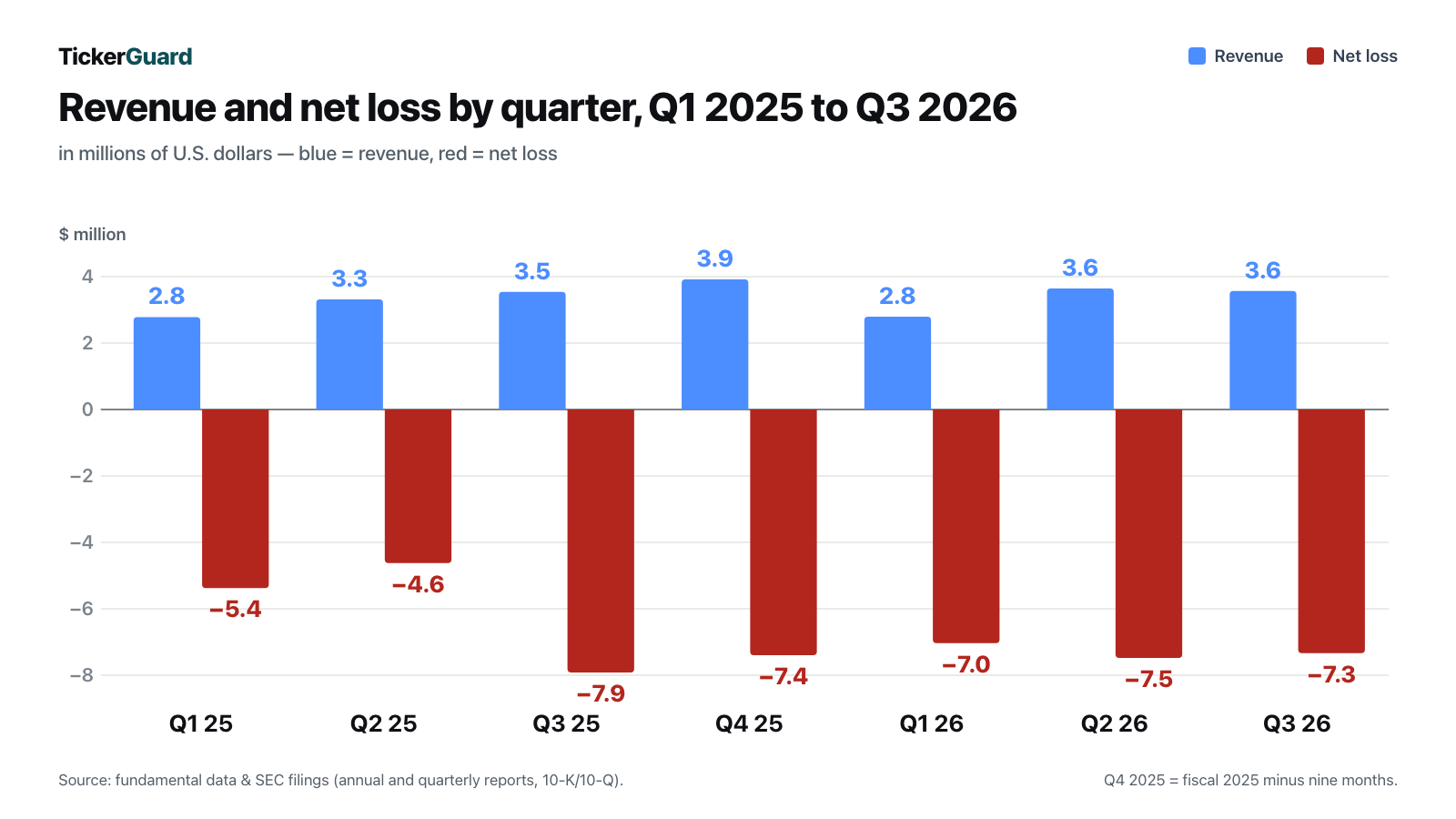
The third quarter of 2026 in detail: revenue of $3.6 million, versus $3.5 million a year earlier — up less than 1 percent. Gross margin fell from 54 to 49 percent; the company cites higher flash memory prices, a one-time inventory obsolescence charge and higher stock-based compensation. Operating expenses eased to $9.1 million (prior year: $9.9 million) mainly because the prior-year quarter carried a $1.0 million non-cancellable initial fee for an image-sensor development agreement with Canon, while selling and administrative costs rose; with the colon study complete, the company says in its earnings release that it expects related clinical expenses to decline. Bottom line: a $7.3 million net loss, or 15 cents per share. Over nine months, revenue rose 3.8 percent to $10.0 million while the net loss grew 22 percent to $21.9 million. The ratio behind it: in the third quarter of 2026, $3.6 million of revenue stood against about $11.0 million of costs — for every dollar of revenue, CapsoVision spent about three. The company expects the AI tool to speed up growth — "with the full commercial impact anticipated in 2027," it writes in the earnings release. For 2026, the milestone is not yet a number. Which brings us to the uncomfortable truths.
What the filings say — the uncomfortable truths
Uncomfortable truth No. 1: The company itself doubts it can carry on
A going-concern note is one of the most serious warnings a company can write into its own financial statements. In plain words: management says it cannot be sure the money on hand will carry it through the next twelve months. CapsoVision is not writing this for the first time — the 2025 annual report carried the note too — but it is also in the latest quarterly report, after three equity raises this year:
"The Company, having evaluated the extant facts and circumstances, concluded that the facts and circumstances raise substantial doubt about the Company’s ability to continue as a going concern within one year after the date of issuance of these financial statements."
— CapsoVision, Inc., SEC quarterly report 10-Q for the period ended Sep 30, 2026, Note 2 "Going Concern"
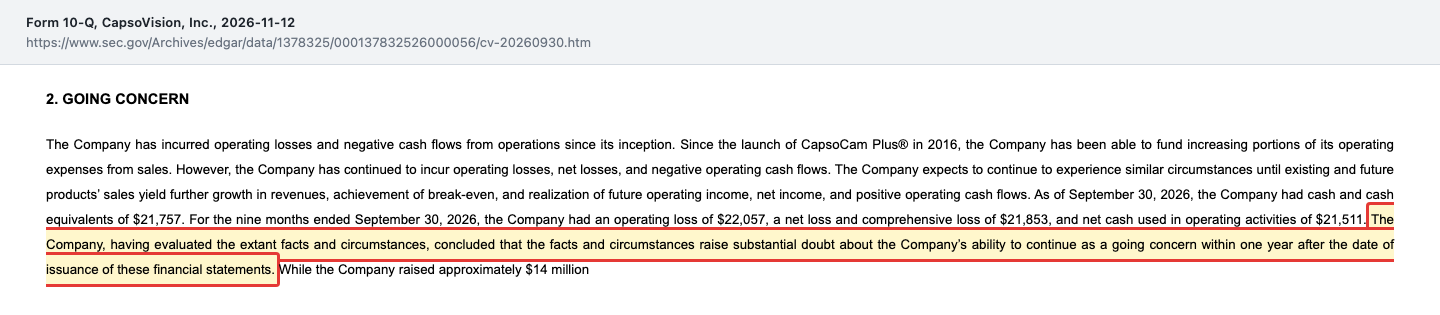
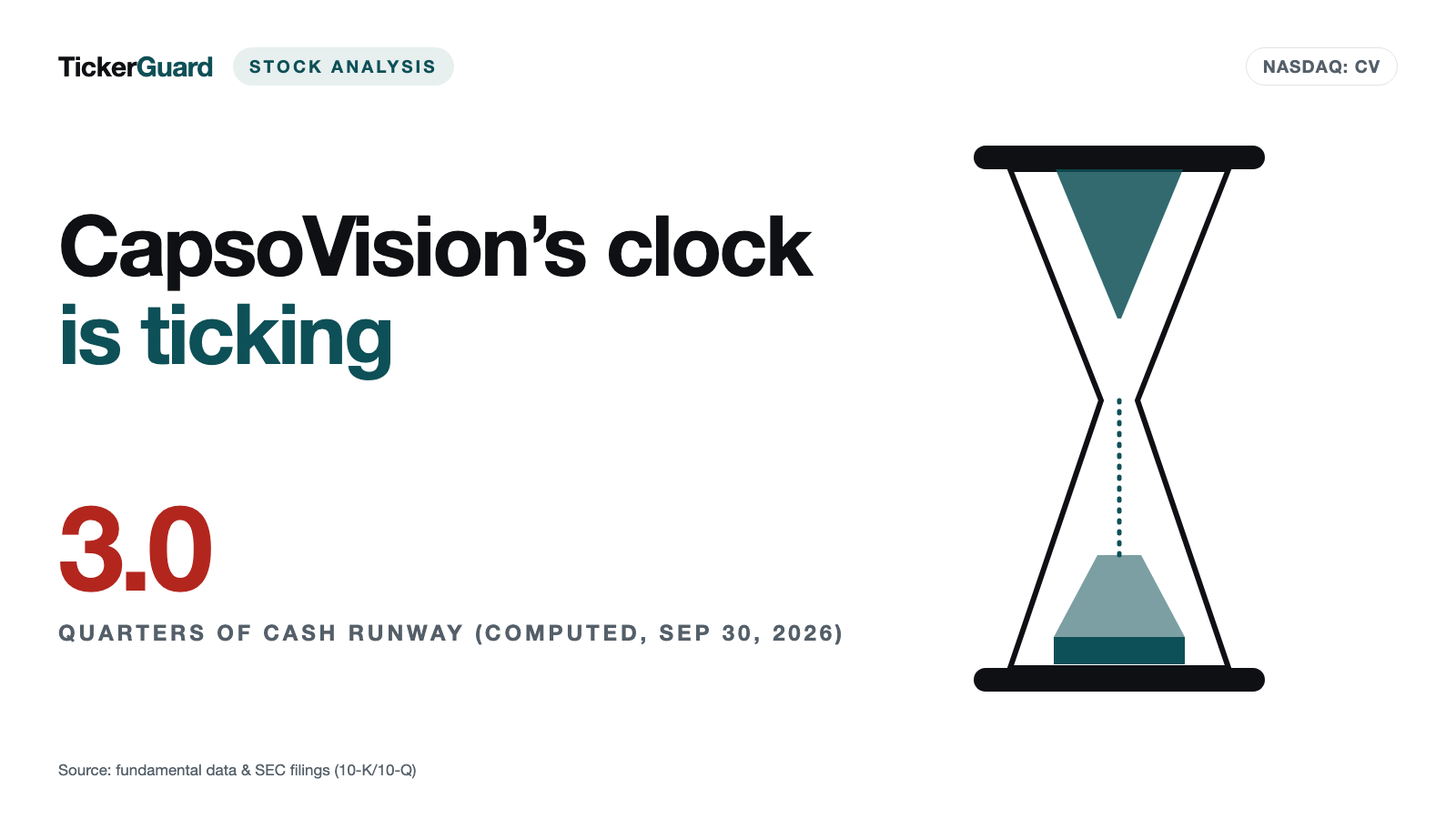
Let's do the math. In the first nine months of 2026, operations burned $21.5 million, an average of $7.2 million per quarter. At that pace, the $21.8 million in cash on September 30, 2026, lasts about 3.0 quarters — roughly to mid-2027, with no cushion. The company itself names an earlier point for its next raise, as the next truth shows. Picture an hourglass: an equity raise turns it over, but the sand keeps running.
Uncomfortable truth No. 2: The cash balance is a sawtooth — and shareholders pay for every tooth
How CapsoVision has survived so far shows up in its cash at the quarter-ends shown. In none of the periods shown did it rise on its own: each of the three increases followed a sale of new shares, and then it melted away again:
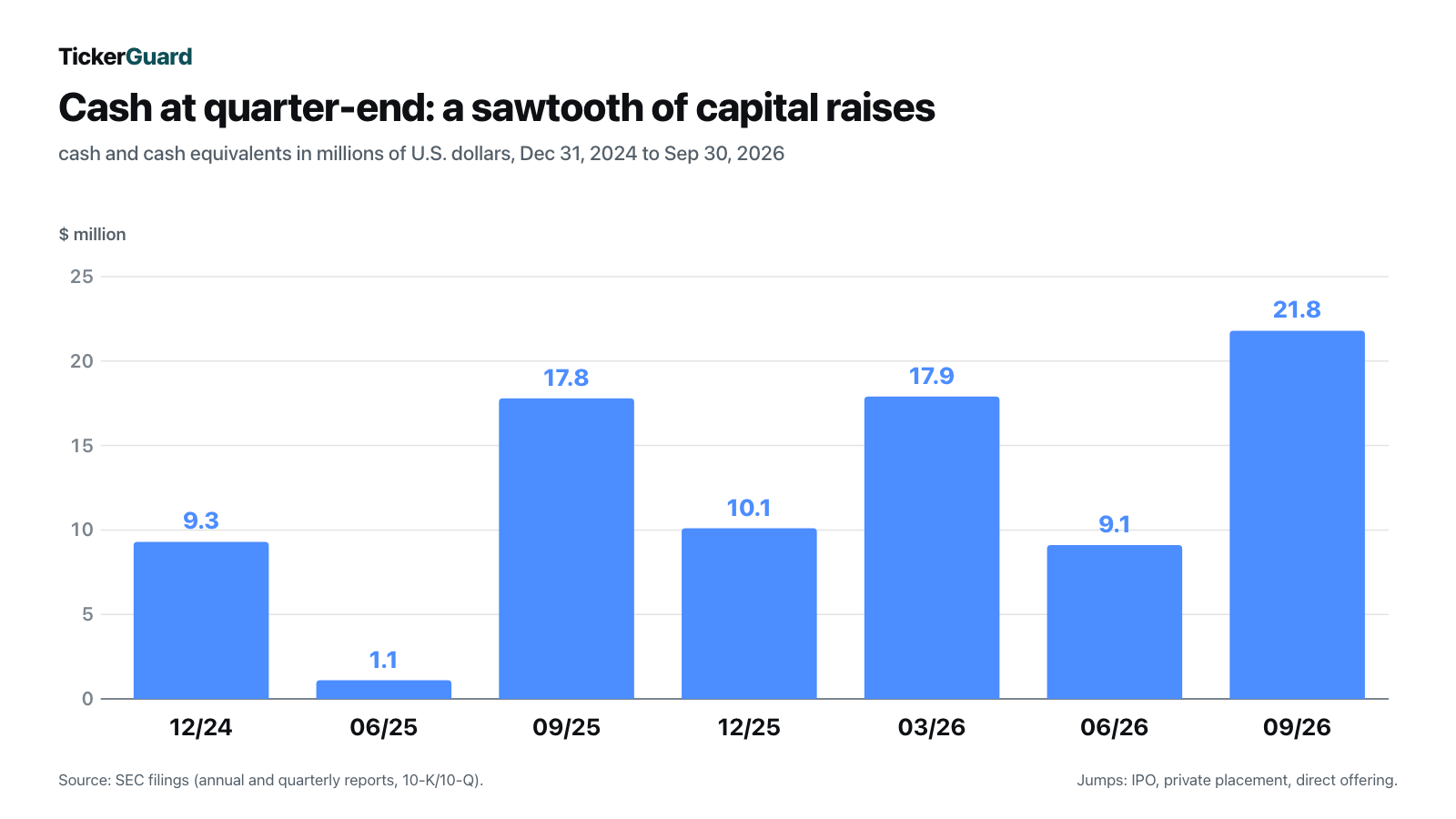
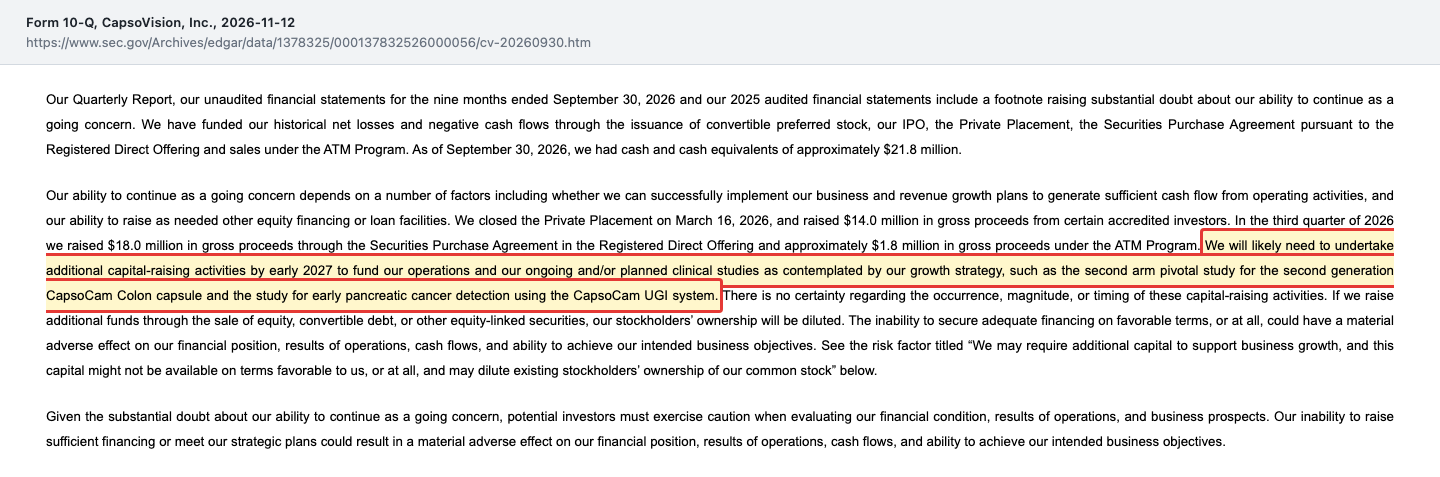
The teeth, one by one: the July 2025 IPO at $5.00 per share (about $23.4 million net). A private placement on March 16, 2026, of 2,867,089 shares at $4.883 ($14.0 million gross). In August 2026, an at-the-market program with Cantor Fitzgerald for up to $100 million, under which 276,446 shares were sold in the third quarter for about $1.7 million net. And on September 18, 2026, a registered direct offering of 3,163,444 shares at $5.69 ($18.0 million gross), about 5 percent below the last reported price of $5.99 on September 16, 2026. Together with exercised options and vested restricted stock units, the share count rose from 46.9 million on December 31, 2025 (46,865,051), to 53.6 million on November 11, 2026 (53,609,719 per the cover page of the quarterly report) — up 14.4 percent. Put simply: your slice of the pie keeps shrinking because new slices keep being cut to heat the bakery. And the quarterly report already announces the next slice:
"We will likely need to undertake additional capital-raising activities by early 2027 to fund our operations and our ongoing and/or planned clinical studies as contemplated by our growth strategy, such as the second arm pivotal study for the second generation CapsoCam Colon capsule and the study for early pancreatic cancer detection using the CapsoCam UGI system."
— CapsoVision, Inc., SEC 10-Q for Q3 2026, Item 1A Risk Factors
In fairness: two large holders wrote checks in September. In the September offering, Eliyahou Harari — who, together with family trusts, holds about 13.2 percent according to his ownership filing (SC 13G/A, as of September 18, 2026) — bought about $10 million worth, and Ching-Hang Shen's Star One Global Capital about $5 million. That is a vote of confidence — and also a sign of how small the circle of funders is. We worked through what it looks like when a medtech company with encouraging study data still hinges on financing in our Fractyl Health analysis; the pattern is related.
Uncomfortable truth No. 3: The big colon-cancer bet has already been reset once
The colon is the bet with which CapsoVision wants to grow beyond the small bowel. That is exactly where things have not gone to plan. In the second quarter of 2025, the company filed its 510(k) submission with the FDA for the first-generation CapsoCam Colon. In December 2025, the FDA raised questions on image processing, study design, sample size and the primary endpoint of an extended study. The consequence is in the quarterly report:
"Based on our communications with the FDA, we have decided not to further pursue the submission and approval for the First-Generation Product, and to prioritize our resources for the development of our second-generation of CapsoCam Colon capsule (the “Second-Generation Product”), which features improved imaging quality and increased field of review with use of AI and better lens."
— CapsoVision, Inc., SEC 10-Q for Q3 2026, Item 2 "Management’s Discussion and Analysis"
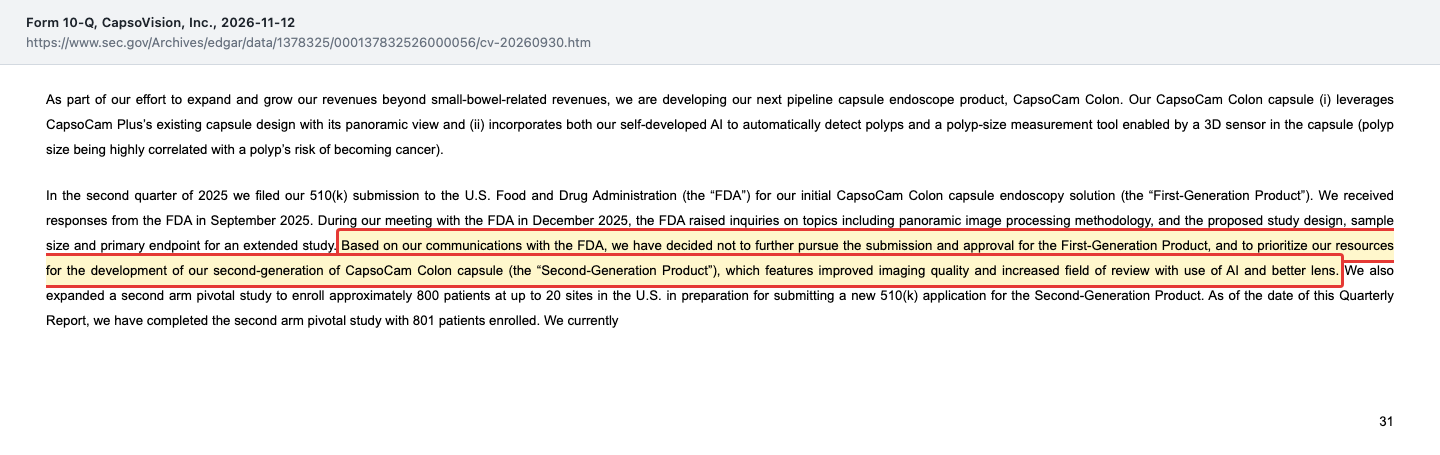
The second study arm, with 801 patients, has since been completed, and CapsoVision plans the new submission for the fourth quarter of 2026 — "subject to any further requests from the FDA." That is not a failure, but it is a delay of roughly a year and a half versus the first submission. And it shows how the race against the cash works: a loop with the regulator lengthens the road without slowing the hourglass. The pancreatic capsule took a hit too: in January 2026 the FDA declined the request for "Breakthrough Device" designation because the device did not specifically define diagnostic criteria.
Uncomfortable truth No. 4: On small-bowel AI, a competitor reached the market first
The AI clearance of September 2026 is the milestone carrying the headlines. The risk factors frame it more soberly: a competitor got there first.
"Notably, one competitor, Ankon (through its affiliate AnX Robotics), has already established a market presence with their FDA-cleared AI product for the small bowel in the U.S. and various other markets outside the U.S."
— CapsoVision, Inc., SEC 10-Q for Q3 2026, Item 1A Risk Factors
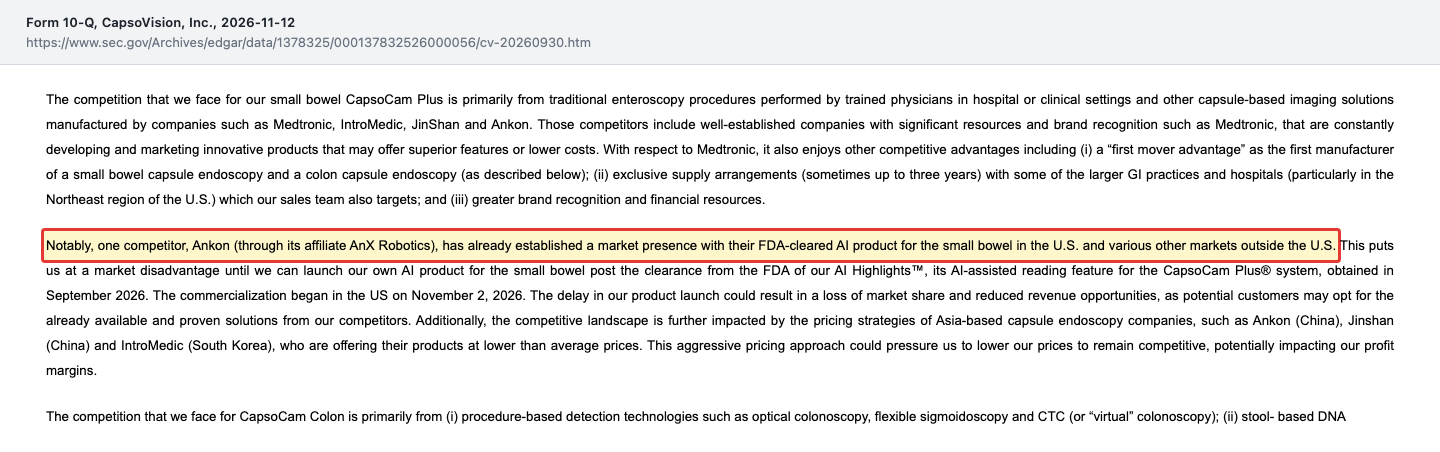
Then there is Medtronic: according to the quarterly report, it enjoys the first-mover advantage in small-bowel and colon capsules, exclusive supply arrangements of sometimes up to three years with some of the larger practices and hospitals, and greater brand recognition and financial resources. Asia-based players such as Ankon, JinShan and IntroMedic sell below average prices, according to the quarterly report. CapsoVision's pitch is the combination of 360-degree imaging and AI-assisted review, available, per the earnings release, for adults and children aged two and older. Whether physicians switch capsules for it is an open question — the company itself flags the risk that AI Highlights may not achieve the market acceptance it expects.
Valuation: the market cap prices in the future, not the present
At the closing price of $6.27 on November 12, 2026, CapsoVision's 53,609,719 shares (as of November 11, 2026) were worth about $336 million. A cross-check from the prospectus supplement ($5.99 closing price on September 16, 2026, times the 53,195,592 shares the prospectus supplement gives for immediately after the direct offering) gives about $319 million — the same ballpark. Against revenue for the last four quarters ($13.9 million), that is a price-to-sales ratio of about 24; put simply, the market pays $24 for every dollar of annual revenue. Shareholders' equity was $26.4 million on September 30, 2026, so the market value is roughly 13 times book value. There is no price-to-earnings ratio, because there are no earnings. This valuation is not paying for today's small-bowel business; it is paying for the hope of the colon and pancreatic capsules.
The view from the pros: according to fundamental data (as of November 13, 2026), only two analysts cover the stock, both rating it a buy with an average price target of $9.50. Two voices are not a consensus, they are a sample. For context on the price history: the highest close came on December 11, 2025, at $14.42, and the lock-up on about 41.1 million pre-IPO shares expired in early January 2026. How heavily a medtech valuation can lean on future approvals is also the theme of our Alpha Tau Medical analysis.
Upside and risks at a glance
What speaks for CapsoVision:
- A cleared product on the market with a growing base: CapsoCam Plus FDA-cleared since 2016, more than 184,000 patients through September 30, 2026; 2025 revenue of $13.6 million (up 15 percent).
- AI Highlights FDA-cleared on September 25, 2026, on sale in the U.S. since November 2, 2026, and in the EU since August 2026 — including for children as young as two.
- Second colon study arm with 801 patients completed; the 510(k) submission for second-generation CapsoCam Colon is planned for the fourth quarter of 2026, and study costs are expected to decline afterward.
- A balance sheet without bank debt (total liabilities of $6.4 million on September 30, 2026) and two large shareholders who bought in the September 2026 direct offering themselves.
What speaks against it:
- Going-concern note in the Q3 2026 quarterly report; $21.8 million in cash against about $7.2 million of cash burn per quarter — about 3.0 quarters on our math.
- Ongoing dilution: share count up 14.4 percent in 2026 through November 11, another raise expected by early 2027 per the filing, a program of up to $100 million ready; plus 3.9 million options, warrants and restricted stock units.
- Barely any growth this year (Q3 2026: up 0.8 percent; nine months: up 3.8 percent) and a lower gross margin (49 percent after 54 percent), partly due to pricier memory chips.
- The first colon capsule submission was dropped after FDA questions; on AI, competitor Ankon reached the market first, and Medtronic, per the filing, has the first-mover advantage and exclusive arrangements; assembly and suppliers sit mainly in Taiwan and Japan.
- A valuation of about 24 times annual revenue (at the November 12, 2026, price) bets on future approvals rather than today's business.
A human conclusion
Back to the milestone high from the beginning. At CapsoVision it is understandable, because the milestones are real: a capsule that has worked for years, an AI clearance, a finished study with 801 patients. But the high overlooks that those steps come with bills, and that the company has so far funded its losses with new shares. So the honest question for you is not "Is the technology good?" but: how many more times will the hourglass be turned over before the business carries itself — and at what price to your stake? If you believe in the colon capsule and accept the dilution as the price of admission, you have a thesis. If you only bought the AI-clearance headline, you have a high. What you make of it is your decision. And that is how it should be.
Sources
All original documents used in this analysis — so you can check them yourself:
- CapsoVision, Inc. — SEC quarterly report 10-Q for the period ended Sep 30, 2026 (filed November 12, 2026)
- CapsoVision, Inc. — Third-quarter 2026 earnings release, 8-K Exhibit 99.1 (November 12, 2026)
- CapsoVision, Inc. — SEC 10-Q for the period ended Jun 30, 2026 (filed August 13, 2026)
- CapsoVision, Inc. — SEC 10-Q for the period ended Mar 31, 2026 (filed May 14, 2026)
- CapsoVision, Inc. — SEC annual report 10-K for 2025 (filed March 26, 2026)
- CapsoVision, Inc. — SEC 10-Q for the period ended Sep 30, 2025 and Jun 30, 2025
- CapsoVision, Inc. — Current report 8-K on the registered direct offering (September 18, 2026) and prospectus supplement 424B5 (September 18, 2026)
- CapsoVision, Inc. — Prospectus supplement 424B5 for the at-the-market program of up to $100 million (August 21, 2026)
- Ownership filing SC 13G/A by Eliyahou Harari (filed November 4, 2026) and the full filing history: CapsoVision on EDGAR (sec.gov)
- Fundamental data (prices, analyst ratings; as of November 13, 2026), reconciled with the SEC filings.
Transparency & disclaimer: this analysis is journalistic commentary on publicly available information. It is not investment advice, not a regulated investment research product and not a solicitation to buy or sell securities. Equity investments carry substantial risk up to and including total loss. All information is provided without warranty; the as-of date for each figure is stated in the text. Positions held by the operator are disclosed daily; where one exists, it appears as a notice at the top of this analysis.
Key figures at a glance
All monetary figures in millions of $; earnings per share as reported.
| Metric | 2023 | 2024 | 2025 |
|---|---|---|---|
| Revenue | 9.8 | 11.8 | 13.6 |
| Operating Income (EBIT) | -11.3 | -19.9 | -25.5 |
| Net Income | -11.3 | -19.9 | -25.3 |
| Net Margin | -115.9% | -169.3% | -186.8% |
| Earnings Per Share | -0.29 $ | -0.43 $ | -0.54 $ |
Source: fundamental data & SEC filings (annual and quarterly reports, 10-K/10-Q)
Our Bottom Line at a Glance
- Product & clearances positive
- CapsoCam Plus has been FDA-cleared since 2016 and used in more than 184,000 patients (9/30/2026); the AI Highlights reading tool won FDA clearance on 9/25/2026, with U.S. sales starting 11/2/2026.
- Growth neutral
- Revenue grew 15% to $13.6 million in 2025, but only 3.8% after nine months of 2026 (Q3: +0.8%); gross margin slipped to 49% in Q3 2026 (prior year 54%). The company expects the AI impact only in 2027.
- Liquidity & going concern negative
- Going-concern note in the Q3 2026 10-Q; $21.8 million in cash against an average operating cash burn of $7.2 million per quarter — about 3.0 quarters on our math; next raise expected by early 2027 per the filing.
- Dilution negative
- Share count up 14.4% to 53.6 million from 12/31/2025 to 11/11/2026; three capital raises totaling $33.8 million gross in 2026, with an at-the-market program of up to $100 million in place.
- Pipeline & competition negative
- First CapsoCam Colon submission dropped after FDA questions (December 2025), second planned for Q4 2026; per the quarterly report, on AI Ankon reached the market first, and Medtronic has a first-mover advantage and exclusive arrangements.
CapsoVision is a textbook case of the milestone high: the capsule has worked for years, the AI reading tool has been cleared since September 2026, the second colon study is complete. Yet the quarterly report for the period ended September 30, 2026, itself doubts the company's ability to continue, the $21.8 million in cash lasts about three quarters on our math, and the losses have so far been funded with new shares (share count in 2026: up 14.4 percent). A market value of about 24 times revenue bets on approvals still to come. Not investment advice.
What Our Rating Means
Substance risk
We found at least one documented issue that threatens the company itself — regardless of how the stock is currently valued.
Red, because two documented substance risks coincide: the Q3 2026 quarterly report carries a going-concern note, and at the 2026 burn rate the cash lasts only about three quarters on our math. The company therefore depends on its next equity raise. The product itself is cleared and in use, and the balance sheet carries no bank debt — the rating says nothing against the technology, it speaks to the funding. At the November 12, 2026, price, the market pays about 24 times revenue for approvals that have not been granted. The decision is yours.
A journalistic assessment by our editorial team at the time of the deep dive, based on public sources — not investment advice and not a solicitation to buy or sell. Your personal circumstances (investment goals, risk capacity, taxes) cannot be taken into account. What our levels mean, how verdicts are formed, and what conflicts of interest exist →
Worth Noting
- This analysis was prompted by the quarterly report (10-Q) and earnings release (8-K) filed on November 12, 2026. Price reference: closing price of $6.27 on 11/12/2026; cross-check from the prospectus supplement: $5.99 on 9/16/2026.
- Data cut-off: the latest periodic report is the 10-Q for the period ended 9/30/2026; no further SEC filings through 11/13/2026. The November 12, 2026, conference call was not available as a transcript; no statements from it are used.
- The computed cash runway (about 3.0 quarters) is our own math: $21.8 million in cash divided by the average operating cash burn of the first nine months of 2026 ($7.2 million per quarter). Q4 2025 in the chart = fiscal 2025 minus nine months.
- Company name: until 2014 the SEC listed the company as "Capso Vision Inc"; major-holder figures come from Eliyahou Harari's SC 13G/A ownership filing (as of 9/18/2026, filed 11/4/2026).
Stock Watch
This analysis is as of November 13, 2026. Stock Watch will tell you what's changed at CV since then.
Later $1 a month per stock — signing up is free, and you'll be the first to know when it launches.
The full analysis as a PDF for later
We will send you this analysis as a PDF — to print, file away, and read at your own pace. And we will add you to the free Stock Watch list for CapsoVision, Inc. (CV), so you hear about it when something material in this analysis changes.
Frequently Asked Questions
CapsoVision, Inc. (Nasdaq: CV) of Saratoga, California, makes the CapsoCam Plus, a swallowable camera capsule that films the small bowel in 360 degrees with four cameras. It has been FDA-cleared since 2016 and was used in more than 184,000 patients through September 30, 2026. In development are a colon capsule (CapsoCam Colon) and a capsule for early pancreatic cancer detection.
In its quarterly report (10-Q) for the period ended September 30, 2026, CapsoVision says there is substantial doubt about its ability to continue for one year without additional capital. Cash was $21.8 million, and operations used $21.5 million in the first nine months. On our math the money lasts about three quarters; the company says it will likely need its next capital raise by early 2027.
The share count rose 14.4 percent between December 31, 2025, and November 11, 2026, to 53.6 million. Behind that are a March 2026 private placement ($14.0 million), a September registered direct offering at $5.69 ($18.0 million) and sales under an at-the-market program of up to $100 million. About 3.9 million options, warrants and restricted stock units come on top.
AI Highlights is an AI-assisted reading tool for the CapsoCam Plus capsule. It flags and prioritizes video images with suspected abnormal lesions so physicians can review studies faster. The FDA cleared it on September 25, 2026, and U.S. sales began on November 2, 2026. CapsoVision expects the full commercial impact only in 2027.
CapsoVision dropped its first 510(k) submission, filed in the second quarter of 2025, after FDA questions in December 2025. For the second generation, the study with 801 patients is complete, and the company plans the new submission for the fourth quarter of 2026, subject to further FDA requests. Per the 10-Q, sales are targeted within one quarter after a clearance.
At the closing price of $6.27 on November 12, 2026, the market value was about $336 million. That is roughly 24 times revenue for the last four quarters ($13.9 million) and about 13 times shareholders' equity ($26.4 million). There is no P/E ratio because there are no earnings. The price bets on future approvals, not on today's business.
Found an error?
Did you spot a factual error, an outdated number, or a typo in this deep dive? Let us know briefly — your report goes straight to the editorial team.