Jerash: The Sewing Shop Behind The North Face Earns 4.5x as Much - and Hangs on Two Customers
The North Face jacket in your closet may well have been sewn in Jordan - by a company worth about $93 million on Nasdaq. Jerash Holdings reports net income of $2.2 million for the quarter ended September 30, 2026, 4.5 times the prior year. Adjusted for the margin tailwind, about $1.4 million remains - and four of every five revenue dollars come from just two customers. What happens if one of them moves orders elsewhere?
 Thomas Mücke
Founder & Publisher
As of Today
As of: November 12, 2026
- Closing price
- 7.40 $ -5.80%
- Market Capitalisation
- 97.0 $M
- P/E
- 20.0
- Growth Score
- 6/10
- AAQS
- 5/10
This analysis has a cut-off date. The Stock Guard tells you when something material changes in the numbers. Reserve your free spot
Chart
Interactive price chart (TradingView).
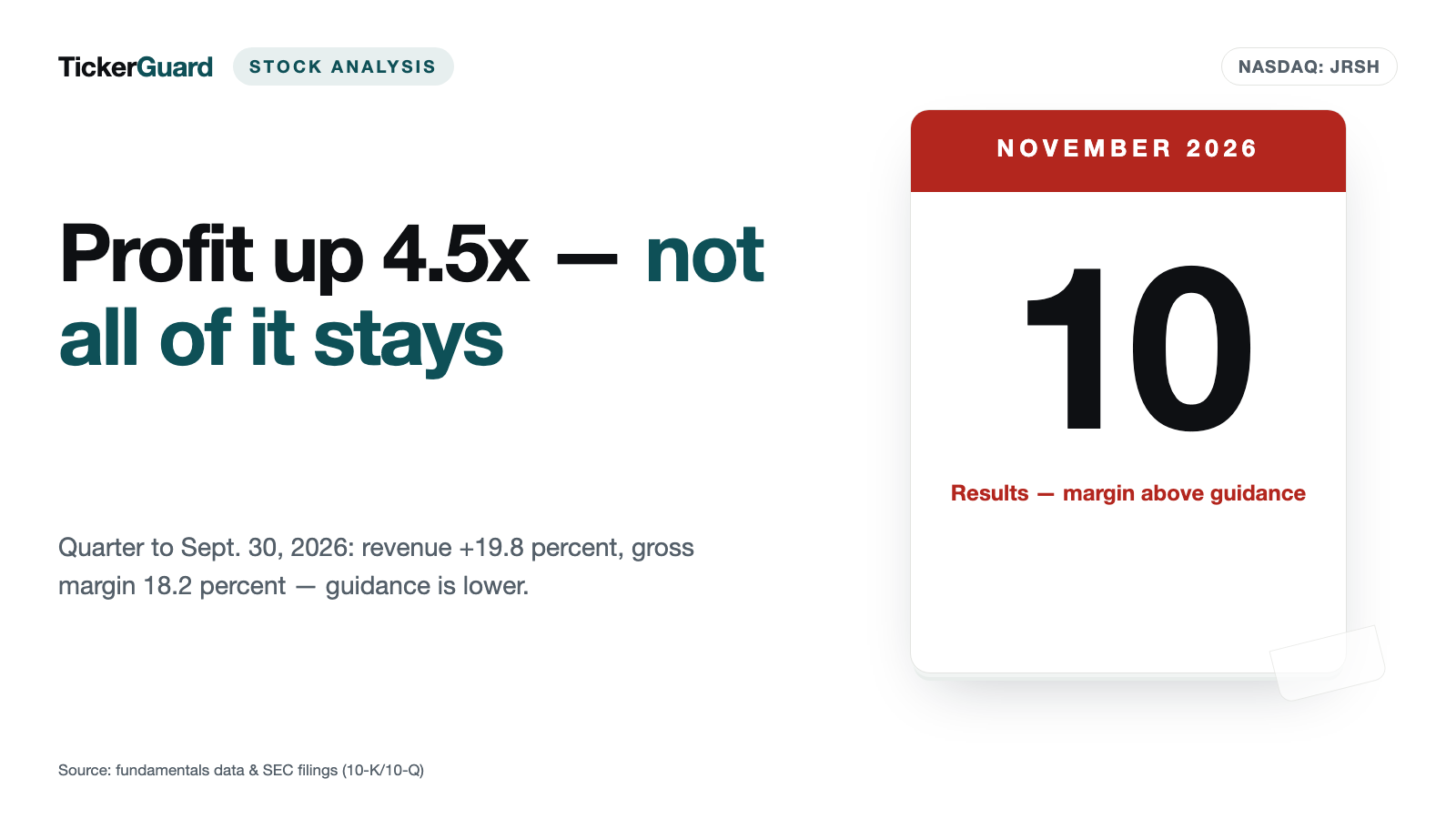
52-week range: 2.90 $ to 7.80 $ · Last price: 7.40 $ (As of: November 12, 2026)
Note: pure fact-based analysis, not investment advice and not a solicitation to buy or sell. All figures without guarantee.
The North Face or Timberland jacket in your closet may well have been sewn by people in Jordan - for a company worth less than $100 million on Nasdaq. And that very company has just reported net income 4.5 times the prior year. That is where a bias begins that strikes hardest right when the numbers look best: the anchoring effect of a record figure. The moment you read "net income up 4.5 times," that number lodges in your mind like an anchor in a harbor - and everything that follows is measured against it. If the next quarter is "only" twice as good as a year earlier, it feels like a letdown. Worse, you extrapolate the record as if it were the new normal. That is exactly what happened on November 10, 2026, with Jerash Holdings (US), Inc. (Nasdaq: JRSH). The press release for its fiscal 2027 second quarter reports revenue up 19.8 percent, a gross margin of 18.2 percent, and net income 4.5 times the prior year. Let's make a deal instead: we'll read what Jerash told the U.S. securities regulator, the SEC, two days later in its quarterly report (Form 10-Q) - and work out how much of the $2.2 million profit will come back and how much won't. The unadjusted profit figure is accurate, but here it tells only half the story.
What Jerash Holdings Actually Does - A Needle Shop With Customers Everyone Knows
Jerash Holdings isn't a fashion brand you see in stores - it's the company that sews for the brands you see in stores. It manufactures and exports custom sportswear and outerwear made from knitted fabric: jackets, polos, vests, t-shirts, pants, shorts. Production doesn't happen in China or Vietnam but almost entirely in the Hashemite Kingdom of Jordan - per the November 10, 2026 earnings release, eight factory units and six warehouses with about 6,600 employees; the annual report (Form 10-K) cites annual capacity of around 24 million pieces as of March 31, 2026. The earnings release names the customers: VF Corporation (owner of The North Face, Timberland, and Vans), New Balance, G-III (licensed brands such as Calvin Klein, Tommy Hilfiger, and Nautica), Urban Outfitters, American Eagle, and Acushnet (FootJoy). Founded as a Delaware holding company in January 2016, the group is based in Fairfield, New Jersey. The tension of this analysis is already built into the business model: Jerash lives on a handful of global brands entrusting it with their manufacturing - which makes it strong as long as those customers stay and vulnerable the moment even one leaves.
How the Stock Landed on Our Desk
The trigger is the fresh quarterly report: the earnings release on November 10, 2026 and the full quarterly report (Form 10-Q) on November 12, 2026 - for the quarter ended September 30, 2026, Jerash's fiscal 2027 second quarter. We read both, plus two filings from the days before, and the passages that didn't make it into the press release.
The Numbers Over the Years - Fairly Assessed
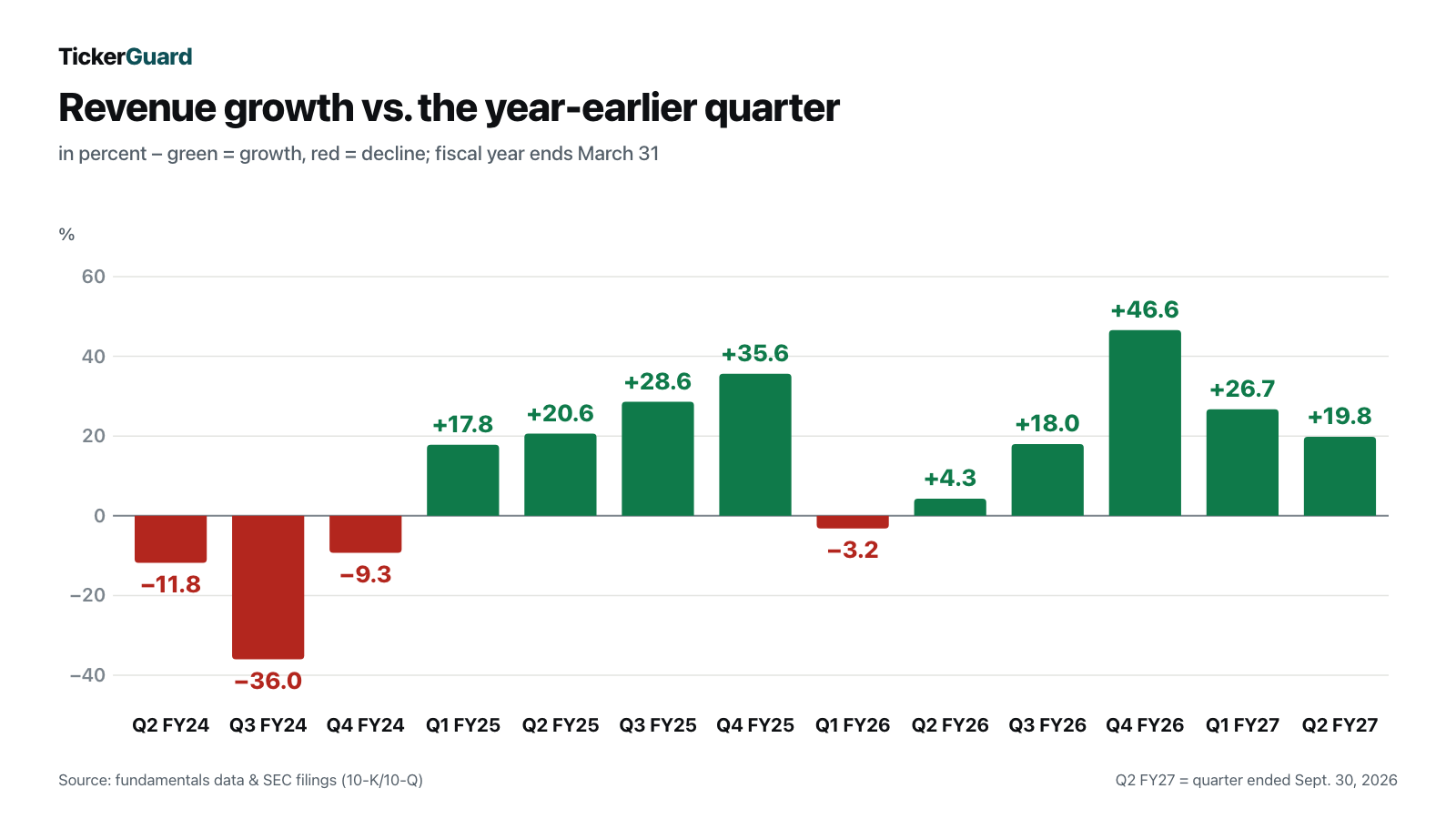
Let's start with what is genuinely impressive: Jerash has put a serious crisis behind it. Between late 2023 and early 2024, attacks on cargo ships in the Red Sea and congestion at the port of Haifa caused massive delivery delays - revenue plunged 36.0 percent in the quarter ended December 31, 2023, and three quarters in a row were negative. Since then the picture has turned:
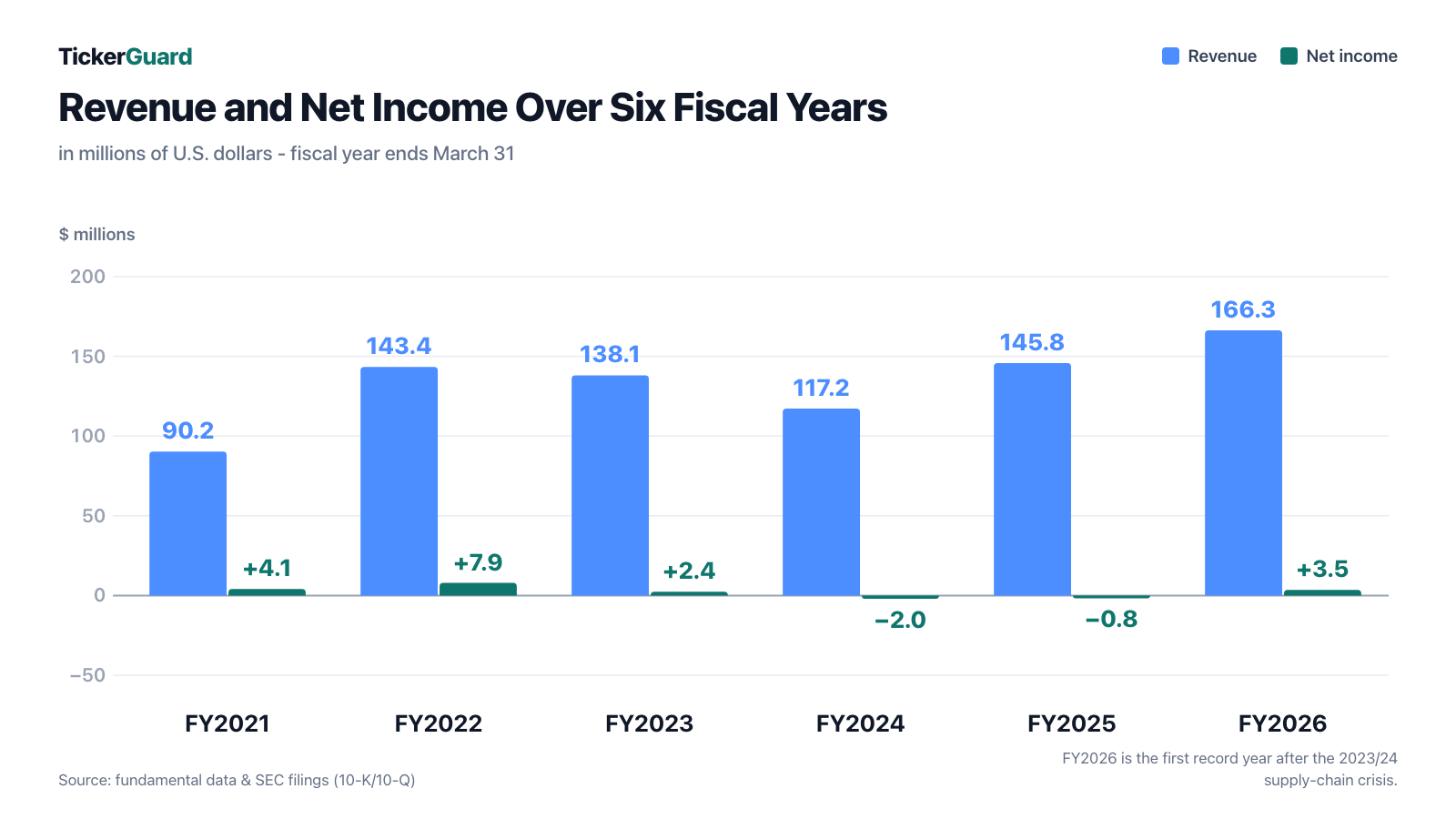
Over six fiscal years the pattern is even clearer: after the pandemic catch-up year 2022 ($143.4 million revenue) came two weaker years with net losses before fiscal 2026 (ended March 31, 2026) became the best revenue year so far, with $166.3 million in revenue and $3.5 million in net income.
And the latest quarter adds another layer. The key figures per the quarterly report, each against the year-earlier quarter (ended September 30, 2025):
- Revenue $50.3 million (prior year $42.0 million, +19.8 percent).
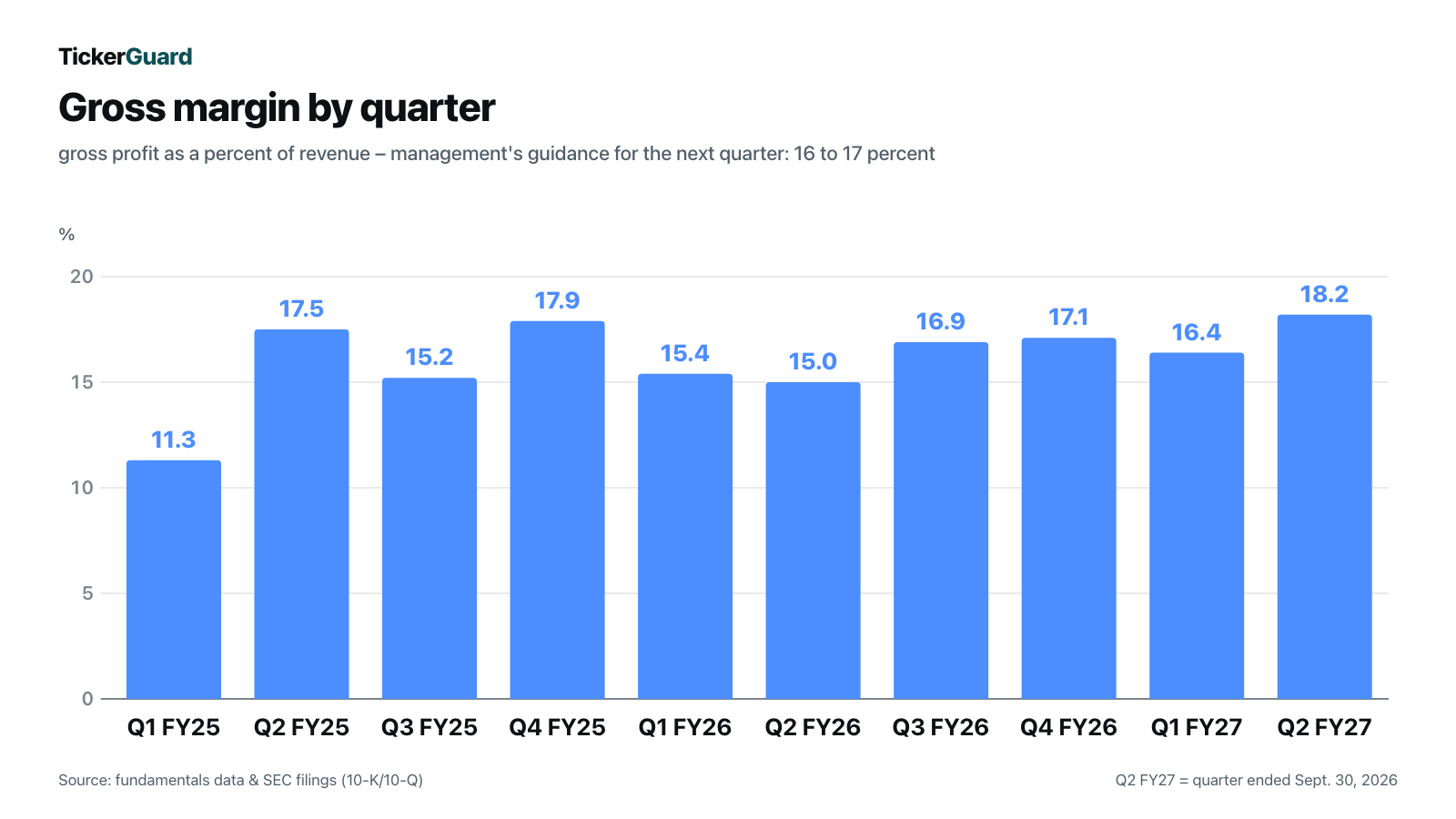
- Gross profit $9.1 million (prior year $6.3 million, +45.4 percent) - gross margin 18.2 percent versus 15.0 percent.
- Operating income $3.1 million (prior year $1.1 million, nearly threefold); operating expenses rose only from $5.2 to $6.1 million.
- Pre-tax income $2.6 million (prior year $0.6 million), income taxes $402,000 (prior year $154,000) - effective tax rate 15.7 percent versus 24.3 percent.
- Net income $2.2 million, $0.16 per diluted share (prior year $479,000 and $0.04) - 4.5 times. For the half year: $3.8 million versus $0.8 million, $0.29 versus $0.06 per share.
Adjusted, Not Dazzled: What Comes Back of the Profit
This is where the headline separates from the arithmetic. We put four questions to the profit, and the answers belong before the valuation, not in a footnote.
1. Are there one-off gains? No. The quarterly report shows no gain on a sale, no reserve release, and no special write-down that would explain the jump. The profit comes from ongoing manufacturing - the good news without an asterisk.
2. What does the tax rate contribute? The effective tax rate fell from 24.3 to 15.7 percent. The quarterly report attributes this to a tax concession in Jordan that cut the corporate income tax rate from 20 to 10 percent effective October 1, 2025. That is not a one-off but a lasting benefit - yet it explains part of the jump: at last year's tax rate (24.3 percent), net income would be about $1.94 million instead of $2.16 million, i.e. a good $0.2 million lower (own calculation).
3. How much of the margin is tailwind? The earnings release credits the 18.2 percent to higher shipments to U.S. customers with stronger margins, automation, "advance purchases of raw materials earlier in the second quarter," and tighter wastage controls. The same release guides next quarter to only 16 to 17 percent, citing higher transportation costs for imported raw materials. For context: in August management had guided 14 to 15 percent for the quarter just ended - 18.2 was delivered. Apply the guidance midpoint (16.5 percent) to the reporting quarter's revenue and you get gross profit of about $8.3 million instead of $9.1 million and net income of about $1.4 million instead of $2.2 million, roughly $0.11 instead of $0.16 per share (own calculation, assuming the guidance proves right).
4. And the cash flow? Operating cash flow for the half year is $7.5 million (prior year $0.3 million) - a strong figure, but $6.6 million of it comes from drawing down inventory (inventory of $23.3 million on September 30, 2026, versus $30.0 million on March 31, 2026). Inventory can only be emptied once. Without that item, about $0.9 million of operating cash inflow remains. Offsetting this, advances to suppliers rose by $3.2 million to $11.9 million - money paid ahead for capacity and materials in coming quarters.
The bottom line of the adjustment: even normalized, about $1.4 million of quarterly profit remains - just under three times the prior year. The improvement is real, only smaller than the headline. Whoever extrapolates the 18.2 percent as the new normal has fallen for the anchor.
Promised, Delivered, Turned - What Management Said and What Came of It
Jerash publishes guidance for the next quarter at the end of each earnings release - a number that has to withstand reality three months later. One note up front: transcripts of the earnings calls with analyst questions were not available to us for Jerash. What analysts probe in the Q&A we therefore cannot document; we rely on the written earnings releases (Form 8-K, Exhibit 99.1) that the company itself files with the SEC. The guidance scorecard:
| When said | What was promised | What was delivered |
|---|---|---|
| November 2024 | Revenue Q3 FY2025: +35 to 38% | +28.6% - missed (supply-chain crisis) |
| February 2025 | Revenue Q4 FY2025: +50 to 53% | +35.6% - missed (Haifa port congestion, about $3.8 million of goods stuck on the dock) |
| February 2026 | Revenue Q4 FY2026: +23 to 26% | +46.6% - almost double |
| June 2026 | Revenue Q1 FY2027: +20 to 22%; margin 15 to 17% | +26.7%; margin 16.4% - revenue beaten, margin within the range |
| August 2026 | Revenue Q2 FY2027: $49 to 51 million; margin 14 to 15% | $50.3 million; margin 18.2% - revenue within the range, margin 3 to 4 points above |
| November 2026 | Revenue Q3 FY2027: $49 to 51 million (+17 to 22%); margin 16 to 17% | open - report for the quarter ending 12/31/2026 |
The pattern is clear: in the middle of the crisis the guidance was too optimistic; since supply chains have been running, it has been cautious and gets beaten. Recently, results have come in at the top of the range or above guidance. That also applies to the August margin - only the 14 to 15 percent range then says little about actual earning power and a lot about management's restraint.
Where the tone turned, CEO Sam Choi's quotes show:
- Demand: In June 2026 the factories were "fully booked through December 2026." In November: "Our production facilities are fully booked through June 2027, and order in-flow remains strong." That is half a year more visibility - the clearest positive shift in tone.
- Capacity: In June management promised roughly 15 percent more capacity from the first expansion phase by the end of 2026 and a further 20 to 25 percent for the remainder by mid-2027. In November the talk is of renovating the most recently acquired facility plus a third satellite factory supported by the Jordanian government, which "together" are expected to add about 15 to 20 percent of capacity - done by September 2027. Whether the 15 to 20 percent comes on top of the 15 percent first phase, the release does not say; the completion date has in any case moved from mid-2027 to September 2027.
- Trade and logistics: In August, Choi called the situation "encouraging" and pointed to "newly announced duty-free access" for Jordanian apparel. In November he speaks of "logistics challenges across the Middle East" and higher import transportation costs from regional shipping disruptions - and credits the margin explicitly to "strategic early purchases of raw materials." The tone has shifted from the tailwind argument to the headwind-mastered argument, and next quarter's guidance goes down accordingly.
- Strategy: In June 2026 management spoke of "increased emphasis on customer diversification." The customer table in the quarterly report (see below) shows a higher, not lower, share for the two largest customers this quarter.
What the Quarterly Report Says - The Uncomfortable Truths
Uncomfortable Truth No. 1: Two Customers Carry 80 Percent of Revenue
"Profit up 4.5 times" sounds like broad demand. The customer table in the quarterly report shows something else.
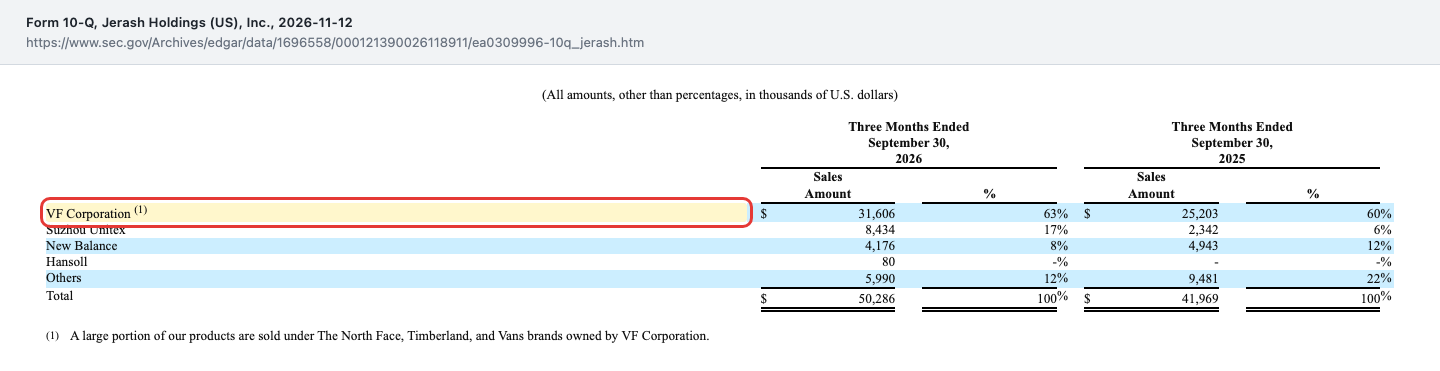
In an everyday image: picture a restaurant reporting dazzling revenue - and on closer look you learn two corporate clients book four-fifths of all tables. As long as they keep coming, everything looks great. If one stays away, things change overnight. The shift in detail: VF Corporation's share rose from 57 percent in the prior quarter (60 percent in the year-earlier quarter) to 63 percent; Suzhou Unitex, a customer registered in China and Hong Kong whose orders, per the report, are mainly shipped to the U.S., jumped from 6 to 17 percent versus the year-earlier quarter. Also versus the year-earlier quarter, New Balance fell from 12 to 8 percent and the remainder from 22 to 12 percent; new South Korean customer Hansoll contributed only $80,000 in the quarter ($2.2 million for the half year). Concentration has risen, not fallen - most of the quarter's growth came from the same addresses. How dependence on a few large buyers can weigh on a stock is also shown in our analysis of Hyster-Yale.
Uncomfortable Truth No. 2: The Press Release Names a Margin Driver the Quarterly Report Leaves Out
The November 10 earnings release explains the margin like this:

The quarterly report, which gives the reasons for the same margin, speaks only of higher shipments to U.S. customers, automation, and "improved controls on raw material purchases and wastage allowances" - the advance purchases are missing there. Why it matters: a raw material bought early, and probably cheaply, lifts the margin in the quarter it is processed without changing anything about the business's earning power. The 16 to 17 percent guidance for next quarter says this tailwind does not continue at the same strength.
Uncomfortable Truth No. 3: The Entire Manufacturing Base Hangs on One Country - and the Tariff Hasn't Gone Away
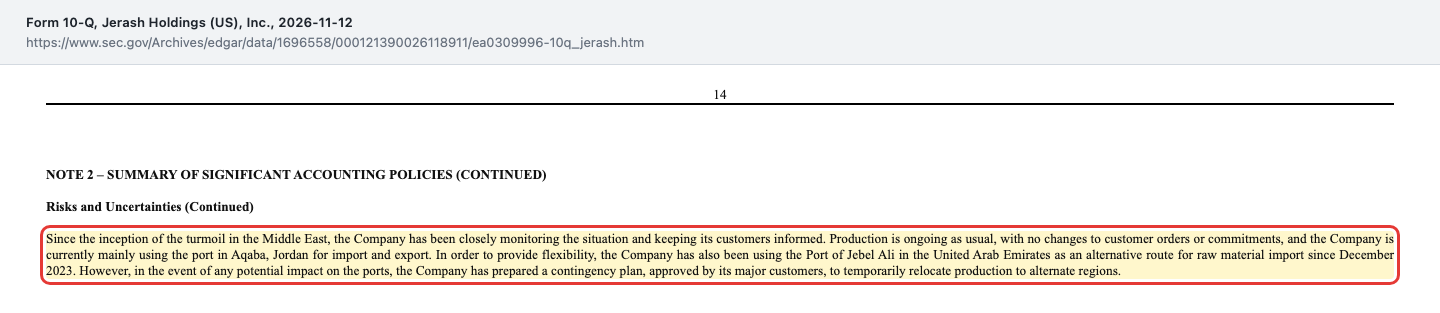
Jerash manufactures practically exclusively in Jordan. That is on the one hand the core of the investment story - customers see the location as a tariff-advantaged alternative to China and Vietnam - and on the other hand a cluster risk: a single geopolitical event can hit the entire production. The report itself says so openly:
"Since the inception of the turmoil in the Middle East, the Company has been closely monitoring the situation and keeping its customers informed. Production is ongoing as usual, with no changes to customer orders or commitments, and the Company is currently mainly using the port in Aqaba, Jordan for import and export. In order to provide flexibility, the Company has also been using the Port of Jebel Ali in the United Arab Emirates as an alternative route for raw material import since December 2023. However, in the event of any potential impact on the ports, the Company has prepared a contingency plan, approved by its major customers, to temporarily relocate production to alternate regions."
- Jerash Holdings (US), Inc., Form 10-Q, filed November 12, 2026, Note 2
Read positively: the customers co-signed the plan; they want to keep Jerash as a partner. Read soberly: a contingency plan is only needed when the normal case fails, and until then the entire value creation hangs on one country. On trade: since July 28, 2026, a 10 percent tariff on goods from Jordan has applied following a Section 301 forced-labor investigation, with exemptions in Annex I and II of the notice. The quarterly report states: "Most of the garment categories that Jerash manufactures fall within the HTSUS codes in the exceptions and thus are not subject to the tariff." That is the reassurance that was missing in August; the share that is not exempt is still not quantified.
Uncomfortable Truth No. 4: Two Side Notes in the Fine Print
Pay restructuring at the top. On October 30, 2026, subsidiary Treasure Success terminated the consulting agreements with two companies owned by CEO Choi Lin Hung (Sam Choi) and Chairman Ng Tsze Lun, respectively; both move to direct employment contracts on November 1, 2026, each with a monthly base salary of HK$297,000 and a year-end payment of one month's salary. The quarterly report puts the former consulting fees at $300,000 per year each ($75,000 per quarter) and notes that the agreements were terminated as part of the restructuring. It gives no figure for the new total compensation; at about HK$7.8 per U.S. dollar, 13 monthly salaries would be roughly $495,000 per person (own calculation).
A lawsuit in the fine print. Part II of the quarterly report says the company is "not currently involved in any material legal proceedings." The notes additionally describe a 2020 dispute over protective equipment: a court of first instance ordered Jerash Garments to pay $653,000, an appeal is pending, and management, citing legal opinions, considers a loss "remote" and has accrued nothing. Against quarterly profit of $2.2 million this is no existential question, but a number worth knowing.
Valuation: Not a Bargain, but Not a Hype Price Either
How expensive is Jerash? At a market capitalization of about $93 million and trailing-twelve-month diluted earnings per share of $0.47, the price-to-earnings ratio is about 15.6 (fundamental data as of November 13, 2026; market value cross-checked against 12,699,940 shares and the latest closing price of about $7.35). That is the unadjusted figure. Put the latest quarter at the guidance margin (the adjustment above, about $0.7 million less net income) and the price-to-earnings ratio rises to about 17.5 (own calculation, based on diluted EPS of $0.47 less about $0.05 for the margin effect) - the trailing profit still contains the tailwind. Book value per share is about $5.24, so the stock trades at roughly 1.4 times book; equity was $67.9 million on September 30, 2026. On top comes a dividend of $0.05 per quarter ($0.20 per year), declared again by the board on November 5, 2026 (payable November 23 to holders of record November 16) - at about 43 percent of trailing earnings per share (own calculation) well covered; $1.3 million went to shareholders in the first half. The balance sheet: cash of $16.1 million (plus $0.8 million restricted), bank loans of $2.8 million and credit facilities of $4.5 million ($7.3 million together), and current assets covering current liabilities 3.1 times. What clouds the picture is market thinness: of the 12.7 million shares outstanding, about half are held by insiders, and the free float is only about 6.3 million shares (fundamental data) - a small, thinly traded stock where even moderate buy or sell orders can move the price.
Opportunities and Risks at a Glance
What speaks for Jerash Holdings:
- Structural recovery rather than a flash in the pan: nine of ten quarters with revenue growth since the low of the supply-chain crisis, with guidance beaten for months.
- The profit comes from ongoing manufacturing: no one-off gain in the quarterly report, a tax benefit of lasting nature, and even with a normalized margin about three times the prior year's profit remains.
- Good visibility: per management, the factories are booked through June 2027; additional capacity of about 15 to 20 percent is due by September 2027.
- Solid balance sheet: equity of $67.9 million, current assets at 3.1 times current liabilities, no going-concern warning, dividends paid continuously since 2018.
What speaks against:
- Extreme and rising customer concentration: VF Corporation and Suzhou Unitex together 80 percent of quarterly revenue (prior year 66 percent) - losing either would hit the balance sheet immediately.
- A margin with a tailwind: 18.2 percent is above guidance; management expects 16 to 17 percent next quarter, and the half-year cash flow rests with $6.6 of $7.5 million on inventory reduction.
- One-country manufacturing in Jordan: the contingency plan to relocate production is a safety net, not a second site; plus transportation costs from Middle East disruptions and a 10 percent tariff whose exemptions cover most, but not all, categories per the report.
- Small, thin stock with about 6.3 million shares of free float; dilution cushion of 907,840 RSUs and 150,000 options (together about 8.3 percent of shares).
A Human Conclusion
Back to the anchoring effect from the start. Its trick isn't that it lies to you - Jerash Holdings did deliver a strong quarter with a clean explanation: more volume, more efficiency, no one-off gain. Its trick is that it turns the best number into the yardstick. Calculate honestly and about $1.4 million of the $2.2 million remains as a repeatable core - still three times what it was a year ago, but not the 4.5-fold headline. And that core stands on four-fifths of revenue at two phone numbers and on a single country. The honest question for you therefore isn't "profit up 4.5 times - buy?" but: Would you want to pay for a core of $1.4 million in quarterly profit if you knew one of the two major customers might move part of its orders elsewhere tomorrow? If so, you have a thesis that goes beyond the headline. If not, you only saw the anchor. What you make of it is your decision.
Sources
All primary documents used in this analysis - to read for yourself:
- Jerash Holdings (US), Inc. - SEC Form 10-Q for the quarter ended 09/30/2026 (filed November 12, 2026)
- Jerash Holdings (US), Inc. - Form 8-K with earnings release for fiscal 2027 second quarter (filed November 10, 2026)
- Jerash Holdings (US), Inc. - Form 8-K on the pay restructuring of the CEO and chairman (filed November 2, 2026)
- Jerash Holdings (US), Inc. - Form 8-K on the quarterly dividend (filed November 5, 2026)
- Jerash Holdings (US), Inc. - SEC Form 10-K for fiscal 2026 (filed June 18, 2026)
- Jerash Holdings (US), Inc. - earnings releases of the preceding quarters (Form 8-K, Exhibit 99.1), filed between June 27, 2024 and August 10, 2026, each with next-quarter guidance
- Complete SEC filing history for Jerash Holdings (US), Inc.: EDGAR overview (sec.gov)
- Fundamental data (metrics, valuation, free float; as of November 13, 2026), cross-checked against the SEC filings.
Transparency & disclaimer: This analysis is a journalistic assessment of publicly available information. It is not investment advice, not a regulated financial analysis, and not a solicitation to buy or sell securities. Equity investing carries substantial risk, including total loss. All figures are provided without guarantee; data dates are noted in the text. Positions held by the operator are disclosed daily; where one exists, it appears as a notice at the top of this deep dive.
Key figures at a glance
All monetary figures in millions of $; earnings per share as reported.
| Metric | 2022 | 2023 | 2024 | 2025 | 2026 |
|---|---|---|---|---|---|
| Revenue | 143.4 | 138.1 | 117.2 | 145.8 | 166.3 |
| Operating Income (EBIT) | 10.5 | 4.4 | -0.7 | 1.4 | 6.3 |
| Net Income | 7.9 | 2.4 | -2.0 | -0.8 | 3.5 |
| Net Margin | 5.5% | 1.8% | -1.7% | -0.6% | 2.1% |
| Earnings Per Share | 0.67 $ | 0.19 $ | -0.16 $ | -0.07 $ | 0.27 $ |
Source: fundamental data & SEC filings (annual and quarterly reports, 10-K/10-Q)
Our Bottom Line at a Glance
- Growth & earnings quality positive
- Quarter ended 09/30/2026: revenue +19.8 percent, net income $2.2 million (prior year $0.5 million) with no one-off gains. Adjusted for the margin tailwind (guidance 16 to 17 instead of 18.2 percent), about $1.4 million remains - three times the prior year. Nine of ten quarters since the 2023/24 supply-chain crisis with revenue growth, guidance recently beaten regularly.
- Customer concentration negative
- VF Corporation (63%) and Suzhou Unitex (17%) together account for 80 percent of quarterly revenue (10-Q for 09/30/2026), up from 66 percent a year earlier. The announced diversification does not show in the customer table; new customer Hansoll contributed only $80,000 in the quarter.
- Manufacturing base & trade policy neutral
- Practically all production sits in Jordan; a contingency plan to relocate production, backed by the major customers, exists but is only a safety net. The 10 percent tariff (Section 301, since 07/28/2026) does not hit most apparel categories per the quarterly report because of exemptions; higher transportation costs from Middle East disruptions weigh on margin guidance.
- Balance sheet & payout positive
- Equity of $67.9 million, cash of $16.1 million, bank loans and credit facilities together $7.3 million, current assets 3.1 times current liabilities, no going-concern warning. Quarterly dividend of $0.05 paid continuously since 2018, most recently declared 11/05/2026. Half-year operating inflow ($7.5 million) came $6.6 million from inventory reduction; a court judgment of $653,000 (under appeal) is not accrued.
- Tradability & ownership neutral
- About half of the 12.7 million shares are held by insiders, free float only about 6.3 million shares (fundamental data) - a small, thinly traded stock. Plus a dilution cushion of 907,840 RSUs and 150,000 options (about 8.3 percent of shares).
Jerash Holdings delivers a strong, clean result in fiscal 2027 second quarter - revenue up 19.8 percent, net income 4.5 times, with no visible one-offs. Against its own guidance, though, the margin had a tailwind; adjusted, about $1.4 million rather than $2.2 million of quarterly profit remains. Two customers carry 80 percent of revenue, and the entire manufacturing base hangs on one country. An operationally healthy company with an open structural question - not investment advice.
What Our Rating Means
Open questions
The business works in principle, but one material question is open. As long as it stays open, our findings do not carry a quality verdict.
Operating substance is documented: a profitable, growing business, a solid balance sheet, no governance or accounting breaks, dividends paid continuously since 2018. The light is yellow because of an open operating question that is not (yet) an existential one: extreme and recently rising customer concentration (80 percent at two addresses), paired with a one-country manufacturing base and a profit that partly rests on a margin management itself sets lower for next quarter. That is a price/risk argument for the entry timing, not a substance risk in the sense of the light - the decision is yours.
A journalistic assessment by our editorial team at the time of the deep dive, based on public sources — not investment advice and not a solicitation to buy or sell. Your personal circumstances (investment goals, risk capacity, taxes) cannot be taken into account. What our levels mean, how verdicts are formed, and what conflicts of interest exist →
Worth Noting
- This analysis is triggered by the earnings release (Form 8-K) of 11/10/2026 and the quarterly report (Form 10-Q) of 11/12/2026 for fiscal 2027 second quarter (quarter ended 09/30/2026); it replaces the version of 08/13/2026 on the quarter ended 06/30/2026.
- Valuation and free-float figures as of November 13, 2026 (fundamental data), cross-checked against the SEC filings; figures marked "own calculation" are the editorial team's computations from those reports; no daily quote is a buy argument.
- Not to be confused: Jerash Holdings (US), Inc. is the U.S.-listed Delaware holding company (Nasdaq: JRSH) with manufacturing in Jordan - not an Israeli, Jordanian, or Chinese listing with the same or a similar name.
Stock Watch
This analysis is as of November 13, 2026. Stock Watch will tell you what's changed at JRSH since then.
Later $1 a month per stock — signing up is free, and you'll be the first to know when it launches.
The full analysis as a PDF for later
We will send you this analysis as a PDF — to print, file away, and read at your own pace. And we will add you to the free Stock Watch list for Jerash Holdings US Inc (JRSH), so you hear about it when something material in this analysis changes.
Frequently Asked Questions
Jerash Holdings (US), Inc. (Nasdaq: JRSH) manufactures and exports customized, ready-made sportswear and outerwear made from knitted fabric - jackets, polo shirts, t-shirts, pants, shorts. Production happens almost entirely in eight factory units in Jordan for global brands such as VF Corporation (The North Face, Timberland, Vans), New Balance, G-III, Urban Outfitters, American Eagle, and Acushnet.
Net income rose to $2.2 million ($0.16 per diluted share) in the quarter ended September 30, 2026, 4.5 times the prior year. The quarterly report names no one-off gains. If you scale the gross margin back to management's guidance of 16 to 17 percent (instead of 18.2 percent), about $1.4 million remains - three times the prior year (own calculation). The lower tax rate (15.7 versus 24.3 percent) is a lasting effect.
Very. Per the quarterly report, VF Corporation (63 percent) and Suzhou Unitex (17 percent) together accounted for 80 percent of revenue in the quarter ended September 30, 2026, up from 66 percent a year earlier. New Balance fell from 12 to 8 percent versus the year-earlier quarter; new customer Hansoll of South Korea contributed only $80,000 in the quarter.
Since the supply-chain crisis, guidance has been cautious and gets beaten: for the quarter ended September 30, 2026, management guided $49 to 51 million in revenue and a 14 to 15 percent gross margin in August - $50.3 million and 18.2 percent were delivered. For next quarter, $49 to 51 million in revenue and a 16 to 17 percent margin are guided. On capacity and utilization there are partly new figures: booked through June 2027 instead of December 2026, and capacity up 15 to 20 percent by September 2027.
Since July 28, 2026, a 10 percent tariff on goods from Jordan has applied following a Section 301 forced-labor investigation, with exemptions in Annex I and II. Per the quarterly report, most of Jerash's garment categories fall under the exemptions and do not pay it. The company does not quantify exactly what share of revenue the tariff hits.
Yes. On November 5, 2026, the board declared a regular quarterly dividend of $0.05 per share ($0.20 per year), payable November 23, 2026 to holders of record November 16. That is about 43 percent of trailing-twelve-month earnings per share (own calculation); per fundamental data it has been paid continuously since 2018.
At a market capitalization of about $93 million and trailing diluted earnings per share of $0.47, the price-to-earnings ratio is about 15.6 (as of November 13, 2026); adjusted for the latest quarter's margin tailwind it is about 17.5 (own calculation). The stock trades at roughly 1.4 times its book value of $5.24 per share. Not a bargain, but not a hype price either - plus a thin stock with only about 6.3 million shares of free float.
Found an error?
Did you spot a factual error, an outdated number, or a typo in this deep dive? Let us know briefly — your report goes straight to the editorial team.