Traeger: Sales Collapse, the Stock Jumps — and $403 Million Comes Due in 2028
Traeger promises growth in the fourth quarter — right after a summer quarter with 40 percent less revenue. The market believed it and lifted the stock by a quarter in a single day. But even if the promise holds: is one strong quarter enough to replace the $403 million loan that comes due in June 2028? Not investment advice — just the math behind the jump.
 Thomas Mücke
Founder & Publisher
As of Today
As of: November 12, 2026
- Closing price
- 57.90 $ -6.20%
- Market Capitalisation
- 0.2 $B
- Growth Score
- 3/10
- AAQS
- 1/10
Price change since November 11, 2026: -6.3%
This analysis has a cut-off date. The Stock Guard tells you when something material changes in the numbers. Reserve your free spot
Chart
Interactive price chart (TradingView).
52-week range: 0.539 $ to 82.00 $ · Last price: 57.90 $ (As of: November 12, 2026)
Note: pure fact-based analysis, not investment advice and not a solicitation to buy or sell. All figures without guarantee.
"Next quarter will be better." Few sentences have been said more often on Wall Street — and few are believed more willingly. I call it the postponement trap: when a company disappoints but moves success to the next quarter, we reward the promise as if it had already been kept. Traeger (NYSE: COOK), the inventor of the wood pellet grill, is offering a current example. On November 4, 2026, the company reported third-quarter revenue down 40.4 percent and a net loss of $28.5 million. At the same time, CEO Jeremy Andrus promised growth in the fourth quarter. On the next trading day, the stock rose 24.7 percent to $62.03. Let's make a deal: before you let that jump carry you away, let's read together what Traeger itself has filed with the U.S. securities regulator, the SEC — the quarterly report (10-Q) of November 5, 2026, this year's earnings releases (8-K) and the annual report (10-K) for 2025. In the end, the decision is yours.
What Traeger actually does — the pellet grill and everything around it
Traeger invented a product category. The annual report says so plainly:
"In 1987, we invented the original wood pellet grill. The original Traeger helped to transform outdoor cooking by making it easy to enjoy the delicious flavors of wood-fired food."
— Traeger, Inc., 10-K for 2025, Item 1 "Business"
In everyday terms, a pellet grill is a grill with a built-in heater and thermostat. You fill the hopper with compressed wood pellets, an auger feeds them into a small fire pot, and the electronics hold the temperature — you get wood-fire flavor without standing next to the fire. Traeger makes money in three ways: the grills themselves (about 51 percent of revenue in the first nine months of 2026), consumables such as wood pellets, rubs and sauces, and accessories, including the MEATER wireless meat thermometers Traeger acquired in July 2021. Pellets come mainly from owned or leased plants in the U.S., supplemented by contract manufacturers in the U.S. (and, according to the 2025 10-K, in Poland); the grills are made by contract manufacturers, about 80 percent of them in China, according to the 2025 10-K.
Sales now run almost entirely through retailers. As part of a cost program called "Project Gravity," Traeger largely shut down its own online store and redirected shoppers to its retail partners' websites. That makes Traeger a classic branded manufacturer that lives on a handful of large customers. In August 2026, it added a partnership with home-improvement chain Lowe's, with a national launch announced for spring 2027. Traeger was acquired in 2017; since September 2017, partners of private-equity firm AEA have sat on its board. The company has been listed on the New York Stock Exchange since July 2021, is headquartered in Salt Lake City and had 433 full-time employees at the end of 2025.
That sets up the central tension of this analysis: a strong brand is selling much less, cutting costs hard and has refilled its cash pile — but it carries a $403 million loan whose interest the operating business has not earned for years, and everything now hinges on the promise for next quarter.
Company history for investors
-
1987
The pellet grill is invented
According to the annual report, Traeger invented the wood pellet grill in 1987. For shareholders: the brand has genuine roots — though the original patent expired back in 2006.
-
2017
The acquisition
Traeger is acquired in 2017; since September 2017, partners of private-equity firm AEA have sat on its board. For shareholders: this deal created the large intangible assets and most of the annual amortization of customer relationships and trademarks (about $35 million a year from the 2017 and 2021 acquisitions, about $32 million of it from 2017).
-
2021
IPO and MEATER acquisition
In July 2021, Traeger listed on the New York Stock Exchange and bought thermometer maker MEATER. For shareholders: the strongest revenue year so far ($785.5 million).
-
2025
Cost program and impairment
"Project Gravity" started in May; in the third quarter, all $74.7 million of goodwill was written off. For shareholders: a net loss of $115.2 million for 2025.
-
2026
1-for-50 reverse split
After two NYSE notices over a share price below $1, Traeger combined every 50 shares into one on March 17. For shareholders: the value of your stake is unchanged. Since then the stock has traded far above $1; the 10-Q of November 5, 2026, mentions no open deficiency.
-
2026
Revenue −40%, guidance narrowed
Third-quarter revenue fell to $74.7 million, and Traeger promised growth in the fourth. For shareholders: a 24.7 percent jump on a promise.
How the stock landed on our desk
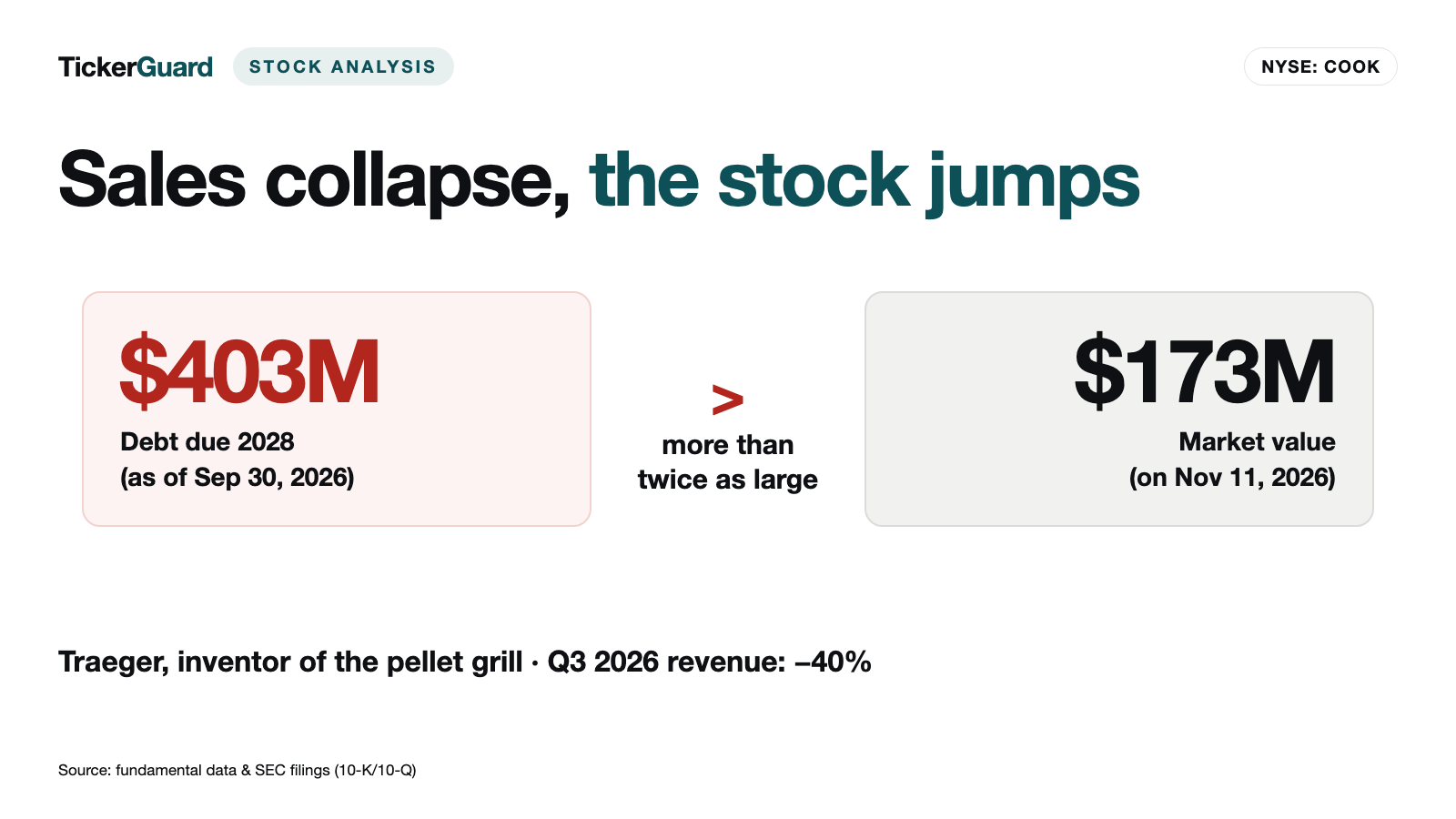
Traeger landed on our desk through the earnings release of November 4, 2026 — or, more precisely, through the market's reaction to it. The numbers were weak, yet the stock jumped from $49.75 (close on November 4) to $62.03 (November 5). At the November 11, 2026, close of $61.79 and 2,804,287 shares (10-Q cover, as of October 30, 2026), Traeger is worth about $173 million.
Two things matter about that price. First: in March 2026, Traeger combined every 50 old shares into one new share — a so-called reverse split. Think of it as trading fifty one-dollar bills for a fifty-dollar bill; your wallet is not worth a cent more. The trigger was two letters from the New York Stock Exchange dated November 19, 2025, and March 5, 2026, because the average share price had dropped below $1 — a threshold that can ultimately lead to delisting. Since the reverse split, the stock has traded far above that line, and the 10-Q of November 5, 2026, mentions no open deficiency. Second: converted to today's share count, the closing price on the first trading day, July 29, 2021, was about $1,100 (source: fundamental data). Anyone who bought at the first closing price has lost about 94 percent. Remember: a one-day jump of a quarter is not a sign of a healthy business at Traeger — it is the sign of a stock that reacts violently to any hope.
The numbers over the years — honestly assessed
First, what genuinely impresses. Traeger cleaned house hard in 2025 and 2026. "Project Gravity," approved in May 2025, is expected to deliver $64 million to $70 million of annual run-rate savings, according to the 10-Q; about $20 million showed up in 2025, and Traeger expects about $30 million in 2026. Sales and marketing expenses fell 34.3 percent in the first nine months of 2026, general and administrative expenses 16.5 percent. Inventory dropped from $98.8 million at the start of the year to $79.5 million, cash rose from $19.6 million (December 31, 2025) to $67.8 million (September 30, 2026), and the $82.5 million revolving credit facility is undrawn. For a company that had barely $20 million in the bank at the end of 2025, that is real progress.
Now the other side. Traeger has been shrinking since its IPO year, 2021, and 2026 is accelerating that trend:
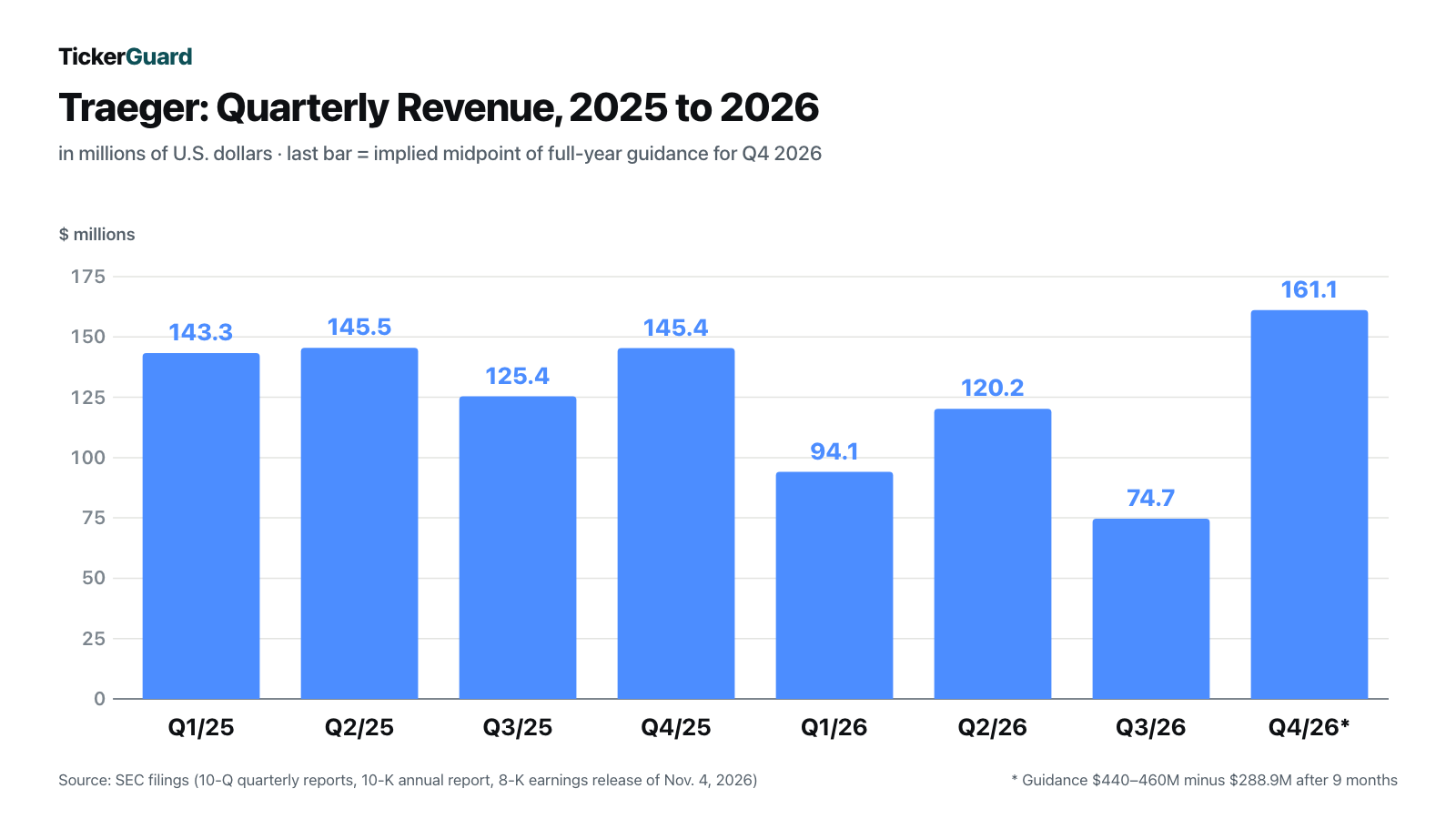
Quarter by quarter: revenue of $143.3 million, $145.5 million, $125.4 million and $145.4 million in 2025, then $94.1 million, $120.2 million and $74.7 million in the first three quarters of 2026. Over the years, the series looks like this: revenue of $785.5 million in 2021, $655.9 million in 2022, $605.9 million in 2023, $604.1 million in 2024 and $559.5 million in 2025 (10-K annual reports). For 2026, Traeger expects $440 million to $460 million — at the midpoint, 43 percent less than in 2021. Part of that is deliberate: if you close your own online store and end your in-store roadshows at Costco, you lose revenue you no longer want. Direct-to-consumer sales fell from $18.4 million to $8.1 million in the third quarter of 2026. But the biggest chunk is the grills themselves, and the reason is less comfortable:
"The decrease was primarily driven by a reduction in average selling price in excess of 30% and a decrease in unit volume in excess of 20%."
— Traeger, Inc., 10-Q for the quarter ended September 30, 2026, Item 2 "Revenue" (grills)
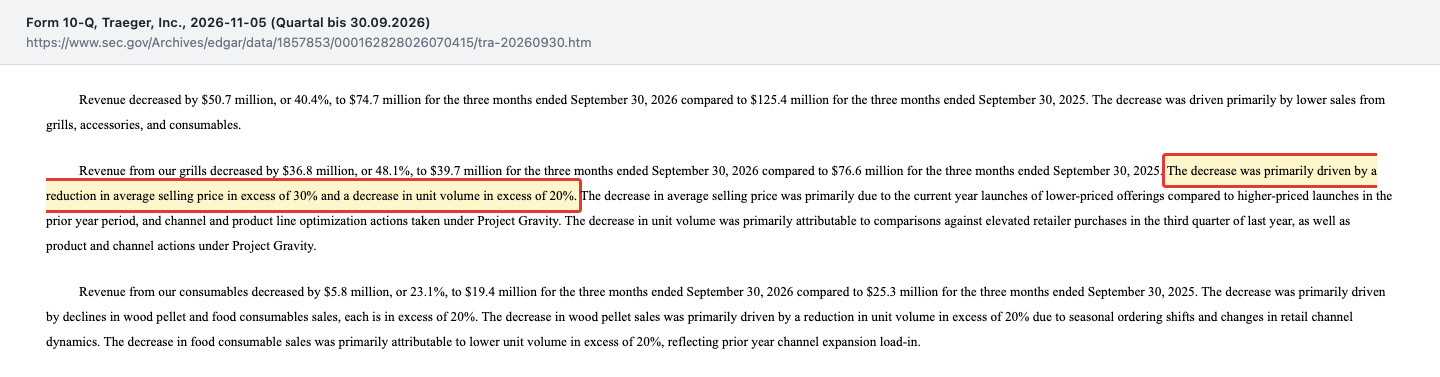
Both at once is the pattern you least want to see at a brand: fewer units and cheaper units. Traeger attributes the lower prices to newly launched, cheaper models and the "Project Gravity" changes, and the lower volume to heavy retailer orders in the prior-year quarter. Gross margin — the share of each revenue dollar left after the cost of the product — fell from 38.7 percent to 33.5 percent in the third quarter, and adjusted EBITDA (earnings before interest, taxes, depreciation, amortization and special items, roughly what the operations throw off) went from positive $13.8 million to negative $3.3 million. Even consumables, the products meant to drive repeat purchases, are shrinking: pellets, rubs and sauces brought in $78.3 million in the first nine months of 2026, 14.8 percent less than a year earlier (third quarter: $19.4 million, down 23.1 percent). Accessories fell 27.0 percent to $61.9 million in nine months, mainly because of weaker MEATER sales. Remember: cost cuts help the margin, but they do not replace revenue.
The fourth-quarter promise
This is exactly where the postponement trap bites. Traeger has adjusted its 2026 full-year guidance three times since March. The revenue range was cut and then narrowed around an unchanged midpoint:
- March 5, 2026: revenue of $465 million to $485 million, gross margin of 38 to 39 percent, adjusted EBITDA of $50 million to $60 million.
- May 11, 2026: revenue unchanged; gross margin raised to 39.5 to 40.5 percent and EBITDA to $57 million to $67 million.
- August 5, 2026: revenue cut to $435 million to $465 million; gross margin raised to 40 to 41 percent, EBITDA held at $57 million to $67 million.
- November 4, 2026: revenue narrowed to $440 million to $460 million and EBITDA to $59 million to $65 million; gross margin (40 to 41 percent) and free cash flow (at least $30 million) reiterated.
After nine months, $288.9 million of revenue is on the books. Do the math: to hit guidance, Traeger needs $151 million to $171 million in the fourth quarter — more than the $145.4 million of the prior-year quarter and roughly twice the third quarter just reported. The CEO explains it this way:
"We expect to return to revenue and Adjusted EBITDA growth in the fourth quarter, supported by channel expansion and the activity that shifted out of the third quarter."
— Jeremy Andrus, CEO, third-quarter 2026 earnings release (8-K, Exhibit 99.1, November 4, 2026)
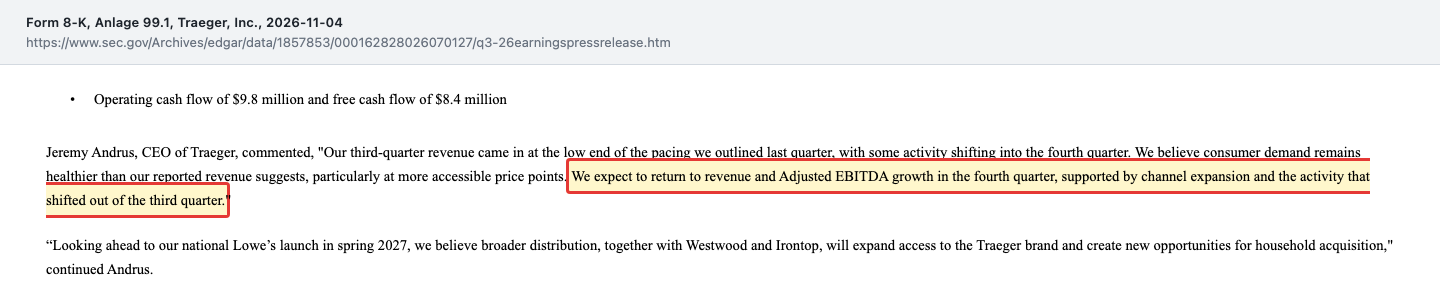
Two sentences earlier, the release says third-quarter revenue came in "at the low end of the pacing we outlined last quarter" — at the bottom of what management itself had sketched in August. That is the heart of the postponement trap: part of the success that did not show up in the third quarter is now supposed to arrive in the fourth. Can it work? Yes — if the announced channel expansion already puts product on shelves in the fourth quarter; the forward-looking statements in the release mention an initial load-in at Lowe's, without a date or an amount. Whether that revenue then reaches end customers will only become clear in 2027.
The other targets deserve a second look, too. For adjusted EBITDA, Traeger expects $59 million to $65 million for 2026, after $31.2 million in nine months — so the fourth quarter would have to contribute $28 million to $34 million, versus $19.4 million a year earlier. Those figures include a tariff refund that relates to costs of prior years: according to the company's reconciliation, it lifted nine-month gross margin by 3.2 percentage points — by our math about $9 million, which is not removed from adjusted EBITDA. On free cash flow — the cash left after capital spending — Traeger promises "at least $30 million" but has already generated $49.4 million in nine months. In plain terms, guidance leaves room for a cash outflow of up to about $19 million in the fourth quarter. We cannot add color from the third-quarter earnings call: no transcript was available to us at the time of writing, and every statement here comes from the earnings releases filed with the SEC.
What the filings say — the uncomfortable truths
Uncomfortable truth No. 1: The operating result does not earn the interest
Traeger pays about $31 million a year in interest on its debt. The question is simple: does the business earn that amount? It has not for years.
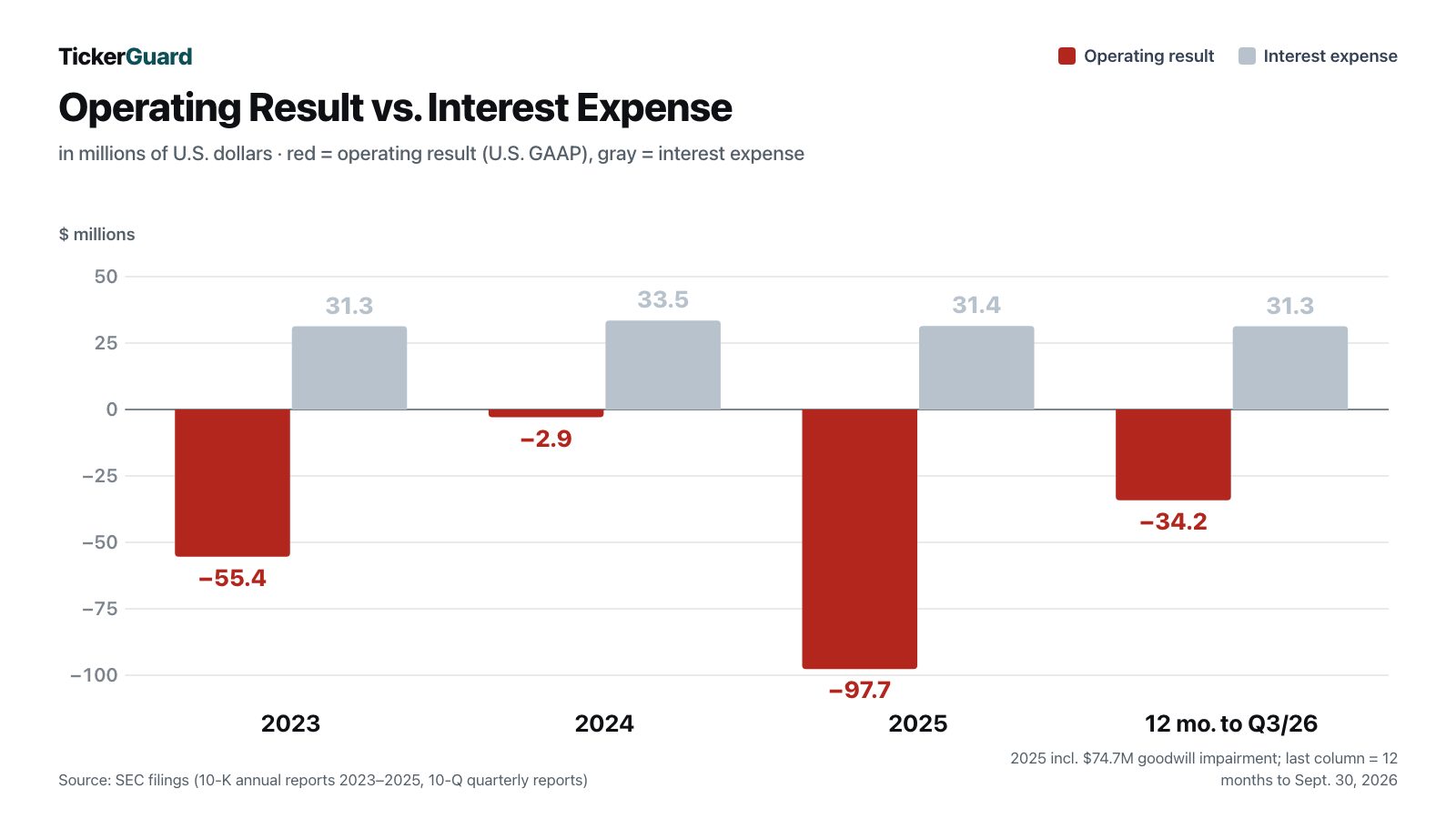
You could object that the operating result contains large items that involve no cash: above all the amortization of customer relationships and trademarks from the 2017 and 2021 acquisitions (about $35 million a year, about $32 million of it from the 2017 acquisition) and the restructuring costs of "Project Gravity." Let's generously strip both out: in the twelve months through September 30, 2026, about $19.6 million remains — against $31.3 million of interest. Interest coverage, meaning how many times earnings could pay the interest bill, is still only about 0.6. And those $19.6 million already include the one-time tariff refund from the first quarter. Only on adjusted EBITDA, which also excludes depreciation of equipment and stock-based pay, does Traeger clear the interest bill: about $50.6 million over twelve months. Remember: if a company only earns its interest before amortization, stock-based pay and special items, it does not earn it after all costs.
Uncomfortable truth No. 2: $403 million comes due in 2028
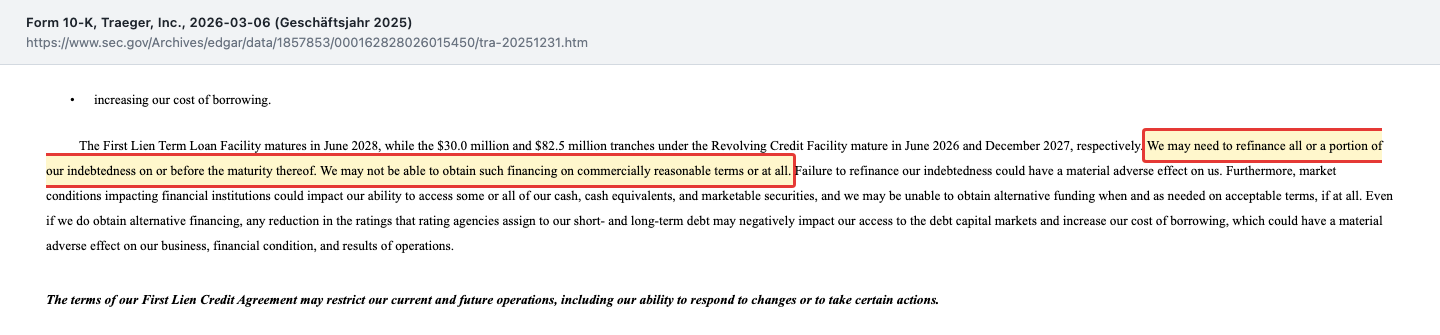
The debt is more than twice the size of the entire company's market value: as of September 30, 2026, $403.1 million was still outstanding on a term loan, while the market value stood at about $173 million on November 11, 2026. Traeger took out the loan in 2021; it amortizes in small installments and is priced at the U.S. benchmark rate SOFR plus 3.00 to 3.25 percentage points. The balance is due on June 29, 2028; the $82.5 million revolving credit facility expires as early as December 29, 2027, and the receivables financing on August 6, 2027. Since an interest-rate hedge expired on February 28, 2026, every rate move hits Traeger in full — according to the 10-Q, each additional percentage point costs about $4.0 million a year. The annual report names the risk itself:
"We may need to refinance all or a portion of our indebtedness on or before the maturity thereof. We may not be able to obtain such financing on commercially reasonable terms or at all."
— Traeger, Inc., 10-K for 2025, Item 1A "Risk Factors"
Net of cash, about $335 million of debt remains — roughly 6.6 times trailing twelve-month adjusted EBITDA, or about 5.4 times the midpoint of full-year guidance. Even net of cash, the debt is nearly twice the market value. And the $140.0 million of stockholders' equity consists entirely of intangible assets such as trademarks and customer relationships ($357.4 million); strip those out and equity is negative by about $217 million. To be fair: all loan covenants were met as of September 30, 2026, including a $15 million minimum liquidity requirement, and management explicitly expects to have enough cash for at least twelve months. None of the filings we reviewed contains a going-concern warning. What it looks like when a well-known brand with heavy debt heads into a refinancing, we described in our Krispy Kreme analysis. Remember: at Traeger, shareholders own the smaller part of the enterprise value — creditors finance the larger part.
Uncomfortable truth No. 3: The full cash pile comes from shrinking and refunds
The good news of the year, $67.8 million of cash, has two sources that cannot be repeated. First: if you sell less, you need to pre-finance less. Receivables fell by $36.7 million in nine months and inventory by $19.3 million — together $56 million flowing back from the warehouse and customer accounts into cash. Second: $16.2 million of tariff refunds and $11.6 million from a pandemic-era employee retention tax credit, together $27.8 million. The 10-Q names both as the main reasons for operating cash flow of $54.8 million. And the tariff money is not even safe:
"Because the government has appealed the refund order, refunds received could be subject to repayment if the order is reversed."
— Traeger, Inc., 10-Q for the quarter ended September 30, 2026, Item 2 "Macroeconomic Conditions"
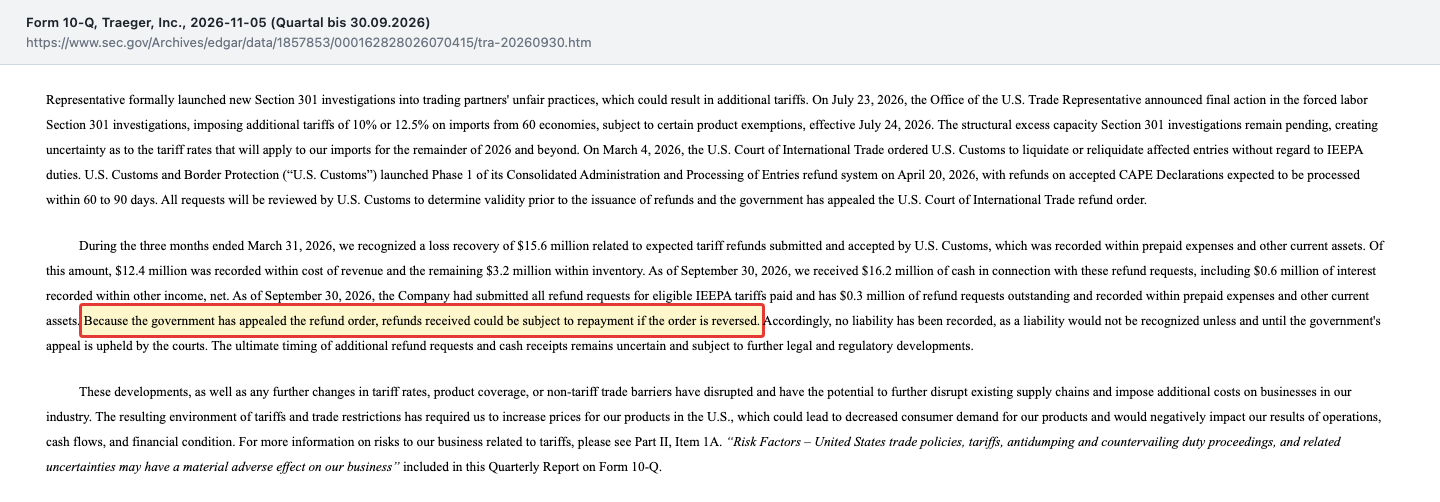
Traeger has recorded no liability for this; one would only come if the government wins in court. How much tariff refunds can distort earnings is also shown in our Carter's analysis. Without the one-time money, Traeger would have generated about $27 million of operating cash flow in nine months — and even that only because inventory and receivables were run down, releasing $56 million on their own. Remember: a cash pile filled by shrinking empties again as soon as the growth that guidance promises comes back.
Uncomfortable truth No. 4: Few retailers, one sourcing country, few owners
Traeger depends on a handful of addresses. The annual report is clear:
"For example, in the year ended December 31, 2025, our three largest retailers accounted for 29%, 14%, and 8% of our revenue, respectively, with no other customer accounting for greater than 10% of our revenue for the year."
— Traeger, Inc., 10-K for 2025, Item 1A "Risk Factors"
In the first nine months of 2026, the two largest retailers accounted for 27 percent and 17 percent of revenue. If your neighbor told you his shop was doing great, but one customer brought in more than a quarter of sales — would you swallow hard for a moment? Then there is the supply side: about 80 percent of the grills are made in China (2025 10-K), so every tariff change hits directly. In April 2026, U.S. Customs also asserted that certain drip-tray and bucket liners sourced from China are subject to antidumping and countervailing duties; Traeger is contesting this and has recorded no accrual because it considers a loss neither probable nor estimable.
Finally, the owners. According to the proxy statement (DEF 14A) of April 27, 2026, private-equity firm AEA (24.2 percent), the Canadian pension fund OTPP (17.8 percent) and Trilantic (13.0 percent) together hold 55 percent, and CEO Andrus another 14.5 percent (as of April 13, 2026). That makes Traeger a "controlled company" under exchange rules; the investors fill board seats through a stockholders agreement. An 8-K filed on March 27, 2026, adds: although the 2025 bonus program's goals were missed, the CEO received a discretionary bonus of $956,250 and the CFO $270,938 — justified by their contributions in 2025 and the aim of retaining them. There have been no open-market insider purchases since August 2026; the Form 4 filings show grants, tax withholdings and one sale of 2,750 shares by the chief sales officer.
Valuation: what the November 11, 2026, close implies
At the closing price of $61.79, Traeger is worth about $173 million on the stock market. Add net bank debt of about $335 million and the whole company costs about $509 million (leases not included). That yields these orders of magnitude:
- There is no P/E ratio — Traeger has posted a loss in every year since its IPO (2025: −$115.2 million; first nine months of 2026: −$34.2 million).
- Price-to-sales of about 0.4 ($434.3 million of revenue over the last four quarters) — cheap at first glance, because almost all of the enterprise value is financed with debt.
- Enterprise value to adjusted EBITDA of about 10 on the last four quarters ($50.6 million) or about 8 on the guidance midpoint ($62 million) — no visible risk discount for a shrinking, heavily indebted manufacturer.
- Price-to-book of about 1.2 ($140.0 million of equity) — but without trademarks and customer relationships, equity would be negative.
In plain terms: the market is not paying for today's Traeger, but for a Traeger that grows again from the fourth quarter on, refinances its debt on workable terms and raises adjusted EBITDA. The "view of the pros" is lukewarm: according to fundamental data (as of November 11, 2026), six of seven analysts rate the stock a hold and one a buy; the average price target of $57.20 sits below the November 11 close.
Opportunities and risks at a glance
What speaks for Traeger:
- A strong brand as the inventor of the pellet grill (1987), with its own consumables (pellets, rubs) that customers buy again and again.
- Significant cost cuts: "Project Gravity" is expected to save $64 million to $70 million a year; sales and marketing expenses down 34 percent in nine months.
- Cash of $67.8 million and an undrawn $82.5 million credit line (September 30, 2026); all loan covenants met.
- A new channel through Lowe's from spring 2027 and cheaper models for new customer groups.
- Guidance for the fourth quarter of 2026 promises a return to revenue and EBITDA growth.
What speaks against it:
- Third-quarter 2026 revenue down 40.4 percent; for grills, prices and unit volumes are falling at the same time.
- Operating result negative for years; even excluding acquisition amortization and restructuring costs, it does not cover interest.
- $403.1 million term loan due June 29, 2028, revolver as early as December 2027; equity excluding intangibles is negative.
- The full cash pile comes from inventory reduction and one-time refunds; $16.2 million of tariff money could be subject to repayment.
- Dependence on two large retailers (27 percent and 17 percent of revenue), on manufacturing in China and on a few large shareholders.
A human conclusion
Back to the postponement trap from the beginning. Its core is not that promises are lies — Traeger may well grow in the fourth quarter of 2026, because new sales channels are being added and because part of the business is catching up from the third quarter. Its core is that we pay for the promise before it is kept: with a one-day jump of a quarter. Set that jump aside and a sober picture remains. Traeger is a well-known brand that is cutting costs hard and has refilled its cash pile. But it is also a company whose revenue has shrunk by more than two-fifths since 2021, whose operating result does not earn its interest, and which has to repay or refinance $403 million in less than two years — with a market value of about $173 million. So the honest question for you is not "Will the fourth quarter come?" but: if the fourth quarter comes, will it be enough to get a new loan in 2028 — and at what price for you as a shareholder? What you do with that is your decision. And that is how it should be.
Sources
All original documents used in this analysis — so you can check them yourself:
- Traeger, Inc. — 10-Q for the quarter ended September 30, 2026 (filed November 5, 2026)
- Traeger, Inc. — third-quarter 2026 earnings release (8-K Item 2.02, Exhibit 99.1, filed November 4, 2026)
- Traeger, Inc. — 10-Q for the quarter ended June 30, 2026 (August 6, 2026) and earnings release of August 5, 2026
- Traeger, Inc. — 10-Q for the quarter ended March 31, 2026 (May 11, 2026) and earnings release of May 11, 2026
- Traeger, Inc. — 10-K for 2025 (filed March 6, 2026) and fourth-quarter 2025 earnings release (March 5, 2026)
- Traeger, Inc. — 10-K annual reports for 2024 and 2022
- Traeger, Inc. — 8-K filings of November 24, 2025 and March 6, 2026 (NYSE notices), March 17, 2026 (reverse split) and March 27, 2026 (discretionary bonus)
- Traeger, Inc. — proxy statement DEF 14A (April 27, 2026, ownership)
- Full SEC filing history including insider filings (Form 4): EDGAR overview Traeger, Inc. (sec.gov)
- Fundamental data (prices, analyst coverage, market value cross-check; as of November 11, 2026), reconciled with the SEC filings.
Transparency & disclaimer: this analysis is journalistic commentary on publicly available information. It is not investment advice, not a regulated investment research product and not a solicitation to buy or sell securities. Equity investments carry substantial risk up to and including total loss. All information is provided without warranty; the as-of date for each figure is stated in the text. Positions held by the operator are disclosed daily; where one exists, it appears as a notice at the top of this analysis.
Key figures at a glance
All monetary figures in millions of $; earnings per share as reported.
| Metric | 2021 | 2022 | 2023 | 2024 | 2025 |
|---|---|---|---|---|---|
| Revenue | 785.5 | 655.9 | 605.9 | 604.1 | 559.5 |
| Operating Income (EBIT) | -61.1 | -345.9 | -55.4 | -2.9 | -1.2 |
| Net Income | -91.8 | -382.1 | -84.4 | -34.0 | -115.2 |
| Net Margin | -11.7% | -58.3% | -13.9% | -5.6% | -20.6% |
| Earnings Per Share | -40.83 $ | -159.63 $ | -34.11 $ | -13.34 $ | -43.27 $ |
Source: fundamental data & SEC filings (annual and quarterly reports, 10-K/10-Q)
Our Bottom Line at a Glance
- Revenue & brand negative
- Q3 2026 revenue $74.7M (−40.4%), 9M −30.2%; 2026 guidance $440–460M after $785.5M in 2021. For grills, average selling price (down more than 30%) and unit volume (down more than 20%) are falling at the same time.
- Costs & cash positive
- "Project Gravity" is expected to save $64–70M a year; cash $19.6M (2025-12-31) → $67.8M (2026-09-30), $82.5M revolver undrawn. However, $27.8M came from one-time refunds and about $56M from running down inventory and receivables.
- Earnings power & interest negative
- Operating result for the 12 months to 2026-09-30: −$34.2M against $31.3M of interest expense; excluding acquisition amortization and restructuring costs about $19.6M — interest coverage below 1. Adjusted EBITDA Q3 2026: −$3.3M.
- Debt & refinancing negative
- Term loan $403.1M due 2028-06-29, revolver 12/2027, receivables facility 08/2027; net debt about $335M against a market value of about $173M. Equity excluding intangibles about −$217M; covenants met.
- Ownership & governance neutral
- AEA, OTPP and Trilantic hold 55%, the CEO 14.5% (2026-04-13) — a controlled company. Discretionary bonus of $956,250 for the CEO despite missed 2025 bonus goals (8-K of 2026-03-27).
Traeger shows how the postponement trap works: after a third quarter of 2026 with 40.4 percent less revenue and negative adjusted EBITDA, management promises growth in the fourth quarter, and the stock rises 24.7 percent in a single day. The cost cuts are real and cash is higher than a year ago, but it comes from shrinking and one-time refunds. The operating result does not cover interest, and $403 million comes due in June 2028. Not investment advice.
What Our Rating Means
Substance risk
We found at least one documented issue that threatens the company itself — regardless of how the stock is currently valued.
Red, because there is a documented substance risk: the operating result has not covered interest for years (twelve months through September 30, 2026: −$34.2 million against $31.3 million of interest; even excluding acquisition amortization and restructuring costs, only about $19.6 million), and a $403.1 million loan must be repaid or refinanced by June 2028, which the annual report itself describes as not assured. Equity is negative without trademarks and customer relationships. Against an even harsher reading: no going-concern warning, covenants met, $67.8 million of cash and an undrawn credit line. The jump after the guidance does not change this assessment. The decision is yours.
A journalistic assessment by our editorial team at the time of the deep dive, based on public sources — not investment advice and not a solicitation to buy or sell. Your personal circumstances (investment goals, risk capacity, taxes) cannot be taken into account. What our levels mean, how verdicts are formed, and what conflicts of interest exist →
Worth Noting
- The occasion for this analysis is the earnings release (8-K) of November 4, 2026, and the 10-Q of November 5, 2026. Price reference: closing price of $61.79 on 2026-11-11 (Nov. 4: $49.75; Nov. 5: $62.03; source: fundamental data).
- Data as of: the latest periodic report is the 10-Q for the quarter ended 2026-09-30; no further filings through 2026-11-12. No transcript of the third-quarter earnings call was available; management statements come from the earnings releases.
- All share counts and prices before 2026-03-18 are adjusted for the 1-for-50 reverse split. The interest-coverage calculation excluding acquisition amortization and restructuring costs is our own, based on the statements of operations (10-K 2025, 10-Q Q3 2026).
- The ticker COOK stands for Traeger, Inc.; until July 2021, the registrant was named TGPX Holdings I LLC, according to SEC records.
Stock Watch
This analysis is as of November 13, 2026. Stock Watch will tell you what's changed at COOK since then.
Later $1 a month per stock — signing up is free, and you'll be the first to know when it launches.
The full analysis as a PDF for later
We will send you this analysis as a PDF — to print, file away, and read at your own pace. And we will add you to the free Stock Watch list for Traeger Inc (COOK), so you hear about it when something material in this analysis changes.
Frequently Asked Questions
Traeger, Inc. (NYSE: COOK), based in Salt Lake City, invented the wood pellet grill in 1987. The company sells pellet grills, wood pellets, rubs and sauces, plus accessories including MEATER wireless thermometers. Its grills are made mostly in China and sold almost entirely through retailers. Traeger had 433 full-time employees at the end of 2025.
In the third quarter of 2026, revenue fell 40.4 percent to $74.7 million. For grills, the average selling price dropped more than 30 percent and unit volume more than 20 percent, according to the 10-Q. Deliberate cuts added to that: Traeger largely closed its own online store and ended its Costco roadshow program, and retailers had ordered heavily in the prior-year quarter.
According to the earnings release of November 4, 2026, Traeger expects revenue of $440 million to $460 million, gross margin of 40 to 41 percent, adjusted EBITDA of $59 million to $65 million and free cash flow of at least $30 million. After $288.9 million of revenue in nine months, that implies $151 million to $171 million in the fourth quarter — more than a year earlier.
As of September 30, 2026, $403.1 million was outstanding on a term loan that matures on June 29, 2028. The undrawn $82.5 million revolving credit facility expires on December 29, 2027. Against that stood $67.8 million of cash. Covenants were met, but the annual report explicitly names refinancing as a risk.
No. Traeger has reported a net loss in every year since its 2021 IPO — $115.2 million in 2025 and $34.2 million in the first nine months of 2026. Operating income before interest was also negative, at −$34.2 million in the twelve months through September 30, 2026. Only adjusted EBITDA is positive.
The New York Stock Exchange notified Traeger on November 19, 2025, and again on March 5, 2026, that its average share price had fallen below $1 — a breach of listing rules. On March 17, 2026, Traeger therefore combined every 50 shares into one. Since then, the stock has traded far above $1; a reverse split does not change the value of your stake.
According to the proxy statement of April 27, 2026, private-equity firm AEA (24.2 percent), the Canadian pension fund OTPP (17.8 percent) and Trilantic (13.0 percent) together hold 55 percent of the shares. CEO Jeremy Andrus owns another 14.5 percent. That makes Traeger a controlled company under exchange rules.
Found an error?
Did you spot a factual error, an outdated number, or a typo in this deep dive? Let us know briefly — your report goes straight to the editorial team.