Microvast: The CEO Got Shares at 50 Cents – and Every Creditor Stands Ahead of You
$1.23 of book value per share against a 22-cent close on November 10, 2026 – that looks like a bargain. In its quarterly report, management itself doubts the company can continue; we show the pecking order a stock quote leaves out.
 Thomas Mücke
Founder & Publisher
As of Today
As of: November 10, 2026
- Closing price
- 0.2202 $ -64.30%
- Market Capitalisation
- 75.0 $M
- Growth Score
- 7/10
- AAQS
- 3/10
This analysis has a cut-off date. The Stock Guard tells you when something material changes in the numbers. Reserve your free spot
Chart
Interactive price chart (TradingView).
52-week range: 0.2202 $ to 5.00 $ · Last price: 0.2202 $ (As of: November 10, 2026)
Note: pure fact-based analysis, not investment advice and not a solicitation to buy or sell. All figures without guarantee.
A single missed payment, and lenders may enforce their security over the Chinese main subsidiary – its assets and the equity interest in it. That is what Microvast's latest quarterly report says. That subsidiary, in Huzhou, runs the main plant. And yet to many, the stock looks like an opportunity.
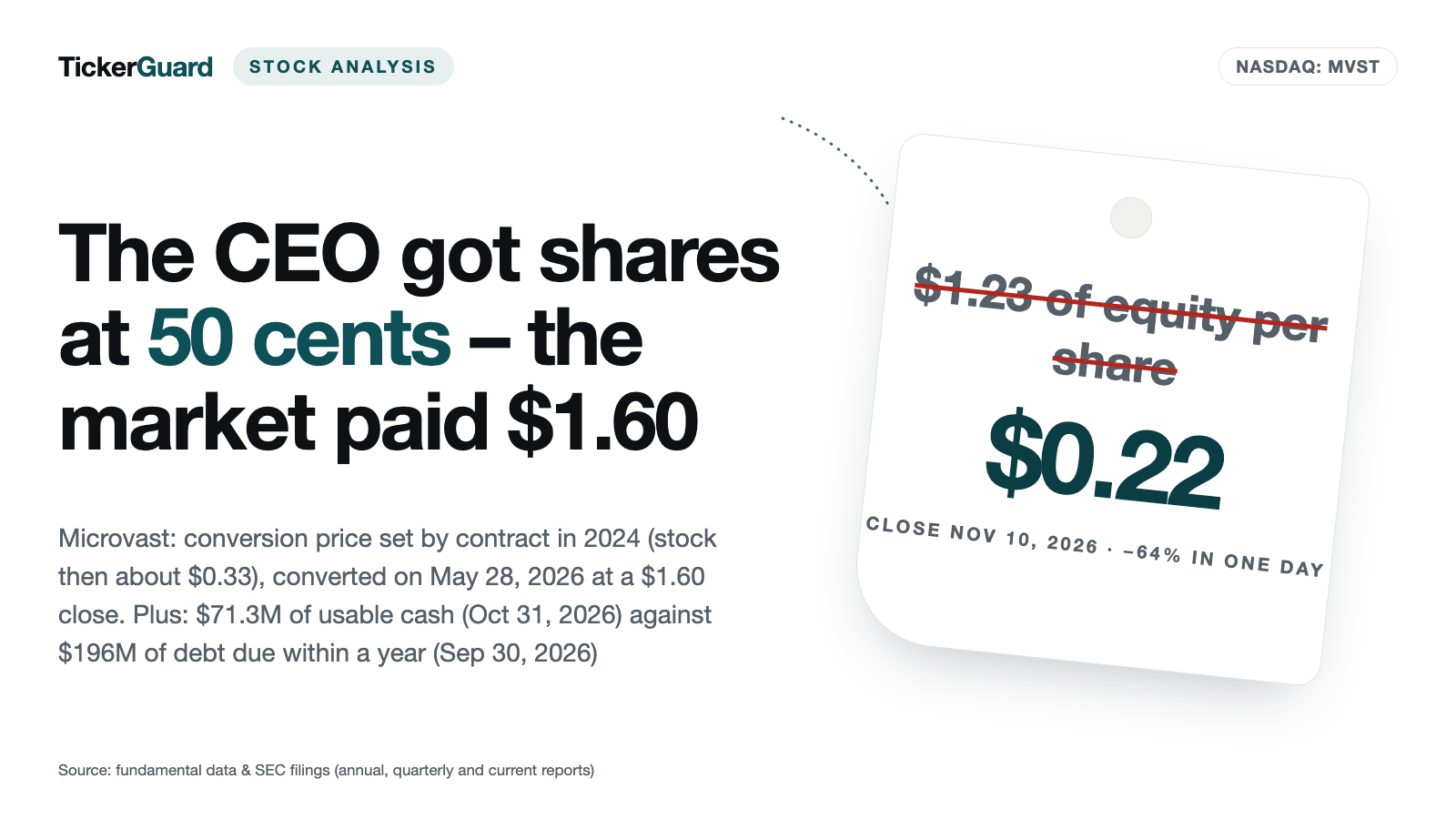
Three numbers, and all of them whisper the same word. On November 10, 2026, shares of Microvast Holdings (Nasdaq: MVST) closed at $0.22 — 64 percent below the previous day. The two analysts in our fundamental data put the average price target at $3.00. And the balance sheet for September 30, 2026 shows $472.8 million of equity, about $1.23 per share. The word is: bargain. And one person already holds shares at a very different price: founder and CEO Yang Wu converted a 2024 loan into stock at $0.50 per share in May 2026, as the contract allowed – on a day the market paid $1.60. The price had been set in 2024, when the stock traded at about $0.33.
This is where a common investor weakness kicks in, the bargain reflex. We compare a fallen price with what used to be, or with what others expect — and treat the gap as profit that is just waiting to be collected. Let's make a deal: we set the price target and yesterday's quote aside and read what Microvast filed, under legal liability, with the U.S. securities regulator, the SEC. At the end, you decide.
What Microvast actually does — batteries for commercial vehicles
Microvast was founded in Texas in 2006 and is now based in Houston. It develops and builds lithium-ion battery systems — from cell materials to cells and modules to the finished battery pack with cooling and controls. Its customers are mostly makers of commercial vehicles: heavy trucks, port and mining equipment, buses. Put in everyday terms: Microvast supplies the fuel tank for vehicles that run on electricity instead of diesel — the heavy ones that work long shifts every day.
The heart of the business is in China. The Huzhou plant makes components, cells, modules and packs; the company behind it, Microvast Power Systems (MPS for short), is what the group calls its principal operating subsidiary. There is also a module plant near Berlin and a large, not yet fully built-out plant in Clarksville, Tennessee. At the end of 2025, Microvast had 1,908 full-time employees. Most sales are in Europe: from January through September 2026, 64 percent of revenue came from there, 46 percent from Italy alone.
That names the central tension of this analysis: Microvast has a real business, real factories and, on paper, a lot of equity — but the cash is stuck in China and Europe, most of the debt comes due within the next twelve months, and revenue is falling away. So the question is not what Microvast is worth, but who gets paid first.
Company history for investors
-
2021
Listing through a SPAC
In July 2021, Microvast goes public on Nasdaq through its merger with Tuscan Holdings. On Sep 30, 2021, it holds $612.5 million in cash, including restricted cash.
-
2023
The costly build-out year
Microvast spends $186.8 million on capex; cash including restricted cash falls to $88.2 million by the end of 2023. For shareholders, the era of tight funding begins.
-
2024
The CEO lends the company money
In May 2024, CEO Yang Wu commits a secured $25.0 million loan (drawn in May and July), convertible at $0.50 per share, plus warrants for 5.5 million shares.
-
2025
Highest revenue since 2019 and first full-year operating profit
$427.5 million of revenue, $7.0 million of operating income and $75.9 million of operating cash flow. In March 2026, management concludes it is probable that its plans will alleviate the going-concern doubt.
-
2026
Conversion at 50 cents
On May 28, 2026, Yang Wu converts the loan into 50.0 million shares; the stock closes at $1.60. By Sep 30, 2026, the share count is up 15.9% from the end of 2025.
-
2026
Revenue collapse and going-concern doubt
On Nov 9, 2026, Microvast reports third-quarter revenue down 62.8% and unresolved going-concern doubt; the next day, the stock falls to $0.22.
How the stock landed on our desk
No metrics scanner flagged Microvast; other investors' attention did. Our in-house Reddit hype scanner, which counts which smaller U.S. stocks are mentioned unusually often in Reddit forums, fired in November 2026 — right after the earnings release of November 9. The numbers explain the noise: on November 10, 2026, about 36.3 million Microvast shares traded according to our fundamental data, against an average of about 3.0 million a day in October 2026 (average meaning: all trading days added up and spread evenly). The price fell that day from the previous close of $0.6175 to $0.2202.
For context on the price level: on October 16, 2025, the stock closed at $6.40, and at the end of 2025 at $2.80. Since July 13, 2026, it has traded below $1. So the crash is not a one-day event but the last step of a slide lasting more than a year — with a stock that has lost about 97 percent since its highest close in October 2025.
The numbers over the years — honestly appraised
First, what Microvast genuinely achieved. Revenue rose from $152.0 million (2021) to $427.5 million (2025), nearly tripling. In 2025, Microvast posted its first full-year operating profit as far back as the annual reports go (to 2019): $7.0 million. And operations brought in $75.9 million of cash in 2025, far more than they used. For a company that had poured a combined $425.5 million into factories from 2021 through 2023, that was a first sign the math could work.
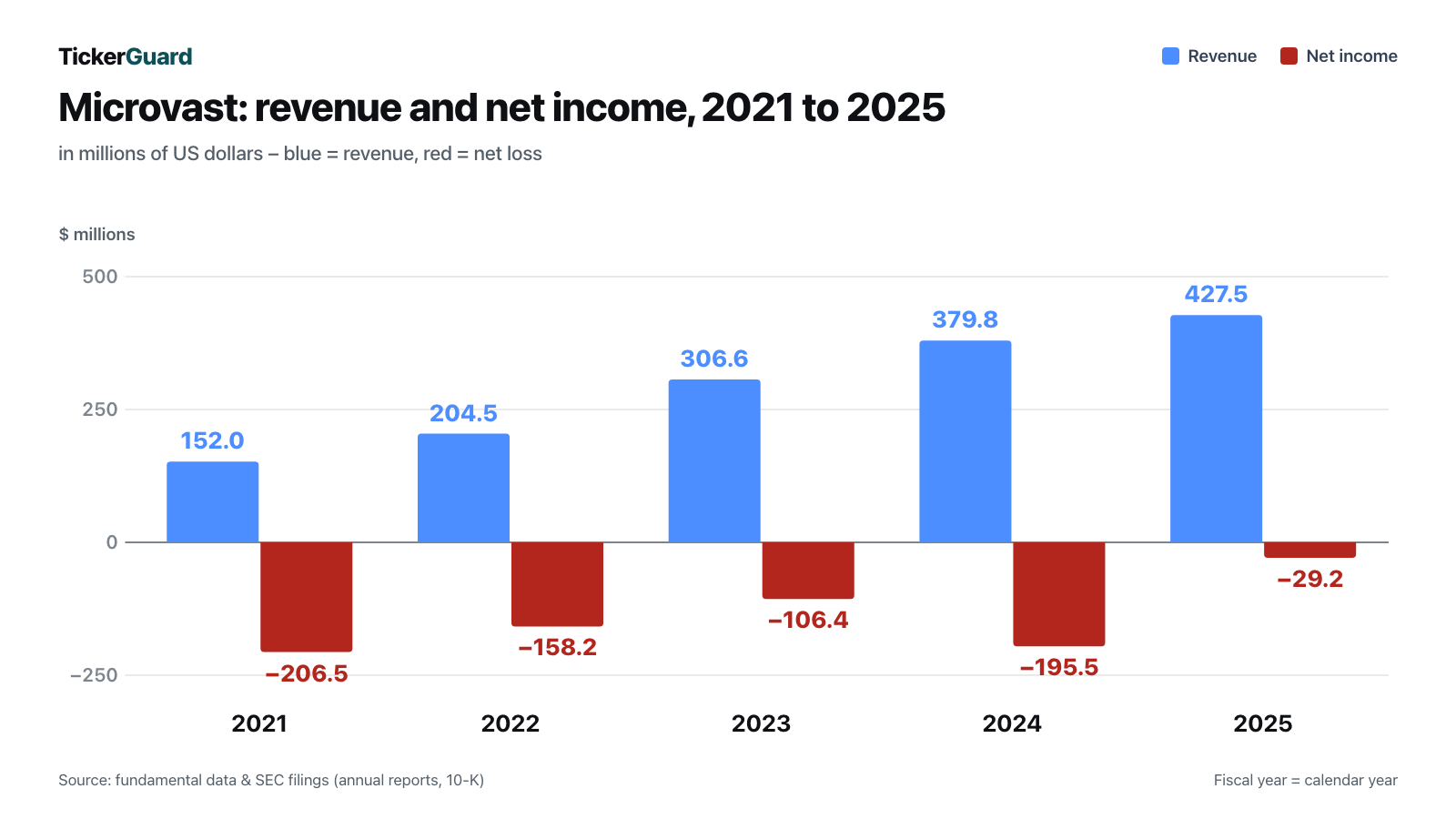
Even so, every year ended in a loss. In 2025 it was $29.2 million — mainly because Microvast had to book a $39.1 million non-cash fair-value loss on the CEO's convertible loan and on warrants whose value had risen with the share price. On top of that came a $32.5 million write-down of energy storage inventory that had been built for a customer but never sold.
In 2026, the picture flips. Revenue fell 48.0 percent in the first quarter. The second quarter, at $87.3 million and down only 4.5 percent, looked like a recovery — then revenue fell 62.8 percent in the third, to $45.8 million. The quarterly report gives the reason itself:
“During the third quarter of 2026, we experienced a significant reduction in demand for our products, and our revenue for the three months ended September 30, 2026 decreased by 62.8% compared with the corresponding prior-year period.”
— Microvast Holdings, Inc., SEC quarterly report 10-Q for September 30, 2026, Item 2
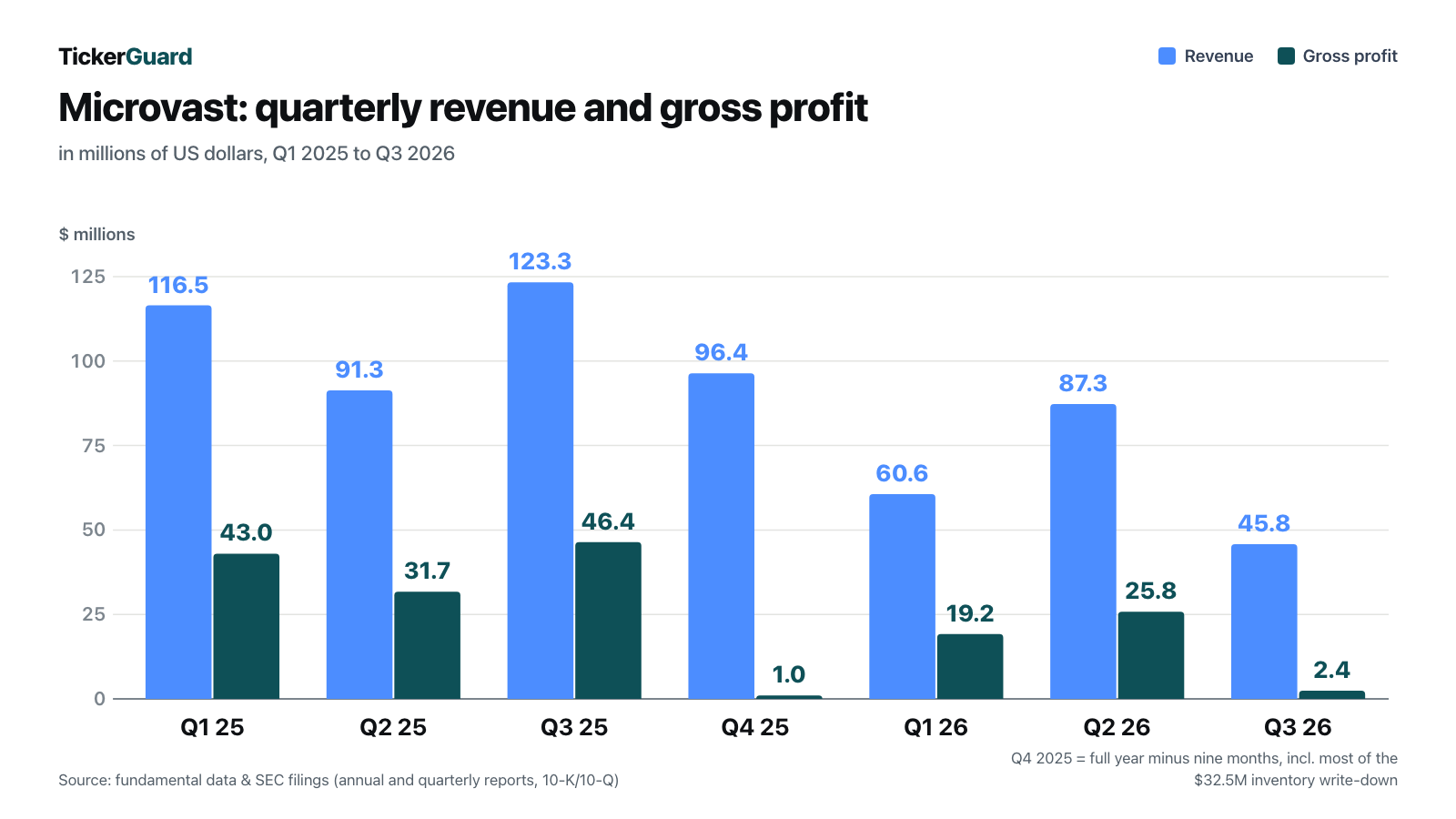
Gross margin — how many dollars of every $100 in revenue remain after production costs — fell to 5.2 percent in the third quarter of 2026, from 37.6 percent a year earlier. A $9.3 million write-down of obsolete inventory accounted for 20.4 percentage points of that. Below the gross line came $35.7 million of impairments on production assets in China, Germany and the U.S., and a net loss of $76.8 million. From January through September 2026, operations used $65.4 million of cash, after generating $59.5 million in the same period a year earlier.
One detail shows how deceptive single quarters can be: in the first quarter of 2026, Microvast reported net income of $48.2 million. It came from a $63.8 million non-cash fair-value gain — the CEO's convertible loan and the warrants were worth less as the share price fell. The falling stock produced the profit, not the business.
Remember this: 2025 was the highest-revenue year since 2019, the first year with Microvast figures in the annual reports, and the first with a full-year operating profit. In the third quarter of 2026, less than half of that revenue level is left.
What the filings say — the uncomfortable truths
Uncomfortable truth no. 1: The going-concern doubt is back
In its annual report for 2025, filed in March 2026, Microvast still wrote that it was probable its own plans would alleviate the doubt about its ability to continue. The quarterly report for March 31, 2026 said the same. By the report for June 30, 2026, it said the doubt had not been alleviated. The report for September 30, 2026 puts it this way:
“After considering the Company’s financial condition, operating results, cash flow forecasts, debt obligations and management’s plans, management concluded that substantial doubt about the Company’s ability to continue as a going concern is not alleviated.”
— Microvast Holdings, Inc., SEC quarterly report 10-Q for September 30, 2026, Note 1, section “Liquidity and Going Concern”
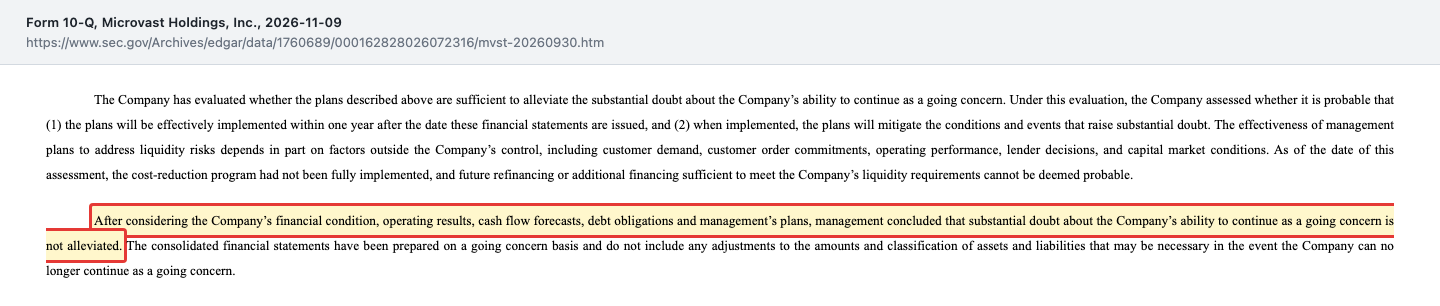
Worth knowing: auditors do not fully audit a quarterly report — the assessment comes from management itself. Here, management expects its available cash to be insufficient to meet its obligations as they come due over the next twelve months, absent additional financing, refinancing, extension or restructuring of its debt, or significant further cost reductions. The same note spells out what happens if financing does not come through: the company would have to “significantly reduce, restructure, or cease” operations, liquidate assets or, if necessary, seek relief under applicable reorganization laws.
Uncomfortable truth no. 2: The cash is in the wrong place
As of September 30, 2026, Microvast had $124.4 million of cash, cash equivalents and restricted cash, of which $84.8 million was unrestricted. Of that, $30.4 million sat with the Chinese and $14.4 million with the European subsidiaries. The earnings release is candid about what that means:
“Due to foreign regulatory restrictions, adverse tax consequences and localized working capital needs, we are currently unable to repatriate cash from China and Europe to fund our U.S. operations.”
— Microvast Holdings, Inc., SEC current report 8-K of November 9, 2026, Exhibit 99.1 “Liquidity and Balance Sheet”
On the other side is debt that mostly comes due within a year: current bank borrowings ($120.8 million), notes payable ($33.5 million) and the current bond ($41.7 million) added up to about $196.0 million as of September 30, 2026. On October 31, 2026, about $71.3 million was usable across all entities. After September 30, Microvast also fully repaid the remaining $22.4 million under a 2022 loan facility; whether before or after October 31 is not stated. Year to date, Microvast refinanced $59.8 million of bank loans; per the report, further refinancing cannot be deemed probable. And if it fails, the consequence is spelled out:
“A failure to make any of these payments will result in an event of default under the relevant debt arrangement and the acceleration of substantially all of the Company’s bank borrowings and bonds payable and the enforcement of security over MPS’s assets and the Company’s equity interest in MPS.”
— Microvast Holdings, Inc., SEC quarterly report 10-Q for September 30, 2026, Note 1
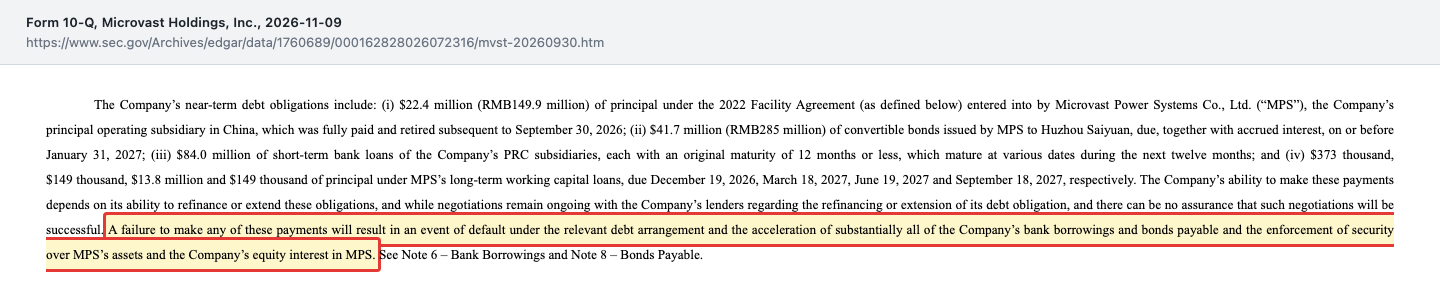
In plain terms: you own the house, but it carries several mortgages, and the bank can demand the keys as soon as one payment is missed. On top of that, the report says a significant portion of customer receivables is overdue — and the cash position depends on collecting them.
Uncomfortable truth no. 3: A pledge on the crown jewel
The most sensitive item on the maturity list – the only bond – dates back to 2018. Back then, MPS agreed to issue convertible bonds to Huzhou Saiyuan, an entity established by the local government. RMB 285 million is still outstanding, about $41.7 million, due on or before January 31, 2027. What happens if Microvast does not pay is in Note 8:
“According to the terms of the agreement, if the Company fails to repay the bonds when due, the applicable interest rate will increase to 12%, and Huzhou Saiyuan will have the right, within 60 days after the maturity date, to dispose of the Company’s 12.39% equity interest in MPS in proportion to the amount of matured bonds or to convert the outstanding bonds into an equity interest of MPS based on an entity value of MPS of $950.0 million.”
— Microvast Holdings, Inc., SEC quarterly report 10-Q for September 30, 2026, Note 8 “Bonds Payable”

By our own calculation, $41.7 million at that entity value would equal about 4.4 percent of MPS, excluding interest — that applies to conversion. For disposal, the right covers the pledged 12.39 percent stake in proportion to the matured bonds; the report does not quantify it. Microvast says either outcome would reduce its ownership interest in MPS. Either way, it would hit the principal operating subsidiary with the Huzhou plant — not the Houston holding company whose stock you can buy. What Note 1 describes for a missed payment weighs more: enforcement of security over MPS's assets and over the holding company's equity interest in MPS. The gap is striking: the 2018 agreement puts MPS at an entity value of $950.0 million, while on November 10, 2026 the market valued the entire group's equity at about $84.8 million (market value, excluding debt). The $950.0 million, however, is a contractual figure from 2018, not a current valuation. Microvast says it has fully complied with the amended repayment schedule so far. At the same time, the quarterly report is unambiguous about the January repayment:
“We do not expect to be able to repay the convertible bonds on or before January 31, 2027 unless we are able to refinance or extend them. […] A failure to repay the bonds when due will also constitute an event of default and trigger cross-defaults under our other debt arrangements.”
— Microvast Holdings, Inc., SEC quarterly report 10-Q for September 30, 2026, Item 2 (section “Short-Term Strategy”)
Cross-default means: if this one bond fails, the other loans count as breached too. That makes January 31, 2027 a date worth remembering.
Uncomfortable truth no. 4: The CEO converted at 50 cents
In May 2024, when cash was tight, founder and CEO Yang Wu committed a $25.0 million loan to the company; $12.0 million was drawn in May and $13.0 million in July 2024. The loan was secured by substantially all assets and could be exchanged for shares: two shares per dollar, or 50 cents a share. On the day of the agreement, May 28, 2024, the stock closed at about $0.33 according to our fundamental data. So at the time, the conversion price was above the market price; the conversion right was only in the money after the later rise in the share price. On the maturity date, he used that right:
“On May 28, 2026, Mr. Wu elected to convert $25.0 million of the outstanding principal amount into 50.0 million shares of Common Stock at a per share price of $0.50 in accordance with the terms of the Loan Agreement.”
— Microvast Holdings, Inc., SEC quarterly report 10-Q for September 30, 2026, Note 14 “Convertible Loan Measured at Fair Value”

On May 28, 2026, the stock closed at $1.60. The new shares were booked at $80.0 million — arithmetically $1.60 per share, that day's close, for a $25.0 million loan. That was contractually agreed and broke no rule. But it shows how dilution works: your slice of the cake gets smaller when someone else receives new slices at roughly a third of that day's price. Shares outstanding rose from 331.8 million at the end of 2025 to 384.5 million on September 30, 2026, up 15.9 percent. According to the proxy statement, Yang Wu beneficially owned about 35.8 percent as of the record date, October 6, 2026, including warrants for 5.5 million shares at $2.00 and 1.0 million shares held by his son. The loan came when cash was tight — all other shareholders bear the dilution.
Uncomfortable truth no. 5: Few customers, one country
From January through September 2026, a single customer accounted for 46 percent of revenue and a second for 16 percent; Italy alone for 46 percent. Microvast does not name the customers. But the quarterly report warns of significant uncertainty about orders from its largest customer after 2026 and says one significant European customer was recently acquired by a third party. Customers generally order through non-exclusive purchase orders or framework supply agreements that they can adjust, cancel, defer or suspend, and are generally not contractually obligated to buy any minimum volume. In plain terms: if one of the two big buyers orders less, you do not see it in a footnote but in the next quarter's revenue.
Uncomfortable truth no. 6: The $1 deadline and the lawsuits
The stock has closed below $1 since July 13, 2026. On August 26, 2026, Nasdaq sent a deficiency notice; the quarterly report names the deadline:
“Pursuant to the Rules, the Company has 180 days, or until February 22, 2027 to cure the deficiency and regain compliance with the minimum closing bid price (subject to additional time periods for which the Company may be eligible).”
— Microvast Holdings, Inc., SEC quarterly report 10-Q for September 30, 2026, Item 1A
The usual way out is a reverse stock split: for example, ten old shares become one new one — the price rises arithmetically, your stake stays the same. No such reverse split is on the agenda of the annual meeting on November 30, 2026, and neither is a capital increase or any other financing. Issuing new shares, however, needs no stockholder vote: 750 million shares are authorized, and about 386 million were issued as of September 30, 2026. The report also warns that Nasdaq could delist the stock regardless of its price if Microvast or MPS becomes subject to bankruptcy or reorganization proceedings.
Then there are lawsuits, old and new. A 2023 class action over allegedly misleading statements — about a conditional grant from the U.S. Department of Energy, profitability, the China operations and the construction of a facility — is set to be settled for about $16.5 million, subject to court approval; about $11.4 million of that is to be covered by insurance. Since July 21, 2026, a new putative class action in Texas (Graham) has also been pending against Microvast, Yang Wu and three people who served as CFO during the alleged class period, including current CFO Rodney Worthen, over allegedly false and misleading statements; per the report it is in its preliminary stages, and Microvast intends to defend it vigorously; two derivative suits rest on similar allegations. Several lawsuits in Delaware over the merger with the SPAC Tuscan Holdings are still pending, some of them stayed.
Remember this: each of these six truths is about the same question — who gets what before anything is left for shareholders.
Valuation: book value versus creditors
On November 10, 2026, Microvast had a market value of about $84.8 million (385,112,845 shares at $0.2202). Equity stood at $472.8 million as of September 30, 2026, about $1.23 per share. So the market paid roughly 18 cents for every dollar of book value. Arithmetically, the market value matched the unrestricted cash of September 30, 2026 almost exactly — but $30.4 million of it is stuck in China and $14.4 million in Europe. Outside China and Europe, that arithmetically leaves about $40.0 million.
Why is the discount so large? Because book value is not cash. Much of it sits in factories, inventory and receivables, and in the third quarter of 2026 Microvast already had to impair $35.7 million of assets. Above all, shareholders stand at the very back of the line. The quarterly report says so itself:
“In addition, as certain of our assets are pledged as collateral to secure our indebtedness, if we default or declare bankruptcy, after these obligations are met, there may not be sufficient funds or assets to satisfy our subordinate interests, including those of our stockholders, and our stockholders may receive little or no recovery.”
— Microvast Holdings, Inc., SEC quarterly report 10-Q for September 30, 2026, Item 1A
And the $3.00 price target? According to our fundamental data (retrieved November 11, 2026), two analysts cover the stock, both at the highest buy rating. That is the two analysts' view — but a target nearly 14 times the November 10 close looks more like it comes from the world before the third quarter than after it; our data do not show when the targets were set. And the average — all targets added up and spread evenly — says little with only two analysts: a single outlier moves it a lot.
Customer concentration is familiar from other battery companies in our analyses: at Enovix, a single customer accounted for 65 percent of revenue in the quarter ended July 5, 2026; Amprius pursues a different design, silicon anodes. Microvast already has series production and hundreds of millions in revenue — and still it is running out of time, because its debt comes due faster than cash comes in.
Opportunities and risks at a glance
What speaks for Microvast
- A real business with $427.5 million of revenue and a first full-year operating profit in 2025 — demand was there not long ago.
- Finished assets: the equipment for expansion phase 3.2 in Huzhou has been installed and commissioned, and the battery pack line in Clarksville is substantially complete.
- More than 890 patents according to the earnings release; according to the quarterly report, a backlog mainly with long-term transit and logistics partners in Europe.
- A market value of about $84.8 million (November 10, 2026) against $472.8 million of equity (September 30, 2026) — relevant only if the company continues.
- Microvast refinanced $59.8 million of bank loans year to date and another $8.9 million after September 30.
What speaks against it
- Management sees substantial doubt about the going concern, and per the report, sufficient financing cannot be deemed probable (10-Q for September 30, 2026).
- About $71.3 million of usable cash (October 31, 2026) against about $196.0 million of current bank borrowings, notes payable and bonds (September 30, 2026); cash in China and Europe currently cannot be moved to the U.S.
- Per the report, a missed payment leads to acceleration of substantially all loans and enforcement of security over MPS; 12.39 percent of MPS is pledged for a $41.7 million bond due by January 31, 2027.
- Revenue down 62.8 percent in the third quarter of 2026, one customer with 46 percent of revenue from January through September 2026.
- Nasdaq deadline for the minimum price is February 22, 2027; the share count rose 15.9 percent in nine months.
Conclusion: The bargain reflex and the pecking order
Back to the three numbers from the start. The 64 percent one-day loss tells you what other investors read on November 10, 2026 — not what the stock is worth. The analysts' $3.00 price target looks like it comes from a world with $123 million of quarterly revenue, not $46 million — our data do not show when it was set. And the $1.23 of equity per share is yours only after all creditors have been paid: banks, holders of notes payable, the bondholder from Huzhou, suppliers and others. The CEO lent the company money in 2024 at a contractually agreed conversion price of 50 cents and converted in 2026; whoever buys at 22 cents stands behind all creditors.
So the honest question for you is not “How cheap is the stock?” but: Do you believe Microvast will roll over its loans in China, refinance or extend the bond before January 2027 and win back its revenue before the money runs out — and can you live with it if it does not? If you have a reasoned answer, you have a thesis. If all you see is the distance to the old price, you have a reflex. What you make of it is your decision. And that is how it should be.
Sources
- Microvast Holdings, Inc. — SEC quarterly report 10-Q for September 30, 2026 (filed November 9, 2026)
- Microvast Holdings, Inc. — SEC current report 8-K of November 9, 2026, Exhibit 99.1 (third-quarter 2026 results)
- Microvast Holdings, Inc. — Proxy statement (DEF 14A) of October 9, 2026
- Microvast Holdings, Inc. — SEC current report 8-K of August 31, 2026 (Nasdaq minimum bid price, Item 3.01)
- Microvast Holdings, Inc. — SEC current report 8-K of August 7, 2026 (new Chief Accounting Officer)
- Microvast Holdings, Inc. — SEC quarterly report 10-Q for June 30, 2026 (filed August 10, 2026)
- Microvast Holdings, Inc. — SEC quarterly report 10-Q for March 31, 2026 (filed May 11, 2026)
- Microvast Holdings, Inc. — SEC annual report 10-K for 2025 (filed March 16, 2026)
- Microvast Holdings, Inc. — SEC quarterly report 10-Q for September 30, 2025 (filed November 10, 2025)
- Microvast Holdings, Inc. — SEC annual report 10-K for 2024 (filed March 31, 2025)
- Full SEC filing history: EDGAR overview Microvast Holdings (sec.gov)
- Fundamental data (prices, trading volume, analyst ratings; data date November 11, 2026), cross-checked against the SEC filings.
Transparency & disclaimer: This analysis is a journalistic assessment of publicly available information. It is not investment advice, not a financial analysis in the regulatory sense, and not a solicitation to buy or sell securities. Investing in stocks involves substantial risk, up to and including the total loss of your investment. All information without guarantee; the data date is noted in the text. Market value and book value per share are our own calculations based on the SEC filings. Positions held by the operator are disclosed daily; where one exists, it appears as a notice at the top of this deep dive.
Key figures at a glance
All monetary figures in millions of $; earnings per share as reported.
| Metric | 2021 | 2022 | 2023 | 2024 | 2025 |
|---|---|---|---|---|---|
| Revenue | 152.0 | 204.5 | 306.6 | 379.8 | 427.5 |
| Operating Income (EBIT) | -194.1 | -159.9 | -106.7 | -116.1 | 40.5 |
| Net Income | -216.0 | -158.2 | -106.3 | -195.5 | -29.2 |
| Net Margin | -142.1% | -77.4% | -34.7% | -51.5% | -6.8% |
| Earnings Per Share | -1.16 $ | -0.52 $ | -0.34 $ | -0.61 $ | -0.09 $ |
Source: fundamental data & SEC filings (annual and quarterly reports, 10-K/10-Q)
Our Bottom Line at a Glance
- Business trend negative
- After $427.5 million of revenue and a first full-year operating profit in 2025, third-quarter 2026 revenue fell 62.8 percent to $45.8 million and gross margin to 5.2 percent; net loss $76.8 million (10-Q for Sep 30, 2026).
- Liquidity & debt negative
- Usable cash about $71.3 million (Oct 31, 2026) against about $196.0 million of current bank borrowings, notes payable and bonds (Sep 30, 2026); cash in China and Europe currently cannot be repatriated; going-concern doubt not alleviated.
- Collateral negative
- Per the report, a missed payment leads to acceleration of substantially all loans and enforcement of security over the main subsidiary MPS; 12.39 percent of MPS is pledged for the $41.7 million Huzhou Saiyuan bonds due by Jan 31, 2027.
- Assets & technology neutral
- Phase 3.2 in Huzhou installed, Clarksville pack line substantially complete, more than 890 patents; but the Phase 3.2 line runs at full capacity only with sufficient volumes, and the full build-out in Clarksville needs new financing or partners.
- Shareholders & listing negative
- CEO Yang Wu converted a loan at $0.50 per share on May 28, 2026 (close $1.60) and beneficially owns about 35.8 percent; share count up 15.9 percent in nine months; Nasdaq minimum-price deadline Feb 22, 2027.
Microvast shows how the bargain reflex works on crashed stocks: a 64 percent one-day loss, an analyst price target of $3.00 and $1.23 of book value per share look like an opportunity. The SEC filings show a real battery business whose revenue is collapsing, whose cash is stuck in China and Europe and whose creditors stand ahead of shareholders. Not investment advice.
What Our Rating Means
Substance risk
We found at least one documented issue that threatens the company itself — regardless of how the stock is currently valued.
Red, because management itself sees substantial doubt about the going concern in the quarterly report for September 30, 2026, where sufficient financing cannot be deemed probable: about $71.3 million of usable cash faces about $196.0 million of current bank borrowings, notes payable and bonds, operations used $65.4 million from January through September, and a single missed payment allows enforcement of security over the main Chinese subsidiary. The low market value relative to book value does not change that — it is a price, not quality. Anyone buying in is betting on loan extensions and a return of demand. The decision is yours.
A journalistic assessment by our editorial team at the time of the deep dive, based on public sources — not investment advice and not a solicitation to buy or sell. Your personal circumstances (investment goals, risk capacity, taxes) cannot be taken into account. What our levels mean, how verdicts are formed, and what conflicts of interest exist →
Worth Noting
- The analysis was prompted by the 10-Q for Sep 30, 2026 and the earnings release (8-K of Nov 9, 2026). Price references: $6.40 (Oct 16, 2025), $2.80 (Dec 31, 2025), $1.60 (May 28, 2026), $0.6175 (Nov 9, 2026), $0.2202 (Nov 10, 2026). Price target $3.00 and two analysts per fundamental data (retrieved Nov 11, 2026).
- Own calculations: market value 385,112,845 × $0.2202 ≈ $84.8M; book value per share $472.8M ÷ 385.1M ≈ $1.23; price-to-book ≈ 0.18; Q4 2025 revenue = 427.5 − 331.1 = $96.4M; Huzhou bonds 41.7 ÷ 950.0 ≈ 4.4% of MPS; cash outside China and Europe 84.8 − 30.4 − 14.4 = $40.0M; due within a year 120.8 (bank borrowings) + 33.5 (notes payable) + 41.7 (bond) = $196.0M; total bank and bond debt 135.3 + 41.7 = $177.0M, of which about $162.5M due within twelve months per the 10-Q; share price on May 28, 2024 (loan agreement) $0.3298 per fundamental data; share count 384.5 ÷ 331.8 − 1 ≈ 15.9%; capex 2021–2023: 87.862 + 150.880 + 186.788 = $425.530M, rounded $425.5M (calculated from the unrounded values in the annual cash flow statements).
- The analysis covers the common stock of Microvast Holdings, Inc. (Nasdaq: MVST, CIK 0001760689), Tuscan Holdings Corp. until July 2021; MPS (Microvast Power Systems Co., Ltd.) is the main Chinese subsidiary and is not listed.
Stock Watch
This analysis is as of November 11, 2026. Stock Watch will tell you what's changed at MVST since then.
Later $1 a month per stock — signing up is free, and you'll be the first to know when it launches.
The full analysis as a PDF for later
We will send you this analysis as a PDF — to print, file away, and read at your own pace. And we will add you to the free Stock Watch list for Microvast Holdings Inc (MVST), so you hear about it when something material in this analysis changes.
Frequently Asked Questions
Microvast Holdings, Inc. (Nasdaq: MVST), based in Houston, develops and builds lithium-ion battery systems, mainly for commercial vehicles such as heavy trucks and port and mining equipment. Its main plant is in Huzhou, China, with further plants near Berlin and in Clarksville, Tennessee. Revenue was $427.5 million in 2025; it had 1,908 full-time employees at the end of 2025.
On November 9, 2026, Microvast reported third-quarter revenue down 62.8 percent to $45.8 million, a 5.2 percent gross margin and a $76.8 million net loss. Management also wrote that substantial doubt about the company’s ability to continue as a going concern had not been alleviated. On November 10, the stock fell from $0.62 to $0.22.
That has not been decided, but the risk is documented. According to the quarterly report for September 30, 2026, management expects available cash to be insufficient to meet obligations over the next twelve months, absent additional financing, refinancing, extension or restructuring of its debt, or significant further cost reductions. Usable cash was about $71.3 million on October 31, 2026; current bank borrowings, notes payable and the current bond totaled about $196.0 million as of September 30, 2026.
On November 10, 2026, Microvast was worth about $84.8 million, roughly 18 cents per dollar of book value. But book value is not cash: it sits mostly in factories, inventory and receivables, partly pledged as collateral. According to the quarterly report, shareholders may receive little or no recovery in a default.
A deadline is running. The stock has closed below $1 since July 13, 2026, and Nasdaq sent a deficiency notice on August 26, 2026. Microvast has until February 22, 2027 to regain compliance with the $1 minimum closing bid price; further extensions are possible. In bankruptcy proceedings, Nasdaq could delist the stock regardless.
Yang Wu committed a $25.0 million loan to Microvast in May 2024 (drawn in May and July 2024), convertible at $0.50 per share. On May 28, 2026, he converted it into 50.0 million shares; the stock closed at $1.60 that day. According to the proxy statement, he beneficially owned about 35.8 percent of the shares as of October 6, 2026, including warrants.
Found an error?
Did you spot a factual error, an outdated number, or a typo in this deep dive? Let us know briefly — your report goes straight to the editorial team.