Eastern Company: The Cheap P/E of 16 Is a Gift That Brought No Cash
A seller short of cash let truck-mirror maker Eastern buy two companies far below value — the $6.53 million discount now sits in the books as profit. The catch: no cash came in, and the seemingly cheap price-to-earnings ratio holds only with that item included.
 Thomas Mücke
Founder & Publisher
As of Today
As of: November 10, 2026
- Closing price
- 29.50 $ +8.20%
- Market Capitalisation
- 0.2 $B
- P/E
- 37.5
- Growth Score
- 4/10
- AAQS
- 3/10
Price change since November 10, 2026: +0.1%
This analysis has a cut-off date. The Stock Guard tells you when something material changes in the numbers. Reserve your free spot

Chart
Interactive price chart (TradingView).
52-week range: 17.80 $ to 29.50 $ · Last price: 29.50 $ (As of: November 10, 2026)
Note: pure fact-based analysis, not investment advice and not a solicitation to buy or sell. All figures without guarantee.
Imagine someone urgently needs cash and therefore sells you two companies for $7.85 million — even though their inventories, machinery and receivables, net of the liabilities you take on, are worth $14.38 million. That is exactly what happened to The Eastern Company (Nasdaq: EML) in June 2026, and under U.S. accounting rules Eastern has to book the $6.53 million discount as profit, even though not a single extra cent lands in its bank account. What that means for you: part of the profit that makes the stock look cheap is a book gain with no cash behind it.
Add a second catch: in the third quarter of 2026, Eastern earned $3.45 million, but operating cash flow was negative $3.15 million. Eastern is no newcomer, either: its roots go back to 1858, and according to CEO Ryan Schroeder it had paid a dividend for 344 consecutive quarters as of August 2026 — that is 86 years.
The price-to-earnings ratio looks low at 16 (closing price of November 10, 2026); on adjusted earnings, from which Eastern also removes one-time restructuring and acquisition costs, it is about 25. This is where the base-effect trap sits: big percentages — third-quarter earnings per share of $0.57 versus $0.10, and $1.61 versus $0.78 after nine months — make you forget that they rest on a tiny base and a one-time item. Its chairman is James Mitarotonda, whose activist fund Barington holds about 11 percent — while asset manager BlackRock cut its stake from 5.1 to 0.7 percent within a year.
So let's make a deal. Before the percentages carry you away, we read together what Eastern itself filed with the U.S. securities regulator, the SEC — the quarterly report (10-Q) and the earnings release (8-K) of November 10, 2026, the earlier quarterly reports and the 2025 annual report (10-K) — plus what management promised on its earnings calls over the past two years. Filing false information with the SEC carries penalties, which is why these reports are among the most reliable sources there are. In the end, the decision is yours.
What Eastern actually does — truck mirrors, latches, transport racks and, since June, aircraft parts
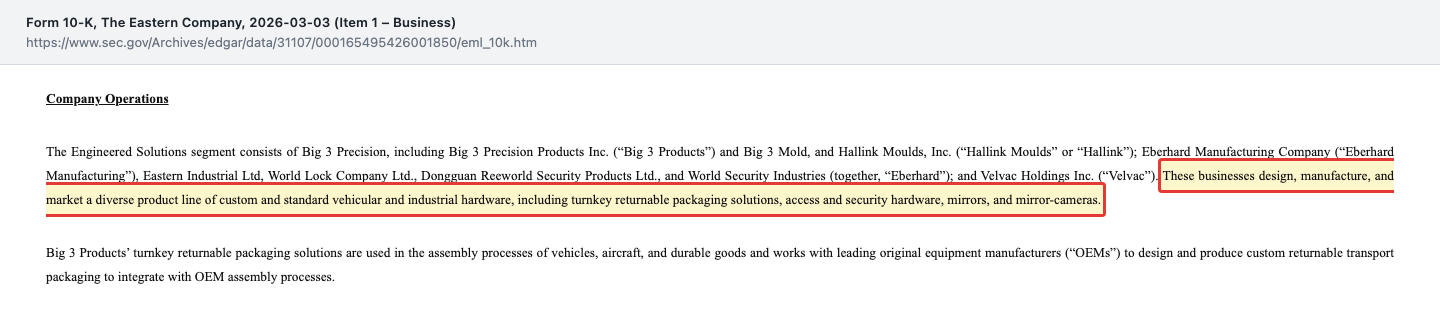
According to its annual report, The Eastern Company was incorporated under the laws of Connecticut in October 1912, succeeding a co-partnership established in 1858; today it is headquartered in Shelton. As of January 3, 2026, it employed 1,246 people, 612 in the U.S. and 634 abroad — in Canada, Mexico, Taiwan, Hong Kong and China. The annual report sums up the business in one sentence:
"These businesses design, manufacture, and market a diverse product line of custom and standard vehicular and industrial hardware, including turnkey returnable packaging solutions, access and security hardware, mirrors, and mirror-cameras."
— The Eastern Company, Form 10-K for fiscal 2025, Item 1 "Business"
In everyday terms, it is four workshops under one roof. Velvac builds exterior mirrors, mirror-cameras and aftermarket parts for heavy "Class 8" trucks — the big tractor units — as well as for buses and RVs, mostly in Reynosa, Mexico. Eberhard supplies latches, locks, handles and hinges for truck sleeper cabs, work vehicles and military vehicles. Big 3 Precision builds returnable transport racks in which auto plants move body and interior parts between production steps; this business depends on how many new car models launch, because every new model needs new racks. And since June 1, 2026, there is Eastern Precision Holdings with two California aerospace and defense suppliers: Sungear (precision gears and assemblies) and Crown Precision (components for aircraft actuators). The key drivers are therefore heavy-truck production — the customer side whose cycle we described in our analysis of Daimler Truck — and the number of model launches in the auto industry.
That defines the central tension of this analysis, and it runs through every chapter: the third quarter of 2026 shows a real, mostly organic recovery — but 2026 earnings and the low P/E rest half on a one-time gain, and the strong third quarter tied up more cash than it brought in.
Company history for investors
-
1858
Origins as a co-partnership
According to the annual report, a co-partnership is established in 1858; in October 1912, the corporation The Eastern Company succeeds it. For shareholders: a long history — but it says nothing about today's earning power.
-
2024
Ryan Schroeder becomes CEO
The former Plaskolite chief takes over in November 2024. For shareholders: from his first call in March 2025, promises and results can be compared.
-
2025
Restructuring and a weak year
Blow-mold unit sold, 60 jobs cut, revenue of $249.0 million, operating margin of 4.3% after 7.4%. For shareholders: the base year against which 2026 is measured.
-
2025
New credit agreement
In October 2025, a $100 million revolver with Citizens Bank, due 2030, replaces the old loans. For shareholders: financing secured through the end of the decade.
-
2026
Acquisition of Sungear and Crown Precision
Bought on June 1 for $7.85 million, $6.53 million one-time gain booked. For shareholders: entry into aerospace, but an earnings jump without cash.
-
2026
Best quarter in five quarters
Q3: revenue of $75.0 million (+36%), operating margin of 7.4%, backlog of $126.1 million. For shareholders: first sign of a turn, but with negative quarterly cash flow.
How the stock landed on our desk
Eastern landed on our desk through the quarterly report itself: on November 10, 2026, the company filed its 10-Q for the third quarter (July 5 to October 3, 2026) and its earnings release on the same day. The headline numbers are strong: revenue of $75.0 million after $55.3 million, an operating margin of 7.4 percent versus 3.1 percent, and earnings per share of $0.57 versus $0.10. The stock closed that day at $29.48, a little more than 8 percent above the prior close ($27.25) and at the top of its 52-week range of $17.61 to $29.91 (intraday low and high; source: fundamental data, as of November 10, 2026).
Pour those numbers into a ratio and you quickly find an apparent bargain: the price-to-earnings ratio (P/E) — in plain terms, you pay that many years of earnings for the stock. For a supplier whose revenue just jumped by a third, a low value sounds cheap. This is exactly where the base-effect trap bites, because reported earnings over the past four quarters contain an item that has nothing to do with selling mirrors and latches. So keep this in mind from the start: at Eastern, the third quarter is clean — the year 2026 is not.
One-time items first: what is left of the profit without the bargain
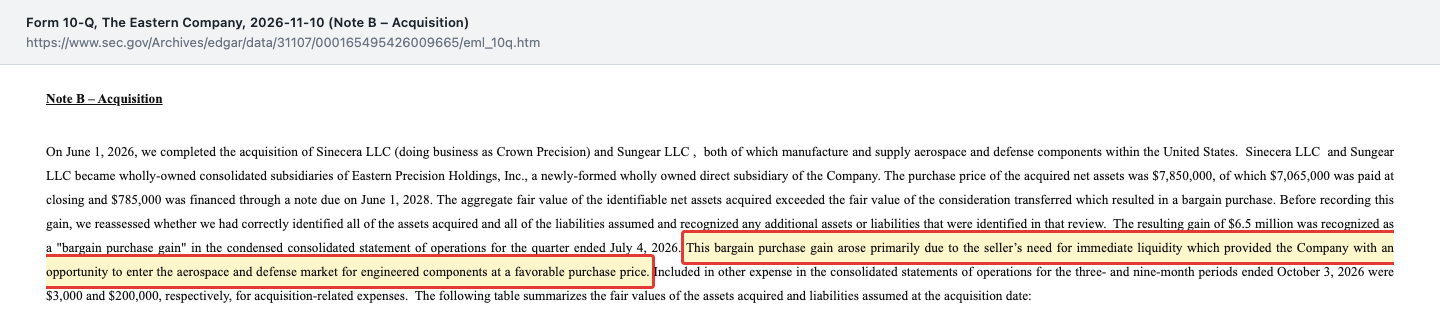
On June 1, 2026, Eastern acquired Sungear and Crown Precision for $7.85 million — $7.065 million in cash and $785,000 as a seller note due June 1, 2028. In return it received assets that Eastern, after review, values at $14.38 million net: mainly inventories ($10.47 million), property and equipment ($4.32 million) and receivables ($1.75 million), less assumed liabilities ($2.45 million). When you buy something below its value, U.S. accounting rules require the difference to be booked as income — a so-called bargain purchase gain. At Eastern, that was $6.53 million, booked in the second quarter of 2026. Think of it like this: you buy a bike worth $1,400 at a flea market for $785 and write the difference into your household budget as income. On paper you are richer; your bank account has not gained a cent. Why the seller sold so cheaply is spelled out in the notes:
"This bargain purchase gain arose primarily due to the seller’s need for immediate liquidity which provided the Company with an opportunity to enter the aerospace and defense market for engineered components at a favorable purchase price."
— The Eastern Company, Form 10-Q for the quarter ended October 3, 2026, Note B "Acquisition"
How much this item matters becomes clear when you compare reported (GAAP) and adjusted earnings. GAAP stands for U.S. generally accepted accounting principles; "adjusted" is the company's own calculation excluding special items such as one-time gains, restructuring costs or acquisition expenses. Both figures appear in the reconciliation in the November 10, 2026, earnings release (income from continuing operations, millions of dollars):
| Item | Q3 2026 | Q3 2025 | 9M 2026 | 9M 2025 |
|---|---|---|---|---|
| GAAP net income | 3.45 | 0.58 | 9.74 | 4.78 |
| of which one-time gain (pre-tax) | – | – | 6.53 | – |
| Adjusted net income | 3.63 | 0.80 | 5.29 | 6.50 |
| GAAP EPS ($) | 0.57 | 0.10 | 1.61 | 0.78 |
| Adjusted EPS ($) | 0.60 | 0.13 | 0.88 | 1.06 |
| Adjusted EBITDA | 7.64 | 3.48 | 14.02 | 15.24 |
The table tells two stories. The first is good: the third quarter is practically free of special items. Between $3.45 million under GAAP and $3.63 million adjusted there are only acquisition costs and the drag from acquired inventory having been recorded at its higher fair value, which now weighs on margins as it is sold ($239,000 in the quarter). The second is sobering: over nine months, adjusted earnings fell 18.6 percent ($5.29 million versus $6.50 million), and adjusted EBITDA — earnings before interest, taxes, depreciation and amortization, roughly what operations throw off before financing — fell 8.0 percent. The 104 percent GAAP increase comes entirely from the one-time gain. After tax, that is about $4.9 million, or roughly $0.82 per share — a little over half of nine-month earnings.
What that means for the price-to-earnings ratio: reported earnings over the past four quarters come to $1.81 per share (the sum of the four quarters from Q4 2025 through Q3 2026: $0.19 + $0.11 + $0.94 + $0.57); at the closing price of $29.48 on November 10, 2026, that gives a P/E of about 16. That includes about $0.82 of after-tax one-time gain; strip out only that ($0.99), and the P/E is about 30. On adjusted earnings of $1.17 (the same four-quarter sum of adjusted figures: $0.31 + $0.11 + $0.15 + $0.60, excluding the one-time gain and one-time restructuring and acquisition costs), it is about 25.
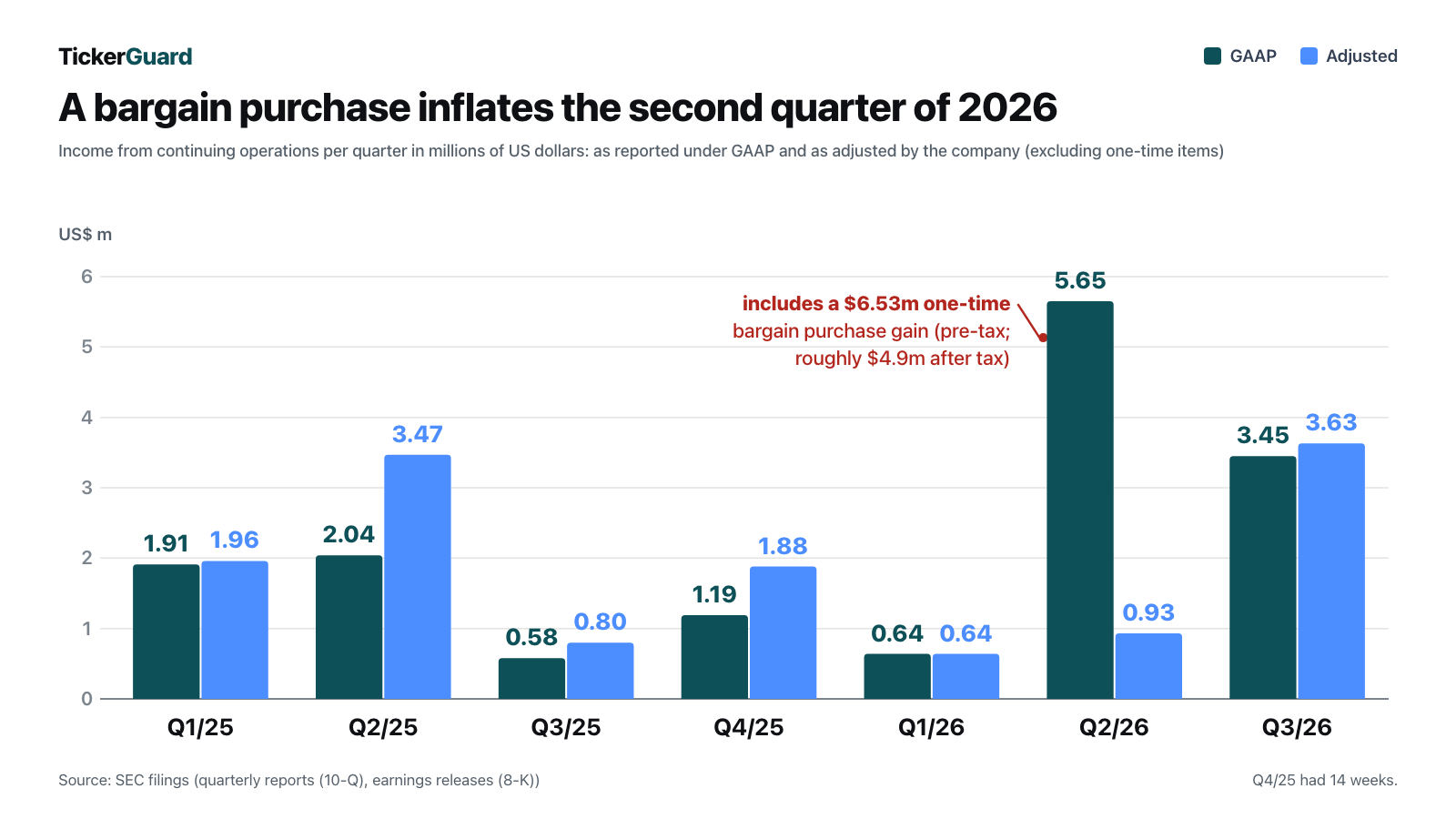
And the third-quarter growth? A close look pays off here, because the acquisition explains less than you might think. According to the 10-Q, only $5.4 million of the $19.6 million revenue increase came from the acquired aerospace and defense businesses; $7.4 million came from truck mirrors, $5.7 million from transport racks and $1.1 million from latches and handles. Without the acquisition, revenue would have grown about 26 percent — mostly organic growth. Over nine months the picture is more sober: up 2.6 percent in total and, excluding the acquisition ($7.1 million), a slight decline of about 1 percent. If you want to see bargain purchases as a recurring business model, look at our analysis of Mutares; at Eastern it is a one-off so far. Remember: the quarter counts, the bargain does not.
The numbers over the years — honestly assessed
First, what genuinely impresses. Eastern has cleaned house in recent years: unprofitable parts were sold (most recently the blow-mold tooling unit of Big 3 Mold on April 30, 2025), a 2025 restructuring cut 60 jobs and closed the Dearborn site, and bank debt fell from $71.3 million (end of 2021) to $33.9 million (January 3, 2026). According to CEO Ryan Schroeder, as of August 2026 the quarterly dividend of $0.11 had been paid for 344 consecutive quarters. And the backlog — goods ordered but not yet delivered — rose from $74.3 million (September 27, 2025) to $126.1 million as of October 3, 2026, up 70 percent. Excluding the acquired aerospace business ($19.0 million of acquired orders, less $3.6 million of lower aerospace orders since), $110.7 million remains, about 49 percent more: truck mirrors +$19.6 million, transport racks +$8.4 million, latches and handles +$8.4 million (10-Q filed November 10, 2026, Item 2).
Now the other side. Over five years Eastern has not grown, and its margin has recently shrunk:
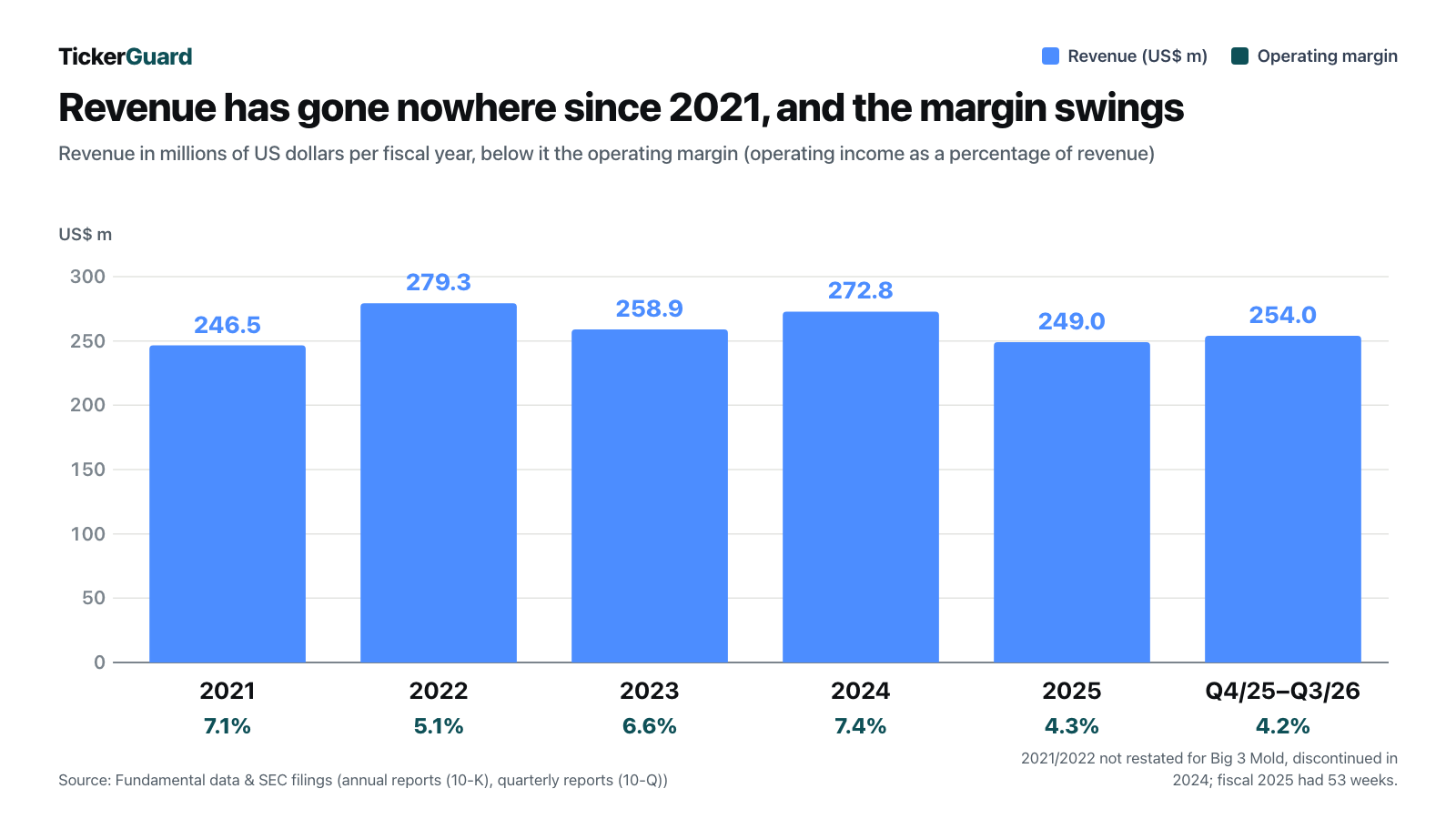
The series shows continuing operations. The years 2021 and 2022 come from older annual reports that are not restated for Big 3 Mold; Eastern classified that unit as discontinued in the third quarter of 2024, and its ISBM tooling division was sold on April 30, 2025. Fiscal 2025 had 53 weeks instead of 52 — one extra week of revenue that must not be forgotten in comparisons. The real slump came in 2025: revenue of $249.0 million after $272.8 million, an operating margin of 4.3 percent after 7.4 percent, and adjusted EBITDA of $19.8 million after $27.1 million. Truck makers built fewer trucks, automakers launched hardly any new models, and tariffs on goods from China cost Eastern $10.2 million in 2025 according to the annual report, mostly passed on to customers. Over the four quarters through October 3, 2026, the operating margin of 4.2 percent is not yet back at its old level, even though the third quarter at 7.4 percent shows where things could go. Remember: one strong quarter does not make a turnaround, but it is the first in two years that looks like one.
Earnings calls: promised, delivered, spun
Four times a year, Eastern explains its numbers on a conference call with analysts. Since Ryan Schroeder became CEO in November 2024, you can check what he announced — and what actually happened. The basis is the transcripts of the calls from the fourth quarter of 2024 through the second quarter of 2026; they come from an external transcription service and are not documents published by the company. The call on the third quarter of 2026 was scheduled for November 11, 2026; its transcript was not available at the time of writing and is not included here.
| Call | Promised | Delivered? |
|---|---|---|
| Q2 2025 (Aug 7, 2025), CFO Vlahos | Job cuts to bring "approximately $4 million in annual cash cost savings" | Partly: the March 3, 2026, earnings release reports $4 million in annual savings; in Q3 2026, however, selling and administrative expenses rose $1.6 million, mainly from higher incentive pay. |
| Q3 2025 (Nov 5, 2025), Schroeder | Customers expect "a soft first half of 2026," then improvement toward year-end | Delivered and exceeded: first-half 2026 revenue about 11 percent below the prior year, third quarter up 36 percent. |
| Q3 2025, Schroeder | More car model launches next year | Delivered from Q3 2026: transport racks +$5.7 million revenue, +$8.4 million backlog; still −$5.2 million over nine months. |
| Q4 2025 (Mar 4, 2026), Schroeder | The third quarter of 2025 was the trough | Not in the next quarter: adjusted EBITDA in Q1 2026 was $2.99 million, below the $3.48 million of Q3 2025. Only Q3 2026 was clearly above it. |
| Q4 2025, Schroeder | Acquisitions only if "immediately accretive," i.e., lifting earnings per share right away | Open: the June 2026 acquisition ran at a gross margin around zero in its first month; no separate profit contribution is reported. |
| Q1 2026 (May 13, 2026), Schroeder | Loss-making Big 3 orders only weigh on the first half of 2026 | Delivered: Q2 release says "now behind us," Q3 gross margin 23.9 percent. |
| Q2 2026 (Aug 12, 2026), Schroeder | Acquisition to bring "maybe $5 million and maybe $6 million a quarter" in revenue | Delivered: $5.4 million in the third quarter. |
| Q2 2026, Schroeder | "We expect the majority of the current backlog to convert to revenue over the balance of the year" ($126 million) | Open until the annual report: the backlog stayed at $126.1 million because new orders replaced shipments. |
| Q2 2026, CFO Vlahos | Target gross margin for the acquisition "in a 20% to 30% range" | Open, not reported separately. |
The most revealing part is the change in tone around the trough. In November 2025, Schroeder openly called it a disappointing quarter. In March 2026, he declared the bottom reached:
"Sequential financial improvement and momentum in our sales funnel suggest the third quarter represented the trough."
— Ryan Schroeder, CEO, earnings call for the fourth quarter of 2025 (March 4, 2026), transcript by a transcription service
Two months later the tone was different: "This was a quarter with positives and negatives." In addition, Schroeder named a problem at Big 3 for the first time in May 2026:
"Within Big 3, to fill plant capacity against a prolonged period of soft demand, our racks team quoted orders in the fourth quarter, which were discovered to be below our margin thresholds."
— Ryan Schroeder, earnings call for the first quarter of 2026 (May 13, 2026), transcript by a transcription service
Translated: to fill the plants, orders were accepted that, by Schroeder's account, were below the company's own margin thresholds. At least the promise that the damage would be limited to the first half held.
The second notable thread is the questions about the acquisition on the August 12, 2026, call. In the transcript, management is confronted with its own acquisition criteria from the April 2026 investor presentation — a 15 percent EBITDA margin and demonstrated profitability — together with the question of why a company without profits was bought: "I was kind of surprised to see a profitless aerospace company being acquired." Schroeder first answered with his strategy: the aerospace market lacks suppliers, and Eastern can buy and improve such companies. Only when analyst Jake Patterson followed up and asked whether the companies had been profitable at all in recent fiscal years did he say:
"No, they’re going to be profitable. They’re going to be profitable this year. They were profitable for the first half of this year after taking some pricing action last year, and we think there’s more to be done there, and we intend for this acquisition to be accretive to our overall efforts this year."
— Ryan Schroeder, earnings call for the second quarter of 2026 (August 12, 2026), transcript by a transcription service
He gave no number. An analyst noted that the acquired businesses' gross margin had been "effectively breakeven" in the first month and that it would be "a few quarters" before a reasonable margin — Schroeder confirmed: "That’s correct." He also conceded that some products in the acquired backlog were "priced inappropriately." Together with the explanation in the 10-Q — the seller's need for cash — the picture is clear: Eastern bought cheaply because there is something to fix.
A third thread: three times since 2025, analysts asked whether the lower gross margin was structural; three times the answer was volume and product mix, with no target figure. In the third quarter of 2026, gross margin did rise to 23.9 percent; over nine months, however, it was still below the prior year at 21.7 percent (22.9 percent). And overall interest is strikingly thin: on three of the calls reviewed, nobody asked a single question.
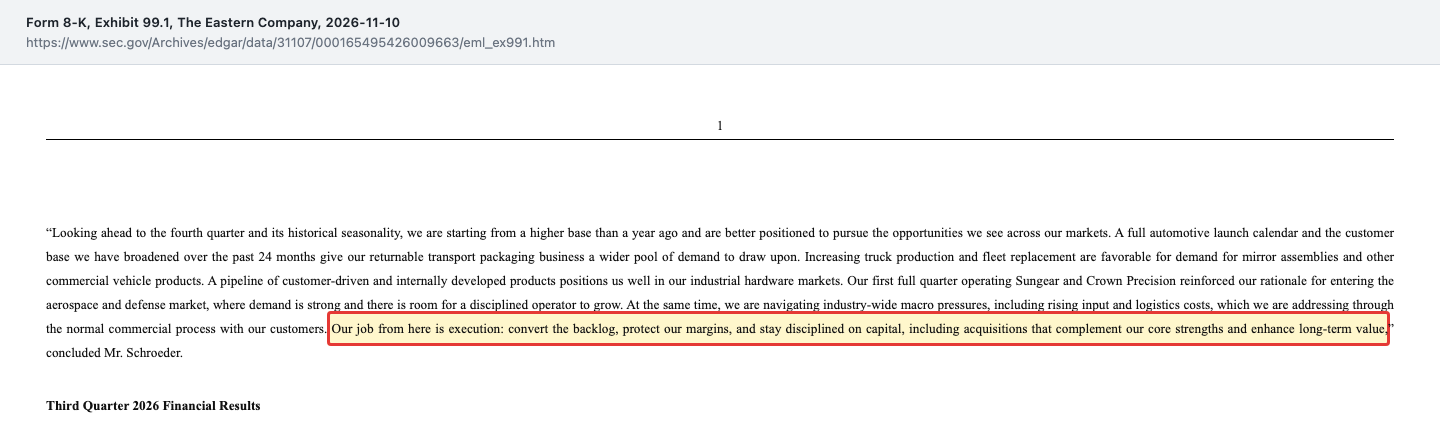
What does management promise now? The November 10, 2026, earnings release contains no quantified guidance — no revenue, earnings or margin target. There is only a qualitative outlook: the fourth quarter is seasonally weaker, but Eastern starts "from a higher base than a year ago"; at the same time, Schroeder cites rising input and logistics costs. His closing sentence:
"Our job from here is execution: convert the backlog, protect our margins, and stay disciplined on capital, including acquisitions that complement our core strengths and enhance long-term value"
— Ryan Schroeder, third-quarter 2026 earnings release (8-K, Exhibit 99.1, November 10, 2026)
What the filings say — the uncomfortable truths
Uncomfortable truth No. 1: the strongest quarter in five quarters cost cash
Earnings are a calculation; money in the bank is a fact. In the third quarter of 2026, the two diverged: Eastern earned $3.45 million, but operating cash flow was negative $3.15 million. That figure appears in no press release; it only emerges when you subtract the first-half cash flow statement (+$12.04 million) from the nine-month one (+$8.88 million). Cash fell from $15.1 million to $7.9 million in the quarter. The reason is growth itself: ship more, and you wait for more customer money. Receivables rose from $30.1 million at the start of the year to $42.5 million, and customers paid after 58 days on average versus 43 days a year earlier. Why the nine months still look positive, the report explains as follows:
"Cash flow from operations in the first nine months of 2026 increased due to timing of vendor payments partially offset by timing of customer receivable collections and the exclusion of the non-cash bargain purchase gain."
— The Eastern Company, Form 10-Q for the quarter ended October 3, 2026, Item 2 "Liquidity and Sources of Capital"
In plain English: Eastern paid its suppliers later. Accounts payable grew from $16.4 million to $29.9 million. That is ordinary cash management — but it is credit that someone will eventually want back. On the positive side, no cash was burned on inventory; the $10.4 million increase since the start of the year came almost entirely with the acquisition. Remember: whether the strong third quarter also pays off in cash will only show in the 2026 annual report.
Uncomfortable truth No. 2: tariffs are a pass-through — and a refund may not belong to Eastern
Eastern sources part of its goods in China. Tariffs on them cost $10.2 million in 2025 according to the annual report; so far in 2026:
"For the three and nine months ended October 3, 2026, we incurred approximately $2.3 and $7.3 million, respectively, in tariff and tariff-related expenses, $2.3 and $6.9 million, respectively, of which have been mitigated through price increases."
— The Eastern Company, Form 10-Q for the quarter ended October 3, 2026, Item 2 "Recent Developments"
That is good news with a catch. Good, because only about $0.4 million of the nine-month tariffs stuck to Eastern. The catch: part of the higher revenue is simply passed-through tariffs, not extra demand. And when tariffs fell, prices fell too — Schroeder on the August 12, 2026, call: "our prices with our customers reduce some." After the U.S. Supreme Court ruled on February 20, 2026, that some of the tariffs were not authorized, Eastern is filing refund claims. There is no number; the company writes that as of October 3, 2026, it had "not recorded a material benefit for potential refunds." Because the tariffs were mostly passed on to customers, it is unclear how much of any refund Eastern would keep. Anyone hoping for a tariff windfall is hoping without evidence.
Uncomfortable truth No. 3: the balance sheet holds — but the cushion is thinner
As of October 3, 2026, Eastern had $39.7 million of bank debt (including the $785,000 seller note) against $7.9 million in cash, or about $31.8 million net. The facility is with Citizens Bank, a $100 million revolver running to October 2030 and secured by substantially all assets. The covenants are clearly worded:
"The Company’s loan covenants under the Credit Agreement require the Company to maintain a senior net leverage ratio not to exceed 3.50 to 1.00, which is to be tested quarterly on a trailing twelve-month basis."
— The Eastern Company, Form 10-Q for the quarter ended October 3, 2026, Note I "Debt"

The covenants are met according to the report, and with adjusted EBITDA of $18.6 million over the past four quarters, net debt is roughly 1.7 times that figure — well below the limit. The report does not state the exact ratio as of October 3, 2026. Still, the cushion has shrunk: the current ratio — current assets divided by current liabilities — fell from 3.7 at the start of the year to 2.7. On top of that come $12.3 million of pension obligations from four frozen legacy plans, and $58.7 million of the $132.7 million in shareholders' equity is goodwill from earlier acquisitions — an item that has to be written down if things go badly. No alarm, but a reason why further acquisitions leave little room for error.
Valuation: what the November 10, 2026, close implies
At the closing price of $29.48 on November 10, 2026, Eastern is worth about $177.6 million based on 6,023,136 shares (cover of the 10-Q). Add net bank debt and the whole company costs about $209 million (excluding leases). That yields these orders of magnitude — each based on the four quarters through October 3, 2026:
- GAAP P/E of about 16 ($1.81 per share) — but with the one-time gain included; the derivation is in the chapter "One-time items first".
- Adjusted P/E of about 25 ($1.17 per share). That is the more honest yardstick, and it is not cheap for a supplier with a 4 percent operating margin.
- Enterprise value to adjusted EBITDA of about 11 ($18.6 million) — normal for a solid industrial supplier, no discount.
- Price-to-sales of about 0.7 ($254.0 million revenue) and price-to-book of about 1.3 ($22.03 of equity per share) — Eastern looks cheap here because its margin is low.
- Dividend yield of about 1.5 percent ($0.44 a year).
In plain terms: the market is not paying for the weak 2025, but for an Eastern that holds its third-quarter margin. Annualize the quarter's $0.60 of adjusted earnings per share and you get a P/E of a little over 12 — except that the fourth quarter is seasonally weaker and in 2026 has one week less than in 2025. There is hardly a "view from the pros": according to fundamental data, there are no analyst estimates. A different kind of clue: Chairman James Mitarotonda, whose activist fund Barington holds about 11 percent, and director Frederick DiSanto bought shares on the open market in 2026; according to the insider filings (Form 4), there have been no insider sales since May 2025. The amounts are small: Barington and Mitarotonda bought about $0.3 million worth in 2026. Asset manager BlackRock, by contrast, cut its stake from 5.1 to 0.7 percent according to its filing of July 28, 2026.
Opportunities and risks at a glance
What speaks for Eastern:
- A real organic recovery in the third quarter of 2026: revenue up about 26 percent excluding the acquisition, operating margin of 7.4 percent after 3.1 percent, earnings practically free of special items.
- Backlog of $126.1 million as of October 3, 2026 (up 70 percent, about 49 percent excluding the acquired aerospace business); truck production and car model launches are picking up.
- The acquisition was bought below book value ($7.85 million for $14.38 million of net assets) and opens the aerospace and defense market; first full-quarter revenue of $5.4 million.
- Solid financing: covenants met, net debt roughly 1.7 times adjusted EBITDA, $61 million of undrawn credit as of October 3, 2026.
- Dividend paid for 344 quarters according to the CEO (as of August 2026), insider buying in 2026, no insider sales since May 2025.
What speaks against it:
- Nine-month 2026 earnings rest half on a $6.53 million one-time gain; adjusted, they fell 18.6 percent.
- Operating cash flow of negative $3.15 million in the third quarter; the nine-month figure relies on later supplier payments ($29.9 million outstanding).
- The acquisition has not yet proven profitable: gross margin around zero in the first month, mispriced legacy orders, a seller in need of cash.
- Heavy dependence on two cycles (truck production, car model launches) and on tariffs on Chinese goods; the largest customer accounts for 14 percent of receivables.
- Management declared the trough too early once; it first named underpriced Big 3 orders in May 2026.
A human conclusion
Back to the base-effect trap from the beginning. Its core is not that the percentages are wrong — revenue up 36 percent and earnings per share of $0.57 versus $0.10 are exactly what the 10-Q says. Its core is that big percentages make you forget what they refer to: a prior-year quarter that management itself called "disappointing," and annual earnings that contain the discount of a seller who needed cash immediately. Set both aside and an honest finding remains. Eastern had a genuinely good third quarter in 2026, mostly on its own strength, with a full order book. But over nine months it earned less on an adjusted basis than a year earlier, it consumed cash in the strong third quarter, and on adjusted earnings it costs about 25 years of profit. So the honest question for you is not "Isn't the stock cheap?" but: do you believe the third quarter of 2026 is the new normal — and not just the rebound after a weak year? If yes, you have a thesis that the 2026 annual report will confirm or refute. If no, you bought a base effect. What you make of it is your decision. And that is how it should be.
Sources
All original documents used in this analysis — so you can read them yourself:
- The Eastern Company — Form 10-Q for the quarter ended October 3, 2026 (filed November 10, 2026)
- The Eastern Company — third-quarter 2026 earnings release (8-K Item 2.02, Exhibit 99.1, filed November 10, 2026)
- The Eastern Company — Form 10-Q for the quarter ended July 4, 2026 (filed August 11, 2026) and the earnings release of the same day
- The Eastern Company — Form 10-Q for the quarter ended April 4, 2026 (filed May 12, 2026)
- The Eastern Company — 8-K of June 2, 2026, on the acquisition of Sungear and Crown Precision (Exhibit 99.1)
- The Eastern Company — Form 10-K for fiscal 2025 (filed March 3, 2026) and Form 10-K/A (March 19, 2026, exhibits filed late)
- The Eastern Company — fourth-quarter 2025 earnings release (8-K, March 3, 2026)
- The Eastern Company — Form 10-K for 2024, 2023 and 2022
- The Eastern Company — 8-K of November 3, 2025 (new credit agreement), 8-K of May 8, 2026 (annual meeting) and proxy statement DEF 14A (March 23, 2026)
- Barington Companies — SC 13D/A of March 18, 2026; BlackRock — SC 13G/A of July 28, 2026
- Full SEC filing history: EDGAR overview for The Eastern Company (sec.gov)
- Transcripts of the earnings calls for Q4 2024 through Q2 2026 (the call on the third quarter of 2026, held November 11, 2026, was not available as a transcript at the time of writing).
- Fundamental data (prices, 52-week range, market value cross-check, analyst coverage; as of November 10, 2026), reconciled with the SEC filings.
Transparency & disclaimer: this analysis is journalistic commentary on publicly available information. It is not investment advice, not a regulated investment research product and not a solicitation to buy or sell securities. Equity investments carry substantial risk up to and including total loss. All information is provided without warranty; the as-of date for each figure is stated in the text. Positions held by the operator are disclosed daily; where one exists, it appears as a notice at the top of this analysis.
Key figures at a glance
All monetary figures in millions of $; earnings per share as reported.
| Metric | 2021 | 2022 | 2023 | 2024 | 2025 |
|---|---|---|---|---|---|
| Revenue | 246.5 | 279.3 | 258.9 | 272.8 | 249.0 |
| Operating Income (EBIT) | 17.4 | 14.2 | 17.0 | 20.1 | 10.1 |
| Net Income | 9.3 | 12.3 | 8.6 | -8.5 | 5.1 |
| Net Margin | 3.8% | 4.4% | 3.3% | -3.1% | 2.1% |
| Earnings Per Share | 1.49 $ | 1.97 $ | 1.37 $ | -1.37 $ | 0.84 $ |
Source: fundamental data & SEC filings (annual and quarterly reports, 10-K/10-Q)
Our Bottom Line at a Glance
- Operations positive
- Q3 2026 shows a real recovery: revenue of $75.0 million (up 36%, about 26% excluding the acquisition), gross margin of 23.9% (prior year 22.3%), operating margin of 7.4% (3.1%), backlog of $126.1 million (up 70%).
- Earnings quality negative
- Nine-month 2026 earnings ($9.74 million under GAAP) include a non-cash $6.53 million one-time gain from a bargain purchase; adjusted, they fell 18.6% to $5.29 million. Q3 earnings themselves are nearly clean.
- Cash flow negative
- Operating cash flow in Q3 2026 of negative $3.15 million, cash down from $15.1 million to $7.9 million; over nine months (+$8.9 million), the main support was paying suppliers later (accounts payable up from $16.4 million to $29.9 million).
- Balance sheet & financing neutral
- Bank debt of $39.7 million, about $31.8 million net — roughly 1.7 times adjusted EBITDA against a 3.5 limit; covenants met as of 10/03/2026. But the current ratio fell from 3.7 to 2.7, and goodwill equals 44% of equity.
- Management & acquisition neutral
- Trough declared too early in March 2026; underpriced Big 3 orders first named in May 2026; the June 2026 acquisition ran at a gross margin around zero in its first month. Promises on the first half, acquired revenue and Big 3 losses held.
Eastern is the base-effect trap in two layers: a strong third quarter of 2026 (revenue up 36%, mostly organic) meets a very weak prior-year quarter, and nine-month earnings only double thanks to a $6.53 million one-time gain from a bargain purchase. Adjusted, nine-month earnings fall 18.6 percent, the stock is not cheap on adjusted earnings, and the strong third quarter cost $3.15 million of operating cash flow. The recovery is real; its durability is unproven. Not investment advice.
What Our Rating Means
Open questions
The business works in principle, but one material question is open. As long as it stays open, our findings do not carry a quality verdict.
Yellow, because a material operating question is open: 2026 earnings depend half on a single event (a $6.53 million one-time gain from the acquisition), the recovery is only one quarter old, operating cash flow was negative in that quarter, and the acquisition has not yet proven profitable. Red would require a substance risk, and there is none: no going-concern doubt, covenants comfortably met, net debt roughly 1.7 times adjusted EBITDA, positive cash flow over nine months. Green would require proof that the third-quarter margin holds. At the November 10, 2026, price, the stock is not cheap on an adjusted basis. The decision is yours.
A journalistic assessment by our editorial team at the time of the deep dive, based on public sources — not investment advice and not a solicitation to buy or sell. Your personal circumstances (investment goals, risk capacity, taxes) cannot be taken into account. What our levels mean, how verdicts are formed, and what conflicts of interest exist →
Worth Noting
- Occasion for this analysis: the 10-Q and the 8-K earnings release of November 10, 2026. Price reference: closing price of $29.48 on 11/10/2026 (prior close $27.25; 52-week range $17.61–$29.91 based on intraday lows and highs according to fundamental data).
- Data as of: the latest periodic report is the 10-Q for the quarter ended 10/03/2026; no further filings through 11/11/2026. The Q3 2026 earnings call (11/11/2026) was not available as a transcript; call statements come from the calls for Q4 2024 through Q2 2026.
- Time series: continuing operations; 2021/2022 not restated for the Big 3 Mold unit classified as discontinued in 2024; FY2025 and Q4 2025 each have one extra week (53 and 14 weeks); Q4 2026 has 13 weeks. Adjusted figures per the company's reconciliations.
- Not to be confused with: The Eastern Company (EML) is unrelated to Eastern Bankshares or East West Bancorp.
Stock Watch
This analysis is as of November 11, 2026. Stock Watch will tell you what's changed at EML since then.
Later $1 a month per stock — signing up is free, and you'll be the first to know when it launches.
The full analysis as a PDF for later
We will send you this analysis as a PDF — to print, file away, and read at your own pace. And we will add you to the free Stock Watch list for Eastern Co (EML), so you hear about it when something material in this analysis changes.
Frequently Asked Questions
The Eastern Company (Nasdaq: EML) of Shelton, Connecticut, is an industrial supplier whose roots go back to a co-partnership established in 1858. Velvac makes mirrors and mirror-cameras for heavy trucks, Eberhard makes latches, handles and hinges, and Big 3 Precision builds returnable transport racks for auto plants. Since June 1, 2026, the aerospace and defense suppliers Sungear and Crown Precision have been part of the group. Eastern had 1,246 employees as of January 3, 2026.
Under GAAP, income from continuing operations for the first nine months of 2026 rose 104 percent to $9.74 million, but mainly because of a $6.53 million one-time gain from the bargain purchase of Sungear and Crown Precision. Adjusted, earnings fell 18.6 percent to $5.29 million. The third quarter on its own was genuinely strong: $3.45 million under GAAP and $3.63 million adjusted, versus $0.58 million and $0.80 million a year earlier.
A bargain purchase gain arises when a company buys a business for less than the fair value of its net assets; under U.S. accounting rules, the difference must be booked as income. Eastern paid $7.85 million for net assets worth $14.38 million and recorded a $6.53 million gain in the second quarter of 2026. It is a one-time, non-cash item — no money arrived in the bank account.
At the closing price of $29.48 on November 10, 2026, the price-to-earnings ratio on reported trailing four-quarter earnings is about 16, but it includes a one-time gain; on adjusted earnings it is about 25. The derivation is in the chapter "One-time items first". The market value was about $177.6 million.
In the third quarter of 2026, revenue rose $19.6 million to $75.0 million. According to the 10-Q, $5.4 million of that came from the acquired aerospace and defense businesses; the rest came from truck mirrors (+$7.4 million), transport racks (+$5.7 million) and latches and handles (+$1.1 million). Excluding the acquisition, Eastern grew about 26 percent. Over nine months, organic growth was about minus 1 percent.
No. As of October 3, 2026, it had $39.7 million of bank debt against $7.9 million in cash, about $31.8 million net — roughly 1.7 times adjusted EBITDA over the past four quarters. The credit agreement allows up to 3.5 times, and the covenants are met. On top of that come $12.3 million of pension obligations and $61 million of undrawn credit.
No quantified guidance. The November 10, 2026, earnings release gives neither a revenue nor an earnings target. CEO Ryan Schroeder points to the usual weakness of the fourth quarter, a higher starting point than a year earlier and rising input and logistics costs; as the task ahead he names converting the backlog of $126.1 million (October 3, 2026).
Found an error?
Did you spot a factual error, an outdated number, or a typo in this deep dive? Let us know briefly — your report goes straight to the editorial team.