Daimler Truck: Guidance Up, Margin Down
On August 7, 2026, Daimler Truck raised its full-year guidance to adjusted Group EBIT of 3.6 to 4.1 billion euros. Only 1,336 million euros of that had been booked in the first half — 36 percent less than a year earlier. And of the 1.91 euros in second-quarter earnings per share, 1.76 euros came from a business the group has just handed over. We read the interim report line by line and worked out what the second half now has to deliver.
 Thomas Mücke
Founder & Publisher
Thomas Mücke
Founder & Publisher
Chart
Interactive price chart (TradingView).
Note: pure fact-based analysis, not investment advice and not a solicitation to buy or sell. All figures without guarantee.
There is a reflex almost every investor knows, and it takes about two seconds. The headline reads: "Daimler Truck raises full-year guidance." Below it: earnings per share more than quintupled, free cash flow up from 20 million to 1.76 billion euros. And before you have read the first paragraph, your brain has already filed the news away: this is working.
Call it the headline reflex. It is not stupid — it is economical. Nobody has time to read 58 pages of an interim report. The problem is simply this: in August 2026, two completely different stories sit inside the same set of Daimler Truck numbers, and the headline tells only one of them.
So let us do it the other way round. We will read the interim report to June 30, 2026 together — the one KPMG subjected to an audit review — and we will recalculate the sentences printed in it. No recommendation, no price target. Just the question: what actually happened in the first half of 2026, and what has to happen for the raised guidance to hold at year-end?
What Daimler Truck actually does
Daimler Truck builds the trucks and buses that move everything you own. The group is based in Leinfelden-Echterdingen near Stuttgart, belongs to Germany's DAX index, and employed exactly 98,869 people as of June 30, 2026.
Since the Japanese business departed, the company stands on four legs. Trucks North America builds heavy long-haul trucks in the United States, Canada and Mexico under the Freightliner and Western Star brands — historically the group's profit engine. Mercedes-Benz Trucks serves Europe and Latin America; the Actros celebrated its thirtieth birthday in 2026. Daimler Buses makes city and coach buses under the Setra and Mercedes-Benz names. And Financial Services is the in-house bank, financing and leasing the vehicles the other three build, with a contract volume of 30.7 billion euros at June 30, 2026.
The business model is about as cyclical as a business model gets. A haulier buys a new truck when he believes he can keep it busy, and postpones the purchase the moment he doubts it. That is why the numbers in this industry do not swing by ten percent but by fifty.
One thing you need to know, or every year-on-year comparison goes wrong: effective April 1, 2026, Daimler Truck handed over its Japanese subsidiary Mitsubishi Fuso. Fuso was combined with Hino Motors into a new holding company called ARCHION Corporation, now listed on the Tokyo Stock Exchange. Daimler Truck retains only a shareholding, accounted for using the equity method — no longer its own business, but a stake in someone else's. The former Trucks Asia segment is gone. Roughly 10,000 employees left the group with Fuso, which explains the drop in headcount from 108,476 to 98,869.
How the stock landed on our desk
Not through a screen. Daimler Truck reached us via the discussion rankings of German retail-investor forums: on August 11, 2026, when we looked, the stock was among the most-discussed German names on wallstreet-online. That is not a buy signal and not a metric — it is an attention signal. Where many people talk, many half-truths are born, and that is exactly why the original numbers are worth reading.
The trigger for the discussion is easy to find. On August 7, 2026, the group published its second-quarter figures and raised full-year guidance in the same breath. CEO Karin Rådström said in the investor release that the strong business performance at Trucks North America, the prospect of higher unit sales and the lower expected tariff burden over the remainder of the year had encouraged the company to raise its full-year guidance.
That is the headline. Now the numbers underneath it.
The first-half numbers — starting with what impresses
Let us begin with what genuinely looks good, because there is plenty of it.
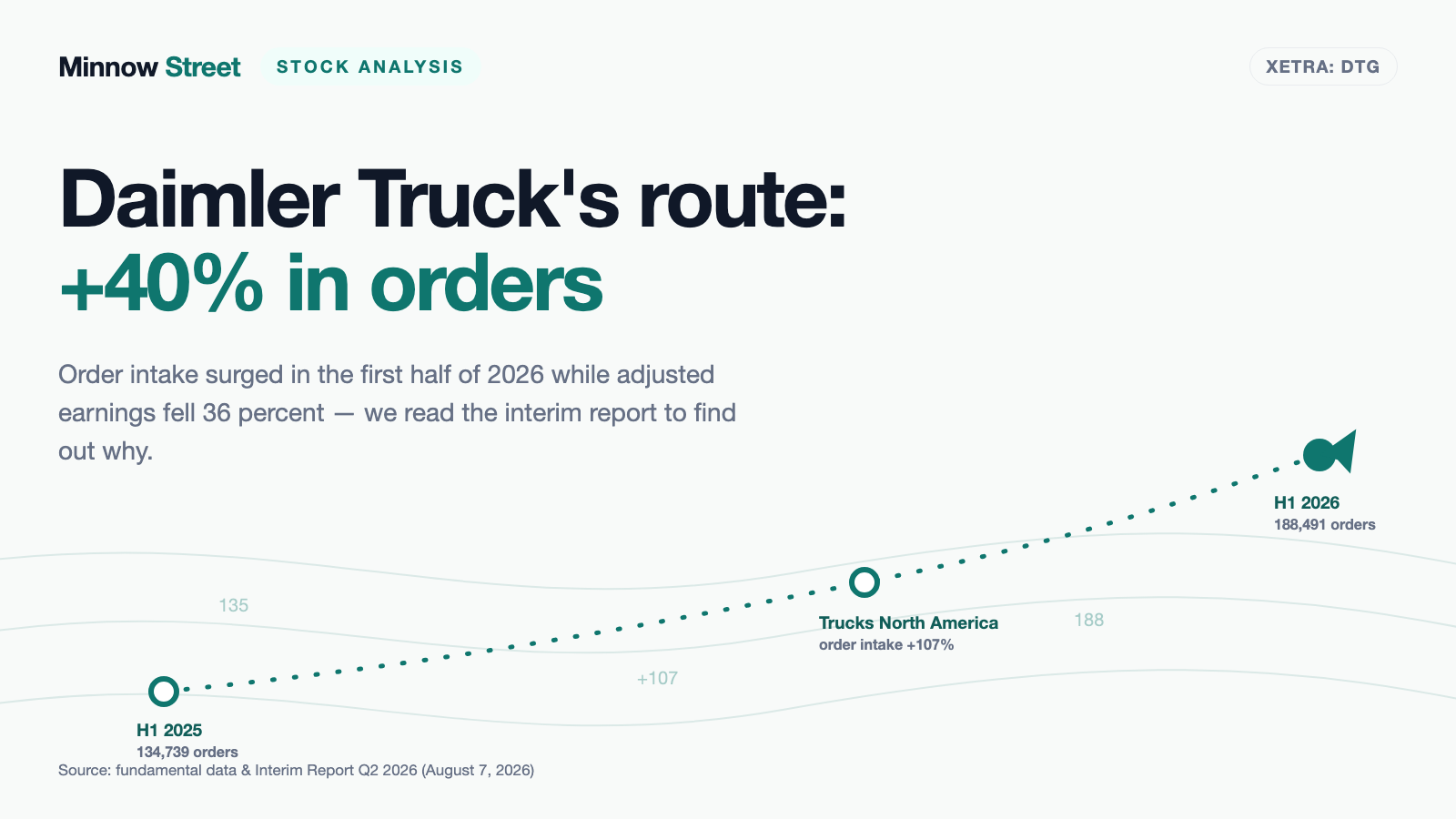
The order books are filling fast. In the first half of 2026, 188,491 orders came in, against 134,739 in the prior-year period — up 40 percent. At Trucks North America, order intake more than doubled: 94,574 vehicles against 45,582, a gain of 107 percent. In the second quarter alone the increase there was 156 percent. If you want to know whether a cyclical industry is turning, order intake is the first place you look — and it is turning.
The balance sheet is strong. Net liquidity of the Industrial Business — cash and equivalents less financial debt, excluding the captive bank — rose to 8,342 million euros at June 30, 2026, from 7,670 million at the end of 2025. The Industrial Business equity ratio climbed from 45.9 to 48.6 percent. For a cyclical company that is a thick cushion: you can sit out a bad stretch without asking the bank for permission.
Mercedes-Benz Trucks is delivering. The European segment sold 73,456 vehicles in the first half, 11 percent more than a year earlier; in the EU30 region sales rose from 23,446 to 30,501 units, and in Germany from 7,639 to 9,477. Revenue grew 7 percent to 9,923 million euros. Europe has now overtaken North America in revenue — more on that shortly.
Cash flow jumped. Free cash flow of the Industrial Business reached 1,762 million euros in the second quarter, against 20 million a year earlier. For the half year it stands at 1,318 million against 53 million.
And shareholders are getting a share: 1.5 billion euros in dividends flowed out in the first half of 2026, alongside a running buyback. On August 7, 2026, CFO Eva Scherer announced that the second tranche would run until the end of June 2027 with a volume of up to 1.1 billion euros. The number of shares outstanding had already fallen from 765.6 million at the end of 2025 to 760.2 million at June 30, 2026.
So much for the sunny side. It is real and it is documented. Now let us turn the page.
What the interim report says: four uncomfortable truths
Uncomfortable truth no. 1: The profit jump was a parting gift
In the second quarter of 2026, Daimler Truck earned 1.91 euros per share. In the prior-year quarter it was 0.36 euros. That sounds like a fivefold increase — and it is one, just not the kind you would assume.

The group states it plainly:
"Earnings per share amounted to €1.91 (Q2 2025: €0.36), of which €0.15 (Q2 2025: €0.29) was from continuing operations and €1.76 (Q2 2025 €0.07) was from discontinued operations."
— Daimler Truck Holding AG, Interim Report Q2 2026, Profitability
In plain language: of the 1.91 euros, 1.76 euros is the book gain recorded when Fuso left the group. That is a one-time event — you cannot sell the same company twice. What the ongoing business earned in the quarter is the remaining 0.15 euros. And that figure did not rise against the prior-year quarter; it fell by 46 percent.
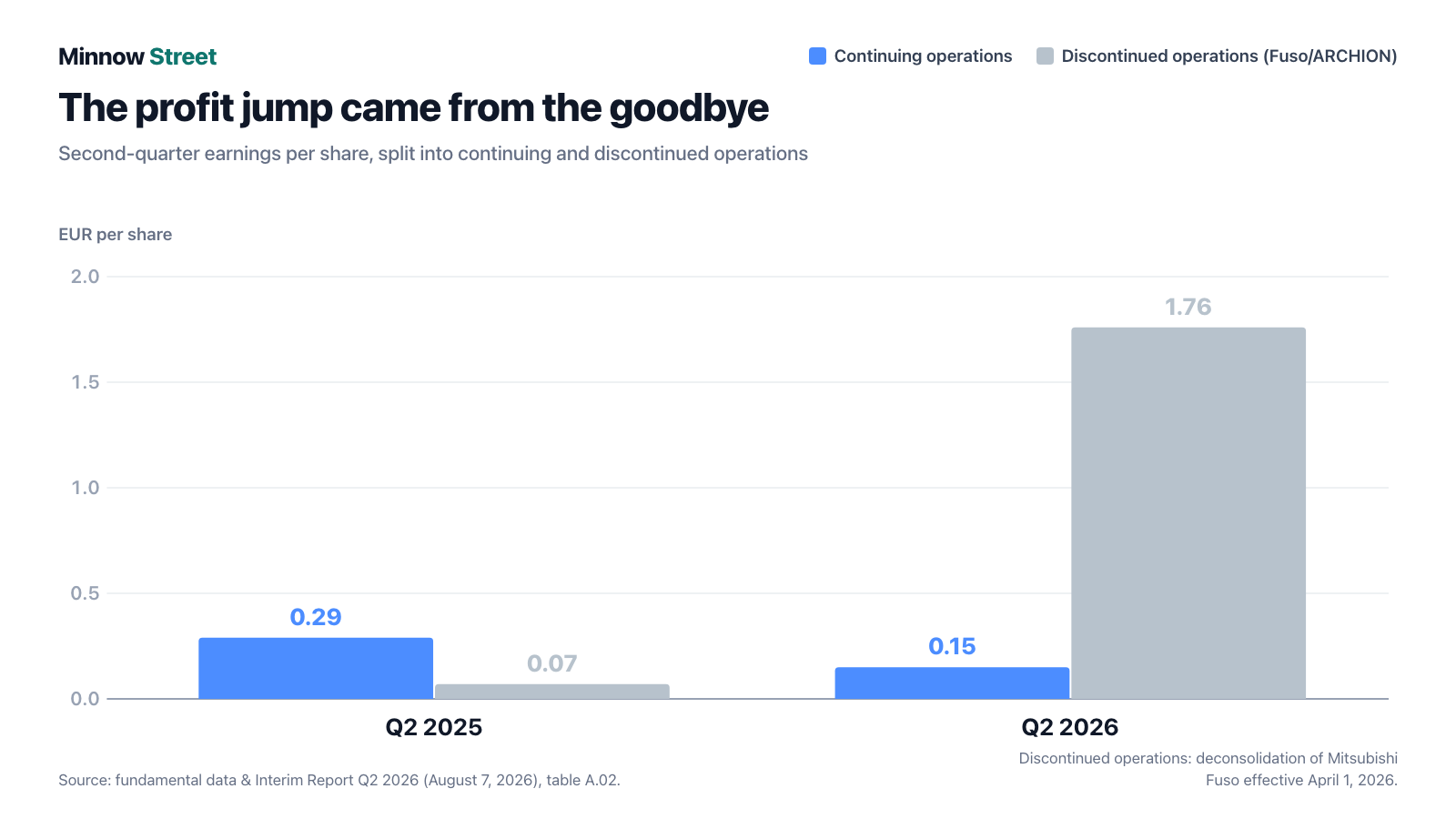
The same pattern shows up in the half year: 2.14 euros per share in total, of which 1.80 euros from discontinued operations. From the ongoing business, 0.34 euros remained — after 1.22 euros in the first half of 2025. That is 72 percent less.
Uncomfortable truth no. 2: The raised cash flow guidance describes a decline
This one is the most elegant, because the company writes it down itself — you only have to turn to the outlook.
The headline: free cash flow of the Industrial Business is expected to land at 3.0 to 3.5 billion euros in 2026, raised from 2.7 to 3.2 billion. Against the 1.8 billion euros actually achieved in 2025, that would be close to a doubling.
Then you read the next sentence:

"Excluding these special items, we expect free cash flow of the Industrial Business to be slightly below the prior year level."
— Daimler Truck Holding AG, Interim Report Q2 2026, Outlook
The "special items" are, according to the same paragraph, 1.4 billion euros of inflows related to the Fuso and Hino integration, less 0.3 billion euros of outflow from the deconsolidation, plus further proceeds from selling down the ARCHION stake. Strip the restructuring out and less operating cash remains than in 2025.
This is not accounting cosmetics and not an accusation — the company prints it. It is simply a fine example of how far a perfectly correct headline ("cash flow guidance raised") can lead you from the substance if you skip the following sentence.
Uncomfortable truth no. 3: "Adjusted" carried 684 million euros in the half year
Almost every group today reports an "adjusted" result: earnings excluding items management considers one-off. That is legitimate and often helpful. It is only worth checking how large the adjustment is — and what it consists of.
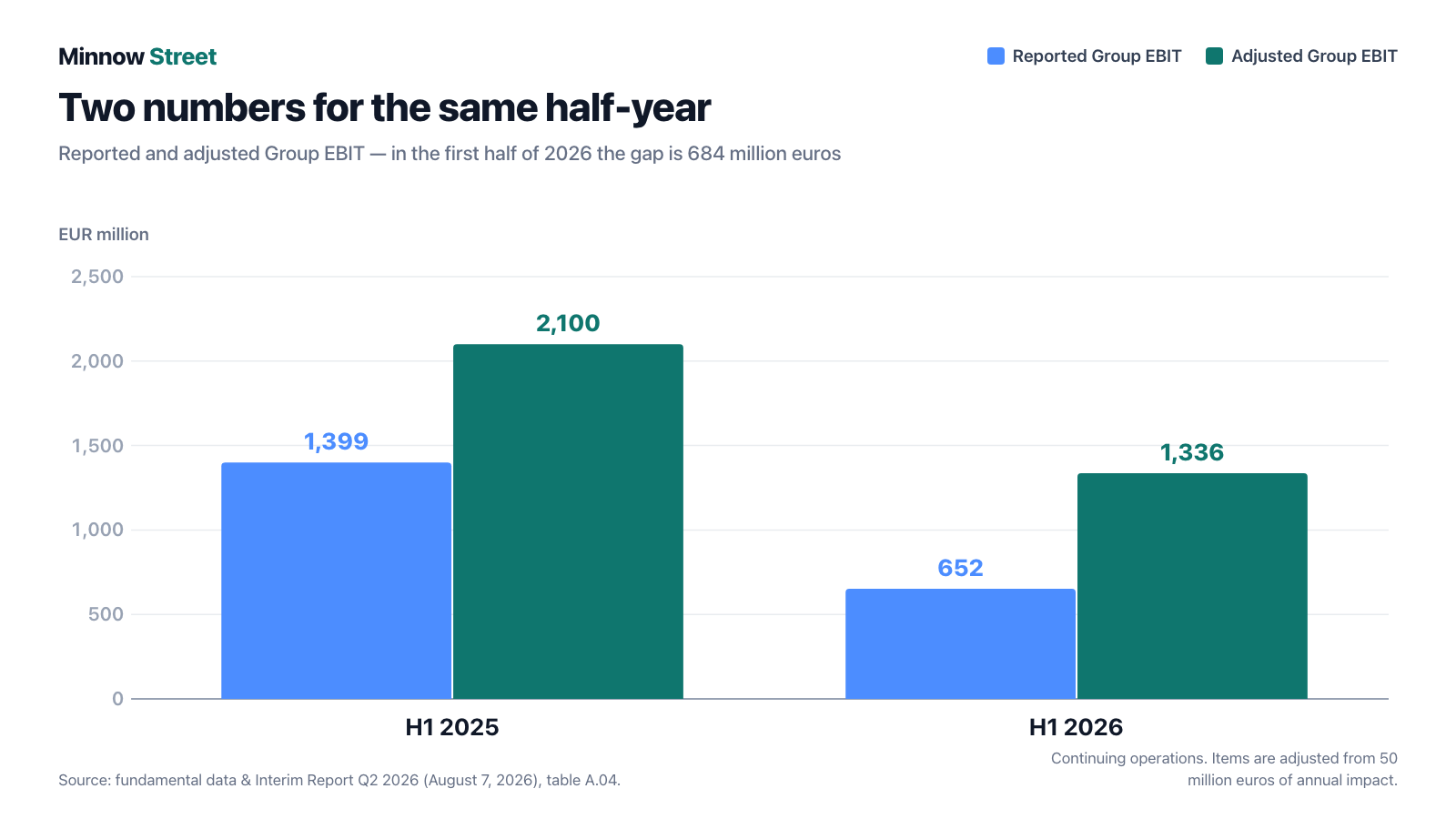
Reported Group EBIT — operating profit as the accounting rules produce it — came to 652 million euros in the first half of 2026, down 53 percent. The adjusted figure was 1,336 million euros, down 36 percent. The difference of 684 million euros consists entirely of items the group books under "M&A-related matters."
And what is inside? Mainly write-downs on investments Daimler Truck itself holds:

"During the second quarter of 2026, an impairment loss of €297 million was recognized on the portion of investment in ARCHION that is not held for sale."
— Daimler Truck Holding AG, Interim Report Q2 2026, Profitability
Let us hold that thought for a second. In the very same quarter in which the Fuso departure produced a book gain of 1,340 million euros, the group wrote down the ARCHION stake it received in exchange by 297 million euros. Add 222 million euros of write-downs on the portion of the same investment held for sale, and — in the first quarter of 2026 — 199 million euros on the battery-cell joint venture Amplify Cell Technologies. The carrying amount of the ARCHION investment stood at 1.1 billion euros at June 30, 2026.
One side effect is easy to miss: because the ARCHION impairment is not deductible for tax purposes, the effective tax rate in the second quarter of 2026 jumped to 67.5 percent, from 39.2 percent a year earlier. Of every euro earned before tax, roughly 32 cents survived.
Uncomfortable truth no. 4: The whole year hangs on the second half — and on a tariff ruling
Now the calculation that actually matters. It is simple enough for the back of an envelope.
The full-year target for adjusted Group EBIT is 3.6 to 4.1 billion euros. The first half delivered 1,336 million euros. So the second half has to produce 2,264 to 2,764 million euros.
That is 69 to 107 percent more than the first half. And since one should also ask whether such a jump has ever been managed before: in the second half of 2025 the group earned roughly 1,400 million euros on an adjusted basis — full-year 2025 came to 3.5 billion, the first half of 2025 to 2.1 billion. Measured against that comparison, the guidance demands a gain of 62 to 97 percent.
Where is it supposed to come from? The group names two reasons, and both are plausible. First, the rising order intake at Trucks North America, which converts into deliveries with a lag. Second — and this is the more interesting part — an administrative decision: the U.S. Department of Commerce approved Daimler Truck's U.S. content application with an effective date of November 1, 2025. As a result, the tariff burden turns out lower than previously assumed. The interim report puts the resulting guidance increase at a "three-digit million amount."
This deserves to be stated cleanly: a substantial part of the raised expectation comes not from selling better or producing more cheaply, but from an authority recognising a classification. The group itself notes that the guidance assumes the current framework of the trade agreement between the United States, Mexico and Canada holds. Tariff policy is therefore not a peripheral risk for this stock; it is a main ingredient of the forecast.
How hard tariffs bit in the first half is visible at Trucks North America itself: segment revenue fell 14 percent to 9,021 million euros, adjusted EBIT dropped 55 percent to 644 million, and the adjusted return on sales went from 13.7 to 7.1 percent. The former profit engine now earns only marginally more than the European business, which managed 5.5 percent over the same period — and Europe has actually overtaken North America on revenue (9,923 versus 9,021 million euros). For the full year the group again credits Trucks North America with 9 to 11 percent. After 7.1 percent in the half year, a great deal has to come together in the second half.
A short postscript on electrification, since it comes up in every commercial-vehicle discussion: of the 86,707 vehicles sold in the second quarter of 2026, 1,405 were zero-emission — 1.6 percent. For the half year it is 2,147 of 155,556, or 1.4 percent. Consistent with that, the group capitalises ever less development spending: 76 million euros in the first half of 2026 after 161 million a year earlier, a share of 8.0 percent of total research activity instead of 12.1 percent. At Trucks North America nothing at all was capitalised in the first half of 2026, after 45 million euros the year before. Back in the second quarter of 2025, Daimler Truck had already derecognised 218 million euros of previously capitalised development costs — explicitly citing the delayed pace of the transition to battery-electric vehicles, especially in the U.S. market.
What the market is paying for it
We deliberately work with orders of magnitude and a dated anchor rather than live prices. On June 30, 2026, the shares closed Xetra trading at 42.20 euros, putting the market capitalisation at 32.1 billion euros across 760.2 million shares outstanding.
That produces an interesting picture:
- Price to book: equity attributable to shareholders stood at 22,571 million euros at June 30, 2026. The market value therefore corresponded to roughly 1.4 times book. For an industrial group with this balance sheet, that is not expensive.
- Enterprise value to earnings target: deduct the 8.3 billion euros of Industrial Business net liquidity from the market value and roughly 23.8 billion euros remain. Measured against the guidance range of 3.6 to 4.1 billion euros of adjusted EBIT, that is about 5.8 to 6.6 times. This is a valuation that prices in considerable scepticism.
- Price to sales: against Industrial Business revenue of 42.1 billion euros in 2025, the market value sits at roughly 0.76 times. With margins in the mid single digits, that is normal — truck makers are revenue giants and margin dwarfs.
- Dividend: 1.90 euros per share was paid for 2025 (an outflow of 1.5 billion euros in the first half of 2026). Against the June 30, 2026 anchor price, that is roughly 4.5 percent.
And the professionals' view? As of the August 11, 2026 data date, the analyst consensus sat at an average target price of about 49.80 euros. Such consensus figures are notoriously trend-following, though: they rise after the share price has risen. As a standalone argument they are worth little — as a sentiment gauge, rather more.
The honest summary of the valuation is this. The stock is not expensive measured against what the group can earn in a good year. Nor is it obviously cheap measured against what it actually earned this half year. Which of those two numbers is the right reference point will be decided by the second half.
Anyone who knows the pattern will recognise it: in our analysis of HENSOLDT we looked at how a German industrial with bulging order books can burn cash at the same time — and at RENK, at how quickly a growth story turns into a margin question. Full order books are a promise, not a booking.
Opportunities and risks at a glance
What speaks for the company:
- Order intake rose 40 percent in the first half of 2026 to 188,491 vehicles, and 107 percent at Trucks North America — the classic leading indicator for a cyclical points upwards.
- The balance sheet is unusually solid: 8,342 million euros of net liquidity in the Industrial Business and an Industrial Business equity ratio of 48.6 percent at June 30, 2026.
- The European business is now carrying its weight: Mercedes-Benz Trucks lifted unit sales 11 percent and revenue 7 percent in the first half while North America shrank.
- Capital returns are running: 1.90 euros per share in dividends for 2025 and a buyback whose second tranche is to reach up to 1.1 billion euros (announced August 7, 2026).
- The portfolio restructuring is done: the low-margin Japanese business has been deconsolidated and the group is concentrating on North America and Europe.
What speaks against it:
- The guidance requires adjusted EBIT of 2,264 to 2,764 million euros in the second half of 2026 — 69 to 107 percent more than the first half delivered.
- A material part of the increase stems from a U.S. Department of Commerce tariff ruling rather than from operations; the guidance explicitly assumes the existing USMCA framework holds.
- The Trucks North America margin almost halved over the half year, from 13.7 to 7.1 percent adjusted return on sales.
- Excluding the ARCHION restructuring effects, the group itself expects free cash flow slightly below the prior-year level.
- The group wrote down investments by a combined 718 million euros in the first half of 2026 (297 and 222 million on ARCHION, 199 million on Amplify) — a sign that the valuations from the restructuring have not held.
- Daimler Buses had to cut its 2026 unit sales guidance from 25,000-30,000 to 20,000-25,000 vehicles because of weak markets in Latin America and Mexico.
- Closing truck manufacturing in Portland by the end of 2026 brings a charge in the high double-digit million range that was not yet in the books at June 30, 2026.
A human conclusion
Remember the headline reflex from the opening? It is especially seductive with this stock, because both headlines are true. "Daimler Truck raises guidance" — true. "Earnings per share more than quintupled" — true. "Record free cash flow" — also true.
And yet the ongoing business was 36 percent weaker in the first half of 2026 than a year earlier, the most important division nearly halved its margin, and the group writes into its own outlook that cash flow excluding the restructuring would fall short of last year. Both truths sit in the same document, twelve pages apart.
That is the real lesson here, and it reaches well beyond this one stock. A headline is not a lie; it is an abbreviation. The difference between an investor who feels informed and one who is informed is usually two more paragraphs of reading.
What actually lies in front of you is neither a scandal nor a sure thing, but a bet with a clear date on it: a cyclical global group with a very strong balance sheet, order books filling up nicely, and a full-year guidance that asks the second half for close to a doubling of the first half's result — depending on whether those orders turn into deliveries and whether tariff policy delivers what it promised in the summer of 2026. On November 3, 2026, Daimler Truck reports third-quarter figures. Then you will know more than you do today.
What you make of it is your decision. And that is exactly as it should be.
Sources
- Daimler Truck Holding AG: Interim Report Q2 2026 (IFRS interim financial statements subject to an audit review by KPMG, published August 7, 2026) — group and segment key figures, interim management report, consolidated statement of income (tables A.02 and A.04), reconciliation to adjusted EBIT (A.03 and A.05), forecast table A.13 and note 20, "Events after the reporting period"
- Daimler Truck Holding AG: Investor Relations release on the raised 2026 guidance (August 7, 2026, German original) — guidance increase, segment key figures and the statements by Karin Rådström and Eva Scherer
- wallstreet-online: Daimler Truck Holding discussion forum — the origin of this analysis; discussion rankings reviewed on August 11, 2026
- Fundamental data (master data, ratios, price history, analyst consensus), as of August 11, 2026
Note on the data: Daimler Truck is not a registrant with the U.S. securities regulator, the SEC. The group is listed in the Prime Standard of the Frankfurt Stock Exchange; its only U.S. presence is a Level I ADR program (DTRUY), which does not create an SEC reporting obligation. There are therefore no annual reports (10-K) or quarterly reports (10-Q) — the evidence in this analysis comes entirely from the German original publications. Reporting and trading currency are identical (the euro).
Disclaimer: This article is journalistic analysis of publicly available company information. It is not investment advice, not a buy or sell recommendation, and not a solicitation to buy or sell securities. Shares are subject to price fluctuations up to and including total loss. All figures are given with their respective reporting dates and may have changed since publication; the original document always governs. Positions held by the operator are disclosed daily; where one exists, it appears as a notice at the top of this deep dive.
Our Bottom Line at a Glance
- Order situation positive
- Order intake rose 40 percent in H1 2026 to 188,491 vehicles, and 107 percent to 94,574 at Trucks North America. The most important leading indicator for a cyclical company points clearly upwards.
- Balance sheet and financial strength positive
- Net liquidity of the Industrial Business of EUR 8,342m at 30.06.2026 (31.12.2025: EUR 7,670m) and an Industrial Business equity ratio of 48.6 percent after 45.9 percent. The group can sit out a weak stretch under its own power.
- Ongoing earnings power negative
- Adjusted Group EBIT fell 36 percent in H1 2026 to EUR 1,336m and the reported figure 53 percent to EUR 652m. Continuing operations produced EUR 0.34 per share after EUR 1.22 in the prior-year period.
- Trucks North America negative
- The adjusted return on sales of the former profit engine nearly halved in H1 2026, from 13.7 to 7.1 percent, and segment revenue fell 14 percent to EUR 9,021m. Europe has overtaken North America on revenue.
- Quality of the guidance neutral
- The range of EUR 3.6bn to 4.1bn raised on 07.08.2026 requires EUR 2,264m to 2,764m from the second half — 69 to 107 percent more than the first. A material part of the increase rests on a U.S. Department of Commerce tariff ruling rather than on operations.
- Special items and transparency neutral
- The group discloses the special items cleanly, including the note that free cash flow excluding the ARCHION restructuring would be slightly below the prior year. At EUR 684m for the half year, however, the adjustments are large enough that the headline figures mislead unless you read on.
Daimler Truck is a financially very solid cyclical business with sharply rising order intake — and a full-year guidance that asks the second half of 2026 for close to a doubling of the first half result. The spectacular second-quarter profit jump came to 1.76 of 1.91 euros per share from the deconsolidation of Mitsubishi Fuso, not from ongoing operations. Whether the arithmetic works out depends on converting orders into deliveries and on tariff policy. Not investment advice.
What Our Rating Means
Open questions
The business works in principle, but one material question is open. As long as it stays open, our findings do not carry a quality verdict.
The business model works, the balance sheet is above average with EUR 8,342m of net liquidity and a 48.6 percent Industrial Business equity ratio, and no threat to the substance of the company is visible. One material operating question is open: the adjusted return on sales fell to 6.0 percent in H1 2026, and at Trucks North America from 13.7 to 7.1 percent, while the full-year target demands 69 to 107 percent more earnings from the second half than the first delivered — partly dependent on an administrative tariff ruling. That is not a solvency problem, but it is an unproven turn, which is why the light is amber rather than green. The decision is yours.
A journalistic assessment by our editorial team at the time of the deep dive, based on public sources — not investment advice and not a solicitation to buy or sell. Your personal circumstances (investment goals, risk capacity, taxes) cannot be taken into account. What our levels mean, how verdicts are formed, and what conflicts of interest exist →
Worth Noting
- Origin: review of the discussion rankings on German retail-investor forums (wallstreet-online) on 11.08.2026 — not a screener hit but an attention signal.
- Data date: Interim Report Q2 2026 dated 07.08.2026 (reporting date 30.06.2026); market figures and analyst consensus as of 11.08.2026.
- Comparability: Mitsubishi Fuso was deconsolidated effective 01.04.2026 and the former Trucks Asia segment no longer exists. Unit sales and earnings are presented on a continuing-operations basis, which limits the meaning of prior-year group revenue comparisons.
- Risk of confusion: Daimler Truck Holding AG (DTG.DE) has been an independent company since the spin-off of 10.12.2021 and is not the same as Mercedes-Benz Group AG (MBG.DE).
- Not an SEC filer: there are no 10-K or 10-Q filings. The evidence comes from the German interim report and the investor relations release.
The full analysis as a PDF for later
We will send you this analysis as a PDF — to print, file away, and read at your own pace.
Frequently Asked Questions
Earnings per share came to 1.91 euros after 0.36 euros in the prior-year quarter. However, 1.76 euros of that came from discontinued operations — the book gain on the deconsolidation of Mitsubishi Fuso effective April 1, 2026. Continuing operations contributed only 0.15 euros, 46 percent less than a year earlier.
ARCHION Corporation is the new Japanese holding company into which Mitsubishi Fuso and Hino Motors were combined effective April 1, 2026; it has since been listed on the Tokyo Stock Exchange. Daimler Truck holds a stake accounted for using the equity method. Its carrying amount was 1.1 billion euros at June 30, 2026 — after a 297 million euro impairment in the second quarter.
Daimler Truck earned 1,336 million euros of adjusted Group EBIT in the first half of 2026. The second half would therefore have to deliver 2,264 to 2,764 million euros, or 69 to 107 percent more. The group attributes this to rising deliveries in North America and a lower tariff burden following a U.S. Department of Commerce ruling.
In the first half of 2026 reported Group EBIT was 652 million euros while the adjusted figure was 1,336 million — a gap of 684 million euros. It consists of items around the group restructuring, chiefly write-downs on the investments in ARCHION (297 and 222 million euros) and in the battery joint venture Amplify (199 million euros).
Yes. Net liquidity of the Industrial Business rose to 8,342 million euros at June 30, 2026 from 7,670 million at the end of 2025. The Industrial Business equity ratio stood at 48.6 percent (previously 45.9 percent) and the group ratio including financial services at 31.6 percent. Equity attributable to shareholders was 22,571 million euros.
A central one. Tariffs weighed on material costs and North American demand in the first half of 2026. The guidance increase of August 7, 2026 rests substantially on the U.S. Department of Commerce approving the company's U.S. content application effective November 1, 2025. The guidance applies explicitly only while the existing USMCA framework holds.
Still early. Of the 86,707 vehicles sold in the second quarter of 2026, 1,405 were zero-emission, or 1.6 percent; for the half year, 2,147 of 155,556 (1.4 percent). The group capitalised only 76 million euros of development costs in the first half of 2026 after 161 million a year earlier — and nothing at all at Trucks North America.
No. Daimler Truck is listed in the Prime Standard of the Frankfurt Stock Exchange and is not an SEC registrant. Its only U.S. presence is a Level I ADR program (ticker DTRUY), which creates no reporting obligation. There are therefore no annual reports (10-K) or quarterly reports (10-Q); the German annual and interim reports govern.
Found an error?
Did you spot a factual error, an outdated number, or a typo in this deep dive? Let us know briefly — your report goes straight to the editorial team.