PepGen: The Stock Nearly Doubles in a Day — and That Same Evening Come $125 Million in New Shares
On November 10, 2026, PepGen reported what it calls the highest level ever reported in a multiple-dose study for its only drug against the muscle disease DM1: 46.5 percent splicing correction after four monthly doses. The stock rose from $2.39 to $4.61 that day. Its SEC filings tell the rest of the story: six treated patients per dose, a partial clinical hold by the FDA in the U.S., a competitor that failed on the same test in Phase 3 — and a $125 million stock offering, announced on the evening of the jump. The headline shows only half the math.
 Thomas Mücke
Founder & Publisher
As of Today
As of: November 10, 2026
- Closing price
- 4.61 $ +92.89%
- Market Capitalisation
- 0.3 $B
- AAQS
- 1/10
This analysis has a cut-off date. The Stock Guard tells you when something material changes in the numbers. Reserve your free spot
Chart
Interactive price chart (TradingView).
52-week range: 1.40 $ to 7.20 $ · Last price: 4.61 $ (As of: November 10, 2026)
Note: pure fact-based analysis, not investment advice and not a solicitation to buy or sell. All figures without guarantee.
There is an investor trap that snaps shut with special reliability in biotech. Call it the headline trap: a single number sits in the headline of a press release, and for one day that number paints the whole picture. If it is bad, everyone runs; if it is good, everyone wants in. PepGen (Nasdaq: PEPG) went through both within one year. On March 31, 2026, the stock fell in a single day from $4.23 to $1.77 after disappointing trial data. On November 10, 2026, it rose after good data from $2.39 to $4.61 — and on that one day, according to fundamental data, 104.4 million shares changed hands, more than PepGen has issued in total. Let’s make a deal: before you let the number of the day guide you, let’s read the company’s filings with the U.S. securities regulator, the SEC, together — and look at what sits next to the headline. In the end, you decide.
What PepGen actually does — a key for a jammed blueprint
PepGen is based in Boston, employed 56 people full time as of December 31, 2025, and has been listed on Nasdaq since May 2022 (IPO price: $12.00 per share). The company develops a single drug in clinical trials: PGN-EDODM1 for myotonic dystrophy type 1 (DM1). It is a rare, progressive inherited disease. Muscles have trouble relaxing after they tense (myotonia), grow weaker, and the heart, breathing and other organs are affected too. PepGen puts the number of people affected in the U.S. and the EU at more than 110,000; no approved therapy addresses the underlying cause.
A picture for the cause: every cell reads its genes and trims the transcript (RNA) before building proteins from it — like a film editor cutting raw footage into a movie. Scientists call this splicing. In DM1, the transcript of one particular gene (DMPK) forms long, sticky hairpins that trap an important splicing protein called MBNL1. Then the cuts go wrong in many other genes. PGN-EDODM1 is designed to bind to these hairpins and release MBNL1 again. To get the drug into muscle cells at all, PepGen attaches a small transport peptide — that is the company’s “EDO” technology. The key measure in its trials is therefore splicing correction: in muscle biopsies it shows how far the disturbed splicing pattern of 22 genes has moved back toward normal.
PepGen discontinued a second program, for Duchenne muscular dystrophy (PGN-EDO51), in May 2025 because the Phase 2 results fell short. Since then everything rides on one drug. That defines the central tension of this analysis: The latest trial data are, according to PepGen, the highest ever reported in a multiple-dose study, but they come from six treated patients per dose, the U.S. Food and Drug Administration (FDA) has partially halted the trial in the U.S. — and shareholders are paying for the next step with a large stock offering.
Company history for investors
-
2022
IPO at $12
In May 2022, PepGen lists 10.2 million shares on Nasdaq at $12.00 and takes in $110.2 million net. For shareholders the starting point: since then, the company has funded its research from cash and new shares.
-
2025
Duchenne exit and offering at $3.20
In May 2025, PepGen ends its Duchenne program. In September come good single-dose DM1 data and 35.9 million new shares at $3.20 — the share count has thus more than doubled.
-
2026
FDA hold and a weak low dose
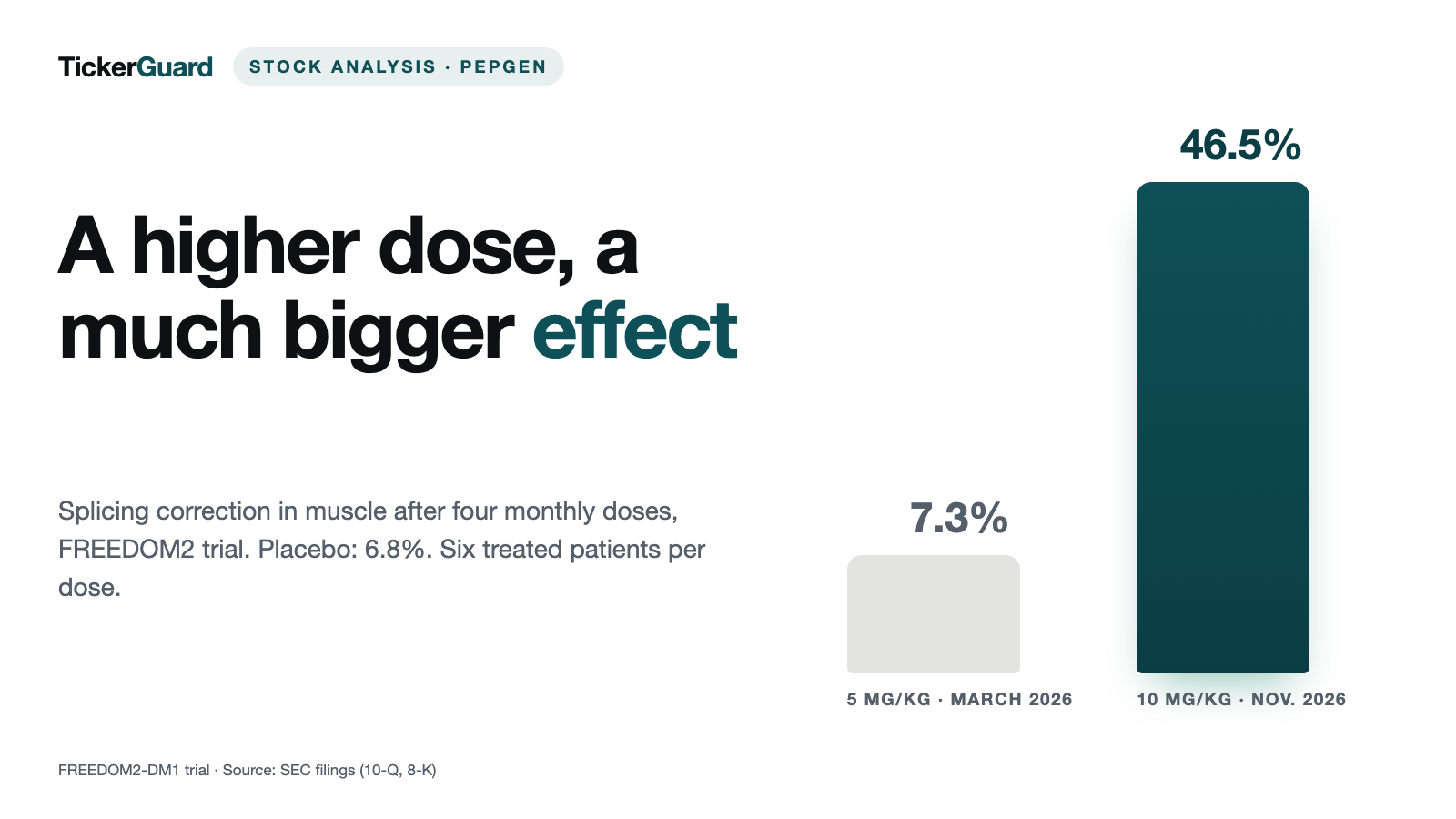
On 03/04/2026, PepGen reports a partial clinical hold in the U.S.; on 03/30/2026, just 7.3% splicing correction at 5 mg/kg. The next day the stock falls from $4.23 to $1.77.
-
2026
46.5 percent and $125 million in new shares
On 11/10/2026, PepGen reports 46.5% splicing correction at 10 mg/kg, and the stock closes at $4.61. That evening comes the prospectus for a $125 million offering.
How the stock landed on our desk
PepGen made our research list through our in-house Reddit hype scanner, which tracks stocks that investors are talking about unusually often in online forums. The trigger was November 10, 2026: that morning PepGen reported data for the middle dose (10 mg/kg of body weight), and the stock closed at $4.61, up from $2.39 the day before (fundamental data). PepGen itself confirms the $4.61 close in its prospectus supplement filed that evening. For comparison: on January 2, 2026, the stock had reached $7.17, its highest close since early 2025 (fundamental data); on May 15, 2026, it stood at $1.55 according to the shelf prospectus.
We reviewed the annual reports (10-K) for 2024 and 2025, the quarterly reports (10-Q) through September 30, 2026, the earnings release and the trial release of November 10, 2026, the current reports (8-K) on the clinical hold and the 5 mg/kg data, and the preliminary prospectus supplement (424B5) of November 10, 2026, checked through November 11, 2026. A final prospectus supplement with price and share count had not been filed by then.
The numbers over the years — an honest look
First, what impresses. PepGen cut its research spending after ending the Duchenne program: from $76.5 million in 2024 to $71.0 million in 2025. The net loss was $55.0 million in the first nine months of 2026, down from $71.3 million a year earlier. And the company raised money in time: in September 2025, after good single-dose data, it sold 35.9 million new shares at $3.20 each and took in $107.6 million net. There is no going-concern warning; by its own account, the money lasts into 2028.
The flip side: PepGen has never generated revenue — neither from products nor from partnerships. Everything is paid for out of the treasury, and the treasury only refills through new shares:
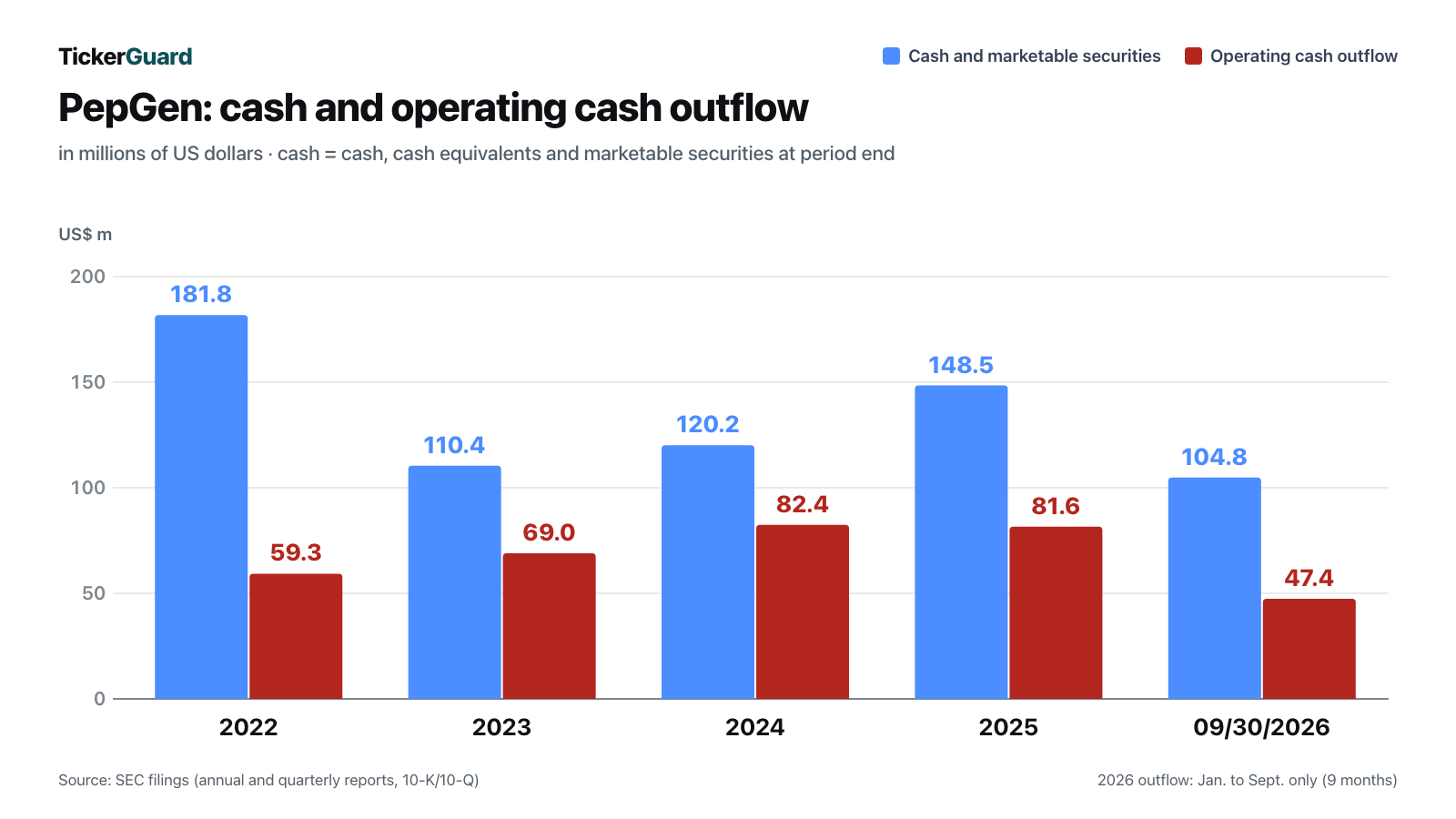
Since inception, PepGen had accumulated losses of $416.1 million by September 30, 2026. The runway math is simple: $47.4 million of outflow in nine months is just over $15 million a quarter. At that pace, $104.8 million carries PepGen roughly six to seven quarters — consistent with the company’s “into 2028.” Remember: For PepGen, cash is not the problem of the coming months; the question is what new money is raised for, and at what price.
What the filings say — the uncomfortable truths
Uncomfortable truth No. 1: The strong number rests on six people — and so did the weak one
The FREEDOM2 trial tests PGN-EDODM1 in three cohorts of rising dose (5, 10 and 12.5 mg/kg). Each cohort has eight participants, six of whom receive the drug and two a placebo; they get four infusions four weeks apart. For the 10 mg/kg cohort, PepGen reported mean splicing correction of 46.5 percent at week 13; five of six treated patients were above 20 percent, four above 50 percent. The pooled placebo group (four people) came in at 6.8 percent. PepGen calls this the highest level reported to date in a multiple-dose study.
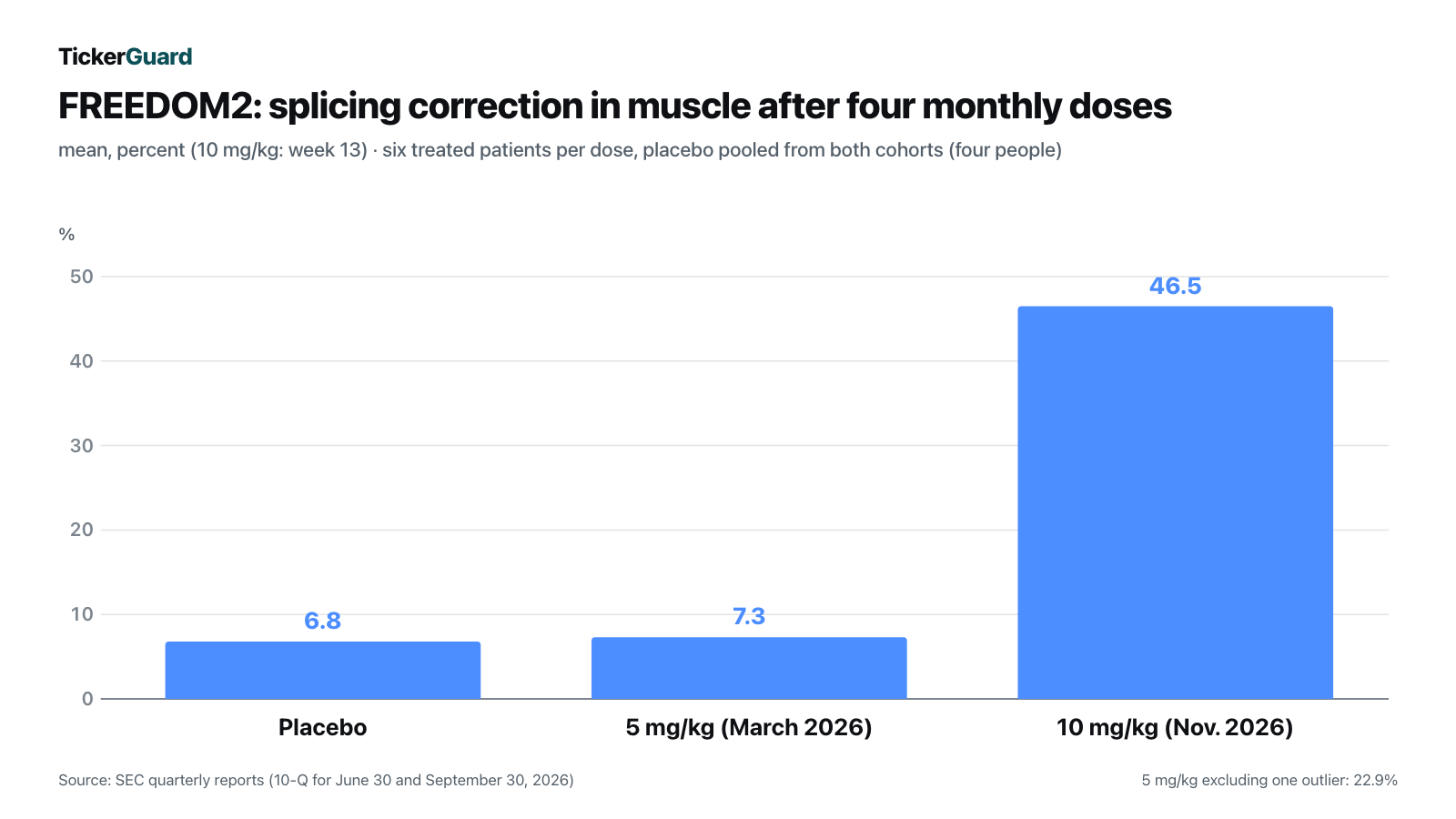
In March 2026, the low dose had painted a very different picture. The quarterly report put it this way:
“Such results also demonstrated a mean splicing correction of 7.3%, compared to 6.8% in placebo-treated patients.”
— PepGen Inc., SEC quarterly report 10-Q for the period ended June 30, 2026, Item 2 “Management’s Discussion and Analysis”
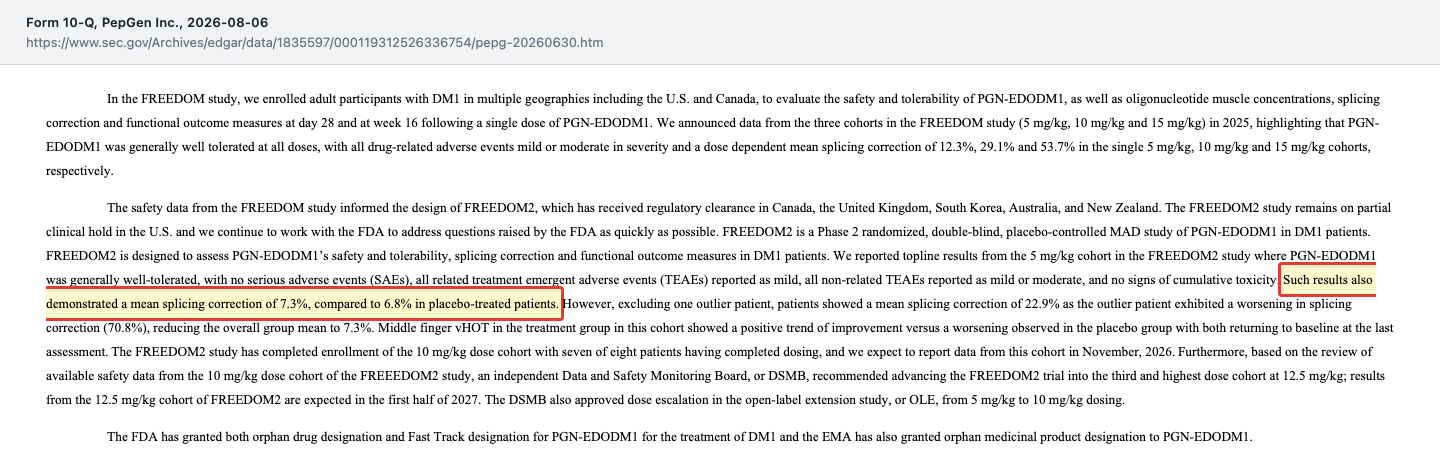
One patient had shown a 70.8 percent worsening at the time and dragged down the average of the whole cohort — that is what the same paragraph says. And that is the point: with six people, a single one can flip the result, in either direction. The market reacted with minus 58 percent in one day in March and nearly plus 93 percent in November. Both times to the same kind of number, both times based on six treated patients. Remember: The 46.5 percent is a real signal — but a signal from a very small sample, measured at 13 weeks (splicing correction) and 16 weeks (functional tests).
Uncomfortable truth No. 2: In the U.S., the trial is partially on hold
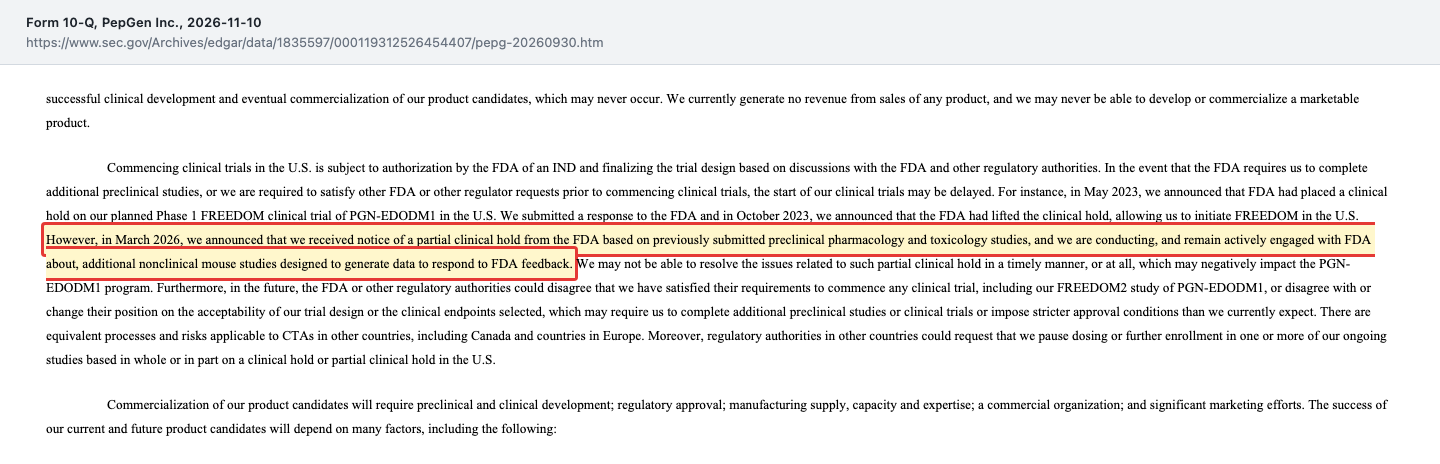
On March 4, 2026, PepGen announced that the FDA had placed a partial clinical hold on FREEDOM2. In plain terms: in the U.S., the trial cannot proceed as planned for now. The FDA based the hold on animal studies PepGen had submitted earlier; according to the annual report, it did not cite questions about the then still blinded patient data from the first trial. The latest quarterly report describes the status as follows:
“However, in March 2026, we announced that we received notice of a partial clinical hold from the FDA based on previously submitted preclinical pharmacology and toxicology studies, and we are conducting, and remain actively engaged with FDA about, additional nonclinical mouse studies designed to generate data to respond to FDA feedback.”
— PepGen Inc., SEC quarterly report 10-Q for the period ended September 30, 2026, Item 1A “Risk Factors”
The trial therefore runs in Canada, the U.K., South Korea, Australia and New Zealand. The hold matters for what comes next: PepGen plans the end-of-Phase 2 meeting with the FDA, which is meant to pave the way to a large pivotal trial, for the second half of 2027 — explicitly only if the hold has been lifted by then. PepGen gives no date for that. One bright spot: in October 2026, the FDA selected PGN-EDODM1 for a manufacturing pilot program (CMC Development and Readiness Pilot), intended to speed up alignment on production ahead of a pivotal trial.
Uncomfortable truth No. 3: A major competitor failed on the same test in Phase 3
Besides splicing correction, PepGen reports functional measures. The most important one is called vHOT: a video measures how long a patient needs to open the hand again after a firm grip — the typical muscle lock of DM1. In the 10 mg/kg cohort, that time improved by 3.9 seconds (about 52.7 percent) after 16 weeks, versus 0.2 seconds on placebo. Grip strength and walking tests improved as well; the questionnaires in which patients rate their own condition were inconclusive, according to PepGen. How robust vHOT is as evidence is shown by a sentence in the company’s own quarterly report:
“For example, Avidity Biosciences, Inc. (owned by Novartis) recently announced that its DM1 candidate, del-desiran, failed to show a statistically significant improvement over placebo with respect to its primary endpoint, VHOT, in a Phase 3 pivotal trial.”
— PepGen Inc., SEC quarterly report 10-Q for the period ended September 30, 2026, Item 1A “Risk Factors”
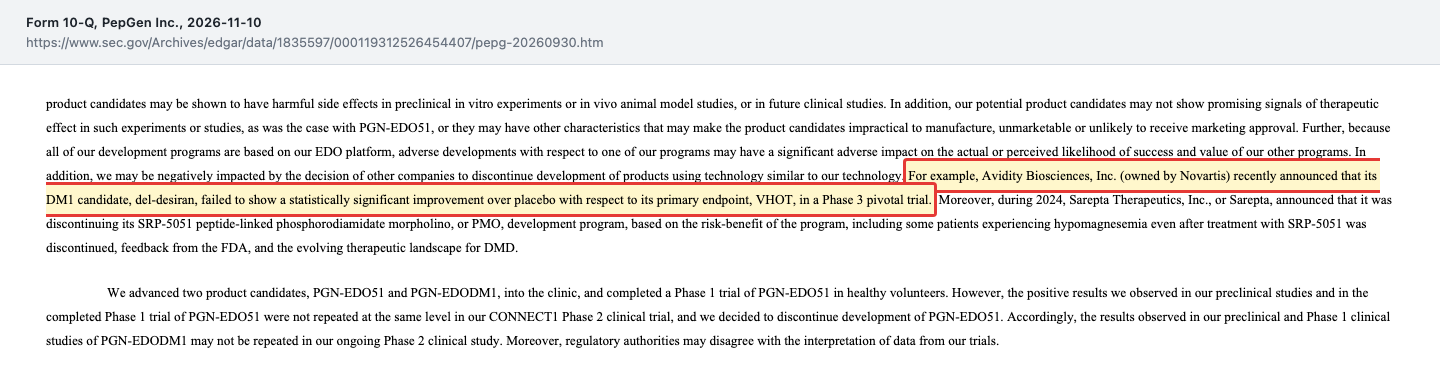
That does not mean PGN-EDODM1 faces the same fate — its mechanism is different. But it shows how wide the gap between a small trial with a visible effect and a large, placebo-controlled pivotal trial can be. Competition adds to it: PepGen itself names, among others, Dyne with DYNE-101, which is pursuing accelerated approval in the U.S., Vertex with VX-670 and Sarepta with a drug originally developed by Arrowhead. What it looks like when a small company with a single drug for a rare disease has actually made it to market is shown in our Zevra Therapeutics stock analysis.
Uncomfortable truth No. 4: Shareholders pay for the success — that same evening
After the jump, PepGen moved fast. On November 10, 2026, at 22:06 UTC — after the close in New York — the company filed a preliminary prospectus supplement:
“On November 10, 2026, the closing sale price of our common stock on the Nasdaq Global Select Market was $4.61 per share.”
— PepGen Inc., preliminary prospectus supplement 424B5 of November 10, 2026, cover page
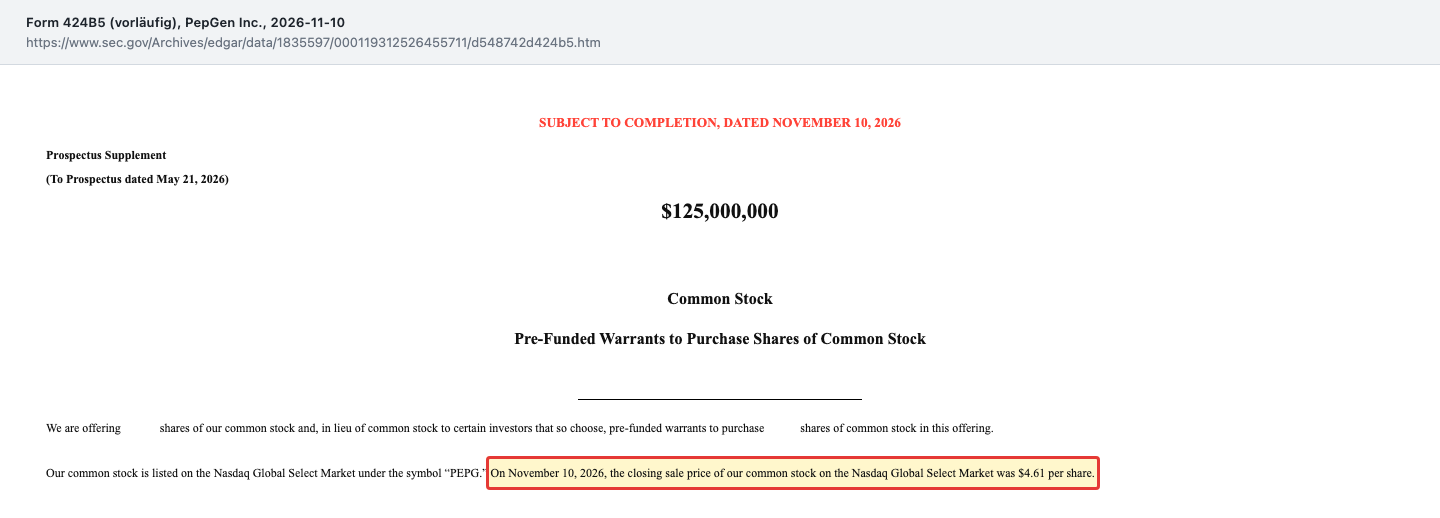
On offer are shares worth $125 million, optionally as pre-funded warrants (warrants that are almost fully paid up front and can be exchanged for a share at any time for one ten-thousandth of a dollar). On top comes an option for the underwriters to buy more shares. Picture it this way: every new share is another slice cut from the same pie — your slice gets smaller. At the $4.61 close, $125 million would be about 27 million new shares, about 39 percent of the 69.3 million outstanding on November 4, 2026. The previous round was big, too: the September 2025 offering more than doubled the share count, from 32.6 million (end of 2024) to 68.9 million (end of 2025).
To be fair, there is another side: a company without revenue has to raise money, and after good data it gets better prices than after bad data — in September 2025 it was $3.20 per share. The new money would more than double the cash of $104.8 million. In addition, 8.0 million employee stock options are outstanding at a weighted average exercise price of $4.86, plus 1.1 million restricted stock units (as of September 30, 2026). Remember: Good trial data don’t just make a stock more expensive — they make it more plentiful.
Valuation: what the market paid before and after the data
There is no price-to-earnings or price-to-sales ratio, since there are neither earnings nor sales. That leaves market value, based on 69,261,282 shares (November 4, 2026): at the $2.39 close on November 9, 2026, that was about $166 million; at the $4.61 close on November 10, about $319 million. Subtracting the $104.8 million of cash as of September 30, the market valued the technology and the drug at about $61 million on November 9 and about $214 million a day later — more than three times as much, based on data from six more treated patients.
Whether that is too much or too little depends on questions nobody can answer today: Will the highest dose (12.5 mg/kg, data guided for the first half of 2027) confirm the trend? Will the FDA lift the hold? And will the vHOT effect hold up over a longer period and in a large trial? Also relevant: after the offering, any future company value will be spread across considerably more shares. According to the quarterly report, executive officers, directors, holders of more than five percent and their affiliates together own about 47.7 percent of the shares (as of September 30, 2026).
Opportunities and risks at a glance
What speaks for PepGen:
- Strong trial data at 10 mg/kg: 46.5 percent mean splicing correction after four monthly doses, four of six treated patients above 50 percent; improvements in hand opening, grip strength and walking tests.
- Well tolerated so far: no severe or serious adverse events and no treatment discontinuations in the 10 mg/kg cohort; one discontinuation due to a hypersensitivity reaction in the extension study.
- A large, underserved market: more than 110,000 people affected in the U.S. and the EU, no approved therapy for the underlying cause; FDA Orphan Drug and Fast Track designations.
- No cash crunch: $104.8 million as of September 30, 2026, runway into 2028 according to the company — before the announced offering.
- Clear next checkpoints: data from the 12.5 mg/kg cohort in the first half of 2027, safety data from the extension study in January 2027.
What speaks against it:
- Very small cohorts: six treated patients per dose, four on placebo; at 5 mg/kg a single patient tipped the result to 7.3 percent.
- FDA partial clinical hold in the U.S. since March 2026; the end-of-Phase 2 meeting depends on it being lifted.
- The vHOT functional test failed for a competitor in Phase 3; patient questionnaires were inconclusive at PepGen.
- A $125 million stock offering, announced on the evening of the jump — about 39 percent of the market value at the time.
- A single drug, no revenue, $416.1 million in losses since inception; the second program was discontinued in 2025.
A human conclusion
Back to the headline trap. In March, one number — 7.3 percent — more than halved the stock; in November, another — 46.5 percent — nearly doubled it. Both numbers come from six people each. That doesn’t make the new number wrong; according to PepGen, it is the highest level ever reported in a multiple-dose study, and for people living with DM1 every real hope is worth a great deal. The trap lies in mistaking the number of the day for the whole picture. The whole picture includes a clinical hold in the U.S., a functional test on which a major competitor failed, and $125 million in new shares announced on the evening of that same day. The next number comes in the first half of 2027. If you know by then what to watch for, you won’t be driven by the cheering or by the next disappointment — with or without the stock. What you make of it is your decision. And that is how it should be.
Sources
All original documents used in this analysis — for your own reading:
- PepGen Inc. — SEC quarterly report 10-Q for the period ended September 30, 2026 (filed November 10, 2026)
- PepGen Inc. — SEC filing 8-K of November 10, 2026, Exhibit 99.1 (third-quarter 2026 earnings release) and Exhibit 99.2 (10 mg/kg cohort data)
- PepGen Inc. — preliminary prospectus supplement 424B5 of November 10, 2026 ($125 million stock offering)
- PepGen Inc. — SEC quarterly report 10-Q for the period ended June 30, 2026 (filed August 6, 2026) and 10-Q for the period ended March 31, 2026 (filed May 12, 2026)
- PepGen Inc. — SEC filing 8-K of March 30, 2026 (5 mg/kg cohort data) and 8-K of March 4, 2026 (FDA partial clinical hold)
- PepGen Inc. — SEC annual report 10-K for 2025 (filed March 4, 2026) and 10-K for 2024 (filed February 24, 2025)
- PepGen Inc. — SEC filing 8-K of September 26, 2025 (offering at $3.20 per share)
- PepGen’s complete SEC filing history: EDGAR overview (sec.gov)
- Fundamental data (prices through the November 10, 2026 close; retrieved November 11, 2026), cross-checked against the SEC filings and the SEC’s XBRL data series.
- Reddit mentions: our in-house Reddit hype scanner.
Transparency & disclaimer: This analysis is a journalistic assessment of publicly available information and not investment advice, not a financial analysis in the regulatory sense and not a solicitation to buy or sell securities. Equity investments carry substantial risks up to and including total loss. All information without guarantee; the date of the data is noted in the text. We disclose the operator’s own positions on a daily basis; if one exists, it appears as a note at the top of this analysis.
Key figures at a glance
All monetary figures in millions of $; earnings per share as reported.
| Metric | 2021 | 2022 | 2023 | 2024 | 2025 |
|---|---|---|---|---|---|
| Revenue | 0.0 | 0.0 | 0.0 | 0.0 | 0.0 |
| Operating Income (EBIT) | -27.1 | -68.3 | -84.8 | -97.7 | -93.6 |
| Net Income | -27.3 | -69.1 | -78.6 | -90.0 | -89.7 |
| Earnings Per Share | -1.22 $ | -4.42 $ | -3.30 $ | -2.85 $ | -2.12 $ |
Source: fundamental data & SEC filings (annual and quarterly reports, 10-K/10-Q)
Our Bottom Line at a Glance
- Trial data positive
- 10 mg/kg: 46.5% mean splicing correction after four monthly doses (placebo 6.8%), vHOT 3.9 seconds better after 16 weeks; no severe or serious adverse events.
- Strength of evidence negative
- Six treated patients per dose, four on placebo; the 5 mg/kg cohort came in at 7.3% in March 2026 — a single patient tipped the average.
- Regulation negative
- FDA partial clinical hold on FREEDOM2 in the U.S. since March 2026 over animal-study questions; end-of-Phase 2 meeting planned for the second half of 2027, provided the hold is lifted.
- Liquidity positive
- $104.8 million in cash and marketable securities (09/30/2026), $47.4 million outflow in nine months, runway into 2028 according to the company; no going-concern warning.
- Dilution negative
- Share count up from 32.6 million (end of 2024) to 69.3 million (11/04/2026); new $125 million offering announced on 11/10/2026 — about 39% of market value at the close.
PepGen is a textbook case of the headline trap: on November 10, 2026, the company reported 46.5 percent splicing correction, by its own account the highest level in a multiple-dose study, and the stock rose from $2.39 to $4.61. But the number comes from six treated patients, the trial is partially on hold in the U.S., a competitor failed on the same functional test in Phase 3, and that same evening PepGen announced $125 million in new shares. Cash lasts into 2028; proof of efficacy is still pending. Not investment advice.
What Our Rating Means
Open questions
The business works in principle, but one material question is open. As long as it stays open, our findings do not carry a quality verdict.
Yellow, because a material operational question is open: PepGen depends on a single drug whose efficacy has so far been shown only in very small cohorts and whose U.S. trial has been partially on hold since March 2026. There is no substance risk in the sense of red: as of September 30, 2026, PepGen held $104.8 million in cash and marketable securities, runway lasts into 2028 according to the company, and there is no going-concern warning and no financial debt. The $125 million offering dilutes but strengthens the treasury. The decision is yours.
A journalistic assessment by our editorial team at the time of the deep dive, based on public sources — not investment advice and not a solicitation to buy or sell. Your personal circumstances (investment goals, risk capacity, taxes) cannot be taken into account. What our levels mean, how verdicts are formed, and what conflicts of interest exist →
Worth Noting
- PepGen made our research list through our in-house Reddit hype scanner (Reddit hype run of November 11, 2026).
- The offering is based on the preliminary prospectus supplement (424B5) of 11/10/2026 (filed at 22:06 UTC); price, share count and the size of the underwriters’ option had not been published as of 11/11/2026.
- Market value is our own calculation: 69,261,282 shares (10-Q cover page, as of 11/04/2026) × $4.61 (11/10/2026 close per 424B5) = about $319 million; prior day: × $2.39 (fundamental data) = about $166 million. The fundamental data still showed a market value of about $165 million based on prices before 11/10/2026; it was not used.
- New shares at the close: $125 million ÷ $4.61 = about 27.1 million shares, about 39% of 69,261,282; our own rough estimate without the underwriters’ option, discount or costs.
- Cash and marketable securities per year summed by us from the XBRL data of the 10-K/10-Q filings (cash plus current marketable securities); runway our own calculation: $47.4 million outflow in nine months ≈ $15.8 million per quarter.
- Prices of 03/30–31/2026 ($4.23 and $1.77), 11/09/2026 ($2.39), 01/02/2026 ($7.17) and the trading volume of 11/10/2026 (104.4 million shares) come from fundamental data; the 05/15/2026 price ($1.55) from the S-3/424B5 shelf prospectus.
Stock Watch
This analysis is as of November 11, 2026. Stock Watch will tell you what's changed at PEPG since then.
Later $1 a month per stock — signing up is free, and you'll be the first to know when it launches.
The full analysis as a PDF for later
We will send you this analysis as a PDF — to print, file away, and read at your own pace. And we will add you to the free Stock Watch list for PepGen Inc. (PEPG), so you hear about it when something material in this analysis changes.
Frequently Asked Questions
PepGen Inc. (Nasdaq: PEPG) of Boston develops drugs based on short strands of genetic material (oligonucleotides) that are carried into muscle cells by a small transport peptide. Its only drug in clinical trials is PGN-EDODM1 for myotonic dystrophy type 1 (DM1). PepGen has no revenue; a second program for Duchenne was discontinued in May 2025.
For the 10 mg/kg cohort of its Phase 2 FREEDOM2 trial, mean splicing correction of 46.5 percent after four monthly doses (placebo: 6.8 percent), plus improvements in hand-opening time, grip strength and walking tests. The basis is six treated patients and four on placebo. The same day, PepGen filed a preliminary prospectus supplement for a $125 million stock offering.
In March 2026, the FDA placed a partial clinical hold on FREEDOM2. The reason is questions about previously submitted animal studies on pharmacology and toxicology; according to PepGen, the FDA did not cite questions about patient data from the first trial. PepGen is conducting additional mouse studies; the trial continues in Canada, the U.K., South Korea, Australia and New Zealand.
As of September 30, 2026, PepGen had $104.8 million in cash and marketable securities; operating cash outflow was $47.4 million in the first nine months of 2026. The company says the money lasts into 2028 — not counting the $125 million offering announced on November 10, 2026.
Price and share count had not been set as of November 11, 2026. At the $4.61 close, $125 million would equal about 27 million new shares, about 39 percent of the 69.3 million shares outstanding (November 4, 2026). On top comes an option for the underwriters to buy more shares.
According to PepGen, safety data at 10 mg/kg and clinical data at 5 mg/kg from the extension study in January 2027, and results for the highest dose (12.5 mg/kg) from FREEDOM2 in the first half of 2027. An end-of-Phase 2 meeting with the FDA is planned for the second half of 2027, provided the clinical hold has been lifted.
Found an error?
Did you spot a factual error, an outdated number, or a typo in this deep dive? Let us know briefly — your report goes straight to the editorial team.