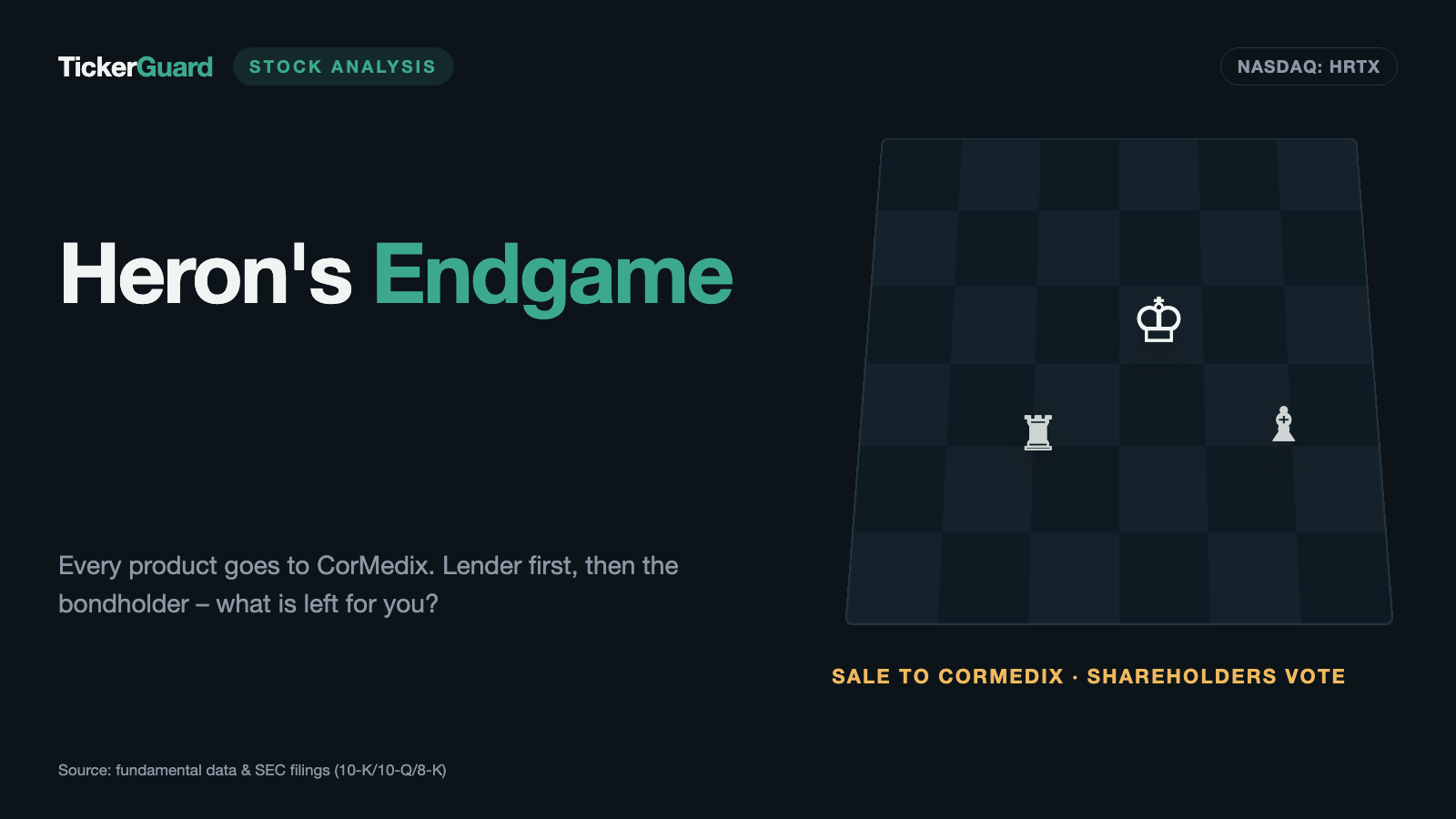
Heron Therapeutics: Everything Goes to CorMedix – After the Loan and the Convertible, About 45 Cents a Share Remain
An upfront value of $222.6 million for a company the market valued at roughly $70 million – that is how Heron Therapeutics’ sale to CorMedix of November 8, 2026 reads. We subtract the loan and the convertible note, show why the money lands in an empty corporate shell rather than with you, and what can still go wrong before the vote. Not investment advice – just the subtraction the press release leaves out.
 Thomas Mücke
Founder & Publisher
As of Today
As of: November 10, 2026
- Closing price
- 0.3741 $ +0.90%
- Market Capitalisation
- 79.0 $M
- Growth Score
- 2/10
- AAQS
- 1/10
Price change since November 9, 2026: +0.9%
This analysis has a cut-off date. The Stock Guard tells you when something material changes in the numbers. Reserve your free spot
Chart
Interactive price chart (TradingView).
52-week range: 0.27 $ to 1.50 $ · Last price: 0.3741 $ (As of: November 10, 2026)
Note: pure fact-based analysis, not investment advice and not a solicitation to buy or sell. All figures without guarantee.
$222.6 million. That number sat in the joint release that Heron Therapeutics (Nasdaq: HRTX) and the buyer, CorMedix, published on November 9, 2026: it is what the cash payment and the CorMedix shares are worth that Heron is set to receive for substantially all of its assets. On the last trading day before, November 6, 2026, the stock market valued Heron at just under $56 million. Put the two side by side and you see a discount of three quarters — and you reach for the buy button. On November 9, about 139 million Heron shares changed hands and the price rose from $0.29 to $0.37.
This is one of the oldest investor traps at work: the anchoring effect. The first big number we see becomes the yardstick for everything that follows — even when it has nothing to do with our question. Because $222.6 million is the price CorMedix pays. Your question, though, is: how much of it reaches a Heron shareholder? Let's make a deal: we leave the anchor where it lies and do the math with the numbers Heron filed, under penalty of law, with the U.S. securities regulator, the SEC. At the end, you decide.
What Heron actually does — four drugs for hospitals
Heron is a small pharmaceutical company from Cary, North Carolina, that was called A.P. Pharma until 2014. It does not sell pills for the medicine cabinet but drugs that are given in hospitals, ambulatory surgery centers or infusion clinics. Put in everyday terms: Heron supplies what is in the syringe around an operation or a chemotherapy session. At the end of 2025 it had 128 full-time employees.
- CINVANTI (aprepitant) against chemotherapy-induced nausea and vomiting — on the market since 2018 and, at $96.8 million, the largest product in 2025.
- ZYNRELEF (bupivacaine and meloxicam), a long-acting anesthetic placed directly into the surgical site that is meant to spare patients opioid painkillers; 2025: $38.1 million.
- APONVIE, the same active ingredient as CINVANTI, against nausea after surgery; 2025: $11.6 million.
- SUSTOL against chemotherapy-induced nausea — no longer sold since September 30, 2026.
Sales run through wholesalers: three customers accounted for 97.4 percent of revenue in the third quarter of 2026. That is common in the industry, but it makes Heron a classic supplier with only a few doors to the market.
That names the central tension of this analysis: Heron is selling a business with about $150 million in annual revenue for a price that, on paper, is a multiple of its market value — but between the purchase price and the shareholder stand a lender, a convertible holder, a vote and a corporate shell that wants to do something new with the money.
Company history for investors
-
2014
A.P. Pharma becomes Heron
In early 2014, A.P. Pharma starts operating as Heron Therapeutics. By September 30, 2026, the company had accumulated losses of about $1.96 billion.
-
2017
FDA approves CINVANTI
Approved in November 2017 and sold from January 2018, CINVANTI becomes the key product, bringing in $96.8 million of $154.9 million in 2025 revenue.
-
2021
ZYNRELEF reaches the market
In May 2021, the FDA approves the postoperative pain drug. It grows but stays small: $38.1 million in revenue in 2025.
-
2025
Refinancing in August
Old convertibles of $150 million are retired with shares, cash, a new Hercules loan and a Rubric convertible with a $1.80 conversion price.
-
2026
Patent ruling and Nasdaq notice
On June 1, 2026, a court holds two CINVANTI patents invalid; on June 25, 2026, Nasdaq flags the sub-$1 price. Deadline: December 22, 2026.
-
2026
Sale to CorMedix agreed
On November 8, 2026, Heron agrees to sell substantially all assets. Shareholders are left with a shell holding cash, CorMedix stock and loss carryforwards.
How the stock landed on our desk
No metrics scanner flagged Heron; other investors' attention did. Our in-house Reddit hype scanner, which counts which smaller U.S. stocks are mentioned unusually often in Reddit forums, fired in November 2026 — right after the sale announcement. The numbers explain the noise: on November 9, 2026, about 139.5 million Heron shares traded according to our fundamental data, against an average of about 2.2 million a day in October 2026. The price jumped about 26 percent that day to $0.3706.
For context on the price level: on January 16, 2026, the stock still closed at $1.49; on September 21, 2026, at $0.27. According to fundamental data (retrieved November 10, 2026), about 36.7 million shares were sold short, just under a quarter of the free float. The two analysts the data provider tracks both rate the stock "hold". That is neither a buy nor a sell signal — it only shows that two camps face each other here.
The numbers over the years — honestly appraised
First, what Heron genuinely achieved. Revenue rose from $86.3 million (2021) to $154.9 million (2025), and over the same period the net loss shrank from $217.7 million to $20.2 million. For a company that spent hundreds of millions on research and product launches for years, that is real progress: the gross margin — of $100 in revenue, this many dollars remain after production costs — was about $73 in 2025.
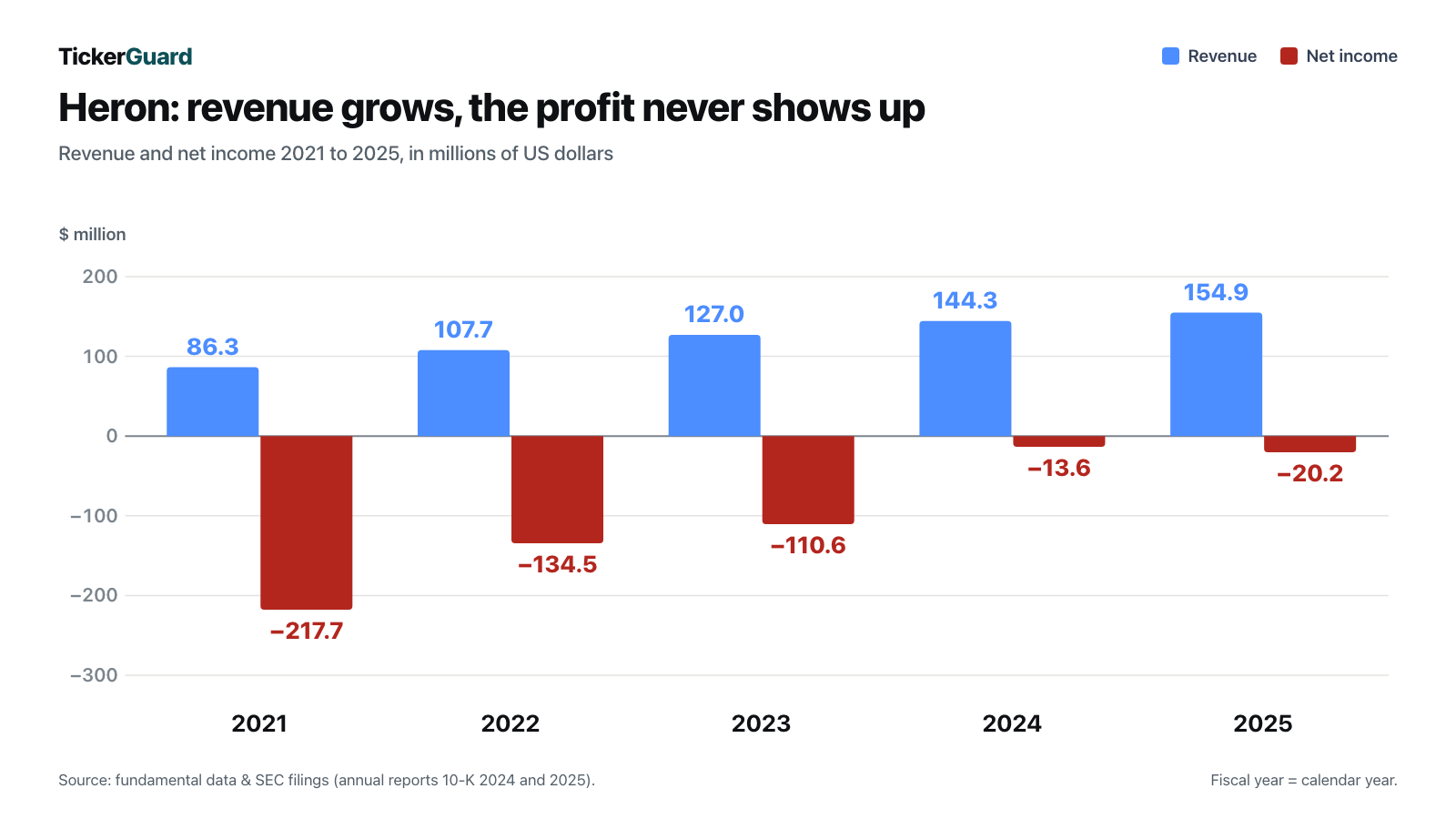
In 2026 the picture tips. In the third quarter, revenue fell 7.8 percent year over year to $35.3 million; for the first nine months it fell 5.9 percent to $107.6 million. The two growth products push back: ZYNRELEF reached $10.6 million in the third quarter (up 13.8 percent), APONVIE $4.5 million (up 49.3 percent). The oncology business, however, is shrinking: CINVANTI dropped to $20.0 million (down 16.6 percent), SUSTOL to $0.2 million. The quarterly report itself gives the reason:
"The decrease was primarily attributable to a decrease in units sold as a result of continued competitive pressure."
— Heron Therapeutics, Inc., SEC quarterly report 10-Q for September 30, 2026, Item 2, on oncology products
The bottom line for the third quarter of 2026 was an operating loss of $1.7 million and a net loss of $5.0 million; $3.0 million of that was interest on the loan. In August 2026, Heron withdrew its full-year guidance. Operations consumed $4.5 million from January through September 2026 — not much. Cash still shrank from $46.6 million to $23.4 million, mainly because Heron had to prepay $17.5 million of its loan in August and September.
Remember this: Heron almost closed the loss gap — but not quite, and the debt stayed.
The sale to CorMedix: what the contract says
On November 8, 2026, Heron signed an agreement to sell substantially all of its assets to CorMedix Inc. (Nasdaq: CRMD). It is not a takeover of the stock: CorMedix buys the products, inventory and contracts, not the company. In return, Heron receives:
- $145.0 million in cash, adjusted for cash and working capital at closing (post-closing adjustments are capped at $10 million in either direction; $2.0 million goes into escrow);
- 14,583,333 CorMedix shares — calculated as $105 million divided by $7.20 per share;
- up to $55 million in earn-outs: $25 million if ZYNRELEF reaches at least $65 million in revenue in 2028, another $30 million at $95 million;
- a 5 percent royalty on the portion of combined revenue from CINVANTI, SUSTOL and the Long Grove products that exceeds $25 million in each of the years 2027 to 2029.
One line decides a lot and is easy to skim past. The number of CorMedix shares is fixed — their value is not:
"The number of shares was determined by dividing $105 million by $7.20 per share and is fixed, subject to customary adjustment for stock splits and similar events; it will not be adjusted for changes in CorMedix's share price prior to closing."
— Heron Therapeutics, Inc., SEC current report 8-K of November 9, 2026, Exhibit 99.1 "Transaction Terms"

So the $105 million in that formula was history the moment the deal was signed. At the $5.32 close of November 6, 2026, the shares were worth about $77.6 million, as the release itself states — and that is how the headline $222.6 million comes about. How much the CorMedix price moves is shown by two days in the fundamental data: $7.64 on October 29 and $5.70 on October 30, 2026.
Then there are conditions: a majority of all outstanding Heron shares must approve (holders of about 22 percent, including Rubric and management, have contractually committed their votes), the antitrust waiting period must expire, and if closing does not happen within six months of signing, either side may walk away. If Heron walks away for a better offer, it pays $4.0 million. If shareholders vote no, Heron must reimburse CorMedix for up to $2.5 million in expenses.
Remember this: What is fixed is $145 million in cash and a number of shares. Everything else — share value, earn-out, royalty — fluctuates or depends on conditions.
What is left of the purchase price — our math
Now to the question from the start. We take the upfront consideration and subtract what the contract pays out first. All numbers come from the quarterly report for September 30, 2026 and the filings of November 9, 2026; the math is our own and deliberately simple.
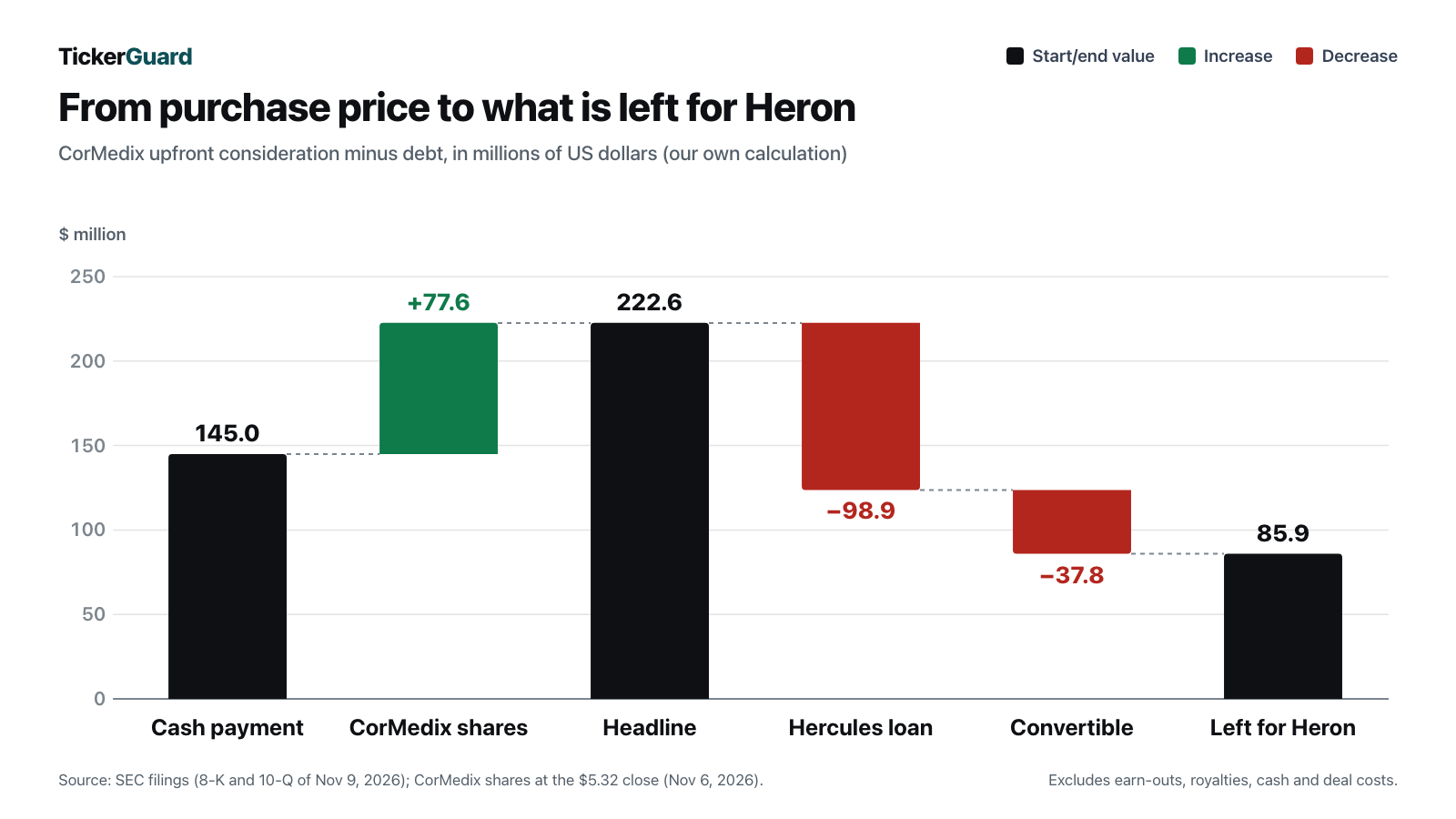
- Cash payment: $145.0 million.
- Plus CorMedix shares: $77.6 million (at the November 6, 2026 price) — that makes the headline $222.6 million.
- Minus the Hercules loan: about $98.9 million. As of September 30, 2026, the books showed $93.3 million of principal, $1.3 million of accrued interest that only comes due at repayment, and an accrued end-of-term fee of $4.3 million. Under the agreement, the loan is repaid in full at closing; interest until then comes on top.
- Minus the Rubric convertible: about $37.8 million. The $35.0 million note plus interest will be exchanged in four quarterly installments for CorMedix shares from Heron's holding.
- Remainder: about $85.9 million — with 190,273,587 shares outstanding (November 4, 2026), roughly 45 cents per share.
What we deliberately left out, because it is uncertain, shows how thin the number is. On the plus side, the cash is missing ($23.4 million as of September 30, 2026, but the cash price is adjusted for cash at closing, and losses and adviser fees keep running until then), the earn-outs (at most $55 million, about 29 cents per share) and the royalties. On the minus side, deal costs, interest until closing, employee options and the running costs of a listed company without a business are missing. The 70,012 preferred shares not yet converted equal 700,120 common shares and barely change the result.
And then there is the leverage the Rubric exchange agreement creates. The $37.8 million is fixed in dollars; it is paid in CorMedix shares at the prevailing price. If CorMedix falls, Rubric needs more shares and Heron keeps fewer. With a CorMedix price 20 percent below that of November 6, 2026, our remainder shrinks by the same math from about $85.9 million to about $70.4 million — roughly 37 cents per share, almost exactly the November 9, 2026 price. Heron redacted the minimum price below which no exchange is required in the published exhibit.
There is a counterweight, but it is hard to value: about $2.3 billion in tax loss carryforwards (September 30, 2026). Put simply: Heron may offset future profits up to that amount against old losses and save taxes. That is only worth something if the shell makes profits again — and U.S. tax law limits their use if ownership changes substantially. That is why Heron has a protection plan that penalizes large purchases of Heron stock, extended in August 2026 to August 14, 2029.
Remember this: After the loan and the convertible, $222.6 million becomes about $85.9 million — and every percentage point the CorMedix stock loses hits the stake Heron keeps after paying Rubric roughly twice as hard in percentage terms.
What the filings say — the uncomfortable truths
Uncomfortable truth no. 1: The company gets the money, not you
Many investors read "sale" and think of a payout. The quarterly report makes clear there is none:
"The Company, and not its stockholders, will receive the stock and cash consideration from the Asset Sale […]"
— Heron Therapeutics, Inc., SEC quarterly report 10-Q for September 30, 2026, Item 1A "Risks Related to the Asset Sale"
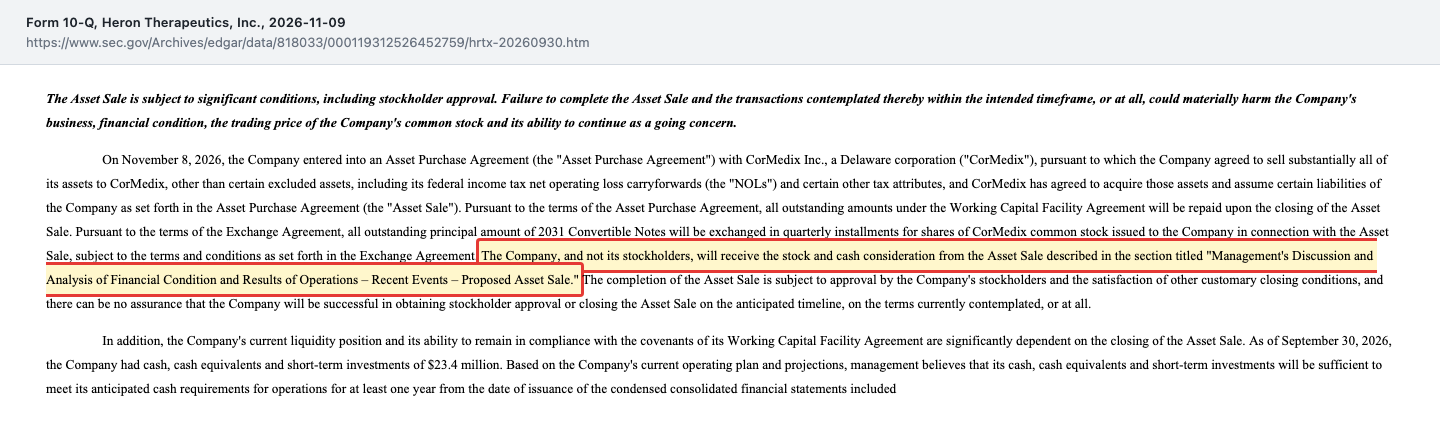
Heron does not intend to liquidate but to carry on as a listed company. The board wants to put the proceeds into new businesses, "which may or may not be pharmaceutical or biotechnology businesses". Which ones is open. Heron may not sell the CorMedix shares for six months after closing; after that it may distribute them pro rata to its shareholders, but it does not have to. Put in an everyday image: after the sale you own a share of a suitcase holding cash, CorMedix stock and tax credits — and the board decides what to buy with it. The report itself names the risk that Heron could then be deemed an investment company and face strict restrictions.
Uncomfortable truth no. 2: Without the sale, the loan becomes a problem
The Hercules loan agreement requires minimum levels of cash, revenue and earnings before interest, taxes, depreciation and amortization. For the second quarter of 2026, Heron needed a waiver of the revenue and earnings tests; in return it prepaid $17.5 million and lost access to another $40 million of credit. What happens if that goes wrong again is spelled out in the quarterly report:
"If the payment of the debt is accelerated, absent any additional funding, cash flows from our operations will be insufficient to repay such debt in full."
— Heron Therapeutics, Inc., SEC quarterly report 10-Q for September 30, 2026, Note 1 "Liquidity and Going Concern"
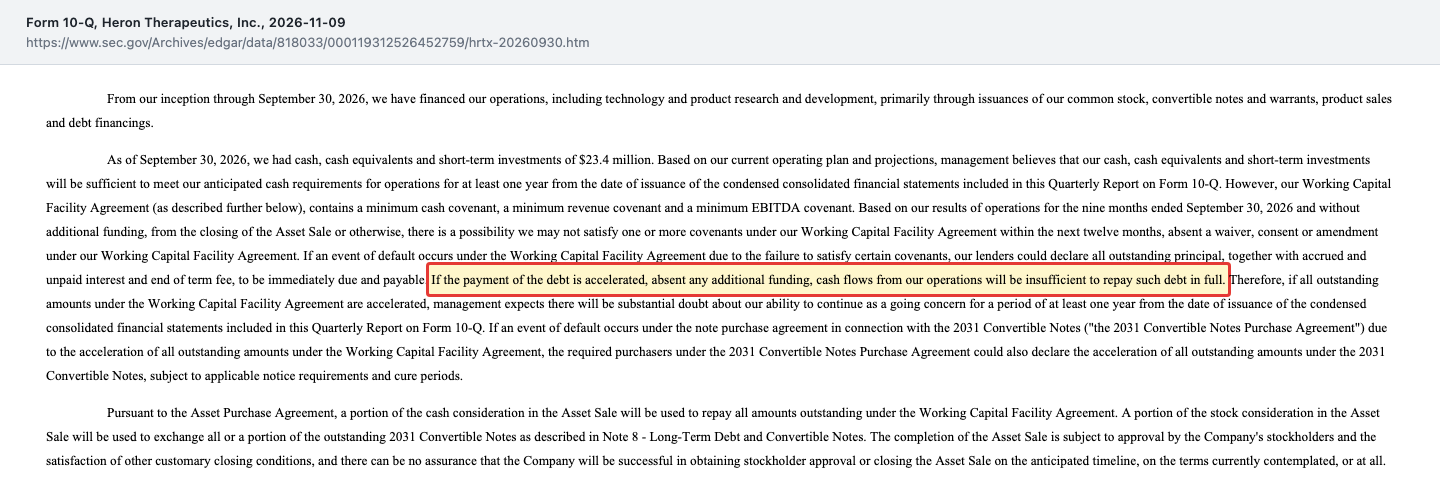
Heron writes explicitly that it may fail one or more loan covenants within the next twelve months — absent sale proceeds, a waiver or an amendment. If the loan were then accelerated, management expects "substantial doubt" about the company's ability to continue as a going concern. The current state as of September 30, 2026: $23.4 million in cash, $93.3 million of loan principal, a $35.0 million convertible and only $4.9 million of equity. Put simply: the sale is not just an opportunity, it is also the life buoy.
Uncomfortable truth no. 3: The $1 deadline is running
Since mid-May 2026, Heron has traded below one dollar. Nasdaq requires a closing price of at least one dollar for continued listing and set a deadline on June 25, 2026:
"In accordance with applicable Nasdaq procedures, the Company has been provided a period of 180 calendar days, or until December 22, 2026, to cure the deficiency and regain compliance."
— Heron Therapeutics, Inc., SEC current report 8-K of June 25, 2026, Item 3.01
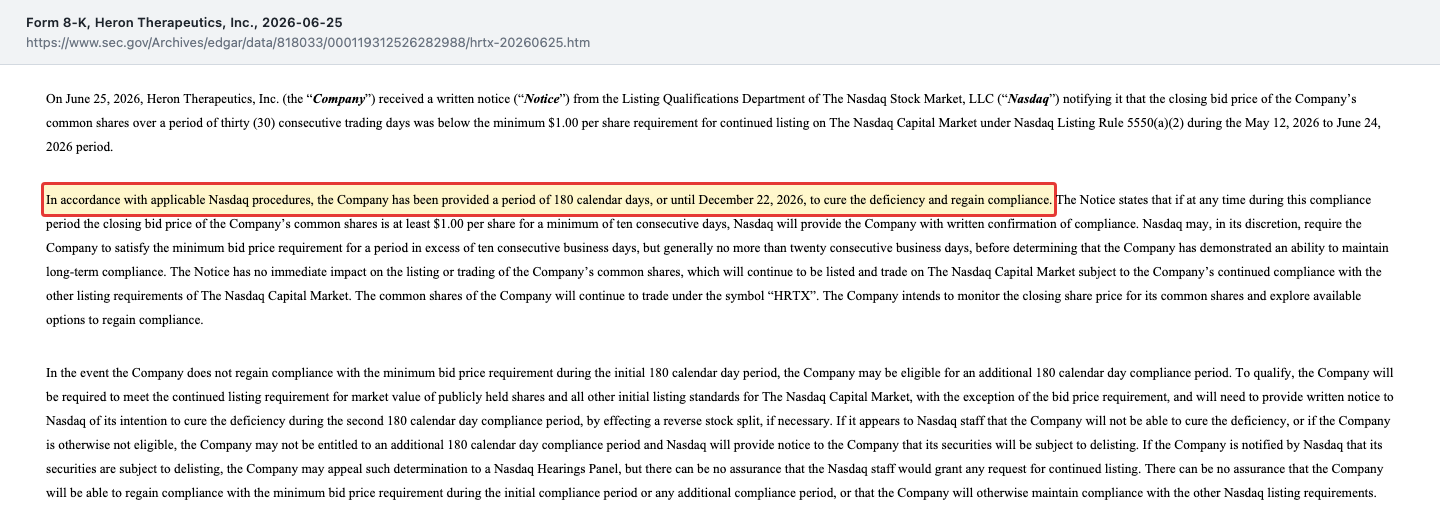
To get there, the price would have to reach at least one dollar on ten consecutive trading days — on November 9, 2026, it stood at $0.37. The filing names the way out itself: a second 180-day period if Heron meets the other requirements, with a reverse split if necessary. Put simply: ten old shares become one new one — the price rises arithmetically, your stake stays the same. A delisting has not been decided, but the deadline is real, and it expires before the sale is expected to close.
Uncomfortable truth no. 4: The largest product is losing its protection
On June 1, 2026, a U.S. federal court in Delaware held two CINVANTI patents invalid in the dispute with Azurity; Heron has appealed, and briefing ended on November 4, 2026. According to the quarterly report, the ruling does not affect earlier settlements with other generic makers. The pressure already shows in revenue, though — down 16.6 percent in the third quarter of 2026. And a third challenger became a partner: Long Grove had filed for a generic version in June 2026; on September 23, Heron signed a multi-product license agreement with Long Grove, and the case was dismissed. That matters for the royalty Heron is supposed to receive from 2027: it only applies to revenue above $25 million a year. The faster CINVANTI shrinks, the less of it is left.
Uncomfortable truth no. 5: The earn-out is ambitious
The first $25 million of the earn-out only flows if ZYNRELEF reaches at least $65 million in revenue in 2028. In 2025 it was $38.1 million; from January through September 2026, $31.9 million. By our calculation, ZYNRELEF needs about 20 percent growth a year from 2025 to 2028, and about 36 percent a year for the second tier at $95 million. And by then the revenue is CorMedix's responsibility, not Heron's. Anyone who counts the full $55 million in their valuation is betting on growth Heron itself has not delivered so far.
Remember this: Each of the five truths moves the value in the same direction: away from the headline, toward the subtraction.
Valuation: market value versus residual value
On November 9, 2026, the market valued Heron at about $70.5 million (190,273,587 shares at $0.3706). Our residual value is about $85.9 million. The market therefore priced Heron at about 82 percent of that remainder — in other words, at a discount of about 18 percent.
Is that a bargain? The discount is the price of the questions missing from the math: will shareholders approve? Will the CorMedix stock hold its value until Heron may sell or distribute it? What does the shell cost until it has found a new business — and what will it buy? On top of that, the classic yardstick stops working: a price-to-sales ratio of about 0.5 ($70.5 million market value against about $148 million in revenue over the last four quarters) looks cheap, but after closing that revenue belongs to CorMedix.
How differently a small drugmaker can be positioned is shown by two other analyses: Puma Biotechnology has a single drug but no debt, and at Zevra Therapeutics the reported profit was larger than what the business generates on a recurring basis. Heron is the reverse case: a business that works but stayed too small for its debt.
Opportunities and risks at a glance
What speaks for Heron
- By our calculation, about $85.9 million remains after the loan and the convertible — more than the market value of about $70.5 million on November 9, 2026.
- Up to $55 million in earn-outs and a royalty for 2027 to 2029 are additional upside not included in that number.
- The sale solves the loan problem: Hercules is repaid in full at closing.
- Holders of about 22 percent of the shares have already committed their votes; CorMedix has no financing condition.
- About $2.3 billion in loss carryforwards could shield the shell's future profits from tax.
What speaks against it
- The company gets the money, not the shareholder; what the board buys with it is open.
- Part of the value sits in CorMedix shares that are locked up for six months; because the Rubric debt is fixed in dollars, every price drop hits the remaining stake roughly twice as hard in percentage terms.
- If the sale fails, missed loan covenants and going-concern doubt loom — with $23.4 million in cash and $4.9 million of equity (September 30, 2026).
- The Nasdaq deadline for the $1 minimum bid price ends on December 22, 2026.
- The ongoing business is shrinking (down 7.8 percent in the third quarter of 2026), and CINVANTI lost two patents at first instance.
Conclusion: The anchor and the math behind it
Back to the anchoring effect from the start. The $222.6 million is not wrong — it is the price CorMedix pays, calculated at a single day's share price. But it is the wrong number for your question. After the Hercules loan and the Rubric convertible, about $85.9 million remains by our calculation, roughly 45 cents per share — not in your account, but in a company that sold its business and is looking for a new one.
So the honest question for you is not "How big is the discount to the purchase price?" but: Do you trust the board to build something with cash, CorMedix shares and $2.3 billion in loss carryforwards that is worth more than the sum — and can you sit through the wait until closing? If you have an answer, you have a thesis. If all you have in mind is the $222.6 million, you have an anchor. What you make of it is your decision. And that is as it should be.
Sources
- Heron Therapeutics, Inc. — SEC quarterly report 10-Q for September 30, 2026 (filed November 9, 2026)
- Heron Therapeutics, Inc. — SEC current report 8-K of November 9, 2026, Exhibit 99.1 (third-quarter 2026 results)
- Heron Therapeutics, Inc. — SEC current report 8-K of November 9, 2026 (asset sale to CorMedix, Rubric exchange agreement, tax benefit preservation plan)
- Heron Therapeutics, Inc. — SEC current report 8-K of November 9, 2026, Exhibit 99.1 (joint release with CorMedix)
- Heron Therapeutics, Inc. — SEC current report 8-K of November 9, 2026, Exhibit 10.4 (exchange agreement with Rubric)
- Heron Therapeutics, Inc. — SEC current report 8-K of September 29, 2026 (license agreement with Long Grove)
- Heron Therapeutics, Inc. — SEC current report 8-K of August 14, 2026 (extension of the tax benefit preservation plan)
- Heron Therapeutics, Inc. — SEC current report 8-K of June 25, 2026 (Nasdaq minimum bid price)
- Heron Therapeutics, Inc. — SEC current report 8-K of June 2, 2026 (CINVANTI patent ruling)
- Heron Therapeutics, Inc. — SEC quarterly report 10-Q for June 30, 2026 (filed August 10, 2026)
- Heron Therapeutics, Inc. — SEC quarterly report 10-Q for March 31, 2026 (filed May 11, 2026)
- Heron Therapeutics, Inc. — SEC annual report 10-K for 2025 (filed February 26, 2026)
- Heron Therapeutics, Inc. — SEC quarterly report 10-Q for September 30, 2025 (filed November 4, 2025)
- Heron Therapeutics, Inc. — SEC annual report 10-K for 2024 (filed February 27, 2025)
- Full SEC filing history: EDGAR overview Heron Therapeutics (sec.gov)
- Fundamental data (prices of Heron and CorMedix, trading volume, short interest, analyst ratings; data as of November 10, 2026), cross-checked against the SEC filings.
Transparency & disclaimer: This analysis is a journalistic assessment of publicly available information. It is not investment advice, not a financial analysis in the regulatory sense, and not a solicitation to buy or sell securities. Investing in stocks involves substantial risk, up to and including the total loss of your investment. All information without guarantee; the data date is noted in the text. The residual value per share is our own calculation based on the SEC filings, not a company figure. We disclose any positions held by the publisher on a current basis; if one exists, it appears as a note at the top of this analysis.
Key figures at a glance
All monetary figures in millions of $; earnings per share as reported.
| Metric | 2021 | 2022 | 2023 | 2024 | 2025 |
|---|---|---|---|---|---|
| Revenue | 86.3 | 107.7 | 127.0 | 144.3 | 154.9 |
| Operating Income (EBIT) | -217.8 | -174.7 | -110.6 | -11.5 | -2.5 |
| Net Income | -217.7 | -134.5 | -110.6 | -13.6 | -20.2 |
| Net Margin | -252.1% | -124.9% | -87.0% | -9.4% | -13.0% |
| Earnings Per Share | -2.21 $ | -1.23 $ | -0.80 $ | -0.09 $ | -0.12 $ |
Source: fundamental data & SEC filings (annual and quarterly reports, 10-K/10-Q)
Our Bottom Line at a Glance
- Sale price positive
- $145.0 million in cash plus 14,583,333 CorMedix shares ($77.6 million on November 6, 2026); after the loan and the convertible, about $85.9 million remains by our calculation — more than the market value of about $70.5 million (November 9, 2026).
- Who gets the money negative
- Cash and shares go to the company, not to shareholders (10-Q for September 30, 2026). Heron wants to stay public and invest in as yet unknown businesses; the CorMedix shares are locked up for six months.
- Balance sheet & loan negative
- $23.4 million in cash, $93.3 million of loan principal, a $35.0 million convertible, $4.9 million of equity (September 30, 2026); without sale proceeds, missed covenants and going-concern doubt loom.
- Ongoing business neutral
- Third-quarter 2026 revenue of $35.3 million (down 7.8 percent), net loss of $5.0 million; ZYNRELEF (up 13.8 percent) and APONVIE (up 49.3 percent) grow, CINVANTI (down 16.6 percent) shrinks under competitive pressure.
- Listing negative
- Nasdaq notice of June 25, 2026 over a price below one dollar; deadline December 22, 2026, price on November 9, 2026 $0.37. A second period and a reverse split are possible.
Heron Therapeutics shows how the anchoring effect works on deal headlines: an upfront value of $222.6 million faces a market value of about $70.5 million, yet after the loan and the convertible about $85.9 million remains by our calculation — with the company, not the shareholder. The sale solves Heron's debt problem but turns the stock into a stake in a corporate shell with an open purpose. Not investment advice.
What Our Rating Means
Substance risk
We found at least one documented issue that threatens the company itself — regardless of how the stock is currently valued.
Red, because the substance is not secured without the sale: as of September 30, 2026, Heron holds only $23.4 million in cash and $4.9 million of equity against $93.3 million of loan principal, itself expects possible covenant breaches and — if the loan were accelerated — substantial doubt about its ability to continue as a going concern; on top, the Nasdaq deadline for the $1 minimum bid price is running. The CorMedix sale can fix that but depends on the shareholder vote. A holder betting on the residual value is betting on approval, on the CorMedix share price and on a board that fills the shell sensibly. The decision is yours.
A journalistic assessment by our editorial team at the time of the deep dive, based on public sources — not investment advice and not a solicitation to buy or sell. Your personal circumstances (investment goals, risk capacity, taxes) cannot be taken into account. What our levels mean, how verdicts are formed, and what conflicts of interest exist →
Worth Noting
- The occasion for this analysis is the asset sale to CorMedix (agreement of November 8, 2026, 8-K of November 9, 2026) and the 10-Q for September 30, 2026 (filed November 9, 2026). Price references: $1.49 (January 16, 2026, highest close of the twelve months), $0.27 (September 21, 2026, lowest), $0.293 (November 6, 2026), $0.3706 (November 9, 2026). Shares sold short about 36.7 million (fundamental data, retrieved November 10, 2026).
- Our residual value math: $145.0M cash + $77.6M CorMedix shares (14,583,333 × $5.32) − $98.9M Hercules (93.3 principal + 1.3 accrued PIK interest + 4.3 accrued end-of-term fee, 09/30/2026) − $37.8M Rubric (35.0 principal plus interest) = $85.9M; ÷ 190,273,587 shares ≈ $0.45. Scenario CorMedix −20%: 46.1 + (14,583,333 − 37.8M/4.256) × 4.256 ≈ $70.4M. Earn-out growth: (65/38.1)^(1/3) ≈ 1.20; (95/38.1)^(1/3) ≈ 1.36.
- This analysis covers the common stock of Heron Therapeutics, Inc. (Nasdaq: HRTX, CIK 0000818033), formerly A.P. Pharma, Inc. (until 2014); not to be confused with the buyer CorMedix Inc. (Nasdaq: CRMD). Heron did not hold a conference call for its November 9, 2026 results.
Stock Watch
This analysis is as of November 11, 2026. Stock Watch will tell you what's changed at HRTX since then.
Later $1 a month per stock — signing up is free, and you'll be the first to know when it launches.
The full analysis as a PDF for later
We will send you this analysis as a PDF — to print, file away, and read at your own pace. And we will add you to the free Stock Watch list for Heron Therapeuti (HRTX), so you hear about it when something material in this analysis changes.
Frequently Asked Questions
Heron Therapeutics, Inc. (Nasdaq: HRTX) of Cary, North Carolina, sells drugs for hospitals and surgery centers: CINVANTI and APONVIE against nausea, ZYNRELEF against pain after surgery; SUSTOL was discontinued as of September 30, 2026. In 2025 revenue was $154.9 million and the net loss $20.2 million. On November 8, 2026, Heron agreed to sell substantially all of its assets to CorMedix.
CorMedix pays $145.0 million in cash (adjusted for cash and working capital) and issues 14,583,333 of its own shares, worth about $77.6 million at the November 6, 2026 close. On top come up to $55 million in earn-outs if ZYNRELEF reaches at least $65 million or $95 million in 2028 revenue, and a 5 percent royalty on certain revenue from 2027 to 2029.
Not directly. According to the 10-Q for September 30, 2026, the company, not its shareholders, receives the cash and the CorMedix shares. Heron does not intend to liquidate but to stay public and invest the proceeds in new businesses. After a six-month lock-up, Heron may distribute the CorMedix shares pro rata to its shareholders, but it is not required to.
By our own calculation: $145.0 million in cash plus $77.6 million in CorMedix shares, minus about $98.9 million for the Hercules loan (as of September 30, 2026) and about $37.8 million for the Rubric convertible, leaves about $85.9 million. With 190,273,587 shares, that is roughly 45 cents per share, excluding earn-outs, royalties, cash and costs.
A deadline is running. On June 25, 2026, Nasdaq notified Heron that its closing bid price had been below one dollar for 30 trading days. Heron has until December 22, 2026 to close at or above one dollar on ten consecutive trading days; a second 180-day period is possible, with a reverse split if needed. On November 9, 2026, the stock closed at $0.37.
Then Heron must reimburse CorMedix for up to $2.5 million in expenses and is left with a shrinking business and the Hercules loan. According to the 10-Q for September 30, 2026, Heron could fail loan covenants without sale proceeds; if the loan were accelerated, management expects substantial doubt about its ability to continue as a going concern. Cash: $23.4 million.
After the sale, Heron keeps about $2.3 billion in tax loss carryforwards (as of September 30, 2026). They only reduce taxes if the company makes profits in the future, and their use can be limited after large ownership changes. A protection plan, extended to August 14, 2029, is meant to prevent such changes. That is why the item has no fixed value.
Found an error?
Did you spot a factual error, an outdated number, or a typo in this deep dive? Let us know briefly — your report goes straight to the editorial team.