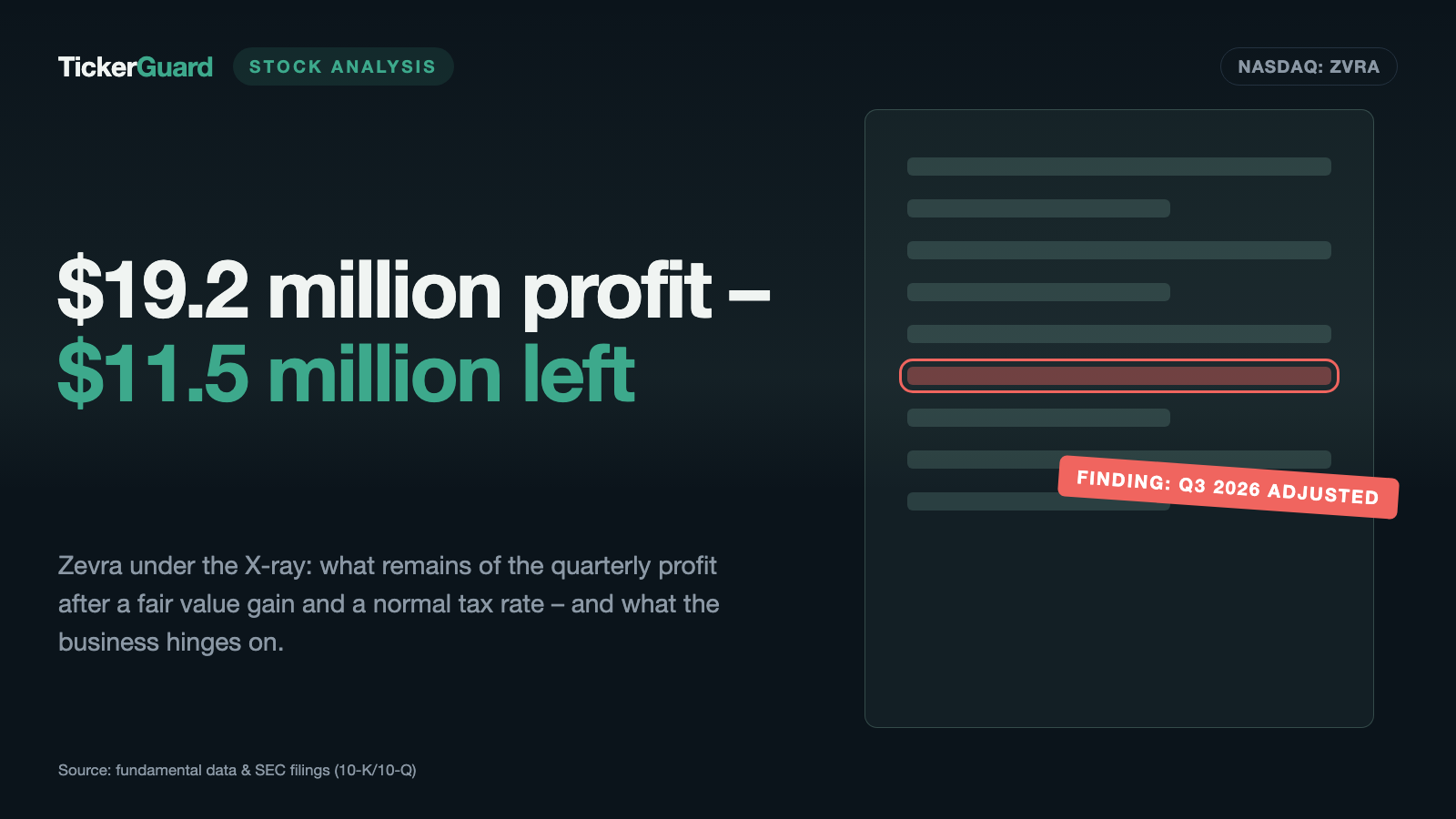
Zevra Therapeutics: a $19.2 Million Profit – Why Only About $11.5 Million of It Is Likely to Repeat
Zevra Therapeutics reported a third-quarter 2026 profit of $19.2 million on $37.8 million of revenue – a net margin of 50.9 percent. Inside that number sit a $5.1 million fair value gain and a tax rate of just 2.6 percent. We rebuild the figure, read the SEC filings and check nine earnings calls for what management promised and what actually happened. Add a conflict the headline does not show: Europe has said no for now, and short sellers are betting on a decline.
 Thomas Mücke
Founder & Publisher
As of Today
As of: November 3, 2026
- Closing price
- 10.30 $ +1.60%
- Market Capitalisation
- 0.6 $B
- P/E
- 5.2
- Growth Score
- 5/10
- AAQS
- 4/10
Price change since November 3, 2026: +0.4%
This analysis has a cut-off date. The Stock Guard tells you when something material changes in the numbers. Reserve your free spot
Chart
Interactive price chart (TradingView).
52-week range: 8.10 $ to 14.80 $ · Last price: 10.30 $ (As of: November 3, 2026)
Note: pure fact-based analysis, not investment advice and not a solicitation to buy or sell. All figures without guarantee.
There is an investor trap that springs shut on the first line of a press release: the headline trap. Psychologists call the mechanism framing — the number that appears first and biggest sets the frame through which we read everything else. On November 3, 2026, the headline from Zevra Therapeutics (Nasdaq: ZVRA) read: $37.8 million of third-quarter revenue, up 45 percent year over year, and $19.2 million of net income. Do the quick math: that is a net margin of 50.9 percent. More than half of every revenue dollar supposedly ended up as profit.
A number like that is tempting. So let's make a deal: before the frame captures you, let's read together what Zevra filed with the U.S. securities regulator, the SEC — the fresh quarterly report (10-Q) for September 30, 2026, from the first page to the last, the quarterly reports before it, the annual reports (10-K) for 2024 and 2025 — and the transcripts of nine earnings calls in which management answered analysts' questions. Filing false information with the SEC carries penalties, which makes these reports some of the most reliable sources there are. In the end, the decision is yours.
What Zevra actually does — a drug for a disease almost nobody knows
Zevra is a small Boston-based drugmaker with a clear focus: medicines for rare diseases. The name says it all, as the company itself explains:
“Zevra is the Greek word for zebra, which is the internationally recognized symbol for rare disease.”
— Zevra Therapeutics, Inc., SEC quarterly report 10-Q for Sept. 30, 2026, Item 2 "Overview"
Until February 2023 the company was called KemPharm and mainly developed treatments for attention disorders. Today almost everything rides on one product: MIPLYFFA (arimoclomol), approved in the U.S. on September 20, 2024, as the first treatment for Niemann-Pick disease type C (NPC). NPC is an inherited metabolic disorder: cells cannot properly move cholesterol and fats, and mobility, cognition, speech and swallowing gradually decline. Think of it as the garbage collection inside the body's cells going on strike, with the waste slowly clogging the nervous system. Zevra estimates about 900 patients in the U.S., of whom only 300 to 350 have been diagnosed. A tiny market — but one in which drugs are very expensive.
There are three side shows. OLPRUVA, a treatment for inherited urea cycle disorders, came with the 2023 acquisition of Acer Therapeutics — and flopped: $0.2 million of revenue in Q3 2026. Celiprolol is in a late-stage (Phase 3) trial for vascular Ehlers-Danlos syndrome, a condition with fragile blood vessels. And in Europe and some other countries, patients receive arimoclomol through an expanded access program (EAP), for which Zevra gets paid even though the drug is not yet approved there. At the end of 2025, Zevra had 61 full-time employees; the CEO is Neil F. McFarlane.
That sets up the central tension of this analysis: a single drug sells better in the U.S. quarter after quarter and has made Zevra debt-free — but the reported profit is bigger than the business delivers, and the second leg, Europe, is wobbling.
Company history for investors
-
2023
KemPharm becomes Zevra, buys Acer
In February 2023 KemPharm renames itself Zevra; in November 2023 the Acer Therapeutics deal adds OLPRUVA. For shareholders, a switch from ADHD to rare diseases.
-
2024
FDA approves MIPLYFFA
On Sept. 20, 2024, MIPLYFFA becomes the first U.S.-approved treatment for Niemann-Pick type C. Since then it has carried almost all revenue.
-
2025
Priority review voucher sold for $148.3M
On April 1, 2025, selling the voucher received with the approval brings in $148.3 million net — the foundation of today's cash position.
-
2025
OLPRUVA written down to zero
In Q2 2025 Zevra writes down $58.7 million on OLPRUVA and scales back the sales effort. The second product effectively drops out as a source of income.
-
2026
Commave settlement, loans repaid
In March 2026 the sale of the AZSTARYS rights brings a $43.3 million one-time gain; the loans are repaid in full. Zevra has been debt-free since.
-
2026
Negative CHMP opinion in Europe
In July 2026 the EU committee CHMP recommends rejecting the arimoclomol application; Zevra requests a re-examination. Expanded access revenue falls to $3.6 million the next quarter.
How the stock landed on our desk
The trigger is simply the calendar: on November 3, 2026, Zevra filed its quarterly report for September 30, 2026, and its earnings release with the SEC. A net margin above 50 percent at a biotech worth about $610 million deserves a second look.
The stock has had a turbulent year. Its lowest close in the twelve months before the report was $8.10 (December 18, 2025), its highest $14.75 (July 8, 2026). From July 23 to July 24, 2026, it fell from $12.52 to $9.53, a drop of about 24 percent — in the month the negative opinion from Europe became public. On November 3, 2026, it closed at $10.26. About 6.2 million shares were sold short (fundamental data, retrieved November 4, 2026), a little over 10 percent of shares outstanding: a noticeable part of the market is betting on a decline.
The nine analysts tracked by our data provider see it differently: seven "strong buy," two "buy," with an average price target of $25.25 (as of November 4, 2026). Average means all targets added up and spread evenly — a single very high target pulls it up noticeably. That is these analysts' opinion, not TickerGuard's. Keep this in mind: the professionals and the short sellers are arguing about the same question — what is a company worth that hangs on one drug?
The numbers over the years — given their due
First, what Zevra has genuinely achieved. Before MIPLYFFA was approved, the company was a classic biotech cash burner: in 2024, $23.6 million of revenue stood against a net loss of $105.5 million, and operations consumed $69.7 million. In 2025, revenue jumped to $106.5 million, and in the first nine months of 2026 it already reached $113.6 million — more than the entire prior year. Operating cash flow swung from minus $7.1 million (January–September 2025) to plus $33.2 million (January–September 2026). That is no small feat: for a company with a freshly approved rare-disease drug, that step is not a given.
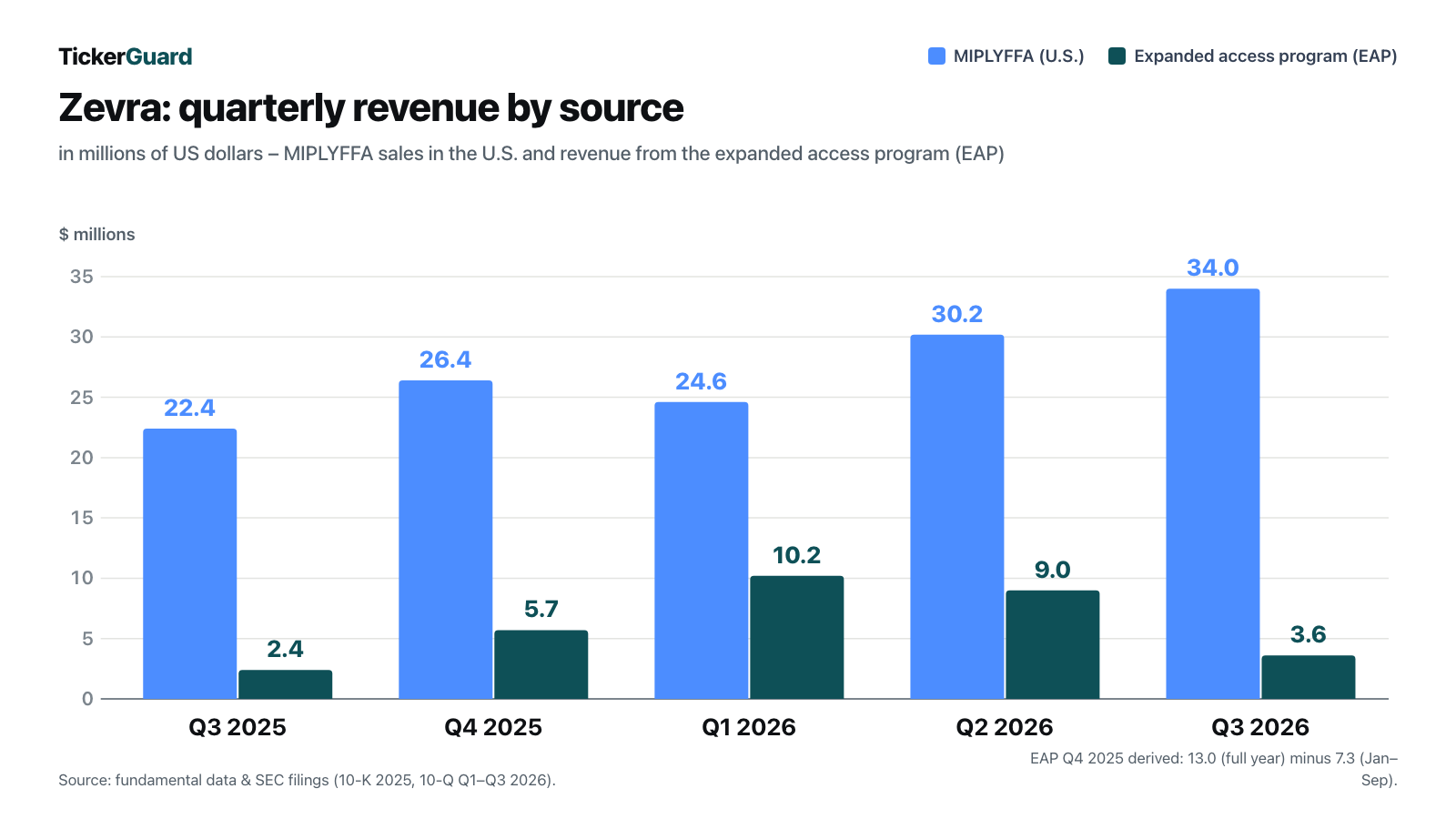
The chart shows both the strength and the first dent. U.S. sales of MIPLYFFA rose from $22.4 million (Q3 2025) to $34.0 million (Q3 2026), with a single setback to $24.6 million in Q1 2026. The number of prescription enrollments (an enrollment is a prescription submitted to the specialty pharmacy) reached 197 since launch by September 30, 2026 — 14 were added in the second quarter and 13 in the third. Less pleasing: total revenue fell from $39.7 million in Q2 to $37.8 million in Q3 2026, because expanded access revenue dropped from $9.0 million to $3.6 million. The headline's 45 percent growth compares with the prior-year quarter — sequentially, revenue went down.
In short: the U.S. business is growing for real and on the record; the rest of the revenue swings.
One-time items and adjusted numbers: what is really left of the profit
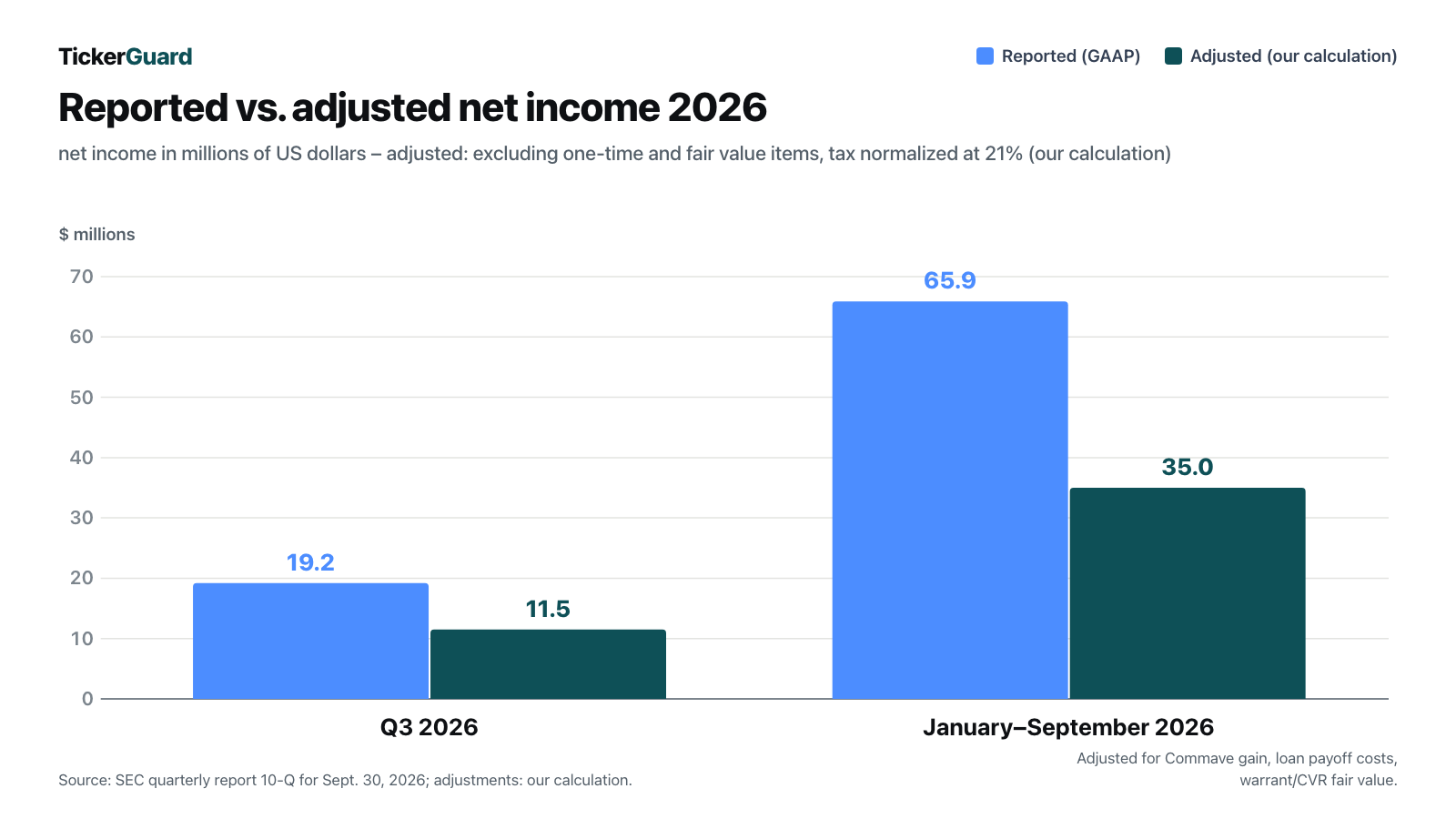
Now back to the headline. Net income under U.S. accounting rules (GAAP) is not a false number — but it mixes what the business earns again every quarter with items that occur once or by chance. Anyone who extrapolates the 50.9 percent net margin is counting on money that will not come back in that form. So let's take the numbers apart.
Q3 2026: two tailwinds
Operating income — revenue minus manufacturing, research, selling and administrative costs — came to $11.6 million, an operating margin of about 31 percent. Interest and other income on the cash pile added $3.0 million. The jump to $19.2 million of net income comes from two further sources:
- A $5.1 million fair value gain on warrants and contingent value rights (CVRs). Zevra carries its outstanding warrants as a liability and remeasures them every quarter. When the share price falls, that liability shrinks — and Zevra books the difference as income. Put plainly: the company "earns" because its own stock got cheaper. If the price rises, the effect reverses. In Q3 2025 it was still a $5.5 million expense.
- A 2.6 percent tax rate. On $19.7 million of pre-tax income, income taxes were only $0.5 million. For the first nine months of 2026 the rate was 14.8 percent, in the second quarter 31.6 percent (our calculation from the 10-Qs). The quarterly report does not explain the low third-quarter rate.
Our adjustment is deliberately simple: we remove the fair value gain and apply the U.S. federal tax rate of 21 percent to the rest. The 21 percent is our assumption, not a company figure.
| $ millions | Q3 2026 | January–September 2026 |
|---|---|---|
| Pre-tax income, reported | 19.7 | 77.3 |
| minus gain from the Commave settlement | – | −43.3 |
| plus loss on derivative and early loan payoff | – | +10.0 |
| minus/plus fair value of warrants and CVRs | −5.1 | +0.3 |
| = Pre-tax income, adjusted | 14.6 | 44.3 |
| Tax at 21% (assumption) | −3.1 | −9.3 |
| = Net income, adjusted (our calculation) | 11.5 | 35.0 |
| for comparison: net income, reported | 19.2 | 65.9 |
| Net margin adjusted / reported | about 30% / 50.9% | about 31% / 58% |
Per share, that is about $0.19 adjusted instead of $0.31 reported (basic, on 59.4 million weighted average shares; our calculation). If you use Zevra's own nine-month tax rate of 14.8 percent instead of 21 percent, Q3 comes to about $12.4 million — the order of magnitude holds.
The first nine months: a settlement, a loan payoff, and a fee waiting for the fourth quarter
The biggest one-time item of the year dates from the first quarter. On March 13, 2026, Zevra sold its remaining rights to the ADHD drug AZSTARYS to Commave Therapeutics, settling a legal dispute:
“In accordance with ASC 610-20, Gains and Losses from the Derecognition of Nonfinancial Assets, the net proceeds from the sale were recorded as a gain on sale of future royalties, intellectual property, and other assets, net of $43.3 million in the Company's unaudited condensed consolidated statements of operations for the nine months ended September 30, 2026.”
— Zevra Therapeutics, Inc., SEC quarterly report 10-Q for Sept. 30, 2026, Note A
One day before that agreement, on March 12, 2026, Zevra had already repaid its loans in full: about $63.1 million of principal plus interest, a final payment fee ($1.8 million) and a make-whole and prepayment premium ($7.2 million). On the books, that produced a $7.2 million loss on a derivative and a $2.8 million loss on extinguishment — about $10.0 million of one-time costs combined. So the Commave gain is not a Q3 effect; it sits only in the nine-month figure. And one small item disappears: $1.4 million of AZSTARYS royalty revenue through March 2026 will not recur.
One more item belongs in the forward view. Zevra owes XOMA (part of Ligand Pharmaceuticals since July 2026) a mid-single-digit royalty on MIPLYFFA, plus $5.0 million once annual sales reach $100 million. After nine months of 2026, $88.9 million of MIPLYFFA sales were on the books. We described a similar pattern — profit partly coming from the tax or fair value line — in our ACADIA Pharmaceuticals analysis and our TG Therapeutics analysis.
Keep this in mind: Zevra earns real money — about $11.5 million a quarter on an adjusted basis. That is good. It just isn't $19.2 million.
What management promised — and what came of it
Four times a year, Zevra's leadership explains its numbers on an earnings call and takes analysts' questions. We read the transcripts of the nine calls covering Q1 2024 through Q1 2026 (the calls on Q2 and Q3 2026 were not available as transcripts) and set the promises against what later appeared in the SEC filings. The Q&A carries more weight than the prepared remarks: that is where management has to improvise.
| Call | Promise (verbatim) | What happened | Rating |
|---|---|---|---|
| Q2 2024 (Aug. 13, 2024), Neil McFarlane, CEO | “We are on track in order to be able to have product in the channel within the customary time frame, let's call it, eight to 12 weeks” | Approval Sept. 20, 2024; U.S. launch in November 2024 (10-Q). | delivered |
| Q4 2024 (Mar. 11, 2025), LaDuane Clifton, then CFO | “our current operating forecast combined with existing resources extends our cash runway into 2029” | Priority review voucher (PRV) sold for $148.3 million net on Apr. 1, 2025, loans repaid Mar. 12, 2026, $270.9 million in cash and investments (Sept. 30, 2026). | exceeded |
| Q4 2024 (Mar. 11, 2025), McFarlane | “we are progressing regulatory submissions, with the focus on submitting a marketing authorization application in Europe, during the second half of 2025” | EU marketing application filed in July 2025. | delivered |
| Q1 2025 (May 13, 2025), McFarlane | “Our course corrections and marketing strategy for OLPRUVA are gaining traction” | In Q2 2025, OLPRUVA's intangible asset written down by $58.7 million to zero, then sales and marketing scaled back; the drug remains available while strategic alternatives are weighed (10-Q). | missed |
| Q3 2025 (Nov. 5, 2025), McFarlane | “We are highly confident in our submission, which incorporates an expanded data set beyond what served as the basis for the FDA filing and U.S.A. approval.” | July 2026: negative CHMP opinion, re-examination requested, outcome pending. | not achieved so far (re-examination under way) |
| Q4 2025 (Mar. 9, 2026), McFarlane, on new EAP markets | “We've actually had additional orders in Q1 already, and that will continue.” | EAP revenue $10.2 million (Q1), $9.0 million (Q2), $3.6 million (Q3 2026). | partly |
The scorecard is mixed, and the pattern is instructive. Where Zevra had its own hand on the lever — timelines, filings, financing — management kept its word or did better. Where others decide — physicians for OLPRUVA, regulators in Europe — its confidence missed on OLPRUVA and has not been borne out in Europe so far.
Where the tone shifted
At the MIPLYFFA launch, McFarlane sounded euphoric in March 2025:
“So as we go through this trajectory and it has been a rocket ship trajectory”
— Neil McFarlane, Q4 2024 earnings call (March 11, 2025)
A year later, once the first patients from the expanded access program had been transitioned and new enrollments came in small numbers, he talked about fluctuations:
“One patient makes a difference on a quarter-over-quarter basis. So we expect variability moving forward for the duration of the launch”
— Neil McFarlane, Q4 2025 earnings call (March 9, 2026)
On OLPRUVA the tone turned even faster: in May 2025 the course corrections were "gaining traction"; in November 2025, McFarlane said the drug's differentiation "has not penetrated a mature and well-served UCD market" — with a write-down to zero in between. And on celiprolol, McFarlane said in August 2024 that interest in the trial "has exceeded our expectations"; in March 2026, with 52 patients enrolled, he said: "but I'd like to see more." By September 30, 2026, enrollment stood at 72 of a planned 150.
What the analyst questions reveal
Three questions keep coming up on the calls — and never get a clear answer.
First, Europe. In March 2026, Sumant Kulkarni (Canaccord) asked whether the EU agency had requested new clinical data. McFarlane:
“So we're continuing to engage, and I won't get into the specifics of what questions are coming or not. There's no surprises that we have seen in the questions that we've seen so far.”
— Neil McFarlane, Q4 2025 earnings call (March 9, 2026)
Four months later, the negative opinion arrived. The statement referred to the agency's questions, not to the outcome. Management gave no assessment of the approval chances on that call.
Second, persistence. How many patients stay on MIPLYFFA for a full year? For a drug treating a chronic disease, that is the most important number for future revenue. In August 2025, McFarlane said the company needed "about 6 quarters" to give a true rate; in March 2026, Chief Commercial Officer Josh Schafer answered the same question from Jason Butler (Citizens):
“And it's too early in our launch to be able to give meaningful data on persistency.”
— Josh Schafer, Q4 2025 earnings call (March 9, 2026)
Third, active patients. Zevra reports the cumulative number of prescription enrollments (197 through September 30, 2026). How many of those patients are still on therapy, it does not: "We do not report on how many of those are actively on drug," Schafer said in May 2025. Think of a gym that tells you how many memberships it has ever sold — but not how many members still show up.
Keep this in mind: Zevra's management delivers on what it controls. On the numbers that decide MIPLYFFA's long-term value, it stayed vague from August 2025 through the last call we reviewed in March 2026; the quarterly report for September 30, 2026, gives no count of active patients either.
What the filings say — the uncomfortable truths
Uncomfortable truth No. 1: Europe said no — for now
Europe, where Zevra estimates about 1,100 people live with NPC, was meant to be the second growth engine. The quarterly report records the setback matter-of-factly:
“In July 2026, the Committee for Medicinal Products for Human Use (CHMP) of the EMA adopted a negative opinion regarding the MAA. Under European regulatory procedures, the Company has requested a re-examination of the CHMP opinion.”
— Zevra Therapeutics, Inc., SEC quarterly report 10-Q for Sept. 30, 2026, Note A
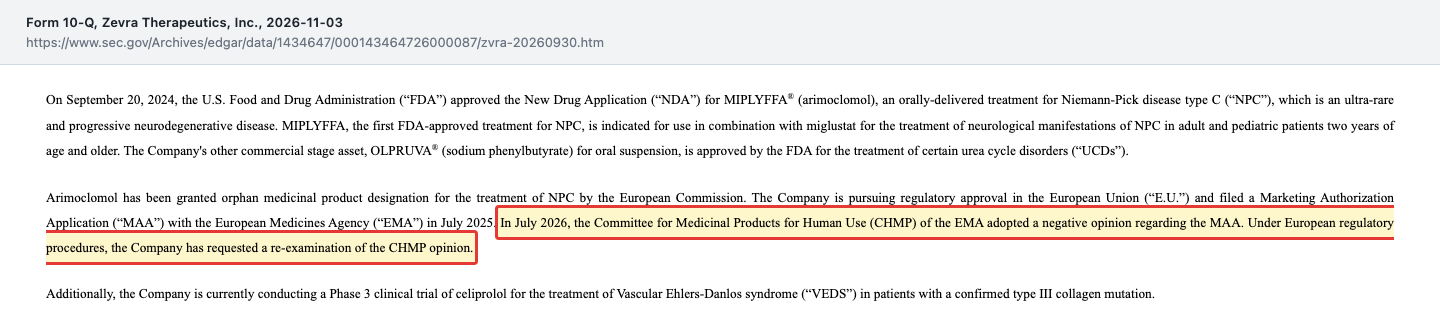
What that means shows up in the expanded access revenue line: $3.6 million in Q3 2026 after $9.0 million in Q2. The report gives no reason. On top of that comes a repayment obligation: in France, a provisional price applies until approval; if the eventual approved price is lower, Zevra has to pay back the difference.
“The total estimated clawback reserve liability as of September 30, 2026, and December 31, 2025, was $14.8 million and $15.3 million, respectively.”
— Zevra Therapeutics, Inc., SEC quarterly report 10-Q for Sept. 30, 2026, Note F

In its 2025 annual report, Zevra itself writes that ending the expanded access program before approval would have a "material adverse effect" on its business and results. The re-examination is under way; the report gives no date for a decision.
Uncomfortable truth No. 2: one drug, one distributor
According to the 2025 annual report, about 82 percent of revenue came from MIPLYFFA; in Q3 2026 it was $34.0 million of $37.8 million, or 90 percent. And all U.S. sales run through a single buyer:
“The Company currently utilizes a single specialty pharmacy provider as its sole distributor for MIPLYFFA and OLPRUVA.”
— Zevra Therapeutics, Inc., SEC quarterly report 10-Q for Sept. 30, 2026, Note F
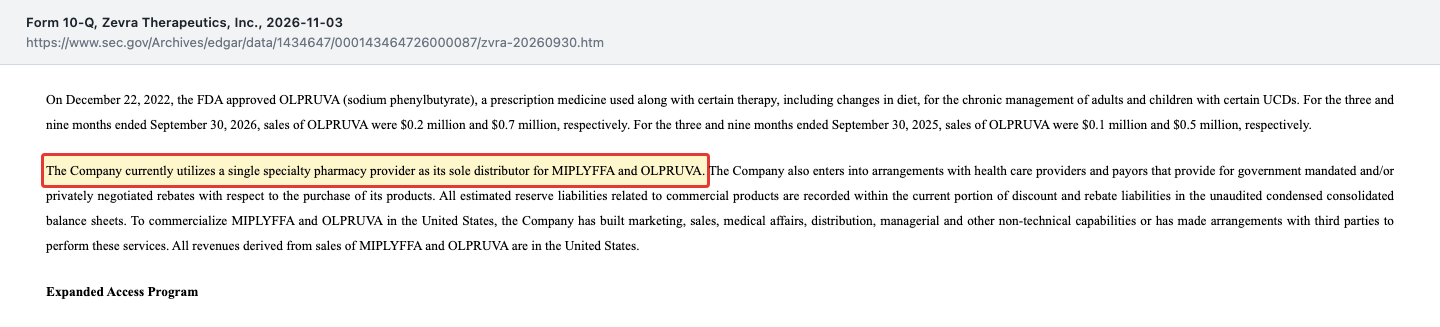
That is common for rare-disease drugs and not an existential threat — a specialty pharmacy is a logistics partner, not a customer that determines demand. But it is a bottleneck. Add competition: shortly after MIPLYFFA, the FDA approved a second NPC treatment, AQNEURSA from IntraBio (10-K 2025). Zevra's protection rests on orphan drug exclusivity through 2031 and patents through 2041.
Uncomfortable truth No. 3: a cautionary phrase that slows any extrapolation
Smaller, but worth noting: management's discussion contains a cautionary phrase that Zevra already used almost word for word in its 2024 annual report:
“We expect to continue to incur significant expenses and minimal positive net cash flows from operations or negative net cash flows from operations for the near future, and those expenses and losses may fluctuate significantly from quarter-to-quarter and year-to-year.”
— Zevra Therapeutics, Inc., SEC quarterly report 10-Q for Sept. 30, 2026, Item 2 "Overview"

This is standard caution more than a finding of its own, especially since Zevra has recently reported several quarters of positive operating cash flow. But the sentence sits in a mandatory report filed with the SEC. Anyone annualizing the $33.2 million of operating cash flow from the first nine months of 2026 does so without backing from that report.
Uncomfortable truth No. 4: your slice of the pie is shrinking
Since the start of the year, shares outstanding have risen from 56.85 million to 59.44 million (September 30, 2026), an increase of 4.5 percent. About half of that — 1.30 million shares — came from exercised warrants, the rest from employee options, share awards and the employee stock purchase plan (1.19 million and 0.09 million respectively). Put simply: when new slices keep getting cut, your slice gets smaller even if the pie grows. Counting all outstanding options and warrants, Zevra reaches 68.97 million shares — 16 percent more than are outstanding today. On the plus side: through September 30, 2026, not a single share had been sold under the at-the-market program set up in 2024 (up to $75 million).
Uncomfortable truth No. 5: the pipeline is thin
Behind MIPLYFFA, there is little. OLPRUVA has been written off and is merely under "strategic" review. Celiprolol has been in a Phase 3 trial since July 2022 that is meant to enroll 150 patients; after a restart in mid-2024, it had 72 participants and four confirmed events as of September 30, 2026. Zevra wants to discuss a faster path with the FDA; there is no outcome yet. The next concrete step is a label expansion for MIPLYFFA in infants under 24 months, which Zevra plans to file in Q1 2027 (8-K of November 3, 2026). Growth through acquisitions is a stated goal — affordable with $270.9 million in cash and investments, but it has not happened yet.
In short: Europe unresolved, one product, one distributor, a growing share count, a thin pipeline — none of these threatens Zevra today, but together they explain why the market does not extrapolate the profits.
Valuation: cheap only on paper?
At $10.26 (closing price November 3, 2026) and 59.5 million shares (October 30, 2026), the market value was about $610 million. Subtract the $270.9 million of cash and investments (there is no debt), and the market is paying about $340 million for the actual business — the enterprise value (our calculation).
Revenue over the last four quarters (Q4 2025 through Q3 2026) adds up to about $148 million. That gives a price-to-sales ratio of about 4 and an enterprise value of a little over twice annual revenue. On earnings, everything depends on which number you take: on reported net income over the last four quarters (about $78 million), the price-to-earnings ratio works out to about 8. On the adjusted quarterly profit of $11.5 million, annualized to about $46 million, it is about 13 — and measured by enterprise value about 7 (all our calculations). The gap between 8 and 13 comes from the adjustment alone.
What the market is weighing is what lies behind the profit: one drug, a disease with a few hundred diagnosed patients in the U.S., no persistence figure, Europe unresolved. The optimistic analysts are betting that exactly these questions turn out well — that is their opinion, not TickerGuard's.
Upside and risks at a glance
What speaks for Zevra
- MIPLYFFA is growing: $34.0 million of U.S. revenue in Q3 2026, up 52 percent from the prior-year quarter ($22.4 million).
- Debt-free since March 12, 2026, $270.9 million in cash and investments, no going-concern warning.
- The business earns about $11.5 million a quarter on an adjusted basis (our calculation); the operating margin in Q3 2026 was about 31 percent.
- Orphan drug exclusivity through 2031, patents through 2041; planned expansion to infants (filing in Q1 2027).
- A positive re-examination in Europe would open access to about 1,100 more patients.
What speaks against it
- Reported profit is bigger than recurring profit: $19.2 million instead of about $11.5 million for the quarter, $65.9 million instead of about $35.0 million for nine months.
- Negative CHMP opinion on the EU application (July 2026), expanded access revenue down from $9.0 million to $3.6 million, a $14.8 million clawback reserve for France.
- About 90 percent of quarterly revenue from one drug, a single U.S. distributor, an approved competitor.
- No disclosed persistence rate and no count of active patients; in a cautionary phrase, the quarterly report holds out only "minimal" operating cash flow.
- Share count up 4.5 percent since January, 68.97 million shares fully diluted; a thin pipeline.
Conclusion: the headline and the rest of the page
Back to the headline trap from the start. The $19.2 million profit and the 50.9 percent margin are not made up — they are in the quarterly report. But they are the frame, not the picture. Take out the fair value gain and apply a normal tax rate, and about $11.5 million remains: a small drugmaker earning decent money, with a very strong balance sheet, hanging on a single drug whose second leg is wobbling right now.
So the honest question for you is not "How low is the P/E?" but: Do you believe MIPLYFFA keeps growing in the U.S. even if Europe says no — and that patients stay on it, in numbers management does not disclose? If you have a reasoned answer, you have a thesis. If you only have the headline, you have a frame. What you make of it is your decision. And that is as it should be.
Sources
- Zevra Therapeutics, Inc. — SEC quarterly report 10-Q for Sept. 30, 2026 (filed Nov. 3, 2026)
- Zevra Therapeutics, Inc. — SEC current report 8-K of Nov. 3, 2026, Exhibit 99.1 (Q3 2026 results)
- Zevra Therapeutics, Inc. — SEC quarterly report 10-Q for June 30, 2026 (filed Aug. 5, 2026)
- Zevra Therapeutics, Inc. — SEC quarterly report 10-Q for Mar. 31, 2026 (filed May 6, 2026)
- Zevra Therapeutics, Inc. — SEC current report 8-K of Mar. 16, 2026 (Commave settlement, loan repayment)
- Zevra Therapeutics, Inc. — SEC annual report 10-K for 2025 (filed Mar. 9, 2026)
- Zevra Therapeutics, Inc. — SEC quarterly report 10-Q for Sept. 30, 2025 (filed Nov. 5, 2025)
- Zevra Therapeutics, Inc. — SEC annual report 10-K for 2024 (filed Mar. 12, 2025)
- Full SEC filing history: EDGAR overview Zevra Therapeutics (sec.gov)
- Earnings call transcripts Q1 2024 through Q1 2026 (quoted: Aug. 13, 2024, Mar. 11, 2025, May 13, 2025, Aug. 12, 2025, Nov. 5, 2025, Mar. 9, 2026); quoted passages checked verbatim against the transcript.
- Fundamental data (prices, short interest, analyst ratings; as of Nov. 4, 2026), cross-checked against the SEC filings.
Transparency & disclaimer: This analysis is a journalistic assessment of publicly available information. It is not investment advice, not a financial analysis in the regulatory sense, and not a solicitation to buy or sell securities. Investing in stocks involves substantial risk, up to and including the total loss of your investment. All information without guarantee; the data date is noted in the text. Adjusted figures are our own calculations based on the SEC filings, not company figures. We disclose any positions held by the publisher on a current basis; if one exists, it appears as a note at the top of this analysis.
Key figures at a glance
All monetary figures in millions of $; earnings per share as reported.
| Metric | 2021 | 2022 | 2023 | 2024 | 2025 |
|---|---|---|---|---|---|
| Revenue | 28.7 | 10.2 | 27.5 | 23.6 | 106.5 |
| Operating Income (EBIT) | 7.7 | -42.6 | -49.6 | -87.0 | -4.2 |
| Net Income | -8.6 | -26.8 | -46.0 | -105.5 | 83.2 |
| Net Margin | -29.9% | -263.5% | -167.7% | -446.9% | 78.2% |
| Earnings Per Share | -0.29 $ | -0.78 $ | -1.30 $ | -2.28 $ | 1.45 $ |
Source: fundamental data & SEC filings (annual and quarterly reports, 10-K/10-Q)
Our Bottom Line at a Glance
- U.S. MIPLYFFA business positive
- U.S. revenue of $34.0 million in Q3 2026 versus $22.4 million a year earlier; 197 prescription enrollments since launch (Sept. 30, 2026), most recently 13 to 14 per quarter. Operating margin in Q3 2026 about 31 percent.
- Balance sheet positive
- Loans repaid in full on March 12, 2026, $270.9 million in cash and investments, $238.9 million of equity (Sept. 30, 2026); no going-concern warning, no shares sold under the at-the-market program.
- Earnings quality negative
- Reported $19.2 million in Q3 2026 at a 2.6 percent tax rate and with a $5.1 million fair value gain; adjusted about $11.5 million. For nine months, $65.9 million instead of about $35.0 million, due to a $43.3 million one-time gain (our calculation).
- Europe & expanded access negative
- Negative CHMP opinion in July 2026, re-examination requested; expanded access revenue down from $9.0 million (Q2) to $3.6 million (Q3 2026), $14.8 million clawback reserve for France.
- Dependence & transparency neutral
- About 90 percent of quarterly revenue from MIPLYFFA, a single U.S. distributor, one approved competitor; persistence and active patient counts are not disclosed.
Zevra Therapeutics shows how the headline trap works: a $19.2 million quarterly profit and a 50.9 percent margin are formally correct, but by our calculation the recurring figure is closer to $11.5 million. Underneath sits a real, growing U.S. business with MIPLYFFA and a debt-free balance sheet with $270.9 million in cash — but a company that hangs on one drug whose European approval is unresolved. Not investment advice.
What Our Rating Means
Open questions
The business works in principle, but one material question is open. As long as it stays open, our findings do not carry a quality verdict.
The business works: MIPLYFFA is growing in the U.S., Zevra earns about $11.5 million a quarter on an adjusted basis, and it has no debt but $270.9 million in cash. Yellow rather than green because a material operating question is open: almost all revenue depends on one drug whose EU approval is unresolved after the negative CHMP opinion and whose persistence management does not disclose. Yellow rather than red because neither the balance sheet nor liquidity shows a substantive risk. The decision is yours.
A journalistic assessment by our editorial team at the time of the deep dive, based on public sources — not investment advice and not a solicitation to buy or sell. Your personal circumstances (investment goals, risk capacity, taxes) cannot be taken into account. What our levels mean, how verdicts are formed, and what conflicts of interest exist →
Worth Noting
- This analysis was prompted by the 10-Q for Sept. 30, 2026 (filed Nov. 3, 2026) and the earnings release. Shares sold short about 6.2 million (fundamental data, retrieved Nov. 4, 2026), a little over 10% of shares outstanding. Price references: $8.10 (12/18/2025, lowest close of the twelve months), $14.75 (07/08/2026, highest), $12.52 (07/23/2026), $9.53 (07/24/2026), $10.26 (11/03/2026).
- Our calculations: adjusted Q3 2026 net income = (19.7 pre-tax income − 5.1 warrant/CVR fair value gain) × (1 − 21%); January–September 2026 = (77.3 − 43.3 Commave + 7.2 derivative + 2.8 extinguishment loss + 0.3 fair value) × 0.79. Enterprise value = $610.5 million market value − $270.9 million cash and investments. EAP Q4 2025 = 13.0 full year − 7.3 January–September.
- This analysis covers the common stock of Zevra Therapeutics, Inc. (Nasdaq: ZVRA, CIK 0001434647); filings before February 2023 are listed at the SEC under KemPharm, Inc. Earnings call quotes come from transcripts of the calls from 2024 to Q1 2026; the calls on Q2 and Q3 2026 were not available as transcripts.
Stock Watch
This analysis is as of November 4, 2026. Stock Watch will tell you what's changed at ZVRA since then.
Later $1 a month per stock — signing up is free, and you'll be the first to know when it launches.
The full analysis as a PDF for later
We will send you this analysis as a PDF — to print, file away, and read at your own pace. And we will add you to the free Stock Watch list for Zevra Therapeutics Inc. (ZVRA), so you hear about it when something material in this analysis changes.
Frequently Asked Questions
Zevra Therapeutics, Inc. (Nasdaq: ZVRA), based in Boston, develops and sells drugs for rare diseases. Its main product is MIPLYFFA (arimoclomol), approved in the U.S. on Sept. 20, 2024, for the neurological disease Niemann-Pick disease type C; in Q3 2026 it brought in $34.0 million of $37.8 million in revenue. Until February 2023 the company was called KemPharm.
Zevra reported Q3 2026 net income of $19.2 million. That includes a $5.1 million fair value gain on warrants and contingent value rights and a tax rate of only 2.6 percent. Excluding the fair value gain and applying a 21 percent tax rate, about $11.5 million remains by our calculation; for January through September 2026, about $35.0 million instead of $65.9 million.
On March 13, 2026, Zevra sold its rights to the ADHD drug AZSTARYS and the compound SDX to Commave Therapeutics and settled a legal dispute. Commave paid $50 million in total, 10 percent of which went to Aquestive. Zevra booked a one-time gain of $43.3 million in Q1 2026; AZSTARYS royalty revenue has ended since.
No. On March 12, 2026, Zevra repaid its loans from HCR and Perceptive in full — about $63.1 million of principal plus interest, a $1.8 million final payment fee and a $7.2 million make-whole and prepayment premium. At Sept. 30, 2026, Zevra held $270.9 million in cash and investments against $238.9 million of equity.
No. Zevra filed the EU marketing application in July 2025; in July 2026 the drug committee CHMP adopted a negative opinion. Zevra has requested a re-examination, and the outcome is pending (as of Nov. 3, 2026). Until then, patients in Europe receive arimoclomol through an expanded access program, which generated $3.6 million of revenue in Q3 2026.
Yes. Shortly after MIPLYFFA, the U.S. Food and Drug Administration approved AQNEURSA from IntraBio as a second treatment for Niemann-Pick disease type C. According to the 2025 annual report, the trial endpoint and safety profile differ; other compounds are in development. MIPLYFFA is protected by orphan drug exclusivity through 2031 and patents through 2041.
Shares outstanding rose from 56.85 million to 59.44 million between Dec. 31, 2025, and Sept. 30, 2026 (up 4.5 percent): 1.30 million from warrants, 1.19 million from employee options and awards, and 0.09 million from the stock purchase plan. Fully diluted, Zevra counts 68.97 million shares.
Found an error?
Did you spot a factual error, an outdated number, or a typo in this deep dive? Let us know briefly — your report goes straight to the editorial team.