Herbalife: $1.87 Billion for Its Own Shares — Today They Would Be Worth Only About $515 Million
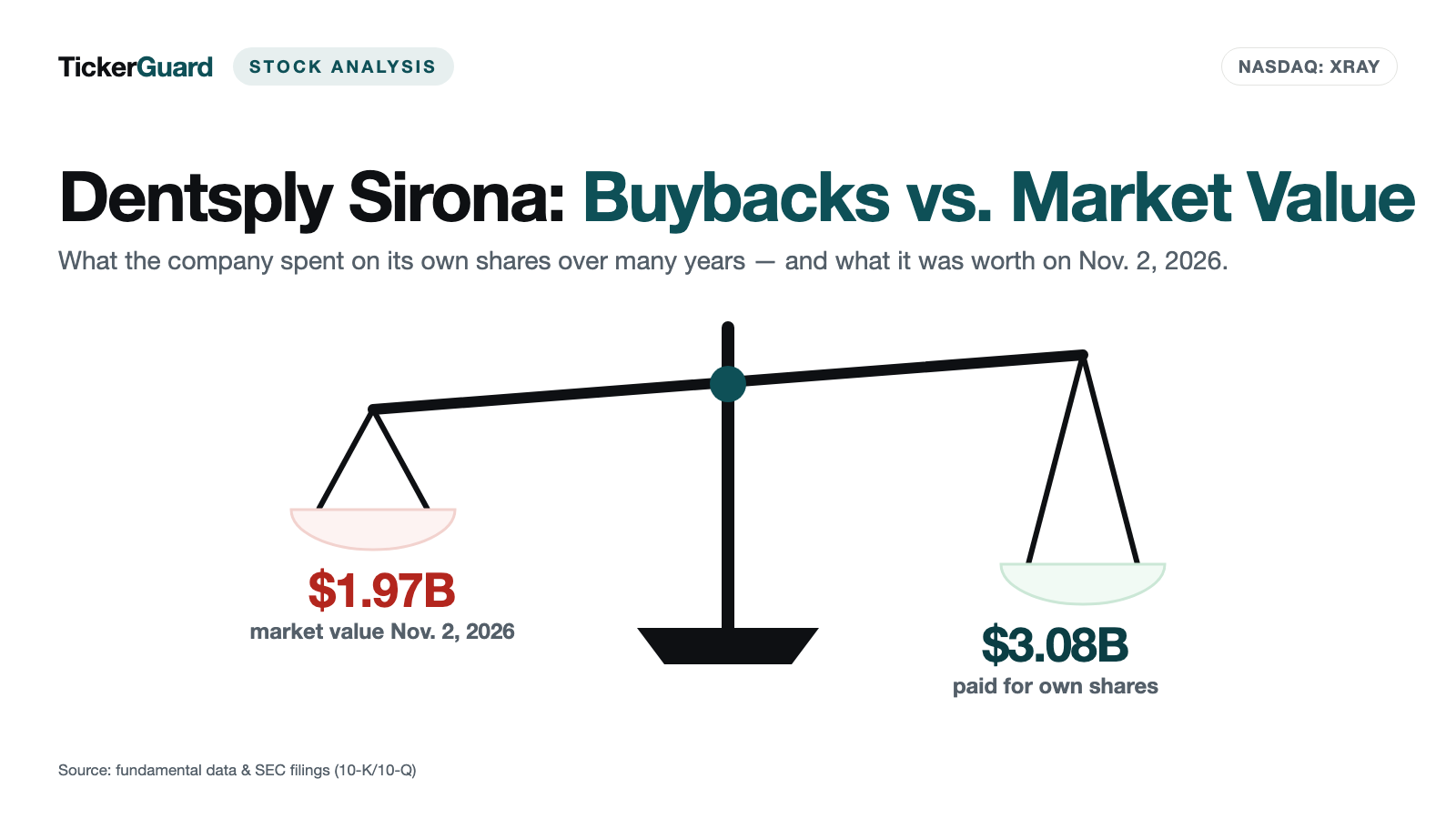
In the first nine months of 2026, 92 percent of Herbalife's revenue growth came from India, and for its 2020 and 2021 buybacks the company paid about $1.87 billion — at the November 2, 2026 price those shares would be worth about $515 million. Not investment advice, but the question of whether the price in your head comes from today or from back then.
 Thomas Mücke
Founder & Publisher
As of Today
As of: November 2, 2026
- Closing price
- 13.30 $ +1.80%
- Market Capitalisation
- 1.4 $B
- Growth Score
- 4/10
- AAQS
- 4/10
Price change since November 2, 2026: +0.2%
This analysis has a cut-off date. The Stock Guard tells you when something material changes in the numbers. Reserve your free spot
Chart
Interactive price chart (TradingView).
52-week range: 8.00 $ to 20.00 $ · Last price: 13.30 $ (As of: November 2, 2026)
Note: pure fact-based analysis, not investment advice and not a solicitation to buy or sell. All figures without guarantee.
Some numbers lodge in your head like an earworm. With Herbalife, it is 48. At an average of roughly $48 per share, the company bought back its own stock in 2020 and 2021 — 38.8 million shares for about $1.87 billion. On November 2, 2026, the stock closed at $13.28. At that price the repurchased shares would be worth about $515 million, just over a quarter of the purchase price (our calculation). And your brain is already doing the math: if the company itself paid $48, then $13 is practically a giveaway! Welcome to the anchoring effect. It works like this: a number we have seen for something becomes the yardstick — even when it has nothing to do with the present. Like the crossed-out price in the shop window: it tells you nothing about what the jacket is worth, but a lot about what you are willing to pay.
What stands out: Herbalife itself acted as if an anchor had been part of the decision. The buybacks included a $600 million block from major shareholder Carl Icahn ($48.05 per share). In 2021 alone, $1,011.3 million flowed into buybacks according to the cash flow statement ($982.7 million under the repurchase programs plus $28.6 million for shares withheld for taxes on employee equity awards; annual report 10-K 2021), while only $460.3 million came in from operations — the rest came from debt and cash.
That gives us a story with a tension that runs through the whole text: Herbalife is financially tidier than three years ago and cheaply valued — but growth hangs almost entirely on India, the profit jump in the third quarter of 2026 comes mainly from lower interest, and since November 1, 2026 an interim chief has been at the helm. Together we read what the reports to the U.S. securities regulator, the SEC, say about it.
What Herbalife does — shakes, independent sellers and a seat in the Cayman Islands
Herbalife sells nutrition and weight-management products: protein shakes, teas, supplements. You will not find them on a supermarket shelf. They reach customers through independent distributors whom the company calls "members". This is direct selling (network marketing): one person sells to acquaintances, neighbors, friends — the plastic-container party principle, just with shakes. According to the annual report (10-K) for 2025, there were about 6.4 million such members on December 31, 2025; the company operates in 95 markets (quarterly report 10-Q Q3 2026) and employed roughly 8,500 people, about 2,200 of them in the U.S. (as of December 31, 2025). It reports in five regions: North America, Latin America, Europe/Middle East/Africa (EMEA), Asia Pacific excluding China, and China.
The top tier of this system is called "Sales Leaders" — distributors who have built teams of their own. Their number is a leading indicator for the health of the network; we come back to it.
Direct selling has a backstory investors should know. After a multi-year investigation, Herbalife settled with the U.S. Federal Trade Commission (FTC) in July 2016. The settlement still applies and ties distributor compensation in the U.S. to genuine customer sales. The quarterly report describes the consequence like this:
"In the U.S., distributor compensation is capped if the Company does not meet an annual requirement as described in a consent order entered into with the U.S. Federal Trade Commission in July 2016."
— Herbalife Ltd., SEC quarterly report 10-Q as of 09/30/2026, Note 2
On the name: until April 11, 2023, the company was called "Herbalife Nutrition Ltd."; since then it has traded as "Herbalife Ltd." Many data portals still carry the old name — it is the same company (CIK 0001180262). It is a Cayman Islands company based in Grand Cayman but run operationally from Los Angeles, and it files normal annual and quarterly reports as a U.S. domestic issuer. If you want to hold the business model up against its industry, our stock analysis of Nature's Sunshine covers a direct-selling peer — whose annual report names Herbalife in the comparison group for its share-price performance from 2020 to 2025.
Company history for investors
-
2016
FTC settlement
In July 2016 Herbalife settles with the U.S. trade regulator: U.S. distributor pay is tied to genuine customer sales — still an ongoing theme for owners.
-
2021
Record revenue and expensive buybacks
Record revenue of $5,802.8M; buybacks of $982.7M at an average $48.10, including $600M to Carl Icahn: the price anchor sits in the balance sheet.
-
2023
Renamed Herbalife Ltd.
In April 2023 Herbalife Nutrition Ltd. becomes Herbalife Ltd. Data portals often keep the old name — same company, same CIK.
-
2024
Tax benefit lifts net income above pre-tax profit
A restructuring brings an $84.9M tax benefit; 2024 net income ($254.3M) exceeds pre-tax profit. Operating income is the more honest yardstick.
-
2026
April refinancing
Expensive debt (12.25 percent) is replaced by 7.75 percent notes: a $94.6M one-off loss; per management about $45M in annual interest savings, and in the third quarter, together with debt paydown, $19.1M less net interest.
-
2026
CEO change and buyback program
A $250M buyback program on 09/07/2026, CEO exit on 10/31, interim CEO DeSimone from 11/01/2026: capital returns, leadership is open.
How the stock reached our desk — the quarterly report of November 2, 2026
The occasion for this analysis is the quarterly report (10-Q) and earnings release (8-K) of November 2, 2026. Three things were in them that together form a picture:
- Numbers: Third-quarter 2026 revenue of $1,350.2 million (+6.0 percent, +7.6 percent in local currency) — the fifth quarter of growth in a row. Net income rose from $43.2 million to $58.8 million (+36.1 percent), diluted earnings per share from $0.42 to $0.55.
- Leadership: The previous CEO, Stephan Gratziani, left the company effective October 31, 2026; former CFO John DeSimone has led it as interim CEO since November 1, 2026.
- Capital return: On September 7, 2026, the board authorized a buyback program of up to $250 million, running until September 7, 2029. Nothing was bought in the third quarter.
On the outlook: for the fourth quarter of 2026 the company guides to 0.5 to 4.5 percent revenue growth (2.5 to 6.5 percent in local currency), with adjusted EBITDA of $145 to $165 million (prior-year quarter: $156.1 million). For full-year 2026 it says revenue +4.9 to +5.9 percent and adjusted EBITDA of $670 to $690 million (2025: $657.6 million). Growth is thus expected to slow in the closing quarter.
And the price? This is where the anchor deserves a look. Split-adjusted, the stock closed at $61.47 on February 4, 2019, at $40.93 at the end of 2021, $14.88 at the end of 2022, $15.26 at the end of 2023 and $6.69 at the end of 2024. The low was $5.11 (February 12, 2025), the 2026 high $19.96 (February 20, 2026); at the end of 2025 it stood at $12.89, and on November 2, 2026 at $13.28 (source: fundamental data). Count from 61 and you see a crash. Count from the low of $5.11 and you see a doubling and more. Both are anchors — neither says anything about the value of the company.
The leadership change did not come out of the blue either, but it came fast. The announcement of the chief's departure was plain:
"On August 31, 2026, the Company announced that Stephan Gratziani will transition from his role as Chief Executive Officer, effective October 31, 2026."
— Herbalife Ltd., SEC current report 8-K (Item 5.02) of 08/31/2026
The filing gives no reason.
The numbers over the years
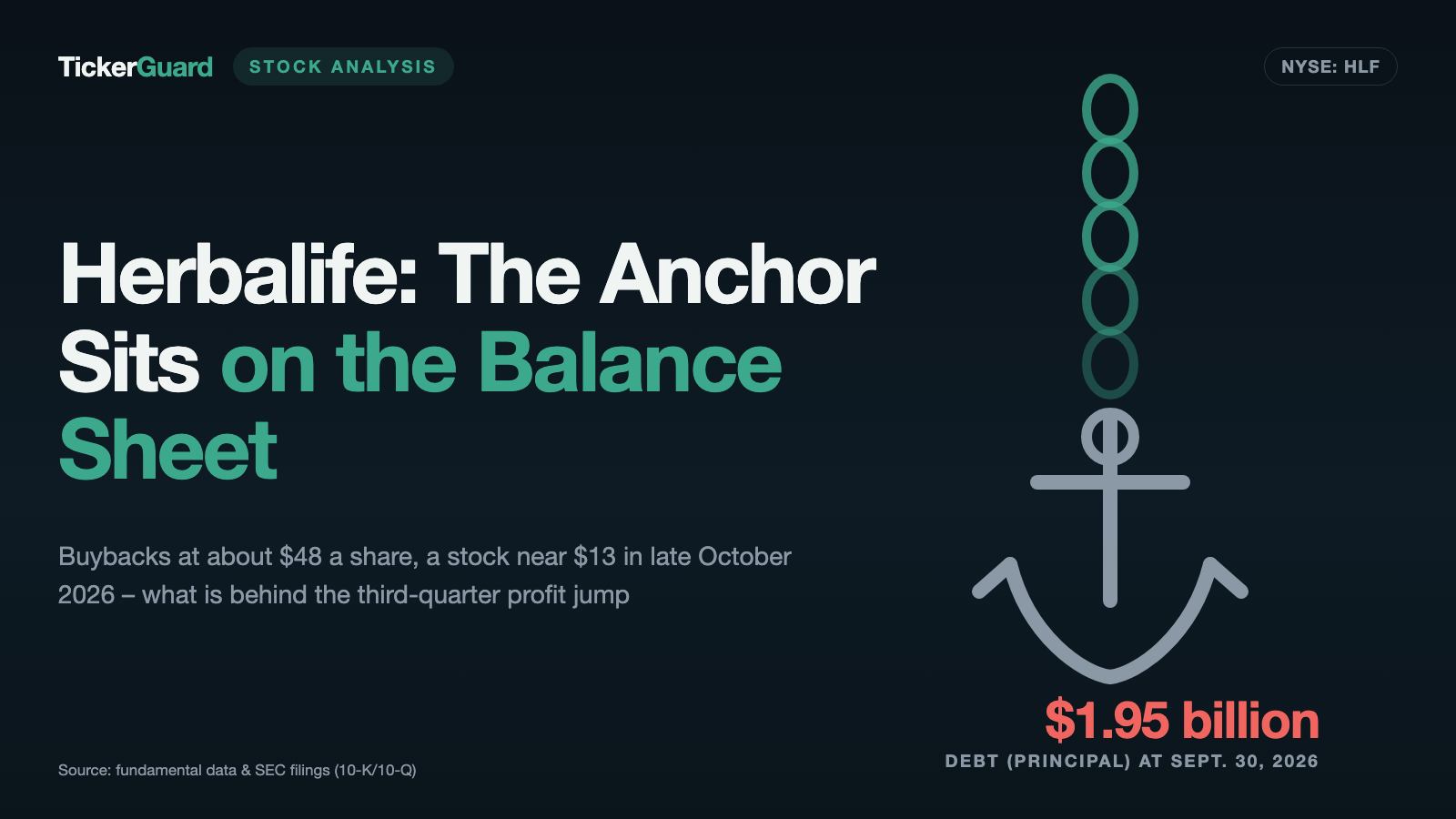
First, what impresses. Herbalife has tidied up in recent years — and consistently. Debt (carrying value) fell from $2,762.6 million at the end of 2021 through $2,692.0 million (2022), $2,562.4 million (2023) and $2,260.1 million (2024) to $1,992.6 million at the end of 2025. On September 30, 2026, the principal amount was $1,951.9 million and the carrying value $1,929.2 million. Negative equity shrinks year after year: from −$1,391.5 million (end of 2021) through −$1,265.9 million, −$1,060.3 million and −$801.1 million to −$509.4 million (end of 2025) and −$403.7 million on September 30, 2026. The last two figures are total equity, including non-controlling interests; the Herbalife shareholders' deficit alone was −$515.1 million (end of 2025) and −$409.6 million (September 30, 2026).
The business throws off cash along the way. Operating cash flow — the money that comes in from running the business — was $352.5 million in 2022, $357.5 million in 2023, $285.4 million in 2024 and $333.3 million in 2025; in the first nine months of 2026 it was $298.0 million (prior-year period: $235.0 million). Capital spending is small: $40.7 million in nine months of 2026. Operating income recovered from $356.4 million (2023) through $385.9 million (2024) to $481.0 million (2025). Interest coverage — how many times operating income covers net interest — was about 4.3 in the third quarter of 2026 ($138.5 million to $31.9 million, our calculation); the total leverage ratio under the credit agreement fell from 2.8x (end of 2025) to 2.6x, the net ratio from 2.3x to 2.0x (as reported, rounded; 2.04x on the underlying numbers, our calculation). At 2.6x, the total ratio sits well below the 4.00x limit permitted under the credit agreement.
Now the other side: revenue is not back yet. It stood at a record $5,802.8 million in 2021, then $5,204.4 million (2022), $5,062.4 million (2023), $4,993.1 million (2024) and $5,037.5 million (2025) — 13.2 percent below the record year. The twelve months through September 2026 come to $5,277.2 million, still 9.1 percent below 2021.
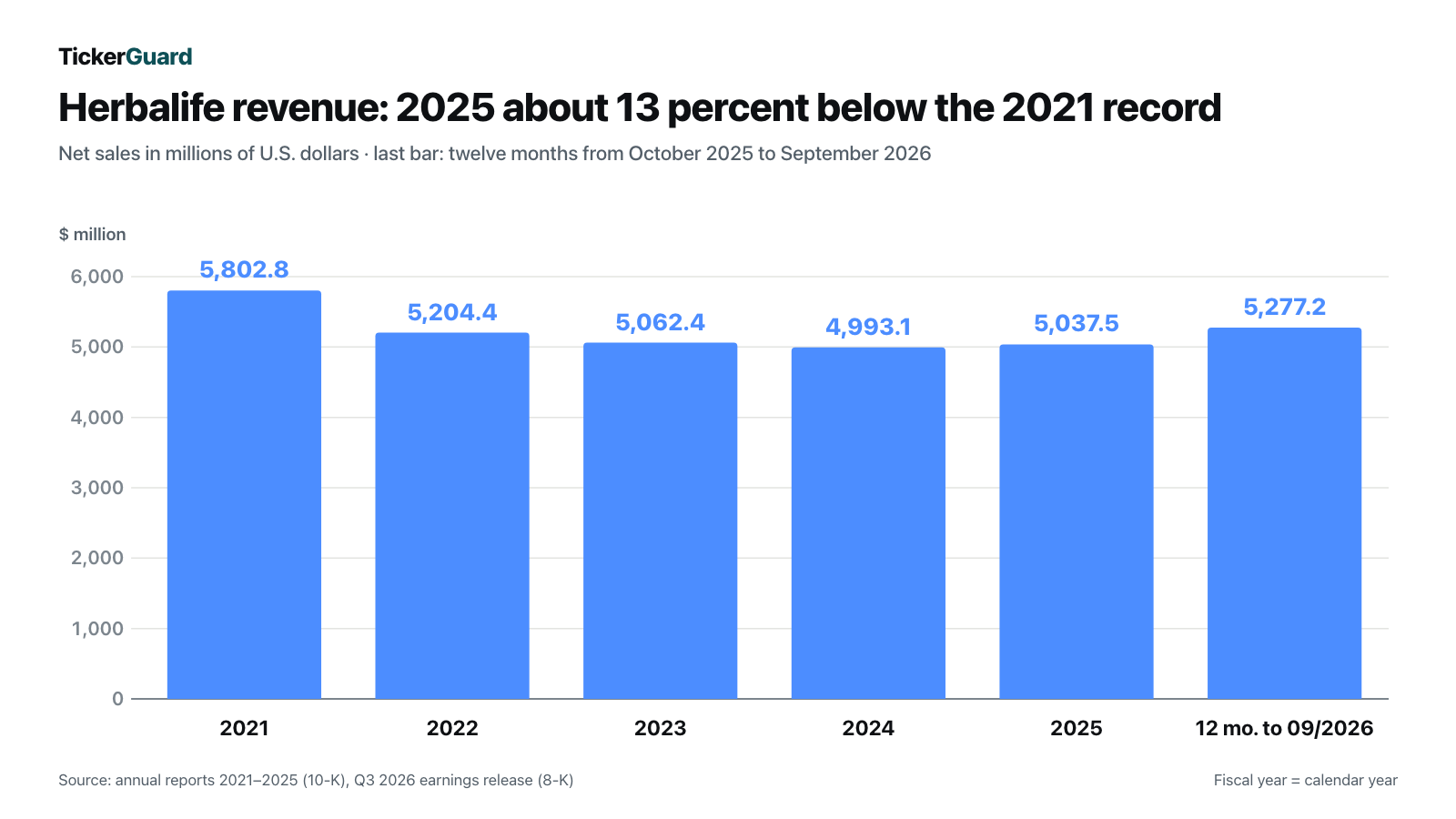
Remember the rule: tidying up is not growing. Herbalife has repaired its balance sheet but has made up only about a third of its revenue decline (up $284.1 million from the 2024 low against a gap of $809.7 million to the 2021 record, our calculation) — and, as we will see in a moment, with a very one-sided engine.
One-offs and adjusted figures — what is left of the profit jump
This is the chapter to read before you repeat the number "profit +36 percent". Net income for the third quarter of 2026 ($58.8 million) and the prior year's ($43.2 million) did not come about in the same way. We break the jump into its parts.
The profit bridge: where the extra $15.6 million comes from
From $43.2 million to $58.8 million is $15.6 million more. The bridge in between: plus $12.7 million from higher operating income ($138.5 million instead of $125.8 million, +10.1 percent), plus $19.1 million from lower net interest ($31.9 million instead of $51.0 million), minus $17.8 million from higher taxes ($49.5 million instead of $31.7 million) and plus $1.6 million from non-controlling interests (a loss of $1.7 million instead of $0.1 million, which lifts the profit of Herbalife shareholders). Of the pre-tax profit increase ($106.6 million instead of $74.8 million, up $31.8 million), about 60 percent comes from interest and about 40 percent from the business (our calculation).
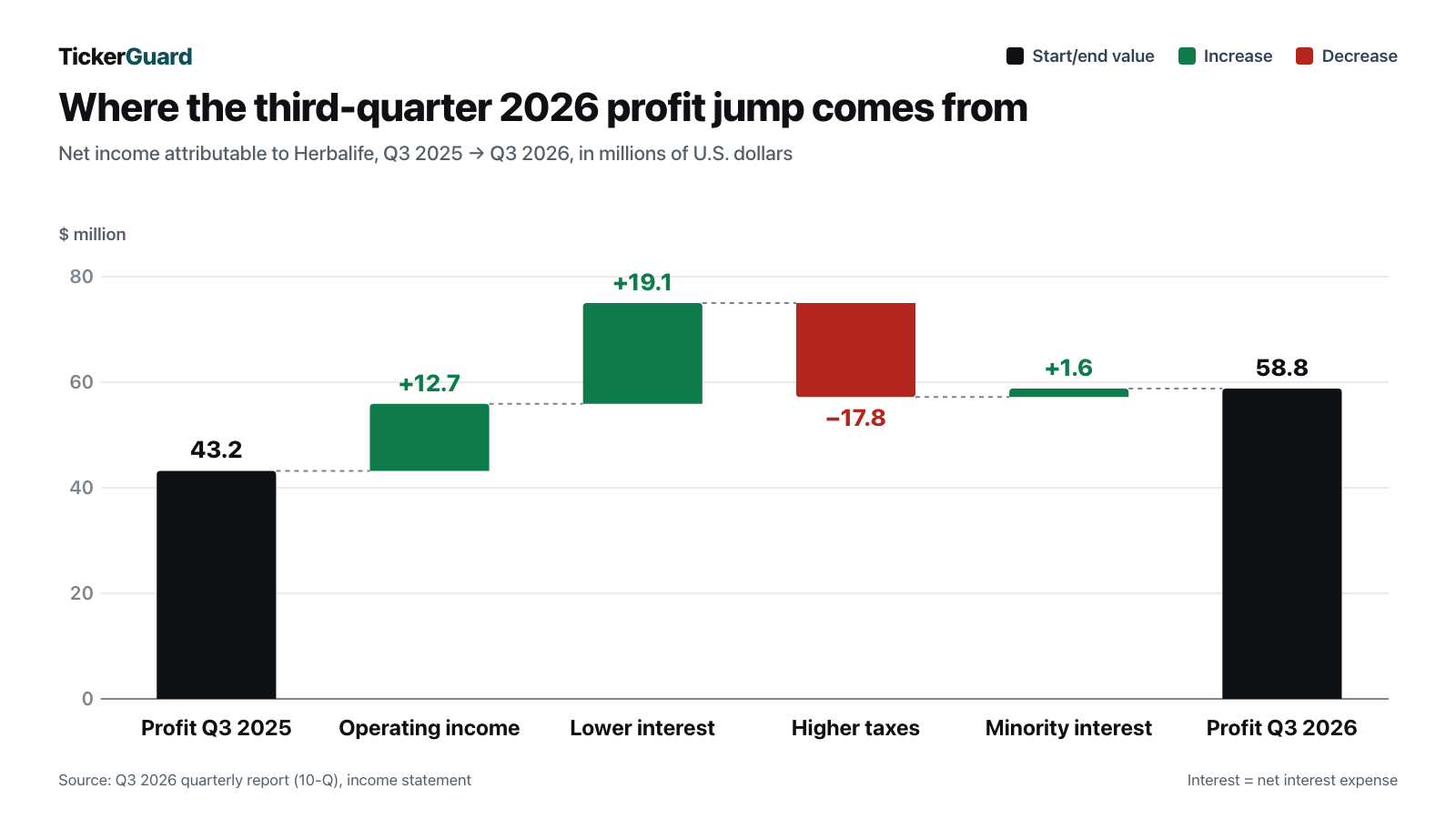
The company says so quite openly. CFO Scott Schaefer is quoted in the earnings release like this:
"Our April refinancing reduced net interest expense by $19.1 million year-over-year in the third quarter, strengthening our earnings and cash generation."
— Herbalife Ltd., SEC earnings release 8-K (Exhibit 99.1) of 11/02/2026
Important for putting it in context: according to the CFO, the $19.1 million comes from two sources — the April refinancing and the ongoing debt paydown ("Our April refinancing, combined with the continued debt paydown", call of November 2, 2026). For the refinancing alone, DeSimone cited on the May 6, 2026 call about $45 million a year in savings ("approximately $45 million in annualized cash interest savings") and added that the estimate may change with further paydown and moving variable rates. So the effect is not a one-time gain but a lower interest level — lasting as long as debt levels and rates stay roughly where they are. To be honest about it, though: that is financial work, not a better business.
The refinancing loss: $94.6 million, a one-off in the second quarter
In April 2026, Herbalife replaced expensive debt. The $800 million notes at 12.25 percent interest (due 2029) and the $365 million Term Loan B (weighted average interest rate under the old credit agreement at December 31, 2025: 11.64 percent) were replaced by a new secured $800 million note at 7.75 percent (due May 1, 2033) and a new credit agreement (weighted average interest rate on borrowings under the new and the old credit agreement during the period: 8.50 percent). That comes at a price that went straight into the income statement:
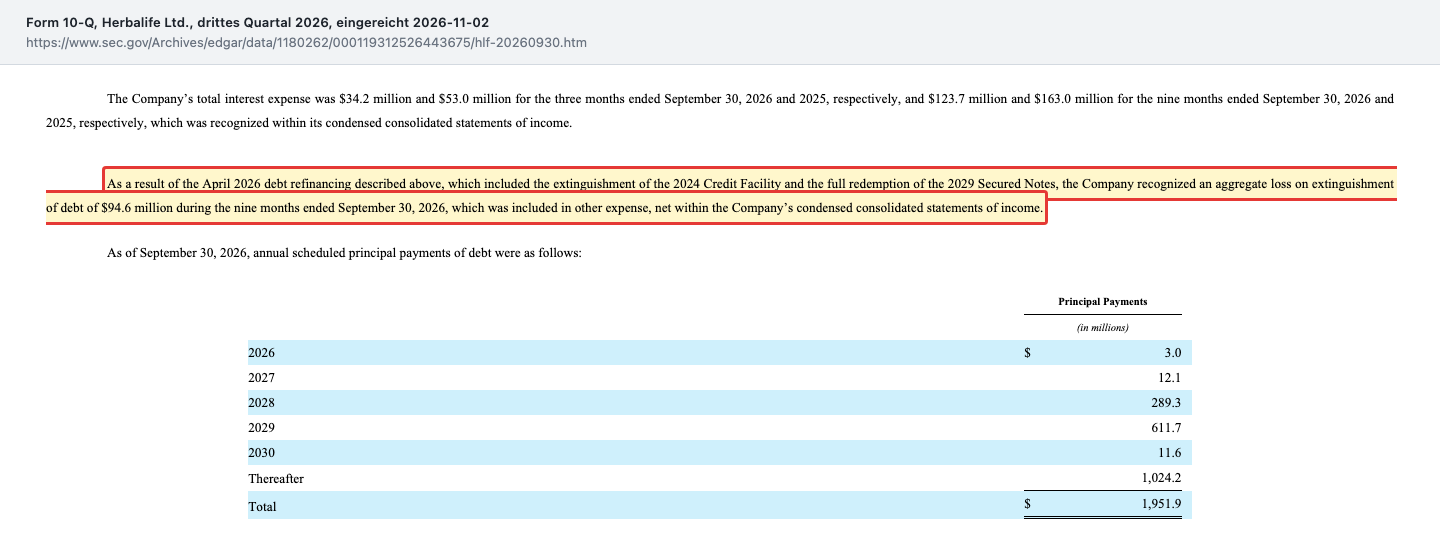
"As a result of the April 2026 debt refinancing described above, which included the extinguishment of the 2024 Credit Facility and the full redemption of the 2029 Secured Notes, the Company recognized an aggregate loss on extinguishment of debt of $94.6 million during the nine months ended September 30, 2026, which was included in other expense, net within the Company’s condensed consolidated statements of income."
— Herbalife Ltd., SEC quarterly report 10-Q as of 09/30/2026, Note 4
Of that, $72.8 million related to retiring the 12.25 percent notes due 2029 and $21.8 million to the old credit agreement; it includes a $49.0 million early-redemption premium that Herbalife actually paid in cash. The loss was booked only in the second quarter and turned an operating profit into a net loss of $26.3 million. Over nine months, net income therefore fell from $142.9 million to $94.4 million (minus 33.9 percent), earnings per share from $1.38 to $0.88. Without the refinancing loss ($74.6 million after tax), nine-month profit would be about $169.0 million — roughly 18 percent more than a year earlier (our calculation). Bottom line: the refinancing cost something once but saves every year. At the $45 million a year management cites, the full book loss of $94.6 million would be recovered after a little over two years; the $49.0 million early-redemption premium paid in cash after a little over one year (our calculation).
Taxes: 46.4 percent and two special effects
The tax side looks bumpier. The effective tax rate — the share of pre-tax profit that goes to tax — was 46.4 percent in the third quarter of 2026 (prior year 42.4 percent) and 52.8 percent over nine months (36.5 percent). That is a lot; the company itself strips out deferred-tax effects from a corporate restructuring ($4.1 million in the quarter). That restructuring is the source of the two special effects: in 2024, Herbalife booked a tax benefit of $84.9 million (among other things through the transfer of intellectual property to a European subsidiary in the fourth quarter of 2024) — which made 2024 net income ($254.3 million) higher than pre-tax profit ($169.4 million). In 2025 the report showed a tax rate of 17.2 percent, including $36.3 million of "favorable deferred tax effects" from the same restructuring. The 2024 and 2025 profits are therefore boosted by special tax effects; operating income ($356.4 million → $385.9 million → $481.0 million) is the better yardstick.
The company's adjustments — and the programs that never end
The company also shows "adjusted" figures. For the third quarter of 2026: adjusted net income of $68.5 million (prior year $51.5 million), adjusted earnings per share of $0.64 ($0.50), adjusted EBITDA of $182.4 million at a margin of 13.5 percent (+70 basis points; EBITDA = earnings before interest, taxes, depreciation and amortization). Alongside it, the earnings release lists a "Credit Agreement EBITDA" of $198.9 million — a more generous definition from the credit agreement that additionally strips out stock compensation and inventory write-downs.
Items removed in the quarter: costs of the "Optimization Program" ($5.6 million pre-tax), Russia-Ukraine costs ($1.2 million), "Technology Realignment" ($0.8 million), tax effects (minus $1.9 million) and deferred-tax effects from the 2024 restructuring (plus $4.1 million, added back to adjusted net income). The pattern behind it is one you may view critically: since 2024, three "programs" have followed one another — Restructuring 2024/25, Technology Realignment and the Optimization Program 2026. If you take a new "one-time program" out of the numbers every year, you are looking at costs that recur. "Adjusted" here is the company's view, not a law of nature.
Remember: a "one-time program" that comes back every year belongs to the running costs.
Our clean reading
What is left when we read the numbers without frills? Operating income rose 10.1 percent in the third quarter to $138.5 million — on 6.0 percent more revenue. That is the business's real progress. Earnings per share grew far more, 31 percent ($0.55 instead of $0.42), because interest is permanently lower; higher taxes slowed it again. Gross margin slipped slightly (77.3 percent instead of 77.7 percent). The interest benefit is permanent. The loss in the second quarter is a one-off. The tax rates of recent years are not dependable. A profit jump of 36 percent therefore reads better than the business actually grew — a gain of about 10 percent in operating income is the number you can steer by.
What the filings say — the uncomfortable truths
Uncomfortable truth no. 1: The buybacks at $48 and the negative equity
Back to the anchor. The annual report for 2021 says what Herbalife did with the buybacks:
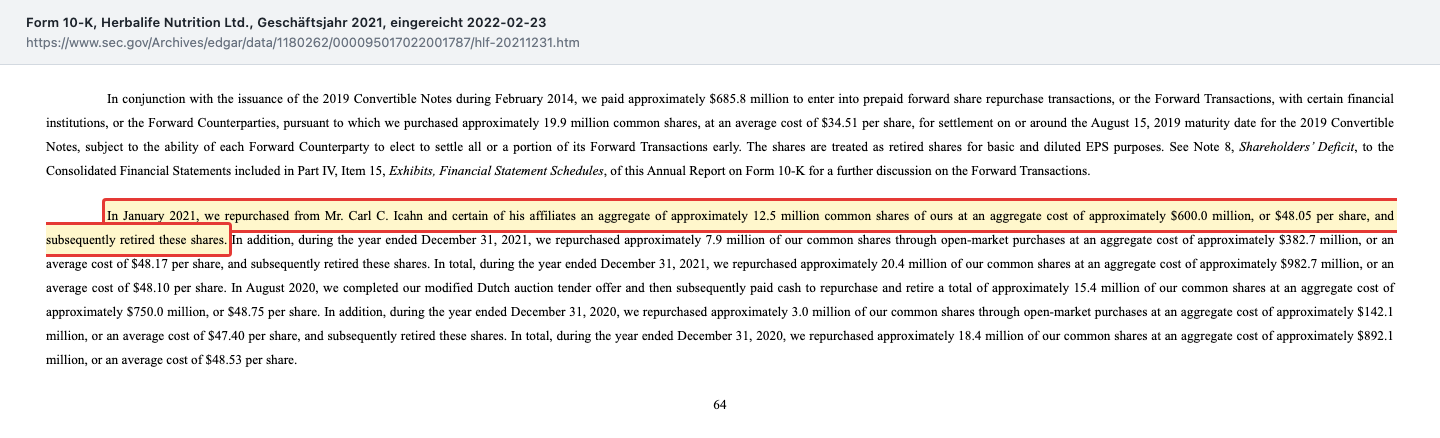
"In January 2021, we repurchased from Mr. Carl C. Icahn and certain of his affiliates an aggregate of approximately 12.5 million common shares of ours at an aggregate cost of approximately $600.0 million, or $48.05 per share, and subsequently retired these shares."
— Herbalife Ltd., SEC annual report 10-K for 2021, Liquidity
In total, Herbalife bought back about 20.4 million shares for $982.7 million in 2021 (average $48.10) and about 18.4 million for $892.1 million in 2020 (average $48.53). Added up, that is the 38.8 million shares for roughly $1.87 billion mentioned above — which at the November 2, 2026 price ($13.28) would be worth about $515 million (our calculation).
That was only the peak of a series. Buybacks from 2017 to 2021 add up to about $3.5 billion according to the cash flow statements ($844.2 million in 2017, $750.3 million in 2018, $16.7 million in 2019, $923.5 million in 2020, $1,011.3 million in 2021). The consequence sits in the balance sheet: equity was still positive at $196.3 million at the end of 2016 and flipped to −$334.7 million in 2017. Negative equity does not mean losses ate up the assets. It means the company handed more money back to shareholders than was ever paid in and earned. The image: you borrow money and pay it out to yourself as a dividend — your account looks worse even though your shop is running. Because the business earns money, the minus has shrunk every year since 2021, most recently to about $0.4 billion on September 30, 2026 (breakdown in the chapter "The numbers over the years"). Since 2023, buybacks have shrunk to little more than tax withholding on employee shares ($8 million to $11 million a year).
Uncomfortable truth no. 2: Growth has an address — India
The overall picture of the third quarter of 2026 looks like this (revenue in millions of U.S. dollars): North America $267.5 (+1.7 percent), Latin America $250.2 (+9.0 percent), EMEA $259.0 (minus 4.9 percent), Asia Pacific $517.9 (+18.4 percent; +26.1 percent in local currency) and China $55.6 (minus 22.0 percent). The reason for the Asian surge is stated in one place in the management discussion:
"Net sales in India were $313.5 million and $859.5 million for the three and nine months ended September 30, 2026, respectively."
— Herbalife Ltd., SEC quarterly report 10-Q as of 09/30/2026, management discussion
India grew by $87.1 million in the third quarter (+38.5 percent; +51.6 percent in local currency). Total group revenue rose only $76.5 million. Without India, revenue fell $10.6 million (about minus 1 percent, our calculation). Over nine months (revenue $3,994.2 million, +6.4 percent), $220.2 million of the $239.7 million in added revenue came from India — 92 percent of the growth comes from one country. India ($313.5 million) is bigger in the quarter than all of North America ($267.5 million) and makes up 23 percent of group revenue. Add the regulatory risk: in the fourth quarter of 2025, a tax change (GST, September 2025) cost $11.3 million in earnings.
The rest of the world is weak. Over nine months, North America stands at $788.1 million (minus 0.2 percent), EMEA at $811.6 million (minus 2.6 percent), China at $173.0 million (minus 19.9 percent). The network of Sales Leaders in North America is shrinking too: 69,586 (2023), 58,782 (2024) and 52,939 (2025), each at the end of February — minus 24 percent in two years. Worldwide excluding China the number held steady (582,107 → 571,245 → 580,617), because Asia Pacific grew from 223,714 through 242,792 to 257,725 (annual report 10-K 2025).
Uncomfortable truth no. 3: A maturity clause on December 16, 2027
On paper, the new loans run until April 29, 2031. On paper — because the fine print contains a condition that can pull the date forward:
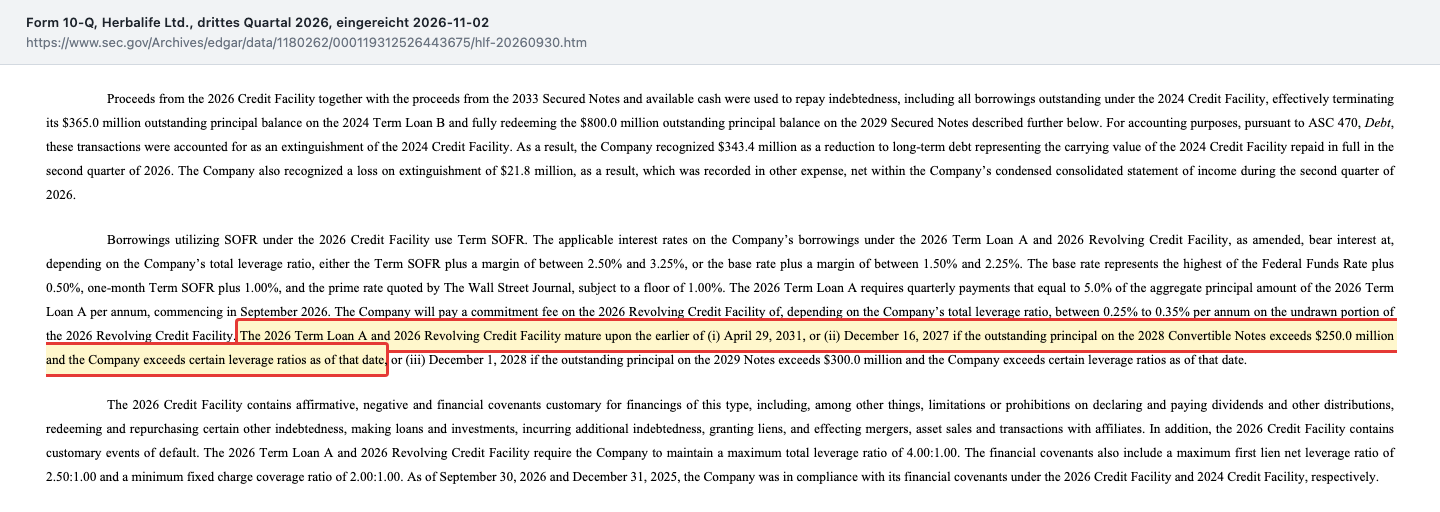
"The 2026 Term Loan A and 2026 Revolving Credit Facility mature upon the earlier of (i) April 29, 2031, or (ii) December 16, 2027 if the outstanding principal on the 2028 Convertible Notes exceeds $250.0 million and the Company exceeds certain leverage ratios as of that date […]"
— Herbalife Ltd., SEC quarterly report 10-Q as of 09/30/2026, Note 4
The image: a mortgage the bank may call early if your neighbor has not finished his garden fence by December. The neighbor is the 2028 convertible notes (interest 4.25 percent, due June 15, 2028, initial conversion price about $16.98 per share). On September 30, 2026, $277.5 million of them were still outstanding — $27.5 million above the threshold of $250 million. A similar clause with December 1, 2028 as its test date applies to the unsecured 2029 notes — not the 12.25 percent notes repaid in April, but the "2029 Notes" at 4.875 percent interest, due June 1, 2029, of which $600.0 million was outstanding on September 30, 2026 (threshold $300 million). The quarterly report does not say which leverage ratios are meant; the credit agreement permits a total leverage ratio of at most 4.00 to 1.00, and the total ratio stood at 2.6x on September 30, 2026. The credit agreement comprises the Term Loan A and the revolver at $272.2 million combined. Cash is $409.2 million — enough to reduce the $27.5 million if need be. Nothing is decided; that is why this is a watch item, not an alarm. Behind it waits the repayment schedule (principal amounts per the quarterly report, Note 4):
| Year | Principal due ($ million) |
|---|---|
| 2026 (remainder) | 3.0 |
| 2027 | 12.1 |
| 2028 | 289.3 |
| 2029 | 611.7 |
| 2030 | 11.6 |
| Thereafter | 1,024.2 |
| Total | 1,951.9 |
The years 2028 and 2029 are the big chunks: 2028 brings the convertible notes, 2029 the unsecured notes at $600.0 million, which make up most of the $611.7 million (our allocation).
Uncomfortable truth no. 4: Leadership on an interim basis
On July 30, 2026, CFO John DeSimone informed the board that he intended to retire effective December 31, 2026; this became public with the filing of August 5, 2026 (8-K, Item 5.02). Scott Schaefer was to become CFO on January 1, 2027. Then the chief left. In the quarterly report, the solution appears soberly in Part II, Item 5:
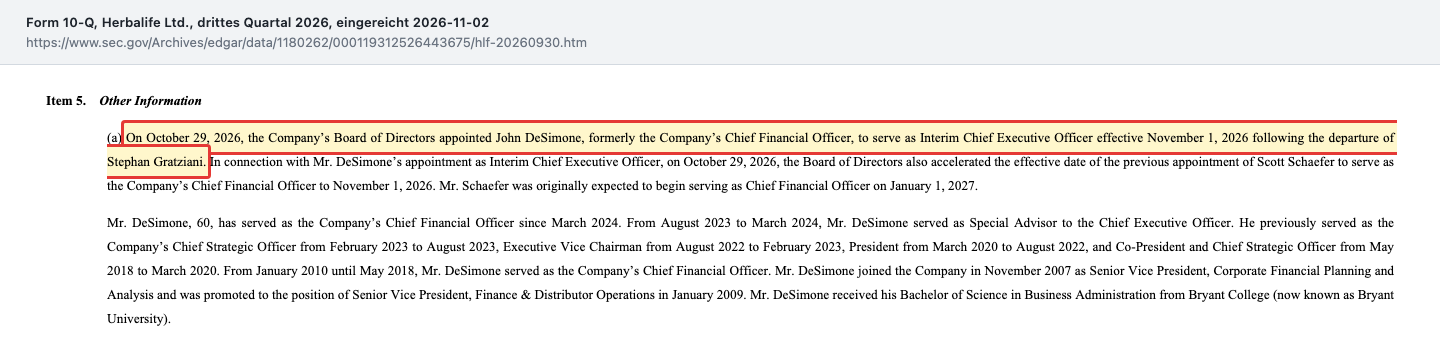
"On October 29, 2026, the Company’s Board of Directors appointed John DeSimone, formerly the Company’s Chief Financial Officer, to serve as Interim Chief Executive Officer effective November 1, 2026 following the departure of Stephan Gratziani."
— Herbalife Ltd., SEC quarterly report 10-Q as of 09/30/2026, Part II, Item 5
Scott Schaefer has therefore been CFO since November 1, 2026, two months earlier than planned. According to the earnings release, the search for a permanent chief is under way. That means the person shaping the company's course right now is the previous CFO, who holds the post only on an interim basis. An interim chief usually does not set a new long-term strategy — that is not a reproach but a circumstance you should carry in your calculation. How few questions were asked on the first call after the change is covered in the chapter on the Q&A.
Two more footnotes belong here. In Brazil, tax assessments totaling about $128 million are open (our addition from Note 5): about $110 million for the state ICMS tax — excluding the 2018 tax year case, closed since August 2025 — and about $17.9 million from the Federal Revenue Office. They are secured by, among other things, letters of credit and surety bonds (Notes 4 and 5); Herbalife has not recognized a loss because it does not believe one is probable. And for the acquisition of the British company Bioniq (personalized nutritional supplements) on April 30, 2026, Herbalife agreed to a base price of $55 million, payable over five years; the first payment of $10 million was made shortly after closing, and the base price is recorded at its present value of about $45.2 million. Up to a further $95 million depends on performance (through December 31, 2031, recorded at $9 million).
What management promised — and what came true
Promises are cheap; kept promises are not. We evaluated the earnings-call transcripts from 2022 through November 2, 2026, with a focus on the calls from February 14, 2024 to November 2, 2026. All verbatim quotes appear in the transcripts exactly as given; the transcript of the August 5, 2026 call is faulty (duplicated content, automatic speech recognition) and therefore yields no quotes. Two terms up front: adjusted EBITDA is operating profit before depreciation, amortization, interest and taxes, excluding one-off items as the company defines them — it appears only in the earnings releases, not in the annual report. The leverage ratio sets debt against that EBITDA: 3x means three years of EBITDA in debt.
Promised → came true?
| What was promised | When and by whom | What came of it | Status |
|---|---|---|---|
| Cut total leverage to 3.0x by the end of 2025; share buybacks only afterwards | 3x target already on the 02/14/2024 call (CFO Amezquita); end-of-2025 deadline on the 05/01/2024 and 07/31/2024 calls (DeSimone) | 2.8x at 12/31/2025; buyback program of up to $250 million approved in September 2026, nothing bought yet in the third quarter. | Delivered |
| Pay down $1 billion of debt in four to five years (from $2.4 billion to $1.4 billion by the end of 2028) | Call 07/31/2024 (DeSimone), refined 02/19/2025 | Debt under the credit agreement at 09/30/2026: $1,951.9 million, about $450 million repaid (roughly 45 percent) after about half the time. Net debt $1,542.7 million. | On track |
| Adjusted EBITDA margin in 2025 "at least 100 basis points" above 2024 | Call 05/01/2024 (management, finance) | 2024: 12.7 percent, 2025: 13.1 percent — only about 40 basis points more. As early as February 2025 the guidance had been lowered to "mid-12 percent". | Not delivered |
| Restructuring: at least $80 million in savings per year from 2025 | Call 05/01/2024 (management, finance) | The annual report for 2025 cites annual savings of about $80 million. Two more programs followed (Technology Realignment, Optimization Program 2026). | Delivered, but programs follow |
| 2024 revenue flat to up 5 percent | Call 02/14/2024 only "relatively flat"; formal range of 0 to plus 5 percent in the 03/20/2024 release (8-K), reaffirmed on the 05/01/2024 call ("reaffirming") | 2024 revenue: $4,993.1 million, minus 1.4 percent (plus 1.2 percent in local currency). In the following quarters guidance was lowered step by step to minus 1 to minus 2 percent. | Not delivered |
| Digital platform Pro2col: U.S. launch in the fourth quarter of 2025, tens of thousands of users by the end of 2025, hundreds of thousands by the end of 2026 | Call 04/30/2025 (Gratziani) | On the 11/02/2026 call the interim CEO says: still in beta, low usage. According to the quarterly report, only milestone payments of $2.0 million (beta, July 2025) and $3.0 million (beta 2.0, December 2025) have been made so far; further payments will be made only if and when milestones are achieved. That none of the user-dependent milestones (up to $46 million in total) has been triggered is our inference from this. | Not delivered |
| 2026: revenue growth in North America and in every region except China | Call 02/19/2026 (DeSimone) | Nine months 2026: North America minus 0.2 percent, EMEA minus 2.6 percent, China minus 19.9 percent (third quarter minus 22.0 percent). The fourth quarter is still to come. | Not delivered so far |
| Net leverage below 2x by the end of 2026 | Call 05/06/2026 (DeSimone) | In May it said "below 2x", in November "at or below 2x". Reported for 09/30/2026: 2.0x; our recalculation with the earnings release figures (net debt of $1,542.7 million against trailing-twelve-month credit agreement EBITDA of $757.0 million) gives 2.04x; the credit agreement definition may differ. | Open: reported 2.0x at 09/30/2026, 2.04x on our calculation; year-end target still to come |
| 2026 guidance: revenue plus 1 to plus 6 percent, adjusted EBITDA $670 to $710 million | Call 02/19/2026 (DeSimone) | Nine-month revenue plus 6.4 percent, almost all of it from India. The EBITDA range was lowered to $670 to $690 million. | Revenue on track, EBITDA in the lower part |
| Distributor network in North America getting stronger, new distributors plus 19 percent in the fourth quarter | Call 02/19/2026 (Gratziani) | Not testable with the available figures: the latest Sales Leader counts date from the end of February 2025, before the statement was made. As background: Sales Leaders in North America at the end of February 58,782 (2024) and 52,939 (2025), minus 9.9 percent. | Open, not testable |
The pattern is clear: on financial commitments, management delivered; on growth promises, it put people off. The new CFO style since 2024 brought numbers you can tick off — and most were ticked off.
Where the tone turned
From the predecessor to discipline (2024): In February 2024, the then CFO gave only a "relatively flat" revenue expectation; there was no formal guidance. The range of 0 to plus 5 percent followed on March 20, 2024, with the release on the CFO change (8-K). Asked whether buybacks were possible, the answer was:
"Well, we need to get the 3x target before we can ever consider that."
— Alex Amezquita, CFO, transcript of the earnings call of 02/14/2024 (Q&A)
That was kept: the buyback program came only in September 2026. From March 2024, with DeSimone as CFO, the company issued guidance for every quarter, a savings plan and measurable debt targets. In July 2024 he said:
"We want to pay off $1 billion in debt over the next four to five years and transfer that value to equity holders, and that will be our primary use of our free cash."
— John DeSimone, CFO, transcript of the earnings call of 07/31/2024
The grand vision (2025): In February 2025, the designated chief sounded like this:
"Herbalife is destined to become one of the world's most important health and wellness platforms."
— Stephan Gratziani, President (designated CEO), transcript of the earnings call of 02/19/2025
Two months later came the concrete promise about the Pro2col platform:
"By the end of 2025, we believe we’ll have tens of thousands of users on the platform, with hundreds of thousands by the end of next year."
— Stephan Gratziani, designated CEO, transcript of the earnings call of 04/30/2025
The break (Q2 → Q3 2026): On August 5, 2026, Gratziani announced only a CFO change and looked forward to working with DeSimone "through the end of the year". Twenty-six days later came the announcement of his own departure. On the November 2, 2026 call, the big words disappeared. Asked about the platform, the interim CEO said:
"It's still in beta. Its usage is low."
— John DeSimone, Interim CEO, transcript of the earnings call of 11/02/2026 (Q&A)
And about the stance of the new leadership:
"We're not trying to reinvent what makes Herbalife successful."
— John DeSimone, Interim CEO, transcript of the earnings call of 11/02/2026
The margin is also judged more cautiously now, and on the debt target the exact wording is worth a look. In May 2026 it said:
"we are establishing a target to reduce net leverage to below 2x by the end of this year."
— John DeSimone, CFO, transcript of the earnings call of 05/06/2026
In November the new CFO reported:
"[…] while maintaining a net leverage at or below 2x. At quarter end, we achieved that target with a net leverage ratio of 2.0x, down from 2.2x at the end of the second quarter."
— Scott Schaefer, CFO, transcript of the earnings call of 11/02/2026
In May it said "below 2x", in November "at or below 2x". Reported: 2.0x; our recalculation with the earnings release figures ($1,542.7 million of net debt against $757.0 million of trailing-twelve-month credit agreement EBITDA) gives 2.04x; the credit agreement definition may differ. On the margin, the tone is quieter:
"Looking ahead, we expect the path to further expansion to be more gradual."
— Scott Schaefer, CFO, transcript of the earnings call of 11/02/2026
The Q&A session: what only came out when asked
The prepared remarks are the glossy brochure. More interesting is what comes only when someone asks — and what nobody asks.
On China, the hard statement came only in response to a question about the regions in February 2026:
"I will say that we're expecting net sales growth in every region with the exception of China. China is expected more of a 2027 event."
— John DeSimone, CFO, transcript of the earnings call of 02/19/2026 (Q&A)
In May 2026, a further question about China brought:
"We have not found our footing yet. We are working on it."
— John DeSimone, CFO, transcript of the earnings call of 05/06/2026 (Q&A)
The November 2, 2026 call is notable above all for what is missing. Only a single analyst asked questions (Anthony Vendetti, Maxim Group), and he asked about weight-loss injections (GLP-1; on that competitive backdrop see also our stock analysis of Eli Lilly) and the new brands. There was no question about the chief's departure, the dependence on India, China or the decline in EMEA — on the first call after the change at the top. In the quarter's prepared remarks, China appears only in passing as a partial offset; nobody mentions the minus 22 percent. It is possible that the transcript provider left out questions; the text itself gives no indication of that.
Verdict on the promises
The financial commitments since 2024 were largely kept — on discipline, the company delivered. On the growth promises (Pro2col, North America, margin), it put people off, and the big words of the predecessor era have disappeared. Anyone who concludes "management can be trusted" is right about the debt and has nothing in hand yet on growth. The human trap behind it: whoever has delivered on time three times gets a credit of trust for everything else he says.
Valuation — what the market asks for the stock
Valuation figures age quickly, so each one carries a date. On November 2, 2026, the stock closed at $13.28. With 104,895,787 shares outstanding (cover of the quarterly report, October 26, 2026), that gives a market value of about $1.39 billion. Add net debt under the credit agreement ($1,951.9 million of debt minus $409.2 million of cash = $1,542.7 million on September 30, 2026): enterprise value is about $2.9 billion, roughly 4.3 times adjusted EBITDA for the last twelve months ($680.8 million; our calculation). The price-to-sales ratio is about 0.26 ($1.39 billion against $5,277.2 million of revenue).
On earnings: reported net income for the last twelve months ($179.8 million, about $1.68 per diluted share) gives a price-to-earnings ratio (P/E) of about 7.9. Without the one-off refinancing loss ($74.6 million after tax) it would be about $2.37 per share and a P/E of about 5.6. Because the twelve months include the fourth quarter of 2025 with a tax benefit, we honestly say only: about 6 to 8 (our calculation). Free cash inflow over the twelve months is about $337 million (operating cash flow $396.3 million minus capital spending $59.2 million; in addition there are capitalized software implementation costs of $32.5 million in nine months, which sit outside capital spending); market value is thus about 4 times that inflow.
At first glance that looks cheap — and here lurks the second anchor: "P/E of 8, that's cheap." Whether 8 is cheap depends on whether the profit stays. The market hesitates for reasons you have met in this text: revenue 9 percent below the record, growth from a single country, debt with a maturity clause, a chief on a temporary basis and an industry with an FTC past. The $250 million buyback program equals about 18 percent of market value (our calculation) — if it is used. According to CFO Scott Schaefer on the November 2, 2026 call, purchases are to start in the fourth quarter ("We plan to begin repurchasing shares in the fourth quarter"). The initial conversion price of the convertible notes is about $16.98, well above the November 2, 2026 price.
The professionals' view (source: fundamental data, as of November 3, 2026): four analysts, two with "strong buy", one with "buy", one with "sell"; the consensus (average) price target is $17. Average means: all price targets added up and spread evenly — a single outlier up or down pulls it strongly. That is context, not a recommendation — with only four voices it says little, and price targets are anchors too.
Opportunities and risks
What speaks for the company:
- Tidied balance sheet: debt (principal amount) of $1,951.9 million on September 30, 2026, net leverage ratio 2.0x rounded (2.04x on the underlying numbers), total ratio 2.6x against 4.00x permitted.
- Lower interest: $19.1 million less net interest in the third quarter (refinancing and paydown); per management about $45 million a year from the refinancing alone.
- Cash-strong: operating cash flow of $298.0 million in nine months of 2026, low capital spending.
- Revenue is growing again: the third quarter of 2026 was the fifth growth quarter in a row (+6.0 percent).
- Operating income is rising ($138.5 million in the third quarter, plus 10.1 percent); $250 million buyback program through 2029.
- Financial targets on debt and savings have largely been met since 2024; the 2025 adjusted EBITDA margin target, by contrast, was missed.
What speaks against it:
- Growth almost entirely from India (92 percent of added revenue in nine months), with regulatory risk (GST charge of $11.3 million in the fourth quarter of 2025).
- North America, EMEA and China are stagnating or shrinking; Sales Leaders in North America fell 24 percent from the end of February 2023 to the end of February 2025.
- Maturity clause on December 16, 2027 and large repayments in 2028 ($289.3 million) and 2029 ($611.7 million).
- Interim CEO since November 1, 2026 and a CFO change; digital platform Pro2col unproven.
- FTC compensation cap in the U.S., tax dispute in Brazil, a tax rate of 46.4 percent in the third quarter, pressure from weight-loss injections as an alternative to diet shakes.
- Fourth-quarter guidance: growth slows, EBITDA midpoint ($155 million) below the prior year ($156.1 million).
Conclusion — the anchor returns
Back to the $48. After the era of expensive buybacks, Herbalife has tidied the boat remarkably: less debt, cheaper interest, rising cash flow, equity that is creeping upward. That is real, and it is more than many companies with negative equity can show. At the same time, the revenue gain rests almost on a single country, about 60 percent of the rise in pre-tax profit is fed by saved interest (at the net income level, the saved interest is even larger than the entire jump, because higher taxes pulled the other way), and the chief holds the post only on an interim basis. None of this is the end of the world — but it is not a free pass either.
The anchor cuts several ways. Whoever stares at the $48 of the buybacks or the $61 of 2019 sees a stock that "must" be too cheap. Whoever stares at "P/E 8" also sees something that looks "too cheap". None of these numbers says anything about what happens over the next years: whether India keeps growing, whether North America catches itself, whether the maturity clause is defused and who will hold the wheel. What the 2020 and 2021 buybacks would be worth today, you saw at the start — that, too, is an anchor you cannot shake once you have dropped it. So check, for every price you carry in your head, whether it still belongs to the ship.
What you make of it is your decision. And that is exactly as it should be.
Sources and data cut-off
- Quarterly report 10-Q as of 09/30/2026, filed 11/02/2026, sec.gov
- Earnings release 8-K (Item 2.02, Exhibit 99.1) of 11/02/2026, sec.gov
- Announcement of the CEO's departure, 8-K (Item 5.02) of 08/31/2026, sec.gov
- Earnings release 8-K of 08/05/2026 (second quarter, CFO succession), sec.gov
- Quarterly reports 10-Q as of 06/30/2026 (sec.gov) and as of 03/31/2026 (sec.gov)
- Annual reports 10-K for 2025 (sec.gov), 2024 (sec.gov) and 2021 (sec.gov)
- Company overview on EDGAR: sec.gov. No further filings after the quarterly report of 11/02/2026 had appeared by 11/03/2026.
- Transcripts of the earnings calls for 2022 through 2026 (focus 02/14/2024 to 11/02/2026)
- Source: fundamental data & SEC filings (annual and quarterly reports, 10-K/10-Q); price and market value as of November 2, 2026, analyst overview as of November 3, 2026
Disclaimer: This analysis is a journalistic contextualization of publicly available information. It is not investment advice and not a solicitation to buy or sell securities. Stocks can lose value, up to a total loss. All figures are provided without warranty; our own calculations are marked as such. We disclose the operator's own positions on a current basis; if one exists, it appears as a note at the top of this analysis.
Key figures at a glance
All monetary figures in millions of $; earnings per share as reported.
| Metric | 2021 | 2022 | 2023 | 2024 | 2025 |
|---|---|---|---|---|---|
| Revenue | 5,802.8 | 5,204.4 | 5,062.4 | 4,993.1 | 5,037.5 |
| Operating Income (EBIT) | 734.1 | 545.2 | 356.4 | 385.9 | 441.5 |
| Net Income | 447.2 | 321.3 | 142.2 | 254.3 | 228.3 |
| Net Margin | 7.7% | 6.2% | 2.8% | 5.1% | 4.5% |
| Earnings Per Share | 4.13 $ | 3.23 $ | 1.42 $ | 2.50 $ | 2.20 $ |
Source: fundamental data & SEC filings (annual and quarterly reports, 10-K/10-Q)
Our Bottom Line at a Glance
- Balance sheet & cash flow positive
- Debt (principal) $1,951.9 million on 09/30/2026, net ratio 2.0x rounded (2.04x on the underlying numbers; end of 2025: 2.3x), cash $409.2 million; operating cash flow in nine months of 2026 of $298.0 million (prior year $235.0 million). The negative equity (about −$0.4 billion) has been shrinking since 2021.
- Earnings quality neutral
- Net income Q3 2026 $58.8 million instead of $43.2 million; largest single contribution $19.1 million lower interest (permanent), operating income +10.1 percent. Refinancing loss of $94.6 million only in the second quarter; tax rate 46.4 percent.
- Growth & concentration negative
- India generated $313.5 million in Q3 2026 (+38.5 percent); without India, group revenue fell $10.6 million. Over nine months, 92 percent of added revenue comes from India, China −19.9 percent, EMEA −2.6 percent.
- Debt structure neutral
- Maturity clause on 12/16/2027: 2028 convertible notes at $277.5 million, above the $250 million threshold; large repayments in 2028 ($289.3 million) and 2029 ($611.7 million). Total leverage ratio 2.6x against 4.00x permitted.
- Leadership & management negative
- Interim CEO since 11/01/2026, CFO change; financial commitments since 2024 largely kept, growth promises (Pro2col, 2025 margin, North America) not. On the 11/02/2026 call only one analyst asked questions.
- Valuation (as of 11/02/2026) neutral
- Neutral to positive: market value about $1.39 billion at a $13.28 close; enterprise value about 4.3 times adjusted EBITDA ($680.8 million last twelve months), P/E about 6 to 8, buyback program $250 million (about 18 percent of market value). Cheap only if the profit holds.
Herbalife has cleaned up its balance sheet and interest burden: debt fell, operating cash flow carries, and profit rose 36 percent to $58.8 million in the third quarter of 2026. The largest single contribution, however, is saved interest, operating income grew 10.1 percent, 92 percent of the revenue growth comes from India, and since November 1, 2026 the company has been run by an interim chief. Not investment advice.
What Our Rating Means
Open questions
The business works in principle, but one material question is open. As long as it stays open, our findings do not carry a quality verdict.
The business is profitable and cash-strong (operating cash flow of $298.0 million in nine months of 2026), debt is falling, interest coverage is about 4.3 in the third quarter, the loan terms are being met, and there is no going-concern warning. The negative equity (about −$0.4 billion) is here a consequence of the 2017 to 2021 buybacks, not of losses, and has shrunk every year since 2021 — so it is not a substance risk in the sense of red. The core operating question stays open: growth hangs almost entirely on India, North America, EMEA and China are shrinking or stagnating, the digital platform is unproven and the top job is filled only on an interim basis. A holder is betting that India keeps carrying growth and the maturity clause gets defused; a new buyer is betting on the same two things, at a price that already assumes the profit holds. The decision is yours.
A journalistic assessment by our editorial team at the time of the deep dive, based on public sources — not investment advice and not a solicitation to buy or sell. Your personal circumstances (investment goals, risk capacity, taxes) cannot be taken into account. What our levels mean, how verdicts are formed, and what conflicts of interest exist →
Worth Noting
- The occasion for this analysis is the quarterly report as of 09/30/2026 (filed 11/02/2026) with a leadership change and a buyback program. One-offs and adjusted figures have their own chapter; quoting the profit figure without adjustment would be misleading.
- Risk of confusion: Herbalife Ltd. was called Herbalife Nutrition Ltd. until 04/11/2023; many data portals still carry the old name. Same company (CIK 0001180262), not to be confused with other direct-selling companies.
- Valuation figures are dated: price $13.28 (close 11/02/2026), 104,895,787 shares (10/26/2026). Our own calculations are marked in the text; analyses are evergreen, daily prices are not a buy argument.
Stock Watch
This analysis is as of November 3, 2026. Stock Watch will tell you what's changed at HLF since then.
Later $1 a month per stock — signing up is free, and you'll be the first to know when it launches.
The full analysis as a PDF for later
We will send you this analysis as a PDF — to print, file away, and read at your own pace. And we will add you to the free Stock Watch list for Herbalife Nutrition Ltd (HLF), so you hear about it when something material in this analysis changes.
Frequently Asked Questions
Herbalife Ltd. (NYSE: HLF) sells nutrition and weight-management products such as shakes through independent distributors (direct selling). As of 12/31/2025 there were about 6.4 million members; the company operates in 95 markets and employed roughly 8,500 people. Until 04/11/2023 it was called Herbalife Nutrition Ltd.; it is based in Grand Cayman and run from Los Angeles.
Equity has been negative since 2017 because Herbalife put about $3.5 billion into share buybacks from 2017 to 2021 — in 2020/21 at an average of roughly $48 per share, including $600 million to Carl Icahn. These are not losses but returns to shareholders. The minus has been shrinking since 2021 and stood at about $0.4 billion on 09/30/2026.
Very much so for growth: India generated $313.5 million in the third quarter of 2026 (+38.5 percent), 23 percent of group revenue. Without India, revenue fell $10.6 million in the quarter; over nine months, $220.2 million of the $239.7 million in added revenue (92 percent) came from India. There is also tax risk (GST charge of $11.3 million in the fourth quarter of 2025).
Partly. Net income rose from $43.2 million to $58.8 million. The largest single contribution was $19.1 million less interest after the April 2026 refinancing — permanent, but not a better business. Operating income added $12.7 million (+10.1 percent), higher taxes cost $17.8 million. Roughly 10 percent operating growth is the dependable number.
Since 11/01/2026, John DeSimone, until then CFO, has led the company as interim CEO. Stephan Gratziani left effective 10/31/2026; the 08/31/2026 filing gave no reason. Scott Schaefer has been CFO since 11/01/2026. According to the 11/02/2026 earnings release, the search for a permanent chief is under way.
The credit agreement (Term Loan A and revolver, $272.2 million combined) runs until 04/29/2031 but falls due as early as 12/16/2027 if more than $250 million of the 2028 convertible notes are then outstanding and certain leverage ratios are exceeded. On 09/30/2026, $277.5 million were outstanding; cash was $409.2 million.
On 09/07/2026 the board approved a buyback program of up to $250 million through 09/07/2029, about 18 percent of the market value as of 11/02/2026. Nothing was bought in the third quarter; a start is planned for the fourth quarter. Herbalife pays no dividend.
Found an error?
Did you spot a factual error, an outdated number, or a typo in this deep dive? Let us know briefly — your report goes straight to the editorial team.