uniQure: The FDA Is Reviewing Its Huntington’s Gene Therapy — and the Stock Has Halved Since June
The U.S. Food and Drug Administration is reviewing a gene therapy from Amsterdam-based uniQure that is designed to slow the course of Huntington’s disease, and plans to decide by May 1, 2027. The company held about $810 million in cash and securities on June 30, 2026. Even so, the stock fell from $46.06 at the end of June to $22.97 on November 2, 2026. The SEC filings explain why: twelve patients, a comparison group drawn from a database, and a regulator that changed its mind twice. Not investment advice — just the question of what the market knows that the success story leaves out.
 Thomas Mücke
Founder & Publisher
As of Today
As of: November 2, 2026
- Closing price
- 23.00 $ -7.50%
- Market Capitalisation
- 1.6 $B
- Growth Score
- 2/10
- AAQS
- 4/10
Price change since November 2, 2026: +0.1%
This analysis has a cut-off date. The Stock Guard tells you when something material changes in the numbers. Reserve your free spot
Chart
Interactive price chart (TradingView).
52-week range: 9.00 $ to 67.90 $ · Last price: 23.00 $ (As of: November 2, 2026)
Note: pure fact-based analysis, not investment advice and not a solicitation to buy or sell. All figures without guarantee.
There is an investor trap that springs shut with particular reliability in biotech: the headline swing. Every new announcement throws you to the other side. Good trial data — you are convinced. The regulator hesitates — you are sure it is all over. The regulator relents — you kick yourself for not buying. On a swing, every arc feels like an insight, when it is really just momentum. uniQure (Nasdaq: QURE), based in Amsterdam, has produced more arcs over the past fourteen months than almost any other stock: up 248 percent in one day, down 49 percent on another, then up 78 percent again. So let’s make a deal: instead of letting the next headline push you around, we will read together what the company itself has reported to the U.S. securities regulator, the SEC — the annual report (10-K) for 2025, the quarterly report (10-Q) for June 30, 2026, and every current report (8-K) through November 2, 2026. The CEO and CFO put their signatures behind these reports. The punchline up front: the FDA really is now reviewing a drug that could become the first to slow the course of Huntington’s disease. And precisely for that reason it pays to look closely at what this application rests on. In the end, the decision is yours.
What uniQure Actually Does — Genes as Medicine
uniQure develops gene therapies. The principle in everyday terms: instead of supplying the body with a spare part for years, you install a new set of instructions once. The delivery vehicles are viruses rendered harmless (so-called AAV vectors) that carry a genetic instruction into cells. The company is headquartered in Amsterdam, where it leases office and lab space, and its U.S. site is in Lexington near Boston. As of December 31, 2025, uniQure had 221 employees, 126 of them in the Netherlands.
So far, exactly one product has been approved: HEMGENIX for the bleeding disorder hemophilia B, in the U.S. since November 2022 and in the EU since February 2023. But uniQure does not sell it. The worldwide rights went to the drugmaker CSL Behring under an agreement signed in June 2020 that took full effect in May 2021. Between July 2021 and July 2023, uniQure collected $617.4 million from that deal; since then it has received royalties on CSL’s sales. Those royalties make up essentially all of uniQure’s revenue: $16.1 million in 2025 and $9.4 million in the first half of 2026.
The company’s future is called AMT-130, with the drug name ifezuntirgene inilparvovec. In Huntington’s disease — an inherited, incurable brain disorder that leads to complete physical and mental deterioration over 12 to 15 years — the therapy is designed to silence the disease-causing gene. It is injected once, during brain surgery, into two core regions of the brain. According to uniQure, about 75,000 people in the U.S., the EU and the U.K. live with Huntington’s disease; no approved therapy slows its progression. Alongside AMT-130, early-stage trials are under way in a severe form of epilepsy (AMT-260) and in the metabolic disorder Fabry disease (AMT-191).
One quirk for investors: uniQure is a Dutch public company (N.V.), yet it reports like a U.S. company — annual reports (10-K) and quarterly reports (10-Q), in U.S. dollars, with the calendar year as its fiscal year. Many obligations, however, are denominated in euros, and that feeds into the bottom line: the 2025 net loss included a $26.1 million currency gain, the second quarter of 2026 a $1.7 million currency loss. That defines the central tension of this analysis, and it runs through every section: a well-funded company may be close to the first approval of a therapy designed to slow the course of Huntington’s disease — but on a body of evidence about which the regulator itself has changed its mind twice.
Company history for investors
-
2021
HEMGENIX rights go to CSL Behring
The June 2020 agreement takes full effect in May 2021 and brings the only profitable year: $329.6 million. Since then uniQure has been a licensor only.
-
2022
FDA approval for HEMGENIX (November)
Proof that uniQure can take a gene therapy to approval — although CSL Behring is the one selling it.
-
2023
Royalties sold for $375 million
The lowest royalty tier goes to HemB SPV; the buyer is entitled to up to $693.8 million through mid-2032. For shareholders: HEMGENIX income barely funds research anymore.
-
2025
36-month data and the first FDA reversal
In September the stock jumps from $13.66 to $47.50; in November the FDA no longer considers the data sufficient: down 49 percent in one day.
-
2026
Sham surgery requested, then a yes
In early March the stock falls to $9.03; in June the FDA accepts the 3-year analysis after all. uniQure raises $259 million at $45.50 per share.
-
2026
Application accepted, deadline May 1, 2027
After the four-year data the stock falls 37 percent; on November 2 the FDA accepts the application. Until the decision, every update on the confirmatory study counts.
How the Stock Landed on Our Desk
uniQure made our research list through our Reddit hype scanner, which flags stocks with unusually frequent mentions in Reddit forums — not a quality or valuation screen, but a thermometer for attention. For this stock the thermometer has been showing a fever for months, and the closing prices show why (prices per fundamental data):
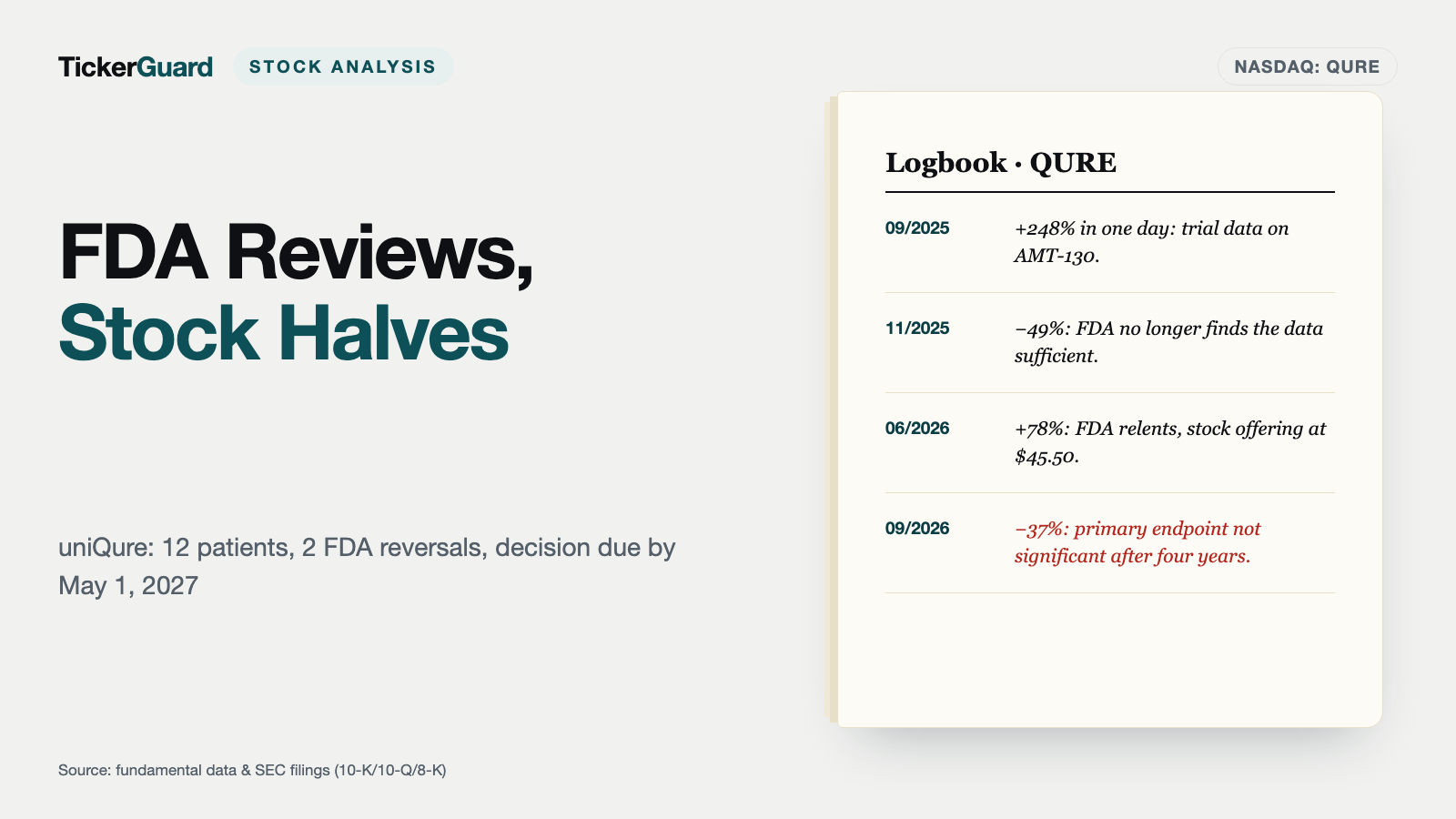
- September 23 to 24, 2025: from $13.66 to $47.50 (up 248 percent) after the 36-month data on AMT-130.
- October 31 to November 3, 2025: from $67.69 to $34.29 (down 49 percent) after the FDA’s first reversal.
- February 25 to March 3, 2026: from $24.87 to $9.03, when the FDA called for a new sham-surgery-controlled study.
- June 16 to 17, 2026: from $26.99 to $48.16 (up 78 percent) after the second reversal.
- September 28 to 29, 2026: from $39.11 to $24.51 (down 37 percent) after the four-year data.
On November 2, 2026, the day the FDA accepted the application, the stock closed at $22.97 — half its level of June 30, 2026 ($46.06). A company whose application is accepted while its stock falls on the same day: to us that is neither a buy signal nor a sell signal, but a question. What does the market know that the success story leaves out? The answer is in the filings.
The Numbers Over the Years — Given Their Due
Let’s start with what is genuinely impressive, because at uniQure that is no small thing.
First: this company has delivered before. HEMGENIX was one of the first approved gene therapies for hemophilia — and uniQure sold it at a price that produced net income of $329.6 million in 2021. For a company without its own sales force, that was the smarter route than building one.
Second: the cash pile is large. As of June 30, 2026, uniQure held $810.3 million in cash and current investment securities, up from $622.5 million at the end of 2025; including restricted cash, the figure was $811.9 million. That is the amount the company refers to in its quarterly report:
“We believe these resources will be sufficient to fund our projected operating expenses into 2030, including costs associated with the commercial launches and confirmatory study of AMT-130, ongoing clinical trials of AMT-130, AMT-191 and AMT-260, and potential investments to advance certain pipeline candidates into late stage development.”
— uniQure N.V., SEC quarterly report 10-Q for June 30, 2026, Item 2, “Financial Position, Liquidity and Capital Resources”
The math behind it holds up: operating cash outflow was $178.0 million in 2025 and $66.8 million in the first half of 2026. Even at the 2025 pace, the cash would last a about four and a half years on paper. For a biotech without a product of its own, that is an unusually comfortable cushion. On top of that, according to the report, lender Hercules would provide up to $100 million in additional credit if AMT-130 is approved before September 30, 2027.
And now the part you have to read alongside it: apart from the one-time HEMGENIX sale, uniQure has never made money.
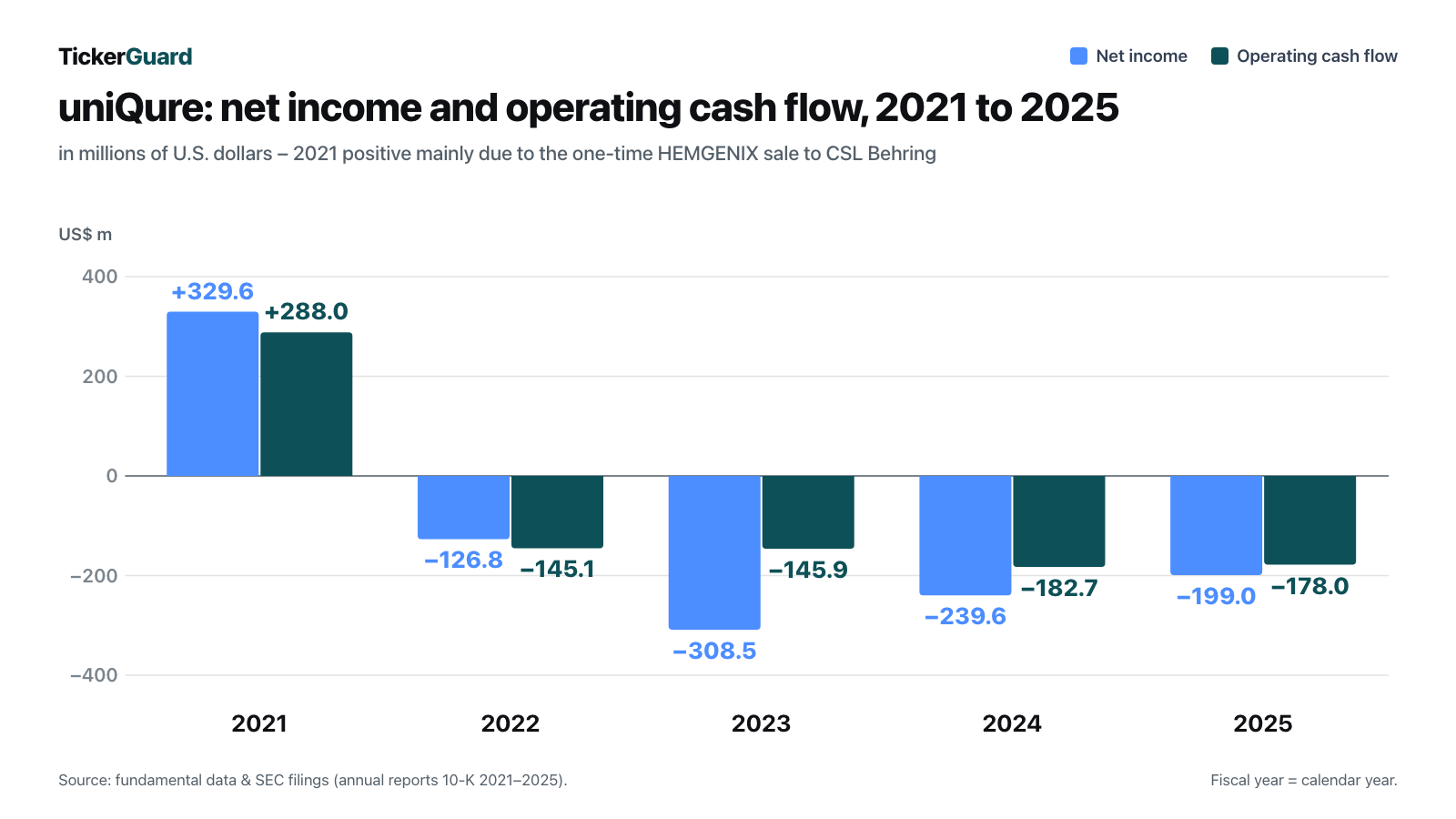
The accumulated deficit since the company’s founding stood at $1.46 billion on June 30, 2026. As of December 31, 2024, shareholders’ equity was even slightly negative (minus $6.8 million); only several equity offerings in 2025 and another in June 2026 brought it to $324.1 million by June 30, 2026. Remember this as the basic pattern of this company: research is not funded from profits but by shareholders — most recently each time shortly after good news had lifted the stock.
What the Filings Say — the Uncomfortable Truths
Uncomfortable truth No. 1: The application rests on twelve patients and a database — and the FDA changed its mind twice
In September 2025, uniQure reported 36-month data from its early-stage (Phase I/II) studies: in twelve high-dose patients, the disease progressed 75 percent more slowly on a composite rating scale (cUHDRS) than in a comparison group (p=0.003). That comparison group, however, was not made up of trial participants but of statistically matched patients from the natural history database Enroll-HD. In everyday terms: instead of sending two groups into the race at the same time, you compare your runners with the times of other runners from earlier years. That can be meaningful — but only if the old times are truly comparable. That is exactly where the dispute began. On November 3, 2025, uniQure reported:
“Though final meeting minutes have not yet been received, based on the discussions at the meeting, uniQure believes that the FDA currently no longer agrees that data from the Phase I/II studies of AMT-130 in comparison to an external control, as per the prespecified protocols and statistical analysis plans shared with the FDA in advance of the analyses, may be adequate to provide the primary evidence in support of a BLA submission.”
— uniQure N.V., current report 8-K of November 3, 2025, Exhibit 99.1

It got stricter. After another meeting in January 2026, the earnings release of March 2, 2026, described what the agency asked for:
“The FDA strongly recommended the Company conduct a prospective, randomized, double-blind, sham surgery-controlled study.”
— uniQure N.V., fiscal 2025 earnings release, 8-K of March 2, 2026, Exhibit 99.1
A study like that would have taken years. On March 3, 2026, the stock stood at $9.03. Then, on June 17, 2026, came the second reversal: according to uniQure, the FDA said after a Type B meeting that the 3-year analysis would be acceptable as the primary basis of an application for accelerated approval. uniQure announced the submission on September 2, 2026. For you as an investor, that does not mean the data are bad. It means that the same data received three different assessments from the same agency within eight months, meaning two reversals — and that the final answer is still pending.
Uncomfortable truth No. 2: After four years, the primary endpoint misses significance
On September 29, 2026, uniQure released the four-year data. The key line in the results section is candid:
“cUHDRS showed a 44% slowing of disease progression compared to the updated external control and did not reach statistical significance (p=0.144).”
— uniQure N.V., current report 8-K of September 29, 2026, Exhibit 99.2

“Not statistically significant” means in plain English: the difference is too small, or the group too small, to rule out chance with confidence. A fair reading includes three points that uniQure itself makes. First, the second measure, everyday functioning (TFC), showed 61 percent slowing at 48 months (nominal p=0.008). Second, the updated 36-month analysis, now with 15 high-dose patients, showed 80 percent slowing on the cUHDRS scale (nominal p=0.005). Third, 53 percent of the data in the comparison group were missing at 48 months; uniQure argues that faster-progressing patients in particular dropped out of the database and that the effect is therefore understated. Using the earlier comparison group, the slowing would be 53.5 percent (nominal p=0.041) — a post hoc calculation.
Equally fair: the four-year data were not part of the application, which rests on the 36-month analysis. On safety, uniQure reports that five high-dose patients (according to uniQure, 17 percent of all treated patients) had a treatment-related serious adverse event in the form of central nervous system inflammation, all of which resolved. Since September 2025, one low-dose patient died by suicide about five years after treatment; the study investigator assessed this as unrelated to treatment. On September 29, 2026, the market nonetheless read only the first line: down 37 percent. That is the swing in its purest form — and exactly why you should read every line.
Uncomfortable truth No. 3: The only approved product largely works for a creditor
In May 2023, uniQure sold the lowest tier of its HEMGENIX royalties to the investment vehicle HemB SPV, L.P. for an upfront payment of $375 million. The annual report describes what the buyer receives in return:
“The Purchaser will receive 1.85 times the upfront payment (or $693.8 million) until June 30, 2032 (“First Hard Cap Date”) if such thresholds are met or, if such cap is not met by June 30, 2032, up to 2.25 times of the upfront payment through December 31, 2038 (“Second Hard Cap Date”).”
— uniQure N.V., SEC annual report 10-K for 2025, Note 12 “Royalty Financing Agreement”
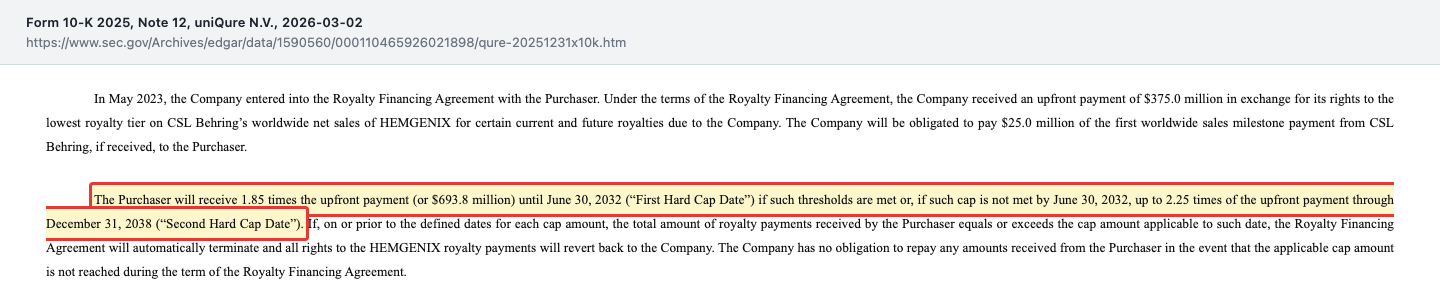
On the balance sheet this is a loan repaid from royalties: as of June 30, 2026, it was carried at $495.1 million, more than at signing, because the accrued interest (first half of 2026: $25.6 million) exceeds the payments ($9.2 million). The good news is right below in the report: uniQure owes nothing back if the royalties never reach the cap. So the liability does not threaten the company. The uncomfortable news is a different one: in the first half of 2026, $9.4 million in revenue was matched by $9.2 million in payments to the purchaser. The revenue you see in every database currently ends up almost entirely with the creditor. The HEMGENIX business cannot carry the research on AMT-130.
Uncomfortable truth No. 4: Your slice of the pie is getting smaller — most recently at $45.50
A company that funds research through its shareholders issues new shares. At uniQure it looks like this:
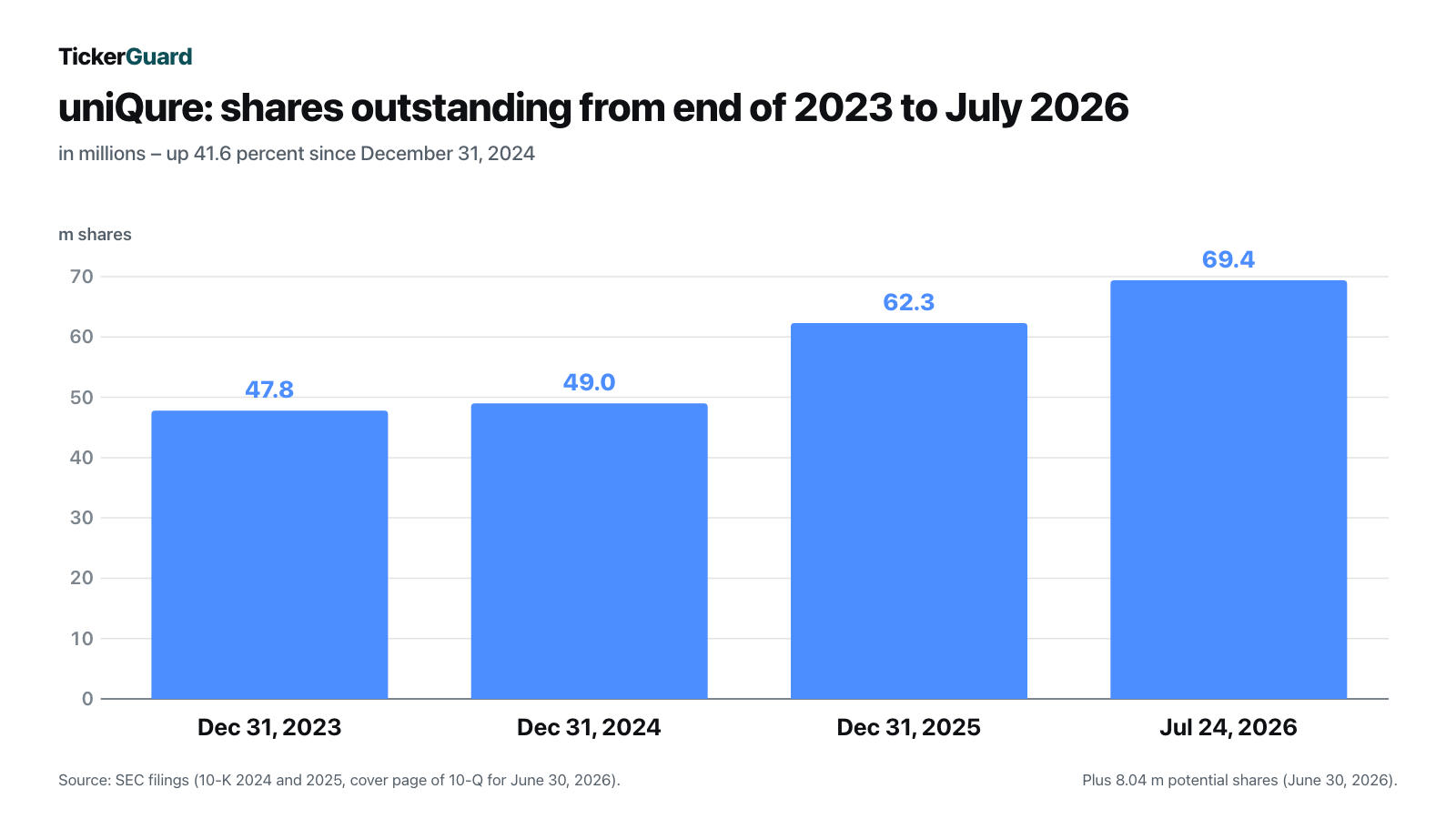
From December 31, 2024 (48,988,087 shares) to July 24, 2026 (69,366,412 shares), the share count rose 41.6 percent. Dilution in everyday terms: the pie is cut into more slices, so your slice gets smaller — unless the fresh money makes the pie grow faster. The latest offering came in June 2026, right after the FDA’s second reversal: 5,686,813 new shares at $45.50, $259 million gross. In the same month, shareholders raised the authorized share capital from 80 million to 100 million shares. As of June 30, 2026, another 8.04 million potential shares from options, stock awards and warrants were outstanding, about 11.6 percent of the shares outstanding.
The CEO also sold after the June 2026 price jump — through a prearranged plan. According to his insider filings (Form 4), Matt Kapusta sold a total of 262,594 shares between June 17 and July 2, 2026, at prices between just over $42 and just over $50, for a little more than $12 million in total. The sales ran automatically under a Rule 10b5-1 trading plan adopted on October 5, 2025, and he still holds about 519,000 shares. What matters for you as an investor is the price comparison: the new shares from the offering cost $45.50 in June 2026, while the stock closed at $22.97 on November 2, 2026.
Uncomfortable truth No. 5: Accelerated approval is approval on probation
On November 2, 2026, uniQure announced the success it has been working toward for years:
“On November 2, 2026, the Company announced the FDA has accepted for review the BLA for ifezuntirgene inilparvovec, an investigational gene therapy for the treatment of Huntington’s disease submitted under the Accelerated Approval pathway. The application has been granted Priority Review with a Prescription Drug User Fee Act (“PDUFA”) target action date of May 1, 2027. In its acceptance letter, the FDA stated that they are tentatively planning to discuss this application at an Advisory Committee meeting.”
— uniQure N.V., current report 8-K of November 2, 2026, Item 8.01

This paragraph contains three things that a headline swallows. First: accepted is not approved. Acceptance only means the application is complete enough to be reviewed. Second: an advisory committee is a public hearing of independent experts; the FDA does not have to follow its vote, but the meeting puts every weakness in the data on display. Third: accelerated approval is approval on probation. It requires a confirmatory study, and according to the earnings release of July 29, 2026, the FDA expects that study to be “well underway” at the time of approval. About 200 patients are planned, two thirds on AMT-130 and one third on standard of care, with everyday functioning after 36 months as the primary endpoint; patient screening in the U.S. is slated to begin by the end of 2026. If that study does not confirm the benefit, an accelerated approval can be withdrawn. What happens to a drug after the FDA says yes is something we described in our analysis of Outlook Therapeutics: an approval alone does not pay the bills.
Two more points belong on this list. Since February 2026, a shareholder class action has been pending in New York on behalf of investors who bought between September 24 and October 31, 2025; it alleges misleading statements by uniQure. The company has not recorded a reserve because it currently considers a loss not probable and reasonably estimable. And for the epilepsy program AMT-260, uniQure owes the former owners of its French subsidiary up to €160 million (about $182 million) in milestone payments if the program reaches late-stage development and approval in the U.S. and the EU; uniQure expects these to fall due between 2030 and 2034, and up to a quarter may be paid in shares.
What Has Happened Since the Quarterly Report
The quarterly report for June 30, 2026, was filed on July 29, 2026, together with the earnings release (8-K, Item 2.02). Since then, uniQure has filed three current reports: on September 2, 2026, the FDA application and the U.K. application (with the regulator MHRA); on September 29, 2026, the four-year data; and on November 2, 2026, the acceptance of the application. There were also a registration of additional shares for employee plans (Form S-8, July 29, 2026) and ownership reports from large investors (Schedule 13G) showing passive positions that do not change the picture. There have been no insider filings (Form 4) since July 7, 2026. As of our editorial cutoff on November 3, 2026, the quarterly report for September 30, 2026, had not yet been filed; last year it came out on November 10.
Valuation — What Does Hope Cost?
At the closing price of $22.97 on November 2, 2026, and 69,366,412 shares outstanding (as of July 24, 2026, cover page of the quarterly report), uniQure has a market value of about $1.59 billion. Of that, $810.3 million sits in cash and current investment securities (June 30, 2026), or about $11.70 per share. Subtract the cash and add the $50 million Hercules loan, and by our calculation the market is paying about $830 million for everything else: the chance of approval for AMT-130, the early-stage programs in epilepsy and Fabry disease, and the HEMGENIX royalties after the creditor agreement runs out. The $495.1 million royalty liability is not included, because uniQure only has to service it from HEMGENIX income.
Classic metrics are of little help here, and that is a gap in the data we name openly: there is no price-to-earnings ratio because uniQure is losing money. A price-to-sales ratio of about 99 (market value against 2025 revenue of $16.1 million) would be misleading, because in the first half of 2026 that revenue flowed almost entirely to the royalty buyer. The bankruptcy early-warning score Altman Z, which our fundamental data put at minus 0.6, also says little about a research company without product revenue — it measures earnings and sales against the balance sheet and therefore flashes red even for a company with about four and a half years of cash runway on paper. And because the balance sheet is in U.S. dollars while many obligations are in euros, quarterly losses swing with the exchange rate alone.
The view from Wall Street: according to fundamental data (as of November 3, 2026), 13 analysts cover the stock, 11 of them with a buy or strong buy rating, and the average price target is $60.32. The average means: all price targets added up and spread evenly — a single very high target pulls it up sharply. For a stock whose value hinges on a single regulatory decision, such an average is above all a bet on a yes. We do not adopt it.
Upside and Risks at a Glance
What speaks for uniQure:
- Possibly the first therapy to slow the course of Huntington’s disease: application accepted on November 2, 2026, priority review, target date May 1, 2027; plus an application in the U.K. since September 2026.
- A full war chest: $810.3 million as of June 30, 2026, which the company says will last into 2030; up to $100 million in additional credit upon approval before September 30, 2027.
- Proven technology: with HEMGENIX, uniQure has already taken a gene therapy to approval in the U.S. (2022) and the EU (2023).
- Consistent signals: everyday functioning (TFC) showed 67 and 61 percent slowing in the updated 36-month analysis and at 48 months, and the high dose did better than the low dose.
- A second and third shot: early-stage trials in epilepsy (AMT-260) and Fabry disease (AMT-191).
What speaks against it:
- Thin evidence: the application rests on twelve high-dose patients and an external control; at 48 months the primary endpoint missed significance (44 percent, p=0.144).
- A shifting regulator: between November 2025 and June 2026, the FDA assessed the same data three different ways, with two reversals; an advisory committee is tentatively planned.
- Approval on probation: the confirmatory study with about 200 patients is expected to be well advanced at the time of approval.
- Hardly any revenue of its own: $16.1 million in 2025 revenue, a $199.0 million net loss; HEMGENIX royalties currently flow almost entirely to the creditor.
- Dilution and legacy obligations: 41.6 percent more shares since the end of 2024, 8.04 million more potential shares, a pending class action and up to €160 million in milestones for AMT-260.
A Human Conclusion
Back to the headline swing from the beginning. uniQure has given it five hard pushes in fourteen months, and every arc threw investors to one side or the other. After reading the filings, a calmer picture remains. This is a well-funded company that has already brought one gene therapy to approval, working on a drug for a disease with no way out. Its application is with the FDA, and an answer is due by May 1, 2027. Against that stand a body of evidence that even the agency has read differently more than once, a primary endpoint without significance after four years, and revenue that ends up almost entirely with a creditor. Whoever buys the stock is not buying a company so much as a decision — with a cash cushion covering roughly half the market value. The stock carries the risk of a total loss, and the road to May 2027 is likely to bring more sharp swings. The honest question is not “Will approval come?” but: Do you know what you will do when the next headline pushes the swing again? What you make of it is your decision. And that is how it should be.
Sources
All primary documents used in this analysis — so you can read them yourself:
- uniQure N.V. — Current report 8-K on the acceptance of the BLA (filed November 2, 2026)
- uniQure N.V. — Four-year data on AMT-130, 8-K Exhibit 99.2 (filed September 29, 2026)
- uniQure N.V. — Submission of the U.S. and U.K. applications, 8-K Exhibit 99.1 (filed September 2, 2026)
- uniQure N.V. — SEC quarterly report 10-Q for June 30, 2026 (filed July 29, 2026)
- uniQure N.V. — Second-quarter 2026 earnings release, 8-K Item 2.02, Exhibit 99.1 (filed July 29, 2026)
- uniQure N.V. — Pricing of the offering at $45.50, 8-K Exhibit 99.1 (filed June 24, 2026)
- uniQure N.V. — Plan for BLA submission after the Type B meeting with the FDA, 8-K Exhibit 99.1 (filed June 17, 2026)
- uniQure N.V. — SEC quarterly report 10-Q for March 31, 2026 (filed May 5, 2026)
- uniQure N.V. — Fiscal 2025 earnings release, 8-K Exhibit 99.1 (filed March 2, 2026)
- uniQure N.V. — SEC annual report 10-K for 2025 (filed March 2, 2026)
- uniQure N.V. — Final FDA minutes of the pre-BLA meeting, 8-K Exhibit 99.1 (filed December 4, 2025)
- uniQure N.V. — Regulatory update on AMT-130, 8-K Exhibit 99.1 (filed November 3, 2025)
- uniQure N.V. — SEC annual report 10-K for 2024 (filed February 27, 2025)
- Full SEC filing history including insider filings (Form 4): EDGAR overview (sec.gov)
- Fundamental data (prices, market value, analyst estimates; as of November 2/3, 2026), cross-checked against the SEC filings and the SEC’s XBRL company facts.
This article is journalistic analysis and not investment advice. It contains no buy or sell recommendation and is not a solicitation to buy or sell securities. Stocks can lose substantial value; a total loss of invested capital is possible, and for biotech stocks ahead of a regulatory decision that risk is especially high. All figures come from the primary sources named above and carry the reporting dates stated; later developments are not reflected. Positions held by the operator are disclosed daily; where one exists, it appears as a notice at the top of this deep dive.
Key figures at a glance
All monetary figures in millions of $; earnings per share as reported.
| Metric | 2021 | 2022 | 2023 | 2024 | 2025 |
|---|---|---|---|---|---|
| Revenue | 524.0 | 106.5 | 15.8 | 27.1 | 16.1 |
| Operating Income (EBIT) | 310.6 | -143.2 | -282.9 | -184.3 | -187.8 |
| Net Income | 329.6 | -126.8 | -308.5 | -239.6 | -199.0 |
| Net Margin | 62.9% | -119.1% | -1,947.1% | -883.4% | -1,236.0% |
| Earnings Per Share | 7.04 $ | -2.71 $ | -6.47 $ | -4.92 $ | -3.46 $ |
Source: fundamental data & SEC filings (annual and quarterly reports, 10-K/10-Q)
Our Bottom Line at a Glance
- Funding positive
- As of June 30, 2026, uniQure held $810.3 million in cash and current investment securities; according to the quarterly report, that lasts into 2030. Operating cash outflow was $178.0 million in 2025 and $66.8 million in the first half of 2026. Upon approval before September 30, 2027, up to $100 million in additional credit becomes available.
- AMT-130 evidence negative
- The application rests on twelve high-dose patients at 36 months compared with an external control from the Enroll-HD database. At 48 months, the primary endpoint cUHDRS missed significance with 44 percent slowing (p=0.144); everyday functioning showed 61 percent (nominal p=0.008).
- Regulatory process neutral
- The FDA accepted the application with priority review on November 2, 2026, target date May 1, 2027, and an advisory committee is tentatively planned. Before that, it changed its stance on the same data in November 2025, early 2026 and June 2026. Accelerated approval requires a confirmatory study with about 200 patients.
- Revenue base negative
- uniQure generated only $16.1 million in 2025 revenue from HEMGENIX royalties against a $199.0 million net loss. In the first half of 2026, $9.4 million in revenue was matched by $9.2 million in payments to the royalty buyer, whose claim runs up to $693.8 million through mid-2032.
- Dilution negative
- The share count rose 41.6 percent from December 31, 2024, to July 24, 2026, to 69.37 million, most recently through the June 2026 offering at $45.50. Another 8.04 million potential shares are outstanding; authorized capital was raised to 100 million shares.
uniQure is a well-funded gene therapy company with $810.3 million in cash whose Huntington’s therapy AMT-130 has been under FDA review since November 2, 2026 (target date May 1, 2027). The evidence is thin and was disputed within the agency itself, the primary endpoint missed significance after four years, there is hardly any revenue of its own, and the share count has risen 41.6 percent since the end of 2024. At $22.97 (November 2, 2026), cash covers about half of the market value. Not investment advice.
What Our Rating Means
Open questions
The business works in principle, but one material question is open. As long as it stays open, our findings do not carry a quality verdict.
Yellow, because the company’s fate hinges on a single event — the FDA’s decision on AMT-130 by May 1, 2027 — without a documented threat to its substance. Against green: apart from the one-time HEMGENIX sale in 2021, uniQure has never been profitable, a revenue base of its own is missing, the application rests on twelve high-dose patients versus an external control, and the agency has changed its stance on that data twice. Clearly against red: $810.3 million in cash against $178.0 million in operating cash outflow in 2025 means about four and a half years of runway on paper, equity is positive at $324.1 million, the report contains no going-concern doubt, and the $495.1 million royalty liability only has to be serviced from HEMGENIX income. That the stock has lost half its value since June 2026 is a question of price, not quality. The next milestones are the advisory committee date and the start of the confirmatory study. The decision is yours.
A journalistic assessment by our editorial team at the time of the deep dive, based on public sources — not investment advice and not a solicitation to buy or sell. Your personal circumstances (investment goals, risk capacity, taxes) cannot be taken into account. What our levels mean, how verdicts are formed, and what conflicts of interest exist →
Worth Noting
- uniQure made our research list through the Reddit hype scanner (mentions in Reddit forums). We reviewed the annual reports (10-K) for 2025 (filed 03/02/2026) and 2024 (02/27/2025), the quarterly reports (10-Q) for 03/31/2026 and 06/30/2026 (07/29/2026), the earnings release (8-K Item 2.02, Exhibit 99.1) of 07/29/2026, and every filing since: S-8 of 07/29/2026, Schedule 13G/13G-A of 08/14 and 10/16/2026 (passive stakes), 8-Ks of 09/02/2026 (U.S. and U.K. applications), 09/29/2026 (four-year data) and 11/02/2026 (BLA acceptance). Last insider filing (Form 4) on 07/07/2026. No 10-Q for 09/30/2026 had been filed as of 11/03/2026.
- Our own calculations from reported figures: 69,366,412 shares (07/24/2026) vs. 48,988,087 (12/31/2024) = up 41.6%; 8,039,069 potential shares (06/30/2026) = about 11.6% of shares outstanding; market value 69,366,412 × $22.97 = about $1.593 billion (identical to the fundamental data figure); $1.593 billion minus $810.3 million cash plus the $50.0 million Hercules loan = about $830 million; cash runway $810.3 million / $178.0 million = about 4.5 years at the 2025 pace; CEO sales 06/17–07/02/2026 per Form 4: 262,594 shares, about $12.1 million in total.
- Data gaps named openly: no P/E (loss); price-to-sales and Altman Z (fundamental data: −0.6) say little about a research company without product revenue; reporting currency U.S. dollars with many euro obligations, hence currency effects in earnings (2025: +$26.1 million, Q2 2026: −$1.7 million). Risk of confusion: AMT-130 and ifezuntirgene inilparvovec are the same therapy; HEMGENIX is sold by CSL Behring, not uniQure. Analyses are evergreen; daily prices are not a reason to buy.
Stock Watch
This analysis is as of November 3, 2026. Stock Watch will tell you what's changed at QURE since then.
Later $1 a month per stock — signing up is free, and you'll be the first to know when it launches.
The full analysis as a PDF for later
We will send you this analysis as a PDF — to print, file away, and read at your own pace. And we will add you to the free Stock Watch list for Uniqure NV (QURE), so you hear about it when something material in this analysis changes.
Frequently Asked Questions
uniQure N.V. (Nasdaq: QURE), based in Amsterdam, develops gene therapies that use viruses rendered harmless to deliver a genetic instruction into cells. Its approved product so far is the hemophilia B therapy HEMGENIX, whose worldwide rights have belonged to CSL Behring since 2021. The focus is AMT-130 for Huntington’s disease; early-stage trials are also under way in epilepsy and Fabry disease. As of December 31, 2025, uniQure had 221 employees.
The FDA accepted the application for AMT-130 (ifezuntirgene inilparvovec) on November 2, 2026, and granted priority review. The target action date is May 1, 2027. The agency is tentatively planning to discuss the application at an advisory committee meeting. uniQure is seeking accelerated approval, which requires a confirmatory study with about 200 patients.
On September 29, 2026, uniQure reported that the primary endpoint cUHDRS showed 44 percent slowing at 48 months in twelve high-dose patients but did not reach statistical significance (p=0.144). The stock fell from $39.11 to $24.51 that day. Everyday functioning (TFC) showed 61 percent slowing; the application itself rests on the 36-month data.
As of June 30, 2026, uniQure held $810.3 million in cash and current investment securities. According to its quarterly report, that is enough to fund planned spending into 2030, including the launch and confirmatory study of AMT-130. Operating cash outflow was $178.0 million in 2025 and $66.8 million in the first half of 2026.
In May 2023, uniQure sold the lowest tier of its HEMGENIX royalties for $375 million. The buyer receives up to $693.8 million through June 30, 2032, or otherwise up to 2.25 times the upfront payment through the end of 2038. The liability stood at $495.1 million on June 30, 2026; uniQure owes nothing back if the cap is not reached.
uniQure is a Dutch public company (N.V.) headquartered in Amsterdam, but it reports like a U.S. company: annual reports (10-K), quarterly reports (10-Q), in U.S. dollars and with the calendar year as its fiscal year. Many obligations are denominated in euros, so results swing with the exchange rate — in 2025 by a currency gain of $26.1 million.
Found an error?
Did you spot a factual error, an outdated number, or a typo in this deep dive? Let us know briefly — your report goes straight to the editorial team.