Outlook Therapeutics Stock: The FDA Said Yes — Nothing Is Paid For Yet
At the fourth attempt, on July 24, 2026, the U.S. Food and Drug Administration approved what Outlook Therapeutics has been fighting for since 2022: LYTENAVA, the first bevacizumab developed specifically for the eye in the United States. The stock closed 6.4 percent higher that day — on more than five times its usual volume. We read what the approval actually says, what the label reveals about the trials, and why $7.75 million of cash is a very short blanket for a U.S. launch. A regulator's yes is not an invoice that pays itself.
 Thomas Mücke
Founder & Publisher
Thomas Mücke
Founder & Publisher
As of Today
As of: September 17, 2026
- Closing price
- 0.681 $ +0.60%
- Market Capitalisation
- 0.1 $B
- Growth Score
- 3/10
- AAQS
- 3/10
Price change since August 4, 2026: -25.2%
This analysis has a cut-off date. The Stock Guard tells you when something material changes in the numbers. Reserve your free spot
Chart
Interactive price chart (TradingView).
52-week range: 0.1981 $ to 2.50 $ · Last price: 0.681 $ (As of: September 17, 2026)
Note: pure fact-based analysis, not investment advice and not a solicitation to buy or sell. All figures without guarantee.
There is a thinking error that costs more than any price forecast: the finish-line illusion. We wait months for one event — the court date, the earnings report, the regulator's decision — and quietly assume that this single day settles the story. At Outlook Therapeutics (Nasdaq: OTLK), that day was July 24, 2026: the FDA approved the eye drug LYTENAVA, at the fourth attempt, after three formal rejections. Finish line crossed. And then? The stock closed 6.4 percent higher — after an intraday range of $1.12 to $1.75, a midday trading halt and roughly 55.6 million shares traded, about six and a half times the average of the preceding twenty sessions. The market did not celebrate; it did the math. So let's make a deal: we read together what the approval actually says, what the label reveals about the trials, and what else was filed with the securities regulator that same week. By the end you will see why this finish line is a starting line.
What was approved — and what was not
Outlook Therapeutics is a biotech company from Iselin, New Jersey, with a single bet: ONS-5010, marketed as LYTENAVA — an antibody against wet age-related macular degeneration (wet AMD). In everyday language: leaky blood vessels sprout under the retina, the center of vision blurs, and it is one of the most common causes of blindness in old age. The peculiarity of this market: for more than two decades, eye doctors have injected the cancer drug bevacizumab (known as Avastin) into the eye because it works and costs little — but it was never officially approved for that use. Pharmacies repackage the cancer drug into single syringes. That is exactly the gap Outlook fills: a version developed and approved specifically for the eye. On July 24, 2026 the company reported the outcome to the U.S. securities regulator, the SEC:
"On July 24, 2026, Outlook Therapeutics, Inc. (the "Company") issued a press release announcing that the U.S. Food and Drug Administration (FDA) approved the Company's biologics license application for ONS-5010/LYTENAVA™ (bevacizumab-vikg), an ophthalmic formulation of bevacizumab, for the treatment of neovascular (wet) age-related macular degeneration (wet AMD)."
— Outlook Therapeutics, SEC current report 8-K of July 24, 2026, Item 8.01 "Other Events"

That is a real achievement and it deserves credit: a company with 17 full-time employees (as of September 30, 2025, per the annual report) argued its way past three rejections from the most powerful drug regulator in the world and ultimately prevailed. But the framing also requires what was not approved. The label names exactly one indication — wet AMD. Neither diabetic macular edema nor retinal vein occlusion, both of which appear in company communications as expansion steps, is covered. And the prescribing information sets a fixed schedule — with a note on sourcing: as of July 27, 2026 only the company-published version (revision 07/2026) was retrievable; three days after the approval, Drugs@FDA did not yet list the product. Every label figure below is taken verbatim from that version.
"The recommended dose for LYTENAVA is 1.25 mg (0.05 mL of 25 mg/mL) administered by intravitreal injection once monthly (approximately 28 days)."
— LYTENAVA (bevacizumab-vikg) U.S. Prescribing Information, Section 2.2, label revision 07/2026
Translated: one injection a month, which works out to roughly twelve per eye per year (the injection count is our own arithmetic; the label does not state it, and the pivotal trial ran for one year). An extended dosing interval, of the kind the more expensive competitors now offer, is not in the label. For the patient that means a monthly appointment; for the practice, a monthly chair. Remember this tension, because it runs through the whole analysis: the approval proves the product works. It does not prove that money can be made with it.
Company history for investors
-
2023
First FDA rejection
In August 2023, Outlook Therapeutics received its first FDA Complete Response Letter for ONS-5010, the first of several rejections before approval.
-
2024
European approvals
LYTENAVA was approved in the EU in May 2024 and in the UK in July 2024, though direct sales there did not begin until about a year later.
-
2026
US approval after three rejections
On July 24, 2026 the FDA approved LYTENAVA in the United States for the treatment of wet age-related macular degeneration.
Where the stock sits on our desk
Every day we run roughly 4,300 stocks through the 160 scanners of our in-house stock scanner. In a live query on July 27, 2026, Outlook Therapeutics fires in 16 scanners — and the list reads like two different stocks. On one side, momentum: Qullamaggie top gainers 1M and 3M, RS leader (≥90), above the 50- and 200-day averages, up/down accumulation, high ADR. On the other side, the small print: going concern (distress proxy), Altman-Z distress zone (value −116.12), Weinstein stage 3 — and the scanner whose name says it all: the "Insolvency Radar: cash running out". Even after the approval, OTLK sits at rank 1 of 173 hits (live query July 27, 2026). These lists are recalculated daily, so the as-of date is part of the statement. In our roundup of the radar's top 10 we dissected the whole list.
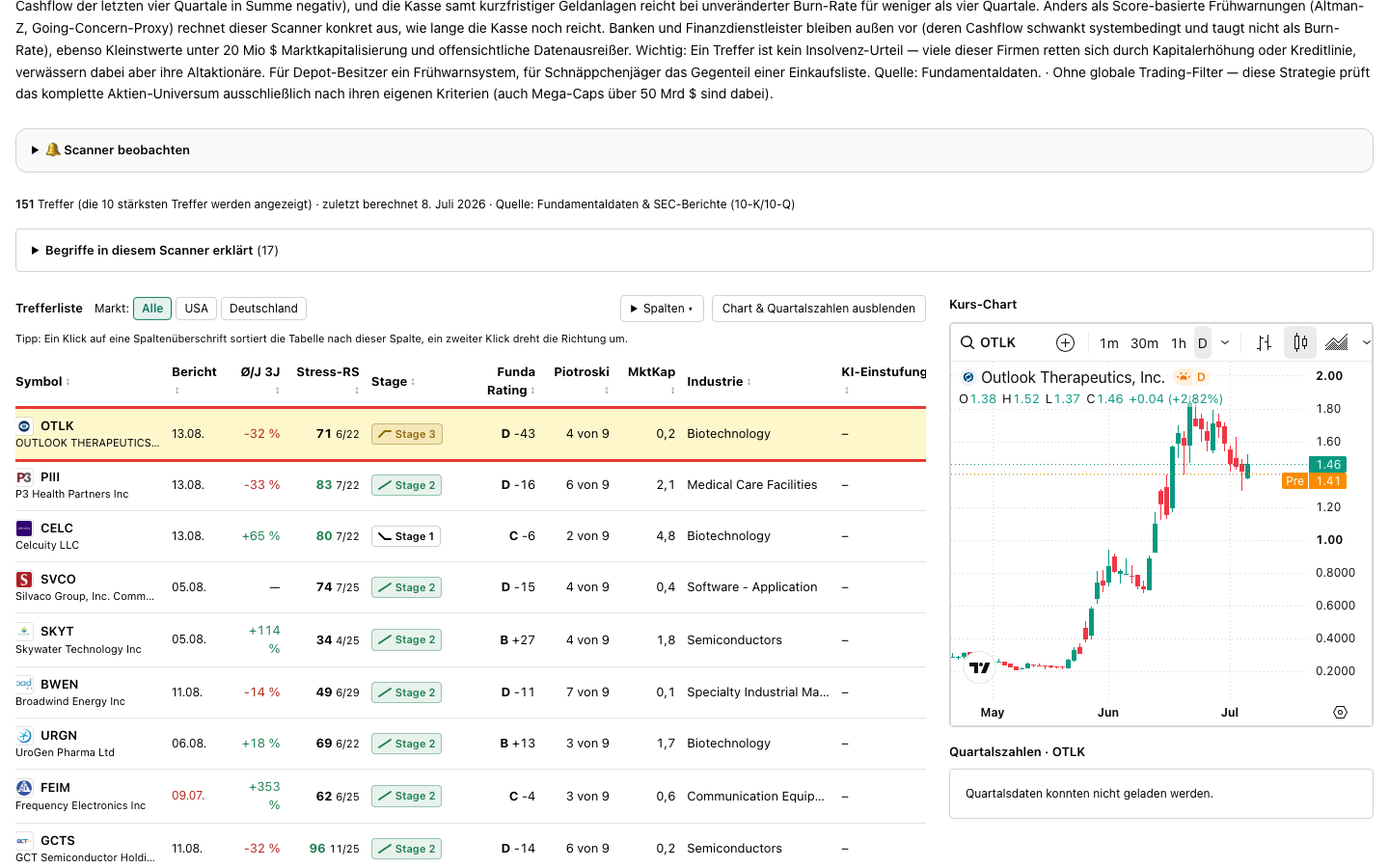
Quickly translated: the radar hunts for companies whose operating business burns cash and whose balance covers the outflow for only a few more quarters. One word of framing — it is a smoke detector, not an insolvency ruling. Many companies on this list save themselves, usually through capital raises that dilute existing holders. Add the quality numbers as of July 27, 2026: the fundamental grade is D (29 out of 100), the deep-red end of the scale. The Piotroski F-score stands at 4 of 9 — a nine-point test of the health of the books; a rock-solid company sits at 8 or 9, and 4 is weak. That the approval does not immediately move these numbers is not a flaw in the system: it measures balance sheets, and the balance sheet is still the old one.
The numbers — Europe as the reality check
Praise first, because it is deserved: LYTENAVA has been approved in the EU since May 2024 and in the UK since July 2024, and per the approval press release it is now sold in Germany, Austria and the United Kingdom. That gives investors something most biotech bets do not offer: an actual commercial track record. It just reads soberly. Outlook's fiscal year ends September 30. In fiscal 2025 (October 2024 through September 2025) the company reported $1.4 million of revenue against a net loss of $62.4 million (prior year: $75.4 million). In the first half of fiscal 2026 (October 2025 through March 2026), something rare happened: reported net revenue was negative — minus $1.08 million, because an increased returns reserve and distributor fees arithmetically overtook the small sales. The January–March 2026 quarter showed $127,439 of net revenue. For comparison: research ($8.1 million) and selling, general and administrative expenses ($18.1 million) consumed a good $26 million in that same half-year.
This is the most uncomfortable number in the analysis — not because it is dramatic, but because it answers the question everyone asks: what happens after an approval? In Europe the answer has been: not much, so far. EU approval came on May 27, 2024, UK approval on July 8, 2024; direct sales started in June 2025, twelve to thirteen months later. And two details turn "not much" into a warning. In the final quarter of fiscal 2025, net revenue was already negative on the arithmetic (nine months showed $1.51 million, the full year only $1.41 million). And in the January–March 2026 quarter, $127,439 of revenue faced $149,327 of cost of goods sold — the gross margin was negative. In the segment note of the same report, the company itself calls product revenue immaterial. Anyone equating the U.S. approval with a revenue jump should know this run-up.
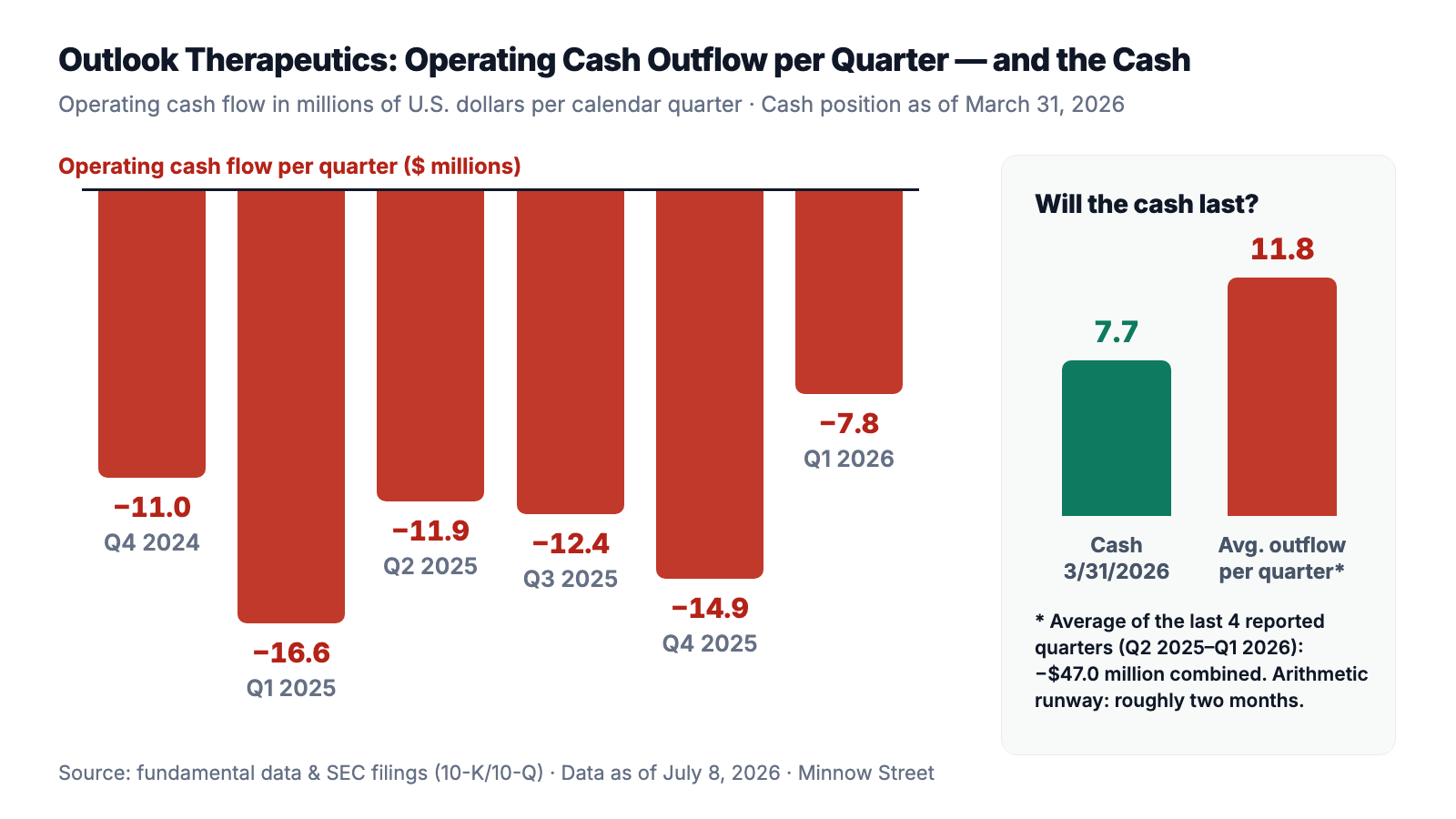
The math behind it fits in your head: over the four reported quarters from April 2025 through March 2026, $47.0 million flowed out of operations — an average of $11.8 million per quarter. The balance sheet showed exactly $7,748,226 of cash as of March 31, 2026. The outflow has slowed ($7.8 million in the quarter through March 2026, after $14.9 million the quarter before), and fresh money has arrived in slices since April 2026: $4.5 million net from an offering in April, roughly $5.0 million gross from a placement in late May, plus an at-the-market program of up to $100 million. That extends the clock by weeks and options, not by years. The next quarterly report is announced for August 13, 2026 — the cash line in it is the most important number of this stock.
What the documents say — the uncomfortable truths
A filing with the U.S. securities regulator, the SEC, is honest under penalty of law, and a prescribing information follows different rules than a press release: it has to include what does not look good. Together they paint a different picture than the announcement of approval day.
Uncomfortable truth no. 1: The failed trial is printed in the approval document
The road to approval was not straight. In August 2023 came the first Complete Response Letter (CRL) — the FDA's formal way of saying no. The follow-up trial agreed with the agency, NORSE EIGHT, missed its pre-specified primary endpoint in November 2024. Two more rejections followed (August 27, 2025 and December 30, 2025), then Outlook won a formal dispute resolution on May 26, 2026, resubmitted on June 1, and received the yes on July 24 — five days ahead of the agency's own goal date. What is remarkable is what the FDA wrote into the label: it did not leave the failure out.
"NORSE EIGHT did not meet its pre-specified NI margin of -3.5 letters in mean change from baseline BCVA at Week 8 compared to ranibizumab. […] At Week 8, the LYTENAVA group had a mean increase in BCVA of 3.3 compared to a mean increase of 4.5 in the ranibizumab group. The LS mean difference and 95% CI was -2.3 (-4.0, -0.5)."
— LYTENAVA (bevacizumab-vikg) U.S. Prescribing Information, Section 14.1, label revision 07/2026
In plain terms: in that trial, LYTENAVA came out behind the comparator at week 8 — the confidence interval sits entirely below zero (that reading of the numbers is ours; the label makes no such finding of its own). Approval nevertheless followed, carried by the older NORSE TWO trial, which did meet its endpoint: 41.7 percent of LYTENAVA patients gained at least 15 letters of visual acuity by month 11, against 23.1 percent on ranibizumab. But the fine print matters here too, and again the agency insisted on it: the comparator arm received ranibizumab monthly only three times and quarterly thereafter — five injections in total, against twelve in the LYTENAVA arm. The 18.6-point lead is therefore not a comparison at equal dosing frequency. Knowing that, the phrase "supported by rigorous clinical evidence" from the press release reads differently. The release itself, by the way, contains not a single efficacy figure, does not use the word NORSE once — and gives no dosing interval either. In fairness: the FDA did not simply set NORSE EIGHT aside in the appeal. It weighed NORSE TWO together with confirmatory evidence, NORSE EIGHT included.
Uncomfortable truth no. 2: The competitor is Avastin — and Outlook will be more expensive
Now to the commercial core question, which Outlook answers itself, in its own annual report, where companies have to be honest. LYTENAVA's competitor is not the expensive branded drug but the cheap workaround it is meant to replace. The company lists it as a risk factor of its own:
"Although ONS-5010/LYTENAVA is approved in the EU and the UK, off-label repackaging of Avastin at compounding pharmacies may continue, which could have a material adverse effect on our business and financial condition. In the United States, approximately 66.3% of new patient starts are off-label repackaged bevacizumab […] there is no guarantee that we will be effective in reducing the off-label use of Avastin."
— Outlook Therapeutics, SEC annual report 10-K for the fiscal year ended September 30, 2025, Item 1A "Risk Factors"
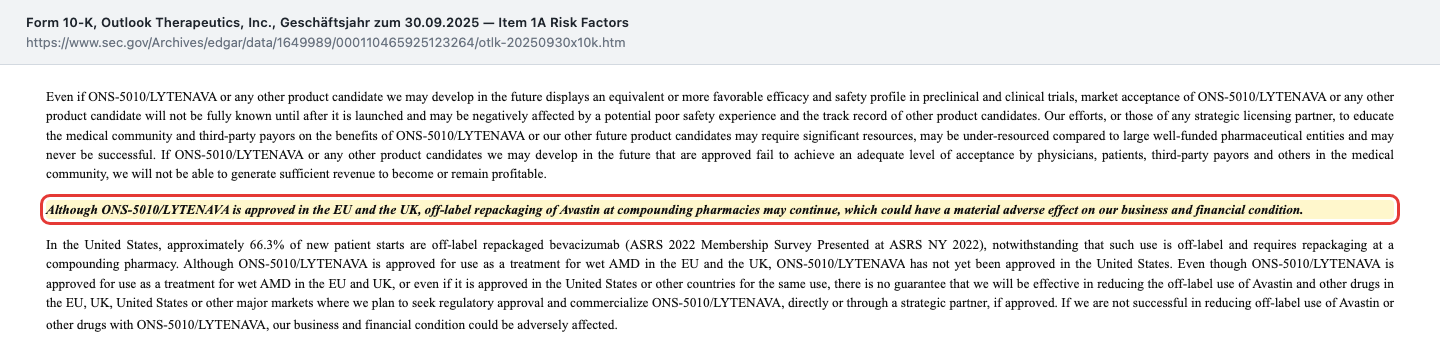
That frames the task precisely: two out of three newly treated patients in the United States currently receive repackaged bevacizumab — roughly 2.7 million injections a year, per the same report. What Outlook sells is therefore not a better molecule (it is the same molecule) but reliability: audited manufacturing, consistent batches, regulatory oversight, clear liability. That is a strong argument. It is simply one that every practice has to weigh against its own economics — and the annual report spells out the prevailing preference: "Doctors who wish to treat their retinal patients with a less expensive anti-VEGF drug, with minimal reimbursement hurdles, often use off-label bevacizumab." The history of this market is unforgiving on that point: since the CATT trial (2011, 1,161 patients) it has been known that repackaged Avastin and approved Lucentis land essentially level on visual acuity. The approved status of the pricier option did not flip market share for a decade and a half.
The size of the price gap can be read off Medicare's own payment limits. For the July-to-September 2026 quarter, the reimbursed drug value of one eye dose of bevacizumab is roughly $9. For comparison, per injection in the same quarter: Lucentis about $255, Eylea about $1,487, Vabysmo about $1,943, Eylea HD about $2,389. That is the chasm LYTENAVA has to be sold into — priced, by the company's own account, above the nine dollars but below the branded products. And the market's move in 2025 shows where practices under cost pressure go: off-label bevacizumab overtook Eylea as the most frequent injection for the first time — 29.8 percent of all intravitreal injections against 21.9 percent for Eylea (practice-data analysis presented at the retina specialists' congress in July 2026). For Outlook that cuts both ways: volume is migrating toward its own molecule — but it is migrating there because the molecule is cheap.
Then there is a mechanic that decides launches in the United States: the practice buys the drug itself and bills the payer afterwards ("buy and bill"). Newly approved products start out with neither average-price data nor a billing code of their own; claims run through miscellaneous codes and payment is capped. A permanent code for LYTENAVA is, on the usual quarterly cycle, unlikely before January 1, 2027 and realistically arrives on April 1, 2027. For the first months that means the practice fronts the money and carries the billing risk — against a workaround that has been reimbursed smoothly for twenty years.
How that can play out does not require speculation — there is a precedent inside the company's own house, and it sits in Germany. The Federal Joint Committee, which decides on the added benefit of new drugs, assessed LYTENAVA on October 16, 2025, and the finding is blunt: "Ein Zusatznutzen ist nicht belegt" — an additional benefit is not proven, because "no evaluable data" were submitted. More revealing still is the cost table of that decision: because LYTENAVA is dosed monthly and the label provides no interval extension, drug costs in the first year of treatment run to €10,886.52 — against €6,224 to €7,262 for aflibercept and €4,547 to €7,276 for faricimab. In Germany, the approved bevacizumab is therefore not the cheap alternative but arithmetically the most expensive of the three therapies. That is the structural contradiction of this product: for the manufacturer it only pays if it is clearly dearer than repackaged Avastin — and the dearer it is, the less it solves the problem it was built for.
And what about the "12 Years of Market Exclusivity" in the headline of the approval release? That sounds like twelve years of open road, and at that spot it is marketing language, not statute. The legal basis is 42 U.S.C. § 262(k)(7): a biosimilar application naming LYTENAVA as its reference product may not be submitted until four years after first licensure and may not be made effective until twelve years after — counting from July 24, 2026, that is 2030 and 2038 respectively. The protection therefore blocks exactly one path: a cheap copy of LYTENAVA. It does not block the continuing repackaging of Avastin, which is precisely the practice being replaced; nor the already approved competition from aflibercept, ranibizumab and faricimab together with their own biosimilars; nor a rival filing its own ophthalmic bevacizumab with its own trials. Outlook itself puts it correctly and narrowly in the annual report — twelve years of regulatory exclusivity against biosimilar competition. The U.S. price had not been published as of July 27, 2026; it is the most important unknown in this bet. The company expects to make the product available "before year-end."
Uncomfortable truth no. 3: The dilution machine was upgraded before the yes
Dilution means your slice of the pie shrinks as new slices keep being cut. At Outlook the pie machine runs around the clock, and in the weeks before the approval it was enlarged again. Per the cover pages and balance sheets of the SEC filings, the share count rose from 53.9 million (September 30, 2025) through 104.6 million (March 31, 2026) to 187.0 million as of June 22, 2026.
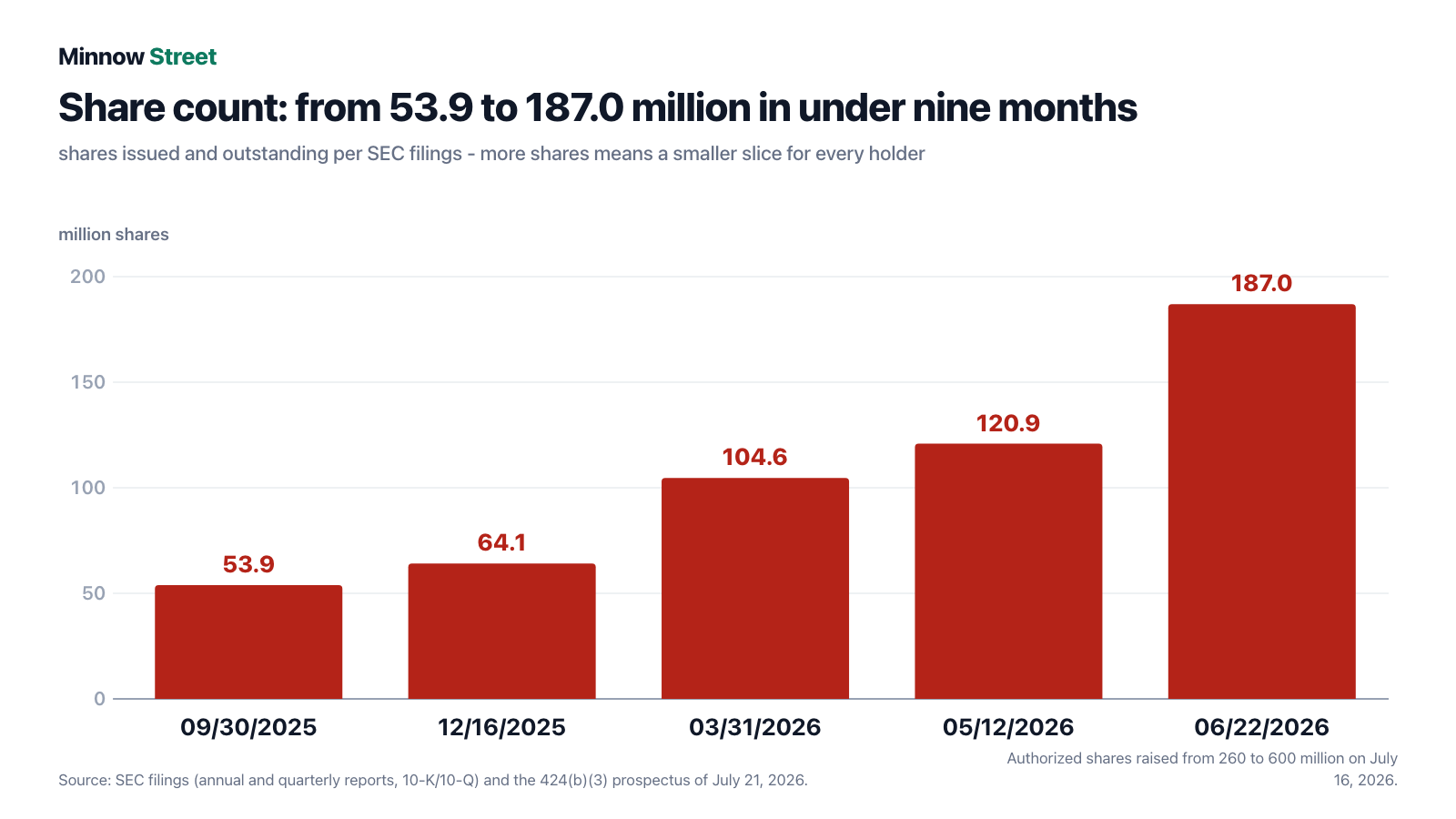
The long view sharpens it further: adjusted for both prior reverse splits (1-for-8 in March 2019, 1-for-20 in March 2024), Outlook had roughly 13.0 million shares as of September 30, 2023. By June 22, 2026 it was 187.0 million — 14.4 times as many in less than three years.
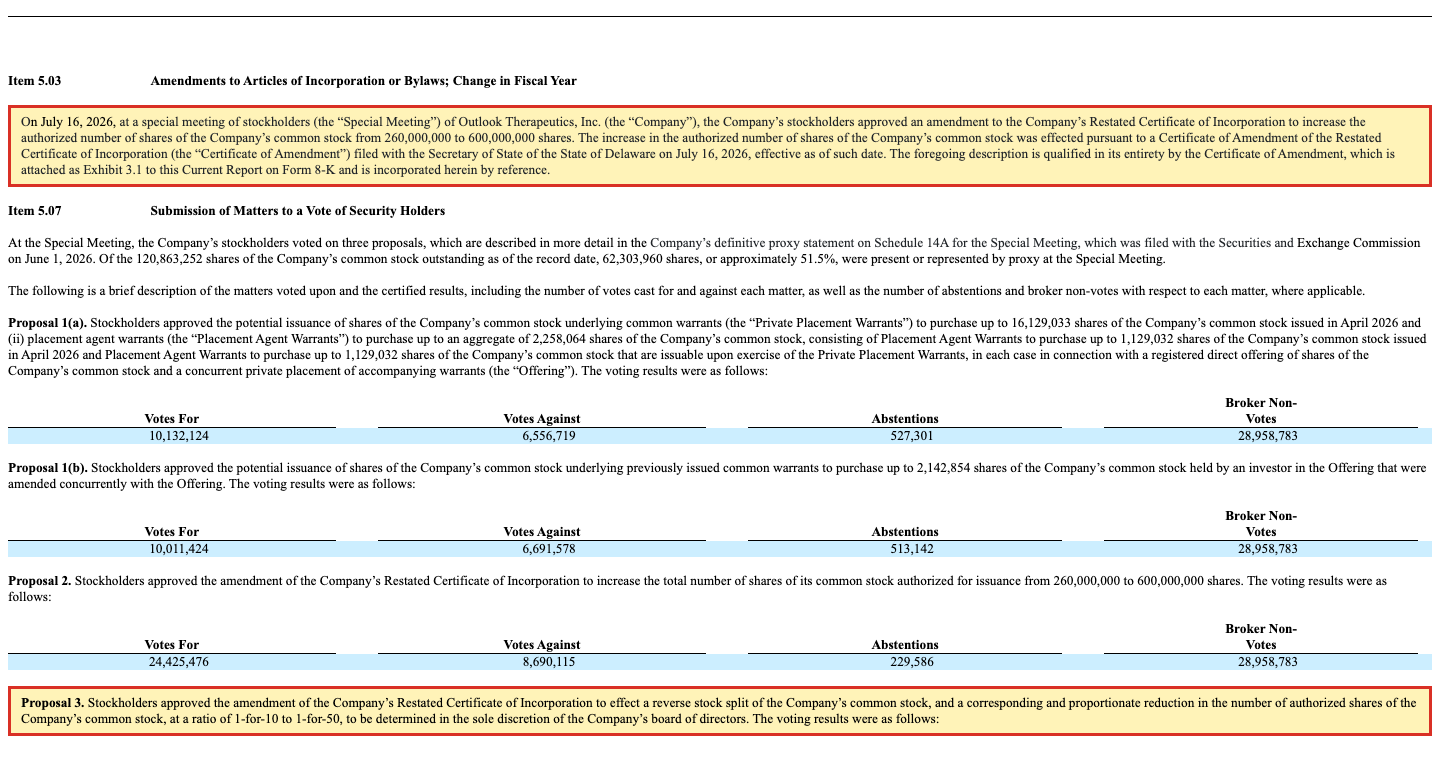
On July 16, 2026, eight days before the approval, a special meeting of stockholders raised the authorized share count from 260 to 600 million and additionally approved a third reverse stock split at a ratio of 1-for-10 to 1-for-50, to be triggered at the board's sole discretion. At 187.0 million shares outstanding, that leaves headroom for 413.0 million more — more than double today's count. In fairness: the Nasdaq minimum-bid proceeding that had been running since February 2026 was closed as cured on June 26, 2026, so the split is not currently needed; it is merely authorized until July 16, 2027 and had not been executed as of July 27, 2026. A reverse split changes nothing about the value of a company, only the price per share — but it does create optical room for further issuance.
Three days before the yes came the next building block: on July 21, 2026 a prospectus became effective registering the resale of 17,258,065 shares — predominantly shares underlying warrants from the April 2026 private placement with an exercise price of $0.31. Such paper is harmless as long as nobody exercises. At a closing price of $1.405 on July 24, 2026, the incentive is obvious: anyone entitled to subscribe at $0.31 and able to sell at $1.40 eventually will.

Then there is the debt, and it has teeth. As of March 31, 2026 the books carried $30.2 million: $10.4 million from a convertible note with Avondale Capital (maturing December 31, 2026) and $19.8 million from a loan from Atlas Sciences (maturing June 16, 2027), each including accrued interest and exit fees. By May 26, 2026 the Avondale balance had melted to roughly $3.1 million — not through repayment, but through conversion into shares. That is this company's mechanism in one sentence: debt disappears here by turning into stock. The convertible carries the clause professionals call toxic: conversion at the lesser of $2.26 or 90 percent of the lowest closing bid over three trading days, with a floor of $0.404. In the January–March 2026 quarter alone, $6.91 million of debt became 15,057,649 new shares — at a weighted average conversion price of 46 cents, against the originally agreed fixed conversion price of $2.26.
The remainder has to be served in cash: the Atlas loan is not convertible. From September 16, 2026, the lender may redeem up to $3 million per calendar quarter in cash; every cash payment carries a 7.5 percent exit fee, and interest accrues at a 9.5 percent minimum, compounded daily. And one clause inverts the logic of the floor: if the conversion price falls below $0.404, Outlook must satisfy a conversion notice in cash. The floor therefore does not protect the company — it turns a price collapse into a payment obligation.
Honesty requires the other direction here, and it is substantial: after the approval, that same formula works for shareholders. At a closing price of $1.405 (July 24, 2026), the conversion price would sit near $1.27 rather than 46 cents. Applied to the balance as of March 31, 2026, that is roughly 8 million new shares instead of about 23 million — the higher price spares existing holders roughly 14 million shares of dilution from this one contract. With this capital structure, a higher share price is not merely a gain; it is a savings program.
Uncomfortable truth no. 4: A bonus with a deadline
This finding made no headline, and it is the most revealing of the week. On July 21, 2026 — three days before the approval — the compensation committee approved not only stock options for the CEO (100,000) and the CFO (210,078) at an exercise price of $1.4304, but also cash bonuses. Their condition is remarkably precise:
"Each Bonus will be earned and become payable only in the event that, on or prior to July 31, 2026, the FDA approves ONS-5010 (bevacizumab-vikg) and renders a favorable decision with respect to the Company's BLA. The Compensation Committee awarded the Bonuses in recognition of Mr. Jahr and Mr. Kenyon's contributions to the advancement of the ONS-5010 (bevacizumab-vikg) BLA and the Company's non-payment of annual bonuses for their 2025 service."
— Outlook Therapeutics, SEC current report 8-K of July 24, 2026 for the July 21, 2026 event, Item 5.02
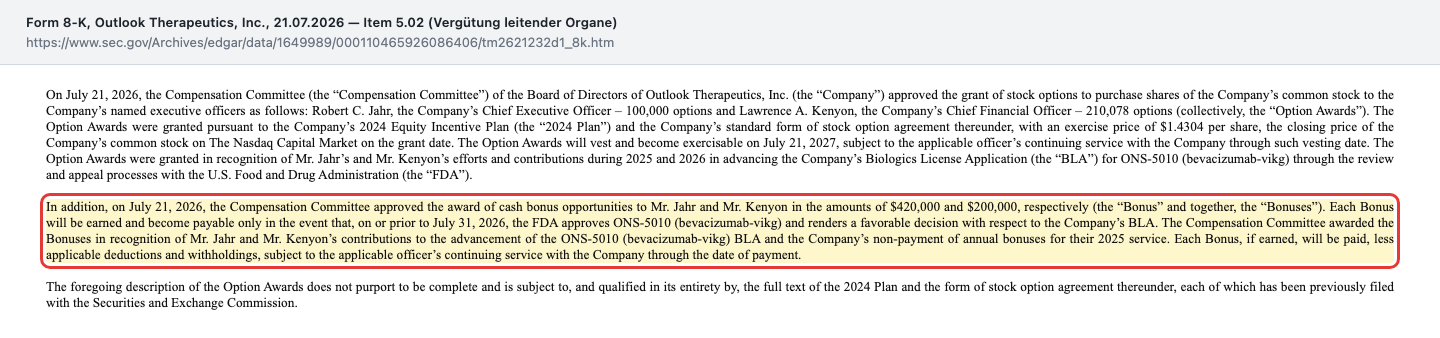
You can read this charitably: an incentive on the home stretch, and the two executives genuinely received no bonus for 2025. You can also simply do the arithmetic. The approval landed on July 24, inside the window — so $620,000 has been earned. Measured against the cash position of March 31, 2026, that is roughly 8 percent of all liquid funds, paid to two people, in a company whose own quarterly report documents substantial doubt about its ability to continue. If you want to know how seriously a management team takes its own cash position, you rarely find the answer in the press release and almost always in Item 5.02.
Uncomfortable truth no. 5: The warning sentence still stands
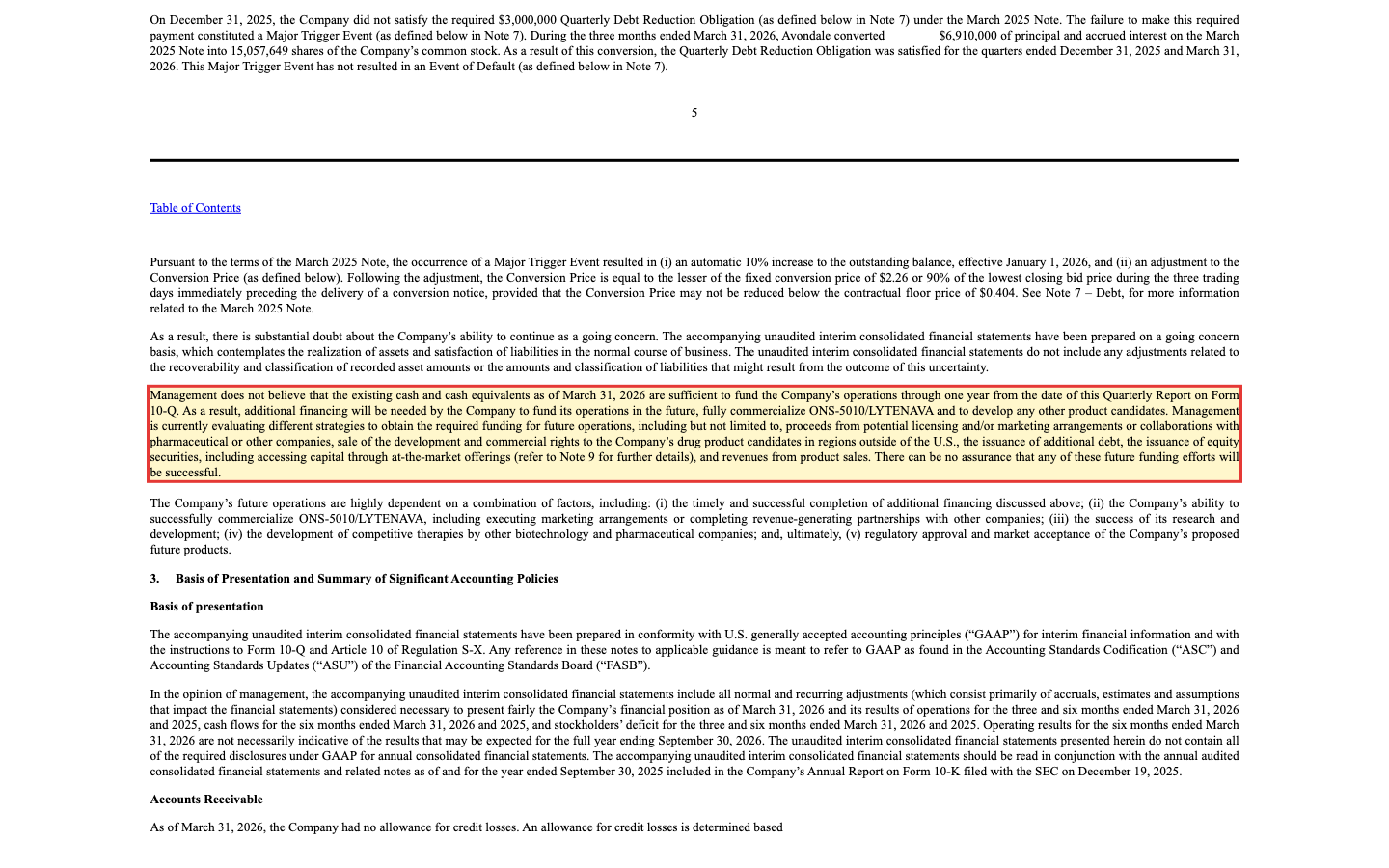
"Going concern" is the most formal warning signal in accounting: the financial statements are prepared only under the assumption that the company survives, while documenting that substantial doubt exists. That notice sits in the quarterly report as of March 31, 2026, and the approval does not retire it; the next report on August 13, 2026 will show how management phrases it now.
"Management does not believe that the existing cash and cash equivalents as of March 31, 2026 are sufficient to fund the Company's operations through one year from the date of this Quarterly Report on Form 10-Q. As a result, additional financing will be needed by the Company to fund its operations in the future, fully commercialize ONS-5010/LYTENAVA and to develop any other product candidates."
— Outlook Therapeutics, SEC quarterly report 10-Q as of March 31, 2026, Note 2 "Liquidity"
How seriously management itself takes the position shows in the list of options in the same report. At the very end of it stands a word executives write only when they must:
"Alternatively, we may be required to, among other things, modify our clinical trial plans for ONS-5010/LYTENAVA in additional indications, make reductions in our workforce, scale back our plans and place certain activities on hold, discontinue our development programs, liquidate all or a portion of our assets, and/or seek protection under the provisions of the U.S. Bankruptcy Code."
— Outlook Therapeutics, SEC quarterly report 10-Q as of March 31, 2026, MD&A "Liquidity and Capital Resources"
And now the part the approval does not make easier but harder: launching a drug in the United States costs money before it earns any. It requires a field force for retina practices, reimbursement and patient-assistance programs, inventory, logistics. Outlook last reported 17 full-time employees (as of September 30, 2025 — the company has published no newer figure), states plainly in its annual report that it has no marketing and sales organization, and announces in the approval release that it is building "an industry-leading, specialized retina commercial organization."
What that costs does not have to be guessed — it is on the books of those who have done it. Apellis Pharmaceuticals launched the retina drug SYFOVRE in the United States in 2023 and reported general and administrative expenses of $500.8 million for that year, after $277.2 million the year before. The launch worked, generating $396.6 million of revenue. But those $500.8 million of launch costs equal 65 times Outlook's entire cash position as of March 31, 2026. That is neither an accusation nor a forecast; it is a yardstick for the task that begins beyond the finish line.
And because approval euphoria is a stubborn feeling, three documented cases for calibration. Biogen won accelerated approval for ADUHELM in June 2021 and booked $3.0 million of revenue for all of 2021 — against roughly $480 million of selling expense for that one product; it was discontinued in early 2024. Clovis Oncology sold its approved cancer drug Rubraca for $148.8 million in 2021 and still filed for Chapter 11 in December 2022, its share count having tripled over six years. And straight from the retina market: Coherus BioSciences launched an approved, cheaper ranibizumab biosimilar in the United States in October 2022 — and sold the entire ophthalmology franchise, approval and sales force included, for $170 million in March 2024 to repay bank debt. None of these cases predicts anything about Outlook. All three say the same thing about approvals: they are a permission, not a revenue.
Valuation: what does hope cost now?
At the July 24, 2026 closing price of $1.405 and with 187.0 million shares, the market valued Outlook at roughly $263 million — or more precisely at at least that much, because the last documented share count dates from June 22, 2026 and the at-the-market program kept running through the five weeks that followed. A price-to-earnings ratio does not exist for lack of earnings; a price-to-sales ratio would be arithmetically possible on revenue in the low six figures and analytically meaningless. What you buy here is not a valuation but a bet — except its subject has shifted. Until July 24 it read: will the FDA say yes? Since then it reads: can this company finance a U.S. launch before the money runs out — and at what price to existing shareholders?
A rough yardstick helps. The company puts the addressable U.S. anti-VEGF market at roughly $8.5 billion a year (the footnote points to the National Eye Institute, a research agency that does not publish market revenue; the market figures come, per the same release, from three market-research sources dated 2022 and 2023). Even a 1 percent share would be $85 million of revenue — a multiple of anything Outlook has ever earned, and still less than a third of today's market value. The approval opens a real door; it says nothing about how many physicians walk through it.
Two calculations make the financing question tangible. First, dilution: if Outlook needed $100 million of fresh equity and placed it at $1.20 — a customary discount to the July 24, 2026 close — roughly 83 million new shares would be created, leaving existing holders with just under 70 percent of their prior stake. At $150 million it would be about 125 million new shares and a 60 percent stake. These are scenarios, not announcements: as of July 27, 2026, Outlook had announced no capital raise following the approval. Second, the historical comparison: despite the approval, the market value on July 24, 2026 of roughly $263 million was still below the level at the end of 2022 (about $277 million) and well below the end of 2021 (about $305 million). The company is further along than ever — its shareholders from back then are not.
The professionals' view is less uniform than the average suggests. Before the approval, the visible price targets stood at $0.50 (April 8, 2026), $1.61 (June 30, 2026) and $10.00 (June 10, 2026) — an average near $5.50 emerges here from dispersion, not from agreement. The first post-approval reaction is now in: the house that had been most cautious at $1.61 upgraded to Buy with a $4.00 target on July 27, 2026, while the other two models still stood at their pre-approval settings. Take all of it for what it is: the opinions of a handful of analysts on a micro cap, not a safety net. How a going-concern calculation reads without an approval is something you can study in our analysis of fellow radar resident TuHURA Biosciences — same warning sentence, same arithmetic, different calendar.
Opportunities and risks at a glance
What speaks for Outlook Therapeutics
- The approval is real and cannot be taken back: LYTENAVA has been approved in the United States since July 24, 2026 — per the current report, as the first and only ophthalmic bevacizumab formulation for wet AMD; the EU (May 2024) and UK (July 2024) approvals remain in place.
- The single largest risk in the stock is gone: the binary regulatory decision that had defeated the company three times has been made, and the FDA accepted NORSE TWO as sufficient evidence of effectiveness (41.7 versus 23.1 percent of patients gaining at least 15 letters by month 11).
- The market is real and large: bevacizumab is already used off-label at scale in ophthalmology — an approved version replaces an improvised solution, not a need. The company puts the addressable U.S. market at roughly $8.5 billion a year.
- Formally, twelve years of reference product exclusivity under the BPCIA now run from July 24, 2026: a biosimilar application naming LYTENAVA may not be submitted for four years and may not be made effective for twelve.
- The cash burn has slowed ($7.8 million of operating outflow in the quarter through March 2026, after $14.9 million the quarter before), and with 600 million authorized shares plus an at-the-market program of up to $100 million, financing routes are available at any time.
- The higher share price makes that financing far cheaper: the same $100 million costs roughly 71 million shares at about $1.41 — at $0.2425 (May 12, 2026) it would have cost some 412 million. And the convertible now converts near $1.27 instead of 46 cents.
- The volume tailwind is real: in 2025, off-label bevacizumab overtook Eylea as the most frequent intravitreal injection (29.8 versus 21.9 percent) — the shift runs toward the molecule Outlook alone offers in an approved ophthalmic form.
What speaks against it
- The cash does not carry the launch: $7.75 million as of March 31, 2026 against roughly $11.8 million of operating outflow per quarter, plus $30.2 million of debt maturing December 31, 2026 and June 16, 2027, with a quarterly cash redemption right of up to $3 million from September 16, 2026.
- The very financing routes counted as an opportunity are the cost borne by existing holders: share count from 53.9 to 187.0 million within nine months, authorized shares raised to 600 million, a 1-for-10 to 1-for-50 reverse split authorized, and 17.26 million shares registered for resale.
- The label is narrower than the narrative: wet AMD only, monthly injections with no interval extension — and the prescribing information documents the missed non-inferiority margin of NORSE EIGHT (−2.3 letters versus ranibizumab at week 8).
- The main competitor is not a biosimilar but cheap, repackaged Avastin: 66.3 percent of all new patient starts in the United States, per Outlook's own annual report — and the twelve-year exclusivity does not protect against it. No U.S. price had been published as of July 27, 2026.
- The launch has to be built from scratch: no marketing and sales organization per the annual report, and 17 full-time employees as of September 30, 2025. For scale: Apellis reported $500.8 million of selling and administrative expense in the launch year of its retina drug in 2023 — 65 times Outlook's cash position of March 31, 2026.
- The European track record is the warning from inside the house: $1.4 million of revenue in fiscal 2025, and negative net revenue in the first half of fiscal 2026 (−$1.08 million) because of returns reserves and trade fees.
- In Germany, the Federal Joint Committee ruled on October 16, 2025 that an added benefit is not proven. Because of the monthly regimen, drug costs run to €10,886.52 in the first year — above aflibercept (€6,224–7,262) and faricimab (€4,547–7,276).
- U.S. reimbursement is a hurdle of its own: without a billing code — unlikely before January 1, 2027 and realistically April 1, 2027 — the practice fronts the money and carries the billing risk.
- The price had largely front-run the decision: up roughly 420 percent from May 20 to July 24, 2026, and only 6.4 percent on approval day itself, after an intraday range of $1.12 to $1.75.
A human conclusion
Back to the finish-line illusion. The finish was crossed, and it was real: a company with the headcount of a dental practice beat three FDA rejections and is bringing the first bevacizumab developed specifically for the eye into the largest pharmaceutical market in the world. That deserves respect regardless of the share price. But the actual race begins beyond that line, and the starting grid is written in the same documents that prove the approval: $7.75 million of cash as of March 31, 2026, $30.2 million of debt maturing within the next year and a half, a share count that more than tripled in nine months, and an authorized share pipe that was doubled to 600 million shortly before the yes. Anyone buying today is no longer betting on the regulator but on the cash box — and on financing arriving at terms that do not shrink their slice further. Two dates keep the story moving: the quarterly report on August 13, 2026, with the cash line and the going-concern paragraph, and the announced U.S. launch "before year-end," with the first real price. Until then, what holds for every approval rally holds here: a regulator's yes is a permission, not a revenue. You now know both sides. What you make of it is your decision. And that is exactly as it should be.
Sources
All original documents used in this analysis — to read for yourself:
- SEC current report (8-K) of 07/24/2026 on the FDA approval, Item 8.01 with the press release as Exhibit 99.1: tm2621316d1_8k.htm (sec.gov)
- SEC current report (8-K) of 07/24/2026 for the 07/21/2026 event, Item 5.02 — options and approval-contingent bonuses: tm2621232d1_8k.htm (sec.gov)
- SEC prospectus 424(b)(3) of 07/21/2026 (Reg. No. 333-297532) — resale of 17,258,065 shares, share count as of 06/22/2026: tm2619649d5_424b3.htm (sec.gov)
- SEC current report (8-K) of 07/16/2026 — special meeting: authorized shares 260 → 600 million, reverse split 1-for-10 to 1-for-50: tm2620677d1_8k.htm (sec.gov)
- SEC quarterly report (10-Q) as of 03/31/2026, filed 05/15/2026: otlk-20260331x10q.htm (sec.gov) — going-concern notice (Note 2), debt (Note 7), share count, half-year revenue
- SEC annual report (10-K) for the fiscal year ended 09/30/2025, filed 12/19/2025: otlk-20250930x10k.htm (sec.gov) — fiscal 2025 revenue and result, headcount, competition and exclusivity
- LYTENAVA (bevacizumab-vikg) U.S. Prescribing Information, label revision 07/2026 — indication, dosing, NORSE TWO and NORSE EIGHT: Prescribing Information (lytenava.com)
- Legal basis for the exclusivity: 42 U.S.C. § 262(k)(7) (govinfo.gov)
- German benefit assessment and therapy costs: Decision of the Federal Joint Committee of October 16, 2025, Annex XII (bevacizumab/nAMD, g-ba.de)
- U.S. payment limits per drug (Medicare, quarter of July through September 2026): CMS ASP pricing files (cms.gov); 2025 injection shares from a practice-data analysis presented at the American Society of Retina Specialists congress in July 2026.
- Outlook Therapeutics' complete SEC filing history: EDGAR overview (sec.gov)
- Launch comparisons (SEC filings of the companies named): Apellis Pharmaceuticals, 10-K for 2023 (general and administrative expense $500.8 million, revenue $396.6 million); Biogen, 8-K of February 3, 2022 (ADUHELM full-year 2021 revenue of $3.0 million); Clovis Oncology, 8-K of December 13, 2022 (Chapter 11 filing) and 10-K for 2021 (Rubraca revenue $148.8 million); Coherus BioSciences, sale of the ophthalmology franchise to Sandoz for $170 million, completed March 1, 2024.
- Prices, share count, analyst consensus: from our fundamental data, reconciled with the SEC filings (data as of July 27, 2026).
- Screener and rating data: in-house stock scanner (live query July 27, 2026); context on the top hits in the Insolvency Radar top-10 roundup; the same going-concern arithmetic without an approval in our TuHURA Biosciences analysis.
Transparency & disclaimer: This analysis is a journalistic contextualization of publicly available information and is not investment advice, not a financial analysis in the regulatory sense, and not a solicitation to buy or sell securities. Stock investments carry substantial risks up to total loss. All information without guarantee; the data cut-off is noted in the text in each case. Positions held by the operator are disclosed daily; where one exists, it appears as a notice at the top of this deep dive.
Key figures at a glance
All monetary figures in millions of $; earnings per share as reported.
| Metric | 2021 | 2022 | 2023 | 2024 | 2025 |
|---|---|---|---|---|---|
| Revenue | 0.0 | 0.0 | 0.0 | 0.2 | 1.4 |
| Operating Income (EBIT) | -51.7 | -63.1 | -53.1 | -71.7 | -67.1 |
| Net Income | -53.2 | -66.1 | -59.0 | -75.4 | -62.4 |
| Net Margin | – | – | – | -44,301.0% | -4,416.2% |
| Earnings Per Share | -6.96 $ | -6.23 $ | -4.72 $ | -4.06 $ | -2.45 $ |
Source: fundamental data & SEC filings (annual and quarterly reports, 10-K/10-Q)
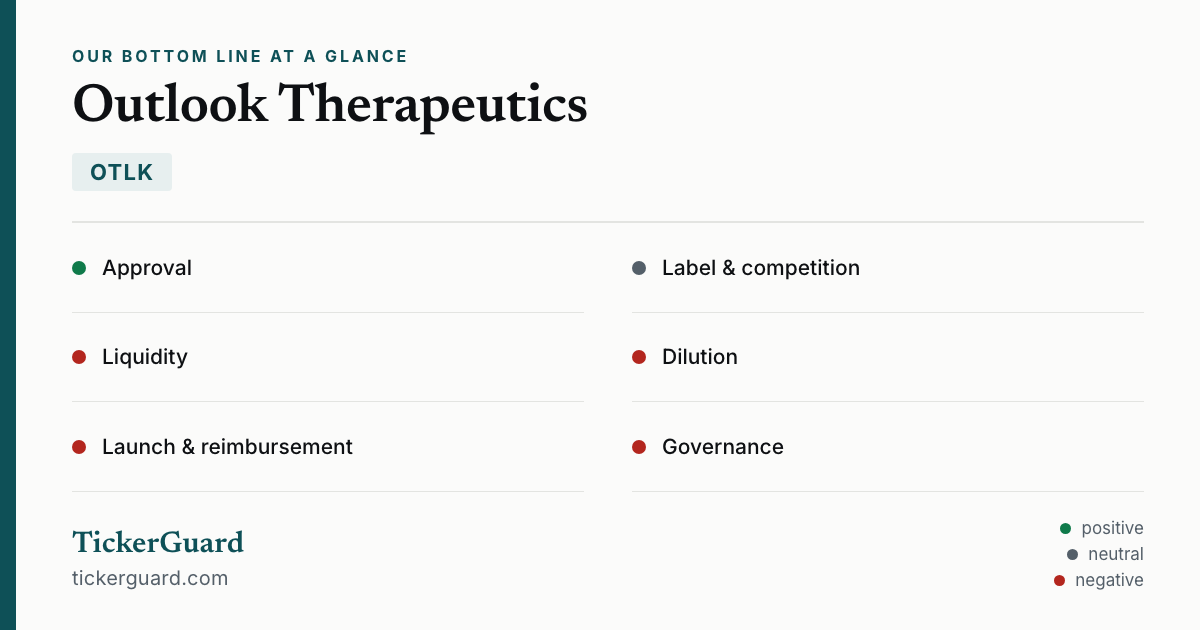
Our Bottom Line at a Glance
- Approval positive
- The FDA approved LYTENAVA on July 24, 2026 — at the fourth attempt and five days ahead of its own goal date. The single largest risk in the stock is settled, and the EU (May 2024) and UK (July 2024) approvals remain in place.
- Label & competition neutral
- Only wet AMD is approved, dosing is monthly (1.25 mg roughly every 28 days) with no interval extension, and the label documents the missed non-inferiority margin of NORSE EIGHT. The twelve-year exclusivity blocks biosimilars, not repackaged Avastin, which accounts for 66.3 percent of new patient starts per Outlook's own annual report.
- Liquidity negative
- Going-concern notice in the quarterly report: $7.75 million of cash (March 31, 2026) against roughly $11.8 million of operating outflow per quarter, plus $30.2 million of debt maturing December 31, 2026 and June 16, 2027 — rank 1 in our "Insolvency Radar" (live query July 27, 2026).
- Dilution negative
- Share count from 53.9 million (September 30, 2025) to 187.0 million (June 22, 2026); authorized shares raised from 260 to 600 million on July 16, 2026, a 1-for-10 to 1-for-50 reverse split authorized, and the resale of 17,258,065 shares registered on July 21, 2026.
- Launch & reimbursement negative
- The European track record is the warning from inside the house: $1.4 million of revenue in fiscal 2025 and negative net revenue in the first half of fiscal 2026 (−$1.08 million); Germany's benefit assessment of October 16, 2025 found no proven added benefit while assigning the highest first-year drug costs in the comparator set. The U.S. sales organization has yet to be built, with 17 full-time employees and no published price as of July 27, 2026.
- Governance negative
- Three days before the approval, the compensation committee approved cash bonuses totaling $620,000, payable only upon FDA approval by July 31, 2026 — roughly 8 percent of the cash position of March 31, 2026, in a company carrying a going-concern notice (8-K of July 24, 2026, Item 5.02).
At the fourth attempt, Outlook Therapeutics achieved what had defeated it three times: LYTENAVA has been approved in the United States since July 24, 2026. The binary regulatory risk is settled — and the question shifts to the cash box: $7.75 million as of March 31, 2026, $30.2 million of debt, a share count that more than tripled in nine months, and an authorized share pipe doubled to 600 million shortly before the yes. Not investment advice.
What Our Rating Means
Substance risk
We found at least one documented issue that threatens the company itself — regardless of how the stock is currently valued.
The approval is a genuine milestone and removes the single largest risk — but it removes neither the going-concern notice, nor the $30.2 million of debt maturing from late 2026, nor the ongoing dilution. The bet on the regulator has become a bet on the financing; anyone staying invested should size the position against a capital raise on weak terms. The decision is yours.
A journalistic assessment by our editorial team at the time of the deep dive, based on public sources — not investment advice and not a solicitation to buy or sell. Your personal circumstances (investment goals, risk capacity, taxes) cannot be taken into account. What our levels mean, how verdicts are formed, and what conflicts of interest exist →
Worth Noting
- Cash runway computed with the same formula as our scanner: $7.75 million of cash (March 31, 2026) divided by roughly $11.8 million of average quarterly operating outflow (last four reported quarters). Since April 2026, $4.5 million net and about $5.0 million gross arrived from two placements; per management explicitly not sufficient for twelve months.
- Next checkpoints: the quarterly report on August 13, 2026 (cash line and going-concern paragraph) and the U.S. launch announced for "before year-end", with the first published price.
- The price had largely front-run the approval: from a closing price of $0.27 on May 20, 2026 to $1.405 on July 24, 2026; on approval day itself, 6.4 percent was left after an intraday range of $1.12 to $1.75 on roughly 55.6 million shares traded.
- The most recently visible analyst price targets ($0.50 / $1.61 / $10.00) all predate the approval; the frequently cited average near $5.50 emerges from dispersion, not agreement.
Download the verdict card (traffic light and rating of this analysis as an image, PNG)
Stock Watch
This analysis is as of August 26, 2026. Stock Watch will tell you what's changed at OTLK since then.
Later $1 a month per stock — signing up is free, and you'll be the first to know when it launches.
The full analysis as a PDF for later
We will send you this analysis as a PDF — to print, file away, and read at your own pace. And we will add you to the free Stock Watch list for OUTLOOK THERAPEUTICS INC (OTLK), so you hear about it when something material in this analysis changes.
Frequently Asked Questions
Yes. The FDA approved LYTENAVA (bevacizumab-vikg) for neovascular (wet) age-related macular degeneration on July 24, 2026 — five days ahead of its own goal date and after three rejections (August 2023, August 27, 2025, December 30, 2025). Per the 8-K, it is the first and only FDA-approved ophthalmic bevacizumab formulation in the United States. The company expects to make it available before the end of 2026.
The U.S. prescribing information calls for 1.25 mg by intravitreal injection once monthly, roughly every 28 days — about twelve injections per eye per year. The label provides for no extended dosing interval and no treat-and-extend regimen (label revision 07/2026). The only approved indication is wet AMD, not diabetic macular edema or retinal vein occlusion.
Under 42 U.S.C. § 262(k)(7), a biosimilar application naming LYTENAVA as its reference product may not be submitted until four years after first licensure and may not be made effective until twelve years after. The protection applies only to such follow-on applications. It prevents neither the continuing repackaging of Avastin by compounding pharmacies nor competition from already approved anti-VEGF drugs.
Because the approval costs money before it earns any. As of March 31, 2026 the company held $7.75 million of cash against roughly $11.8 million of operating outflow per quarter and $30.2 million of debt maturing December 31, 2026 and June 16, 2027. The quarterly report carries a going-concern notice, and our in-house stock scanner still ranks OTLK first in the Insolvency Radar (live query July 27, 2026).
The approval rests on NORSE TWO: 41.7 percent of LYTENAVA patients gained at least 15 letters of visual acuity by month 11, against 23.1 percent on ranibizumab — although the comparator arm received five rather than twelve injections. The follow-up trial NORSE EIGHT is in the label too, as a failure: at week 8, LYTENAVA gained 3.3 letters against 4.5 for ranibizumab (difference −2.3; 95 percent interval −4.0 to −0.5).
Off-label repackaged bevacizumab — the same molecule, prepared by compounding pharmacies. Outlook's own annual report states that roughly 66.3 percent of new wet AMD patient starts in the United States use it, some 2.7 million injections a year, and lists as a risk factor that this practice may continue with a material adverse effect on the business. No U.S. price for LYTENAVA had been published as of July 27, 2026.
Per SEC documents, the share count rose from 53.9 million (September 30, 2025) to 187.0 million (June 22, 2026). On July 16, 2026 a special meeting raised the authorized share count from 260 to 600 million and approved a reverse stock split of 1-for-10 to 1-for-50 at the board's discretion. On July 21, 2026 the resale of a further 17,258,065 shares was registered.
On July 21, 2026 the compensation committee approved cash bonuses of $420,000 for CEO Robert C. Jahr and $200,000 for CFO Lawrence A. Kenyon — payable only if the FDA approved on or prior to July 31, 2026. The approval arrived on July 24, so the bonuses are earned. Together, $620,000 equals roughly 8 percent of the cash position of March 31, 2026; the company had not paid annual bonuses for 2025 (8-K of July 24, 2026, Item 5.02).
Found an error?
Did you spot a factual error, an outdated number, or a typo in this deep dive? Let us know briefly — your report goes straight to the editorial team.