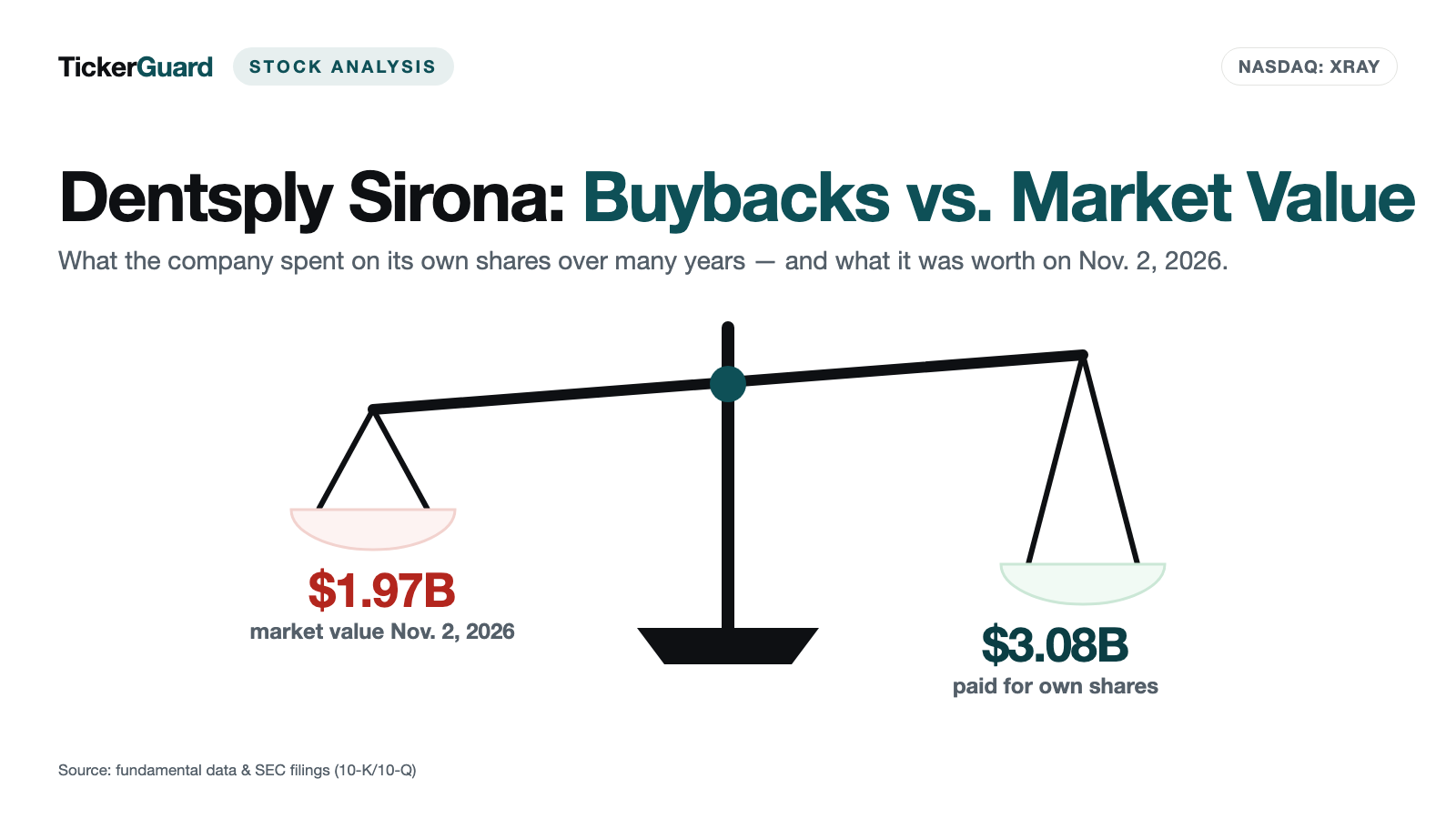
Dentsply Sirona Paid $3.08 Billion for Its Own Shares – in November 2026 the Whole Company Was Worth Less
The treasury shares Dentsply Sirona held in mid-2026 had cost a combined $3.08 billion over many years — on November 2, 2026, the entire company was worth $1.97 billion on the stock market. How that happened is in its filings with the U.S. securities regulator, the SEC: the company that calls itself the world’s largest diversified dental manufacturer wrote off about $3.3 billion of goodwill and intangibles from 2022 through 2025, eliminated its dividend, and in October 2026 obtained looser covenants from its lenders for the second time in ten months. Size is a promise — and the balance sheet is where it gets kept or broken.
 Thomas Mücke
Founder & Publisher
As of Today
As of: November 2, 2026
- Closing price
- 9.90 $ +3.90%
- Market Capitalisation
- 2.0 $B
- Growth Score
- 4/10
- AAQS
- 0/10
This analysis has a cut-off date. The Stock Guard tells you when something material changes in the numbers. Reserve your free spot
Chart
Interactive price chart (TradingView).
52-week range: 8.40 $ to 14.70 $ · Last price: 9.90 $ (As of: November 2, 2026)
Note: pure fact-based analysis, not investment advice and not a solicitation to buy or sell. All figures without guarantee.
There is an investor trap that feels like caution: the market-leader trap. It works like this. A company is the biggest in its industry, every professional knows its products, and it has been around for more than a century. Your brain concludes: “Nothing much can go wrong here.” Size feels like safety — and that is exactly why you stop looking closely. Dentsply Sirona (Nasdaq: XRAY) is that kind of company. If you have ever had a root canal, an instrument or material from this group may well have been in your mouth. The company describes itself like this:
“Dentsply Sirona is the world's largest diversified manufacturer of professional dental products and technologies, with over a century of innovation and service to the dental industry and patients worldwide.”
— DENTSPLY SIRONA Inc., SEC current report 8-K/A of August 7, 2026, Exhibit 99.1 (second-quarter 2026 results)
One pair of numbers shows how strong the trap is. Over many years, Dentsply Sirona has bought back its own shares; the 65.3 million it still held in mid-2026 had cost a combined $3.08 billion, about $47 apiece on average — on November 2, 2026, the whole company was worth $1.97 billion on the stock market. So before you think “market leader” at your next dental bill, let’s read together what the company has told the U.S. securities regulator, the SEC — the annual report (10-K) for 2025, the quarterly reports (10-Q) through June 30, 2026, and the current reports (8-K) through October 2026. Filing false information with the SEC carries penalties, which makes these documents some of the most reliable sources there are. They tell the story of a company that calls itself the world’s largest diversified dental manufacturer, has written off about $3.3 billion since 2022, eliminated its dividend, and asked its lenders for looser covenants twice in ten months. In the end, the decision is yours.
What Dentsply Sirona actually does — from root canals to chairside scanners
Dentsply Sirona is an outfitter for dental practices and dental labs. Think of it as a hardware store and a machine shop for dentists rolled into one. It sells what gets used up every day, and what gets bought once and then sits in the practice for ten years. The 2025 annual report splits this into four segments:
- Essential Dental Solutions (consumables and instruments: files and filling materials for root canals, restoratives, anesthetics, preventive products): $1.47 billion of 2025 revenue, segment adjusted operating income of $514 million.
- Connected Technology Solutions (equipment: X-ray and 3D imaging, treatment centers, intraoral scanners such as Primescan, the CEREC milling systems that make a crown in a single visit, the DS Core cloud platform): $1.04 billion of revenue, segment income of $52 million.
- Orthodontic and Implant Solutions (dental implants, prosthetics, SureSmile clear aligners): $850 million of revenue, segment income of $108 million.
- Wellspect Healthcare (catheters and irrigation systems for people with bladder or bowel dysfunction): $325 million of revenue, segment income of $102 million.
Together that came to $3.68 billion of revenue in 2025. At December 31, 2025, the company employed about 14,000 people, about 3,000 of them in the U.S.; headquarters are in Charlotte, North Carolina. Until the end of February 2016 the SEC listed the company as DENTSPLY International Inc., and as DENTSPLY SIRONA Inc. since then. Daniel T. Scavilla has led the company since 2025; the new CFO, John C. Fortson, was appointed in June 2026 and took office on July 20, 2026. Their program is called the “Return-to-Growth Action Plan.”
That sets up the central tension of this analysis, and it runs through every section: Dentsply Sirona is big, well known and makes money in its day-to-day business — but the goodwill from past acquisitions keeps crumbling, equity keeps melting, and the lenders now have a say in what happens to the cash.
Company history for investors
-
2016
Dentsply International becomes Dentsply Sirona
Until the end of February 2016, the SEC lists the company as DENTSPLY International Inc., then as DENTSPLY SIRONA Inc. For shareholders, the ticker XRAY on Nasdaq stays the same.
-
2022
Internal investigation and the first billion-dollar write-down
In May 2022 the company announces an audit committee investigation into financial reporting; class actions follow. $1,287 million of impairments, net loss of $950 million.
-
2024
Byte halted
On 10/24/2024 Dentsply Sirona suspends sales and marketing of its Byte aligners. 2024 impairments: $1,014 million, net loss of $910 million.
-
2025
Implant goodwill fully written off
Another $650 million of impairments; the implant unit’s goodwill is gone by the end of 2025. On 12/24/2025 lenders permit higher leverage and restrict certain payments.
-
2026
Dividend eliminated, covenants loosened again
On 02/23/2026 the board eliminates the dividend; a cost program targets about $120 million a year. On 10/08/2026 the covenants are loosened a second time within ten months.
How the stock landed on our desk
What prompted this analysis was the share price. From August 5, 2026 (close: $13.78) to October 19, 2026 ($8.42, the lowest close in the twelve months through early November 2026), the stock lost about 39 percent (fundamental data). In between came the October 9, 2026 filing on the second covenant loosening in ten months. When a self-described industry leader falls that hard, it lands on our research list — precisely because that is when the market-leader trap whispers loudest: “It hasn’t been this cheap in a long time.”
One detail from February shows how the market reacts to this company. On February 26, 2026, Dentsply Sirona announced the elimination of its dividend along with a restructuring plan — and the stock rose the next day from $12.71 to $14.68, a gain of just over 15 percent. The market initially rewarded the cut — it looked at the cost program, not the balance sheet. A little over seven months later, the stock stood at $8.42. The analysts covering the stock are cautious: of 17, two rate it a strong buy, two a buy, twelve a hold and one a sell; their average price target is $12.40 (fundamental data, as of November 2, 2026). Average here means all price targets added up and spread evenly — a single outlier on the high or low side shifts it noticeably. That is the view of those analysts, not an assessment by TickerGuard. So keep this in mind from the start: at Dentsply Sirona, the share price doesn’t tell the story — the balance sheet does.
The numbers over the years, given their due
First, what Dentsply Sirona does well — and it is not nothing. In every year from 2017 through 2025, the company took in more cash from its operations than it spent: operating cash flow was $657 million in 2021 and still $235 million in 2025, and $139 million in the first half of 2026. The consumables segment is a genuine profit engine: $514 million of segment adjusted operating income on $1.47 billion of revenue (2025) — about 35 cents per revenue dollar. Adjusted earnings before interest, taxes, depreciation and amortization (adjusted EBITDA) even rose slightly in 2025, to $667 million from $631 million. And Wellspect is growing: up 7.1 percent in the second quarter of 2026.
Revenue, on the other hand, is heading the wrong way: $4.23 billion (2021), $3.92 billion (2022), $3.97 billion (2023), $3.79 billion (2024), $3.68 billion (2025) — down 13 percent in four years. In the first half of 2026 it slipped another 2.1 percent to $1.78 billion; in the second quarter it fell 4.1 percent to $898 million, and 6.3 percent in constant currency. And the bottom line looks like this:
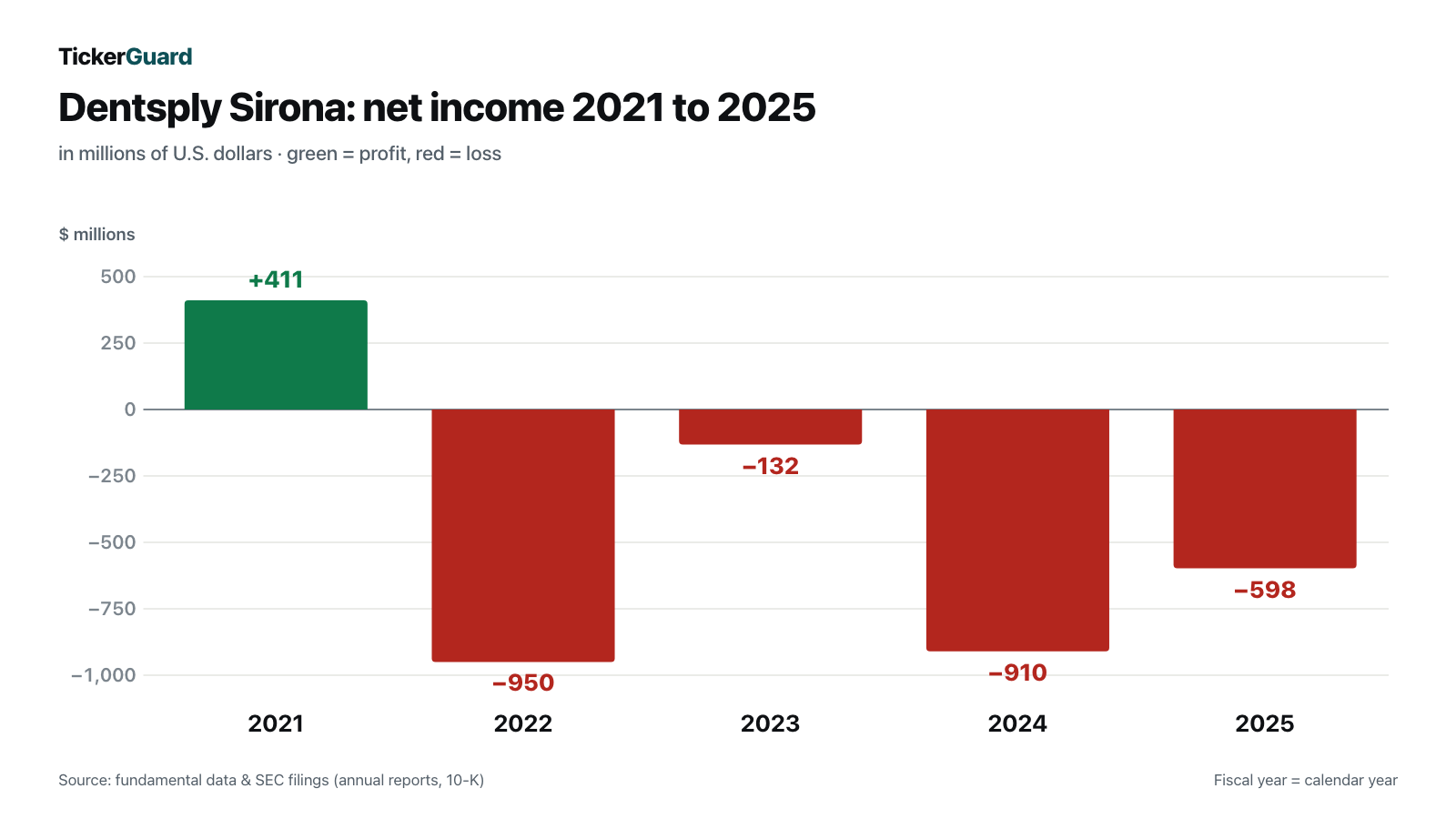
The losses don’t come from day-to-day operations; they come almost entirely from impairments. In 2022 the company wrote down $1,287 million of goodwill and intangible assets, $307 million in 2023, $1,014 million in 2024 and $650 million in 2025 — about $3.26 billion in total. No cash went out the door. But an impairment is an admission: what the company once paid for is worth less than it thought. In short: the cash register works, revenue is crumbling, and every year the balance sheet clears out more old hopes.
What the filings say — the uncomfortable truths
Uncomfortable truth #1: The implant goodwill is gone entirely — and so are three quarters of the equity
Goodwill arises when a company pays more for an acquisition than its assets are worth. Think of buying a busy café: you don’t just pay for the chairs and the espresso machine, you pay extra for the regulars. If the café later struggles, that premium is lost — and has to be written off. At Dentsply Sirona, the implant business took the biggest hit. After another $116 million impairment at the end of 2025, the annual report says:
“This impairment charge resulted in a full impairment of all remaining goodwill within the reporting unit.”
— DENTSPLY SIRONA Inc., SEC annual report 10-K for 2025, goodwill note (Implant & Prosthetic Solutions)
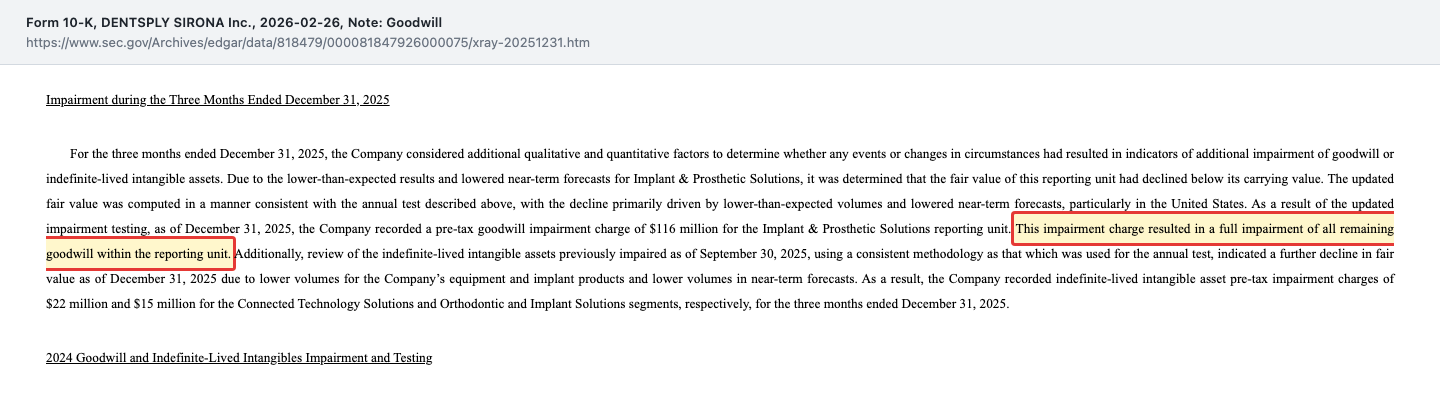
The report cites lower volumes, especially in the U.S., lowered forecasts and the impact of U.S. tariffs. What this means for shareholders shows up in equity — the part of the assets that belongs to the owners after all debts are paid:
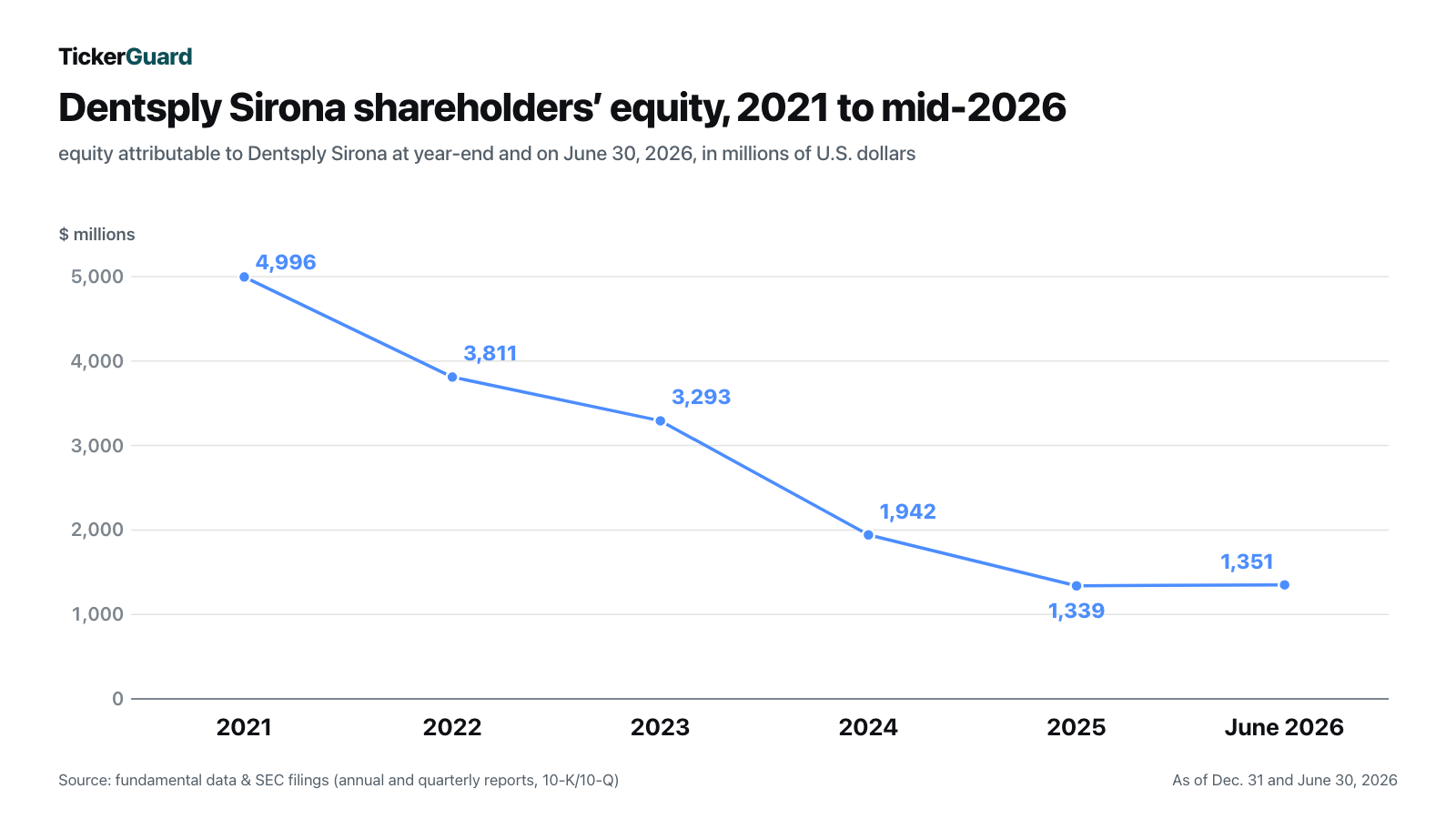
And even the remaining $1.35 billion is, on paper, entirely accounted for by goodwill and other intangibles: at June 30, 2026, the balance sheet still carried $1,138 million of goodwill and $870 million of other intangible assets (trade names, technologies), $2.01 billion in total. Take them out and tangible equity comes to roughly negative $657 million (our own calculation). That is not a solvency alarm — brands and technology are real assets. But it means: every further impairment goes straight to the core.
Uncomfortable truth #2: The high-tech division earns the least
When people think of Dentsply Sirona, they think of scanners, 3D imaging and CEREC machines that mill a ceramic crown in a single visit. That is the Connected Technology Solutions segment. It brought in $1.04 billion of revenue in 2025 — and only $52 million of segment adjusted operating income, about 5 cents per revenue dollar. The unglamorous consumables earned almost ten times as much, $514 million. Think of it as a store where the shiny machines in the window draw customers in, but the files and fillings on the shelves behind them pay the rent.
Then there is the segment with implants and clear aligners. Here Dentsply Sirona had sold aligners directly to consumers under the Byte brand. Sales were suspended in October 2024, and in January 2025 came the final end for new patients:
“In January 2025, we announced that Byte aligners would no longer be offered to new patients.”
— DENTSPLY SIRONA Inc., SEC annual report 10-K for 2025, Item 1A “Risk Factors”
The company had voluntarily suspended sales and marketing on October 24, 2024. In the second quarter of 2026, revenue in this segment fell 13.2 percent to $197 million, and 27.1 percent in the Americas — according to the quarterly report, because of the absence of Byte and lower implant volumes. The lesson: at Dentsply Sirona, the growth dreams sit in the weakest lines of the income statement.
Uncomfortable truth #3: First-half 2026 profit is smaller than the tariff refund
In the second quarter of 2026, Dentsply Sirona reported net income of $37 million after a $45 million loss a year earlier, and gross margin rose from 52.4 to 54.9 percent. That sounds like a turnaround. But the quarterly report lists tariff refunds first among the reasons for the better margin, followed by currency effects. The size of the effect appears in the liquidity section:
“Cash provided by operating activities increased compared to the six months ended June 30, 2025, driven by higher net income, which included $44 million related to tariff refunds received from the U.S. government, lower accounts receivable, and higher accounts payable.”
— DENTSPLY SIRONA Inc., SEC quarterly report 10-Q for June 30, 2026, Item 2 “Liquidity and Capital Resources”
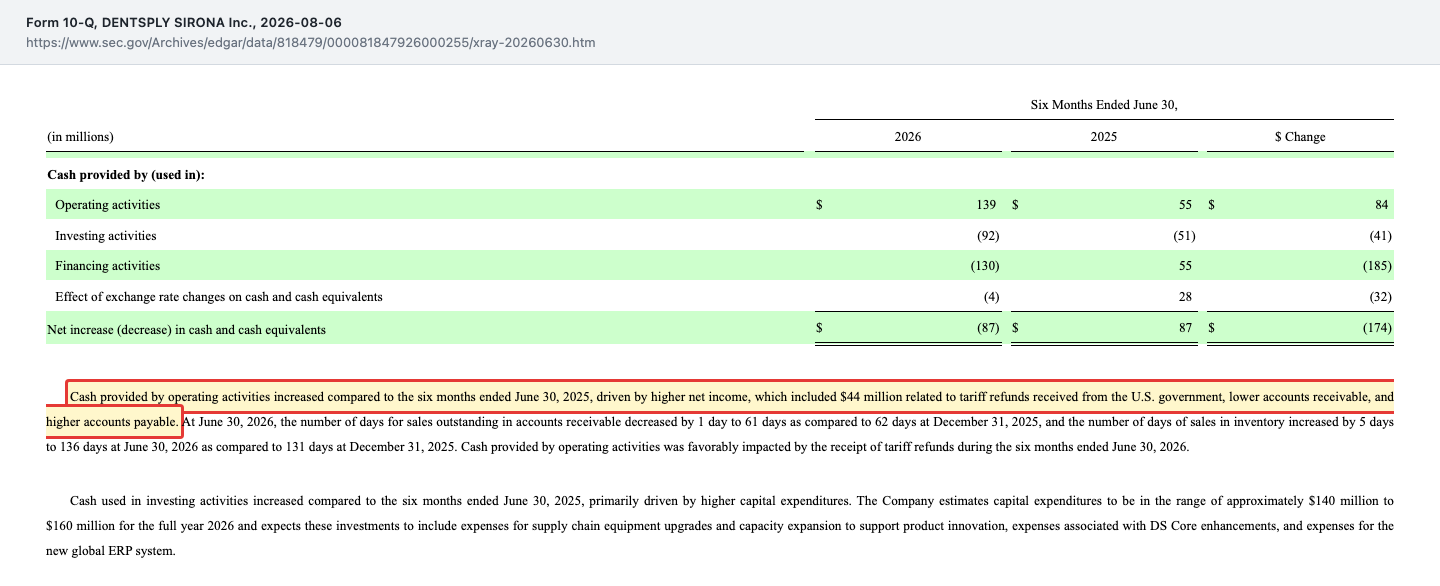
For comparison: net income for the entire first half of 2026 was $27 million. The refund is larger than the whole first-half profit. The comparison isn’t perfectly like-for-like — the refund is pre-tax, the profit after tax — but the order of magnitude shows how much of the first-half result rests on a one-off. The company itself strips it out of its earnings outlook: according to the August 6, 2026 earnings release, tariff refunds are not included in the guidance for adjusted earnings per share ($1.40 to $1.50). Think of someone who counts their tax refund as salary — they feel better paid than they are. Keep this in mind: a profit that comes from a refund doesn’t repeat itself.
Uncomfortable truth #4: Dividend eliminated — then the covenants loosened a second time
In 2025, Dentsply Sirona paid a dividend of $0.64 per share, $128 million in total. That same year, after capital expenditures ($131 million), operating cash flow ($235 million) left free cash flow of just $104 million — less than the payout. Net interest expense was $88 million in 2025 and $46 million in the first half of 2026. In February 2026, the board drew the consequence:
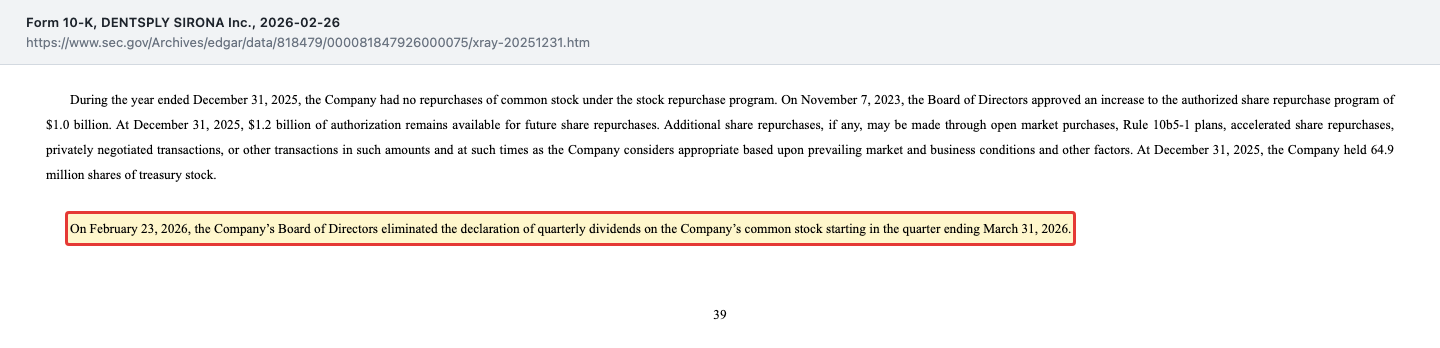
“On February 23, 2026, the Company’s Board of Directors eliminated the declaration of quarterly dividends on the Company’s common stock starting in the quarter ending March 31, 2026.”
— DENTSPLY SIRONA Inc., SEC annual report 10-K for 2025, Item 7 “Liquidity and Capital Resources”
In the fourth-quarter 2025 earnings release, CEO Scavilla explained that eliminating the dividend would enable “the redeployment of capital toward share repurchases and debt reduction.” Dividend cuts are not unusual; how it played out at another company that more than halved its payout in 2025 is covered in our ManpowerGroup analysis. At Dentsply Sirona, the second piece of news came in October. On December 24, 2025, banks and noteholders had already loosened the loan covenants — think of them as the house rules a lender imposes on a borrower, such as how high debt may be relative to earnings. On October 8, 2026, a second loosening within ten months followed, this time for the third and fourth quarters of 2026. The 8-K gives the reason:
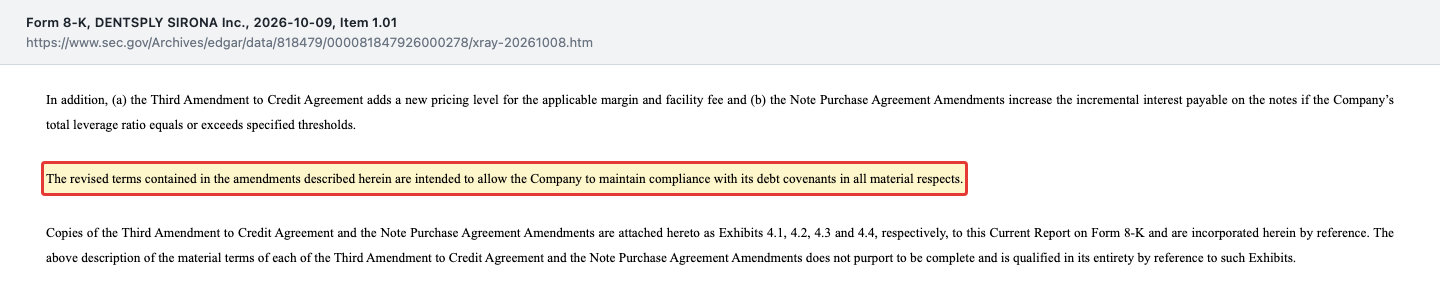
“The revised terms contained in the amendments described herein are intended to allow the Company to maintain compliance with its debt covenants in all material respects.”
— DENTSPLY SIRONA Inc., SEC current report 8-K of October 9, 2026, Item 1.01
The price of the relief: until the compliance certificate for fiscal 2026 is delivered, new liens and new subsidiary debt are largely prohibited, restricted payments to shareholders — which include buybacks — may not exceed $25 million per quarter during this period, subject to exceptions, per Exhibit 4.1 (the December 2025 amendment had already restricted certain payments), and the extra interest rises above certain leverage thresholds. The announced shift toward buybacks now has a lid on it; in the first half of 2026 the company repurchased 1.3 million shares for about $12 million. Our own back-of-the-envelope math shows how tight it is: $2.22 billion of debt (June 30, 2026) divided by $621 million of adjusted EBITDA over the last four quarters comes to about 3.6 times. Under the amended credit agreement (Exhibit 4.1), the cap stays at 4.25 times at the end of September and the end of December 2026, replacing the previously scheduled 4.0 in the marked-up agreement; from March 2027 it drops to 3.75 times. The contractual definition differs from our math (it allows add-backs for restructuring costs, for example), but the direction is the same. In numbers: at the same debt level, adjusted EBITDA could fall by roughly 16 percent before our math hits 4.25 times by the end of 2026 — against the cap from March 2027 (3.75 times), just under 5 percent of headroom remains unless debt comes down by then. What a breach would mean, the annual report spells out itself:
“Our failure to comply with those covenants could result in an event of default which, if not cured or waived, could result in the acceleration of all of our debt, which could adversely affect our business, earnings and financial condition.”
— DENTSPLY SIRONA Inc., SEC annual report 10-K for 2025, Item 1A “Risk Factors”
The 10-Q for September 30, 2026 had not been filed as of November 3, 2026; when it arrives, the covenant disclosure is the first place to look. To be fair: at June 30, 2026, Dentsply Sirona was in compliance with all covenants, had $683 million of available credit lines and, per the quarterly report, expects sufficient liquidity for the next twelve months. The combined revolving credit and commercial paper capacity of $700 million runs until May 2028. This is not an acute crunch. But the pattern is clear: a company that needs gentler rules twice in ten months is no longer negotiating from strength.
Valuation: cheap on paper — but measured against which earnings?
With 199,353,876 shares outstanding (as of July 24, 2026) and a closing price of $9.90 on November 2, 2026, the market value came to about $1.97 billion. Against $3.64 billion of revenue over the last four quarters (through June 30, 2026), that is a price-to-sales ratio of about 0.54. Add net debt ($2.22 billion of debt minus $239 million of cash) and the whole company costs about $3.96 billion — roughly 6.4 times adjusted EBITDA over the last four quarters ($621 million, our own calculation). Based on the 2026 guidance for adjusted earnings per share ($1.40 to $1.50), the price-to-earnings ratio is about 7.
That sounds cheap. The catch is the word “adjusted”: among other things it excludes acquisition-related amortization, restructuring costs and impairments — exactly the items that have explained Dentsply Sirona’s losses for years. Under the unvarnished rules (GAAP), the company earned $0.14 per share in the first half of 2026, including the tariff refund. And the pair of numbers from the start belongs right here: the 65.3 million treasury shares (06/30/2026) sit on the balance sheet at a combined cost of $3.08 billion — about $47 per share on average, almost five times the November 2, 2026 price. The total built up over many years and is not adjusted for inflation: at the end of 2015, before the combination with Sirona, treasury shares were already carried at about $0.9 billion; in 2024 the company still spent $250 million on buybacks, in 2025 nothing. The roughly $47 is a historical cost basis, not a yardstick for what the stock is worth today — above all it shows how much shareholder money went into buybacks that are not reflected in the market value. It is not a loss in any accounting sense. So keep this in mind: Dentsply Sirona stock is only cheap if the adjusted earnings are the real ones.
Upside and risks at a glance
What speaks for Dentsply Sirona:
- Market position: by its own account the world’s largest diversified dental manufacturer, with $3.68 billion of revenue (2025) and products ranging from consumables to imaging to implants.
- Profitable consumables: $514 million of segment adjusted operating income on $1.47 billion of revenue (2025); Wellspect is growing (second quarter of 2026: +7.1 percent).
- Positive operating cash flow in every year from 2017 through 2025, $139 million in the first half of 2026; $683 million of available credit lines (06/30/2026).
- Cost program: the plan from February 2026 targets about $120 million of annualized savings; part of it is meant to go into innovation, clinical education and sales team training.
- Low valuation: price-to-sales of about 0.54 and about 7 times guided 2026 adjusted earnings (as of 11/02/2026).
What speaks against it:
- Shrinking revenue: $4.23 billion (2021) down to $3.68 billion (2025), second quarter of 2026 −4.1 percent, implants and aligners −13.2 percent.
- About $3.26 billion of impairments from 2022 through 2025, implant goodwill fully written off, negative tangible equity (about −$657 million, 06/30/2026).
- Covenants loosened twice within ten months (December 2025, October 2026); by our own approximation only about 5 percent of EBITDA headroom against the cap from March 2027; restricted payments and new debt limited until the fiscal 2026 compliance certificate.
- Earnings quality: first-half 2026 profit ($27 million) is smaller than the tariff refund ($44 million); the high-tech division earns only about 5 percent of revenue.
- No dividend since the first quarter of 2026; pending shareholder class actions filed in 2022 and 2024 that accuse the company and former executives of misleading statements — allegations, not findings. Related derivative suits point to revenue recognition tied to distributor rebate programs and distributor inventory levels. For the 2022 case, the company recorded a liability at 06/30/2026, offset by an insurance receivable (no earnings impact).
A human conclusion
Back to the market-leader trap from the beginning. Its core is not that size is worthless — Dentsply Sirona has brands, customers and a consumables business earning about 35 cents of segment income per revenue dollar (2025). Its core is that size gives you the feeling you no longer need to do the math. The filings show something else: revenue in 2025 13 percent below 2021, $3.3 billion of written-off hopes, equity that would be negative without goodwill, and lenders who now have a say in how much cash may flow to shareholders. So the honest question for you is not “Can a company this big fail?” but: how would you recognize that the turnaround is real? For Dentsply Sirona, it comes down to three numbers: revenue that grows again without one-offs, GAAP earnings without tariff refunds — and a quarterly report that meets the covenants without another amendment. If you see all three, you have a thesis. If not, you only had a big name. What you make of it is your decision. And that’s how it should be.
Sources
All primary documents used in this analysis — so you can check them yourself:
- DENTSPLY SIRONA Inc. — SEC current report 8-K of October 9, 2026 (covenant amendments, Items 1.01 and 2.03) with Exhibit 4.1 (Third Amendment to Credit Agreement)
- DENTSPLY SIRONA Inc. — SEC current report 8-K/A of August 7, 2026, Exhibit 99.1 (second-quarter 2026 results and outlook)
- DENTSPLY SIRONA Inc. — SEC quarterly report 10-Q for June 30, 2026 (filed August 6, 2026)
- DENTSPLY SIRONA Inc. — SEC quarterly report 10-Q for March 31, 2026 (filed May 5, 2026)
- DENTSPLY SIRONA Inc. — SEC current report 8-K of June 11, 2026 (new CFO)
- DENTSPLY SIRONA Inc. — SEC current report 8-K of February 26, 2026, Exhibit 99.1 (2025 results, 2026 outlook, dividend elimination)
- DENTSPLY SIRONA Inc. — SEC annual report 10-K for 2025 (filed February 26, 2026)
- DENTSPLY SIRONA Inc. — SEC annual report 10-K for 2024 (filed February 27, 2025)
- Full SEC filing history: EDGAR overview for Dentsply Sirona (sec.gov)
- Fundamental data (prices, analyst ratings; data as of November 2, 2026), cross-checked against the SEC filings and the SEC’s XBRL data series.
Transparency & disclaimer: this analysis is journalistic commentary on publicly available information. It is not investment advice, not a regulated investment research product and not a solicitation to buy or sell securities. Equity investments carry substantial risk up to and including total loss. All information is provided without warranty; the as-of date for each figure is stated in the text. Positions held by the operator are disclosed daily; where one exists, it appears as a notice at the top of this analysis.
Key figures at a glance
All monetary figures in millions of $; earnings per share as reported.
| Metric | 2021 | 2022 | 2023 | 2024 | 2025 |
|---|---|---|---|---|---|
| Revenue | 4,231.0 | 3,922.0 | 3,965.0 | 3,793.0 | 3,680.0 |
| Operating Income (EBIT) | 608.0 | -937.0 | -85.0 | -879.0 | 252.0 |
| Net Income | 411.0 | -950.0 | -132.0 | -910.0 | -598.0 |
| Net Margin | 9.7% | -24.2% | -3.3% | -24.0% | -16.3% |
| Earnings Per Share | 1.87 $ | -4.41 $ | -0.62 $ | -4.48 $ | -3.00 $ |
Source: fundamental data & SEC filings (annual and quarterly reports, 10-K/10-Q)
Our Bottom Line at a Glance
- Market position & core business positive
- By its own account the world’s largest diversified dental manufacturer: $3.68 billion of revenue (2025), well-known brands in practices and labs. The consumables segment earned $514 million of segment adjusted operating income on $1.47 billion of revenue in 2025.
- Revenue & earning power negative
- Revenue down from $4.23 billion (2021) to $3.68 billion (2025), second quarter of 2026 −4.1 percent. Four straight loss years (2022 to 2025), driven by about $3.26 billion of impairments in total; the equipment division earns only about a 5 percent segment margin.
- Cash flow & earnings quality neutral
- Operating cash flow positive in every year, but down from $657 million (2021) to $235 million (2025); $139 million in the first half of 2026. First-half 2026 net income of $27 million includes $44 million of tariff refunds.
- Balance sheet & covenants negative
- Equity shrank from $5.0 billion (2021) to $1.35 billion (06/30/2026), tangible equity negative (about −$657 million, own calculation). Covenants loosened in December 2025 and October 2026; debt of $2.22 billion at roughly 3.6 times adjusted EBITDA (own calculation). In compliance at 06/30/2026, $683 million of available credit lines.
- Restructuring & leadership neutral
- New CEO since 2025, new CFO (appointed in June, in office since July 20, 2026), cost program targeting about $120 million of annualized savings (plan from February 2026), 2026 outlook reaffirmed on 08/06/2026. Whether the turnaround holds is not yet proven in the numbers.
Dentsply Sirona is an example of the market-leader trap: a well-known company with a strong consumables business and positive cash flow — but with revenue 13 percent below 2021, about $3.3 billion of impairments since 2022, equity down to just over a quarter, an eliminated dividend and covenants loosened twice. Buyers are betting that the cost program and new leadership stabilize revenue before the covenants tighten again. Not investment advice.
What Our Rating Means
Open questions
The business works in principle, but one material question is open. As long as it stays open, our findings do not carry a quality verdict.
The day-to-day business holds up: operating cash flow was positive every year, the covenants have been met so far, and there are $683 million of available credit lines. The central operating question is open — whether revenue, down 13 percent since 2021, stabilizes. Yellow rather than red because there is no covenant breach, no liquidity gap and no going-concern warning; a third amendment or a breach would change the picture. The decision is yours.
A journalistic assessment by our editorial team at the time of the deep dive, based on public sources — not investment advice and not a solicitation to buy or sell. Your personal circumstances (investment goals, risk capacity, taxes) cannot be taken into account. What our levels mean, how verdicts are formed, and what conflicts of interest exist →
Worth Noting
- This analysis was prompted by the share price decline from $13.78 (08/05/2026) to $8.42 (10/19/2026, the lowest close in the twelve months through early November 2026), with the October 9, 2026 filing on the second covenant loosening in ten months in between (closing prices, fundamental data).
- The 10-Q for September 30, 2026 had not been filed as of November 3, 2026; the most recent periodic report is the 10-Q for June 30, 2026. Own calculations: adjusted EBITDA for the last four quarters $621 million (full-year 2025 $667 million minus first-half 2025 $365 million plus first-half 2026 $319 million, per the earnings releases); tangible equity = $1,351 million minus $1,138 million of goodwill minus $870 million of intangibles.
- This analysis covers the common stock of DENTSPLY SIRONA Inc. (Nasdaq: XRAY, CIK 0000818479); filings through February 2016 are listed at the SEC under DENTSPLY International Inc. Valuation dated and evergreen: market value from 199,353,876 shares × $9.90 (11/02/2026).
Stock Watch
This analysis is as of November 3, 2026. Stock Watch will tell you what's changed at XRAY since then.
Later $1 a month per stock — signing up is free, and you'll be the first to know when it launches.
The full analysis as a PDF for later
We will send you this analysis as a PDF — to print, file away, and read at your own pace. And we will add you to the free Stock Watch list for Dentsply Sirona Inc (XRAY), so you hear about it when something material in this analysis changes.
Frequently Asked Questions
DENTSPLY SIRONA Inc. (Nasdaq: XRAY), based in Charlotte, North Carolina, makes products and equipment for dental practices and labs: consumables and instruments such as those used in root canal treatment, imaging and scanning equipment, CEREC systems, implants and clear aligners. Its Wellspect unit adds catheters and irrigation systems. In 2025 the company generated $3.68 billion of revenue and employed about 14,000 people.
Mainly because of goodwill and intangible asset impairments: $1,287 million (2022), $307 million (2023), $1,014 million (2024) and $650 million (2025). Most recently the implant business was hit hardest; its goodwill was fully written off by the end of 2025. The 2025 net loss was $598 million; the first half of 2026 showed a $27 million profit, including $44 million of tariff refunds.
No. On February 23, 2026, the board eliminated the quarterly dividend starting with the first quarter of 2026. In 2025 Dentsply Sirona had paid $0.64 per share, $128 million in total — more than its free cash flow of $104 million. According to the CEO, the money was to go toward buybacks and debt reduction. The December 2025 credit amendment had already restricted certain payments; since October 2026, dividends and buybacks are capped at $25 million per quarter through the fiscal 2026 compliance certificate, subject to exceptions.
On October 8, 2026, banks and noteholders raised the maximum permitted leverage for the third and fourth quarters of 2026 — the second time in ten months, after December 2025. Per the 8-K, the changes are meant to keep the company in compliance. In return, new subsidiary debt and new liens are largely prohibited, restricted payments are limited, and the extra interest on the notes rises above certain thresholds.
On paper, yes: at $9.90 (November 2, 2026) the market value was about $1.97 billion, the price-to-sales ratio about 0.54, and the price-to-earnings ratio on guided 2026 adjusted earnings ($1.40 to $1.50) about 7. But adjusted earnings leave out impairments and restructuring costs; under GAAP the company earned only $0.14 per share in the first half of 2026.
Dentsply Sirona voluntarily suspended sales and marketing of its direct-to-consumer Byte aligners on October 24, 2024, and announced in January 2025 that they would no longer be offered to new patients. Byte-related assets of $187 million were written off in the fourth quarter of 2024. The loss of Byte still weighs on the implants and aligners segment, whose revenue fell 13.2 percent in the second quarter of 2026.
Found an error?
Did you spot a factual error, an outdated number, or a typo in this deep dive? Let us know briefly — your report goes straight to the editorial team.