ManpowerGroup Calls an “Inflection Point” — but the Margin Lost Since 2022 Exceeds Its Entire Operating Profit
Staffing giant ManpowerGroup calls 2026 an “inflection point,” and its stock more than doubled between February and August 2026. The filings with the U.S. securities regulator, the SEC, paint a more mixed picture: revenue is growing again, but gross margin has been falling since 2022, operating cash flow turned negative in 2025, the dividend was more than halved, and the company itself lists its clients’ use of AI as a risk to demand. And its treasury holds its own shares that cost a combined $4.84 billion — more than twice what the whole company is worth on the stock market as of October 20, 2026. If you want to believe in a turning point, it helps to know what one actually looks like in the numbers.
 Thomas Mücke
Founder & Publisher
As of Today
As of: October 20, 2026
- Closing price
- 43.00 $ +3.62%
- Market Capitalisation
- 2.0 $B
- P/E
- 17.0
- Growth Score
- 1/10
- AAQS
- 1/10
This analysis has a cut-off date. The Stock Guard tells you when something material changes in the numbers. Reserve your free spot
Chart
Interactive price chart (TradingView).
52-week range: 25.80 $ to 63.00 $ · Last price: 43.00 $ (As of: October 20, 2026)
Note: pure fact-based analysis, not investment advice and not a solicitation to buy or sell. All figures without guarantee.
There is one word that makes investors stop calculating and start hoping. The word is inflection point. When management says the worst is behind it, your brain no longer hears “maybe” — it hears “here we go,” and it buys the future before the future shows up in the numbers. Call it the turning-point trap. ManpowerGroup (NYSE: MAN), one of the largest staffing companies in the world, put the word out there itself:
“Our performance to date reinforces our confidence that 2026 is an inflection point for the business.”
— Jonas Prising, Chair and CEO, SEC current report 8-K of October 15, 2026, Exhibit 99.1 (third-quarter 2026 results)
The market had celebrated the turn in advance: from $25.75 (close on February 24, 2026) the stock climbed to $62.95 (August 31, 2026), a gain of about 144 percent in six months. On the day of the third-quarter results, October 15, 2026, it fell from $51.96 to $43.74 (fundamental data). Before you lean on the turning point, let’s read together what the company has told the U.S. securities regulator, the SEC — the annual report (10-K) for 2025, the quarterly reports (10-Q) through June 30, 2026, and the third-quarter earnings release. Filing false information with the SEC carries penalties, which makes these documents some of the most reliable sources there are. In the end, the decision is yours.
What ManpowerGroup actually does — renting out workers and earning the spread
ManpowerGroup is a staffing company. Its core business is temporary staffing: it hires people and places them with companies that need workers at short notice — in logistics, in factories, in offices, in IT. Think of it as a car rental company, except the fleet is people. The client pays an hourly rate, ManpowerGroup pays the worker’s wage plus payroll taxes, and what is left in between is the gross margin. It is the heart of the business, and it is thin: in 2025, 16.7 cents of every revenue dollar remained. Offices, sales and administration still have to come out of that — leaving an operating profit of 0.8 cents per revenue dollar in 2025.
Three brands sit under the roof: Manpower (classic staffing and placement), Experis (IT and professional talent) and Talent Solutions (recruitment process outsourcing, managed service programs for contingent workforces, and career transition services). At December 31, 2025 the company had about 25,400 employees in about 2,100 offices across more than 70 countries; by its own count it supports about 485,000 workers every day. About 85 percent of revenue came from outside the U.S. in 2025, most of it from Europe. France alone made up 53 percent of the Southern Europe segment in 2025; in the third quarter of 2026 ManpowerGroup generated $1.13 billion of revenue there, just under a quarter of group revenue. Large national and multinational clients made up about 60 percent of revenue in 2025, and they often split their business among several providers. How a specialized U.S. healthcare staffing company handled the demand slump is covered in our AMN Healthcare analysis; a business model that outsources HR administration rather than renting out workers is described in our Insperity analysis.
That sets up the central tension of this analysis, and it runs through every section: revenue is growing again in 2026 — but every revenue dollar carries less margin, the cash comes in late, and the clients ManpowerGroup lives off are increasingly turning to AI.
Company history for investors
-
2013
Manpower Inc. becomes ManpowerGroup
Until 01/30/2013 the SEC lists the company as Manpower Inc., afterwards as ManpowerGroup Inc. Nothing changes for shareholders: the CIK and the NYSE ticker MAN stay the same.
-
2022
Margin peak: 18.0% gross margin
Gross margin reaches 18.0%, operating profit $581.7M. In June a €400M bond at 3.50% is issued, maturing in June 2027.
-
2025
Cash outflow and a halved dividend
Operating cash flow of −$104.1M, dividend cut from $3.08 to $1.44 per share, goodwill impairments in the U.K. and Switzerland, a 114.2% tax rate.
-
2026
“Inflection point” and a change at the top
Revenue grows again and the stock more than doubles by August. On 10/15/2026 the company reports Q3 results and the CEO handover to Becky Frankiewicz effective 01/01/2027.
How the stock landed on our desk
What prompted this analysis was the share-price move around the third-quarter 2026 results. A stock that more than doubles in six months and then loses 15.8 percent in a single day (October 15, 2026, from $51.96 to $43.74) shows how much hope was priced in. That same day ManpowerGroup reported two things: a third quarter with 4.4 percent more revenue and almost twice the net income ($34.1 million versus $18.0 million) — and a change at the top. Jonas Prising hands the CEO role to Becky Frankiewicz, until now President and Chief Strategy Officer, on January 1, 2027, and becomes Executive Chair. For the fourth quarter, the company guided to diluted earnings per share of $1.03 to $1.13, with a 44 percent tax rate.
The analysts covering the stock are cautious: of twelve, three rate it a strong buy, one a buy and eight a hold; their average price target is $52.33 (fundamental data, as of October 21, 2026). That is the view of those analysts, not an assessment by TickerGuard. Classic metrics from our scanners only go so far here: for a staffing company with an operating margin below one percent (2025), a low price-to-sales ratio says little. So keep this in mind from the start: at ManpowerGroup, revenue is not what decides — what sticks from it is.
The numbers over the years, given their due
First, what ManpowerGroup does well — and that is a lot. The company moves revenue of roughly $18 billion to $22 billion a year (2018: $21.99 billion, 2022: $19.83 billion, 2025: $17.96 billion), a scale smaller rivals cannot match. From 2015 through 2025 it booked an operating profit in every single year, including the pandemic year 2020 ($187.6 million). And it has rewarded shareholders generously for years: from 2015 through 2025 ManpowerGroup bought back its own stock for a combined $3.07 billion according to the SEC’s XBRL data, and from 2019 through 2025 it paid out about $892 million in dividends.
At first glance, 2026 looks good too. In the first nine months revenue rose 7.3 percent to $14.21 billion (4.7 percent in constant currency), and net income swung from −$43.5 million to +$90.1 million. In the third quarter, the U.S. business grew 5.5 percent and its segment profit 18.2 percent; Northern Europe went from a $14.9 million loss to a $7.5 million profit. There is also a one-off: on April 30, 2026, ManpowerGroup sold its U.S. Jefferson Wells business (finance and accounting professionals) for a transaction value of $100 million and initially booked a $30.0 million gain, which was adjusted slightly downward in the third quarter with the final settlement. Now for the chart that puts it all in order — the margins over eight years:
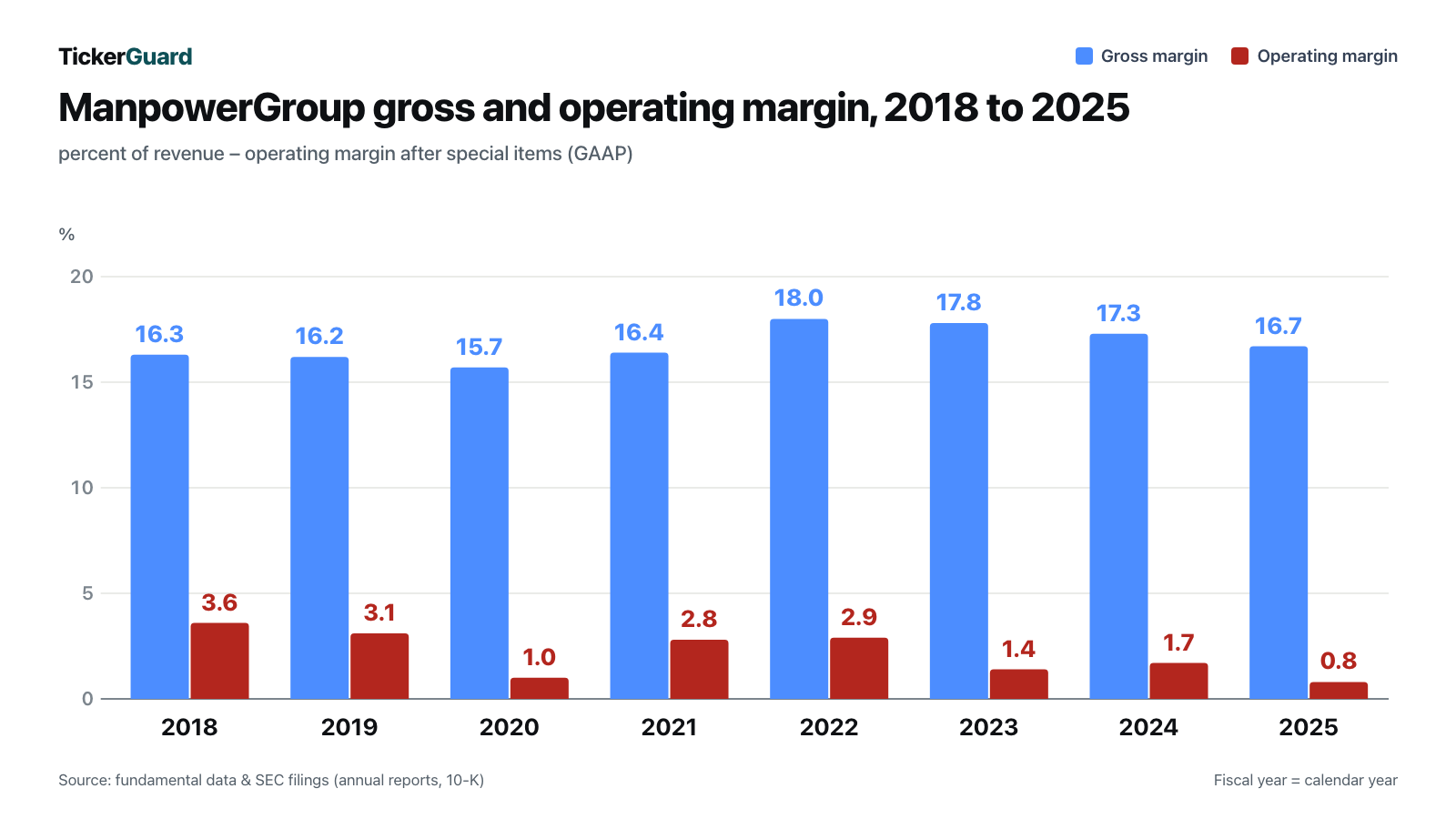
The chart shows two things. First, gross margin has fallen three years in a row since its 2022 peak. Second, less and less of the gross margin survives as operating profit: 3.6 percent of revenue in 2018, 0.8 percent in 2025, partly because of goodwill impairments on the U.K. and Swiss businesses and restructuring costs. Operating profit fell from $796.7 million (2018) to $150.1 million (2025), and 2025 ended with a net loss of $13.3 million. Keep the picture in mind: ManpowerGroup is still big, but its earning power has shrunk to a fraction.
What the filings say: the uncomfortable truths
Uncomfortable truth No. 1: More revenue, less margin — and the gap is bigger than operating profit
The growth of 2026 comes at a price. In the third quarter of 2026 revenue rose 4.4 percent to $4.84 billion — but gross profit edged down, from $768.9 million to $767.3 million. Gross margin fell from 16.6 to 15.9 percent. Over nine months it stands at 16.0 percent versus 16.8 percent a year earlier. The June 30, 2026 quarterly report names the reason itself:
“In the second quarter of 2026, our gross profit margin decreased 80 basis points compared to the second quarter of 2025, primarily attributable to decreases in our staffing and interim margins due to business mix shifts and impact from the sale of the higher-margin Jefferson Wells U.S. business.”
— ManpowerGroup Inc., SEC quarterly report 10-Q for June 30, 2026, Item 2 MD&A
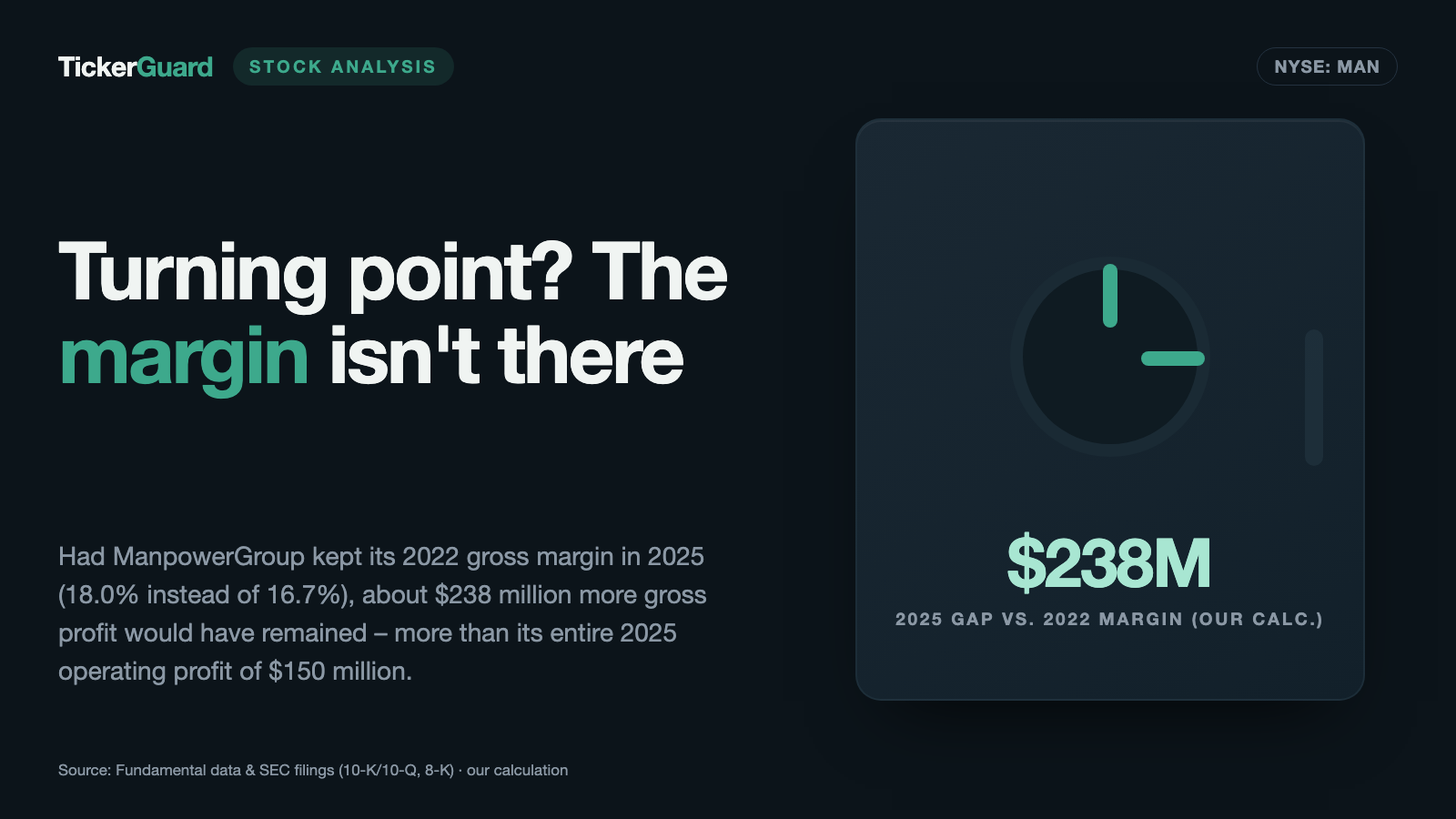
In plain terms: the growth comes mainly from classic staffing under the Manpower brand, and that is cheaper than IT specialists or placement fees. A simple calculation shows how large the effect is. In 2022, 18.0 cents of every revenue dollar remained as gross profit; in 2025, 16.7 cents. Using the unrounded margins (18.02 and 16.69 percent) on 2025 revenue ($17.96 billion), that is about $238 million of missing gross profit — more than the entire 2025 operating profit of $150.1 million. A turning point in revenue is therefore not yet a turning point in profit. The lesson: if you grow by selling cheaper goods, you have to sell a lot more of them just to earn the same.
Uncomfortable truth No. 2: In 2025 cash flowed out instead of in — and the dividend was more than halved
A staffing company has a built-in cash problem as soon as it grows: it pays its placed workers weekly or monthly, but collects from clients weeks later. At June 30, 2026, clients took 56 days on average to pay. Think of a contractor who pays for materials and crew right away but gets paid two months later — the more jobs, the more money sits with the customer. In 2025, that happened even though revenue barely grew:
“Cash used in operating activities was $104.1 in 2025, as compared to $309.2 generated in 2024.”
— ManpowerGroup Inc., SEC annual report 10-K for 2025, Item 7 “Liquidity and Capital Resources” (amounts in millions of dollars)

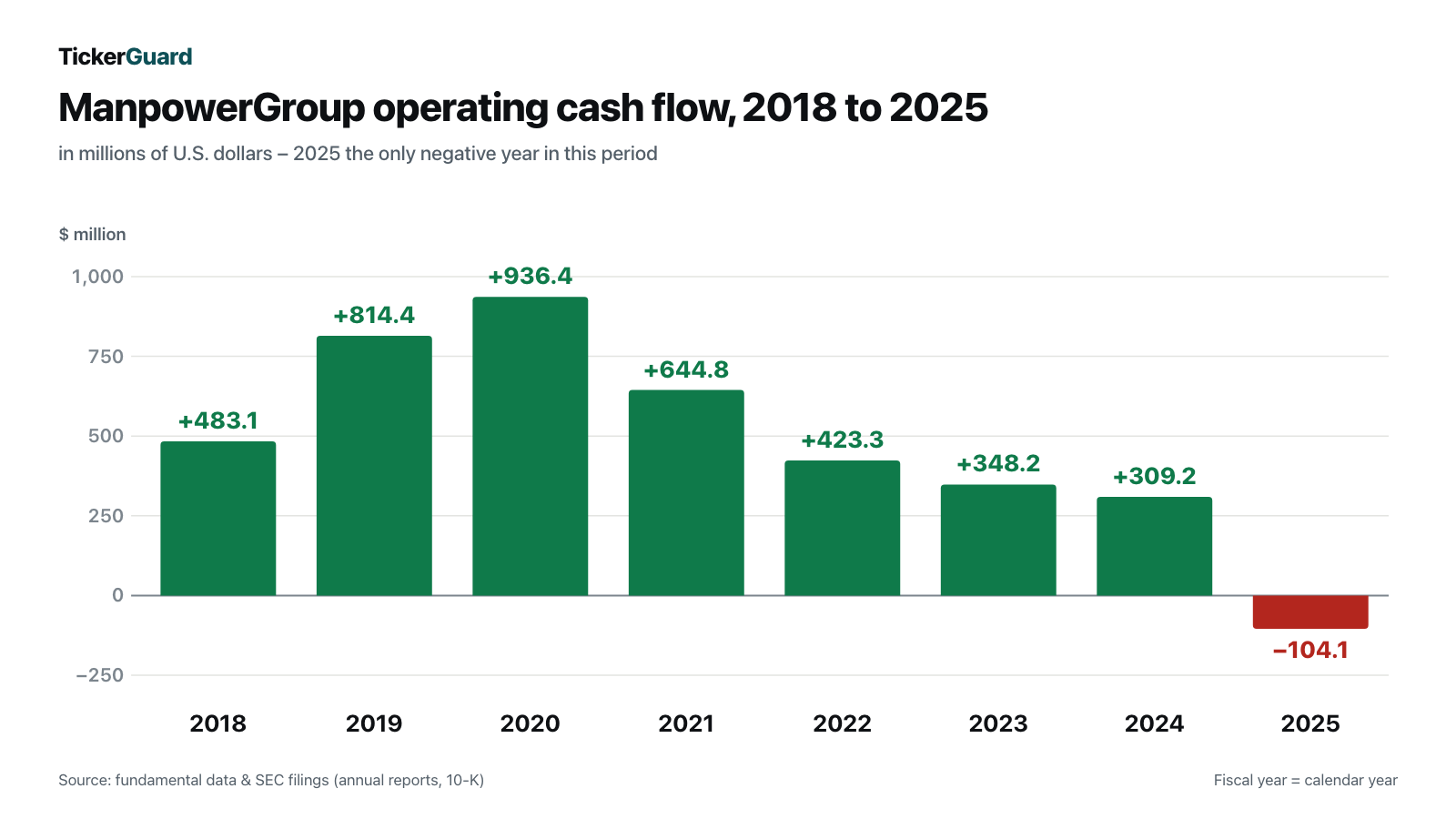
The dividend followed: shareholders received $3.08 per share in 2024 and only $1.44 in 2025; total payouts fell from $145.8 million to $66.7 million. In fairness, ManpowerGroup’s cash flow swings a lot over the year. In 2025 the outflow stood at $283.0 million after nine months and shrank to $104.1 million by year-end, because a lot of client money comes in during the final quarter. In 2026 it stands at −$137.0 million after nine months. Whether 2026 ends positive will only show in the next annual report. Bottom line: growth costs a staffing company cash first — so the turning point has to show up in the cash, not just in revenue.
Uncomfortable truth No. 3: Its own clients are deploying AI — and that can cost ManpowerGroup business
ManpowerGroup lives off companies needing people for tasks. What happens when software takes over some of those tasks? The annual report raises the question itself, in its risk factors:
“The rapidly increasing deployment of AI technology by our customers may lead to reduced demand for our services and solutions. As these technologies evolve, some services and tasks currently performed by our associates may be replaced by AI automation, which could lead to reduced demand for our services if we cannot replace such demand with new services.”
— ManpowerGroup Inc., SEC annual report 10-K for 2025, Item 1A “Risk Factors”

A few paragraphs later the report goes further: there is a risk that these developments could result in “significant rapid disruption to our business model.” That is not boilerplate; it is a specific statement about the company’s own business. Our AI rating therefore classifies ManpowerGroup as “threatened” — even though the company uses AI itself, for example in candidate assessments and internal operations. The report does not say which tasks might go first. There is still a place to watch: the IT and professional brand Experis was still losing revenue in the second quarter of 2026 and only returned to growth in the U.S. in the third quarter. On its own, that proves nothing about AI — but this brand is where you are most likely to see whether demand for office and knowledge work holds up. The core of the risk: a staffing company earns on tasks that people do — every task a piece of software takes over is missing from its books.
Uncomfortable truth No. 4: Almost half of pre-tax income goes to the taxman — and not just since 2026
Even when ManpowerGroup makes money, remarkably little reaches shareholders. In the third quarter of 2026 it booked $68.0 million of pre-tax income; $33.9 million went to income taxes, $34.1 million remained. 2025 was even more extreme:
“We recorded income tax expense at an effective rate of 114.2% for 2025, as compared to an effective rate of 43.5% for 2024.”
— ManpowerGroup Inc., SEC annual report 10-K for 2025, Item 7 “Provision for Income Taxes”
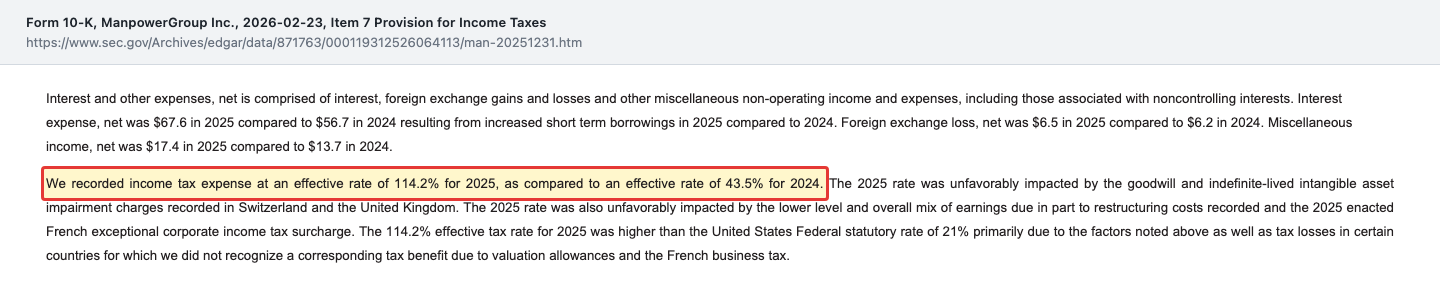
A tax rate above 100 percent means tax expense ($106.7 million) exceeded pre-tax income ($93.4 million). Part of that is self-inflicted — impairments that are not tax-deductible, and losses in countries where they save no tax. Another part comes from France: the report cites an exceptional French corporate income tax surcharge enacted in 2025 and extended by one year in the 2026 Finance Bill, plus the French business tax. For the fourth quarter of 2026, ManpowerGroup itself expects 44 percent. In everyday terms: of every dollar the company earns before taxes, almost one in two currently goes to the tax authorities. Remember this: at ManpowerGroup, a political decision in Paris can move earnings per share more than a good quarter can.
Uncomfortable truth No. 5: Cheap money is over — and the next bond matures in June 2027
ManpowerGroup funds itself largely through euro-denominated bonds. In January 2026 the company redeemed a €500 million bond carrying 1.75 percent interest — using the proceeds of a new €500 million bond issued in December 2025 that costs 3.75 percent, more than twice as much. Interest expense rose to $28.0 million in the third quarter of 2026 from $24.0 million a year earlier. The next maturity is already set:
“Our €400.0 notes and €500.0 notes are due June 2027 and December 2030, respectively. We plan to refinance the notes at maturity, or prior to maturity, with new borrowings.”
— ManpowerGroup Inc., SEC quarterly report 10-Q for June 30, 2026, “Liquidity and Capital Resources”
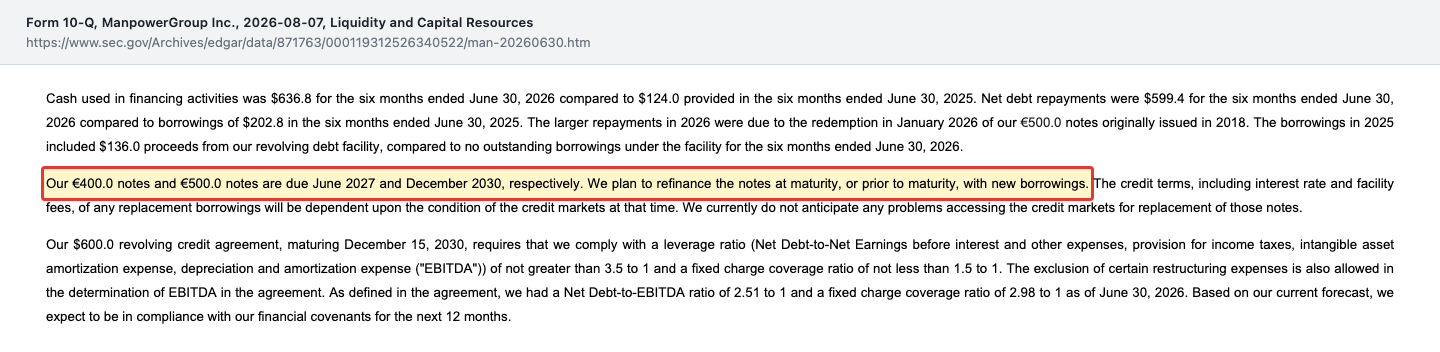
The 2027 bond carries a 3.50 percent coupon. At September 30, 2026, ManpowerGroup held $233.1 million in cash (end of 2025: $871.0 million), against $540.6 million of short-term and $562.8 million of long-term debt. That is not acute: at June 30, 2026 the $600 million revolving credit facility was essentially undrawn (in the third quarter of 2026 the company drew a net $50.0 million from it), and the covenants were met with room to spare — net debt at 2.51 times EBITDA against a 3.5 limit, fixed-charge coverage at 2.98 times against a 1.5 minimum. But the cushion is thinner, and any refinancing is likely to cost more than the old debt did. Keep the picture in mind: no fire, but a thinner cushion — and interest eats into an already slim margin.
Valuation: below book value — but book value is mostly goodwill
With 46,505,570 shares (as of August 5, 2026) and a closing price of $42.98 on October 20, 2026, the market value was about $2.0 billion. Against about $18.92 billion of revenue over the last four quarters, that is a price-to-sales ratio of roughly 0.11; the price-to-earnings ratio on reported earnings over the last four quarters is about 17 (fundamental data). The $1.44 per-share dividend was equivalent to a yield of about 3.4 percent at that price. Shareholders’ equity stood at $2.14 billion at September 30, 2026, slightly above the market value — but $1.48 billion of it is goodwill and $408.3 million other intangible assets, accounting entries from past acquisitions. What remains is tangible equity of about $250 million, a little over $5 per share.
One detail from the same balance sheet sheds light on past capital allocation: at June 30, 2026, ManpowerGroup held 72,939,030 shares in treasury, bought back over many years at a combined cost of $4.84 billion — about $66 per share on average. The total is more than twice the company’s entire market value on October 20, 2026 (about $2.0 billion). Buybacks are not a mistake as long as they are cheap. In hindsight, though, ManpowerGroup spent a lot of money at prices that were, on average, well above the October 2026 share price. So remember: a price below book value is no proof of a bargain at ManpowerGroup — it is a bet that the margin comes back.
Upside and risks at a glance
What speaks for ManpowerGroup:
- Scale and reach: about 2,100 offices in more than 70 countries, $17.96 billion of revenue (2025); large clients with work in many countries need a provider of this size.
- Revenue is growing again: +7.3 percent in the first nine months of 2026, U.S. business +5.5 percent in the third quarter with 18.2 percent more segment profit, Northern Europe profitable again.
- Solid funding: the $600 million credit facility was undrawn at June 30, 2026; net $50.0 million was drawn in the third quarter, leaving about $550 million available at September 30, 2026 (our calculation), covenants met with room to spare (2.51 against a 3.5 limit); the bond due in 2026 has already been replaced with one running to 2030.
- Valuation close to book value and a low 0.11 price-to-sales ratio; because the margin is so thin, any change in margin, up or down, shows up disproportionately in earnings.
- Tax lever: if the French surcharge lapses, the tax rate would fall from its recent level of roughly half of pre-tax income.
What speaks against it:
- Gross margin has been falling since 2022 (18.0 → 16.7 percent, first nine months of 2026: 16.0 percent); growth is coming from lower-margin staffing.
- Operating cash outflow in 2025 (−$104.1 million) and in the first nine months of 2026 (−$137.0 million); the dividend was more than halved in 2025.
- AI risk at the core: the annual report warns that AI at clients could replace tasks done by temporary workers and quickly disrupt the business model.
- Heavy tax burden (2025: 114.2 percent, third quarter of 2026: about 50 percent) and rising interest costs; a €400 million bond matures in June 2027 against $233.1 million of cash.
- Dependence on France (just under a quarter of third-quarter 2026 revenue, segment profit there down 26.9 percent) and a CEO change on January 1, 2027.
A human conclusion
Back to the turning-point trap from the beginning. Its core is not that management is exaggerating — the 2026 revenue growth is real, the U.S. business is doing well, Northern Europe is making money again. Its core is that a turning point in revenue feels like a turning point in the business, even when it is not one yet. At ManpowerGroup, the growth rests on a thin and thinning margin, the cash comes in late, the tax authorities take almost half, interest costs are rising, and the company’s own clients are working out which tasks software will handle next. So the honest question for you is not “Is 2026 the turning point?” but: how would you recognize that it was — and are you watching that number? For ManpowerGroup there are three: a rising gross margin, positive operating cash flow for the full year, and a tax rate that drops below 40 percent without the French surcharge. If you see all three in the next annual report, you have a thesis. If not, you only had a nice word. What you make of it is your call — and that is exactly as it should be.
Sources
All primary documents used in this analysis — so you can check them yourself:
- ManpowerGroup Inc. — SEC current report 8-K of October 15, 2026, Exhibit 99.1 (third-quarter 2026 results and fourth-quarter outlook)
- ManpowerGroup Inc. — SEC current report 8-K of October 15, 2026, Item 5.02 (CEO succession effective January 1, 2027)
- ManpowerGroup Inc. — SEC quarterly report 10-Q for June 30, 2026 (filed August 7, 2026)
- ManpowerGroup Inc. — SEC quarterly report 10-Q for March 31, 2026 (filed May 8, 2026)
- ManpowerGroup Inc. — SEC annual report 10-K for 2025 (filed February 23, 2026)
- ManpowerGroup Inc. — SEC annual report 10-K for 2024 (filed February 19, 2025)
- ManpowerGroup Inc. — SEC current report 8-K of August 11, 2026 (new board member)
- Full SEC filing history: EDGAR overview for ManpowerGroup (sec.gov)
- Fundamental data (prices, analyst ratings; data as of October 20 and 21, 2026), cross-checked against the SEC filings and the SEC’s XBRL data series.
Transparency & disclaimer: this analysis is journalistic commentary on publicly available information. It is not investment advice, not a regulated investment research product and not a solicitation to buy or sell securities. Equity investments carry substantial risk up to and including total loss. All information is provided without warranty; the as-of date for each figure is stated in the text. Positions held by the operator are disclosed daily; where one exists, it appears as a notice at the top of this analysis.
Key figures at a glance
All monetary figures in millions of $; earnings per share as reported.
| Metric | 2021 | 2022 | 2023 | 2024 | 2025 |
|---|---|---|---|---|---|
| Revenue | 20,724.4 | 19,827.5 | 18,914.5 | 17,853.9 | 17,957.1 |
| Operating Income (EBIT) | 585.4 | 660.5 | 255.8 | 306.0 | 238.8 |
| Net Income | 382.4 | 373.8 | 88.8 | 145.1 | -13.3 |
| Net Margin | 1.8% | 1.9% | 0.5% | 0.8% | -0.1% |
| Earnings Per Share | 6.90 $ | 7.08 $ | 1.76 $ | 3.00 $ | -0.29 $ |
Source: fundamental data & SEC filings (annual and quarterly reports, 10-K/10-Q)
Our Bottom Line at a Glance
- Market position & scale positive
- By its own account, one of the world’s largest staffing companies: $17.96 billion of revenue (2025), about 2,100 offices in more than 70 countries, large multinational clients at about 60 percent of revenue. Revenue is growing again in 2026 (nine months +7.3 percent).
- Margins & earning power negative
- Gross margin down from 18.0 percent in 2022 to 16.7 percent (2025) and 16.0 percent (nine months 2026); operating margin just 0.8 percent in 2025. The margin lost since 2022 equals about $238 million of 2025 gross profit — more than the entire operating profit.
- Cash flow & dividend negative
- Operating cash flow of −$104.1 million in 2025, the first negative year since at least 2018, and −$137.0 million after nine months of 2026 (seasonal; the final quarter can offset part of it). Dividend cut from $3.08 to $1.44 per share in 2025.
- AI risk negative
- The 2025 annual report names clients’ use of AI as a demand risk and warns of possible rapid disruption to the business model; our AI rating: “threatened.”
- Funding & taxes neutral
- Covenants met with room to spare (2.51 against a 3.5 limit, as of 06/30/2026), $600 million credit facility undrawn at 06/30/2026 (net $50.0 million drawn in the third quarter), interest covered (nine months 2026: $222.6 million of operating profit against $77.5 million of interest expense). But $233.1 million of cash against a €400 million bond due June 2027, rising interest (1.75 → 3.75 percent) and a tax rate of about 50 percent in the third quarter of 2026.
ManpowerGroup is a textbook case of the turning-point trap: management calls 2026 an inflection point, revenue is growing again, and the stock had more than doubled by August 2026. The SEC filings, however, show a gross margin that has been falling since 2022, negative operating cash flow in 2025, a dividend cut by more than half, a tax rate around 50 percent, more expensive debt, and clients’ use of AI as an openly stated risk. Buying the stock is a bet that the revenue turn becomes a margin and cash turn. Not investment advice.
What Our Rating Means
Open questions
The business works in principle, but one material question is open. As long as it stays open, our findings do not carry a quality verdict.
Revenue is turning, margin is not: the gross margin lost since 2022 costs ManpowerGroup about $238 million, more than its entire 2025 operating profit. Yellow, because the business and the balance sheet hold up, but the central operational question is open — whether the turn is real will show in three numbers in the next annual report: gross margin, full-year operating cash flow and the tax rate. The decision is yours.
A journalistic assessment by our editorial team at the time of the deep dive, based on public sources — not investment advice and not a solicitation to buy or sell. Your personal circumstances (investment goals, risk capacity, taxes) cannot be taken into account. What our levels mean, how verdicts are formed, and what conflicts of interest exist →
Worth Noting
- This analysis was prompted by the share-price move around the third-quarter 2026 results: a rise from $25.75 (02/24/2026) to $62.95 (08/31/2026), then a drop on 10/15/2026 from $51.96 to $43.74 (closing prices, fundamental data).
- The 10-Q for September 30, 2026 had not been filed as of October 21, 2026; third-quarter 2026 figures come from the earnings release (8-K of 10/15/2026, Exhibit 99.1). The margin calculation ($238 million) is our own: the difference between the unrounded 2022 (18.02%) and 2025 (16.69%) gross margins applied to 2025 revenue of $17.957 billion; the rounded figures would give about $233 million.
- Not to be confused: the NYSE ticker MAN belongs to ManpowerGroup Inc. (CIK 0000871763), not to the German truck maker MAN. Valuation dated and evergreen: market value from 46,505,570 shares × $42.98 (10/20/2026).
Stock Watch
This analysis is as of October 21, 2026. Stock Watch will tell you what's changed at MAN since then.
Later $1 a month per stock — signing up is free, and you'll be the first to know when it launches.
The full analysis as a PDF for later
We will send you this analysis as a PDF — to print, file away, and read at your own pace. And we will add you to the free Stock Watch list for ManpowerGroup Inc (MAN), so you hear about it when something material in this analysis changes.
Frequently Asked Questions
ManpowerGroup Inc. (NYSE: MAN), based in Milwaukee, is, by its own account, one of the world’s largest staffing companies. It places temporary workers, recruits permanent hires and runs recruitment and contingent-workforce programs for companies under the Manpower, Experis and Talent Solutions brands. In 2025 it generated $17.96 billion of revenue, about 85 percent of it outside the U.S., with about 25,400 employees in more than 70 countries.
Gross margin fell from 18.0 percent (2022) to 16.7 percent (2025) and was 16.0 percent in the first nine months of 2026. For the second quarter of 2026 the company cites lower staffing and interim margins from shifts in business mix and the April 30, 2026 sale of its higher-margin U.S. Jefferson Wells business as the main drivers; company-wide, lower permanent recruitment margins on weaker activity added to the decline. Growth is coming mainly from classic temporary staffing.
It has already been cut: ManpowerGroup paid $3.08 per share in 2024 and only $1.44 in 2025. In May 2026 the board declared a semi-annual dividend of $0.72. Operating cash flow was negative at −$104.1 million in 2025 and stood at −$137.0 million after nine months of 2026. According to the annual report, the dividend depends on earnings, financial condition and other factors.
The 2025 annual report names it explicitly as a risk: clients’ rapidly increasing use of AI could reduce demand because tasks performed by its associates may be replaced by AI automation; in the extreme, the business model could face significant rapid disruption. Our AI rating therefore classifies ManpowerGroup as “threatened,” even though the company also uses AI itself.
The effective tax rate was 114.2 percent in 2025 and about 50 percent in the third quarter of 2026; for the fourth quarter the company expects 44 percent. Reasons cited in the annual report: non-deductible impairments, losses in countries without a matching tax benefit, the French business tax, and an exceptional French corporate income tax surcharge that was extended by one year in 2026.
On October 13, 2026, the board appointed Becky Frankiewicz, until now President and Chief Strategy Officer, as CEO effective January 1, 2027. Longtime Chair and CEO Jonas Prising is retiring as CEO and becomes Executive Chair. Frankiewicz joined from PepsiCo in 2017 and previously led the North America business. The change was disclosed in an 8-K on October 15, 2026.
Found an error?
Did you spot a factual error, an outdated number, or a typo in this deep dive? Let us know briefly — your report goes straight to the editorial team.