Exascale Labs: $500 Million on Paper, $11.8 Million From the SPAC
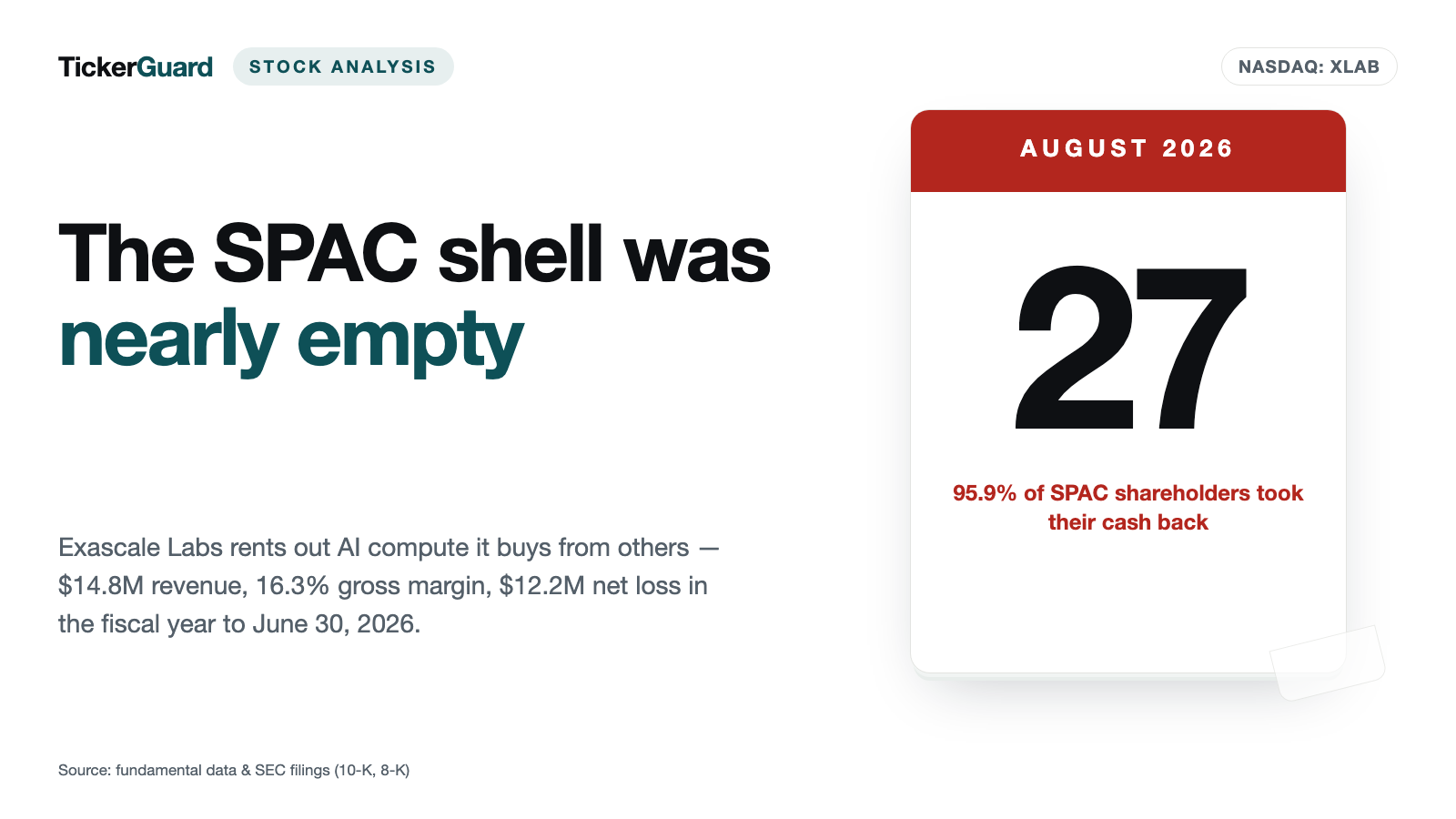
The merger valued Exascale Labs at $500 million. What actually arrived was something else: holders of 95.9 percent of the public SPAC shares took their money back, leaving roughly $11.8 million. The first annual report shows a company that rents out AI compute while buying the GPUs from others — $14.8 million in revenue, a 16.3 percent gross margin, a $12.2 million net loss. Add a roughly $71 million purchase contract and a stock that more than tripled in three trading days in October 2026. We checked what really sits behind the ten-dollar price tag.
 Thomas Mücke
Founder & Publisher
As of Today
As of: October 20, 2026
- Closing price
- 3.10 $ +30.21%
- Market Capitalisation
- 0.2 $B
Price change since October 19, 2026: +1.3%
This analysis has a cut-off date. The Stock Guard tells you when something material changes in the numbers. Reserve your free spot
Chart
Interactive price chart (TradingView).
Last price: 3.10 $ (As of: October 20, 2026)
Note: pure fact-based analysis, not investment advice and not a solicitation to buy or sell. All figures without guarantee.
There is an investor trap that snaps shut most often after a stock has already fallen hard: the anchoring trap. Your brain remembers the first number it heard about something and measures everything after against it. With Exascale Labs, that first number is easy to find. The merger with the listed shell D. Boral ARC Acquisition I Corp. assumed $10.00 per share and an equity value of $500 million. On October 14, 2026, the stock closed at $0.91, according to price data. The trap whispers: “Ninety percent below the deal price — that has to be cheap.” Three trading days later it closed at $3.06, and the trap whispered the opposite: “Here we go.” Both sentences measure against a label, not against the company. So let’s make a deal: before you form an opinion, we read together what Exascale itself filed with the U.S. securities regulator, the SEC — the first annual report (10-K) for the fiscal year ended June 30, 2026 with two years of audited numbers, the current reports (8-K) on the merger, and everything filed through October 20, 2026. At the end, the call is yours.
What Exascale Labs Actually Does — Compute for Rent, Sourced From Others
Exascale Labs rents out computing power on graphics processing units, or GPUs — the chips on which AI models are trained and run today. According to the report, the offering is explicitly tailored to small and mid-sized companies and AI start-ups that do not run their own data centers. The company describes itself in its annual report this way:
“We are a next-generation AI infrastructure provider operating an asset-light, software-defined GPU compute platform and related AI infrastructure solutions.”
— Exascale Labs Holdings Inc., SEC annual report 10-K for fiscal 2026, Item 1 (Business)
The key word is “asset-light.” Exascale does not buy the chips. It rents GPU capacity, bundled with power, cooling and network connectivity, from third-party data centers and re-rents it with its own orchestration software — mostly on fixed terms, the majority of them one year. An everyday picture: Exascale is not the hotel owner but a travel agency with its own booking system. In fiscal 2026, 98.9 percent of revenue came from this rental business, the rest from operating services for two data center owners. A third line — modular data centers, liquid cooling, high-voltage DC power — is described as ready for market but, according to the report, has not generated a single dollar of revenue.
The company is young and small. Exascale Labs Inc. was incorporated in Delaware on June 1, 2022 and had 12 full-time employees as of the report, five in the United States and seven at a subsidiary in Singapore. In fiscal 2026, 30.6 percent of revenue came from Hong Kong, 26.4 percent from the U.S., 24.8 percent from Canada and 13.6 percent from Singapore. Among competitors, the report itself names the large cloud platforms and specialized AI clouds such as CoreWeave and Nebius — providers that, as the report puts it, in some cases own and operate substantial GPU fleets. We described what that capital-intensive counter-model looks like in our Nebius stock analysis. That sets up the central tension of this analysis: Exascale earns the spread between the purchase and rental price of other people’s chips — and the market was once supposed to value it at $500 million.
Company history for investors
-
2022
Exascale Labs Inc. incorporated in Delaware (June 1)
From October 2022 the company funds itself through SAFE pre-financings — $14.1 million by June 2026, later converted into shares.
-
2025
IPO of the SPAC D. Boral ARC (August 1)
$280 million then sits in a trust account. Investors may take their money back before a merger — a right that later decides how much cash Exascale gets.
-
2026
Merger agreement at a $500 million equity value (January 11)
The ten-dollar math is born: 50 million new shares for Exascale’s owners. That is not a market price but an agreement between two parties.
-
2026
Merger closes, 95.9 percent redeemed (August 27)
Of roughly $289.9 million in the trust, Exascale keeps about $11.8 million. With that, management considers the going-concern doubt in the annual report alleviated.
-
2026
First annual report with audited numbers (September 28)
$14.8 million in revenue, a 16.3 percent gross margin, a $12.2 million loss — and in the notes a roughly $71 million purchase contract dated July 15, 2026.
-
2026
$8.2 million Sunon agreement (reported October 15)
The stock rises from $0.91 to $3.06 in three trading days. For investors: the valuation reacts to headlines more than to financial statements.
How This Stock Landed on Our Desk
Exascale is not a find from our valuation or quality screens. The stock reached our research list through the Reddit hype scanner — the part of our in-house stock scanner that counts what retail forums are talking about (as of October 20, 2026). It measures attention, not quality. And the attention had a trigger. On October 15, 2026, Exascale filed a current report (8-K) on a purchase and sale agreement with California-based Sunon Inc., a U.S. subsidiary of Taiwan’s Sunonwealth Electric Machine Industry: 12 servers with a total of 96 NVIDIA HGX B300 GPUs, plus deployment and 36 months of IT operations, for a combined $8.2 million. That equals 55 percent of total revenue in fiscal 2026 — and, unlike the existing business, it is a hardware sale. According to the 8-K, delivery depends on the down payment, the chip manufacturer’s approval and all export and import authorizations.
The market reaction was violent. According to price data, the stock closed at $0.91 on October 14, at $1.36 on October 15, at $2.35 on October 16 and at $3.06 on October 19. On October 16, 171.6 million shares changed hands — a little more than five times all 33.7 million Class A shares outstanding, in a single day. Counting all 64.3 million shares of both classes, the market value rose in those three trading days from roughly $58 million to roughly $197 million — an increase of about $138 million on an $8.2 million contract. Keep this in mind: with so few freely tradable shares, a headline moves the price more than any financial statement.
The Numbers Over the Years — Credit Where It Is Due
First, what genuinely impresses. Revenue more than doubled in the fiscal year ended June 30, 2026: from $7.0 million to $14.8 million, up 111.3 percent. Of the $7.8 million increase, the report attributes $4.8 million to existing customers and $3.0 million to new ones. Average revenue per enterprise customer rose from $250,000 to $570,000. On average, 91.0 percent of deployed GPU capacity was contracted to customers, and the weighted-average remaining contract term doubled from 4.2 to 8.2 months. For a company with 12 employees, that is real growth with paying customers — close to 50 of them as of June 30, 2026, the largest accounting for 20.1 percent of revenue. Note the calendar: the fiscal year runs from July 1 to June 30, so “fiscal 2026” largely covers the second half of 2025 and the first half of 2026.
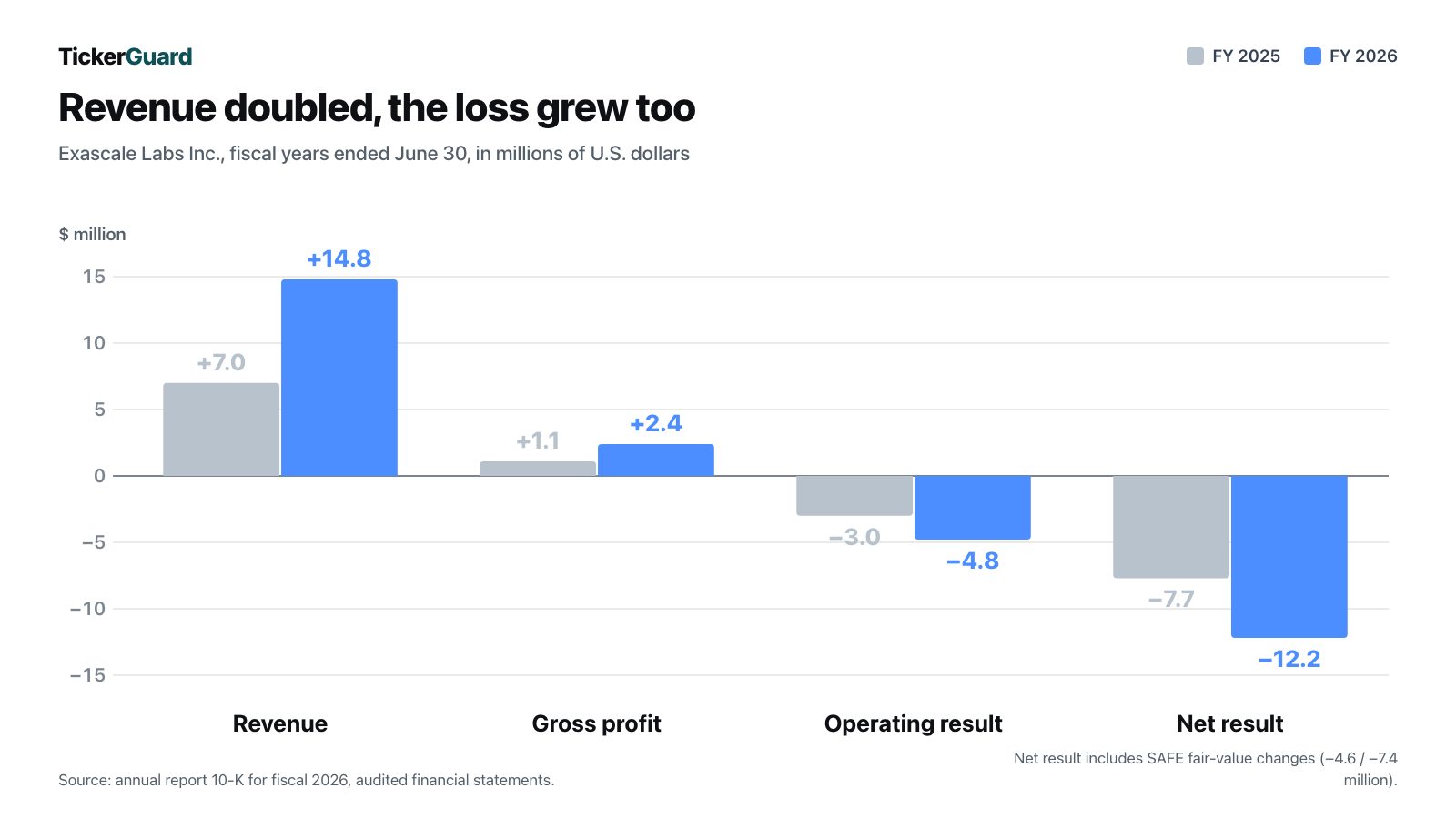
Now the other side of the same table. Only $2.4 million in gross profit remained — 16.3 percent, after 15.8 percent a year earlier. Against that stood $7.2 million in operating expenses, $5.5 million of it for research and development. The result: a $4.8 million operating loss (prior year: $3.0 million). The $12.2 million net loss (prior year: $7.7 million) is larger because the SAFE pre-financings — rights to future shares that investors had bought since 2022 — were remeasured as the company’s value rose, a non-cash charge of $7.4 million. The more telling number is operating cash outflow: $2.8 million in fiscal 2026 after $1.0 million. With all SAFEs converted into shares at the merger closing, that accounting effect disappears going forward.
What the Filings Say — the Uncomfortable Truths
Uncomfortable Truth No. 1: The Lifeline Was the SPAC — and It Was Nearly Empty
A SPAC is an empty listed company with a trust account. Before a merger, its shareholders may choose: come along or take back the money they paid in. At D. Boral ARC, about $289.9 million sat in the trust account as of June 30, 2026. Then investors voted with their feet:
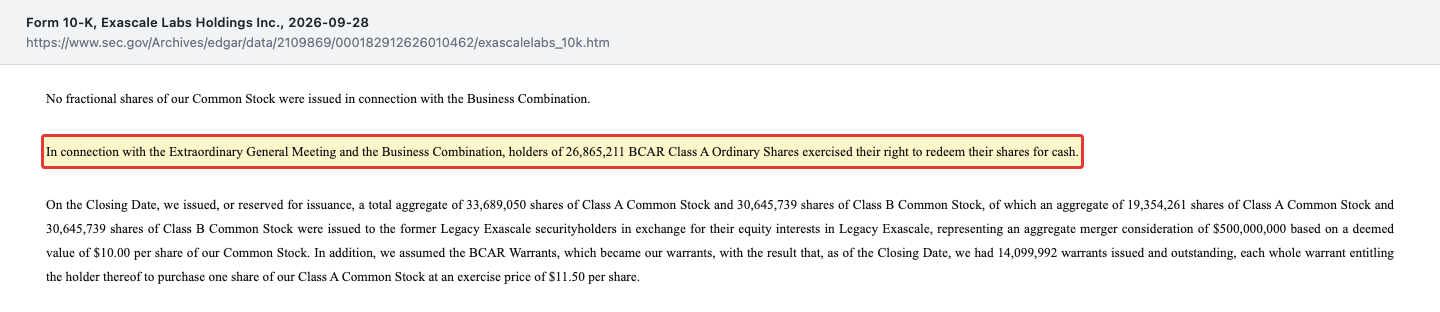
According to the pro forma balance sheet, $278.1 million flowed back to the redeeming investors; Exascale itself cites roughly $11.8 million retained from the business combination. In other words: of every $100 in the trust, about $96 went back to investors and about $4 reached the company. Those who had the right to become Exascale shareholders at ten dollars turned it down almost unanimously. Why that matters is written in the same annual report:
“These factors raised substantial doubt regarding our ability to continue as a going concern within one year of the date our audited consolidated financial statements included elsewhere in this Annual Report were issued.”
— Exascale Labs Holdings Inc., SEC annual report 10-K for fiscal 2026, Item 7 (Liquidity and Capital Resources, Going Concern Considerations)
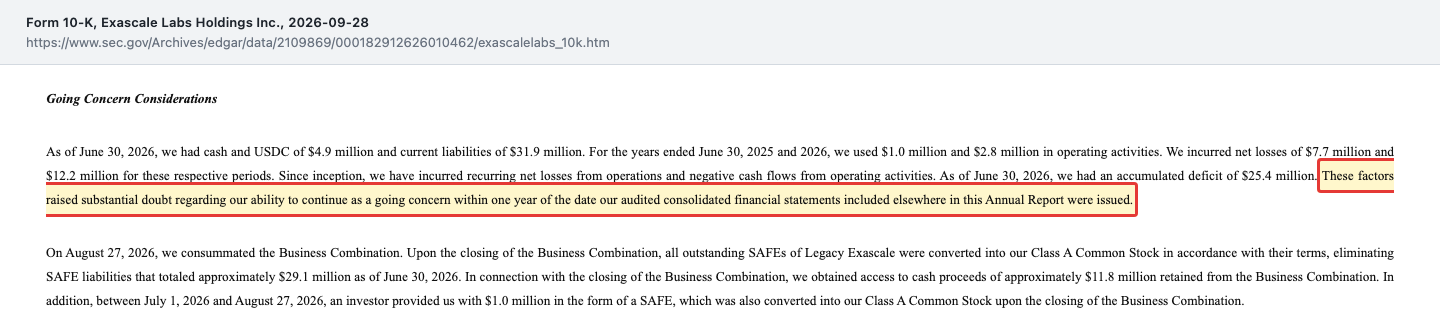
To be fair: in the next paragraph management writes that the doubt has been alleviated by the merger proceeds and the conversion of the SAFEs ($29.1 million liability as of June 30, 2026). The auditor, HTL International, issued its opinion without a going-concern paragraph. Shareholders’ equity moves from a $25.2 million deficit to a pro forma positive $15.3 million. But the cushion is thin: roughly $14.0 million in pro forma cash plus $2.2 million in stablecoins — and in July 2026 Exascale itself lent $1.5 million to an unnamed third party under a convertible loan. Rule of thumb: alleviated here means alleviated with the roughly 4 percent of the trust money that remained after the other investors redeemed.
Uncomfortable Truth No. 2: 16 Cents of Gross Profit per Dollar — a Middleman’s Margin
The business model has an advantage, and Exascale states it openly: no expensive chips on the balance sheet, no debt for data centers. The flip side sits in the same section:
“We operate under an asset-light model and do not own core hardware.”
— Exascale Labs Holdings Inc., SEC annual report 10-K for fiscal 2026, Item 7 (Specific Factors Affecting Our Results of Operations)
If you do not own the hardware, you pay its owner with every invoice. Of each revenue dollar in fiscal 2026, 83.7 cents went to suppliers of compute, professional services and operating staff; gross margin was 16.3 percent. Purchasing is highly concentrated: four suppliers accounted for 31.0, 28.0, 18.4 and 11.4 percent of purchases — 88.8 percent combined. The customer side looks similar: the two largest customers contributed 20.1 and 19.2 percent of revenue, and a single customer accounted for 43.7 percent of accounts receivable as of June 30, 2026. Customer loyalty also slipped: of 28 customers in the prior year, 19 still generated revenue in fiscal 2026 — a renewal rate of about 68 percent, after about 90 percent a year earlier. And of $5.5 million in research and development spending, $4.1 million was outsourced development. In everyday terms: Exascale is a travel agency re-renting hotel rooms — with few hotels, few big clients and a 16 percent commission.
Uncomfortable Truth No. 3: A Purchase Contract Almost Five Times Annual Revenue
At the very back of the notes, among the events after the balance sheet date, sits the largest number in the entire annual report:
“On July 15, 2026, the Company entered into a Compute Service Agreement with a third party to secure GPU compute capacity of approximately 4,000 PFLOPS (FP16) over a three-year term, for total contracted service fees of approximately $71 million. As of the date of this report, service delivery under the agreement has not commenced and no payment obligations have arisen.”
— Exascale Labs Holdings Inc., SEC annual report 10-K for fiscal 2026, Note 15 (Subsequent events)

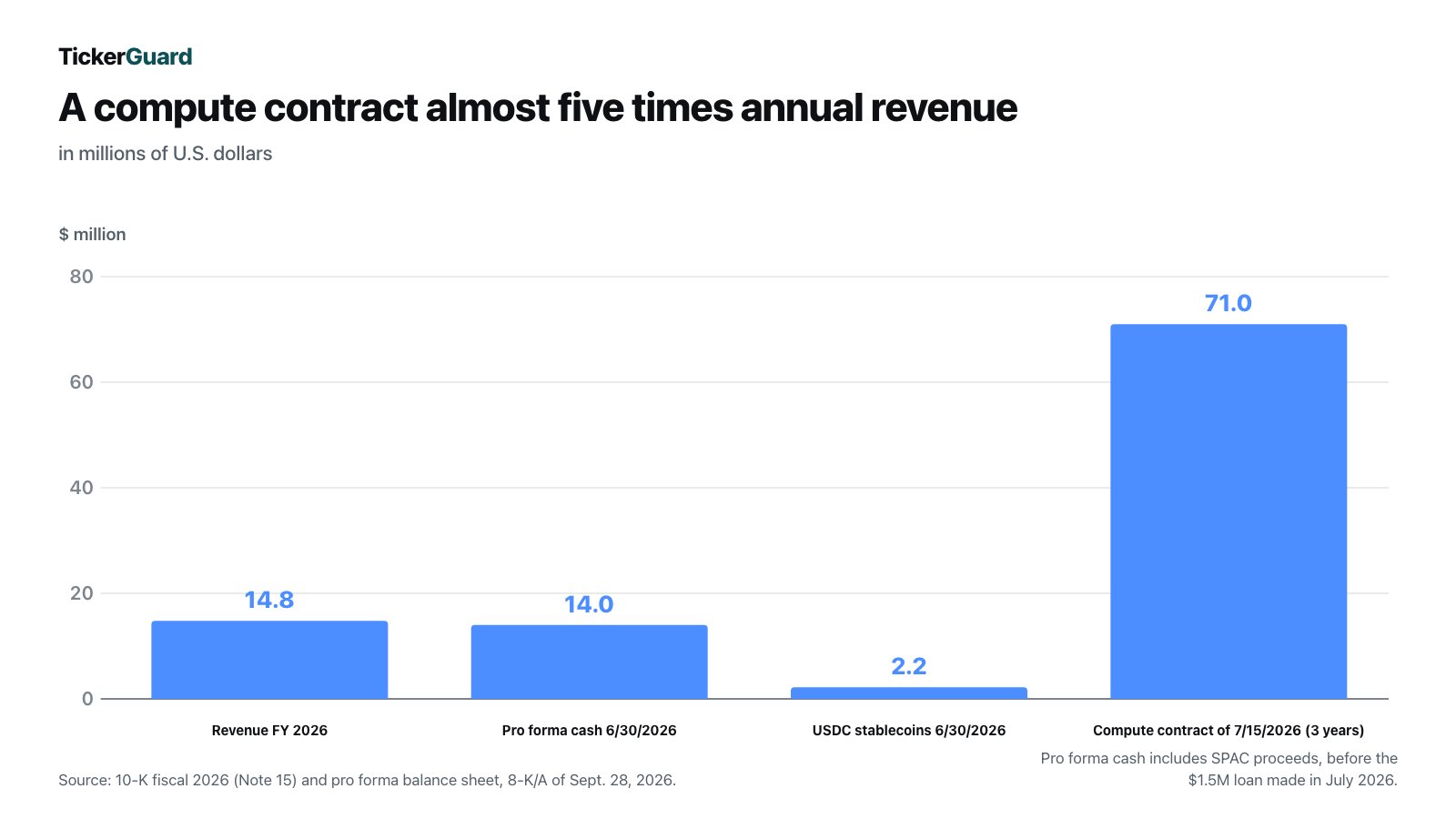
Spread over a year, that is close to $23.7 million — almost twice the entire cost of revenue in fiscal 2026 ($12.4 million). For a reseller, such a contract can be the basis for the next growth step; then it needs customers for all that capacity. The open question is a different one: in its business section, the same report states that the existing supplier arrangements contain no take-or-pay obligations and no minimum purchase commitments. Whether the July 15, 2026 contract contains such an obligation is not disclosed. That decides whether it is flexibility or a commitment larger than the cash balance. The answer belongs in the first quarterly report (10-Q) for the period ended September 30, 2026.
Uncomfortable Truth No. 4: You Buy Shares, Not a Say
Exascale has two share classes. The listed Class A shares carry one vote each, the unlisted Class B shares twenty. The 30,645,739 Class B shares are held by five holders: four are attributable to CEO Hoansoo Lee (his company HSL Capital Management and three trusts for the benefit of his children), one to Chairperson Wenying Jia (Zerowave Ltd.). According to the closing 8-K, Wenying Jia holds 79.3 percent of the voting power and Hoansoo Lee 15.5 percent. The annual report spells out the consequence:
“Our certificate of incorporation currently only authorizes 260,000,000 shares of Class A Common Stock, which means that even if every authorized share of Class A Common Stock was issued and outstanding, the five holders of shares of Class B Common Stock would have more votes than all of the holders of Class A Common Stock together.”
— Exascale Labs Holdings Inc., SEC annual report 10-K for fiscal 2026, Item 1A (Risk Factors)

That makes Exascale a “controlled company” under Nasdaq rules, entitled to skip parts of the usual board independence requirements; according to the report, it does not currently rely on those exemptions. One side detail leads to the next point: in the sentence before the quote, the report cites 680,880,000 votes for the Class B shares. But 30,645,739 shares times 20 votes equals 612,914,780. The closing 8-K uses the correct number (94.8 percent of the votes for the Class B shares). The discrepancy does not change the majority — it does raise the question of how carefully the numbers are put together.
Uncomfortable Truth No. 5: The Accounting Function Is Still Being Built
Exascale states that its internal control over financial reporting has material weaknesses: too few accounting staff with knowledge of U.S. GAAP and SEC rules, and missing financial reporting policies. What that looked like in practice shows up in one line of the liquidity section:
“During the fiscal year ended June 30, 2026, we received $3.5 million of SAFEs proceeds through non-cash channels, consisting of $3.0 million received in USDC and $0.5 million received by an employee on our behalf.”
— Exascale Labs Holdings Inc., SEC annual report 10-K for fiscal 2026, Item 7 (Financing Activities)
USDC is a crypto token pegged to the U.S. dollar, a so-called stablecoin. Exascale has used stablecoins as a means of payment since December 2025: about $2.8 million of revenue — 18.9 percent of the year’s total — was settled in stablecoins, and $2.2 million sat with a single custodian as of June 30, 2026. None of that is prohibited. But investor money routed through an employee and a vote count that does not add up are exactly the kind of findings that describe weak controls. The finance leadership fits the picture: since the August 27, 2026 closing, Exascale has had three chief financial officers — CEO Lee on an interim basis, Gildas Bonnier from September 4 (as a consultant at $10,000 a month), and Jake Carney from September 25 with a base salary of $6,000 a month. According to the 8-K, Carney is also chief financial officer of another listed SPAC, ARC Group Securities Acquisition I, and was a managing director of ARC Group Limited until April 2025. On October 15, 2026, that group’s subsidiary reported 4,946,413 Class A shares on Schedule 13G — 14.7 percent of the class; according to the same filing, 1,000,000 of them were already sold to Publico Partners in June 2026 and await delivery.
Valuation: $500 Million on Paper, About $197 Million in the Market
There is no price-to-earnings ratio — Exascale has never reported a profit. That leaves the comparison with revenue. At the closing price of October 19, 2026 ($3.06) and with all 64,334,789 shares of both classes (cover of the annual report, as of September 25, 2026), the market value comes to roughly $197 million. We count both classes because, according to the notes, they rank equally for dividends and liquidation; the Class A shares alone would be worth about $103 million. Against annual revenue of $14.8 million, that is a price-to-sales ratio of about 13, and about 13 times pro forma equity of $15.3 million. On October 14, 2026, the same figure stood at roughly $58 million. A range like that in three trading days shows how little the price currently depends on the numbers. According to the data feed, there are no analyst estimates for XLAB.
More important for you is what may still be added. At closing, 14,099,992 warrants were outstanding with an exercise price of $11.50 — far out of the money at prices around $3, but not expired. The employee equity plan reserves 10,000,000 Class A shares, and from January 1, 2027 the reserve grows automatically each year by up to 5 percent of the Class A shares. On October 6, 2026, 345,000 restricted stock units were granted from it to the CEO and three directors, 300,000 of them to Lee. Before any annual top-up, the share count could rise from 64.3 million to about 88.4 million — up roughly 37 percent. And on February 27, 2027, the six-month lock-up ends for up to 18.96 million Class A shares held by former SAFE holders and Exascale stockholders; in addition, the roughly 12.2 million shares held by the SPAC sponsor and affiliates (12.0 million founder shares) are to be registered for resale.
Upside and Risks at a Glance
What speaks for Exascale Labs:
- Real, audited growth: revenue up from $7.0 million to $14.8 million in the fiscal year ended June 30, 2026 (up 111.3 percent); revenue per enterprise customer up from $250,000 to $570,000.
- High utilization and longer contracts: on average 91.0 percent of deployed GPU capacity was contracted, and the weighted-average remaining contract term rose from 4.2 to 8.2 months.
- No bank debt and almost no capital spending: the asset-light model shields against the obsolescence of older chip generations; capital expenditures were zero in fiscal 2026.
- A cleaned-up balance sheet: converting all SAFEs removed a $29.1 million liability; pro forma equity is a positive $15.3 million.
- New business after the balance sheet date: the $8.2 million Sunon Inc. agreement (8-K of October 15, 2026), plus non-binding letters with Compal Electronics and EnergyBank and for at least 20 megawatts of data centers in Japan.
What speaks against it:
- The annual report states that substantial doubt about the company’s ability to continue as a going concern had existed; it was alleviated with roughly $11.8 million from a SPAC whose investors redeemed 95.9 percent.
- A thin margin without own assets: 16.3 percent gross margin, a $4.8 million operating loss, $2.8 million operating cash outflow; 88.8 percent of purchases from four suppliers; customer renewal down from about 90 to about 68 percent.
- A roughly $71 million three-year purchase contract whose take-or-pay status the report leaves open — about five times pro forma cash.
- No say for public shareholders: two people hold 94.8 percent of the voting power; material weaknesses in internal control; three chief financial officers in a month.
- Supply pressure ahead: lock-up expiry for up to 18.96 million Class A shares on February 27, 2027, resale registration for the roughly 12.2 million shares held by the SPAC sponsor and affiliates (12.0 million founder shares), 14.1 million warrants and a growing equity plan.
A Human Conclusion
Back to the anchoring trap from the start. Ten dollars per share and a $500 million valuation were never a market price. They were a figure negotiated between the parties to the agreement, not a price investors had paid. The only real price test came at the vote: holders of 95.9 percent of the public SPAC shares preferred to take their money back. Anyone who measures from ten dollars today is measuring against a label that investors themselves did not want to pay. That does not make Exascale a bad idea. Twelve people are working on a business that grows, has paying customers and plays in a market with real demand. It does make Exascale a company whose numbers you have to judge on their own: $14.8 million in revenue, 16 cents of gross profit per dollar, a $71 million contract whose terms nobody knows yet, and a vote that never reaches you. So the honest question is not “Is this cheap compared with ten dollars?” but: would you buy this company at today’s market value if you had never heard the number ten? If yes, you have a thesis. If no, you had an anchor. What you do with that is your decision. And that is how it should be.
Sources
All original documents used in this analysis — for your own reading:
- Exascale Labs Holdings Inc. — SEC annual report 10-K for the fiscal year ended June 30, 2026 (filed September 28, 2026)
- Exascale Labs Holdings Inc. — SEC current report 8-K/A of September 28, 2026, Item 2.01 (Form 10 information), with Exhibit 99.1 (audited financial statements), Exhibit 99.2 (MD&A) and Exhibit 99.3 (pro forma financial information)
- Exascale Labs Holdings Inc. — fiscal 2026 results release, Exhibit 99.1 to the SEC current report 8-K of September 28, 2026
- Exascale Labs Holdings Inc. — SEC current report 8-K of September 2, 2026 (closing of the business combination, lock-up agreements, voting power)
- Exascale Labs Holdings Inc. — SEC current report 8-K of September 8, 2026, Item 5.02 (interim CFO) and 8-K of September 30, 2026, Item 5.02 (new CFO)
- Exascale Labs Holdings Inc. — SEC current report 8-K of October 15, 2026, Item 1.01 (purchase and sale agreement with Sunon Inc.)
- ARC Group International Limited et al. — Schedule 13G of October 15, 2026
- Complete SEC filing history of Exascale Labs Holdings Inc. (CIK 0002109869), including the insider filings (Form 3 and Form 4) of October 5 and 6, 2026: EDGAR overview (sec.gov)
- Prices and trading volume: fundamental data, as of October 19, 2026. Forum mentions: in-house stock scanner, Reddit hype analysis, as of October 20, 2026.
No earnings call transcripts were available for Exascale Labs; we evaluated the annual report, the current reports and the results release instead. There is no quarterly report (10-Q) yet — the first is due for the quarter ended September 30, 2026.
Transparency & disclaimer: this analysis is journalistic commentary on publicly available information. It is not investment advice, not a regulated financial analysis and not a solicitation to buy or sell securities. Equity investments carry substantial risk up to and including total loss; at a young, loss-making company with few freely tradable shares and a highly volatile stock price, that risk is especially pronounced. All information is provided without warranty; the as-of date for each figure is noted in the text. Positions held by the operator are disclosed daily; where one exists, it appears as a notice at the top of this deep dive.
Our Bottom Line at a Glance
- Growth positive
- Audited revenue rose from $7.0 million to $14.8 million in the fiscal year ended June 30, 2026 (up 111.3 percent), revenue per enterprise customer from $250,000 to $570,000. On average 91.0 percent of deployed GPU capacity was contracted, and the weighted-average remaining contract term rose from 4.2 to 8.2 months.
- Margin and dependencies negative
- Gross margin was 16.3 percent in fiscal 2026, the operating loss $4.8 million. Exascale owns no hardware; four suppliers accounted for 88.8 percent of purchases, the two largest customers for 39.3 percent of revenue. The customer renewal rate fell from about 90 to about 68 percent.
- Funding negative
- The annual report cites substantial doubt about the company’s ability to continue as a going concern, considered alleviated only with the merger proceeds. Roughly $11.8 million remained because holders of 95.9 percent of the public SPAC shares redeemed. Pro forma, $14.0 million in cash and $2.2 million in USDC compare with $2.8 million in operating cash outflow in fiscal 2026.
- Commitments negative
- On July 15, 2026, Exascale signed a three-year GPU compute agreement with roughly $71 million in service fees — 4.8 times annual revenue. The annual report leaves open whether there is a firm purchase obligation; as of September 28, 2026, delivery and payments had not begun.
- Control and governance negative
- Through Class B shares with 20 votes each, two people hold 94.8 percent of the voting power. The report discloses material weaknesses in internal control; $0.5 million of SAFE money was received by an employee on the company’s behalf, and the Class B vote count in the 10-K (680,880,000) does not match the share count. Since August 27, 2026, there have been three CFOs.
- Balance sheet after the merger neutral
- Converting all SAFEs at closing removed a $29.1 million liability; equity moves from −$25.2 million (June 30, 2026) to a pro forma +$15.3 million. There is no bank debt. At the same time, Exascale lent $1.5 million to an unnamed third party under a convertible loan in July 2026.
Exascale Labs is a young, real business with real growth: $14.8 million in audited revenue in the fiscal year ended June 30, 2026, more than double the prior year, at 91 percent utilization. But the model is that of a reseller of other people’s compute — a 16.3 percent gross margin, a $4.8 million operating loss, high supplier and customer concentration. The going-concern doubt in the annual report was alleviated with roughly $11.8 million from a SPAC whose investors redeemed 95.9 percent; against that stands a roughly $71 million purchase contract with an open take-or-pay question. Public shareholders have no say through the Class A stock. Not investment advice.
What Our Rating Means
Substance risk
We found at least one documented issue that threatens the company itself — regardless of how the stock is currently valued.
Red, because the question of substance is written in the company’s own annual report and has not yet been answered by a second report. The fiscal 2026 10-K cites substantial doubt about the ability to continue as a going concern; it is alleviated only by management’s forecast and roughly $11.8 million from a SPAC whose investors redeemed 95.9 percent. Against that stands a roughly $71 million purchase contract — about five times pro forma cash — whose take-or-pay status the report leaves open, in a business with a 16.3 percent gross margin, a $4.8 million operating loss and disclosed material weaknesses in internal control. Between yellow and red, our rule picks the more cautious level. Explicitly not relevant to the rating are the October 2026 price spike, the price-to-sales ratio of about 13 and the small free float — those are price arguments. In fairness: revenue is audited and has doubled, utilization is 91 percent, and there is no bank debt. Yellow would come into view once a quarterly report shows that the $71 million contract is not an uncovered purchase obligation and cash keeps more than four quarters of runway. The decision is yours.
A journalistic assessment by our editorial team at the time of the deep dive, based on public sources — not investment advice and not a solicitation to buy or sell. Your personal circumstances (investment goals, risk capacity, taxes) cannot be taken into account. What our levels mean, how verdicts are formed, and what conflicts of interest exist →
Worth Noting
- Exascale Labs reached our research list through the Reddit hype scanner (as of October 20, 2026), not through a quality or valuation screen. The trigger was the Sunon Inc. agreement (8-K of October 15, 2026), after which the stock rose from $0.91 to $3.06 within three trading days.
- The data basis is the first annual report (10-K) of September 28, 2026 with the audited financial statements of the operating Exascale Labs Inc. for the fiscal years ended June 30, 2025 and 2026; the August 27, 2026 merger is not yet recorded there, and its effect is shown in the pro forma balance sheet in the 8-K/A filed the same day. No quarterly report (10-Q) is available yet. Data-feed metrics based on stub periods before the listing were not used.
- Market value: we count all 64,334,789 shares of both classes (10-K cover, as of 9/25/2026), because Class A and Class B rank equally for dividends and liquidation. A feed value of $151 million matched neither that calculation (about $197 million at $3.06) nor the Class A shares alone (about $103 million) and was therefore not used.
- Possible confusion: Exascale Labs has nothing to do with the term “exascale” used for supercomputers in the quintillion-operations class. The listed holding was named D. Boral ARC Merger Corporation until August 27, 2026, and the SPAC was D. Boral ARC Acquisition I Corp. (ticker BCAR).
Stock Watch
This analysis is as of October 20, 2026. Stock Watch will tell you what's changed at XLAB since then.
Later $1 a month per stock — signing up is free, and you'll be the first to know when it launches.
The full analysis as a PDF for later
We will send you this analysis as a PDF — to print, file away, and read at your own pace. And we will add you to the free Stock Watch list for Exascale Labs Holdings Inc. (XLAB), so you hear about it when something material in this analysis changes.
Frequently Asked Questions
Exascale Labs Holdings Inc. (Nasdaq: XLAB), based in Houston, rents out compute on graphics processing units (GPUs) to AI companies — for training AI models and running them. The chips do not belong to Exascale: the company rents GPU capacity from third-party data centers and re-rents it with its own orchestration software. In the fiscal year ended June 30, 2026, 98.9 percent of its $14.8 million in revenue came from this business.
Through a SPAC: on August 27, 2026, Exascale Labs Inc. combined with the listed D. Boral ARC Acquisition I Corp. (BCAR); the holding company was previously named D. Boral ARC Merger Corporation. Since August 28, 2026, the Class A stock trades as XLAB and the warrants as XLABW on Nasdaq. Holders of 95.9 percent of the public SPAC shares redeemed them for cash in the process.
No. In the fiscal year ended June 30, 2026, revenue of $14.8 million came with an operating loss of $4.8 million and a net loss of $12.2 million, of which $7.4 million stemmed from remeasuring the SAFE pre-financing. Gross margin was 16.3 percent and operating cash outflow $2.8 million. The company has not reported a profit since it was founded in 2022.
As of June 30, 2026, before the merger, Exascale had $2.7 million in cash and $2.2 million in the stablecoin USDC. According to the company, roughly $11.8 million was retained from the business combination; the pro forma balance sheet shows $14.0 million in cash. In July 2026 another $1.0 million came in through a further SAFE, while Exascale lent $1.5 million to a third party under a convertible loan.
Because Exascale has two share classes. The listed Class A shares carry one vote each, the 30,645,739 unlisted Class B shares twenty each. According to the closing 8-K, Chairperson Wenying Jia thus holds 79.3 percent and CEO Hoansoo Lee 15.5 percent of the votes. Even if all 260 million authorized Class A shares were issued, the Class B holders would still have the majority, the annual report says.
On July 15, 2026, Exascale signed a three-year agreement with an unnamed third party for roughly 4,000 PFLOPS of GPU compute, with total service fees of roughly $71 million. Exascale is the buyer. As of September 28, 2026, delivery and payments had not begun. The annual report does not say whether there is a firm purchase obligation; the first quarterly report should clarify it.
According to the 8-K of September 2, 2026, the lock-up agreements of the former Exascale stockholders and SAFE holders generally end six months after the August 27, 2026 closing, which is February 27, 2027. Up to 18,964,761 Class A shares are affected, 56.3 percent of the class. In addition, Exascale must register the roughly 12.2 million shares held by the SPAC sponsor and affiliates (12.0 million founder shares) for resale.
Found an error?
Did you spot a factual error, an outdated number, or a typo in this deep dive? Let us know briefly — your report goes straight to the editorial team.