Vertical Aerospace: The Air Taxi Takes Off, the Stock Crashes — and a Creditor Now Holds the Controls
Vertical Aerospace flew its Valo air taxi from hover into wing-borne flight with a pilot on board in 2026, and its books even show a 2025 profit of £232.9 million — produced by the falling share price. There is no revenue, the cash lasts to the end of the third quarter of 2027 without new funding, by the company’s own estimate, and its largest creditor’s conversion price has been amended down to $1.30. Before a 40-cent stock looks like a bargain, find out how many claims rank ahead of yours.
 Thomas Mücke
Founder & Publisher
As of Today
As of: October 20, 2026
- Closing price
- 0.4037 $ -1.99%
- Market Capitalisation
- 70.0 $M
- AAQS
- 0/10
This analysis has a cut-off date. The Stock Guard tells you when something material changes in the numbers. Reserve your free spot
Chart
Interactive price chart (TradingView).
52-week range: 0.3618 $ to 7.30 $ · Last price: 0.4037 $ (As of: October 20, 2026)
Note: pure fact-based analysis, not investment advice and not a solicitation to buy or sell. All figures without guarantee.
There is an investor trap that feels like common sense. It is called anchoring: your brain locks onto an old price and measures every new one against it. In December 2025, shares of Vertical Aerospace (NYSE: EVTL) closed at $7.28; on October 20, 2026, they closed at $0.40 (fundamental data). Your brain does the math at once: “Down 94 percent — an electric air taxi will never be this cheap again.” And the air taxi is real; it even flies. Let’s make a deal anyway. Before you follow the anchor, let’s read together what the company has filed with the U.S. securities regulator, the SEC — the 2025 annual report on Form 20-F, the interim financial statements as of June 30, 2026, and every current report (6-K) through October 21, 2026. False statements to the SEC carry penalties, which is why these filings are among the most reliable sources there are. In the end, the call is yours.
What Vertical Aerospace actually does — an air taxi that doesn’t make money yet
According to its annual report, Vertical Aerospace was founded in 2016 by Stephen Fitzpatrick and is based in Bristol, England; the parent company is incorporated in the Cayman Islands. Its product is Valo, an electric aircraft that takes off and lands vertically like a helicopter and then flies on its wings like a plane — the industry calls this an eVTOL. Picture it as a quiet taxi for the hop between downtown and the airport, just through the air. Per the annual report, Valo is designed to carry a pilot and four passengers, scalable to up to six, about 100 miles at around 150 mph. Vertical is also developing a hybrid-electric variant for longer routes. In addition, according to its first-half update of August 13, 2026, Vertical is working with the specialist Near Earth Autonomy on autonomous capabilities for defense missions. The company reports about 1,500 pre-orders, including from American Airlines, Avolon, Bristow, GOL and Japan Airlines.
There is no revenue yet. As of December 31, 2025, Vertical had 454 employees, most of them in the United Kingdom. One thing matters for reading the numbers: Vertical is registered with the SEC as a foreign private issuer. Instead of a 10-K annual report and 10-Q quarterly reports, it files an annual report on Form 20-F and current reports on Form 6-K, reports under international accounting standards (IFRS) and presents its financials in British pounds, while the stock trades in U.S. dollars. That sets up the central tension of this analysis, and it runs through every section: the aircraft is making real progress — but shareholders pay for every step with new shares, and a creditor now holds the controls.
Company history for investors
-
2016
Founded by Stephen Fitzpatrick
Vertical starts in Bristol with the aim of decarbonizing air travel using technology from aviation, energy and the auto industry. The founder remains majority shareholder until 2024.
-
2021
Listing via the SPAC Broadstone
In December 2021, Vertical lists on the NYSE through its merger with Broadstone Acquisition Corp.; Mudrick Capital buys $200 million of convertible notes.
-
2024
One-for-ten reverse split and restructuring
In September, every ten shares become one. In December, Mudrick converts about $130 million of notes into stock and becomes the controlling party; the accounting costs £457.2 million.
-
2025
Two equity raises and the Valo unveiling
In January and July, $83.9 million and $66.4 million net come in from new shares; in December, Vertical unveils Valo. The £232.9 million annual profit is a remeasurement of the notes.
-
2026
Transition flight, $1.30 conversion price, strategic review
In April, the piloted transition flight succeeds. In August, the Mudrick conversion price drops to $1.30; September brings the NYSE notice and the review of strategic alternatives.
How the stock landed on our desk
Vertical Aerospace made our research list through our in-house Reddit hype scanner: 3 mentions in 24 hours, rank 147, up from rank 668 the day before (ApeWisdom, retrieved October 21, 2026). That is a flicker, not a storm. One footnote belongs here: on September 16, 2026, according to a 6-K, Vertical hired a firm called Outside The Box Capital to distribute information about the company for a cash fee through March 15, 2027, “including through social media channels.” We do not know whether any individual posts are related. But you should know about it if the stock shows up in a forum you read.
The highest close of the past twelve months was $7.28 (December 9, 2025); on October 20, 2026, the stock closed at $0.40 — down about 94 percent (fundamental data). The eight analysts covering the stock are split: four rate it a strong buy, one a buy, two a hold and one a sell; their average price target is $6.98 (fundamental data, as of October 20, 2026). The average simply adds up all eight targets and spreads them evenly, so a single very high target pulls it up sharply. It is more than seventeen times the October price; the data do not show when each target was last updated, and many likely date from before the crash. These are third-party views, not a TickerGuard forecast. Keep this in mind from the start: an old share price is not a value, it is a memory.
The numbers over the years, given their due
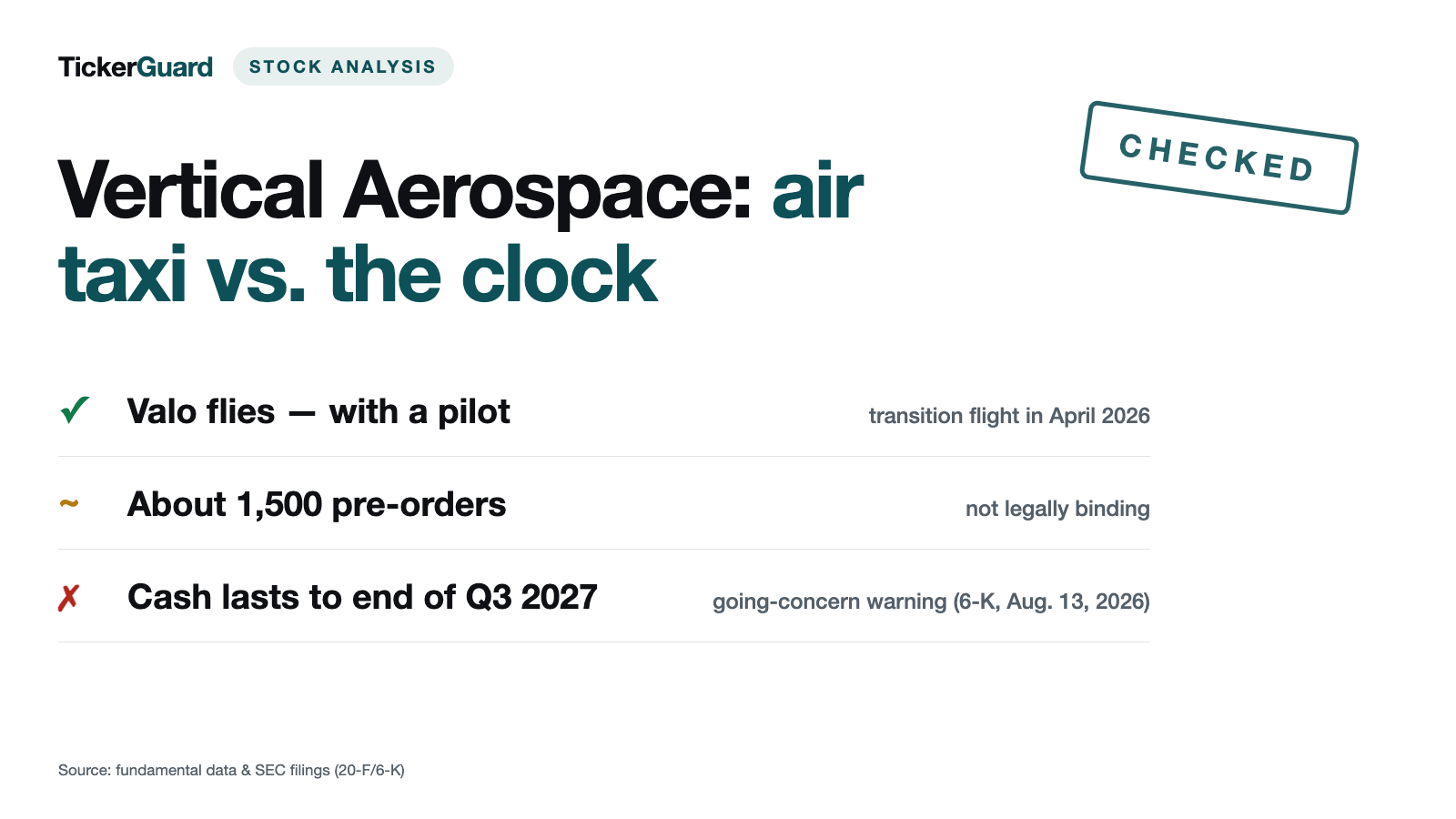
First, what genuinely impresses. In April 2026, a piloted Valo prototype flew the so-called transition for the first time — from vertical hover into wing-borne cruise and back. According to the first-half update of August 13, 2026, that made Vertical, by its own account, only the second company worldwide to do so with a full-scale tiltrotor aircraft; by August, its second prototype had done the same. At the Farnborough International Airshow, Valo flew on five consecutive days in front of the public. In October 2026, Vertical signed long-term supply agreements for seating with ANH Structure and for the inertial reference system with Northrop Grumman LITEF (6-K of October 16, 2026). Those are not slides; those are flight hours and contracts.
The financials tell the other half. The operating loss was £101.9 million in 2023, £61.2 million in 2024 — cushioned by a one-time $34 million payment from Rolls-Royce for ending a propulsion partnership — and £127.4 million in 2025. In the first half of 2026 alone it reached £75.8 million; research and development expense rose 143 percent year over year to £55.3 million. Cash used in operating activities was about £74.7 million in 2023, £46.3 million in 2024, £82.8 million in 2025 and £83.0 million in the first half of 2026 alone — as much as in the entire prior year.
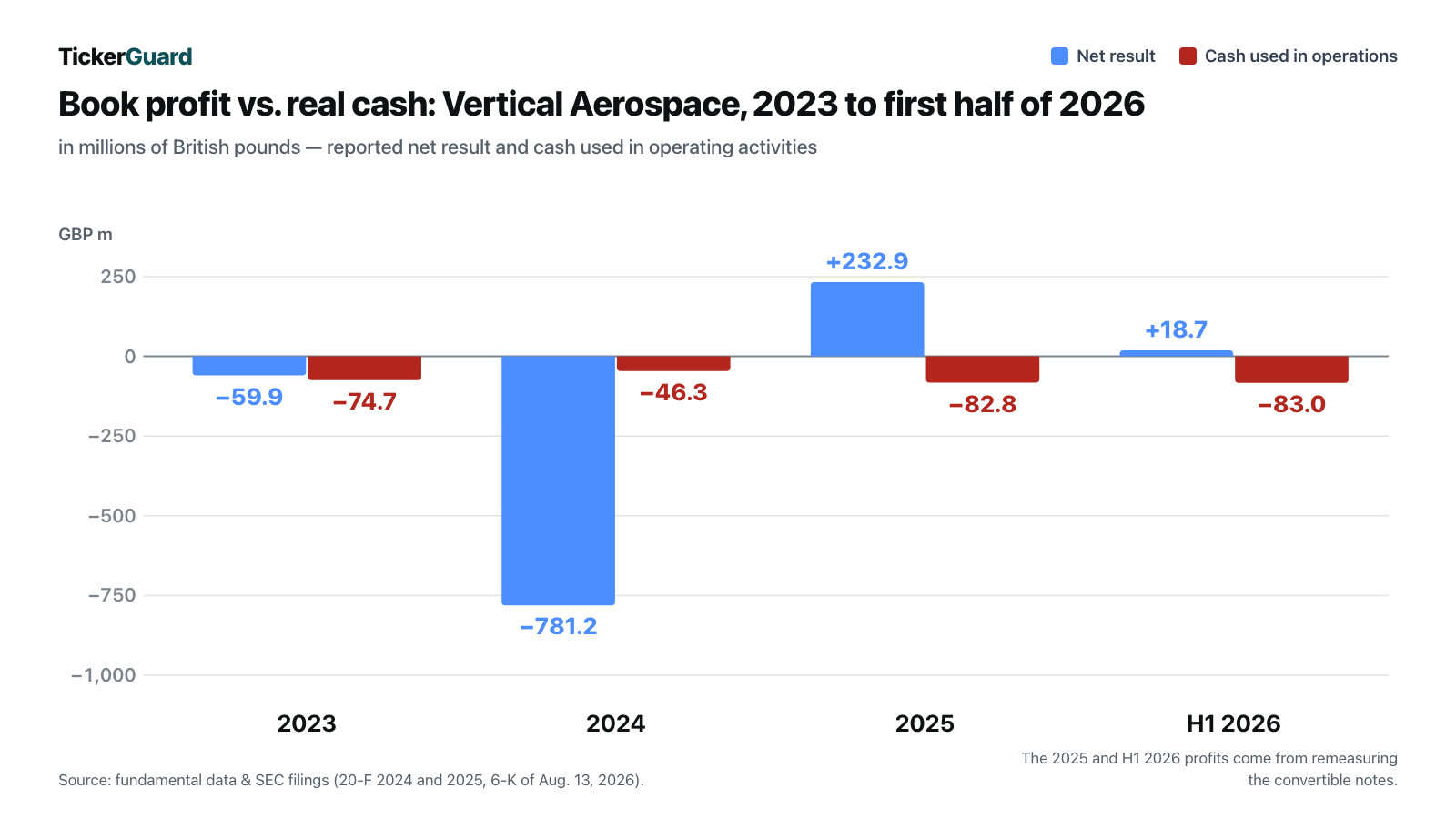
The blue bars are misleading: in 2023 Vertical posted a net loss of £59.9 million, in 2024 it reported a loss of £781.2 million, in 2025 a profit of £232.9 million, and in the first half of 2026 a profit of £18.7 million. The business barely changed in between — the red bars show it. Why the net result jumps around like that is the first uncomfortable truth. The takeaway: in the first half of 2026, about £14 million flowed out every month, whatever the bottom line said.
What the filings say: the uncomfortable truths
Uncomfortable truth No. 1: The profits appear because the company’s own stock falls
Vertical has borrowed much of its money through convertible notes — a loan the lender can take back in shares instead of cash. The lender is the investment firm Mudrick Capital. Because the notes can be swapped into stock, Vertical carries them on the balance sheet at fair value, and that fair value depends on the share price. When the stock falls, the conversion right is worth less, the liability shrinks on paper — and the decline shows up as a gain. The annual report says so plainly:
“Fair value gains on financial liabilities, relating to Convertible Senior Secured Notes subsequent to their amendment, increased by £548,530 thousand, from fair value losses of £230,495 thousand during the year ended December 31, 2024, to fair value gains £318,035 thousand during 2025. This results from a greater reduction in share price from December 31, 2024, to December 31, 2025, compared to the period from December 31, 2023, to December 31, 2024.”
— Vertical Aerospace Ltd., SEC annual report 20-F for 2025, Item 5.A “Net finance income/(costs)”
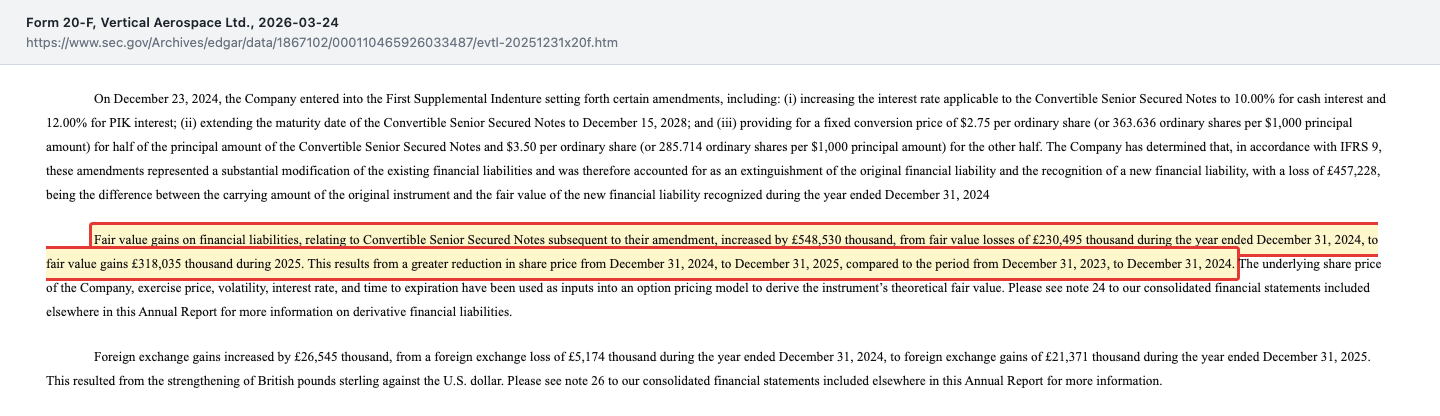
The first half of 2026 repeated the pattern: operations lost £75.8 million, remeasuring the notes added £113.0 million, and the bottom line showed a £18.7 million profit. The operating review again cites the “lower share price” as of June 30, 2026. If the stock rises, the effect reverses and produces losses — as in 2024, when the restructuring with Mudrick also triggered a £457.2 million loss. Remember: when a company without revenue reports a profit, first find the line item that made it.
Uncomfortable truth No. 2: The clock runs to the end of the third quarter of 2027
As of June 30, 2026, Vertical had £49.7 million in cash. After an equity offering, a tranche of preferred shares and an accelerated note draw in August, the first-half update put cash at about £99 million ($134 million) on August 13, 2026. For the following twelve months, the company expects net cash outflows of about £110 million. The operating review spells out how far that goes:
“Because of the restrictions imposed by the financing package executed in April 2026, including the limitations on the funding accessible thereunder over the next 12 months, unless we are able to raise additional funds in the intervening period, we project that our current existing resources and facilities will only be sufficient to fund our ongoing operations to the end of the third quarter of 2027.”
— Vertical Aerospace Ltd., SEC Form 6-K of August 13, 2026, Exhibit 99.2, “Liquidity and Capital Resources”
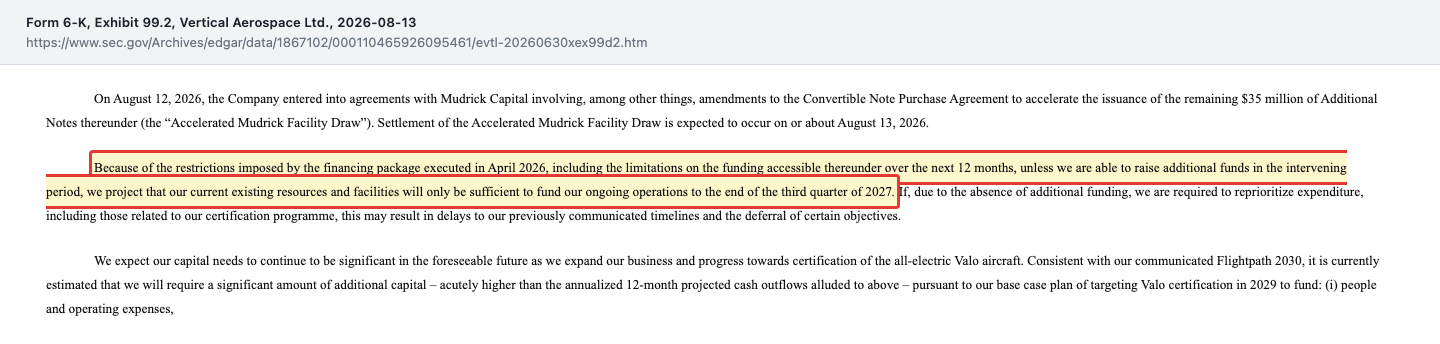
That is notable because in May 2026 the very same package was described as financing “totaling up to $850 million” (6-K of May 12, 2026). “Up to” is the operative phrase: the preferred share tranches require, among other things, minimum share prices and trading volumes, and each draw on the equity line is capped at 4.99 percent of the shares. The lower the stock, the less can be drawn. On top of that, the notes contain a covenant requiring a minimum cash balance of $10 million:
“We project that we will breach this covenant towards the end of the third quarter of 2027 unless additional capital is raised.”
— Vertical Aerospace Ltd., SEC Form 6-K of August 13, 2026, Exhibit 99.2, “Liquidity and Capital Resources”
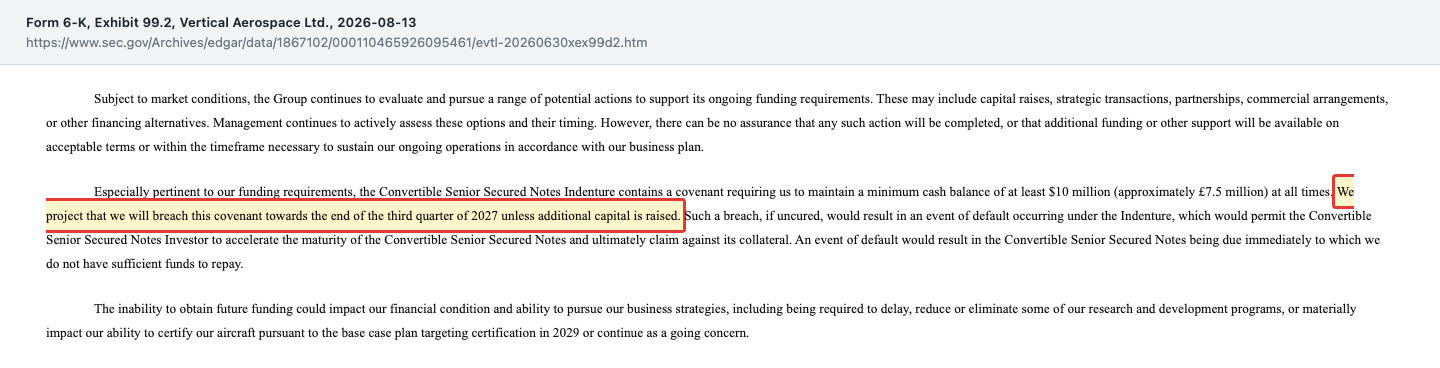
What happens then is in the next sentence: an uncured breach would be an event of default, Mudrick could accelerate the notes and claim against the collateral — per the interim statements, fixed and floating charges over substantially all assets of the U.K. subsidiary. By its own account, Vertical would not have the money to repay. Consistently, both the company and its auditor, PwC, flag substantial doubt about its ability to continue as a going concern. In plain English: the accountants assume there is a tomorrow, but they add that it is not secured.
Uncomfortable truth No. 3: The 1,500 pre-orders bind no one
About 1,500 pre-orders sound like a full order book. The annual report frames them differently in its risk factors:
“All of the pre-orders we have received for our aircraft are not legally binding, are conditional, and may be terminated without penalty at any time by either party.”
— Vertical Aerospace Ltd., SEC annual report 20-F for 2025, Item 3.D “Risk Factors”

That is common in the industry and not an accusation. But it means the pre-orders bring no cash and carry no value you could add to a valuation. Some customers are expected to make pre-delivery payments; per the operating review, those are conditional and may be refundable in certain circumstances. The first-half update also notes that certain customer obligations are expected to be fulfilled via third-party agreements. Remember: a pre-order is interest, not revenue.
Uncomfortable truth No. 4: A creditor holds the controls — and its conversion price is falling
Since the December 2024 restructuring, in which Mudrick Capital converted about $130 million of its notes into 47.3 million shares, the investor has been the company’s “ultimate controlling party,” per the annual report. Founder Stephen Fitzpatrick, previously the majority shareholder, still held 7.7 percent in February 2026. According to the latest ownership filing (Schedule 13D/A of September 24, 2026), Mudrick beneficially owns 64.2 percent — counting the shares its notes and warrants can be converted into.
On August 12, 2026, Vertical amended the note terms for the fourth time: the conversion price on all of Mudrick’s notes fell from $3.50 to $1.30 per share, and in return Mudrick accelerated the remaining $35 million of its commitment (6-K of August 13, 2026). As of June 30, 2026, the notes could have been converted into 47.2 million shares; after the amendment, the figure is 158.0 million — against 171.7 million shares outstanding (August 10, 2026). Working backward, about $205 million of notes are involved; at the old $3.50, that would be 58.7 million shares. Most of the jump therefore comes from the lower price, not from the additional money.
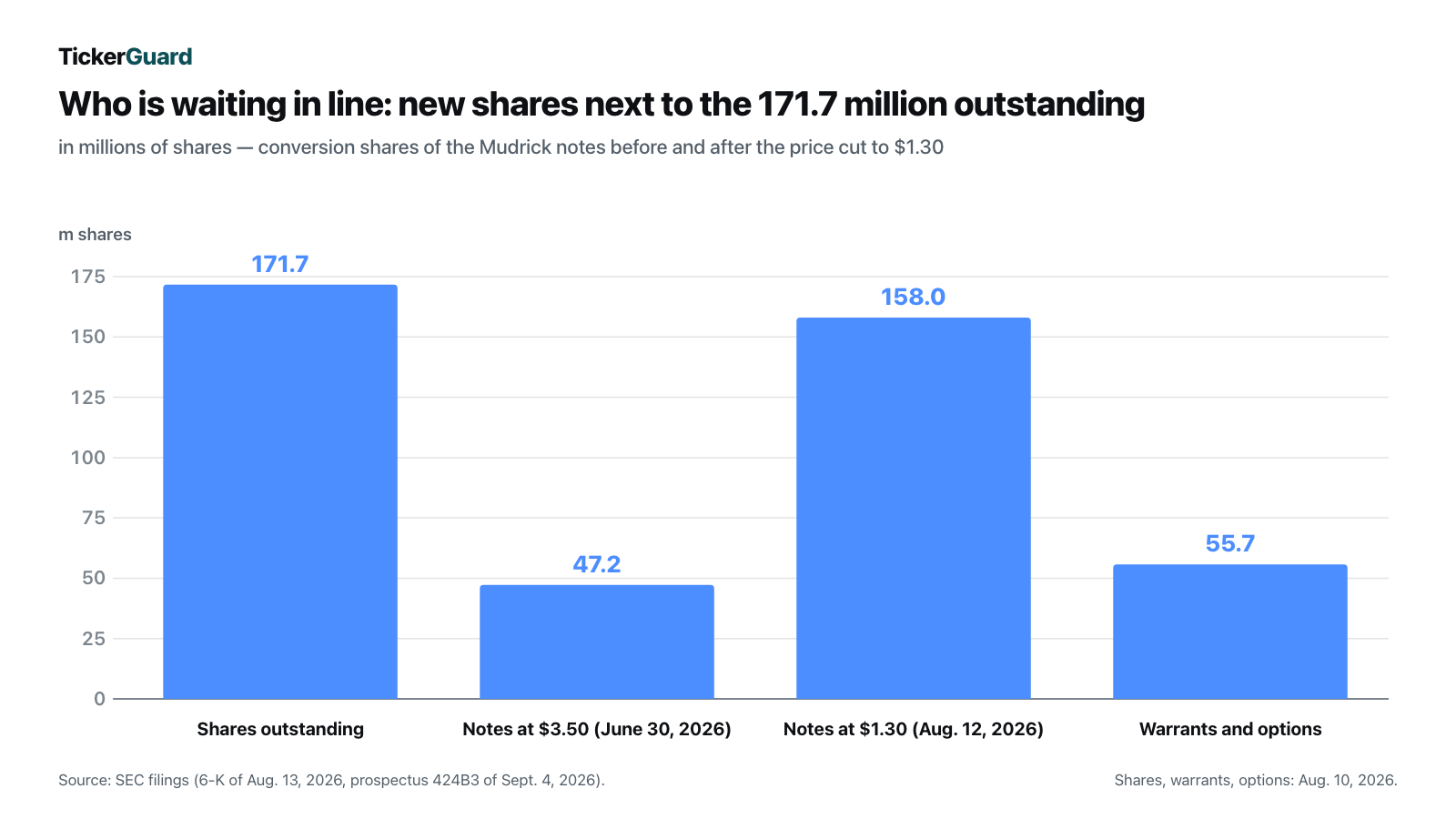
At a share price of $0.40, converting at $1.30 does not pay today. It pays precisely when you as a shareholder would win: if the stock climbs above $1.30, Mudrick shares the gain with you — the 158.0 million conversion shares would be just under half of the then-larger pie. In a downside scenario, the notes also rank ahead of you; they are secured by the company’s assets. Governance sits with Mudrick, too: since the shareholder agreement of August 12, 2026, the investor has had rights to nominate and remove directors (6-K of August 13, 2026); the annual general meeting on September 11, 2026 wrote them into the articles. The new chair, Fabrice Brégier, formerly head of Airbus’s commercial aircraft business, and director Clyde Woltman were proposed by Mudrick; two other directors stepped down effective October 5, 2026, and effective October 21, 2026, Marc Fontaine, head of the French unit of defense AI company Helsing, joined as another Mudrick-nominated director (6-K of October 21, 2026). The same meeting cut the exercise price of certain employee options from $3.50 or $5.82 to $1.30, with 27.9 million votes against. On September 24, 2026, Vertical announced a review of “strategic alternatives” with the investment bank Jefferies as adviser; the filing mentions potential strategic and financial partnerships. Remember: whoever provides the money writes the rules — and at Vertical, a creditor writes them.
Uncomfortable truth No. 5: The goalposts move — certification, listing rules, patent fight
Three clocks are running side by side. First, certification: the March 2026 annual report and the first-quarter report in May still targeted 2028 in the base case. On July 13, 2026, the company said that after re-baselining its program it now expects type certification of Valo in 2029 (6-K of July 13, 2026). Vertical does not put a price on the extra year. The operating review of August 13, 2026, does say, however, that the capital needed to reach certification in 2029 is “acutely higher” than the roughly £110 million of cash outflow projected for twelve months. The next milestone is the so-called Critical Design Review by the end of 2026, which locks in the certifiable design. Second, the exchange: on September 9, 2026, the NYSE notified Vertical that its average closing price over 30 trading days had fallen below $1 (6-K of October 2, 2026). Vertical has six months to cure and intends to stay listed; one route would be a reverse split, as Vertical already carried out in September 2024 at a ratio of one-for-ten. Third, a patent fight: competitor Archer Aviation sued Vertical in a federal court in Texas on February 23, 2026; Vertical calls the claims without merit and filed a counterclaim for infringement of one of its own patents on October 6, 2026.
Valuation: about $69 million — less than the cash, and still no discount
At the October 20, 2026 close of $0.40, the 171.7 million shares are worth about $69 million combined. That is less than the roughly $134 million in cash Vertical held on August 13, 2026. It sounds like free money. It is not, for three reasons. First, the cash is draining — about £110 million over twelve months, per the company’s own forecast. Second, ahead of shareholders stand the secured notes, by our math about $205 million, and Yorkville’s preferred shares: 27,000 of them (as of August 18, 2026) with a stated value of $1,000 each, convertible into more and more shares as the price falls, down to a floor of $0.598 per share. Third, equity was negative as of June 30, 2026: minus £34.4 million, after minus £121.4 million at the end of 2025.
With no revenue and no operating profit, there is no price-to-earnings or price-to-sales ratio. The honest valuation question is therefore: how many shares will exist once Valo is certified — and who will own them? How another technology stock with real technology and a thin cash cushion fares on the market is described in our Kodiak AI stock analysis. At Vertical, every financing done below $1 a share is paid for by today’s shareholders with their stake. Remember: a market value below the cash balance is no safety net for a cash-burning company; it is a bill that has not been paid yet.
Upside and risks at a glance
What speaks for Vertical Aerospace:
- Documented technical progress: a piloted transition flight in April 2026, a second prototype following by August, five days of flying at Farnborough.
- Well-known partners and new supply agreements, including Honeywell, Syensqo, Sonaca and, since October 2026, Northrop Grumman LITEF.
- About 1,500 pre-orders from airlines and lessors on four continents — non-binding, but a sign of interest.
- A major investor with a stake in the outcome, a chair with Airbus experience and an ongoing review of strategic options.
What speaks against it:
- No revenue; an operating loss of £127.4 million in 2025 and £75.8 million in the first half of 2026.
- Cash only to the end of the third quarter of 2027 without new capital, per the company, with an expected breach of the minimum cash covenant around the same time; going-concern warning from both the company and its auditor.
- Heavy dilution built in: 158.0 million conversion shares and 55.7 million from warrants and options next to 171.7 million shares outstanding.
- Negative equity (minus £34.4 million as of June 30, 2026) and a secured creditor ranking ahead of shareholders.
- Certification target moved from 2028 to 2029, an NYSE cure period for a sub-$1 share price, and a patent suit from Archer.
A human conclusion
Back to anchoring. In December 2025, $7.28 was a price, not a value — and it was paid for a company that then had fewer shares, a higher conversion price for its creditor and a certification plan one year earlier. Put $0.40 next to it today and you are comparing two different companies. The air taxi is real, it flies, and it may one day carry passengers. So the honest question for you is not “Will the air taxi come?” but: how big is your slice of the pie when it does — and how many new shares will have been added by then? If you have an answer that satisfies you, you have a thesis. If not, all you have is an old price in your head. What you do with that is your decision. And that’s how it should be.
Sources
All primary documents used in this analysis — so you can check them yourself:
- Vertical Aerospace Ltd. — SEC Form 6-K of August 13, 2026, Exhibit 99.2 (operating and financial review as of June 30, 2026), Exhibit 99.3 (interim financial statements) and Exhibit 99.1 (first-half update)
- Vertical Aerospace Ltd. — SEC annual report 20-F for 2025 (filed March 24, 2026)
- Vertical Aerospace Ltd. — SEC annual report 20-F for 2024 (filed March 11, 2025)
- Vertical Aerospace Ltd. — SEC Form 6-K of July 13, 2026 (Valo certification now expected in 2029) and 6-K of May 6, 2026 (first quarter of 2026)
- Vertical Aerospace Ltd. — SEC Form 6-K of August 13, 2026 (fourth supplemental indenture, $1.30 conversion price)
- Vertical Aerospace Ltd. — SEC Form 6-K of April 20, 2026 (financing package with Mudrick and Yorkville) and 6-K of May 12, 2026 (chair resignation, financing package “up to $850 million”)
- Vertical Aerospace Ltd. — SEC Form 6-K of September 11, 2026 (annual general meeting voting results)
- Vertical Aerospace Ltd. — 6-K of September 18, 2026 (marketing services agreement of September 16), 6-K of September 21, 2026 (new chair), 6-K of September 24, 2026 (review of strategic alternatives)
- Vertical Aerospace Ltd. — 6-K of October 2, 2026 (NYSE notice), 6-K of October 5, 2026 (directors), 6-K of October 7, 2026 (counterclaim against Archer, filed October 6), 6-K of October 16, 2026 (supply agreements), 6-K of October 21, 2026 (new director Marc Fontaine)
- Vertical Aerospace Ltd. — Prospectus 424B3 of September 4, 2026 (share count as of August 10, 2026)
- Mudrick Capital Management — Schedule 13D/A of September 24, 2026: EDGAR overview for Vertical Aerospace (sec.gov)
- New York Stock Exchange — Form 25-NSE of December 4, 2024 (removal of the old warrants from the NYSE)
- Fundamental data (prices, analyst ratings; as of October 20, 2026), cross-checked against the SEC filings.
- Reddit mentions: ApeWisdom (as of October 21, 2026); accessed via our in-house Reddit hype scanner.
Transparency & disclaimer: this analysis is journalistic commentary on publicly available information. It is not investment advice, not a regulated investment research product and not a solicitation to buy or sell securities. Equity investments carry substantial risk up to and including total loss. All information is provided without warranty; the as-of date for each figure is stated in the text. Positions held by the operator are disclosed daily; where one exists, it appears as a notice at the top of this deep dive.
Key figures at a glance
All monetary figures in millions of £; earnings per share as reported.
| Metric | 2021 | 2022 | 2023 | 2024 | 2025 |
|---|---|---|---|---|---|
| Revenue | 0.1 | 0.0 | 0.0 | 0.0 | 0.0 |
| Operating Income (EBIT) | -277.2 | -98.1 | -101.9 | -61.2 | -127.4 |
| Net Income | -245.2 | -94.4 | -59.9 | -781.2 | 232.9 |
| Net Margin | -185,775.8% | – | – | – | – |
| Earnings Per Share | -19.76 £ | -5.26 £ | -3.13 £ | -38.46 £ | 1.83 £ |
Source: fundamental data & SEC filings (annual and quarterly reports, 10-K/10-Q)
Our Bottom Line at a Glance
- Technology & progress positive
- Piloted transition flight in April 2026, a second prototype by August 2026, five days of flying at Farnborough; long-term supply agreements with ANH and Northrop Grumman LITEF (October 2026).
- Revenue & demand negative
- No revenue through 06/30/2026. Per the 2025 Form 20-F, the roughly 1,500 pre-orders are not legally binding and may be terminated at any time without penalty; certification now targeted for 2029 instead of 2028.
- Earnings power negative
- Operating loss of £127.4m in 2025 and £75.8m in H1 2026. The net profits for 2025 (£232.9m) and H1 2026 (£18.7m) come from remeasuring the convertible notes as the share price fell.
- Liquidity & going concern negative
- Going-concern warning from the company and its auditor, PwC. About £99m of cash (08/13/2026) lasts to the end of Q3 2027 without new capital, per the company; a breach of the $10m minimum cash covenant is expected around the same time.
- Capital structure & control negative
- Mudrick Capital is in control (64.2 percent beneficial ownership, 13D/A of 09/24/2026); the conversion price of its secured notes was amended from $3.50 to $1.30: 158.0m conversion shares next to 171.7m outstanding. Equity −£34.4m (06/30/2026).
Vertical Aerospace is a textbook case of anchoring: the stock fell from $7.28 in December 2025 to $0.40 in October 2026, but it only looks cheap next to a company that no longer exists in that form. The air taxi flies, there is no revenue, the profits are accounting entries, the cash lasts to the end of Q3 2027 per the company, and a creditor with 158.0 million conversion shares holds the controls. Not investment advice.
What Our Rating Means
Substance risk
We found at least one documented issue that threatens the company itself — regardless of how the stock is currently valued.
Substantial doubt about the company’s ability to continue as a going concern appears in the August 13, 2026 operating review and in PwC’s audit report, equity is negative (minus £34.4 million as of June 30, 2026), and without new capital the cash lasts only to the end of the third quarter of 2027, per the company — around the same time it expects to breach the secured notes’ minimum cash covenant. An NYSE cure period for a sub-$1 share price is running as well. That is why the rating is red. The technology is real and advancing, which makes Vertical more than an empty shell, but it does not prove a viable business. If you wait, check: does the Critical Design Review land by the end of 2026, how much cash is left in the next report, and what does the strategic review produce? The decision is yours.
A journalistic assessment by our editorial team at the time of the deep dive, based on public sources — not investment advice and not a solicitation to buy or sell. Your personal circumstances (investment goals, risk capacity, taxes) cannot be taken into account. What our levels mean, how verdicts are formed, and what conflicts of interest exist →
Worth Noting
- Vertical Aerospace made our research list through our in-house Reddit hype scanner (3 mentions in 24 hours, rank 147 after rank 668 the day before, ApeWisdom, as of October 21, 2026). Since 09/16/2026, per a 6-K, Vertical has been paying a firm to communicate about the company, including via social media.
- Vertical is a foreign private issuer: annual report on Form 20-F instead of a 10-K, current reports on Form 6-K instead of 10-Qs, IFRS financial statements in pounds. The stock trades in U.S. dollars, so cash and price figures appear partly in pounds and partly in dollars. Form 25 of 12/04/2024 concerned only the old warrants, not the shares.
- Market value calculated by us: 171,723,641 shares (prospectus 424B3, as of 08/10/2026) × the $0.4037 close on 10/20/2026 ≈ $69m; cross-check against fundamental data: $69.5m. The price has fallen sharply since the 08/10/2026 offering ($1.05 per unit). About $205m of notes = 157,972,433 conversion shares (operating review, 6-K of 08/13/2026; the 424B3 prospectus states 157,972,431) × $1.30 (our math).
Stock Watch
This analysis is as of October 21, 2026. Stock Watch will tell you what's changed at EVTL since then.
Later $1 a month per stock — signing up is free, and you'll be the first to know when it launches.
The full analysis as a PDF for later
We will send you this analysis as a PDF — to print, file away, and read at your own pace. And we will add you to the free Stock Watch list for Vertical Aerospace Ltd (EVTL), so you hear about it when something material in this analysis changes.
Frequently Asked Questions
Vertical Aerospace Ltd. (NYSE: EVTL), based in Bristol, U.K., is developing Valo, an electric air taxi that takes off and lands vertically and then flies on its wings (eVTOL). It is designed to carry a pilot and four passengers, scalable to up to six, about 100 miles. A hybrid-electric variant, including for defense, is also in development. There is no revenue yet; the company targets certification in 2029.
Because Mudrick Capital’s convertible notes are carried at fair value, which depends on the share price. When the stock falls, the liability’s value drops and the difference shows up as a gain. That is how 2025 showed a £232.9 million net profit against a £127.4 million operating loss, and the first half of 2026 an £18.7 million profit against a £75.8 million operating loss.
Per its operating review of August 13, 2026, existing resources fund operations to the end of the third quarter of 2027 without new capital. On August 13, Vertical had about £99 million ($134 million) and expected net outflows of about £110 million over twelve months. Both the company and its auditor, PwC, flag substantial doubt about its ability to continue as a going concern.
The investment firm Mudrick Capital, holder of the secured convertible notes. Per its Schedule 13D/A of September 24, 2026, it beneficially owns 64.2 percent, including shares from its notes and warrants. Since the shareholder agreement of August 12, 2026, Mudrick has had rights to nominate and remove directors, which the annual general meeting of September 11, 2026 wrote into the articles; chair Fabrice Brégier and, since October 21, 2026, Marc Fontaine were nominated by Mudrick.
Next to 171.7 million shares outstanding (August 10, 2026), the Mudrick notes can be converted at $1.30 into 158.0 million shares since August 12, 2026, up from 47.2 million before. On top come 55.7 million shares from warrants and options, plus Yorkville preferred shares convertible into stock at prices down to a floor of $0.598.
On September 9, 2026, the NYSE notified Vertical that its average closing price over 30 trading days was below $1. The company has six months to get back to at least $1 and intends to stay listed. Trading continues normally during the cure period; in 2024 the company already carried out a one-for-ten reverse split.
Found an error?
Did you spot a factual error, an outdated number, or a typo in this deep dive? Let us know briefly — your report goes straight to the editorial team.