Kodiak AI: The Trucks Drive Themselves — the Cash Lasts Only Into the Second Quarter of 2027
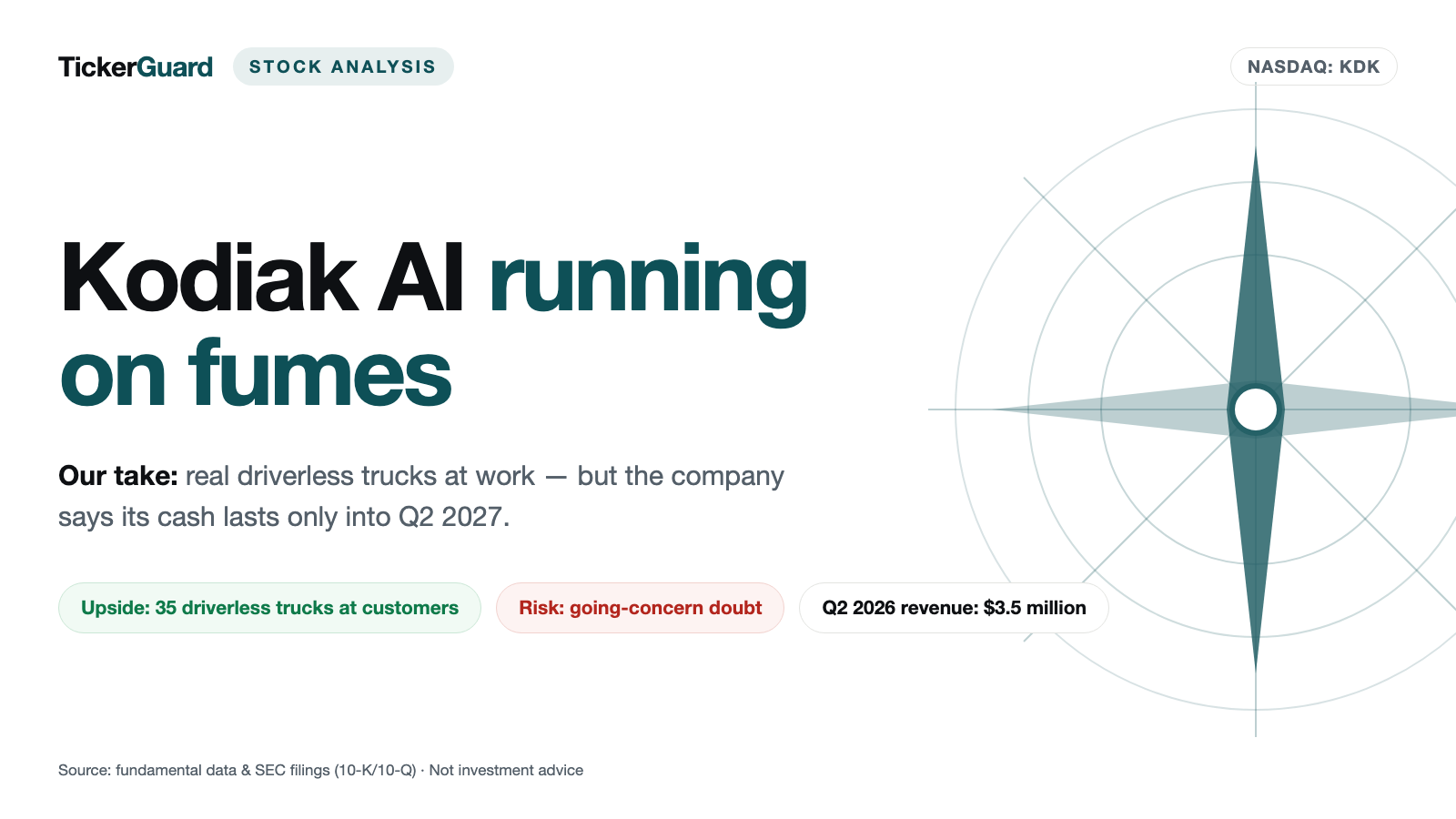
Kodiak AI has 35 customer trucks running with nobody behind the wheel, the pitch is “physical AI,” and the second quarter of 2026 even showed a profit — one that arose largely because the stock fell. But revenue was $3.5 million, operations lost $43.7 million, and the quarterly report itself flags substantial doubt about the company’s ability to continue as a going concern. If the story has you hooked, read the numbers behind it in full — before the next equity raise reads them for you.
 Thomas Mücke
Founder & Publisher
As of Today
As of: October 19, 2026
- Closing price
- 1.20 $ -11.10%
- Market Capitalisation
- 0.2 $B
- Growth Score
- 3/10
- AAQS
- 4/10
This analysis has a cut-off date. The Stock Guard tells you when something material changes in the numbers. Reserve your free spot
Chart
Interactive price chart (TradingView).
52-week range: 1.60 $ to 10.90 $ · Last price: 1.20 $ (As of: October 19, 2026)
Note: pure fact-based analysis, not investment advice and not a solicitation to buy or sell. All figures without guarantee.
There is an investor trap that does not feel like a trap. It feels like vision. Call it the narrative trap: a story is so good that you stop reading the numbers behind it — or you read only the ones that fit. Trucks rolling through the West Texas desert with nobody at the wheel. Artificial intelligence taking over a job that freight companies can barely staff. And then, in the summer of 2026, the company even reports a quarterly profit. Your brain whispers: “This is the future. And the stock costs a dollar twenty.” Kodiak AI (Nasdaq: KDK) is exactly that kind of story — and it is not made up; the trucks really do drive themselves. Let’s make a deal anyway: before you follow the story, let’s read together what the company has told the U.S. securities regulator, the SEC — the annual report (10-K) for 2025, the quarterly report (10-Q) for June 30, 2026, and the current reports (8-K) and other filings, reviewed through October 2026. Misleading the SEC carries penalties, which is why these filings are among the most reliable sources there are. In the end, the call is yours.
What Kodiak AI actually does — a driver who never gets tired, sold as a subscription
Kodiak AI was founded in 2018 by Don Burnette, whom the company calls an autonomy industry pioneer, and is based in Mountain View, California. Its product is the Kodiak Driver: AI-powered driving software combined with sensor and computing hardware that can be fitted to almost any modern truck. Put simply, Kodiak does not build trucks — it builds the driver, and rents it out. Since December 2024 this has run as Driver-as-a-Service: the customer owns and operates the truck, while Kodiak supplies the driving system, software updates, remote monitoring and support, and charges a fee per vehicle or per mile. The first major customer, according to the annual report, is the oil and gas logistics provider Atlas Energy Solutions, which runs the trucks in the Permian Basin of West Texas and Eastern New Mexico — an area where, per the quarterly report, drivers are hard to recruit and operations run around the clock.
The operating numbers are real and growing fast. According to the earnings release of August 6, 2026, 35 customer-owned trucks were running driverless at the end of June, seven more than three months earlier. Paid driverless operating hours had passed 40,000 — the annual report put them at about 10,700 at the end of 2025. Kodiak also hauls freight on highways between Dallas, Houston, Oklahoma City, Atlanta and El Paso with its own autonomous trucks; it aims to run those routes with no one on board by the end of 2026. A third line is defense: Kodiak has worked for the U.S. Army and was selected for the second phase of a Defense Innovation Unit demonstration program. At December 31, 2025, Kodiak had 342 employees. For how another driverless-vehicle company looks on the stock market, see our WeRide analysis. That sets up the central tension of this analysis, and it runs through every section: the technology works in day-to-day use — but the business does not make money yet, and the company says its cash lasts only into the second quarter of 2027.
Company history for investors
-
2018
Founded by Don Burnette
Kodiak starts in California with the goal of trucks that drive without a driver. Until the listing, it is funded with venture capital and SAFEs.
-
2024
Truck subscription launches with Atlas
In December the Driver-as-a-Service business starts: Atlas Energy Solutions runs its own driverless trucks in the Permian Basin. Revenue still comes 89 percent from the U.S. Army.
-
2025
Listing via the SPAC Ares Acquisition Corp II
The merger closes on 09/24/2025, with about 89 percent of SPAC shares redeemed. The highest close as KDK follows on 12/31/2025 at $10.92.
-
2026
$100 million at $6.50 — and a going-concern warning
In May, $100 million comes in through new stock and the preferred conversion price is halved. The August quarterly report again carries the going-concern warning; cash lasts into Q2 2027, per the company.
How the stock landed on our desk
Kodiak AI made our research list through our in-house Reddit hype scanner: 3 mentions in 24 hours, rank 126, up from rank 774 the day before (ApeWisdom, retrieved October 20, 2026). That is not a storm, more a flicker — typical of a stock that has fallen hard and whose story is easy to tell. The highest close since the listing was $10.92 (December 31, 2025); on October 19, 2026 the stock closed at $1.20, down about 89 percent (fundamental data).
Kodiak did not come to market through a traditional IPO but through a merger with a blank-check company, a SPAC: Ares Acquisition Corp II, sponsored by the investment firm Ares. The merger closed on September 24, 2025. If you search the SEC database, you will find a Form 25 dated the same day — that is not a delisting of Kodiak but the removal of the old SPAC securities from the New York Stock Exchange; the same day, Kodiak registered its new Nasdaq listing (Form 8-A). Another number in the quarterly report is more telling: of 49.4 million shares held by SPAC investors, 43.9 million were redeemed for cash before the merger — roughly 89 percent that never became Kodiak stock. So keep this in mind from the start: for a company with no operating profit, the most important number is not the story but cash divided by cash burn.
The analysts who cover the stock rate it mostly positively: of nine, seven rate it a strong buy, one a buy and one a hold; their average price target is $10.50 (fundamental data, as of October 20, 2026) — far above the October price. These are third-party views, not a TickerGuard forecast, and we do not adopt them. A gap that wide between target and price is not unusual for young technology stocks; mostly it shows how much the analysts expect from the story. Whether the cash lasts long enough to finish telling it is a question price targets do not answer.
The numbers over the years, given their due
First, what impresses: Kodiak has trucks driving with nobody on board in paid customer service. Paid driverless operating hours nearly quadrupled in the first half of 2026, and the number of trucks at customers is rising quarter by quarter. In the second quarter of 2026, Kodiak-powered trucks delivered more than 300,000 tons of freight, according to the company. Revenue picked up: $3.5 million in the second quarter of 2026 versus $0.5 million a year earlier, and $5.3 million in the first half versus $2.0 million.
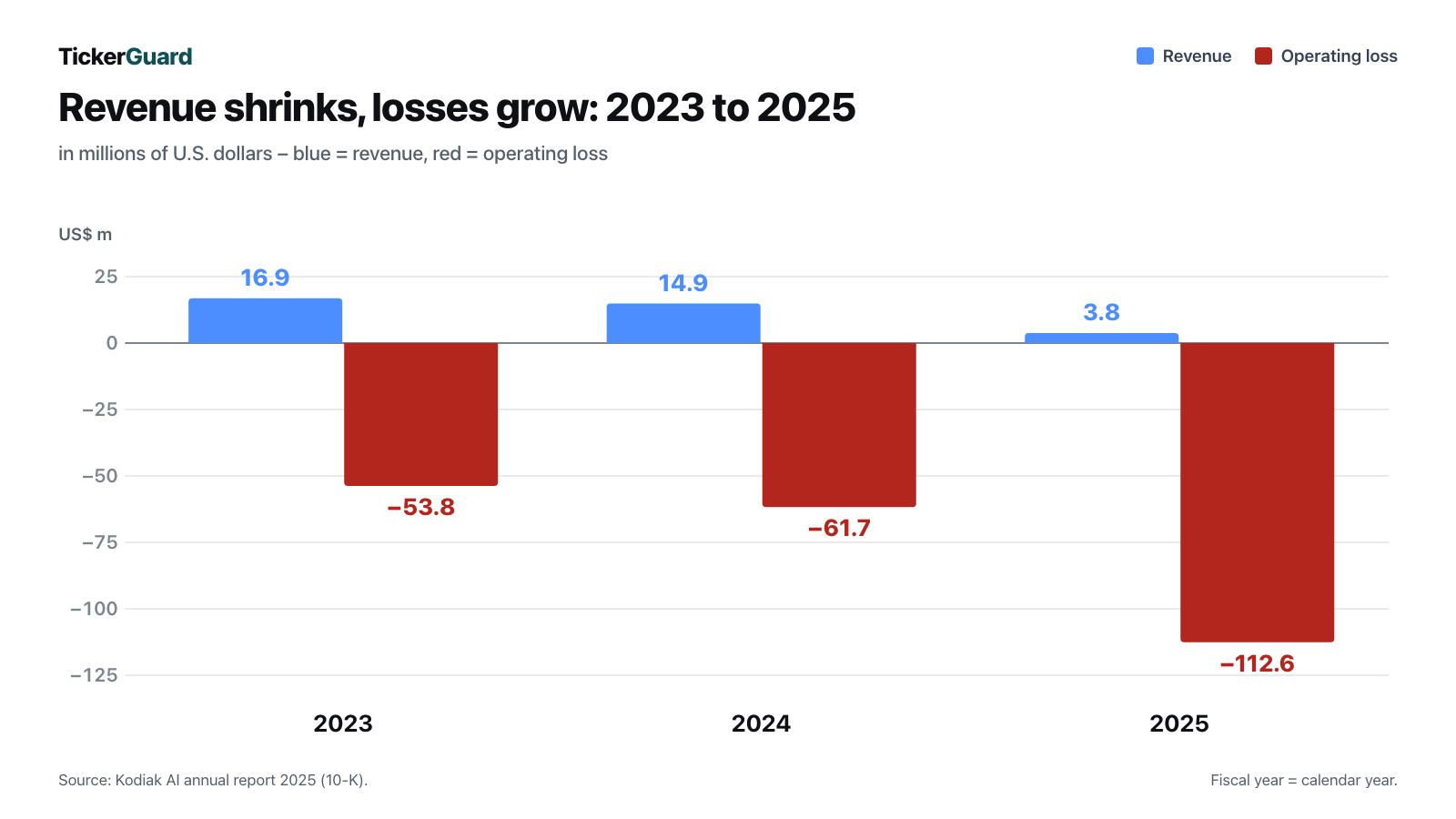
Over the years, the picture looks different. Revenue fell from $16.9 million (2023) to $14.9 million (2024) and $3.8 million (2025), while the operating loss grew from $53.8 million to $61.7 million and $112.6 million. The drop in revenue is not about a weak trucking business but about the Army work running out — more on that below.
The cash actually going out is growing, too: operations consumed about $43.8 million in 2023, $51.0 million in 2024, $94.4 million in 2025 and $63.6 million in the first half of 2026 alone. Add spending on trucks and technology, and free cash outflow was about $35.0 million in the first quarter of 2026 and $38.1 million in the second. The 2025 net loss of $585.5 million was far larger still; most of it came from fair-value charges around the merger (among them a $210.7 million loss on the issuance of equity instruments and $190.1 million from remeasuring simple agreements for future equity, or SAFEs) that cost no cash. The picture that sticks: the trucks drive more and more — and in the first half of 2026 every month cost Kodiak more than twelve million dollars on average.
What the filings say: the uncomfortable truths
Uncomfortable truth No. 1: Kodiak itself doubts it can continue as a going concern
The most important paragraph in the June 30, 2026 quarterly report sits right up front, in the first note to the financial statements. At that date Kodiak had $151.1 million of cash and marketable securities and $12.7 million of short-term debt. The company writes:
“These factors in the aggregate raise substantial doubt regarding the Company’s ability to continue as a going concern for at least one year after the filing date of these condensed consolidated financial statements, and management’s plans do not alleviate this substantial doubt.”
— Kodiak AI, Inc., SEC quarterly report 10-Q for June 30, 2026, Note 1 “Liquidity and Going Concern”
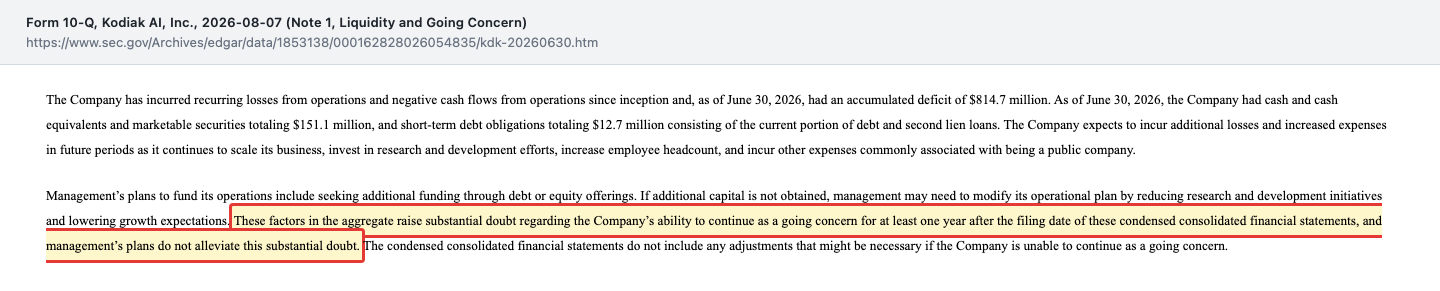
“Going concern” is the accounting assumption that a company will keep existing — put simply, the bookkeepers are allowed to assume there is a tomorrow. When a company writes that there is substantial doubt about it, that is not fine print. Nor is it new: the auditors’ reports for 2025, 2024 and 2023 already carried such an explanatory paragraph (annual report 2025, risk factors). In the management’s discussion section of the quarterly report, Kodiak then spells out the runway:
“We do not anticipate our cash and cash equivalents and marketable securities will be sufficient to meet our capital requirements for at least one year from the filing date of this Quarterly Report under our current operating plan. We expect to be able to fund our business plan into the second quarter of 2027.”
— Kodiak AI, Inc., SEC quarterly report 10-Q for June 30, 2026, Item 2 “Liquidity and Capital Resources”
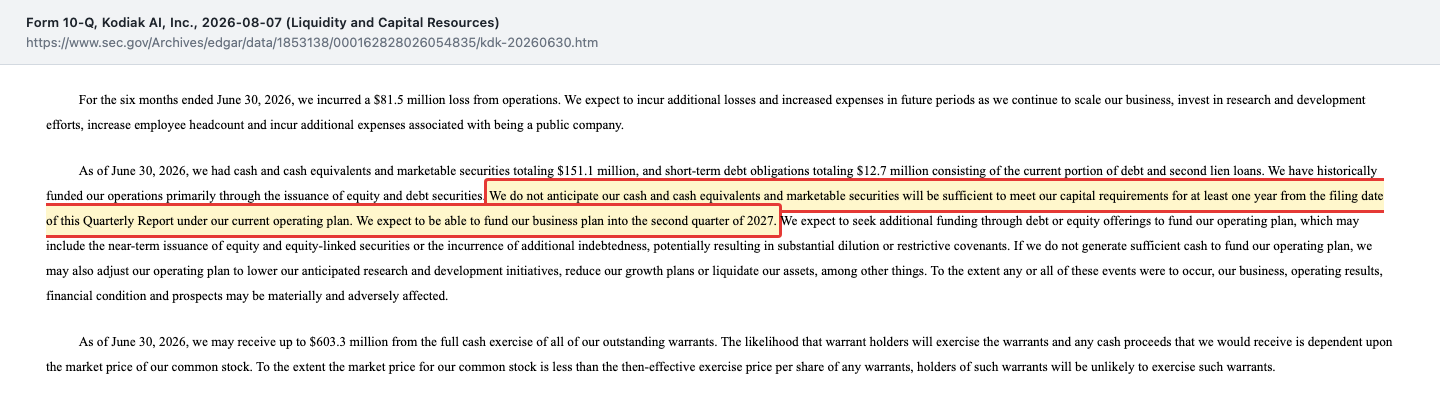
The math checks out: $151.1 million of cash divided by roughly $35 million to $38 million of free cash outflow per quarter gives about four quarters from June 30, 2026. How the hole is to be filled is in the same paragraph: through debt or equity, “which may include the near-term issuance of equity and equity-linked securities,” with potentially “substantial dilution.” In plain terms: your slice of the pie gets smaller when new slices are cut — and the lower the share price, the more slices it takes to raise the same amount.
Uncomfortable truth No. 2: The quarterly profit is an accounting entry — and it exists largely because the stock fell
For the second quarter of 2026, Kodiak reported net income of $12.5 million, and $39.0 million for the first half. That sounds like a turnaround. It is not. Operations lost $43.7 million in the quarter. The result was flipped by a line called “Change in fair value of common stock warrants”: a $58.3 million fair-value gain on warrants.
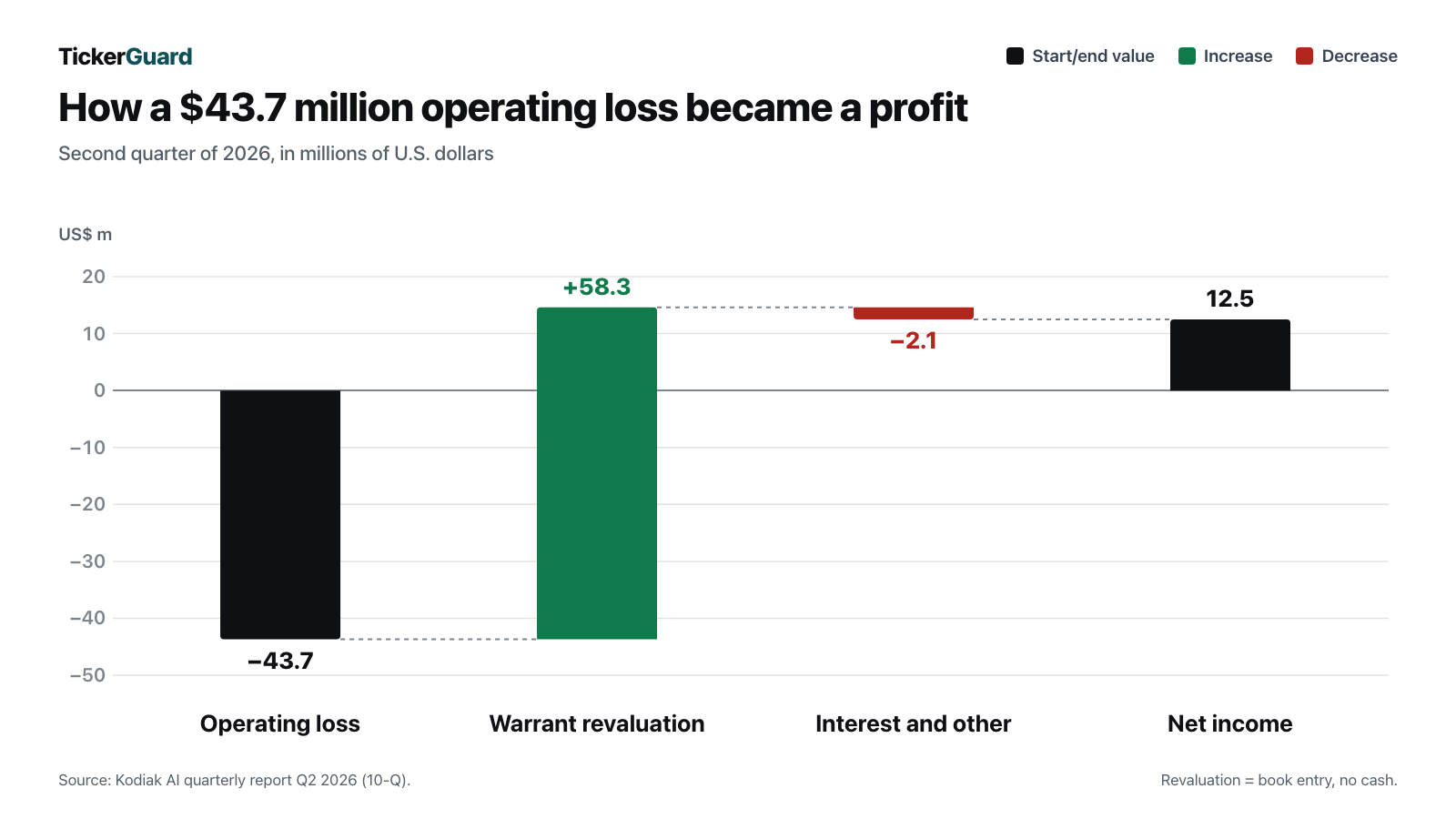
The explanation sounds paradoxical but is plain accounting: some of Kodiak’s warrants — rights to buy shares later at a fixed price — are carried on the balance sheet as a liability and marked to market every quarter. When the stock falls, those rights are worth less, the liability shrinks, and the decline shows up as a gain. At June 30, 2026 they stood at $97.7 million, down from $158.3 million at the end of 2025. If the stock recovers, the effect reverses and produces losses. None of this has anything to do with the business: operations consumed $34.1 million of cash in the second quarter. A second item turns the per-share result into a loss — a $46.1 million deemed dividend to the preferred holders, explained in truth No. 4. All told, Kodiak reports a second-quarter loss of $0.20 per share, and even $0.50 diluted — larger because the diluted calculation strips the $58.3 million fair-value gain on the warrants back out. Remember: a profit that rises when your own stock falls is not a profit; it is a mirror image.
Uncomfortable truth No. 3: The old anchor customer is gone — and the new one brings in more than half
Through 2024, Kodiak’s revenue came almost entirely from one customer: the U.S. Army, which paid Kodiak to develop autonomous military vehicles. It accounted for $15.0 million in 2023 and $13.3 million in 2024 — 89 percent of revenue each year. In 2025 it was $1.0 million. The annual report describes the drop plainly:
“Revenues decreased by $11.1 million, or 75%, to $3.8 million for the year ended December 31, 2025 from $14.9 million for the year ended December 31, 2024. The decrease was primarily attributed to a $12.3 million decrease related to contracts with the U.S. Army, and a $0.5 million decrease in freight delivery revenue.”
— Kodiak AI, Inc., SEC annual report 10-K for 2025, Item 7 “Revenues”

According to the annual report, the Army contract expires in October 2026, with only a limited number of contracted deliverables left. The new business is growing — the second quarter of 2026 brought $1.7 million more from the truck subscription and $1.2 million from ground autonomy solutions — but it again rests on few shoulders: a single customer, called “Customer B” in the quarterly report, accounted for 56 percent of second-quarter revenue and 65 percent for the first half. Kodiak itself lists its dependence on a small number of customers, naming Atlas and defense customers, as a risk. Per the annual report, Atlas was the only customer with driverless trucks in its own fleet at December 31, 2025; Atlas is contractually committed to deploying the Kodiak Driver on 100 of its own trucks, and nothing beyond that is locked in. New customers have been announced, such as a pilot with the lumber company West Fraser in Canada; they do not show up in the revenue numbers yet.
Uncomfortable truth No. 4: There is a long line ahead of you — preferred stock, warrants, earnout shares
At the merger in September 2025, investors put in $145 million through preferred stock — paper with a 9.99 percent annual dividend paid not in cash but in more paper, and the right to demand redemption after the fifth anniversary of the merger. Its redemption and liquidation value was $183.6 million at June 30, 2026. In a liquidation or sale, it gets paid before common shareholders. It can also be converted into common stock — and the conversion price was cut in half in May 2026:
“In May 2026, in connection with the private placement of common stock and warrants (see Note 12), the conversion price of the Series A Preferred Stock was adjusted from $12.00 to $6.00 per share. The Company recognized a deemed dividend of $46.1 million representing the incremental fair value transferred to holders from the conversion price reduction.”
— Kodiak AI, Inc., SEC quarterly report 10-Q for June 30, 2026, Note 11 “Redeemable Convertible Preferred Stock”
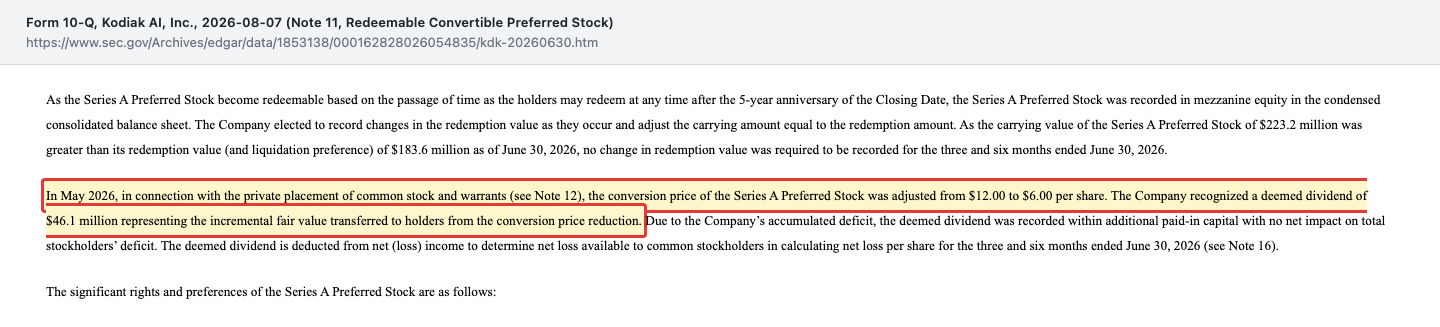
The trigger was the private placement of May 7, 2026: 15.4 million new shares at $6.50, each with a warrant at $6.00, for $100 million of gross proceeds; an Ares affiliate took about $5 million (8-K of May 7, 2026). Because the issue price was below the old conversion price, anti-dilution clauses would have adjusted the preferred terms anyway; instead, the parties agreed on $6.00 — for some existing warrants, too. The result in numbers: at June 30, 2026 Kodiak had about 269.9 million shares reserved for future issuance — 79.6 million for warrants, 30.6 million for the preferred, 52.1 million for employee options, 32.6 million for employee plans and 75.0 million so-called earnout shares for Kodiak’s pre-merger owners. Outstanding on July 31, 2026: 200.6 million. For perspective: the earnout shares are only issued if the stock trades above $18, $23 or $28 for 20 of 30 trading days — a long way off. And most warrants only make sense to exercise above $6.00 or $9.28. But every one of those thresholds sits exactly where you, as a shareholder, want to go. The 2025 warrants had protection clauses against issuance at lower prices. That is why their exercise price was cut from $12.00 to $6.00 in May 2026; according to the quarterly report, $6.00 is the contractual floor (Note 5). The new 2026 warrants carry their own adjustment clauses (Note 10).
Uncomfortable truth No. 5: Pay raises in a storm — and a former executive sells
On July 1, 2026 — between two quarterly reports that both flagged substantial doubt about the company’s future — the compensation committee, following a review by its independent compensation consultant, raised base salaries at the top: CEO Don Burnette from $425,000 to $525,000 (maximum annual bonus opportunity raised from up to 80 percent to up to 100 percent of salary), CFO Surajit Datta and COO Michael Wiesinger from $400,000 to $450,000 each. On top came restricted stock unit grants with a combined target value of $12.0 million ($7.0 million for Burnette, $2.5 million each for Datta and Wiesinger), vesting over four years (8-K of July 2, 2026). That is common in Silicon Valley and can be explained as a retention tool. It is also a sentence worth reading right next to “substantial doubt about its ability to continue as a going concern.”
A second filing came at the end of September 2026. Andreas Wendel, Kodiak’s chief technology officer (CTO) according to the 2025 annual report and listed as a former officer in his later September filings, sold 3.25 million shares for about $9.0 million on September 25, 2026, and another 164,707 shares for about $0.35 million on September 29. The source is his notices of proposed sale (Form 144) dated September 25, 29 and 30, 2026; the two later ones also list the prior days’ sales, and the first lists Wendel as an “affiliate.” The other side belongs here, too: large investors such as the fund firm LMR Partners (6.5 percent at June 30, 2026) have come in, and the Ares group added money in May. The point to hold on to: an insider who sells does not have to know anything you don’t — but the sale is a fact, not a rumor.
Valuation: about $241 million for a driver already on the road
At the October 19, 2026 close of $1.20, the 200.6 million shares are worth about $241 million. Against that stood $151.1 million of cash and marketable securities at June 30, 2026 — another quarter has passed since, after free cash outflows of $35.0 million and $38.1 million in the two quarters before; the September 30, 2026 balance will only come with the next quarterly report. At June 30, 2026, ahead of common shareholders sat about $42 million of debt — a $30 million term loan due January 2030 and a $10 million second-lien loan (fair value $12.0 million) due October 1, 2026; whether it was repaid will only show in the next quarterly report — plus the preferred stock with a $183.6 million redemption value. Common stockholders’ equity was negative at June 30, 2026: minus $188.9 million.
There is no price-to-earnings ratio, since operations make no profit. The price-to-sales ratio is about 34 (revenue for the four quarters through June 2026: $7.2 million) — in other words, the market is paying 34 times what Kodiak takes in over a year. For a company that can double or triple its revenue, that number alone is not a verdict. What matters is who pays for the road there. Our Serve Robotics analysis describes a similar tension between the promise of robotics and the need for capital. With Kodiak, the point is this: if the next raise comes at prices around one dollar, today’s shareholders pay for much of it with their stake. Nasdaq rules also require a minimum price of one dollar; the quarterly report explicitly lists the exchange’s standards on market value, holders and share price as a risk. Remember: for a company with a cash problem, a low market value is not a discount; it is the price at which the next raise dilutes you.
Upside and risks at a glance
What speaks for Kodiak AI:
- The technology runs in paid service: 35 driverless customer trucks and more than 40,000 paid driverless operating hours (June 30, 2026), up from about 10,700 at the end of 2025.
- A scalable subscription model: a fee per vehicle or per mile, without Kodiak having to buy the trucks; first-half 2026 revenue up 170 percent to $5.3 million.
- Three markets: off-road industrial trucking, long-haul freight (driverless launch planned by the end of 2026) and defense (selected for phase II of a Defense Innovation Unit program).
- Backers added money: a $100 million private placement in May 2026, including Ares and institutional investors.
What speaks against it:
- Substantial doubt about continuing as a going concern in the quarterly report (June 30, 2026) and the auditors’ report for 2025; cash lasts into the second quarter of 2027, by the company’s own estimate.
- Tiny revenue, big losses: $3.5 million of revenue and a $43.7 million operating loss in the second quarter of 2026; free cash outflow of $38.1 million.
- High customer concentration: one customer with 56 percent of quarterly revenue; Army revenue fell from $15.0 million (2023) to $1.0 million (2025).
- Dilution flagged: new stock in the “near term,” plus 79.6 million warrant shares, 30.6 million shares from the preferred and more employee and earnout shares.
- At June 30, 2026, preferred stock with a $183.6 million redemption value ranked ahead of common shareholders, whose equity was negative (−$188.9 million) at that date.
A human conclusion
Back to the narrative trap from the beginning. The trap is not that the story is false. With Kodiak, it isn’t: the trucks drive, with no one aboard, for paying customers, and there are more of them every quarter. The trap is that a good story hides the question of who pays for it. In the first half of 2026, Kodiak spent many times what it took in, writes about substantial doubt over its own future and is flagging new stock. The quarterly profit that fits the story so neatly is an accounting entry that gets bigger the further the stock falls. So the honest question is not “Will driverless trucks arrive?” — they probably will. It is: Will you still own a meaningful piece of Kodiak when they do? If you have an answer to that you are comfortable with, you have a thesis. If not, you have only heard a story. What you make of it is your decision.
Sources
All original documents used in this analysis — so you can check them yourself:
- Kodiak AI, Inc. — SEC quarterly report 10-Q for June 30, 2026 (filed August 7, 2026)
- Kodiak AI, Inc. — SEC quarterly report 10-Q for March 31, 2026 (filed May 8, 2026)
- Kodiak AI, Inc. — SEC annual report 10-K for 2025 (filed March 11, 2026)
- Kodiak AI, Inc. — SEC current report 8-K of August 6, 2026, Exhibit 99.1 (second-quarter 2026 results)
- Kodiak AI, Inc. — SEC current report 8-K of July 2, 2026 (Item 5.02, executive compensation)
- Kodiak AI, Inc. — SEC current report 8-K of May 7, 2026 ($100 million private placement)
- Kodiak AI, Inc. — SEC current report 8-K of December 31, 2025 ($30 million term loan)
- Kodiak AI, Inc. — 424B3 prospectus supplement of August 7, 2026 (closing price $4.36 on August 6, 2026)
- Kodiak AI, Inc. — Form 25 of September 24, 2025 (removal of the SPAC securities from the NYSE)
- Notices of proposed sale (Form 144) by Andreas Wendel of September 25, 29 and 30, 2026, and ownership reports (Schedule 13G) from August 2026: EDGAR overview for Kodiak AI (sec.gov)
- Fundamental data (prices, analyst ratings; as of October 19 and 20, 2026), checked against the SEC filings.
- Reddit mentions: ApeWisdom (as of October 20, 2026); surfaced via our in-house Reddit hype scanner.
Transparency & disclaimer: this analysis is journalistic commentary on publicly available information. It is not investment advice, not a regulated investment research product and not a solicitation to buy or sell securities. Equity investments carry substantial risk up to and including total loss. All information is provided without warranty; the as-of date for each figure is stated in the text. Positions held by the operator are disclosed daily; where one exists, it appears as a notice at the top of this analysis.
Key figures at a glance
All monetary figures in millions of $; earnings per share as reported.
| Metric | 2023 | 2024 | 2025 |
|---|---|---|---|
| Revenue | 16.9 | 14.9 | 3.8 |
| Operating Income (EBIT) | -53.8 | -61.7 | -112.6 |
| Net Income | -56.9 | -69.5 | -585.5 |
| Net Margin | -336.0% | -465.1% | -15,420.7% |
| Earnings Per Share | -0.31 $ | -0.38 $ | -6.42 $ |
Source: fundamental data & SEC filings (annual and quarterly reports, 10-K/10-Q)
Our Bottom Line at a Glance
- Technology & market position positive
- Driverless trucks in paid customer service: 35 customer-owned trucks and more than 40,000 paid driverless operating hours at 06/30/2026, up from about 10,700 at the end of 2025. A seventh-generation driving system was introduced in Q2 2026.
- Revenue & customers negative
- 2025 revenue was only $3.8 million (2024: $14.9 million) because Army work fell from $13.3 million to $1.0 million. Q2 2026 revenue was $3.5 million, 56 percent of it from a single customer.
- Earnings power negative
- Operating loss of $112.6 million in 2025 and $43.7 million in Q2 2026. The $12.5 million Q2 2026 net income stems from a $58.3 million fair-value gain on warrants, not from the business.
- Liquidity & going concern negative
- Going-concern warning in the 10-Q for 06/30/2026 and in the auditors’ report for 2025. $151.1 million of cash lasts into Q2 2027, per the company, at roughly $35 million to $38 million of free cash outflow per quarter.
- Capital structure & dilution negative
- New stock flagged for the “near term”; 269.9 million shares reserved for future issuance (200.6 million outstanding). Preferred stock with a $183.6 million redemption value (06/30/2026), conversion price cut from $12 to $6 in May 2026.
Kodiak AI is the narrative trap in pure form: the story of driverless trucks is true — 35 trucks run with no one aboard for paying customers. But second-quarter 2026 revenue was $3.5 million, the operating loss $43.7 million, the quarterly profit is an accounting entry, and the company itself doubts it can continue as a going concern. Cash lasts into the second quarter of 2027, by its own estimate, and new stock is flagged. Buying is a bet that the technology turns into revenue faster than the cash runs out. Not investment advice.
What Our Rating Means
Substance risk
We found at least one documented issue that threatens the company itself — regardless of how the stock is currently valued.
Substantial doubt about its ability to continue as a going concern: that is what the quarterly report for June 30, 2026 says, and it is why the light is red. The company says its $151.1 million of cash lasts into the second quarter of 2027, free cash outflow runs at $35 million to $38 million a quarter (Q1 2026: $35.0 million, Q2 2026: $38.1 million), and common stockholders’ equity is negative at minus $188.9 million. The technology is real and growing — which makes Kodiak more than an empty shell, but does not prove a viable business. If you wait, check the next quarterly report: how much cash is left, how many shares were added, and how fast is subscription revenue growing? The decision is yours.
A journalistic assessment by our editorial team at the time of the deep dive, based on public sources — not investment advice and not a solicitation to buy or sell. Your personal circumstances (investment goals, risk capacity, taxes) cannot be taken into account. What our levels mean, how verdicts are formed, and what conflicts of interest exist →
Worth Noting
- Kodiak AI made our research list through our in-house Reddit hype scanner (3 mentions in 24 hours, rank 126, ApeWisdom, as of October 20, 2026).
- Kodiak AI was called Ares Acquisition Corp II until the merger on 09/24/2025 (same CIK 0001853138). The Form 25 filed that day concerned the old SPAC securities on the NYSE, not a delisting of Kodiak. Figures before the merger are those of the former Kodiak Robotics, Inc.
- Market value calculated by us: 200,618,170 shares (10-Q cover, 07/31/2026) × $1.20 close (10/19/2026). Price cross-check against the 424B3 prospectus supplement of 08/07/2026 ($4.36 on 08/06/2026); the gap is explained solely by the share price decline since then.
Stock Watch
This analysis is as of October 20, 2026. Stock Watch will tell you what's changed at KDK since then.
Later $1 a month per stock — signing up is free, and you'll be the first to know when it launches.
The full analysis as a PDF for later
We will send you this analysis as a PDF — to print, file away, and read at your own pace. And we will add you to the free Stock Watch list for Kodiak AI, Inc. (KDK), so you hear about it when something material in this analysis changes.
Frequently Asked Questions
Kodiak AI, Inc. (Nasdaq: KDK) of Mountain View, California, develops the “Kodiak Driver,” an AI-powered driving system for trucks. Customers such as the oil and gas logistics provider Atlas Energy Solutions run their own trucks with it, without a driver, and pay a fee per vehicle or per mile. At the end of June 2026, 35 customer-owned trucks were running driverless; Kodiak also hauls highway freight and works for the military.
No. In the second quarter of 2026, revenue of $3.5 million compared with an operating loss of $43.7 million, and operations consumed $34.1 million of cash. The reported net income of $12.5 million came from a $58.3 million fair-value gain on warrants, which lose value when the share price falls. Per share, Kodiak reports a loss of $0.20.
According to its quarterly report for June 30, 2026, Kodiak had $151.1 million of cash and marketable securities and expects that to fund its business plan into the second quarter of 2027. The company therefore reports substantial doubt about its ability to continue as a going concern and plans to raise capital, including new stock with potentially substantial dilution.
Because U.S. Army work ran out. In 2023 and 2024, 89 percent of revenue came from the Army ($15.0 million and $13.3 million); in 2025 it was just $1.0 million. Total revenue fell from $14.9 million to $3.8 million as a result. The new truck subscription grew by $1.7 million in 2025 and kept growing in the first half of 2026, but it does not yet replace the Army revenue.
At June 30, 2026, Kodiak had about 269.9 million shares reserved for future issuance, more than the 200.6 million outstanding (July 31, 2026): 79.6 million for warrants, 30.6 million for preferred stock, 52.1 million for employee options, 75.0 million earnout shares (only from prices of $18) and more for employee plans. New stock has also been flagged.
Through a merger with the blank-check company (SPAC) Ares Acquisition Corp II, completed on September 24, 2025; since then the stock has traded on Nasdaq as KDK. About 89 percent of the SPAC shares were redeemed before the merger. The Form 25 filed the same day only removed the old SPAC securities from the NYSE and is not a delisting of Kodiak.
Found an error?
Did you spot a factual error, an outdated number, or a typo in this deep dive? Let us know briefly — your report goes straight to the editorial team.