WeRide Does Not Hold the Map License Its Own Robotaxis Need — RMB 66.8 Million Went to a Sibling's Company in 2025
A robotaxi company without its own map license: WeRide Inc. (Nasdaq: WRD) buys the high-definition maps none of its vehicles can drive without from Guangzhou Yuji — a firm in which a sibling of chairman and chief executive Dr. Tony Xu Han owns a substantial interest in the voting power, according to the 2025 annual report on Form 20-F. The bill for 2025 alone came to RMB 66.8 million — after RMB 111.5 million in 2023 and RMB 90.1 million in 2024. Sentences like that get skipped when the time-lapse trap takes hold and a sharp picture of the future feels closer than the calendar allows. So we read what WeRide actually told the U.S. securities regulator, the SEC — including the revenue table, where the robobus at RMB 231.5 million ranks ahead of the robotaxi at RMB 148.0 million.
 Thomas Mücke
Founder & Publisher
Thomas Mücke
Founder & Publisher
As of Today
As of: October 5, 2026
- Closing price
- 5.10 $ +0.90%
- Market Capitalisation
- 1.7 $B
- Growth Score
- 2/10
- AAQS
- 5/10
Price change since August 20, 2026: -16.0%
This analysis has a cut-off date. The Stock Guard tells you when something material changes in the numbers. Reserve your free spot
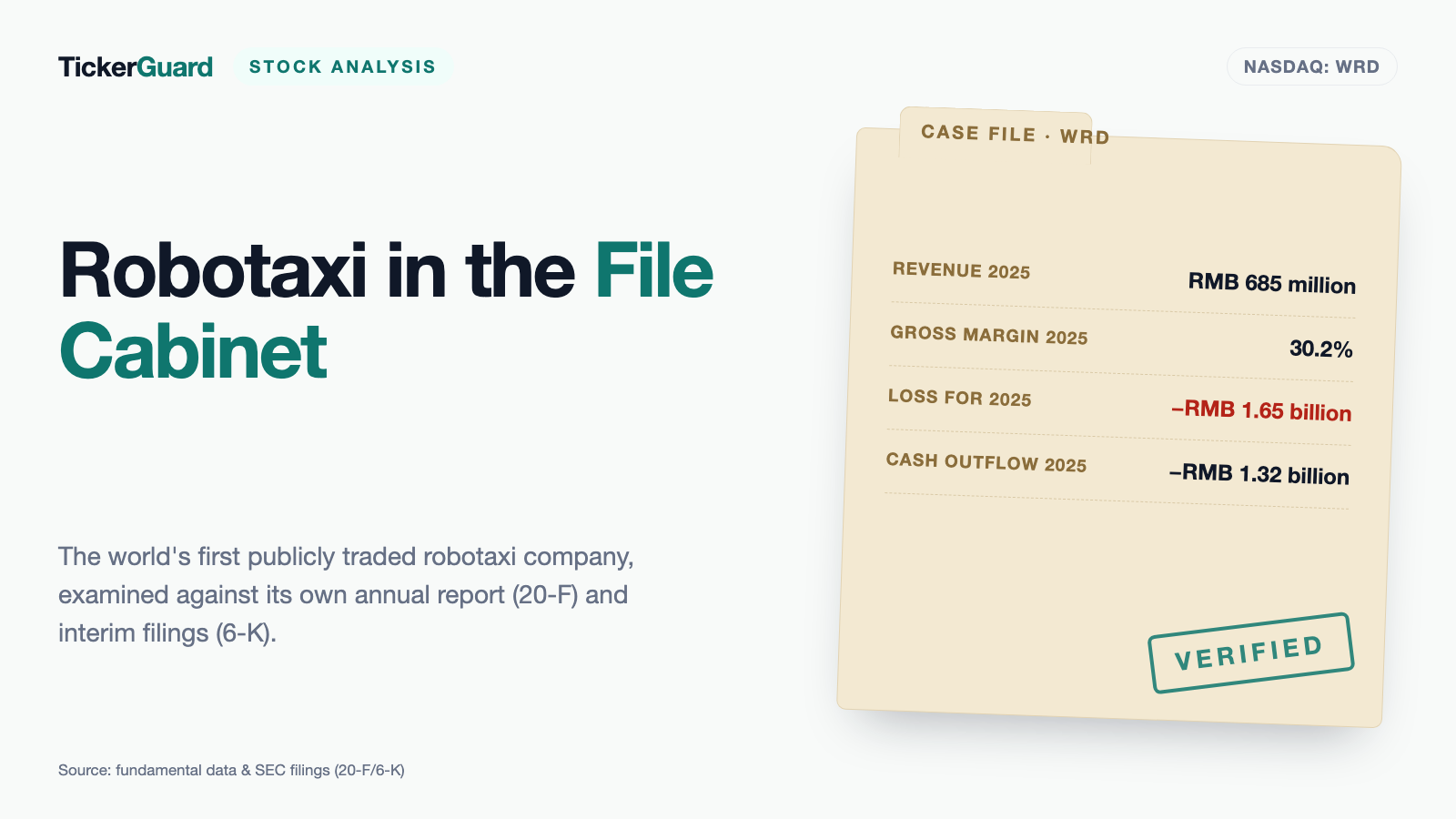
Chart
Interactive price chart (TradingView).
52-week range: 5.00 $ to 12.40 $ · Last price: 5.10 $ (As of: October 5, 2026)
Note: pure fact-based analysis, not investment advice and not a solicitation to buy or sell. All figures without guarantee.
A robotaxi company that does not hold the license for its own maps: WeRide Inc. (Nasdaq: WRD) sources the high-definition maps none of its vehicles can drive without from Guangzhou Yuji Technology Co., Ltd. — a firm in which a sibling of chairman and chief executive Dr. Tony Xu Han owns a substantial interest in the voting power, as the 2025 annual report on Form 20-F states. For 2025 alone, Guangzhou Yuji billed WeRide RMB 66.8 million, roughly one tenth of the company's full-year revenue.
That sentence never makes a headline, and there is a reason. The reason is an investing weakness that does not feel like a weakness at all. It feels like foresight. Call it the time-lapse trap: the more clearly we can picture a future, the closer we assume it is. Anyone can picture a taxi without a driver — the door opens, nobody is up front, the car pulls away. Because the image is so sharp, it feels like next year, and everything printed in the notes reads like fine print. The calendar is less forgiving. Driverless taxis have been on the road for years, and the companies building them still do not make money from them.
WeRide describes itself as "the first publicly traded robotaxi company." So let us make a deal: before you buy the picture, we read together what WeRide itself told the U.S. securities regulator, the SEC — the annual report on Form 20-F for 2025, filed April 23, 2026, and the interim filings on Form 6-K through August 12, 2026. Those documents carry criminal liability; marketing brochures do not. And they describe a company whose revenue nearly doubled, whose cash is leaving faster than ever and whose biggest revenue line is a bus. What you make of it is your decision.
What WeRide sells — and why the robobus brings in more than the robotaxi
WeRide builds autonomous driving systems. In plain terms, the company does not primarily sell cars; it sells the driver, packaged as software, computing hardware and sensors. Four vehicle types carry the name: the robotaxi, the robobus (a driverless shuttle on fixed routes — plants, campuses, feeder lines), the robosweeper (a driverless street sweeper) and the robovan (a driverless delivery vehicle). A fifth, invisible business sits alongside them: ADAS development and data services. ADAS stands for advanced driver-assistance systems — the step below full autonomy that already ships in production cars. According to its 2025 annual report on Form 20-F, WeRide develops such systems for others, including Bosch, and supplies autonomous driving development work to Nissan. The sensors these vehicles use to read the world rely heavily on lidar, the laser eyes of machines; and in the same annual report WeRide explicitly names Nvidia as one of its ecosystem partners.
Legally, WeRide is a Cayman Islands holding company with operations in Guangzhou. Three things follow for an investor. First, WeRide reports as a foreign private issuer. There is no Form 10-K and there are no Form 10-Q quarterly reports; instead there is an annual report on Form 20-F and interim filings on Form 6-K. Quarterly figures are therefore voluntary and are not produced inside the same review framework a domestic filer uses. Second, the accounts are prepared under IFRS in renminbi while the stock trades in dollars. Every operating figure in this analysis is stated in renminbi; where the company converts, it uses RMB 6.7851 to $1.00, the rate in effect on June 30, 2026. Third, since November 6, 2025 the shares are also listed on the Hong Kong Stock Exchange under stock code 0800. One American depositary share traded on Nasdaq represents three Class A ordinary shares — a conversion worth remembering behind every per-share number.
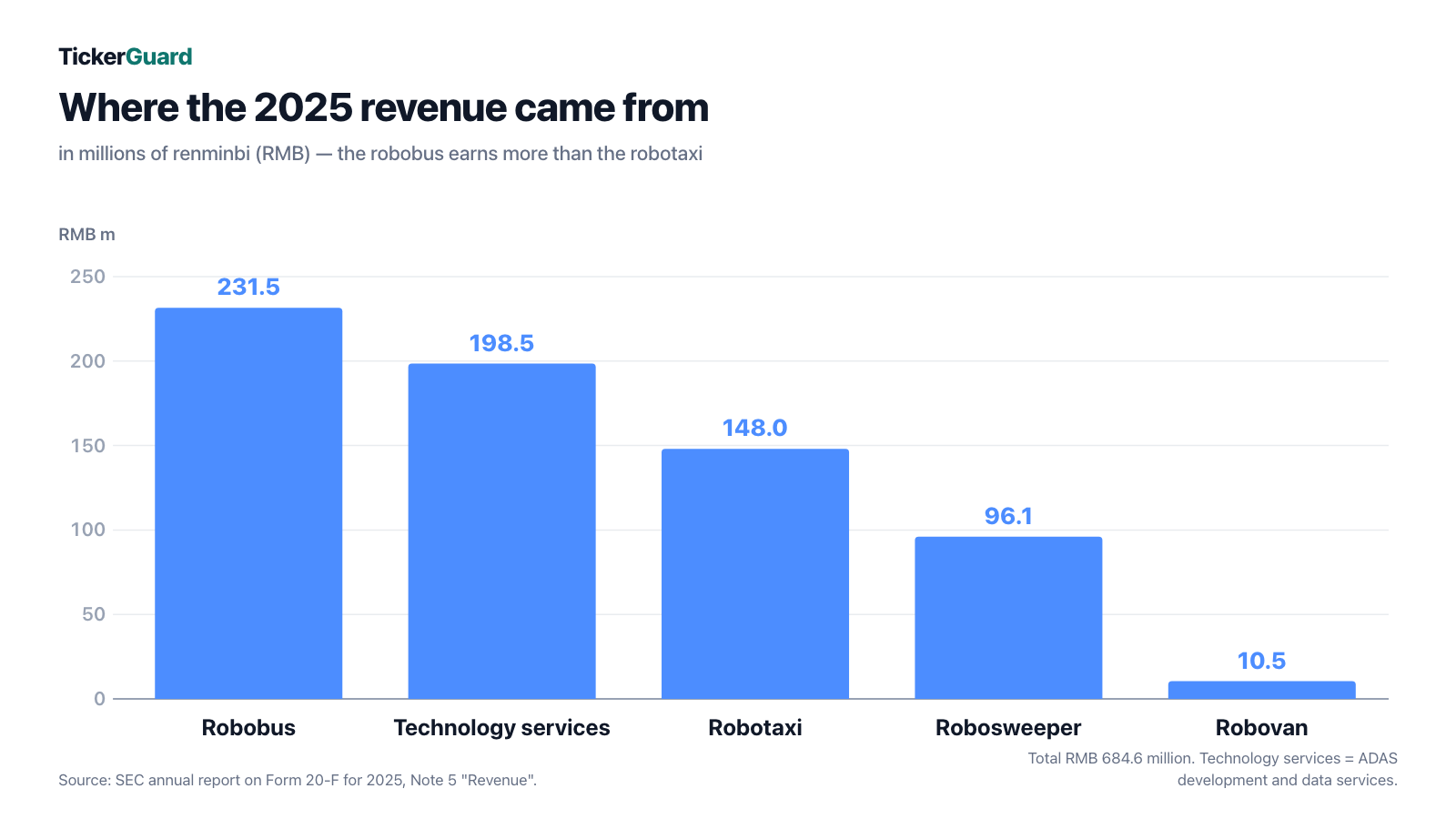
And now the point that reorders the story. The notes to the annual report break down where the RMB 684.6 million of 2025 revenue came from: robobus RMB 231.5 million, ADAS and data services RMB 198.5 million, robotaxi RMB 148.0 million, robosweeper RMB 96.1 million, robovan RMB 10.5 million. Unit sales were 156 robobuses, 123 robotaxis, 91 robosweepers and 28 robovans. So the robotaxi is neither the largest nor the second-largest revenue line — and the rides themselves barely register: revenue from WeRide's own WeRide Go service is described in the report as "insignificant." WeRide earns most of its money selling vehicles and development work to others, not moving people from A to B. That frames the central tension of this analysis, and it runs through every chapter that follows: the equity story is robotaxi, the income statement is vehicle sales and contract engineering — and the bridge between the two still has to be built and paid for.
Company history for investors
-
2024
Nasdaq listing
ADS trading began on October 25, 2024. The listing converted the preferred shares into ordinary shares, turning RMB 3.05 billion of negative equity into RMB 7.07 billion of positive equity.
-
2025
Hong Kong listing raises HK$2.3 billion
The secondary listing under stock code 0800 followed on November 6, 2025, raising HK$2,318.0 million net. For shareholders that meant fresh capital — which then sat untouched through August 2026.
-
2026
Shareholders cut Class B voting power from 40 to 10
The resolution of March 13, 2026 sharply reduced the founders' super-voting rights. The same meeting approved a new share plan with capacity for 95.1 million shares.
-
2026
Buybacks of roughly $100 million
Between March and June 2026 WeRide repurchased 40.45 million of its own ordinary shares. The price per ordinary share ranged from $1.79 to $2.64 — about $5.40 to $7.90 per ADS.
-
2026
Founders move stakes into family trusts
On July 13, 2026 the Hong Kong Stock Exchange waived Listing Rule 8A.18(1). Both founders transfer 20 percent of their holding vehicles to family trusts and keep sole control of the voting rights.
-
2026
Half-year figures: revenue up 73 percent, cash down 24 percent
On August 12, 2026 WeRide reported RMB 345.9 million of first-half revenue and a RMB 789.8 million loss. The liquid position fell from RMB 7.1 billion to RMB 5.4 billion in six months.
How the stock landed on our desk
WeRide did not reach our research list through a valuation or momentum scanner. It came from our in-house Reddit hype scanner, which tracks daily which smaller U.S. stocks are being mentioned unusually often in retail investor forums, and flagged WeRide on August 21, 2026. That is a trigger, not a metric — and we treat it accordingly: a reason to go and read, not an argument. Forum attention says nothing about a business model; it says only that a lot of people are telling the same story at the same time. On a subject like driverless taxis that is no surprise. It is the time-lapse trap in its purest form: the story is too good to check.
What the scanner cannot supply, the market can: a price. At the closing price of $6.07 on August 20, 2026 and 328.96 million ADS equivalents, the market value was roughly $2.0 billion. The range over the preceding twelve months ran from $5.18 to $12.55 — against the twelve-month high of $12.55 the stock has more than halved; measured over a full year it is down roughly a third, and it sits nearer the bottom of that band. That is not an argument either way; it is the frame we place the numbers in. Let us start with what genuinely impresses.
The numbers over the years, honestly credited
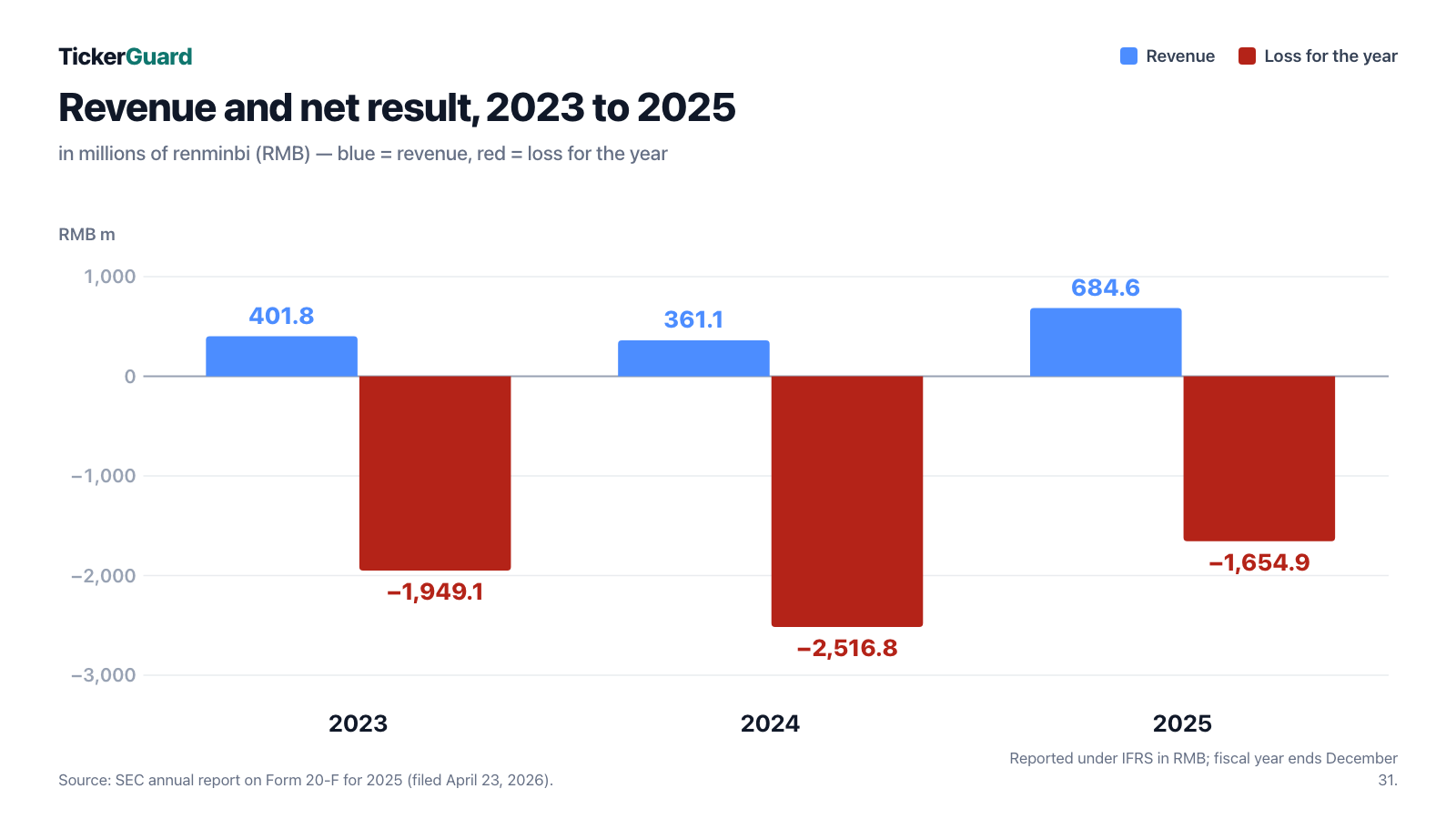
WeRide is growing, and clearly so. Revenue rose 89.6 percent in 2025, from RMB 361.1 million to RMB 684.6 million. The product business carried it, more than quadrupling from RMB 87.7 million to RMB 359.8 million — 156 robobuses sold versus 14 the year before, 123 robotaxis versus 18. The trend has continued: in the second quarter of 2026 revenue grew 82.2 percent to RMB 231.7 million, and 73.3 percent in the first half to RMB 345.9 million. More striking still is the international line. Revenue outside mainland China rose from RMB 49.4 million to RMB 199.8 million in 2025, from 13.7 percent to 29.2 percent of the total, and the company reports a further 164.4 percent year-over-year increase in the second quarter of 2026.
One figure belongs alongside that jump, and it rarely features in the growth story: 2024 was itself a step backwards. Revenue fell that year from RMB 401.8 million in 2023 to RMB 361.1 million. The 89.6 percent growth of 2025 therefore builds on a shrunken prior year. Measured against 2023 instead, the two-year gain is roughly 70 percent — still respectable, but markedly less spectacular than the headline number.
The balance sheet deserves credit too. As of June 30, 2026 the company held RMB 5.4 billion ($795.6 million) in cash, time deposits, restricted cash and short-term investments against total liabilities of only RMB 1.36 billion. Equity stood at RMB 6.4 billion. There is almost no interest-bearing debt: RMB 485.0 million of short-term bank loans at 2.11 to 2.21 percent. That is a funding position many growth companies would envy — and the reason the question here is not "will it survive?" but "how long is the head start funded for?"
Operating progress in the core business belongs in the credit column as well. Gross margin rose to 37.5 percent in the second quarter of 2026 from 28.1 percent a year earlier, as higher-margin ADAS work and overseas business gained weight. In fairness, that recovery is young: across full fiscal years, gross margin fell from 45.7 percent in 2023 to 30.7 percent in 2024 and 30.2 percent in 2025 — whether the second-quarter 2026 recovery holds for a full year remains to be seen. The fleet comprised roughly 3,400 level 4 vehicles as of July 31, 2026 — level 4 being the tier at which no human has to intervene — including more than 1,800 robotaxis; in the Chinese domestic business, daily rides per vehicle rose 24 percent quarter over quarter in the second quarter of 2026 to more than 21. And the revenue split shows why this progress still counts for little in the total:
And the most recent quarter shifts the picture again, in a direction that fits the central tension of this analysis. Of the RMB 231.7 million of revenue in the second quarter of 2026, the company reports that RMB 125.2 million came from the level 4 business — all driverless vehicles combined — up 47.3 percent year over year. The remaining RMB 106 million or so came from the other businesses — L2++/L3 contract development of driver-assistance systems for other manufacturers (the tier below autonomy where a human stays at the wheel) together with the AI infrastructure business of intelligent data services. WeRide does not publish a separate revenue figure for L2++/L3 alone; for that business — contract development of driver-assistance systems — it reports only growth of 2,593.8 percent year over year. WeRide delivered roughly 30,000 units of its WRD 3.0 solution in the quarter and reports production design wins for more than 30 vehicle models plus a level 3 proof-of-concept project with Mercedes-Benz. In July 2026 it also introduced its own foundation model, WeRide WITT, built to extract rules of the physical world from operating data. In percentage terms, in other words, the growth spurt of the latest quarter did not come from the robotaxi. It came from these other businesses around supplier work and data services.
Hold on to that picture; it carries the rest of the analysis. The impressive growth rates sit on a very small base. RMB 684.6 million is about $98 million of annual revenue on the company's own conversion — for a business the market values at roughly $2 billion. Now to what else is in the filings.
What the filings say — the uncomfortable truths
Uncomfortable truth no. 1: the loss is shrinking — and more than twice as much cash is going out
At first glance 2025 looks like a turn. The annual loss fell from RMB 2,516.8 million to RMB 1,654.9 million, down 34.2 percent. The second glance spoils the mood. The money that actually left the building rose sharply in the same year — operating cash outflow grew from RMB 593.6 million to RMB 1,321.7 million, an increase of 123 percent. WeRide names the contradiction itself in its risk factors:
"We have a history of net losses and operating cash outflow and have not been profitable since our inception. We incurred loss for the year of RMB1,949.1 million, RMB2,516.8 million and RMB1,654.9 million (US$236.6 million) in 2023, 2024 and 2025, respectively. We recorded net cash outflow from operating activities of RMB474.9 million, RMB593.6 million and RMB1,321.7 million (US$189.0 million) for the years ended December 31, 2023, 2024 and 2025, respectively."
— WeRide Inc., Form 20-F for 2025, Item 3.D Risk Factors

Why do the two figures diverge? Because much of the 2024 loss consisted of non-cash items — RMB 1,187.9 million of share-based compensation alone, meaning payment in the company's own stock rather than cash, plus revaluation effects on preferred shares that converted into ordinary shares at the IPO. In 2025 that line fell to RMB 450.0 million. So the loss shrank mainly because it contained fewer bookings, not fewer outlays. Meanwhile growth tied up real money: receivables rose RMB 213.8 million in 2025 and inventories RMB 207.6 million. In plain terms: revenue doubles, but a growing share of it sits as an invoice in a folder and as goods on a shelf rather than as cash in the bank. Remember the distinction: a falling loss is news about the accounting; a rising cash outflow is news about the till. During the first half of 2026 the total liquid position then shrank from RMB 7.1 billion to RMB 5.4 billion — down 24.3 percent in six months, as the company states in its own interim report.
Uncomfortable truth no. 2: a sixth of the receivables is more than two years old — and 68.2 percent of it is written down
When revenue grows but cash does not, the receivables are worth a look. WeRide's notes contain an unusually candid table. As of December 31, 2025, total credit exposure — trade receivables, amounts due from related parties, contract assets and payments made on behalf of customers — stood at RMB 602.1 million. Of that, RMB 393.3 million was less than a year old, RMB 112.0 million was one to two years old and RMB 96.8 million was more than two years old. To that oldest bucket WeRide applies an expected loss rate of 68.2 percent; the year before it was 43.6 percent.

The yardstick appears a few pages earlier in the same notes:
"Trade receivables are normally due within 30 to 90 days from the invoice date."
— WeRide Inc., Form 20-F for 2025, Note 18 "Trade receivables"
An invoice still open two years after issue has missed its payment term by more than eightfold. Put it in everyday terms: you sold your neighbour three lawnmowers, you have been waiting two years for the money on one of them, and you now assume yourself that two thirds of it will never arrive. This is not a catastrophe — a RMB 96.3 million allowance against RMB 5.4 billion of liquid assets is absorbable. But it is a warning sign about the quality of the revenue growth. Part of what was booked at the top never arrived as cash at the bottom, and the allowance kept climbing in 2025, from RMB 81.0 million to RMB 96.3 million. The notes do offer relief on a related front: the largest customer's share of the receivables balance fell from 28 percent to 15 percent, and the top five customers' share from 37 percent to 27 percent. The concentration risk is shrinking while the ageing risk grows.
Uncomfortable truth no. 3: fresh money sits untouched — and the company still buys its own shares
On November 6, 2025 WeRide raised HK$2,318.0 million net in its Hong Kong listing — roughly $300 million at the pegged rate of about HK$7.8 to the dollar. The interim report for the six months ended June 30, 2026 states that none of it had been used as of its publication date of August 12, 2026, and that the money is to be deployed over two to three years. A few paragraphs later, the same document sets out what WeRide did with cash between March and June 2026 instead:
"During the Reporting Period, the Company repurchased a total of 27,447,800 Class A ordinary shares at an aggregate consideration of HK$542.98 million on the Stock Exchange and a total of 4,335,433 ADSs at an aggregate consideration of US$30.02 million on Nasdaq."
— WeRide Inc., Form 6-K of August 12, 2026, interim report as of June 30, 2026

Add the two amounts and you get roughly $100 million. The 4,335,433 ADSs represent 13,006,299 ordinary shares; together with the 27,447,800 shares bought in Hong Kong, WeRide held exactly 40,454,099 treasury shares as of July 31, 2026. In fairness: buybacks are not inherently suspect, and treasury shares can later settle employee awards without new stock being issued — economically that acts as a brake on dilution rather than a distribution. The sequence still needs explaining, though. A company raises fresh equity in November, leaves it untouched for nine months, burns a quarter of its liquid assets in the same half-year, and spends roughly $100 million on its own shares in parallel. Readers who want to track moves like this will find the finding, its trigger and its watch point in our side-finds feed.
Uncomfortable truth no. 4: the maps come from a company in which the chief executive's sibling holds substantial voting power
An autonomous vehicle needs high-definition maps, and producing them in China requires a state surveying licence. WeRide does not hold one. It buys the mapping services from Guangzhou Yuji Technology Co., Ltd. The annual report names who stands behind it:
"Guangzhou Yuji is an entity in which a substantial interest in the voting power is owned by a sibling of Dr. Tony Xu Han, our chairman and chief executive officer."
— WeRide Inc., Form 20-F for 2025, Item 3 "Key Information," section "Our Holding Company Structure"
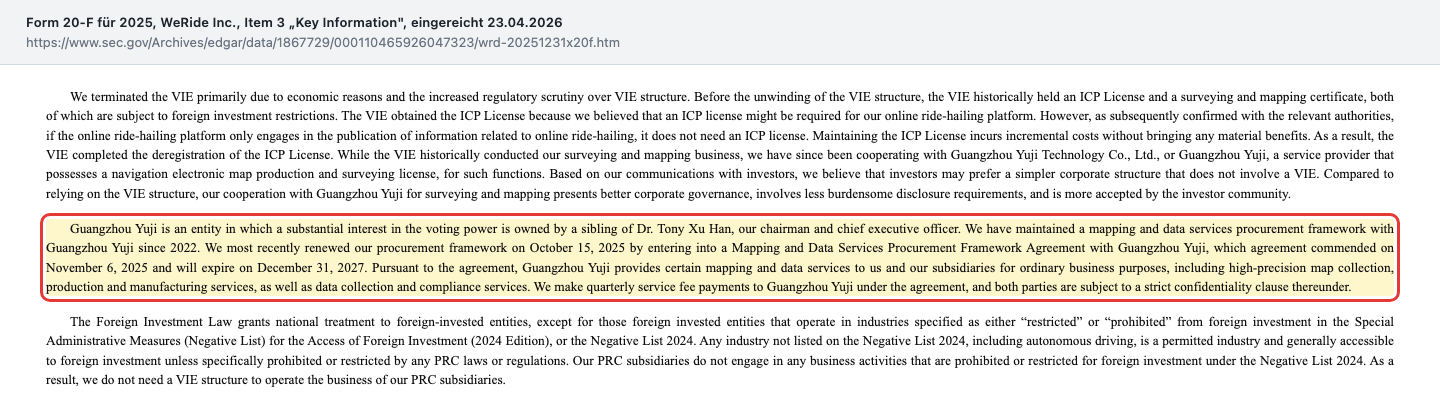
The scale: Guangzhou Yuji billed WeRide RMB 111.5 million in 2023, RMB 90.1 million in 2024 and RMB 66.8 million in 2025 for surveying and mapping services. The RMB 66.8 million in 2025 is about a tenth of total annual revenue and roughly 14 percent of cost of revenue. On November 21, 2025 the audit committee — made up of all three independent non-executive directors — raised the annual cap for 2025 from RMB 65 million to RMB 69 million because the original ceiling would no longer have covered expected demand; the announcement states expressly that the aggregate amount procured had not exceeded the cap at the time of the revision. The board ratified the revision in April 2026. The cap for 2026 and 2027 is RMB 70 million each.
Two things need saying. First, in fairness: everything is disclosed, the audit committee consists of three independent directors, and neither WeRide nor Dr. Tony Xu Han himself holds any economic or voting interest in Guangzhou Yuji — nor is Guangzhou Yuji a shareholder of WeRide. The company argues the arrangement is preferable to the variable interest entity structure it previously used. Second, in caution: this is not a peripheral service but a permit without which the vehicles may not operate. The risk factors put it plainly:
"If our cooperation with Guangzhou Yuji is terminated or expires without timely renewal for any reason, and we cannot reach similar cooperation arrangements with other qualified service providers on terms acceptable to us, or at all, we may have to halt the relevant operation of our vehicles until we can obtain such licenses, if ever."
— WeRide Inc., Form 20-F for 2025, Item 3.D Risk Factors
In everyday terms: the driving licence for your entire fleet does not belong to you but to an outside supplier in which the boss's sibling holds substantial voting power — and the contract for it expires at the end of 2027. That is not an accusation. It is a dependency to price in.
Uncomfortable truth no. 5: three in four employees label data — and a fifth more shares waits in the pipeline
WeRide employed 718 people at the end of 2023, 3,093 at the end of 2024, 3,801 at the end of 2025 and 5,485 as of June 30, 2026 (4,952 full-time employees and 533 interns). The interesting part is not the number but its composition. As of June 30, 2026, 4,125 people — 75.2 percent of the workforce — worked in "R&D data processing", that is reviewing, sorting and labelling driving data. Engineering headcount was 1,066; sales and marketing was 116. The annual report explains why: these staff were hired to provide data processing services to customers as well as to feed the company's own development. Part of the "technology services" revenue is therefore classic, labour-intensive data work — that line alone grew by RMB 103.8 million in 2025. It is a solid business, but it scales like a service, not like software.
The second number in this chapter concerns your slice of the pie. Dilution means new slices are cut, so yours gets smaller. The monthly return to the Hong Kong Stock Exchange dated August 6, 2026 lists, as of July 31, 2026: 90,435,903 outstanding options and 14,740,911 shares under share awards from the 2018 plan, plus an entirely untouched capacity of 95,064,817 shares under the 2026 plan approved on March 13, 2026. That is 200,241,631 ordinary shares against 986,868,365 ordinary shares outstanding — roughly 20.3 percent. Part of it can be settled from the 40,454,099 treasury shares; the rest would be new stock.
And the report also sets out who decides all of this. WeRide has two share classes: Class A with one vote and Class B with ten votes per share, reduced from forty by resolution of the extraordinary general meeting on March 13, 2026. Founder, chairman and chief executive Dr. Tony Xu Han therefore holds about 27.5 percent of the votes on 6.7 percent of the capital, co-founder and chief technology officer Dr. Yan Li 10.9 percent of the votes on 5.0 percent, and all directors and officers together 39.5 percent of the votes on 15.6 percent. On July 13, 2026 the Hong Kong Stock Exchange also granted a waiver allowing both founders to transfer 20 percent of their holding vehicles into family trusts for their children, with sole control over the voting rights expressly staying with them. Add one governance deviation the company discloses itself: the roles of chairman and chief executive are held by the same person.
Valuation: about 16 times annual revenue
A price-to-earnings ratio cannot be formed — there are no earnings. That leaves revenue. In the twelve months to June 30, 2026 WeRide generated RMB 830.8 million of revenue (the second half of 2025 plus the first half of 2026), roughly $122 million at the company's conversion rate of RMB 6.7851 to the dollar. At the closing price of $6.07 on August 20, 2026 and 328.96 million ADS equivalents, that is a price-to-sales ratio of about 16. Strip out net liquidity — $795.6 million of liquid assets less $71.5 million of bank loans as of June 30, 2026 — and the enterprise value is roughly $1.3 billion, or about ten times annual revenue. Against equity of $942.6 million, the price-to-book ratio is about 2.1.
How should that be read? A price-to-sales ratio of 16 is absurd for a profitable industrial company and unremarkable for a young technology business growing 80 to 90 percent. The price therefore mostly contains the expectation that today's $122 million of annual revenue becomes a multiple of that within a few years, and that gross margin — 37.5 percent in the second quarter of 2026 — rises far enough to carry development costs that ran to RMB 797.7 million in the first half of 2026 alone. That is the arithmetic that has to work. The analyst consensus in our fundamental data covers three ratings — one strong buy, two buys, no hold and no sell — at a mean price target of $13.86; the source does not disclose which firms stand behind them. We report that as a third-party view and do not adopt it as our own — the same consensus expects per-share losses for both 2026 and 2027. And there is one sober reference point from inside the house: WeRide bought back its own shares between March and June 2026 at prices between HK$17.23 and HK$21.30, or $1.79 to $2.64 per ordinary share — roughly $5.40 to $7.90 per ADS.
Opportunities and risks at a glance
What speaks for WeRide:
- Real, accelerating growth: revenue up 89.6 percent in 2025 to RMB 684.6 million, up 82.2 percent in the second quarter of 2026 to RMB 231.7 million and up 73.3 percent in the first half of 2026 to RMB 345.9 million.
- A strong balance sheet: RMB 5.4 billion ($795.6 million) of liquid assets as of June 30, 2026 against RMB 1.36 billion of total liabilities and only RMB 485.0 million of short-term bank loans at 2.11 to 2.21 percent; equity of RMB 6.4 billion.
- Rising gross margin: 37.5 percent in the second quarter of 2026 versus 28.1 percent a year earlier, driven by higher-margin ADAS work and overseas business.
- International presence with weighty partners: permits in eight markets, vehicles tested or operated in more than 60 cities across 13 countries and roughly 3,400 level 4 vehicles as of July 31, 2026; Uber (5.6 percent), Alliance Ventures (6.3 percent) and Yutong (6.5 percent) are also shareholders.
- Falling concentration risk: the top five customers' share of revenue fell from 76.6 percent in 2023 to 45.6 percent in 2024 and 40.5 percent in 2025, and the largest customer's share from 55.3 percent to 11.4 percent; related-party revenue fell to 1.1 percent of the total.
What speaks against it:
- Never profitable and needing more cash: a RMB 1,654.9 million loss in 2025 on RMB 684.6 million of revenue, operating cash outflow up from RMB 593.6 million to RMB 1,321.7 million, and liquid assets down 24.3 percent during the first half of 2026.
- Ageing receivables: RMB 96.8 million more than two years old at a 68.2 percent expected loss rate (prior year 43.6 percent), and a total allowance up from RMB 81.0 million to RMB 96.3 million — on payment terms of 30 to 90 days.
- The story does not yet carry the numbers: the robotaxi delivered only RMB 148.0 million of the RMB 684.6 million of 2025 revenue, the report calls revenue from the company's own rides "insignificant," and 75.2 percent of the workforce works in data processing.
- Dependence on a related party: the surveying license for high-definition maps sits with the supplier Guangzhou Yuji, in which a sibling of the chief executive holds substantial voting power according to the annual report — the chief executive himself holds neither capital nor voting rights there (RMB 66.8 million of services in 2025, framework agreement to December 31, 2027); without it, the risk factors say vehicle operations may have to stop.
- Control and dilution: 27.5 percent of the votes on 6.7 percent of the capital in one pair of hands, chairman and chief executive in one person, and 200.2 million ordinary shares in employee plans — roughly 20.3 percent of the base. On top of that come the regulatory risks of a Chinese company with a U.S. listing, described at length in the annual report.
A human conclusion
Back to the time-lapse trap. Its trick is not that it makes you believe something false. Driverless taxis are coming — nobody at WeRide doubts that, least of all the people who have obtained permits in eight markets. Its trick is that it steals the schedule. Between "this will happen" and "this pays" this company has so far placed RMB 684.6 million of annual revenue against a RMB 1,654.9 million annual loss, a cash outflow growing faster than the business, and a cash pile that shrank by a quarter during the first half of 2026. None of that is a death sentence: the balance sheet holds, the growth is real, the margin is rising. But it is a very concrete piece of arithmetic, and it is running against a clock.
So the honest question is not "do you believe in the robotaxi?" It is: are you willing to hold, for several years, a company whose biggest revenue line is a bus, whose map license does not belong to it but to the supplier Guangzhou Yuji, in which a sibling of the chief executive holds substantial voting power according to the annual report, three quarters of whose staff label data, and whose next milestone is written not in its own calendar but in the calendars of eight regulators? If yes, you at least know what you are waiting for — which is more than most people can say about their bets on the future. If no, that is not weakness; it is a realistic view of your own patience. What you make of it is your decision. And that is exactly as it should be.
Sources
Every primary document used in this analysis, for you to read yourself:
- WeRide Inc. — SEC annual report on Form 20-F for 2025 (filed April 23, 2026)
- WeRide Inc. — SEC Form 6-K of August 12, 2026: unaudited second quarter and first half 2026 results
- WeRide Inc. — SEC Form 6-K of August 12, 2026: interim report as of June 30, 2026
- WeRide Inc. — SEC Form 6-K of August 6, 2026: monthly return on share capital (July 2026)
- WeRide Inc. — SEC Form 6-K of July 13, 2026: waiver from Listing Rule 8A.18(1)
- WeRide Inc. — SEC Form 6-K of April 23, 2026: revision of the annual cap for continuing connected transactions
- WeRide Inc. — SEC annual report on Form 20-F for 2024 (filed March 25, 2025)
- Complete SEC filing history for WeRide Inc.: EDGAR overview (sec.gov)
- Fundamental data (price and market data, analyst picture; as of August 21, 2026; closing price $6.07 on August 20, 2026), reconciled against the SEC filings.
- Trigger: our in-house Reddit hype scanner, flagged on August 21, 2026.
Transparency & disclaimer: This analysis is journalistic commentary on publicly available information. It is not investment advice, not a regulated financial analysis and not a solicitation to buy or sell securities. Equity investments carry substantial risk up to and including total loss. All information is provided without warranty; the as-of date of each figure is stated in the text. Positions held by the operator are disclosed daily; where one exists, it appears as a notice at the top of this deep dive.
Key figures at a glance
All monetary figures in millions of CNY; earnings per share as reported.
| Metric | 2021 | 2022 | 2023 | 2024 | 2025 |
|---|---|---|---|---|---|
| Revenue | 138.2 | 527.5 | 401.8 | 361.1 | 684.6 |
| Operating Income (EBIT) | -500.5 | -779.2 | -1,566.2 | -2,185.2 | -1,822.5 |
| Net Income | -1,007.3 | -1,298.5 | -1,949.1 | -2,516.8 | -1,654.9 |
| Net Margin | -729.0% | -246.1% | -485.0% | -696.9% | -241.7% |
| Earnings Per Share | -3.74 CNY | -4.84 CNY | -7.27 CNY | -9.14 CNY | -5.37 CNY |
Source: fundamental data & SEC filings (annual and quarterly reports, 10-K/10-Q)
Our Bottom Line at a Glance
- Growth positive
- Revenue rose 89.6 percent in 2025 to RMB 684.6 million, 82.2 percent in the second quarter of 2026 to RMB 231.7 million and 73.3 percent in the first half of 2026 to RMB 345.9 million. Overseas revenue grew from RMB 49.4 million to RMB 199.8 million in 2025. Gross margin improved to 37.5 percent in the second quarter of 2026 from 28.1 percent a year earlier.
- Result and cash burn negative
- The Form 20-F for 2025 states that WeRide has not been profitable since inception. The 2025 loss of RMB 1,654.9 million was 2.4 times revenue. Operating cash outflow rose from RMB 593.6 million in 2024 to RMB 1,321.7 million in 2025, because the smaller loss came mainly from lower share-based compensation while receivables and inventories together increased by RMB 421.4 million.
- Balance sheet and funding positive
- As of June 30, 2026 the company held RMB 5.4 billion ($795.6 million) of liquid assets against RMB 1,360.1 million of total liabilities and RMB 6,395.3 million of equity. Only RMB 485.0 million of short-term bank loans at 2.11 to 2.21 percent bear interest. On the 2025 burn rate that funds a little over three years; at the pace of the first half of 2026 (down 24.3 percent) under two.
- Quality of revenue negative
- Of RMB 602.1 million of credit exposure as of December 31, 2025, RMB 96.8 million was more than two years old and carried a 68.2 percent expected loss rate (prior year 43.6 percent) — on stated payment terms of 30 to 90 days. At the same time the robotaxi that gives the company its name delivered only RMB 148.0 million of the RMB 684.6 million of 2025 revenue, and 75.2 percent of the workforce was in labour-intensive data processing as of June 30, 2026.
- Governance and capital structure negative
- The surveying licence for high-definition maps sits with Guangzhou Yuji, in which a sibling of the chief executive holds a substantial voting interest according to the annual report (RMB 66.8 million of services in 2025, agreement to December 31, 2027). According to the annual report, neither the chief executive nor WeRide itself holds any capital or voting rights in Guangzhou Yuji, and Guangzhou Yuji is not a shareholder of WeRide; the volume fell from RMB 111.5 million in 2023 to RMB 90.1 million in 2024 and RMB 66.8 million in 2025, approved by an audit committee of three independent directors. The chief executive holds 27.5 percent of the votes on 6.7 percent of the capital and also chairs the board. Employee plans can create 200.2 million ordinary shares — about 20.3 percent of the base as of July 31, 2026.
WeRide describes itself as the world's first publicly traded robotaxi company and it is growing fast: revenue up 89.6 percent in 2025 to RMB 684.6 million and up 82.2 percent in the second quarter of 2026. The numbers behind the story are smaller than the story suggests — the largest single line in 2025 was the robobus at RMB 231.5 million, the robotaxi ranked only third at RMB 148.0 million, and the report calls revenue from the company's own rides insignificant. The loss fell to RMB 1,654.9 million in 2025 while operating cash outflow rose to RMB 1,321.7 million, and the liquid position shrank 24.3 percent to RMB 5.4 billion during the first half of 2026. Add ageing receivables, a map license that belongs not to WeRide but to the supplier Guangzhou Yuji — in which a sibling of the chief executive holds substantial voting power, while the chief executive himself holds neither capital nor voting rights there — and a dilution overhang of about 20.3 percent from employee plans. Not investment advice.
What Our Rating Means
Open questions
The business works in principle, but one material question is open. As long as it stays open, our findings do not carry a quality verdict.
Yellow, because the business works in principle but the decisive operating question is open: whether $122 million of annual revenue can grow enough to carry development costs that ran to RMB 797.7 million in a single half-year before the cash pile thins out noticeably. The gap is documented — a 2025 loss of 2.4 times annual revenue, operating cash outflow more than doubled to RMB 1,321.7 million, and receivables older than two years that WeRide itself writes down by 68.2 percent. Red would still be wrong: as of June 30, 2026 there were RMB 5.4 billion of liquid assets against RMB 1.36 billion of total liabilities and RMB 6.4 billion of equity, interest-bearing debt is RMB 485.0 million at a little over two percent, and no filing contains a going-concern warning. Green is ruled out by the unproven earning power — and by the dependence on a related party for the map licence. That the stock costs about 16 times annual revenue is a price argument and changes nothing here. The decision is yours.
A journalistic assessment by our editorial team at the time of the deep dive, based on public sources — not investment advice and not a solicitation to buy or sell. Your personal circumstances (investment goals, risk capacity, taxes) cannot be taken into account. What our levels mean, how verdicts are formed, and what conflicts of interest exist →
Worth Noting
- WeRide reached our research list through our in-house Reddit hype scanner (flagged on August 21, 2026). Forum attention is a reason to read, not an argument; this analysis rests entirely on the filings with the U.S. securities regulator, the SEC.
- Mind the currency and the reporting regime: WeRide prepares its accounts under IFRS in renminbi but trades in dollars. Every operating figure here is stated in renminbi; where a conversion is used, it is the company's own rate of RMB 6.7851 per dollar as of June 30, 2026. As a foreign private issuer WeRide files no Form 10-K and no Form 10-Q, but an annual report on Form 20-F and interim filings on Form 6-K — quarterly figures are therefore voluntary.
- One ADS represents three Class A ordinary shares, so per-share figures from price portals and from the filings are not directly comparable. WeRide should also not be confused with the same company's Hong Kong listing (stock code 0800) or with the over-the-counter symbol WRDIF.
Stock Watch
This analysis is as of August 26, 2026. Stock Watch will tell you what's changed at WRD since then.
Later $1 a month per stock — signing up is free, and you'll be the first to know when it launches.
The full analysis as a PDF for later
We will send you this analysis as a PDF — to print, file away, and read at your own pace. And we will add you to the free Stock Watch list for WeRide Inc. (WRD), so you hear about it when something material in this analysis changes.
Frequently Asked Questions
WeRide Inc. (Nasdaq: WRD) develops and sells autonomous driving systems: robotaxis, robobuses, robosweepers (driverless street sweepers) and robovans, plus advanced driver-assistance systems (ADAS) and data services for other manufacturers. Of RMB 684.6 million of revenue in 2025, RMB 231.5 million came from the robobus, RMB 198.5 million from ADAS and data services and RMB 148.0 million from the robotaxi. The holding company is incorporated in the Cayman Islands; operations are in Guangzhou.
Because the U.S. securities regulator, the SEC, treats WeRide as a foreign private issuer. Such companies file an annual report on Form 20-F instead of a Form 10-K, and interim reports on Form 6-K instead of quarterly reports on Form 10-Q. The annual report for 2025 was filed on April 23, 2026 and the second quarter 2026 figures on August 12, 2026. The accounts are prepared under IFRS in renminbi, and the fiscal year ends December 31.
One American depositary share traded on Nasdaq represents three Class A ordinary shares. As of July 31, 2026, 986,868,365 ordinary shares excluding treasury were outstanding, equal to about 328.96 million ADS equivalents. Per-ADS figures are therefore three times the per-share figures: in the first half of 2026 the loss was RMB 2.37 per ADS against RMB 0.79 per ordinary share.
No. The Form 20-F for 2025 states that WeRide has not been profitable since its inception. The loss for the year was RMB 1,949.1 million in 2023, RMB 2,516.8 million in 2024 and RMB 1,654.9 million in 2025. In the first half of 2026 the loss was RMB 789.8 million. Operating cash outflow rose from RMB 593.6 million in 2024 to RMB 1,321.7 million in 2025.
As of June 30, 2026 WeRide held RMB 5.4 billion ($795.6 million) in cash, time deposits, restricted cash and short-term investments — 24.3 percent less than six months earlier. On the 2025 burn rate (RMB 1,321.7 million operating plus RMB 248.4 million of capital expenditure) that is a little over three years; at the pace of the first half of 2026 it would be under two. Interest-bearing debt is minimal: RMB 485.0 million of short-term bank loans.
WeRide has two share classes. Class A shares carry one vote; Class B shares have carried ten votes since the extraordinary general meeting of March 13, 2026, down from forty. Founder and chief executive Dr. Tony Xu Han therefore holds about 27.5 percent of the votes on 6.7 percent of the capital, co-founder Dr. Yan Li 10.9 percent on 5.0 percent, and all directors and officers together 39.5 percent on 15.6 percent. Larger holders include Yutong (6.5 percent), Qiming and Alliance Ventures (6.3 percent each) and Uber Technologies (5.6 percent).
Guangzhou Yuji Technology supplies WeRide with the high-definition mapping and surveying services that require a state licence in China — a licence WeRide does not hold itself. According to the annual report, a sibling of chief executive Dr. Tony Xu Han holds a substantial voting interest in that company; the chief executive himself holds neither capital nor voting rights in Guangzhou Yuji, the annual report states. The services amounted to RMB 111.5 million in 2023, RMB 90.1 million in 2024 and RMB 66.8 million in 2025. The framework agreement runs from November 6, 2025 to December 31, 2027, with annual caps of RMB 70 million for 2026 and 2027.
WeRide went public on Nasdaq on October 25, 2024 and added a Hong Kong listing under stock code 0800 on November 6, 2025, raising HK$2,318.0 million net. The interim report as of June 30, 2026 states that this money had not been used as of August 12, 2026 and is to be deployed over two to three years. The secondary listing also subjects WeRide to Hong Kong disclosure rules, including monthly returns on movements in share capital.
Found an error?
Did you spot a factual error, an outdated number, or a typo in this deep dive? Let us know briefly — your report goes straight to the editorial team.