bp Stock: Debt Target Hit, Another $4 Billion Written Off — Not Yet a Pension
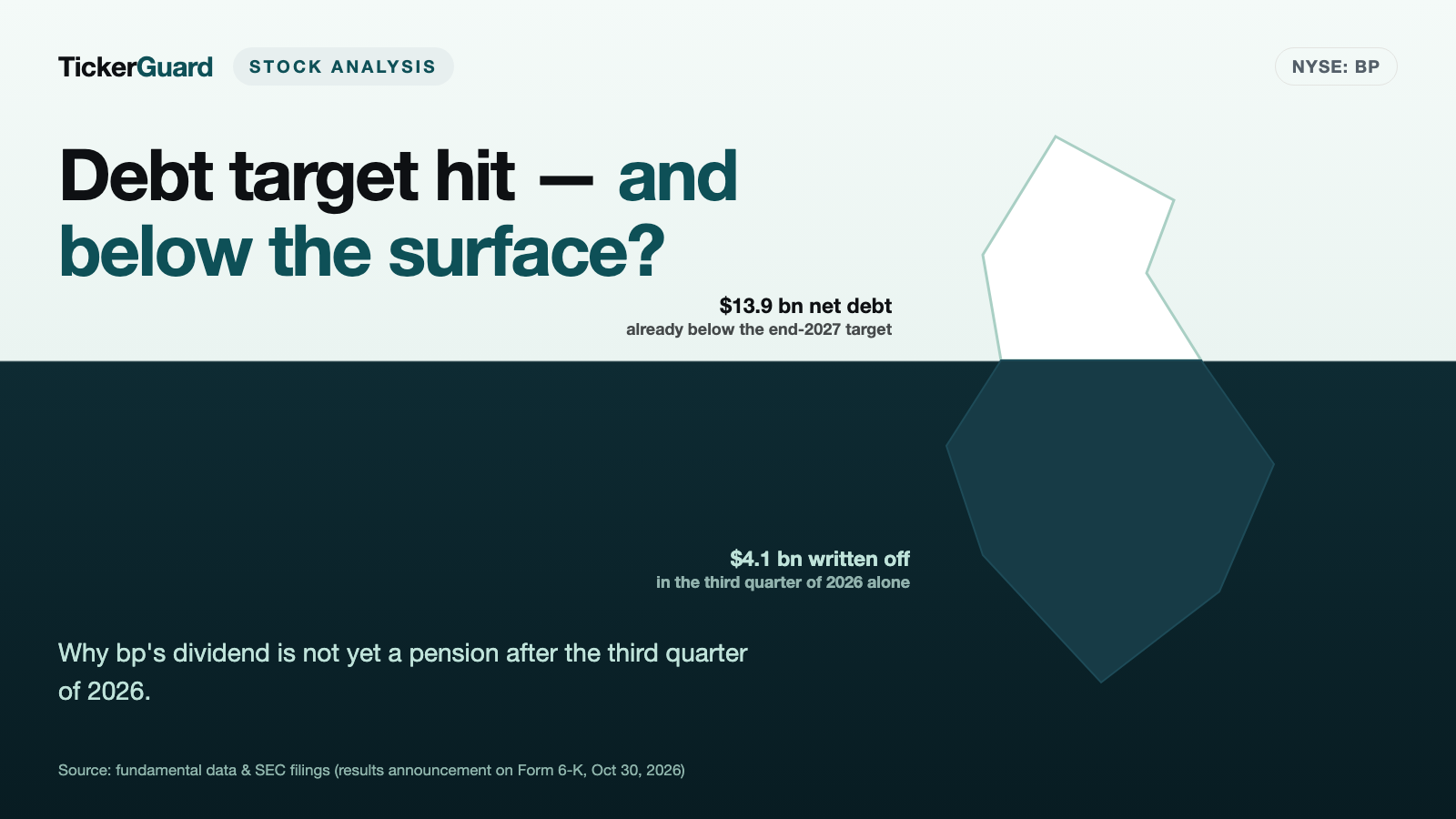
More than a year ahead of plan, bp's net debt of $13.9 billion sits below its target for the end of 2027 — and in the same quarter bp wrote off another $4.1 billion, mostly on its businesses of the future. Underlying quarterly profit of $8.5 billion was carried mainly by higher refining margins and strong gas trading. On December 15, 2026 bp intends to set out its plans and capital frame — the next checkpoint for a dividend many people feel is a safe pension.
 Thomas Mücke
Founder & Publisher
As of Today
As of: October 30, 2026
- Closing price
- 50.40 $ +0.10%
- Market Capitalisation
- 129.8 $B
- P/E
- 24.1
- Growth Score
- 3/10
- AAQS
- 4/10
This analysis has a cut-off date. The Stock Guard tells you when something material changes in the numbers. Reserve your free spot
Chart
Interactive price chart (TradingView).
52-week range: 33.30 $ to 51.30 $ · Last price: 50.40 $ (As of: October 30, 2026)
Note: pure fact-based analysis, not investment advice and not a solicitation to buy or sell. All figures without guarantee.
The Dividend Trap
Every three months it lands in your account on schedule, almost like a pension payment: the bp dividend. How much of it was earned that quarter is not on the bank statement. And that is where the problem starts, because there is a kind of stock where the thinking stops before it starts. A global company everyone knows, a payout that seems to have been there forever, and a yield comfortably above a savings account. That does not feel like risk. It feels like a pension.
That is exactly the dividend trap: we confuse "regular" with "earned". A dividend is a board decision, not a law of nature. It can come out of profit, out of the cash box, out of selling parts of the company, or out of new debt — and the payment slip does not say which.
So let us make a deal. I will show you what bp's own filings with the U.S. securities regulator, the SEC, actually say — the annual report for 2025, the interim report for the first half of 2026 and the results announcement for the third quarter of 2026 — and you decide for yourself whether the sense of safety holds. The tension that runs through this whole piece: bp's cash generation has been fine for years. Its income statement was not, for two of them.
Company history for investors
-
2016
Consent decree with the U.S. and five Gulf states
The settlement spreads payments over many years; at the end of 2025 installments over seven to eight years were still outstanding. For shareholders that means a fixed outflow of roughly a billion dollars a year, whatever the oil price does.
-
2022
Rosneft interest written down to nil
Since the first quarter of 2022 the Russian business has been carried at nil. The stake cannot be sold and no dividend income is recognized.
-
2023
Profit of $15,239 million
$5.27 per depositary share — more than the underlying measure showed. It was the last year in which reported earnings exceeded the adjusted figure.
-
2024
Profit collapses to $381 million
Impairments of $5,633 million consume the result. The company still paid out $5.0 billion of dividends and $7.1 billion of buybacks.
-
2025
Castrol sale and change at the top
In December 2025 the chief executive steps down; bp agrees to sell 65 percent of Castrol to Stonepeak for roughly $6 billion net. The money is earmarked for debt, not for distribution.
-
2026
Buybacks suspended, chair replaced, debt target met
February: buybacks suspended. May: chair removed; September: successor appointed. End of September: net debt $13.9 billion, with another $4 billion written off in the quarter.
The Third Quarter of 2026: Debt Target Met, Write-Downs Back
This analysis first appeared in August 2026, based on the half-year report, and left three questions open: whether net debt would finally come down, whether the run of multi-billion write-downs would end, and how much of the profit jump came from the market. On October 30, 2026 bp published its results for the third quarter and the first nine months of 2026 (current report on Form 6-K). They answer the first question with a clear yes, the second with a no — and the third the way we feared.
The cash. Operating cash flow in the third quarter was $14,829 million ($10,858 million in the prior quarter, $7,786 million a year earlier), and $28,547 million over nine months. Capital expenditure fell to $3,036 million in the quarter. Net debt dropped within three months from $22,251 million to $13,870 million, and gearing (net debt relative to net debt plus equity) from 22.6 to 14.8 percent. That puts bp below the $14 to $18 billion range at September 30, 2026 — a range originally meant to be reached by the end of 2027. Chief executive Meg O'Neill writes:
"We have now delivered our net debt and structural cost reductions targets and have line of sight on the remaining two of the four primary financial targets we set ourselves for 2027."
— bp p.l.c., third-quarter 2026 results announcement on Form 6-K, furnished October 30, 2026
For structural cost reductions the same announcement shows a cumulative $3,984 million against 2023 levels, excluding the divested Gelsenkirchen refinery. And it adds its own caveat: add hybrid capital, lease liabilities and the Gulf settlement obligations to net debt and the combined figure fell by $9.3 billion versus the second quarter — but "we are still too leveraged," the report says, and further strengthening of the balance sheet remains the number one job.
The earnings. Stripping out inventory holding effects and adjusting items (underlying replacement cost profit), bp earned $8,458 million in the third quarter after $5,732 million in the prior quarter and $2,210 million a year earlier — $3.26 per ADS. In the income statement, bp shareholders were left with $4,696 million for the quarter and $12,449 million over nine months. The gap between the two numbers has a name this analysis already knows: $4.1 billion of pre-tax impairments in the third quarter alone ($4.0 billion after tax), $5.3 billion over nine months — once again mostly in the transition businesses of the gas & low carbon energy segment. The chief executive does not dodge it:
"But this quarter we recognized $4.0 billion of impairments linked largely to transition businesses; we know we need to be better stewards of our shareholders' capital."
— bp p.l.c., third-quarter 2026 results announcement on Form 6-K
Where the profit comes from. Against the prior quarter, the report names significantly higher realized refining margins and a significantly higher gas marketing and trading result as the main drivers. The refining business (products) alone added $2.5 billion on an underlying basis, while the customer business — retail, Castrol and midstream — came in $0.5 billion lower. Set the segments against each other: underlying profit before interest and tax rose by $3,131 million versus the prior quarter ($13,443 million after $10,312 million). The gas segment, with higher realizations and a much stronger gas trading result, added $1,061 million, refining and customers together $1,994 million, while oil production was practically flat at minus $47 million; the remaining $123 million came from other businesses and corporate. The increase therefore sits almost entirely in the businesses whose earnings depend on margins, prices and trading. The chief executive herself describes the results as "supported by the higher-price, higher-margin environment and some good progress on performance improvement." Fairness requires the operational side too: bp-operated upstream plant reliability rose to 95.3 percent (92.4 percent in the prior quarter) and refining availability to 96.5 percent. For the fourth quarter, though, bp expects a significantly lower customers result and refinery throughput of only 1,160 to 1,210 thousand barrels per day after 1,396 in the third quarter, with Gelsenkirchen gone and more maintenance scheduled.
Where the money goes next. Primarily not to buybacks. Shortly before the results bp agreed with the State of Louisiana to accelerate its oil spill settlement commitments; the payment date of the $350 million settlement named in that context is still to be determined. The board's intent is spelled out plainly:
"Our intent is now to prioritize the use of excess cashflow to address our remaining Deepwater Horizon liabilities in full."
— bp p.l.c., third-quarter 2026 results announcement on Form 6-K
The dividend stays at 8.660 cents per ordinary share, payable on December 18, 2026. On December 15, 2026 bp plans to set out its strategy, capital frame and new targets. Only then will it become clear whether and when buybacks return — the results announcement says nothing about it.
What we do not have. A verbatim transcript of the October 30, 2026 analyst call was only available behind paywalls at the time of writing. We therefore worked from the results announcement itself and the trading statement of October 13, 2026, not from answers given in the Q&A.
What bp Actually Does
bp is an integrated energy company. "Integrated" means it accompanies a barrel of oil or a cargo of gas from the wellhead to the pump. It explores and produces (upstream), it refines in its own plants, it trades in world markets, and at the end it sells to filling stations, airlines and industrial customers.
Through the end of 2026 it reports in three segments. Gas & low carbon energy covers natural gas, liquefied natural gas and the remaining renewables interests. Oil production & operations is the classic oil production business. Customers & products bundles refineries, retail sites, the Castrol lubricants business and trading. The move to a simple upstream and downstream structure, announced on June 9, 2026, was completed organizationally in July 2026; per the results announcement of October 30, 2026 segment reporting stays unchanged until December 31, 2026 and only switches with fiscal year 2027.
The scale: $189,335 million of revenue in 2025, 93,700 employees at December 31, 2025 (100,500 a year earlier), and production of 2,312 thousand barrels of oil equivalent per day in 2025. When a company this size starts sliding, you do not see it in revenue — that stays. You see it further down the page.
One thing about the numbers you cannot skip at bp: there are three currency layers. The ordinary share trades in London, where per-share amounts are quoted in pence. On the New York Stock Exchange what trades is a depositary receipt, an American Depositary Share (ADS), and one ADS represents six ordinary shares. Accounting and reporting, though, are in U.S. dollars — the annual report calls the dollar "the economic currency of bp." Every figure here is therefore in U.S. dollars, and every per-unit figure says whether it refers to an ordinary share or to an ADS.
How This Stock Landed on Our Desk
Not through a hit in our in-house stock scanner, but through the filing calendar at the U.S. securities regulator. With the SEC, bp is a foreign private issuer: it files no U.S. annual report (10-K) and no quarterly reports (10-Q), but an annual report on Form 20-F and a steady stream of current reports on Form 6-K. On August 4, 2026 the interim report for the first half of 2026 came in — and one number jumped out: $7,753 million of profit attributable to bp shareholders, after $2,316 million a year earlier. Up 235 percent.
When a number at a company this size more than triples within a year, the first question is never "how nice." It is "why was it so low before?" That is the question this piece works through.
What our own metrics add (data as of August 15, 2026): the in-house stock scanner computes a Piotroski F-Score of 7 out of 9 for bp — a nine-point checklist for balance sheet quality, where 7 is respectable but not spotless; a genuinely healthy company sits at 8 or 9. The Altman Z-score comes in at 1.35. That measure estimates distress risk and was originally built for manufacturers; at capital-heavy energy companies with enormous balance sheets it reads low by construction. Treat it as a flag, not a verdict — interest cover runs at about 3 according to the scanner (trailing twelve months, data as of August 15, 2026; on underlying earnings for the first nine months of 2026 it is nearly ten times, see the assessment below), and operating cash flow in the first half of 2026 alone was $13,718 million.
The Numbers Over the Years — And What 2026 Changes
Start with what genuinely impresses: bp earns cash. Not profit in the accounting sense — actual money. In 2025, $24.5 billion came in from operations; in the first half of 2026 it was $13,718 million. Adjusted EBITDA was $37,615 million in 2025. A company pushing that much money through the till does not disappear overnight.
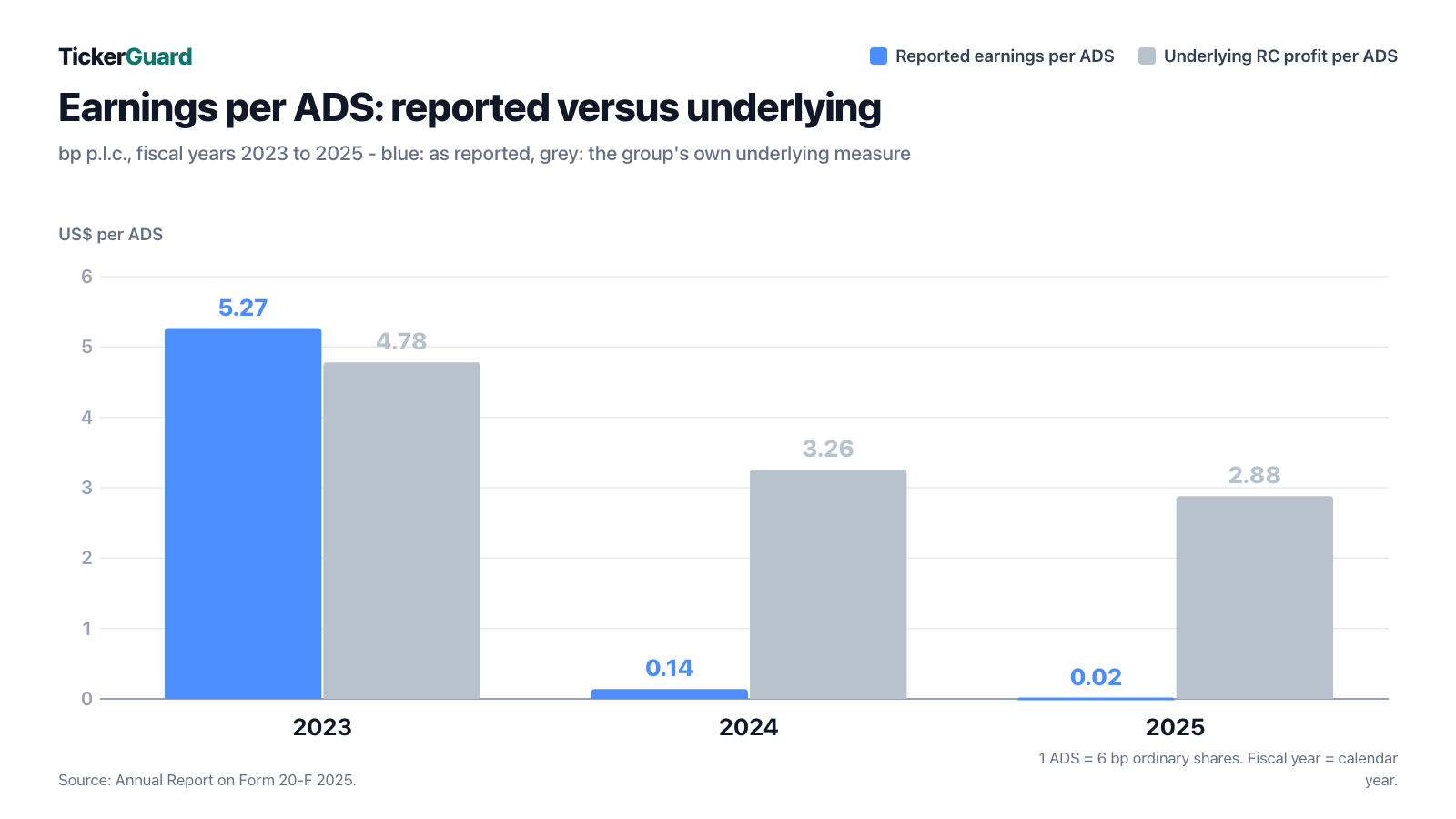
Now the other side. The 2025 annual report lines up three years in its summary table. Revenue: $210,130 million, $189,185 million and $189,335 million for 2023, 2024 and 2025. Profit attributable to bp shareholders: $15,239 million, then $381 million, then $55 million. Per depositary share that is $5.27, then $0.14, then $0.02.
Alongside it the company runs its own adjusted measure, underlying replacement cost profit. It strips out inventory holding effects and one-offs to show what the business would have earned without those swings: $4.78, $3.26 and $2.88 per ADS. That is a company-defined measure, not a required one — but the gap between the two lines is the real story.
2026 looks different. First-half revenue rose to $121,360 million (from $93,532 million), profit attributable to shareholders to $7,753 million and operating cash flow to $13,718 million. Capital expenditure edged down to $6,376 million.
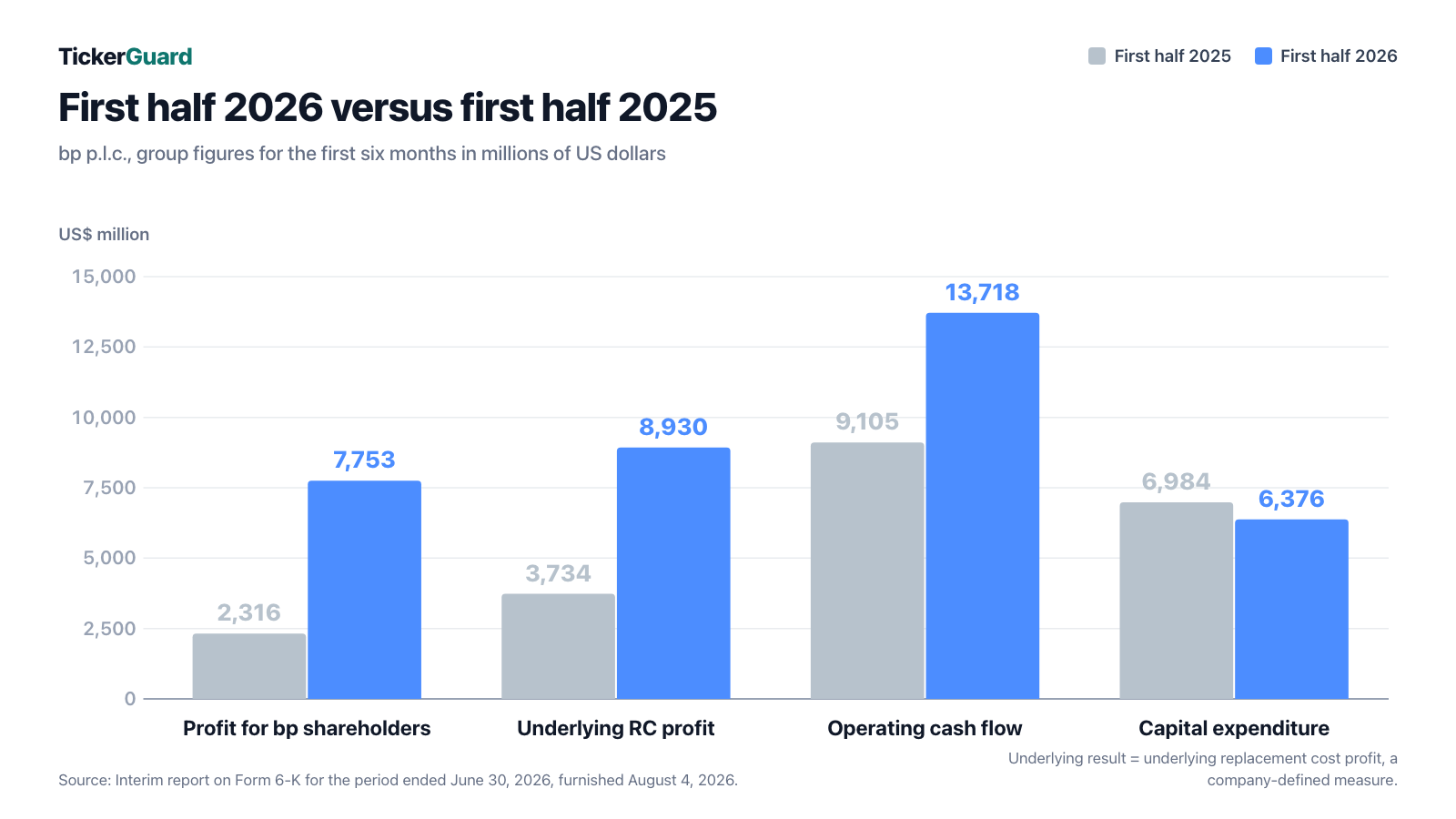
Where did the jump come from? The report says so itself: significantly stronger realized refining margins, higher liquids realizations and a materially better oil trading result. Those are market conditions. A company can capture them or miss them — it cannot create them. Keep this sentence for the verdict: a strong half-year in a strong market is not yet proof that the company has changed.
The third quarter of 2026 extends the series: over the first nine months revenue rose to $189,759 million (from $141,952 million) — so after three quarters bp has already booked slightly more revenue than in all of 2025 ($189,335 million). Profit attributable to shareholders reached $12,449 million after $3,477 million a year earlier, and operating cash flow $28,547 million after $16,891 million. The report again names the drivers itself: higher refining margins, higher realizations and markedly stronger trading results.
Uncomfortable Truth No. 1: Three Years, Three Write-Downs Above Five Billion
When a company concludes that a power plant, an oil field or an acquired business is worth less than its carrying amount, it has to write the carrying amount down. That is an impairment — in everyday terms: you bought a car for $30,000, it still shows at $30,000 in your net worth, and at some point you have to admit it would fetch $12,000. The difference lands in the income statement.
At bp that line reads, in the notes to the 2025 annual report: $5,529 million of impairment losses in 2025, $5,633 million in 2024, $5,747 million in 2023. Three consecutive years above $5.5 billion, close to $17 billion in total. For scale: total equity attributable to bp shareholders stood at $53,052 million on December 31, 2025.
The biggest share in 2025 fell on the very segment that was supposed to be the future: $4,146 million of impairments hit gas & low carbon energy. Of that, $2,009 million alone were write-downs of goodwill in the transition businesses. The report names the solar company Lightsource bp and the biogas business Archaea Energy as the main cases. On August 4, 2026 bp announced it is launching a process to market Archaea Energy for sale.
And the series is not over. The third quarter of 2026 added net impairment charges (after reversals) of $4,067 million pre-tax, bringing the nine-month total to $5,315 million. On the same net basis the three prior years came to $5,701 million, $5,189 million and $5,395 million — so 2026 has almost reached that level after three quarters. Of the third-quarter charge, $3,365 million fell on the gas & low carbon energy segment, mostly on the transition businesses according to the report.
Chief executive Meg O'Neill, in post since April 1, 2026, says it herself in her first full quarterly report, unusually bluntly:
"However, we are not making the most of our potential. Our performance over the past few years has not met our own expectations, let alone those of our shareholders. We have not delivered consistently; we have written off too much value; and our costs and liabilities are not resilient enough in a low price environment."
— bp p.l.c., interim report on Form 6-K for the period ended June 30, 2026, furnished August 4, 2026

One footnote belongs here, because it shows how long mistakes echo in a balance sheet like this. bp has carried its interest in the Russian oil company Rosneft and its other Russian businesses within other investments since the first quarter of 2022 — at nil. The note explains that the shares cannot be sold on the Moscow Stock Exchange and that no reliable fair value can be established. bp has recognized no dividend income from Russia for 2023, 2024 or 2025.
Uncomfortable Truth No. 2: You Stand at the Back of the Line
Shareholders sit at the very end of the queue of claims. Suppliers, taxes and interest come first, then bondholders — and at bp there is one more layer in between that many investors miss: hybrid capital. These are perpetual subordinated instruments that count as equity in the balance sheet but cost a running distribution. In everyday terms: a silent partner who takes his cut every year before you get yours.
The figures from Note 32 of the 2025 annual report: hybrid bonds were attributed $640 million of 2025 profit and paid $644 million; hybrid securities were attributed a further $159 million and paid $158 million. In the income statement, total profit attributable to non-controlling interests shows as $1,240 million. bp shareholders were left with $55 million.
Read those two numbers side by side once more: $799 million for the hybrid holders against $55 million for the shareholders. (The remaining roughly $441 million of the $1,240 million went to the other non-controlling interests.) That is not a footnote. That is the order of claims in its purest form.
bp is working on it. At December 31, 2025 the balance sheet carried $16.0 billion of hybrid capital. On June 22, 2026 the company paid $2.9 billion to redeem 2.5 billion euros of hybrid bonds; at June 30, 2026 roughly $13.0 billion remained within total non-controlling interests of $17,992 million. In the third quarter of 2026 the announced further $1.0 billion followed: a group subsidiary redeemed $1.0 billion of perpetual subordinated hybrid securities that had been earmarked to fund BP Alternative Energy Investments, including Lightsource bp. At September 30, 2026, $12,103 million of hybrid capital remained on the balance sheet, alongside $5,317 million of other non-controlling interests. Every one of those steps shortens the queue ahead of you — and costs cash up front.
Uncomfortable Truth No. 3: Sixteen Years On, bp Is Still Paying for the Oil Spill
Note 22 of the 2025 annual report carries a line you would not expect on a 2026 balance sheet: Payables related to the Gulf of America oil spill. At December 31, 2025 that is $1,520 million current and $5,735 million non-current — $7,255 million in total, roughly 14 percent of equity attributable to bp shareholders.

And it is not a dormant entry. Operating cash flow in 2025 contained an outflow of $1,169 million for this purpose ($1,192 million in 2024, $1,280 million in 2023). For 2026 bp still guides to around $1.6 billion pre-tax, of which $0.4 billion was paid in the first quarter and $1.1 billion in the second. At September 30, 2026, $5,940 million of oil spill payables and provisions remained on the balance sheet, $1,131 million of it current.
What is new since the results announcement of October 30, 2026 is the direction: bp has agreed with the State of Louisiana to accelerate its settlement commitments and intends to use excess cash first to retire the remaining Deepwater Horizon obligations in full. For scale: the $5,940 million is slightly more than one year of dividends (2025: $5.1 billion). For you as a shareholder that cuts both ways: a legacy item that would otherwise have tied up about a billion dollars a year for years disappears faster — but the money for it is exactly the money that could otherwise go to buybacks.
Anyone measuring bp's free cash flow against its dividend has to know about this item: roughly a billion dollars a year leaves the company for obligations that have nothing to do with today's business. In that respect bp resembles other long-lived oil companies — at a pure producer such as the one in our APA Corporation stock analysis, the equivalent line is asset retirement obligations for old wells.
Uncomfortable Truth No. 4: The Buybacks Are Suspended
A share buyback is the dividend's quiet sibling: the company buys its own shares in the market and cancels them, so your slice of the business grows without you doing anything. bp used the tool heavily for years — $7.1 billion in 2024 and $4.5 billion in 2025, in each case including fees and stamp duty.
That is over for now. At the fourth-quarter 2025 results in February 2026 the board suspended the programme:
"At the fourth quarter 2025 results in February 2026, the board decided to suspend share buybacks; excess cash is now fully allocated to the balance sheet, in service of optimizing financing costs and strengthening the balance sheet."
— bp p.l.c., Annual Report on Form 20-F for 2025, "Liquidity and capital resources"

The cash flow statement confirms it: over the first nine months of 2026, $562 million went to share repurchases, all of it in the first quarter; in the second and third quarters of 2026 the figure was zero. Dividends paid to bp shareholders over the nine months came to $3,925 million — just under 14 percent of the $28,547 million of operating cash flow.
The dividend, by contrast, continues: 32.640 cents per ordinary share were distributed in 2025, $5.1 billion in total. For the third quarter of 2026 bp again announced 8.660 cents per ordinary share on October 30, 2026, payable on December 18, 2026 to holders on the register on November 13, 2026 — that is $0.5196 per ADS. The board is not offering a scrip alternative for it. The company expects to raise the dividend per ordinary share by at least 4 percent a year, explicitly subject to board discretion.
The goal behind the buyback stop was: net debt is to fall to $14 to $18 billion by the end of 2027. At June 30, 2026 it still stood at $22,251 million — practically unchanged from $22,182 million at December 31, 2025. Then came the third quarter: $13,870 million at September 30, 2026, gearing of 14.8 percent. The target has been reached more than a year early. Add hybrid capital, leases and the oil spill obligations and the block totalled $57.8 billion at the end of 2025; in the third quarter of 2026 it fell by a further $9.3 billion, according to the results announcement. Whether buybacks come back, bp is not saying yet — the next answer is due on December 15, 2026, when the company plans to present its capital frame. Until then Deepwater Horizon has first call on the excess cash.
Uncomfortable Truth No. 5: Two Chief Executives and One Removed Board Chair in Eight Months
Governance sounds like paperwork. In practice it is the question of whether the people at the top have a grip on the company — and how calmly a business can work while the chairs at the top are wobbling. At bp, the stretch between September 2025 and September 2026 looked like this:
- Albert Manifold joins the board on September 1, 2025 and takes over as chair on October 1, 2025.
- Chief executive Murray Auchincloss steps down in December 2025 after more than three decades at bp; Carol Howle takes over on an interim basis from December 18, 2025.
- Meg O'Neill is appointed chief executive in December 2025 and takes up the role on April 1, 2026.
- On May 26, 2026 chair Albert Manifold, in post for barely eight months, is removed with immediate effect. Ian Tyler becomes interim chair.
- Effective August 1, 2026 the board committees are reshuffled; on July 31, 2026, following a formal tender, bp confirms Deloitte LLP as statutory auditor from fiscal year 2028, subject to shareholder approval at the 2027 annual general meeting.
- On September 2, 2026, after a search including internal and external candidates, the board appoints Ian Tyler as permanent chair. The same day Senior Independent Director Dame Amanda Blanc announces she will not stand for re-election at the 2027 annual general meeting.
The wording of the removal is unusually direct:
"The Board of BP p.l.c. (LSE and NYSE: bp) ('bp') announces that it has today unanimously decided that Albert Manifold should no longer serve as Chair and Director with immediate effect. This follows serious concerns raised to the Board related to important governance standards, oversight and conduct."
— bp p.l.c., current report on Form 6-K of May 26, 2026

Fairness requires the other reading: a board that unanimously removes its own chair within eight months is a board that works. This is not a buried story, it is a published one. Since September 2026 the top seat has been filled permanently again — but the road there was anything but quiet.
A second finding fits alongside it, and it concerns the plants rather than the boardroom: tier 1 and tier 2 process safety events rose to 20 in the second quarter of 2026, after 5 in the same quarter of 2025. The half-year report still showed 18 for that quarter; bp keeps investigating reported events and recounts them, and the results announcement of October 30, 2026 puts the figure at 20. bp-operated upstream plant reliability fell to 92.4 percent in the second quarter, from 96.8 percent a year earlier. The third quarter of 2026 looked calmer: 8 process safety events, the same as a year earlier, and 95.3 percent plant reliability. After nine months the count stands at 35 against 23 a year earlier — one better quarter is not yet a turnaround.
What the Stock Costs
Orders of magnitude, not daily prices. As of November 1, 2026 (ADS closing price on October 30, 2026: $50.39), bp carries a market capitalization of roughly $130 billion. The cross-check fits: 2,593,903 thousand ADS equivalents at September 30, 2026 times $50.39 gives roughly $131 billion. Against trailing twelve-month revenue that is a price-to-sales ratio of about 0.55. Oil majors are traditionally revenue-heavy and margin-light, so a high figure here would be unusual.
The price-to-earnings ratio is where it gets interesting. On a trailing twelve-month basis through September 30, 2026 it sits at about 15 — a period that still includes the weak fourth quarter of 2025 and the new impairments. Measured against earnings expectations for the coming twelve months, it lands at about 8.7. Both numbers are correct and both are misleading, because they describe different worlds: one with billions of impairments, one with exceptionally strong refining margins. More robust are the enterprise value to adjusted EBITDA ratio of roughly 3.5 and the price-to-book ratio of roughly 2.1.
The dividend: $0.5196 per ADS is again declared for the third quarter of 2026. Rolled forward over four quarters that is about $2.08 per ADS — roughly 4.1 percent against the closing price of $50.39 on October 30, 2026. That roll-forward is our own arithmetic, not a company commitment; the board decides each quarterly dividend afresh. In August, at the then price of $42.53, it was just under 4.9 percent — the yield fell because the price rose, not because the dividend was cut.
The professional view: 19 analyst opinions are on file (data as of November 1, 2026) — 8 at the strongest buy rating, 3 at buy, 6 at hold, 1 at sell and 1 at the strongest sell rating. The mean price target is about $54. The 52-week range runs from roughly $32.03 to $51.49. Translated: sentiment has warmed since August — back then 8 buy opinions faced 9 holds and there were no sells. Now there are more buys, but unlike in August also two opinions calling for a sale.
Opportunities and Risks at a Glance
What speaks for bp
- Enormous cash generation: $28,547 million of operating cash flow in the first nine months of 2026, $14,829 million of it in the third quarter alone; $24.5 billion in full-year 2025.
- The debt target was met early: net debt of $13,870 million at September 30, 2026, below the $14 to $18 billion range targeted for the end of 2027; gearing of 14.8 percent.
- The restructuring is running and quantified: the sale of 65 percent of Castrol for roughly $6 billion, whose completion the results announcement calls imminent; the sale of the Gelsenkirchen refinery, completed on July 31, 2026; an agreed sale of the Austrian retail business; and announced plans to market the U.K. North Sea business and Archaea Energy. bp now expects around $8 billion of divestment proceeds in 2026.
- Costs are falling: cumulative structural cost reductions of $3,984 million since 2023 at September 30, 2026 (excluding Gelsenkirchen); the chief executive reports the cost target as delivered.
- The balance sheet is being unwound: $2.9 billion of hybrid capital repaid in June 2026 and a further $1.0 billion in the third quarter; bp also intends to use excess cash to retire the Deepwater Horizon legacy in full ahead of schedule.
- A long dividend record with a stated growth path of at least 4 percent per ordinary share per year.
What speaks against it
- Earnings quality remains the problem: impairments of $5,747 million, $5,633 million and $5,529 million in 2023, 2024 and 2025 pushed profit attributable to shareholders down to $55 million in 2025 — and the first nine months of 2026 added another $5,315 million, $4,067 million of it in the third quarter.
- The 2026 profit jump comes mostly from market conditions — stronger refining margins, higher realizations, better trading results — not from proven operational improvement. For the fourth quarter bp itself expects a significantly weaker customers result and lower refinery throughput.
- Hybrid capital sits ahead of shareholders: $799 million of 2025 profit attributed to hybrid holders against $55 million for shareholders; $12,103 million of hybrid capital still on the balance sheet at September 30, 2026.
- $5,940 million of Gulf of America oil spill payables and provisions at September 30, 2026; excess cash is meant to go first to retiring them.
- Buybacks have been suspended since February 2026, and whether they return is open — bp plans to present its new capital frame only on December 15, 2026.
- Turbulence at the top and in the plants: a removed chair in May 2026, a chief executive change in December 2025, and 35 tier 1 and tier 2 process safety events in the first nine months of 2026 after 23 a year earlier.
- Earnings depend on oil and gas prices and refining margins that nobody inside the company controls.
A Human Verdict
We started with the dividend trap: the feeling that a regular payout is the same thing as a reliable profit. At bp those have been two different things — and you could see it, if you opened the notes. In 2025 roughly $9.6 billion went out to shareholders while $55 million was left for them in the income statement. It was paid out of the cash box, not out of profit.
That is not automatically wrong. A company like bp can absorb impairments because they cost no cash — they only correct the carrying values of old decisions. But it is also not the safe annuity many people take this stock to be. The anchor of safety is not the word "bp"; it is the cash flows, and those depend on oil prices, refining margins and whether the restructuring under way eventually brings money in.
In August three questions were left open: whether net debt genuinely heads towards $14 to $18 billion, whether the impairments stop, and how much of the profit jump comes from the market. After the third quarter of 2026 the first is answered — $13,870 million of net debt, below the target. The second is not: once again more than $4 billion was written off in a single quarter, once again mostly in the businesses that were supposed to be the future. And the third the way we feared: the tailwind still comes from refining margins and trading that nobody at bp controls. At the top, a permanently appointed chair has brought calm; in the plants, not yet — 35 process safety events in nine months after 23 a year earlier. A strong year in a strong market is not yet proof that the company has changed — that sentence from earlier stands until proven otherwise. The next clue comes on December 15, 2026, when bp presents its capital frame.
What you do with that is your decision. And that is exactly as it should be.
If you want to see the same question — payout against substance — at a far smaller energy company, you will find it in our Petrolina Holdings stock analysis.
Sources and Disclosure
- Annual Report on Form 20-F for 2025, BP p.l.c., filed March 6, 2026 (accession 0000313807-26-000006)
- Results announcement for the third quarter and nine months of 2026 (Form 6-K), furnished October 30, 2026 (accession 0001654954-26-009265) — most recent periodic report; plus the quarterly financial statements in XBRL format (Form 6-K) of the same day
- Third-quarter 2026 trading statement (Form 6-K) of October 13, 2026
- Total voting rights at September 30, 2026 (Form 6-K) of October 1, 2026
- Current report "Ian Tyler appointed bp Chair" (Form 6-K) of September 2, 2026
- Interim report on Form 6-K for the period ended June 30, 2026, furnished August 4, 2026
- Second-quarter 2026 trading statement (Form 6-K) of July 14, 2026
- Current report "bp Chair removed" (Form 6-K) of May 26, 2026
- Current report "Conclusion of Audit Tender Process" (Form 6-K) of July 31, 2026
- Current report on board committee changes (Form 6-K) of July 31, 2026
- Current report on the sale of the Gelsenkirchen refinery (Form 6-K) of March 19, 2026
- Current report on the sale of 65 percent of Castrol (Form 6-K), furnished to the SEC on December 29, 2025 (announced by bp on December 24, 2025)
- EDGAR filing index for BP p.l.c. (CIK 0000313807)
- bp investor relations (financial calendar, reports, dividend information)
- Prices, market capitalization, valuation multiples and analyst coverage: fundamental data, as of November 1, 2026 (closing price of October 30, 2026); scanner metrics (Piotroski F-Score, Altman Z): as of August 15, 2026
- A verbatim transcript of the October 30, 2026 analyst call was only available behind paywalls at the time of writing and was not used.
Disclosure: This article is journalistic analysis of publicly available company filings. It is not investment advice, not a buy or sell recommendation and not a solicitation to buy or sell securities. Shares in commodity and energy companies move with prices nobody can forecast; a total loss of the capital employed is possible. Anyone buying the depositary receipt (ADS) on the NYSE also bears a currency risk and depositary fees. Every figure is stated with its own reporting date and may have changed since; first published in August 2026, updated on November 1, 2026 with the third-quarter 2026 results announcement. Positions held by the operator are disclosed daily; where one exists, it appears as a notice at the top of this deep dive.
Key figures at a glance
All monetary figures in millions of $; earnings per share as reported.
| Metric | 2021 | 2022 | 2023 | 2024 | 2025 |
|---|---|---|---|---|---|
| Revenue | 157,739.0 | 241,392.0 | 210,130.0 | 189,185.0 | 189,335.0 |
| Operating Income (EBIT) | 10,672.0 | 41,447.0 | 31,049.0 | 12,848.0 | 15,465.0 |
| Net Income | 7,565.0 | -2,487.0 | 15,239.0 | 381.0 | 55.0 |
| Net Margin | 4.8% | -1.0% | 7.3% | 0.2% | 0.0% |
| Earnings Per Share | 2.24 $ | -0.79 $ | 5.15 $ | 0.14 $ | 0.02 $ |
Source: fundamental data & SEC filings (annual and quarterly reports, 10-K/10-Q)
Our Bottom Line at a Glance
- Cash generation positive
- Operating cash flow was $24.5 billion in 2025 and $28,547 million in the first nine months of 2026, after $16,891 million a year earlier, $14,829 million of it in the third quarter alone. Adjusted EBITDA came to $37,615 million in 2025. At September 30, 2026 the balance sheet held $42,993 million of cash and cash equivalents.
- Earnings quality negative
- Impairments of $5,747 million, $5,633 million and $5,529 million in 2023, 2024 and 2025 pushed profit attributable to bp shareholders from $15,239 million to $381 million and then $55 million. The first nine months of 2026 added another $5,315 million pre-tax, $4,067 million of it in the third quarter. The chief executive concedes in the October 30, 2026 results that bp needs to be a better steward of its shareholders' capital.
- Balance sheet and leverage positive
- At September 30, 2026, $55,366 million of finance debt sits against $42,993 million of cash; net debt fell within one quarter from $22,251 million to $13,870 million, gearing to 14.8 percent. That meets the $14 to $18 billion target for the end of 2027. The company still calls itself too leveraged once hybrid capital, leases and oil spill obligations are added.
- Order of claims negative
- Non-controlling interests were attributed $1,240 million of 2025 profit, of which $799 million went to hybrid holders — bp shareholders were left with $55 million. At September 30, 2026, $12,103 million of hybrid capital remained on the balance sheet; excess cash is meant to retire the oil spill legacy first, and buybacks stay suspended.
- Restructuring and portfolio positive
- The sale of 65 percent of Castrol (roughly $6 billion of proceeds, announced December 24, 2025) is, per the results announcement, about to close; the Gelsenkirchen refinery has been sold since July 31, 2026; a sale of the Austrian retail business is agreed; and bp plans to market the U.K. North Sea business and Archaea Energy. bp reports cumulative structural cost reductions of $3,984 million since 2023 at September 30, 2026 (excluding Gelsenkirchen).
- Leadership and operations neutral
- Between December 2025 and May 2026 the chief executive role changed twice, and the chair who had been in post only since October 2025 was unanimously removed on May 26, 2026 — according to the filing, over serious concerns about governance standards, oversight and conduct. Since September 2, 2026 Ian Tyler has been the permanent chair. In the plants: 20 process safety events in the second quarter and 8 in the third; 35 over nine months after 23.
bp generates enormous cash — $28,547 million in the first nine months of 2026 — and used it to cut net debt to $13,870 million at September 30, 2026, below the target for the end of 2027. Shareholders were left with $12,449 million over nine months, a little over four fifths of the full year 2023 ($15,239 million). The other side: after three years of impairments above $5.5 billion, 2026 has already added another $5.3 billion, the profit jump comes mostly from refining margins and trading, hybrid capital sits ahead of shareholders, and buybacks stay suspended while excess cash goes first to retiring the oil spill legacy. Survival is not in question: at September 30, 2026 the balance sheet held $62,173 million of equity attributable to shareholders and $42,993 million of cash, and underlying profit before interest and tax covered underlying finance costs, including pension interest, nearly ten times over the first nine months ($30,024 million against $3,120 million). Not investment advice.
What Our Rating Means
Open questions
The business works in principle, but one material question is open. As long as it stays open, our findings do not carry a quality verdict.
Yellow, because net debt is on target but earnings quality is not: the debt target for the end of 2027 is already met and survival is not in question, although hybrid capital and the oil spill legacy still weigh on the balance sheet — yet bp keeps writing billions off its own businesses of the future, and the 2026 profit jump comes mostly from refining margins and trading, that is, from the market. That the stock does not look expensive on enterprise value to operating earnings is a price argument and changes none of this.
A journalistic assessment by our editorial team at the time of the deep dive, based on public sources — not investment advice and not a solicitation to buy or sell. Your personal circumstances (investment goals, risk capacity, taxes) cannot be taken into account. What our levels mean, how verdicts are formed, and what conflicts of interest exist →
Worth Noting
- The hook for this analysis is the filing calendar for foreign private issuers at the U.S. securities regulator, the SEC — specifically bp's interim report on Form 6-K of August 4, 2026 — not a hit in our in-house stock scanner. The scanner metrics (Piotroski F-Score 7 of 9, Altman Z 1.35) are as of August 15, 2026.
- Filing forms: bp is a foreign private issuer with the SEC and therefore files no annual report (10-K) and no quarterly reports (10-Q), but an annual report on Form 20-F and ongoing current reports on Form 6-K. That is a different form family, not a shortfall in transparency.
- Currencies: the ordinary share trades in London in pence, the NYSE line is an American Depositary Share representing six ordinary shares, and reporting and distributions are in U.S. dollars. Every figure here is in U.S. dollars, and every per-unit figure is labelled either per ordinary share or per ADS.
- Easy to confuse: the security trading under "BP" on the NYSE is the depositary receipt, not the share itself. Comparisons between the New York and London quotations only reconcile with the factor of six and the prevailing exchange rate.
- The Form 25-NSE of December 18, 2025 in the EDGAR index covers two guaranteed notes due in 2026 only, not the listing of the ADS. The ADS continue to trade on the NYSE, and no Form 15 has been filed.
- Update of November 1, 2026: the most recent periodic report used is the third-quarter 2026 results announcement (Form 6-K of October 30, 2026). Between the interim report of August 4, 2026 and November 1, 2026 we also reviewed the trading statement of October 13, 2026, the appointment of Ian Tyler as chair on September 2, 2026 and the monthly total voting rights notices; a Form 13F-HR of August 7, 2026 says nothing about the operating business. No further filing followed between October 30 and November 1, 2026.
- A verbatim transcript of the October 30, 2026 analyst call was only available behind paywalls at the time of writing and was therefore not used. Every statement by the chief executive in the update comes from the results announcement itself.
Stock Watch
This analysis is as of November 1, 2026. Stock Watch will tell you what's changed at BP since then.
Later $1 a month per stock — signing up is free, and you'll be the first to know when it launches.
The full analysis as a PDF for later
We will send you this analysis as a PDF — to print, file away, and read at your own pace. And we will add you to the free Stock Watch list for BP PLC ADR (BP), so you hear about it when something material in this analysis changes.
Frequently Asked Questions
Because bp is treated as a foreign private issuer by the U.S. securities regulator, the SEC. Such companies file an annual report on Form 20-F instead of the U.S. annual report (10-K), and current reports on Form 6-K instead of quarterly reports (10-Q). This analysis rests on the 20-F for 2025 filed March 6, 2026, the 6-K interim report for the period ended June 30, 2026, furnished August 4, 2026, and the 6-K results announcement for the third quarter of 2026, furnished October 30, 2026.
The ordinary share trades on the London Stock Exchange, where per-share amounts are quoted in pence. On the New York Stock Exchange what trades is a depositary receipt, an American Depositary Share. One ADS represents six ordinary shares, so every dividend and earnings figure per ADS is six times the per-ordinary-share figure: 8.660 cents per ordinary share for the third quarter of 2026 equals $0.5196 per ADS.
U.S. dollars. The 2025 annual report calls the dollar the economic currency of bp and sets the dividend in dollars; it is then converted into sterling for London holders. For the third-quarter 2026 dividend the sterling amount is due to be announced on December 8, 2026. Every figure in this analysis is therefore in U.S. dollars.
Because impairments consumed the result. The notes to the 2025 annual report show $5,529 million of impairment losses, of which $4,146 million fell in the gas and low carbon energy segment. Goodwill in the transition businesses alone accounted for $2,009 million. The company's own underlying measure comes to $7,485 million for 2025.
Yes. On October 30, 2026 bp again announced an interim dividend of 8.660 cents per ordinary share for the third quarter of 2026, payable on December 18, 2026 — that is $0.5196 per ADS. In 2025 a total of 32.640 cents per ordinary share was distributed, $5.1 billion in all. The company expects to raise the dividend per ordinary share by at least 4 percent a year, subject to board discretion.
No. At the fourth-quarter 2025 results in February 2026 the board suspended the buybacks; excess cash has since gone entirely to the balance sheet. bp repurchased $4.5 billion of stock in 2025 and $7.1 billion in 2024. The goal of net debt of $14 to $18 billion by the end of 2027 was already met at September 30, 2026, at $13,870 million; excess cash is now meant to go first to retiring the remaining oil spill obligations. bp plans to present its new capital frame on December 15, 2026.
At December 31, 2025 the balance sheet carried $7,255 million of payment obligations — $1,520 million current and $5,735 million non-current. Cash outflows were $1,169 million in 2025 and $1,192 million in 2024. For 2026 bp guides to around $1.6 billion pre-tax, of which $0.4 billion was already paid in the first quarter and $1.1 billion in the second. At September 30, 2026, $5,940 million remained on the balance sheet; bp intends to use excess cash first to retire it in full.
Since the first quarter of 2022 bp has carried its interest in Rosneft and its other Russian businesses within other investments at a fair value of nil. The notes to the 2025 annual report explain that the shares cannot be sold on the Moscow Stock Exchange and that no reliable measurement is possible. bp recognized no dividend income from Russia for 2023, 2024 or 2025.
Found an error?
Did you spot a factual error, an outdated number, or a typo in this deep dive? Let us know briefly — your report goes straight to the editorial team.