Hyperion DeFi: Eye-Drop Maker Eyenovia Became a HYPE Vault — but Every Share Faces More Than Three Potential Others
In June 2025, Eyenovia swapped its failed ophthalmology business for a treasury of HYPE, the token of the crypto exchange Hyperliquid. As of September 30, 2026, the renamed Hyperion DeFi held 1.85 million tokens (gross, including liquid staking tokens), $14.5 million in cash and stablecoins and no long-term debt. The company values its CEO’s 2025 compensation at $9.29 million, about two thirds of it in stock awards that vest only at a market capitalization of $150 million and $500 million, respectively. We read the company’s filings with the U.S. securities regulator through November 1, 2026. A vault is only worth the part of it that ends up belonging to you.
 Thomas Mücke
Founder & Publisher
As of Today
As of: November 1, 2026
- Closing price
- 3.20 $ -8.13%
- Market Capitalisation
- 49.0 $M
Price change since October 30, 2026: -0.6%
This analysis has a cut-off date. The Stock Guard tells you when something material changes in the numbers. Reserve your free spot
Chart
Interactive price chart (TradingView).
Last price: 3.20 $ (As of: November 1, 2026)
Note: pure fact-based analysis, not investment advice and not a solicitation to buy or sell. All figures without guarantee.
In July 2026, Hyperion DeFi handed over the rights to its former hope, the Optejet eye-drop dispenser, in exchange for the release of $100,000 of debt. A year earlier, the same company, then still Eyenovia, had raised $50 million to buy a crypto token. Today the stock comes with a discount: it trades below the value of its token treasury. You know the feeling when a shop window says “Everything must go — 30 percent off”? Your brain does the math instantly: a dollar’s worth of goods for 70 cents can only be good. That is the bargain reflex, a variant of the anchoring effect: the discount feels like a win before we have checked what we are getting. In the stock market, the line goes: “The stock trades below the value of its crypto treasury.”
Hyperion DeFi is that kind of stock. The Dallas company holds a treasury of HYPE, the token of the crypto exchange Hyperliquid, and put its own net asset value at $134.2 million as of June 30, 2026. On that day, the market valued it at considerably less. Before you decide anything about this stock, let’s read together what Hyperion has filed with the U.S. securities regulator, the SEC — and work out how much of that dollar actually belongs to you as a common shareholder.
The central tension of this analysis, running through every chapter: On paper, Hyperion looks like a dollar of HYPE for less than a dollar. But the profit is a price ticker, the operating business does not cover its costs, and every common share faces more than three potential others that are already contractually promised.
What Hyperion DeFi Actually Does
Hyperion DeFi is a Delaware corporation headquartered in Dallas, Texas, with nine employees (as of December 31, 2025). The company is older than its name: it was founded in 2014 as Eyenovia and developed eye medicines and a dispensing system called Optejet. On November 15, 2024, Eyenovia announced that its lead drug MicroPine had missed the primary endpoint of CHAPERONE, a three-year Phase III study in childhood myopia. The company cut about 75 percent of its workforce and explored “strategic alternatives”; the auditor added going-concern doubt to the 2024 financial statements. On January 31, 2025, every 80 shares were combined into one.
The alternative arrived in June 2025: a $50 million private placement that Eyenovia used to buy HYPE. The new name followed on July 1, 2025. Hyperliquid is a blockchain of its own, used mainly to trade perpetual futures on cryptocurrencies; HYPE is its token. Hyperion describes itself as the first U.S. publicly listed company building on Hyperliquid and wants to be more than a token depot. According to its quarterly report as of June 30, 2026, it earns money in three ways:
- Staking: anyone who delegates HYPE to a validator — a computer that confirms transactions — receives new tokens as a reward, about 2.1 percent a year according to the company (as of July 31, 2026). Hyperion runs a joint validator with its partners Kinetiq and MAVAN.
- Token lending (HAUS): partners use the company’s staked HYPE, for example to launch their own markets on Hyperliquid, which requires 500,000 staked HYPE. In July and August 2026, Hyperion signed two such agreements for 500,000 HYPE each.
- Extra income: options trades on HYPE, lending against HYPE, and tokens distributed by partners.
The old business is history. In July 2026, Hyperion sold the rights to Optejet and its pharmaceutical program to Arctic Vision — in exchange for the release of $100,000 of debt.
“In July 2026, the Company sold all its right, title, and interest to intellectual property associated with the Optejet and the Company’s pharmaceutical development program to Arctic Vision (Hong Kong) Limited in exchange for a $100,000 release of indebtedness.”
— Hyperion DeFi, quarterly report 10-Q as of June 30, 2026, Note 1
Rule of thumb: a new name changes the business, not the history. Hyperion still carries Eyenovia’s losses on its balance sheet, an accumulated deficit of $200.8 million at the end of June 2026. The company makes no money from AI; our company-specific AI rating nonetheless lists it as “threatened,” because the 2025 annual report explicitly names AI-powered rival blockchains as a reason HYPE could become technologically obsolete.
Company history for investors
-
2014
Founded as Eyenovia
The later Hyperion DeFi is founded in 2014 as Eyenovia and develops eye medicines and the Optejet dispenser. By the end of 2024, losses add up to $195.3 million.
-
2024
CHAPERONE study fails
On 11/15/2024, MicroPine misses the primary endpoint of its Phase III study. Eyenovia cuts about 75 percent of its workforce; the auditor doubts it can continue as a going concern.
-
2025
1-for-80 reverse split
On 1/31/2025, every 80 shares are combined into one. About 1.5 million shares remain — the starting point for the dilution that followed.
-
2025
$50M for a HYPE treasury
In June 2025, investors buy $50M of preferred stock plus warrants for 30.8M shares at $3.25. On 7/1/2025, Eyenovia becomes Hyperion DeFi.
-
2025
Loss quarter after HYPE slump
In Q4 2025, HYPE falls from $45.2 to $25.4 (company data). Hyperion books a $39.8M loss — the flip side of the token gains.
-
2026
Optejet handed over for $100,000
In July 2026, the rights to Optejet and the pharma program go to Arctic Vision for the release of $100,000 of debt. The old business is fully wound down.
-
2026
Loan repaid, tokens sold
On 9/28/2026, Hyperion repays an $8.6M loan, funded in part by HYPE sales. Holdings fall to 1.85M tokens, about a tenth less per share.
How the Stock Landed on Our Desk
No metrics screen flagged Hyperion; other investors’ attention did. On October 30, 2026, our in-house Reddit hype scanner picked up the ticker HYPD. That is not a buy or sell signal, only a sign that people in forums are talking about a stock. That day the stock closed at $3.22 (source: fundamental data). For comparison: the highest close since the pivot was $15.97 on July 16, 2025, two weeks after the name change; the lowest in 2026 was $2.34 on July 29, 2026. Anyone who bought at the peak is down about 80 percent. You can find current price and metrics data on our Hyperion DeFi stock page.
A word on screener metrics: many databases still list Hyperion under “healthcare/biotechnology,” the old Eyenovia business. With the SEC, the company is now classified as a finance services firm. A price-to-sales ratio or growth figures here compare apples with eye drops.
On the reporting status: the fiscal year is the calendar year. The latest periodic report is the quarterly report (10-Q) as of June 30, 2026, filed on August 13, 2026, alongside the earnings release of August 12, 2026. After that came two insider filings (Form 4) on shares withheld for taxes and, on October 2, 2026, a current report (8-K) on the loan payoff, HYPE sales and cash as of September 30, 2026. The quarterly report as of September 30, 2026 had not been filed at the time of writing.
The Numbers Over the Years — An Honest Look
First, what genuinely impresses: Hyperion pulled off the turnaround Eyenovia could not. At the end of 2024, the company had $2.1 million in cash, $10.2 million in loan debt (as of March 15, 2025) and negative stockholders’ equity of $13.1 million. As of June 30, 2026, the quarterly report showed $101.9 million in equity, the going-concern doubt has been resolved since the 2025 annual report, and on September 28, 2026, the company repaid its loan in full. Costs are falling: selling, general and administrative expenses dropped to $3.9 million in the second quarter of 2026, from $7.7 million a year earlier. And staking income is growing; revenue rose to $0.6 million in the first half of 2026.
Now for the scale. First-half revenue of $0.6 million compares with $8.4 million in selling, general and administrative expenses. Net income of $39.8 million in the first half of 2026 came almost entirely from token valuations: $21.5 million of realized and $27.9 million of unrealized gains on digital assets. The picture over four years:
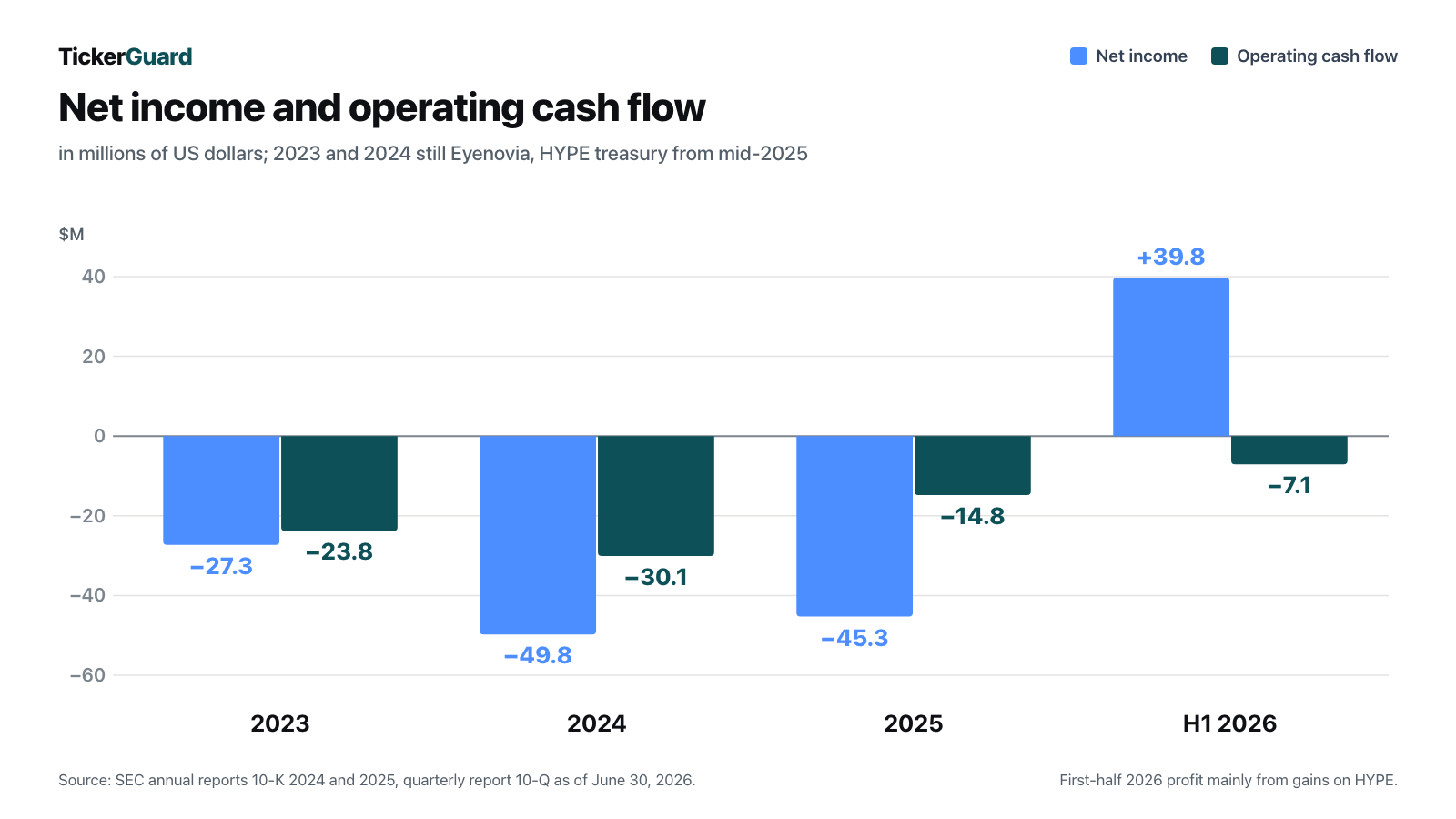
The gap between the two bars is the core: a gain on tokens is wealth, but not cash in the drawer until someone sells. In 2025 it went the other way. In the fourth quarter of 2025, HYPE fell from $45.2 to $25.4 according to the earnings release, and the company booked a $39.8 million loss in just three months — coincidentally almost exactly the amount it reported as first-half 2026 profit. Rule of thumb: a profit tied to a token price is a price ticker, not an annual report.
The turnaround was paid for with new shares. The common share count has risen more than tenfold since the end of 2024:
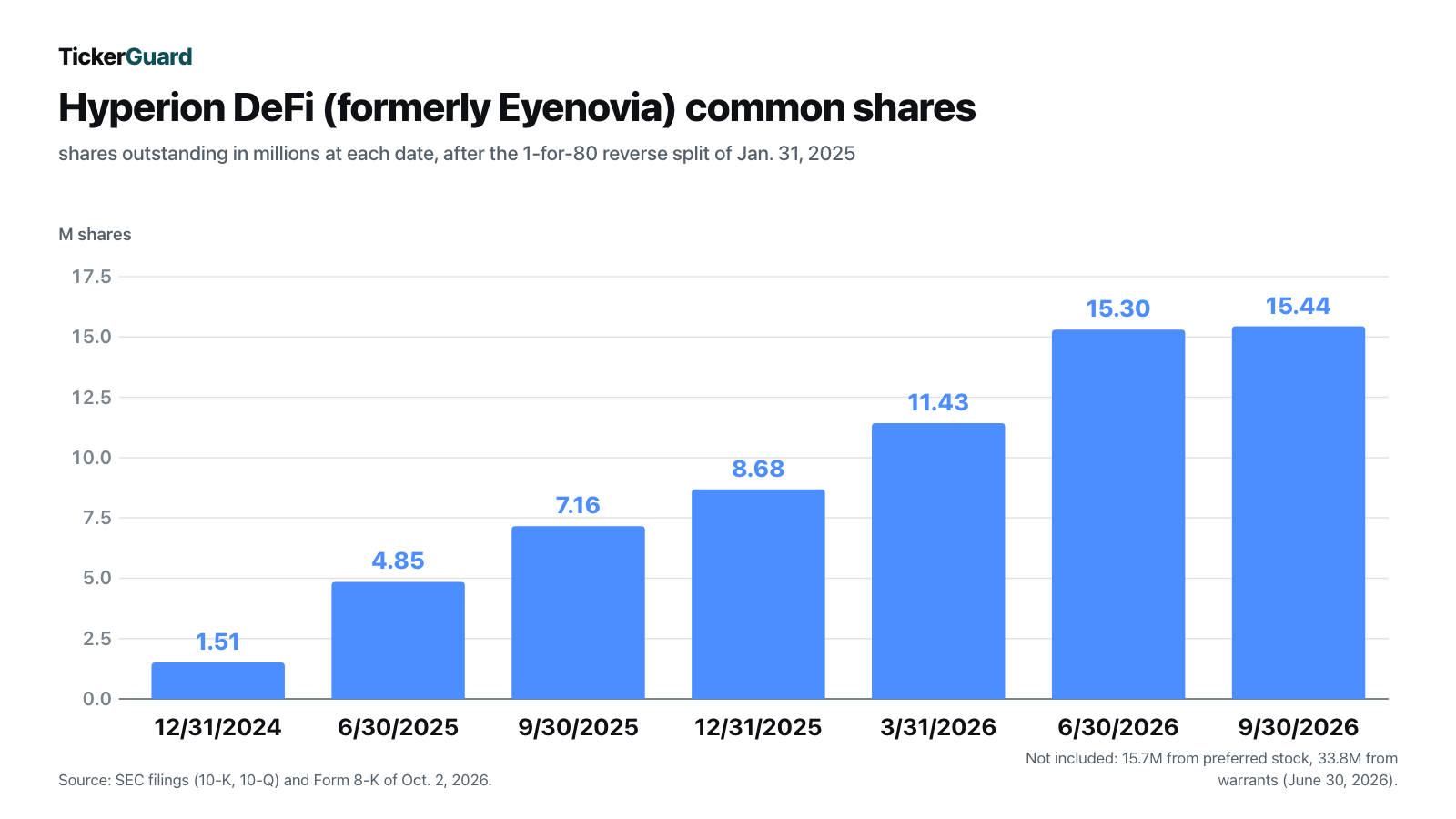
In the first half of 2026 alone, Hyperion sold 2,352,776 shares through an at-the-market program ($8.5 million net) and in May 2026 another 2,910,027 shares at $3.60 in a public offering (about $9.3 million net). The close on the day before pricing, May 4, 2026, was $4.50, so the new shares went out at a 20 percent discount. Your slice of the pie shrinks when new slices keep being cut — and here at a 20 percent discount to the prior day’s close.
What the Filings Say — The Uncomfortable Truths
A filing with the SEC is made under penalty of law. That is why it pays to take it literally — including where it gets uncomfortable.
Uncomfortable Truth No. 1: Everything Hinges on a Single Token
Hyperion says so itself in the liquidity section of its latest quarterly report:
“The Company’s financial condition is substantially dependent on the market price and liquidity of HYPE tokens, which are subject to extreme volatility and limited trading venues. Substantially all of the Company’s treasury assets are concentrated in HYPE tokens. The Company’s financial results and carrying value of its digital assets will fluctuate materially based on HYPE token price movements. The Company depends on the continued success and adoption of the Hyperliquid protocol for the value of its treasury holdings.”
— Hyperion DeFi, quarterly report 10-Q as of June 30, 2026, Note 2

What that means in practice shows up a few pages later in the same report: between June 30 and August 10, 2026, HYPE fell from about $65.00 to $55.40.
“The fair value price of HYPE has declined from approximately $65.00 as of June 30, 2026 to $55.40 as of August 10, 2026, which corresponds to a fair value decline on our approximately 1.1 million tokens of HYPE digital assets held as of June 30, 2026 of approximately $10.9 million.”
— Hyperion DeFi, quarterly report 10-Q as of June 30, 2026, Note 13
That figure covers only the roughly 1.1 million directly held tokens; the rest of the holdings sits in liquid staking tokens carried at cost less impairment (Note 6). Those $10.9 million in six weeks exceed the entire adjusted gross profit the company projected in August for all of 2026 ($5 million to $7 million, earnings release of August 12, 2026; according to the press release of October 2, 2026, it raised guidance in September; no new figure appears in any SEC filing). Add risks a shareholder does not see: staked tokens are locked for seven days before the company can sell them. Hyperion holds the tokens in self-custody, and according to the quarterly report, the insurance of custodian Anchorage Digital explicitly does not cover self-custodied tokens. And partner agreements can vanish overnight: when the end of the USDH stablecoin was announced in May 2026, two agreements tied to about 800,000 HYPE ended in June 2026 (current report 8-K of June 5, 2026).
Uncomfortable Truth No. 2: Half the Company Is Already Spoken For
The $50 million of June 2025 did not come in as ordinary shares. Investors received non-voting preferred stock — and a bonus that weighs more today than the money:
“Each share of Series A Preferred Stock is convertible into three shares of common stock. The Series A Preferred Stock has a par value of $0.0001 per share. Additionally, the investors were issued five-year warrants exercisable into an aggregate of 30,769,230 shares of common stock at an exercise price of $3.25 per share exercisable beginning on December 21, 2025.”
— Hyperion DeFi, quarterly report 10-Q as of June 30, 2026, Note 11
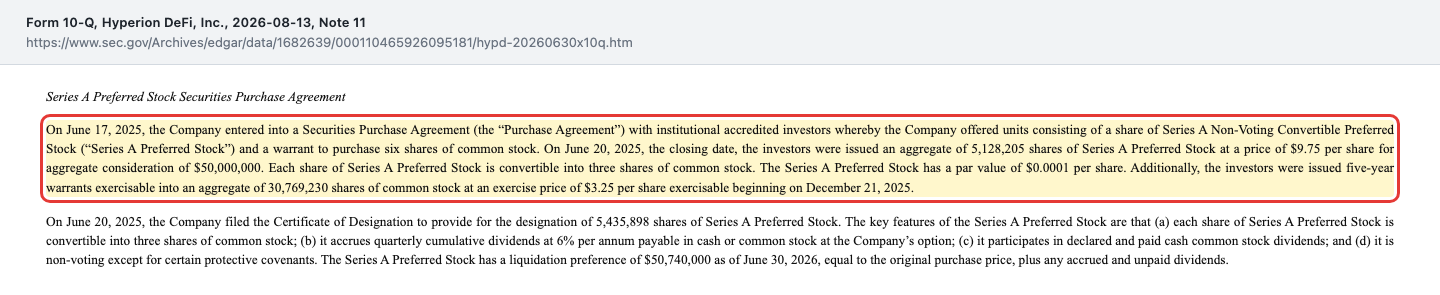
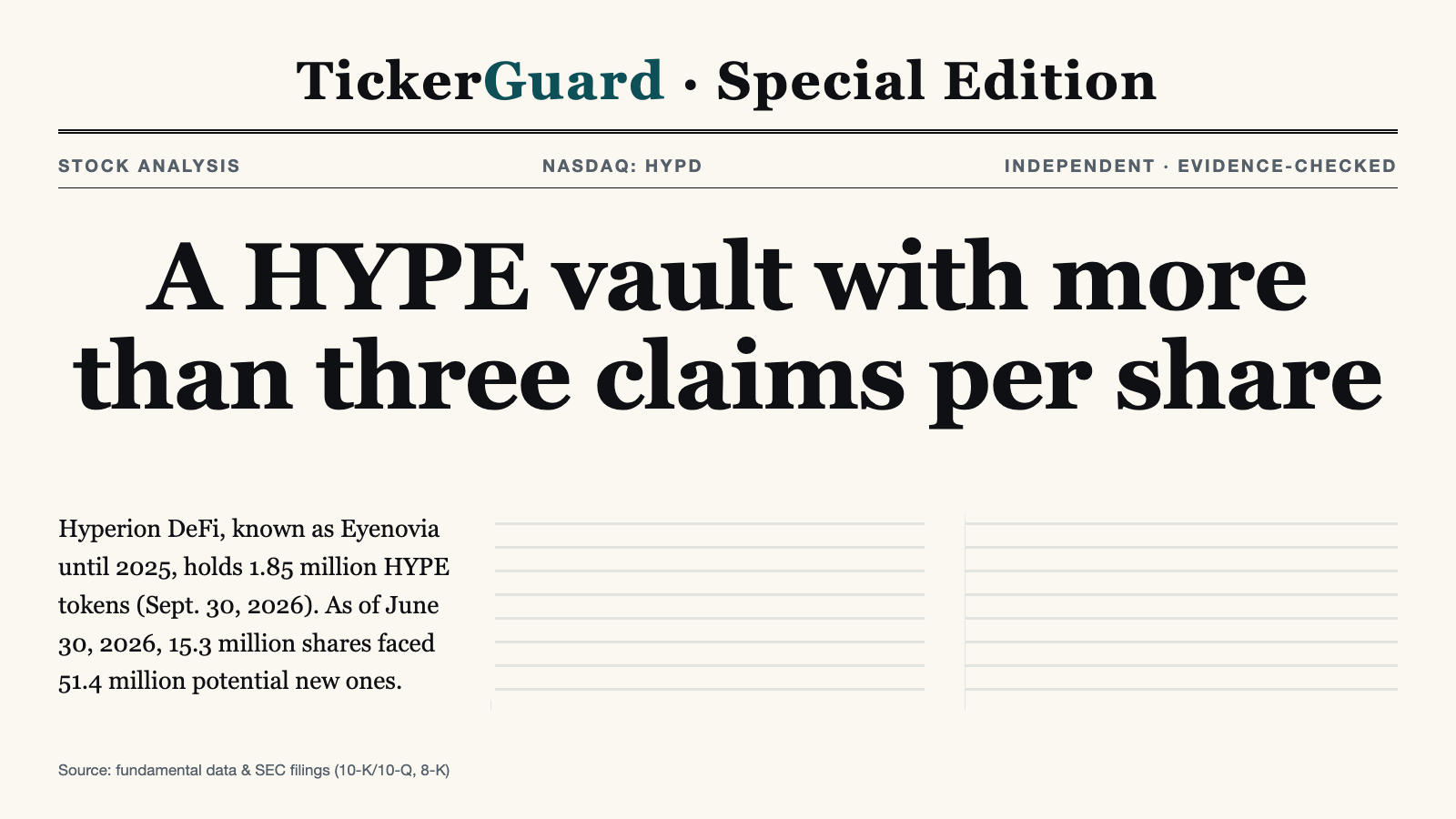
Let’s do the math as of June 30, 2026: 5,235,897 preferred shares remain outstanding, which convert into 15,707,691 common shares — slightly more than the 15,299,832 common shares outstanding that day. Taken together, common shareholders therefore own just under half of the company on an as-converted basis. On top come 33.8 million warrants, about 1.8 million promised but not yet delivered shares from employee plans (1.65 million not yet vested and 0.17 million vested, per Note 11) and 81,000 options. In total, 51.4 million potential new shares on 15.3 million existing ones — more than three per share.
And the preferred stock keeps growing on its own: Hyperion has so far paid its 6 percent annual dividend in common stock — 244,518 shares on January 5, 2026, 236,318 on April 6 and 235,618 on July 6, 2026. That is about 1.5 percent of the share count per quarter. The buyback Hyperion started in September 2026, 240,124 shares at an average of $3.21, roughly offsets one single dividend payment. Common shares still rose from 15,299,832 to 15,442,482 in the third quarter.
Uncomfortable Truth No. 3: The Vault Is Shrinking per Share
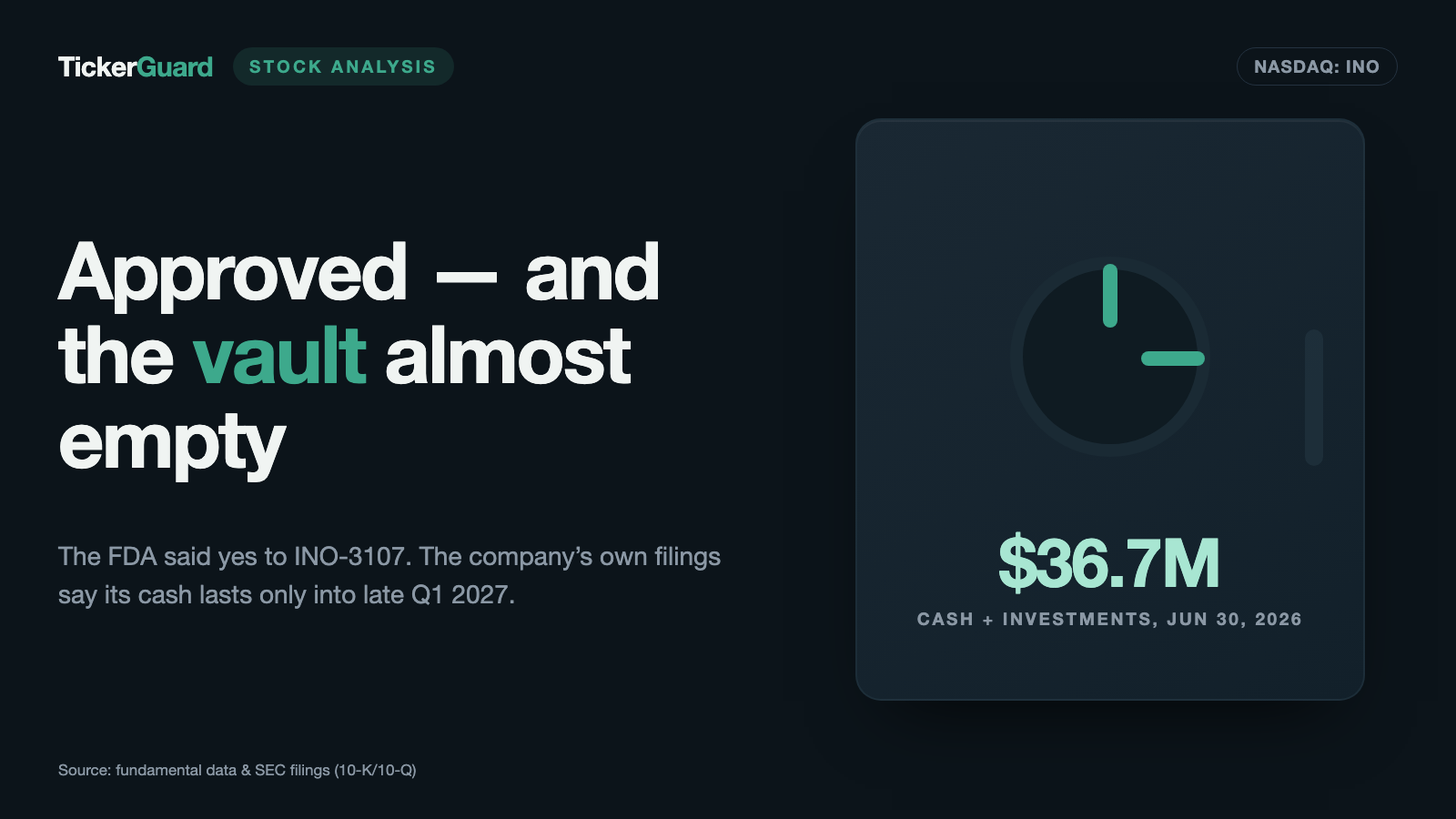
A crypto treasury company lives by one question: is the token count per share growing? Until mid-2026, the answer was yes; the company reported an increase from 1.31 million HYPE (June 30, 2025) to 2.04 million (June 30, 2026). In the third quarter of 2026 it reversed. Hyperion sold 200,000 HYPE and liquid staking tokens and, on September 28, 2026, repaid its loan from Avenue Capital:
“The aggregate payoff amount was approximately $8.6 million. The Company did not incur any early termination penalties in connection with the repayment. The repayment was funded with the proceeds from the sale of HYPE tokens described in Item 8.01 below and cash on hand.”
— Hyperion DeFi, current report 8-K of October 2, 2026, Item 1.02

Having no long-term debt is good; the loan most recently carried 8 percent interest. But the per-share math looks different: on June 30, 2026, each share, with preferred stock converted, stood for about 0.066 HYPE; on September 30, 2026, it was about 0.059 — a decline of roughly a tenth in one quarter (our calculation, assuming no preferred conversions in the third quarter). Raising money through new shares also has a limit. The company’s at-the-market program has been sized at up to $500 million since November 2025. The prospectus supplement of May 2026 names the actual constraint:

One-third of $52.7 million is about $17.6 million over twelve months; the May 2026 offering, at $10.5 million gross, already used a large part of it. The $500 million is therefore a ceiling on paper, not an available source of money. As long as the market value stays small, Hyperion funds itself from cash, from token sales — or through the warrants if the stock rises above $3.25.
Uncomfortable Truth No. 4: Who Decides — and What He Is Rewarded For
Hyperion is run by Hyunsu Jung, who according to a June 2025 current report was 29 at the time and previously a portfolio manager at crypto asset manager DARMA Capital. He joined with the private placement as chief investment officer and director and is now also chief executive. According to the 2026 proxy statement, the company reported $9.29 million in compensation for him for 2025 (grant-date value per the Summary Compensation Table), almost entirely in stock awards; $6.1 million of that relates to one million shares that vest only at market-cap thresholds, half each at a market capitalization of $150 million and $500 million. The same proxy puts “compensation actually paid,” calculated under SEC rules, at $4.59 million; per the proxy, that figure explicitly does not reflect compensation actually received. But market capitalization also grows when the company simply issues more shares — what counts for you as a shareholder is value per share, not the total. After shares were withheld for taxes in August 2026, Jung directly held 1,345,676 shares according to his insider filing (Form 4 of August 18, 2026), about 8.7 percent of the common shares outstanding on September 30, 2026.
Shareholder oversight is thin. At the annual meeting on June 30, 2026, less than half of the eligible shares were represented (48.22 percent), each director received about 1.6 million votes in favor, and a proposed charter amendment failed to get the required majority. The preferred holders, who own about half of the company on an as-converted basis, do not vote at all. Two more footnotes from the filings: for 2025, Hyperion reported a material weakness in internal controls over token pricing, which the quarterly report as of June 30, 2026 says has been remediated. And with the change of business, part of the tax loss carryforwards from the Eyenovia era can no longer be used, because U.S. tax law requires the old business to continue (quarterly report as of June 30, 2026, Note 10).
Valuation: What the Market Pays for the HYPE Vault
At the $3.22 close on October 30, 2026, the 15,442,482 common shares (as of September 30, 2026) are worth about $50 million. As a cross-check: fundamental data show about $49 million, and Hyperion paid an average of $3.21 per share for its September buyback. Converting the preferred stock adds 15.7 million shares, and the company as a whole is worth about $100 million.
Against that stands the net asset value Hyperion calculates itself (an adjusted, non-GAAP figure): $134.2 million as of June 30, 2026, at a HYPE price of $65. Per share, with preferred stock converted, that was about $4.33; the close on the same day was $3.14, or about 73 percent. There it is, the bargain reflex. But three things belong in the same calculation:
- The value is a snapshot. By August 10, 2026, HYPE had fallen to $55.40, and by September 30, 2026, the holdings had shrunk to 1.85 million tokens (gross, including liquid staking tokens). As a rule of thumb, every $10 move in the HYPE price changes the value of the holdings by about $18.5 million, or about $0.59 per share (our calculation, preferred stock converted, the $3.25 warrants not included).
- The discount has reasons. The company keeps burning cash: $7.1 million net in operating activities in the first half of 2026. Every year that continues eats into the assets.
- The warrants sit at the stock price. If the stock rises well above $3.25, 32.6 million new shares can be created. That brings the company money, but also more than twice as many co-owners.
A price-to-earnings ratio makes no sense here, because earnings depend on the token price. Neither does price-to-sales: revenue of $0.6 million in the first half of 2026 is a footnote next to the assets. In August, the company projected adjusted gross profit of $5 million to $7 million for 2026 (earnings release of August 12, 2026; according to the press release of October 2, 2026, it raised guidance in September; no new figure appears in any SEC filing); by its own measure, the first half came to $2.1 million. In August it also expected its adjusted net operating cash flow to turn positive by the end of 2026; in the second quarter of 2026 it was negative $2.1 million by the company’s measure (earnings release of August 12, 2026, a non-GAAP figure).
The view from the pros helps little: according to fundamental data, two analysts rate the stock a “strong buy,” with an average price target of $9.83 (as of November 1, 2026). Average means all price targets added up and spread evenly — with only two votes, a single outlier can shift it a lot. Two ratings are not a consensus.
How a larger crypto treasury company handles similar questions — capital raising, discount or premium to assets, holdings per share — is covered in our Metaplanet stock analysis.
Upside and Risks at a Glance
What speaks for Hyperion DeFi:
- No long-term debt, liquid funds. Loan fully repaid on September 28, 2026, about $14.5 million in cash and stablecoins as of September 30, 2026 (preliminary, unaudited), plus 1.85 million HYPE.
- Costs are falling. Selling, general and administrative expenses of $3.9 million in the second quarter of 2026, after $7.7 million a year earlier; the ophthalmology business has been wound down.
- A business of its own in the making. Joint validator, new HAUS agreements for 500,000 HYPE each (July and August 2026), August guidance of $5 million to $7 million in adjusted gross profit for 2026 (raised in September per the press release, with no new figure in any SEC filing).
- Discount to assets. As of June 30, 2026, the stock traded at about 73 percent of the company’s own net asset value per share.
What speaks against it:
- One token, one protocol. Substantially all assets are in HYPE, the token of the Hyperliquid blockchain; per the quarterly report (Note 2), the value of that treasury depends on the continued success and adoption of the Hyperliquid protocol.
- Profit without cash. First-half net income of $39.8 million came from token gains; operating cash flow was negative in every reporting period.
- Dilution. 51.4 million potential new shares on 15.3 million existing ones; the preferred dividend is paid in stock, about 1.5 percent per quarter.
- Shrinking holdings per share. In the third quarter of 2026, HYPE per share fell by roughly a tenth.
- Weak oversight. CEO pay tied to market capitalization rather than value per share, low turnout at the annual meeting, non-voting major financiers.
A Human Bottom Line
Remember the shop window with 30 percent off? Hyperion DeFi really does have a discount on the sign — about 27 percent off the value the company calculates itself as of June 30, 2026. Only: half the goods in the shop are already set aside for others, the display consists of a single item whose price fell from $65.00 to $55.40 in six weeks, about 15 percent, and the shop occasionally sells a few shelves to pay the rent. The bargain reflex sees the sign. The filings show the shop.
Does that make it a bad business? Not necessarily. A company with a failed study, negative equity and going-concern doubt has become a company with no long-term debt that reported $101.9 million in equity as of June 30, 2026. For investors, the stock is a listed route to HYPE, with the dilution pressure that comes with that route. One number shows how large it can get: if all 32.6 million warrants were exercised at $3.25, the company would receive about $106 million by our calculation — and the share count would more than triple. The next checkpoints are clear: the quarterly report as of September 30, 2026 with share count, token holdings and cash flow, how the stock behaves around the $3.25 warrant strike, and whether the positive adjusted cash flow the company projected in August for the end of 2026 (earnings release of August 12, 2026) actually materializes.
What you make of it is your decision. And that is how it should be.
Sources and Data Cutoff
- Quarterly report 10-Q for the second quarter of 2026 (period ended June 30, 2026, filed August 13, 2026, latest periodic report) and 10-Q for the first quarter of 2026 (May 15, 2026); 10-Q as of September 30, 2025 (November 14, 2025)
- Annual report 10-K for 2025 (March 30, 2026) and annual report 10-K for 2024 (April 15, 2025, still as Eyenovia)
- Current reports 8-K: private placement and appointment of Hyunsu Jung (June 24, 2025), public offering at $3.60 (May 6, 2026), end of the USDH agreements (June 5, 2026), annual meeting voting results (July 1, 2026), executive employment agreements (July 8, 2026), second-quarter earnings release (August 12, 2026, Ex. 99.1), loan payoff, HYPE sales and cash (October 2, 2026) with Ex. 99.1 (buyback, share count)
- Prospectus supplement 424B5 of May 6, 2026 and proxy statement DEF 14A of May 5, 2026 (compensation, ownership)
- Insider filings (Form 4) of August 18, 2026 and September 30, 2026 (each a tax withholding)
- Price and metrics data: source fundamental data, as of November 1, 2026 (closing prices through October 30, 2026, analyst count and price target)
Data cutoff: company figures as of December 31, 2025 (fiscal 2025) and June 30, 2026 (latest periodic report of August 13, 2026); share count, token holdings and cash as of September 30, 2026 from the current report of October 2, 2026 (preliminary, unaudited). We reviewed the list of SEC filings through November 1, 2026. Prices: closes of July 16, 2025, May 4, June 30, July 29 and October 30, 2026, plus the September 2026 buyback price. Calculated values (market value, as-converted share count, potential new shares, net assets and tokens per share, rule of thumb per $10 of HYPE price, warrant exercise proceeds) are our own estimates and labeled as such.
Note: This article is journalistic analysis, not investment advice, and not a solicitation to buy or sell securities. Shares of companies whose assets sit in a single crypto token can be extremely volatile; you can lose some or all of your money. Positions held by the operator are disclosed daily; where one exists, it appears as a notice at the top of this deep dive.
Our Bottom Line at a Glance
- Concentration risk negative
- Substantially all assets in HYPE; per the Q2 2026 10-Q, the financial condition depends on the price and liquidity of a single token.
- Earnings power negative
- H1 2026 net income of $39.8M from token gains; revenue $0.6M, operating cash flow −$7.1M, negative in every reporting period.
- Dilution negative
- 51.4M potential new shares on 15.3M (6/30/2026); preferred dividend paid in stock, about 1.5% per quarter.
- Balance sheet positive
- $8.6M loan repaid on 9/28/2026, $14.5M in cash and stablecoins (9/30/2026, preliminary), equity $101.9M (6/30/2026).
- Leadership and oversight negative
- CEO pay tied to market-cap thresholds instead of value per share; non-voting preferred holders, low turnout at the 2026 annual meeting.
Hyperion DeFi, formerly Eyenovia, is today a HYPE treasury with a small staking business. Earnings depend on the token price, the operating business burns cash, and every common share faces more than three potential new ones. No long-term debt since September 2026, but token holdings per share fell in the third quarter. Not investment advice.
What Our Rating Means
Substance risk
We found at least one documented issue that threatens the company itself — regardless of how the stock is currently valued.
Red because two findings are documented: operating cash flow has been negative in every reporting period, including the first half of 2026 with $39.8 million of reported net income, and according to its own quarterly report the company’s financial condition is substantially dependent on the market price and liquidity of a single token; substantially all treasury assets are in HYPE. That the stock trades below net asset value is a price question and does not change the color. The decision is yours.
A journalistic assessment by our editorial team at the time of the deep dive, based on public sources — not investment advice and not a solicitation to buy or sell. Your personal circumstances (investment goals, risk capacity, taxes) cannot be taken into account. What our levels mean, how verdicts are formed, and what conflicts of interest exist →
Worth Noting
- This analysis was prompted by the stock appearing in our in-house Reddit hype scanner on 10/30/2026, not by a metrics screen.
- Data feeds and databases partly still list Hyperion under healthcare/biotechnology (Eyenovia); with the SEC it is classified as a finance services firm. Ratios such as price-to-sales are therefore hardly comparable.
- Basis: 10-K 2024 (4/15/2025) and 2025 (3/30/2026), 10-Q Q2 and Q3 2025 plus Q1 and Q2 2026, 8-Ks through 10/2/2026, 424B5 (5/5 and 5/6/2026), DEF 14A (5/5/2026), Form 4 (8/18 and 9/30/2026); SEC filing list reviewed through 11/1/2026, no Form 15, no Form 25. The 10-Q for 9/30/2026 had not been filed yet.
- Calculated values are our estimates: as-converted share count = common shares plus 3 × 5,235,897 preferred shares (as of 6/30/2026, assumed unchanged for 9/30/2026); net assets per share = $134.2M / 31.0M; rule of thumb 1.85M tokens × $10 = $18.5M.
Stock Watch
This analysis is as of November 1, 2026. Stock Watch will tell you what's changed at HYPD since then.
Later $1 a month per stock — signing up is free, and you'll be the first to know when it launches.
The full analysis as a PDF for later
We will send you this analysis as a PDF — to print, file away, and read at your own pace. And we will add you to the free Stock Watch list for Hyperion DeFi, Inc. (HYPD), so you hear about it when something material in this analysis changes.
Frequently Asked Questions
Hyperion DeFi of Dallas, the ophthalmology company Eyenovia until July 2025, holds a treasury of HYPE, the token of the crypto exchange Hyperliquid. It earns income from staking, a validator run jointly with Kinetiq and MAVAN, lending staked tokens to partners and options trades. As of September 30, 2026, the company held 1.85 million HYPE tokens.
Eyenovia developed eye medicines and the Optejet dispenser. After its Phase III CHAPERONE study failed in November 2024, it cut about three quarters of its workforce. In June 2025 it raised $50 million for a HYPE treasury and has been called Hyperion DeFi since July 1, 2025. The Optejet rights went to Arctic Vision in July 2026 for the release of $100,000 of debt.
Only on paper. In the first half of 2026, Hyperion reported net income of $39.8 million, almost entirely from gains on HYPE. Revenue was $0.6 million, and operating activities used $7.1 million in cash. 2025 ended with a net loss of $45.3 million, including minus $39.8 million in the fourth quarter alone as HYPE fell.
Common shares rose from 1.51 million at the end of 2024 to 15.44 million on September 30, 2026. As of June 30, 2026, another 51.4 million potential shares stood behind them: 15.7 million from preferred stock (each convertible into three common shares), 33.8 million from warrants, 32.6 million of them at $3.25, plus stock awards and options.
Hyperion held 2.04 million HYPE as of June 30, 2026 and 1.85 million as of September 30, 2026, after selling 200,000 tokens to repay its loan. With preferred stock converted, that is about 0.066 and 0.059 HYPE per share by our calculation, a decline of roughly a tenth in one quarter.
As of June 30, 2026, Hyperion put its net asset value at $134.2 million, at $65 per HYPE. Per share, with preferred stock converted, that was about $4.33; the close on the same day was $3.14, about 73 percent of it. The value moves with HYPE: every $10 price move changes the holdings by about $18.5 million.
Hyperion makes no money from AI, and its filings do not describe operational use of it. The 2025 annual report, however, names blockchains that build AI into their core features as a possible reason HYPE could become technologically obsolete. Our AI rating is therefore “threatened,” indirectly through the value of the HYPE treasury.
Found an error?
Did you spot a factual error, an outdated number, or a typo in this deep dive? Let us know briefly — your report goes straight to the editorial team.