FuboTV Has Disney Behind It — and That Is Exactly the Catch for Minority Shareholders
Since merging with Hulu + Live TV, FuboTV books about $1.5 billion in revenue per quarter and belongs to the Disney empire. But 72 percent of that revenue is a fee Hulu pays at just below its own programming costs, Disney holds 70 percent of the vote, and $2.6 billion of goodwill had only 3.6 percent of headroom in March 2026. A famous name on the label is not the same as a large slice for you.
 Thomas Mücke
Founder & Publisher
As of Today
As of: October 30, 2026
- Closing price
- 7.60 $ -4.30%
- Market Capitalisation
- 0.2 $B
- P/E
- 2.5
- Growth Score
- 2/10
- AAQS
- 3/10
Price change since October 30, 2026: -0.3%
This analysis has a cut-off date. The Stock Guard tells you when something material changes in the numbers. Reserve your free spot
Chart
Interactive price chart (TradingView).
52-week range: 1.10 $ to 13.80 $ · Last price: 7.60 $ (As of: October 30, 2026)
Note: pure fact-based analysis, not investment advice and not a solicitation to buy or sell. All figures without guarantee.
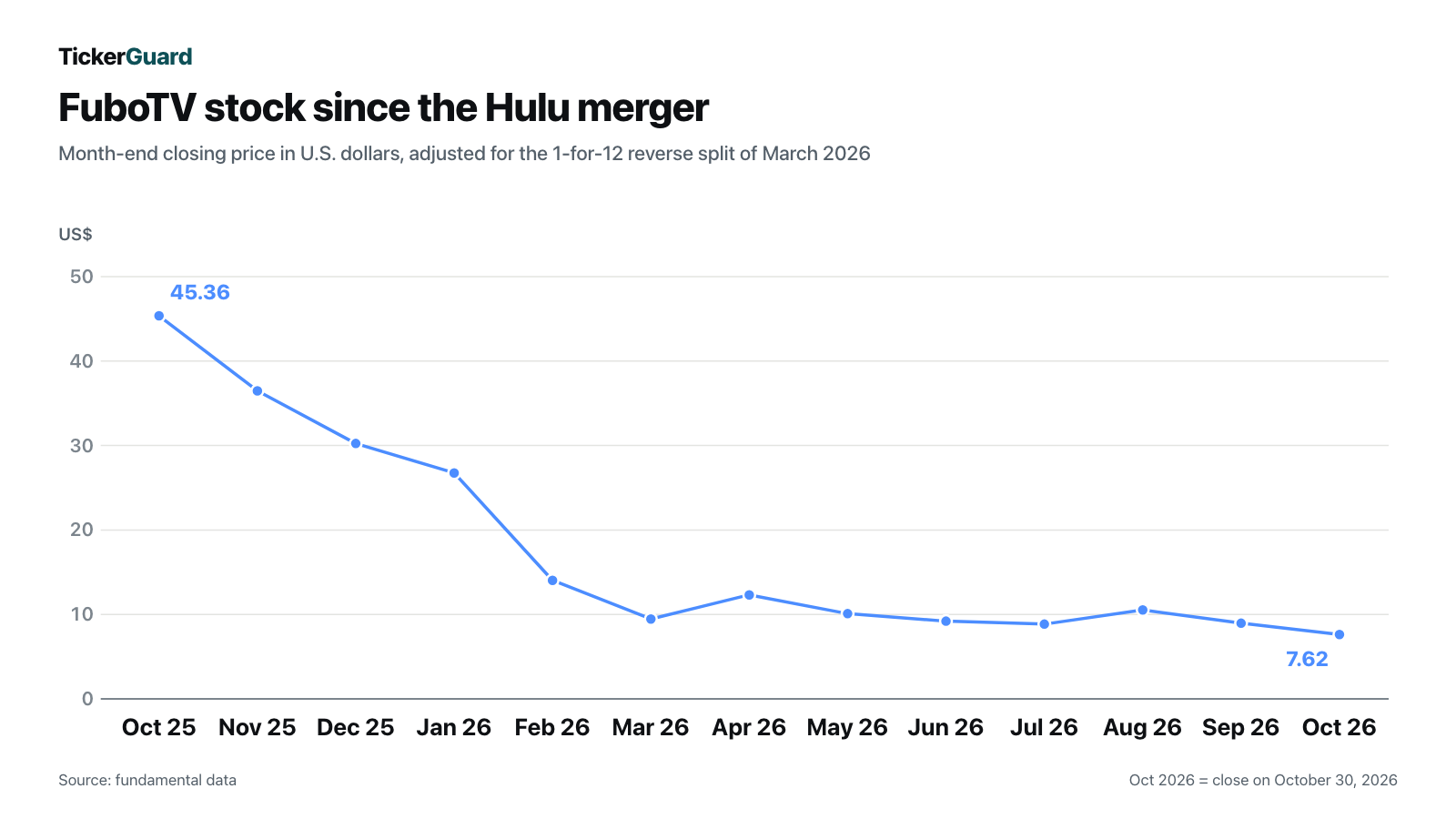
There is an investor trap that snaps shut most easily when a famous name is involved. Psychologists call it the halo effect: one shining trait colors everything else. Put “Disney” on the label and a stock suddenly feels safer, more solid, somehow grown-up. FuboTV (NYSE: FUBO) has carried that label since October 29, 2025. On that day, Disney combined its streaming TV service “Hulu + Live TV” with FuboTV and took majority control in return. Anyone who bought the stock that day paid the equivalent of $44.28. One year later, on October 30, 2026, it was $7.62. Before the halo blinds you, let’s read together what the company tells the U.S. securities regulator, the SEC — and work out how much of the famous name actually reaches you. In the end, you decide.
What FuboTV actually does — cable TV without the cable
FuboTV sells television over the internet. Instead of a cable connection, you get a subscription with live channels — sports, news, entertainment — on a smart TV, phone or tablet. The industry calls this a “virtual pay TV provider” (vMVPD). Fubo came from sports: the company motto in its 2024 annual report is “come for the sports, stay for the entertainment.” The listed company was called FaceBank Group until August 2020. After the Hulu + Live TV merger, it describes itself in its own earnings release, citing UBS estimates, as the sixth largest pay TV company in the U.S. As of June 30, 2026, FuboTV counted 5.75 million paying subscribers in North America, compared with 5.63 million a year earlier on a combined basis, plus 356,000 subscribers in France and Spain.
Since the merger, the business has two very different halves. The first is the Fubo services: here FuboTV sells the subscriptions itself, sets the prices and carries the costs. The second is Hulu + Live TV: Hulu, a Disney subsidiary, still sells that service on the Hulu platform. Hulu collects the subscription fees, runs the marketing, sells the advertising — and pays FuboTV a wholesale fee. FuboTV, in turn, buys the channels. Put simply: at Hulu + Live TV, FuboTV is more the buyer in the back office than the owner of the store.
For comparison, our Roku analysis shows how a streaming platform business works; what the network side earns is covered in our Fox Corporation analysis, whose sports broadcasts also run on FuboTV. That names the central tension of this analysis: Disney makes FuboTV big — with customers, advertising, cheap credit and billions in revenue. And Disney makes FuboTV small for you — with a fee just below cost, 70 percent of the vote and the final say on everything that matters.
Company history for investors
-
2020
FaceBank Group becomes fuboTV
In August 2020, the former FaceBank Group takes the name fuboTV. Years of strong growth and heavy losses follow — $561.5 million in 2022 alone.
-
2025
Merger agreement with Disney
On 01/06/2025, FuboTV, Disney and Hulu agree to combine with Hulu + Live TV. Settling an antitrust dispute brings a $219.5 million gain in 2025.
-
2025
Closing: Hulu takes control
The merger closes on 10/29/2025. Hulu receives 70% of the vote; the stock closes at the equivalent of $44.28. Legacy shareholders begin life as a minority.
-
2026
1-for-12 reverse split
From 03/24/2026 the stock trades after combining twelve shares into one — approved by Hulu alone. The price stood at $9.46 at the end of March.
-
2026
Disney executive takes the helm
Since 07/10/2026, Alisa Bowen, previously president of Disney+, has led the company. Co-founder David Gandler departs. A strategic update is slated for November 2026.
How the stock landed on our desk
FuboTV made our research list through our in-house Reddit hype scanner, which tracks stocks that investor forums are talking about; it flagged the name on October 29, 2026. More interesting was where else FuboTV showed up. On October 31, 2026, the stock appeared in our price-to-sales ranking, which looks for stocks valued especially low relative to revenue, in the price-to-earnings ranking, in the Beneish M-Score (a screen for unusual accounting patterns), in the bankruptcy-risk radar and in the parabolic-reversal scanner. Cheap, suspicious and at risk all at once — a bundle like that calls for a closer look.
The numbers provide it. Our fundamental data shows a price-to-sales ratio of 0.04: the market values FuboTV at four cents per dollar of annual revenue. The reason: the dataset counts only the 30.2 million Class A shares that trade on the exchange — a market value of just over $0.23 billion at $7.62 — but uses the full group revenue of $5.7 billion over four quarters. Hulu’s 79.0 million units, which are exchangeable into Class A shares, are missing from that calculation. And the Beneish M-Score reacts to sudden jumps in revenue and receivables — exactly what a merger produces when a different company takes over the reporting history. Remember: a scanner hit is a question, not an answer.
Ten analysts provide a rating in our fundamental data: five strong buy, three buy, two hold; their average price target is $17 (data as of October 31, 2026). Average here means all price targets added up and spread evenly — a single very high target pulls the figure up noticeably. These are third-party views, not a TickerGuard forecast, and we do not adopt them. On the other side are short sellers, who bet on falling prices: according to our fundamental data, about 23 percent of the free float was sold short. We reviewed the 2024 annual report (10-K), the quarterly reports (10-Q) through June 30, 2026, the Hulu Live financial statements and filings through October 31, 2026. We did not review earnings call transcripts; instead we used the shareholder letter of August 5, 2026.
The numbers over the years — an honest look
First, a warning about the numbers, because they are unusual. For accounting purposes, FuboTV did not acquire the Hulu Live business in the merger — it was the other way around. That is why the filings show Hulu + Live TV figures as the “prior year,” not those of the old FuboTV. At the same time, the fiscal year changed: since the merger it ends on September 30, as at Disney. The third quarter of fiscal 2026 therefore covers April to June 2026. We keep both histories strictly apart.
The old FuboTV grew fast and lost money doing it. According to its annual report, revenue rose from $1,008.7 million (2022) to $1,368.2 million (2023) and $1,622.8 million (2024); the loss attributable to shareholders shrank from $561.5 million to $287.5 million and $172.3 million. The first nine months of 2025 even showed a profit of $161.6 million — but only thanks to a $219.5 million gain from settling an antitrust dispute. The Hulu Live business was even larger and also in the red: in the fiscal year ended September 27, 2025 it generated $4,413.0 million in revenue and lost $156.3 million, after a $159.1 million loss the year before.
Now the impressive part: combined, FuboTV is a heavyweight. Revenue for April to June 2026 came to $1,481.7 million, and $4,604.3 million for the nine months since October 2025. Adjusted EBITDA, a measure without one-time items that the company calculates itself, was positive in every quarter: $41.4 million (October to December 2025, partly pro forma), $37.7 million and $19.1 million. Advertising contributed $108.9 million in the third quarter, and according to the shareholder letter the 2026 FIFA World Cup delivered three times the ad revenue of the 2022 World Cup. And the filings express no doubt about the company’s survival — quite the opposite:
“We believe our existing cash and cash equivalents will provide us with the necessary liquidity to continue as a going concern for at least the next twelve months.”
— FuboTV Inc., SEC quarterly report 10-Q for the quarter ended June 30, 2026, Item 2 “Liquidity and Capital Resources”
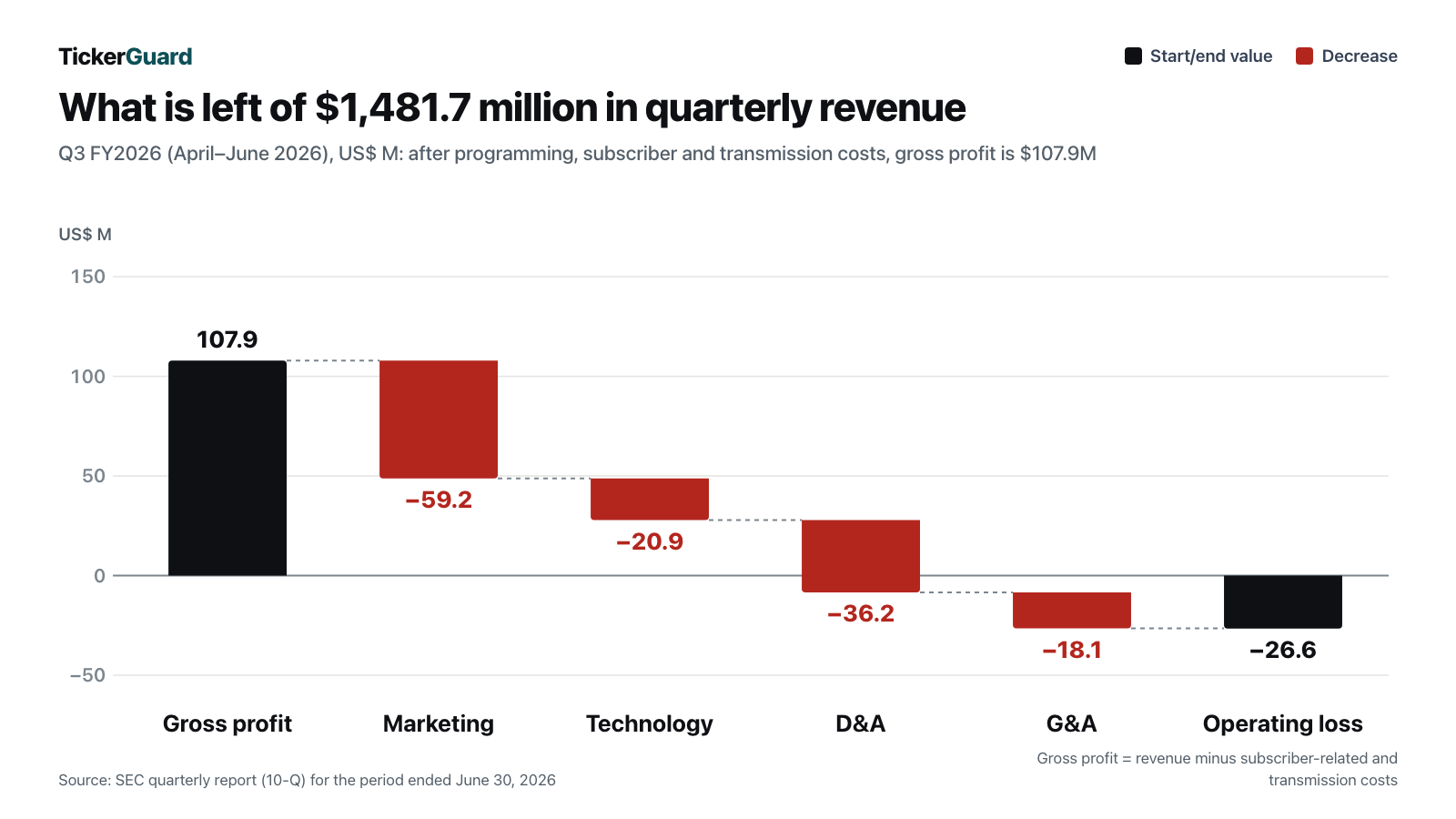
The chart shows the flip side. Of every dollar of revenue, only a little over seven cents remained as gross profit in the third quarter — the rest went to networks for programming rights, $547.8 million of it to Disney entities themselves. The bottom line was an operating loss of $26.6 million and a net loss of $25.7 million; $8.2 million of that is attributable to Class A shareholders, 25 cents per share. And cash flowed out: in the nine months through June 2026, operating cash outflow reached $417.1 million. Most of it sits in a single receivable — $501.3 million that Hulu owed FuboTV on June 30, more than twice the $230.3 million in cash. In the third quarter, operating cash outflow was just $4.7 million. Remember: big revenue is only worth what is left after the purchasing costs.
What the filings say — the uncomfortable truths
Uncomfortable truth No. 1: Most of the billion-dollar revenue is a pass-through
In the third quarter, $1,067.9 million of $1,481.7 million in revenue came from a single payer: Hulu. That is 72 percent, and almost 73 percent over nine months. How this fee is calculated is spelled out in the quarterly report:
“Pursuant to our Commercial Agreement with Hulu, for the Hulu Live Service, the Company receives a wholesale fee from Hulu initially equal to 95% of carriage fee expenses incurred by the Hulu Live Business for calendar years 2025 and 2026, escalating to 97.5% in calendar year 2027 and 99% in calendar year 2028 and thereafter.”
— FuboTV Inc., SEC quarterly report 10-Q for the quarter ended June 30, 2026, Item 2 “Components of Results of Operations”

Read the sentence slowly. Hulu reimburses FuboTV for the cost of the channels on Hulu + Live TV — but only at 95 percent. Put simply: on the Hulu Live side, FuboTV adds five cents on every dollar of programming costs before paying for staff, technology or interest. FuboTV can only earn money there through a share of ad revenue and by buying channels more cheaply. The rate rises to 97.5 percent in 2027 and 99 percent from 2028 — that improves the picture but does not turn the business into a major profit engine. The agreement runs for five years and renews only if both parties agree. Hulu sells the subscriptions, sets the prices and handles marketing; according to the quarterly report, the Hulu Live business is reliant on Hulu “for certain key operational aspects.” Remember: whoever works someone else’s cash register earns what the other party leaves them.
Uncomfortable truth No. 2: You are buying a minority — Disney has the final say
The stock you can buy on the exchange is a Class A share. Alongside it there are 78.99 million Class B shares that carry voting rights only — and Hulu owns them. What that means, FuboTV spells out in its risk factors:
“Hulu (and Disney, through its indirect ownership of Hulu) collectively owns and controls 70% of the voting interest (calculated on a fully diluted basis) in our business through its ownership of the Class B Common Stock issued in the Share Issuance.”
— FuboTV Inc., SEC quarterly report 10-Q for the quarter ended June 30, 2026, Part II, Item 1A “Risk Factors”

The 2026 filings show what that looks like in practice. Hulu alone approved the 1-for-12 reverse split in March 2026 by written consent; no vote of the other shareholders was needed. In July 2026, Disney executive Alisa Bowen, until then president of Disney+, replaced co-founder David Gandler as CEO. The July 28, 2026 annual meeting added 7 million shares to the equity plan for employees and executives — almost a quarter measured against 30.2 million Class A shares. As a “controlled company” under NYSE rules, FuboTV may also dispense with a majority of independent directors, and according to the filing it does.
On top of that, two money flows run toward the controlling shareholder. First, under a Tax Receivable Agreement, FuboTV must pass a portion of certain tax benefits on to Hulu; the company itself says the payments could be “substantial.” Second, in January 2026 Hulu registered its 78,992,518 exchangeable shares for resale. Put simply: the company’s largest block can come onto the market at any time. On the plus side, Disney lent FuboTV $145 million at 4.2 percent until 2031 in January 2026, which was used to repay a maturing convertible note. Remember: a strong controlling shareholder protects the company — not automatically your slice of it.
Uncomfortable truth No. 3: The goodwill hangs on a 3.6 percent cushion
Because, for accounting purposes, Hulu Live acquired the old FuboTV, the $1,347.6 million purchase price had to be allocated to the old FuboTV’s assets. Whatever could not be assigned to a specific asset became goodwill — a little over $1.3 billion. Together with the goodwill Hulu Live already carried, $2,614.2 million now sits on the balance sheet, two thirds of total assets. Put simply: goodwill is the premium paid for customer relationships, brand and future expectations. It stays on the books only as long as the business justifies it. After the share price collapse, FuboTV had to test that as of March 31, 2026:
“Based on the interim impairment assessment, the Company concluded that the estimated fair value of the reporting unit exceeded its carrying value by approximately 3.6% and the Company concluded no impairment was warranted.”
— FuboTV Inc., SEC quarterly report 10-Q for the quarter ended June 30, 2026, Item 2 “Critical Accounting Policies and Estimates – Goodwill”
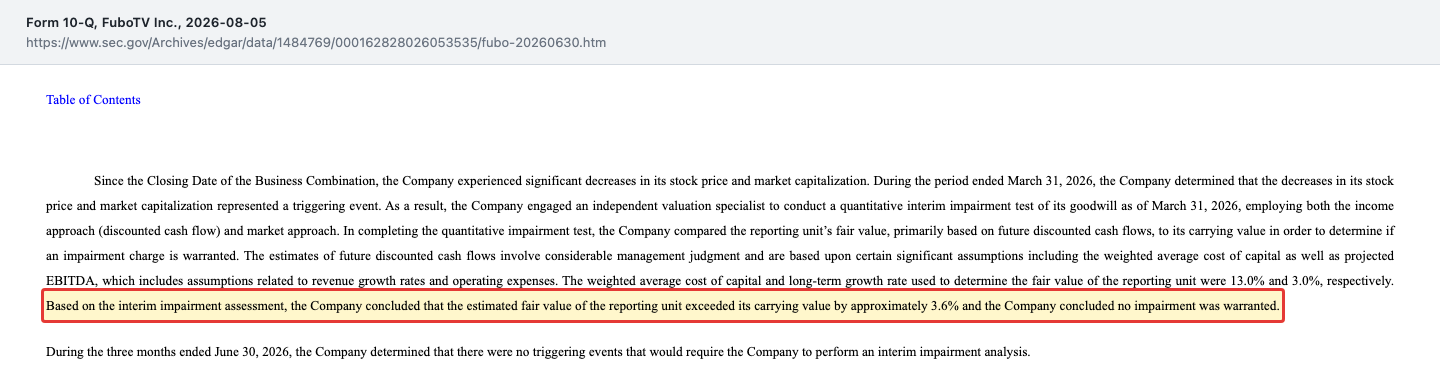
3.6 percent is a thin cushion. On March 31, 2026 the stock closed at $9.46; on October 30, 2026 at $7.62 — about 19 percent lower. The company itself writes that a further decline in share price, market value or business performance could trigger another test and an impairment. The regular annual test was on July 1, 2026; its result will appear in the annual report for the fiscal year ended September 30, 2026, which had not been filed as of October 31. An impairment costs no cash. But it would noticeably reduce the $813.4 million of shareholders’ equity and spoil a year’s reported results. Remember: goodwill is an expectation in balance-sheet form — and expectations are renegotiated on the stock market every day.
Valuation: cheap on the screen, pricier in the fine print
Let’s calculate the market value properly. At $7.62 (October 30, 2026 close), the 30,204,277 Class A shares (as of July 31, 2026) are worth about $230 million — the figure many data services display. Economically, however, Hulu’s 78,992,518 units belong in the count, because they are exchangeable into Class A shares at any time. Together that makes 109.2 million shares and about $832 million. The price box on this page shows the current price and therefore differs from this as-of calculation. Adding debt ($177.5 million convertible notes, $145 million Disney loan) and subtracting $236.4 million in cash gives an enterprise value of about $0.92 billion.
Measured against about $6.2 billion in revenue over the four quarters through June 2026 (the first two pro forma, as if the merger had already existed), that looks dirt cheap: about 13 cents of market value per dollar of revenue. But revenue is the wrong yardstick here, because only a little over seven cents per dollar remains as gross profit. Adjusted EBITDA fits better: over the same four quarters it totaled about $102 million. Enterprise value is therefore roughly nine times that — no bargain multiple for a business without net income. For the fiscal year ending September 30, 2026, FuboTV expects $90 million to $100 million; after $98.2 million in the first nine months, that arithmetically leaves a range of minus $8.2 million to plus $1.8 million for July to September. For fiscal 2028, the target is at least $300 million.
That $300 million is the core of every optimistic case. The filings name two levers: the rising wholesale rate (97.5 percent from 2027, 99 percent from 2028) and savings from combining the two businesses, which the company lists among its forward-looking statements. If that works, today’s valuation would look different. Just don’t forget which part of it belongs to you: about 70 percent of earnings are attributable to Hulu, and Hulu decides how they are used. The CEO plans to present a strategic update in November 2026.
Opportunities and risks at a glance
What speaks for FuboTV:
- Scale: $1,481.7 million in quarterly revenue (April to June 2026), 5.75 million paying subscribers in North America (June 30, 2026), about 2 percent more than a year earlier.
- Adjusted EBITDA positive in every quarter since the merger ($41.4 / $37.7 / $19.1 million); target for fiscal 2028: at least $300 million.
- Rising wholesale rate: 97.5 percent of programming costs from 2027, 99 percent from 2028.
- Disney as a partner: ad sales through Disney, customer acquisition via ESPN, a $145 million loan at 4.2 percent until 2031.
- No going-concern doubt in the quarterly report; cash of $236.4 million (June 30, 2026), guidance of at least $200 million at September 30, 2026.
What speaks against it:
- Dependence: 72 percent of revenue from Hulu, a fee below programming costs, distribution, pricing and advertising in Hulu’s hands; a $501.3 million receivable from Hulu.
- Control: 70 percent of the vote with Hulu/Disney, exemptions from governance rules, payments to Hulu under the tax agreement.
- Goodwill: $2,614.2 million with 3.6 percent headroom (March 31, 2026), share price about 19 percent lower since.
- Losses: operating loss of $26.6 million and net loss of $25.7 million in the third quarter; operating cash outflow of $417.1 million over nine months.
- Supply overhang: 78.99 million Hulu shares registered for resale, 7 million new shares for the equity plan.
- Litigation: in an antitrust counterclaim, DISH seeks to unwind Disney’s controlling stake (stayed since July 2026 because of DISH’s bankruptcy); Adeia has been suing for patent infringement since July 2026.
A human conclusion
Back to the halo effect. It isn’t foolish: having Disney on board really does mean FuboTV gets customers, advertisers and money it would never have gotten on its own, and the quarterly report expresses no doubt about the company’s survival. The trap is a different one. The halo belongs to the controlling shareholder, not to you. Disney decides on management, on the fee, on pricing at Hulu + Live TV — and Disney earns money on the channels FuboTV buys. So the honest question for you is not “Is Disney strong?” It is: Do you want to be a minority shareholder in a business whose largest customer, largest supplier and majority owner are the same family — and whose goodwill hangs on a 3.6 percent cushion? Whoever has an answer to that doesn’t need a halo. What you do with it is your decision. And that is how it should be.
Sources
All original documents used in this analysis — to read for yourself:
- FuboTV Inc. — SEC quarterly report 10-Q for the quarter ended June 30, 2026 (filed August 5, 2026)
- FuboTV Inc. — SEC filing 8-K of August 5, 2026: Exhibit 99.1 (shareholder letter) and Exhibit 99.2 (earnings release for the third quarter of fiscal 2026)
- FuboTV Inc. — SEC quarterly reports 10-Q for the quarters ended March 31, 2026, December 31, 2025 and September 30, 2025
- FuboTV Inc. — SEC annual report 10-K for 2024 (filed March 3, 2025)
- FuboTV Inc. — SEC filing 8-K/A of December 23, 2025 (Hulu Live financial statements) and 8-K of October 30, 2025 (closing of the merger)
- FuboTV Inc. — SEC filings 8-K of July 9, 2026 (new CEO), July 29, 2026 (annual meeting), March 20, 2026 (1-for-12 reverse split) and January 7, 2026 (Disney loan)
- FuboTV Inc. — SEC registration S-8 of August 5, 2026 (7 million shares for the equity plan)
- Fundamental data (prices through the October 30, 2026 close, analyst ratings, short interest; retrieved October 31, 2026), cross-checked against the SEC filings.
- Scanner hits: in-house Reddit hype scanner and price-to-sales ranking (as of October 31, 2026).
Transparency & disclaimer: this analysis is journalistic commentary on publicly available information. It is not investment advice, not a regulated investment research product and not a solicitation to buy or sell securities. Equity investments carry substantial risk up to and including total loss. All information is provided without warranty; the as-of date for each figure is stated in the text. Positions held by the operator are disclosed daily; where one exists, it appears as a notice at the top of this deep dive.
Key figures at a glance
All monetary figures in millions of $; earnings per share as reported.
| Metric | 2021 | 2022 | 2023 | 2024 | 2025 |
|---|---|---|---|---|---|
| Revenue | 638.4 | 1,008.7 | 1,368.2 | 1,622.8 | 2,722.1 |
| Operating Income (EBIT) | -328.3 | -411.9 | -293.1 | -177.8 | -71.9 |
| Net Income | -382.8 | -561.5 | -287.5 | -172.3 | 155.6 |
| Net Margin | -60.0% | -55.7% | -21.0% | -10.6% | 5.7% |
| Earnings Per Share | -33.41 $ | -36.92 $ | -1.04 $ | -6.47 $ | 5.35 $ |
Source: fundamental data & SEC filings (annual and quarterly reports, 10-K/10-Q)
Our Bottom Line at a Glance
- Dependence on Hulu negative
- 72% of Q3 FY2026 revenue ($1,067.9M of $1,481.7M) is Hulu’s wholesale fee, only 95% of programming costs in 2025/2026; distribution, pricing and advertising with Hulu; receivable of $501.3M (10-Q for the quarter ended 06/30/2026).
- Control & governance negative
- Hulu/Disney hold 70% of the vote, FuboTV uses the controlled-company exemptions; reverse split by Hulu consent (03/2026), Disney executive as CEO (07/2026).
- Earnings power neutral
- Gross margin 7.3%, operating loss of $26.6M in Q3 FY2026; adjusted EBITDA positive in every quarter since the merger ($41.4M / $37.7M / $19.1M), target ≥ $300M for FY2028.
- Balance sheet & goodwill negative
- Goodwill of $2,614.2M against $813.4M of shareholders’ equity; headroom in the 03/31/2026 test only about 3.6%, share price about 19% lower since.
- Liquidity & financing positive
- Cash of $236.4M (06/30/2026), no going-concern doubt; Disney loan of $145M at 4.2% until 2031, $177.5M convertible notes not due until 02/2029.
FuboTV is a textbook case of the halo effect: with Disney behind it, the company books about $1.5 billion in revenue per quarter and has cash plus a cheap loan from its controlling shareholder. But 72 percent of revenue is a fee just below programming costs, 70 percent of the vote sits with Hulu/Disney, and $2.6 billion of goodwill had only 3.6 percent headroom in March 2026. Since the merger, the stock has fallen 83 percent. Not investment advice.
What Our Rating Means
Substance risk
We found at least one documented issue that threatens the company itself — regardless of how the stock is currently valued.
Red, because a documented substance risk exists: an existential dependence on a single counterparty. Hulu pays 72 percent of revenue, sells and prices the largest service, markets the advertising and owes FuboTV $501.3 million; the agreement runs five years and renews only by mutual consent. At the same time, operating results do not cover interest (operating loss of $56.0 million over nine months). The company does not doubt its survival, and Disney is a solvent partner — the dependence remains existential nonetheless. The decision is yours.
A journalistic assessment by our editorial team at the time of the deep dive, based on public sources — not investment advice and not a solicitation to buy or sell. Your personal circumstances (investment goals, risk capacity, taxes) cannot be taken into account. What our levels mean, how verdicts are formed, and what conflicts of interest exist →
Worth Noting
- FuboTV made our research list through our in-house Reddit hype scanner (10/29/2026); on 10/31/2026 it also appeared in the price-to-sales ranking, price-to-earnings ranking, Beneish M-Score, bankruptcy-risk radar and parabolic-reversal scanner.
- The accounting acquirer in the merger is the Hulu Live business; prior-year figures in the 10-Qs since 12/31/2025 are Hulu Live figures. Figures for the old FuboTV (2022–2024, nine months 2025) come from its own 10-K/10-Q and are shown separately.
- Market value calculated by us: 30,204,277 Class A shares, or including 78,992,518 exchangeable Hulu units (10-Q cover page, 07/31/2026) × $7.62 close (10/30/2026). The Class A count matches the fundamental data exactly. Enterprise value = $832.1M + $177.5M + $145.0M − $236.4M.
- Four-quarter revenue (about $6.2B) and adjusted EBITDA (about $102M) combine pro forma (Q4 FY2025, Q1 FY2026) and reported figures (Q2, Q3 FY2026) from the 08/05/2026 shareholder letter; the arithmetic range for Q4 FY2026 (−$8.2M to +$1.8M) is our own calculation from the $90–100M guidance minus $98.2M for nine months.
- Prices are adjusted for the 1-for-12 reverse split (03/23/2026); $44.28 = close on the merger day 10/29/2025 (unadjusted $3.69).
Stock Watch
This analysis is as of October 31, 2026. Stock Watch will tell you what's changed at FUBO since then.
Later $1 a month per stock — signing up is free, and you'll be the first to know when it launches.
The full analysis as a PDF for later
We will send you this analysis as a PDF — to print, file away, and read at your own pace. And we will add you to the free Stock Watch list for Fubotv Inc (FUBO), so you hear about it when something material in this analysis changes.
Frequently Asked Questions
FuboTV Inc. (NYSE: FUBO), based in New York, sells live television over the internet: sports, news and entertainment by subscription. Since October 29, 2025, the Fubo and Hulu + Live TV services have been combined. As of June 30, 2026, FuboTV counted 5.75 million paying subscribers in North America, plus 356,000 in France and Spain.
Hulu, a Disney subsidiary, holds 70 percent of the vote through Class B shares and about 70 percent of the economic interest. Only the Class A shares trade on the exchange — 30.2 million as of July 31, 2026. That makes FuboTV a controlled company under NYSE rules.
Hulu sells the service and pays FuboTV a wholesale fee. In 2025 and 2026, that fee equals 95 percent of the Hulu Live business’s programming costs, rising to 97.5 percent in 2027 and 99 percent from 2028. In the April to June 2026 quarter, the fee amounted to $1,067.9 million, 72 percent of revenue.
No. In the April to June 2026 quarter, net loss was $25.7 million and operating loss $26.6 million. Adjusted EBITDA was positive at $19.1 million. For the fiscal year ending September 30, 2026, FuboTV expects $90 million to $100 million on a pro forma basis, and at least $300 million for fiscal 2028.
On March 23, 2026, every twelve shares were combined into one; the stock began trading split-adjusted on March 24. According to the company, the goal was a share count better aligned with its size and a stock more attractive to institutional investors. Hulu approved it by written consent.
At $7.62 (October 30, 2026 close), the 30.2 million Class A shares are worth about $230 million. Including Hulu’s 79.0 million exchangeable units, the total is about $832 million. Many data services show only the smaller figure, which makes FuboTV look extremely cheap.
Found an error?
Did you spot a factual error, an outdated number, or a typo in this deep dive? Let us know briefly — your report goes straight to the editorial team.