Prime Medicine Doubts It Can Continue — and Its First Liver Data Won’t Arrive Until 2027
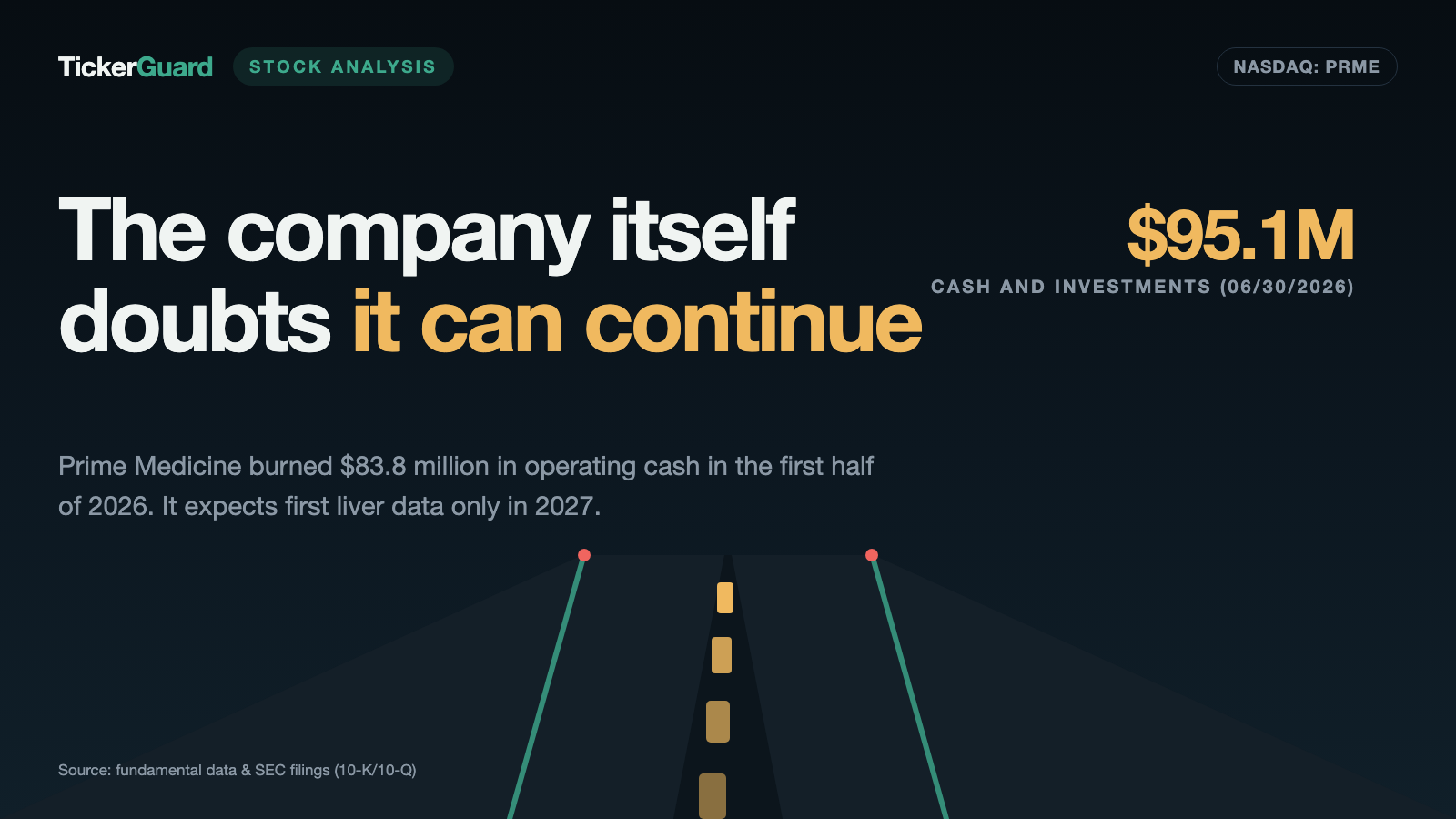
At Prime Medicine, the first number that matters is not the cure rate but how long the money lasts. The company wants to fix inherited diseases by rewriting the error in the DNA itself; 2026 brought its first trial clearances and a won arbitration. But as of June 30, 2026, only $95.1 million was left in cash and investments, $83.8 million flowed out in the first half, and the company itself reports substantial doubt about its ability to continue as a going concern.
 Thomas Mücke
Founder & Publisher
As of Today
As of: October 30, 2026
- Closing price
- 4.70 $ -9.90%
- Market Capitalisation
- 0.9 $B
- Growth Score
- 4/10
- AAQS
- 4/10
Price change since October 30, 2026: -0.4%
This analysis has a cut-off date. The Stock Guard tells you when something material changes in the numbers. Reserve your free spot
Chart
Interactive price chart (TradingView).
52-week range: 2.70 $ to 5.40 $ · Last price: 4.70 $ (As of: October 30, 2026)
Note: pure fact-based analysis, not investment advice and not a solicitation to buy or sell. All figures without guarantee.
There is an investor trap that gets especially loud with biotech stocks. Let’s call it the cure reflex: the moment a company promises to fix an inherited disease at its root, part of us switches to hope — and the part that usually asks about the bank balance goes quiet. Prime Medicine (Nasdaq: PRME) triggers that reflex reliably: a technology meant to rewrite errors in DNA with precision, trial clearances in the U.S. and New Zealand, a partner like Bristol Myers Squibb. Yet its latest quarterly report to the U.S. securities regulator, the SEC, contains a sentence no company writes voluntarily: it doubts it can get through the next 12 months without new money. So before you buy into the cure story, we read the filings together — and look at a cash pile that is shrinking faster than the research is delivering results. In the end, you decide.
What Prime Medicine actually does — gene repair with “find and replace”
Prime Medicine is based in Cambridge, Massachusetts, was founded in September 2019 and went public in October 2022. It works with Prime Editing, a technique built on the toolkit of the well-known CRISPR gene scissors. Put simply: a classic gene editor cuts through the DNA and lets the cell patch the wound itself, while Prime Editing works more like “find and replace” in a word processor. A protein tool travels to the faulty spot, nicks only one of the two DNA strands and writes in the correct letters from a template it brings along. The company believes this is the most versatile and precise way to rewrite DNA — in humans, the technique has so far been tested only in one small study with two patients (PM359).
The pipeline as of the quarterly report filed August 6, 2026: PM577a targets Wilson disease, in which copper builds up in the liver and brain; in June 2026 Prime Medicine received clearance for a study in New Zealand, and in July 2026 the U.S. Food and Drug Administration (FDA) cleared its application as well. PM647 targets alpha-1 antitrypsin deficiency (AATD), an inherited disease that damages the liver and lungs; the company planned to file for trial clearance in the third quarter of 2026. Both are given inside the body, packed into tiny fat droplets that home in on the liver. PM359 is the only program that has already treated patients: for the rare immune disorder CGD, blood stem cells are repaired outside the body and given back. On top of that come a cystic fibrosis program co-funded by the Cystic Fibrosis Foundation and a collaboration with Bristol Myers Squibb (BMS) on cell therapies for cancer and autoimmune disease.
How another company with related technology is doing is covered in our Editas analysis. For Prime Medicine, the central tension of this analysis is clear: Scientifically, the company stands at the threshold of the clinic — it expects first liver data in 2027. Financially, by its own account its cash lasts into 2027, and it reports substantial doubt about its ability to continue as a going concern. Without new money, proof and the end of the cash fall into the same year.
Company history for investors
-
2022
Nasdaq IPO
Prime Medicine goes public in October 2022. From then on shareholders fund the research — by mid-2026, losses add up to $979.6 million.
-
2024
Collaboration with Bristol Myers Squibb
In September 2024, BMS pays $55 million upfront and buys $55 million of stock. A quality signal for shareholders and a year with lower cash burn.
-
2025
Restructuring and equity raise
May 2025: layoffs, a new CEO, PM359 deprioritized. In August, 43.7 million new shares at $3.30: $138.4 million net, and the share count jumps.
-
2026
Going-concern warning returns
On 03/03/2026, Prime Medicine again reports substantial doubt about continuing as a going concern; it had dropped away after the 2025 raise. No path to 2027 data without new money.
-
2026
Trial clearances and arbitration win
June/July 2026: clearances for PM577a, RMAT for PM359, win against Beam (07/06). The pipeline moves toward the clinic as cash falls to $95.1 million (06/30).
How the stock landed on our desk
Prime Medicine made our research list through our in-house Reddit hype scanner, which flags stocks that are drawing unusual attention in investor forums. The share price shows why. At the end of September 2026 the stock closed at $3.055; on October 28, 2026 it closed at $5.36 — the highest close of the past 12 months, on a day with 15.2 million shares traded. On October 30 it was $4.72 (fundamental data). The lowest close of those 12 months came on May 19, 2026, at $2.70. Important: the SEC filings offer no explanation for the October jump. Prime Medicine’s most recent filing through October 31, 2026 is dated August 6.
There was a documented jump in July: on July 8, 2026, Prime Medicine reported its win in the arbitration against Beam Therapeutics (8-K), and the stock closed at $4.62 after $3.99 the day before. For the longer view: according to the annual report, the stock traded at about $9.39 on February 27, 2024, and at about $1.15 on April 8, 2025. In August 2025, Prime Medicine sold 43.7 million new shares at $3.30 each.
Fourteen analysts in our fundamental data offer a rating: ten say strong buy, one buy, three hold; their average price target is about $7.30 (data as of October 31, 2026). Average here means all price targets added up and spread evenly — a single very high target pulls the figure up noticeably. These are third-party views, not a TickerGuard forecast, and we do not adopt them. The contrast is striking: ten of 14 analysts say strong buy, while the company itself doubts in its mandatory filings that it can continue as a going concern. We reviewed the annual report (10-K) for 2025, the quarterly reports (10-Q) through June 30, 2026, and the earnings release of August 6, 2026, checked through October 31, 2026. The report for the third quarter of 2026 had not been filed by then.
The numbers over the years — an honest look
First, what is impressive. Prime Medicine cut hard in 2025. Headcount fell from 214 (December 31, 2024) to 146 (December 31, 2025) after the company announced a workforce reduction in May 2025. The quarterly report shows the effect: research and development expenses in the second quarter of 2026 were $33.4 million, down from $41.4 million a year earlier, and general and administrative expenses were $11.0 million versus $13.1 million. The quarterly net loss shrank from $52.6 million to $42.1 million. And the money now flows into a narrower pipeline: clinical expenses rose by $2.7 million in the first half of 2026 as the Wilson disease and AATD programs move toward patients.
The partners are a quality signal, too. According to the annual report, BMS paid $55 million upfront in September 2024 and bought another $55 million of stock; more than $3.5 billion in milestone payments are possible — money that only flows if research, development and sales goals are met. The Cystic Fibrosis Foundation committed up to $15 million in 2024 and up to another $24 million in 2025 to the cystic fibrosis program.
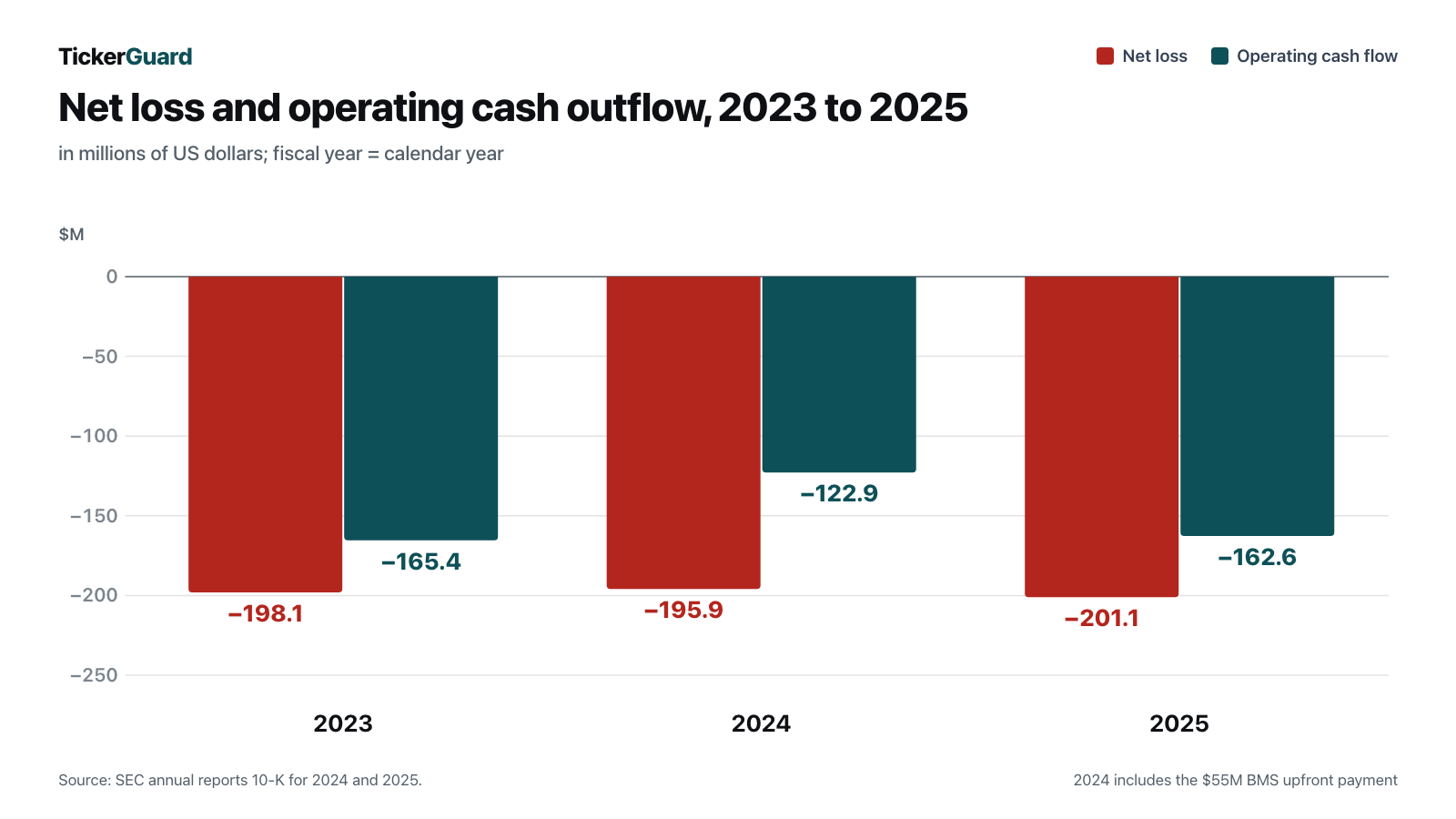
The chart shows the flip side. Prime Medicine has not sold a product yet. Its 2025 revenue of $4.6 million consists of collaboration revenue, almost entirely from BMS; in the first half of 2026 it was $2.0 million. Against that stood a 2025 net loss of $201.1 million and an operating cash outflow of $162.6 million. Since its founding, the company had accumulated losses of $979.6 million through June 30, 2026. Shareholders paid for it: the share count rose from 131.2 million (end of 2024) to 180.5 million (end of 2025), mainly through the August 2025 offering with net proceeds of $138.4 million. Put simply: every new share makes your slice of the pie smaller.
In the first half of 2026, the net loss fell to $91.2 million and operating cash outflow was $83.8 million — $42.7 million in the first quarter and $41.0 million in the second. Stockholders’ equity shrank from $120.9 million to $39.8 million in those six months. Remember: cutting costs extends the journey. You still have to arrive.
What the filings say — the uncomfortable truths
Uncomfortable truth No. 1: The company itself doubts it can continue
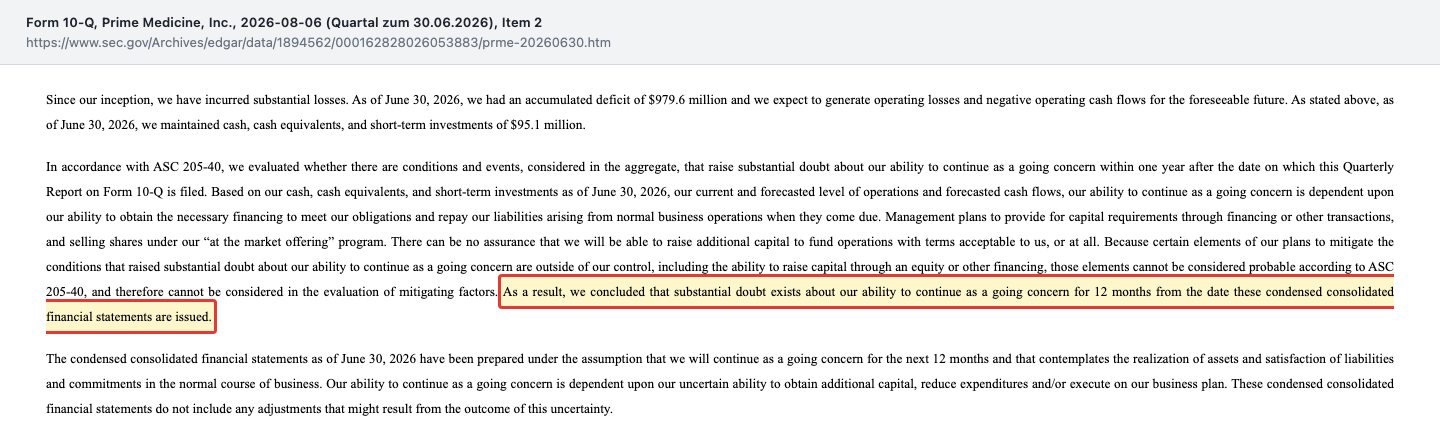
Whoever prepares financial statements must assess whether the company can get through the next 12 months on its own. If it cannot say so with confidence, it must disclose it — accountants call this a going-concern warning. Put simply: it is the sentence in which a company says, “without fresh money, things get tight.” Prime Medicine wrote it into its 2025 annual report and repeats it in the quarterly report for the period ended June 30, 2026. It is not new: it already appeared in the 2024 annual report and the quarterly report for the period ended March 31, 2025, disappeared after the August 2025 offering and returned in March 2026 — in the 2025 annual report, the auditor PricewaterhouseCoopers also highlights it separately in its opinion. The latest quarterly report says:
“As a result, we concluded that substantial doubt exists about our ability to continue as a going concern for 12 months from the date these condensed consolidated financial statements are issued.”
— Prime Medicine, Inc., SEC quarterly report 10-Q for the quarter ended June 30, 2026, Item 2 “Going Concern”
The same report contains the forecast management relies on:
“We believe our existing cash, cash equivalents, and investments will be sufficient to fund our operating expenses and capital expenditure requirements into 2027.”
— Prime Medicine, Inc., SEC quarterly report 10-Q for the quarter ended June 30, 2026, Item 2 “Funding Requirements”
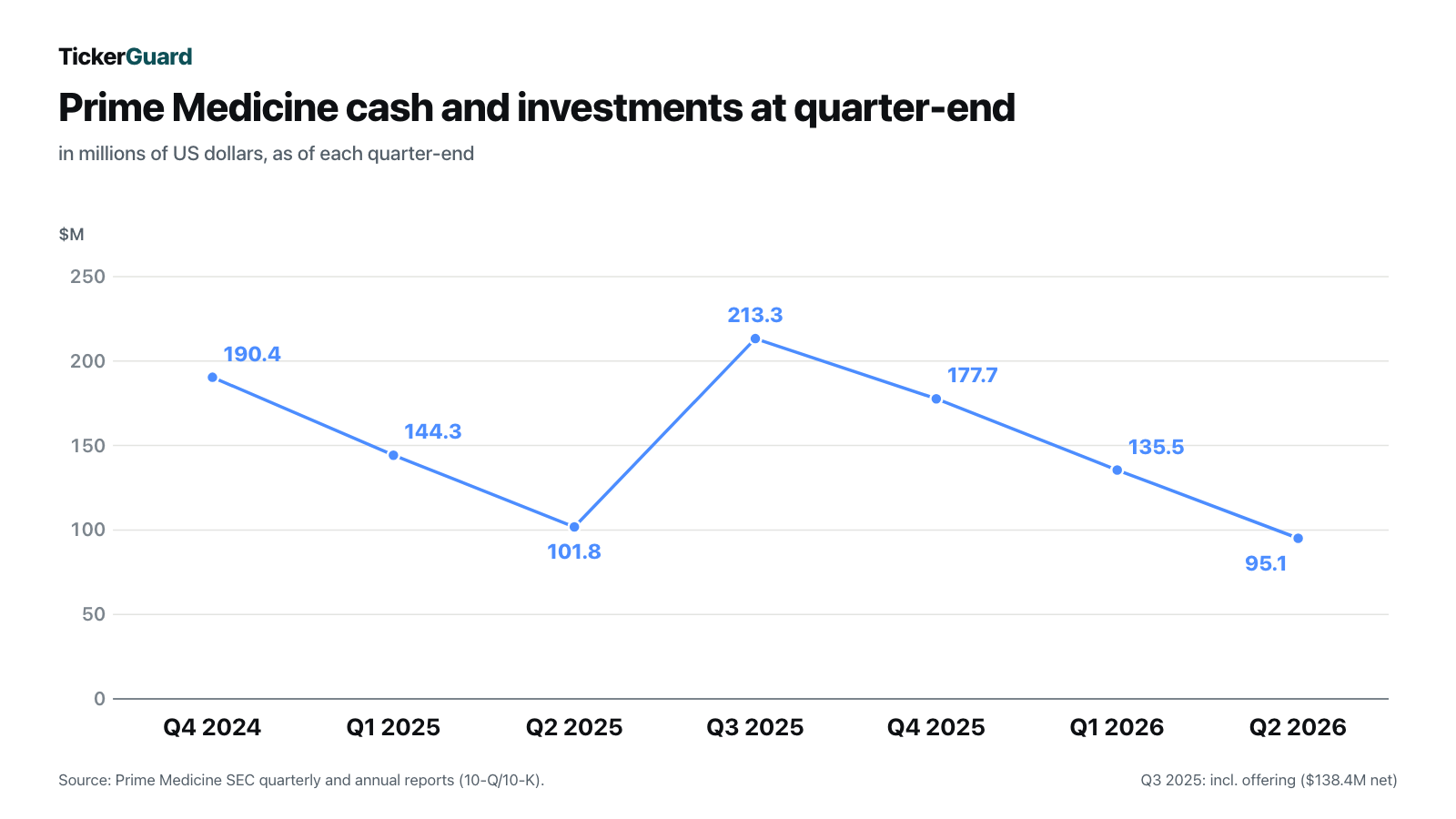
Read the two sentences together. Into 2027 — Prime Medicine said that in its March 2026 annual report, when $177.7 million was on hand, and it says it again in August with $95.1 million. At the pace of the first half of 2026 ($83.8 million operating outflow), that amount lasts just under seven months on paper, roughly into early 2027. The two fit together: the company’s “into 2027” is correct — but the money only just reaches into the new year, not through it. On top of that come leases for offices and labs that, according to Note 6, still tie up $173.6 million in future payments, $22.4 million of it in 2027 alone. Put simply: the leases commit almost twice as much money as there is in cash and investments. The rescue plan is new stock. Prime Medicine has a program for selling shares into the market on an ongoing basis; $200 million is registered for it. Remember: a going-concern warning is not a bankruptcy filing. But it is a bill somebody pays — usually the shareholder, through new shares.
Uncomfortable truth No. 2: The only program with patient data was put on the back burner
Prime Medicine’s strongest calling card is PM359. According to the 2025 annual report, the treatment for the immune disorder CGD showed a rapid restoration of the missing immune function — in two patients. Since June 2026, PM359 has held the FDA’s RMAT designation, a program for cell and gene therapies with closer agency guidance; a marketing application is planned for the first half of 2027. What is easy to miss is in the same annual report:
“All of our current product development programs are still in the research or preclinical stage of development. PM359, for which we commenced a Phase 1/2 clinical trial in 2024, was deprioritized in May 2025, though we continue to engage in regulatory interactions with the FDA based on the current data set from the clinical trial.”
— Prime Medicine, Inc., SEC annual report 10-K for 2025, Item 1A “Risk Factors”
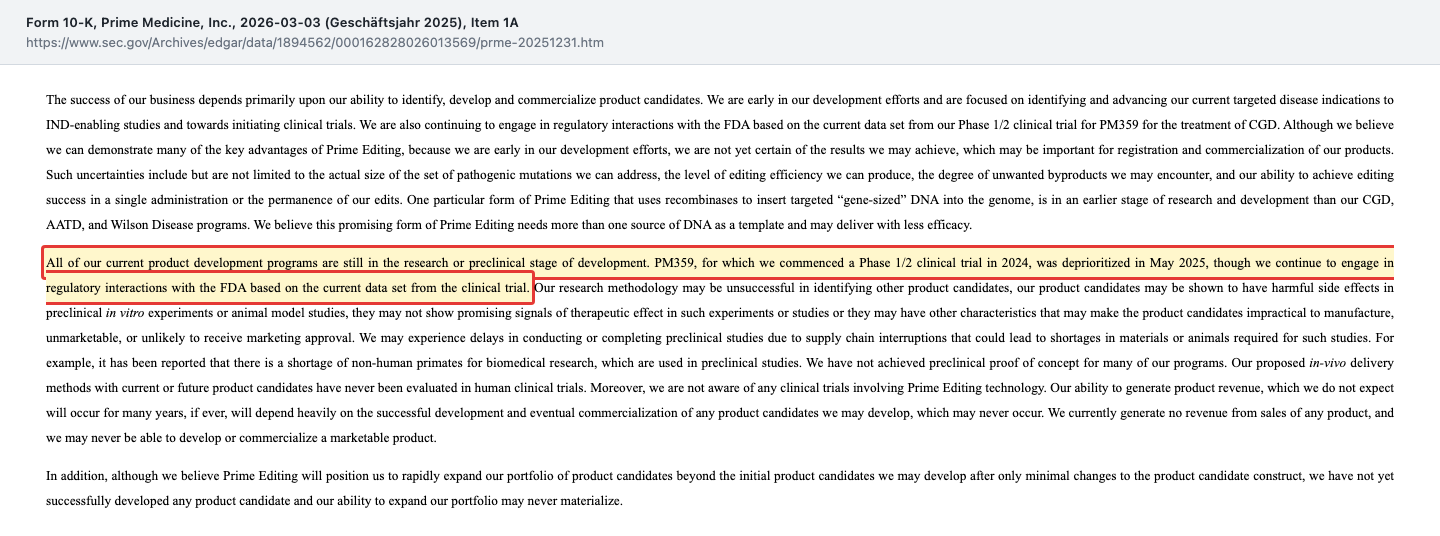
Read the sequence again: in May 2025, PM359 was deprioritized; in June 2026, it received RMAT designation; and in the first half of 2027 a marketing application is to follow — based on two patients. Of all programs, the deprioritized one is now the closest to approval. Who will pay for it is open: according to the annual report, Prime Medicine intends to evaluate strategic alternatives and potential partnership opportunities for PM359.
Some things have moved since the annual report: PM577a has its trial clearances, and according to the August 6, 2026 earnings release the study itself was in start-up, with first data expected in 2027. As of then, none of the programs had treated a patient inside the body. And the timelines are drifting: the annual report in March promised the PM647 filing for “mid-2026,” the August earnings release for the third quarter of 2026. Whether it was filed could not be seen in any SEC filing through October 31, 2026. Put simply: the story the market is trading is PM577a and PM647 — and their first test in humans is still ahead.
Uncomfortable truth No. 3: Prime Medicine does not own the technology itself
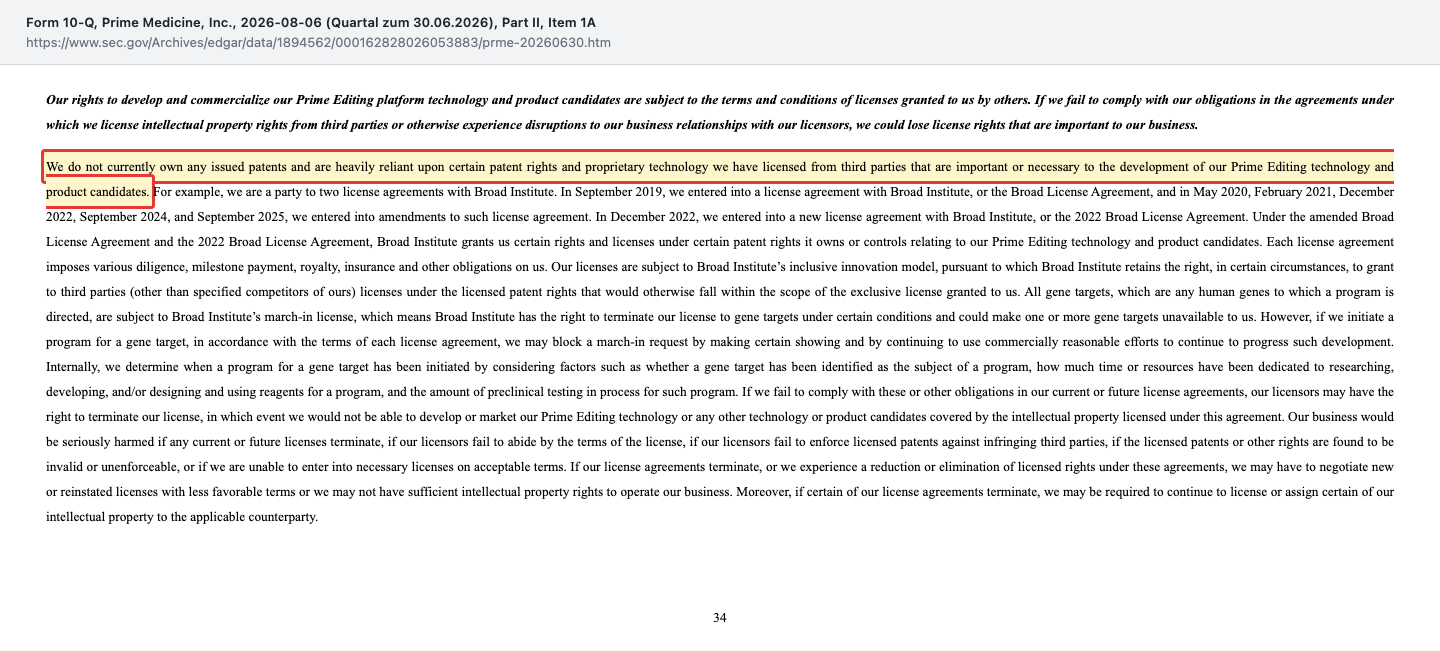
Patents are the heart of any biotech company. At Prime Medicine, they sit elsewhere, as the most recent quarterly report states:
“We do not currently own any issued patents and are heavily reliant upon certain patent rights and proprietary technology we have licensed from third parties that are important or necessary to the development of our Prime Editing technology and product candidates.”
— Prime Medicine, Inc., SEC quarterly report 10-Q for the quarter ended June 30, 2026, Part II, Item 1A “Risk Factors”
How delicate that can be, Prime Medicine learned in 2025 and 2026. After the company announced its AATD program in March 2025, Beam Therapeutics accused it of breaching a joint 2019 license agreement and sought, among other things, monetary damages. On July 6, 2026, the arbitration tribunal ruled in Prime Medicine’s favor: PM647 falls within Prime Medicine’s own field, there was no breach, and no damages are owed (8-K of July 8, 2026). That is good news, and it cost money: in the first half of 2026, professional and consultant fees in general and administrative expenses rose by $4.2 million, the majority of it arbitration-related. Remember: build on rented patents and you will win some disputes — but you have to fight them in the first place.
Valuation: about $856 million for a pipeline without a product
At a closing price of $4.72 on October 30, 2026, the 181,376,856 shares (as of July 31, 2026, cover of the quarterly report) are worth about $856 million. The price box on this page shows the current price and therefore differs from this point-in-time calculation. Subtract cash and investments of $95.1 million (June 30, 2026), and about $761 million remains that the market is paying for technology, licenses and pipeline. Classic metrics do not help here: there is no price-to-earnings ratio without earnings, and measured against $4.6 million of 2025 collaboration revenue, any sales multiple would be meaningless.
More important is what comes next. As of June 30, 2026, options and performance-based awards covered a combined 26.0 million additional shares, about 14 percent of the share count, according to the quarterly report. Add the room in the $200 million at-the-market program. Anyone holding or buying the stock is not only getting a shot at a scientific breakthrough but also a place in line ahead of the next equity raise. Whether it comes at $3.30 as in August 2025, at $4.72 or at a very different price will help decide the size of your stake.
Opportunities and risks at a glance
What speaks for Prime Medicine:
- Progress toward the clinic: trial clearances for PM577a in New Zealand (June 2026) and the U.S. (July 2026); first data for PM577a and PM647 expected in 2027.
- Arbitration won: July 6, 2026 arbitration award in Prime Medicine’s favor in the dispute with Beam Therapeutics, no damages.
- Proof in humans: PM359 with FDA RMAT designation (June 2026), marketing application planned for the first half of 2027.
- Well-known partners: BMS ($55 million upfront, $55 million stock purchase, possible milestones above $3.5 billion), Cystic Fibrosis Foundation.
- Cost control: second-quarter 2026 net loss of $42.1 million versus $52.6 million a year earlier.
What speaks against it:
- Going-concern warning: substantial doubt about continuing as a going concern per the 2025 10-K and the 10-Q for the quarter ended June 30, 2026.
- Thin cash: $95.1 million (June 30, 2026) against $83.8 million of operating outflow in the first half; cash lasts only into 2027 by the company’s own account.
- Dilution: $200 million of stock registered for at-the-market sales, 26.0 million options and performance-based awards outstanding; the share count rose by about 38 percent in 2025.
- Fixed costs: $173.6 million of future lease payments (June 30, 2026).
- No issued patents of its own; dependence on the licensor Broad Institute.
- Early stage: through August 2026 no program had treated a patient inside the body; timelines have already slipped (PM647 from mid-2026 to the third quarter of 2026).
A human conclusion
Back to the cure reflex. It is nothing to be ashamed of — without it there would hardly be any money for research into rare diseases, and Prime Medicine’s progress in 2026 is real. The trap is that the word “cure” drowns out the second clock ticking in the filings: $95.1 million in cash, about $42 million of outflow per quarter, a going-concern warning the company wrote itself. So the honest question for you is not “Does Prime Editing work?” It is: Are you willing to own a company whose first evidence from the liver and whose last dollar fall into the same year — and can you live with the equity raise the company itself names as part of its funding plan? Once you have answered that for yourself, you know what you are getting into — with or without the stock. What you make of it is your decision. And that is how it should be.
Sources
All original documents used in this analysis — for your own reading:
- Prime Medicine, Inc. — SEC quarterly report 10-Q for the quarter ended June 30, 2026 (filed August 6, 2026)
- Prime Medicine, Inc. — SEC filing 8-K of August 6, 2026, Exhibit 99.1 (second-quarter 2026 earnings release)
- Prime Medicine, Inc. — SEC filing 8-K of July 8, 2026 (arbitration award in the Beam Therapeutics proceedings)
- Prime Medicine, Inc. — SEC quarterly report 10-Q for the quarter ended March 31, 2026 (filed May 7, 2026)
- Prime Medicine, Inc. — SEC annual report 10-K for 2025 (filed March 3, 2026) and 10-K for 2024 (filed February 28, 2025)
- Prime Medicine, Inc. — SEC quarterly reports 10-Q for the quarters ended March 31, 2025, June 30, 2025 and September 30, 2025 (quarterly liquidity)
- Prime Medicine, Inc. — SEC filing 8-K of April 16, 2026 (new chief financial officer)
- Fundamental data (prices through the October 30, 2026 close, analyst ratings; retrieved October 31, 2026), cross-checked against the SEC filings.
- Reddit mentions: our in-house Reddit hype scanner.
Transparency & disclaimer: this analysis is journalistic commentary on publicly available information. It is not investment advice, not a regulated investment research product and not a solicitation to buy or sell securities. Equity investments carry substantial risk up to and including total loss. All information is provided without warranty; the as-of date for each figure is stated in the text. Positions held by the operator are disclosed daily; where one exists, it appears as a notice at the top of this deep dive.
Key figures at a glance
All monetary figures in millions of $; earnings per share as reported.
| Metric | 2021 | 2022 | 2023 | 2024 | 2025 |
|---|---|---|---|---|---|
| Revenue | 0.0 | 5.2 | 0.0 | 3.0 | 4.6 |
| Operating Income (EBIT) | -84.5 | -116.5 | -204.8 | -202.5 | -208.4 |
| Net Income | -165.4 | -121.8 | -198.1 | -195.9 | -201.1 |
| Net Margin | – | -2,338.2% | – | -6,566.6% | -4,342.4% |
| Earnings Per Share | -1.73 $ | -1.25 $ | -2.18 $ | -1.65 $ | -1.35 $ |
Source: fundamental data & SEC filings (annual and quarterly reports, 10-K/10-Q)
Our Bottom Line at a Glance
- Liquidity & going concern negative
- $95.1 million in cash and investments (06/30/2026) against $83.8 million of operating outflow in H1 2026; going-concern warning in the 2025 10-K and the 10-Q for the quarter ended 06/30/2026, cash lasts into 2027 per the company.
- Pipeline & progress positive
- Trial clearances for PM577a in New Zealand (06/2026) and the U.S. (07/2026), RMAT designation for PM359 (06/2026), PM359 marketing application planned for H1 2027.
- Rights & patents neutral
- Arbitration award of 07/06/2026 in Prime Medicine’s favor against Beam; at the same time no issued patents of its own and dependence on the licensor Broad Institute (10-Q for the quarter ended 06/30/2026).
- Costs positive
- Headcount cut from 214 (12/31/2024) to 146 (12/31/2025); Q2 2026 net loss of $42.1 million versus $52.6 million a year earlier.
- Dilution negative
- Share count rose from 131.2 million to 180.5 million in 2025; $200 million registered under the at-the-market program, 26.0 million options and performance-based awards outstanding (06/30/2026).
Prime Medicine is a textbook case of the cure reflex: scientifically, the company is moving forward in 2026 — trial clearances for PM577a, a won arbitration, a planned marketing application for PM359. Financially, though, only $95.1 million sat in cash and investments as of June 30, 2026, the half-year cost $83.8 million, and the company reports substantial doubt about its ability to continue as a going concern. Without new financing, first liver data and the end of the existing cash fall into the same year. Not investment advice.
What Our Rating Means
Substance risk
We found at least one documented issue that threatens the company itself — regardless of how the stock is currently valued.
Red, because there is a documented substance risk: in its 2025 annual report and its quarterly report for the period ended June 30, 2026, Prime Medicine reports substantial doubt about its ability to continue as a going concern. At the first-half 2026 burn rate, its $95.1 million in cash lasts well under four quarters; without new stock, partner money or other financing it cannot continue. The scientific progress is real but does not change that position. The decision is yours.
A journalistic assessment by our editorial team at the time of the deep dive, based on public sources — not investment advice and not a solicitation to buy or sell. Your personal circumstances (investment goals, risk capacity, taxes) cannot be taken into account. What our levels mean, how verdicts are formed, and what conflicts of interest exist →
Worth Noting
- Prime Medicine made our research list through our in-house Reddit hype scanner.
- Quarterly cash and investments summed from the 10-Q/10-K balance sheets (cash and cash equivalents plus short-term investments, through Q3 2025 including Beam shares held, excluding restricted cash).
- Q2 2026 operating cash outflow ($41.0 million) as the difference between the half-year figure ($83.8 million, 10-Q for the quarter ended 06/30/2026) and the Q1 figure ($42.7 million, 10-Q for the quarter ended 03/31/2026).
- Market value computed: 181,376,856 shares (10-Q cover, 07/31/2026) × $4.72 closing price (10/30/2026); the share count matches the fundamental data exactly. No SEC filing after 08/06/2026 through 10/31/2026.
- The runway estimate (just under seven months from 06/30/2026) is our own rough calculation: $95.1 million divided by the average monthly outflow of H1 2026 ($83.8 million / 6).
Stock Watch
This analysis is as of October 31, 2026. Stock Watch will tell you what's changed at PRME since then.
Later $1 a month per stock — signing up is free, and you'll be the first to know when it launches.
The full analysis as a PDF for later
We will send you this analysis as a PDF — to print, file away, and read at your own pace. And we will add you to the free Stock Watch list for Prime Medicine, Inc. (PRME), so you hear about it when something material in this analysis changes.
Frequently Asked Questions
Prime Medicine, Inc. (Nasdaq: PRME) of Cambridge, Massachusetts, develops gene editing therapies using Prime Editing, a technique meant to rewrite errors in DNA on a “find and replace” basis. Its key programs target Wilson disease (PM577a), alpha-1 antitrypsin deficiency (PM647) and the immune disorder CGD (PM359).
In its 2025 annual report and its quarterly report for the period ended June 30, 2026, Prime Medicine states that substantial doubt exists about its ability to continue as a going concern for the next 12 months without new money. It is not a bankruptcy filing, but a signal that financing is needed — planned through stock sales and other transactions.
As of June 30, 2026, Prime Medicine held $95.1 million in cash and investments, plus $13.7 million of restricted cash. The company says the money lasts into 2027. In the first half of 2026, operating cash outflow was $83.8 million, or about $42 million per quarter.
No. Its 2025 revenue of $4.6 million came from research collaborations, mostly with Bristol Myers Squibb. For PM359 in the immune disorder CGD, Prime Medicine plans to file a marketing application in the first half of 2027, based on data from two patients.
Beam Therapeutics accused Prime Medicine of breaching a joint 2019 license agreement with its alpha-1 antitrypsin deficiency program (PM647). On July 6, 2026, the arbitration tribunal ruled that PM647 falls within Prime Medicine’s field, that there was no breach and that no damages are owed.
At a closing price of $4.72 on October 30, 2026, and 181,376,856 shares (July 31, 2026), Prime Medicine is worth about $856 million. After subtracting $95.1 million of cash and investments, about $761 million remains for technology and pipeline. There is no price-to-earnings ratio because there are no earnings.
Found an error?
Did you spot a factual error, an outdated number, or a typo in this deep dive? Let us know briefly — your report goes straight to the editorial team.