PENN Entertainment Paid Dearly for Two Celebrity Brands — Now Its Leased Casinos Have to Deliver
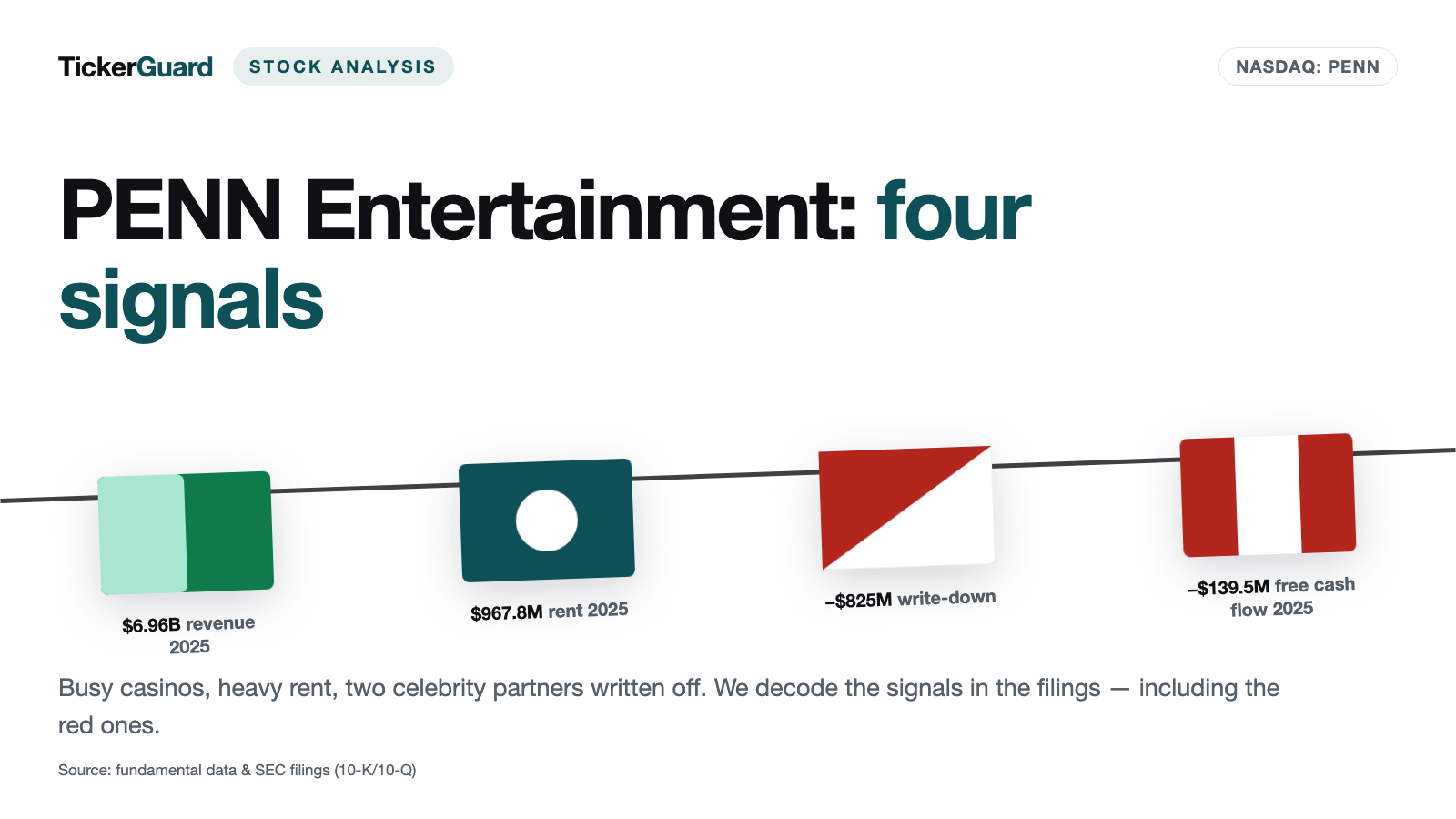
PENN Entertainment runs 42 casinos and racetracks in 19 U.S. states and twice bet on famous names: first Barstool Sports, then ESPN. Both detours ended in charges approaching a billion dollars each. The casinos earn decent money, but most of the buildings belong to a landlord that collected about $968 million in rent in 2025. To understand this stock, start with the landlord.
 Thomas Mücke
Founder & Publisher
As of Today
As of: October 30, 2026
- Closing price
- 15.90 $ +3.70%
- Market Capitalisation
- 2.2 $B
- Growth Score
- 4/10
- AAQS
- 3/10
Price change since October 30, 2026: +0.1%
This analysis has a cut-off date. The Stock Guard tells you when something material changes in the numbers. Reserve your free spot
Chart
Interactive price chart (TradingView).
52-week range: 11.80 $ to 22.10 $ · Last price: 15.90 $ (As of: October 30, 2026)
Note: pure fact-based analysis, not investment advice and not a solicitation to buy or sell. All figures without guarantee.
There is an investor trap that runs on glamour. Call it the celebrity premium: when a famous name stands next to a company — a cult blogger, a sports network everybody knows — we automatically give the business behind it more credit. The name shines, so the business must shine too. PENN Entertainment (Nasdaq: PENN) bought that premium twice: in 2023 it took full control of Barstool Sports, the sports platform of blogger Dave Portnoy, and afterwards it licensed the ESPN brand for its betting app. Both detours ended up in the company’s mandatory filings with the U.S. securities regulator, the SEC, as charges approaching a billion dollars each. Before the next big name dazzles you, let’s read together what sits behind the glamour — casinos, leases, cash flows. In the end, you decide.
What PENN Entertainment actually does — leased casinos and a betting app
PENN Entertainment is based in Wyomissing, Pennsylvania, and was called Penn National Gaming until 2022. According to its annual report (10-K) for 2025, the company operated 42 casinos and horse racetracks in 19 states as of December 31, 2025, under names such as Hollywood Casino, Ameristar, L’Auberge and Boomtown. It also runs online sports betting in 22 U.S. and Canadian jurisdictions and an online casino in five. The company says its PENN Play loyalty program has more than 33 million members; it employed about 23,441 people.
PENN earns almost all of its money in the casinos: the four regional segments — Northeast, South, West and Midwest — together posted segment earnings before rent, interest, taxes, depreciation and amortization (EBITDAR) of about $1.87 billion in 2025. In plain terms, that is what the properties throw off in day-to-day business before the landlord, the banks and the tax authorities get paid. The digital business — the betting app theScore Bet and the online casino Hollywood iCasino — posted an adjusted operating loss of $267.5 million in the same year.
The most important sentence about the business model, though, sits in the fine print: PENN does not own most of its casino buildings and land. They belong to the real estate companies Gaming and Leisure Properties (GLPI) and VICI Properties, to which PENN pays long-term rent — as a so-called triple net tenant that also covers taxes, insurance and maintenance itself. How another casino group with the same structure stacks up is shown in our MGM Resorts analysis. That defines the central tension of this analysis: The casinos earn solid money. But between their earnings and the shareholder stand almost a billion dollars of rent a year and a digital business that has burned more than a billion dollars at the operating level since 2023.
Company history for investors
-
2013
Master lease with GLPI
The master lease with GLPI dated November 1, 2013 turns PENN into a tenant of its own properties. In 2025 that costs $967.8M in rent to GLPI and VICI.
-
2023
Barstool bought and given away
In February 2023 PENN takes full control of Barstool; in August it hands the company back for nominal consideration. For shareholders: a $923.2M loss.
-
2025
ESPN exit and impairment
On November 5, 2025 PENN and ESPN agree to end ESPN BET effective December 1. In the third quarter PENN books an $825.0M impairment charge.
-
2025
Buybacks despite a shortfall
PENN buys back 20.1M shares for $354.4M at an average of $17.64 — while free cash flow comes to −$139.5M.
-
2026
Refinancing and new properties
Notes due 2031, loans to 2031 and 2033, Aurora and Columbus opened. First-half net income of $30.8M and free cash flow of $171.1M.
How the stock landed on our desk
PENN showed up in several in-house scanners at once, including the “CEO buying” scanner, the “insider net buying” scanner and the price-to-sales ranking (hit list as of October 31, 2026). The insider signals can be checked against the insider filings (Form 4): CEO Jay Snowden bought 34,000 shares at about $14.70 on May 22, 2025, and on November 7, 2025 — one day after the ESPN exit was announced — another 34,700 shares at about $14.32, roughly $1 million in total. CFO Felicia Hendrix (7,315 shares, November 21, 2025) and two board members bought as well. One caveat: the 2026 Form 4 filings show only grants under the compensation plan for the CEO, no further open-market purchase; the most recent open-market insider purchase dates from March 2, 2026 (director Jane Scaccetti, 8,000 shares at $15.09).
The price-to-sales ranking comes down to simple arithmetic. The price-to-sales ratio asks how many dollars of market value you pay for one dollar of annual revenue. With a market value of about $2.13 billion ($15.89 on October 30, 2026; 134,066,591 shares on July 29, 2026) and $7.16 billion in revenue over the twelve months through June 2026, the ratio is about 0.3. In other words, you pay 30 cents for a dollar of revenue — very little, which is exactly why you have to ask why.
Twenty analysts rate the stock in our fundamental data: ten strong buy, three buy, seven hold, none sell; their average price target is about $23.47 (data as of October 31, 2026). Average means all targets added up and spread evenly — a few very high targets pull the figure up. These are third-party views, not a TickerGuard forecast. We reviewed the 2025 annual report, the quarterly reports (10-Q) through June 30, 2026, and the earnings release of August 6, 2026, screened through October 31, 2026. The third-quarter 2026 report had not been filed by then.
The numbers over the years — an honest look
First, the impressive part. Revenue rose from $5.91 billion (2021) to $6.96 billion (2025); in the first half of 2026 it reached $3.64 billion, up 5.8 percent year over year. The casinos themselves run steadily: in the second quarter of 2026 PENN reported record casino revenue of about $1.5 billion and a segment margin before rent of 34.4 percent; according to the earnings release, nine properties set second-quarter records. New openings include a hotel tower in Columbus and the new casino in Aurora (both June 2026), and before that the new property in Joliet (August 2025) and a hotel tower at the M Resort near Las Vegas (December 2025).
The digital business has improved, too. Adjusted EBITDA of the Interactive segment was −$402.5 million in 2023, −$499.5 million in 2024 and −$267.5 million in 2025. In the first half of 2026 it was only −$20.4 million, after −$151.0 million a year earlier. On the bottom line, the first half of 2026 brought $30.8 million in net income, $33.1 million of it in the second quarter. The prior-year half was even higher at $94.4 million — but only thanks to a one-time $215.1 million gain from a financing arrangement with the landlord (“Gain on financing arrangement”, quarterly report (10-Q) as of June 30, 2026).
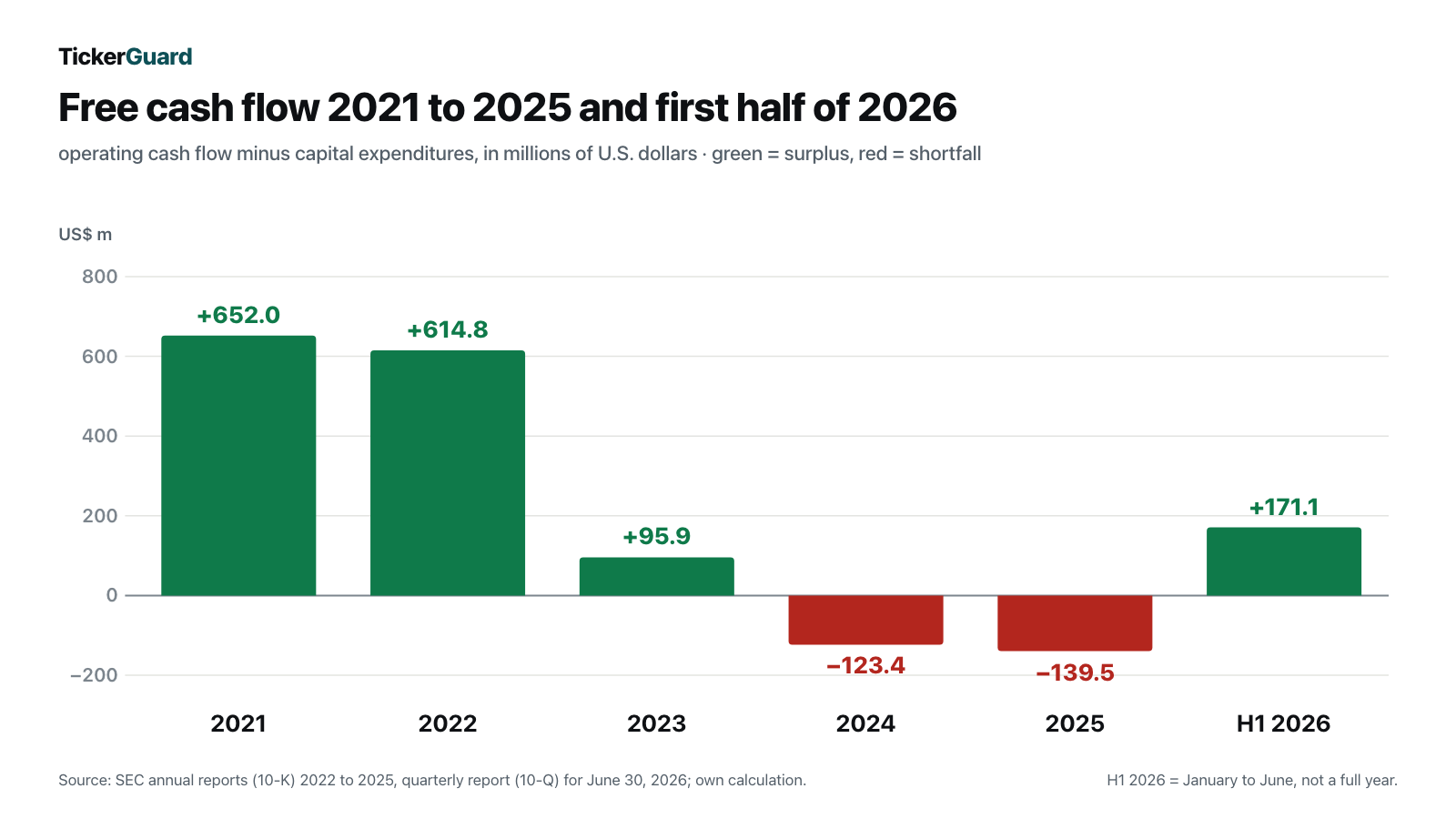
The chart also shows the flip side. PENN posted net losses three years in a row: 2023 (−$490.0 million), 2024 (−$311.5 million) and 2025 (−$843.1 million). Free cash flow was negative in 2024 and 2025 because PENN invested in new buildings: in 2025, $647.7 million went into capital expenditures while operations brought in only $508.2 million. And the casino business is not growing as smoothly as the record revenue suggests: its segment EBITDAR fell from about $2.03 billion (2023) to $1.91 billion (2024) and $1.87 billion (2025). Only in the first half of 2026 did it rise above the prior year again, at about $989 million versus $947 million. Remember: Record revenue is good news. Record earnings would be better news.
What the filings say — the uncomfortable truths
Uncomfortable truth #1: Two celebrity brands, two holes approaching a billion dollars each
The first bet was Barstool Sports, Dave Portnoy’s sports and entertainment platform. PENN initially held 36 percent and, according to the annual report, bought the rest on February 17, 2023 for about $315.3 million in cash plus 2,442,809 of its own shares — only to part with it six months later in order to relaunch its betting app as ESPN BET:
“Pursuant to the Barstool SPA, PENN sold 100% of the outstanding shares of Barstool to David Portnoy in exchange for nominal cash consideration and certain non-compete and other restrictive covenants.”
— PENN Entertainment, Inc., SEC annual report 10-K for 2025, Item 1 “Business”
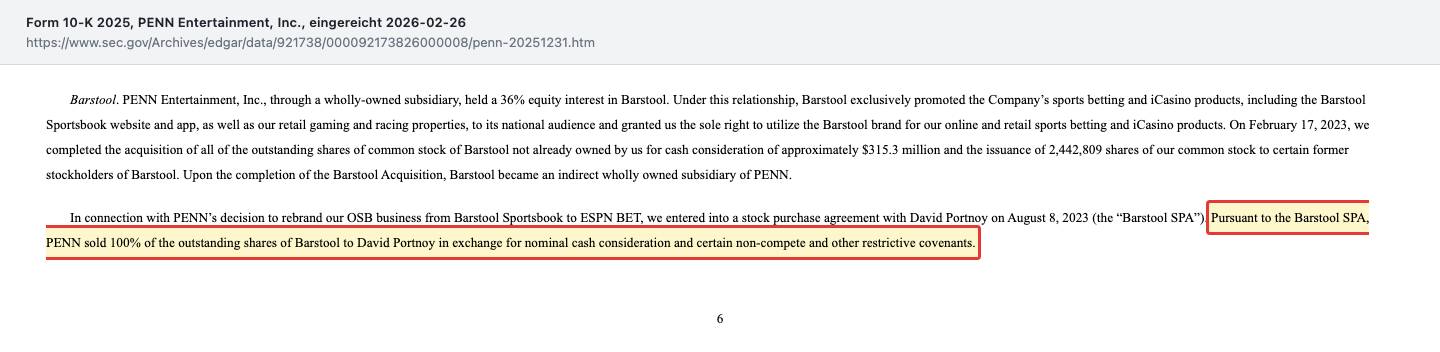
The 2023 income statement records a “loss on disposal of Barstool” of $923.2 million. The second bet, ESPN BET, lasted a little over two years. On November 5, 2025, PENN and ESPN agreed to end the deal early; since December 1, 2025, the U.S. betting app has been called theScore Bet. The quarterly report for the period ended September 30, 2025 states what the change of strategy cost:
“The realignment of its digital focus led the Company to revise its future cash flow projections for the Interactive reporting unit and to perform a quantitative impairment test during the third quarter of 2025, which resulted in a non-cash impairment charge of $825.0 million.”
— PENN Entertainment, Inc., SEC quarterly report 10-Q for the quarter ended September 30, 2025, Note 5 “Goodwill and Other Intangible Assets”
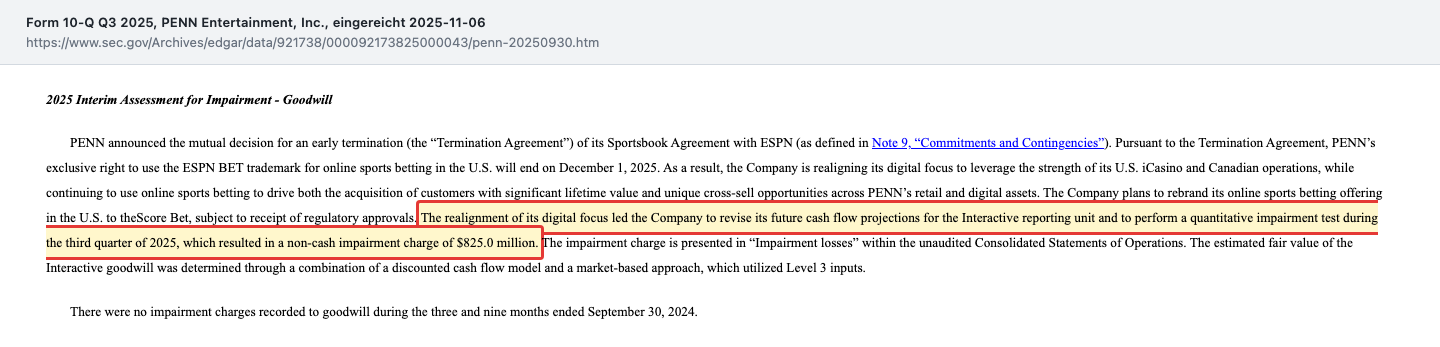
A goodwill impairment is, in plain terms, an admission: we paid more for a business than it is worth by today’s math. The money was gone before — the charge only puts it on the books. Together with the Barstool loss and the digital business’s operating losses of about $1.17 billion from 2023 to 2025, that is the price of the celebrity premium. Remember: A famous partner brings attention. Whether it brings profit only shows up in the filings years later.
Uncomfortable truth #2: PENN does not own most of its casinos
Since the master lease of November 1, 2013, PENN has rented most of its casinos from the real estate company GLPI. That creates a bill that comes back every year. The 2025 annual report names it among the risk factors:
“We also utilize a significant portion of our cash flow from operations to make our rent payments, which were $967.8 million for the year ended December 31, 2025, pursuant to and subject to the terms and conditions of our Master Leases, VICI Master Lease, Margaritaville Lease (prior to December 4, 2025), Greektown Lease (prior to December 4, 2025), and Morgantown Lease, […] collectively, our ‘Triple Net Leases’).”
— PENN Entertainment, Inc., SEC annual report 10-K for 2025, Item 1A “Risk Factors”
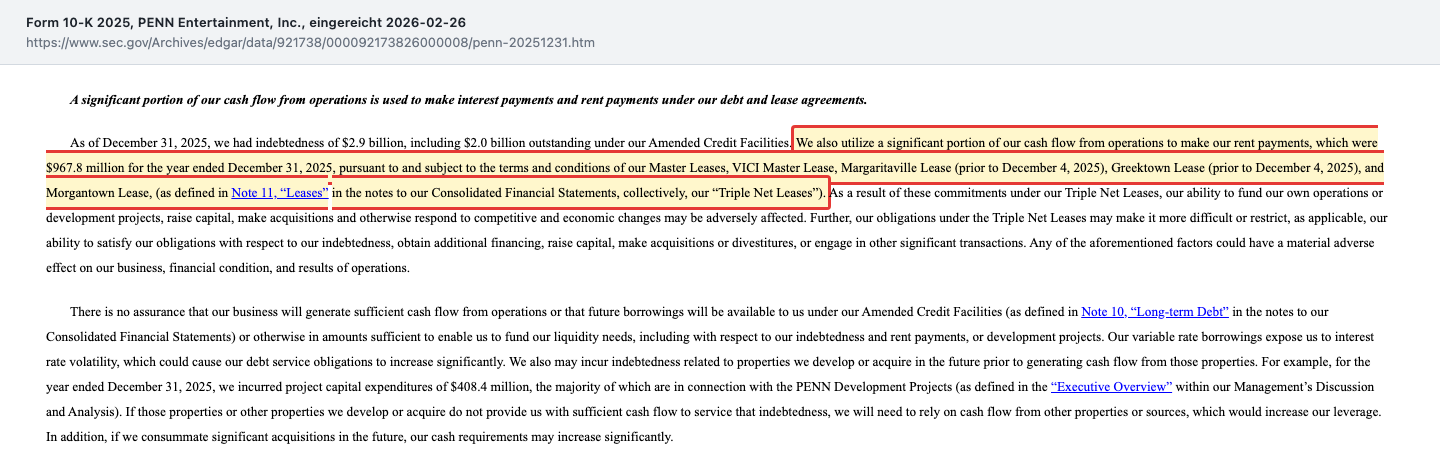
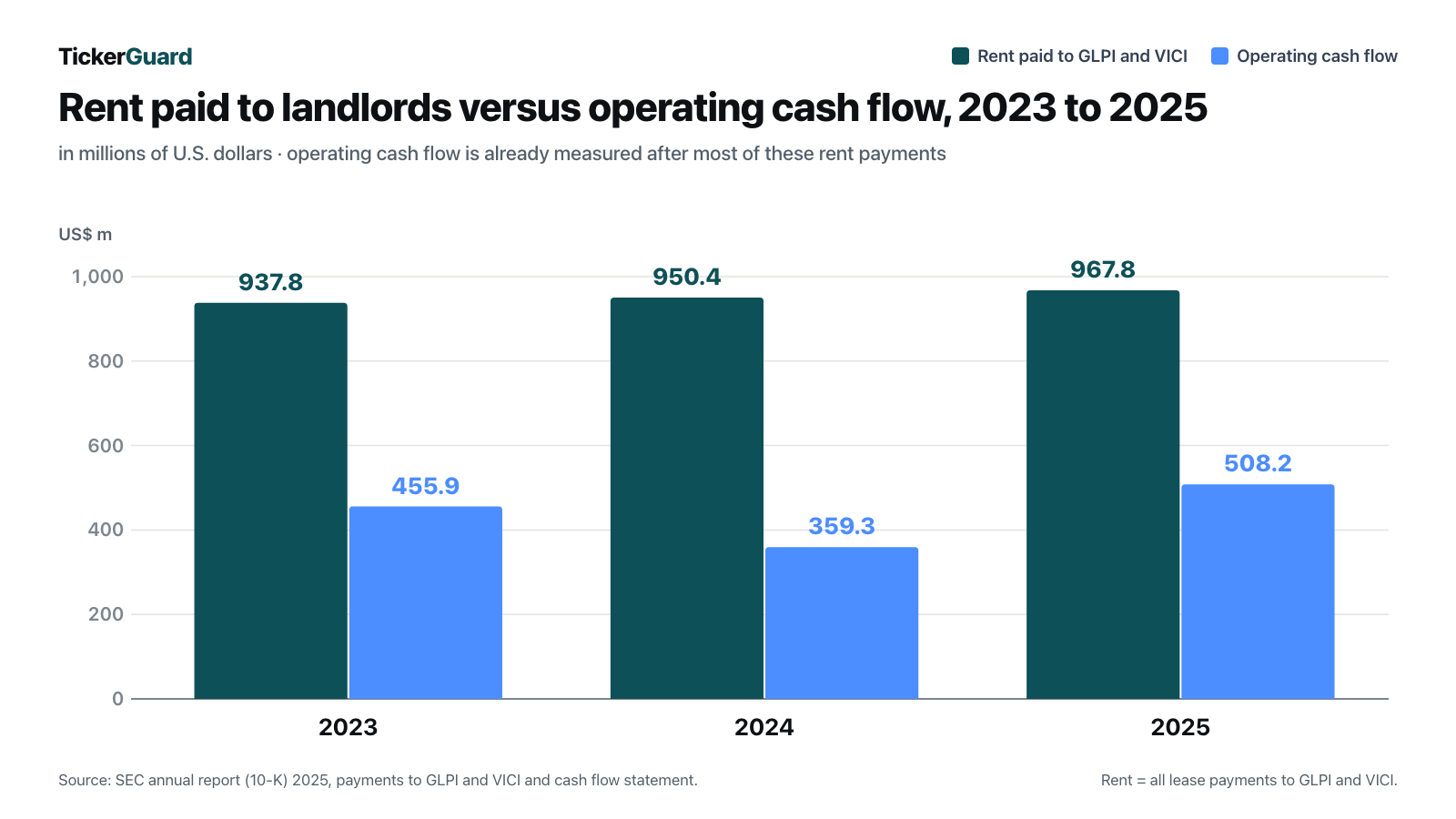
What that means shows up on the balance sheet as of June 30, 2026. Next to $2.74 billion of long-term bank debt and notes, PENN carries long-term lease-related obligations of about $7.77 billion (financing obligations $2.27 billion, operating leases $3.48 billion, finance leases $2.01 billion). Against that stands shareholders’ equity of $1.85 billion. Put simply, PENN is a tenant with a very long lease. As long as the casinos run well, that is manageable. When they weaken, the rent is still due — and it keeps rising under contractual escalators.
Part of the rent shows up in the accounts as interest. That is why PENN’s interest coverage — how many times operating income covers interest expense — is thin: in 2024, operating income of $72.5 million covered interest expense of $470.5 million only about 15 percent; in 2025, impairments pushed operating income to −$673.6 million against $405.8 million of interest. Only in the first half of 2026 did operating income of $228.7 million edge above interest expense of $201.8 million — coverage of about 1.1 times. Remember: Renting instead of owning means lighter luggage — but the rent never takes a day off.
Uncomfortable truth #3: Buybacks when the cash wasn’t there
A share buyback is good for you as a shareholder when the company has surplus cash: every share it retires makes your slice of the pie a little bigger. PENN bought heavily in 2025:
“During the year ended December 31, 2025, the Company repurchased 20,090,831 shares of its common stock at an average price of $17.64 per share.”
— PENN Entertainment, Inc., SEC annual report 10-K for 2025, Item 5
That came to $354.4 million — in a year when free cash flow was −$139.5 million. So the buyback was not funded from surplus cash but from credit, cash on hand and landlord money: in 2025 PENN drew $877.5 million on its revolving credit facility and repaid $307.5 million, a net $570.0 million of new debt, and received $280.0 million from GLPI for the new buildings in Joliet and at the M Resort — in exchange for higher rent. The further $216.3 million from GLPI for Aurora only arrived in the first half of 2026, i.e. after the buyback. The average price of $17.64 also sits above the October 30, 2026 close ($15.89). In 2026 PENN changed course, as the latest quarterly report states:
“We did not repurchase any shares of our common stock during the six months ended June 30, 2026.”
— PENN Entertainment, Inc., SEC quarterly report 10-Q for the quarter ended June 30, 2026, Part II, Item 2
Instead, PENN cleaned up its debt in 2026: $600 million of 6.75 percent notes due 2031 (March), an extension of the revolving credit facility and a term loan to April 2031, a repricing of another $962.5 million term loan to May 2033, and repayment of the remaining $106.7 million of convertible notes in May 2026, which eliminated about 4.6 million potential new shares. That is sensible. It also shows that the 2025 buyback was too generous. Remember: A buyback on borrowed money is not a reward for shareholders but a bet with their money.
Valuation: about $2.1 billion for a casino network on a lease
At a closing price of $15.89 on October 30, 2026, the 134,066,591 shares (as of July 29, 2026) are worth about $2.13 billion. The price box on this page shows the current price and therefore differs. Measured against revenue for the twelve months through June 2026 ($7.16 billion), that is a price-to-sales ratio of about 0.3; measured against book equity ($1.85 billion, June 30, 2026), about 1.1 times. A meaningful price-to-earnings ratio does not exist, because trailing twelve-month earnings are negative due to the impairment.
The stock only looks cheap if you forget the landlords. Anyone buying all of PENN would take on traditional net debt of about $1.9 billion (June 30, 2026) on top of the market value — plus leases that cost about a billion dollars every year. Comparisons with pure online operators therefore fall short: our Rush Street Interactive analysis covers a betting business without real estate and without rent. With PENN you pay little for revenue because the landlord takes its share first. The valuation question is therefore not “How big is revenue?” but: How much is left for you after rent, interest and capital spending? In the first half of 2026 it was $171.1 million of free cash flow — a start, but not yet a track record.
Opportunities and risks at a glance
The case for PENN:
- Broad casino network: 42 properties in 19 states; segment EBITDAR of about $989 million in the first half of 2026, up from $947 million.
- Digital losses nearly stopped: Interactive loss of −$20.4 million in the first half of 2026 after −$151.0 million.
- New properties: Aurora and the Columbus hotel tower (June 2026), Joliet (August 2025), M Resort (December 2025).
- Refinancing done: revolving credit facility and term loan to 2031, another term loan to 2033; liquidity of $1.9 billion as of June 30, 2026.
- Insider buying: the CEO bought about 34,000 shares on the open market twice in 2025.
The case against:
- High fixed costs: $967.8 million of rent in 2025, rising every year; long-term lease obligations of about $7.77 billion.
- Thin interest coverage: operating income below interest expense in 2024 and 2025, only about 1.1 times in the first half of 2026.
- Costly missteps: a $923.2 million loss on Barstool (2023), an $825.0 million impairment after the ESPN exit (2025).
- Volatile cash flow: negative free cash flow in 2024 and 2025.
- Dilution: 4,000,000 additional shares registered for the compensation plan (Form S-8 filed August 10, 2026).
A human conclusion
Back to the celebrity premium. PENN is a textbook case of a big name making a business louder, not better. Barstool and ESPN brought headlines — and a disposal loss plus an impairment that together add up to almost $1.75 billion. The real business was unspectacular all along: people sitting at slot machines in Ohio, Louisiana or Illinois, and a landlord who collects the rent every month. Since 2026, PENN has been steering back toward exactly that — less glamour, more arithmetic. The honest question for you is therefore: Are you buying a casino network that reliably leaves cash over after rent, interest and capital spending — or are you only buying the hope that the first half of 2026 was not a one-off? The answer is not in a press release but in the next quarterly reports. What you make of it is your decision. And that is how it should be.
Sources
All original documents used in this analysis — so you can check them yourself:
- PENN Entertainment, Inc. — SEC quarterly report 10-Q for the quarter ended June 30, 2026 (filed August 6, 2026)
- PENN Entertainment, Inc. — SEC Form 8-K of August 6, 2026, Exhibit 99.1 (second-quarter 2026 earnings release)
- PENN Entertainment, Inc. — SEC quarterly report 10-Q for the quarter ended March 31, 2026 (filed April 29, 2026)
- PENN Entertainment, Inc. — SEC annual report 10-K for 2025 (filed February 26, 2026) and 10-K for 2024 (filed February 27, 2025)
- PENN Entertainment, Inc. — SEC quarterly report 10-Q for the quarter ended September 30, 2025 (filed November 6, 2025)
- PENN Entertainment, Inc. — SEC Form 8-K of March 16, 2026 ($600 million notes due 2031)
- PENN Entertainment, Inc. — SEC Form S-8 of August 10, 2026 (additional shares for the compensation plan)
- Insider filings (Form 4) for PENN Entertainment in 2025 and 2026, retrieved via SEC EDGAR
- SEC XBRL company facts for the 2021 to 2025 series (operating cash flow, capital expenditures, net income).
- Fundamental data (prices through the October 30, 2026 close, analyst ratings; retrieved October 31, 2026), cross-checked against the SEC filings.
- Scanner hits: in-house stock scanners “CEO buying”, “insider net buying” and the price-to-sales ranking.
Transparency & disclaimer: this analysis is journalistic commentary on publicly available information. It is not investment advice, not a regulated investment research product and not a solicitation to buy or sell securities. Equity investments carry substantial risk up to and including total loss. Gambling can be addictive. All information is provided without warranty; the as-of date for each figure is stated in the text. Positions held by the operator are disclosed daily; where one exists, it appears as a notice at the top of this deep dive.
Key figures at a glance
All monetary figures in millions of $; earnings per share as reported.
| Metric | 2021 | 2022 | 2023 | 2024 | 2025 |
|---|---|---|---|---|---|
| Revenue | 5,905.0 | 6,401.7 | 6,362.9 | 6,578.1 | 6,961.0 |
| Operating Income (EBIT) | 1,059.6 | 974.0 | -690.2 | 72.5 | 272.1 |
| Net Income | 420.8 | 222.1 | -490.0 | -311.5 | -843.1 |
| Net Margin | 7.1% | 3.5% | -7.7% | -4.7% | -12.1% |
| Earnings Per Share | 2.40 $ | 1.26 $ | -3.22 $ | -2.05 $ | -5.83 $ |
Source: fundamental data & SEC filings (annual and quarterly reports, 10-K/10-Q)
Our Bottom Line at a Glance
- Casino business positive
- 42 properties in 19 states; segment EBITDAR of about $1.87B in 2025 and about $989M in H1 2026 after $947M; record revenue in Q2 2026.
- Rent & debt negative
- $967.8M rent to GLPI and VICI (2025), long-term lease obligations of about $7.77B, $2.74B of long-term bank debt and notes, equity $1.85B (Jun 30, 2026).
- Digital business neutral
- Adjusted losses of about $1.17B in total from 2023 to 2025, $825.0M impairment after the ESPN exit (Q3 2025); only −$20.4M in H1 2026.
- Capital allocation negative
- $923.2M Barstool loss (2023); 2025 buybacks of $354.4M with −$139.5M free cash flow; no buybacks since 2026, debt refinanced.
- Earnings power neutral
- Three loss years 2023 to 2025; H1 2026 net income of $30.8M and operating income of $228.7M just above $201.8M of interest expense.
PENN Entertainment is a textbook case of the celebrity premium: Barstool and ESPN brought headlines and, in the end, a $923.2 million loss and an $825.0 million impairment. The core business — 42 regional casinos — earns solid money but largely belongs to the landlords GLPI and VICI, which collected $967.8 million in rent in 2025. After negative free cash flow in 2024 and 2025, the first half of 2026 shows positive free cash flow again ($171.1 million after −$64.5 million a year earlier) and net income without a one-time gain; whether that lasts has to be proven over the next quarters. Not investment advice.
What Our Rating Means
Open questions
The business works in principle, but one material question is open. As long as it stays open, our findings do not carry a quality verdict.
Yellow, because one material operating question is open: whether PENN can earn money sustainably after rent, interest and capital spending. The casinos carry the business, liquidity stood at $1.9 billion as of June 30, 2026, the loans run to 2031 and 2033, and equity is positive. On the other hand, operating income was below interest expense in 2024 and 2025 and covered it only about 1.1 times in the first half of 2026 — if coverage drops below 1 again, the rating would turn red. The low market value relative to revenue does not change this assessment. The decision is yours.
A journalistic assessment by our editorial team at the time of the deep dive, based on public sources — not investment advice and not a solicitation to buy or sell. Your personal circumstances (investment goals, risk capacity, taxes) cannot be taken into account. What our levels mean, how verdicts are formed, and what conflicts of interest exist →
Worth Noting
- PENN reached our research list through the in-house scanners “CEO buying”, “insider net buying” and the price-to-sales ranking (hit list as of Oct 31, 2026); the insider purchases were checked against the Form 4 filings.
- Free cash flow is our own calculation: operating cash flow minus capital expenditures per the cash flow statement (10-K 2022 to 2025, 10-Q for Jun 30, 2026); sale-leaseback proceeds from GLPI are neither deducted nor added.
- Casino segment EBITDAR is our own sum of the four regional segments Northeast, South, West and Midwest (10-K 2025, 10-Q for Jun 30, 2026).
- Interest coverage = operating income divided by net interest expense per the income statement; interest expense includes interest on lease-related financing obligations.
- Market value is our own calculation: 134,066,591 shares (10-Q cover page, Jul 29, 2026) × $15.89 close (Oct 30, 2026); consistent with the fundamental data. The third-quarter 2026 report had not been filed by Oct 31, 2026.
Stock Watch
This analysis is as of October 31, 2026. Stock Watch will tell you what's changed at PENN since then.
Later $1 a month per stock — signing up is free, and you'll be the first to know when it launches.
The full analysis as a PDF for later
We will send you this analysis as a PDF — to print, file away, and read at your own pace. And we will add you to the free Stock Watch list for Penn National Gaming Inc (PENN), so you hear about it when something material in this analysis changes.
Frequently Asked Questions
PENN Entertainment, Inc. (Nasdaq: PENN), based in Wyomissing, Pennsylvania, operated 42 casinos and horse racetracks in 19 U.S. states as of December 31, 2025, under brands such as Hollywood Casino, Ameristar and L’Auberge. It also runs online sports betting (theScore Bet) and an online casino (Hollywood iCasino) in the U.S. and Canada.
PENN and ESPN agreed on November 5, 2025 to end their agreement early; since December 1, 2025 the U.S. betting app has been called theScore Bet. According to the annual report, PENN now focuses on U.S. online casino and its Canadian business. The realignment led to an $825.0 million impairment charge in the third quarter of 2025.
PENN bought the remaining stake in Barstool Sports in February 2023 for about $315.3 million in cash plus 2,442,809 shares and sold the company back to founder Dave Portnoy in August 2023 for nominal consideration. The loss on the sale was $923.2 million.
Mostly not. Most of the land and buildings belong to the real estate companies GLPI and VICI, to which PENN pays long-term rent. In 2025 that came to $967.8 million. Long-term lease-related obligations stood at about $7.77 billion as of June 30, 2026.
Not in 2023 to 2025: net losses were $490.0 million, $311.5 million and $843.1 million, mainly because of Barstool and impairments in the digital business. In the first half of 2026 PENN earned $30.8 million, and free cash flow was $171.1 million.
At a closing price of $15.89 on October 30, 2026 and 134,066,591 shares (July 29, 2026), PENN is worth about $2.13 billion. That is roughly 0.3 times revenue for the twelve months through June 2026 of $7.16 billion.
Found an error?
Did you spot a factual error, an outdated number, or a typo in this deep dive? Let us know briefly — your report goes straight to the editorial team.