Rapport Therapeutics: A Positive Trial, Then $410 Million in Fresh Capital at $21 — the Math Behind It
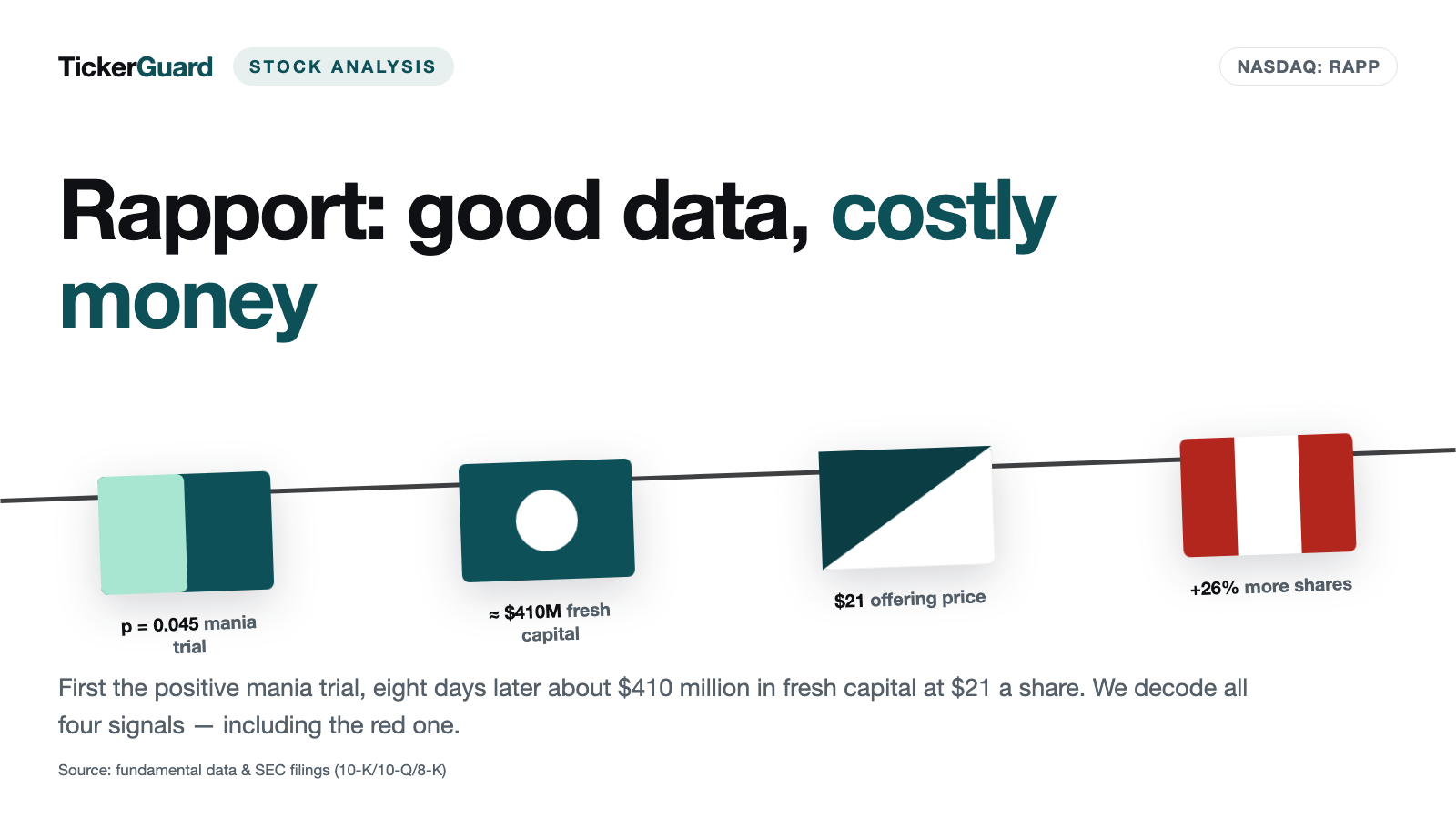
On October 20, 2026, Rapport Therapeutics reported positive data for its drug in acute mania; eight days later it sold new shares at $21 and $172.5 million in convertible notes. That is about $410 million in fresh capital — yet the company now says its cash lasts through the end of 2029, at most half a year longer than before. We walk through the trial, the balance sheet and the fine print of the notes so you can see what you pay for as a shareholder.
 Thomas Mücke
Founder & Publisher
As of Today
As of: October 30, 2026
- Closing price
- 25.10 $ +3.50%
- Market Capitalisation
- 1.2 $B
- Growth Score
- 2/10
- AAQS
- 1/10
Price change since October 30, 2026: +0.2%
This analysis has a cut-off date. The Stock Guard tells you when something material changes in the numbers. Reserve your free spot
Chart
Interactive price chart (TradingView).
52-week range: 22.50 $ to 52.50 $ · Last price: 25.10 $ (As of: October 30, 2026)
Note: pure fact-based analysis, not investment advice and not a solicitation to buy or sell. All figures without guarantee.
There is an investor trap that a single word can spring: positive. Call it the headline trap. When a press release says “positive results,” our minds fill in the rest — trial succeeded, stock goes up, all good. Rapport Therapeutics (Nasdaq: RAPP) sent exactly that kind of release on October 20, 2026: its drug RAP-219 had met the primary endpoint of a trial in acute mania. What came next does not fit the picture. The stock fell on the following trading day, and eight days later Rapport sold new shares at $21 — less than investors had paid in its previous offering a little over a year earlier. So let’s set the headline aside and read together what the company told the U.S. securities regulator, the SEC. The decision at the end is yours.
What Rapport actually does — one drug for specific brain regions
Rapport Therapeutics is based in Boston, has a second site in San Diego and, according to its annual report, was formed in February 2022 with founding support from the venture firms Third Rock Ventures and Johnson & Johnson Innovation. It went public on Nasdaq in June 2024 at $17 a share. At the end of 2025 it had 84 full-time employees, 62 of them in research and development.
The idea is easiest to explain with a light switch. Many drugs for epilepsy or psychiatric disorders dial down signaling across the whole brain — like a master switch that dims every light in the house. That works, but it often leaves patients drowsy, dizzy or unsteady. Rapport wants to dim the lights only in certain rooms. Its drug RAP-219 dampens certain receptors for the messenger glutamate only where a partner protein called TARPγ8 sits — according to the company mainly in the hippocampus and neocortex, and barely in the hindbrain, where side effects often originate.
For Rapport, RAP-219 is everything in one: the company itself calls it a “pipeline-in-a-product.” In play are focal onset seizures (two Phase 3 trials called FOCUS 1 and FOCUS 2, started in the second quarter of 2026), primary generalized tonic-clonic seizures (Phase 3 planned for the first half of 2027), acute bipolar mania (two Phase 3 trials planned for the second half of 2027) and a long-acting injectable that would not need to be taken daily. In March 2026 Rapport licensed the rights for mainland China, Hong Kong, Macau and Taiwan to Tenacia Biotechnology and received $20 million upfront.
For a look at a neuroscience company that already earns money from its drugs, see our Neurocrine analysis. For Rapport, the central tension of this analysis is this: one drug is supposed to win several multibillion-dollar markets — but the epilepsy evidence comes from an open-label study without placebo, the mania evidence is narrow, and the expensive trials meant to settle both have only just begun. Shareholders are footing the bill.
Company history for investors
-
2022
Formed with venture capital
Rapport is formed in February 2022 with money from Third Rock Ventures and Johnson & Johnson Innovation. By mid-2026 it has accumulated $311.7 million in losses.
-
2024
IPO at $17
In June 2024 Rapport lists on Nasdaq, selling 9.2 million shares at $17 plus a private placement. From then on, shareholders fund the trials.
-
2025
Epilepsy data and a $26 offering
September 2025: strong data from an open-label Phase 2a trial, a share price jump, then 11.06 million new shares at $26 ($269.4 million net).
-
2026
China license and Phase 3 start
March 2026: $20 million upfront from Tenacia for rights in mainland China, Hong Kong, Macau and Taiwan. FOCUS 1 and 2 start in epilepsy in the second quarter, and costs climb steeply.
-
2026
Mania data and $410 million in fresh capital
On 10/20/2026 the mania trial meets its goal (p = 0.045); on 10/28, shares at $21 and convertible notes follow. About 26% more shares, runway through the end of 2029.
How the stock landed on our desk
Rapport landed on our research list through an insider filing (Form 4) dated October 30, 2026: director James Healy reported buying 952,380 shares at $21.00 each, held through the venture fund Sofinnova Venture Partners XI; together with smaller lots through three other funds, the total was 969,480 shares for about $20.4 million. The price matches the October 28 offering price exactly. We track such filings continuously; stocks where insiders buy more than they sell show up in the insider net buying scanner.
The overall insider picture is mixed. According to his Form 4 filings, CEO Abraham Ceesay sold 106,212 shares for about $4.8 million between June 29 and October 21, 2026, under Rule 10b5-1 trading plans adopted on March 27, 2026 — in plain terms, the sales followed plans set months in advance, not a spur-of-the-moment decision. After the mania data, by contrast, CFO Troy Ignelzi and five directors bought a combined 61,694 shares from October 21 to 23 at prices between $26.10 and $27.35 — about $1.7 million.
On the share price, with dates: after the first epilepsy data, the stock jumped from $14.36 to $31.47 on September 8, 2025 (closing prices per our fundamental data). It hit its highest close of $52.50 on August 26, 2026, and stood at $28.60 on October 19, 2026. No company filing explains the decline between late August and mid-October. On the day of the mania data the stock closed at $29.37, the next day at $25.06, and on October 30 at $25.05.
Sixteen analysts in our fundamental data offer a rating: fifteen say strong buy, one says buy; their average price target is about $68 (data as of October 31, 2026). Average here means all price targets added up and spread evenly — a single very high target pulls the figure up noticeably. The data do not show whether every target was updated after the October 2026 events. These are third-party views, not a TickerGuard forecast, and we do not adopt them. We reviewed the annual report (10-K) for 2025, the quarterly reports (10-Q) through June 30, 2026, and every filing after that through October 31, 2026. The quarterly report for the period ended September 30, 2026 had not been filed by then.
The numbers over the years — an honest look
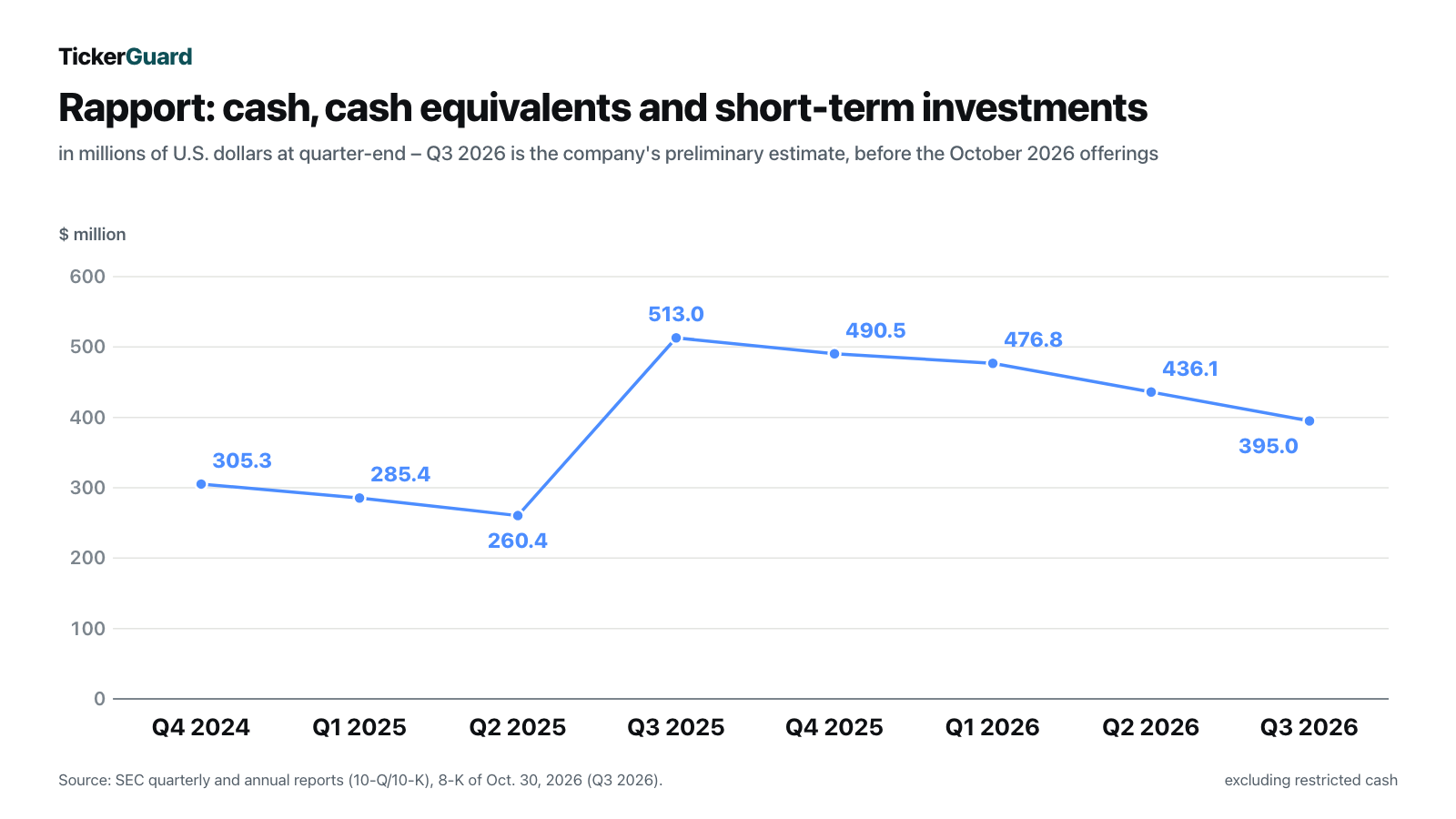
First, what impresses. Rapport is only about four and a half years old and has taken its lead drug all the way to the final stage of clinical testing in that time. After an end-of-Phase 2 meeting in December 2025, the U.S. Food and Drug Administration (FDA) supported moving into two Phase 3 trials in epilepsy. And the company has been well funded: in September 2025, shortly after its first epilepsy data, it sold 11.06 million new shares at $26 and raised $269.4 million net. At the end of 2025 it held $490.5 million in cash and short-term investments. Its first revenue, $20 million in the first quarter of 2026, was the Tenacia upfront payment; according to the quarterly report it is the only revenue the company has ever recognized.
The flip side: losses are growing fast. Rapport lost $34.8 million in 2023, $78.3 million in 2024 and $111.5 million in 2025. Its net loss for the first half of 2026 was $76.5 million — despite the $20 million from Tenacia. Through June 30, 2026, the company had accumulated a deficit of $311.7 million since inception.
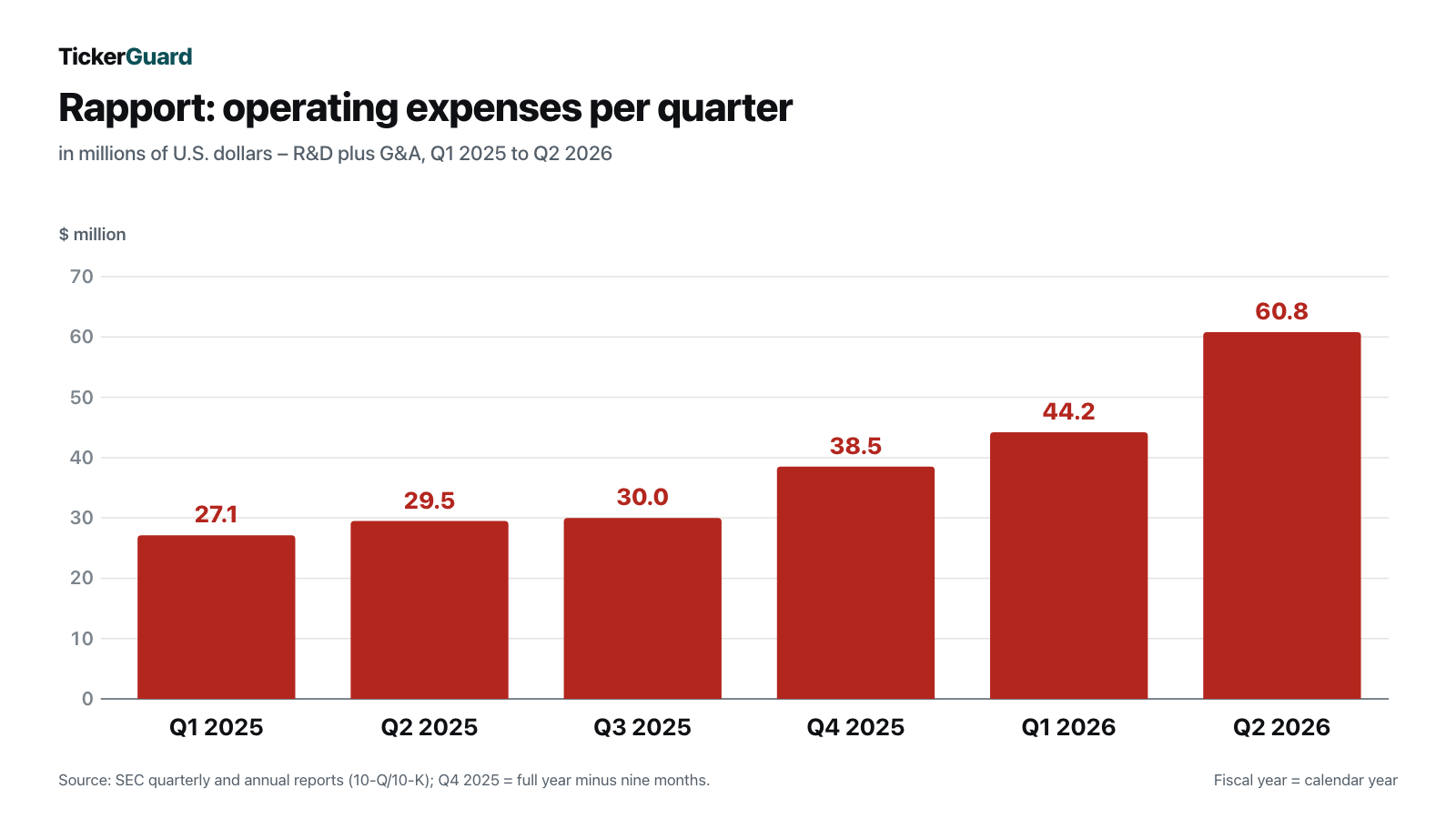
The driver is the clinical program. R&D cost $51.4 million in the second quarter of 2026, versus $22.7 million a year earlier; according to the quarterly report, RAP-219 program costs alone rose by $24.4 million, mainly from starting the Phase 3 epilepsy trials, the mania trial and preparatory work for the injectable. Operating cash outflow in the first half of 2026 was $54.5 million — a figure flattered by the $20 million from Tenacia; without it, it would have been about $74.5 million. Remember: Phase 3 is the most expensive stage of drug development — and Rapport is only at its start.
What the filings say — the uncomfortable truths
Uncomfortable truth No. 1: The epilepsy evidence comes from a study without placebo
In September 2025 Rapport reported strong numbers from its Phase 2a epilepsy trial: according to the annual report, 85.2 percent of patients achieved at least a 30 percent reduction in long electrographic seizure episodes, 72.0 percent cut their clinical seizures by half, and 24 percent were seizure-free over the eight-week treatment period. Measurements came from a brain-implanted device made by partner NeuroPace that records seizure activity. What puts these numbers in perspective sits in the risk factors of the same annual report:
“Our Phase 2a proof-of-concept trial in drug-resistant FOS was an open label study. […] Open-label clinical trials are subject to various limitations that may exaggerate any therapeutic effect as patients in open-label clinical trials are aware when they are receiving treatment.”
— Rapport Therapeutics, Inc., SEC annual report 10-K for 2025, Item 1A “Risk Factors”
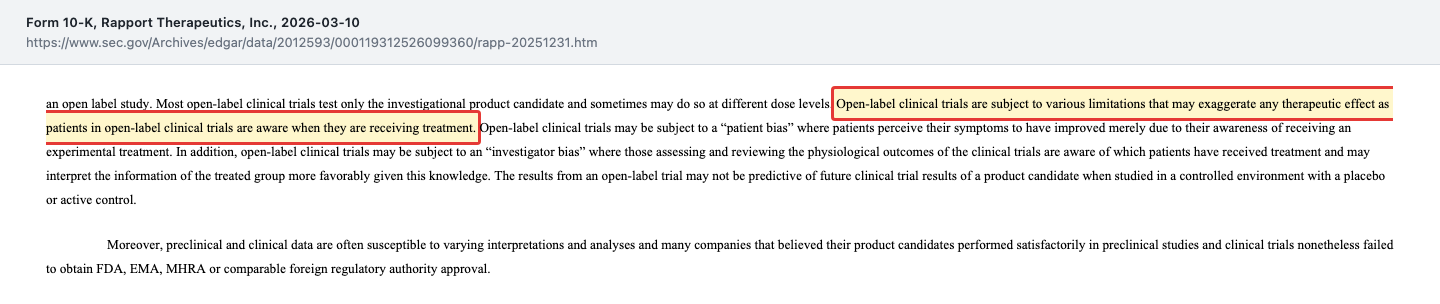
“Open-label” means everyone knew who was getting the drug; there was no placebo group. The comparison was against each patient’s condition before treatment. Rapport itself says such studies can exaggerate an effect. That does not make the epilepsy data worthless — the FDA supported the move into Phase 3 on that basis — but it does mean the first placebo-controlled test in epilepsy will come from FOCUS 1 and FOCUS 2. Remember: a strong number from an open-label study is a promise, not proof.
Uncomfortable truth No. 2: The mania trial was positive — but narrowly
The mania trial is Rapport’s first placebo-controlled efficacy trial in patients with published results. 253 adults in an acute manic episode were treated as inpatients for three weeks, half with RAP-219 and half with a dummy pill. The yardstick was the YMRS, a 0-to-60 scale on which clinicians rate eleven symptoms of mania. The October 20, 2026 release says:
“The trial met its primary endpoint, with RAP-219 achieving a 3.1-point placebo-adjusted improvement in the Young Mania Rating Scale (YMRS) total score at Week 3 (mean reduction from baseline of 15.4 points with RAP-219 versus 12.3 points with placebo (p=0.045).”
— Rapport Therapeutics, Inc., SEC current report 8-K of October 20, 2026, Exhibit 99.1 (press release)
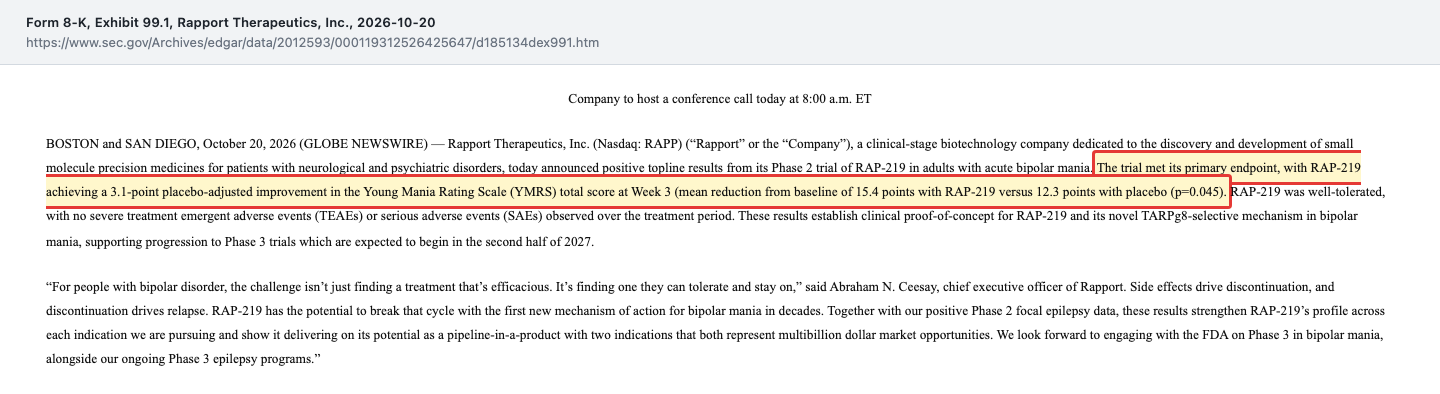
Two numbers deserve a second look. First, the p-value of 0.045: it measures how likely a difference this size could arise by chance alone. The usual threshold is 0.05 — the result sits just below it, not far below. Second, the placebo group: it improved by 12.3 points too. Of the 15.4-point reduction on RAP-219, only 3.1 points are attributable to the drug. The drug’s own effect is therefore smaller than the 15.4 points suggest.
Tolerability is a mixed picture. Overall, adverse events occurred about as often as on placebo (51.6 versus 52.8 percent), none were severe, and drowsiness was less common on RAP-219. On the other hand, 3.2 percent of patients on RAP-219 discontinued because of adverse events, compared with 0.8 percent on placebo — four patients versus one. Agitation was reported by 16.7 versus 9.4 percent. The market’s reaction was sober: a close of $29.37 on the day of the release and $25.06 the day after. Remember: “met the primary endpoint” answers whether a drug works — not how well.
Uncomfortable truth No. 3: $410 million in fresh capital buys at most half a year
On October 28, 2026 Rapport entered into three financings that closed on October 30: new shares and pre-funded warrants at $21 for $215.7 million in net proceeds, a private placement with selected investors for $30.0 million, and $172.5 million of convertible notes with $166.8 million in net proceeds. Together that is about $410 million. Pre-funded warrants are shares in waiting: almost fully paid and exercisable into one share for a tenth of a cent. A convertible note is a loan that lenders can choose to get back in stock rather than cash. What the money is supposed to achieve is in the 8-K:
“The Company believes that the net proceeds from the Offerings, together with its existing cash, cash equivalents and short-term investments, will enable it to fund its operations through the end of 2029.”
— Rapport Therapeutics, Inc., SEC current report 8-K of October 30, 2026, Item 1.01
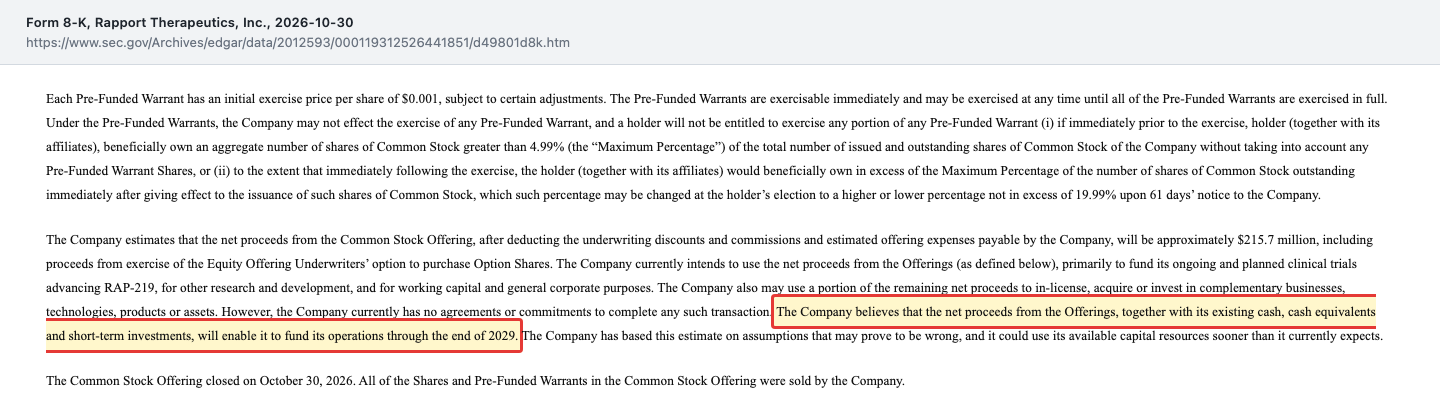
Read that sentence next to the one in the quarterly report for the period ended June 30, 2026. With $436.1 million in the bank, that report said the money would last “into the second half of 2029.” After roughly $410 million more, the wording is now “through the end of 2029.” The fresh capital therefore extends the stated runway by at most about half a year. Rapport does not say which costs the new estimate includes. The two Phase 3 mania trials and the Phase 3 trial in generalized seizures, all planned for 2027, are the obvious candidates — that is our interpretation, not a quote.
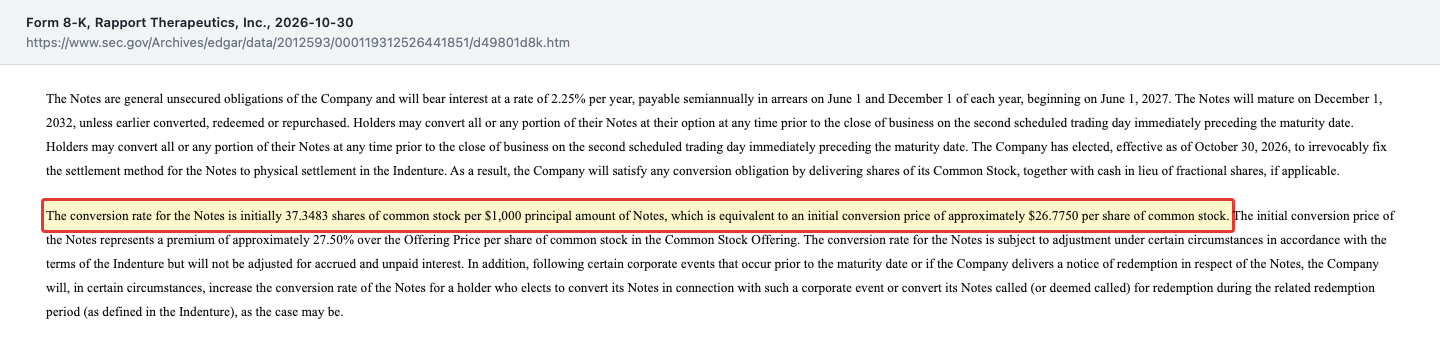
Then there is the price. In September 2025 new shareholders paid $26 a share; in October 2026, after positive mania data, they paid only $21. The offerings lift the share count from 47,955,079 (June 30, 2026) to about 59.1 million; including the pre-funded warrants it is just over 60.3 million, roughly 26 percent more. The notes convert at $26.775 per share, which would mean about 6.4 million more shares on full conversion. On top of that, options on 8.0 million shares were outstanding as of June 30, 2026.
In plain terms: your slice of the pie gets smaller, at a price below the previous round. Remember: when a company raises money more cheaply after good news than after its previous news, the market has read the good news differently than the press release.
Valuation: what the market pays for RAP-219
At a closing price of $25.05 on October 30, 2026 and just over 60.3 million shares including pre-funded warrants, Rapport is worth about $1.5 billion (our calculation; the share count comes from the October 30, 2026 prospectus supplement and is based on the June 30 figure). The price box on this page shows the current price and will therefore differ from this point-in-time calculation. Our fundamental data show a lower market value because they still use the pre-offering share count.
Adding the roughly $410 million raised in October to the preliminary $395.0 million in cash as of September 30, 2026 gives a little over $800 million, against $172.5 million of convertible notes. That means the market is paying roughly $0.9 billion for the technology, patents and RAP-219 trials. There is no price-to-earnings ratio without earnings, and a price-to-sales multiple based on a single license payment would be meaningless. The real question is whether RAP-219 passes Phase 3 in two diseases — and the market values that chance at a little under $1 billion, not several.
Opportunities and risks at a glance
What speaks for Rapport:
- Two diseases, one drug: Phase 3 in epilepsy under way since the second quarter of 2026, mania data that met the primary endpoint (October 20, 2026), Phase 3 in generalized seizures planned for the first half of 2027.
- Good tolerability in the mania trial: no severe adverse events, an adverse-event rate in line with placebo, less drowsiness.
- Well-stocked cash: a preliminary $395.0 million (September 30, 2026) plus about $410 million raised in October; runway through the end of 2029, per the company.
- Insider purchases: the CFO and five directors bought in October 2026 at $26 to $27, and Sofinnova bought about $20.4 million at $21 through James Healy.
- Partner money from Asia: $20 million upfront from Tenacia, up to $308 million in sales-based milestones, plus royalties.
What speaks against it:
- Open-label evidence: the Phase 2a epilepsy trial had no placebo group; per the company, such trials may exaggerate effects.
- Narrow mania result: p = 0.045 and a 3.1-point advantage against a 12.3-point improvement on placebo; discontinuations due to adverse events 3.2 versus 0.8 percent.
- Dilution: about 26 percent more shares from the offerings, up to 6.4 million more through the notes, 8.0 million options (June 30, 2026).
- Rising costs: operating expenses of $60.8 million in the second quarter of 2026 versus $29.5 million a year earlier; $410 million in fresh capital extends the runway by at most half a year.
- Concentration risk: almost the entire value rests on a single drug.
A human conclusion
Back to the headline trap. The word “positive” in the October 20, 2026 release was not a lie — the trial met its primary endpoint, and RAP-219 was well tolerated. The trap is to stop reading at “positive.” Read on, and you find a narrow margin over placebo, epilepsy evidence without a placebo group, and a $21 financing that barely extends the cash runway. Rapport is not a rescue case: its cash lasts through the end of 2029, per the company, and several directors have bought shares themselves. So the honest question for you is not “Was the trial positive?” It is: do you want to own a company whose value rests on a single drug, whose decisive placebo-controlled tests are still years away — and that is paying for them with your share of the company? Once you have answered that for yourself, you know what you are getting into — with or without the stock. What you make of it is your decision. And that is how it should be.
Sources
All original documents used in this analysis — so you can check them yourself:
- Rapport Therapeutics, Inc. — SEC quarterly report 10-Q for the period ended June 30, 2026 (filed August 5, 2026)
- Rapport Therapeutics, Inc. — SEC current report 8-K of October 30, 2026 (offerings, convertible notes, preliminary cash as of September 30, 2026)
- Rapport Therapeutics, Inc. — prospectus supplements (424B5) of October 30, 2026 for the shares and the convertible notes
- Rapport Therapeutics, Inc. — SEC current report 8-K of October 20, 2026, Exhibit 99.1 (mania trial results) and Item 8.01
- Rapport Therapeutics, Inc. — SEC current report 8-K of August 5, 2026, Exhibit 99.1 (second-quarter 2026 results)
- Rapport Therapeutics, Inc. — SEC quarterly report 10-Q for the period ended March 31, 2026 (filed May 7, 2026)
- Rapport Therapeutics, Inc. — SEC annual report 10-K for 2025 (filed March 10, 2026) and 10-K for 2024 (filed March 11, 2025)
- Rapport Therapeutics, Inc. — SEC quarterly reports 10-Q for the periods ended March 31, 2025, June 30, 2025 and September 30, 2025 (cash and expenses per quarter)
- Rapport Therapeutics, Inc. — insider filings (Form 4) from July 1 to October 30, 2026, including James Healy of October 30, 2026 (all filings at the SEC)
- Fundamental data (prices through the October 30, 2026 close, analyst ratings; retrieved October 31, 2026), cross-checked against the SEC filings.
Transparency & disclaimer: this analysis is journalistic commentary on publicly available information. It is not investment advice, not a regulated investment research product and not a solicitation to buy or sell securities. Equity investments carry substantial risk up to and including total loss. All information is provided without warranty; the as-of date for each figure is stated in the text. Positions held by the operator are disclosed daily; where one exists, it appears as a notice at the top of this deep dive.
Key figures at a glance
All monetary figures in millions of $; earnings per share as reported.
| Metric | 2022 | 2023 | 2024 | 2025 |
|---|---|---|---|---|
| Revenue | – | 0.0 | 0.0 | 0.0 |
| Operating Income (EBIT) | -10.4 | -36.2 | -83.1 | -125.1 |
| Net Income | -10.7 | -34.8 | -78.3 | -111.5 |
| Earnings Per Share | -0.53 $ | -1.92 $ | -3.78 $ | -2.37 $ |
Source: fundamental data & SEC filings (annual and quarterly reports, 10-K/10-Q)
Our Bottom Line at a Glance
- Clinical evidence neutral
- Mania trial met its primary endpoint (3.1-point advantage, p = 0.045; 10/20/2026); strong Phase 2a epilepsy data, but from an open-label study without placebo (10-K 2025); Phase 3 in epilepsy under way since Q2 2026.
- Liquidity positive
- Preliminary cash of $395.0 million (09/30/2026) plus about $410 million from the October 2026 offerings; runway through the end of 2029, per the company.
- Costs negative
- Operating expenses Q2 2026: $60.8 million versus $29.5 million a year earlier; about $410 million in fresh capital extends the stated runway by at most half a year.
- Dilution negative
- About 26% more shares from the offerings at $21 (09/2025: $26), up to 6.4 million more through the convertible notes, 8.0 million options (06/30/2026).
- Insiders positive
- CFO and five directors bought about $1.7 million from 10/21 to 10/23/2026, Sofinnova about $20.4 million at $21 through James Healy (Form 4 of 10/30/2026); the CEO sold under 10b5-1 plans.
Rapport Therapeutics is a textbook case of the headline trap: the October 2026 mania trial was positive but narrow, the epilepsy evidence comes from an open-label study, and eight days after the data the company raised about $410 million at $21 a share. Cash is ample and is expected to last through the end of 2029 — but the value rests on a single drug whose decisive Phase 3 tests are only now under way. Not investment advice.
What Our Rating Means
Open questions
The business works in principle, but one material question is open. As long as it stays open, our findings do not carry a quality verdict.
Yellow, because a material operational question remains open: Rapport’s value rests almost entirely on RAP-219, and the placebo-controlled Phase 3 trials that will decide approval or failure are only under way or start in 2027. There is no existential risk: a preliminary $395.0 million in cash and investments (09/30/2026) plus about $410 million raised in October is expected to last through the end of 2029, well beyond four quarters. Dilution at $21 is a price issue, not a quality verdict. The decision is yours.
A journalistic assessment by our editorial team at the time of the deep dive, based on public sources — not investment advice and not a solicitation to buy or sell. Your personal circumstances (investment goals, risk capacity, taxes) cannot be taken into account. What our levels mean, how verdicts are formed, and what conflicts of interest exist →
Worth Noting
- Rapport landed on our research list through director James Healy’s insider filing (Form 4) of 10/30/2026.
- About $410 million = $215.7 million net from shares and pre-funded warrants (incl. the underwriters’ option) + $166.8 million net from the convertible notes + $30.0 million private placement (gross, 6% placement fee) per the 8-K and 424B5s of 10/30/2026; our own sum.
- Share count after the offerings: 59,145,555 per the 424B5 (based on 47,955,079 at 06/30/2026, incl. the underwriters’ option) plus 1,190,476 pre-funded warrants = 60,336,031; market value computed × $25.05 (10/30/2026 close). The fundamental data’s market value (≈ $1.20 billion) uses the pre-offering share count and is not used.
- Q4 2025 operating expenses = full-year 2025 ($125.1 million) minus nine months ($86.6 million); cash as of 09/30/2026 is a preliminary, unreviewed company estimate (8-K Item 2.02).
- Insider totals summed from Form 4 filings of 07/01 to 10/30/2026 (shares × reported average price).
- Our reading of which costs the new runway estimate includes is our own interpretation; Rapport does not itemize them.
Stock Watch
This analysis is as of October 31, 2026. Stock Watch will tell you what's changed at RAPP since then.
Later $1 a month per stock — signing up is free, and you'll be the first to know when it launches.
The full analysis as a PDF for later
We will send you this analysis as a PDF — to print, file away, and read at your own pace. And we will add you to the free Stock Watch list for Rapport Therapeutics, Inc. (RAPP), so you hear about it when something material in this analysis changes.
Frequently Asked Questions
Rapport Therapeutics, Inc. (Nasdaq: RAPP), based in Boston, develops drugs for neurological and psychiatric disorders. Its lead drug, RAP-219, dampens glutamate receptors only in specific brain regions. It is in Phase 3 for focal onset seizures; Phase 3 trials in acute mania and generalized seizures are planned for 2027.
According to the October 20, 2026 release, RAP-219 reduced scores on the YMRS mania scale by 15.4 points after three weeks in 253 patients, versus 12.3 points on placebo. The 3.1-point advantage was statistically significant at p = 0.045. There were no severe adverse events; 3.2 percent discontinued due to adverse events, versus 0.8 percent on placebo.
About $410 million: new shares and pre-funded warrants at $21 with $215.7 million in net proceeds, a $30.0 million private placement and $172.5 million of 2.25 percent convertible notes due December 2032. The company says this funds operations through the end of 2029.
The offerings lift the share count from 47.96 million (June 30, 2026) to just over 60.3 million including pre-funded warrants, about 26 percent more. The notes can add up to about 6.4 million shares at a conversion price of $26.775, and options on 8.0 million shares were also outstanding.
The September 2025 Phase 2a trial was open-label with no placebo group: every patient knew they were being treated. In its 2025 annual report, Rapport itself says such studies may exaggerate effects. The first placebo-controlled test in epilepsy will come from the Phase 3 trials FOCUS 1 and FOCUS 2.
At $25.05 (October 30, 2026 close) and just over 60.3 million shares including pre-funded warrants, about $1.5 billion. Net of a little over $800 million in cash after the offerings and adding $172.5 million of notes, the market pays roughly $0.9 billion for the pipeline. There is no price-to-earnings ratio.
Found an error?
Did you spot a factual error, an outdated number, or a typo in this deep dive? Let us know briefly — your report goes straight to the editorial team.