Fox Corporation: Record Profit, a $24.7 Billion Deal for Roku — and a Share That Doesn't Get to Vote
Fox Corporation just posted its best operating year ever for fiscal 2026 (July 1, 2025 through June 30, 2026): adjusted EBITDA of $3,906 million. Yet reported net income fell 26 percent to $1,685 million, because a swing in the value of its Flutter Entertainment stake hit hard. At the same time, Fox is buying the streaming company Roku for about $24.7 billion and will grow its Class A share count by 71.9 percent to pay for it — but on October 14, 2026, only the second, voting share class, Class B, gets to decide. The publicly traded FOXA stock has no vote at that special meeting under the proxy statement. Let's read the filings together and see what actually reaches you as a shareholder without a ballot.
 Thomas Mücke
Founder & Publisher
Thomas Mücke
Founder & Publisher
As of Today
As of: October 16, 2026
- Closing price
- 64.20 $ +0.30%
- Market Capitalisation
- 27.3 $B
- P/E
- 17.9
- Growth Score
- 5/10
- AAQS
- 8/10
Price change since August 31, 2026: -4.7%
This analysis has a cut-off date. The Stock Guard tells you when something material changes in the numbers. Reserve your free spot
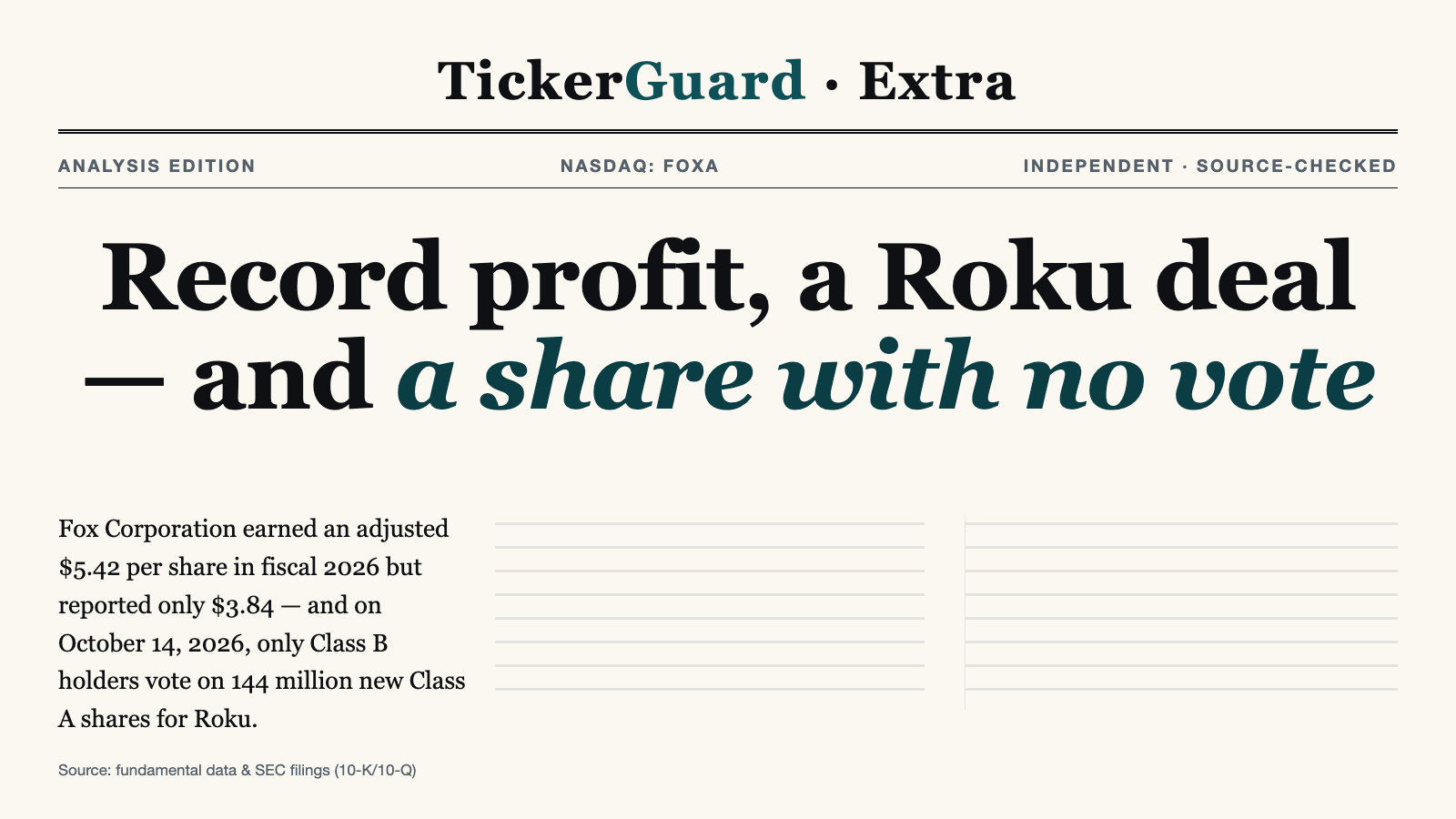
Chart
Interactive price chart (TradingView).
52-week range: 48.80 $ to 76.10 $ · Last price: 64.20 $ (As of: October 16, 2026)
Note: pure fact-based analysis, not investment advice and not a solicitation to buy or sell. All figures without guarantee.
There is a mistake almost every shareholder makes at some point — call it the ballot-box fallacy: buy a share, and you assume you have automatically bought a piece of a say — a small co-owner, with a vote at the annual meeting, with influence over the company's biggest decisions. For most stocks that is even true — just not for every one. Fox Corporation (Nasdaq: FOXA and FOX) is the textbook case for why you should check that before you buy. The company reported record operating profit for fiscal 2026 (July 1, 2025 through June 30, 2026), is buying the streaming company Roku for about $24.7 billion — and on October 14, 2026, only its second share class, Class B, also listed on the Nasdaq but roughly one-third owned by the Murdoch holding company, gets a vote on that deal. The Class A shares, trading under the more familiar ticker FOXA, have nothing to say about it. So let's do what we do with every analysis: read the fresh annual report (10-K) filed August 6, 2026, and the proxy statement (Form 424B3) dated September 1, 2026, together — and see what of all this actually reaches you as a FOXA shareholder.
What Fox Corporation actually does
Fox Corporation is a U.S. media company headquartered in New York, created in 2019 out of the split-up of the old 21st Century Fox media empire — the larger part, with the film studios and international networks, went to Disney, and the remainder has operated independently as Fox Corporation ever since. The stock trades on the Nasdaq in two classes, and the difference matters for the rest of this analysis: Class A (ticker FOXA) is the stock most retail investors buy — but outside of four narrowly defined exceptions (dissolution of the company, sale of substantially all assets, certain mergers, unpaid dividends), it is non-voting. Class B (ticker FOX), by contrast, carries one vote per share and is roughly one-third owned by the Murdoch family holding company. More on that shortly — keep the distinction in mind, it runs through the whole piece.
Operationally, Fox is organized in two reporting segments. Cable Network Programming bundles the news and sports channels distributed through cable and streaming packages: FOX News and FOX Business on the news side, FS1, FS2, Big Ten Network and FOX Deportes on the sports side. Television covers the free-to-air FOX Network with its primetime and sports programming, the 29 owned-and-operated stations in 18 U.S. markets, and the free ad-supported streaming service Tubi. A smaller, third category called "Corporate and Other" carries, among other things, the loan-comparison platform Credible and the subscription streaming service FOX One, launched in August 2025.
Much of the company's value sits in long-term sports rights — in everyday terms, Fox has locked in tickets for decades to the sporting events viewers reliably tune in for. The NFL rights currently run through the 2033 season, though the league holds a one-time opt-out right after the 2029 season. The MLB rights, including exclusive coverage of the World Series and All-Star Game, run through the 2028 season. And the next major package coming up for renewal, per the annual report, is the FIFA World Cup package — Fox just benefited from the 2026 men's World Cup and has to prepare for the next negotiation round.
One more paragraph on how exposed this business is to artificial intelligence — a criterion we check in every analysis. Fox's own annual report frames generative AI explicitly as a risk, not an opportunity: the company sells no AI products and instead warns that AI could erode its revenue streams:
"Other new technological developments, such as the development and use of generative AI, including large language model applications, are rapidly evolving and increasingly being incorporated into business operations and content generation, and AI may be used in ways that could reduce demand for our content, products and services."
— Fox Corporation, SEC annual report 10-K for fiscal 2026, Item 1A "Risk Factors"
Our AI classification for Fox is therefore "threatened": the company sells no AI itself and instead describes it in its risk factors as a possible adversary — both to demand for its own content and to protecting that content against unauthorized use by "generative AI developers."
Company history for investors
-
2019
Spin-off from 21st Century Fox
Most of the old company went to Disney; Fox Corporation remained an independent, smaller media company with a dual-class share structure.
-
2023
Dominion settlement, about $800 million
Fox paid about $800 million to settle the Dominion lawsuit — the most expensive one-off item in this analysis's entire five-year window.
-
2025
Venu Sports buried
The sports-streaming joint venture with Disney and Warner Bros. Discovery was shut down before it ever launched — money spent without ever generating revenue.
-
2025
FOX One launched
The FOX One streaming subscription went live; management has reported satisfaction ever since but still names no concrete subscriber figure.
-
2025
Murdoch family dispute settled
Three Murdoch siblings exited the family trust and sold their stakes — control consolidated in the holding company LGC Holdco, whose votes are cast by a trustee named by Lachlan Murdoch.
-
2026
Roku purchase agreement signed
Fox and Roku agreed to an acquisition worth about $24.7 billion — the single largest decision in the company's history.
-
2026
Special meeting on the Roku deal
Only the Class B class decides on the required share issuance; FOXA shareholders may only virtually watch, per the proxy statement.
How this stock landed on our desk
The trigger for this piece is deliberately unspectacular, and that's exactly what makes it worth reading: on August 6, 2026, Fox filed its annual report (10-K) for fiscal 2026, the year ended June 30, 2026, together with its fourth-quarter earnings release. And on September 1, 2026, the final, roughly 400-page proxy statement (Form 424B3) for the planned Roku acquisition followed — the document that spells out exactly who gets to vote at the special meeting on October 14, 2026. Two filings in the same summer that together paint an unusually clear picture: a record operating year, a massive investment, and a power question already answered in the fine print. If you want to look the numbers up yourself, you'll find the key ones in our in-house stock scanner too — we pulled them here directly from the two original filings, not from a third party's summary.
The numbers over the years — honestly appraised
Let's start with what genuinely impresses. Consolidated revenue grew from $13,974 million in fiscal 2022 to $17,126 million in fiscal 2026 — up 23 percent in five years, not in a straight line but in waves that follow the U.S. sports and election calendar. Adjusted EBITDA — earnings before interest, taxes, depreciation and amortization, the metric Fox uses to show the raw earning power of its operating business — climbed from $2,955 million to a record $3,906 million, up 32 percent. Reported net income under U.S. accounting rules (GAAP) moved from $1,205 million to $1,239 million, $1,501 million, $2,263 million and finally $1,685 million — not a smooth climb but a zigzag that turns down again in the most recent year (more on that in the next chapter). The diluted share count fell noticeably over the same period: from about 570 million weighted diluted shares in fiscal 2022 to 439 million in fiscal 2026 — the result of $2.0 billion in share buybacks in the most recent year alone. Free cash flow (operating cash flow minus capital expenditures, a calculation Fox itself does not define) swung between $1,443 million (2023) and an outlier of $2,993 million (2025, the year with a Super Bowl and election advertising), landing at $1,468 million in fiscal 2026.
Behind those consolidated numbers sit two very different businesses, and the second chart shows how unevenly they contribute to the bottom line:
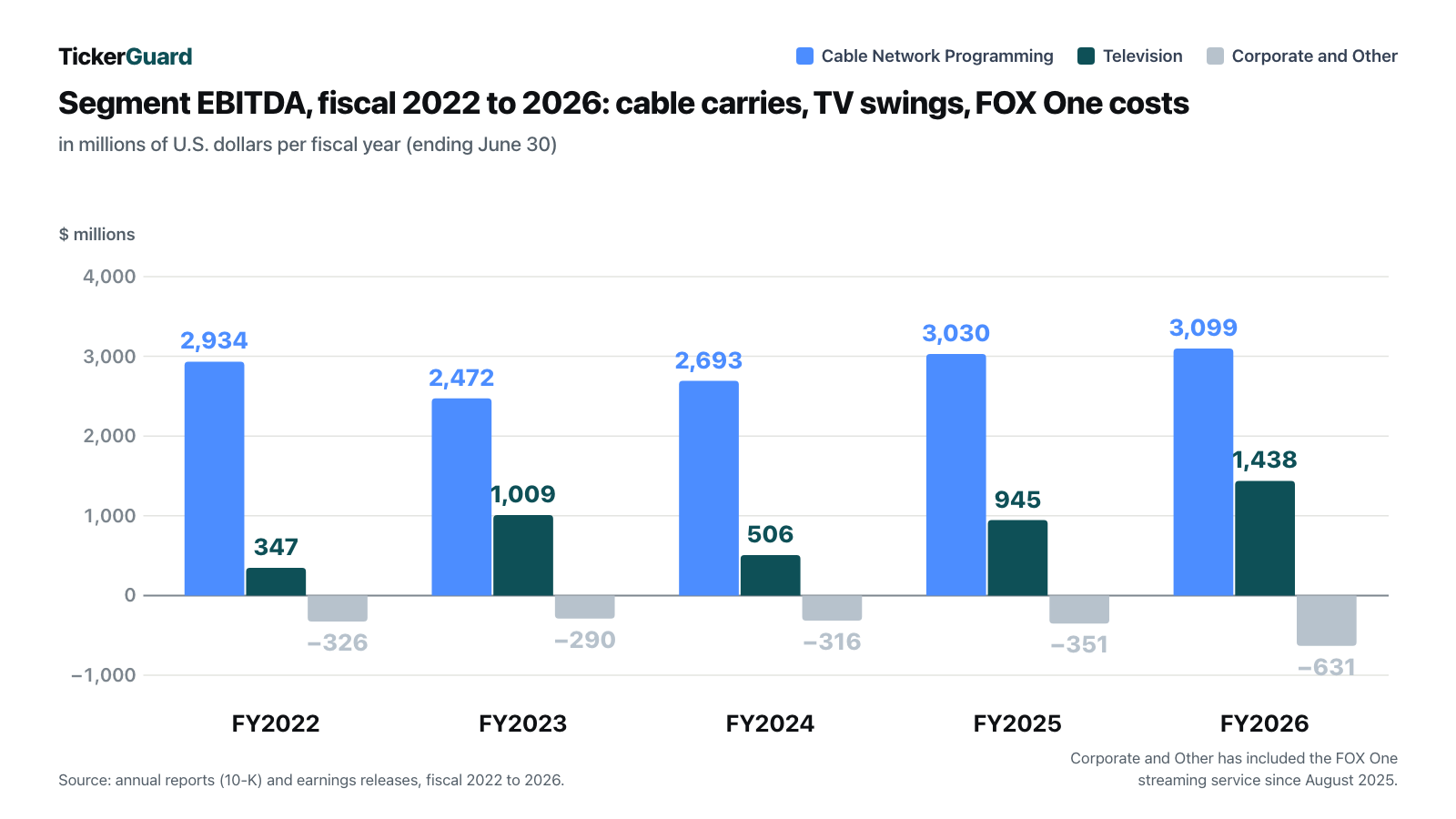
The cable segment is the reliable profit engine — between $2,472 million and $3,099 million in segment income every one of the five years, with an operating margin of roughly 42 percent in fiscal 2026. Television swings far more, because that's where the expensive but ad-rich major sporting events land — from $347 million in the lean fiscal 2022 to a five-year high of $1,438 million in the World Cup year, fiscal 2026. And the "Corporate and Other" category, which houses FOX One among other things, costs increasingly more: minus $631 million in fiscal 2026, nearly double the prior year. Remember this pattern: a solid but mature cable business is funding a more volatile sports business and an increasingly expensive streaming relaunch.
Earnings, honestly calculated: one-offs and adjusted figures
This is the heart of the analysis, because two truths pull apart here that are both real. Under U.S. accounting rules (GAAP), Fox earned $1,685 million in fiscal 2026, or $3.84 per share — down 26 percent from the prior year. Strip out what Fox itself calls one-off items, and the company earned $2,381 million instead, $5.42 per share — up 8 percent (up 13 percent per share, because shares were bought back at the same time). The gap between the two figures is $696 million, and it's worth breaking down:
- The largest item is the line "Non-operating other, net," which shows as a cost of $773 million under GAAP and gets added back when adjusting. Almost all of it is a $761 million valuation loss on Fox's roughly 2.5 percent stake in Flutter Entertainment, the parent of FanDuel — a pure book-value swing, not a cash outflow, but not a consolation prize either: the equity investments (mainly Flutter) were worth only $467 million as of June 30, 2026, down from $1,249 million a year earlier.
- Add $151 million from restructuring, an impairment on FCC broadcast licenses in the Television segment, and legal costs — items Fox traditionally treats as "non-recurring."
- A tax effect of minus $229 million offsets part of the adjustments, because the additional pre-tax correction would naturally carry its own tax impact.
Add it up: $1,685 million + $151 million + $773 million − $229 million (plus $1 million of minority interests) = $2,381 million. For the fourth quarter alone, the same math runs on a smaller scale: $691 million in GAAP net income becomes $765 million adjusted — driven mainly by $113 million of restructuring/impairment, while the equity investments contributed only a small offsetting adjustment of $12 million this time.
Important context: the prior year ran the same adjustment in the opposite direction. In fiscal 2025, GAAP net income ($2,263 million) actually stood above the adjusted figure ($2,202 million), because Flutter contributed a $449 million valuation gain that year, which got subtracted back out when adjusting. In other words: the same line item that lifted reported earnings a year earlier dragged them down hard the next — a lesson in how much a single publicly traded stake can distort the reported profit of a $17 billion company. Fox itself names exactly this as the main reason for the decline:
"Net income decreased $566 million or 25% for fiscal 2026, as compared to fiscal 2025, primarily due to a change in fair value of the Company's investments in equity securities, partially offset by higher Segment EBITDA (as defined below) and lower legal settlement and other costs associated with the discontinuation of Venu Sports in fiscal 2025."
— Fox Corporation, SEC annual report 10-K for fiscal 2026, Item 7 "Management's Discussion and Analysis"
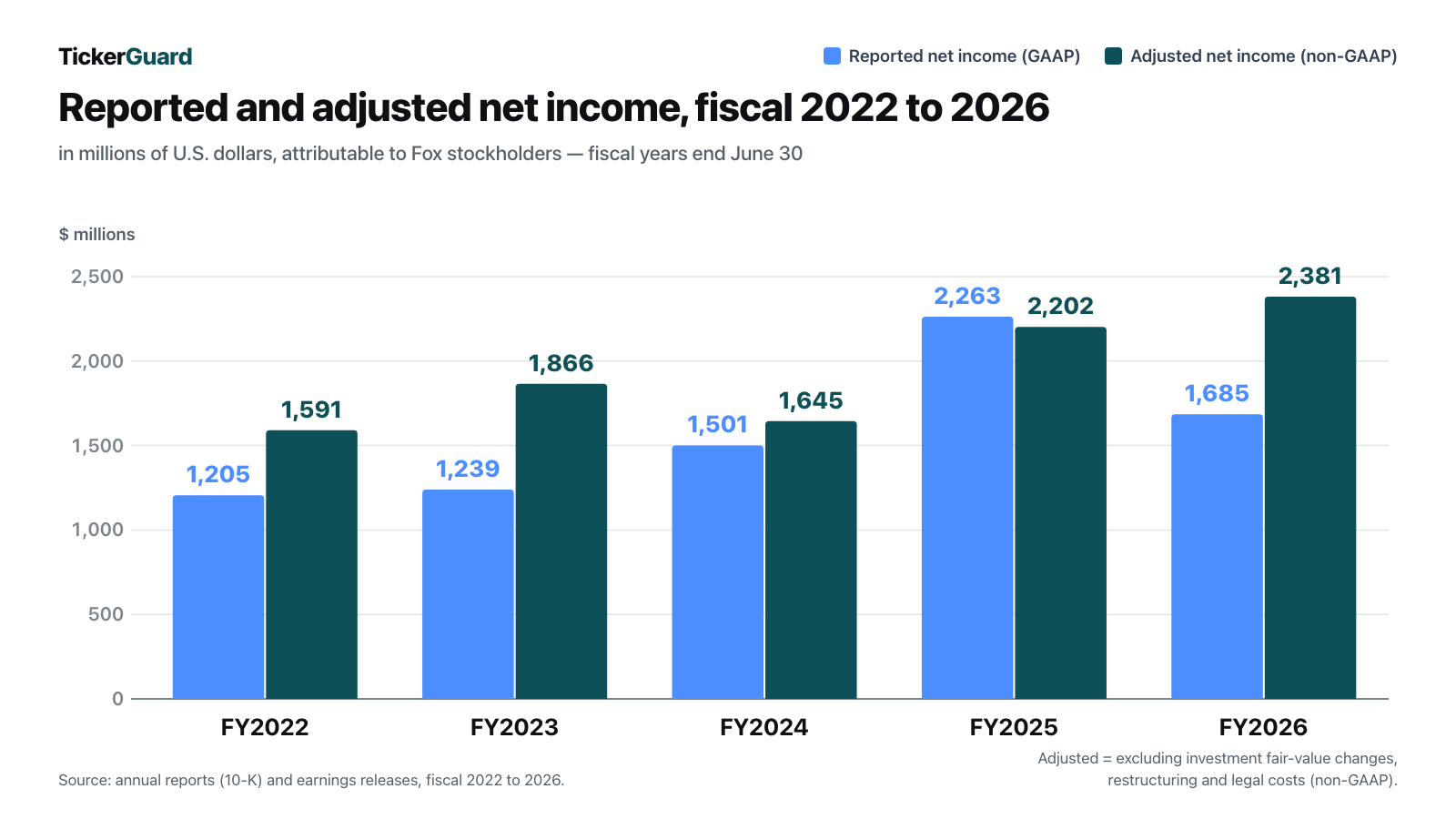
Honesty also means noting what Fox does not strip out, even though it is just as much a one-off. In its ongoing television business, the company has booked an impairment on its own programming content every year for three years running — about $90 million in fiscal 2026, more than double the roughly $40 million in each of the two prior years. Those impairments already reduce the "record" adjusted EBITDA, but they are not added back when calculating adjusted net income — a reminder that "adjusted" at Fox does not mean "everything unusual removed," but a selection management chose to make.
And then there's the men's soccer World Cup. The 2026 tournament's June match days still fell into the fiscal fourth quarter and pushed consolidated advertising revenue from $1,078 million to $1,916 million, up 78 percent from the year-ago quarter. That prior-year quarter had neither a Super Bowl nor election advertising, so the comparison isn't distorted by other one-offs. But exactly how much of that jump is attributable to the World Cup, Fox does not quantify in the annual report, the earnings release or the August 6, 2026 call. The estimate is ours, not Fox's: total quarterly revenue rose $925 million, $838 million of it from advertising — given the absence of a comparable prior-year boost, a large World Cup share looks likely, but there is no solid standalone number. One note of caution on arithmetic: a year's four quarterly earnings-per-share figures never add up exactly to the annual figure — at Fox because the share count changes intra-year through buybacks, and each quarter is rounded on its own. Anyone checking the math should always use the annual figure, not the sum of the four quarters.
What management promised — and what actually happened
In every analysis we check what a management team promised analysts on past earnings calls — and whether it delivered. For Fox we reviewed twelve calls between November 2023 and August 2026. The result is mixed, with one clear lesson: the Q&A section tells you more than the prepared remarks.
The best track record belongs to Tubi, Fox's free, ad-supported streaming service. In August 2025, CFO Steve Tomsic promised a "more substantial improvement in Tubi profitability" in fiscal 2026, weighted toward the second half of the year. It actually arrived sooner: CEO Lachlan Murdoch announced the breakthrough as early as the first quarter.
"I'm happy to say Tubi reached profitability this past quarter. It's a great milestone, a credit to the Tubi brand to our viewer experience and to the revenue momentum we are seeing."
— Lachlan Murdoch, fiscal Q1 2026 earnings call, October 30, 2025 (prepared remarks)
Through the last call on August 6, 2026, Tubi stayed profitable in every quarter of the fiscal year — a promise not just kept, but beaten ahead of schedule.
The exact opposite happened with Venu Sports, the joint sports-streaming venture with Disney and Warner Bros. Discovery. In May 2024, Murdoch still sounded euphoric — unable to wait to launch that fall, "an incredibly exciting product." Nine months later, after a court injunction had already blocked the launch, came the end — briefly explained on the call:
"Our only disappointment in sports is that we will not be moving forward with Venu, our sports streaming joint venture with Warner Bros. Discovery and Disney... the legal distractions around the business became increasingly difficult to bear."
— Lachlan Murdoch, fiscal Q2 2025 earnings call, February 4, 2025 (prepared remarks)
A project that never launched but had been sold beforehand as "incredibly exciting" — a good example of why announcements on a call are no guarantee.
FOX One, the subscription streaming service, went the other way — it was moved up: in February 2025 Murdoch was still naming "by the end of this calendar year" as the target; by May 2025 the date had already shifted ahead of the fall football season; on August 5, 2025, management named August 21 as the launch date, and according to the annual report the service launched in August 2025. Ever since, management has repeated in each of the four following calls that subscriber numbers are running above expectations — but it has never once named a concrete figure, despite repeated analyst questions. It sticks with the vague target range of "low to mid-single-digit millions of subscribers" over three to four years. A promise kept, without any way to externally verify by how much.
The cord-cutting rate — the share of cable customers who cancel each year — is easier to track. From "in the 8% range" in November 2023 (in February 2024, CEO Lachlan Murdoch spoke of "roughly 8% cable erosion"), the rate stepped down, with several plateaus along the way, to "under 6.5%" by August 2026 — a promise of slowing erosion that actually held up, though management itself notes it excludes FOX One.
On the Roku deal, by contrast, management was as tight-lipped as on any other topic across all twelve calls. Before the Q&A portion of the August 6, 2026 call, the head of investor relations explicitly locked the topic down:
"Please note that we are limited in what we can say regarding FOX's pending Roku transaction at this time... For today, we would ask that questions focus on FOX's stand-alone results."
— Gabrielle Brown, Head of Investor Relations, fiscal Q4 2026 earnings call, August 6, 2026 (transition to Q&A)
That left every follow-up on synergies, per-share dilution, or financing details unanswered — the only hard number on the transaction, "about net leverage of 2.8x" at closing, came up almost incidentally in a general question about capital allocation.
The tone also shifted noticeably on the NFL relationship. In May 2026, Murdoch had to respond to a press report of alleged tension:
"There is no tension really with the NFL. We're partners for 30 years... We've read the speculation that the NFL would like to renegotiate and extend the current -- our current deal or the current deals that are in the marketplace. But we've had no substantive discussions with the NFL about that."
— Lachlan Murdoch, fiscal Q3 2026 earnings call, May 11, 2026 (Q&A session)
Three months later, management pre-empted the topic in prepared remarks: it would make no changes to the existing contract before 2030 — the customary timetable. One last pattern stands out across nearly all twelve calls: in at least five of the twelve, management denies any weakness in its own advertising business in almost identical language, regardless of how "mixed" the industry at large describes the ad market. That's not dishonest on its own — Fox's ad revenue has genuinely grown — but a line repeated that often deserves a second look next time. The general lesson from twelve calls: the Q&A section shows more than the prepared remarks — wherever analysts push hard (NFL, Roku, M&A), it becomes clear what management does not yet want to, or cannot, say.
What the filings say — the uncomfortable truths
Uncomfortable truth no. 1: your share has no vote — and roughly 144 million new shares get issued while only the other class decides
Now to the core of the ballot-box fallacy from the opening. If the Roku deal closes, Fox expects to issue, by its own preliminary estimate, about 144.0 million new Class A shares — a 71.9 percent increase over the Class A shares outstanding as of August 17, 2026. That massive dilution — your slice of the pie gets smaller because the pie is cut into more slices — hits all shareholders economically, Class B holders included; but because only new Class A shares are issued, Class B voting power stays untouched. And yet the vote on that exact share issuance, on October 14, 2026, belongs exclusively to the Class B stock. The proxy document says so without hedging:
"Holders of FOX Class A Common Stock are not entitled to notice of, or to vote at, the FOX Special Meeting or any postponement or adjournment thereof; however, holders of FOX Class A Common Stock are invited to virtually attend the FOX Special Meeting."
— Fox Corporation, Joint proxy statement/prospectus (Form 424B3) dated September 1, 2026, summary section "The FOX Special Meeting" (page 21)
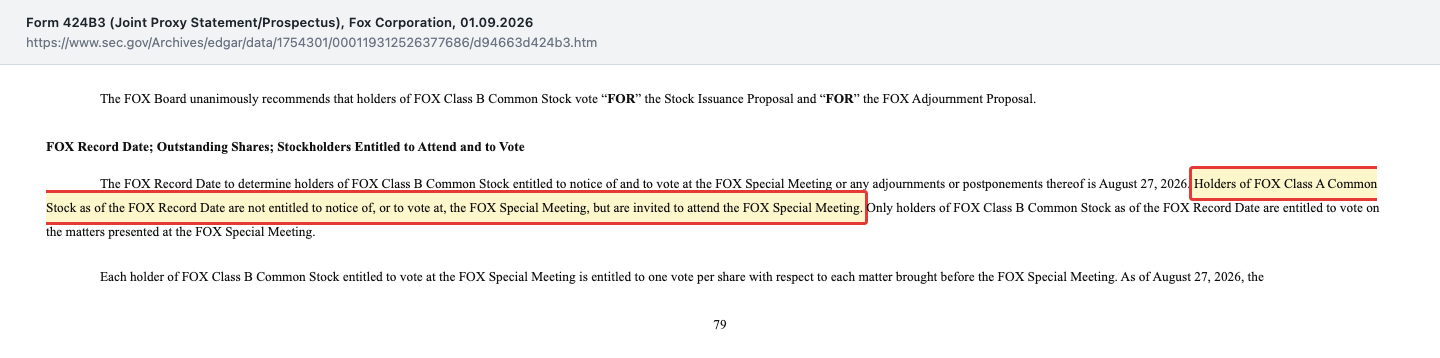
The record date that determines who is entitled to vote is August 27, 2026; the meeting itself takes place virtually on October 14, 2026, at 3 p.m. Eastern time. Only a majority of votes actually cast by Class B holders is required — and a large part of that majority is already committed before a single vote is cast: the Murdoch holding company LGC Holdco (together with Cruden 2, LLC) has contractually committed to vote in favor and controls about 38.8 percent of all outstanding Class B votes. It needs just over eleven percentage points more of the votes actually cast to reach a majority. In everyday terms: picture a cooperative where a large share of the members — the biggest group, in fact — never get a ballot at all, while a separate group that already committed to "yes" beforehand decides alone. That is precisely the structure you invest into as a FOXA shareholder — not illegal, fully disclosed, but the opposite of a say in the matter.
Uncomfortable truth no. 2: subscriber losses are eating the price increases
Fox has raised, year after year, the fees cable operators pay to carry its channels — and that cushions a structural decline in viewers that would otherwise show up more clearly in the numbers. The annual report spells it out:
"The increase of $278 million or 4% in distribution revenue was due to higher average rates per subscriber and higher fees received from television stations that are affiliated with the FOX Network of approximately $440 million, partially offset by the approximately $160 million impact of a lower average number of subscribers."
— Fox Corporation, SEC annual report 10-K for fiscal 2026, Item 7 "Distribution revenue"
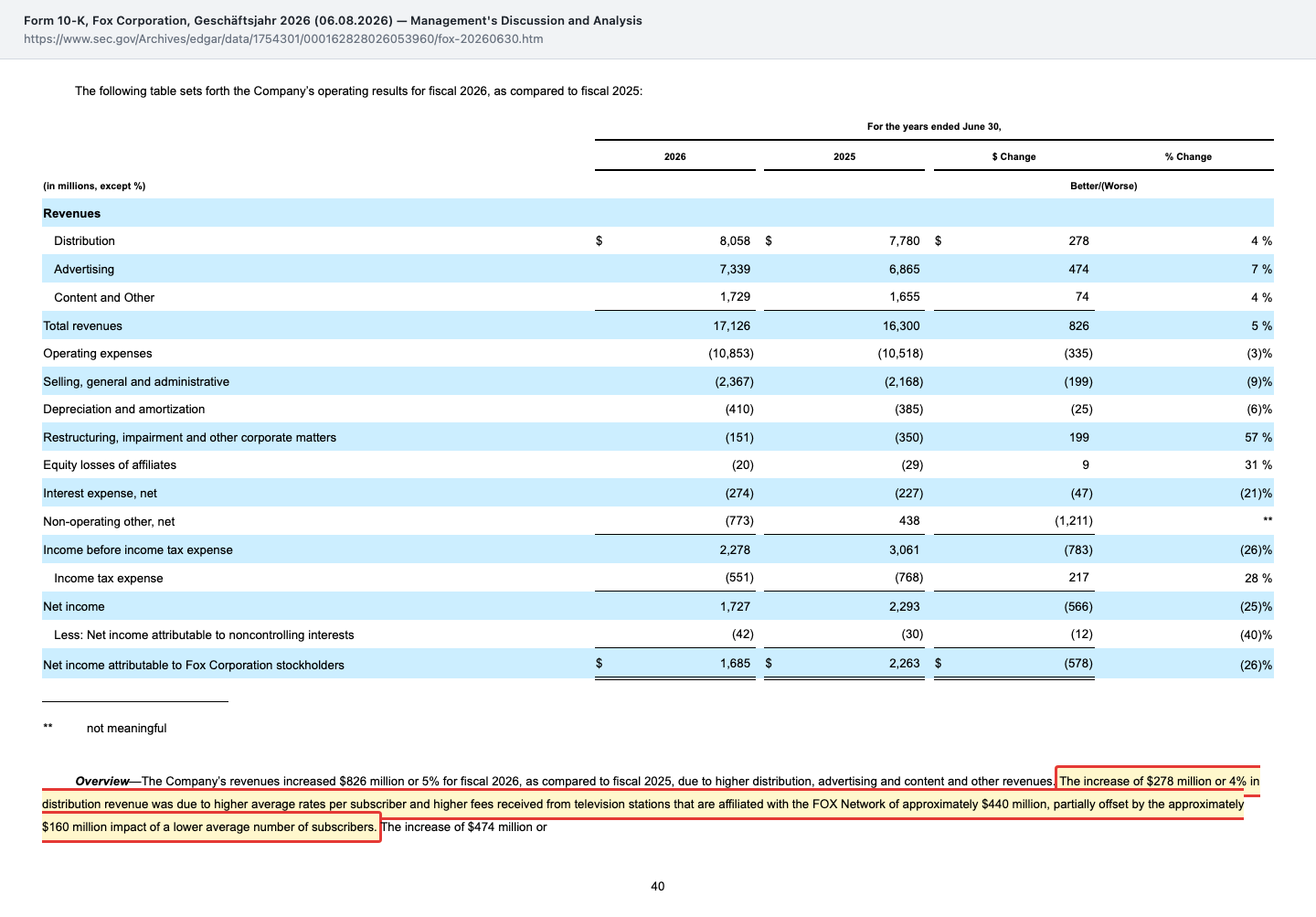
In plain terms: of the $278 million in additional distribution revenue, $440 million came from price increases — and $160 million was lost right back through fewer paying households. How large that erosion has become shows up in a Nielsen-based estimate of reach through traditional cable and satellite packages: FOX News fell from 67 million U.S. households (June 30, 2024) through 61 million to 55 million as of June 30, 2026 — down 18 percent in just two years. FS1 lost the same 18 percent over the period, and FOX Deportes lost 42 percent. And Fox itself expects no reversal:
"These industry-wide subscriber declines are expected to continue and possibly accelerate in the future."
— Fox Corporation, SEC annual report 10-K for fiscal 2026, Item 1A "Risk Factors"
Remember the picture: price increases are not a substitute for growth — they're a bandage on a wound the company itself says could get bigger. FOX One, the in-house streaming subscription, is meant to cushion this trend — but as shown in the previous chapter, Fox still doesn't disclose subscriber figures to back that up.
Uncomfortable truth no. 3: Roku turns Fox into a borrower on a whole new scale
At roughly $24.7 billion in preliminary consideration (as of August 27, 2026, dependent on the FOXA share price), the Roku deal is by far the largest transaction in Fox Corporation's young history — Fox is paying $96.00 in cash plus 0.9693 of its own Class A shares per Roku share, which by our calculation works out to roughly 4.7 times Roku's annual revenue of $5,209 million (the twelve months through June 30, 2026). It's financed to a large extent with debt: Fox needs about $9.8 billion in permanent financing, backstopped initially by a $12 billion bridge facility (since reduced to $11 billion after a separate $1.0 billion loan was signed). The pro-forma interest math shows the consequence: roughly $606 million of additional annual interest expense. That flows straight to the bottom line — reported earnings per share for fiscal 2026 would have been not $3.84 but only $1.05 on a pro-forma basis, had Fox already owned Roku for the whole year. Our own Roku analysis shows that founder Anthony Wood and his trusts, who control roughly 55 percent of Roku's voting power, have already committed to the deal — so on the seller side approval is secured; on Fox's side the committed block still needs just over eleven percentage points.
Fox's net debt would jump from about $2.4 billion today (0.63 times adjusted EBITDA) to roughly $15 billion pro forma — by our calculation from the pro-forma balance sheet in the proxy statement, roughly 3.9 times adjusted EBITDA, and that is without counting Roku's own earnings contribution and without counting the promised synergies. Fox itself communicates a noticeably lower figure:
"At closing, the company expects pro forma net leverage to be approximately 2.8x, inclusive of 50% credit for run-rate cost synergies."
— Fox Corporation, Press release on the Roku acquisition, June 15, 2026 (Ex. 99.1 to Form 8-K)
The gap between roughly 3.9 times and 2.8 times isn't a math error — it's an assumption: Fox counts Roku's own earnings contribution and is crediting itself with about $400 million of annual cost savings at half value before they've actually materialized; in the official pro-forma calculation shown in the proxy statement, those synergies don't appear at all. There are also firm deadlines: the U.S. antitrust waiting period, after an earlier withdrawal and refiling, expires on September 8, 2026; if the deal fails over antitrust or foreign-investment review, a special break fee of $1.237 billion applies, and in certain other termination scenarios — such as a change of board recommendation, a switch to a superior proposal or under the tail provision — a mutual fee of $866 million applies. The outside date by which the deal must close is June 14, 2027, automatically extendable to as late as March 14, 2028, if regulatory proceedings are still pending. Fox's own expected closing: the first half of calendar 2027 — a date still up to ten months away, one that will determine whether the $15 billion bet pays off.
Uncomfortable truth no. 4: a $2.7 billion lawsuit with no reserve — and a pay decision three days before the signature
Fox continues to carry an unquantified legal risk: the lawsuit filed by Smartmatic USA in February 2021.
"This includes the lawsuit filed by Smartmatic USA Corp. and certain of its affiliates (collectively, "Smartmatic") in February 2021 seeking $2.7 billion in damages."
— Fox Corporation, SEC annual report 10-K for fiscal 2026, Note 14 "Commitments and Contingencies"
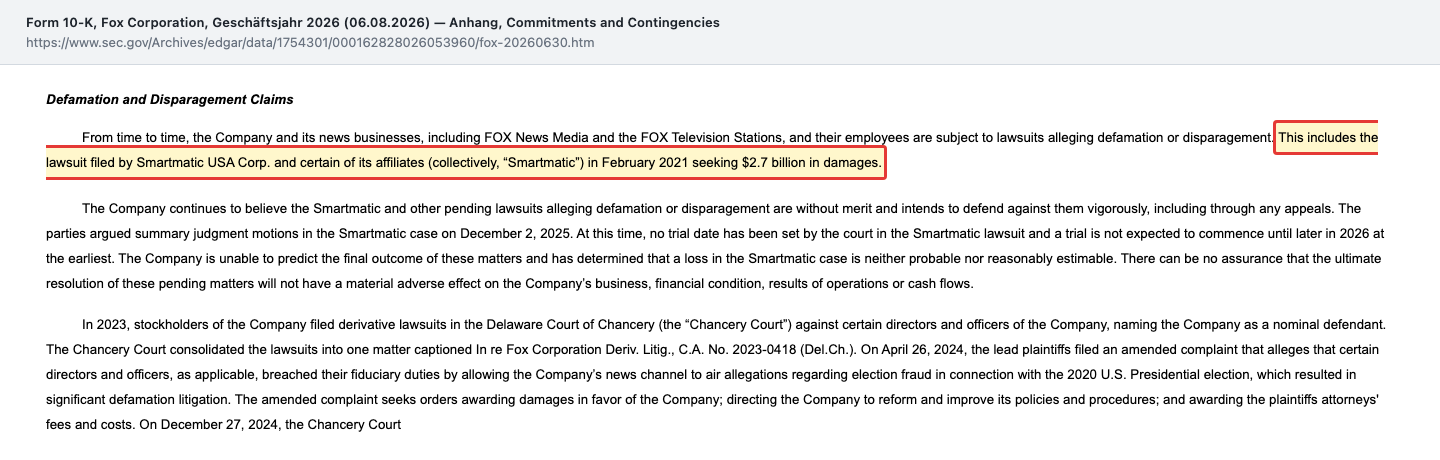
$2.7 billion is equal to 23 percent of shareholders' equity and 1.6 times all of fiscal 2026's GAAP net income — and yet Fox has recorded no reserve for it, because the company judges a loss "neither probable nor reasonably estimable." The report gives no trial date, and a trial is not expected before later in 2026 at the earliest — a date that has already slipped compared with last year's disclosure. For comparison, in the similarly structured Dominion Voting Systems case, Fox paid "approximately $800 million" in April 2023 to settle that suit and a related one; the annual reports we reviewed (fiscal 2023 through 2026) consistently state "approximately $800 million" for both matters combined.
A second find in the fine print concerns not the lawsuit but the timing of a compensation decision: just three days before the Roku purchase agreement was signed, the compensation committee and the board unanimously raised CEO Lachlan Murdoch's target pay:
"In addition, the Committee and the Board each unanimously approved an increase, beginning July 1, 2026, in Mr. Murdoch's target annual bonus to $9,000,000 and target annual equity award to $20,000,000."
— Fox Corporation, Form 8-K dated June 11, 2026, Item 5.02
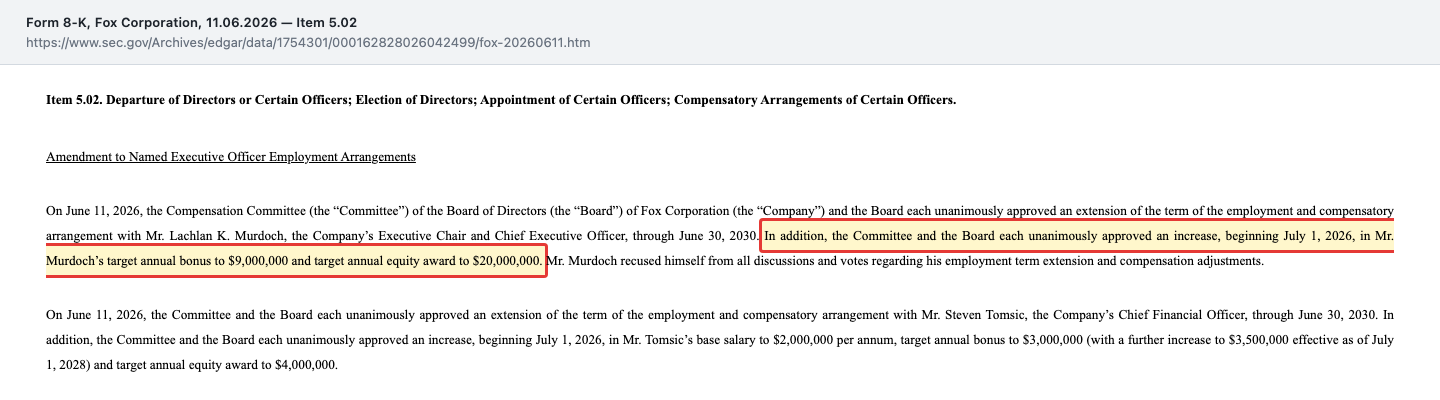
Per the same filing, Mr. Murdoch recused himself from all discussions and votes on the matter; the increase came with an extension of his contract through June 30, 2030, and CFO Steven Tomsic received a parallel extension through 2030 the same day, with base salary raised to $2,000,000, target bonus to $3,000,000 and target equity award to $4,000,000.
The Roku purchase agreement was signed June 14–15, 2026 — so the pay increase sits immediately before it. For scale against the workforce: for fiscal 2025, Fox reported total compensation for Lachlan Murdoch of just under $33 million, against $100,889 for the median employee — the typical worker, the one where half the workforce earns more and half earns less. That works out to a pay ratio of 327 to 1. None of this is illegal or unusual for a company this size, and a rising share price would benefit all shareholders alike. But the timing between the largest acquisition in the company's history and the chief executive's own increase in target pay is a detail we found only in the SEC filing, not in the June 15, 2026 deal press release.
Valuation: order of magnitude, not a daily price
How expensive is Fox? With roughly 420.4 million shares outstanding across both classes (as of August 17, 2026) and a share price around $67.40 as of August 31, 2026, the company's market value comes to roughly $28 billion — a figure that changes with every trading day and is therefore only useful as a rough order of magnitude, not as a reason to buy. Set against adjusted earnings per share ($5.42), that works out to a price-to-earnings ratio of about 12; on reported GAAP earnings per share ($3.84), it's about 17.5. That range — not a single figure — is the honest answer, because the two earnings numbers themselves sit as far apart as the previous chapter showed.
The balance sheet is solid today: net debt of about $2.4 billion equals only 0.63 times adjusted annual EBITDA, and both rating agencies confirm investment-grade ratings (Moody's Baa2, Standard & Poor's BBB, both with a stable outlook) — though that's before the Roku deal closes, whose impact on those ratings is still an open question. Professional analysts covering Fox saw fair value, per the price-target overview documented in the Form 424B3 (as of June 2026), between $54 and $85, with a mean and a median of $73 — the mean adds every target together and spreads it evenly, while the median is the point where half the targets sit above and half below; the fact that the two are nearly identical here shows the analysts' estimates cluster fairly symmetrically around that point.
Fox returned more to shareholders in fiscal 2026 than it earned: $2.0 billion in share buybacks plus $287 million in dividends ($0.56 per share for the year, with the semiannual dividend most recently raised to $0.29) add up to $2,287 million — 156 percent of the $1,468 million in free cash flow. That gap is funded from existing cash, which raises a question worth carrying into the next chapter given the looming Roku financing: how long can this pace continue alongside a $9.8 billion financing gap?
Opportunities and risks at a glance
What speaks for Fox Corporation:
- Record operating profit: adjusted EBITDA $3,906 million in fiscal 2026, up 32 percent since fiscal 2022 — carried by a cable segment with roughly 42 percent margin.
- Investment-grade balance sheet today: net debt only 0.63 times adjusted EBITDA, ratings Baa2 (Moody's) and BBB (Standard & Poor's), both with a stable outlook.
- A long-term sports-rights portfolio locked in: NFL through the 2033 season (league opt-out after 2029), MLB through 2028 — the next major package up for renewal is the FIFA World Cup.
- Digital growth businesses are finally delivering measurably: Tubi was profitable in every quarter of fiscal 2026, and FOX One, launched August 2025, is running above management's own expectations.
- Roku potentially opens a leading U.S. streaming distribution channel with an ad-supported business model, provided integration and the planned cost synergies materialize.
What speaks against it:
- FOXA shareholders have no vote over the largest capital commitment in the company's history — the decision rests with Class B alone; the largest block (LGC Holdco, about 38.8%) is already contractually bound.
- Structural cable subscriber decline: FOX News lost 18 percent of its cable households in two years (67 to 55 million), and Fox itself expects no reversal.
- The Roku financing lifts net debt, by our calculation from the pro-forma balance sheet, to roughly 3.9 times EBITDA without Roku's earnings contribution and without synergies — pro-forma earnings per share would fall from $3.84 to $1.05.
- Unquantified legal risk: the $2.7 billion Smartmatic lawsuit continues with no reserve recorded, and no trial date has been set.
- Shareholder returns (buybacks plus dividends) already exceeded free cash flow by 56 percent in fiscal 2026 — little buffer while a multibillion-dollar acquisition still needs financing.
A human conclusion
Back to the ballot-box fallacy from the opening. At Fox Corporation it's no footnote — it's the thread running through this entire analysis: a company that just posted its best operating year ever in fiscal 2026, is placing one of the largest bets in its history at $24.7 billion — and whose publicly traded stock has no say in that exact decision. That's not fraud, and it's not a scandal; it is spelled out in the charter and consistently in every filing we reviewed — the proxy statement and the annual reports for fiscal 2022 through 2026. It's just easy to skim past when you're looking at the record profit and not the footnote on share class.
What's left when you weigh both together? A profitable, partly structurally shrinking media business that uses its pricing power skillfully but is fighting a genuine erosion in viewers. A leadership team that has reliably kept — and even beaten — some promises (Tubi, the cord-cutting rate), while giving few hard numbers on others (Venu, Roku) — on Roku explicitly citing the pending transaction. And a capital structure that gives you, as a FOXA shareholder, an economic stake in the company's success — but no say over its biggest decisions. Whether that bothers you depends on how much a vote is actually worth to you as an investor — some don't mind at all as long as the numbers hold up; for others it's a dealbreaker, regardless of price. What you make of it is your decision. And that's exactly how it should be.
Sources
All original documents used in this analysis — to read for yourself:
- Fox Corporation — Joint proxy statement/prospectus (Form 424B3) dated September 1, 2026
- Fox Corporation — Annual report 10-K for fiscal 2026, filed August 6, 2026
- Fox Corporation — Annual report 10-K for fiscal 2025, filed August 6, 2025
- Fox Corporation — Annual report 10-K for fiscal 2024, filed August 8, 2024
- Fox Corporation — Fourth-quarter and fiscal 2026 earnings release, August 6, 2026
- Fox Corporation — Form 8-K on the Roku purchase agreement, June 15, 2026
- Fox Corporation — Press release on the Roku acquisition (Ex. 99.1 to Form 8-K), June 15, 2026
- Fox Corporation — Form 8-K on the term-loan financing, June 30, 2026
- Fox Corporation — Form 8-K on the executive pay increase, June 11, 2026
- Fox Corporation — Proxy statement (DEF 14A) for the 2025 annual meeting, September 25, 2025
- Full SEC filing history of Fox Corporation: EDGAR overview (sec.gov)
- Publicly available transcripts of the twelve quarterly earnings calls (November 2, 2023 through August 6, 2026)
- Fundamental data (metrics, segment data, valuation; data as of August 31, 2026), reconciled with the SEC filings above.
More research findings on Fox that didn't fit into the article are in our side finds.
Transparency & disclaimer: This analysis is a journalistic contextualization of publicly available information and is not investment advice, not a financial analysis in the regulatory sense, and not a solicitation to buy or sell securities. Stock investments carry substantial risks up to total loss. All information without warranty; the data cut-off is noted in the text. The author holds no position in Fox or Roku shares at the time of publication.
Key figures at a glance
All monetary figures in millions of $; earnings per share as reported.
| Metric | 2022 | 2023 | 2024 | 2025 | 2026 |
|---|---|---|---|---|---|
| Revenue | 13,974.0 | 14,913.0 | 13,980.0 | 16,300.0 | 17,126.0 |
| Operating Income (EBIT) | 2,574.0 | 2,764.0 | 2,478.0 | 3,229.0 | 3,345.0 |
| Net Income | 1,205.0 | 1,239.0 | 1,501.0 | 2,263.0 | 1,685.0 |
| Net Margin | 8.6% | 8.3% | 10.7% | 13.9% | 9.8% |
| Earnings Per Share | 2.11 $ | 2.33 $ | 3.13 $ | 4.91 $ | 3.84 $ |
Source: fundamental data & SEC filings (annual and quarterly reports, 10-K/10-Q)
Our Bottom Line at a Glance
- Operating substance positive
- Record operating profit in fiscal 2026: adjusted EBITDA $3,906 million (+32% since fiscal 2022), a cable segment with roughly 42 percent margin, net debt today only 0.63 times EBITDA, investment-grade ratings from Moody's (Baa2) and Standard & Poor's (BBB).
- Earnings quality neutral
- Reported GAAP net income fell 26 percent to $1,685 million in fiscal 2026, almost entirely because of a $761 million valuation loss on the Flutter stake — the same line item lifted the prior year's result. Adjusted net income ($2,381 million, +8%) shows the operating picture more clearly.
- Voting structure negative
- FOXA shareholders have no vote, per the proxy statement dated September 1, 2026, over the roughly 144 million new Class A shares tied to the Roku acquisition; the decision on October 14, 2026, rests solely with Class B; the largest block (LGC Holdco, about 38.8%) is already committed.
- Debt from Roku negative
- The Roku financing (about $9.8 billion of permanent financing, a $12 billion bridge) would push net debt, by our calculation from the pro-forma balance sheet, to roughly 3.9 times EBITDA without Roku's earnings contribution and without synergies; pro-forma earnings per share for fiscal 2026 would sit at $1.05 instead of $3.84.
- Subscriber losses negative
- FOX News cable reach fell from 67 to 55 million U.S. households in two years (06/30/2024 to 06/30/2026); price increases have cushioned the revenue impact so far, but Fox itself expects no reversal — possibly even an acceleration.
- Smartmatic legal risk neutral
- The $2.7 billion Smartmatic USA lawsuit continues with no reserve recorded since February 2021; as of the annual report filed August 6, 2026, no trial date has been set.
Fox Corporation shows two truths at once: a record operating year with $3,906 million in adjusted EBITDA — and a reported profit that dropped 26 percent because of a single peripheral stake. At the same time, the company is buying the streaming service Roku for about $24.7 billion, lifting net debt by our pro-forma calculation from $2.4 billion to roughly $15 billion — and letting only the voting Class B stock decide, not the publicly traded FOXA shares. Add a structural cable subscriber decline and an unquantified $2.7 billion lawsuit. Whoever invests is buying a solid but changing media business — without a say over its biggest decisions. Not investment advice.
What Our Rating Means
Open questions
The business works in principle, but one material question is open. As long as it stays open, our findings do not carry a quality verdict.
The operating business supports itself and is rated investment grade (Baa2/BBB) — but three material operational questions remain open: how the balance sheet handles net debt jumping from $2.4 billion to roughly $15 billion via Roku without the promised, not-yet-realized synergies; how far the cable subscriber decline continues, which Fox itself describes as possibly accelerating; and how the unquantified $2.7 billion Smartmatic lawsuit ultimately resolves. That is not a substance risk like insolvency or a governance breach, but it is not a resolved picture either — hence yellow, not green. The stock price plays no role in this rating. The decision is yours.
A journalistic assessment by our editorial team at the time of the deep dive, based on public sources — not investment advice and not a solicitation to buy or sell. Your personal circumstances (investment goals, risk capacity, taxes) cannot be taken into account. What our levels mean, how verdicts are formed, and what conflicts of interest exist →
Worth Noting
- This analysis was triggered by the fresh annual report (10-K) for fiscal 2026 filed August 6, 2026, together with the earnings release, and by the final proxy statement (Form 424B3) for the Roku acquisition dated September 1, 2026. Fundamental data as of August 31, 2026.
- Don't confuse the two: FOXA (Class A) is the widely traded, effectively non-voting class this analysis focuses on; FOX (Class B) carries the voting rights and is roughly one-third owned by the Murdoch family holding company LGC Holdco.
- Fox Corporation's fiscal year ends June 30, not December 31 — "fiscal 2026" refers to the period from July 1, 2025 through June 30, 2026.
Stock Watch
This analysis is as of September 2, 2026. Stock Watch will tell you what's changed at FOXA since then.
Later $1 a month per stock — signing up is free, and you'll be the first to know when it launches.
The full analysis as a PDF for later
We will send you this analysis as a PDF — to print, file away, and read at your own pace. And we will add you to the free Stock Watch list for Fox Corp Class A (FOXA), so you hear about it when something material in this analysis changes.
Frequently Asked Questions
Fox Corporation is organized as a dual-class structure: only Class B (ticker FOX) carries voting rights, while Class A (FOXA) is non-voting outside of four narrowly defined exceptions (dissolution, sale of substantially all assets, certain mergers, unpaid dividends). That is why only Class B, not the publicly traded FOXA stock, votes on the Roku acquisition on October 14, 2026.
FOXA (Class A) is the widely traded, effectively non-voting class, with about 200.2 million shares outstanding (as of 08/17/2026). FOX (Class B) carries the voting rights, comprises 220.2 million shares, and is roughly one-third owned by the Murdoch family holding company LGC Holdco. Economically the two classes are equal; the vote is what separates them fundamentally.
Under the preliminary calculation in the proxy statement dated September 1, 2026, Fox is paying about $24.7 billion: $96.00 in cash plus 0.9693 Fox Class A shares per Roku share. The value moves with the FOXA share price; a 10 percent price swing in either direction would put the consideration between $23.7 billion and $25.7 billion.
Reported GAAP net income fell 26 percent to $1,685 million because Fox's stake in Flutter Entertainment produced a $761 million valuation loss — a pure book-value swing. Adjusted for this and other one-off items, net income actually rose 8 percent to $2,381 million.
Fox Corporation's fiscal year ends June 30, not December 31. "Fiscal 2026" therefore refers to the period from July 1, 2025 through June 30, 2026 — a detail that is easy to miss when comparing Fox against companies with a calendar fiscal year.
Smartmatic USA has sought $2.7 billion in damages from Fox since February 2021. Per the annual report filed August 6, 2026, no trial date has been set, and Fox has recorded no reserve, judging a loss "neither probable nor reasonably estimable."
Found an error?
Did you spot a factual error, an outdated number, or a typo in this deep dive? Let us know briefly — your report goes straight to the editorial team.