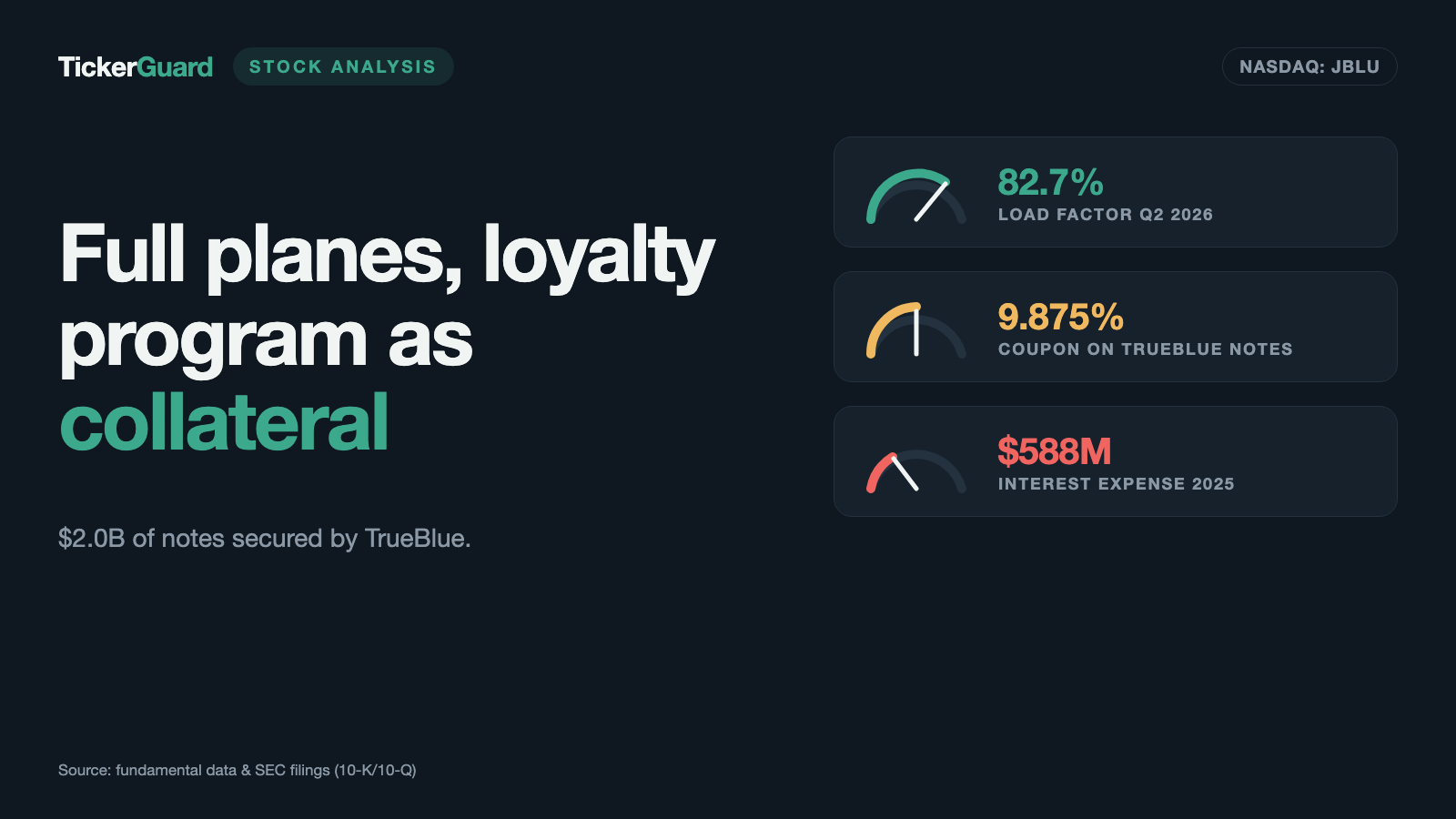
JetBlue Has Put Up Its Loyalty Program as Collateral — at 9.875 Percent Interest
JetBlue’s planes are full, and its loyalty program serves as collateral for the airline’s lenders. In 2025, interest cost $588 million while operations ran at a loss — a price below book value is not a discount coupon on its own.
 Thomas Mücke
Founder & Publisher
Thomas Mücke
Founder & Publisher
As of Today
As of: October 16, 2026
- Closing price
- 2.90 $ -7.00%
- Market Capitalisation
- 1.1 $B
- Growth Score
- 2/10
- AAQS
- 2/10
Price change since October 16, 2026: -1.0%
This analysis has a cut-off date. The Stock Guard tells you when something material changes in the numbers. Reserve your free spot
Chart
Interactive price chart (TradingView).
52-week range: 3.00 $ to 6.50 $ · Last price: 2.90 $ (As of: October 16, 2026)
Note: pure fact-based analysis, not investment advice and not a solicitation to buy or sell. All figures without guarantee.
The Bargain Trap: When a Low Share Price Looks Like a Discount
Picture yourself on a well-filled JetBlue flight from New York to Fort Lauderdale — in the second quarter of 2026, 82.7 percent of all seats were occupied — with the TrueBlue points for the trip landing in your account. What you don’t see from your seat: the loyalty program your points account belongs to serves as collateral for the airline’s lenders, securing $2.0 billion of notes at 9.875 percent interest (10-K for 2025). The planes are full, and yet JetBlue has borrowed against its customer program.
On the stock market, it looks like this: from the September 30, 2026 close ($4.23), the stock fell to $2.93 by October 16 — about 31 percent in just over two weeks, without any filing with the U.S. securities regulator, the SEC, explaining the decline. That means a share now costs less than the equity attributable to it on paper: $4.21 per share as of June 30, 2026. Bargain or warning sign?
This is where the bargain trap waits. At JetBlue, it looks like a ticket below list price: for $2.93 you get a share backed by $4.21 of book equity. But a ticket is good for a fixed flight, while book value is only a snapshot. If equity shrinks sharply every six months — and at JetBlue only one-third of the year-end 2019 level is left — the gap to the share price closes by itself, without the stock moving at all. A price below book value is therefore not a buy argument on its own.
That sets up the central tension of this analysis: demand is strong and the planes are full — but fuel, interest and shrinking equity eat every bit of progress before it reaches shareholders. Let’s read together what the SEC filings actually say. No recommendation, no forecast — just the documents.
Company history for investors
-
2000
First flight on February 11
Founded in 1998, JetBlue starts flying. By 2019 it has grown into a profitable airline with $569 million of annual net income and $4.80 billion of equity.
-
2020
Pandemic collapse
Revenue falls to $2.96 billion, the net loss reaches $1.35 billion. JetBlue has lost money every year since — the start of the equity drain.
-
2024
Spirit deal collapses, costly financing
In March the Spirit acquisition is terminated ($532 million write-off). In August JetBlue borrows $2.0 billion at 9.875 percent, secured by its loyalty program — the interest burden climbs.
-
2025
Blue Sky with United
In May JetBlue and United announce their partnership; from October customers earn points across both. The year ends with a $602 million loss and $588 million of interest expense.
-
2026
Fuel shock, Icahn group halves its stake
Fuel costs $4.23 per gallon in the second quarter (+76 percent). The Icahn group cuts its stake to 3.32 percent; its directors leave the board on Aug. 24, 2026.
What JetBlue Actually Does
JetBlue Airways Corporation was incorporated in Delaware in August 1998 and started flying on February 11, 2000 (10-K for 2025). It calls itself “New York’s Hometown Airline” and flies from its focus cities — New York (JFK), Boston, Fort Lauderdale, Los Angeles, Orlando and San Juan — to more than 100 destinations in the U.S., the Caribbean, Latin America, Canada and Europe. As of June 30, 2026, the fleet consisted of 296 Airbus aircraft (A220, A320, A321 and A321neo) with an average age of twelve years, according to the 10-Q. In 2025, JetBlue employed an average of 18,971 full-time and 3,116 part-time crewmembers.
The business model in one everyday picture: JetBlue sells seats that expire the moment the door closes. That is why airlines measure in “seat miles” — one seat flown one mile. Revenue per available seat mile (RASM) shows how well JetBlue sells; cost per available seat mile (CASM) shows what production costs. When the second number is above the first, JetBlue loses money on every mile. On top of that come the TrueBlue loyalty program with its co-branded credit card, the premium cabin “Mint,” and since May 2025 a partnership with United Airlines called “Blue Sky”: customers of both airlines earn and redeem points across both programs, and since the second quarter of 2026 elite members get reciprocal benefits. Management’s turnaround plan is called “JetForward”; according to the earnings release, it is meant to add $850 million to $950 million of annual operating income by the end of 2027, with $470 million cumulative through June 2026, by the company’s own estimate. The fiscal year is the calendar year.
How the Stock Landed on Our Desk
JetBlue made our research list through the Reddit hype scan of October 17, 2026 — in other words, through chatter in investor forums, not through a metric. The backdrop is a slide in the share price. We use the September 30, 2026 close as the reference point: $4.23. The same day, Carol Clements, JetBlue’s Chief Digital & Technology Officer, sold 2,000 shares at $4.29 according to an insider filing (Form 4) — under a pre-arranged trading plan (Rule 10b5-1) adopted on April 30, 2026. No connection to the later decline is documented. On October 16, 2026, the stock closed at $2.93, about 31 percent below the September 30 close and, according to the price history, the lowest close of the preceding twelve months. On October 13 and 14, more than 40 million shares changed hands each day, roughly one and a half times the average of the 50 trading days from July 22 to September 30 (about 26 million a day). No SEC filing explains the October decline; the most recent guidance update dates from September 10, 2026, and we cover it below.
The sentence to keep in mind for the rest of this analysis: a share price under $3 is only a discount if what stands behind it hasn’t changed. That is exactly what we check.
The Numbers Over the Years — Credit Where It’s Due
First, what impresses. JetBlue has recovered from the pandemic collapse: revenue fell to $2.96 billion in 2020 and reached $9.62 billion in 2023, above the 2019 level of $8.09 billion. In the second quarter of 2026, revenue rose 14.5 percent to $2.70 billion, the average ticket price was $237.38 versus $218.52, and 82.7 percent of all seats were filled. In Fort Lauderdale, where low-cost carrier Spirit has exited, capacity grew by nearly 40 percent — and unit revenue still rose 11 percent. According to the earnings release of July 28, 2026, the Mint premium cabin ranked highest in customer satisfaction among first/business passengers in the “J.D. Power 2026 North America Airline Satisfaction Study” for the second consecutive year. The chart shows revenue and net income since 2019:
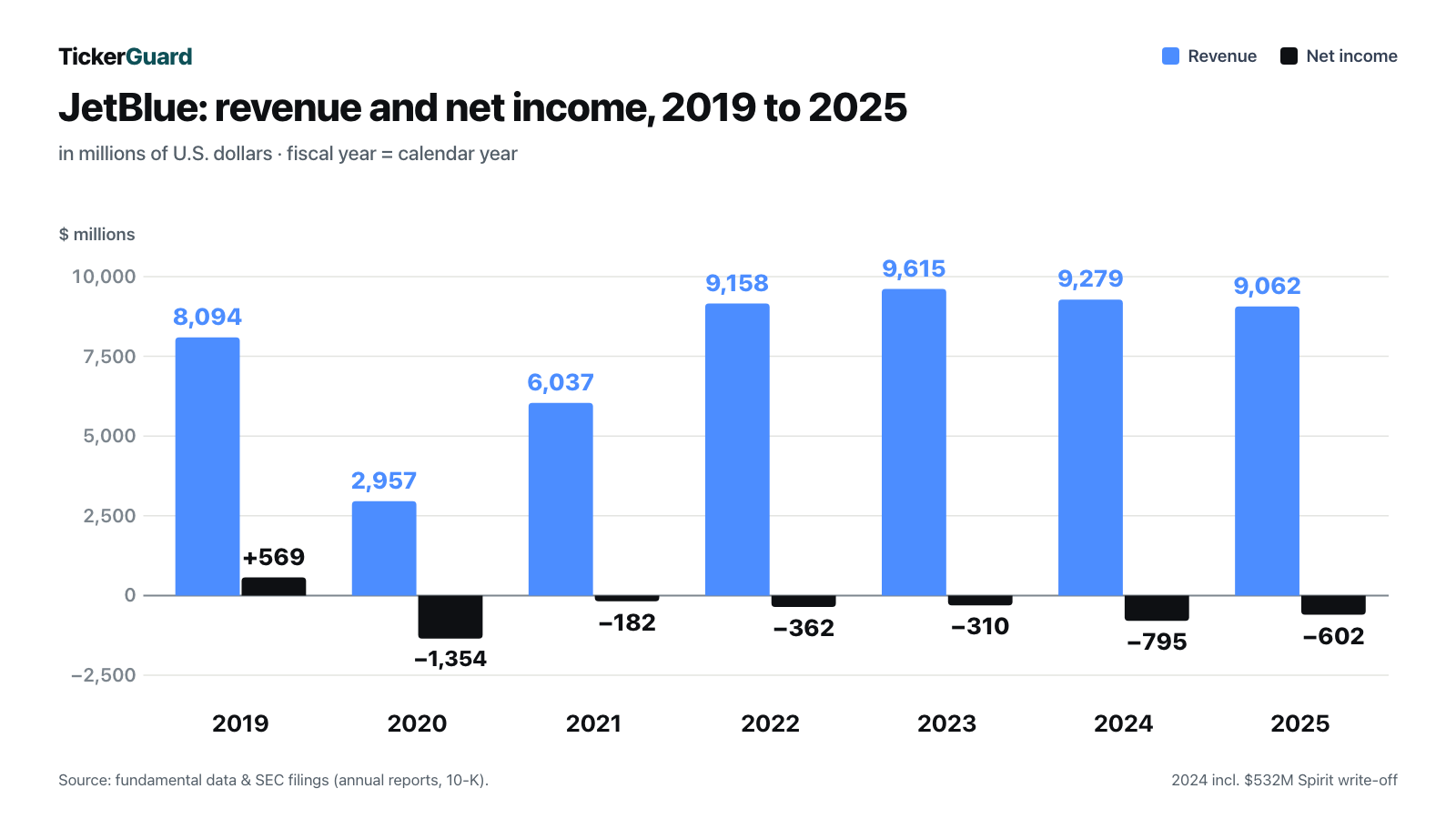
The chart shows the problem: revenue came back, profit did not. In 2019, JetBlue earned $569 million. Since then, every single year has ended in a loss — $3.6 billion in total from 2020 to 2025 (our calculation). 2024 included a $532 million write-off on the collapsed acquisition of Spirit Airlines, which was terminated by mutual agreement in March 2024 (including a $69 million breakup fee). The 2025 loss was $602 million, and the first half of 2026 added $566 million (prior year: $282 million). Operating cash flow turned negative in 2025 at −$94 million for the first time since 2020, while capital expenditures were $1.08 billion. Keep this picture in mind: more than $9 billion in revenue looks like a big company — but for six years nothing has been left at the bottom line.
What the Filings Say — The Uncomfortable Truths
Uncomfortable Truth No. 1: Fuel eats the revenue jump
The second quarter of 2026 is the clearest illustration of the tension. Revenue rose by $341 million; the fuel bill rose by $407 million to $911 million. A small operating profit of $6 million in the prior-year quarter turned into an operating loss of $141 million. The 10-Q gives the reason:
“The average fuel price increased by 76.3% to $4.23 per gallon and fuel consumption increased by 2.5%, or 5 million gallons.”
— JetBlue, SEC quarterly report 10-Q for June 30, 2026, Item 2, “Aircraft Fuel”

To be fair: fuel hits every airline, and according to the earnings release JetBlue recaptured nearly half of the higher fuel cost through pricing in the second quarter. Unit costs excluding fuel rose only 2.4 percent. But as of June 30, 2026, JetBlue had no outstanding fuel hedging contracts at all, according to the 10-Q. Every price spike hits in full and has to be passed on through fares — with a lag. JetBlue spells out the sensitivity itself: a 10 percent increase in fuel prices would raise fuel expense over the following twelve months by about $309 million. For the third quarter, management was already assuming $3.96 per gallon on September 10, 2026, instead of the $3.49 assumed in July. In everyday terms: the store is full, but the electricity bill for the freezers has risen faster than the prices at the register.
Uncomfortable Truth No. 2: Interest is growing faster than the business
To get through the loss years, JetBlue borrowed — and borrowed expensively. Debt including finance lease obligations rose from $2.35 billion at year-end 2019 to $8.54 billion as of June 30, 2026. The biggest piece: in August 2024, JetBlue raised $2.0 billion of notes at 9.875 percent interest and a further $765 million term loan, both secured by the TrueBlue loyalty program. In plain terms, the loyalty program serves as collateral for the lenders. The chart shows the result:
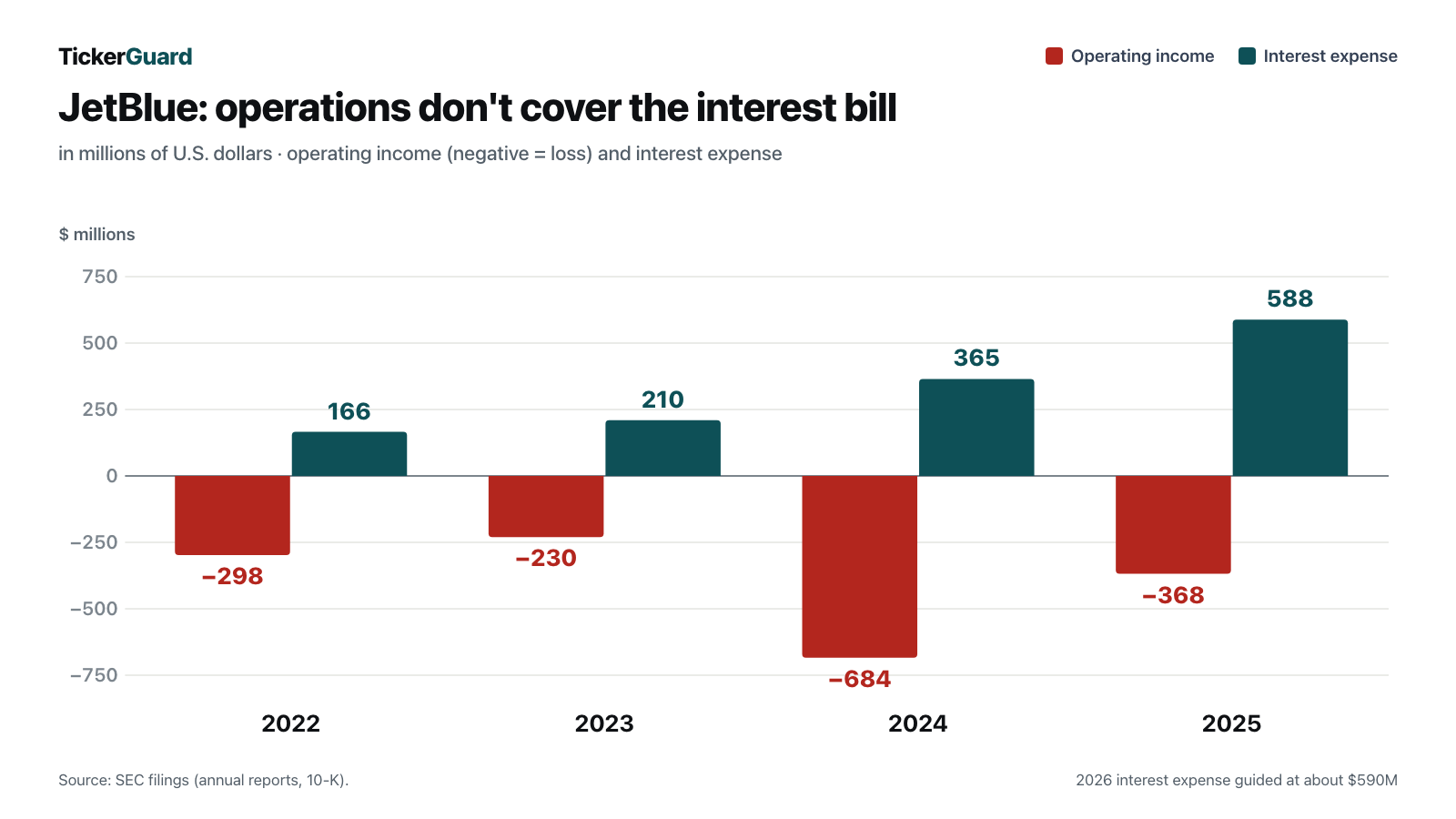
Lenders call the ratio of operating income to interest expense interest coverage. A healthy company earns its interest several times over. JetBlue came in at −0.6 in 2025 (−$368 million divided by $588 million, our calculation): the business not only fails to earn its interest, it loses money on top. Lenders have also attached conditions:
“The agreements governing the TrueBlue® Notes and TrueBlue® Term Loan Facility contain affirmative, negative and financial covenants including compliance with certain debt service coverage ratios and minimum liquidity requirements.”
— JetBlue, SEC quarterly report 10-Q for June 30, 2026, Item 2, “Contractual Obligations”
As of June 30, 2026, JetBlue was in compliance with all material covenants, according to the 10-Q. How much headroom remains is not disclosed. The sentence right below shows how much is already tied up as collateral:
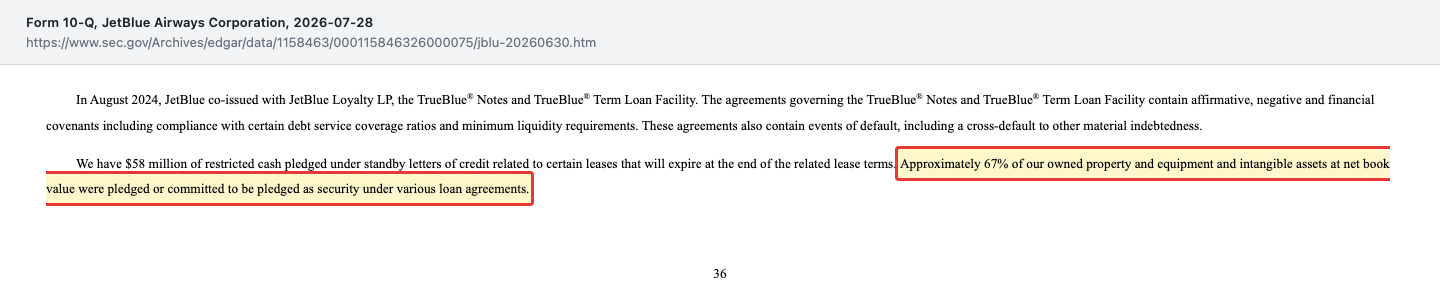
In everyday terms: two-thirds of the house already serves as collateral for loans, leaving less to borrow against for new loans. And maturities bunch up: according to the 10-Q, JetBlue owes about $2.31 billion for debt and finance leases including interest in 2029 — more than twice the 2027 amount ($1.04 billion). That year, the TrueBlue term loan and the $460 million 2.5 percent convertible notes come due; their conversion price of about $6.12 per share was more than double the stock price in mid-October 2026. As long as that holds, converting into stock makes no sense — so the convertible is first and foremost debt that has to be repaid in 2029.
Uncomfortable Truth No. 3: Equity is melting
Every loss is deducted from shareholders’ equity — the part of the company that belongs to shareholders after all debts are subtracted. At JetBlue, it looks like this:
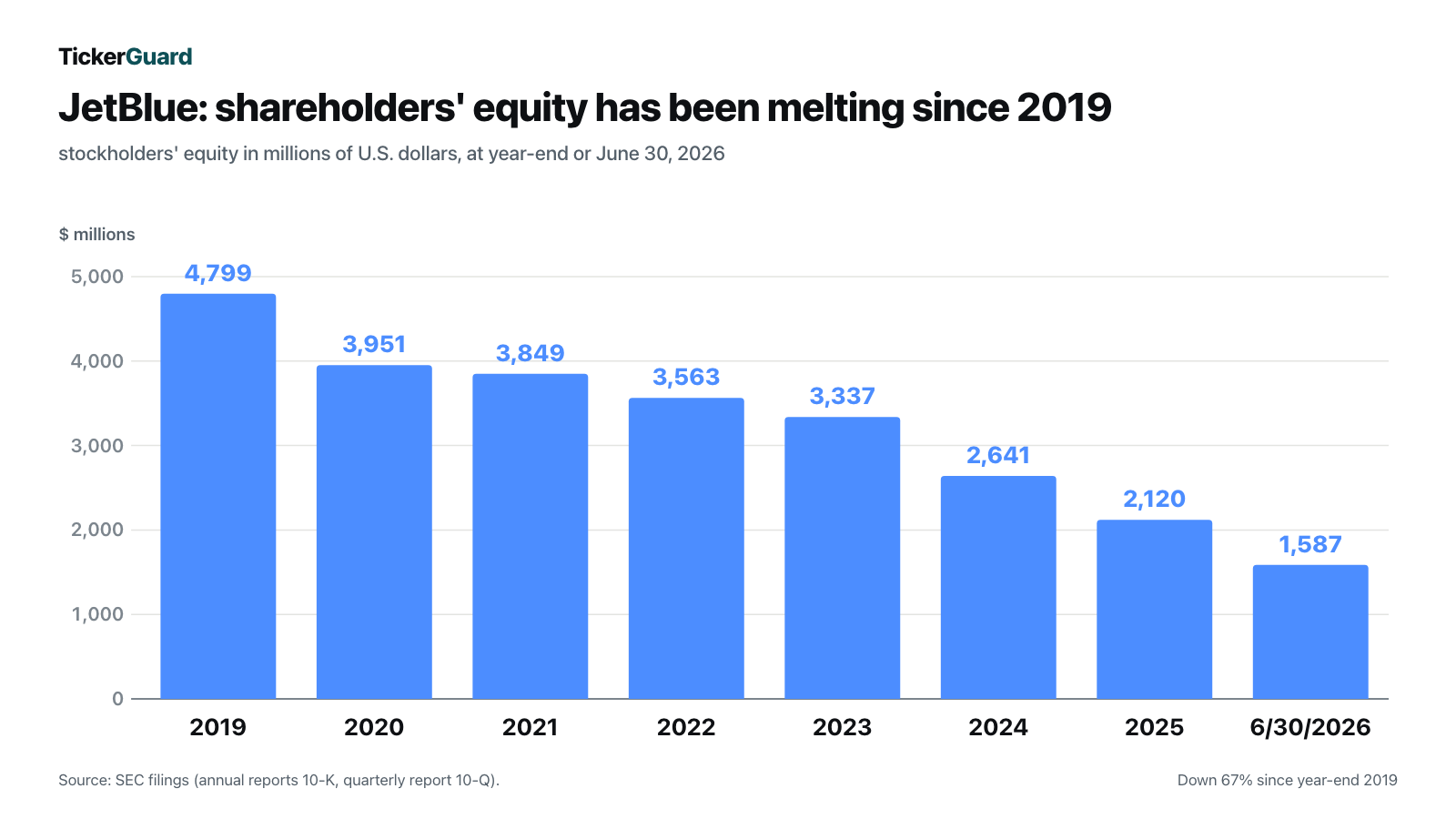
Of $4.80 billion at year-end 2019, $1.59 billion was left as of June 30, 2026 — about $4.21 per share (377.3 million shares, our calculation). In the first half of 2026 alone it fell by $533 million — about one-third of the equity that was left afterwards. An important distinction: shrinking or even exhausted equity is not the same as insolvency. Whether a company can pay its bills depends on its liquidity. The equity ratio — the share of total assets that shareholders finance themselves — was $1.59 billion out of $16.37 billion, just under 10 percent. Liquidity is still there: $2.2 billion of cash and investment securities as of June 30, 2026, plus an undrawn $600 million Citibank credit line. Management says this is sufficient for at least the next twelve months; the report contains no going-concern warning. But the liquidity is borrowed, not earned: in the first half of 2026, operating activities used $35 million, capital expenditures were $375 million, and cash plus investment securities fell from $2.48 billion to $2.17 billion. That happened even though JetBlue took out a new $500 million loan in April, secured by its own aircraft; in the same month, JetBlue repaid a $325 million convertible note that had come due.
Uncomfortable Truth No. 4: The Northeast is home base and concentration risk at once
JetBlue’s strength is the U.S. Northeast, above all New York and Boston. That is exactly where the trouble was in summer 2026. On September 10, 2026, the airline filed an 8-K with updated third-quarter guidance:
“JetBlue’s ATC-related cancellations nearly doubled, reflecting the greater operational impact in our core Northeast geographies.”
— JetBlue, SEC current report 8-K of September 10, 2026, Item 7.01

The numbers in the new guidance: capacity grows only 1.5 to 3.5 percent in the third quarter instead of 3 to 6 percent, unit costs excluding fuel rise 6 to 8 percent instead of 2.5 to 4.5 percent, and fuel costs $3.96 instead of $3.49 per gallon. The good news sits right next to it: unit revenue is expected to rise 17 to 20 percent instead of 12.5 to 16.5 percent, and demand is described as strong. What is missing is any statement on the full-year adjusted operating margin guidance (last −2 to −5 percent, as of July 28, 2026). Whether it holds will only become clear with the third-quarter earnings release. The 10-Q for September 30, 2026, had not been filed as of October 17, 2026.
Uncomfortable Truth No. 5: The Icahn group has halved its stake and left the board
In February 2024, JetBlue agreed to give investor Carl Icahn, who had built a large stake, two seats on its board. In 2026, the Icahn group reduced its stake. The group’s filings (Schedule 13D/A) show the sequence: according to the filing of May 14, 2026, the Icahn group held 24.99 million shares or 6.72 percent; according to the filing of June 9, 5.55 percent; and according to the filing of August 20, 2026, only 12.53 million shares or 3.32 percent. That ended the right to the board seats:
“On August 21, 2026, a representative of the Icahn Group (defined below) notified JetBlue Airways Corporation (the “Company”) that its ownership had decreased below the level that provided the right for the Icahn Group to have two director appointments, and in accordance with the Director Appointment and Nomination Agreement (the “Agreement”), dated as of February 16, 2024, by and among the Company and Carl C. Icahn and the persons and entities listed therein (collectively, the “Icahn Group”), each of Jesse Lynn and Steven D. Miller’s irrevocable resignation is effective as of August 24, 2026.”
— JetBlue, SEC current report 8-K of August 27, 2026, Item 5.02
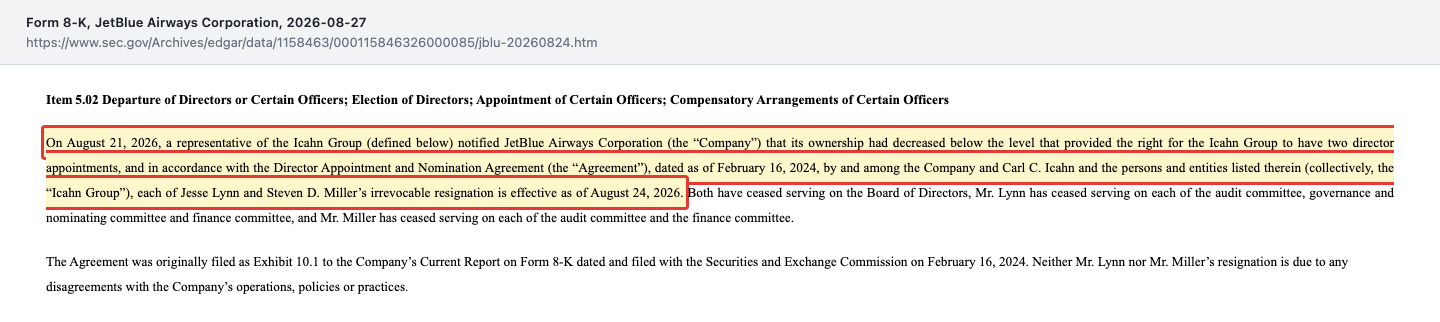
According to the filing, the resignations are not due to any disagreement with the company, and no filing gives a reason for the sales. What is documented is only the sequence: between mid-May and mid-August 2026, the Icahn group’s holding fell from 24.99 million to 12.53 million shares. With a stake below 5 percent, the Schedule 13D reporting obligation ends; further changes are only partly visible from the outside.
Valuation: About $1.1 Billion for an Airline With $9 Billion in Revenue
At the October 16, 2026 close ($2.93), JetBlue’s market value was about $1.1 billion, based on 377,312,181 shares outstanding (as of June 30, 2026, 10-Q). Cross-check with the sale price documented in the insider filing of September 30, 2026 ($4.29): about $1.6 billion at that time. That is roughly 0.12 times 2025 revenue and about 0.7 times book equity as of June 30, 2026. There is no price-to-earnings ratio because JetBlue is losing money.
An eighth of a year’s revenue sounds like a fire sale. But with an airline, the whole purchase price matters: anyone buying the entire company would have to take on the debt as well as the market value, and would get the cash in return. Market value ($1.1 billion) plus debt ($8.48 billion, including finance leases; excluding operating lease payments of $1.45 billion in total per the 10-Q) minus cash and investment securities ($2.17 billion) gives an enterprise value of about $7.4 billion (our calculation, as of June 30, 2026, and October 16, 2026), or 0.8 times revenue; including operating lease payments, it is about $8.9 billion. In plain terms: shareholders hold the thin top layer of a company that is financed roughly nine-tenths with other people’s money. That is why the stock swings so hard — small changes in earnings act like a lever on that top layer. On top of that come purchase commitments for 80 aircraft totaling $5.47 billion stretching into the 2030s (10-Q, Note 7).
Management pushes back: on July 28, 2026, it set a target of at least $1.00 of earnings per share for 2028 — about $377 million of net income at today’s share count (our calculation) — assuming continued strong demand and jet fuel at $3.00 per gallon. For comparison, fuel cost $4.23 per gallon in the second quarter of 2026. How another leisure-focused airline with a similar customer base but a different business model is faring is covered in our Allegiant analysis; for a look at a large European network airline, see our Lufthansa analysis.
Upside and Risks at a Glance
What speaks for JetBlue:
- Strong demand: second-quarter 2026 revenue +14.5 percent to $2.70 billion, unit revenue +10.9 percent, load factor 82.7 percent; third-quarter guidance: unit revenue +17 to +20 percent.
- The Spirit gap: in Fort Lauderdale, capacity grew nearly 40 percent with 11 percent higher unit revenue; plus the winning bid for former Spirit slots at New York-LaGuardia for $58.5 million (closing pending).
- A plan with numbers: by the company’s estimate, JetForward delivered $470 million of cumulative incremental operating income through June 2026, with a target of $850 million to $950 million a year by the end of 2027; 2028 target: at least $1.00 of earnings per share.
- Strong brand and partners: according to the earnings release, the Mint premium cabin led first/business customer satisfaction in the J.D. Power 2026 study for the second year in a row, loyalty revenue +13 percent in the second quarter of 2026, “Blue Sky” partnership with United.
- Liquidity for at least twelve months according to management: $2.2 billion plus an undrawn $600 million credit line (June 30, 2026).
What speaks against it:
- Six straight loss years, $3.6 billion in total from 2020 to 2025, plus $566 million in the first half of 2026.
- Expensive debt: $8.48 billion of debt (June 30, 2026), $588 million of interest expense in 2025 against negative operating income; about 67 percent of owned property, equipment and intangible assets pledged or committed.
- Melting equity: −67 percent since year-end 2019 to $1.59 billion, $533 million of that in the first half of 2026 alone.
- Unhedged fuel (no open contracts as of June 30, 2026): $4.23 per gallon in the second quarter of 2026, while the 2028 earnings target assumes $3.00.
- Northeast concentration: nearly twice as many air-traffic-control cancellations in summer 2026, higher cost guidance for the third quarter.
- According to its filings, the Icahn group cut its stake from 6.72 to 3.32 percent in 2026; its two directors left the board.
A Human Conclusion
Back to the bargain trap from the beginning. Its core is not that a low share price is always a warning. JetBlue has real strengths: full planes, a brand customers like, and with Spirit’s exit room to grow in Fort Lauderdale. The core is this: a low price is only a discount if the same thing still stands behind it. Behind JetBlue today stands one-third of its 2019 equity, more than three times as much debt, and an interest bill that operations have not covered in any year since 2022.
So the honest question for you is not “Is JetBlue cheap below $3?” but: Do you believe demand and the turnaround will work faster than fuel and interest can eat the remaining equity — and would you believe that even if you had never known the old share price? If yes, you have a thesis. If the gap to the old price was all that convinced you, you bought an anchor. What you make of it is your decision.
Sources
All original documents used in this analysis — so you can check them yourself:
- JetBlue Airways Corporation — SEC quarterly report 10-Q for June 30, 2026 (filed July 28, 2026)
- JetBlue Airways Corporation — SEC quarterly report 10-Q for March 31, 2026 (filed April 28, 2026)
- JetBlue Airways Corporation — SEC annual report 10-K for 2025 (filed February 12, 2026)
- JetBlue Airways Corporation — SEC annual report 10-K for 2024 (filed February 14, 2025)
- JetBlue Airways Corporation — Second-quarter 2026 earnings release, Exhibit 99.1 to the 8-K of July 28, 2026
- JetBlue Airways Corporation — 8-K of September 10, 2026 (updated third-quarter 2026 guidance)
- JetBlue Airways Corporation — 8-K of August 27, 2026 (resignation of the Icahn directors)
- Icahn group — Schedule 13D/A of May 14, 2026, June 9, 2026 and August 20, 2026
- JetBlue Airways Corporation — Insider filing (Form 4) of October 2, 2026 (sale at $4.29 on September 30, 2026)
- Complete SEC filing history: EDGAR overview (sec.gov)
- Fundamental data (prices, trading volume; data as of October 16, 2026), cross-checked against the SEC filings.
Transparency & disclaimer: This analysis is a journalistic assessment of publicly available information. It is not investment advice, not a financial analysis in the regulatory sense and not a solicitation to buy or sell securities. Investing in stocks involves substantial risk, up to and including total loss. All information without guarantee; the data date is noted in the text. Positions held by the operator are disclosed daily; where one exists, it appears as a notice at the top of this deep dive.
Key figures at a glance
All monetary figures in millions of $; earnings per share as reported.
| Metric | 2021 | 2022 | 2023 | 2024 | 2025 |
|---|---|---|---|---|---|
| Revenue | 6,037.0 | 9,158.0 | 9,615.0 | 9,279.0 | 9,062.0 |
| Operating Income (EBIT) | -80.0 | -298.0 | -230.0 | -684.0 | -368.0 |
| Net Income | -182.0 | -362.0 | -310.0 | -795.0 | -602.0 |
| Net Margin | -3.0% | -4.0% | -3.2% | -8.6% | -6.6% |
| Earnings Per Share | -0.57 $ | -1.12 $ | -0.93 $ | -2.29 $ | -1.63 $ |
Source: fundamental data & SEC filings (annual and quarterly reports, 10-K/10-Q)
Our Bottom Line at a Glance
- Demand & brand positive
- Second-quarter 2026 revenue +14.5 percent to $2.70 billion, unit revenue +10.9 percent, load factor 82.7 percent. In Fort Lauderdale, capacity grew nearly 40 percent after Spirit’s exit, with 11 percent higher unit revenue.
- Profitability negative
- Losses every year since 2020, $3.6 billion in total through 2025; another $566 million in the first half of 2026. In the second quarter of 2026, fuel expense rose by $407 million, more than revenue.
- Debt & interest negative
- $8.48 billion of debt as of June 30, 2026; interest expense of $588 million in 2025 against an operating loss of $368 million — interest coverage of about −0.6. About 67 percent of owned property, equipment and intangible assets are pledged or committed.
- Equity & liquidity negative
- Equity fell from $4.80 billion (2019) to $1.59 billion (June 30, 2026), −$533 million in the first half of 2026 alone. Liquidity of $2.2 billion plus an undrawn $600 million credit line; sufficient for at least twelve months, according to the company.
- JetForward turnaround neutral
- By the company’s estimate, $470 million of cumulative incremental operating income through June 2026, targeting $850 million to $950 million a year by the end of 2027; 2028 target of at least $1.00 of EPS assuming jet fuel at $3.00 per gallon.
JetBlue is a textbook example of how the bargain trap works: the stock traded below $3 in mid-October 2026, the planes are full, and Spirit’s exit opens growth in Fort Lauderdale. Behind that, however, stand six loss years, $8.48 billion of debt with $588 million of interest expense in 2025, and shareholders’ equity that has shrunk by two-thirds since 2019. Not investment advice.
What Our Rating Means
Substance risk
We found at least one documented issue that threatens the company itself — regardless of how the stock is currently valued.
The brand is strong and demand is proven — that is not the issue. The rating is driven by the balance sheet: operations have not covered interest in any year since 2022 (interest coverage of about −0.6 in 2025), equity has shrunk 67 percent since 2019, and about two-thirds of owned property, equipment and intangible assets are already tied up as collateral. The 10-Q contains no going-concern warning, and according to the company, $2.2 billion of liquidity covers at least twelve months. What the next reports need to show:does the full-year margin guidance hold, do fuel prices fall, and does JetForward show up in earnings? The decision is yours.
A journalistic assessment by our editorial team at the time of the deep dive, based on public sources — not investment advice and not a solicitation to buy or sell. Your personal circumstances (investment goals, risk capacity, taxes) cannot be taken into account. What our levels mean, how verdicts are formed, and what conflicts of interest exist →
Worth Noting
- JetBlue made our research list through the Reddit hype scan of Oct. 17, 2026. The latest periodic report is the 10-Q for June 30, 2026 (filed July 28, 2026, together with the earnings release and guidance); all filings through Oct. 17, 2026, were reviewed (8-Ks of Aug. 27 and Sept. 10, 2026, Schedule 13D/A of Aug. 20, 2026, S-8 of July 31, 2026, Form 4 through Oct. 2, 2026). The 10-Q for Sept. 30, 2026, had not been filed as of Oct. 17, 2026.
- Market value (about $1.1 billion) calculated from 377,312,181 shares (10-Q, as of June 30, 2026) and the Oct. 16, 2026 close ($2.93). Cross-check with the sale price in the insider filing (Form 4) of Sept. 30, 2026 ($4.29): about $1.6 billion. An older market value from the fundamental data (as of July 2026, about $2.2 billion) was not used because it predates the price decline.
- Interest coverage, enterprise value (market value plus debt of $8.48 billion minus cash and investment securities of $2.17 billion), book equity per share and the sum of losses 2020–2025 are our calculations. Multi-year figures 2019–2023 come from the XBRL data of the respective annual reports; 2019 debt ($2.35 billion) includes finance lease obligations.
- Adjusted operating margin and unit costs excluding fuel are company metrics without a U.S. GAAP definition. JetForward contributions ($470 million cumulative) are management estimates, not audited figures.
Stock Watch
This analysis is as of October 17, 2026. Stock Watch will tell you what's changed at JBLU since then.
Later $1 a month per stock — signing up is free, and you'll be the first to know when it launches.
The full analysis as a PDF for later
We will send you this analysis as a PDF — to print, file away, and read at your own pace. And we will add you to the free Stock Watch list for JetBlue Airways Corp (JBLU), so you hear about it when something material in this analysis changes.
Frequently Asked Questions
JetBlue Airways Corporation (Nasdaq: JBLU) is a U.S. airline headquartered in Long Island City, New York. It flies from New York, Boston, Fort Lauderdale, Los Angeles, Orlando and San Juan to more than 100 destinations in North and Latin America, the Caribbean and Europe. As of June 30, 2026, its fleet had 296 Airbus aircraft; 2025 revenue was $9.06 billion.
JetBlue has posted a net loss every year since 2020 — $602 million in 2025. Its cost per available seat mile is above its revenue per seat mile; in the second quarter of 2026, fuel expense rose by $407 million, more than revenue (+$341 million). On top of that came $588 million of interest expense in 2025.
As of June 30, 2026, JetBlue had $8.48 billion of debt ($8.54 billion before issuance costs), including $2.0 billion of 9.875 percent notes secured by the TrueBlue loyalty program. About 67 percent of owned property, equipment and intangible assets are pledged or committed as collateral. Liquidity was $2.2 billion.
The 10-Q for June 30, 2026, contains no going-concern warning; management considers $2.2 billion of liquidity plus an undrawn $600 million credit line sufficient for at least twelve months. However, equity has shrunk 67 percent since 2019 to $1.59 billion, and operations have not covered interest expense for years.
The Spirit acquisition, called off in 2024, cost JetBlue a $532 million write-off. Spirit’s exit now opens room to grow: in Fort Lauderdale, JetBlue’s capacity rose nearly 40 percent in the second quarter of 2026 with 11 percent higher unit revenue, and in July 2026 JetBlue won the bid for former Spirit slots at LaGuardia for $58.5 million.
No filing gives a reason. The sequence is documented: according to its filing of May 14, 2026, the Icahn group held 6.72 percent; according to its filing of Aug. 20, 2026, 3.32 percent. That ended its right to two board seats; Jesse Lynn and Steven D. Miller resigned effective Aug. 24, 2026 — according to JetBlue, not because of any disagreement.
At the Oct. 16, 2026 close ($2.93), the market value was about $1.1 billion — roughly 0.12 times 2025 revenue and about 0.7 times book equity. Adding debt and subtracting cash gives an enterprise value of about $7.4 billion, or 0.8 times revenue. There is no P/E ratio because of the losses.
Found an error?
Did you spot a factual error, an outdated number, or a typo in this deep dive? Let us know briefly — your report goes straight to the editorial team.