Winnebago Guarantees $1.78 Billion of Dealer Inventory — and Still Raises Its Dividend
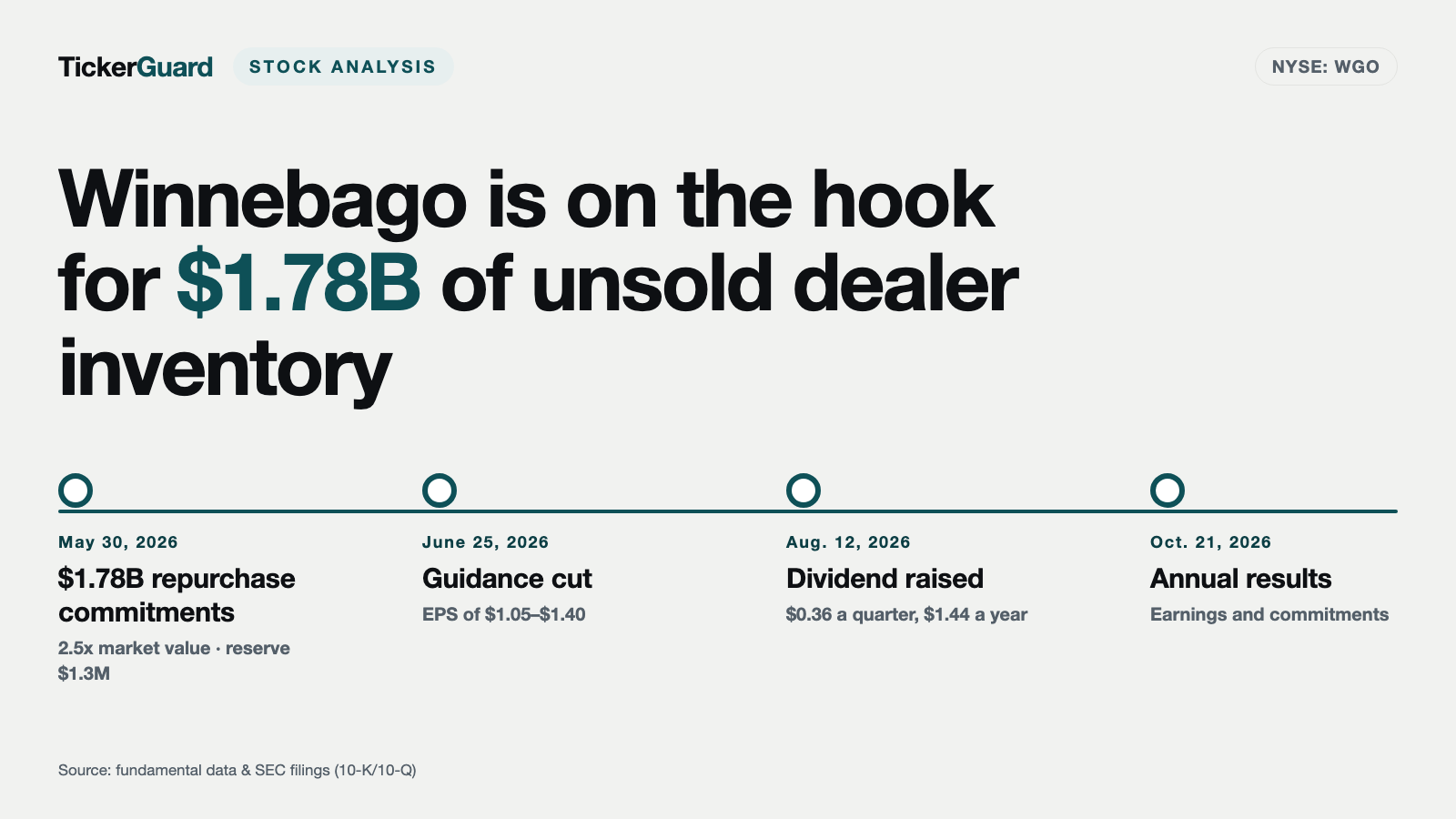
$1.78 billion: that is how much inventory on its dealers' lots Winnebago stands behind with the lenders that finance it (May 30, 2026) — about 2.5 times its market value, against a $1.3 million reserve. Dealer towable inventory is growing (up 5.5 percent) while shipments shrink (down 26.5 percent). Yet in August 2026 Winnebago raised its dividend to $0.36 a quarter, seven weeks after cutting earnings guidance to $1.05 to $1.40 per share — three years after the peak of the camping boom, the company earns about one-fifteenth of what it earned then. Results are due on Oct. 21, 2026, and these are the lines that will matter.
 Thomas Mücke
Founder & Publisher
Thomas Mücke
Founder & Publisher
As of Today
As of: October 16, 2026
- Closing price
- 24.00 $ -2.60%
- Market Capitalisation
- 0.7 $B
- Growth Score
- 2/10
- AAQS
- 4/10
Price change since October 15, 2026: -2.7%
This analysis has a cut-off date. The Stock Guard tells you when something material changes in the numbers. Reserve your free spot
Chart
Interactive price chart (TradingView).
52-week range: 23.10 $ to 49.90 $ · Last price: 24.00 $ (As of: October 16, 2026)
Note: pure fact-based analysis, not investment advice and not a solicitation to buy or sell. All figures without guarantee.
The Waterline Trap: What Isn't on the Balance Sheet Doesn't Feel Real
Picture a dealer lot somewhere in the Midwest: row after row of shiny travel trailers, price tags behind the glass, hardly a customer in sight. The dealer did not pay for most of them — a bank financed the inventory. And behind the bank stands a second guarantor nobody on the lot can see: the manufacturer. If the dealer can't pay, Winnebago takes the units back. That commitment does not appear on any balance-sheet line; it sits in the notes to the quarterly report — and on May 30, 2026, it came to about $1.78 billion, roughly 2.5 times what the entire company was worth on the stock market on Oct. 15, 2026.
This is where a weakness every investor knows sets in: the waterline trap. We value what we can see — price, dividend, earnings — and treat what lies below the surface as if it weren't there. Winnebago offers both: below the waterline, repurchase commitments that grow while dealer lots get fuller and shipments get smaller; above it, a dividend the board raised on Aug. 12, 2026, from $0.35 to $0.36 a quarter — seven weeks after the same company had cut its earnings guidance. That defines the central tension of this deep dive: Winnebago stands behind more and more dealer inventory while paying out more than it earns per share. Whether that holds will show by the Oct. 21, 2026, results at the latest. Let's read together what Winnebago told the U.S. securities regulator, the SEC. No recommendation, no forecast — just the filings.
Company history for investors
-
2022
Peak of the camping boom
Record revenue of $4,957.7 million and $390.6 million of net income ($11.84 per share). For shareholders, the top of a cycle, not the new normal.
-
2024
Earnings collapse and Chris-Craft write-down
Only $13.0 million of net income, including a $30.3 million Chris-Craft goodwill impairment. The dividend ($1.27) exceeds earnings per share ($0.44) for the first time.
-
2026
Guidance cut, dividend raised
On June 25, 2026, EPS guidance falls to $1.05–$1.40; on Aug. 12, 2026, the dividend rises to $1.44 a year. Earnings do not cover the payout.
What Winnebago Actually Does
Winnebago Industries, Inc., headquartered in Eden Prairie, Minnesota, builds recreational vehicles and boats in three segments. Towable RVs — trailers pulled by a car or truck — under the Grand Design and Winnebago brands generated $1,220.2 million in revenue in fiscal 2025. Motorhome RVs under Winnebago, Newmar and Grand Design brought in $1,159.7 million. Marine, with Chris-Craft and the pontoon maker Barletta, added $367.8 million. A battery business, Lithionics, rounds out the portfolio.
Winnebago sells to dealers, not campers: as of Aug. 30, 2025, its dealer network in the U.S. and Canada had more than 760 locations, and no dealer organization accounted for more than 10 percent of revenue (fiscal 2025 10-K). The company employed about 5,300 people at that date. One thing matters for every number in this analysis: the fiscal year ends in late August, on the last Saturday of the month. Fiscal 2026 ran from late August 2025 to Aug. 29, 2026. Put simply, Winnebago sells vacation dreams on wheels — and people buy vacation dreams when money is loose, not when interest rates and gas prices bite.
How the Stock Landed on Our Desk
Winnebago made our research list through the Reddit hype scan of Oct. 17, 2026 — through chatter in investor forums, not through a metric. The share price path of the preceding weeks can be traced through insider filings: on Aug. 13, 2026, CEO Michael Happe exercised stock options and sold 12,045 shares at $32.68 (Form 4). On Oct. 15, 2026, when a tranche of previously granted executive stock vested, Winnebago withheld shares for taxes at $24.66. Between those two filings the stock fell about 25 percent (our calculation). Apart from two further sales by the chief human resources officer after option exercises (Aug. 13 and 19, 2026), all insider filings since August concern grants and tax withholding; no insider reported an open-market purchase on Form 4.
A fallen stock with a raised dividend is exactly the kind of thing forums talk about: a $1.44 annual dividend on a $24.66 share price is a dividend yield of about 5.8 percent (our calculation). The sentence to keep in mind for the rest of this analysis: a high yield is only good news if the business earns it — and if nothing below the waterline can eat it up.
The Numbers Over the Years — Credit Where It Is Due
First, what impresses. Over a decade, Winnebago has grown from an Iowa motorhome builder into a group with five well-known brands. Revenue rose from $1,985.7 million in fiscal 2019 to a peak of $4,957.7 million in fiscal 2022, and net income from $111.8 million to $390.6 million. The pandemic years turned traveling in your own RV into a mass-market wish, and Winnebago delivered. The chart shows what came next:
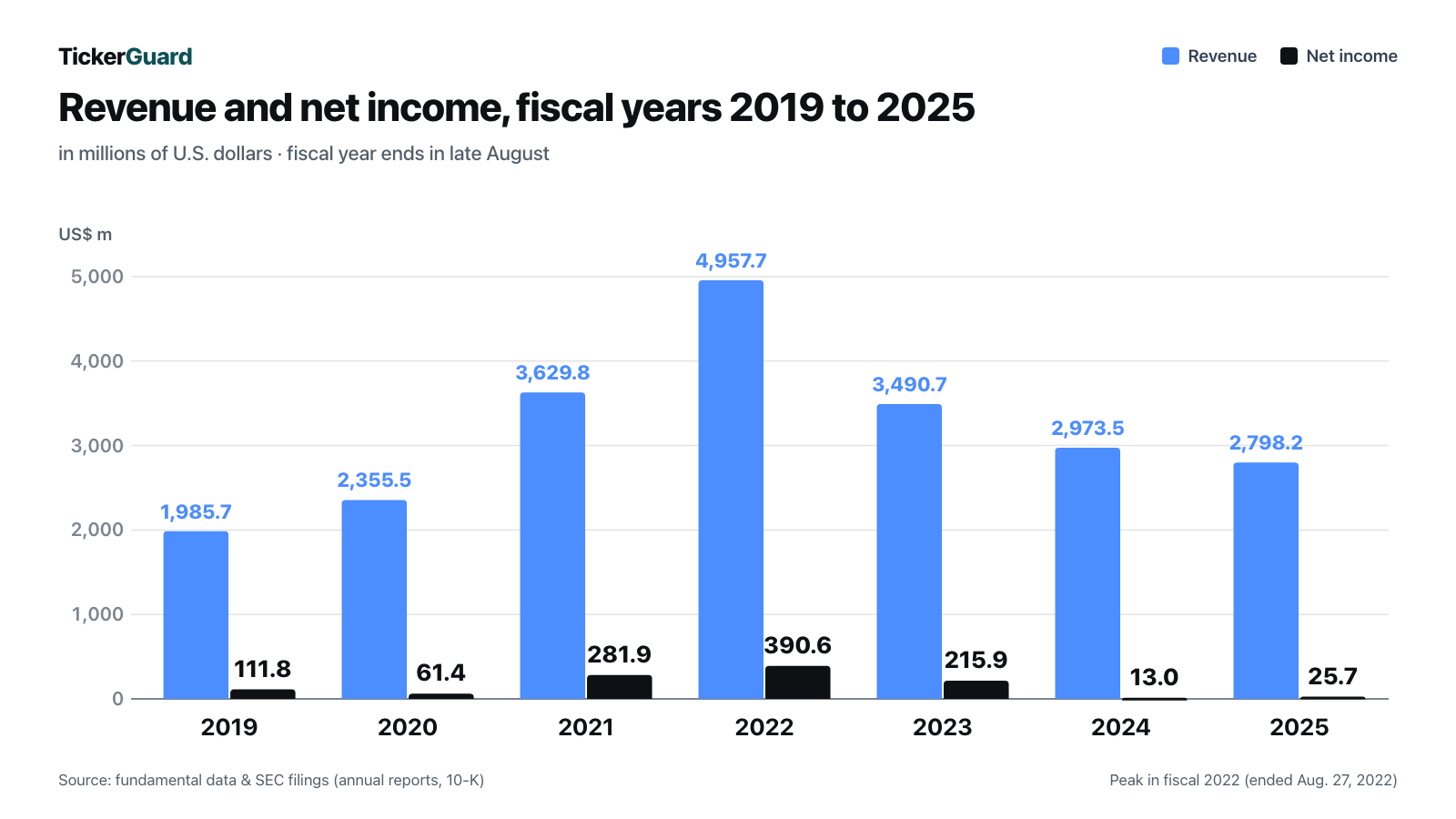
From the 2022 peak to fiscal 2025, revenue fell 43.6 percent and net income 93.4 percent (our calculation). That is the essence of a cyclical — a company whose earnings swing not a little but many times over with the economy. Think of it this way: factories, wages and interest cost almost as much in a slump as in a boom; only the customers are missing. In fiscal 2024, just $13.0 million of profit was left from $2,973.5 million of revenue, including a $30.3 million goodwill impairment for the Chris-Craft boat brand.
The current fiscal year initially looked like a recovery: in the first nine months through May 30, 2026, revenue rose slightly to $2,058.8 million (prior year: $2,020.9 million) and net income to $24.8 million (prior year: $12.0 million). The motorhome segment did most of the lifting: its third-quarter revenue rose 10.1 percent to $320.7 million, and an operating loss of $3.2 million turned into a profit of $9.6 million. Keep this picture in mind: Winnebago is profitable, but at a level where any swing in the market can cost half the profit.
What the Filings Say — the Uncomfortable Truths
Uncomfortable Truth No. 1: A $1.78 billion commitment sits in the notes to the financial statements
RV dealers rarely pay for their lot inventory themselves. A bank finances it (“floorplan” financing), and the manufacturer promises the bank to take the units back if the dealer defaults. That is industry practice — but the size is disclosed not on the balance sheet but in the notes:
“The total contingent liability on all repurchase agreements was approximately $1,777.7 million and $1,640.0 million at May 30, 2026 and August 30, 2025, respectively.”
— Winnebago Industries, SEC quarterly report 10-Q for the quarter ended May 30, 2026, Note 9 “Contingent Liabilities and Commitments”
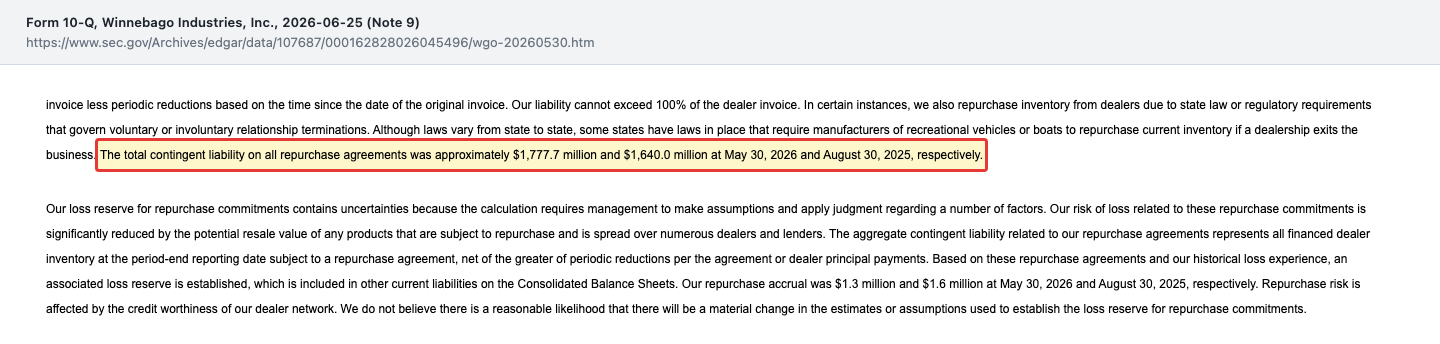
$1,777.7 million is more than total shareholders' equity ($1,234.4 million on May 30, 2026) and about 2.5 times the market value (our calculation). For context: that is the maximum due if every financed dealer lot came back at once — an extreme scenario. The units would still have resale value, and the risk is spread across many dealers and lenders. That is why Winnebago carries a loss reserve of only $1.3 million and reports no material repurchase activity for the first nine months of fiscal 2026. The uncomfortable part is the direction: commitments on May 30, 2026, were 4.1 percent above the prior-year date ($1,707.2 million), even though quarterly revenue fell 9.9 percent. And dealer inventory of Winnebago towables stood at 18,721 units, 5.5 percent above the prior year, while Winnebago shipped 26.5 percent fewer towables. In other words: more product is sitting on dealer lots, turning more slowly — and Winnebago stands behind it if things go wrong.
Uncomfortable Truth No. 2: Guidance was cut — and the fourth quarter will be weaker
The third-quarter results on June 25, 2026, brought a sobering moment. Quarterly revenue fell 9.9 percent to $698.7 million and diluted earnings per share went from $0.62 to $0.51. The towable segment, the largest in fiscal 2025, was hit hardest: its revenue plunged 26.1 percent to $274.7 million, towable unit deliveries fell 26.5 percent, and fifth-wheel deliveries dropped 41.6 percent. And Winnebago cut its full-year outlook:
“Reported earnings per diluted share in the range of $1.05 to $1.40 compared to the Company's prior expectations for reported earnings per diluted share in the range of $1.50 to $2.20”
— Winnebago Industries, Q3 fiscal 2026 earnings release, Exhibit 99.1 to the 8-K of June 25, 2026, “Outlook”

Revenue guidance is $2.65 billion to $2.75 billion. After $2,058.8 million in nine months, that leaves $591 million to $691 million for the fourth quarter — 11 to 24 percent below the $777.3 million of the prior-year fourth quarter (our calculation). CEO Michael Happe offered no hope of a quick turnaround:
“We expect demand conditions to remain challenged in the near term, with continued variability across segments.”
— Winnebago Industries, Q3 fiscal 2026 earnings release, Exhibit 99.1 to the 8-K of June 25, 2026
Winnebago cited higher fuel costs, geopolitical uncertainty and weak consumer confidence. How the year actually ended will show in the results Winnebago has scheduled for Oct. 21, 2026 (press release of Sept. 23, 2026). This analysis is based on the 10-Q for the quarter ended May 30, 2026; the fiscal 2026 10-K had not been filed as of Oct. 17, 2026.
Uncomfortable Truth No. 3: The dividend has exceeded earnings for two years
Now to the visible side, the payout. Dividends declared per share rose from $0.66 in fiscal 2021 to $1.37 in fiscal 2025. Earnings per share went the other way:
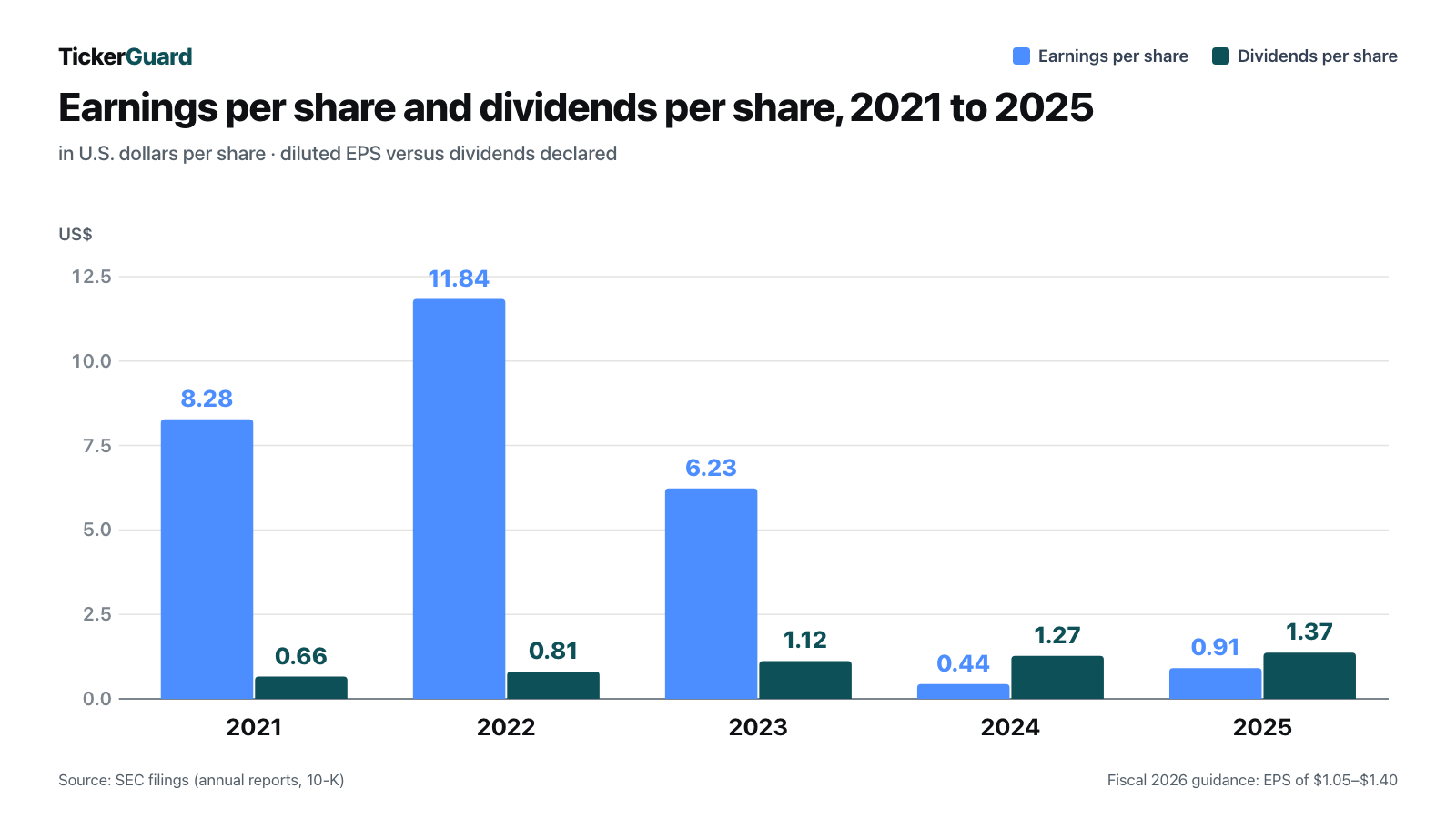
In fiscal 2024 Winnebago paid a $1.27 dividend on $0.44 of earnings per share; in fiscal 2025, $1.37 on $0.91. After the August 2026 increase the annual rate is $1.44 — above the top of the company's own $1.40 earnings guidance. To be fair: dividends are paid out of cash, not earnings, and in a downturn a manufacturer frees up cash because it needs less material and inventory. In fiscal 2024 and 2025, free cash flow (operating cash flow minus capital expenditures: $98.9 million and $89.5 million) covered dividends paid of $36.8 million and $38.9 million (our calculation from the 10-Ks). In the first nine months of fiscal 2026, however, $9.4 million of free cash flow faced $30.1 million of dividend payments. Cash fell from $174.0 million to $57.1 million, partly because Winnebago redeemed $100 million of notes in February 2026.
What the company itself says about the dividend in its annual report:
“Dividends are generally declared each quarter, and the Board of Directors currently intends to continue to pay quarterly cash dividends; however, declaration of future dividends, if any, will be based on several factors including our financial performance, outlook, and liquidity.”
— Winnebago Industries, SEC annual report 10-K for fiscal 2025, Item 5 “Dividends”
In plain words: the increase is an intention, not a commitment. How quickly such an intention can flip when a business weakens is something we traced in our analysis of Carter’s, which cut its quarterly dividend by 69 percent in 2025.
Uncomfortable Truth No. 4: Three-quarters of equity is goodwill and brand names
Winnebago grew through acquisitions — Grand Design, Chris-Craft, Newmar and, most recently, pontoon maker Barletta (on Aug. 31, 2021, for a purchase price of $286.3 million) and battery specialist Lithionics (April 28, 2023). What was paid above tangible value now sits on the balance sheet as goodwill ($484.2 million) and other intangible assets such as trade names and dealer networks ($440.7 million) — together $924.9 million on May 30, 2026, about three-quarters of equity of $1,234.4 million (our calculation). These are not factories you can sell; they are expectations of future profits. If the profits fail to arrive, they get written down. That already happened in fiscal 2024, when Winnebago wrote off the entire $30.3 million of goodwill for the Chris-Craft boat brand. For the remaining Chris-Craft trade name, the latest 10-Q carries a warning:
“However, factors such as a sustained decline in revenues or other adverse changes in macroeconomic conditions could result in an impairment charge to our Chris-Craft trade name in a future reporting period. We will perform a quantitative impairment assessment of the Chris-Craft trade name during the fourth quarter of Fiscal 2026.”
— Winnebago Industries, SEC quarterly report 10-Q for the quarter ended May 30, 2026, Note 6 “Goodwill and Intangible Assets”

The filing does not disclose the carrying value of the Chris-Craft trade name on its own; it only reports all indefinite-lived trade names together at $352.3 million. An impairment costs no cash, but it lowers reported earnings — and with EPS guidance of $1.05 to $1.40, even a moderate write-down could swing the full-year result. If you want to see how a pure-play boat builder navigates the same downturn, take a look at our analysis of MasterCraft.
Valuation: About $700 Million for a Company in the Trough
At $24.66 on Oct. 15, 2026 (per a Form 4 insider filing; an official closing price was not available on Oct. 17, 2026), Winnebago had a market value of about $0.70 billion, based on 28,268,893 shares (as of June 17, 2026, 10-Q cover page). That is about 0.56 times shareholders' equity and roughly a quarter of fiscal 2025 revenue. Adding debt of $450.0 million (principal) and subtracting $57.1 million of cash gives an enterprise value of about $1.09 billion (our calculation).
Measured against fiscal 2026 guidance, the stock trades at 17.6 to 23.5 times earnings — measured against earnings guidance that was cut by about one-third in June (midpoint $1.85 → $1.225 per share, our calculation). On adjusted earnings per share, which Winnebago expects at $1.65 to $2.00 (excluding roughly $22 million of pre-tax amortization of acquired intangibles), the multiple is 12.3 to 14.9. Here lies the quirk of cyclicals: at the 2022 boom, earnings per share were $11.84. Anyone looking at the price-to-earnings ratio back then saw a low multiple — shortly before earnings collapsed by more than 90 percent. Today it is the reverse: the multiple is mathematically large because earnings are near their low point. Whether this is an entry at the low point or just a stopover depends not on the P/E but on when dealers start ordering again.
On financing: Winnebago has $100 million of 6.25 percent senior secured notes (due July 2028) and $350 million of 3.25 percent convertible notes (due January 2030) outstanding. The conversion price of about $87.93 per share is far above the stock price, so the convertibles will most likely have to be repaid as debt rather than converted into shares. On Aug. 20, 2026, Winnebago extended its $350 million credit facility to 2031; nothing was drawn (8-K of Aug. 21, 2026). In the first nine months, operating income ($48.6 million) covered interest expense ($16.3 million) about three times (our calculation).
Opportunities and Risks at a Glance
What speaks for Winnebago:
- Five well-known brands across three segments, more than 760 dealer locations, no dealer organization above 10 percent of revenue (Aug. 30, 2025).
- Motorhomes are turning: third-quarter fiscal 2026 revenue up 10.1 percent to $320.7 million, operating income of $9.6 million after a $3.2 million loss in the prior-year quarter.
- No acute balance-sheet pressure: $350 million credit facility undrawn and extended to 2031, the 2028 secured notes reduced from $300 million to $100 million in two steps (February 2025 and February 2026), interest covered about three times (nine months of fiscal 2026).
- The cycle can turn up as well: the earnings dip of fiscal 2020 ($61.4 million) was followed by $281.9 million (2021) and $390.6 million (2022).
- Market value of about 0.56 times equity (Oct. 15, 2026).
What speaks against it:
- Repurchase commitments of $1,777.7 million to dealer lenders, about 2.5 times the market value, against a $1.3 million reserve and growing dealer inventory.
- Guidance cut: $1.05 to $1.40 in fiscal 2026 EPS instead of $1.50 to $2.20; fourth-quarter revenue implied 11 to 24 percent below the prior year.
- Dividend above earnings: $1.44 per share a year against at most $1.40 of guided earnings; $30.1 million of dividends against $9.4 million of free cash flow in nine months.
- Towable slump: revenue down 26.1 percent in the third quarter of fiscal 2026, dealer inventory up 5.5 percent.
- $924.9 million of goodwill and intangibles; impairment test for the Chris-Craft trade name in the fourth quarter of fiscal 2026.
A Human Conclusion
Back to the dealer lot from the beginning and the waterline trap. The point is not that Winnebago is a bad company. It has strong brands, a balance sheet without acute distress and a motorhome segment that is making money again; it has not reported any material repurchases so far. The point is this: above the waterline, the annual dividend increase tells a story of steadiness that earnings have not told since 2024. In fiscal 2024 and 2025 the dividend was still funded by free cash flow, released as the downturn shrank inventories. In the first nine months of fiscal 2026 that was no longer enough: $30.1 million of dividends faced $9.4 million of free cash flow, and the difference came out of cash. And below the waterline, the commitments for dealer inventory that is selling more slowly keep growing.
So the honest question for you is not “How high is the dividend yield?” but: would you still hold this stock if the board halved the dividend in the next downturn — and all you had left was a bet on dealers ordering again? If yes, you have a thesis about the cycle. If only the yield above the waterline convinced you, you bought the tip of the iceberg. What you do with this is your decision. And that is how it should be.
Sources
All original documents used in this analysis — so you can check them yourself:
- Winnebago Industries, Inc. — SEC quarterly report 10-Q for the quarter ended May 30, 2026 (filed June 25, 2026)
- Winnebago Industries, Inc. — Q3 fiscal 2026 earnings release, Exhibit 99.1 to the 8-K of June 25, 2026
- Winnebago Industries, Inc. — 10-Q for the quarter ended Feb. 28, 2026 (filed March 25, 2026) and 10-Q for the quarter ended Nov. 29, 2025 (filed Dec. 19, 2025)
- Winnebago Industries, Inc. — SEC annual report 10-K for fiscal 2025 (filed Oct. 22, 2025) and 10-K for fiscal 2024 (filed Oct. 23, 2024)
- Winnebago Industries, Inc. — 8-K of Aug. 21, 2026 (new credit agreement to 2031) and 8-K of Feb. 5, 2026 (partial redemption of the 2028 notes)
- Winnebago Industries, Inc. — proxy statement DEF 14A of Nov. 4, 2025 and press release of May 1, 2026, Exhibit 99.1 to the 8-K (new director)
- Insider filings (Form 4) from August through Oct. 16, 2026, and the full filing history: EDGAR overview (sec.gov)
- Winnebago Industries press releases of Aug. 12, 2026 (dividend of $0.36 per quarter) and Sept. 23, 2026 (fiscal 2026 results scheduled for Oct. 21, 2026)
- Fundamental data (industry and ratio data; as of July 29, 2026), cross-checked against the SEC filings; the Oct. 15, 2026 price comes from the insider filings.
Transparency & disclaimer: This analysis is a journalistic assessment of publicly available information. It is not investment advice, not financial research in the regulatory sense and not a solicitation to buy or sell securities. Investing in stocks involves substantial risk, up to and including total loss. All information without guarantee; the data date is noted in the text. Positions held by the operator are disclosed daily; where one exists, it appears as a notice at the top of this deep dive.
Key figures at a glance
All monetary figures in millions of $; earnings per share as reported.
| Metric | 2021 | 2022 | 2023 | 2024 | 2025 |
|---|---|---|---|---|---|
| Revenue | 3,629.8 | 4,957.7 | 3,490.7 | 2,973.5 | 2,798.2 |
| Operating Income (EBIT) | 407.4 | 583.5 | 300.7 | 100.2 | 57.2 |
| Net Income | 281.9 | 390.6 | 215.9 | 13.0 | 25.7 |
| Net Margin | 7.8% | 7.9% | 6.2% | 0.4% | 0.9% |
| Earnings Per Share | 8.28 $ | 11.84 $ | 6.10 $ | 0.44 $ | 0.91 $ |
Source: fundamental data & SEC filings (annual and quarterly reports, 10-K/10-Q)
Our Bottom Line at a Glance
- Brands & dealer network positive
- Five well-known brands in towables, motorhomes and boats, more than 760 dealer locations and no dealer organization above 10 percent of revenue (fiscal 2025 10-K).
- Earnings through the cycle negative
- Net income fell from $390.6 million (fiscal 2022) to $25.7 million (fiscal 2025); fiscal 2026 guidance was cut on June 25, 2026, to $1.05 to $1.40 per share, and towable revenue fell 26.1 percent in the third quarter.
- Dividend negative
- Above earnings per share since fiscal 2024 (fiscal 2025: $1.37 against $0.91); raised to $1.44 a year on Aug. 12, 2026. In the first nine months of fiscal 2026, $30.1 million of dividends against $9.4 million of free cash flow.
- Balance sheet & financing neutral
- $450.0 million of notes, $57.1 million of cash and an undrawn $350 million credit facility running to 2031 (May 30 and Aug. 20, 2026); interest covered about three times over nine months. Three-quarters of equity is goodwill and intangibles.
- Contingent liabilities negative
- Repurchase commitments to dealer lenders of about $1,777.7 million (May 30, 2026), 4.1 percent higher than a year earlier, with dealer towable inventory rising 5.5 percent.
Winnebago stands behind about $1.78 billion of dealer inventory with its dealers' lenders and raised its dividend in August 2026 to $1.44 per share a year — above the top of its reduced earnings guidance. Not investment advice.
What Our Rating Means
Open questions
The business works in principle, but one material question is open. As long as it stays open, our findings do not carry a quality verdict.
The business works: Winnebago stays profitable in the downturn, motorhomes have turned positive, the credit facility is undrawn and extended to 2031, and interest is covered about three times. The open operational question is when dealers will order again — until then earnings per share sit below the dividend, dealer inventories are growing, and towables, boats and the Chris-Craft trade name are under pressure. The repurchase commitments are a contingent risk with no repurchases reported so far; the filings show no existential risk. If you are waiting, check on Oct. 21, 2026: full-year earnings and free cash flow against the dividend, the outcome of the Chris-Craft impairment test and fiscal 2027 guidance. The decision is yours.
A journalistic assessment by our editorial team at the time of the deep dive, based on public sources — not investment advice and not a solicitation to buy or sell. Your personal circumstances (investment goals, risk capacity, taxes) cannot be taken into account. What our levels mean, how verdicts are formed, and what conflicts of interest exist →
Worth Noting
- Winnebago made our research list through the Reddit hype scan of Oct. 17, 2026. The latest periodic report is the 10-Q for the quarter ended May 30, 2026 (filed June 25, 2026, together with the 8-K Item 2.02 earnings release the same day); all filings through Oct. 16, 2026, were reviewed (8-K of Aug. 21, 2026, Schedule 13G, Form 144 and Form 4). The fiscal 2026 10-K (year ended Aug. 29, 2026) had not been filed as of Oct. 17, 2026; results are scheduled for Oct. 21, 2026.
- Price of $24.66 on Oct. 15, 2026: the price at which shares were withheld for taxes according to the Form 4 filings of Oct. 16, 2026. An official closing price was not available on Oct. 17, 2026. Market value (about $0.70 billion) = 28,268,893 shares (10-Q cover page, June 17, 2026) × $24.66; a cross-check against the fundamental data of July 29, 2026 ($0.87 billion at $30.88) implies the same share count of about 28.3 million.
- Dividend of $0.36 per quarter per the press release of Aug. 12, 2026 (payable Sept. 23, 2026); Winnebago does not report dividend declarations on Form 8-K. Free cash flow = operating cash flow minus purchases of property, plant and equipment (our calculation from the cash flow statements).
- Implied fourth quarter ($591 million to $691 million of revenue) = revenue guidance of $2.65 billion to $2.75 billion minus nine months ($2,058.8 million); prior-year fourth quarter = $2,798.2 million minus $2,020.9 million = $777.3 million. Our calculation.
Stock Watch
This analysis is as of October 17, 2026. Stock Watch will tell you what's changed at WGO since then.
Later $1 a month per stock — signing up is free, and you'll be the first to know when it launches.
The full analysis as a PDF for later
We will send you this analysis as a PDF — to print, file away, and read at your own pace. And we will add you to the free Stock Watch list for Winnebago Industries Inc (WGO), so you hear about it when something material in this analysis changes.
Frequently Asked Questions
Winnebago Industries, Inc. (NYSE: WGO) of Eden Prairie, Minnesota, builds travel trailers (Grand Design, Winnebago), motorhomes (Winnebago, Newmar, Grand Design) and recreational boats (Chris-Craft, Barletta). It sells through more than 760 independent dealer locations in the U.S. and Canada. In fiscal 2025 (ended Aug. 30, 2025) revenue was $2,798.2 million and net income $25.7 million.
On Aug. 12, 2026, Winnebago raised its quarterly dividend from $0.35 to $0.36 per share, or $1.44 a year. At the Oct. 15, 2026 price of $24.66, that is a dividend yield of about 5.8 percent. The company states in its 10-K that future dividends depend on factors including financial performance, outlook and liquidity.
Not by reported earnings: in fiscal 2024 the dividend was $1.27 against $0.44 in earnings per share, in fiscal 2025 $1.37 against $0.91. For fiscal 2026 Winnebago guides to $1.05 to $1.40 per share against a $1.44 dividend. Free cash flow covered the dividend in fiscal 2024 and 2025 but not in the first nine months of fiscal 2026 ($9.4 million versus $30.1 million).
Winnebago's fiscal year ends on the last Saturday in August. Fiscal 2025 ended on Aug. 30, 2025, and fiscal 2026 on Aug. 29, 2026. Winnebago has scheduled its fiscal 2026 results for Oct. 21, 2026; the most recent report before this analysis is the 10-Q for the quarter ended May 30, 2026.
Winnebago agrees with the lenders that finance its dealers' inventory to take units back if a dealer defaults. The total contingent liability under these agreements was about $1,777.7 million on May 30, 2026, more than shareholders' equity of $1,234.4 million. The loss reserve is $1.3 million, and Winnebago reports no material repurchase activity for the first nine months of fiscal 2026.
At $24.66 (Oct. 15, 2026) Winnebago's market value was about $0.70 billion, based on 28.3 million shares. That is about 0.56 times shareholders' equity and 17.6 to 23.5 times fiscal 2026 earnings guidance ($1.05 to $1.40 per share). In the 2022 boom year Winnebago earned $11.84 per share.
Found an error?
Did you spot a factual error, an outdated number, or a typo in this deep dive? Let us know briefly — your report goes straight to the editorial team.