GEN Restaurant Group: From the Tabletop Grill to the Freezer Aisle — With $5.9 Million in the Bank
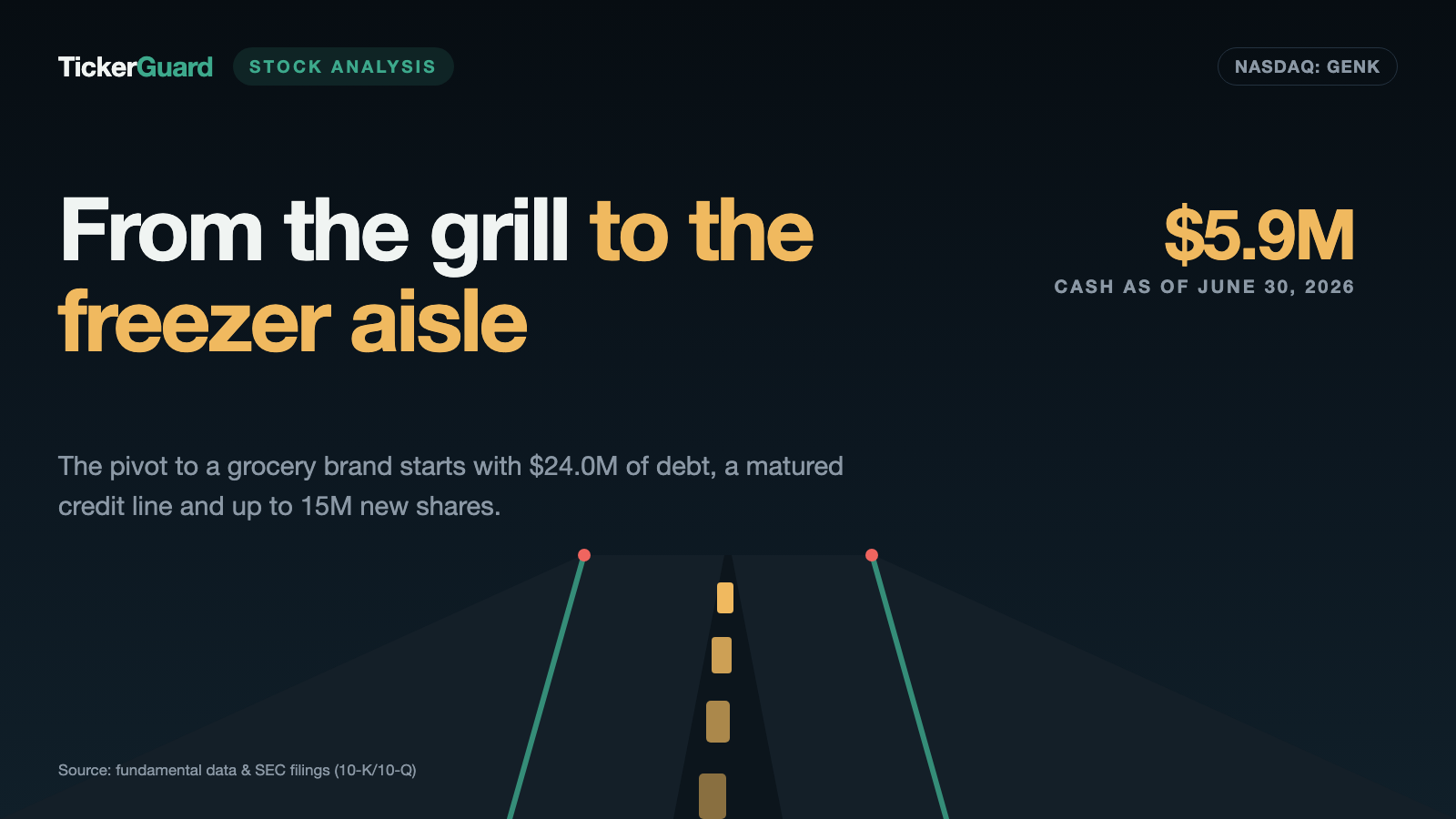
Korean BBQ chain GEN wants to hand its U.S. restaurants to another operator and sell only frozen marinated meat to grocery stores. The new story sounds like a fresh start. The SEC filings show who is supposed to pay for it: $5.9 million in cash, $24.0 million of debt, a bank credit line that matured on Sept. 25, 2026, with no renewal reported so far, and an agreement for up to $25 million of new shares. The overdraft is more than two-thirds drawn before the freezer aisle has reported its first profit.
 Thomas Mücke
Founder & Publisher
Thomas Mücke
Founder & Publisher
As of Today
As of: October 15, 2026
- Closing price
- 1.70 $ 0.00%
- Market Capitalisation
- 59.0 $M
- Growth Score
- 3/10
- AAQS
- 1/10
Price change since October 15, 2026: +0.6%
This analysis has a cut-off date. The Stock Guard tells you when something material changes in the numbers. Reserve your free spot
Chart
Interactive price chart (TradingView).
52-week range: 1.50 $ to 3.10 $ · Last price: 1.70 $ (As of: October 15, 2026)
Note: pure fact-based analysis, not investment advice and not a solicitation to buy or sell. All figures without guarantee.
The Fresh-Start Trap: When a New Story Outshines the Old Numbers
There is an investor trap that feels like optimism: the fresh-start trap. A company whose existing business is struggling tells a new story — a new market, a new product, a new name for what it wants to become. Suddenly the stock feels like a clean sheet of paper. What gets lost: the new story comes with the old debt, the old contracts and the old cash balance. A fresh start is not a reset button. Someone has to pay for it.
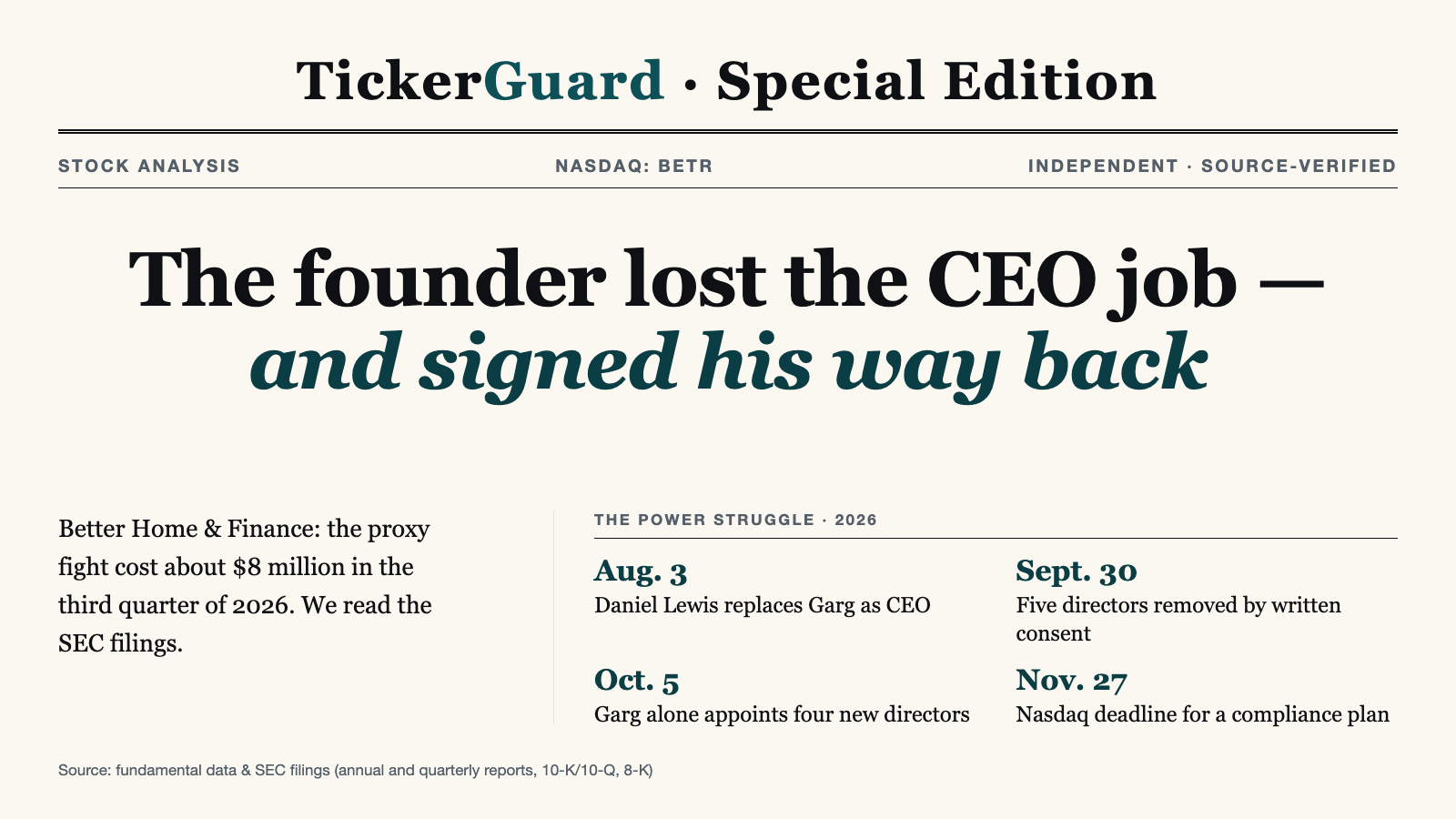
GEN Restaurant Group is a textbook case. The California chain brought Korean BBQ to shopping centers — tabletop grills, K-pop, meat you cook yourself. On Aug. 10, 2026, it told a new story: a nationwide restaurant operator had offered, in a non-binding letter of intent, to acquire the U.S. restaurant operations. GEN would then sell only frozen meat to grocery stores, as a pure consumer packaged goods brand. That names the central tension of this analysis: GEN has a growing grocery business and a well-known brand — but the restaurants that still generate almost all of its revenue are shrinking from within, and its cash is not enough to fund the transformation on its own. Let’s read together what the filings with the U.S. securities regulator, the SEC, actually say. No recommendation, no forecast — just the documents.
Company history for investors
-
2011
First restaurant in Tustin
Co-founder Jae Chang opens the first GEN restaurant in Tustin, California, in September 2011 — the basis of the tabletop-grill concept that still generates almost all revenue.
-
2023
IPO at $12.00
On June 30, 2023, GEN completes the IPO of 4,140,000 Class A shares at $12.00. The year ends with $11.4 million of profit and $32.6 million of cash.
-
2025
15 new restaurants, a loss year
GEN opens 15 restaurants and brings its ready-to-cook marinated meats to more than 800 grocery stores, according to the annual report (as of year-end 2025; by mid-2026 it was nearly 2,000). The year ends with a $19.4 million net loss and $2.8 million of cash — the expansion used up the reserves.
-
2026
Letter of intent and new shares
On Aug. 10, 2026, GEN discloses a non-binding letter of intent to sell its U.S. restaurants, and on Sept. 29, 2026, an agreement for up to $25 million of new shares. The PCB credit line matured on Sept. 25, 2026; no renewal had been reported as of Oct. 17, 2026.
What GEN Actually Does
GEN Restaurant Group, Inc., headquartered in Cerritos near Los Angeles, runs Korean BBQ restaurants: every table has a grill in the middle, and guests cook meat, poultry and seafood themselves. Put simply, part of the kitchen work is outsourced to the guest, which saves on cooks and servers. GEN was founded in 2011 by two Korean immigrants; co-founder Jae Chang opened the first restaurant in Tustin in September 2011, and co-founder David Kim is now chairman and CEO. As of June 30, 2026, GEN operated 54 restaurants in the U.S. and South Korea, according to its quarterly report (10-Q); at the end of 2025 the group had about 2,700 employees, 375 of them full-time.
Since 2025, according to the annual report, there has been a second pillar: consumer packaged goods (CPG). GEN mainly sells frozen marinated meat to supermarkets and warehouse clubs. According to the quarterly report, GEN products are in nearly 2,000 stores; according to the earnings release of Aug. 10, 2026, more than 100 U.S. Costco warehouses have made purchase commitments, and GEN signed distribution agreements with the wholesalers UNFI and C&S Wholesale Grocers. The division’s revenue rose 341 percent in the second quarter of 2026 from the first quarter, according to the company, and June brought more than $2 million for the first time.
GEN has been listed since late June 2023: on June 30, 2023, the company completed its IPO of 4,140,000 Class A shares at $12.00 each (10-K for 2025). The structure is layered but important: the listed GEN Restaurant Group, Inc. is the managing member of an operating company (GEN LLC). The founders hold most of their stake as Class B shares with ten votes each, which they can exchange for Class A shares. The fiscal year is the calendar year.
How the Stock Landed on Our Desk
GEN made our research list through the Reddit hype scan of Oct. 16, 2026 — through chatter in investor forums, not through a financial metric. Two days earlier, on Oct. 14, 2026, 56.9 million GEN shares changed hands, according to fundamental data. In the 50 trading days before (Aug. 4 to Oct. 13, 2026), the average was about 238,000 a day — average meaning all daily volumes added up and spread evenly; a few busy days, such as those around the August earnings release, pull it up. So Oct. 14 came in at about 240 times that level. The stock opened at $2.47 after closing at $1.45 the day before, and it closed at $1.69. No company filing explains the jump. The only SEC filing that day was a formality: a Form D on the stock purchase agreement discussed below.
A forum-driven spike feels like a breakout. The longer view puts it in context: measured against the $12.00 IPO price of June 2023, the closing price of Oct. 15, 2026 ($1.69) was about 86 percent lower. The sentence for the rest of this analysis: The new story moves the stock — but the transformation is paid for out of $5.9 million in cash.
The Numbers Over the Years — Given Their Due
First, what is genuinely impressive. GEN is a real chain with real demand: revenue rose from $181.0 million (2023) to $208.4 million (2024) and $212.5 million (2025). GEN opened six restaurants in each of 2023 and 2024 and fifteen in 2025, six of them in South Korea. An average restaurant open for at least 18 months generated about $5.1 million of sales in 2025. And the grocery division grew from zero to more than $2 million of monthly revenue in a short time. The chart shows revenue and net income since 2023:
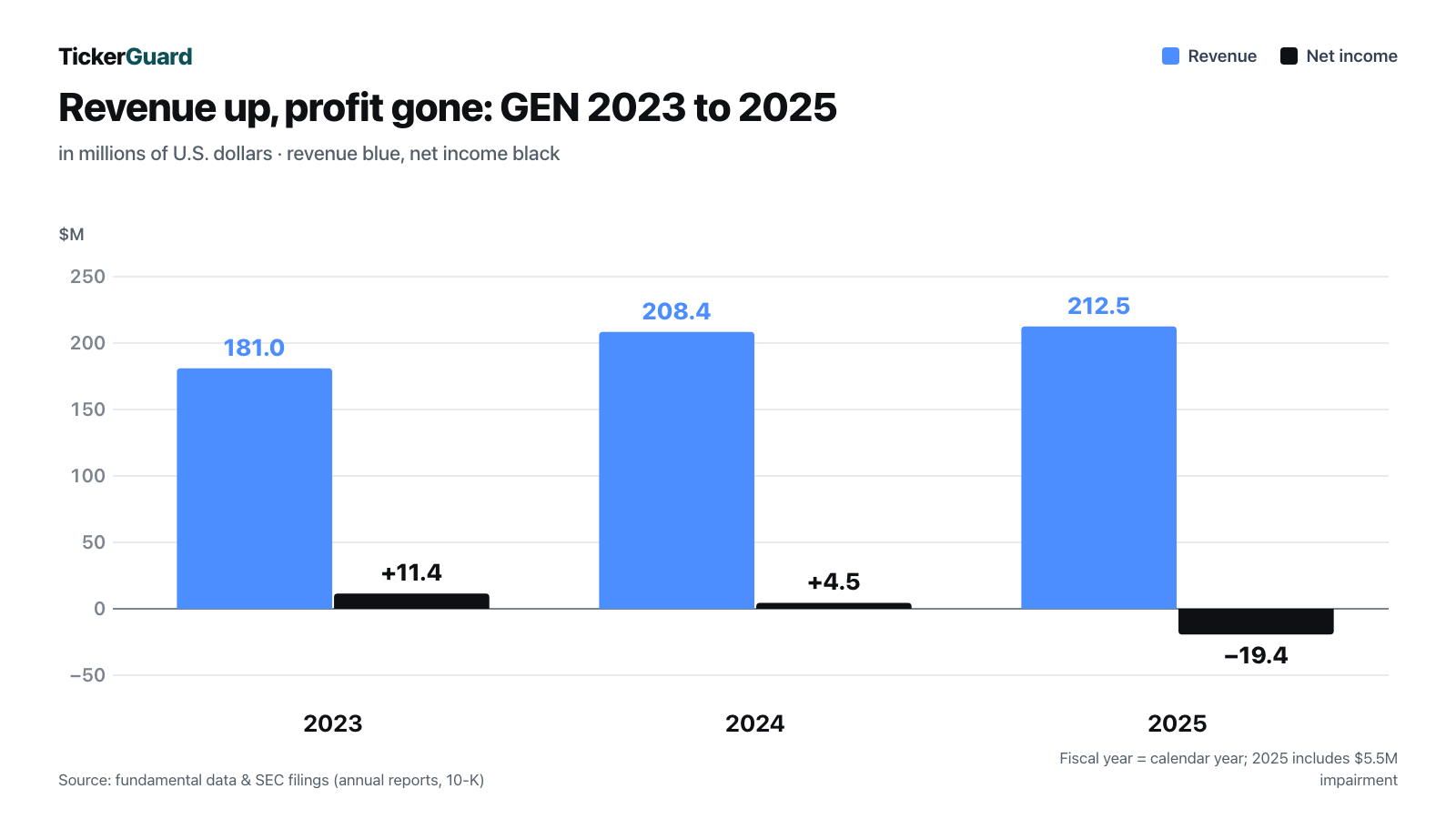
The chart shows the problem: revenue grew, profit disappeared. 2025 ended with a net loss of $19.4 million, including a $5.5 million impairment for five restaurants that GEN is contributing to joint ventures with the chain Chubby Cattle (four transferred by June 30, 2026; the fifth was still held for sale at that date). The first half of 2026 added another $11.8 million of losses on revenue of $109.6 million (prior year: $112.4 million). Operating cash flow was slightly negative at −$0.8 million, plus $5.3 million of capital expenditures. Keep this picture in mind: more restaurants brought more revenue, but not more profit — and every new restaurant cost money that is now missing.
What the Filings Say — The Uncomfortable Truths
Uncomfortable Truth No. 1: The Cash Is Smaller Than the Bill Coming Due
At the end of 2023 GEN still had $32.6 million in cash; at the end of 2024 it was $23.7 million, and at the end of 2025 just $2.8 million. On June 30, 2026, the balance sheet showed $5.9 million — but only because GEN drew $13.55 million on its credit line in the first half and repaid $2.5 million.
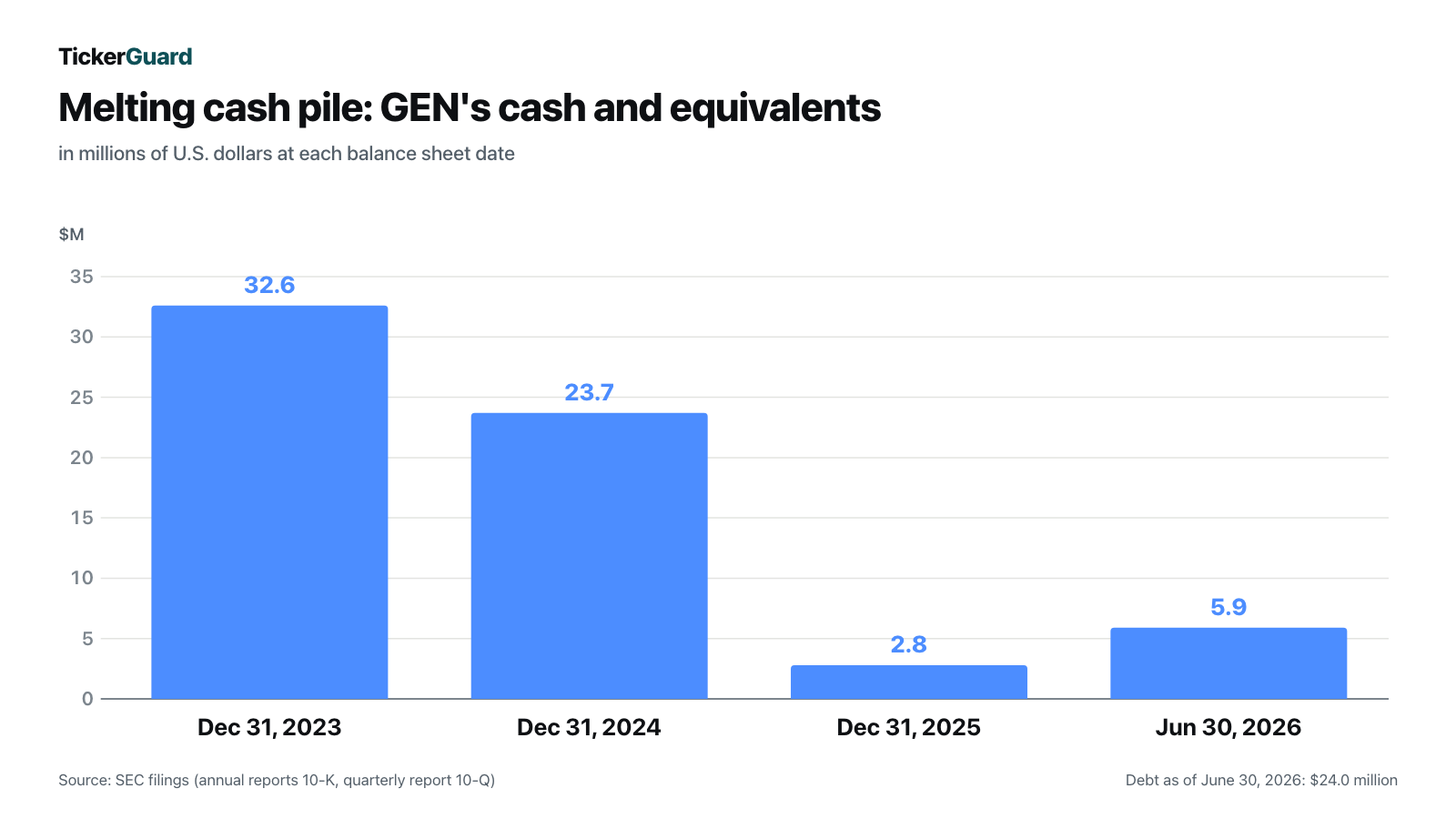
On the other side stand $24.0 million of debt: $12.05 million on the credit line (the balance sheet figure; the report’s text rounds it to $12.0 million or $12.1 million) and $12.0 million of other loans, including pandemic-era disaster loans from the U.S. Small Business Administration. According to the quarterly report (balance sheet as of June 30, 2026), $14.8 million of that is due within twelve months. The most important item is in the notes:
“As of June 30, 2026 the Company had $12.0 million outstanding under its $20.0 million line of credit with PCB Bank, which matures on September 25, 2026 (see Note 7, ‘Line of Credit’).”
— GEN Restaurant Group, SEC quarterly report 10-Q for June 30, 2026, Note 2 (z) “Near Term Maturity”

To be fair: management considers a renewal probable because the line was renewed in each of the two preceding years, and it states that its resources are sufficient for at least twelve months. The report contains no going-concern warning. But GEN drew another $1.7 million on the line in July 2026, according to the quarterly report. And as of Oct. 17, 2026 — three weeks after the maturity date — GEN had reported neither a renewal nor a replacement in a current report (8-K). For context, though: GEN did not report the 2025 renewal in an 8-K either. The quarterly report for June 30, 2025, still listed Sept. 25, 2025, as the maturity date; only the report for Sept. 30, 2025, showed Sept. 25, 2026. So the absence of a filing does not mean the bank has cancelled the line. The quarterly report for Sept. 30, 2026, will show what happened at the latest. In everyday terms: the overdraft is about two-thirds used after the July draw ($13.75 million of $20 million, our calculation), and whether the bank extends it is not yet on the statement.
Uncomfortable Truth No. 2: Up to 15 Million New Shares Are Ready to Go
Because cash is tight, GEN built two routes to fresh shareholder money in 2026. On Aug. 10, 2026, GEN entered into a sales agreement with Roth Capital Partners: new Class A shares worth up to $3.74 million may be sold into the market over time (8-K and prospectus supplement 424B5 of Aug. 10, 2026). The bigger step followed on Sept. 29, 2026: a common stock purchase agreement with Roth Principal Investments for up to $25 million. Over up to 36 months, GEN may sell new shares to the firm at a 3 to 5 percent discount to the market price; as a commitment fee, Roth withholds up to $500,000 from the purchase prices (8-K of Sept. 29, 2026). According to the Form D of Oct. 14, 2026 — a notice of the private placement — no shares had been sold under the agreement by then. GEN filed a prospectus for the resale of these shares:
“The number of shares being registered in this prospectus represents approximately 205.50% of the total Class A Common Stock outstanding as of September 29, 2026, which was 7,299,135 shares of Class A Common Stock.”
— GEN Restaurant Group, prospectus 424B3 of Oct. 8, 2026, Risk Factors

The 205 percent sounds more dramatic than it is, because it refers only to the Class A shares. Add the 26,599,810 Class B shares held by the founders and legacy members, which are exchangeable into Class A, and there are 33.9 million shares. Then 15 million new shares equal about 44 percent of today’s total (our calculation). If all were issued, every current shareholder’s stake would shrink by almost a third. Put simply: your slice of the pie gets smaller because the pie is cut into more pieces. There is a limit: under Nasdaq rules, without stockholder approval GEN may sell no more than 6,776,399 shares to Roth as long as the average price stays below about $1.78. The catch: the founders largely decide on such an approval. According to the proxy statement (DEF 14A of Apr. 30, 2026), directors and executive officers together held 67.6 percent of the voting power; GEN is a “controlled company” and may therefore rely on exemptions from some Nasdaq board independence rules.
The dilution has already started: between June 30 and Sept. 29, 2026, the number of Class A shares rose from 5,364,808 to 7,299,135. Over the same period the number of Class B shares fell by exactly 1,000,000 — they are cancelled when exchanged for Class A shares. The remaining 0.9 million or so Class A shares were newly added (our calculation). Where exactly they came from will be broken down in the next quarterly report. No insider filings (Form 4) on purchases, sales or exchanges by officers or directors were made in 2026 through Oct. 17, 2026.
Uncomfortable Truth No. 3: The Restaurants Are Shrinking From Within
A restaurant company measures its health with one number: comparable restaurant sales — only the locations open long enough that new openings don’t distort the comparison (at GEN, at least 18 full months). At GEN this number has been falling for years, and it is falling faster: −5.6 percent in 2024, −7.9 percent in 2025, −8.8 percent in the first and −9.3 percent in the second quarter of 2026 (10-K for 2025, 2026 quarterly reports). Average unit volume fell from $5.46 million to $5.07 million in 2025. In plain terms: the same restaurants are serving fewer paying guests year after year, or those guests are spending less.
At the same time, costs are rising. Food cost was 39.1 percent of revenue in the second quarter of 2026, up from 33.8 percent a year earlier. Of the $3.2 million increase in food costs, $2.5 million came from the grocery division, according to the quarterly report; GEN attributes the rest to inflation and more restaurants in operation. GEN’s own restaurant-level margin (restaurant-level adjusted EBITDA, i.e., the restaurants’ result before general and administrative costs, depreciation, pre-opening costs and special items) fell from 16.3 percent in the second quarter of 2025 to 7.4 percent in the first quarter of 2026 and recovered to 11.3 percent in the second quarter. In the second quarter of 2026 GEN exited six restaurants: four went to joint ventures with the Chubby Cattle chain, in each of which GEN holds 49 percent, and two in South Korea were closed. According to the quarterly report, GEN recorded its 49 percent stakes at an initial value of zero and also committed to two months of rent per restaurant ($0.2 million in total).
And then the letter of intent. The earnings release of Aug. 10, 2026, quotes CEO David Kim with an important caveat:
“The letter of intent is non-binding and no assurance can be given that any transaction will result, but we believe a transaction of this nature could make strategic sense — pairing our restaurants with a proven operator equipped to scale them, positioning GEN as a pure-play CPG company, and allowing us to dedicate our people and our capital fully to CPG — the fastest-growing part of the K-Food platform we are building.”
— GEN Restaurant Group, second-quarter 2026 earnings release, Exhibit 99.1 to the 8-K of Aug. 10, 2026
No filing through Oct. 17, 2026, names a buyer, a price or a timeline. One number matters for scale: as of June 30, 2026, the balance sheet carries $164.2 million of operating lease liabilities, almost all of them for restaurant space. What a buyer takes over and what it pays for the restaurants will decide whether a sale brings GEN money or merely lifts burdens off its shoulders. If you want to see the other side of this industry — a chain that went public with growing restaurants and also has to watch its comparable sales — read our analysis of Sweetgreen.
Uncomfortable Truth No. 4: The Big Hope Has No Number of Its Own
The entire new story hinges on the grocery division. How big it is, however, cannot be found in the filings. GEN does not report dollar revenue for the division, only growth rates (+341 percent sequentially) and a monthly milestone (June: more than $2 million). The reason is in the segment disclosure:
“The Company determined it has one reportable segment, as the CODM regularly reviews restaurant operations and financial performance at a consolidated level.”
— GEN Restaurant Group, SEC quarterly report 10-Q for June 30, 2026, Note 18 “Segment Information”

The only larger number for the division is a management estimate: based on doors secured and stores “in its pipeline,” GEN puts the division’s forward 12-month revenue run rate at $35 million to $40 million (earnings release of Aug. 10, 2026). For comparison: the record month of June, annualized, comes to more than $24 million. The estimate therefore requires further strong growth. What the division earns is not disclosed anywhere — all we know is that it drives costs: it accounted for about 81 percent of the second-quarter increase in food costs, and general and administrative expenses rose mainly because of marketing and in-store demonstrations. How quickly grocery shelf space can be lost when sales don’t hold up is something we examined in our analysis of Beyond Meat.
A detail on diligence: the income statement in the earnings release of Aug. 10, 2026, shows a first-half 2026 net loss of $10.848 million. The quarterly report filed the same day — and the selected-data table in the same release — show $11.832 million. The $984,000 difference matches exactly the gap in the line item “gain on deconsolidation of restaurants” ($1.037 million versus $0.053 million). The release offers no explanation; the quarterly report is authoritative. Since June 1, 2026, GEN has had a new CFO: Luke Hewko succeeded Thomas Croal, who retired (8-K of June 3, 2026).
Uncomfortable Truth No. 5: A Letter From the Justice Department
The quarterly report for June 30, 2026, contains a new paragraph under “Legal Proceedings”:
“In June 2026, the Operating Company received a civil investigative demand (‘CID’) from the U.S. Department of Justice issued pursuant to the False Claims Act.”
— GEN Restaurant Group, SEC quarterly report 10-Q for June 30, 2026, Part II Item 1 “Legal Proceedings”

The False Claims Act is the U.S. law against false statements in claims for government money. The inquiry concerns applications for pandemic aid from 2020 and 2021, before the IPO: Paycheck Protection Program (PPP) loans of about $23.0 million and their forgiveness, plus Restaurant Revitalization Fund (RRF) grants of about $16.8 million, obtained by companies that the operating company later acquired. Important context: a civil investigative demand is an investigative step, not a lawsuit and not a judgment. According to the report, GEN is cooperating fully and does not currently expect a material impact on its results or financial condition. For you as a shareholder, scale is what counts: the aid involved, $39.8 million in total, is almost seven times the cash balance of June 30, 2026. Whether any of it is actually disputed or will be reclaimed, and how much, is open — the report names no amount.
Valuation: About $57 Million for Two Businesses and Many Open Bills
At the closing price of Oct. 15, 2026 ($1.69), GEN had a market value of about $57 million, based on 33,898,945 shares of both classes (7,299,135 Class A and 26,599,810 exchangeable Class B, as of Sept. 29, 2026, prospectus 424B3). That is about 0.27 times 2025 revenue and about 3.6 times equity as of June 30, 2026 ($16.0 million, including the legacy members’ interest in the operating company). There is no price-to-earnings ratio because GEN is losing money.
A quarter of one year’s revenue sounds cheap. But the math has three catches. First, equity is melting: from $44.1 million at the end of 2024 to $26.5 million at the end of 2025 and $16.0 million in mid-2026. Second, $24.0 million of debt and $164.2 million of lease liabilities rank ahead of shareholders. Third, the Roth agreement could increase the share count by up to 44 percent. What the market value really pays for is a bet that a buyer takes over the restaurants including their leases and that the grocery division meets its own estimate — before the cash runs out.
Upside and Risks at a Glance
What speaks for GEN:
- A known brand with demand: $212.5 million of revenue in 2025 with 57 restaurants at year-end, about $5.1 million of sales per established restaurant.
- A fast-growing grocery division: nearly 2,000 stores, more than 100 Costco warehouses with purchase commitments, a record June 2026 with more than $2 million of revenue; management estimates a forward 12-month revenue run rate of $35 million to $40 million.
- A possible way out: the non-binding letter of intent from a restaurant operator in August 2026 could relieve GEN of restaurants and leases.
- Restaurant-level margin back at 11.3 percent in the second quarter of 2026 after 7.4 percent in the first quarter; six weak locations transferred or closed.
- Founders with a large stake: directors and executive officers held 67.6 percent of the voting power in April 2026 — their stake makes them the ones most affected by success or failure.
What speaks against it:
- Thin cash, debt coming due: $5.9 million of cash against $24.0 million of debt (June 30, 2026); credit line maturing Sept. 25, 2026, no renewal reported as of Oct. 17, 2026.
- Dilution: an agreement for up to $25 million of new shares, 15 million shares registered — about 44 percent of all shares of both classes.
- Shrinking core business: comparable restaurant sales −7.9 percent in 2025 and −9.3 percent in the second quarter of 2026; net loss of $19.4 million in 2025 and $11.8 million in the first half of 2026.
- Limited transparency: no separate revenue or profit figures for the grocery division; contradictory first-half figures in the earnings release of Aug. 10, 2026.
- Legal risk: a Justice Department civil investigative demand on pandemic aid totaling $39.8 million; whether anything will be reclaimed is open.
- Control: directors and executive officers, led by the founders, decide shareholder votes with 67.6 percent of the voting power, including any waiver of the Nasdaq cap on the Roth shares.
A Human Conclusion
Back to the fresh-start trap from the beginning. Its core is not that the new story is wrong. Maybe frozen Korean BBQ in the supermarket really is a better business than restaurants with long leases — the division’s numbers are growing, and Costco is not a bad customer. The core is this: the new story does not begin on a blank page. It begins with $5.9 million in cash, a credit line whose renewal has not been reported, an agreement for up to 15 million new shares and a Justice Department inquiry from the old days.
So the honest question for you is not “Do you believe in Korean BBQ in the freezer aisle?” but: Would you still buy this stock if the restaurants were never sold — and you had to help pay for the transformation through new shares? If yes, you have a thesis. If only the word “fresh start” convinced you, you bought a story. What you do with it is your decision. And that is as it should be.
Sources
All original documents used in this analysis — so you can check them yourself:
- GEN Restaurant Group, Inc. — SEC quarterly report 10-Q for June 30, 2026 (filed Aug. 10, 2026)
- GEN Restaurant Group, Inc. — SEC quarterly report 10-Q for March 31, 2026 (filed May 14, 2026)
- GEN Restaurant Group, Inc. — SEC annual report 10-K for 2025 (filed Mar. 31, 2026)
- GEN Restaurant Group, Inc. — SEC annual report 10-K for 2024 (filed Mar. 10, 2025)
- GEN Restaurant Group, Inc. — second-quarter 2026 earnings release, Exhibit 99.1 to the 8-K of Aug. 10, 2026
- GEN Restaurant Group, Inc. — 8-K of Aug. 10, 2026 (sales agreement with Roth Capital Partners) and prospectus supplement 424B5 of Aug. 10, 2026
- GEN Restaurant Group, Inc. — 8-K of Sept. 29, 2026 (common stock purchase agreement with Roth Principal Investments)
- GEN Restaurant Group, Inc. — prospectus 424B3 of Oct. 8, 2026 and registration statement S-1 of Sept. 30, 2026
- GEN Restaurant Group, Inc. — 8-K of June 3, 2026 (CFO change) and proxy statement DEF 14A of Apr. 30, 2026
- Complete SEC filing history: EDGAR overview (sec.gov)
- Fundamental data (prices, trading volume; as of Oct. 16, 2026), cross-checked against the SEC filings.
Transparency & disclaimer: This analysis is a journalistic assessment of publicly available information. It is not investment advice, not a financial analysis in the regulatory sense and not a solicitation to buy or sell securities. Investing in stocks involves substantial risk, up to and including total loss. All information without guarantee; the data date is noted in the text. Positions held by the operator are disclosed daily; where one exists, it appears as a notice at the top of this deep dive.
Key figures at a glance
All monetary figures in millions of $; earnings per share as reported.
| Metric | 2021 | 2022 | 2023 | 2024 | 2025 |
|---|---|---|---|---|---|
| Revenue | 140.6 | 163.7 | 181.0 | 208.4 | 212.5 |
| Operating Income (EBIT) | 16.7 | 12.4 | 8.1 | 0.5 | -6.6 |
| Net Income | 49.9 | 10.3 | 8.4 | 0.6 | -3.0 |
| Net Margin | 35.5% | 6.3% | 4.6% | 0.3% | -1.4% |
| Earnings Per Share | 13.85 $ | 2.86 $ | 1.99 $ | 0.13 $ | -0.59 $ |
Source: fundamental data & SEC filings (annual and quarterly reports, 10-K/10-Q)
Our Bottom Line at a Glance
- Brand & grocery division positive
- According to the quarterly report, GEN products are in nearly 2,000 stores, and more than 100 Costco warehouses have made purchase commitments. Division revenue rose 341 percent sequentially in the second quarter of 2026, and June brought more than $2 million.
- Restaurant business negative
- Comparable restaurant sales have been falling since 2024, and faster each period: −5.6 percent (2024), −7.9 percent (2025), −9.3 percent in the second quarter of 2026. Average unit volume fell from $5.46 million to $5.07 million in 2025.
- Profitability negative
- From profit ($11.4 million in 2023) to loss: −$19.4 million in 2025 and −$11.8 million in the first half of 2026. In the first half of 2026, an operating loss of $12.4 million compared with interest expense of $0.7 million — the business itself is not currently earning its interest.
- Cash & financing negative
- $5.9 million of cash against $24.0 million of debt as of June 30, 2026, of which $14.8 million is due within twelve months. The PCB credit line matured on Sept. 25, 2026; no renewal had been reported as of Oct. 17, 2026.
- Dilution & control negative
- Up to $25 million of new shares via Roth, 15 million shares registered (about 44 percent of all shares of both classes). Directors and executive officers hold 67.6 percent of the voting power and thus also decide on lifting the 19.99 percent cap.
GEN Restaurant Group is the fresh-start trap in its purest form: according to a non-binding letter of intent, the Korean BBQ chain wants to hand off its U.S. restaurants and become a grocery brand. The grocery division is growing fast, but the restaurant business is shrinking, cash stood at $5.9 million against $24.0 million of debt as of June 30, 2026, and an agreement for up to $25 million of new shares is in place. Not investment advice.
What Our Rating Means
Substance risk
We found at least one documented issue that threatens the company itself — regardless of how the stock is currently valued.
The brand is real, and the grocery division shows that customers buy GEN outside its restaurants too. But financing decides the rating here: with about $6 million of cash outflow in the first half of 2026 (operations plus capital expenditures), $5.9 million of cash lasts only about two quarters on paper without the credit line and new shares. The quarterly report contains no going-concern warning; management considers its resources sufficient for twelve months. If you wait, check: was the credit line renewed, how many shares has GEN sold to Roth, and does the letter of intent turn into a contract? The decision is yours.
A journalistic assessment by our editorial team at the time of the deep dive, based on public sources — not investment advice and not a solicitation to buy or sell. Your personal circumstances (investment goals, risk capacity, taxes) cannot be taken into account. What our levels mean, how verdicts are formed, and what conflicts of interest exist →
Worth Noting
- GEN made our research list through the Reddit hype scan of Oct. 16, 2026; on Oct. 14, 2026, 56.9 million shares traded according to fundamental data, about 240 times the average of the preceding 50 trading days (about 238,000). The latest periodic report is the 10-Q for June 30, 2026 (filed Aug. 10, 2026); all filings through Oct. 17, 2026, were reviewed (8-K of Aug. 10 and Sept. 29, 2026, 424B5, S-1, 424B3, Form D). The quarterly report for Sept. 30, 2026, was not yet available on Oct. 17, 2026.
- Market value (about $57 million) calculated from 33,898,945 shares of both classes (prospectus 424B3, as of Sept. 29, 2026) and the closing price of Oct. 15, 2026 ($1.69); the fundamental-data figure ($55.7 million) differs by about 3 percent. Cross-check with the closing price named in the prospectus for Sept. 29, 2026 ($1.70): about $57.6 million. The Class B shares are not listed but are exchangeable one-for-one into Class A; that is why they count toward market value.
- Cash runway is our calculation: operating cash flow (−$0.8 million) plus capital expenditures (−$5.3 million) in the first half of 2026 come to about −$6.1 million, or about −$3 million per quarter, against $5.9 million of cash on June 30, 2026. Restaurant-level adjusted EBITDA is a company metric without a U.S. GAAP definition.
- Contradiction in the earnings release of Aug. 10, 2026: its income statement shows a first-half 2026 net loss of $10.848 million and a deconsolidation gain of $1.037 million, while the selected-data table in the same release and the quarterly report show $11.832 million and $0.053 million. We use the quarterly report figures.
Stock Watch
This analysis is as of October 17, 2026. Stock Watch will tell you what's changed at GENK since then.
Later $1 a month per stock — signing up is free, and you'll be the first to know when it launches.
The full analysis as a PDF for later
We will send you this analysis as a PDF — to print, file away, and read at your own pace. And we will add you to the free Stock Watch list for GEN Restaurant Group, Inc. (GENK), so you hear about it when something material in this analysis changes.
Frequently Asked Questions
GEN Restaurant Group, Inc. (Nasdaq: GENK) of Cerritos, California, runs Korean BBQ restaurants where guests grill their own food at the table — 54 in the U.S. and South Korea as of June 30, 2026. Since 2025, GEN has also sold frozen marinated meat to supermarkets and warehouse clubs such as Costco, in nearly 2,000 stores according to the company. Revenue was $212.5 million in 2025.
On Aug. 10, 2026, GEN disclosed a non-binding letter of intent from a nationwide restaurant operator to acquire its U.S. restaurant operations; GEN would keep its grocery business. The board is reviewing the proposal. As of Oct. 17, 2026, no filing names a buyer, a price or a timeline, and the company says there is no assurance that a transaction will result.
As of June 30, 2026, GEN had $5.9 million of cash against $24.0 million of debt, of which $14.8 million is due within twelve months. It had drawn $12.05 million on its $20 million PCB Bank credit line and drew another $1.7 million in July 2026. The line matured on Sept. 25, 2026; as of Oct. 17, 2026, GEN had not reported a renewal in a current report.
On Sept. 29, 2026, GEN agreed with Roth Principal Investments that it may sell up to $25 million of new shares over up to 36 months. The prospectus of Oct. 8, 2026, registers 15 million shares for this — 205.5 percent of the Class A shares and about 44 percent of all 33.9 million shares of both classes. On top of that comes an at-the-market program for up to $3.74 million.
In June 2026, the operating company received a civil investigative demand under the False Claims Act. It concerns applications for pandemic aid in 2020 and 2021 by acquired companies: PPP loans of about $23.0 million and RRF grants of about $16.8 million. A civil investigative demand is not a lawsuit; GEN is cooperating and, according to its quarterly report, does not currently expect a material impact.
At the closing price of Oct. 15, 2026 ($1.69), the market value was about $57 million, based on 33.9 million shares of both classes. That is about 0.27 times 2025 revenue and about 3.6 times equity as of June 30, 2026. There is no price-to-earnings ratio because of the losses. The IPO price in June 2023 was $12.00.
Found an error?
Did you spot a factual error, an outdated number, or a typo in this deep dive? Let us know briefly — your report goes straight to the editorial team.